Curated collectionAnswer keys includedPrint-ready PDFs
Sight Words Worksheets by Grade and Level
Show the full sight words progression across 4 real grade combinations, compare task boundaries, model checked examples and explain how to choose the next level.
Start with a real resource
Browse this worksheet collection
4 relevant free entry points are available. Each one includes a printable learner PDF and separate answer key.
A useful practice loop
Print less. Observe more.
- Choose one skill and model the first item aloud.
- Use a short set and notice the learner’s strategy.
- Change the next task from the work you can see.
Need more than the free sheet?
Plus includes all 72 matching catalogue variations where available, plus saved deterministic generators and the worksheet designer.
See Plus membershipComplete guide
How to teach and practise sight words worksheets
3,337 words Updated 6 instructional visuals
Choose sight word practice by task, not by grade label
Sight words worksheets should help a learner move from noticing and reproducing a word to recalling it, reading it in a sentence, and using it accurately. On this page, that progression spans four real grade combinations—Pre-K, kindergarten, 1st grade, and 2nd grade—with 72 catalogue variants and one free 20-problem entry point for each grade.
Begin with the worksheet whose task the learner can complete with modest adult support. Do not automatically choose the sheet matching the learner’s age or school grade. Age is a discovery aid rather than a placement decision, and grade labels describe intended practice level; local curriculum sequences differ.
A practical starting-point decision looks like this:
- Choose matching, pointing, or supported tracing when the learner is still connecting a spoken word to its printed form.
- Choose trace-copy-recall work when the learner recognizes the word but cannot yet write or retrieve it reliably.
- Choose sentence selection when the learner can read the word alone but needs to use meaning and syntax.
- Choose short-passage work when individual words are secure enough to practice in connected reading.
- Move back one task boundary when errors show that the current sheet hides the skill you need to teach.
The catalogue calls each representative free sheet “easy,” but that label should describe the task, not the learner. In observable terms, an easier sight word task supplies more support: a visible model, a small choice set, repeated target words, short directions, or tracing before independent writing. A harder task removes the model, introduces distractors, requires sentence-level decisions, or asks the learner to retrieve several words in connected text.
What counts as a sight word here
A sight word is a word a reader recognizes promptly and accurately rather than laboriously working it out on every encounter. That category can include two different kinds of high-frequency words:
- Words whose spellings can be explained through phonics knowledge, such as and or is
- Words containing an unexpected or not-yet-taught spelling, such as said, was, the, or of
That distinction matters. “Sight word” should not mean “a shape to memorize without looking at the letters.” Learners still need to attend to the word’s sounds, spellings, and meaningful use.
The IES foundational reading practice guide recommends teaching learners to decode words, analyze word parts, and write and recognize words. It also recommends daily reading of connected text to support accuracy, fluency, and comprehension. Those recommendations support a sequence in which explicit word study leads into sentences and short texts. They do not constitute an assessment of WorksheetWise or any individual worksheet.
Regular, irregular, and not yet taught
Before asking a learner to memorize an entire word, determine what can already be explained.
Consider said:
- Say the word:
/sed/. - Match the first sound to s.
- Match the final sound to d.
- Notice that ai represents the middle sound unexpectedly in this word.
- Mark ai as the part to learn “by heart.”
- Read and spell the complete word: s-a-i-d, said.
This checked example belongs on this page because said is explicitly included in the catalogue description as an irregularly spelled sight word, and the supplied teaching guidance identifies s and d as regular while ai must be remembered. It models the heart-word approach associated with UFLI: connect the regular parts to phonics and give special attention to the irregular part.
A spelling may also appear irregular simply because its pattern has not yet been taught. Ask, “Can this learner explain this spelling with what they currently know?” That question is more useful than sorting every word permanently into “phonics” or “memory.”
The four-grade progression at a glance
The catalogue offers Pre-K, kindergarten, 1st-grade, and 2nd-grade sight word combinations. Each grade has a free 20-problem sheet, but the grade name alone does not reveal the right starting point. Compare the representation, response, and amount of independence required.
| Intended practice level | Useful representation | Suitable response | Adult’s main decision |
|---|---|---|---|
| Pre-K | One printed model, word cards, spoken prompts, objects or movement | Point, match, move, say, briefly trace | Can the learner connect the spoken word to the same printed word? |
| Kindergarten | Visible model plus a small set of choices | Find, trace, copy, read | Does the learner attend to every letter rather than only the first? |
| 1st grade | Word bank, sentence frame, trace-cover-write sequence | Recall, select, complete, read aloud | Can the learner retrieve the word without the model and use it in a sentence? |
| 2nd grade | Reduced support, mixed review, sentences or short passages | Read, discriminate, write, explain | Does recognition remain accurate in connected text? |
These are selection boundaries, not universal grade requirements. A 2nd grader may need a supported word-matching task for unfamiliar words. A kindergartner may be ready to read a familiar word in a short sentence. Choose according to the evidence produced by the task.
Pre-K: build print attention without turning practice into a desk test
For ages three and four, prioritize brief adult-led oral, matching, manipulative, and movement work over desk work. A 20-problem printable can supply words and prompts, but it does not need to be completed in one sitting. Cut apart a few items, cover most of the page, or stop after two successful minutes.
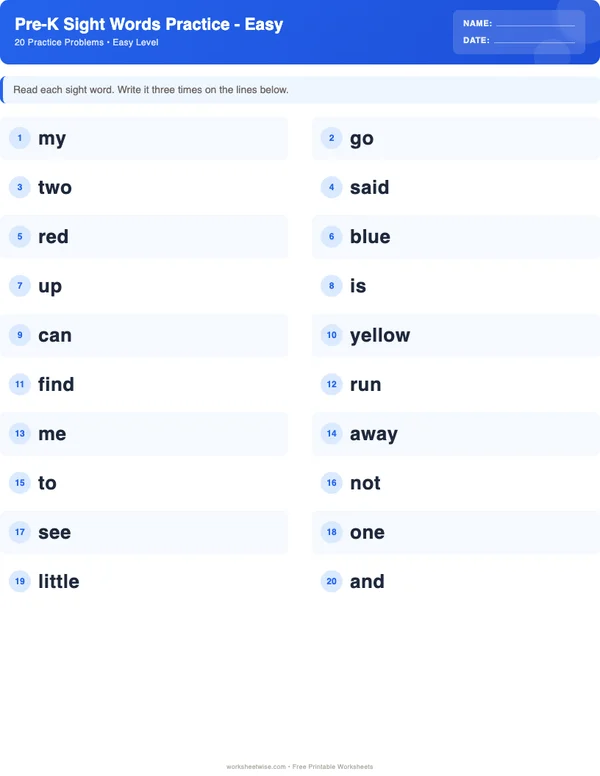
Use the Pre-K Sight Words guide and free sheet when the learner benefits from hearing a word, locating its printed match, and handling cards or markers.
Checked example: match the without guessing from the first letter
Place three cards in front of the learner:
the to is
Say, “Find the.” After the learner points, ask them to slide a counter under each letter while saying, “t-h-e, the.” Mix the cards and repeat.
The correct answer is the. The distractor to shares the first letter, so a correct choice requires attention beyond initial t. Is provides a clearly different comparison. This example belongs at the Pre-K boundary because the response is oral and manipulative: the adult reads the prompt, and the learner points and moves a counter rather than completing a page of independent writing.
If the learner guesses to, reduce the choice to the and is, compare the full spellings, and then restore to. The instructional target remains printed-word discrimination; handwriting is not allowed to become the barrier.
Kindergarten: connect recognition, tracing, and recall
Kindergarten practice can retain a visible word model while asking for a more deliberate response. The most useful sequence is not repeated tracing alone. It is tracing followed by a brief attempt to retrieve the spelling after the model is covered.
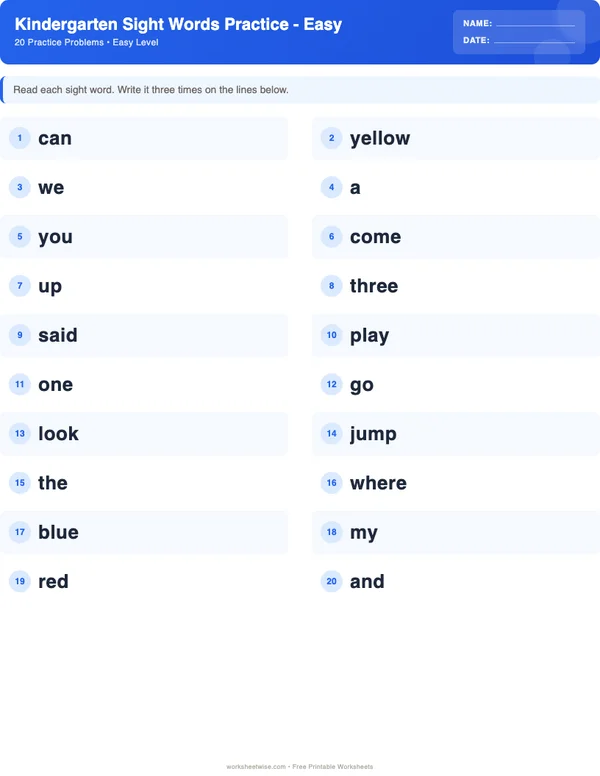
Use the Kindergarten Sight Words guide and free sheet when the learner can participate in a short see-say-spell-write routine but still needs a model nearby.
Checked example: trace, cover, and write was
Show was. Ask the learner to:
- See and say was.
- Spell aloud, “w-a-s.”
- Trace once while naming each letter.
- Cover the model.
- Write was from memory.
- Read the sentence, “The dog was wet.”
The checked spelling is w-a-s, and was fits the sentence grammatically and semantically. This example belongs at the kindergarten level because it bridges copying and recall while keeping the sentence short and orally accessible.
If the learner writes saw, do not merely mark it wrong. The same letters have been reordered. Return to left-to-right mapping: say the word, point to w, a, and s in sequence, cover the model, and try once more. If letter formation consumes all the learner’s attention, let them arrange letter tiles first and write only after the order is secure.
First grade: move from isolated words into sentence decisions
First-grade practice should reveal whether recognition survives when the word appears among other words. A learner who reads is instantly on a card may still omit or replace it in a sentence.
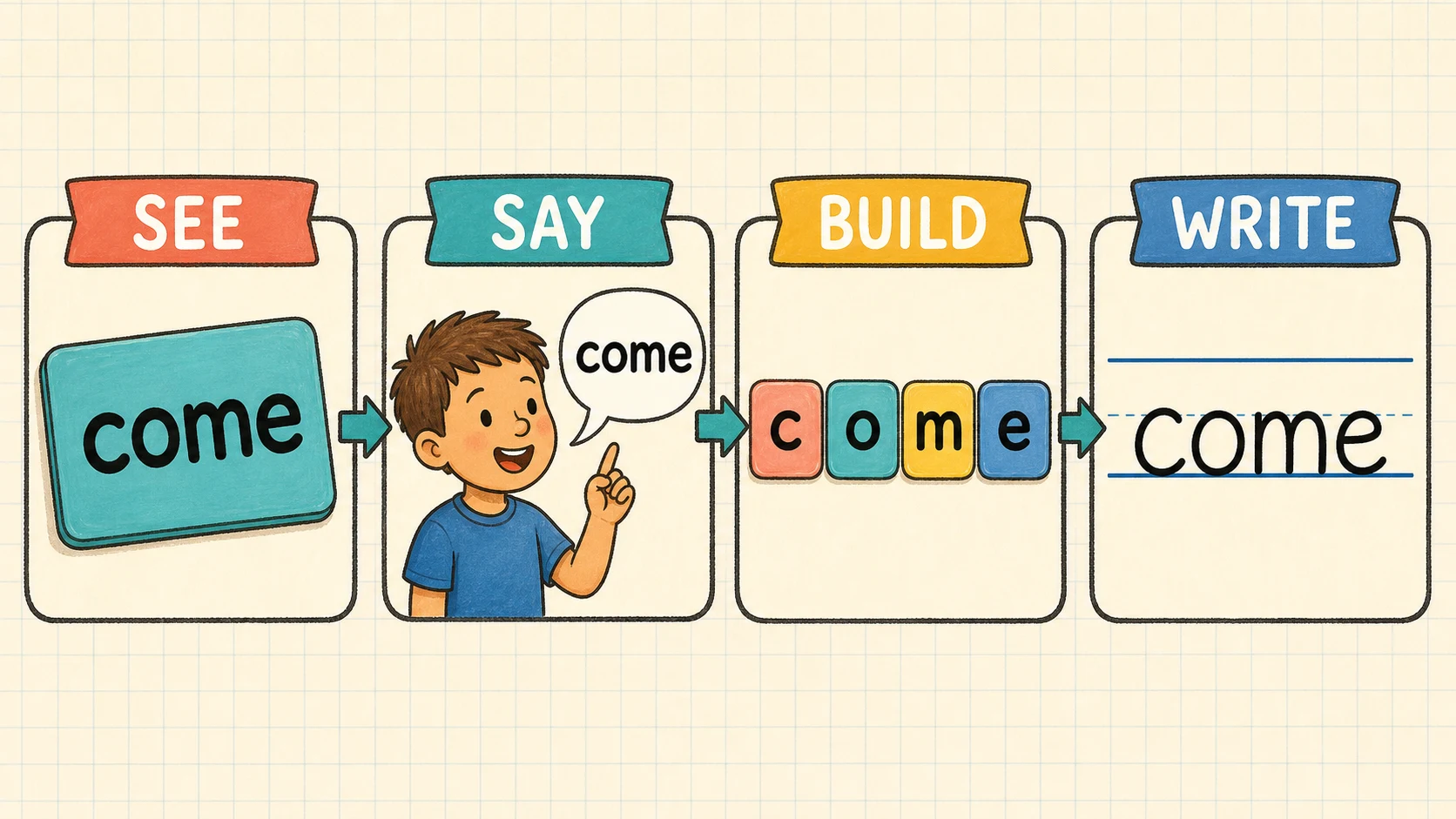
First-grade practice should move from a visible word model to recall and sentence use without changing the target word too quickly.
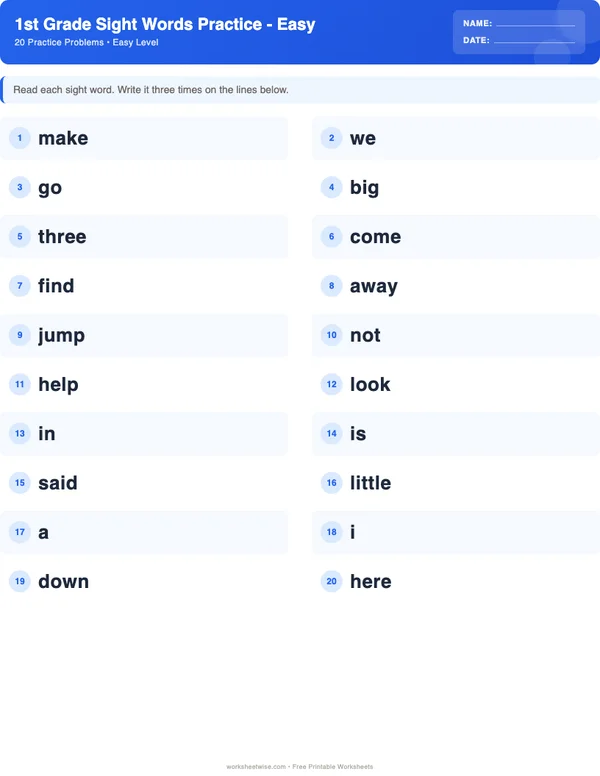
Use the 1st Grade Sight Words guide and free sheet when the learner can read several target words alone and is ready to choose or produce them in context.
Checked example: choose between is and and
Complete the sentence:
“The cat ___ on the mat.”
Choices: is, and
The correct answer is is: “The cat is on the mat.” And cannot connect the subject to the location in this sentence. Ask the learner to read the completed sentence aloud, not just circle the answer.
This example belongs at the 1st-grade boundary because it adds a sentence-level decision while keeping the choice set small. It checks word recognition, syntax, and meaning together. If the learner can read both choices but cannot select one, the issue may be sentence construction rather than sight recognition. Read both versions aloud and ask which sounds complete.
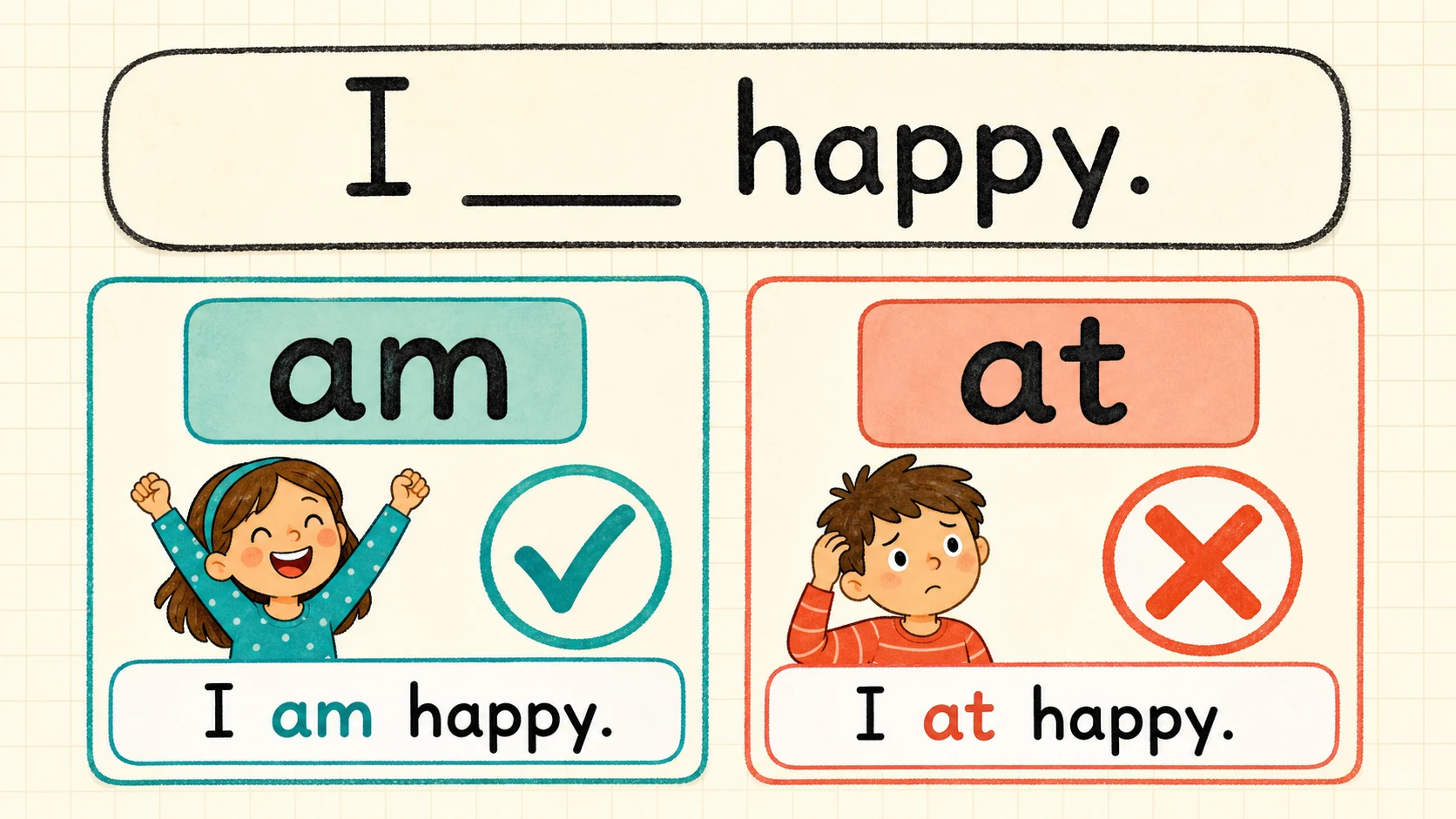
The same wrong answer can require different teaching responses depending on whether the learner misread, guessed, forgot, or misunderstood the sentence.
A short first-grade lesson routine
Use three to five new words across the week, not three to five new words every day. Review previously taught words daily.
- Review: Read five to ten known word cards from a ring.
- Teach: Introduce one current word with see, say, spell, write, and sentence use.
- Recall: Trace while naming letters, cover the model, and write.
- Apply: Read or complete one sentence containing the word.
- Record: Note whether the word was read accurately with a model, from a card, and in a sentence.
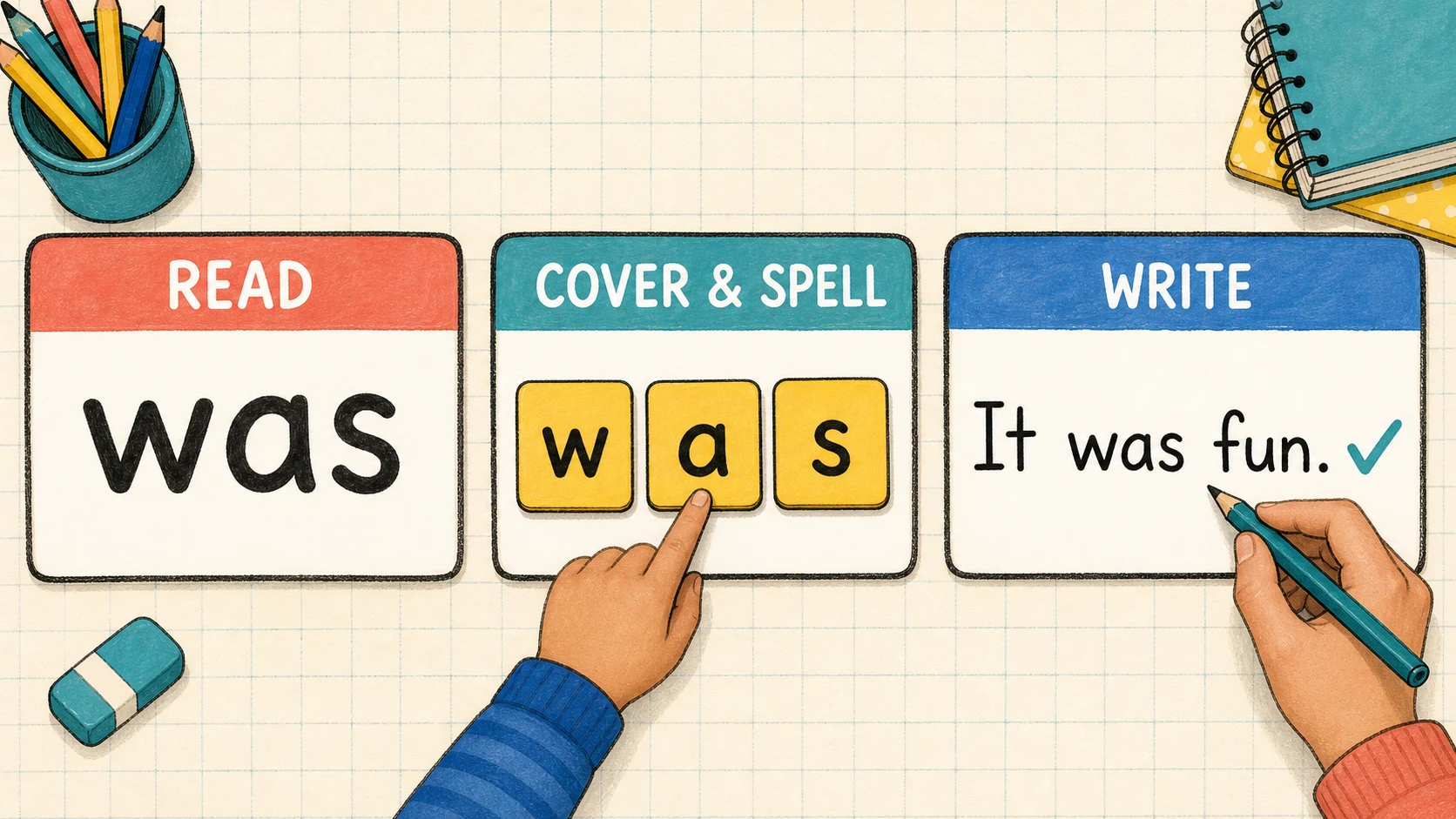
One focused word routine plus cumulative review is more informative than rushing through an entire first-grade page.
The number of review cards is an editorial suggestion for manageability, not a sourced threshold. The supplied catalogue guidance supports the broader pattern: introduce three to five words per week, review older words daily, and use each new word in a sentence.
Second grade: preserve accuracy as support decreases
At the 2nd-grade practice level, the important change is not simply longer word lists. Representation and question design should ask for more independent retrieval and more reading in context.
A useful progression is:
- Read the word from an isolated card.
- Write it after the model is covered.
- Select it among visually similar words.
- Use it to complete a sentence.
- Read it accurately in a short passage.
- Write it in an original, complete sentence.
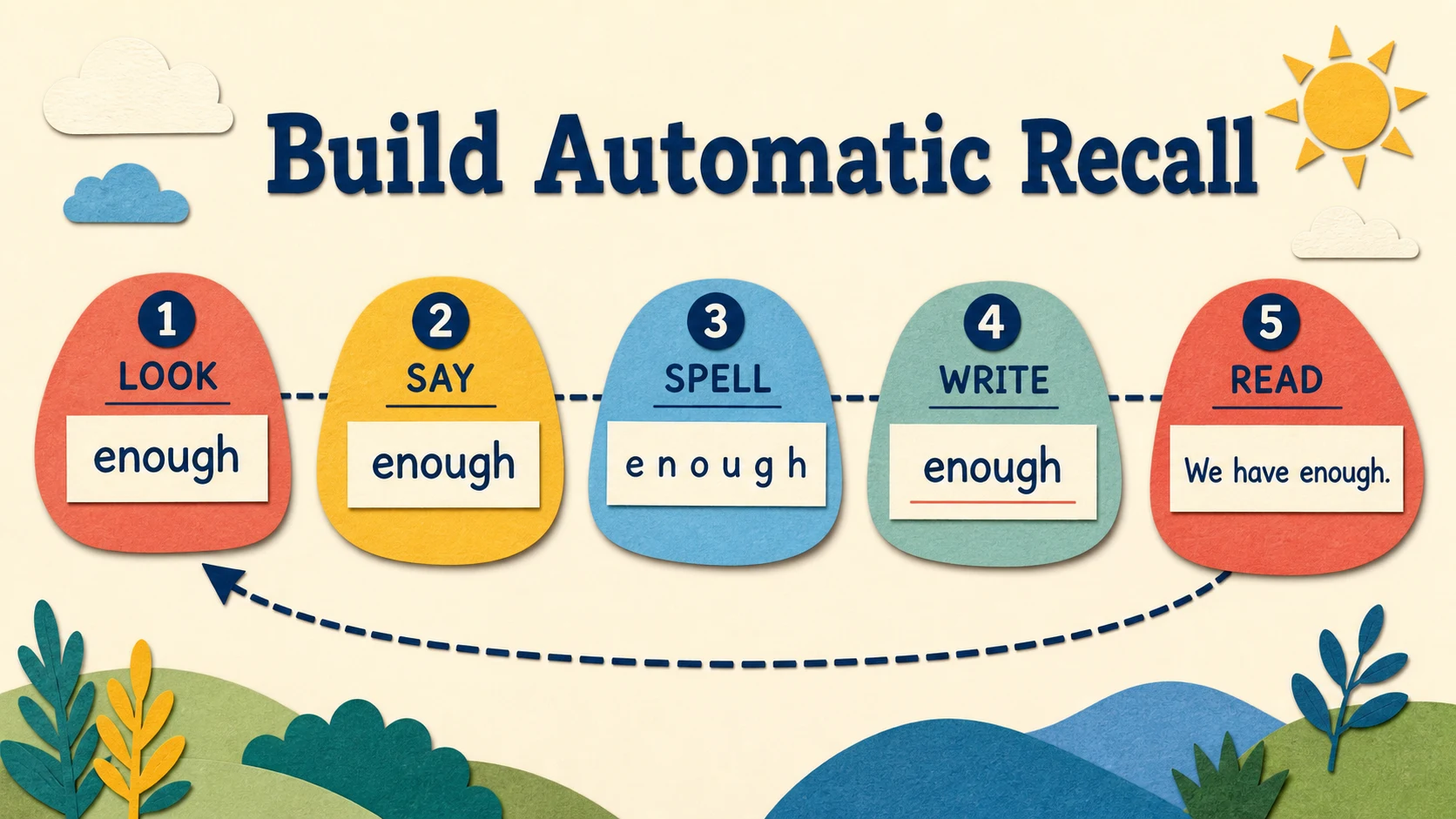
Second-grade progression means less visible support and more connected use, not assigning more items for its own sake.
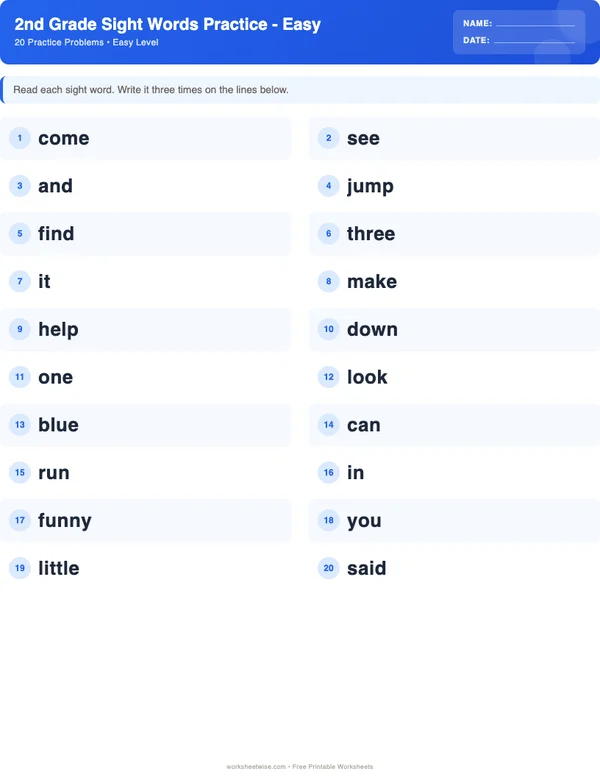
Use the 2nd Grade Sight Words guide and free sheet when the learner can handle mixed review and explain or demonstrate the word’s role in a sentence.
Checked example: distinguish of from off
Complete the sentence:
“I drank a cup ___ water.”
Choices: of, off
The correct answer is of: “I drank a cup of water.” Off has an additional f, a different pronunciation, and does not fit the sentence. The learner should point to the entire word, spell o-f, insert it, and reread the full sentence.
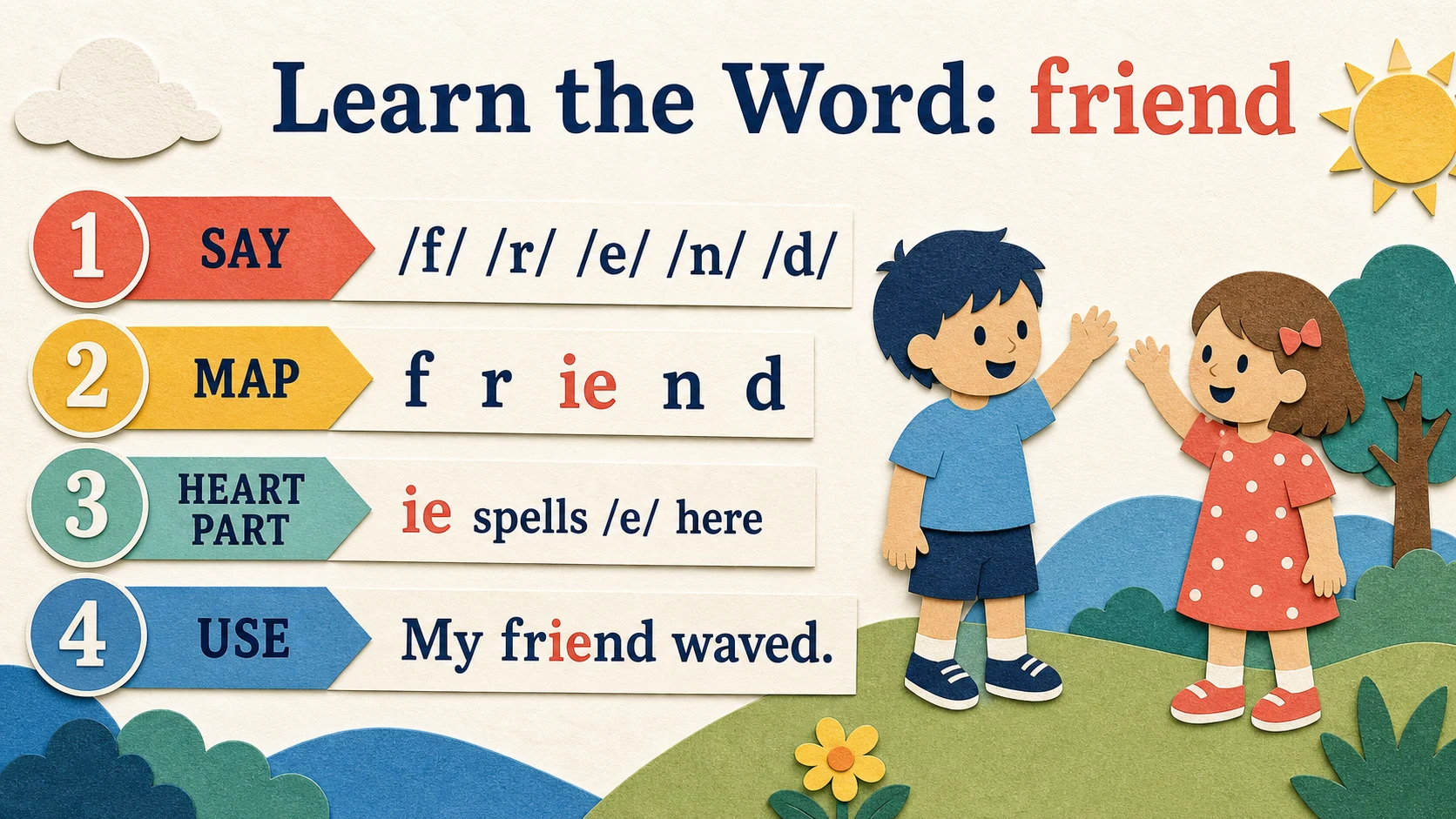
The worked example makes the decision visible: compare every letter, test the word in context, and reread the completed sentence.
This example belongs at the 2nd-grade boundary because the learner must resist a close visual distractor and verify the choice through meaning and grammar. If the learner selects off but reads the sentence as though it says of, ask for slow letter-by-letter comparison. That error points to insufficient print attention, not necessarily lack of sentence understanding.
A short second-grade lesson routine
- Flash-read a mixed ring of taught words.
- Revisit one word that was uncertain on the previous day.
- Analyze its regular and irregular spelling parts.
- Cover and write it from memory.
- Read it in two different sentences or a brief decodable passage.
- Record the response without supplying the word first.
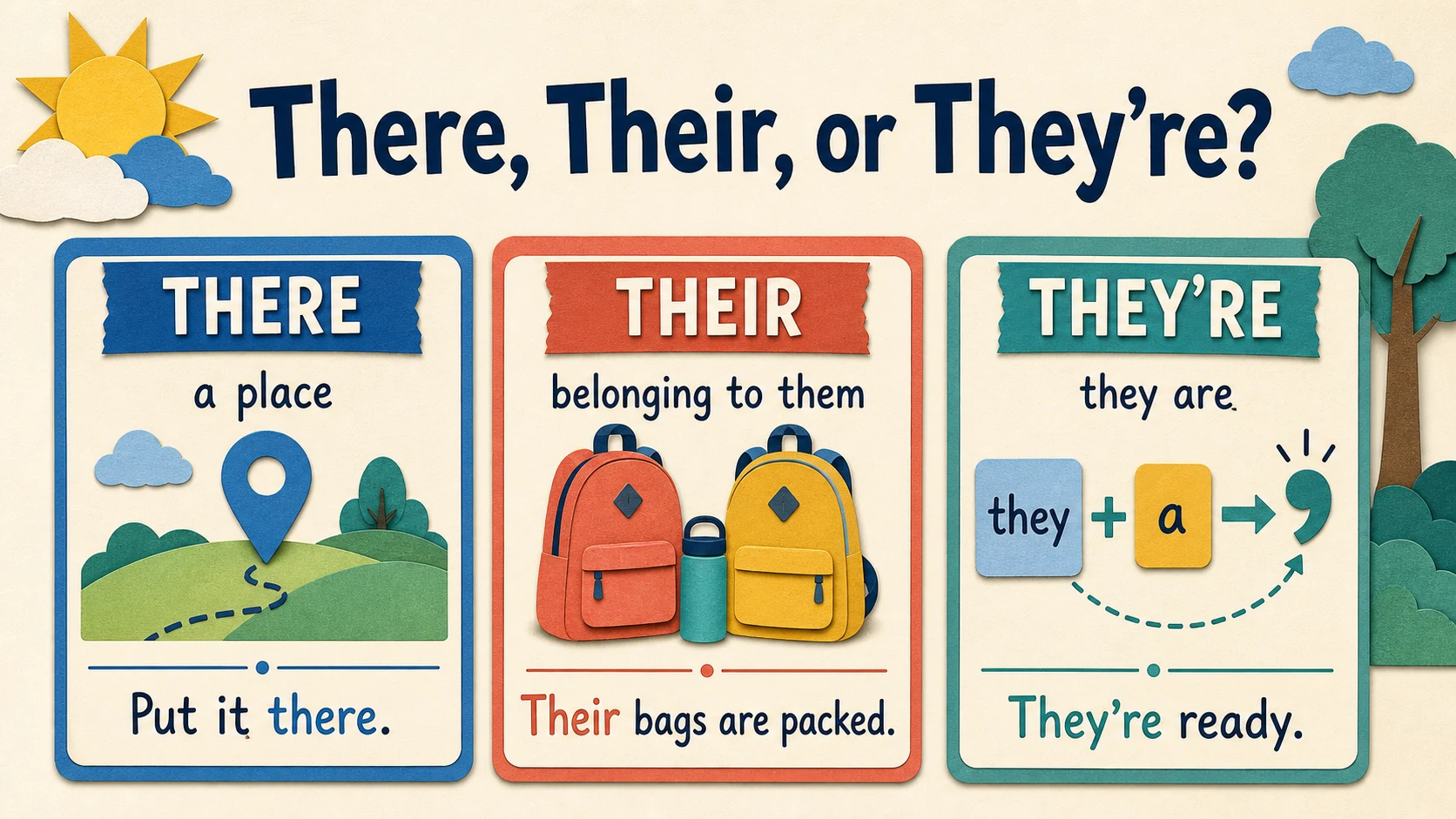
Second-grade review should test whether a known word remains available in writing and connected reading.
The IES writing practice guide recommends daily writing time and instruction that develops fluency with handwriting, spelling, and sentence construction. That supports including short written retrieval and sentence use, but it does not mean a handwriting-heavy task is always the best sight word assessment.
Four task boundaries that worksheets should not blur
A page can look busy while providing weak evidence. Identify exactly what each question asks the learner to do.
Recognition is not recall
Selecting said from three choices is recognition. Writing said after the model is covered is recall. A learner can succeed at the first and not the second, so do not treat the tasks as interchangeable.
Copying is not spelling from memory
Copying the accurately shows visual tracking and letter production. It does not show that the learner can retrieve t-h-e later. Include a cover-and-write step if recall is the target.
Isolated reading is not connected reading
Fast card reading is useful for review, but it does not show that the learner will recognize the same word in a sentence. The IES reading guide specifically recommends daily connected-text reading. Pair word cards with an appropriately controlled sentence or passage containing the taught words.
Sentence completion is not free composition
Choosing is for “The cat ___ on the mat” supplies the sentence structure. Writing an original sentence with is also requires generating an idea, constructing the sentence, and possibly managing spelling and handwriting. A poor original sentence therefore does not prove that is is unrecognized.
The Common Core ELA framework organizes literacy through grade-specific expectations within broader reading, writing, speaking, listening, and language goals. It can help an adult see why word recognition should eventually serve reading and writing. It should not be used here to claim that a particular WorksheetWise sheet is aligned to a local standard.
Interpret errors before choosing another page
An error is a clue about the task. It is not a diagnosis.
| Observable response | Plausible interpretation to check | Immediate teaching response |
|---|---|---|
| Chooses a word sharing the first letter | Attending to the beginning but not the whole spelling | Compare letters left to right; reduce choices, then restore them |
| Reads a card correctly but misses the word in a sentence | Recognition is not yet stable in connected text | Highlight the word once, reread, then remove the highlight |
| Copies correctly but cannot write after covering | Visual copying is stronger than retrieval | Use one trace-cover-write cycle with oral spelling |
| Reverses letter order | Sequence is not secure, or writing load is interfering | Build the word with letter tiles before writing |
| Selects a grammatically impossible word | May be matching visually without checking the sentence | Read both completed sentences aloud and discuss which makes sense |
| Reads accurately only in a fixed card order | May be recalling the sequence rather than each word | Shuffle the ring and retest on another occasion |
| Reads slowly but accurately | Word may require more exposures | Keep it in review; do not add speed pressure immediately |
| Misses many words after several new words were added | The weekly set may be too large for current review conditions | Pause new introductions and consolidate the existing set |
Do not infer dyslexia, attention problems, language disorder, or another condition from worksheet performance. If a persistent pattern concerns you, document what the learner was asked to do, the support provided, and the exact response, then share those observations with the learner’s teacher or an appropriate qualified professional.
Adapt the format without replacing the skill
An adaptation should remove an access barrier while preserving the intended evidence.
If the target is printed-word recognition:
- Let the learner point, place a counter, or hand over a card instead of circling.
- Enlarge the print or reveal one row at a time.
- Read the directions aloud, but do not read the answer choices if decoding them is the target.
If the target is spelling recall:
- Permit letter tiles before pencil writing when handwriting is the main obstacle.
- Keep oral spelling and left-to-right construction.
- Remove the model before the final attempt.
If the target is sentence use:
- Read the surrounding sentence aloud when independent passage reading is not being tested.
- Offer two word choices before requiring an independently generated word.
- Ask the learner to reread the completed sentence to verify meaning.
If the target is connected-text reading:
- Use a brief text containing already taught phonics patterns and sight words.
- Avoid illustrations that reveal every target word.
- Record accuracy first; add timing only when there is a clear instructional reason.
Bingo, memory matching, and flashcard races can vary practice. Keep accuracy central: a fast incorrect response does not win. For a learner who finds racing stressful, race against a personal previous attempt or remove the timer entirely.
Use a repeatable weekly cycle
The following schedule applies the supplied teaching anchor while leaving room for teacher judgment.
Days one through four
Introduce no more than the planned weekly set of three to five words. For each new word:
- Show the word.
- Say it together.
- Spell the letters aloud.
- Identify spellings that follow known phonics patterns.
- Mark any irregular part to learn by heart.
- Trace while saying each letter.
- Cover and write from memory.
- Use the word in a spoken or written sentence.
- Read it in connected text as soon as an appropriate text is available.
Continue daily review of previously taught words. Mix old and new cards so the position of a word cannot cue the answer.
Day five and later checks
Shuffle the flashcard ring and present words without hints. A suggested record could use three columns: date, isolated-word response, and connected-text response.
The supplied catalogue guidance says to move a word to a mastered pile only after it is read correctly on three separate occasions. Keep those occasions separate rather than repeating the card three times in the same sitting. Even after retirement, periodically return mastered words to mixed review; that return is a practical editorial suggestion, not an additional sourced mastery rule.
Select the next real worksheet from observable evidence
Start by examining one free 20-problem sheet at the most plausible grade combination. Then make a task-based decision:
- Select Pre-K when adult-led matching, pointing, movement, and very brief tracing provide the clearest evidence.
- Select kindergarten when the learner can attend to a printed model and is ready to connect tracing with covered recall.
- Select 1st grade when isolated recognition is emerging and sentence choice or short written retrieval is the useful next demand.
- Select 2nd grade when mixed review, close visual comparisons, independent spelling, and connected reading are appropriate.
- Stay at the current level when accuracy depends on support that the next task removes.
- Move forward when the learner completes the current task accurately across changed order, fresh sentences, and separate occasions—not merely after memorizing one page.
A worksheet has limits. It cannot by itself show how the learner responds to an unfamiliar text, explain why an error occurred, or replace direct teaching and conversation. Twenty printed problems may be a resource bank, not a required sitting. Stop when attention or handwriting fatigue begins to distort the reading evidence.
For the next session, open the full worksheet library, choose one of the four real sight word grade combinations, and inspect the first five items before printing. Name the exact demand—match, trace, recall, select in a sentence, or read in context. If that demand is one manageable step beyond what the learner demonstrated today, use the sheet; if it skips a boundary, choose the preceding grade combination and preserve the sight word target with a simpler response.
Put it into practice
Use the guide with a real printable
Move from explanation to a short, observable practice task. Check the first item together, then adjust the next session from the learner's actual work.
Open the first free worksheetExplore a neighboring collection
Choose by a different teaching need
Addition Worksheets by Grade and Level Consonant Blends Worksheets by Grade and Level Counting Worksheets by Grade and Level CVC Words Worksheets by Grade and Level Decimals Worksheets by Grade and Level Digraphs Worksheets by Grade and Level Division Worksheets by Grade and Level Fractions Worksheets by Grade and Level