Curated collectionAnswer keys includedPrint-ready PDFs
Short Vowels Worksheets by Grade and Level
Show the full short vowels progression across 4 real grade combinations, compare task boundaries, model checked examples and explain how to choose the next level.
Start with a real resource
Browse this worksheet collection
4 relevant free entry points are available. Each one includes a printable learner PDF and separate answer key.
A useful practice loop
Print less. Observe more.
- Choose one skill and model the first item aloud.
- Use a short set and notice the learner’s strategy.
- Change the next task from the work you can see.
Need more than the free sheet?
Plus includes all 72 matching catalogue variations where available, plus saved deterministic generators and the worksheet designer.
See Plus membershipComplete guide
How to teach and practise short vowels worksheets
3,474 words Updated 6 instructional visuals
Choose by the task the learner can do, not the grade label
Short-vowel worksheets should move a learner from hearing one vowel sound to reading and spelling that sound inside words. The useful progression is oral discrimination, picture or object sorting, CVC word reading, filling the medial vowel, spelling from dictation, and then retaining short-vowel accuracy when blends, digraphs, and long-vowel patterns appear.
WorksheetWise lists 72 short-vowel variants across four intended practice levels—Pre-K, Kindergarten, 1st Grade, and 2nd Grade—with one 20-problem free sheet at each level. Those grade labels describe intended practice level; local curriculum sequences differ. Select a page by its observable demands: how many vowels are contrasted, whether pictures support the words, whether the learner must read or spell, and whether other phonics patterns compete for attention.
Age is a discovery aid rather than a placement decision. A first grader who cannot yet distinguish pen from pin needs focused listening practice, not a harder page because of age. A younger learner who can already sort and read mixed CVC words may be ready for a later task with adult support. For ages three and four, prioritize brief adult-led oral, matching, manipulative, and movement work over desk work.
What counts as a short-vowel task
The five target sounds are represented by a in apple, e in egg, i in itch, o in octopus, and u in umbrella. In a simple closed syllable, a consonant follows the vowel: cat, pen, sit, hot, and cup are clean examples. Each has one vowel letter between an initial and final consonant, so each can be segmented into three phonemes and mapped to a CVC spelling.
A short-vowel worksheet may ask a learner to:
- Match a picture to an anchor vowel.
- Sort pictures or words by medial sound.
- Read words containing one practiced vowel.
- Contrast two vowels in otherwise similar words.
- Supply the missing middle letter.
- Spell a complete CVC word from dictation.
- Maintain the vowel while reading words with added consonant complexity.
The target is the vowel sound and its spelling, not picture naming, handwriting speed, or general vocabulary. That distinction matters when interpreting a response. If a learner sees a picture of a mug but calls it a cup, the response may be reasonable even when it does not fit an expected letter pattern. Say the intended picture name before deciding that the vowel discrimination was wrong.
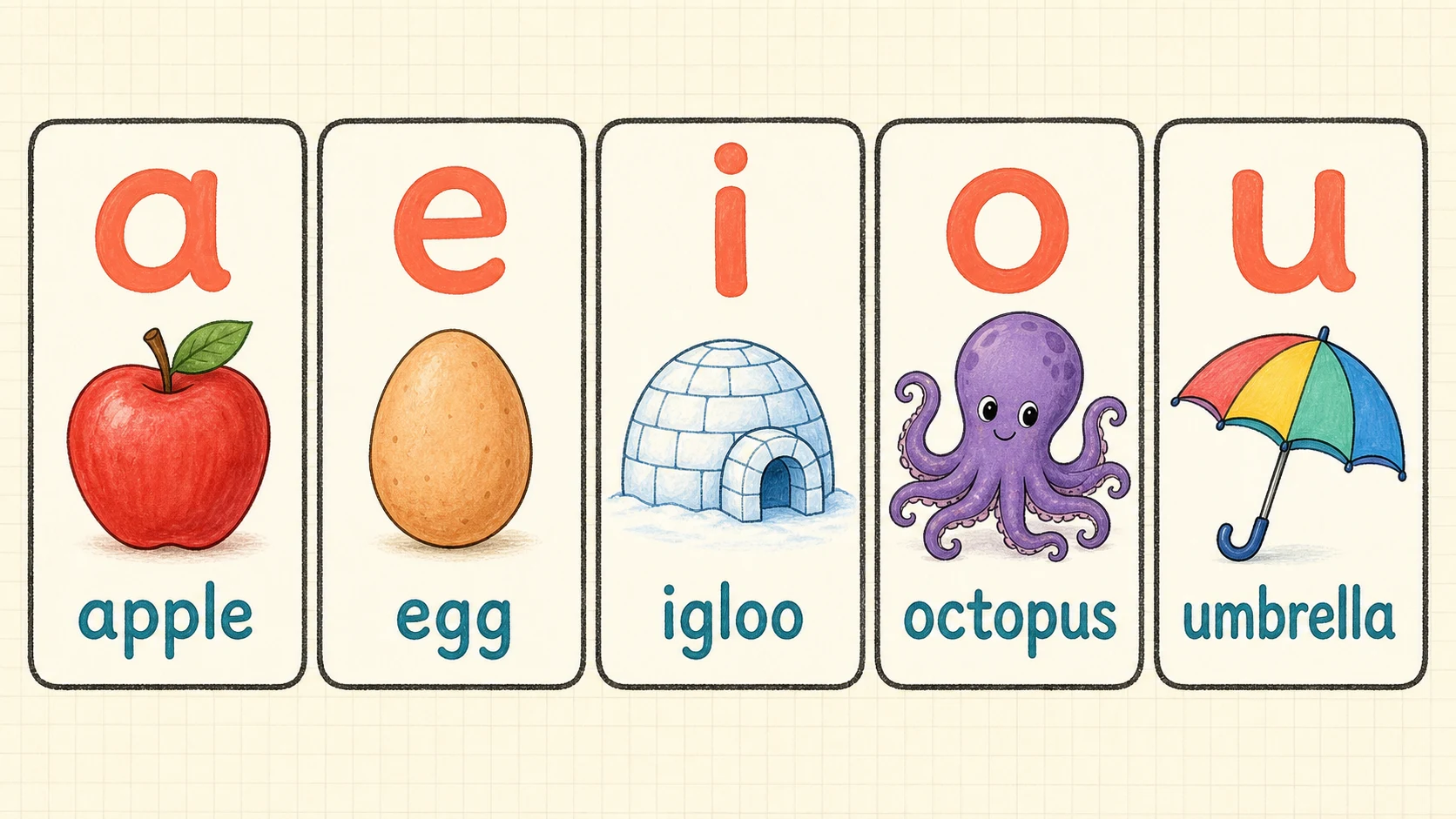
The central pathway is hear the medial sound, connect it to a vowel letter, read it in a word, and reproduce it without a model.
The Institute of Education Sciences recommends explicitly teaching learners to connect sounds with letters, segment words, and decode words rather than leaving those relationships implicit. It also recommends practice reading words in isolation and connected text. That guidance supports the progression in this field guide; it is not an evaluation of WorksheetWise materials. See the IES foundational reading practice guide.
A useful five-vowel teaching order
A practical sequence is a, i, o, u, e. This is a page-specific teaching suggestion drawn from the supplied teaching anchor, not a universal curriculum mandate. Short a provides a relatively distinct starting sound. Introducing short i next establishes a second category. Short o and then short u extend the set. Short e comes last so that the easily confused e/i contrast can receive deliberate attention after the learner understands how sound sorting works.
Give each vowel a stable cue
Use the same picture and motion whenever the sound is retrieved:
- a–apple: pretend to bite an apple.
- i–itch: scratch an arm.
- o–octopus: wiggle the arms.
- u–umbrella: pretend to hold up an umbrella.
- e–egg: pretend to crack an egg.
The motion is a retrieval cue, not an additional fact to memorize. Show an apple, say apple, isolate /ă/, and make the biting motion together. Then remove the picture and ask for the sound while making only the motion. Finally, show the letter a without either cue.
Separate learning from testing
A page containing twenty mixed items may be useful after several vowels have been taught, but it is a poor first exposure to all five. During learning, keep the choice set narrow and model the decision:
- Say the picture name.
- Stretch or repeat the medial sound without distorting it.
- Compare it with the anchor.
- Select or write the vowel.
- Read the complete word normally.
During a check, reduce prompts and note what the learner does independently. Assistance during teaching is productive; assistance during a check changes what the result means.
Revisit old sounds without flooding the page
After introducing a new vowel, mix in a few previously learned words. A learner working on short o might sort hot, log, and mop, then review cat and sit. That arrangement tests whether three categories remain distinct without demanding all five at once. Keep such practice going when blends, digraphs, and long vowels are introduced, but do not let those newer patterns obscure the vowel being checked.
Four catalogue levels and their real task boundaries
All four representative free sheets contain 20 problems and are catalogued as “easy.” That label should be interpreted through task features, never applied to a learner. An “easy” sheet should mean that the page offers a constrained response, familiar representations, limited competing patterns, or visible support. It does not mean every learner ought to complete it independently.
Pre-K: hear, match, move, and manipulate
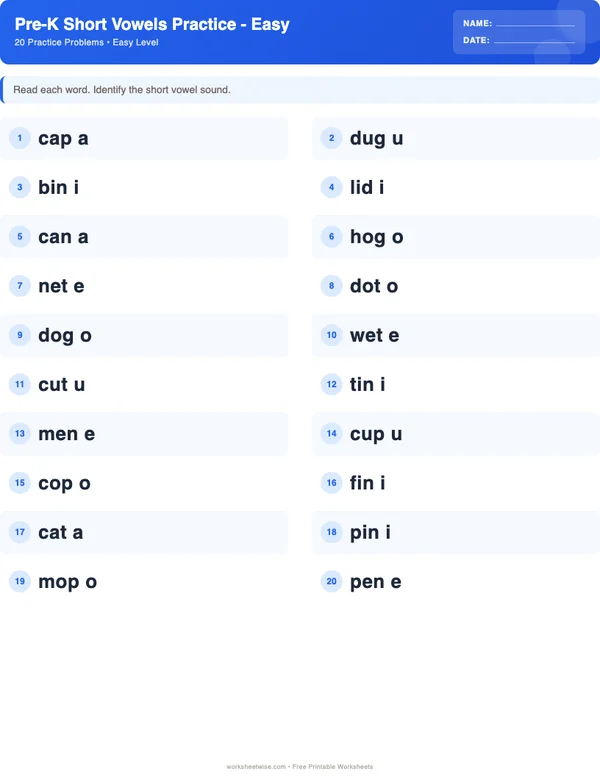
Use the Pre-K Short Vowels guide and free sheet as an entry point when the learner needs adult-led sound awareness and concrete choices. The adult can name each picture, place two anchor cards on the table, and ask the learner to move an object rather than write.
For ages three and four, divide a 20-problem page into very short encounters. Three or four items may be enough at one sitting. Pointing, placing a counter, sorting a card, and performing an anchor motion all preserve the vowel decision while reducing desk and handwriting demands.
Checked example 1: cat versus cot. Say both words naturally, then place an apple card and an octopus card in front of the learner. Ask, “Which middle sound do you hear in cat?” The correct choice is short a: /k/–/ă/–/t/. For cot, it is short o: /k/–/ŏ/–/t/. The initial /k/ and final /t/ stay constant, so the comparison isolates the vowel. This belongs at an early level because the adult supplies the words and the learner makes an oral or manipulative choice rather than decoding print.
Dialect and accent can affect how vowel contrasts are produced and perceived. Use the learner’s familiar spoken variety, pronounce words naturally, and avoid treating a regional pronunciation as carelessness.
Kindergarten: connect the heard sound to a letter
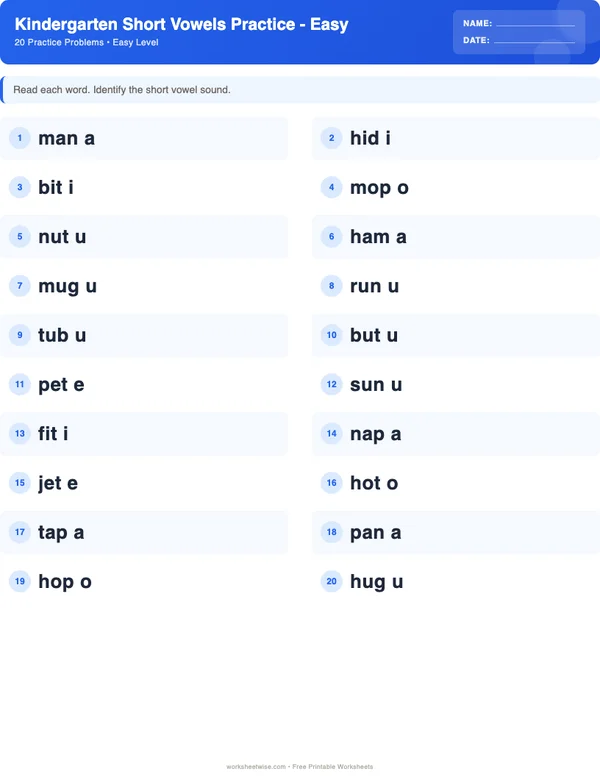
The Kindergarten Short Vowels guide and free sheet is a suitable starting point when a learner can name familiar pictures and hear at least one target sound but still needs visible choices. Typical boundaries include one-vowel picture sorting, matching words to pictures, and filling a medial letter when the surrounding consonants are supplied.
Checked example 2: c _ p. If the intended picture is a cup, segment the word /k/–/ŭ/–/p/. The missing vowel is u, producing cup. This example belongs at the sound-to-letter stage because the initial and final consonants constrain the word, while the learner must identify and encode the medial sound. Before marking an answer, confirm the intended word: a learner who calls the object a mug has produced a valid label that does not fit c _ p.
A response bank with only a and u makes the task less demanding than an open blank. Removing the bank increases retrieval and letter-production demands even though the phonics target remains short u.
1st Grade: read and spell across several vowels
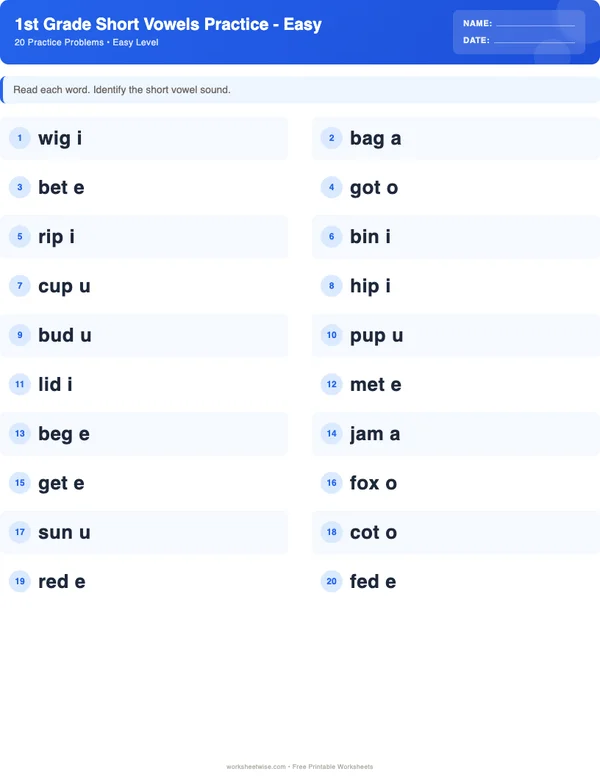
The 1st Grade Short Vowels guide and free sheet becomes useful when the learner can work beyond one anchor at a time. Appropriate tasks include mixed CVC reading, two- or three-vowel sorting, medial-vowel completion without picture support, and short dictation.
Checked example 3: sort map, sit, log, sun, and bed. The correct groups are short a: map; short i: sit; short o: log; short u: sun; and short e: bed. Each is a closed CVC word, and each medial letter represents the target short sound. This belongs at a mixed 1st-grade practice level because the learner must maintain five sound categories and process printed words rather than rely only on pictures.
Do not assume one correct mixed sort means the vowel system is secure. Re-sort the same cards in a different order later, then dictate two of them without displaying the print. Recognition can be stronger than recall.
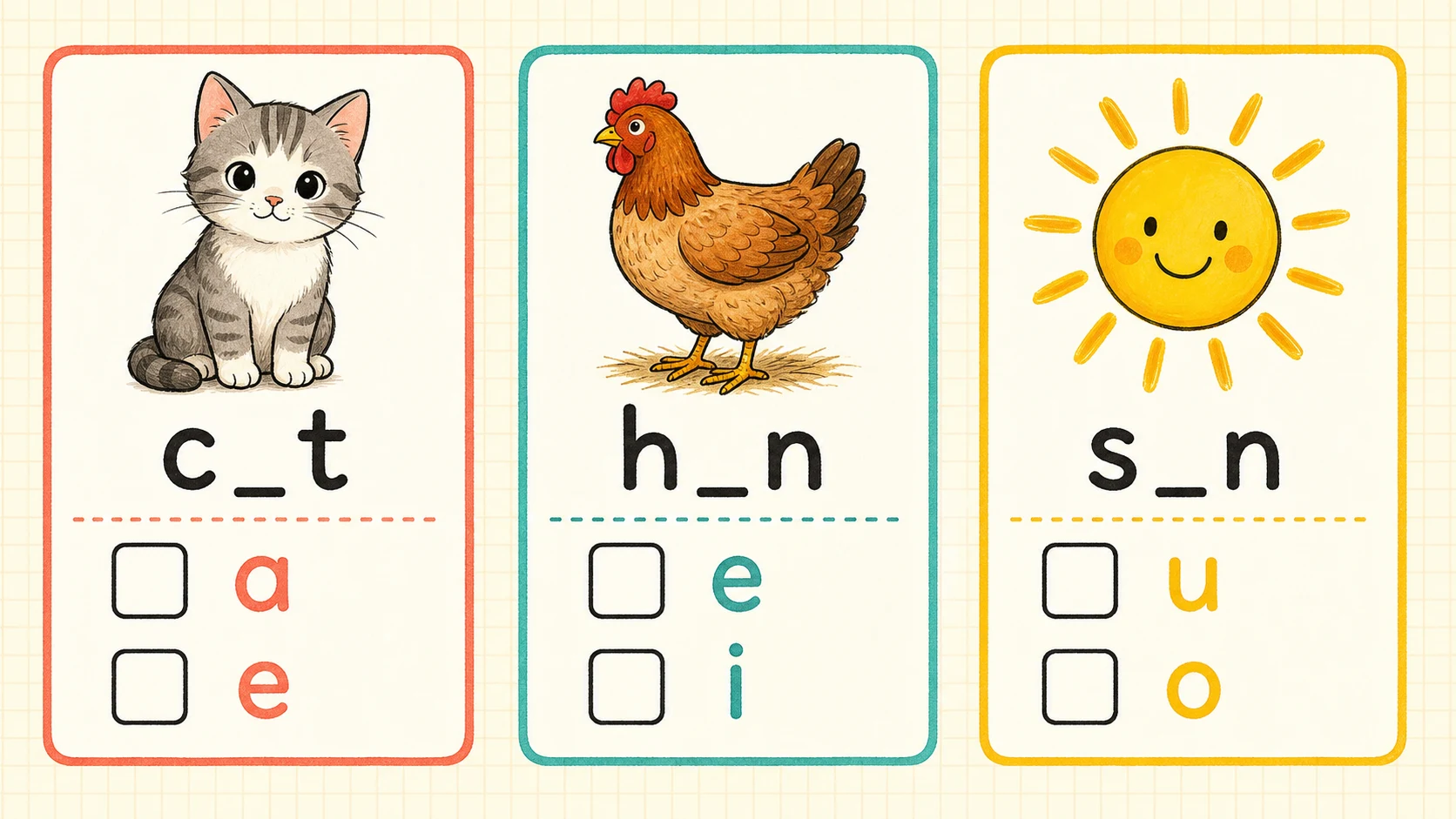
At the 1st-grade practice level, spaced sorting, reading, and dictation reveal more than repeating the same mixed page in one sitting.
2nd Grade: retain the vowel amid greater complexity
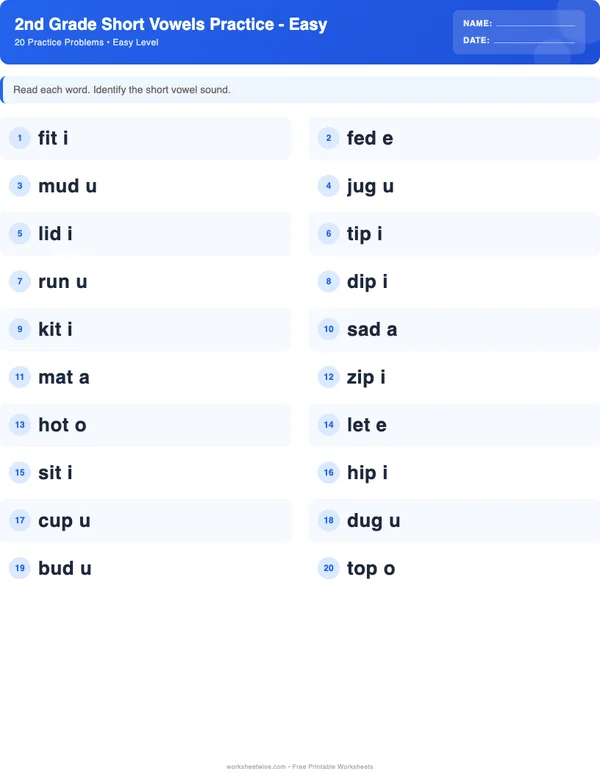
The 2nd Grade Short Vowels guide and free sheet is not simply a longer version of an earlier page; the representative free sheet still has 20 problems. The meaningful change should be in what surrounds the vowel: less picture support, mixed review, spelling from sound, or words in which blends and digraphs add consonant complexity.
Checked example 4: ship and step. In ship, sh represents the initial consonant sound, i is the short vowel, and p closes the syllable. In step, the initial consonant blend is st, e is the short vowel, and p closes the syllable. Both remain one-syllable closed words even though neither has a simple three-letter CVC spelling. They belong in later short-vowel review because the learner must find the vowel while handling a digraph or blend.
This boundary matters: a learner who reads ship accurately but hesitates over step may be managing the vowel and struggling with the blend. Conversely, reading step as stip preserves the consonant frame but changes the vowel, pointing toward an e/i discrimination check.
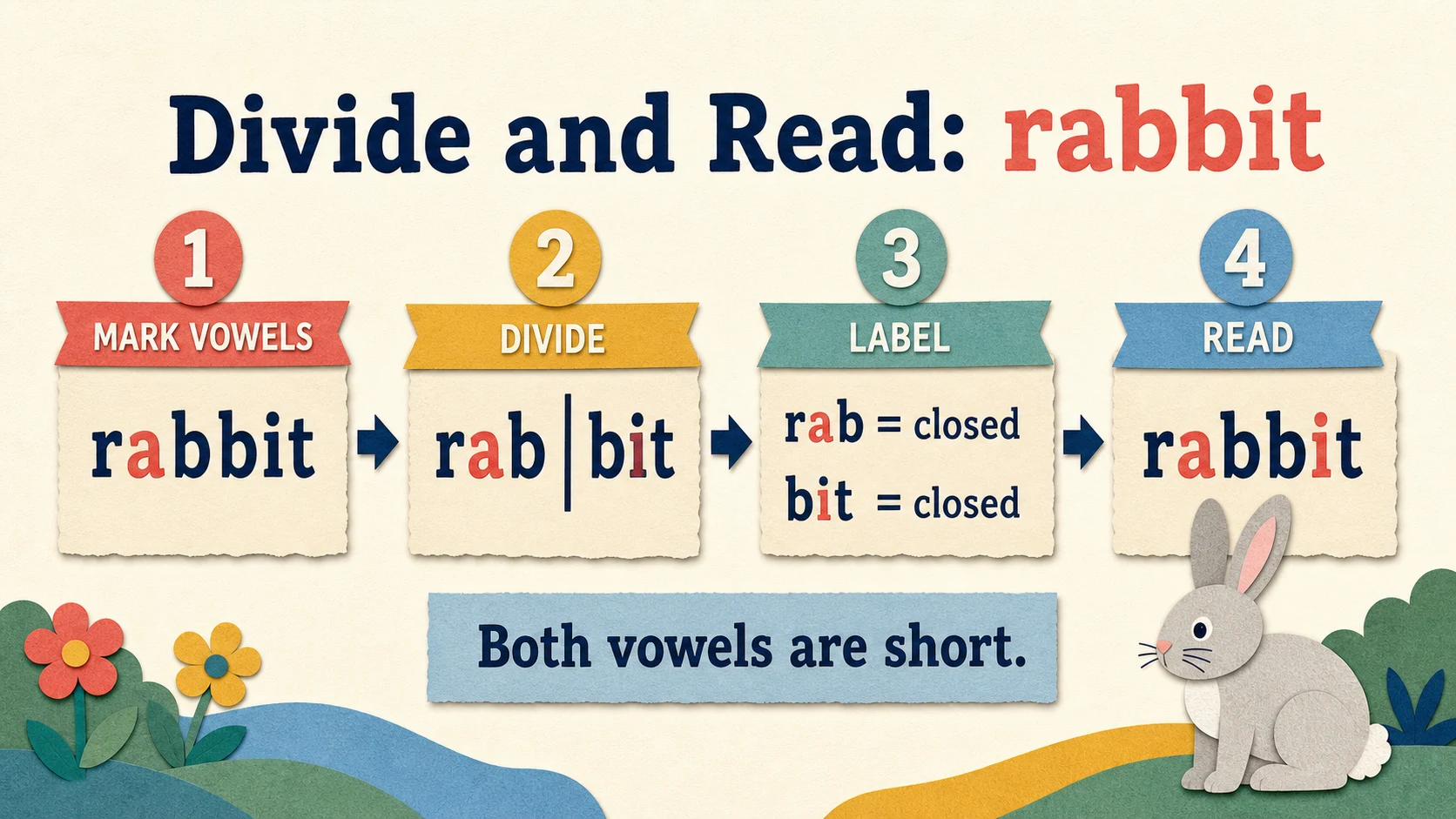
Later practice should make the sound-to-spelling reasoning visible before expecting independent work with less support.
The Common Core English Language Arts standards include grade-specific foundational-skills expectations involving sound-letter correspondences and decoding regularly spelled one-syllable words. They also place spelling within writing and language expectations. These are broad reference points, not proof that a particular worksheet is aligned to a local sequence. Consult the Common Core ELA standards and the requirements used by the learner’s school.
How representation changes the thinking required
Pictures, printed words, missing-letter frames, and dictated words do not measure identical behavior. Two pages can feature the same five vowels but place very different demands on the learner.
Picture-supported choices
Pictures reduce the need to decode but add a naming demand. They are useful for early auditory sorting when an adult establishes each intended label. Four pictures sorted beneath two anchor images produce a more controlled task than twenty mixed pictures with no adult preview.
Choose this representation when the question is, “Can the learner hear the target sound?” Do not use it as the only evidence that the learner can read the corresponding vowel in print.
Complete printed words
Reading cat, pen, sit, hot, and cup asks the learner to blend sounds from letters. A matching illustration may confirm meaning, but it can also permit guessing. Ask the learner to read the word before revealing or discussing the picture.
Choose complete words when the question is, “Can the learner use the vowel letter while decoding?” If the learner recognizes every item from repeated exposure, introduce new regular examples rather than simply increasing speed.
Missing-middle questions
Frames such as p _ n concentrate attention on the vowel, but context changes their validity. Without a picture or spoken word, p _ n has multiple plausible completions, including pan, pen, and pin. A sound-based question must establish which word is intended.
A well-designed adult prompt is: “Write the missing vowel in pen: p _ n.” Segment /p/–/ĕ/–/n/ if teaching; say the word only once or twice if checking. The correct answer is e. The frame then measures vowel selection rather than the ability to guess the author’s word.
Dictation and sentence context
Dictation reverses the direction of the task: the learner hears a word and produces its spelling. This is an editorially recommended part of the sequence because it checks whether the sound-letter connection can be retrieved without visible options. The IES writing guide recommends explicitly teaching foundational writing skills, including spelling, alongside regular writing practice. That broader guidance supports including encoding work; it does not prescribe this particular vowel order or assess these sheets. See the IES elementary writing practice guide.
Sentence context should come after the learner can attend to the word itself. “The hen is red” contains short e in hen and red, but it also adds word recognition, syntax, and tracking demands. Use it for application, not as the first test of whether short e can be heard.
A repeatable lesson around one worksheet section
A worksheet is most informative when it sits inside a brief cycle of listening, modeling, independent response, and review. One workable routine follows.
Prepare a small contrast
Select six to ten items rather than automatically assigning all 20. Choose one known vowel and one current target. Gather the relevant anchor pictures or make word cards. Confirm that every picture has an unambiguous intended name.
Hear and move
Say two or three words without showing print. The learner performs the anchor motion or places a counter beneath the matching vowel. Ask for the middle sound, not merely the letter name.
For map, the learner may pretend to bite an apple and say /ă/. For mop, the learner wiggles octopus arms and says /ŏ/. The shared /m/ and /p/ make this a useful contrast because attention can settle on the changing medial phoneme.
Model one complete decision
Think aloud briefly: “The word is sit. I hear /s/–/ĭ/–/t/. /ĭ/ matches itch, so I choose i. The word is sit.” Keep the model about the target decision. Long explanations increase memory demands without improving the sound contrast.
Release a short set
Have the learner complete three or four items. Ask for a spoken blend after each answer. If the learner needs help on nearly every item, return to oral sorting or reduce the number of vowel choices. If the learner answers accurately without the anchor, remove that support for the next small set.
Dictate and record one observation
End with one or two words that were not left visible. Note an observable response: “Spelled three short-a CVC words from dictation; changed pin to pen.” That statement is more actionable than “Needs phonics help.”
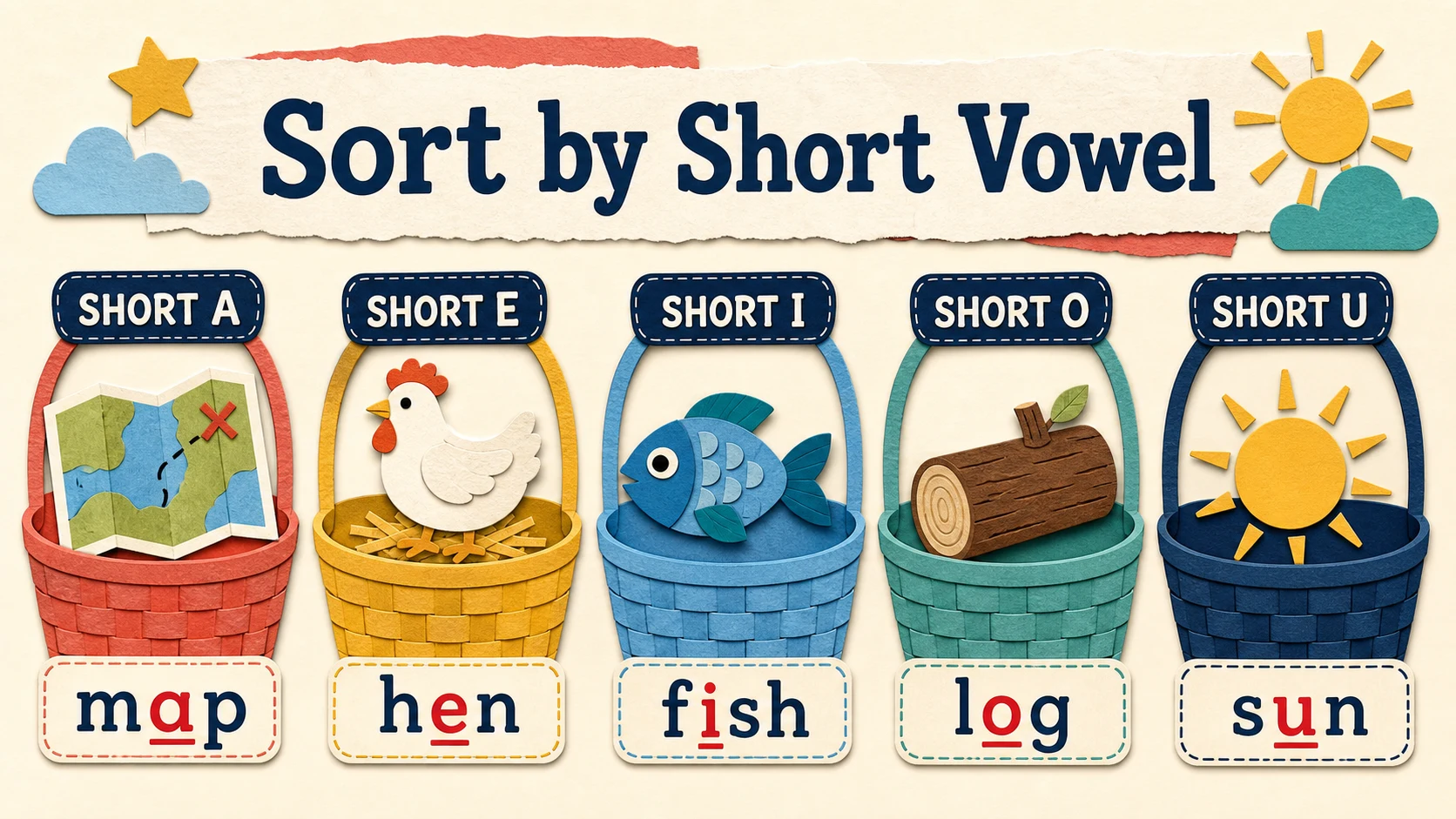
For later practice, a compact hear–model–read–dictate cycle checks whether the vowel remains stable without turning review into a long drill.
Read errors as clues, not diagnoses
An incorrect letter identifies the next comparison to make; it does not identify a disorder, effort level, or fixed ability. Look for a repeatable pattern across oral, reading, and spelling tasks.
Short e replaced by short i
If pen becomes pin, test the contrast away from the worksheet. Say pen/pin, set/sit, and bed/bid in varying order. Ask the learner to point to the matching anchor or move a counter into one of two columns. Then show the spellings.
When modeling, invite the learner to watch the adult’s mouth: short e generally uses a slightly wider opening than short i. That visual cue is a teaching suggestion, not a diagnostic test, and natural pronunciation varies.
Short o replaced by short u
If hot becomes hut, first check whether the learner hears the difference when no letters are present. Contrast cot/cut and hot/hut, using the octopus and umbrella motions. If oral sorting is accurate but spelling is not, the next task should emphasize linking each heard sound to its letter. If both are inconsistent, stay with the two-way auditory sort before returning to mixed vowels.
The correct vowel appears in reading but not spelling
A learner may read bed correctly when the word is visible yet spell it bid from dictation. That difference suggests that recognition currently has more support than retrieval. Use a sequence of read, cover, say, segment, and write. Avoid copying the word repeatedly, because copying does not require the same sound-to-letter decision.
The vowel is correct but the word is still wrong
Writing sep for step does not show a short-e error; the vowel is retained while a consonant in the blend is omitted. Keep the vowel target intact, briefly support the blend with counters or sound boxes, and then reread the complete word. For focused follow-up, the Consonant Blends Worksheets by Grade and Level can help separate consonant-cluster practice from vowel practice.
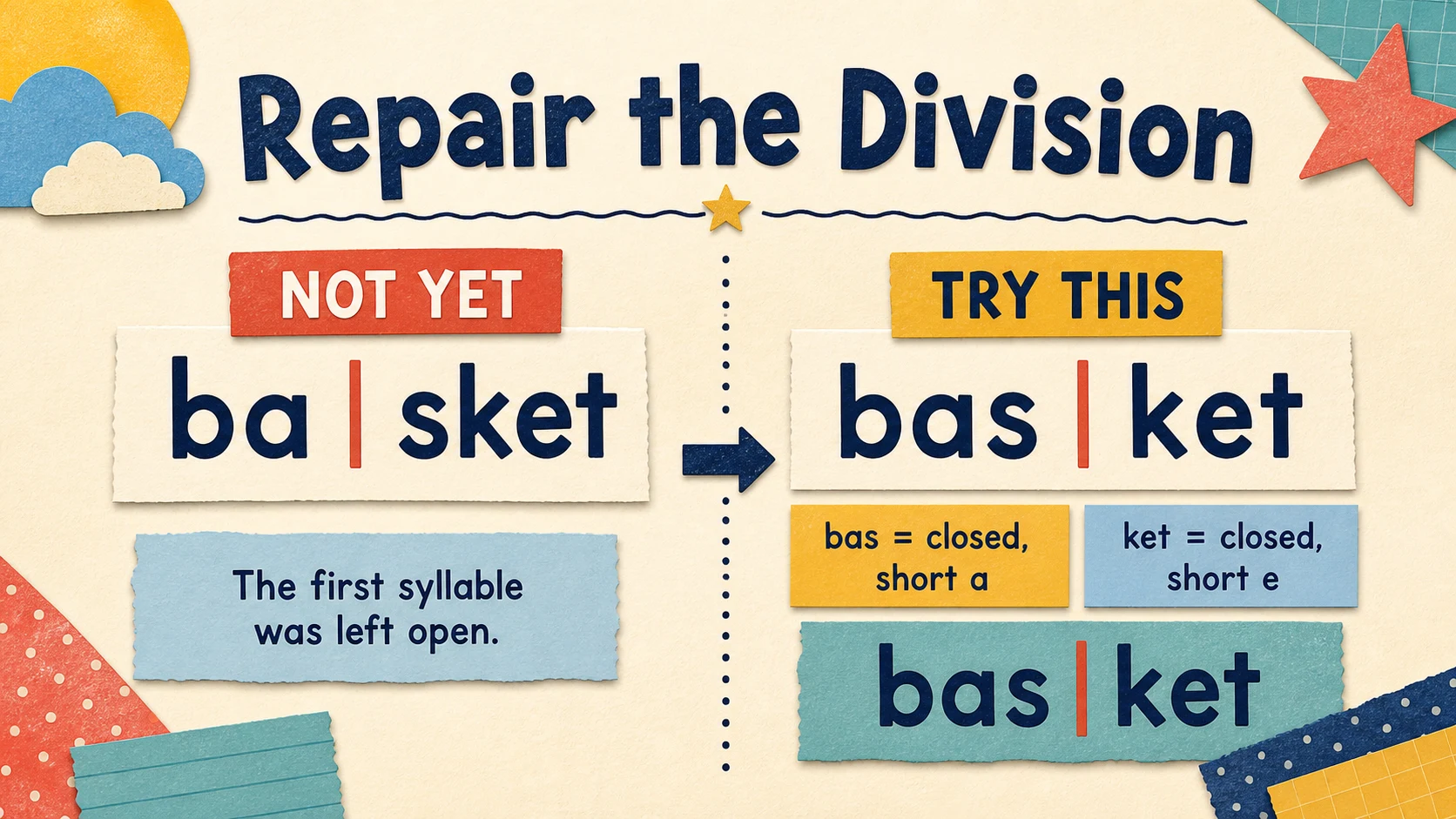
The useful response depends on whether the mismatch occurs in hearing, decoding, encoding, picture naming, or added consonant complexity.
Adapt the access demands while preserving the vowel decision
An adaptation should remove an irrelevant obstacle without supplying the target answer.
- Read directions aloud while leaving the learner responsible for identifying the medial vowel.
- Cut a page into rows or cover unused items to reduce visual crowding.
- Let the learner point to a vowel card instead of writing when handwriting is not the target.
- Provide movable letters a, e, i, o, and u while withholding the correct selection.
- Name an unclear picture, then ask the learner to identify its middle sound.
- Use counters for phoneme positions before asking for the vowel letter.
- Reduce five choices to two when teaching a contrast, then widen the set later.
- Allow the anchor motion during practice and remove it during a brief independent check.
- Enlarge print or increase spacing without changing the word set.
- Split 20 problems across sessions while keeping a record of which items were completed independently.
Avoid reading the target word letter by letter for the learner, emphasizing the correct vowel before the learner answers, or displaying only the correct vowel card. Those changes erase the decision being practiced.
If a learner uses an accent or dialect in which a catalogue contrast is less distinct, consult the learner’s teacher or a language specialist for locally appropriate word choices. A worksheet result alone cannot determine the reason for a pronunciation or spelling pattern.
Select the next sheet from evidence
Start with a brief sample below the level suggested by age or grade, then move only when the task features fit.
Choose a single-vowel, picture-supported page when the learner needs the adult to name pictures, relies on an anchor to identify the sound, or becomes inaccurate when a second vowel is introduced.
Choose a two-vowel sorting page when one sound is stable in isolation but the learner needs to discriminate it from a specific competitor. Use a/o or e/i contrasts with controlled words rather than all five vowels.
Choose a mixed CVC reading or fill-in page when the learner can sort two or more vowels orally and connect them to letters. Confirm that missing-letter questions establish the intended word.
Choose a dictation or low-support mixed page when printed recognition is accurate but independent spelling has not been checked.
Choose later review with blends or digraphs when CVC vowels remain accurate and the next question is whether that accuracy survives added consonant complexity. The CVC Words Worksheets by Grade and Level offers a useful adjacent route when the learner needs more complete-word blending before consonant clusters are added.
Do not advance solely because a page was completed, and do not repeat solely because the score was imperfect. Look at the error type, support used, and whether the learner can explain or reproduce the decision in a new word.
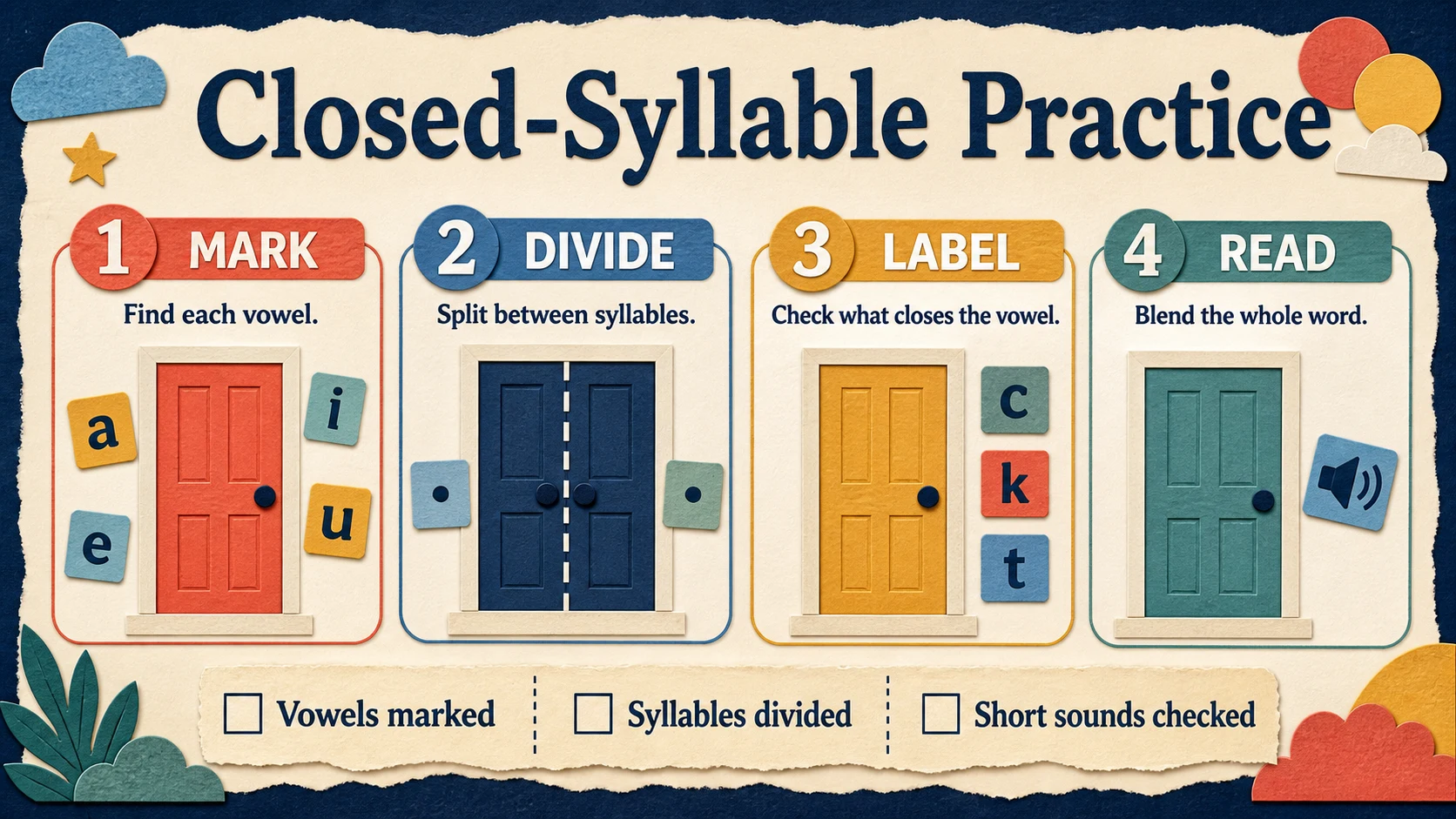
At the 2nd-grade practice level, alternate focused contrasts with mixed reading and dictation so that short vowels remain available inside more complex phonics work.
What these worksheets can and cannot establish
A worksheet can show how a learner responded to a particular set of pictures, printed words, or spelling prompts under particular support conditions. It can help an adult choose the next contrast, decide whether to restore an anchor, or identify whether reading and spelling performance differ.
It cannot by itself establish mastery across contexts, explain why an error occurs, diagnose a reading or language condition, or predict future outcomes. Twenty correct responses may reflect genuine transfer, strong picture clues, remembered item order, or words practiced moments earlier. Check a few unfamiliar examples and one brief dictation before changing levels.
The catalogue facts also do not establish research validation, curriculum alignment, or effectiveness. The authoritative sources cited here provide general guidance about foundational reading and writing instruction; they did not assess WorksheetWise. Local curricula may introduce vowel patterns or grade expectations in a different order.
Your next action is concrete: open the grade entry closest to the learner’s current work—begin with the Kindergarten Short Vowels guide and free sheet if uncertain—sample four items, then dictate cat and sit. Record which vowel choices were independent, prompted, or confused, and use that evidence to keep the level, step back to an oral two-vowel sort, or move forward to mixed CVC practice.
Put it into practice
Use the guide with a real printable
Move from explanation to a short, observable practice task. Check the first item together, then adjust the next session from the learner's actual work.
Open the first free worksheetExplore a neighboring collection
Choose by a different teaching need
Addition Worksheets by Grade and Level Consonant Blends Worksheets by Grade and Level Counting Worksheets by Grade and Level CVC Words Worksheets by Grade and Level Decimals Worksheets by Grade and Level Digraphs Worksheets by Grade and Level Division Worksheets by Grade and Level Fractions Worksheets by Grade and Level