Curated collectionAnswer keys includedPrint-ready PDFs
Word Families Worksheets by Grade and Level
Show the full word families progression across 3 real grade combinations, compare task boundaries, model checked examples and explain how to choose the next level.
Start with a real resource
Browse this worksheet collection
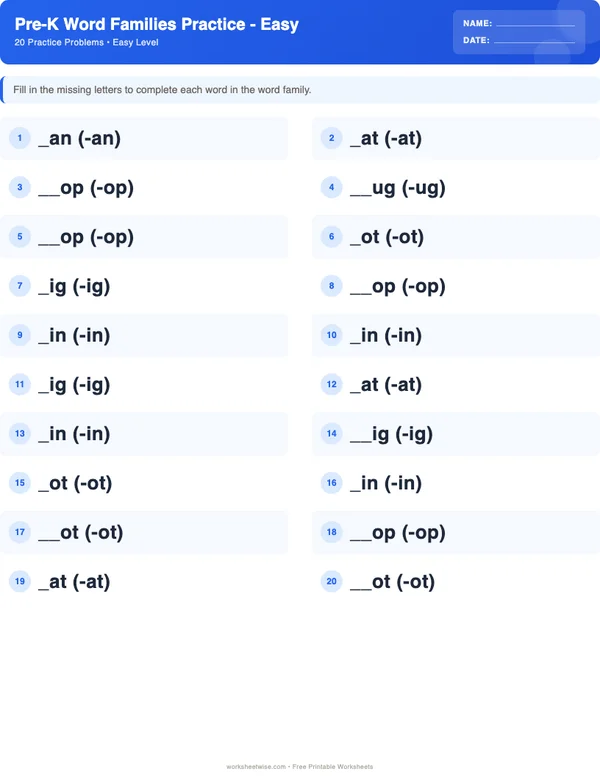
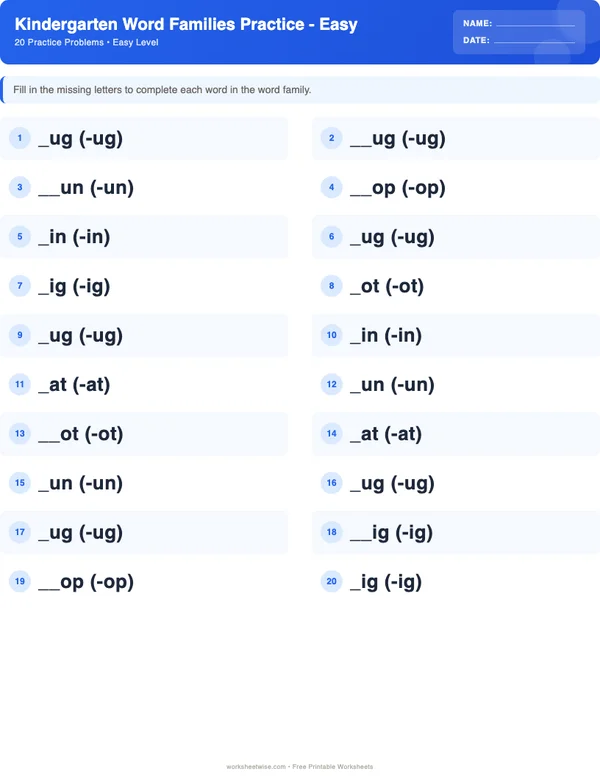
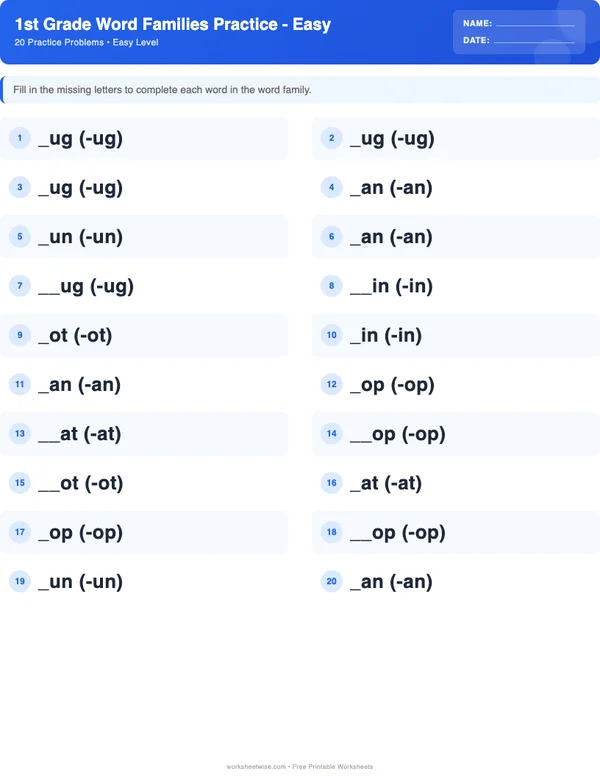
3 relevant free entry points are available. Each one includes a printable learner PDF and separate answer key.
A useful practice loop
Print less. Observe more.
- Choose one skill and model the first item aloud.
- Use a short set and notice the learner’s strategy.
- Change the next task from the work you can see.
Need more than the free sheet?
Plus includes all 54 matching catalogue variations where available, plus saved deterministic generators and the worksheet designer.
See Plus membershipComplete guide
How to teach and practise word families worksheets
3,400 words Updated 6 instructional visuals
Choose a Word Families Worksheet by the Work It Requires
Word families worksheets help beginning readers notice and use a stable spelling chunk—such as -at in cat, bat, and hat—while the beginning of the word changes. The useful progression is not simply “Pre-K, then kindergarten, then first grade.” It moves from hearing and building one family with substantial adult support, to reading and sorting several families, to applying familiar patterns in words and sentences with less prompting.
WorksheetWise currently lists 54 word-family variants across three grade combinations: Pre-K, kindergarten, and first grade. Each grade has one free entry point, for three free resources in total. The representative free sheet at each grade is labeled “easy” and contains 20 problems. Those labels identify catalogue starting points; they do not establish that three sheets require identical reading work.
Choose by observing what the learner can do:
- Start with one-family oral and manipulative work when the learner cannot yet hold -at constant while changing the first sound.
- Choose building, matching, or supported reading when the learner can hear the rhyme but needs help connecting sounds to letters.
- Choose mixed-family sorting when the learner can read several simple words and must decide which ending pattern each contains.
- Move toward sentences and words beginning with blends or digraphs only after simple consonant-vowel-consonant examples are reasonably accurate.
Age is a discovery aid rather than a placement decision. Grade labels describe intended practice level, and local curriculum sequences differ. A first grader may need the concrete starting point on the Pre-K page; a younger learner may already be ready to sort two familiar families orally. Use the task boundary, not the learner’s age or grade name, to make the final decision.
What the Shared Chunk Does—and Does Not Teach
A word family is a group of words sharing a recognizable ending pattern. In a simple example such as cat, the onset is c and the rime is at. Replace the onset, and the stable rime produces bat, hat, mat, and sat. This reduces how much of each new word must be worked out from scratch, but the learner still has to identify the beginning sound, blend it with the ending, and confirm that the result is a real word.
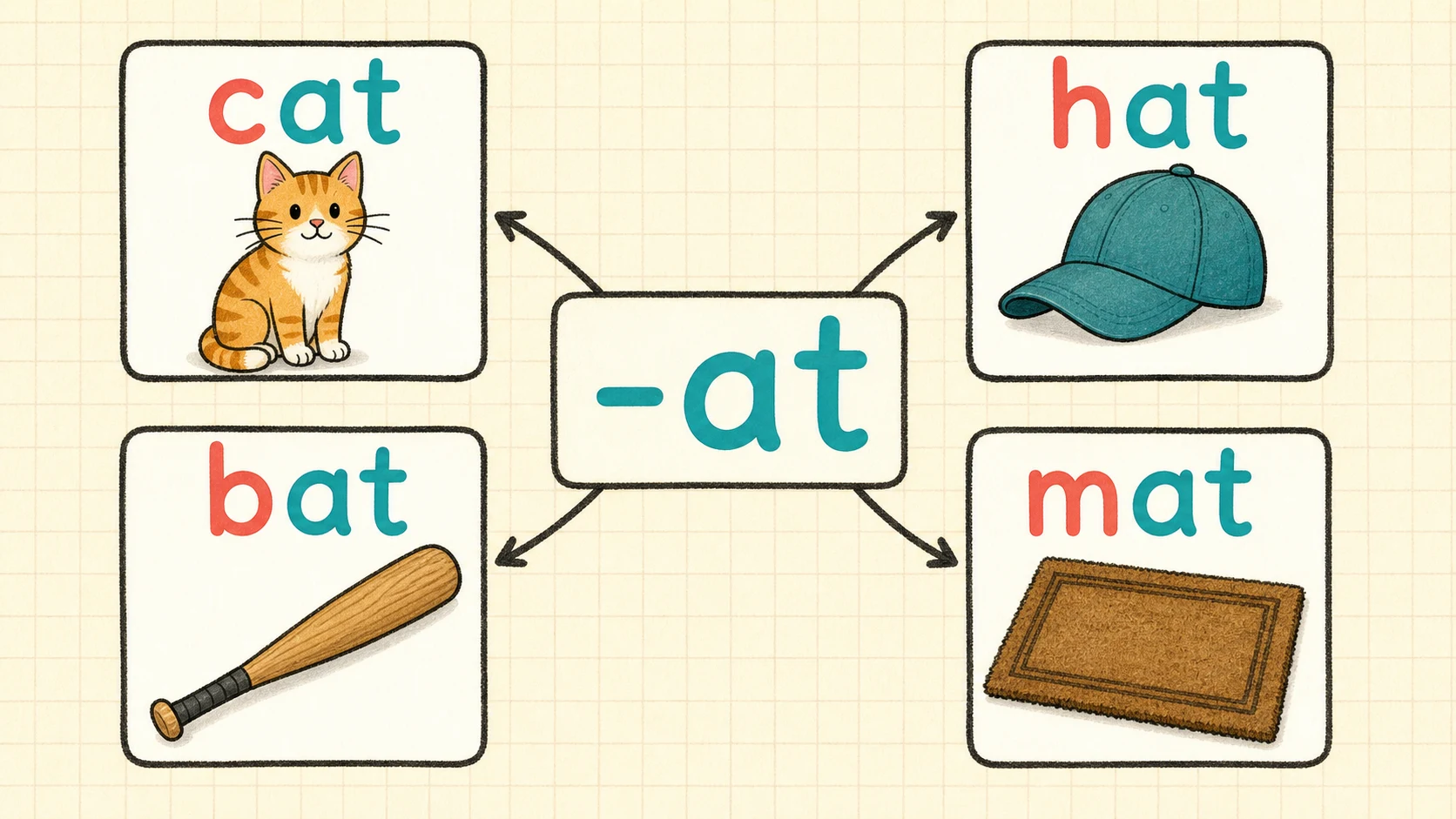
The central skill is using a stable ending while hearing, building, reading, sorting, and eventually writing complete words.
Word-family practice belongs inside systematic phonics teaching, not in place of it. The IES foundational reading practice guide recommends explicit work with sound segments and their links to letters, followed by decoding, word analysis, and connected-text reading. A family such as -at can support that sequence because the adult can make every sound-letter change visible. Merely memorizing a decorated list of rhyming words would not provide the same work.
Three boundaries matter:
- Rhyming is not yet decoding. A learner might say that cat and hat rhyme while being unable to read either printed word.
- Recognizing an ending is not enough. Reading cat correctly requires attention to c as well as -at.
- Pattern use is not a universal shortcut. Not every word with similar-looking letters behaves predictably, so adults should select regular, already taught examples and continue teaching broader phonics knowledge.
The catalogue describes practice through word wheels, rhyming activities, sentence reading, word building, and sorting. These are different representations of related knowledge. The best choice is the one that makes the learner perform the next missing action rather than repeat an action already secure.
The Three Catalogue Starting Points
The live catalogue offers real entry pages for Pre-K word families, kindergarten word families, and first-grade word families. Each representative free resource has 20 problems and carries the catalogue difficulty label “easy.” Here, “easy” should be interpreted through observable features: familiar short-vowel families, short or visually clear directions, limited competing patterns, and support that keeps attention on the changed onset and stable rime. It should never become a label for a learner.
Pre-K: hear, match, and manipulate
At this starting point, the adult should carry most of the reading and direction load. The child’s job can be brief and concrete: hear two words, decide whether they rhyme, choose a picture, move a letter tile, or repeat a newly built word. For ages three and four, prioritize brief adult-led oral, matching, manipulative, and movement work over desk work. A 20-problem page need not be completed in one sitting; cover most of it and reveal two or three items at a time.
A useful readiness check is: after the adult builds at, can the child swap m for s and say sat with help? If not, stay with oral blending and physical tiles. If so, a short matching or building activity can connect the sound change to print.
Kindergarten: connect sound changes to printed patterns
The kindergarten entry point is useful when a learner can hear a shared rhyme and is beginning to read or build regular short-vowel words. The work should make the spelling pattern explicit: keep -ig fixed, attach b, d, f, p, or w, and read each result. Once one family is manageable, compare it with a second family such as -op.
The task boundary has changed. Instead of only deciding whether two spoken words sound alike, the learner must inspect letters, produce or blend the onset, preserve the vowel sound in the rime, and read the whole word. Adult prompting can remain available, but it should point to the print: “What stayed the same?” and “Which letter changed?”
First grade: sort, read in context, and extend the onset
The first-grade entry point fits learners ready to use familiar families with less item-by-item support. Appropriate demands can include sorting mixed words by ending, reading a short controlled sentence, generating another member of a family, or handling an onset containing a digraph or blend.
That does not mean every first-grade learner should begin with chat or flat. The deciding evidence is whether simple forms such as cat, hat, and mat are read accurately without guessing. If changing c to fl causes the learner to drop one sound or abandon the rime, return briefly to tile building before expecting independent written responses.
A Checked Progression from One Rime to Connected Reading
The following progression uses verified catalogue families and teaching context. The examples have been checked letter by letter and sound by sound. They are suggestions for instruction, not claims about the exact item sequence on every downloadable sheet.
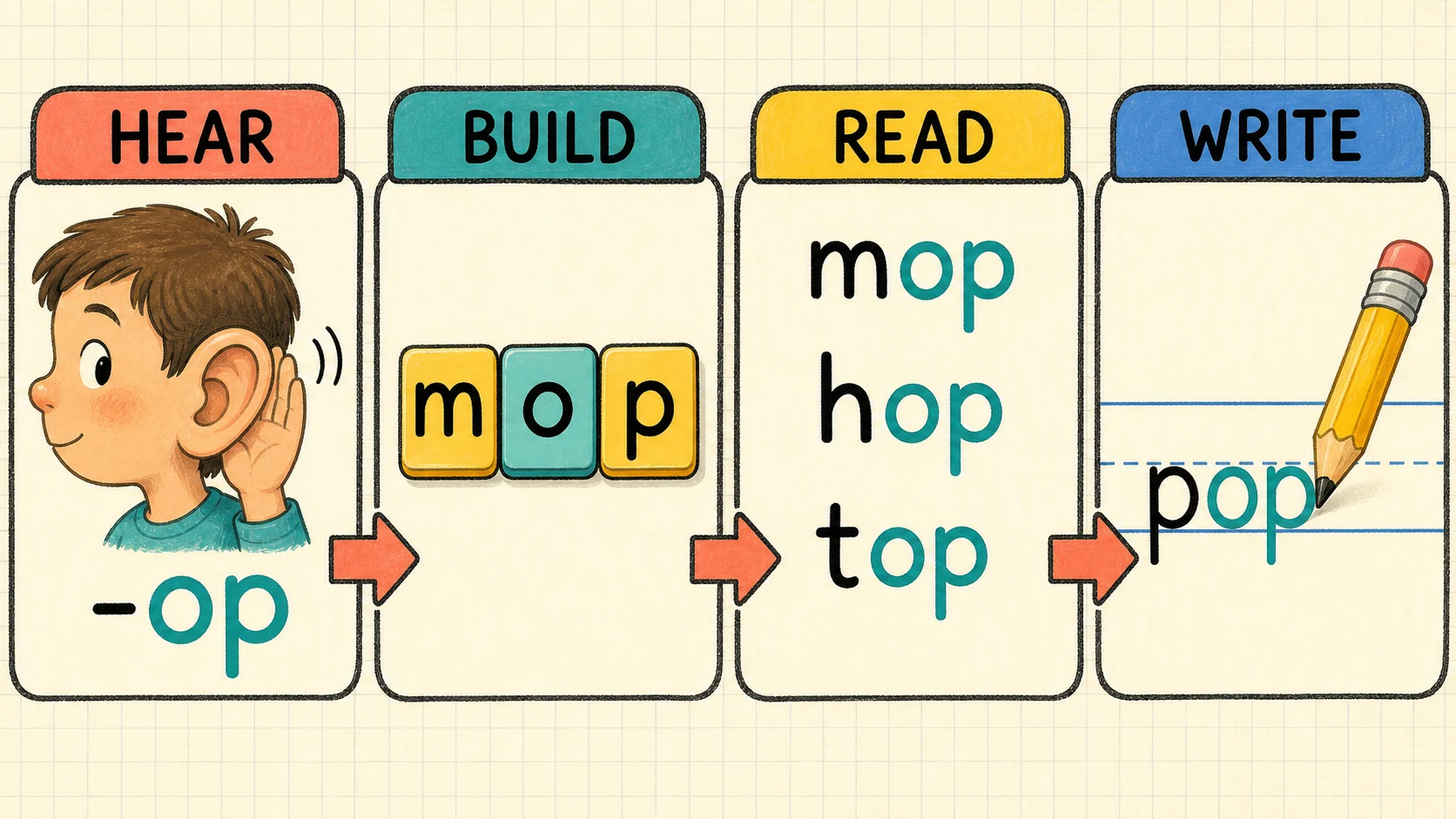
Support should fade as the task shifts from manipulating one visible family to choosing among patterns and reading them in context.
Example 1: preserve -at and change one onset
Place the tiles a and t together. Add c to make cat. Replace c with b, h, m, and s, reading bat, hat, mat, and sat after every swap.
The example is internally consistent: all five words preserve the written rime -at, all use the short a sound in ordinary beginning-reading pronunciation, and each initial consonant changes the onset without changing the ending. It belongs at the earliest part of this progression because the adult can keep at physically stationary and limit each step to one consonant replacement.
Observe whether the learner blends the whole word after each change. A learner who recites “cat, bat, hat” from memory but reads m-at as cat is not yet attending reliably to the onset.
Example 2: build and compare -ig words
Keep ig visible and build big, dig, fig, pig, and wig. Then mix the five onset tiles and ask the learner to rebuild two words named by the adult.
Each answer preserves -ig, and each is a regular three-letter word with one initial consonant. This example belongs after the one-family demonstration because rebuilding a named word requires the learner to distinguish the first phoneme and select its corresponding letter rather than merely repeat a displayed sequence.
A productive prompt is “Say pig slowly. Which sound comes before ig?” Avoid pointing immediately to p; that would remove the discrimination the activity is meant to reveal.
Example 3: sort -op and -ot
Give the mixed set hop, hot, mop, top, pot, and dot. The checked sort is:
- -op: hop, mop, top
- -ot: hot, pot, dot
All six are regular short-o words, but the final consonant differs between the families. This example belongs in the middle of the progression because the learner must compare two printed endings rather than operate inside one known group. It also reveals whether the learner attends to the complete rime. Sorting solely by the vowel o will not work because every word contains it.
Ask the learner to read each completed column. Correct sorting without successful reading may reflect visual matching; successful reading with one misplaced card may reflect a momentary comparison error. Those observations call for different responses.
Example 4: move from a simple onset to a blend or digraph
Compare cat, chat, and flat. Each word ends in -at. Their onsets are c, ch, and fl respectively. The digraph ch represents one consonant sound, while the blend fl retains two consonant sounds.
This example belongs later because holding -at constant is no longer the only challenge. The learner must process a multi-letter onset without dropping or rearranging its sound information. Build chat as ch + at and flat as fl + at before asking for independent writing. If the learner reads flat as fat, the family knowledge may be intact while the blend needs more attention. The consonant blends worksheet guide is the more targeted next resource when that error persists across words.
Example 5: read the family in a sentence
Use: “The fat cat sat on a mat.”
The checked -at words are fat, cat, sat, and mat. The, on, and a are not members of the -at family. This matters because the sentence asks the learner to recognize target words amid other words rather than treat every word as part of the same pattern.
The sentence belongs after isolated-word accuracy because connected reading adds spacing, left-to-right tracking, non-family words, syntax, and meaning. Ask one pattern question after reading: “Which four words share -at?” Then ask one meaning question: “What sat on the mat?” Pattern recognition should support reading, not replace comprehension.
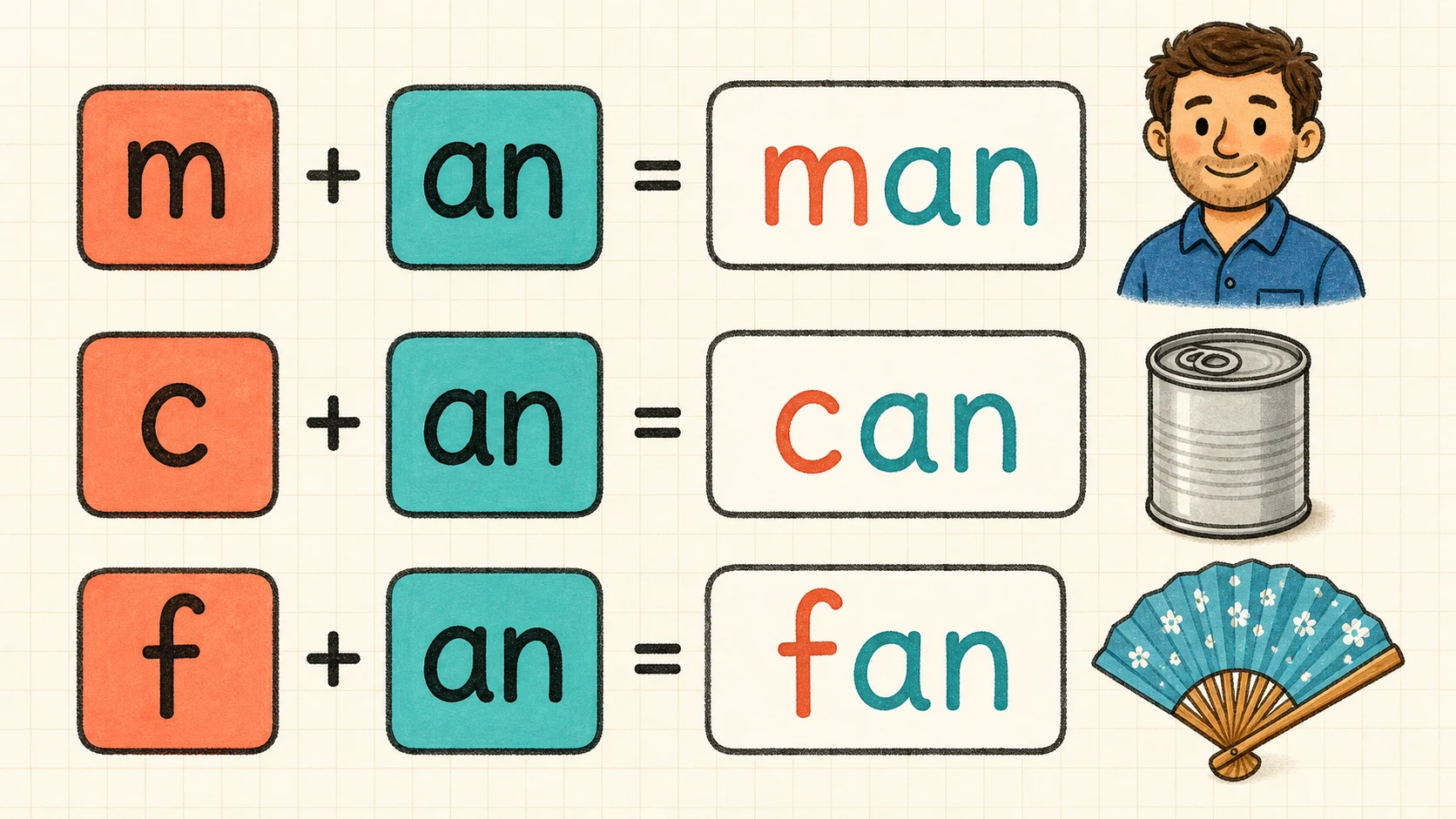
Moving from tiles to print preserves the same decoding decision while gradually removing the physical cue.
How Representation and Question Design Change the Work
Two activities can display the same six words while testing different skills. Before selecting a worksheet, identify the action hidden inside its directions.
Matching and word wheels
Picture-to-word matching reduces the writing demand, but pictures can allow guessing. Ask the learner to point under each letter and blend before matching. A word wheel makes the stable ending visible while the onset rotates; it is especially useful when the learner needs to see that only one part changes.
Use these representations for supported recognition and repeated blending. Do not interpret successful picture matching alone as proof of independent word reading.
Building and completing words
Letter tiles and flip books make the onset-rime structure tangible. A fill-in item such as c + at = ___ adds handwriting or letter-production demands, depending on how the blank is designed. If the target is decoding, let the learner say or select cat rather than requiring extensive copying.
A complete-the-onset prompt—“Add a letter to _at to make hat”—tests sound-letter selection. An open prompt—“Write another -at word”—also tests retrieval and spelling. The latter is a meaningful next step, not an interchangeable version of the former.
Sorting and sentence reading
Sorting requires comparison across options. Begin with two visually and aurally distinct families, then use closer contrasts such as -op and -ot. Ask for oral reading after the sort so visual grouping does not masquerade as decoding.
Sentence reading checks whether word-level knowledge remains available in context. The IES writing practice guide also emphasizes explicit instruction in foundational writing skills and opportunities to write for purposes. A short, controlled sentence using known family words can therefore become a modest bridge from reading to composition. This source offers general instructional guidance; it did not assess WorksheetWise or these catalogue resources.
For example, after reading “The fat cat sat on a mat,” the learner might substitute one checked family word to create “The fat cat sat on a hat.” The result is grammatically readable, even if delightfully improbable. The adult can then discuss meaning rather than rejecting a correctly patterned sentence merely because it is silly.
A Short Routine That Preserves the Decoding Target
A repeatable routine is more informative than asking a learner to finish all 20 problems without interruption.
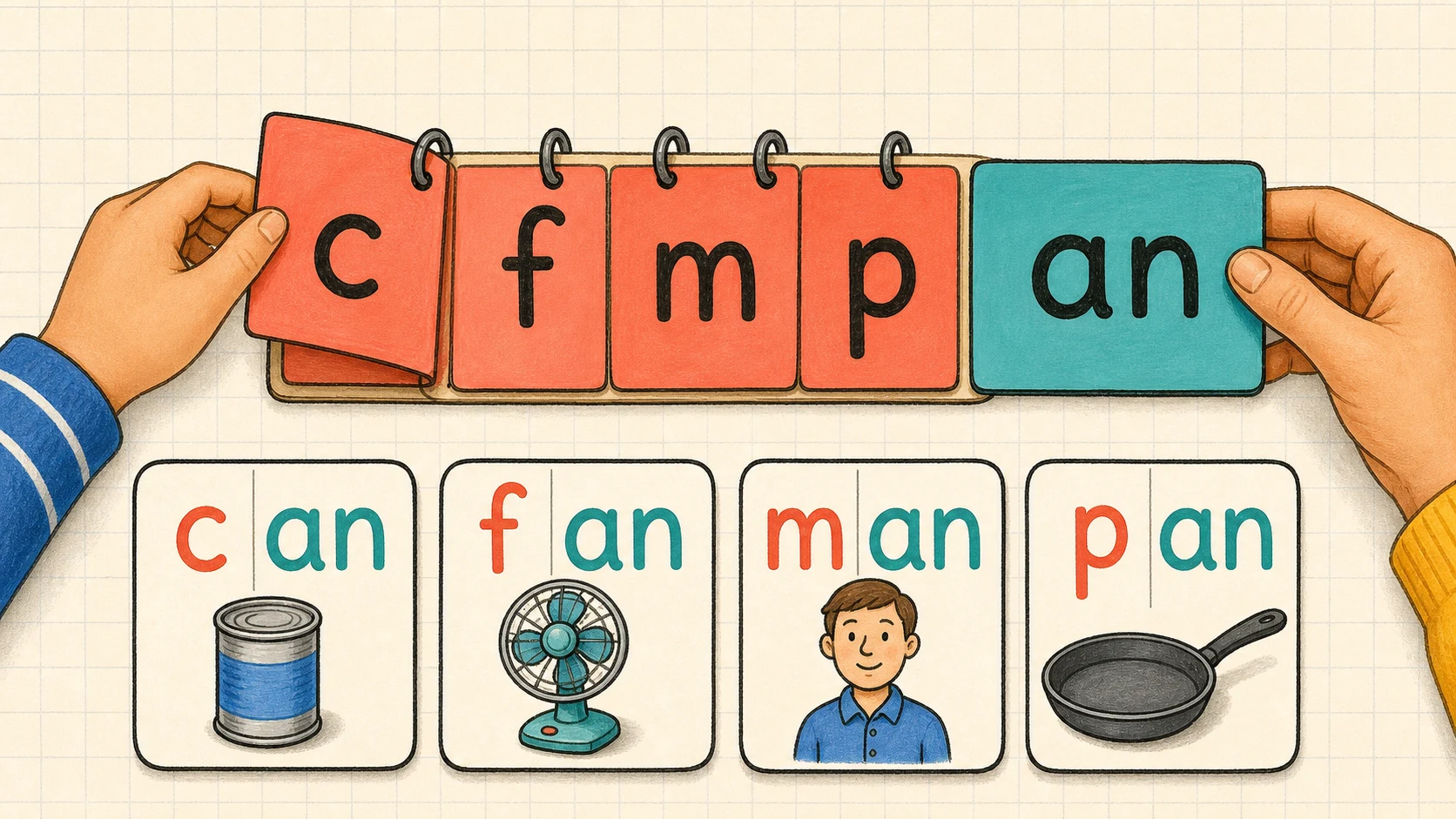
A compact lesson moves from hearing and building to reading, applying, and recording one observable next step.
Use this 10- to 15-minute sequence, shortening it for younger learners:
- Hear the family. Say two or three words, such as cat, hat, and mat. Ask what part sounds the same.
- Build the ending. Place a and t together. Have the learner touch and say the sounds, then blend at.
- Swap onsets. Add or replace the beginning tile. Read every new word rather than racing through silent construction.
- Complete a small worksheet sample. Reveal three to five items. Ask the learner to explain one answer by naming what changed and what stayed the same.
- Read in context. Use one brief sentence containing two or more known family words.
- Record the next action. Note something observable: “Next time, contrast -op and -ot,” or “Rebuild flat because l was omitted.”
Prompt from least to most support. First wait. Then ask the learner to identify the stable ending. Next invite sound-by-sound blending. Only then model the answer and have the learner rebuild or reread it. This sequence lets the adult see which step breaks down.
Do not make speed the first goal. Initial accuracy and attention to every sound are more useful selection evidence. Once a small set is read accurately, brief rereading can build smoother recognition without turning the activity into a timed test.
Interpret Errors by Their Location
An incorrect answer does not establish a diagnosis. It shows where to look during the next few items.
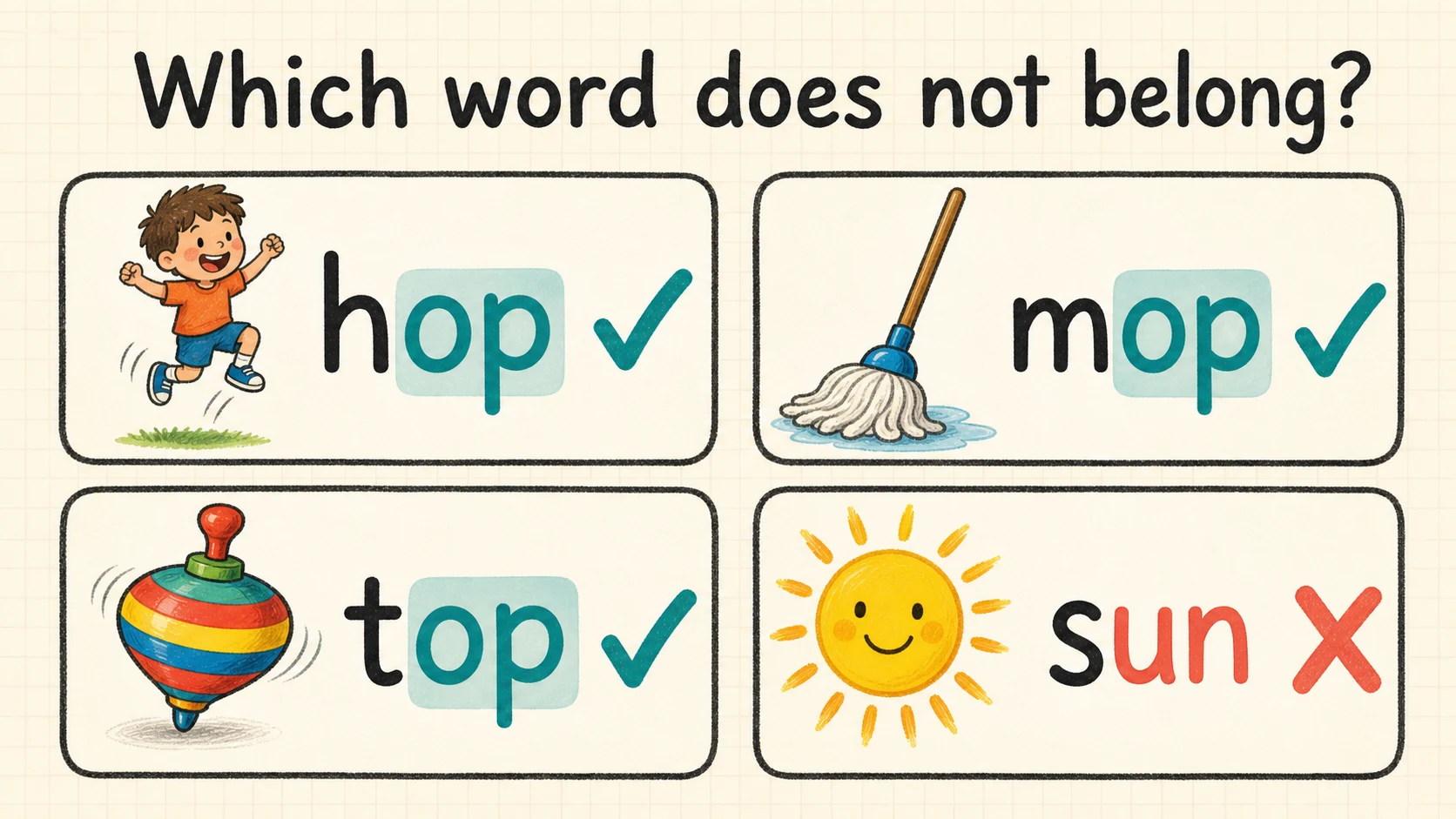
Respond to the part of the word or task that changed instead of assigning a broad ability label.
If mat is read as sat, cover at and compare m with s. Then restore the ending and blend both words. The learner preserved the family but confused or guessed the onset.
If pig is read with the vowel from peg, rebuild i + g, contrast it orally with e + g, and return to a familiar -ig word. The issue observed in that moment concerns the vowel or rime, not the idea of families as a whole.
If hop is placed under -ot, ask the learner to point to the last letter in hop and compare it with the heading. A correct reread followed by a corrected placement suggests a sorting or visual-comparison slip. Continued difficulty reading hop suggests that more direct decoding support is appropriate.
If flat becomes fat, isolate fl, stretch both consonants without inserting a vowel, and rebuild fl + at. Keep the word-family ending but reduce the new blend demand. If blend omissions recur, choose dedicated blend practice rather than advancing to longer word-family lists.
If the learner sorts perfectly but cannot read the columns, the worksheet may be permitting shape matching. Require oral reading of a few items or switch to tiles. If isolated words are accurate but the sentence is halting, keep sentence length short and examine whether non-family words or tracking create the added load.
These interpretations are teaching hypotheses to test immediately, not diagnoses. Look for the same error across several fresh examples before changing levels.
Adapt the Access Demand Without Removing the Skill
An adaptation should reduce an incidental barrier while preserving onset-rime analysis and decoding.
For a learner with limited writing stamina, allow pointing, movable letters, or oral answers. If the target is reading -an words, copying ten words is not essential. Ask the learner to build and read can, fan, and man, then write one if appropriate.
For visual crowding, cover unused rows and expose one item at a time. Enlarge the page if needed, but retain the complete word so the learner must inspect both onset and rime.
For attention or motor needs, put family headings on opposite sides of the room. The learner reads a card and walks it to -op or -ot. This replaces pencil marking with movement while preserving classification by ending pattern.
For multilingual learners, teach picture vocabulary before using pictures as response choices. A learner cannot demonstrate decoding through a picture whose English name is unknown. Say and discuss the word, then return to the print.
For ages three and four, use only a few adult-led oral, matching, manipulative, or movement turns. Stop before fatigue turns the activity into compliance practice. The remaining problems can be used another day.
Avoid adaptations that supply the answer: coloring every -at word one color in advance, reading every target aloud before the learner tries, or offering only one plausible choice. Those changes remove the decision the worksheet is meant to reveal.
Select the Next Real Worksheet from Evidence
Use five criteria when comparing the three catalogue entry points.
First, check the number of families competing on the page. One stable family supports initial building; two or more families introduce discrimination.
Second, inspect the onset complexity. Single consonants such as c, b, and m come before digraphs and blends such as ch and fl in this progression.
Third, identify the response mode. Matching, choosing, building, writing, sorting, and sentence reading impose different language, motor, and memory demands.
Fourth, count the supporting cues. Pictures, preprinted endings, family headings, and adult modeling can make a task accessible. Select fewer cues only when the learner succeeds without them.
Fifth, decide whether the page asks for isolated decoding or contextual application. Sentence reading is not automatically “better”; it is appropriate when isolated family words are already manageable.
The Common Core English language arts standards include grade-specific foundational reading expectations involving phonological awareness, phonics, and word analysis. They can help an adult understand the general progression, but they do not prove alignment for a particular WorksheetWise sheet. Local curriculum sequences and terminology differ, and the catalogue grade labels describe intended practice rather than mandatory placement.
Start at the Pre-K resource when the useful work is adult-led hearing, matching, and manipulation. Start at kindergarten when the learner can connect a heard rime to print and build regular short-vowel words. Start at first grade when the learner is ready to sort patterns, read them among other words, or add blend and digraph onsets. Move down temporarily whenever the representation—not merely the number of items—has become too demanding.
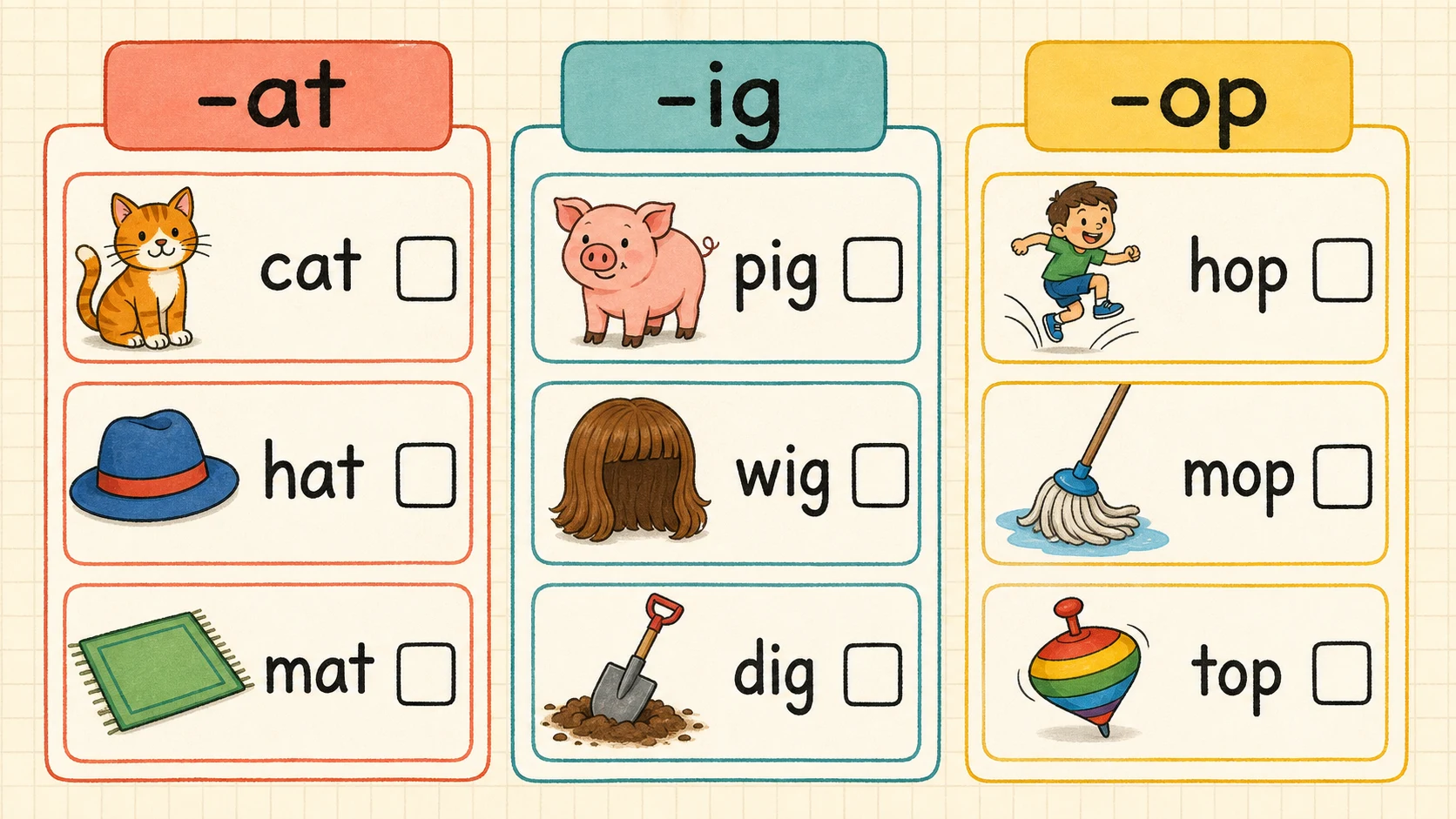
Across two weeks, alternate new families with short reviews and let observed errors determine which pattern returns.
A sensible suggestion is to introduce one or two families, revisit them after a gap, and mix them only after accurate one-family reading. That schedule is editorial guidance, not a sourced guarantee of progress. Twenty problems can be divided across sessions; completion is less important than seeing whether the learner reads the onset, retains the rime, and explains the grouping.
Make One Observable Placement Decision Today
Open the kindergarten Word Families guide and free sheet as the middle catalogue starting point. Preview three items rather than assigning all 20. Before using the page, build cat, hat, and mat with tiles or written cards. Then ask the learner to read each word and explain what stayed the same.
Use the response to make one concrete next decision: choose the Pre-K entry point if the learner needs adult-led oral or manipulative work to preserve -at; continue with the kindergarten sample if the learner can build and read the simple words with print support; or inspect the first-grade resource if the learner can already sort familiar families and read them in a short sentence. Record the exact evidence—such as “read five single-onset -at words, but omitted l in flat”—so the next worksheet addresses a visible task boundary rather than an assumed grade level.
Put it into practice
Use the guide with a real printable
Move from explanation to a short, observable practice task. Check the first item together, then adjust the next session from the learner's actual work.
Open the first free worksheetExplore a neighboring collection
Choose by a different teaching need
Addition Worksheets by Grade and Level Consonant Blends Worksheets by Grade and Level Counting Worksheets by Grade and Level CVC Words Worksheets by Grade and Level Decimals Worksheets by Grade and Level Digraphs Worksheets by Grade and Level Division Worksheets by Grade and Level Fractions Worksheets by Grade and Level