Curated collectionAnswer keys includedPrint-ready PDFs
Telling Time Worksheets by Grade and Level
Show the full telling time progression across 3 real grade combinations, compare task boundaries, model checked examples and explain how to choose the next level.
Start with a real resource
Browse this worksheet collection
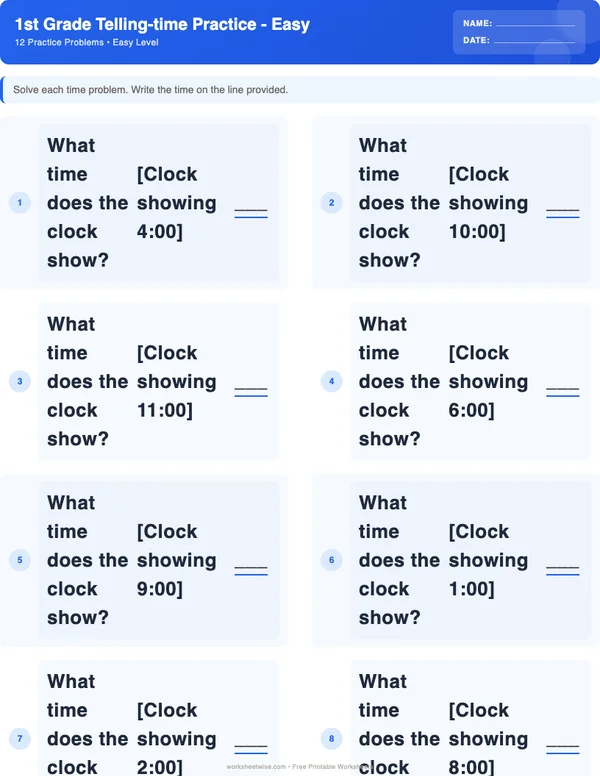
3 relevant free entry points are available. Each one includes a printable learner PDF and separate answer key.
A useful practice loop
Print less. Observe more.
- Choose one skill and model the first item aloud.
- Use a short set and notice the learner’s strategy.
- Change the next task from the work you can see.
Need more than the free sheet?
Plus includes all 54 matching catalogue variations where available, plus saved deterministic generators and the worksheet designer.
See Plus membershipComplete guide
How to teach and practise telling time worksheets
3,449 words Updated 6 instructional visuals
Choose by the clock task, not the grade label alone
Telling time worksheets should follow a visible progression: first understand how the hour hand moves, then read hours and half-hours, count minutes around the clock by fives, read more precise times, and finally reason about elapsed time. The right starting point is the first task a learner cannot yet complete accurately while explaining what both hands mean.
The live WorksheetWise catalogue contains 54 telling-time variants across three intended practice levels: 1st Grade, 2nd Grade, and 3rd Grade. Each grade has one free 12-problem entry sheet, for three free resources in total. Those grade labels are useful starting points, but they describe intended practice levels rather than fixed placement. Local curriculum sequences differ.
A learner working at a later grade level may still need hour-and-half-hour practice. Another may read clocks accurately but need a harder question format, such as drawing hands or finding elapsed time. Choose from evidence in the learner’s work:
- Start with hour and half-hour tasks when the learner cannot reliably identify which hand shows the hour.
- Move to five-minute intervals when the learner reads the hour correctly and can skip-count by five around a clock face.
- Introduce one-minute precision when the learner can locate five-minute landmarks without recounting from 12 every time.
- Use elapsed-time questions when the learner can read both starting and ending times independently.
- Reduce visual support before increasing calculation complexity if the learner succeeds only with numbered minute marks or prompts.
Age is a discovery aid rather than a placement decision. For ages three and four, prioritize brief adult-led oral, matching, manipulative, and movement work over desk work. A child can move a clock hand, match a pictured routine to morning or evening, or stand on floor markers arranged like a clock without being expected to finish a page of written questions.
What telling time requires a learner to coordinate
An analog clock combines several ideas that can be easy to conceal inside a correct-looking answer. The learner must distinguish the hands, understand that the hour hand moves continuously, interpret the minute hand’s position, and combine the two readings into one time.
The hour hand is not simply “pointing at a number.” At 3:45, it has traveled most of the way from 3 toward 4, but the hour is still 3 because the hand has not reached 4. The minute hand points to 9, representing nine groups of five minutes, or 45 minutes. Reading the hands separately and then combining them gives 3:45.
That reasoning is more important than memorizing positions. A learner who calls 3:45 “4:45” may know that the minute hand represents 45 minutes. The error is in deciding which hour is in progress.
The WorksheetWise catalogue description spans analog-clock reading, hour and half-hour times, five- and one-minute intervals, elapsed time, a.m./p.m., unit conversion, schedules, and time-related word problems. That description establishes the family’s scope; it does not mean every individual worksheet contains every task. Inspect the actual sheet before assigning it.
Build the hand relationship before asking for written answers
Begin with the hour hand alone
Use a demonstration clock with geared hands so moving the minute hand also moves the hour hand. Cover the minute hand and slowly turn the mechanism through a full hour. Ask:
- “Which hour have we passed?”
- “Which hour are we moving toward?”
- “Is it still 3-something, or has it become 4-something?”
- “What must happen before the hour changes?”
This makes the hour hand’s slow movement visible. Pause at approximately 3:00, 3:15, 3:30, 3:45, and 4:00. The exact minute is not the target yet. The target is recognizing that every position after 3:00 and before 4:00 remains within the 3 o’clock hour.
This is suggested teaching practice based on the page’s teaching anchor. It is not a claim that a particular WorksheetWise sheet includes a geared clock or an hour-hand-only activity.
Add the minute hand at two stable landmarks
Reveal the minute hand and begin with the o’clock and half-past positions. At 6:00, the minute hand is on 12 and the hour hand is on 6. At 6:30, the minute hand is on 6 and the hour hand is halfway between 6 and 7.
Have the learner read the hour hand first:
- The hour hand has passed 6 but has not reached 7.
- The minute hand is on 6, which represents 30 minutes.
- The time is 6:30.
The phrase “read the hour hand first” is useful because it prevents the longer, more visually prominent minute hand from controlling the answer.
The IES practice guide on Teaching Math to Young Children recommends intentional progression, mathematical language, and attention to children’s understanding rather than isolated answer production. A manipulable clock, adult questions, and a later move to drawn clocks put those principles into a telling-time context. The source offers general mathematics guidance; it did not evaluate WorksheetWise.
Compare the three real catalogue entry points
1st Grade: establish hour and half-hour meaning
The 1st Grade Telling Time guide and free sheet is the most sensible catalogue entry point when a learner is still coordinating the two hands or beginning with hours and half-hours. Its free sheet is catalogued as “easy” and contains 12 problems.
Here, “easy” describes the catalogue’s difficulty tag, not the learner. A useful beginning task should have observable supports or limits: familiar clock positions, uncluttered faces, a small interval set, direct prompts, or matching rather than multi-step calculation. Because the supplied catalogue facts do not identify the exact mix on the PDF, preview its clock positions and response formats before use.
Checked example 1: reading a half-hour. A clock has the minute hand on 6 and the hour hand halfway between 8 and 9. The answer is 8:30, not 9:30. Six five-minute groups make 30 minutes, and the hour hand has passed 8 without reaching 9. This example belongs at the beginning of the progression because it tests both hand roles at one of the two first minute-hand landmarks.
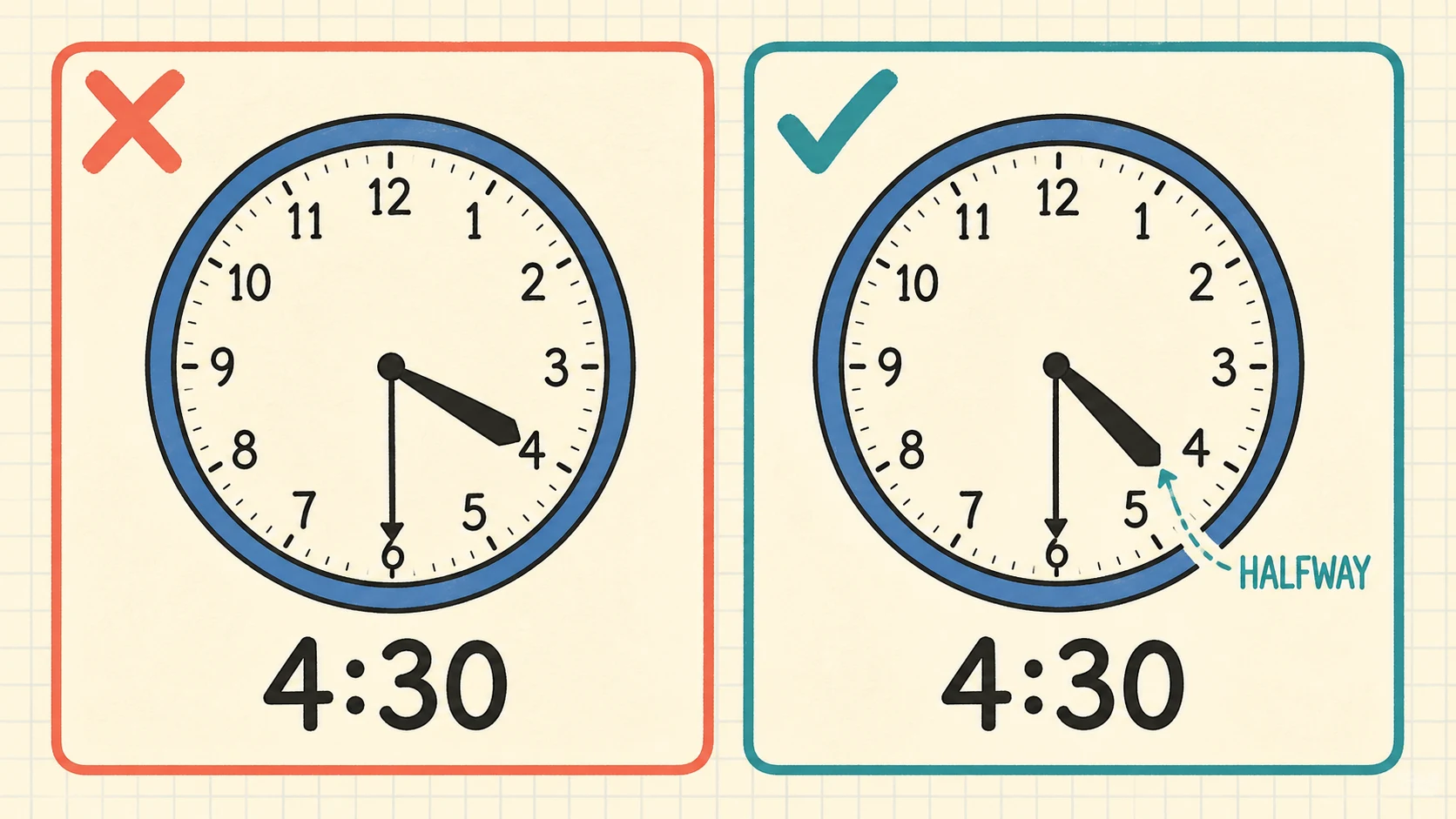
Use an early error pattern to decide whether the next practice should isolate hand identity, hour movement, or the half-hour position.
2nd Grade: organize minutes into groups of five
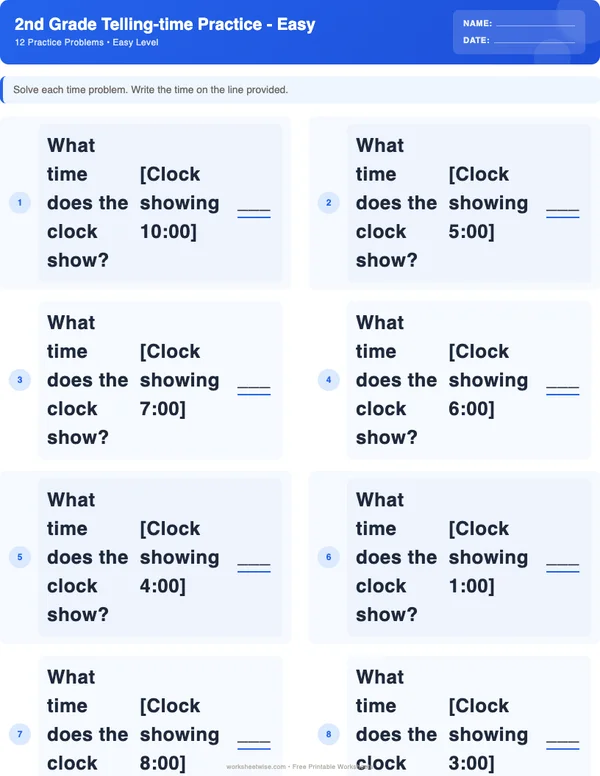
The 2nd Grade Telling Time guide and free sheet is a useful starting point when hour and half-hour readings are secure and the next task is interpreting five-minute positions. Its free resource is also catalogued as “easy” and contains 12 problems.
Before selecting it, ask the learner to point around an empty or numbered clock while saying 5, 10, 15, 20, and onward to 60. If that sequence is hesitant, work on the clock’s five-minute structure with counters, movement, or a demonstration clock before expecting independent written answers.
Checked example 2: reading a five-minute time. The minute hand points to 8, so the minutes are . The hour hand is between 2 and 3 and has not reached 3. The time is 2:40. This belongs in the middle of the progression because it depends on skip-counting by five and on interpreting an hour hand that is visibly closer to the next numeral.
The Common Core State Standards for Mathematics place hour and half-hour reading in Grade 1, five-minute reading in Grade 2, and nearest-minute reading plus elapsed-time problems in Grade 3. That sequence helps explain the catalogue’s three grade combinations, but it is not a placement rule or a claim of WorksheetWise standards alignment. Local curricula may introduce, revisit, or combine these tasks differently.
3rd Grade: add precision and elapsed-time reasoning
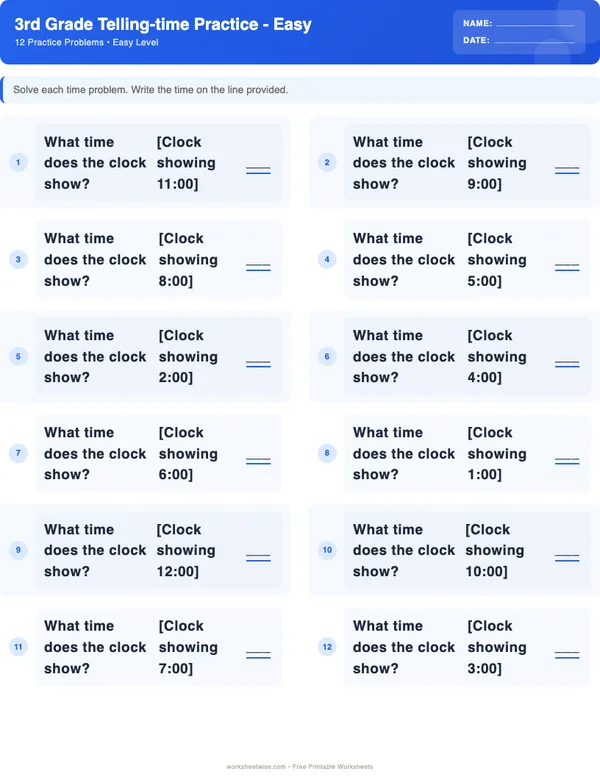
The 3rd Grade Telling Time guide and free sheet is the strongest catalogue entry point when the learner already reads common five-minute times and is ready for finer minute marks, elapsed time, schedules, or multi-step reasoning. Its free sheet carries the same “easy” catalogue tag and the same 12-problem count.
At this level, difficulty can change without changing the clock times. Reading 7:25 from a clearly marked clock is different from drawing 7:25, finding the end time 35 minutes later, or explaining whether an activity could reasonably occur in the morning. Define the level by what the learner must do:
- read or construct the representation;
- work to five-minute or one-minute precision;
- interpret one clock or coordinate two times;
- calculate an interval;
- extract time information from a schedule or word problem;
- explain a choice rather than enter a numeral only.
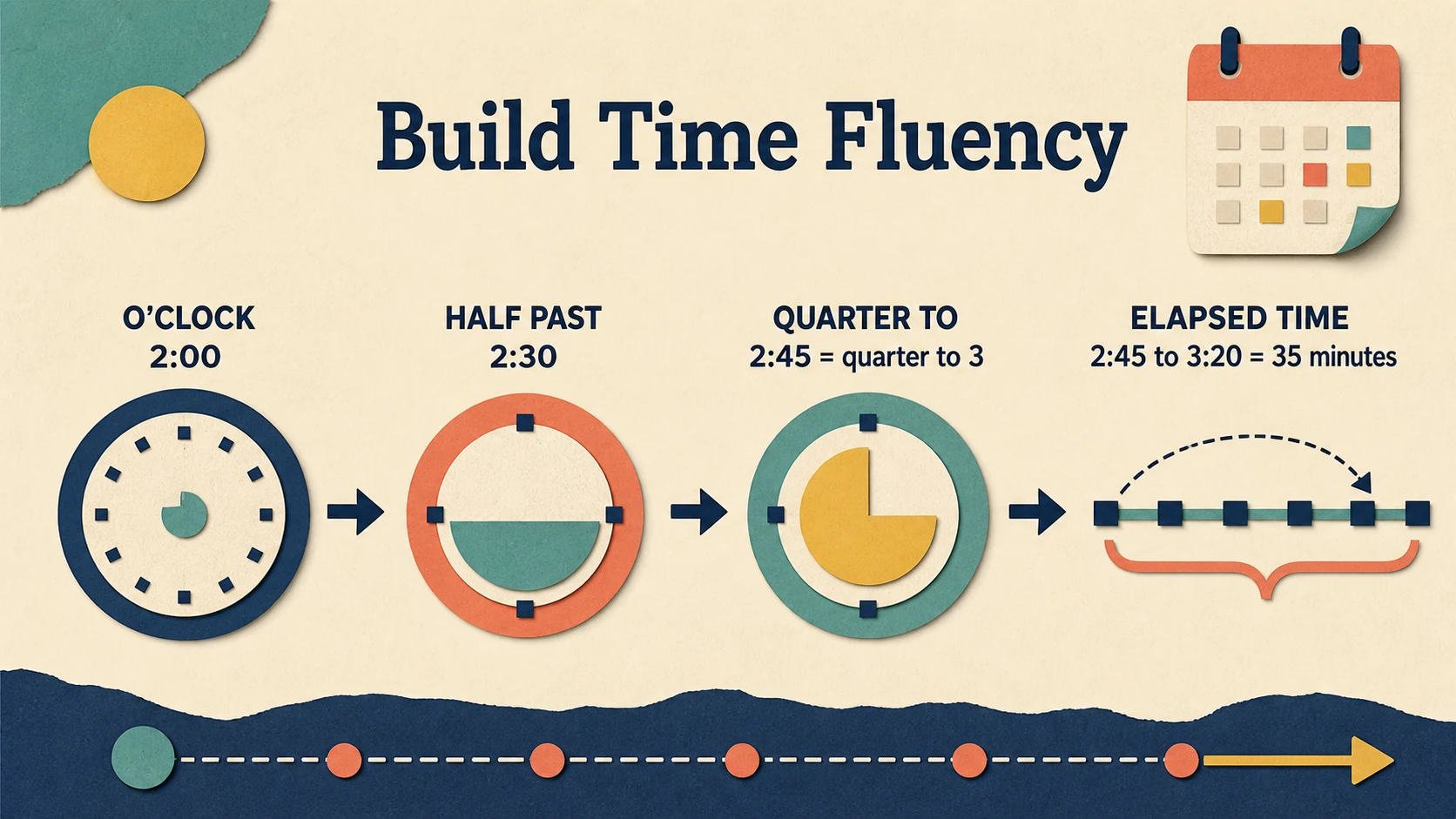
Increase independence by removing supports and changing the question demand only after the clock reading itself is dependable.
Watch how representation changes the demand
A worksheet’s apparent topic can hide several distinct tasks. Two pages both labeled “telling time” may require very different reasoning.
Reading, matching, and drawing are not interchangeable
In a reading task, the clock is given and the learner writes the time. The visual information already exists.
In a matching task, the learner compares clocks, digital times, or descriptions. This reduces writing but adds visual scanning and comparison.
In a drawing task, the learner must create the hour and minute positions. That requires more precision and may reveal whether the learner understands the hour hand’s movement. For 4:45, drawing the hour hand directly on 4 is inaccurate; it should be between 4 and 5, close to 5.
Checked example 3: drawing 4:45. Put the minute hand on 9 because . Put the hour hand between 4 and 5, about three-quarters of the way toward 5. The hour hand must not sit on 5 because 5:00 has not arrived. This example belongs after basic clock reading because constructing the hands removes the cue supplied by a completed clock face.
A useful adaptation for a learner with handwriting or fine-motor difficulty is to provide movable hands, hand-shaped cutouts, or a clock model and allow pointing instead of drawing. That preserves the target skill—representing 4:45—while reducing the unrelated motor demand.
Numbered minute marks can support or conceal understanding
A clock that labels every five-minute interval offers more support than one showing only the numerals 1 through 12. A face with individual tick marks requires the learner to anchor at a nearby five-minute landmark and count additional minutes.
To move from 7:25 to 7:27, keep the minute hand near the 5 and count two tick marks beyond 25. Do not remove all labels at once if the learner still recounts from zero. First retain the hour numerals, then reduce minute labels, and finally ask for an unlabelled or self-drawn representation when appropriate.
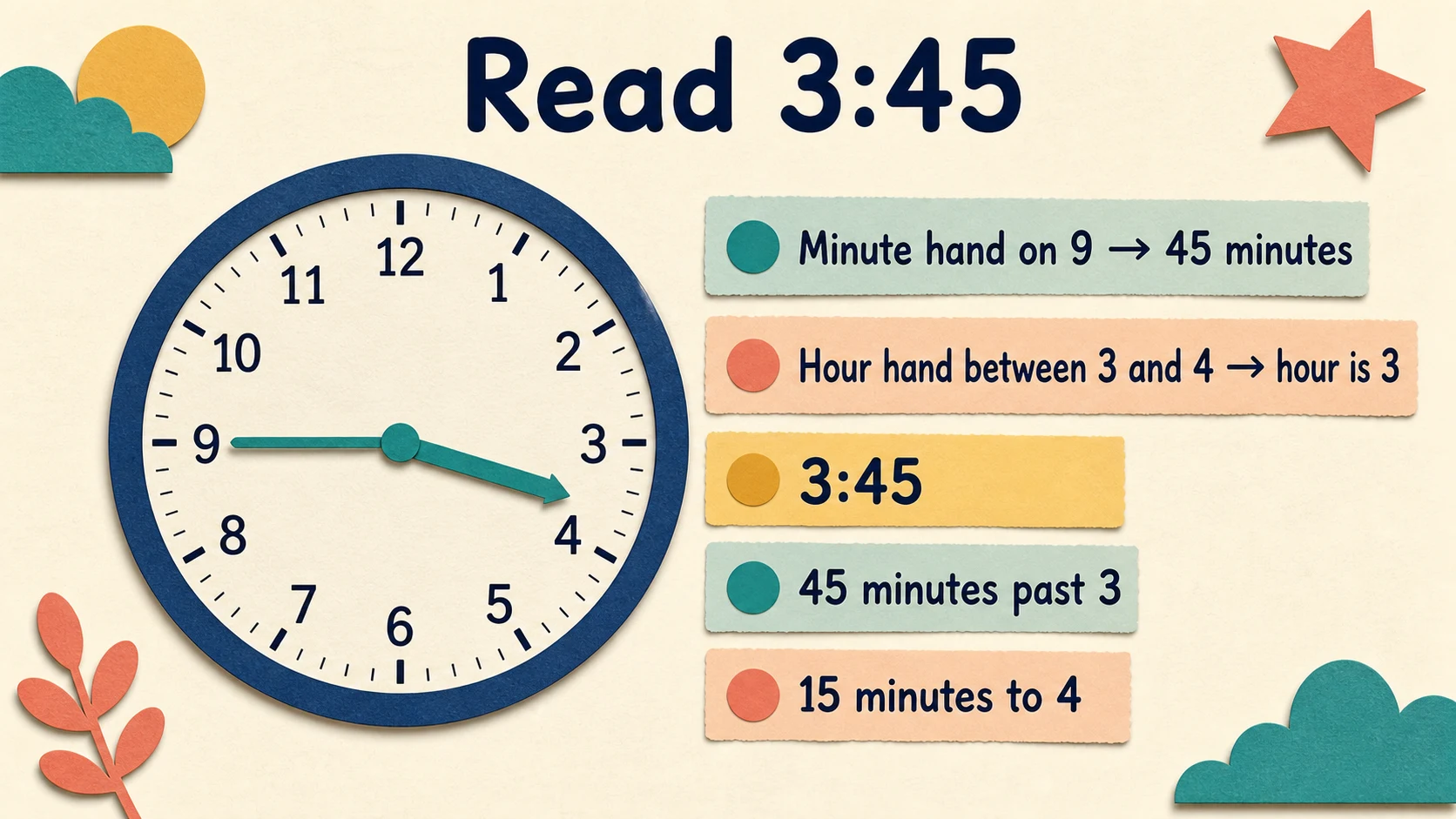
Move from a clock that can be manipulated to a drawn clock and then to notation while keeping the same time constant.
Use a repeatable clock-reading routine
A short routine lets an adult see where reasoning breaks down instead of merely marking the final answer wrong.
The five-step routine
- Locate the hour hand. Ask which numeral it has passed and which it is moving toward.
- Name the hour in progress. If the hand has passed 3 but not reached 4, say “It is still 3-something.”
- Locate the minute hand. Identify its five-minute landmark.
- Count any extra minute marks. Start at the closest known landmark rather than recounting from 12.
- Say and write the complete time. Check that the written hour agrees with the interval shown by the hour hand.
Use two or three demonstration clocks, then a brief group of worksheet items. Stop if the learner repeats the same structural error. More items completed with the same misconception do not provide new information.
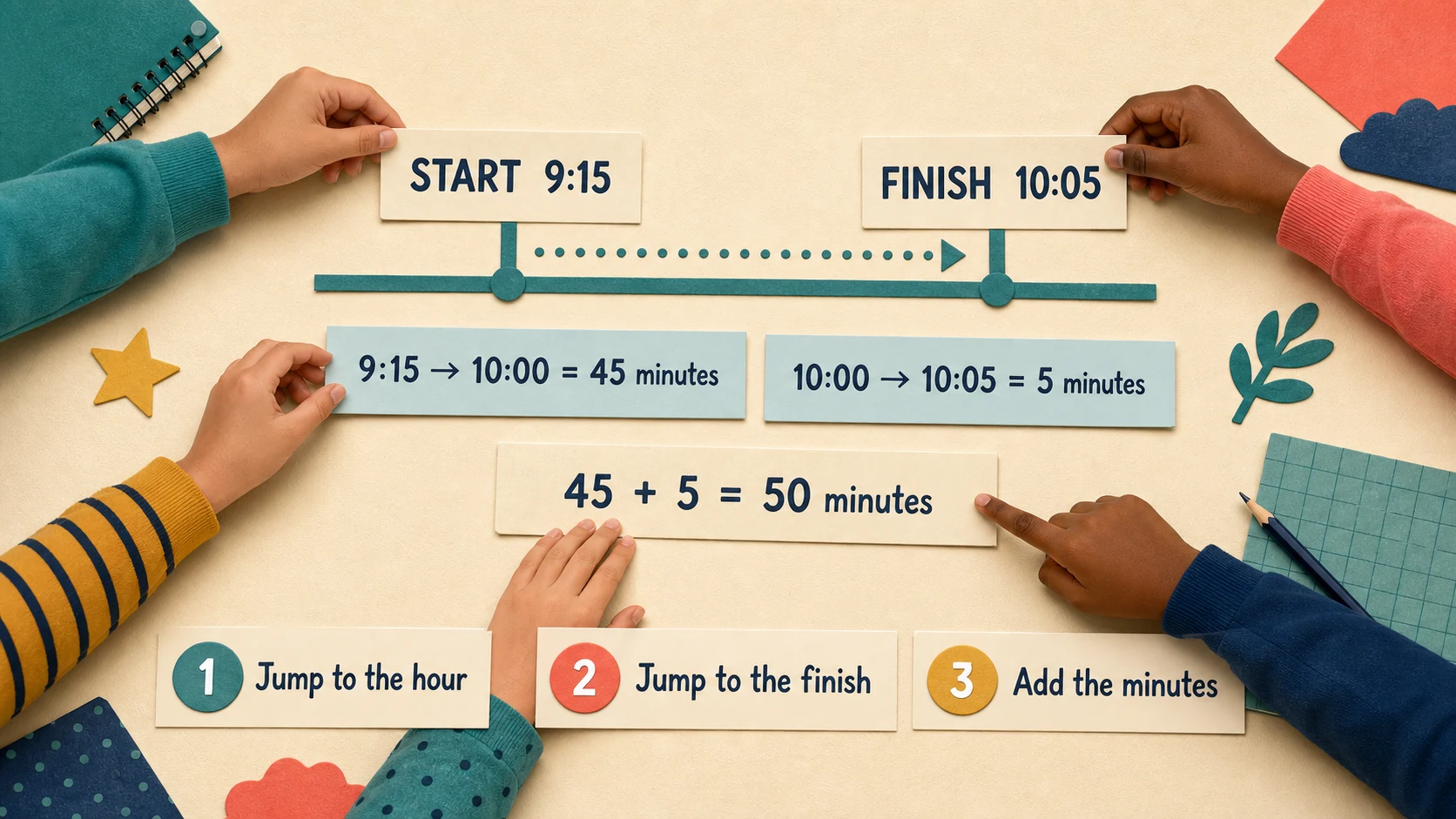
Keep the reading sequence stable so the learner can focus on changing hand positions and minute intervals.
The IES guide on Assisting Students Struggling with Mathematics supports explicit, systematic instruction, visual representations, precise mathematical language, and regular checks of understanding. Applied here, that means modeling the hand-reading sequence, asking the learner to explain it, and responding to the specific step that failed. This is an editorial application of the guide, not evidence about a WorksheetWise product.
Treat wrong answers as evidence about the next prompt
“3:45” read as “4:45”
This is the central hour-boundary error. The learner may correctly read 45 minutes but choose the nearest numeral to the hour hand.
Return to a geared clock. Move from 3:30 toward 4:00 and repeat: “The hour hand hasn’t reached the 4 yet, so it’s still 3-something.” Contrast 3:59 with 4:00. The next action is not necessarily an easier minute interval; it is targeted practice identifying the hour in progress after the half-hour.
“2:40” read as “2:08”
The learner is probably naming the numeral touched by the minute hand rather than converting its position into minutes. Ask the learner to trace clockwise from 12 while skip-counting 5, 10, 15, and so on. Keep the hour constant during the first few examples so the minute structure is the only changing feature.
The hands are reversed
A response such as 6:15 for a clock showing the short hand near 3 and the long hand on 6 suggests confusion about hand roles. Avoid relying only on “short” and “long,” since drawings can make that distinction subtle. Use movement and function: the hour hand moves slowly; the minute hand completes a full turn each hour.
A correct answer without a stable method
If a learner identifies 9:35 correctly but cannot explain why the hour is 9, present another clock at 9:40 or 9:45. One answer may have been guessed from the nearby numerals. Placement decisions should use a small pattern of responses and explanations, not one item.
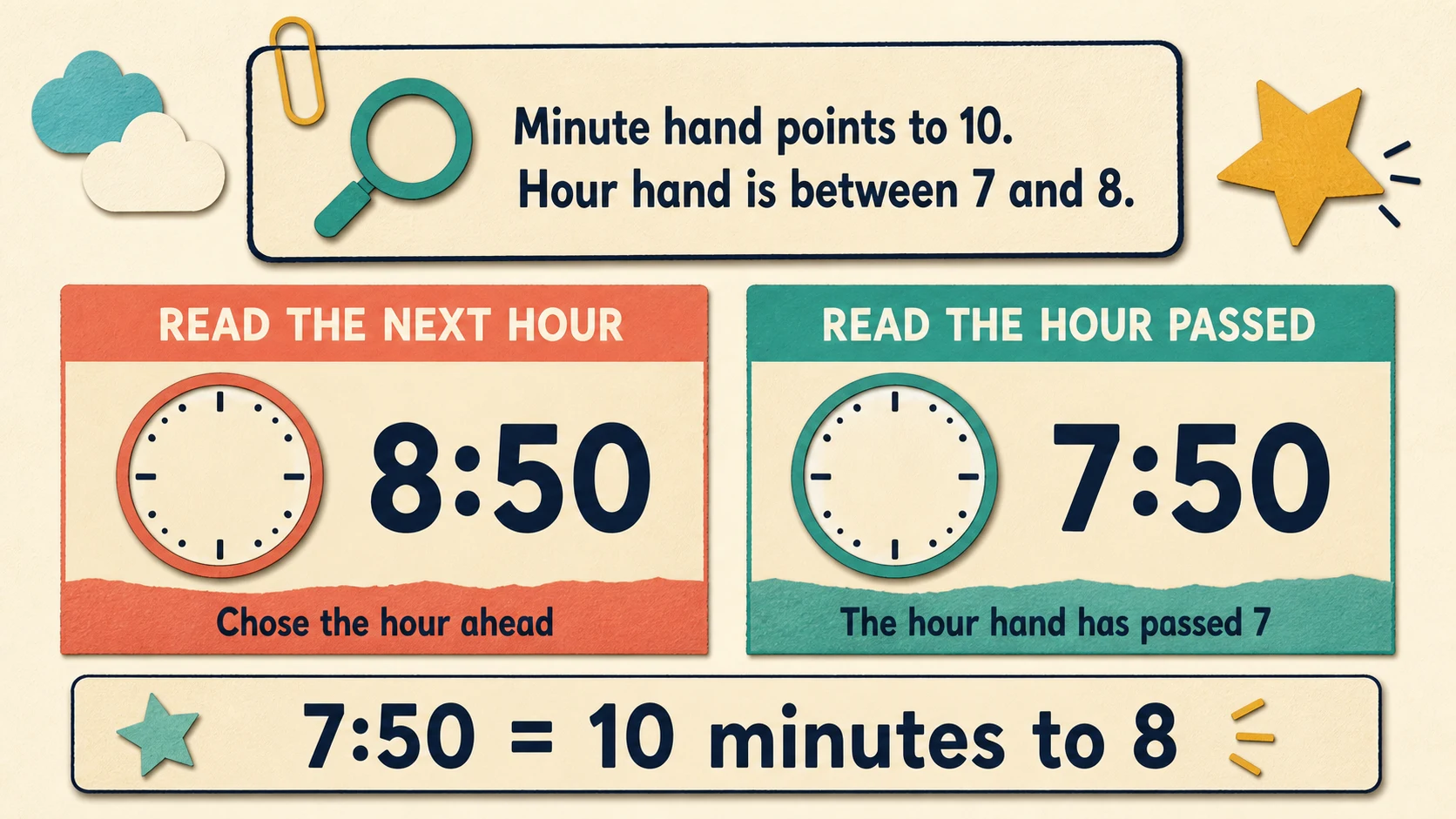
Match the response to the error source: hand identity, hour boundary, minute counting, notation, or interval reasoning.
These observations guide instruction; they are not diagnoses. Fatigue, unfamiliar graphics, language demands, attention, vision, motor demands, or an ambiguous clock drawing can also affect a response.
Teach elapsed time with forward jumps
Elapsed time introduces a new boundary. Reading two clocks is not sufficient; the learner must reason about the interval between them.
Use an open number line. Write the starting time on the left and the ending time on the right. Make convenient forward jumps in hours and minutes.
Checked example 4: 2:35 to 4:10.
- Start at 2:35.
- Jump 25 minutes to 3:00.
- Jump 1 hour to 4:00.
- Jump 10 minutes to 4:10.
- Combine the jumps: minutes, or 1 hour 35 minutes.
Check the result by moving forward from 2:35: after one hour it is 3:35, and after 35 more minutes it is 4:10. This example belongs at the later boundary because it crosses two hour marks and requires composing an interval rather than merely reading a clock.
A different valid number line could jump from 2:35 to 3:35 and then to 4:10. Comparing strategies can be useful after the learner understands that every jump represents elapsed time.
Avoid introducing this through column subtraction that treats 60 minutes as if it were an unfamiliar regrouping trick. The open number line preserves the meaning of time passing and makes each hour boundary visible.
For an initial task, choose times that cross one clear hour boundary, such as 8:45 to 9:20:
- 8:45 to 9:00 is 15 minutes.
- 9:00 to 9:20 is 20 minutes.
- Total elapsed time is 35 minutes.
This is checked example 5. It belongs before the 2:35-to-4:10 example because it uses only minute jumps and one hour boundary. If the learner finds 35 minutes accurately, the next observable action is to try an interval longer than one hour.
Plan practice that changes one demand at a time
A worksheet should be part of a short teaching cycle, not the entire lesson. A workable session might include three minutes with a geared clock, five minutes of oral explanation, six carefully selected worksheet questions, and a final independent check.
Across several sessions, change one variable at a time:
- Keep the response format constant while moving from hour to half-hour times.
- Keep the interval at five minutes while moving from labeled to less-labeled faces.
- Keep the times constant while changing from reading to drawing.
- Keep clock reading simple while introducing an elapsed-time number line.
- Mix tasks only after each component is reasonably stable.
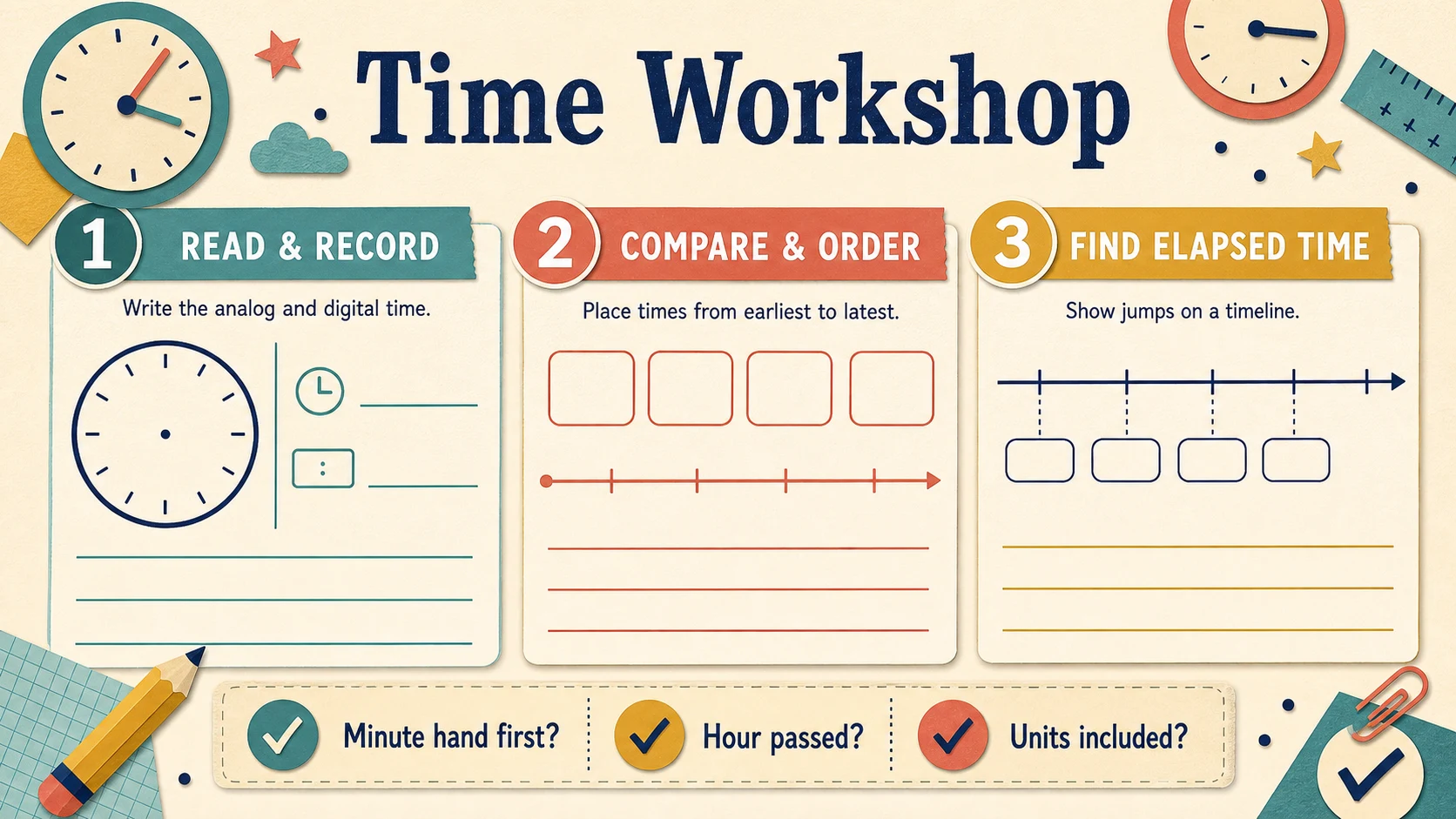
Revisit clock reading while gradually adding drawing, precision, and elapsed-time decisions instead of replacing one task immediately with another.
For a learner who needs less visual load, present half a page at a time, cover unused questions, enlarge the clock faces, or provide a reading window. For a learner who understands the time but struggles to write numerals, accept an oral response or matching card. For a learner learning English, preteach “hour hand,” “minute hand,” “past,” “before,” “start,” “end,” and “elapsed.”
These adaptations preserve telling-time reasoning. Changing every analog clock into a digital display would not preserve the target if the intended skill is interpreting analog hands.
Select the real worksheet by previewing five features
Begin with the grade page closest to the learner’s current task, then preview the actual free sheet. The three catalogue entry sheets each contain 12 problems and are tagged “easy,” but that shared label does not establish identical task demands.
Check five features before printing:
- Interval: Are times limited to hours and half-hours, shown in five-minute steps, or precise to individual minutes?
- Representation: Are the clocks fully numbered, marked by fives, lightly labeled, or unlabelled?
- Response: Must the learner read, match, draw, calculate, or explain?
- Boundary demand: Do hour hands remain near a numeral, or do examples include times past 30 minutes when the hand approaches the next hour?
- Reasoning load: Is each item a single clock reading, or must the learner coordinate a schedule, word problem, or elapsed interval?
Select a page where most items rehearse the current target and a small number reveal readiness for the next one. If every item requires adult rescue, step back in task features. If every answer is immediate and the learner can explain the hand positions, increase one feature: precision, reduced labeling, construction, or interval reasoning.
The catalogue’s “easy” difficulty tag should therefore be translated into visible worksheet evidence. It must never become a label for the learner.
Know the boundary of what a worksheet can show
A completed page can show accuracy on the clocks and question formats presented. It cannot by itself establish durable understanding, standards mastery, a diagnosis, or the ability to use time in every daily context.
A learner may read printed clocks but struggle with a wall clock whose hour hand moves continuously. Another may solve familiar five-minute positions but not draw them. A third may calculate elapsed time on a number line but misread a schedule’s headings. Check understanding through more than one representation and ask for a brief explanation.
The approved sources describe broad instructional and curriculum guidance. They do not provide reviews, outcomes, or endorsements of WorksheetWise. Likewise, the catalogue facts establish the available grade combinations, counts, descriptions, and free entry points; they do not establish how any individual learner will respond.
Make the next choice from one fresh clock
Before downloading a sheet, show a geared or drawn clock at 3:45 and ask the learner to read the hour hand first, explain why the hour is still 3, and then count the minutes. Use the response to choose the next real resource:
- If hand roles or the hour-in-progress idea is unclear, open the 1st Grade Telling Time guide and free sheet.
- If the hour is correct but counting around the face by fives is not yet dependable, use the 2nd Grade Telling Time guide and free sheet.
- If 3:45 is read and explained accurately, open the 3rd Grade Telling Time guide and free sheet and preview its 12 problems for reduced supports, precise minutes, drawing, or elapsed-time demands.
Assign six questions first, listen to the reading routine, and let the observed error—or a fully explained success—determine the following session.
Put it into practice
Use the guide with a real printable
Move from explanation to a short, observable practice task. Check the first item together, then adjust the next session from the learner's actual work.
Open the first free worksheetExplore a neighboring collection
Choose by a different teaching need
Addition Worksheets by Grade and Level Consonant Blends Worksheets by Grade and Level Counting Worksheets by Grade and Level CVC Words Worksheets by Grade and Level Decimals Worksheets by Grade and Level Digraphs Worksheets by Grade and Level Division Worksheets by Grade and Level Fractions Worksheets by Grade and Level