Curated collectionAnswer keys includedPrint-ready PDFs
Money Worksheets by Grade and Level
Show the full money progression across 3 real grade combinations, compare task boundaries, model checked examples and explain how to choose the next level.
Start with a real resource
Browse this worksheet collection
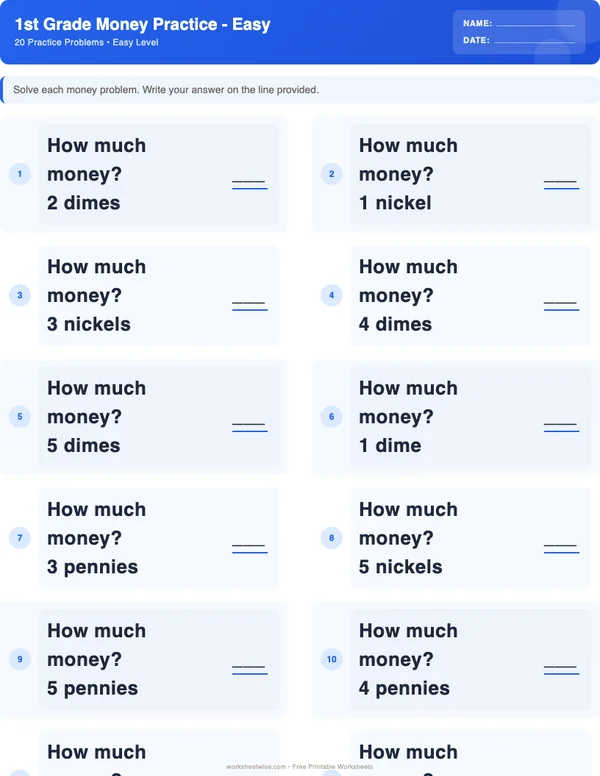
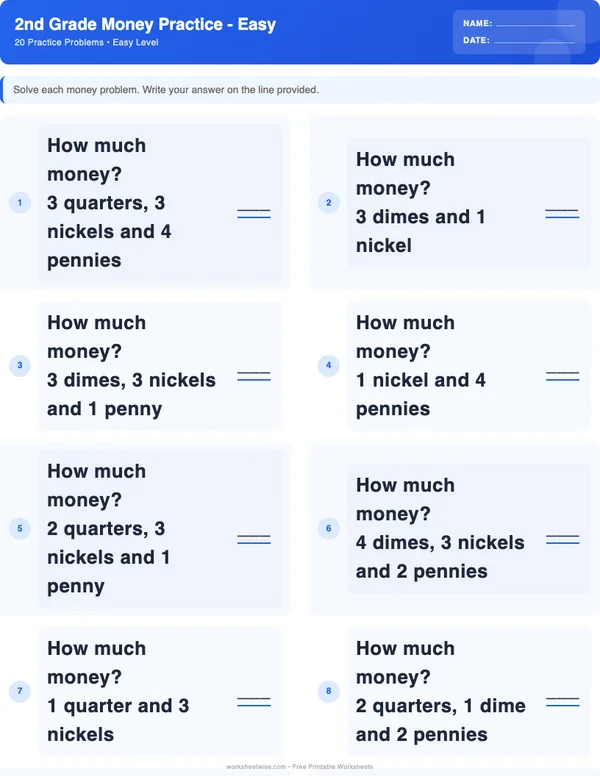
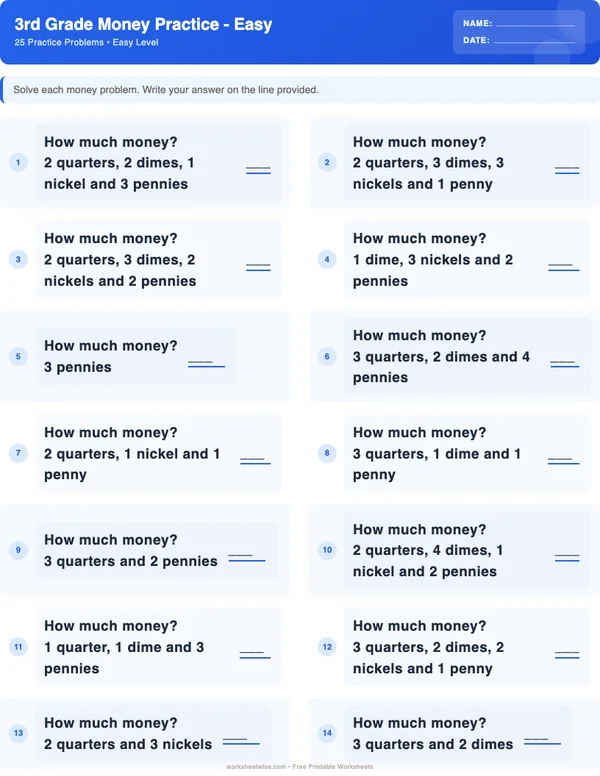
3 relevant free entry points are available. Each one includes a printable learner PDF and separate answer key.
A useful practice loop
Print less. Observe more.
- Choose one skill and model the first item aloud.
- Use a short set and notice the learner’s strategy.
- Change the next task from the work you can see.
Need more than the free sheet?
Plus includes all 54 matching catalogue variations where available, plus saved deterministic generators and the worksheet designer.
See Plus membershipComplete guide
How to teach and practise money worksheets
3,266 words Updated 6 instructional visuals
Choose by the work on the page, not only by the grade label
Money worksheets should move learners through a connected sequence: recognize coins, connect each coin to its value, count same-coin groups, count mixed collections, compare totals, and use dollars and cents in purchase or change problems. The right starting point is the first task a learner can complete accurately while explaining how the amount was found—not necessarily the worksheet bearing the learner’s current grade.
WorksheetWise currently lists 54 money worksheet variants across three grade combinations: 1st Grade Math, 2nd Grade Math, and 3rd Grade Math. Each grade has one free entry point. The 1st- and 2nd-grade free sheets contain 20 problems; the 3rd-grade free sheet contains 25. Those facts help narrow the catalogue, but problem count does not reveal cognitive demand. A page with 20 mixed-coin totals may be harder than a page with 25 single-step purchase questions if the latter supplies clear price labels and familiar amounts.
Grade labels describe intended practice levels; local curriculum sequences differ. Use age, when shown elsewhere, as a discovery aid rather than a placement decision. For ages three and four, prioritize brief adult-led oral, matching, manipulative, and movement work over desk work. A child might match a real penny to a penny picture, carry a coin to a labeled value card, or help sort play coins for two minutes. A full worksheet is usually not the useful starting format.
The catalogue calls each free sheet “easy,” but that label should describe observable task features, not a learner. On this page, treat an easier starting task as one with familiar coin images, one operation or decision per item, limited denominations, and no unnecessary language. A more demanding task may mix denominations, require choosing a counting order, combine dollars and cents, hide the operation inside a shopping situation, or require more than one step.
What learning money actually requires
Money work combines several ideas that can fail independently. A learner must recognize a coin despite differences between its size and value, remember the denomination, skip-count by the relevant interval, maintain a running total, and record that total with the correct unit. A shopping problem adds reading, operation choice, and judgment about whether the payment is sufficient.
That is why “knows coins” is too vague. Separate the evidence:
- Identification: “This is a dime.”
- Value: “A dime is worth 10 cents.”
- Same-coin counting: “10, 20, 30, 40 cents.”
- Mixed-coin counting: “25, 35, 40, 41 cents.”
- Representation: “41¢” and, when dollars are in scope, “$0.41.”
- Application: “The toy costs 38¢, so 41¢ is enough.”
- Change: “From $3.67 to $5.00 is $1.33.”
The instructional anchor for this catalogue is concrete experience. Begin with real coins or realistic play coins so learners can see, turn, sort, and handle them. A printed coin image freezes one view; an actual coin lets the learner notice both faces, edges, size, color, and inscriptions. The worksheet should record or extend an idea already encountered with objects, not carry the entire teaching burden.
This concrete-to-representation movement is consistent with the IES guide on teaching mathematics to young children, which recommends intentionally helping children connect informal mathematical experiences, representations, and mathematical language. That source did not assess WorksheetWise or its materials. Here, the page-specific application is straightforward: build 35¢ with coins, say the count aloud, and only then answer a printed 35¢ item.
The useful progression across the three catalogue grades
The three grade combinations are best understood as overlapping practice zones. They are not rigid placements, and the verified catalogue descriptions include a broad range of money skills at every grade. The distinctions below are editorial selection guidance based on task design, not claims that every worksheet at a grade contains every listed feature.
1st grade: stabilize identity, value, and counting paths
Start with one denomination at a time. The recommended introduction is pennies, then dimes, then nickels, then quarters. That order follows the counting demand: pennies use ones; dimes use tens; nickels use fives; quarters require the less familiar sequence 25, 50, 75, 100.
A strong early page makes the target visible. It may ask learners to circle every dime, match coins to 1¢, 5¢, 10¢, or 25¢, or total small groups containing one denomination. Mixed sets should initially be short enough that the learner can demonstrate a stable method rather than guess from appearance.
Checked example 1: three dimes and two pennies total 32¢.
Count 10, 20, 30, 31, 32. The answer is 32¢ because three dimes contribute 30¢ and two pennies contribute 2¢. This belongs near a 1st-grade starting point because the collection uses only a tens coin and a ones coin; the learner can practice counting on without coordinating nickels or quarters.
The 1st Grade Money guide and free sheet is the relevant catalogue entry when the immediate goal is foundational coin work. Its free sheet has 20 problems and is labeled easy. Inspect the actual questions before assigning all 20: a learner who is still identifying dimes may need only the items that preserve that target.
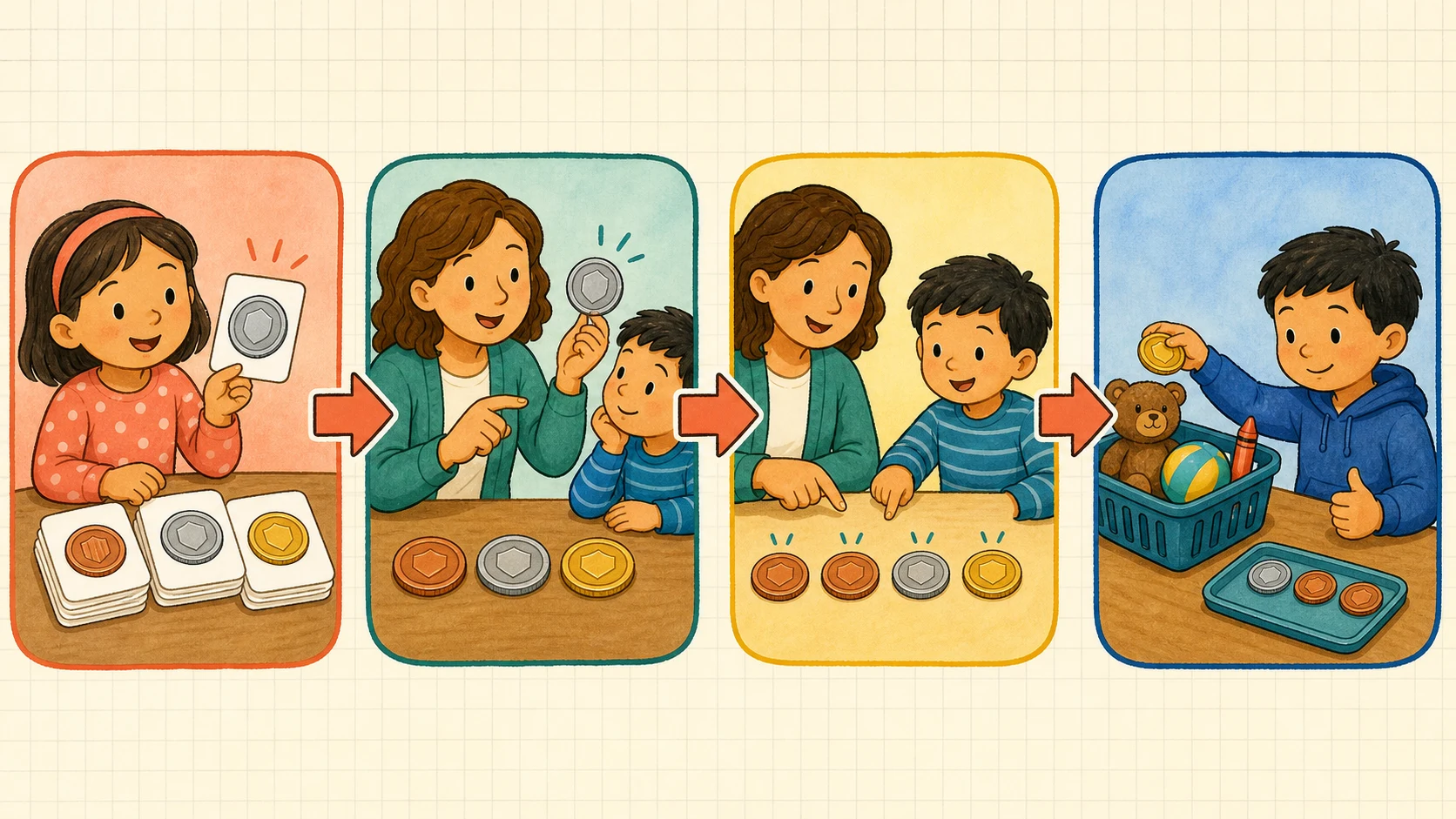
A 1st-grade routine should move from handled coins to spoken counting and then to a small, selected set of printed questions.
2nd grade: coordinate denominations and compare amounts
The middle starting point is useful when coin identity is reasonably stable but mixed collections still require deliberate organization. Representation changes here: instead of presenting coins in helpful value order, a question may scatter them. The learner must impose an order before counting.
Teach one repeatable rule: start with the coin of greatest value, then count on through successively smaller denominations. An anchor chart can show the current total after each coin group. For quarters, dimes, nickels, and pennies, the chart’s path is 25s → 10s → 5s → 1s.
Checked example 2: one quarter, two dimes, one nickel, and four pennies total 54¢.
Reorder by value and count 25, 35, 45, 50, 51, 52, 53, 54. A second check is 25 + 20 + 5 + 4 = 54. This example belongs at the mixed-coin boundary because all four common coins appear, but the total remains below one dollar and the problem asks for one result only.
Comparison questions add a distinct decision. Suppose Collection A contains two quarters and three pennies, while Collection B contains four dimes, two nickels, and one penny. Collection A is 50 + 3 = 53¢; Collection B is 40 + 10 + 1 = 51¢. Therefore, Collection A is greater by 2¢. A learner who totals both correctly but chooses the wrong comparison sign needs work on comparison notation, not coin values.
The 2nd Grade Money guide and free sheet provides the middle catalogue entry, including a 20-problem free sheet labeled easy. Choose it when mixed counting or comparison is the next observable need, after confirming that its particular representations match the learner’s experience.
3rd grade: use money inside a multistep decision
The later catalogue entry can support practice with price tags, dollars and cents, purchase totals, and change. At this point, realistic context should create a mathematical decision rather than merely decorate a computation. The learner may need to select relevant prices, combine them, compare the total with the payment, and represent the result correctly.
Checked example 3: a notebook costs $1.45 and a pencil costs $0.80. Together they cost $2.25.
One check is cents: 145 + 80 = 225 cents, which is $2.25. Another is dollars and cents: $1.45 + $0.80 = $2.25. This belongs with 3rd-grade money practice because it combines two prices and requires coordinating dollars, cents, addition, and notation. It is still a single purchase total, so it should generally precede a problem that also asks for change.
The 3rd Grade Money guide and free sheet is the catalogue’s 25-problem free entry point. Its extra five questions do not automatically make it the right challenge. Select it when the item design—not the sheet length—matches the target.
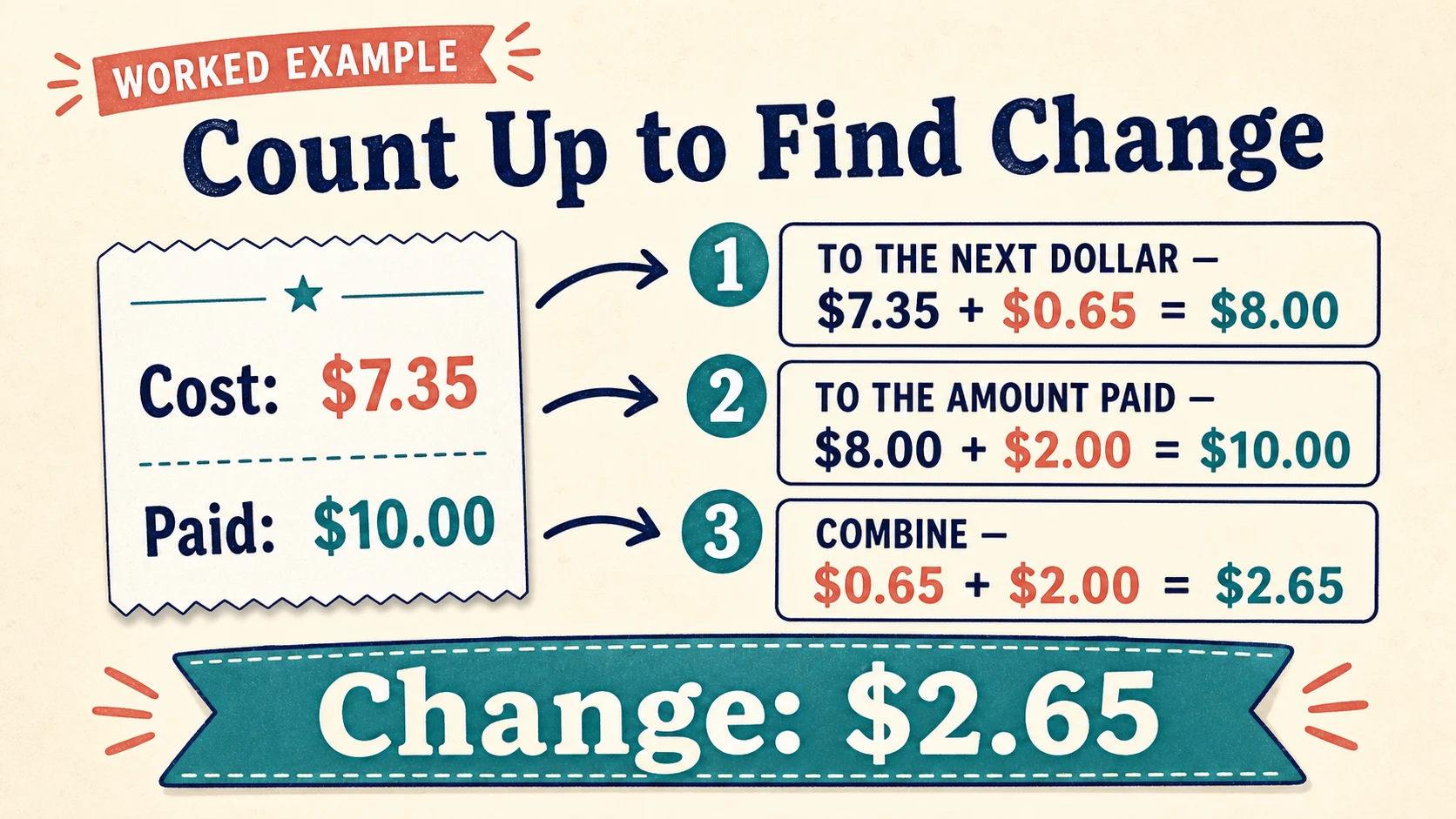
A later money example should expose the route from modeled amounts to a checked numerical answer, not show only the final total.
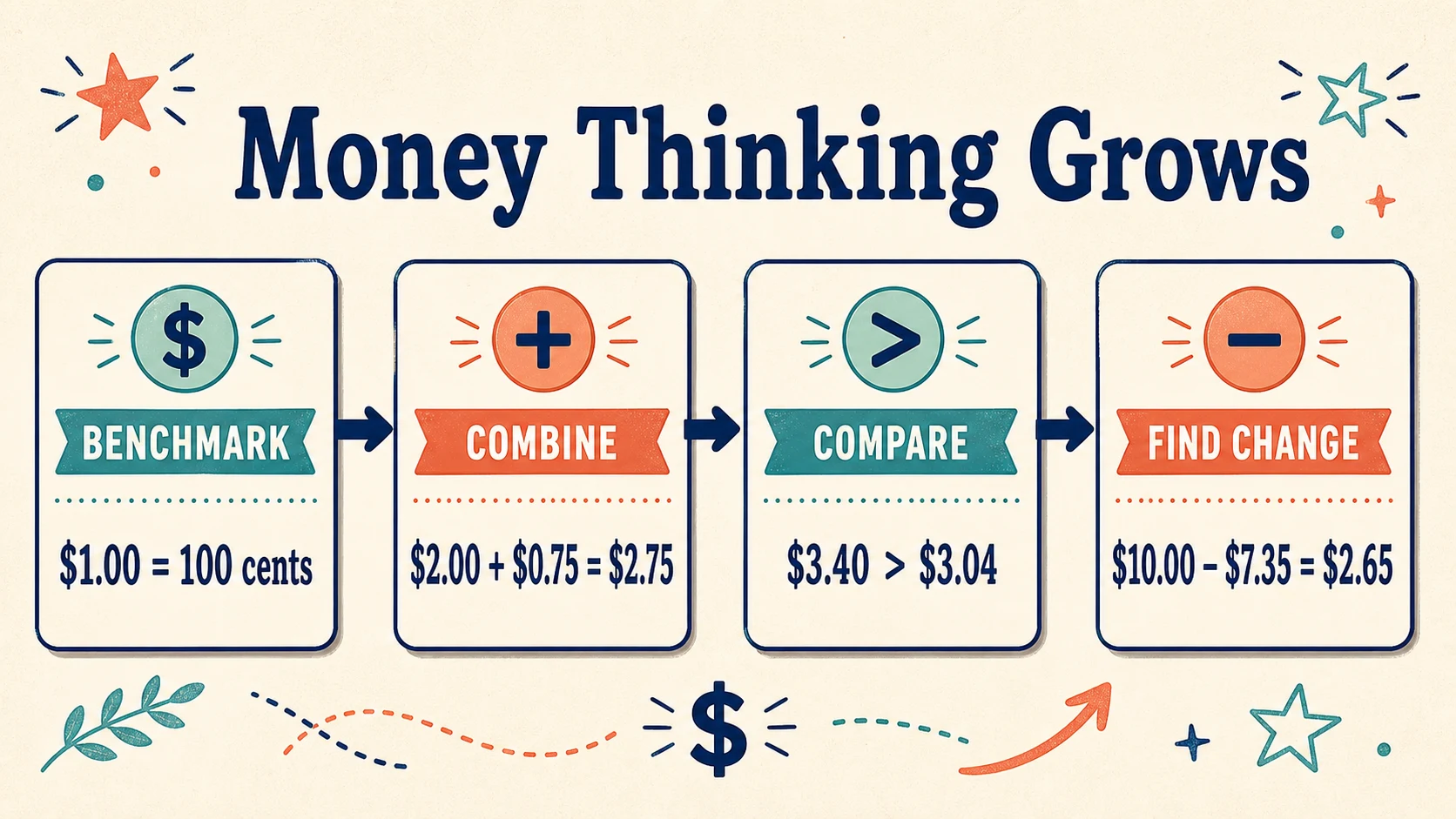
Support can be reduced by removing a supplied counting order or intermediate total while preserving the same money concept.
How representation and question design change the demand
A worksheet becomes harder through more than larger numbers. Look at five design variables before selecting it.
Coin image versus written value
A realistic coin image tests recognition as well as arithmetic. A written expression such as 25¢ + 10¢ + 5¢ removes the identification demand. If a learner succeeds with written values but not images, the likely barrier is coin recognition or visual discrimination. Do not respond by assigning harder arithmetic.
Conversely, a learner might identify every coin but lose the running total. In that case, placing each physical coin beneath its printed image and touching coins while counting preserves the mixed-coin target while reducing tracking demands.
Ordered versus scattered collections
A row arranged quarter, dime, nickel, penny supplies the strategy. A scattered row asks the learner to choose it. Both can produce the same total, but they do not provide the same evidence.
Begin with arranged collections while teaching the greatest-value-first routine. Then use a scattered collection and ask the learner to mark the counting order with small numbers before calculating. Remove those marks once the routine is stable.
Cents only versus dollars and cents
75¢ can be handled as a whole-number count of cents. $2.75 asks the learner to coordinate two units and interpret a decimal point in money notation. The Common Core mathematics standards illustrate that money expectations are distributed differently across grades and domains—for example, solving money word problems appears within measurement and data—so local sequences and the precise task still matter. The standards source did not review WorksheetWise.
Do not infer that a learner who can count 75¢ is automatically ready to compute with general decimals. Money notation offers a familiar two-digit cents structure; decimal understanding is broader. If that broader relationship is the actual target, use the Decimals Worksheets by Grade and Level after checking the learner’s place-value foundation.
Visible operation versus shopping decision
“Add $1.20 and $0.65” reveals the operation. “Maya buys a $1.20 eraser and a $0.65 ruler. How much does she spend?” requires the learner to identify addition. A further question—“She pays with $2.00; what change should she receive?” introduces another step and a new relationship.
Preserve only one new source of demand at a time. If the target is choosing an operation, keep the arithmetic manageable. If the target is accurate computation, state the operation plainly until the method is secure.
A routine that joins coins, talk, and a selected worksheet
A short lesson is more useful than assigning a full page without observing the method.
Build, explain, record, apply, check
- Build: Place real or realistic play coins on the table. Ask the learner to build one amount, such as 41¢.
- Explain: Have the learner name the coins and state the counting order.
- Record: Write the running totals:
25, 35, 40, 41. - Apply: Complete three to five worksheet questions with the same structure.
- Check: Rebuild one answer with a different combination, if possible.
For 41¢, one build is a quarter, a dime, a nickel, and a penny. A different build is four dimes and one penny. Both equal 41¢. The equivalence check reveals whether the learner understands value rather than associating an amount with one fixed picture.
The IES practice guide on assisting students struggling with mathematics recommends systematic instruction that uses clear mathematical language, representations, and opportunities for cumulative review. It also emphasizes monitoring progress to guide instruction. Applied here, that means model the counting path explicitly, select a few aligned questions, and use observed errors to decide the next task. It is not evidence about any particular WorksheetWise sheet.
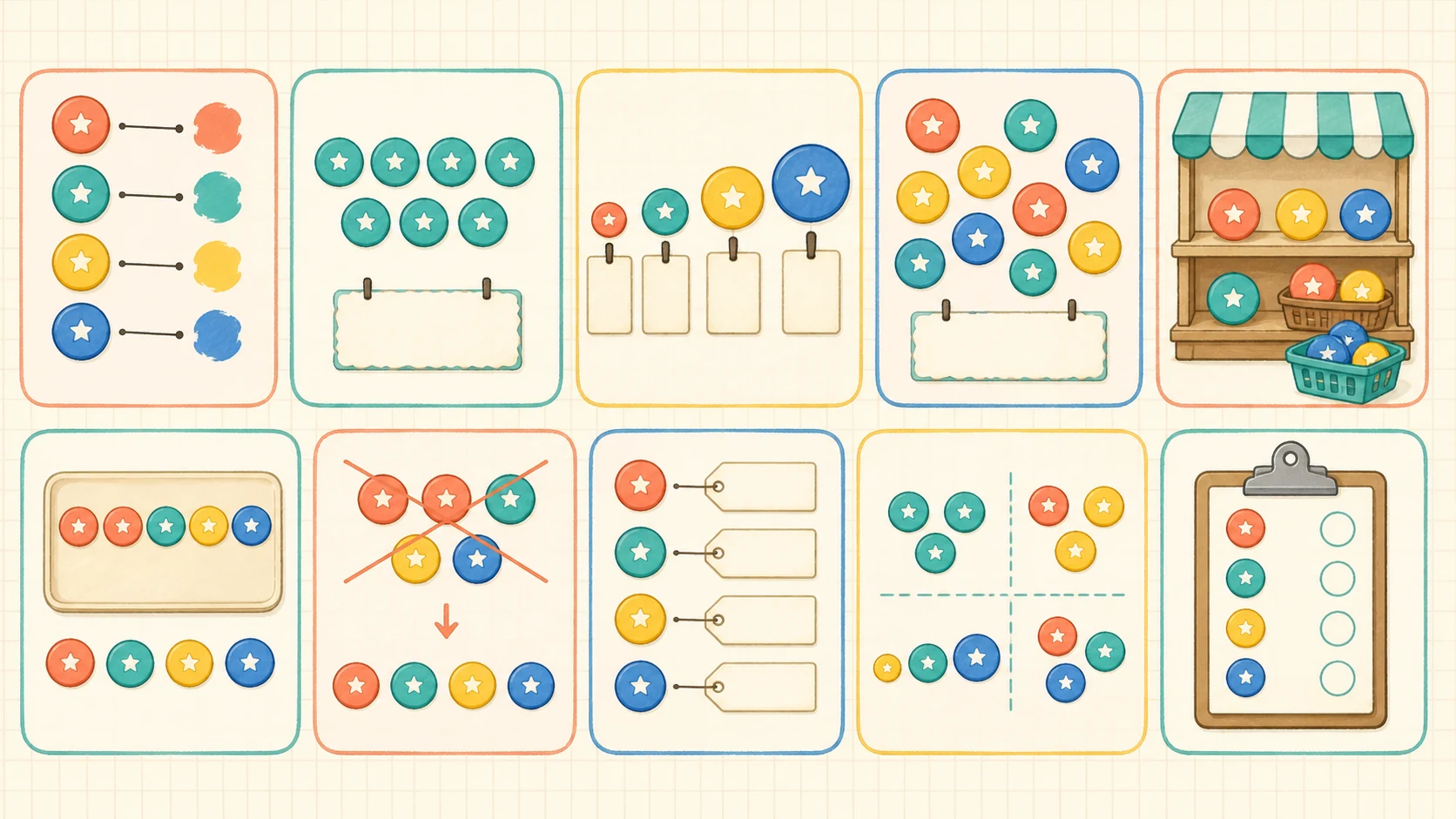
An early two-week plan should revisit coin values and counting paths rather than treating one completed page as mastery.
For a two-week rhythm, alternate focused practice and retrieval. On one day, build and count dimes plus pennies. On the next, briefly retrieve that combination before adding nickels. Later, interleave familiar groups. Keep the physical coins available even after printed accuracy improves; independence means choosing the representation when useful, not being denied it.
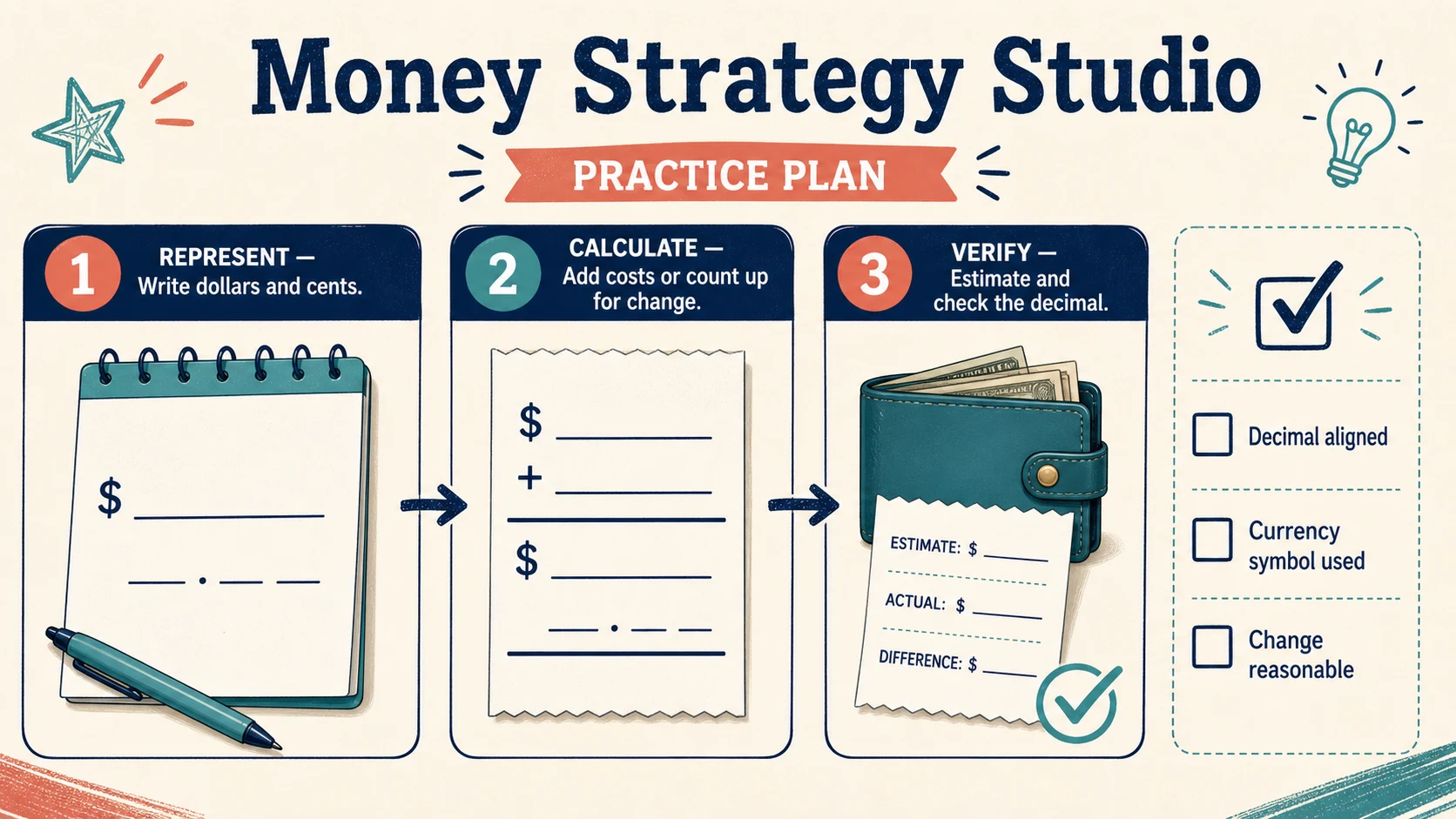
A later two-week plan can alternate purchase totals, sufficient-payment decisions, and count-up change while continuing short mixed-coin review.
Teach change by counting up
Making change can become confusing when learners attempt to subtract decimals before understanding the situation. The recommended approach for this page is to count up from the cost to the amount paid. This mirrors the way change can be assembled and keeps each increment meaningful.
Checked example 4: an item costs $3.67 and the customer pays $5.00.
Count up in useful increments:
- Add 3 pennies:
$3.67 → $3.70. - Add 1 nickel:
$3.70 → $3.75. - Add 1 quarter:
$3.75 → $4.00. - Add 1 dollar:
$4.00 → $5.00.
The added amounts total 3¢ + 5¢ + 25¢ + $1.00 = $1.33, so the change is $1.33. Verify by addition: $3.67 + $1.33 = $5.00.
This example belongs at the later boundary because it crosses two whole-dollar landmarks, requires dollars-and-cents notation, and coordinates several increments. It should not be used to decide whether a learner “understands money” in general. A learner may count mixed coins accurately and simply not yet have learned the count-up structure.
Use a classroom store to make the relationship visible. Label a few objects with prices, give the buyer a fixed payment, and let the cashier physically count the change back. Then use worksheet questions to reinforce the same price-to-payment movement. This classroom-store sequence is a page-specific teaching suggestion drawn from the supplied catalogue guidance; it is not a claim that worksheets alone produce a particular outcome.
Begin with friendly landmarks, such as 65¢ paid with $1.00: add a dime to 75¢, a quarter to $1.00, for 35¢ change. Then introduce less convenient cents and larger payments. Avoid combining unfamiliar vocabulary, several purchases, and difficult change in the first attempt.
Read errors as evidence about the task
An incorrect answer is useful only when the adult notices how it was produced. Ask, “Show me where you started,” or “Touch each coin as you count.” Do not diagnose a condition from worksheet performance.
The learner counts coins instead of value
For a quarter, dime, and penny, the learner answers 3¢. The response preserves the number of objects but ignores denomination. Return to matching each physical coin with its value card. Ask for the total only after the learner says “25 cents, 10 cents, 1 cent.”
The learner treats physical size as value
A learner says a nickel is worth more than a dime because it is larger. This is a money-concept error, not necessarily a counting error. Compare the two coins directly, read their value labels, and trade two nickels for one dime. Then retry a question containing only nickels and dimes.
The learner changes the skip-count interval
For a quarter, two dimes, and a nickel, the learner counts 25, 35, 45, 55 and answers 55¢. The correct total is 50¢: 25, 35, 45, 50. The learner continued counting by tens when the denomination changed. Use an anchor chart with denomination headings and write the new interval before continuing.
The learner counts accurately but records the wrong unit
A learner reaches 75 but writes $75. Keep the arithmetic credit separate from the notation correction. Contrast 75¢, $0.75, and $75.00 with actual or play money. Ask which amount could buy an item priced at 60¢ and why.
The learner subtracts in the wrong direction
For a $2.35 item paid with $5.00, a learner writes $2.35 − $5.00. Rebuild the transaction and ask, “Which amount do we start at, and which amount are we trying to reach?” Count up from $2.35 to $5.00 before introducing a written subtraction comparison.
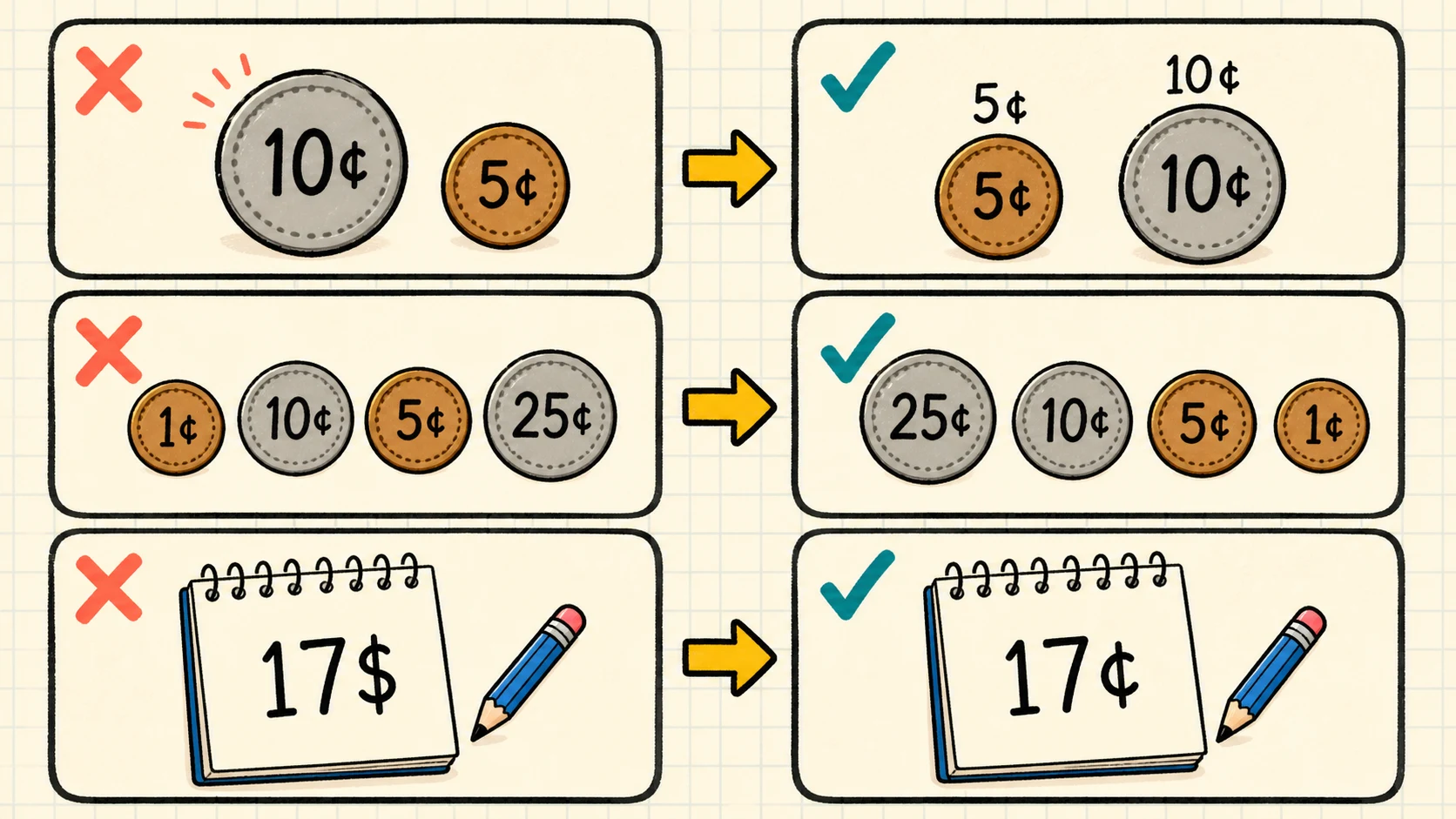
Early errors become actionable when the response distinguishes coin identity, coin value, counting interval, tracking, and notation.
Adapt the work without removing the money target
An adaptation should reduce an incidental barrier while leaving the intended decision intact.
If visual crowding interferes, cover all but one question or enlarge the page. If fine-motor demands interfere, let the learner point, place number cards, or answer orally. If language is the barrier in a shopping problem, read the text aloud while leaving the operation choice to the learner. If working-memory demands disrupt mixed counting, provide a blank running-total row. If coin recognition is the target, do not replace every coin image with a written value; that would remove the very skill being practiced.
For ages three and four, keep adaptations especially concrete: adult-led coin matching, brief sorting, oral naming, and movement between value stations. Do not use age as proof of readiness for a worksheet.
Also recognize the boundaries of printable money practice. Coin images cannot fully reproduce handling, turning, trading, or paying. Classroom-store play cannot by itself guarantee accurate written notation. A worksheet result reflects the pictured coins, wording, layout, and support available on that occasion. It is not a diagnosis, a standards-placement verdict, or a promise of future performance.
Select the next real worksheet from observable evidence
Use a three-question selection test.
What is the one target?
Choose identification, same-coin counting, mixed-coin counting, comparison, purchase totals, or change. Do not select a page merely because it contains money. If the target is mixed counting, a page dominated by word-problem reading gives muddy evidence.
What support should remain visible?
Decide whether the learner still needs physical coins, value labels, an ordered collection, an anchor chart, a running-total line, or adult reading. Removing all support at once makes it impossible to know which change caused an error.
What performance triggers the next move?
After a short set, inspect method as well as accuracy.
- If coin values are confused, step back to handling and matching.
- If values are known but totals drift, keep mixed coins and add a counting-order aid.
- If mixed totals are accurate and explainable, introduce comparison or a scattered arrangement.
- If purchase totals are accurate, add a sufficient-payment decision.
- If the learner can explain the gap between price and payment, introduce count-up change.
- If errors increase only when text becomes longer, preserve the money mathematics and reduce the reading load.
Use three to five questions for this decision before committing to a full 20- or 25-problem sheet. Longer practice is appropriate after the method is accurate enough that repetition will reinforce the intended strategy.
The practical next action is to open the 1st Grade Money guide and free sheet, place real or realistic play coins beside it, and preview its 20 questions. Select the first three items that match one current target. Observe whether the learner identifies the coins, starts with the greatest value, keeps the correct counting interval, and records the unit. That evidence—not age, grade title, or the word “easy”—tells you whether to stay there, move to the 2nd Grade Money guide, or choose a more supported coin task.
Put it into practice
Use the guide with a real printable
Move from explanation to a short, observable practice task. Check the first item together, then adjust the next session from the learner's actual work.
Open the first free worksheetExplore a neighboring collection
Choose by a different teaching need
Addition Worksheets by Grade and Level Consonant Blends Worksheets by Grade and Level Counting Worksheets by Grade and Level CVC Words Worksheets by Grade and Level Decimals Worksheets by Grade and Level Digraphs Worksheets by Grade and Level Division Worksheets by Grade and Level Fractions Worksheets by Grade and Level