2nd Grade · 3 live skills
2nd Grade grammar worksheets
Pick the exact skill below. Each page combines a real free download, a separate answer key, practical teaching guidance and an optional focused pack.
See all 2nd Grade subjects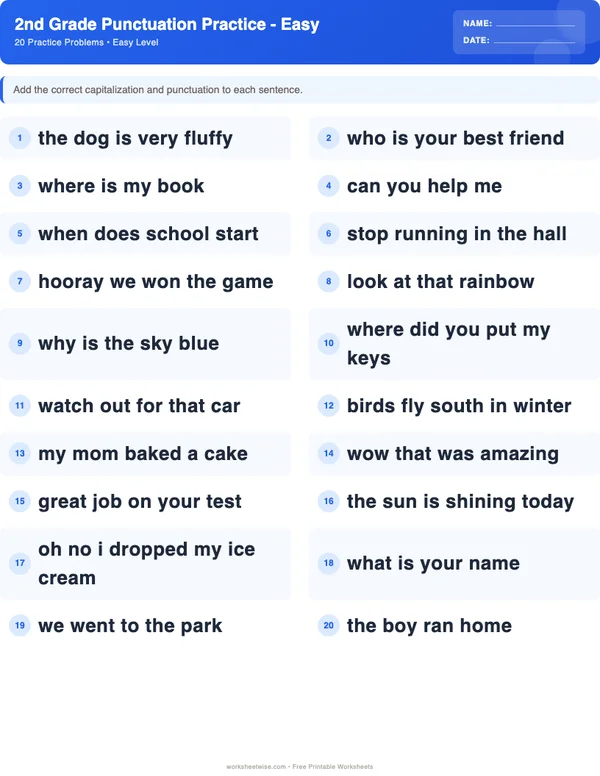
Complete guide
How to teach and practise 2nd grade grammar worksheets
3,384 words Updated 6 instructional visuals
Choose one grammar target from the learner’s actual writing
The live 2nd Grade Grammar catalogue offers three starting points: Parts of Speech, Punctuation, and Sentence Structure. Each topic has one free 12-problem sheet, and the catalogue contains 54 variants across those three topics. Start with the skill that is blocking clarity now—not with all three at once.
Use this decision:
- Choose Sentence Structure if the learner writes fragments, joins several thoughts without a clear break, or cannot explain who or what a sentence is about.
- Choose Punctuation if the thought is complete but its ending mark is missing or does not match the sentence’s purpose.
- Choose Parts of Speech if the learner needs to distinguish the naming word from the action word or improve a sentence with more precise nouns, verbs, or describing words.
For example, The rabbit under the chair. is primarily a sentence-structure problem: it names something but does not tell what the rabbit does or is. Adding a period would not repair the incomplete thought. By contrast, Where did the rabbit go. is structurally complete but needs a question mark. That distinction should determine the worksheet, explanation, and next practice task.
Grade labels describe an intended practice level; local curriculum sequences differ. Age can help an adult discover likely resources, but it is not a placement decision. Select from observable work rather than assuming every second grader needs the same sequence.
What the live 2nd grade catalogue actually covers
The catalogue has three free entry points and 54 total variants. The free sheet in each topic is labeled “easy” and contains 12 problems. Here, “easy” should be understood through task features, not as a label for a child. A suitable introductory task has a short direction, limited competing rules, familiar sentence patterns, and enough support for the learner to show one skill at a time.
The three topics are related, but they are not interchangeable:
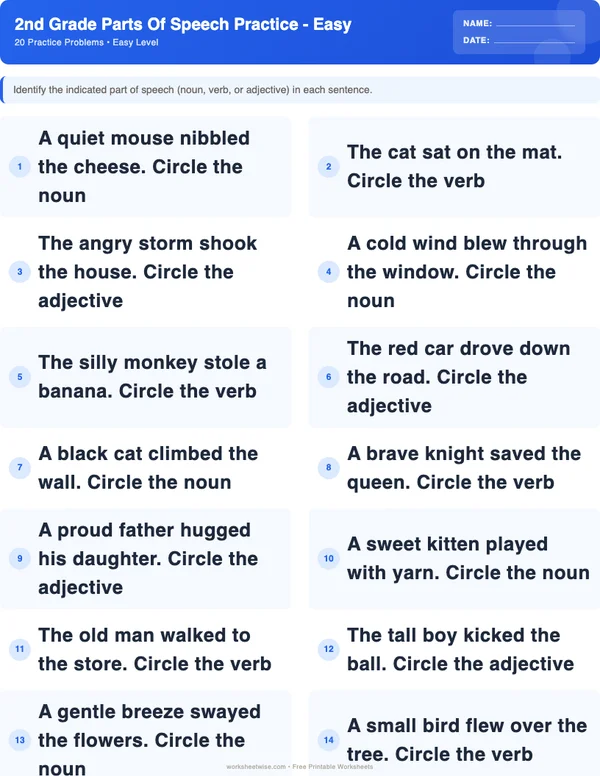
- Parts of Speech asks what a word is doing in a sentence. At this level, nouns and verbs are the most concrete entry point.
- Punctuation asks how a written sentence signals its purpose or internal organization. End punctuation is a narrower starting target than commas, apostrophes, or dialogue punctuation.
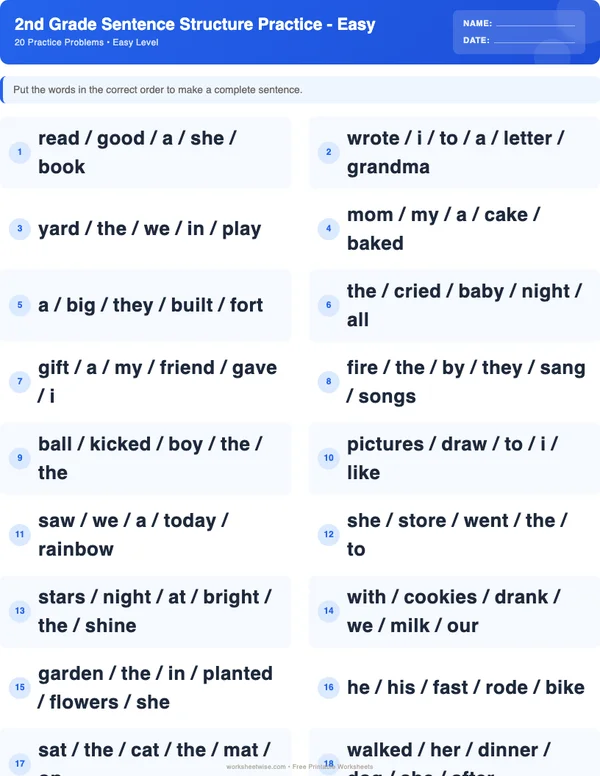
- Sentence Structure asks whether words form a complete thought and how its subject and predicate fit together.
A child can succeed in one area while needing support in another. A learner may correctly identify fox as a noun and runs as a verb yet still write The fox in the field. as a fragment. Another may compose a complete question but finish it with a period. Record those as different observations instead of combining them into a general judgment such as “weak grammar.”
The Common Core ELA framework treats language as one strand within a broader system that also includes reading, writing, speaking, and listening. Its grade-specific expectations add detail to broader literacy goals. That makes a grammar sheet most useful when it supports real reading or writing rather than becoming the whole language program. The standards also do not determine the exact order used by every state, district, or curriculum. Review the Common Core ELA framework.
A workable progression across the three live skills
The catalogue descriptions extend from introductory work toward later, more complex applications. For this page, keep the instructional decision anchored in what a second-grade learner can demonstrate now.
Sentence structure: establish a complete thought
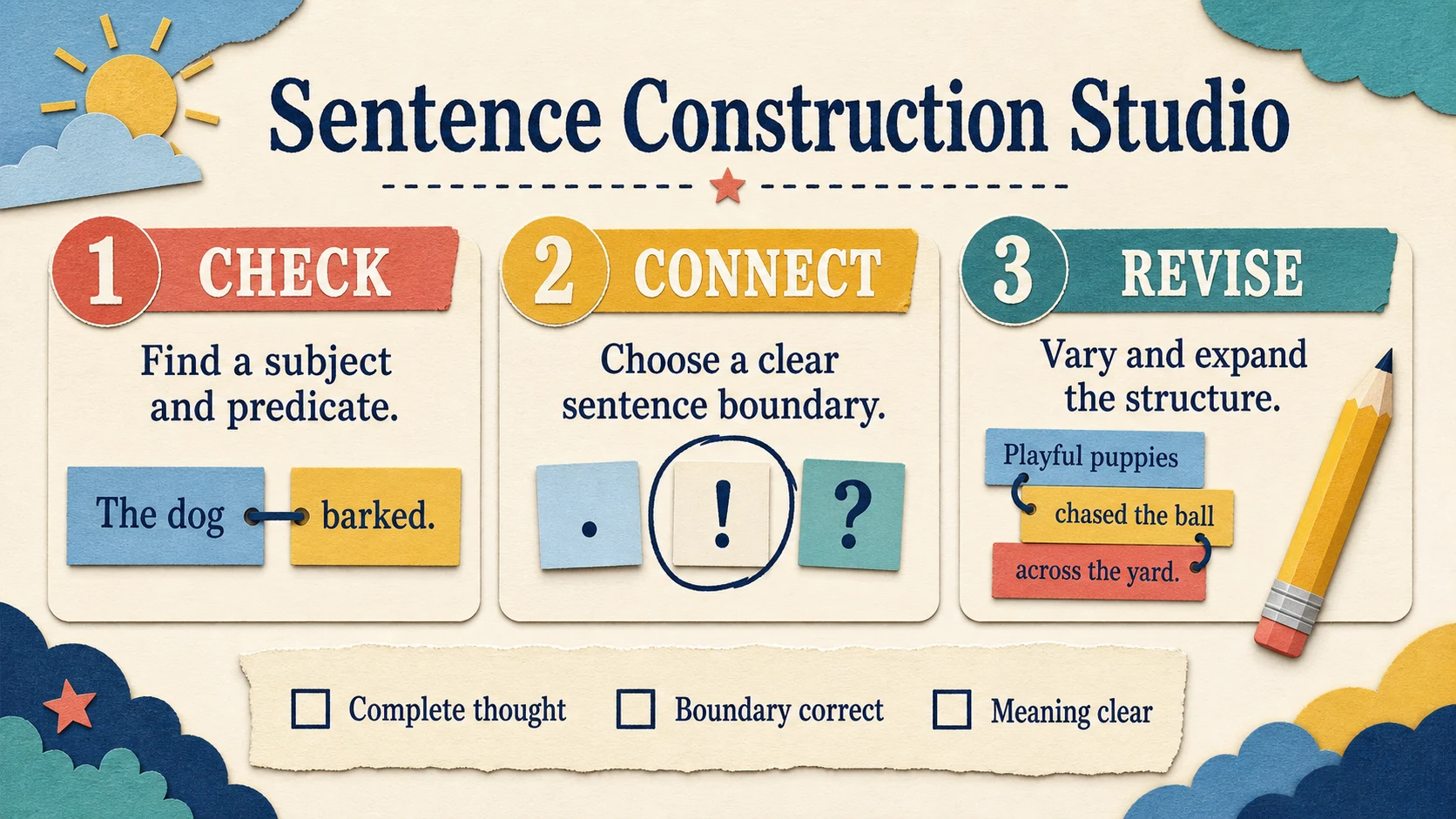
Begin orally with the frame “Who or what? Did what—or is what?” A complete sentence needs both parts, even when the child does not yet use the terms subject and predicate independently.
A useful progression is:
- Decide whether an oral example sounds complete.
- Supply a missing “who or what” or “did what.”
- Separate complete sentences from fragments.
- Identify the subject and predicate in short sentences.
- Expand a complete sentence without losing its structure.
- Combine closely related sentences when the relationship is clear.
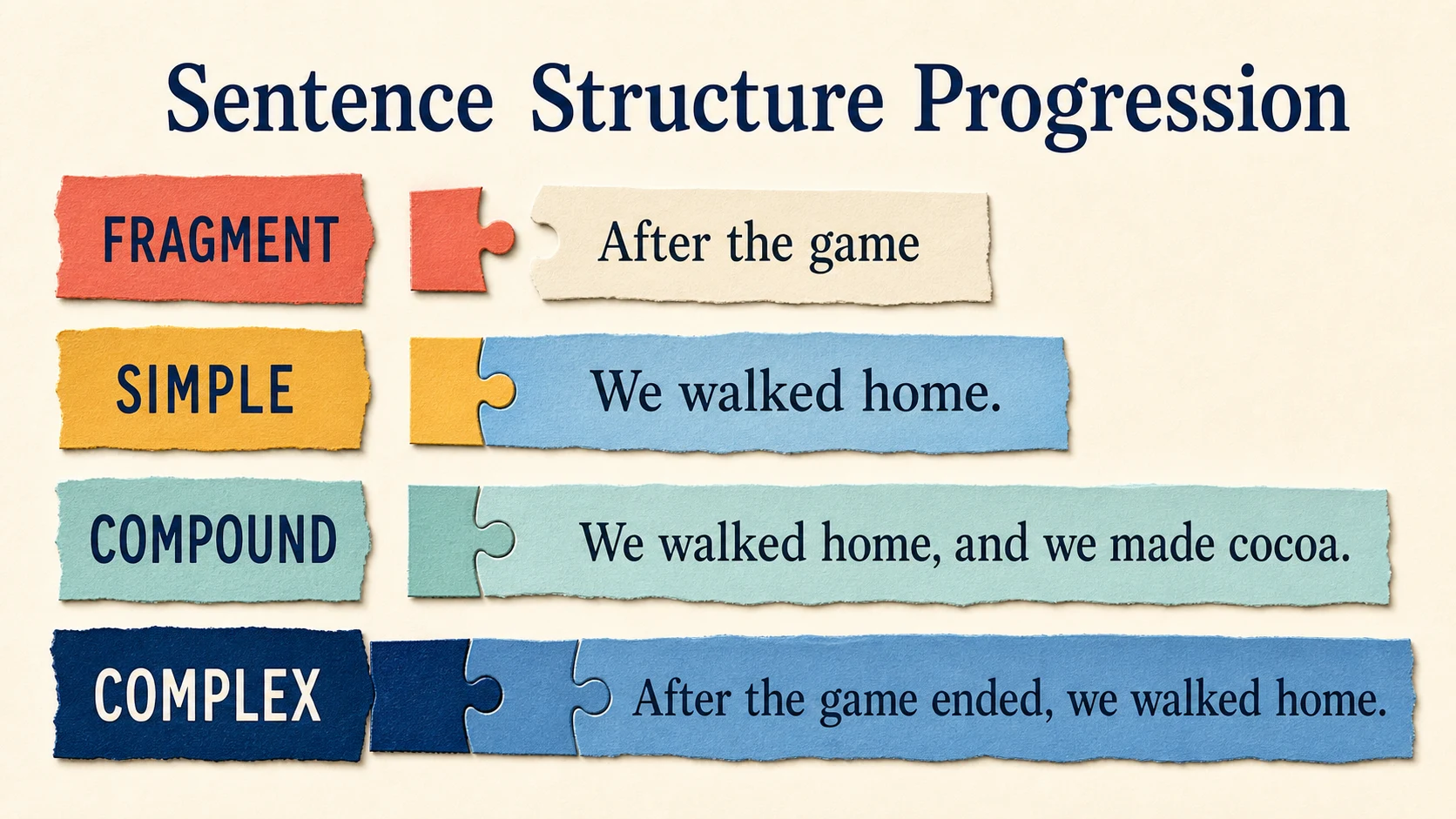
Move from hearing the two necessary sentence parts to constructing and revising complete sentences independently.
Do not begin with sentence combining if the learner cannot yet recognize a complete thought. Combining raises the load: the learner must understand both original sentences, notice what repeats, choose a sensible connection, and punctuate the result.
Parts of speech: study words inside sentences
Start with nouns and verbs because they allow concrete contrasts. A noun can name a person, place, thing, or idea; a verb can show an action or link the subject to information about it. At this practice level, physical objects and actions make the distinction visible.
Then move toward adjectives, pronouns, and other categories only as the task requires. The catalogue’s broader description includes all eight parts of speech and more complex passages, but that is the long progression—not a demand that a second grader classify all eight at once.
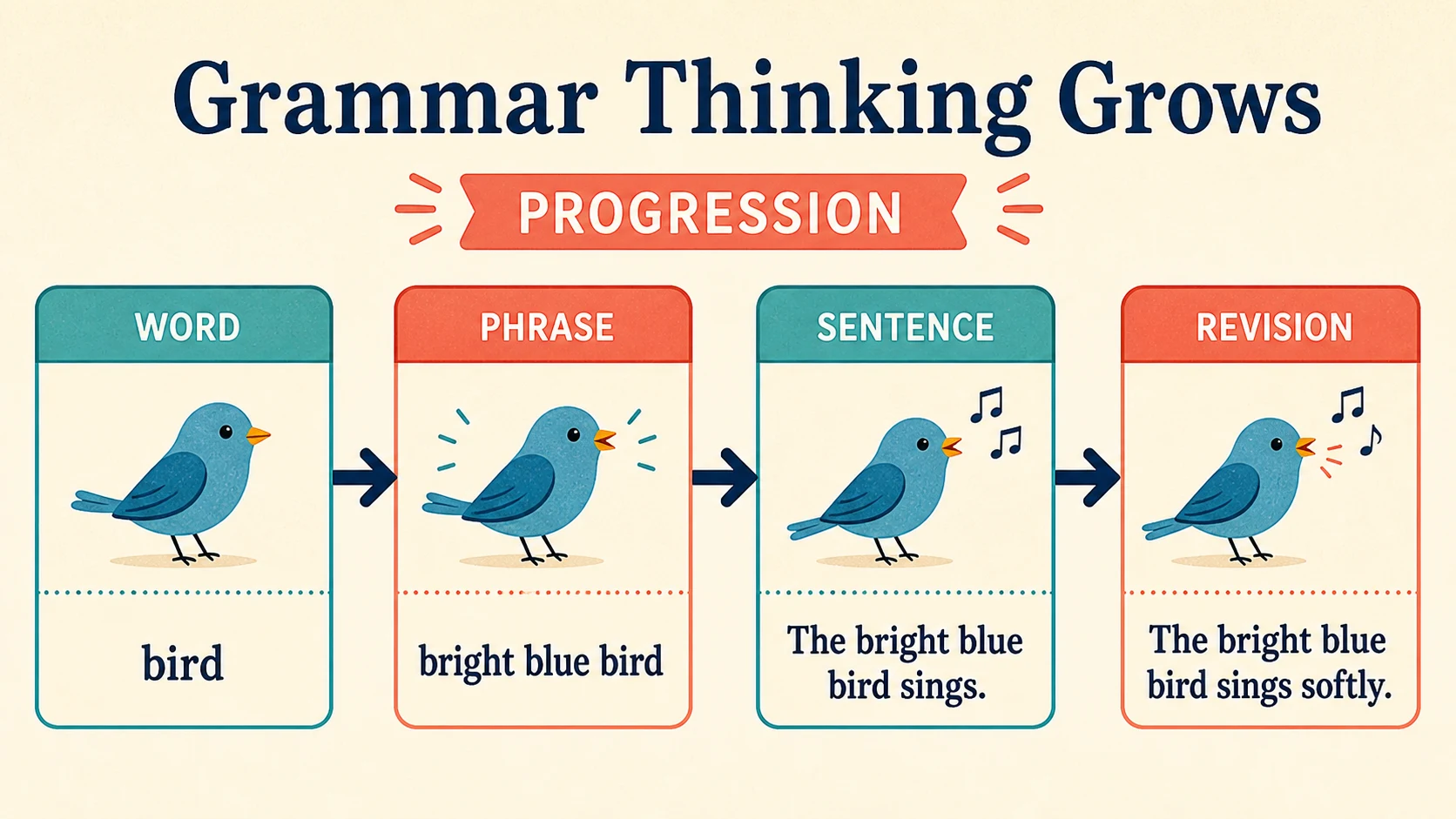
The instructional load grows from concrete noun-and-verb contrasts to choosing words by their function in a complete sentence.
Context matters. In We run after lunch, run is a verb. In We went for a run, run is a noun. A word list alone hides that distinction. Use a sentence whenever the learner must decide a word’s job.
Punctuation: match the mark to the meaning
Begin with periods, question marks, and exclamation points. Ask what the sentence does:
- A statement tells something.
- A question asks something.
- An exclamation expresses strong feeling or emphasis.
Reading aloud can make these purposes easier to hear, but voice alone is not infallible. The learner should also attend to meaning and wording. A rising voice is a clue, not the rule.
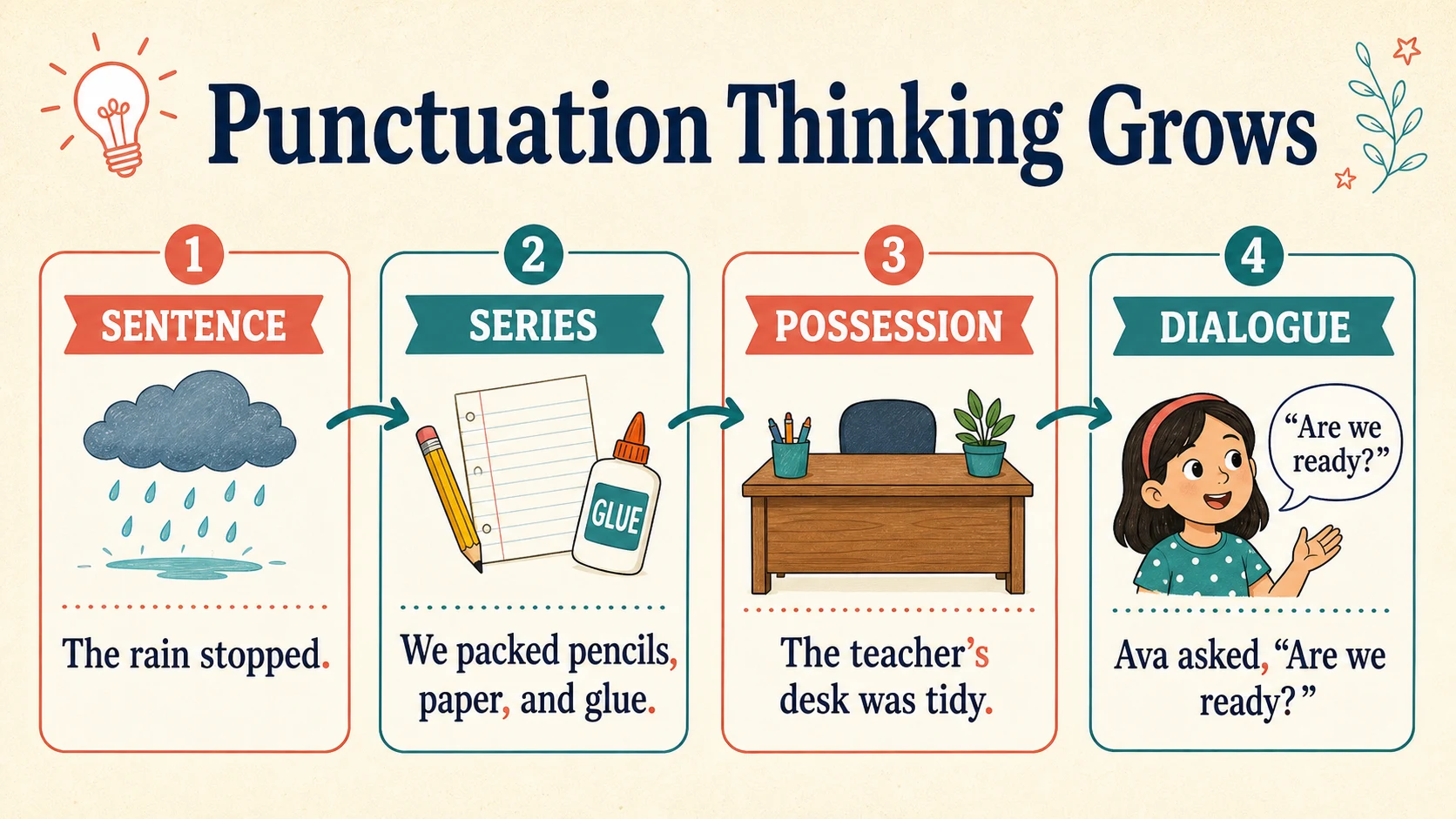
Keep end punctuation separate from later comma, apostrophe, and dialogue rules until the learner can justify the ending mark.
Commas, apostrophes, and quotation marks involve different conventions. Introduce one bounded rule at a time. Correctly choosing a question mark does not show that a learner is ready to punctuate dialogue.
Four checked examples that reveal different needs
These examples are editorially created practice items based on the live topic descriptions. They are not quoted from the free PDFs.
Checked example 1: repair a fragment
Prompt: Is this a complete sentence? If not, repair it.
The small frog on the rock.
Check: Ask “Who or what?” The answer is the small frog. Ask “Did what—or is what?” There is no answer. On the rock tells location; it is not the predicate.
One valid repair is:
The small frog sat on the rock.
Now The small frog is the subject and sat on the rock is the predicate. The capital letter and period finish the written sentence, but the verb sat is what repairs its structure.
This belongs in 2nd grade sentence-structure practice because it uses a concrete subject, a familiar action, and one missing sentence part. It does not require the learner to manage several clauses or advanced punctuation. Use the 2nd Grade Sentence Structure guide and free sheet if this pattern appears repeatedly.
Checked example 2: choose end punctuation
Prompt: Add the correct ending mark.
Can we feed the ducks
Answer: Can we feed the ducks?
The sentence asks for information or permission, so it needs a question mark. A period would misrepresent its purpose. An exclamation point could convey strong emotion, but it would not mark the direct question conventionally.
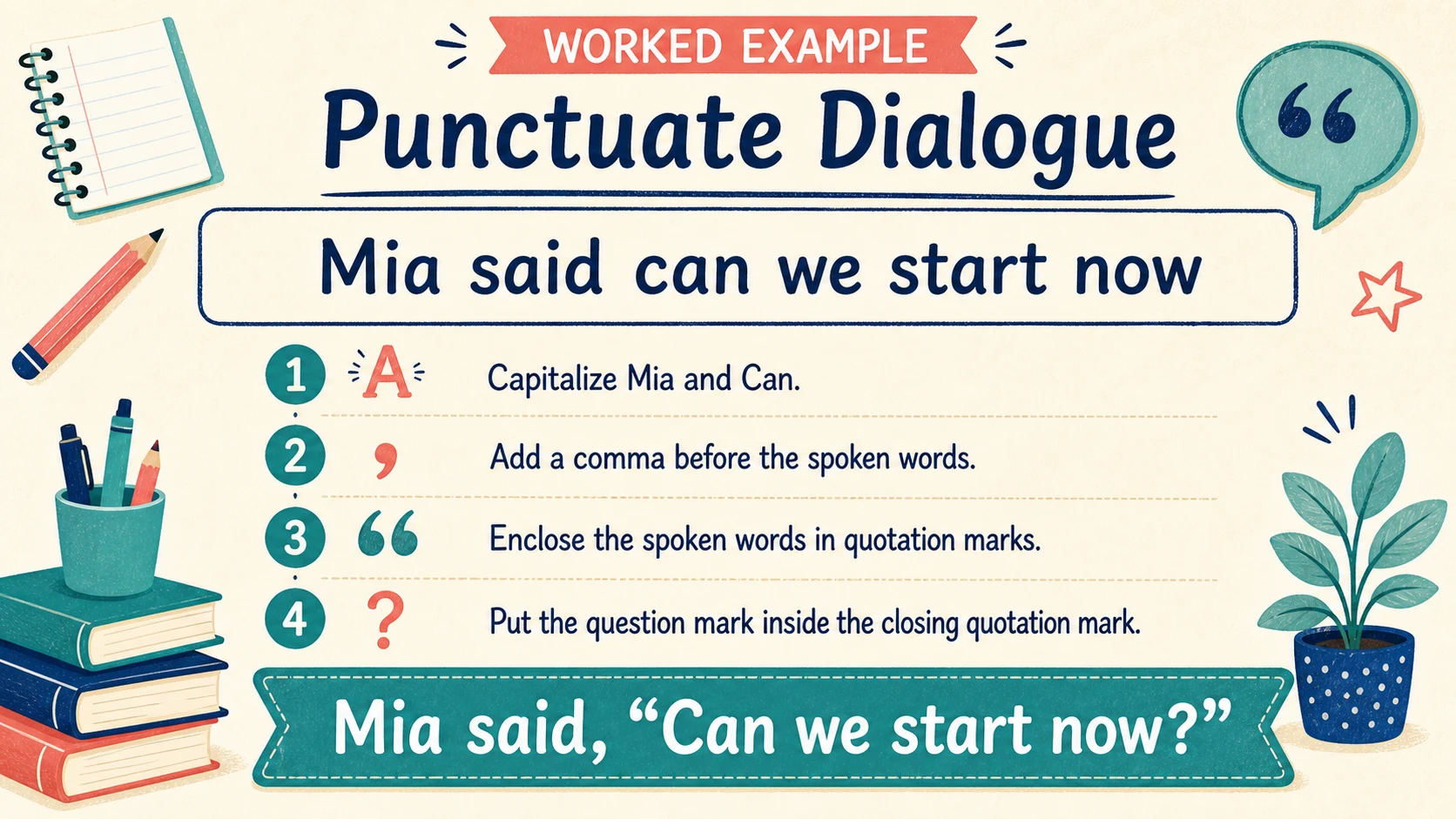
The useful step is not merely adding a mark; it is naming what the sentence is doing and matching the mark to that purpose.
This example belongs here because it isolates one early punctuation decision. It contains a complete sentence and no comma, apostrophe, or quotation-mark distraction. If a learner chooses ? consistently but cannot explain why, ask for a one-sentence justification before increasing complexity. The 2nd Grade Punctuation guide and free sheet provides the corresponding free entry point.
Checked example 3: identify noun and verb in context
Prompt: Find the noun that names the animal and the verb that tells its action.
The puppy chased the ball.
Answer: The target noun is puppy; the action verb is chased.
Ball is also a noun, so the wording of the prompt matters. If the instruction merely says “circle the noun,” the sentence has two correct candidates. A learner who circles ball has identified a noun, even though it is not the sentence’s subject.
This belongs in 2nd grade parts-of-speech practice because it uses observable entities and an action. It also reveals whether a wrong-looking answer came from a grammar misunderstanding or an underspecified direction. Adults should check the prompt before treating the response as evidence of error.
A useful follow-up is to replace the verb: The puppy carried the ball. The sentence remains complete, but the action changes. That makes the verb’s function concrete. Continue with the 2nd Grade Parts of Speech guide and free sheet.
Checked example 4: combine without changing meaning
Prompt: Combine the two sentences.
Maya has a red kite.
Maya has a blue kite.
Checked answer: Maya has a red kite and a blue kite.
The repeated subject and verb appear once, while both original facts remain. Another grammatical answer is Maya has a red and blue kite, but that can describe one kite with two colors. It changes the likely meaning, so it is not the best combination.
This example belongs at the later end of the page’s sentence-structure progression. The learner must identify repeated language, preserve two distinct objects, and use and to connect them. If the learner writes Maya has a red kite a blue kite, the main issue is the missing connector, not necessarily an inability to identify sentences.
Checked example 5: separate structure from punctuation
Prompt: Correct the sentence.
My brother found a shell it was smooth
A clear correction is:
My brother found a shell. It was smooth.
Both halves can stand as complete sentences: My brother found a shell and It was smooth. A period and capital letter create a clean boundary. My brother found a shell, and it was smooth. is also grammatical, but it requires the learner to coordinate the thoughts with and.
This belongs here because it shows why an editing item may draw on two live topics. Recognizing the two complete thoughts is a sentence-structure decision; marking their boundary is a punctuation decision. If the child adds only a period at the very end, reteach how to locate where the first thought is complete before assigning more punctuation rules.
Select a starting sheet by task evidence
A 12-problem sheet is long enough to show a pattern, but the first decision can come from three or four carefully chosen items. Avoid making the learner complete every available topic as a placement test.
Use this brief comparison:
| What you observe | Start with | Keep the first target bounded |
|---|---|---|
Fragments such as The bird in the tree. |
Sentence Structure | Complete subject plus predicate |
| Several complete thoughts run together | Sentence Structure | Find one thought boundary |
| Complete questions ending with periods | Punctuation | Period versus question mark |
| Random use of exclamation points | Punctuation | Match purpose to end mark |
| Confusion between naming and action words | Parts of Speech | Concrete nouns versus action verbs |
| Correct labels in lists but errors in sentences | Parts of Speech | Identify word function in context |
Do not choose from handwriting neatness, speed, confidence, or age alone. Those features can affect performance, but none identifies the grammar target.
Also inspect whether the directions create unnecessary reading demand. The IES foundational reading guide recommends daily connected-text reading and includes academic language and vocabulary among its early-literacy concerns. That guidance was not an evaluation of WorksheetWise. It does, however, support checking whether an unfamiliar word or difficult sentence—not the target grammar concept—caused the response. Read the IES foundational skills practice guide.
Use a short model–try–apply routine
A repeatable routine makes the child’s thinking visible and prevents a worksheet from becoming silent guessing.
One target in eight to twelve minutes
- Name the target. Say, “Today we will decide whether each group of words is a complete sentence.”
- Model one example. Think aloud briefly: “
The bees buzzedtells who and what they did, so it is complete.” - Solve one together. Ask the learner to supply the missing half of
Under the porch. - Try two independently. Do not correct during the first attempt.
- Discuss the evidence. Ask, “What made you choose that answer?”
- Apply it in writing. Have the learner write one original example.
- Record the next decision. Note whether to repeat, reduce support, or change targets.
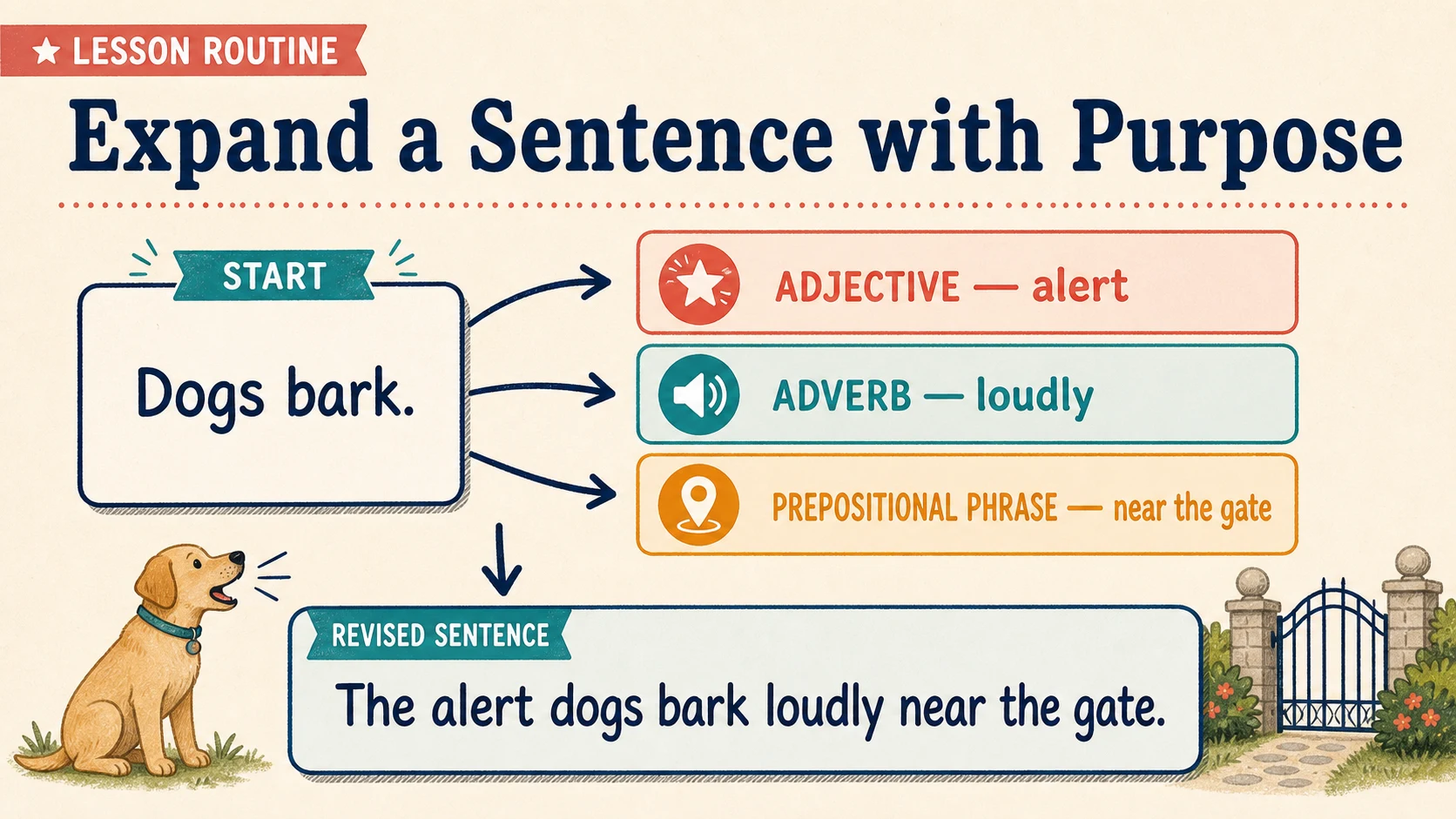
For parts of speech, the same cycle moves from an adult’s sentence model to identification, explanation, and one learner-created sentence.
The IES elementary writing guide recommends daily writing time, explicit work with the writing process, and teaching fluency in sentence construction alongside other transcription and composing skills. Its recommendations concern elementary writing instruction generally; they do not assess these worksheets. A practical implication is to finish isolated grammar practice with a small act of composition. Consult the IES elementary writing practice guide.
For a punctuation lesson, the application might be two lines: one statement and one question about the same picture. For parts of speech, it might be a sentence containing one concrete noun and one action verb. That final sentence shows whether the learner can use the idea rather than only recognize an answer.
Interpret errors before assigning more practice
A score alone hides why an answer went wrong. Sort errors by observable pattern.
The concept is not yet stable
The learner may call every group of words a sentence, choose punctuation by emotion alone, or label every object word as the sentence’s subject. Return to a concrete contrast:
- Complete versus missing a predicate
- Telling versus asking
- Naming word versus action word
Model one contrast, then test it with a new example. Repeating the original item may only measure memory.
The learner knows the rule but misses the boundary
In We planted seeds they began to grow, the learner may know that periods end sentences but not see where the first complete thought ends. Slash the oral boundary together:
We planted seeds / they began to grow.
Then let the learner decide how to write that boundary. This keeps the focus on sentence structure before punctuation.
The directions or vocabulary interfered
If a child correctly identifies dog as a noun but misses animal, check whether the vocabulary is familiar. If the instruction asks for “the noun functioning as the subject,” restate it as “Who or what is this sentence about?” The target remains noun identification; the linguistic wrapper becomes more accessible.
The response is correct for a defensible reason
In The light shines, light is a noun. In Turn on the light, it is also a noun. In The light backpack fell, it is an adjective. Do not mark a word solely from a memorized category without checking its job in that sentence.
Likewise, more than one sentence combination may be grammatical. Check whether the answer preserves the original meaning, forms a complete sentence, and uses an appropriate connector. Do not require the adult’s wording when the child’s version meets all three tests.
The error is isolated
One missed item may reflect a skipped word, accidental mark, or momentary distraction. Look for the same error in at least one fresh item and in the learner’s own sentence before changing the instructional target. This is error interpretation, not diagnosis.
Adapt the work without removing the grammar decision
An adaptation should reduce an irrelevant obstacle while preserving the decision you need to observe.
For sentence structure, read the words aloud or let the learner arrange word cards. Still require the learner to decide whether the thought has both necessary parts.
For punctuation, offer cards showing ., ?, and !. The learner can select and place a card instead of writing the symbol. Still ask, “Is the sentence telling, asking, or exclaiming?”
For parts of speech, let the learner point, sort cards, act out verbs, or handle objects that represent nouns. Then put the word into a sentence so the learner must consider its function.
Other useful adjustments include:
- Covering the rest of the page and showing one item at a time
- Allowing an oral answer before a written one
- Enlarging the text
- Reducing copying while keeping the correction task
- Using familiar names, objects, and actions in adult-created examples
- Completing six well-discussed items instead of rushing through 12
Do not turn the activity into a different skill. If the target is choosing end punctuation, supplying the mark and asking the learner only to trace it removes the decision. If the target is identifying a verb, acting out the verb is support; telling the learner which word to act out is the answer.
Plan review from what changes in the work
A simple two-week sequence can revisit one target without drilling the same page repeatedly.
Space sentence work across recognition, repair, original writing, and review so the adult can observe transfer rather than worksheet recall.
One possible schedule is:
- Day 1: Model the target and complete three supported items.
- Day 2: Complete four fresh items and explain each decision orally.
- Day 3: Find the target feature in a familiar book sentence.
- Day 4: Correct two examples and write one original sentence.
- Day 5: Review only the errors and record the pattern.
- Week 2: Repeat the cycle with less prompting and new sentences.
This schedule is an editorial suggestion, not a required dosage or promised route to improvement. A classroom teacher might use the task as a warm-up or mini-lesson; a family might use it during brief homework grammar practice. Stop when fatigue makes the work uninformative.
Reduce support when the learner makes the target decision accurately in fresh examples and can explain it in plain language. Increase complexity by one feature only: move from statements and questions to exclamations, from nouns and verbs to adjectives, or from recognizing complete sentences to repairing fragments. Do not raise vocabulary, sentence length, rule complexity, and independence simultaneously.
Keep the worksheet within its proper limits
A worksheet can provide focused practice and a record of responses. It cannot by itself establish why a learner struggles, represent the whole language curriculum, or diagnose a learning condition. It also cannot show consistent transfer unless the adult checks fresh reading or writing.
The catalogue’s labels and descriptions are useful for discovery, but local instruction may introduce skills in another order. Although the page’s stated design connects its worksheets with Common Core Language expectations, adults should verify any required local standard against their own state, district, school, or homeschool sequence. Do not infer standards mastery from completing one 12-problem sheet.
Avoid moving prematurely into later punctuation conventions or complex sentence classifications because they appear in the wider topic description. For this grade-specific decision, a small, observable goal is better:
- “Distinguish a complete sentence from a fragment.”
- “Choose a period or question mark and explain why.”
- “Identify the concrete noun and action verb in a short sentence.”
Each goal names something the learner can do, not a trait the learner supposedly has.
Make the next choice from one real response
Take one sentence the learner wrote today and ask three questions in order:
- Does it express a complete thought?
- Does its ending mark match its purpose?
- Can the learner identify the main naming word and action or linking verb?
Choose the first question that reveals a consistent problem. Then open the matching free resource—most often the 2nd Grade Sentence Structure guide and free sheet, Punctuation guide and free sheet, or Parts of Speech guide and free sheet—and complete just three items using the model–try–apply routine. Record one exact error and one correct explanation. Those two observations, not the worksheet title or grade label, should select tomorrow’s task.
Put it into practice
Use the guide with a real printable
Move from explanation to a short, observable practice task. Check the first item together, then adjust the next session from the learner's actual work.
Open the first free worksheet