2nd Grade · 1 live skills
2nd Grade spelling worksheets
Pick the exact skill below. Each page combines a real free download, a separate answer key, practical teaching guidance and an optional focused pack.
See all 2nd Grade subjectsComplete guide
How to teach and practise 2nd grade spelling worksheets
3,312 words Updated 6 instructional visuals
Choose one spelling pattern before choosing a worksheet
The most useful 2nd grade spelling worksheet is not necessarily the one with the longest word list. Choose the sheet that gives the learner one bounded job: distinguish short and long vowels, compare several spellings of one long vowel, apply consonant doubling, notice an r-controlled vowel, find a silent letter, add a prefix or suffix, or divide a multisyllabic word into manageable parts.
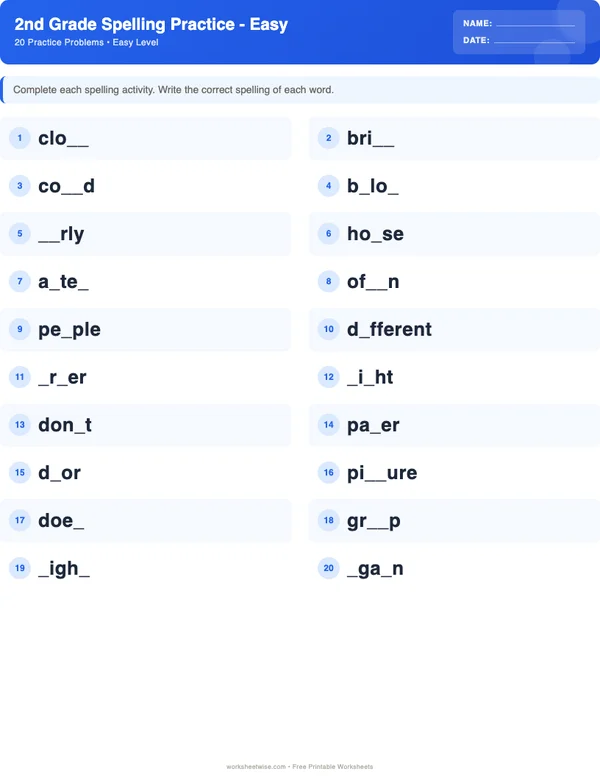
The live WorksheetWise catalogue currently contains 18 variants within one 2nd Grade Spelling Words topic and one free 20-problem sheet. The activities represented include look-cover-write-check, rainbow writing, word sorting, sentence use, and identifying misspelled words. These formats serve different purposes. A sort exposes whether a learner recognizes a pattern; recall writing tests whether the spelling can be reconstructed; a sentence tests whether the word survives the added demands of meaning, capitalization, spacing, and punctuation.
Grade labels describe the intended practice level, not a guaranteed placement. Local curriculum sequences differ. If age appears while browsing resources, treat it as a discovery aid rather than a placement decision. Select from what the learner can actually notice, explain, and write.
A practical starting decision is:
- If the learner confuses vowel sounds, begin with a spoken-and-written short-vowel sort.
- If the sound is secure but the spelling varies, compare one long-vowel family, such as
cake,rain, andplay. - If a base word changes when an ending is attached, focus on suffixes and consonant doubling.
- If isolated words are correct but sentences contain errors, use dictation or proofreading.
- If several older patterns have become unreliable, use a cumulative mixed review rather than introducing another pattern.
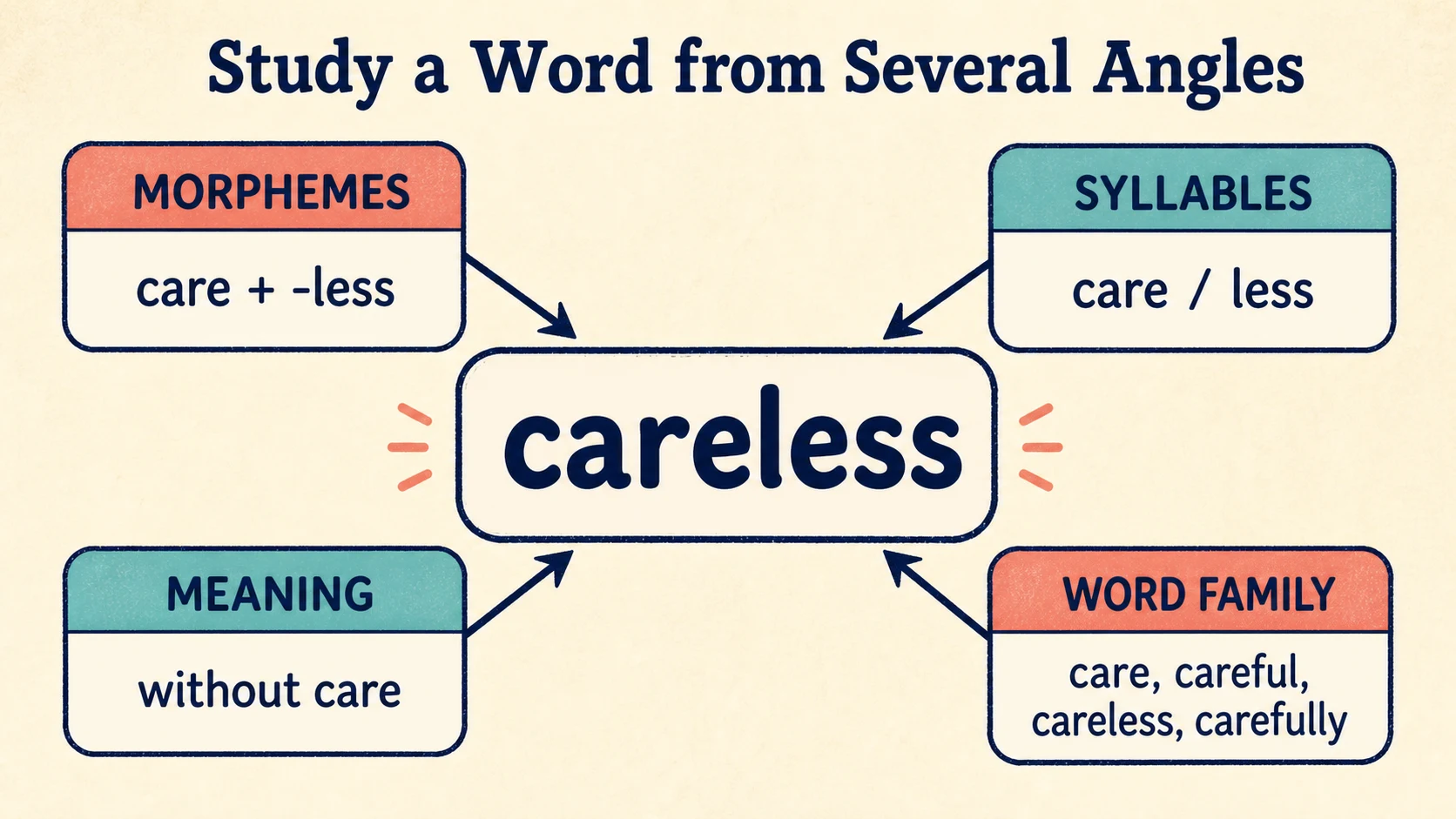
The map separates sound-to-letter work, pattern comparison, word-building, recall, and spelling in context so an adult can select one target instead of assigning undifferentiated practice.
Read the live skill range as a progression, not a checklist
The catalogue names short vowels, long-vowel spellings, consonant doubling, r-controlled vowels, silent letters, prefixes, suffixes, and multisyllabic words. These are related, but they are not interchangeable levels of the same task.
Short vowels establish a sound-to-letter decision
Short-vowel practice asks a learner to hear the vowel within a one-syllable word and represent it. In map, men, sit, hot, and sun, the learner must isolate the middle sound rather than merely remember the outside consonants.
This is an appropriate starting point when the learner writes men as man, but it is unlikely to resolve an error such as hoping written as hopping. The first error concerns vowel identification or a stored spelling; the second concerns how a suffix interacts with a base word.
Long vowels require comparison among spellings
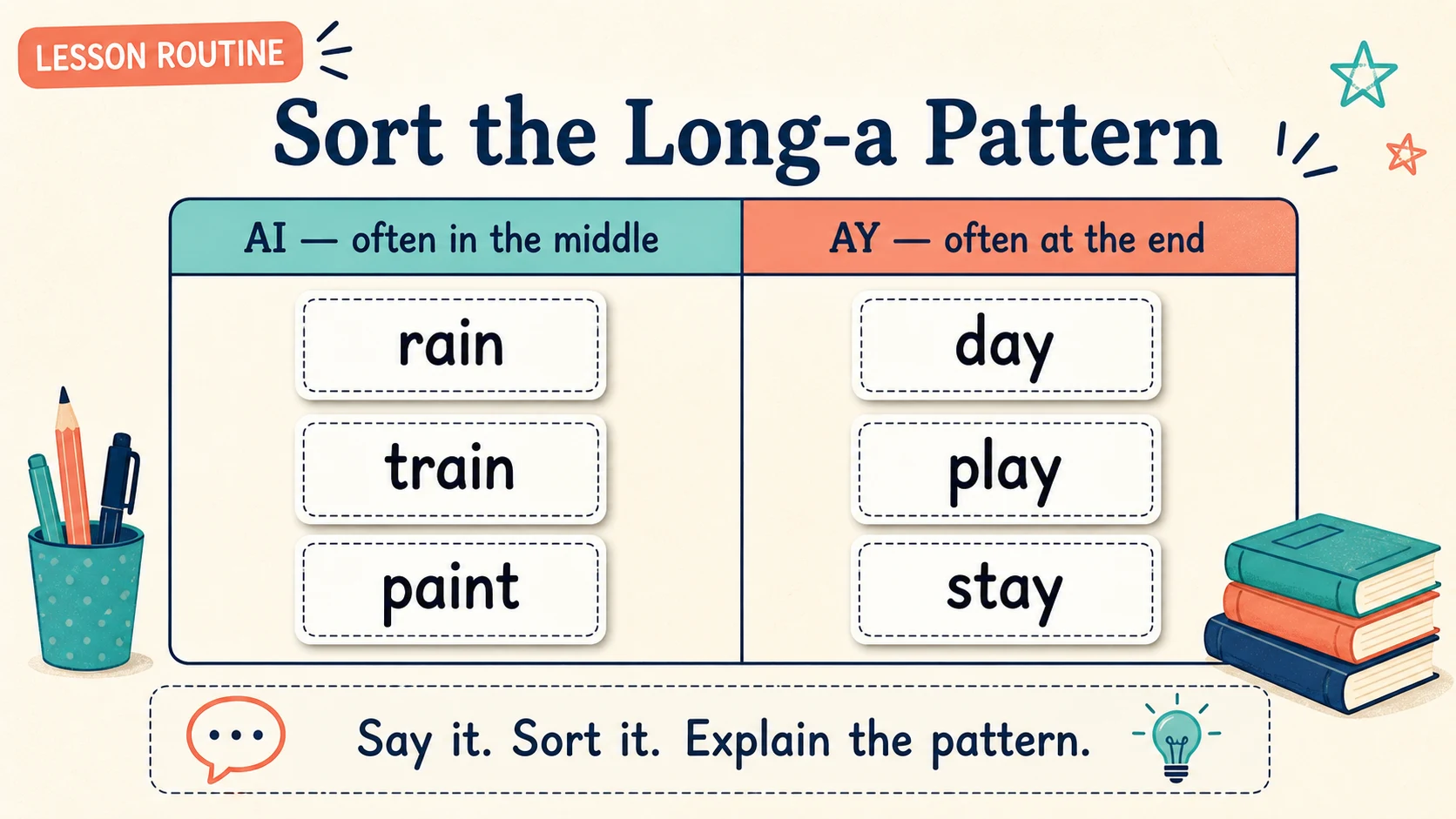
Long-vowel work is more than adding silent e. The catalogue’s own long-a example—cake, rain, play, and break—shows why. The words share a prominent vowel sound, but their spelling patterns differ.
At this stage, “Listen more carefully” is not enough. The sound alone cannot tell a learner whether to write rain or the nonword rane. The useful work is to compare known patterns, notice where they occur, and store the whole word when the spelling is less predictable.
Doubling and suffixes require attention to word structure
Consonant doubling asks the learner to preserve the base word’s vowel pattern when adding an ending: run becomes running, while rain becomes raining. Suffix practice also includes changes that do not require doubling, such as help to helpful.
Prefixes pose a different decision. In a word such as unhappy, the base happy remains visible after un- is attached. A prefix or suffix worksheet therefore belongs after the learner can locate the base word; otherwise, the activity may become copying without understanding the word’s parts.
R-controlled vowels and silent letters demand precise noticing
In car, her, bird, fork, and turn, the vowel cannot be treated as an ordinary short vowel because the following r affects the sound. A useful sort retains the differences among ar, er, ir, or, and ur; placing every word in one “r-controlled” box would conceal the spelling choice the learner must make.
Silent-letter work similarly depends on noticing letters that speech does not reveal fully. In knee, hearing the word does not supply the initial k. The learner needs visual attention to the complete written form, comparison with related examples, and repeated retrieval—not a claim that every silent-letter word follows one simple rule.
Multisyllabic words coordinate several smaller decisions
A word such as sunset can be separated into familiar parts, sun and set. A word such as helpful combines a base and suffix. Longer words may involve syllable boundaries, affixes, or a less predictable stored spelling.
Multisyllabic practice is therefore not automatically “harder” in every case. sunset may be easier to reconstruct than the one-syllable knee because both parts of sunset are audible and familiar. Observable task features—not word length alone—should determine the next sheet.
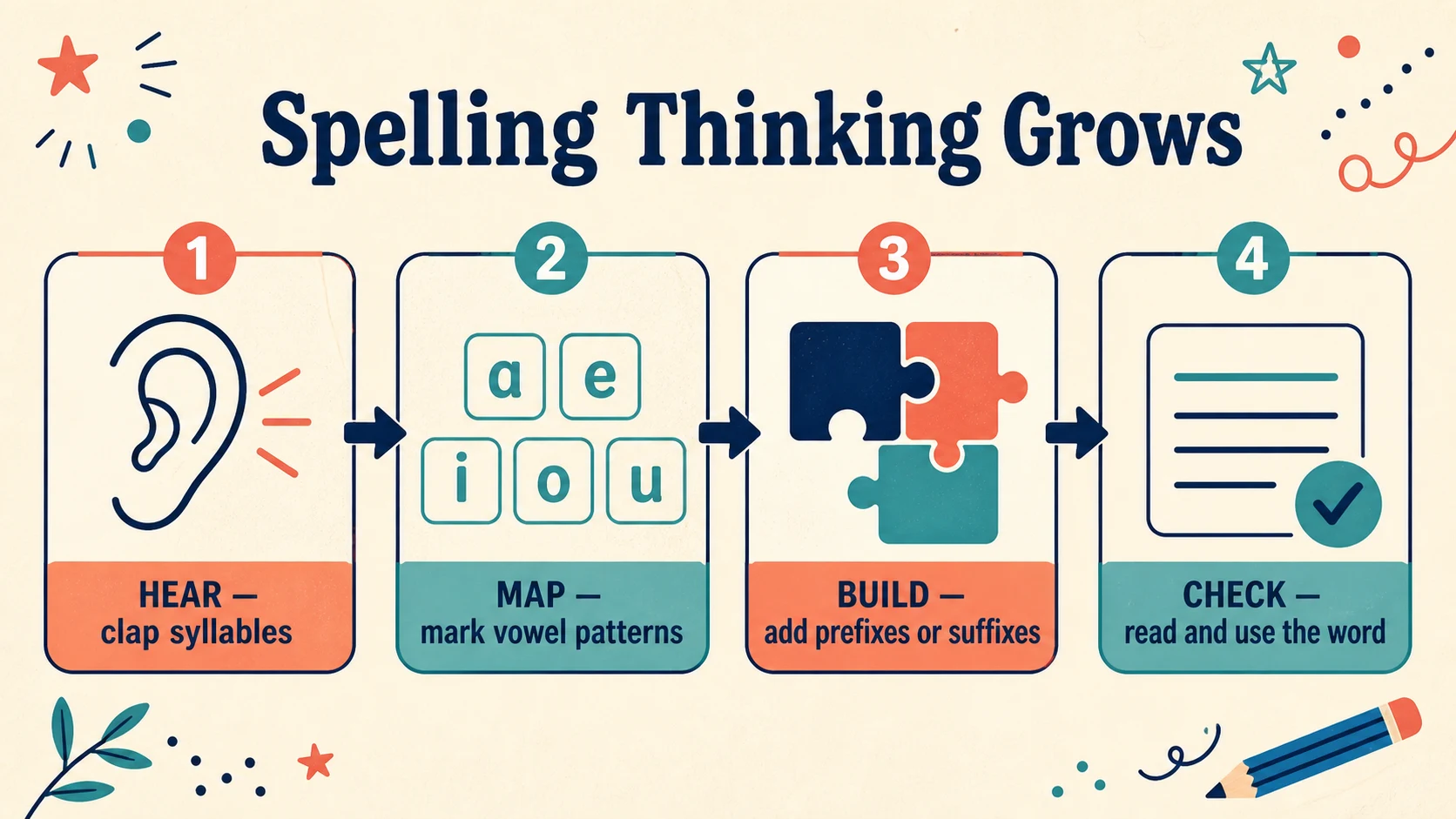
Supported oral comparison, visible pattern sorting, covered recall, sentence application, and independent proofreading place different demands on the learner even when the words stay the same.
Define worksheet difficulty by what the learner must do
The free catalogue sheet is labeled “easy,” but that label should describe the task rather than the learner. For this page, observable features make a more useful definition.
A more supported task might provide the complete words, ask the learner to trace or copy them, keep one pattern visible, and require recognition rather than recall. A less supported task might remove the model, mix several patterns, require sentence composition, or ask the learner to locate and correct an error independently. More items also increase stamina demands, but item count does not by itself establish linguistic difficulty.
Use these criteria before printing:
- Pattern load: Does the page practice one pattern or mix several?
- Response demand: Does the learner match, sort, copy, recall, edit, or compose?
- Visual support: Are complete words and category headings visible?
- Language load: Are words isolated, embedded in supplied sentences, or used in original sentences?
- Memory delay: Does the learner copy immediately or write after covering the model?
- Distractor quality: Are incorrect options obviously different or plausibly confusable?
- Independence: Must the learner read directions, manage materials, and check work alone?
- Stamina: Is the learner expected to complete all 20 problems at once?
A 20-problem free sheet can be divided into two sets of ten without changing its spelling target. That adaptation preserves the task while reducing fatigue. In contrast, leaving the words uncovered during a recall section changes the target from retrieval to copying.
The 2nd Grade Spelling Words guide and free sheet is the concrete entry point for inspecting these features. Preview the response type and patterns before deciding whether to use all 20 problems.
Work the spelling decisions before teaching them
Adults should check every example they introduce. The four examples below use only patterns represented in the live catalogue and show what a correct analysis looks like.
Worked example 1: sort by short-vowel spelling
Sort map, men, sit, hot, and sun.
| Short-vowel category | Checked word | Relevant letters |
|---|---|---|
short a |
map |
a between m and p |
short e |
men |
e between m and n |
short i |
sit |
i between s and t |
short o |
hot |
o between h and t |
short u |
sun |
u between s and n |
Say each word naturally, stretch it only enough to identify the middle sound, and then underline the written vowel. This example belongs here because short vowels are a verified catalogue target and because sorting reveals whether the learner can connect an internal vowel sound to its letter.
If men is placed under short a, ask, “What vowel letter do you see?” and then contrast men with man. Do not infer a reading disorder or hearing problem from one response. The immediate evidence is only that this contrast needs checking.
Worked example 2: compare long-a spellings
Examine cake, rain, play, and break.
cakerepresents longawith ana_epattern.rainusesai.playusesay.breakuseseain this particular word.
All four words contain the long-a sound, but they cannot be generated from one universal spelling rule. A productive sort gives each written pattern its own column. The learner then reads the columns and marks the letters representing the target vowel sound.
This example belongs on this page because the exact set appears in the catalogue teaching tip. It also prevents a common instructional flattening: teaching “long a” as though every word uses silent e.
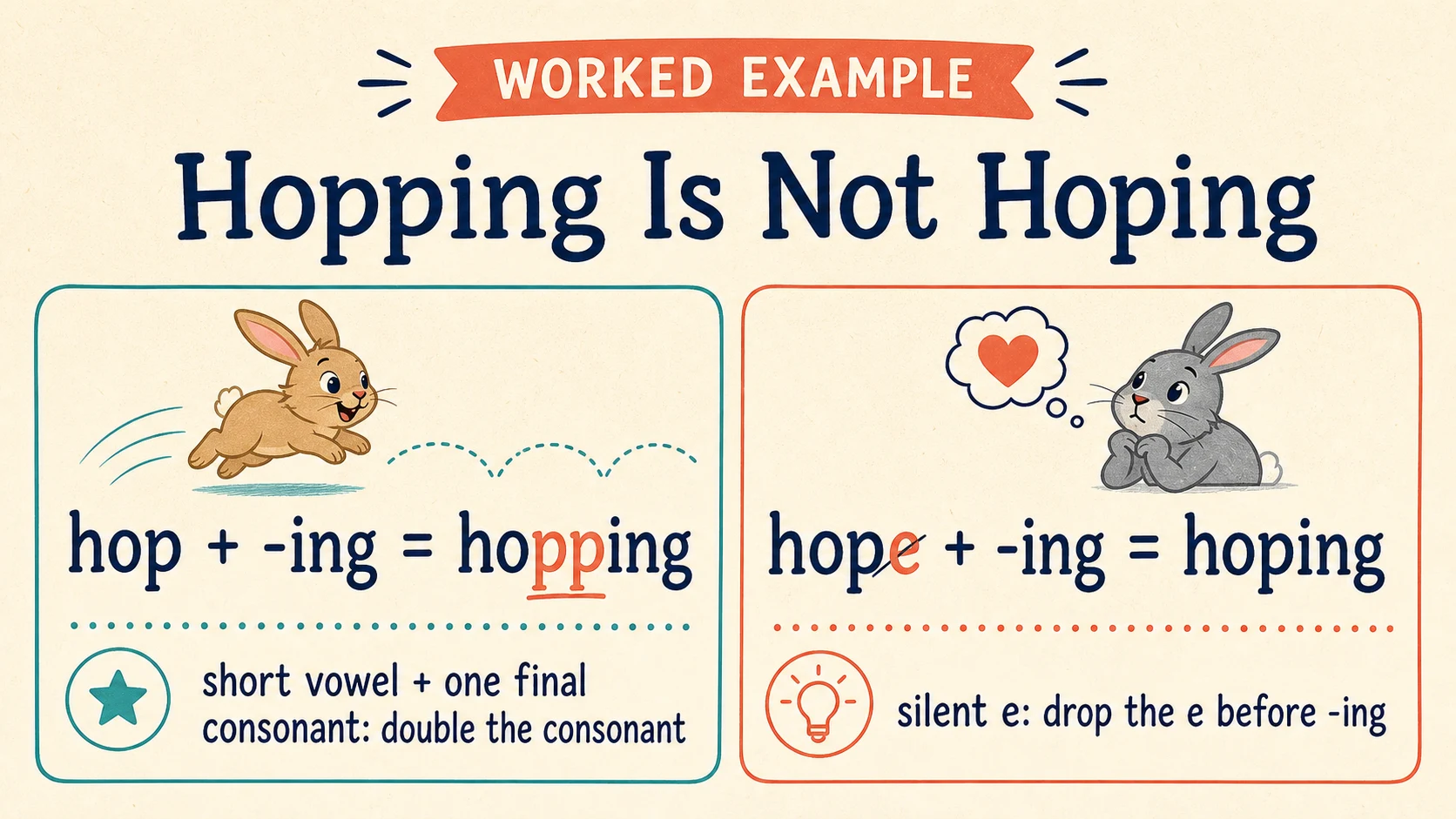
The worked sequence makes the hidden decision visible: hear the shared sound, inspect its different written forms, sort by spelling, and then retrieve one word without the model.
Worked example 3: decide whether to double
Add -ing to run and rain.
runis a one-syllable base ending in one consonant after one vowel.- Double the final
nbefore adding-ing. - The result is
running, notruning.
Now compare:
rainalready contains the vowel teamai.- Add
-ingwithout doubling the final consonant. - The result is
raining, notrainning.
The contrast matters more than three rows of copying. It asks the learner to inspect the base word and apply a spelling change. This belongs here because both consonant doubling and suffixes are live catalogue skills.
After checking the two forms, ask the learner to cover them and explain the difference orally. If the explanation is correct but one word is copied inaccurately, the problem may be attention during transcription rather than misunderstanding the doubling decision.
Worked example 4: preserve a base word when adding an affix
Build unhappy from un- and happy; build helpful from help and -ful.
un- + happy = unhappyhelp + -ful = helpful
In unhappy, the base word keeps both p letters. The second p is not newly doubled because of the prefix. In helpful, the suffix is spelled -ful, with one l, even though the separate word full has two.
This example belongs here because it distinguishes prefix work from suffix work and requires attention to stable word parts. It also supplies a useful correction conversation: identify the base, box the affix, rebuild the word, and check the join.
Worked example 5: proofread in a sentence
Consider: I am runing in the rain.
The misspelled word is runing. The checked correction is:
I am running in the rain.
The learner can identify run as the base, add -ing, and explain why n doubles. Rain remains unchanged because it is a separate word here, not the base of raining.
This example belongs at the 2nd grade practice level because it transfers a named pattern into a short, comprehensible sentence without asking the learner to manage a long passage. It also separates spelling from punctuation: the initial capital and final period are already correct.
Use a short routine that exposes the learner’s thinking
The catalogue recommends pattern-centered lists, look-cover-write-check, sorting, sentence dictation, cumulative review, and finding patterns in reading. The following routine is an editorial suggestion for using those formats efficiently; it is not a claim that WorksheetWise has tested this particular timing.
A repeatable 12-minute session
- Hear and say the target for two minutes. Name the pattern and read four to six words together. For long
a, comparecake,rain, andplay. - Sort or build for three minutes. Place words beneath written pattern headings, or assemble a base and affix with cards.
- Retrieve for three minutes. Use look-cover-write-check: study one word, cover it, write it, and compare it letter by letter.
- Use context for two minutes. Dictate one short sentence containing one or two target words.
- Respond to evidence for two minutes. Circle the exact incorrect part, correct it once carefully, and choose tomorrow’s two review words.
If everything is correct, do not automatically add ten more examples. Ask for one explanation or one new word using the same pattern. If recall is inaccurate after a correct sort, repeat retrieval with fewer words. If both sorting and recall are inaccurate, return to visible comparison.
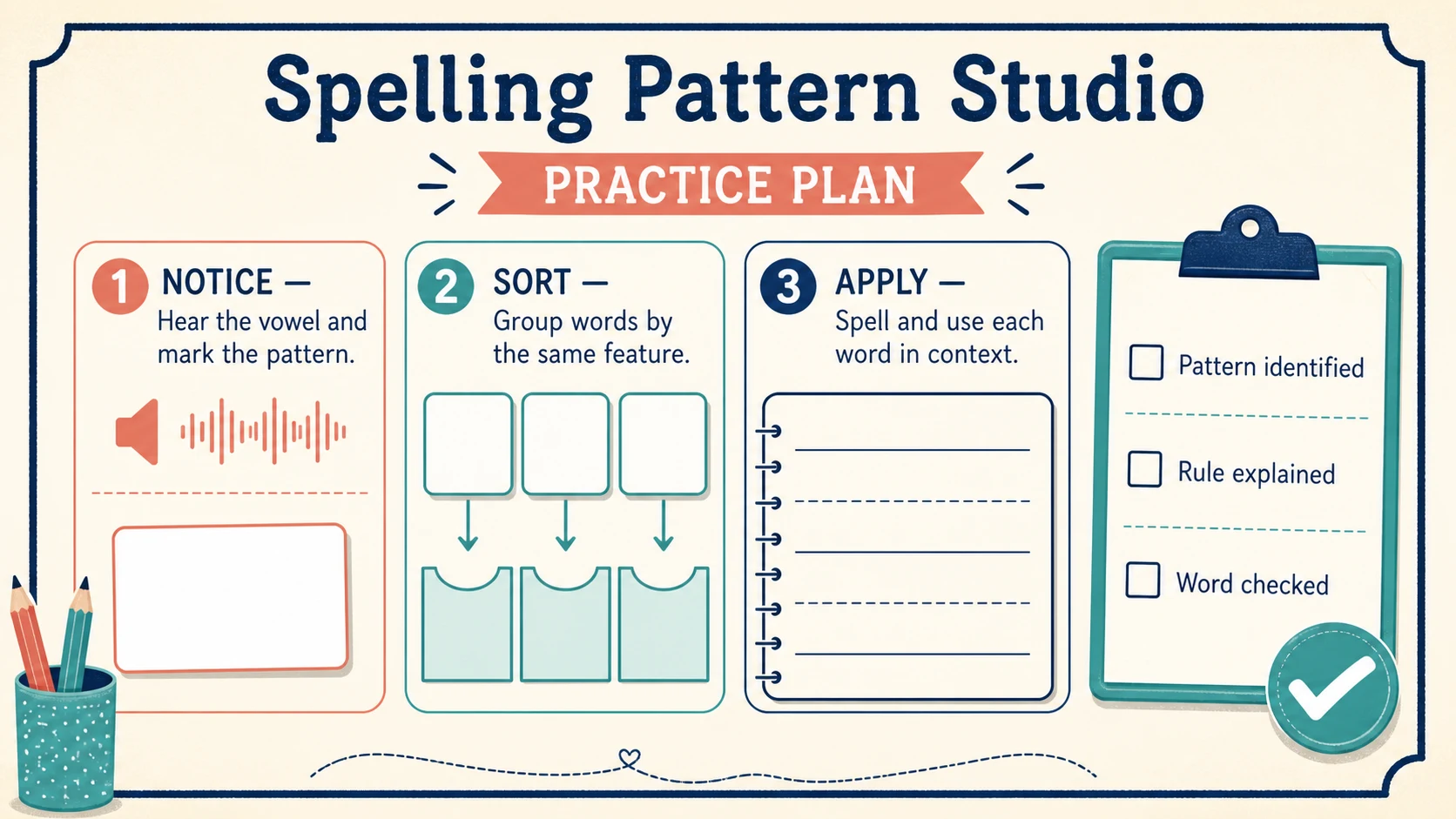
One small cycle connects pattern recognition, memory, sentence use, and correction while keeping the adult’s next decision tied to visible work.
The IES foundational-skills guide recommends systematic instruction that helps children connect sounds with written forms and decode words, with attention to practice and feedback. That supports explicit comparison of spelling patterns, although the guide did not evaluate these WorksheetWise materials. See the IES foundational-skills practice guide.
For a school-week assignment, the Homework Spelling Worksheets route can help locate a context-appropriate format. For teacher-managed independent practice, use Classroom Spelling Worksheets. The setting should affect session length and support, not the spelling rule being taught.
Interpret errors narrowly before choosing another sheet
An error is useful evidence only when the adult identifies what happened. “Needs more spelling” is too broad to guide the next task.
A sound or pattern was confused
Writing men as man suggests checking whether the learner hears and recognizes the short-e and short-a contrast. Test that interpretation with a small oral-and-written comparison such as men/man and pen/pan. If the learner distinguishes the spoken words but still writes the wrong vowel, use visible word comparison and retrieval rather than more listening alone.
The right sound was represented with the wrong long-vowel spelling
Writing rane for rain preserves the sounds but selects the wrong written pattern. The response is not to reteach what long a sounds like. Compare known long-a spellings and place rain in the ai group. Because sound does not uniquely determine the answer, the learner must remember which pattern belongs to this word.
A word-building change was omitted
Writing runing for running preserves the base but omits doubling. Ask the learner to circle run, attach -ing, and compare the result with raining. If the learner can explain and correct the contrast, schedule short retrieval later. If not, continue with base-word comparisons before mixed suffix practice.
The word was correct alone but incorrect in a sentence
This pattern suggests the spelling is not yet stable under a larger writing load. Keep the sentence short, dictate it in meaningful phrases, and have the learner proofread specifically for the target pattern. Do not require an original paragraph merely to make the activity seem more rigorous.
The IES elementary-writing guide emphasizes regular writing opportunities, instruction in the writing process, and explicit teaching of foundational writing skills. In this context, a short sentence is useful because spelling is being applied within writing; the source does not establish that one sentence format will suit every learner. Consult IES guidance on effective elementary writing.
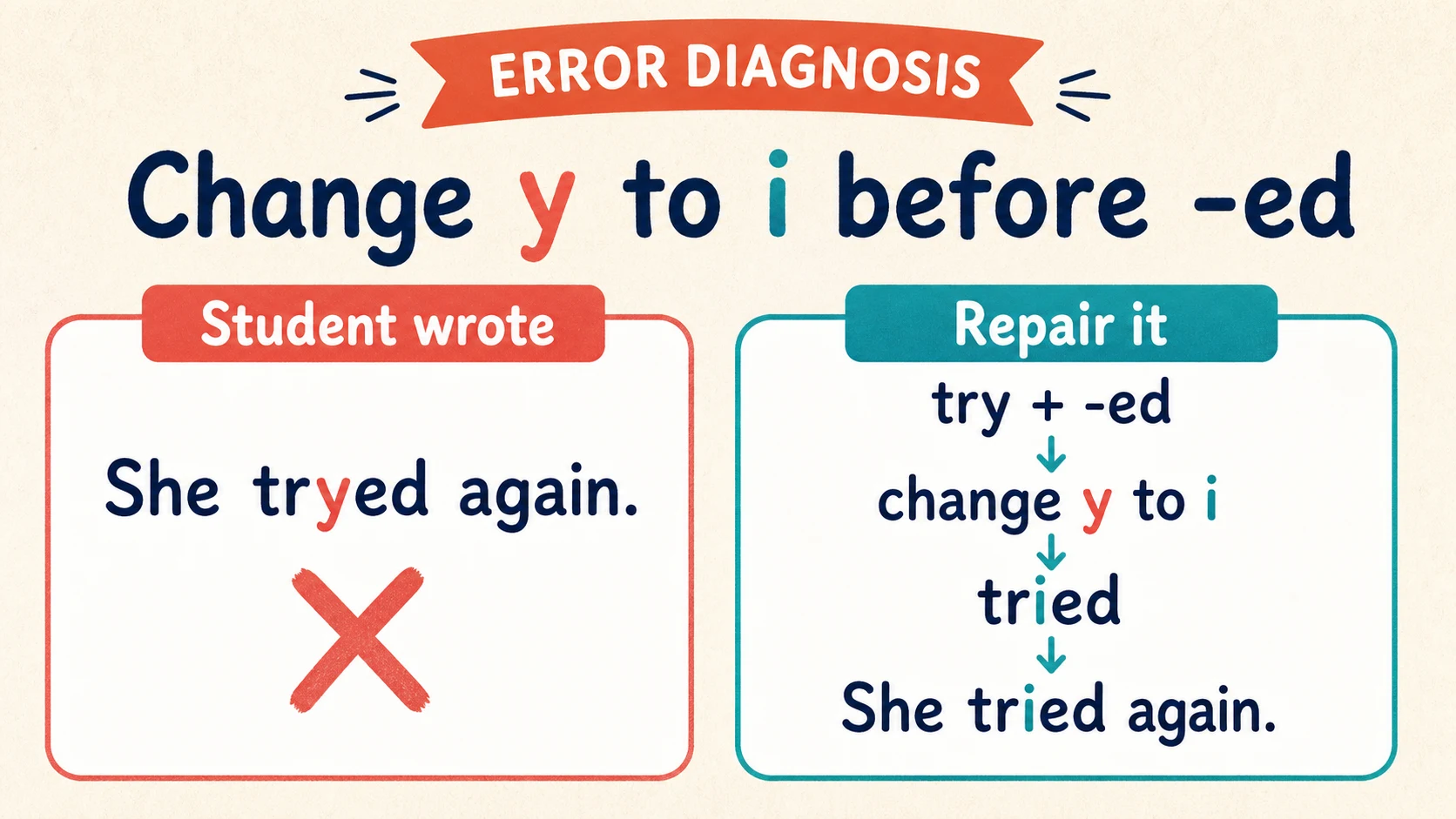
Each response stays close to the evidence: vowel contrast, pattern selection, base-word change, retrieval, or transfer into a sentence.
Adapt access without removing the spelling decision
A useful adaptation changes how the learner reaches the target, not what counts as the target.
- Read directions aloud while leaving the spelling choices to the learner.
- Cut a 20-problem sheet into two ten-item sessions.
- Enlarge print or increase spacing without supplying missing letters.
- Let the learner move word cards into pattern groups before recording the sort.
- Offer letter tiles for building, then require the learner to write the completed word.
- Reduce the number of words while retaining the same pattern contrast.
- Permit an oral explanation after a written answer so the adult can distinguish reasoning from handwriting difficulty.
- Highlight the base word in one color and the affix in another.
- Use a finger tap, step, or counter for each syllable before writing a multisyllabic word.
For ages three and four encountered elsewhere in the catalogue, prioritize brief adult-led oral, matching, manipulative, and movement work over desk work. That is an access and developmental decision, not evidence that a particular child belongs at a named worksheet level.
Avoid adaptations that erase the target. If the task is covered recall, leaving the model visible turns it into copying. If the target is proofreading, pointing directly to the misspelled word removes error detection. If the target is long-vowel pattern selection, providing the missing vowel team in advance answers the central question.
Plan two weeks around one pattern and cumulative review
The catalogue supports weekly spelling instruction and recommends revisiting previously taught patterns. A two-week plan should not mean ten unrelated sheets.
Days 1–5: establish and apply one contrast
- Day 1: Preview six to eight words and sort them by the selected pattern.
- Day 2: Repeat the sort from memory, then check against the models.
- Day 3: Use look-cover-write-check on four words, repeating only missed words.
- Day 4: Dictate two short sentences containing target words.
- Day 5: Give a brief mixed check: two sorted words, two recalled words, and one sentence.
Days 6–10: retrieve, transfer, and review
- Day 6: Revisit only the errors from Day 5 and explain the relevant pattern.
- Day 7: Add two new examples that genuinely fit the same pattern.
- Day 8: Proofread a short passage or several sentences for that pattern.
- Day 9: Mix the current pattern with one previously secure pattern.
- Day 10: Use a fresh sort or dictation, then record the next instructional decision.
The plan revisits one spelling decision in several formats before mixing it with older learning; worksheet quantity is secondary to what the learner can now do.
A word search can serve as review when the learner must inspect the complete spelling and then retrieve it elsewhere. It should not be the only evidence of mastery: a word already printed inside a letter grid can be recognized without being independently spelled.
Keep claims and placement decisions within the evidence
The Common Core English Language Arts standards include grade-level expectations involving conventional spelling, use of spelling patterns, and consultation of reference materials. They offer one public reference point for intended practice, but local curricula may sequence patterns differently. Review the Common Core ELA standards alongside the learner’s school expectations rather than treating a catalogue label as universal alignment.
These worksheets can provide structured practice, but they cannot by themselves:
- diagnose a learning, language, attention, vision, or hearing condition;
- establish complete reading or writing proficiency;
- show that a spelling is secure across every writing situation;
- replace explicit instruction, oral language work, reading, feedback, or authentic writing;
- prove progress from one completed page;
- determine placement solely from grade, age, score, or an “easy” label.
Also separate sourced guidance from page-specific suggestions. The IES guides support systematic foundational instruction and purposeful elementary writing instruction. The catalogue supplies the actual WorksheetWise formats and skill range. The 12-minute routine, example word sets beyond the supplied long-a list, task-selection rules, and two-week sequence in this guide are editorial recommendations reasoned from those facts—not findings reported by IES and not tested product outcomes.
Make the next task observable and small
Start with the free 20-problem 2nd Grade Spelling Words sheet, but preview it before handing it over. Select one section or ten items that share a clear demand. Ask the learner to complete them, explain one answer, and correct one error by identifying the exact letter pattern involved.
Then make only one of three decisions: repeat the same pattern with less support, apply it in one dictated sentence, or return to a visible sort. Record the evidence in concrete language—“sorted ai and ay correctly but wrote rain as rane after covering the model”—and use that observation to choose tomorrow’s task.
Put it into practice
Use the guide with a real printable
Move from explanation to a short, observable practice task. Check the first item together, then adjust the next session from the learner's actual work.
Open the first free worksheet