Curated collectionAnswer keys includedPrint-ready PDFs
Long Vowels Worksheets by Grade and Level
Show the full long vowels progression across 2 real grade combinations, compare task boundaries, model checked examples and explain how to choose the next level.
Start with a real resource
Browse this worksheet collection
2 relevant free entry points are available. Each one includes a printable learner PDF and separate answer key.
A useful practice loop
Print less. Observe more.
- Choose one skill and model the first item aloud.
- Use a short set and notice the learner’s strategy.
- Change the next task from the work you can see.
Need more than the free sheet?
Plus includes all 36 matching catalogue variations where available, plus saved deterministic generators and the worksheet designer.
See Plus membershipComplete guide
How to teach and practise long vowels worksheets
3,092 words Updated 6 instructional visuals
Choose the worksheet by the task, not just the grade
Long-vowel practice should begin after a learner can fluently decode short-vowel CVC words such as cap, pin, hop, and cub. The most useful starting point is usually silent-e, or CVCe, because adding the final e creates a visible spelling change and often changes the vowel sound: cap/cape, pin/pine, hop/hope, and cub/cube. From there, practice can move into common vowel teams, spelling-pattern sorts, mixed reading, and dictation.
The WorksheetWise catalogue currently offers 36 long-vowel worksheet variants across two intended practice levels: 1st Grade and 2nd Grade. Both combinations are Phonics–Long Vowels resources. Each grade has one free 20-problem sheet, giving families and educators two free entry points. Grade labels describe intended practice level; local curriculum sequences differ, so select by what the learner must do on the page rather than by the grade printed at the top.
A practical choice looks like this:
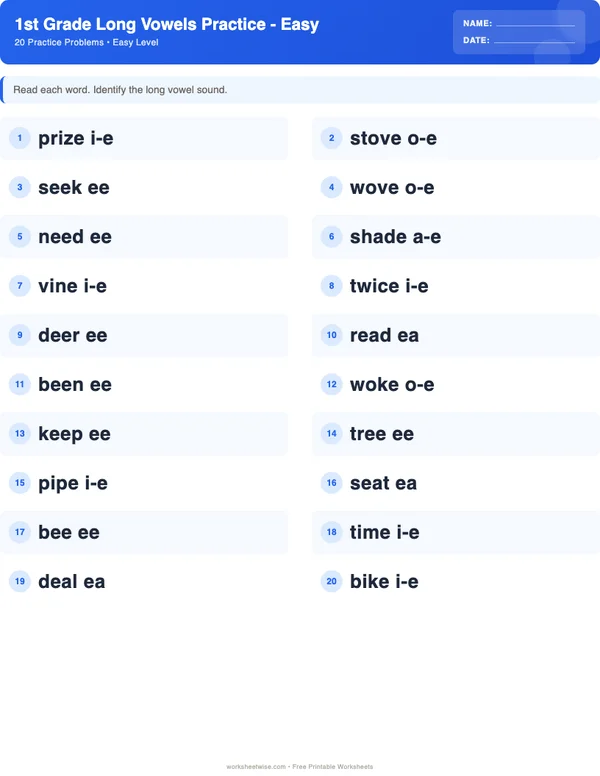
- Choose the 1st Grade Long Vowels guide and free sheet when the learner needs a clear introduction to recognizing or reading common long-vowel patterns with substantial adult support.
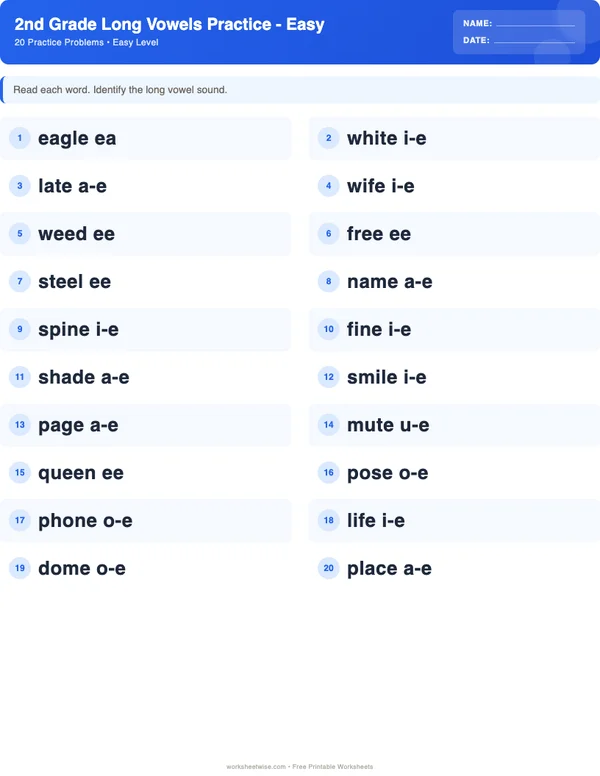
- Choose the 2nd Grade Long Vowels guide and free sheet when the learner can read familiar CVCe words and is ready to compare spellings, read across patterns, or encode words from speech.
- Step back to CVC Words Worksheets by Grade and Level if words such as tap, rip, and hop are still decoded slowly or inaccurately.
The catalogue calls both free sheets “easy,” but that label should not be applied to a learner. Here, treat it as a resource label that must be verified through observable features: how many spelling patterns appear together, whether a model is supplied, whether pictures or word banks reduce recall demands, whether the response is choosing, reading, sorting, or spelling, and how much independent reading the directions require.
What counts as a long vowel on these pages
A long vowel generally says its letter name. Checked examples include the a in cake, e in feet, i in kite, o in bone, and u in cube. The sound can be represented in several ways:
- Silent-e: make, ride, hope
- Vowel teams: ai, ay, ea, ee, oa, ow, and ue
- Open syllables, where the vowel ends the syllable: he, go, and the first syllable of music
The instructional problem is therefore larger than “find the vowel.” A learner must connect a spoken sound with a spelling pattern, use that pattern while reading, and eventually choose an appropriate spelling while writing. English spellings are not perfectly regular, so a useful worksheet makes its immediate pattern boundary clear.
The IES foundational reading practice guide recommends systematic work connecting sounds with letters and using that knowledge to decode words. It also supports practice in reading words, sentences, and connected text. That guidance does not evaluate WorksheetWise materials; it provides an authoritative reason to look for explicit sound–spelling work and opportunities to apply it.
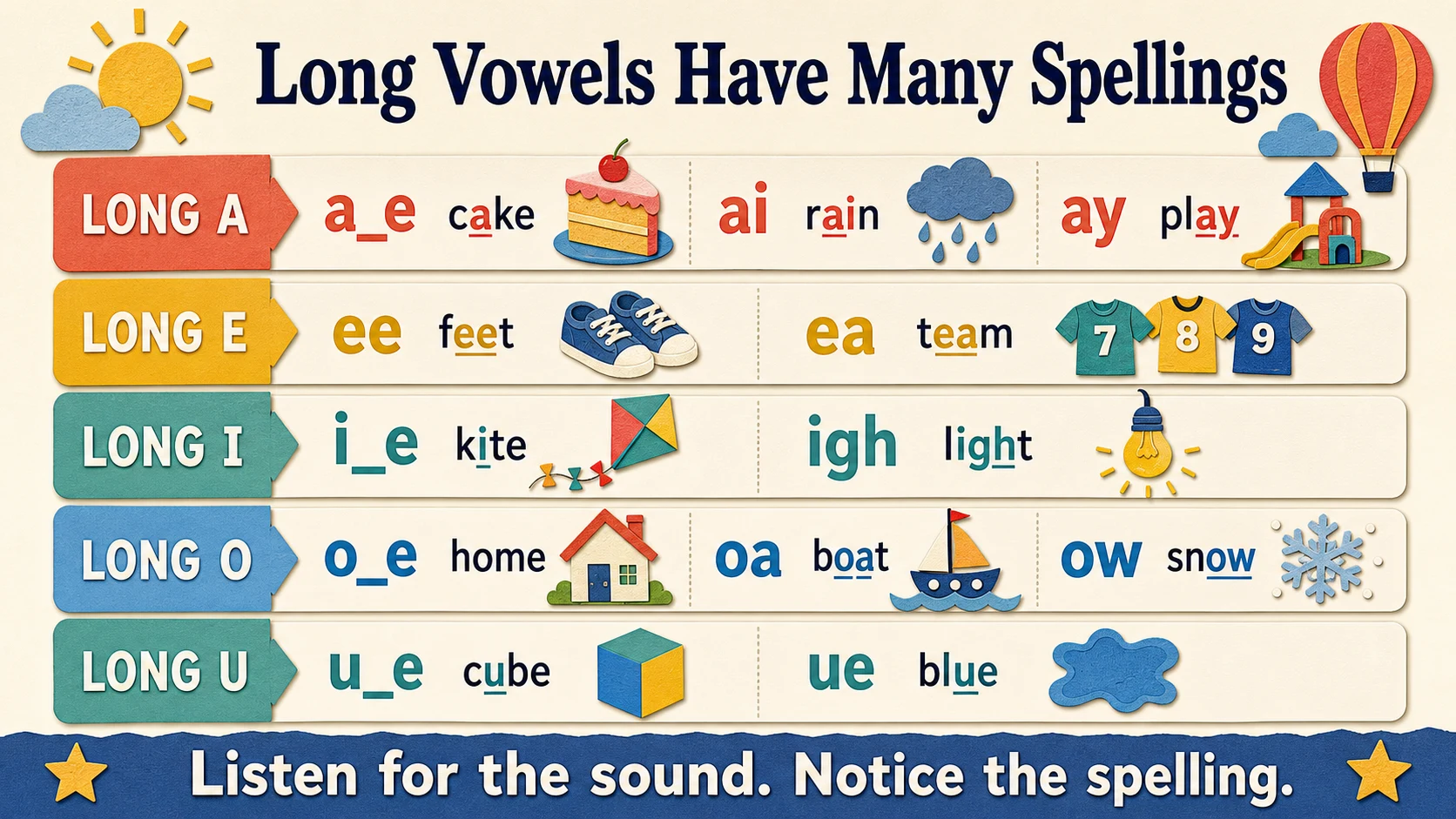
Long-vowel work connects sound recognition, pattern identification, word reading, spelling, and transfer into meaningful text.
A familiar rhyme—“when two vowels go walking, the first one does the talking”—can help introduce teams such as ai, ea, ee, and oa. Treat it as a starting strategy, not a rule. It works for many target words but has enough exceptions that learners also need to notice and remember individual spelling patterns. Saying “this pattern often represents this sound” is more accurate than promising that two adjacent vowels always behave the same way.
The progression from short vowels to flexible long-vowel reading
Confirm the short-vowel foundation
Before introducing final e, check whether the learner can read a small, mixed set such as cap, pin, hop, cub, tap, and rip without needing to guess from the first consonant. This is a readiness check, not a timed diagnosis. If the learner has to stretch and blend every item but remains accurate, provide more CVC practice while introducing only a few contrasting CVCe pairs orally. If the learner changes vowels or guesses whole words, return to direct sound-by-sound blending.
Always contrast a long-vowel word with a short-vowel word during the lesson. The contrast makes the relevant change easier to notice. A page containing only long-vowel words may produce correct answers without revealing whether the learner hears and uses the vowel distinction.
Begin with silent-e contrasts
Teach the initial generalization in plain language: “The e at the end makes the vowel say its name.” Then verify the change with paired reading:
- cap → cape
- pin → pine
- hop → hope
- cub → cube
These examples belong at the entry point because each begins with a decodable CVC word, adds one visually distinctive letter, and preserves the surrounding consonants. The learner can attend to the vowel change instead of solving an unrelated word.
A useful word chain is tap → tape → rip → ripe. Every item is a real word. The first transition changes short a to long a by adding final e. The middle transition removes letters and changes the entire word, so an adult should build it with movable letters rather than imply that tape turns into rip through one-letter substitution. The final transition adds e and changes short i to long i. This chain belongs here because it requires the learner to alternate between CVC and CVCe decoding instead of applying “long vowel” automatically to every word.
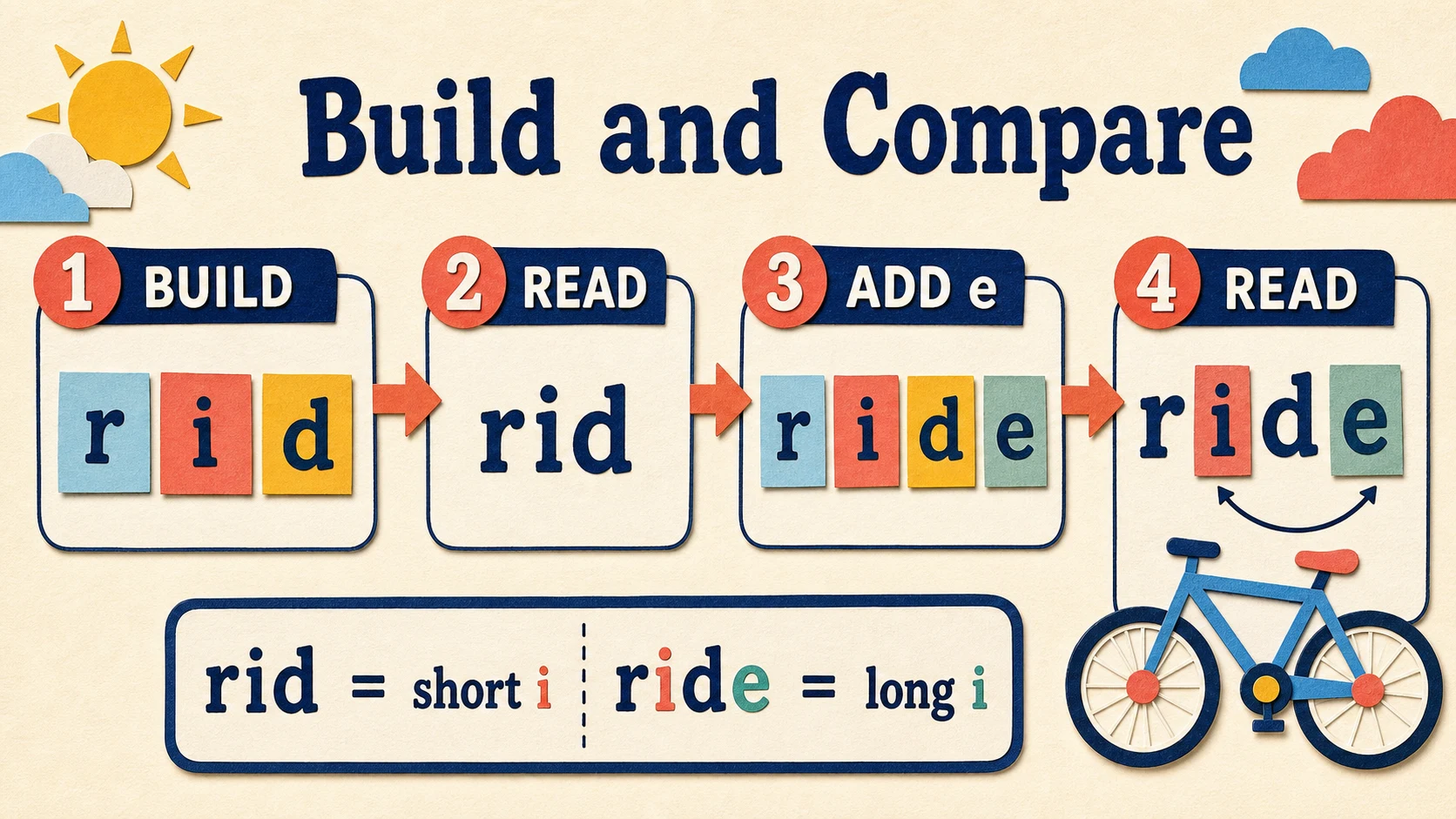
The 1st-grade path should reduce support only after the learner can explain what the final e changes.
Add one common vowel team at a time
After familiar CVCe reading is reasonably secure, introduce frequent spellings before less common alternatives. A workable sequence from the supplied teaching anchor is:
- Long a: a_e, then ai
- Long e: ee, then ea
- Long i: i_e
- Long o: o_e, then oa
- Less common spellings after those patterns are established
Avoid introducing every team simply because a worksheet has room for them. A learner sorting rain, train, day, and play is solving both ai and ay. That may be appropriate after either pattern has been studied separately, but it is a poor first encounter with long a.
Move from recognition to encoding
Recognition asks, “Which word has long o?” Encoding asks the learner to hear /hōp/ and write hope. Encoding is harder because the spelling is not visible. Dictation therefore belongs after explicit modeling and reading practice, not as the unexplained opening task.
The IES elementary writing practice guide recommends teaching writing skills explicitly and providing opportunities for practice. Applied here, that supports brief, modeled spelling work rather than expecting a learner to infer a new pattern from errors. This is a page-specific instructional suggestion informed by the guidance, not a claim that the source prescribes these exact word lists.
How 1st-grade and 2nd-grade task boundaries differ
The same word can appear at either grade level while the thinking demanded by the question changes. Grade is therefore less informative than representation, directions, response type, and pattern range.
A productive 1st-grade starting point
At the intended 1st-grade practice level, a page can reasonably emphasize one visible contrast at a time. The learner might:
- Match cap and cape to different pictures.
- Circle the word that names a pictured kite from kit/kite.
- Add final e to change hop into hope.
- Read a short column of words sharing one pattern.
- Sort a small set into “short vowel” and “long vowel.”
Consider this checked item: “Circle the word for a cloak: cap or cape.” The vocabulary makes this a flawed item because cape may be unfamiliar even if the learner understands CVCe. A better prompt supplies pictures that are immediately recognizable, uses the words in oral sentences, or simply asks the learner to read both words and mark the one with long a. This example belongs in a selection guide because picture vocabulary can conceal the phonics target.
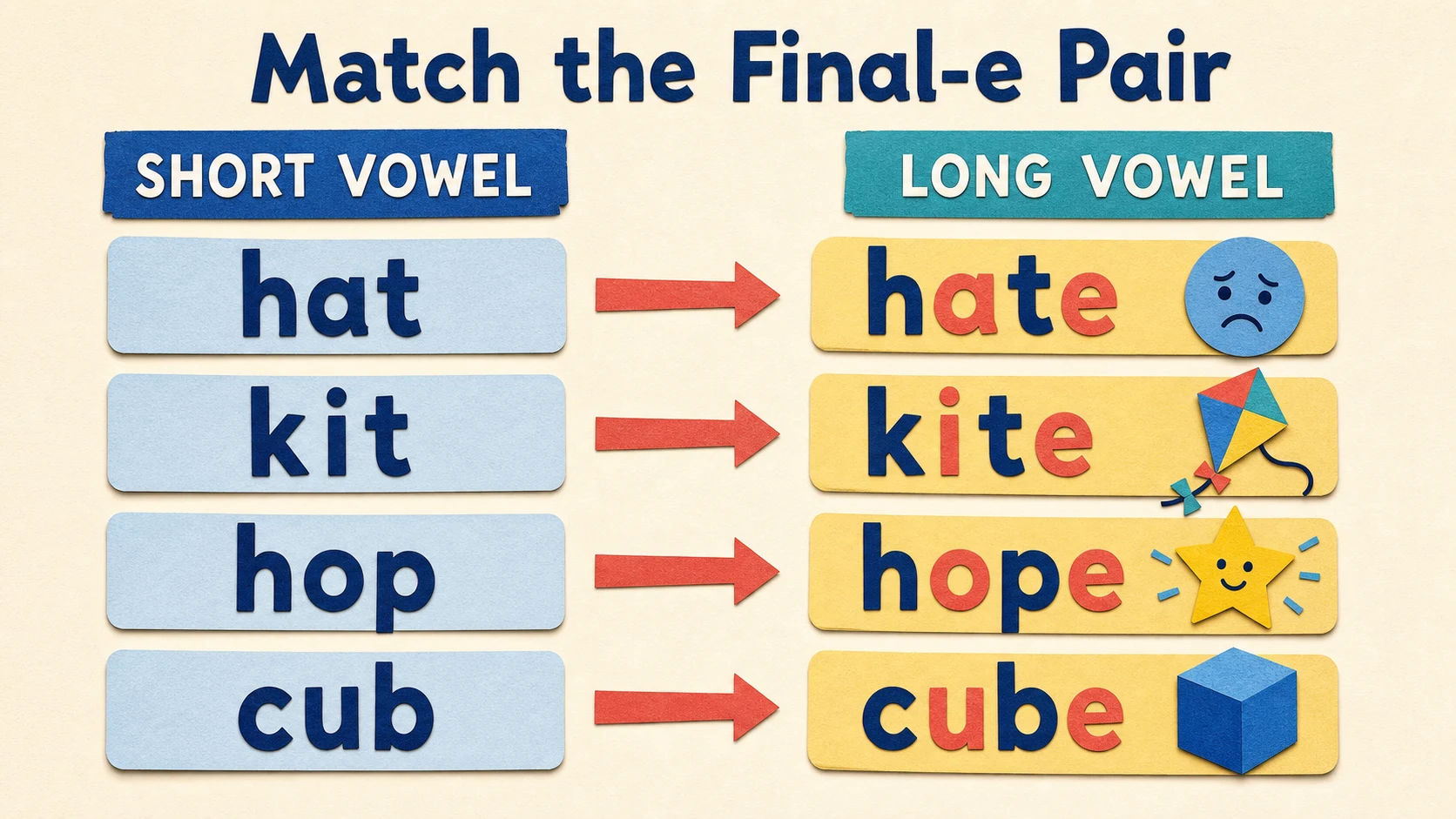
Brief 1st-grade practice can alternate listening, building, reading, marking, and explaining rather than becoming a long block of silent desk work.
A productive 2nd-grade starting point
At the intended 2nd-grade practice level, questions can ask the learner to compare patterns representing the same sound. Appropriate demands may include:
- Sorting long-a words among a_e, ai, and ay
- Reading mixed CVCe and vowel-team words
- Selecting a spelling pattern from context
- Writing dictated words
- Explaining what two words share
- Applying the pattern in a sentence
Here is a checked long-a sort:
| a_e | ai | ay |
|---|---|---|
| cake | rain | day |
| game | train | play |
Every listed word has the long-a sound. The columns differ by spelling pattern, so the task measures pattern awareness rather than merely hearing long a. It belongs later than a simple long/short sort because the learner must hold the sound constant while attending to three spellings. Also notice the position pattern: ay appears at the end of these one-syllable examples, while ai appears within the word. Present that as a useful observation about this set, not an exceptionless English rule.
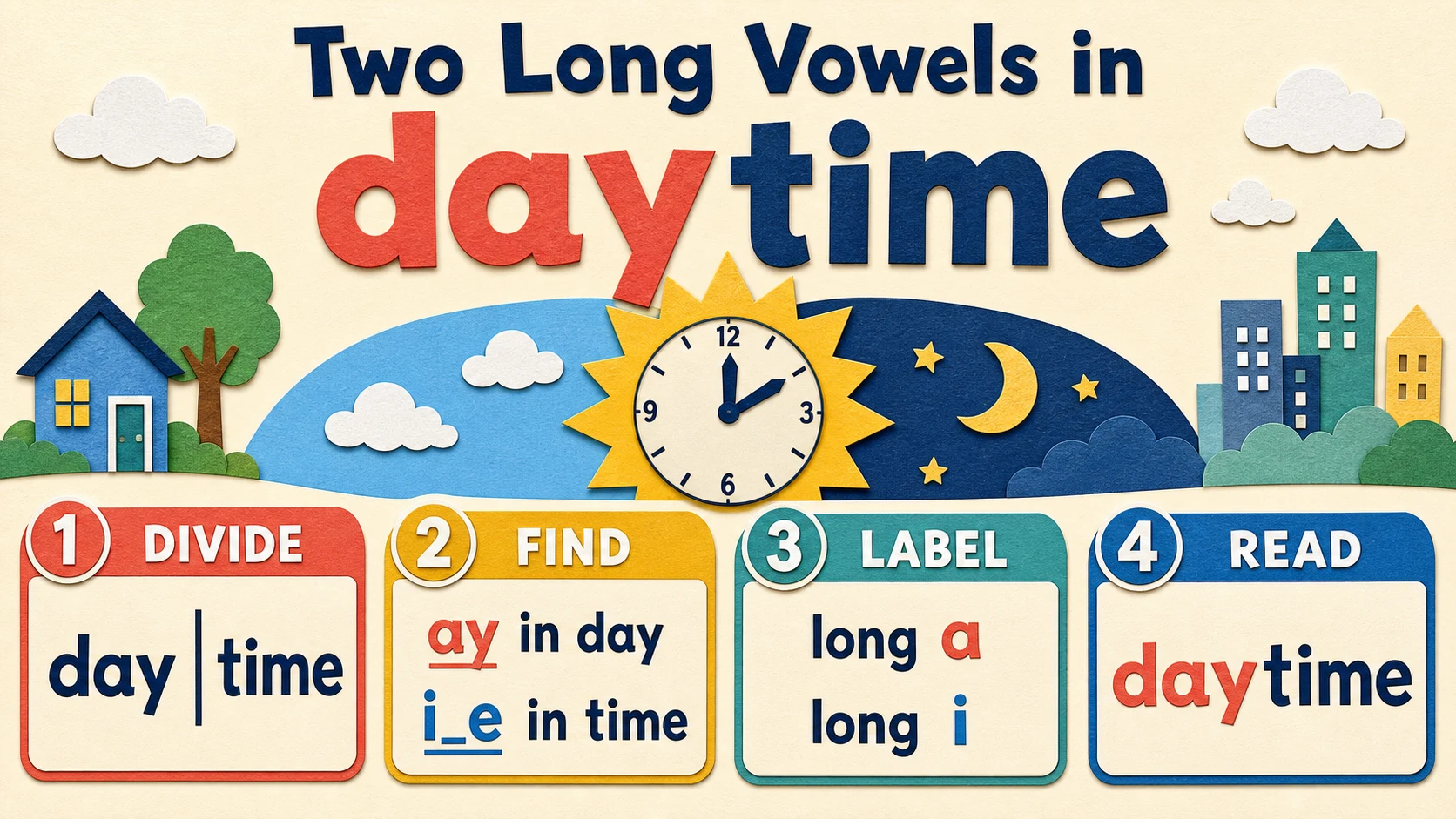
A worked example should make the sound, the visible letter pattern, and the required response equally clear.
The Common Core English Language Arts standards include grade-level expectations involving phonics, word analysis, spelling, and reading. They can help educators understand why tasks become more varied across elementary grades. They do not establish a universal placement sequence, and this guide does not claim formal standards alignment for any worksheet.
Four checked examples and what each one reveals
Example 1: hop and hope
Ask the learner to read hop, add e, and read hope. Both are real words; the initial and final consonants remain the same; short o changes to long o. This is an efficient first CVC/CVCe contrast.
If the learner reads both as hop, point to the final e, restate the generalization, and model the pair. If both become hope, cover and uncover the e so the learner must use the visible difference. The next question should use the same contrast with new letters, such as not/note, rather than immediately mixing vowel teams.
Example 2: pin and pine
Ask, “Which word has the vowel saying its name?” The answer is pine. The final e is not pronounced as a separate syllable in this word; it signals the long i pattern.
This pair belongs in early practice because it separates a common short-i CVC word from a clear i_e word. It also reveals whether a learner mistakes “silent” for “unimportant.” If the learner omits the e when spelling pine, have them build pin, say it, add e, and reread the changed word.
Example 3: feet and team
Both words contain long e, but their teams differ: ee in feet and ea in team. A question asking “Which word has long e?” has two correct answers. A well-designed item must instead ask “Which word spells long e with ee?” or ask the learner to sort the words by ee and ea.
This example belongs in later pattern comparison because it exposes a common question-design problem: a phonically correct word can make an item ambiguous when the prompt does not specify sound or spelling. Check every option, not just the intended answer.
Example 4: spelling boat from dictation
Say boat, use it in a sentence, repeat it, and ask the learner to write it. The expected target pattern is oa. This task belongs after the learner has read and sorted oa words because no printed pattern is available to copy.
If the learner writes bote, the answer still represents long o with a plausible taught pattern. The error is not failure to hear the long vowel; it is uncertainty about which spelling pattern this word uses. Respond with a comparison such as boat/coat beside note/hope, then ask the learner to sort and reread. If the learner writes bot, contrast bot and boat orally and visually because the missing long-vowel representation suggests a different instructional need.
A routine that fits the worksheet instead of replacing instruction
Six moves for a 1st-grade session
Keep the sequence short enough that attention remains on the pattern:
- Say and compare one pair, such as cub/cube.
- Build both words with letter cards.
- Ask what changed in the spelling and sound.
- Complete three to five worksheet items together.
- Let the learner complete a small related set independently.
- End by reading the words aloud in mixed order.
The adult should stop before a long page turns accurate practice into fatigued guessing. The free 1st-grade sheet contains 20 problems, but the catalogue count is not a requirement to complete all 20 at once. Cover unused rows, fold the page, or assign one pattern section.
Six moves for a 2nd-grade session
- Read two known examples from the target pattern.
- Contrast them with one short-vowel or alternative-spelling example.
- Model one item while explaining the decision.
- Have the learner complete a compact set.
- Dictate two words from the studied pattern and one contrast word.
- Ask the learner to explain one answer using both sound and spelling evidence.
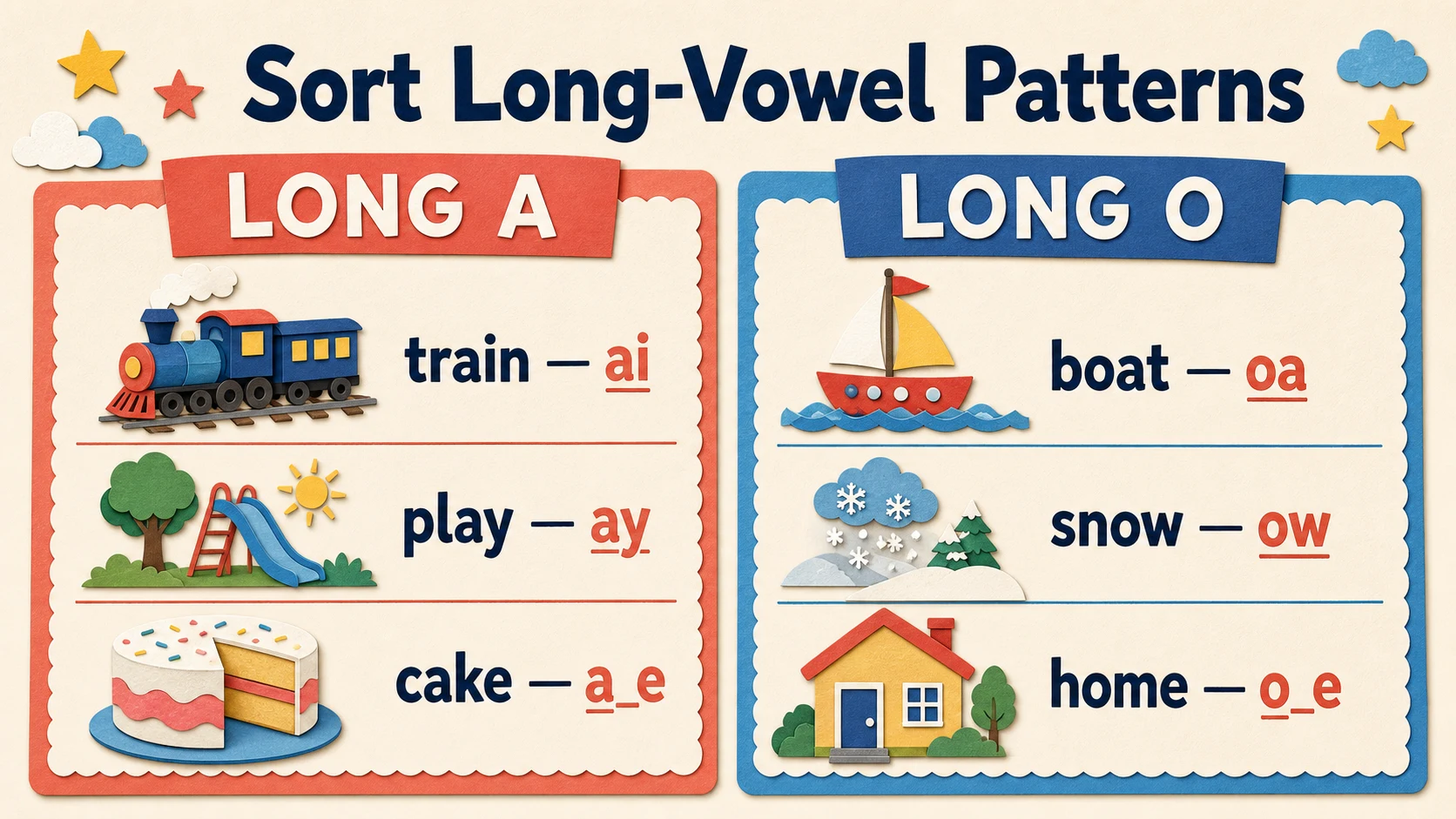
Second-grade practice adds comparison and dictation while keeping an explicit model and a final explanation.
A response such as “train goes under ai because I hear long a and see ai in the middle” provides more useful evidence than a completed sort alone. The explanation shows whether the learner attended to the target feature or guessed from page position.
Interpret errors before choosing the next page
An incorrect response is evidence about that item, not a diagnosis. Look across several comparable items and note what changes when support is added.
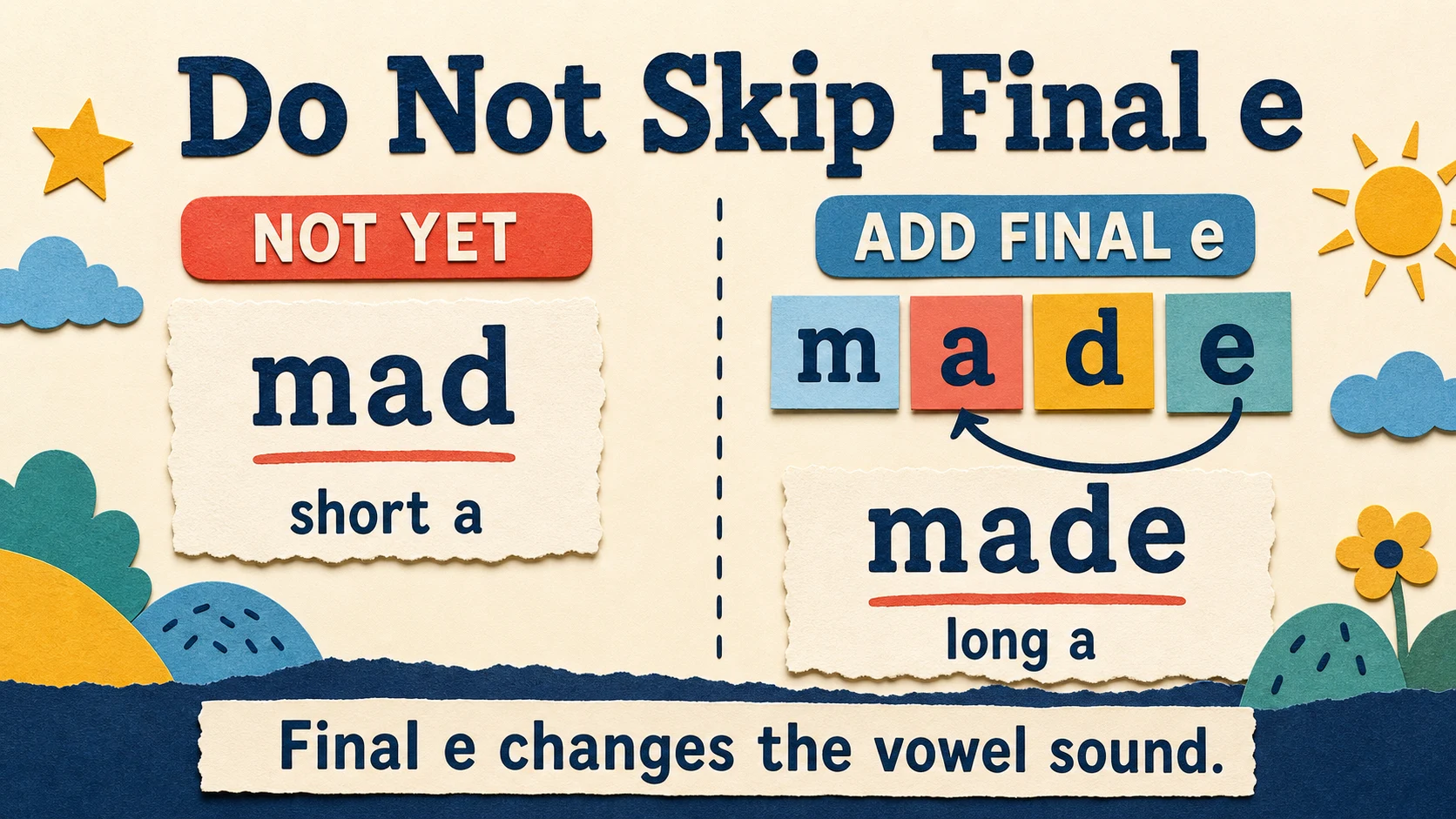
Match the next teaching response to the observed error pattern rather than assigning a broad label to the learner.
When short and long vowels are confused
If cap and cape are read the same way, ask the learner to build both, point to the final e, and say the pair. Keep the consonants constant. The observable next action is to read three CVC/CVCe pairs accurately in mixed order before moving to vowel teams.
When the sound is right but the spelling is not
Writing bote for boat shows a different problem from writing bot. The first response uses a long-o pattern but selects the wrong pattern for the target word. The second may reflect short-/long-vowel confusion or omission of the team. For bote, compare spelling families. For bot, return to oral contrast and word building.
Do not mark every plausible spelling attempt as the same kind of mistake. During instruction, acknowledge what the response represents correctly and identify the exact feature that must change.
When the rule is overgeneralized
A learner may use the “two vowels” rhyme as an absolute rule. Explain that it is a useful first try for many teams in the current set, not a promise about every English word. Keep exceptions out of an introductory sort unless they are explicitly taught and labeled. If an exception appears accidentally, remove it or teach it directly rather than telling the learner the rule works and then penalizing its use.
When worksheet directions cause the error
If the learner reads every word correctly but sorts them by initial letter, check the prompt, model, column headings, and visual spacing. Ask the learner to restate the task. A correct oral explanation followed by misplaced marks may indicate a layout or direction problem rather than missing phonics knowledge.
Adapt the page without removing the long-vowel decision
An adaptation should reduce an unrelated barrier while preserving the sound–spelling judgment.
Useful adaptations include:
- Read the directions aloud while leaving the target words for the learner to decode.
- Cover all but one row to reduce visual crowding.
- Cut word boxes apart so the learner can physically sort them.
- Use movable letters for cap/cape before asking for written spelling.
- Let the learner point or place a counter when handwriting is not the target.
- Enlarge the page without changing the words or answer choices.
- Preteach a picture label when unfamiliar vocabulary would otherwise control the answer.
- Divide a 20-problem sheet into several brief sessions.
Avoid reading every answer choice aloud on a word-decoding task and then treating the result as independent reading. Do not give the correct spelling pattern before a sort intended to reveal pattern selection. If the learner uses speech-to-text for dictation, the encoding demand disappears; choose letter cards or a keyboard instead when handwriting itself is the barrier.
These adaptations do not certify a level or address a diagnosed condition. They simply help an adult observe the intended skill more cleanly.
Select the next real worksheet with a five-part check
First, inspect the pattern range. A first silent-e page should not quietly combine a_e, ai, ay, ee, ea, oa, and open syllables. Mixed patterns are useful only after their parts are familiar.
Second, inspect the response. Choosing from two printed words is easier than spelling from dictation because recognition supplies the possible spellings. Sorting occupies the middle: the words are visible, but the learner must compare their features.
Third, inspect the contrasts. Prefer a page that includes meaningful long/short comparisons when discrimination is the goal. For spelling-pattern study, keep the sound constant and vary the representation, as in the a_e/ai/ay sort.
Fourth, inspect the supports. Pictures, examples, word banks, highlighted patterns, and narrow choice sets change the demand. “Easy” should mean the page offers accessible, observable task features—not that a particular child ought to find it easy.
Fifth, inspect what happens after the mark is made. The strongest follow-up is brief: read the word, explain the pattern, build a contrasting word, or spell one related example. More items are not automatically better evidence.
Stay with the current level when a learner succeeds only after a model or cannot yet explain the contrast. Move to a less-supported page when the learner reads the studied pattern accurately across new examples and can state what feature guided the answer. Move from 1st-grade-style CVCe work toward 2nd-grade pattern comparison when the learner can alternate short and long forms without treating every final vowel as long. Return to CVC work when short-vowel decoding remains the active obstacle.
The catalogue supplies practice, not a diagnostic instrument, curriculum guarantee, or promised outcome. Its 1st- and 2nd-grade labels indicate intended practice levels, and sequences may differ among schools and curricula.
Make the next decision from one observed contrast
Begin with hop/hope. Ask the learner to read both, explain what the final e changes, and spell hope after hearing it. Record exactly what happens.
If the learner needs modeling or reads both words alike, open the 1st Grade Long Vowels guide and free sheet and use only the first small set of silent-e practice. If the learner reads and spells the pair securely, open the 2nd Grade Long Vowels guide and free sheet and choose a task that compares CVCe with one already-taught vowel team. That single checked contrast gives you an observable next action without turning a grade label into a placement verdict.
Put it into practice
Use the guide with a real printable
Move from explanation to a short, observable practice task. Check the first item together, then adjust the next session from the learner's actual work.
Open the first free worksheetExplore a neighboring collection
Choose by a different teaching need
Addition Worksheets by Grade and Level Consonant Blends Worksheets by Grade and Level Counting Worksheets by Grade and Level CVC Words Worksheets by Grade and Level Decimals Worksheets by Grade and Level Digraphs Worksheets by Grade and Level Division Worksheets by Grade and Level Fractions Worksheets by Grade and Level