Pre-K · 4 live skills
Pre-K phonics worksheets
Pick the exact skill below. Each page combines a real free download, a separate answer key, practical teaching guidance and an optional focused pack.
See all Pre-K subjects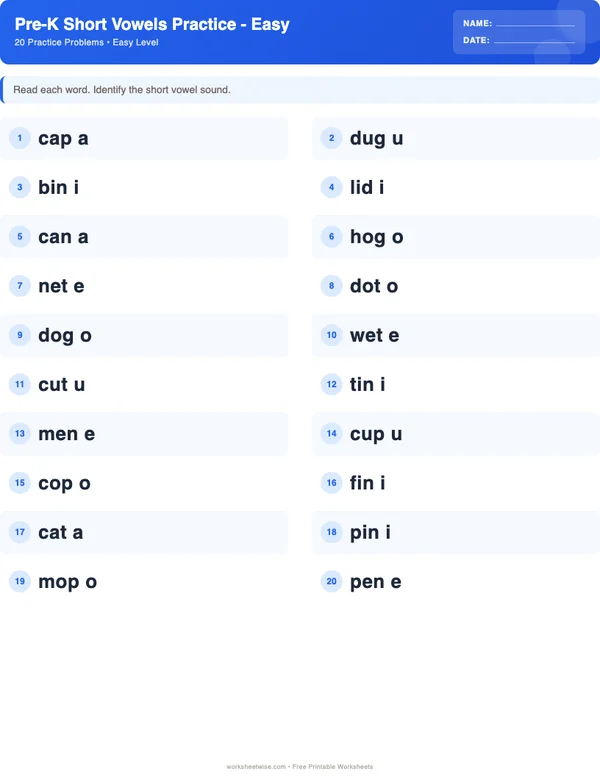
Complete guide
How to teach and practise pre-k phonics worksheets
3,277 words Updated 6 instructional visuals
Choose one phonics target, not a stack of worksheets
Start by asking what the learner can do with spoken sounds and printed letters today. Then choose one bounded target:
- If the learner cannot reliably hear or identify the middle sound in cat, pin, or hug, begin with short-vowel listening and matching.
- If the learner identifies each sound but cannot combine them into a word, begin with supported CVC blending.
- If the learner reads several CVC words sharing an ending but processes each from scratch, compare one or two word families.
- If a frequent word contains an unexpected spelling, teach its regular and irregular parts instead of asking the learner to memorize its overall shape.
The live Pre-K phonics catalogue contains 72 variants across four topics: CVC Words, Short Vowels, Word Families, and Sight Words. Each topic has one free entry point, and each representative free sheet contains 20 problems. Those numbers describe the available materials; they do not mean a learner should complete 20 items in one sitting.
Age is a discovery aid rather than a placement decision. For ages three and four, prioritize brief adult-led oral, matching, manipulative, and movement work over desk work. A child who can move tokens for three sounds but tires after four pencil items is still showing useful phonics knowledge. Grade labels describe intended practice level; local curriculum sequences differ.
Read the four live skills as related but distinct
These topics overlap, but they are not interchangeable. A learner may succeed in one and need support in another.
| Live topic | Central question | Observable task | What a correct response shows | What it does not establish |
|---|---|---|---|---|
| Short Vowels | Which vowel sound is in the word? | Hear, match, sort, read, or supply the middle vowel | The learner discriminates a specified short-vowel sound in that task | Independent blending of the entire word |
| CVC Words | Can three sounds be mapped and blended? | Build, read, spell, or match words such as cat, pin, and hug | The learner coordinates consonant and vowel sounds in a simple word | Automatic reading of other patterns |
| Word Families | Can a shared ending be noticed and used? | Build or sort words such as cat, hat, and mat | The learner recognizes and manipulates a recurring ending | Flexible decoding if the learner has memorized only the rhyme |
| Sight Words | Can a frequent word be read with attention to its spelling? | Read, spell, write, find, or use a selected word | The learner recognizes that word in the tested form and context | General phonics mastery or permanent automaticity |
This distinction matters when selecting a worksheet. A picture sort may reduce the print demand so the adult can examine vowel listening. A CVC word-building task adds letter selection and sequence. A word-family sort asks the learner to compare patterns. A sight-word activity may require analysis of both regular and unexpected spelling.
The IES foundational-reading practice guide recommends teaching learners to connect sounds with letters, decode words, analyze word parts, and read connected text. That is authoritative instructional guidance, not an evaluation of WorksheetWise materials. The catalogue descriptions identify the content available here; adults still need to decide whether a particular task fits the learner.
Locate the learner in the CVC progression
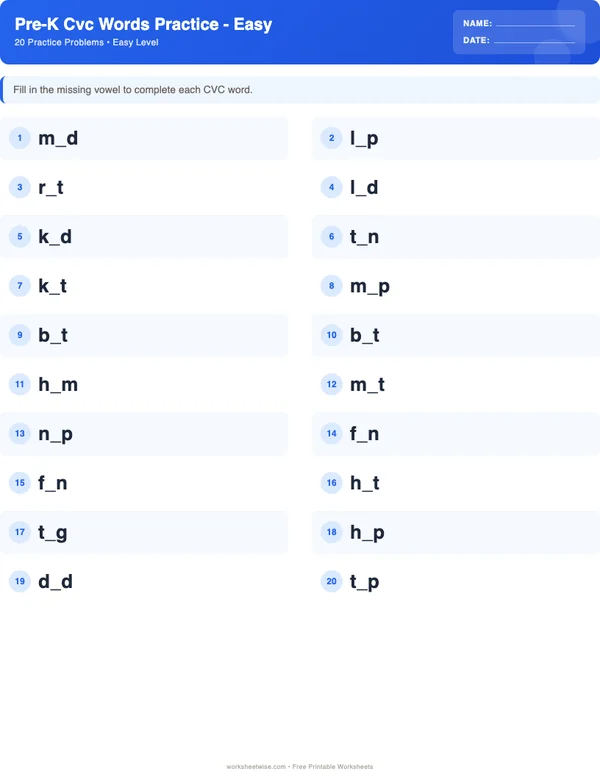
CVC means consonant-vowel-consonant. In cat, the letters correspond to the three sounds /k/, /ă/, and /t/. A CVC task may ask for listening, letter placement, blending, spelling, or reading, so the label alone does not tell you its demand.
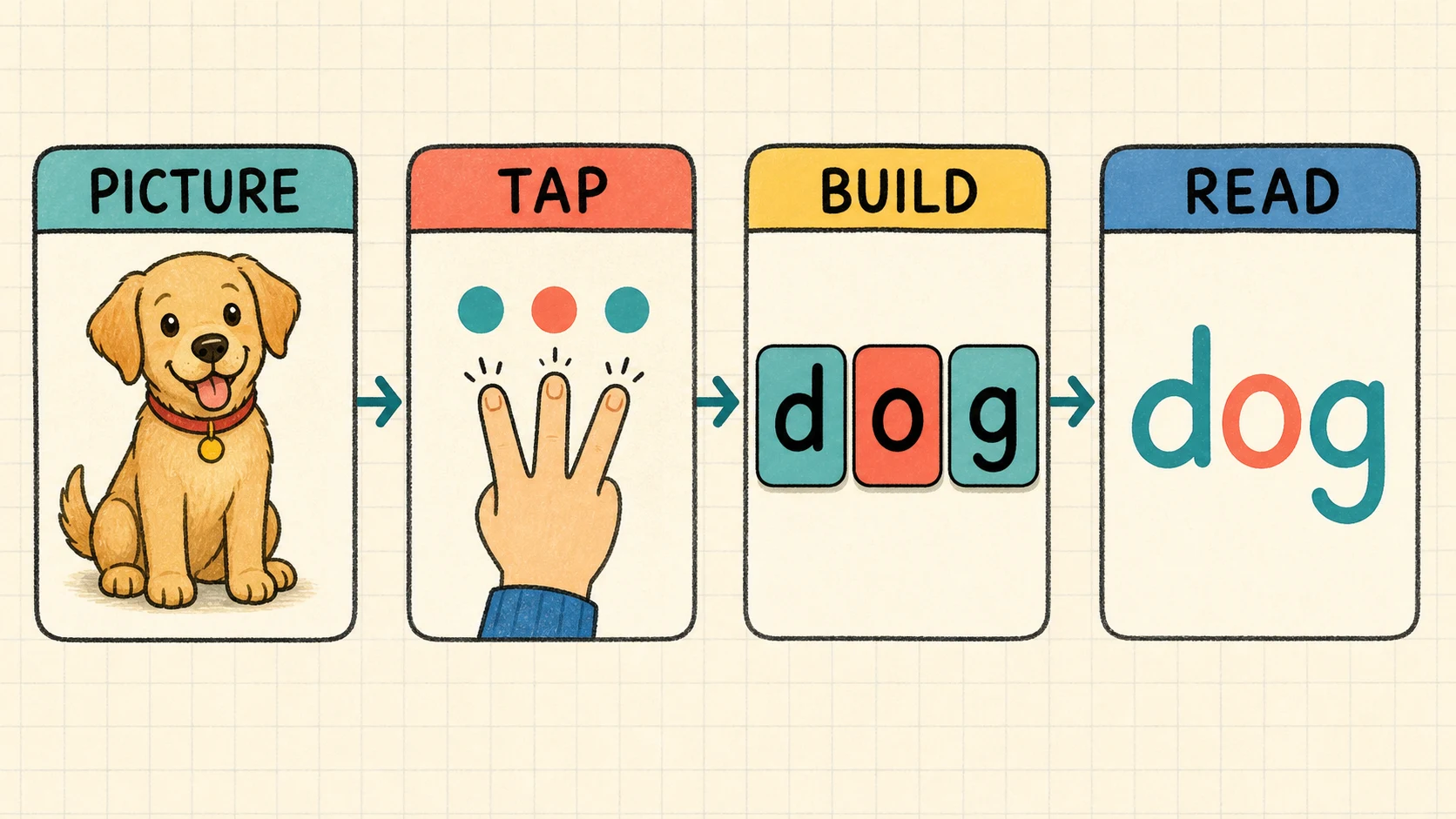
Use the CVC progression to change one support at a time: first model and move pieces, then prompt, and only later ask for an unassisted response.
Checked example: blend map
Place the letters m, a, and p in three connected boxes. Point under each letter while sustaining the sounds as continuously as possible: “mmmăăăp.” Then sweep a finger beneath the whole word and say “map.”
This example belongs in the Pre-K CVC topic because map has exactly three phonemes represented by three letters, with short a in the middle. It tests the same basic structure as the catalogue examples cat, pin, and hug. It does not introduce a digraph, blend, silent e, or vowel team.
Check the response in parts:
- If the learner says /m/, /ă/, /p/ correctly but pauses so long that the word is lost, keep the letters visible and model the sweep.
- If the learner says “mop,” the blend is plausible but the vowel changed. Return to contrasting short a and short o orally.
- If the learner reads “map” but cannot build it after hearing it, decoding is stronger than encoding in this observation. Ask the learner to push one token for each sound before choosing letters.
- If a picture was present, remove it on a second attempt. That checks whether print, rather than picture guessing, supports the answer.
Checked example: change mat to map
Build mat, read it, and ask, “Change only the last sound so the word becomes map.” The checked change is t → p; m and a remain fixed.
This belongs here because it keeps a CVC structure and one short vowel while isolating final-phoneme manipulation. It is more demanding than copying map: the learner must compare two spoken words, locate the changed position, and replace one letter.
If the learner rebuilds all three letters correctly, accept the response but note that the intended observation—holding two positions constant—was obscured. On the next turn, cover m and a or tell the learner that only the final tile may move.
The Pre-K CVC Words guide and free sheet is the clearest entry point when the immediate target is combining or segmenting three sounds rather than identifying a vowel alone.
Separate short-vowel hearing from whole-word reading
Short vowels appear in the middle of the catalogue’s CVC examples: a in cat, i in pin, and u in hug. A learner can know the outer consonants yet confuse the middle sound. Treat that as specific evidence, not as a general reading failure.
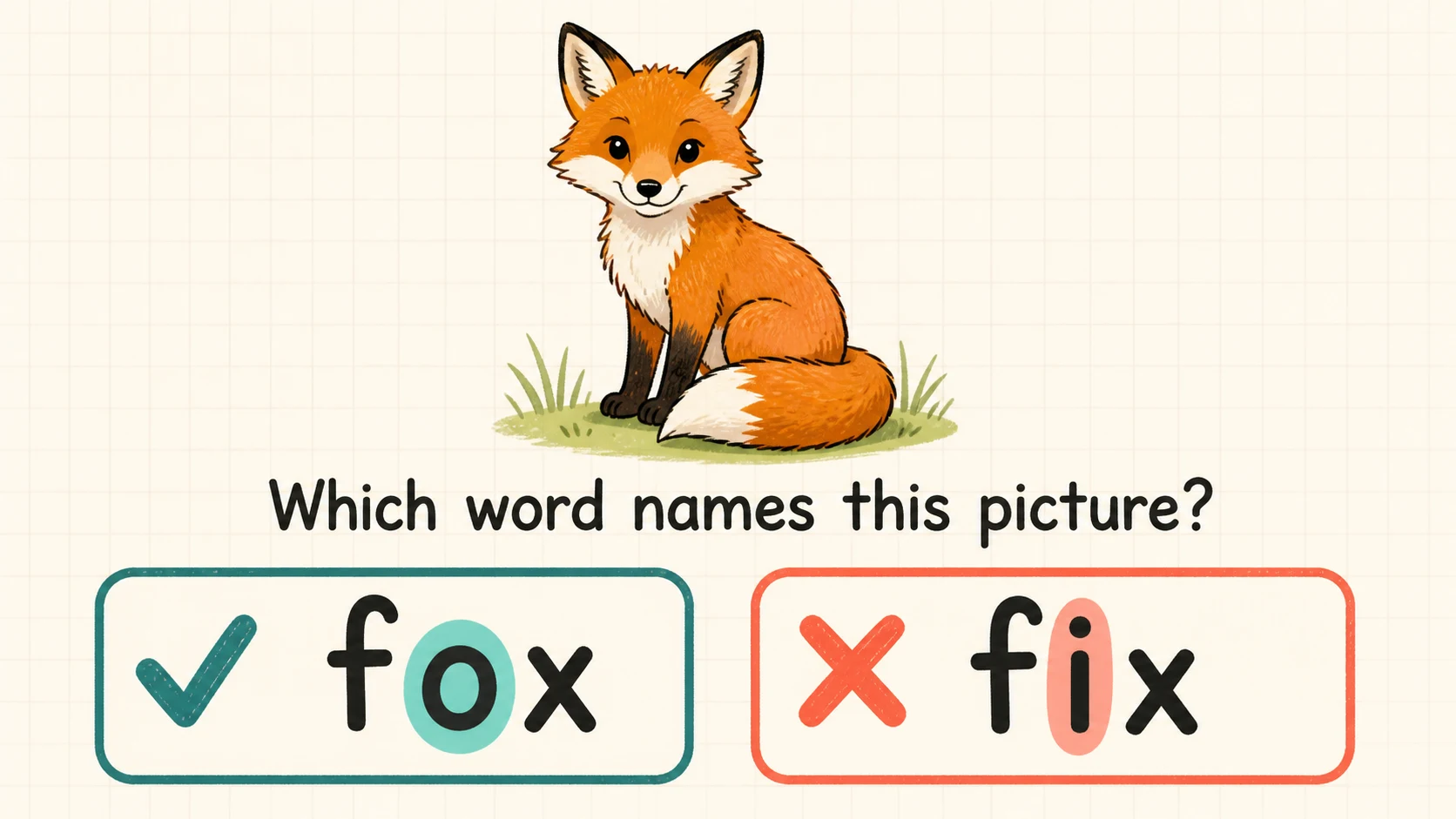
Match the response to the observed error: a vowel substitution calls for sound comparison, while lost sound order calls for segmentation support.
Checked example: distinguish pen from pin
Say pen and pin without showing print. Ask the learner to place a token beneath e for pen and beneath i for pin. Then reveal the two printed words and read them together.
The checked contrast is the middle phoneme: /p/ and /n/ remain constant, while short e and short i differ. This example belongs here because the live short-vowel guidance specifically identifies e/i as a potentially confusable contrast and includes auditory discrimination among its suggested practices.
Interpret the response carefully:
- Correct oral matching followed by incorrect printed matching suggests that the learner heard the distinction but did not yet connect it reliably to e and i.
- Incorrect oral matching means more print will not isolate the immediate problem. Say the words again, let the learner watch the adult’s mouth, and reduce the choice to two.
- Reading both words as pin may reflect a vowel substitution, but one pair is not enough for a diagnosis. Check a fresh pair such as set/sit.
- A correct picture match can be supported by vocabulary or context. Ask for the middle sound to verify the phonics target.
The catalogue suggests teaching one vowel at a time before requiring mixed discrimination. That is page-specific instructional guidance, not a universal timetable. Use the Pre-K Short Vowels guide and free sheet when the bounded target is hearing, selecting, or spelling the middle vowel.
Use word families without turning them into guessing patterns
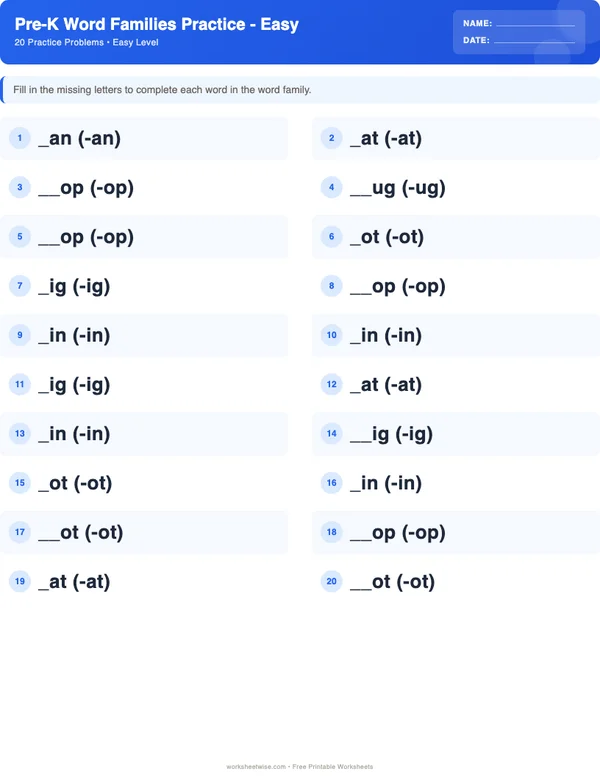
Word families hold an ending steady while the beginning changes: cat, bat, hat, and mat share -at. This can make a repeated pattern visible, but the learner should still attend to every letter.
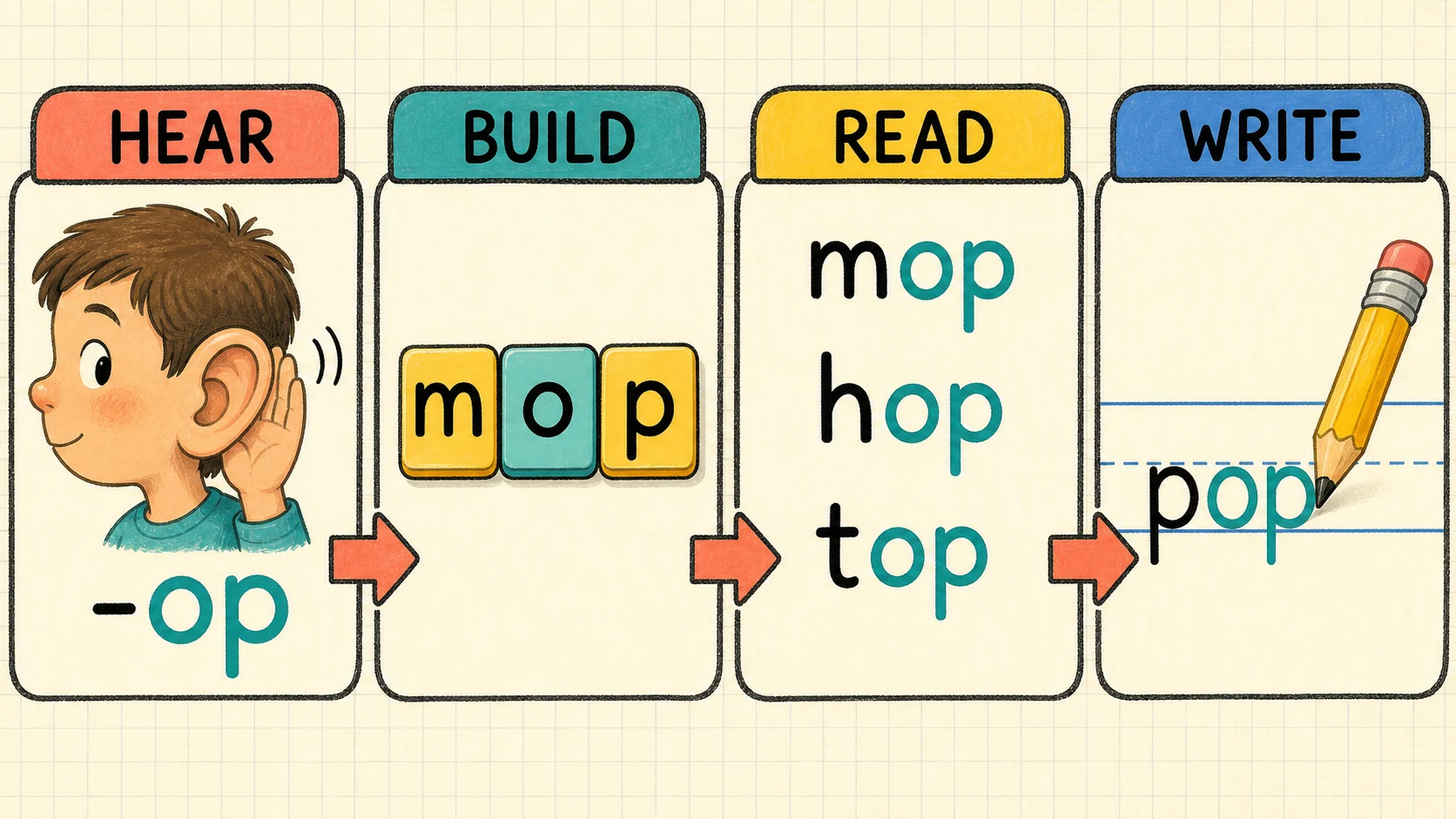
Move from building one family with a fixed ending to sorting mixed families only after the learner reads the changing first sound.
Checked example: sort cat, cap, map, and mat
Prepare two headers, -at and -ap. The correct sort is:
- -at: cat, mat
- -ap: cap, map
This example belongs in the Word Families topic because it requires comparison across two endings, not merely repetition within one family. All four words remain simple CVC forms with short a, so the sort does not add a new vowel.
A learner who places cat and cap together may be grouping by the initial c. Say, “Read from the vowel to the end,” and underline at and ap. A learner who sorts accurately but cannot read the words may be matching visual chunks without blending. Point to the first sound, then the shared ending, and ask for the whole word.
Do not overgeneralize a rime. Knowing -at in cat does not mean that every word ending in the letters at will be handled automatically in later, more complex words. The immediate aim is narrower: notice a stable ending while changing or comparing the onset.
The Pre-K Word Families guide and free sheet is useful after a learner can work with the component sounds and is ready to compare recurring endings.
Treat sight words as words with spellings to inspect
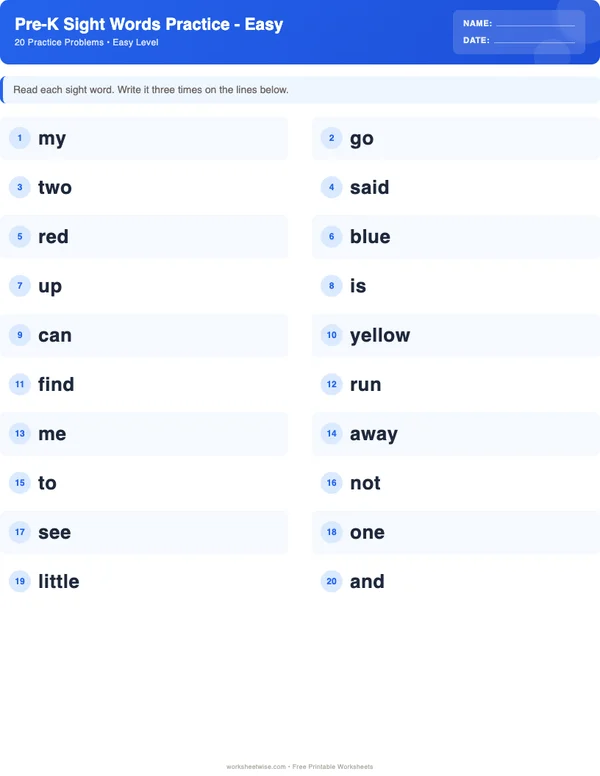
The Sight Words topic differs from the other three because its unit is a selected high-frequency word rather than a single vowel or CVC pattern. Some frequent words are readily decodable with already-taught correspondences; others contain a part that may be unexpected at the learner’s current stage.
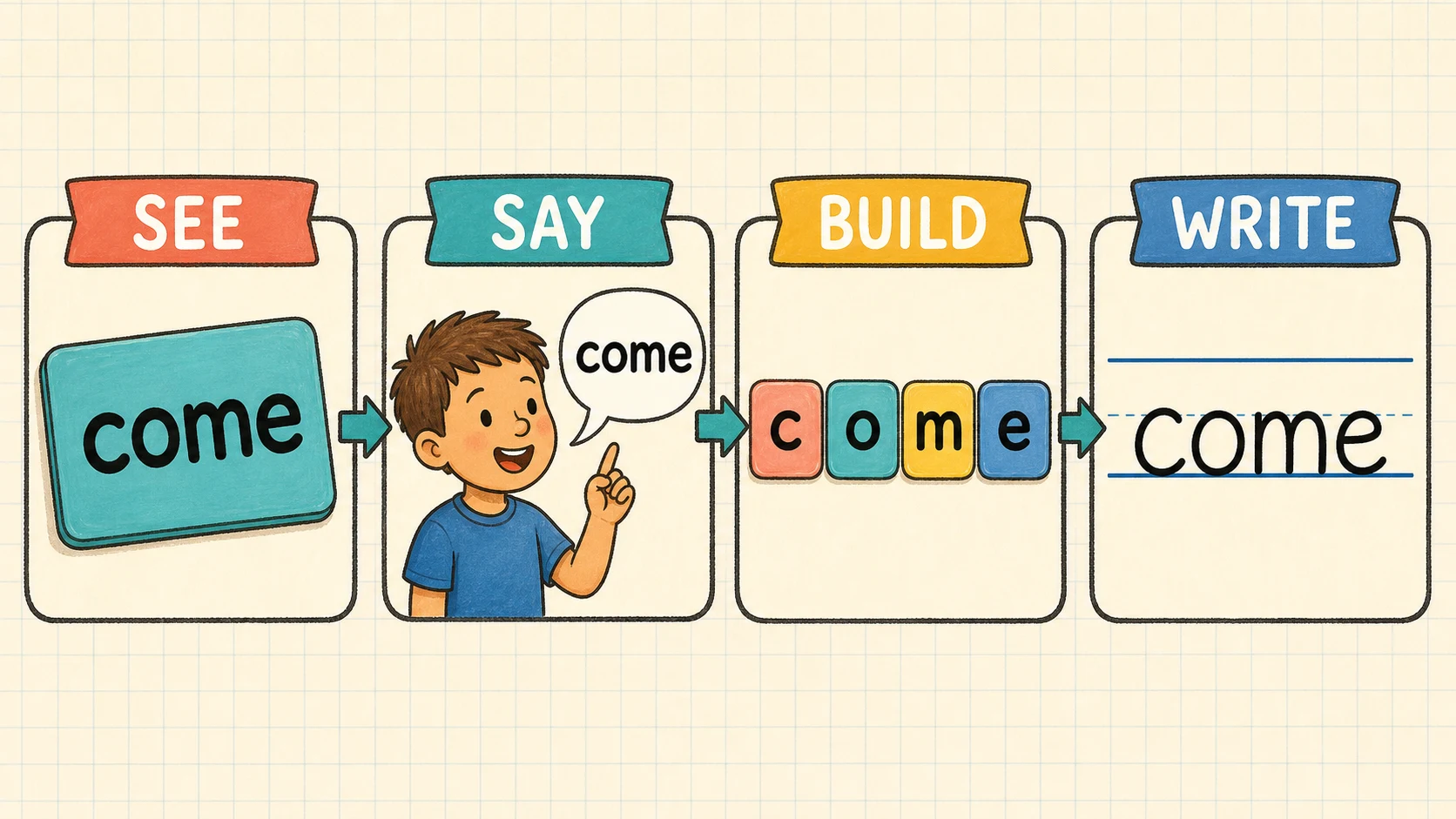
Support sight-word learning by reading and spelling a small set, then checking those words in a new order and in short connected text.
Checked example: analyze said
Write said. Say the word, have the learner repeat it, and map what can be heard:
- s represents the first sound /s/.
- d represents the final sound /d/.
- In this word, ai represents the vowel sound heard in said, rather than the long a a learner might expect from other words.
Then ask the learner to spell the letters aloud, cover the word, rebuild it with letter tiles, and read it in a short sentence such as “Sam said yes.”
This example belongs here because said appears in the catalogue’s description of words with irregular spellings. The analysis preserves phonics: it identifies the regular boundary sounds and marks the internal spelling as the portion that needs special attention. It does not ask the learner to memorize the silhouette of the word.
If the learner reads said correctly on a flashcard but not in the sentence, automatic recognition has not transferred to that context yet. If the learner says a plausible long-a pronunciation, acknowledge the attempt: the learner attended to the spelling but applied a different correspondence. Supply the word and revisit its unexpected part.
The Pre-K Sight Words guide and free sheet fits a target involving a small, explicitly selected word set. It should not replace work on sound-letter relationships.
Define task difficulty by what the page asks the learner to do
All four representative free sheets carry the catalogue label “easy,” but that label must be translated into observable features. It does not label a learner.
A less demanding task may provide:
- One known sound or pattern at a time
- Two clearly different response choices
- Pictures plus letters
- Adult modeling before the learner’s turn
- Movable letters or tokens instead of handwriting
- A fixed word ending while one initial letter changes
A more demanding version of the same target may require:
- Mixed vowels or mixed word families
- Similar distractors such as e and i
- An oral prompt without a picture
- Building or spelling from memory
- Reading items in a new order
- Applying the target in a short sentence
Keep the target stable when adjusting difficulty. If the target is short a, reducing ten written items to four picture-and-letter matches preserves the target. Replacing the activity with alphabet coloring does not.
Likewise, handwriting can accidentally become the main barrier. The IES guide for elementary writing instruction discusses foundational writing skills and the need for instruction and practice. It does not mean every phonics check must require handwriting. Let a learner point, move a tile, or say an answer when letter formation would prevent a clear observation of the phonics skill.
Run a brief teach–try–check routine
A useful session can be short enough to stop before attention and motor fatigue obscure the evidence.
Prepare one contrast
Choose one target and, when helpful, one comparison:
- Short a versus short i
- Blend three sounds in a CVC word
- -at versus -ap
- The regular and unexpected parts of said
Avoid mixing all four topics simply because the worksheet contains space.
Model one item
Say what you are attending to. For map: “I see m, a, p. I blend without dropping the middle sound: mmmăăăp, map.” Keep the explanation shorter than the learner’s practice.
Guide two or three responses
Use the least support that produces an informative attempt. Pointing under letters is lighter support than supplying every sound. Movable letters preserve the spelling decision while removing the formation demand.
Check one fresh item
Use an item that was not in the model. If you modeled map, try sat. Both are short-a CVC words, but the new consonants reduce simple imitation. Record the exact response, including pauses or substitutions.
End with one retrieval
After a brief unrelated movement or conversation, return to one item. Delayed retrieval tells you more than five immediate repetitions. Stop while the learner can still participate willingly.
The IES foundational-reading guide also emphasizes opportunities to read words in isolation and in connected text. A worksheet can support isolated practice, but an adult should also place a successfully read word into a short phrase or sentence that the learner can understand.
Spread practice across two weeks without assigning every box
The catalogue includes 20 problems on each representative free sheet. Treat them as an item bank, not a daily quota.
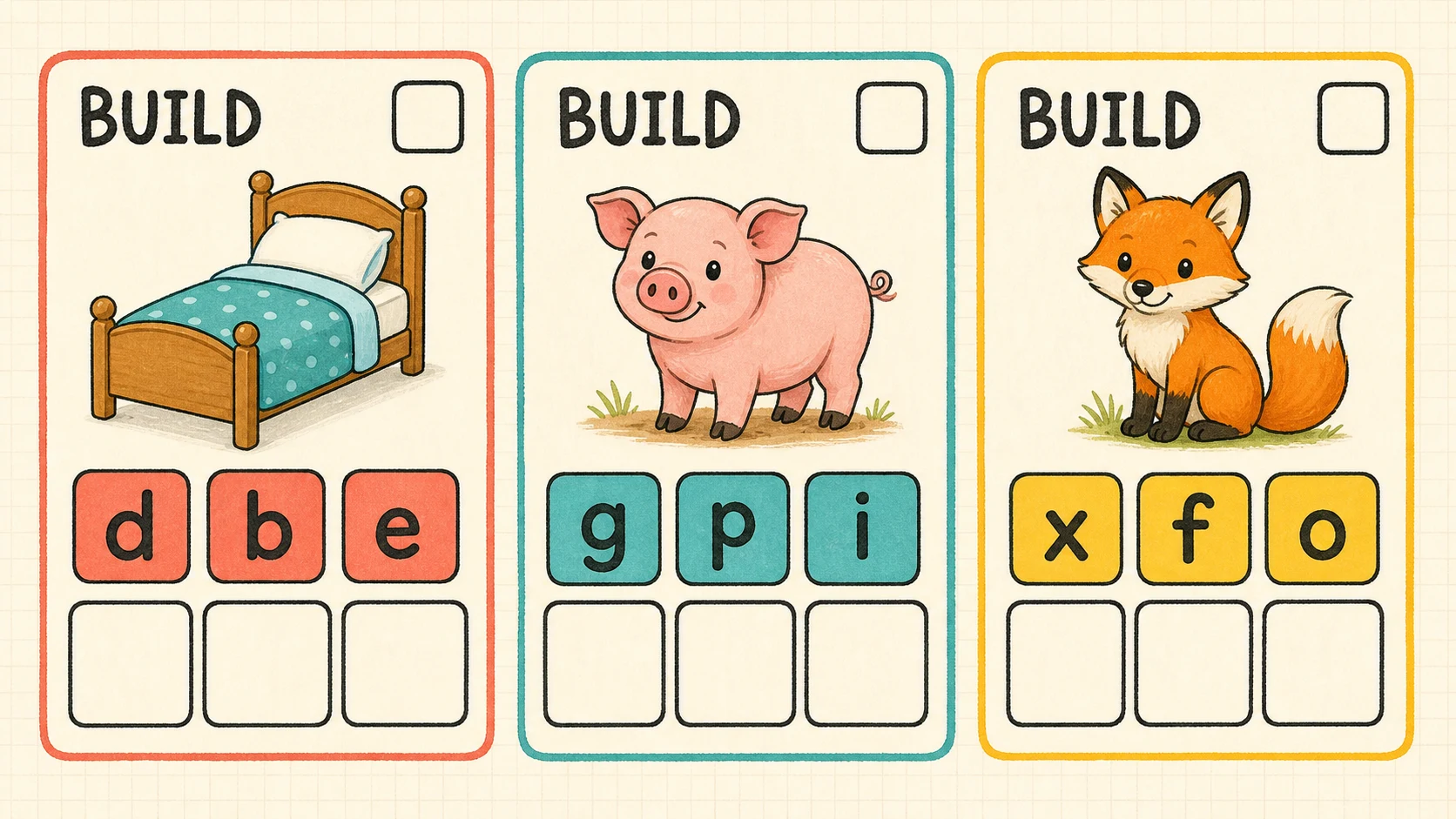
For CVC practice, alternate building, blending, spelling, and brief review instead of repeating the same response format every day.
A reasonable two-week suggestion for a learner currently blending short-a CVC words is three or four brief contacts per week. On the first contact, model and build two words. On the second, reread one known word and try two fresh words. On the third, dictate one word for tile spelling and read one in a sentence. In the second week, revisit errors before adding another vowel.
This schedule is an editorial suggestion, not sourced dosage guidance and not a promise of mastery. Shorten it for a three- or four-year-old who has given a clear response after two items.
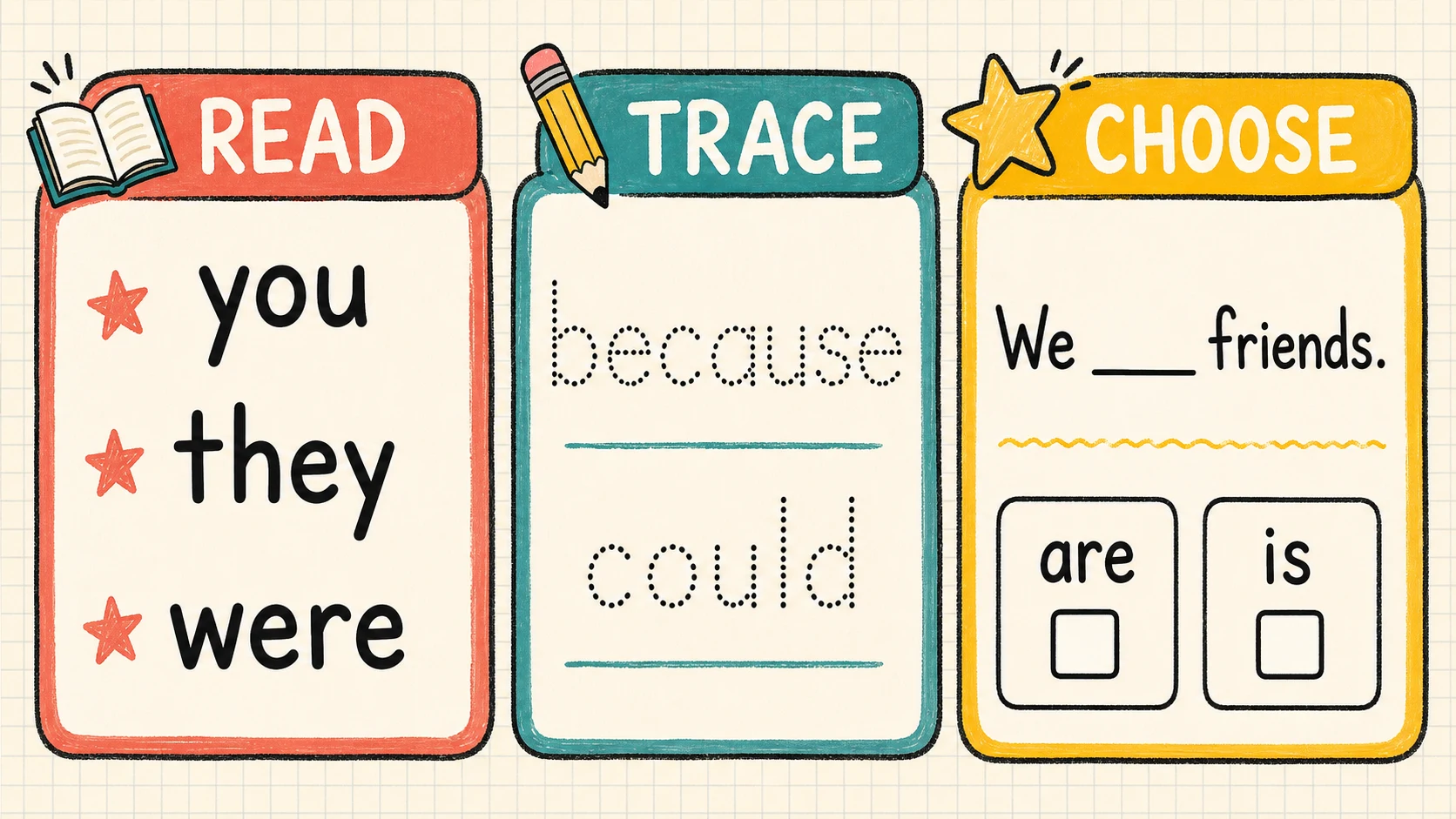
For sight words, revisit a very small selected set through reading, spelling, and sentence use rather than continually adding new cards.
Sight-word practice should not copy the CVC plan mechanically. For one word such as said, alternate analysis, tile building, retrieval, and reading in context. If the learner forgets the internal spelling, return to that specific part instead of restarting a long list.
Interpret errors as next-task evidence
One response is an observation, not a diagnosis. Look for a repeatable pattern across a few carefully chosen items.
| Observed response | Plausible interpretation to check | Useful next task |
|---|---|---|
| Says each sound correctly but cannot produce the word | The pauses may disrupt blending | Continuous blending with a finger sweep |
| Reads map as mop | The middle vowel may be unstable | Oral and printed a/o contrast with fixed consonants |
| Omits the middle sound when spelling | The learner may not be segmenting all three positions | Three sound boxes and three tokens before letters |
| Sorts by first letter instead of -at/-ap | Attention may be on onset rather than ending | Highlight and read the rimes before sorting |
| Reads a word only when its picture is present | The picture may be carrying the response | Repeat the item without the picture |
| Reads said with a long a | A known correspondence may be overapplied | Mark the regular s, d, and unexpected ai |
| Gives unrelated labels for pictures | Vocabulary may be obscuring the phonics check | Name the pictures together before testing sounds |
| Stops after several accurate answers | Endurance or task length may be affecting performance | Use fewer items; do not lower the phonics target automatically |
The distinction between sound, print, vocabulary, speech production, attention, and handwriting matters. This field guide cannot determine why a learner struggles, and a worksheet cannot diagnose a language, reading, hearing, vision, attention, or developmental condition. Discuss persistent concerns with the learner’s teacher and, when appropriate, a qualified professional.
Adapt the activity while preserving the phonics decision
For limited handwriting stamina
Let the learner point to a vowel, circle an answer, use magnetic letters, or dictate while the adult records. Keep the learner responsible for the sound or letter choice.
For limited spoken vocabulary
Preview every picture name. If a drawing could be called cup or mug, agree on the intended word before asking for its vowel. Otherwise, the task may measure picture interpretation.
For speech-production differences
Allow pointing, matching, or selecting letters when producing a sound is difficult. Compare what the learner can perceive with what the learner can say; do not treat the two as identical.
For attention or sensory needs
Cut a page into small strips, cover unused items, add token movement, or place letters around the room for a movement match. Preserve the same target and response options.
For learners ready for less support
Remove the picture, shuffle the order, ask for spelling after reading, or place the word in a short sentence. Increase only one demand at a time so the resulting error remains interpretable.
The Common Core English Language Arts standards include print concepts, phonological awareness, phonics and word recognition, and fluency within their foundational-skills structure. They offer a reference point, not proof that a specific WorksheetWise page aligns with every local sequence. Confirm expectations with the learner’s school or curriculum.
Know what these worksheets can and cannot show
A phonics worksheet can provide focused practice and leave visible evidence: selected letters, sorted words, spelling attempts, or read items recorded by an adult. It cannot by itself show broad reading comprehension, oral-language knowledge, independent book reading, motivation, or performance across settings.
The catalogue is filtered to one grade label, Pre-K, and one subject, Phonics. Although the broader editorial progression refers to later skills such as blends, digraphs, long vowels, and multisyllabic decoding, those are not among the four verified live topics on this page. Do not skip from an unstable short-vowel contrast to more complex patterns merely to follow an assumed grade ladder.
Nor should an adult infer that every Pre-K learner needs all 72 variants. More materials create options; they do not create a prescription. Select from the live topics according to present evidence, not age alone, page count, or a desire to “finish” the hub.
Make the next task observable
Choose one word now: map. Say it without showing the letters. Ask the learner to push one token for each sound, choose m, a, and p, and sweep beneath the completed word while reading it.
Then make one decision:
- Three sounds mapped and blended: try fresh short-a word sat.
- Three sounds mapped but not blended: model continuous blending and repeat with the letters visible.
- Middle sound or letter changed: move to a two-choice short-vowel contrast.
- Task blocked by writing: repeat with tiles rather than pencil.
- Picture or adult cue carried the answer: retry without that cue.
Record the exact response in one sentence. Use it to choose no more than four items from the Pre-K CVC Words guide and free sheet for the next brief session.
Put it into practice
Use the guide with a real printable
Move from explanation to a short, observable practice task. Check the first item together, then adjust the next session from the learner's actual work.
Open the first free worksheet