Pre-K · 1 live skills
Pre-K math worksheets
Pick the exact skill below. Each page combines a real free download, a separate answer key, practical teaching guidance and an optional focused pack.
See all Pre-K subjectsComplete guide
How to teach and practise pre-k math worksheets
3,545 words Updated 6 instructional visuals
Start with counting objects, not a stack of pages
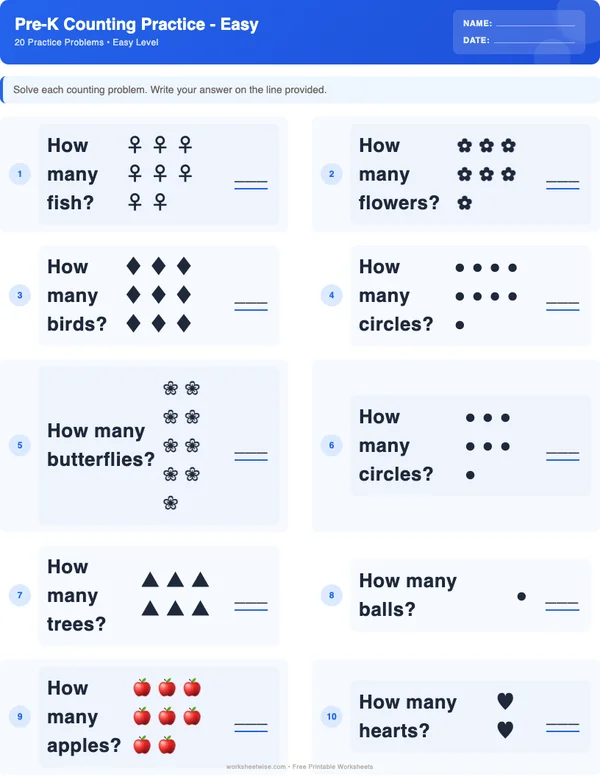
The useful starting point on this Pre-K math page is narrow: counting. The live catalogue contains 18 worksheet variants, but only one verified topic—Counting—and one free entry point: a 20-problem sheet labeled “easy.” That label describes the task’s observable features, not the learner. Here, “easy” should mean a small, familiar counting range; clear pictures or number sequences; limited visual clutter; and little or no reading demand. It must never become a label for a child.
Begin by checking one bounded target: “Can the learner count a set of up to five objects, touching or moving each object once, and then say how many there are?” That reveals more than asking the learner to recite “one, two, three, four, five.” Recitation is knowing the number-word sequence; counting a collection also requires matching one number word to one object and understanding that the final number tells the quantity.
For ages three and four, age is a discovery aid rather than a placement decision. Prioritize brief adult-led oral, matching, manipulative, and movement work over desk work. A worksheet is best used as a short record of thinking after the learner has counted real objects—not as the entire lesson.
The IES guide to teaching mathematics to young children recommends teaching number and operations through a developmental progression and monitoring what each child already knows. It also encourages adults to integrate mathematical talk throughout the day. Those are sourced recommendations. The specific starting checks, examples, and routines below are editorial suggestions for using this catalogue; IES did not evaluate WorksheetWise.
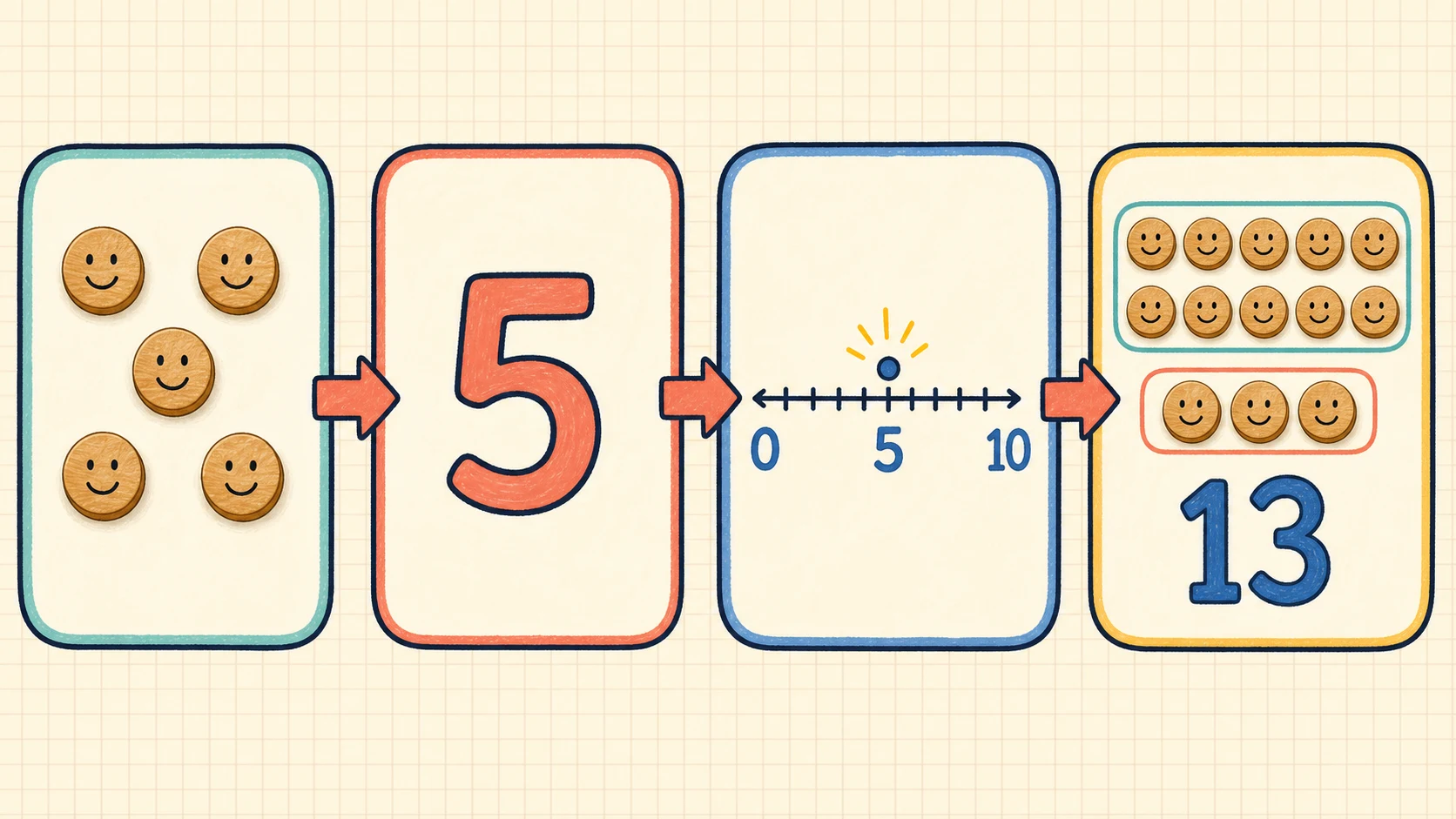
On this page, “counting” branches into number-word order, one-to-one correspondence, quantity, sequence completion, and flexible starts rather than one interchangeable skill.
Read the live catalogue without assuming skills that are not there
The larger WorksheetWise math collection is described as spanning a K–8 progression—from early counting and number recognition to operations, fractions, ratios, geometry, and pre-algebra. This page is not that whole progression. Its verified filters are Pre-K and Math, and its only live topic is Counting. Addition, shapes, measurement, patterns, and other common early-math areas may matter in a complete curriculum, but they should not be presented as available skills on this page without catalogue evidence.
The representative resource describes several forms of counting practice:
- Rote counting: reciting number words in order.
- Rational counting: coordinating one number word with each object.
- Counting sets of objects.
- Completing number sequences and missing numbers.
- Counting forward from a given number.
- Counting backward from 20.
- Skip counting by 2s, 5s, and 10s.
These belong to the same topic but are not equivalent. A learner may recite to 20 while double-counting scattered objects. Another may count six buttons accurately yet be unable to continue from 7 without restarting at 1. Skip counting is a patterned sequence task; it does not demonstrate that the learner can count an unstructured collection by ones. Counting backward adds demands different from identifying a missing number in an ascending row.
The catalogue description places counting with concrete objects to 20 in Pre-K and identifies counting to 100 as a kindergarten milestone. Treat those as catalogue-level descriptions, not universal placement rules. Grade labels describe intended practice level; local curriculum sequences differ. The Common Core mathematics standards emphasize focused, coherent learning across grades and understanding as well as correct procedures, but Common Core begins its grade-specific sequence at kindergarten rather than defining a Pre-K placement rule. Do not infer formal standards alignment for a particular sheet unless that alignment appears on the resource itself.
Separate the counting skills before choosing a sheet
Number-word order comes before accurate object counting—but does not prove it
Ask the learner to count aloud during a walk, while climbing steps, or while passing a ball. Listen for a stable sequence. If the learner says “one, two, three, five,” the immediate target is the ordered language of the count, not pencil formation and not counting a crowded picture.
Keep the range short enough for success. Practice 1–5 before extending to 1–10. If 1–10 is stable, start at 4 and continue to 10. Starting somewhere other than 1 tests whether the sequence is flexible rather than memorized as a single chant.
One-to-one correspondence requires controlled action
Place five buttons in a line. Ask, “How many?” Watch the learner, not just the final answer. Does one touch accompany each number word? Is any button skipped? Is one touched twice? Moving each counted button into a small container can make the correspondence visible.
Then rearrange the same five buttons in a loose cluster. The quantity has not changed. If the learner now loses track, the issue may be organizing the counting path, not knowing the number sequence.
Cardinality is the meaning of the last number
After a correct count of five, ask, “So how many are there?” A learner who recounts may not yet use the final number as the quantity of the whole set. Recounting is not bad behavior; it is useful evidence. Model: “You counted one, two, three, four, five. Five tells how many buttons there are altogether.”
Printed sequences remove objects and increase abstraction
A missing-number task such as 6, 7, __, 9 requires the learner to follow a symbolic sequence and identify the omitted numeral. It does not directly test one-to-one correspondence or cardinality. Before assigning a page of such items, verify that the learner recognizes the numerals in the range and can say the sequence aloud.
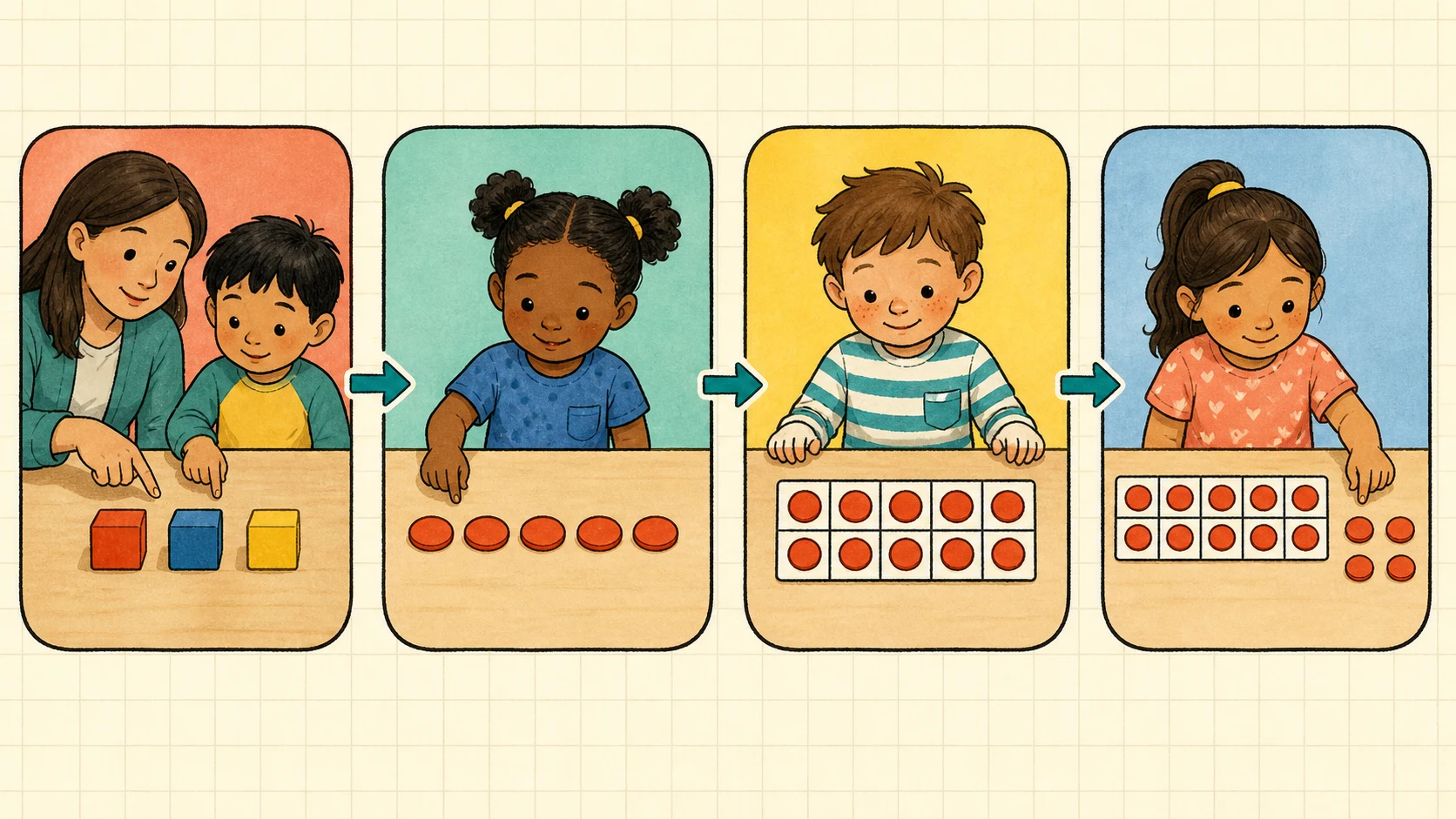
Independence should increase only after the learner can coordinate objects, spoken number words, quantities, and printed numerals within the chosen range.
Check four representative examples before asking for independence
Worked example 1: count a concrete set of six
Put out six cubes in a row. Ask the learner to slide each cube toward you while counting.
● ● ● ● ● ●
A checked count is:
1, 2, 3, 4, 5, 6
The answer is 6 cubes because six objects were each assigned exactly one number word, and the last number word—6—names the quantity.
Now spread the same cubes apart and ask again. The checked answer remains 6. Spacing changes the arrangement, not the number of objects.
This belongs here because the live topic specifically includes concrete-object counting and one-to-one correspondence. It also follows the catalogue teaching tip to begin with manipulatives before pictures or abstract numerals.
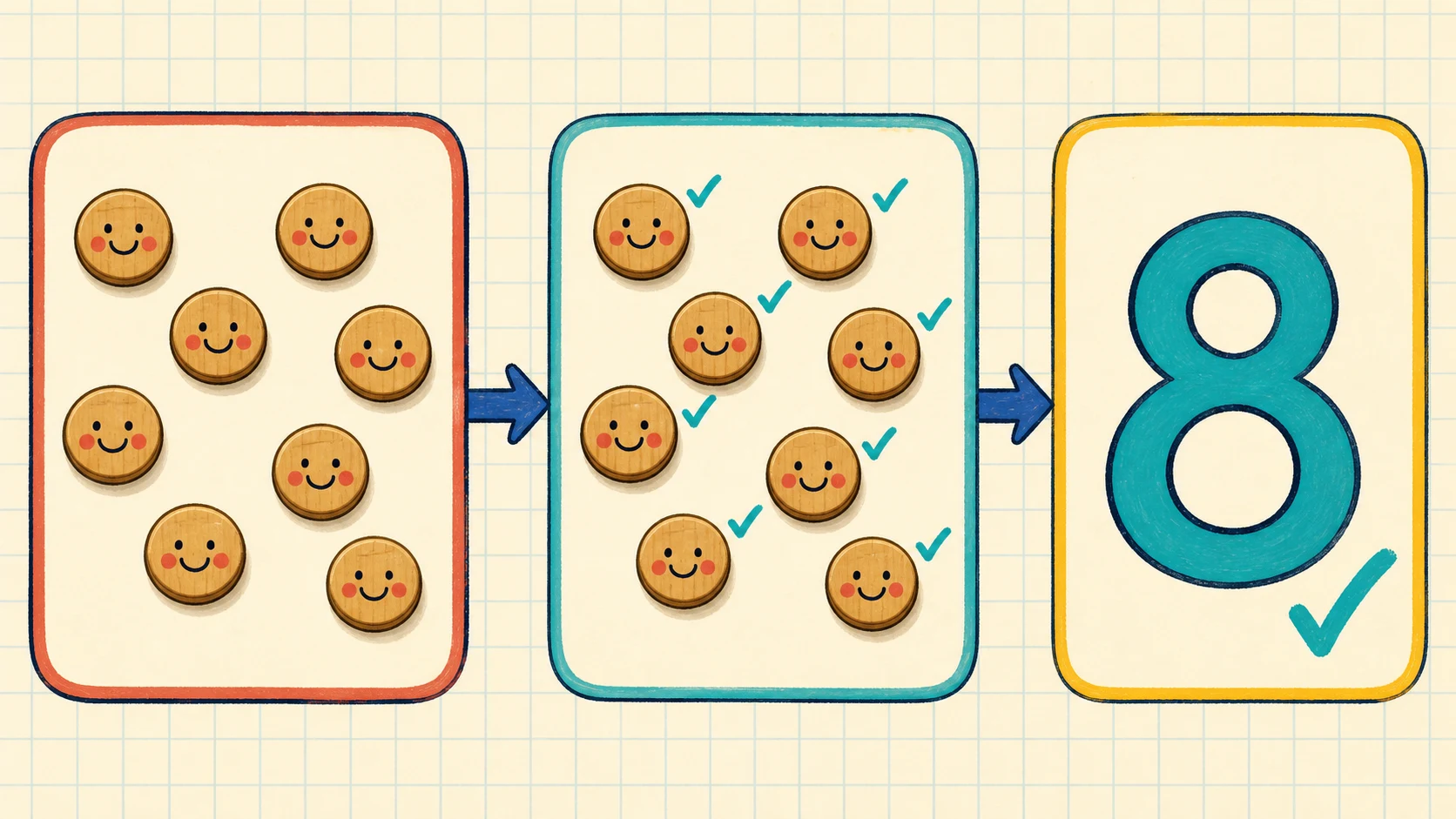
The adult checks the action—one move per word—as well as the written or spoken answer.
Worked example 2: complete one missing number
Consider:
8, 9, __, 11
Say the sequence aloud: “eight, nine, ten, eleven.” The missing number is 10.
Check it from both sides:
- 10 comes immediately after 9.
- 10 comes immediately before 11.
This belongs on the page because missing-number sequences are named in the catalogue description. It is a more abstract task than counting objects: there is no visible collection to recount. If the learner can say “ten” but cannot choose the printed 10, numeral recognition—not sequence knowledge—may be the obstacle.
A useful adaptation is to provide numeral cards 8, 9, 10, and 11 for the learner to order before writing anything. That preserves the number-sequence target while removing handwriting as a confounding demand.
Worked example 3: count forward without returning to one
Ask, “Start at 7 and count three more number words.”
The correct sequence after 7 is:
8, 9, 10
If the task asks where the learner lands after three counts forward, the checked answer is 10. The three spoken steps are 8 (first), 9 (second), and 10 (third). Seven is the starting number, not the first step.
This belongs here because counting forward from any given number is part of the live topic description. It is distinct from reciting 1–10. A learner who restarts at 1 may know the full chant but not yet enter it flexibly at 7.
Use three floor spots labeled 8, 9, and 10. The learner steps once for each number word. The movement supports tracking without changing the mathematical target.
Worked example 4: count a scattered group accurately
Arrange seven counters irregularly:
●       ●
    ●
●             ●
      ●   ●
One valid strategy is to move each counter into a line while counting:
1, 2, 3, 4, 5, 6, 7
The checked answer is 7 counters. The route taken does not matter as long as every counter is counted once and none is counted twice.
This belongs here because the catalogue’s assessment tip specifically suggests a scattered group. A neat row can conceal weak tracking: its layout tells the eyes where to go next. A scattered set requires the learner to organize a path or physically mark what has already been counted.
Do not respond to an incorrect total by immediately saying, “Try again.” First ask, “How could you keep track of the ones you counted?” That turns the error into information about strategy.
Worked example 5: distinguish backward counting from subtraction
Ask the learner to count backward from 8 to 3:
8, 7, 6, 5, 4, 3
That sequence is correct. There are six spoken numerals because both endpoints are included. If the adult instead asks, “What number is one before 8?” the answer is 7.
This belongs here because the catalogue suggests backward counting as preparation for later subtraction. It should not be described as proof that the learner understands subtraction. Backward sequence knowledge and taking objects away are related but separable tasks.
Choose one useful starting task from observable evidence
Use three quick checks before printing anything. Stop when you find the first unstable skill.
Check A: oral sequence
Ask for 1–5, then 1–10 if appropriate. Do not correct during the first attempt. Record the exact sequence. If the learner omits, invents, or consistently swaps number words, start with a brief oral and movement routine in that smaller range.
Check B: objects and quantity
Offer five movable objects. Ask, “How many?” If counting is accurate, rearrange the same objects and ask again. Notice whether the learner:
- pairs one word with one object;
- keeps track of counted objects;
- states the quantity without unnecessary recounting; and
- understands that rearrangement does not add or remove objects.
If this check is unstable, use concrete collections rather than missing-number worksheets.
Check C: printed numerals
Show 2, 4, and 5 one at a time. Ask the learner to name or match each numeral to a collection. If spoken counting is stronger than numeral recognition, use matching cards or invite pointing rather than requiring writing.
Then choose one target:
- Oral sequence target: say 1–5 in order while clapping once per word.
- Correspondence target: move and count exactly five objects.
- Cardinality target: count a set and answer “how many” using the last number.
- Numeral target: match quantities 1–5 to printed numerals.
- Sequence target: fill one missing numeral within a known range.
- Flexible-start target: begin at 6 and continue to 10.
Do not combine all six in one sitting. The one free sheet contains 20 problems, but “20 problems” is a page specification, not a dosage requirement. Fold the page, cover unused items, or stop after a short successful set. For ages three and four, three carefully observed items after hands-on work can be more useful than completing the entire page.
The Pre-K Counting guide and free sheet is the catalogue’s verified free entry point. Preview whether its problem format matches the target you observed before handing it to the learner.
Use a short routine that makes the worksheet informative
A repeatable six-minute sequence
- Name the target. Say, “Today we will touch each picture once as we count.”
- Model with objects. Count three cubes, deliberately moving one per number word.
- Let the learner try. Use a different small collection. Keep your hands still so the learner controls the count.
- Represent the same idea. Match the collection to a picture or printed numeral.
- Try two or three worksheet items. Ask the learner to point, count aloud, and explain the answer.
- Record one observation. Write what happened: “Counted six objects once each; double-counted one object when seven were scattered.”
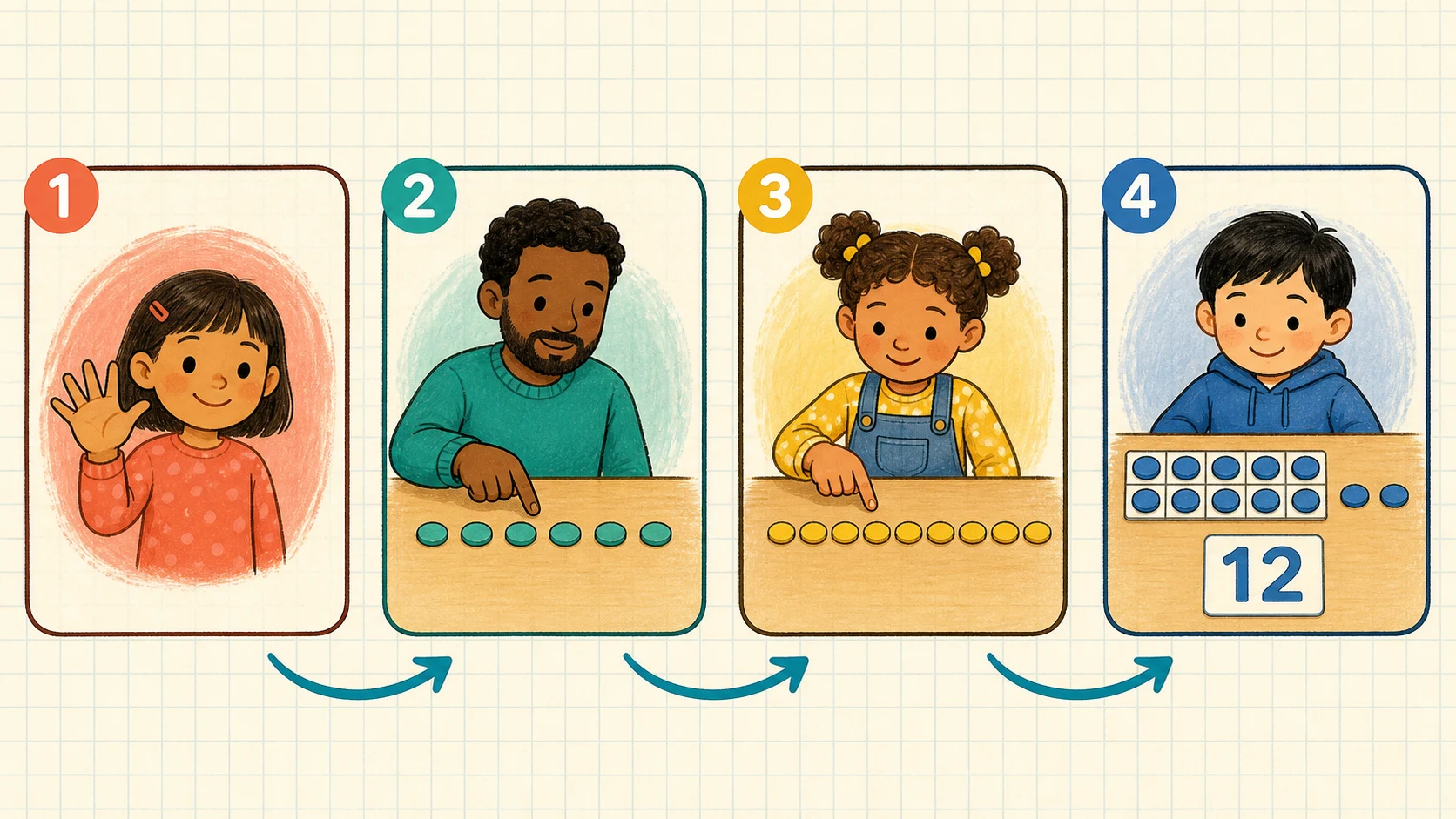
The worksheet comes after oral and concrete work, so the adult can tell whether an error is mathematical, visual, or related to writing.
This sequence reflects the catalogue suggestion to move from concrete objects to pictures and then abstract numbers. It is also consistent with IES guidance to use developmental progressions and ongoing progress monitoring. The exact six-minute duration and number of worksheet items are editorial suggestions, not research findings.
If the learner remains engaged, extend the idea during ordinary activity: count forks at dinner, steps to the door, or blocks going into a bin. If attention fades, stop. A longer session does not automatically provide better evidence.
For group use, the Classroom Math Worksheets collection may help an educator locate broader practice contexts. For home routines, the Pre-K Homeschool Worksheets collection provides another route into age-intended material. These links are discovery tools, not placement recommendations.
Interpret errors by tracing the action
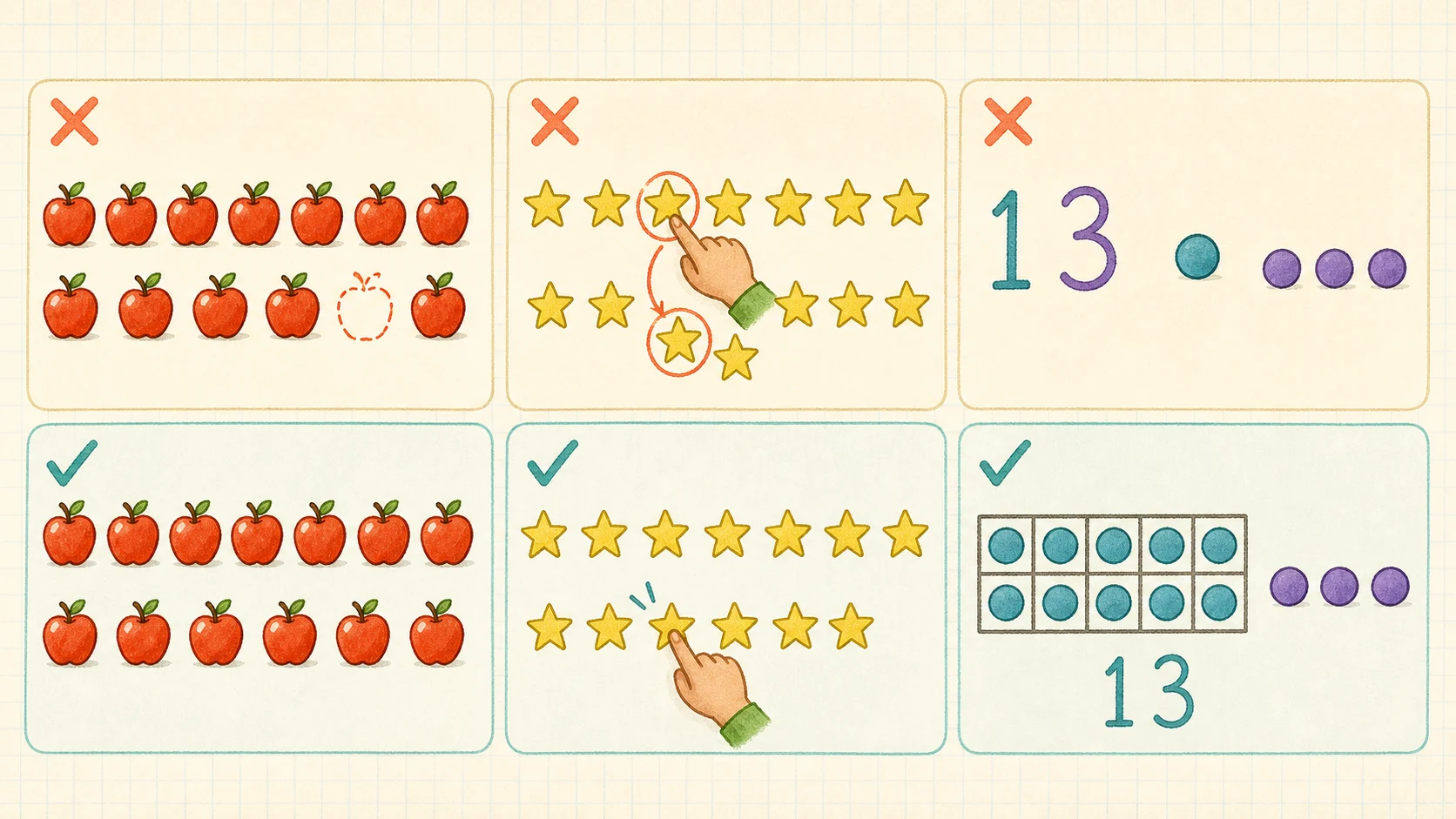
The response should address the observed counting action rather than attach a broad label to the learner.
An error is a clue, not a diagnosis. Repeat the task once with a small change before drawing a teaching conclusion.
| Observed work | Plausible interpretation to test | Next response |
|---|---|---|
| Says “1, 2, 3, 5” | The oral sequence is unstable in this range. | Practice 1–5 with claps or steps; then retry four objects. |
| Says the correct sequence but gets six for five objects | One object may have been counted twice, or speech and touching were not coordinated. | Have the learner move each object into a cup once. |
| Gets five in a row but six after the same five objects are scattered | Tracking the counted set may be the difficulty. | Teach a start point and counting path, or move counted items aside. |
| Counts five correctly, then answers “I don’t know” to “How many?” | The learner may not yet use the final number as the total. | Restate: “The last number, five, tells how many altogether.” |
| Says the missing number but writes a reversed or unclear numeral | Handwriting may be masking correct sequence knowledge. | Let the learner choose a numeral card or point to the answer. |
Completes 4, 5, 6 but restarts at 1 when asked to begin at 4 |
The count sequence may be memorized as one continuous routine. | Practice entering the sequence at several known numbers. |
| Counts pictures correctly until the page becomes crowded | Visual organization or sustained attention may be affecting performance. | Cover all but one item; enlarge or isolate the current set. |
Says 18, 19, 20 incorrectly after accurate earlier counts |
Teen-number language may be unstable. | Slow down and contrast the spoken names with numeral cards. |
A single mistake cannot establish why it occurred. Fatigue, unclear directions, unfamiliar pictures, motor demands, or distraction can change performance. Recheck with real objects and simpler presentation. If concerns are broad, persistent, or extend beyond this task, share specific observations with the learner’s teacher or another qualified professional rather than assigning a diagnosis.
The IES elementary mathematics intervention guide recommends systematic instruction, concise mathematical language, and carefully selected concrete or semi-concrete representations. Its stated grade range is K–6, so it should not be treated as a Pre-K placement document. Still, its representation principle helps adults inspect later difficulty without simply adding more worksheets. IES also distinguishes concrete representations, mathematical language, and number-line work as instructional tools; it did not review this catalogue or this routine.
Adapt the access demand while preserving the counting target
An adaptation is useful when it removes an irrelevant barrier but leaves the intended mathematical decision intact.
If the target is one-to-one correspondence:
- Use larger counters that are easier to grasp.
- Space pictures farther apart.
- Allow pointing, tapping, or eye-gaze selection instead of pencil marks.
- Provide a “counted” box where each object can be moved.
- Reduce the collection size while retaining one object per number word.
Do not count the objects for the learner; that removes the target.
If the target is numeral recognition:
- Offer two numeral cards instead of requiring recall from the full set.
- Allow the learner to match rather than write.
- Say the directions aloud.
- Cover unrelated items on the page.
Do not replace numerals with dots only; that changes numeral recognition into quantity matching.
If the target is a missing-number sequence:
- Read the visible numbers aloud if decoding or speech is not the target.
- Supply moveable numeral cards.
- Use a desk or floor number line as a temporary reference.
- Shorten the sequence but keep the same missing-position decision.
Do not show the answer in its final position and call the task independent.
For movement, place numeral cards on the floor and ask the learner to step from 5 to 6 to 7. For listening practice, say three numbers and pause for the next. For low-vision access, use large, high-contrast objects with generous spacing. For learners who communicate without speech, accept an accurate point, match, object transfer, or device selection. Counting knowledge should not be confused with handwriting or spoken-language production.
Plan review by changing one feature at a time
Use the learner’s work to decide what changes next. Over two weeks, repeat the same bounded target in several forms rather than advancing because a calendar says to.
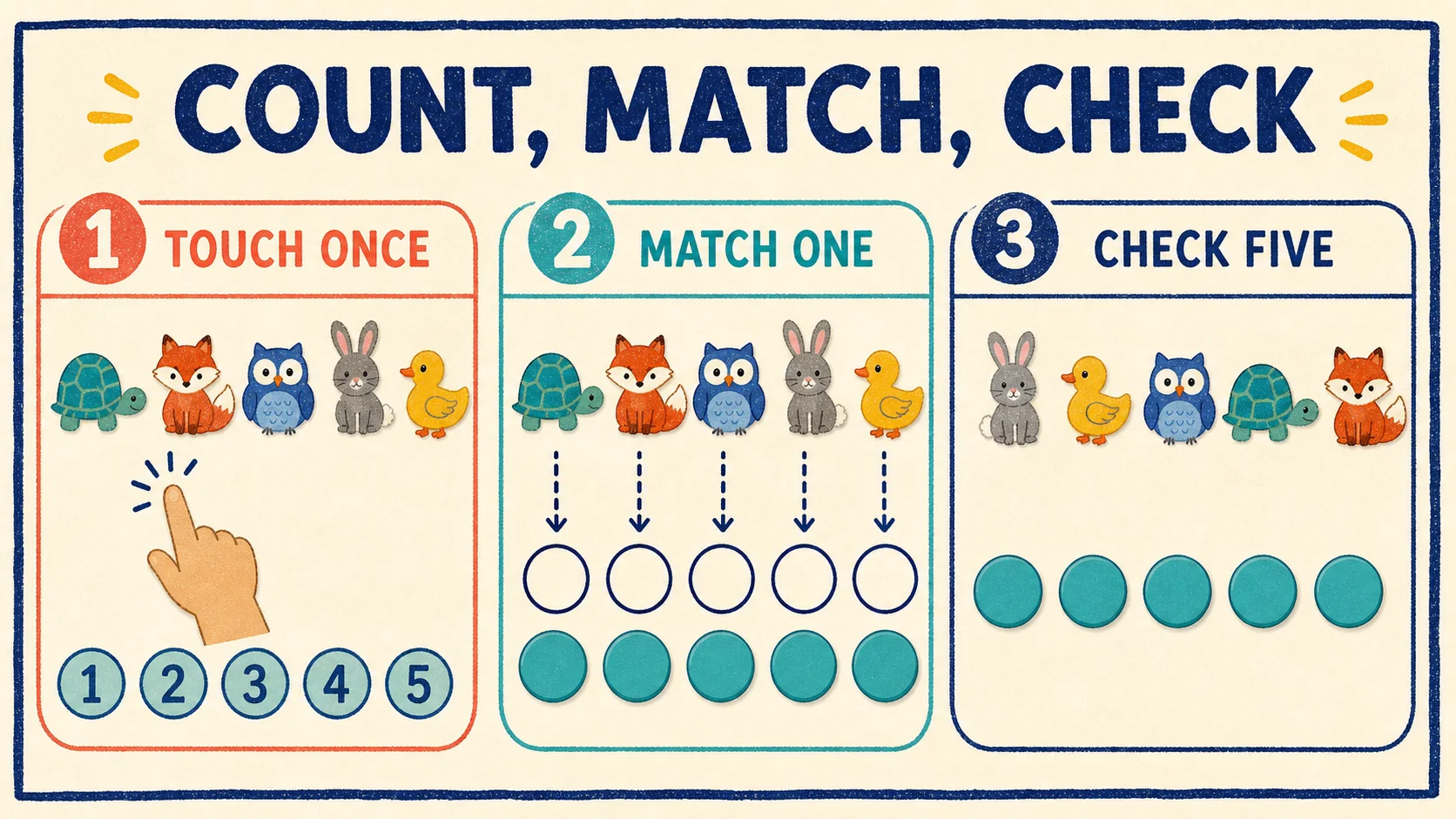
Touch each object once, match one counter to one space, then rearrange the same five objects to check that quantity is preserved.
A practical sequence might be:
- Sessions 1–2: Count 1–5 movable objects arranged in a row.
- Sessions 3–4: Count 1–5 objects in a cluster; move each after counting.
- Sessions 5–6: Match collections of 1–5 to numerals.
- Sessions 7–8: Count pictures without moving them, using pointing to track.
- Sessions 9–10: Complete two worksheet items, then recheck one answer with objects.
This is a suggested review plan, not a promised learning timeline. Repeat, shorten, or pause based on observable work.
Change only one important feature when checking transfer. If five lined-up counters are accurate, scatter the same five before increasing to six. If objects are accurate, use pictures of the same quantity before introducing missing numerals. If 1–10 is stable, ask for a start at 6 before extending the range. Changing range, layout, representation, and directions simultaneously makes the result hard to interpret.
Advance when the learner succeeds across more than one presentation and can show how the answer was found. Stay with the target when success depends on adult counting, repeated guessing, or a memorized page layout. Step back when the learner loses the one-to-one match; reducing the set is more informative than prompting toward the correct total.
Know what this page cannot establish
The catalogue gives adults multiple counting variants, not a complete Pre-K mathematics curriculum. Because the verified page has one topic, it cannot by itself show progression through geometry, measurement, patterns, operations, or data. Explore the full worksheet library when another grade or subject is needed, but check the live filters and resource descriptions rather than assuming availability.
A worksheet answer shows performance on that item under those conditions. It does not establish mastery, readiness for a grade, a learning difficulty, or the cause of an error. It also cannot replace conversation, play, manipulatives, observation, or instruction.
The “Pre-K” label identifies intended practice level. It is not an instruction to place every three- or four-year-old on the same page, nor does it override a school’s local sequence. Likewise, an answer key can help an adult verify final responses, but a correct total alone does not reveal whether the learner counted once per object, copied, guessed, or received a prompt. Check the process aloud.
Skip counting by 2s, 5s, or 10s and counting backward may be explored through movement when the learner is interested, but they should not displace a shaky foundation in counting objects by ones. The verified catalogue describes these as parts of the broader counting progression; it does not provide evidence that every Pre-K learner should complete every part now.
Make the next task depend on what you see
Today, gather five small objects and run the three checks: oral sequence, object counting, and numeral matching. Write down one exact observation rather than a judgment—for example, “said 1–10 in order but touched the third button twice.” Choose one target from that evidence.
Then open the Pre-K Counting guide and free sheet. Use only the first two or three items that match the target, and let the learner count real objects before answering on paper. Your observable next action is simple: record whether each object received one number word and whether the learner could state the total. Use that evidence—not age, page completion, or the word “easy”—to choose tomorrow’s task.
Put it into practice
Use the guide with a real printable
Move from explanation to a short, observable practice task. Check the first item together, then adjust the next session from the learner's actual work.
Open the first free worksheet