Complete guide
How to teach and practise pre-k word families worksheets - standard theme (easy)
How to use this 20-item word-family worksheet
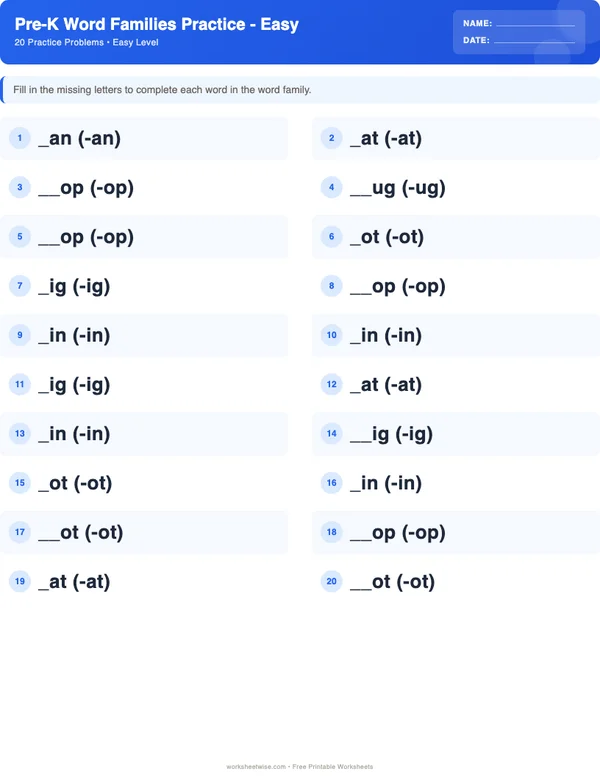
The Pre-K Word Families worksheet asks a learner to fill in one or two missing beginning letters while keeping a printed ending such as -an, -at, -op, -ug, -ot, -ig, or -in. Its main purpose is to practice noticing a stable ending pattern, adding an onset, and reading the completed word.
The concise answer: introduce one family aloud, model how the beginning and ending join, complete two or three items together, and then offer only as much independent work as the learner can manage accurately. Do not require all 20 items in one sitting. Because several prompts permit more than one real word, judge a response by the printed family, the number of blanks, and whether the completed word is valid—not merely by whether it matches the separate answer key.
Use the worksheet after the learner can hear at least some rhymes and recognize several relevant letters or letter sounds. If those foundations are not yet visible, pause the printable and work orally with two or three words. Return when the learner can participate without guessing through every item.
Grade labels describe the intended practice level; local school, district, homeschool, and intervention sequences differ. “Pre-K” and “easy” do not mean that every learner should complete the page independently or on a universal timetable.
Use a short model–practice–check cycle, with the learner’s observed work determining the pace.
What the printable actually asks the learner to do
Each of the 20 prompts shows blanks followed by a parenthesized word-family ending. Examples from the page include _an (-an), _at (-at), __op (-op), and __ug (-ug). The learner fills the blank or blanks to create a word.
That apparently simple action combines several demands:
- Notice the ending that will stay unchanged.
- Select one or two beginning letters.
- Join the beginning with the ending.
- Read or say the completed word.
- Write the selected letters in the available space.
The one-blank items include families such as -an, -at, -ot, -ig, and -in. The two-blank items use -op, -ug, -ig, and -ot. Some answer-key words begin with one consonant, while others begin with a digraph or consonant blend. For example, the key includes ran, cat, and dig, but also drop, plug, shop, chop, twig, flop, and slot.
That range matters. A learner may handle a single beginning consonant but need help coordinating two written letters. Do not interpret difficulty with __op as proof that the learner does not understand -op. Check whether the challenge is hearing the onset, choosing its spelling, forming two letters, or blending the whole word.
For a fuller sequence across word-family activities, use the Word Families topic guide. This guide stays focused on launching and interpreting this particular printable.
Prepare a short, observable lesson
Print the worksheet and keep the separate answer key out of the learner’s view. Have a pencil or crayon ready. Optional letter tiles or small handwritten letter cards can provide support without changing the target skill.
Before starting, scan the page and decide where you might stop. Twenty items are available, but they are not a required sitting length. A reasonable instructional suggestion is to begin with three to five items and continue only if the learner remains attentive and is using the word-family pattern.
| Lesson phase | Adult action | Learner action | What to observe |
|---|---|---|---|
| Oral warm-up | Say two or three rhyming words from one family | Identify what sounds the same at the end | Does the learner hear the shared rime? |
| Model | Complete one item while thinking aloud | Watch, listen, and repeat the blended word | Does the explanation connect letters with sounds? |
| Guided practice | Prompt the next two or three items | Choose letters, blend, and write | Which prompt produces success? |
| Independent sample | Release a small group of items | Complete them without step-by-step help | Is the pattern applied without guessing? |
| Check | Revisit selected responses | Read, compare, or rebuild each word | Can the learner explain or correct the choice? |
| Retrieval | Return to a few words later | Reconstruct or read them again | Is the learning available after a delay? |
Run an oral readiness check
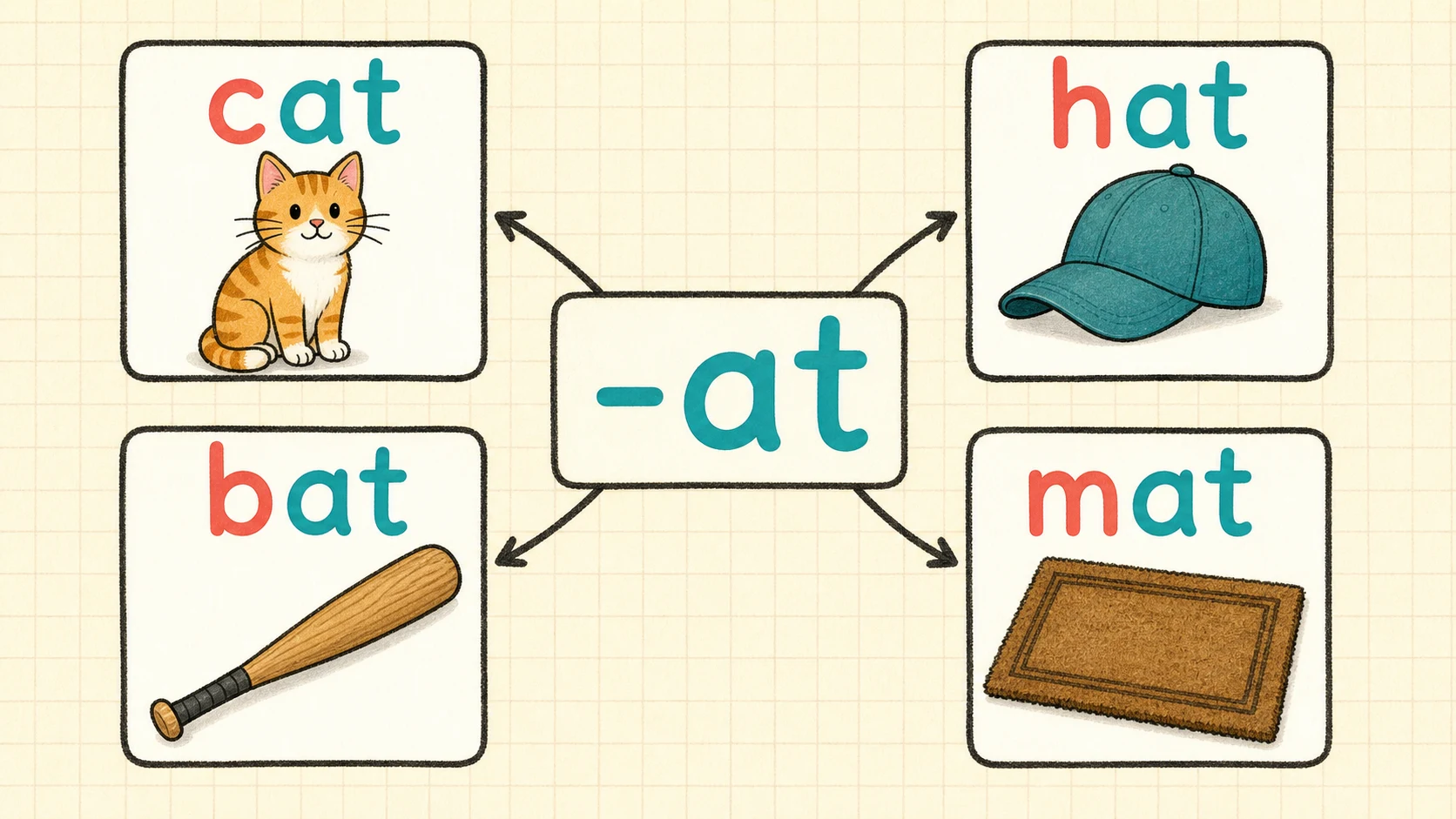
Say, “Listen: cat, mat. What part sounds the same?” Accept an oral approximation of -at if the learner clearly notices the rhyme. Then ask, “If I keep -at and put /p/ at the beginning, what word do I get?” The checked result is pat because /p/ + /at/ = pat.
Try another family: “big, dig. What stays the same?” The intended shared ending is -ig. If the learner cannot yet identify either shared ending, keep the activity oral. Say the words slowly, emphasize the rime, and let the learner echo them. That is preparation for the worksheet, not failure on it.
Separate the reading demand from the direction
Read the printed instruction aloud: “Fill in the missing letters to complete each word in the word family.” Point to a blank, then to the fixed ending. A Pre-K learner should not have to decode the direction independently in order to demonstrate word-family understanding.
The IES foundational reading practice guide, written for kindergarten through grade 3, recommends developing awareness of speech sounds and connecting those sounds to letters, followed by instruction in decoding and analyzing word parts. It did not evaluate this WorksheetWise printable, and its stated grade scope begins at kindergarten. Here it supports only the high-level instructional framing: say the sounds, connect them to print, and blend the parts into a word.
Model the task with fully checked examples
Use one example to show the complete process. Avoid merely supplying the answer. The learner needs to see what remains fixed, what changes, and how to verify the result.
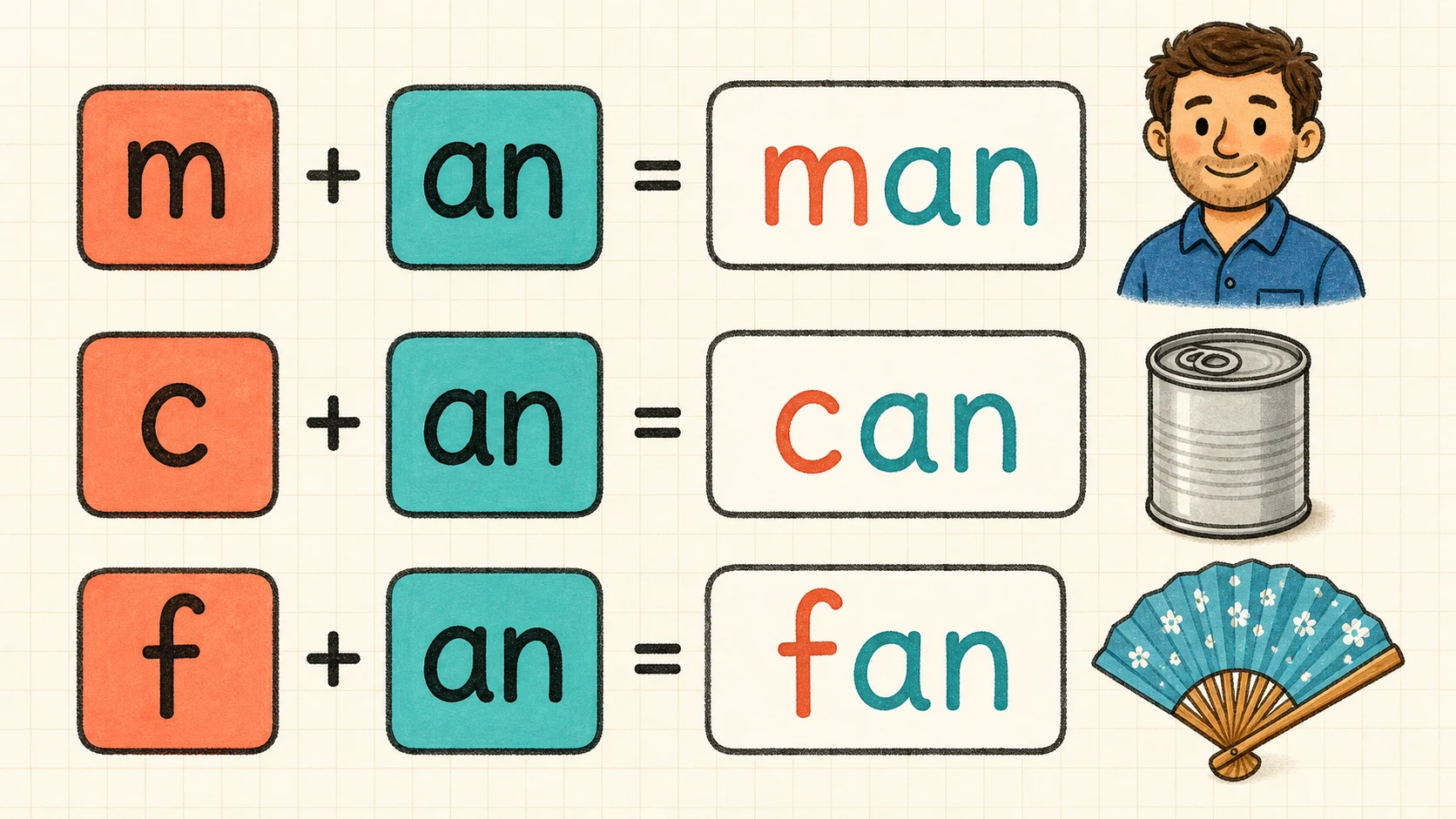
Keep the family ending visible while adding and checking the missing onset.
Example 1: _an becomes ran
Point to -an and say, “This ending stays: /an/.” Point to the single blank and explain that one written letter is needed. Choose r, write it in the blank, and blend:
r + an = ran
Check all three conditions:
- ran ends in the printed family -an.
- The added onset uses one letter, matching the one blank.
- ran is a real word.
The answer key gives ran for item 1, so this completion agrees with the key.
Example 2: _at becomes cat
Keep -at visible. Add c and blend:
c + at = cat
The result ends in -at, uses one missing letter, and forms a real word. The answer key gives cat for item 2.
After modeling, change only the beginning orally: “If c changes to m, what word do we hear?” The checked result is mat. This quick contrast shows the central idea: the onset changes while the rime remains stable.
Example 3: __op becomes drop
This prompt has two blanks. Keep -op unchanged and add dr:
dr + op = drop
Say the onset continuously enough for the learner to hear both consonants, then blend the whole word. Drop ends in -op, uses two added letters, and is a real word. It matches the answer key for item 3.
Do not present dr as two separate word families. It is the beginning part being joined to the fixed -op ending.
Example 4: __ug becomes plug
Add pl to -ug:
pl + ug = plug
Check the spelling from left to right: p-l-u-g. It uses two letters before the printed ending and forms the word plug. This matches item 4 on the key.
If the learner says pug, acknowledge that pug belongs to the -ug family but explain that the worksheet provides two blanks. The intended key word is plug, which supplies both p and l. This is a boundary between understanding the family and satisfying the full written prompt.
Example 5: __op can produce more than one correct word
The answer key uses shop for item 5:
sh + op = shop
That is fully valid: two letters fill two blanks, and the word ends in -op. However, the same printed prompt could also become chop:
ch + op = chop
Both words satisfy the visible information. In fact, the key uses chop for item 8. This confirms that identical prompt forms can have different intended answers. Unless another clue appears on the printed page, the key cannot make one of these valid completions linguistically wrong.
This ambiguity should shape grading. A learner who writes chop for item 5 has demonstrated the requested family pattern even though the key lists shop there.
Move from guided practice to a small independent sample
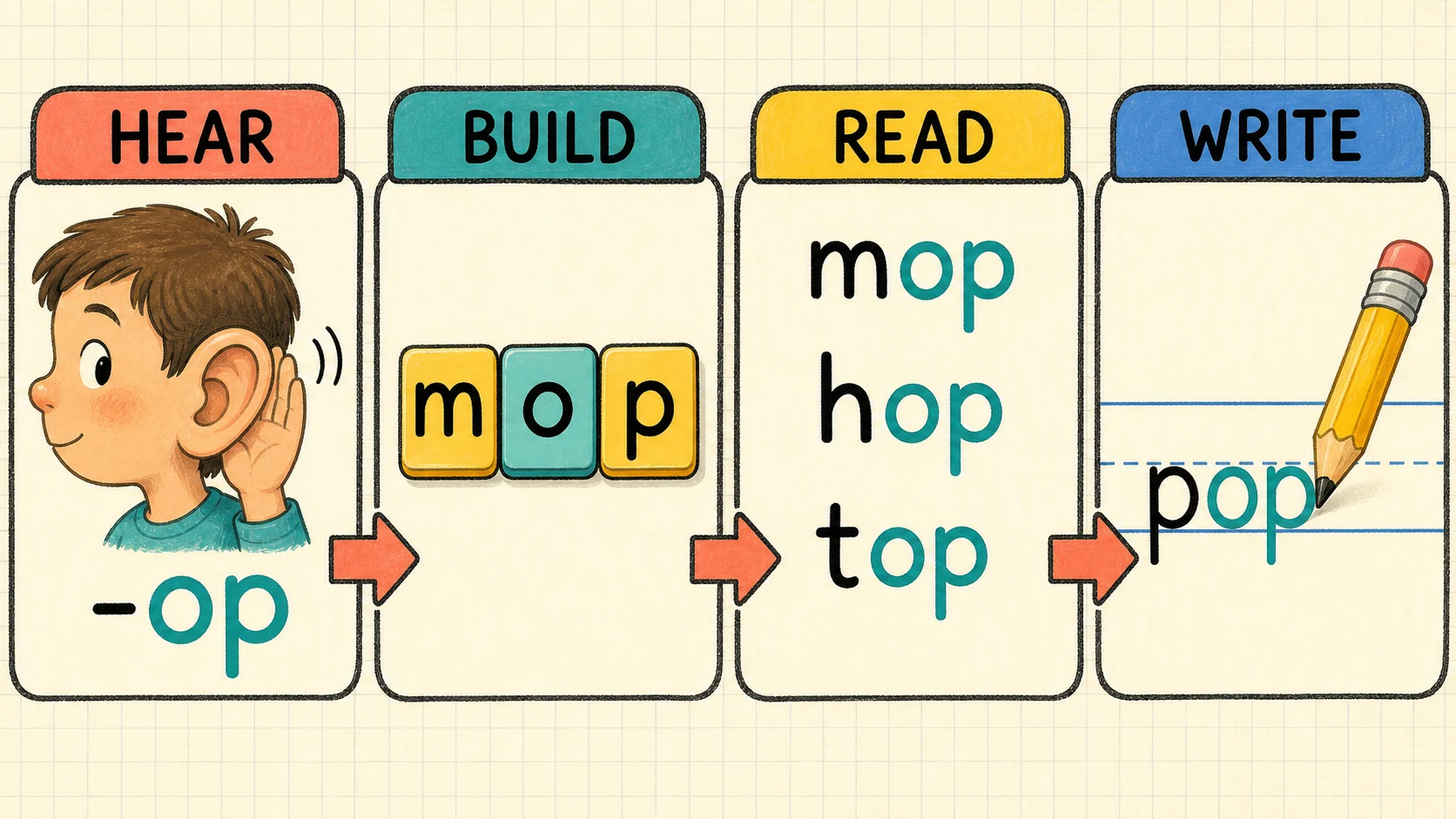
Release responsibility only after the learner has successfully joined an onset and rime with support.
Use a consistent guided prompt
For the next item, avoid naming the missing letters immediately. Try this sequence:
- “What ending stays the same?”
- “How many beginning letters are missing?”
- “What word could we make?”
- “Say the beginning and ending separately.”
- “Blend them.”
- “Does the completed word make sense as a word?”
For item 6, _ot (-ot), the key response is got. A learner might instead propose hot, lot, not, or pot. Each is a real one-letter onset plus -ot, so each meets the printed task. You can record the learner’s choice and then mention that the key shows a different possible member of the same family.
If the learner needs the answer supplied for every item, the task is still guided practice. Stay there. Independent practice begins when the learner can select, blend, and write a completion without step-by-step prompting.
Release only a few items at first
Cover the lower part of the page with another sheet of paper. Ask the learner to complete two visible prompts alone. Then check the process before exposing more.
Continue when the learner:
- preserves the printed ending;
- fills the correct number of blanks;
- produces plausible words;
- attempts to blend the completed forms; and
- works without escalating frustration or indiscriminate guessing.
Pause when the learner repeatedly changes the family ending, cannot recall the task, or is no longer attending to the letters. A shorter accurate attempt provides clearer information than a finished page completed through prompting.
Adapt support without replacing the skill
The target remains recognizing a printed word family, supplying an onset, and combining the parts. Support should reduce unrelated demands while leaving that thinking with the learner.
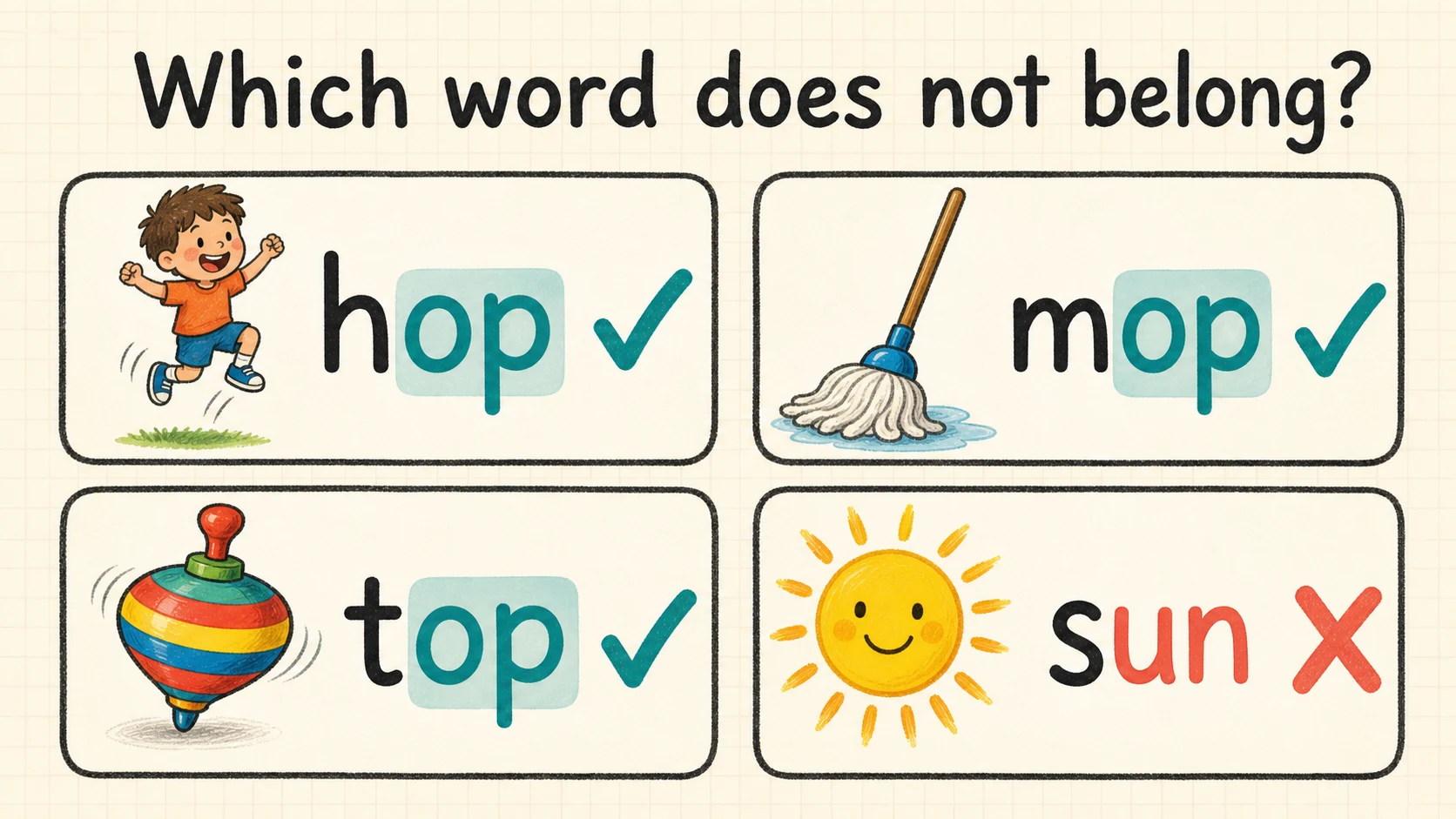
Adjust the visual field, response method, or amount of prompting while keeping onset–rime decisions with the learner.
When the whole page is visually demanding
Cover all but one row. Point to the ending and lightly box it so the learner can see the stable chunk. Complete five items across two sittings rather than insisting on all 20.
This changes the amount visible, not the phonics decision. The learner still chooses the beginning and joins it to the family.
When letter formation obscures phonics knowledge
Offer letter tiles for the missing positions. The learner selects the letters, places them before the printed ending, and reads the result. If appropriate, the learner can then copy the selected letters into the blanks.
Do not silently write the answer and count it as independent completion. If the adult acts as a scribe, note separately that the learner supplied the onset orally. The phonics response may be correct even though handwriting was not independently demonstrated.
The IES elementary writing practice guide includes fluency with handwriting and spelling among its broad recommendations. Its audience and grade range do not make it a direct Pre-K prescription, and it did not review this worksheet. It is useful here only as a reminder that writing mechanics and spelling are related but distinguishable demands. Record which part the learner actually completed.
When choosing from unlimited words is too hard
Provide two spoken choices without identifying the answer: “Could _ig become dig or dog?” The learner must compare each choice with -ig. The correct match is dig because dog changes the vowel and belongs to -og, not -ig.
For a two-letter onset, offer two complete choices: “Would __op become flop or flag?” Flop is the checked answer because it retains -op and fills both blanks. This is still word-family discrimination; it simply narrows the response field.
When the learner finishes easily
Ask for oral verification rather than adding unrelated work: “Read the word. Name the family. Change the beginning to make another real word.” For big, the learner might make dig. For mat, the learner might make pat.
Do not rush automatically to more difficult families. Look for accurate blending and flexible recognition across a small set first. The broader Pre-K phonics collection can help you choose a related activity when the learner is ready.
Interpret errors by their likely source
An incorrect-looking response is evidence to examine, not a complete diagnosis. Ask the learner to read or explain the word before deciding what went wrong.
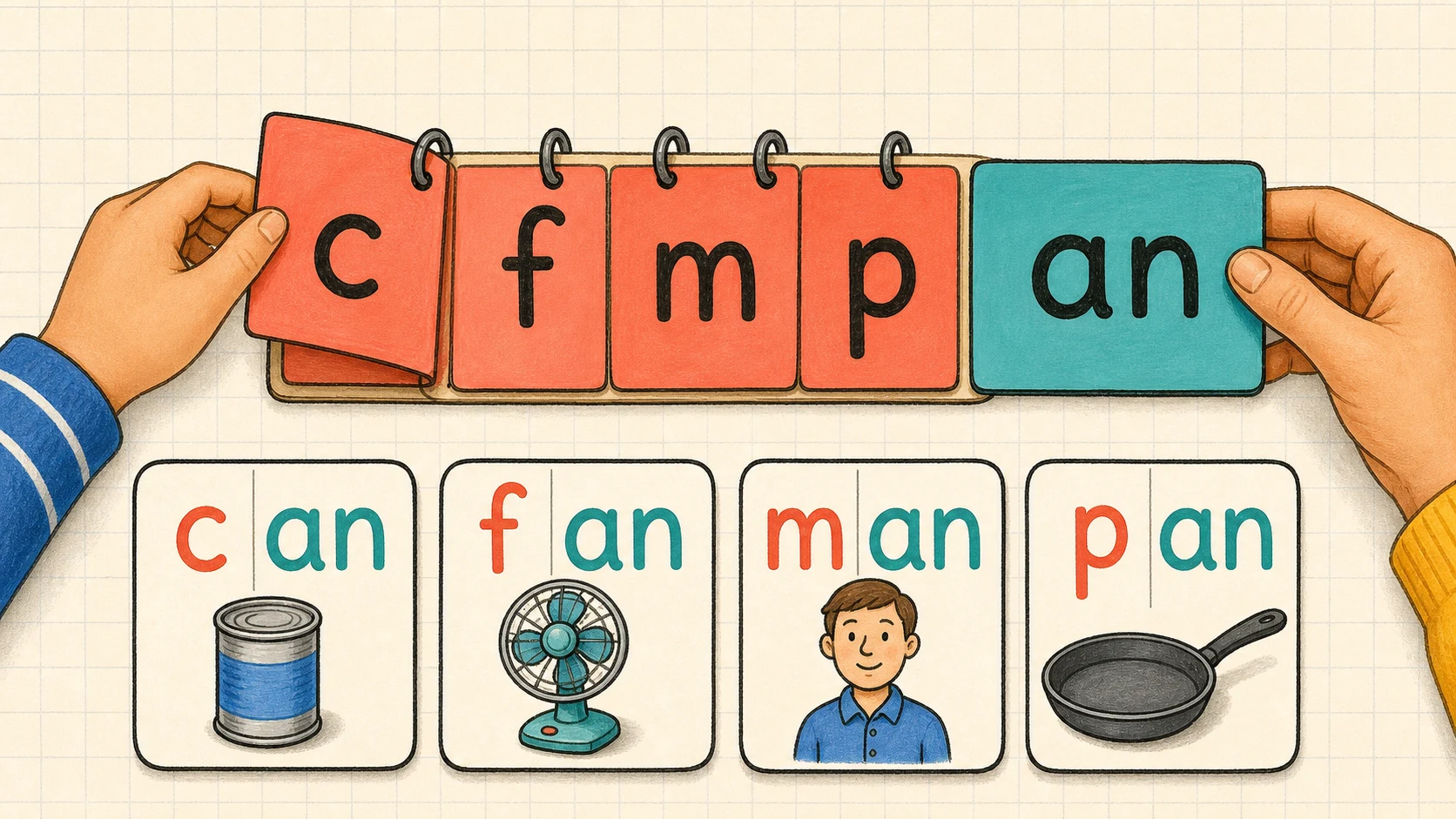
Check the fixed ending, blank count, word status, and oral reading before choosing a correction.
The learner changes the printed ending
Suppose _ig becomes dog. The learner supplied a real word but did not preserve -ig. Point to i-g and say, “These letters stay. Let’s read this part again.” Contrast dig with dog and have the learner identify which word ends with /ig/.
This pattern suggests that attention to the family needs support. It does not necessarily show difficulty with the initial consonant.
The learner supplies too few letters
For __op, the learner writes h, producing hop. Hop is a valid -op word, so the family knowledge is present. However, only one of the two blanks was used. Explain the boundary clearly: “You made a correct -op word. This prompt asks us to add two letters. Can we make shop, chop, flop, or drop?”
Count the phonics success and the format mismatch separately. That distinction is more informative than marking the entire response simply wrong.
The learner supplies a nonword with the correct family
A completion such as zop preserves -op and uses the correct number of letters for _op, but it is not the intended real-word response. Ask, “Is zop a word we know? Can we change the beginning to make mop, hop, or top?”
The learner has noticed the orthographic pattern but needs help selecting a meaningful word. If the learner can define or use an unfamiliar completion convincingly, verify it before rejecting it; do not assume the answer key lists every possible English word.
The learner says the right word but writes another letter
If the learner says cat and writes b in _at, ask the learner to repeat the first sound and identify the letter that represents it. This may be a letter–sound selection error or a writing slip rather than a failure to hear the family.
Correct one step at a time. Preserve the learner’s successful oral blend, then repair the written onset.
The learner treats every two-letter onset alike
The key contains both digraphs and blends. In shop and chop, the two beginning letters work together to represent the opening sound pattern. In flop, drop, plug, twig, and slot, both consonants can be heard within the beginning blend.
Use plain explanations rather than requiring terminology: “In flop, listen for /f/ and /l/ before /op/.” Then rebuild fl + op. The skill remains joining the beginning to the stable ending.
The learner is confused by knot
Item 17 is __ot, and the answer key gives knot. This is a genuine boundary case. The written onset has two letters, kn, but the initial k is not pronounced in the modern spoken word. That makes knot less transparent than regular examples such as hot, not, spot, or slot.
Do not use knot to judge whether a beginning learner can consistently map every printed letter to a sound. If the learner supplies another real four-letter -ot word that fits two blanks—such as spot, plot, or slot—the response satisfies the visible prompt. You may show knot as the key’s intended spelling after the learner has demonstrated the underlying family.
Use the answer key as a reference, not a guessing test
The separate key lists these intended completions:
| Items | Keyed words |
|---|---|
| 1–4 | ran, cat, drop, plug |
| 5–8 | shop, got, dig, chop |
| 9–12 | win, sin, big, mat |
| 13–16 | tin, twig, not, kin |
| 17–20 | knot, flop, pat, slot |
Check each response through four questions:
- Does it retain the printed family?
- Does it fill the stated number of blanks?
- Does it form a real word?
- Can the learner read or explain the completed word?
Use the key to identify the worksheet’s intended examples, catch accidental spelling changes, and discuss another possible family member. Do not require an exact match when the prompt allows alternatives. For example, _in can produce pin, fin, win, sin, tin, or kin, among other possibilities. The key itself assigns different answers to repeated _in prompts.
Similarly, __op may become shop, chop, drop, or flop, all of which appear in the key at different positions. Exact item-by-item matching is therefore not a fair measure of the learner’s word-family knowledge unless an additional clue identifies one intended word.
A simple record can separate:
- correct family and valid word;
- correct family but wrong blank count;
- preserved letters but nonword;
- changed family;
- correct oral answer with writing difficulty; and
- response completed only after prompting.
That record is more useful for planning than a single percentage.
Decide what to teach next from observed work
The learner’s response pattern should determine the next activity.
If rhyming is not yet secure, return to oral pairs such as cat–mat, big–dig, and hop–mop. Ask whether the endings sound the same. No writing is necessary at first.
If the learner hears the family but cannot select letters, use movable letters with one familiar onset at a time. Keep -at fixed and swap c, m, and p to make cat, mat, and pat.
If one-letter onsets are secure but blends are difficult, contrast a simple word with a two-letter beginning: top–stop or hop–chop. Make the printed ending visually stable.
If the learner completes and reads the page accurately, move toward sorting mixed words by ending or reading short, controlled sentences containing familiar family words. The focused Pre-K Word Families pack contains 18 worksheets for additional practice, but more pages should serve a specific observed need rather than replace instruction.
The Common Core ELA framework provides grade-specific literacy expectations and includes foundational reading categories, but it does not establish a universal Pre-K sequence for this worksheet. Consult the Common Core English Language Arts standards only as one broader reference alongside the sequence used in the learner’s setting. Do not claim that completing this page demonstrates comprehensive standards alignment.
Schedule brief retrieval instead of one long repeat
Retrieval means asking the learner to produce or recognize the pattern again after some time has passed. The schedule below is an instructional option, not a universal timetable.
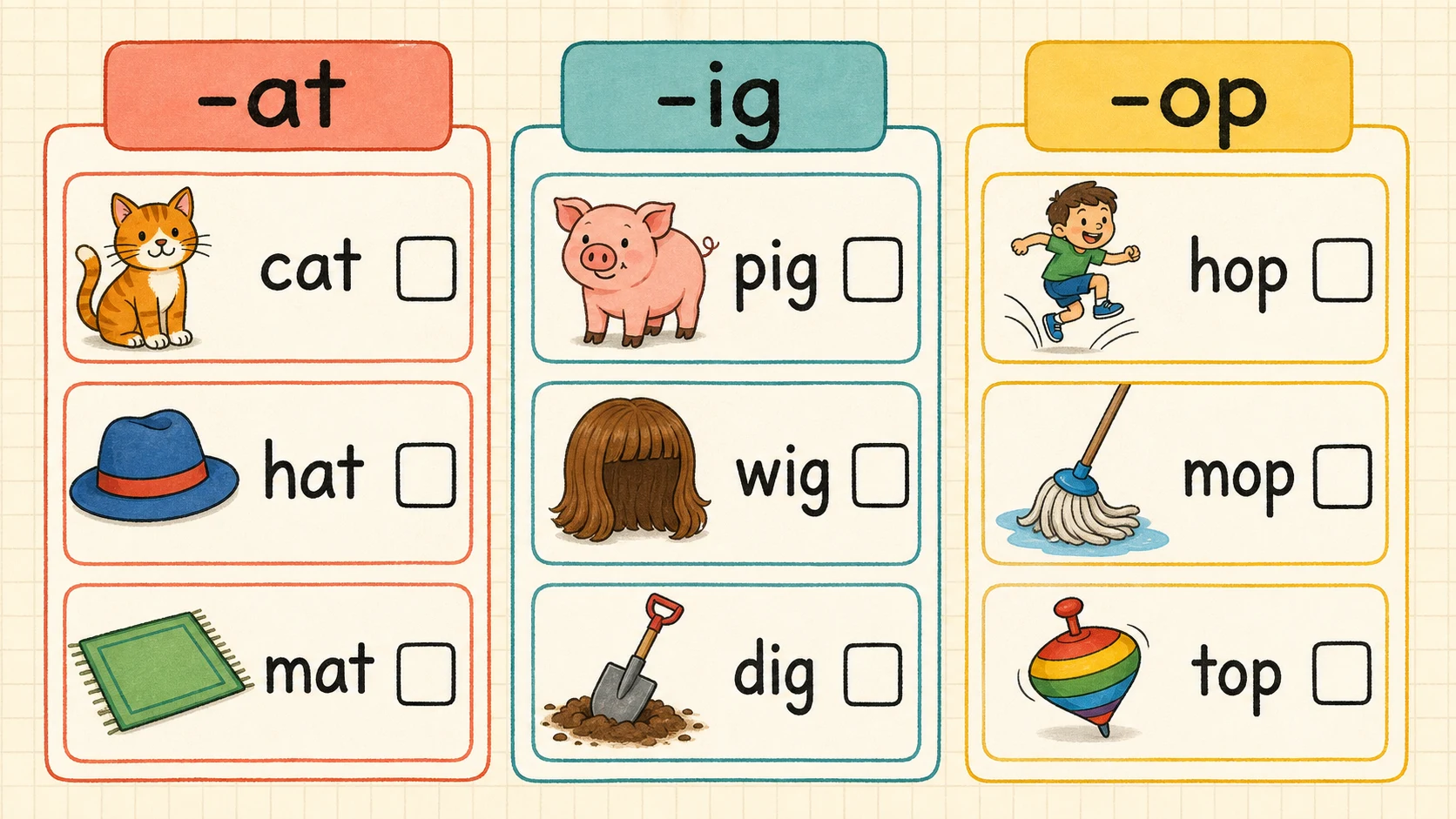
Revisit a small sample after delays, adjusting the spacing when the learner’s responses show a need.
A practical review plan
First lesson: Model one item, complete two or three together, and offer two to five independently. Stop while the learner is still attending to the pattern.
Later the same day or next learning period: Rebuild two completed words without showing the answers. For example, place -at and ask the learner to make cat and then another -at word.
Two or three days later: Present one familiar family and one contrasting family, such as -ig and -in. Ask the learner to place dig and win under the correct endings.
About a week later: Revisit a few unmarked worksheet items or write parallel prompts such as _at, _ig, and __op. Note whether the learner can complete and read them with less support.
In a later review: Use the same families in short oral or printed contexts. “The fat cat sat” contains several -at words, but the adult should still check that the learner is decoding the pattern rather than reciting a memorized sentence.
Shorten the interval or reduce the number of families when the learner cannot retrieve them. Lengthen the interval or mix families when recall is accurate. The learner’s observed work—not the calendar alone—drives pacing.
Know the worksheet’s limitations
This printable provides focused word-building practice, not a complete phonics program. It does not by itself establish independent reading, spelling mastery, comprehension, or writing fluency. It also cannot show whether a correct written word was decoded, copied, remembered visually, or guessed unless an adult asks the learner to read or explain it.
Several prompts are open-ended, so the answer key represents intended possibilities rather than the only acceptable language. Some keyed words use blends, digraphs, or a less transparent spelling such as knot, making the page more varied than a set of simple consonant-vowel-consonant words.
Word families can make common chunks easier to notice, but they should sit alongside systematic work with individual speech sounds, letter–sound relationships, blending, and real reading. The IES reading guide supports that broader framing; it does not certify WorksheetWise, guarantee outcomes, or prescribe this exact lesson.
For the next session, choose three families that the learner handled with the least help and practice them through the free worksheet. Then use the Word Families topic guide to select the next activity based on whether the learner needs more rhyming, onset–rime building, sorting, or reading in context.
Put it into practice
Use the guide with a real printable
Move from explanation to a short, observable practice task. Check the first item together, then adjust the next session from the learner's actual work.
See the 18-worksheet pack