Complete guide
How to teach and practise pre-k short vowels worksheets - standard theme (easy)
What This 20-Item Worksheet Is For
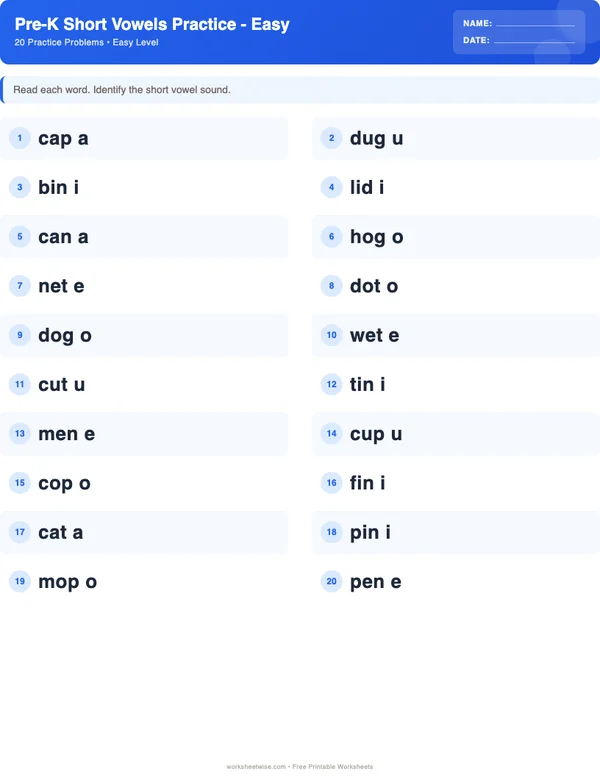
The free Pre-K Short Vowels worksheet gives a learner 20 easy-level exercises with one consistent direction: Read each word and identify its short vowel sound. The instructional goal is to connect the vowel heard in a simple word with the letter that represents it: a, e, i, o, or u.
For most Pre-K learners, the best use is a short lesson rather than a test. Introduce the vowel sounds orally, model how to stretch a word without distorting it, complete a few items together, and then let the learner try a manageable group independently. Stop or add support when the observed work shows that guessing, fatigue, or difficulty reading the words has replaced thoughtful sound identification.
The worksheet practices short vowel sounds, phonics, CVC patterns, and decoding. It includes a separate printable answer key. It does not, by itself, establish mastery of every short vowel pattern or replace oral listening, letter-sound instruction, and supported word reading.
Grade labels describe the intended practice level; they are not a guarantee that every learner at that age is ready for the same task. Local curricula and teaching sequences differ. Use the learner’s responses—not the Pre-K label alone—to decide how much to present at one time.
A Practical Lesson Map
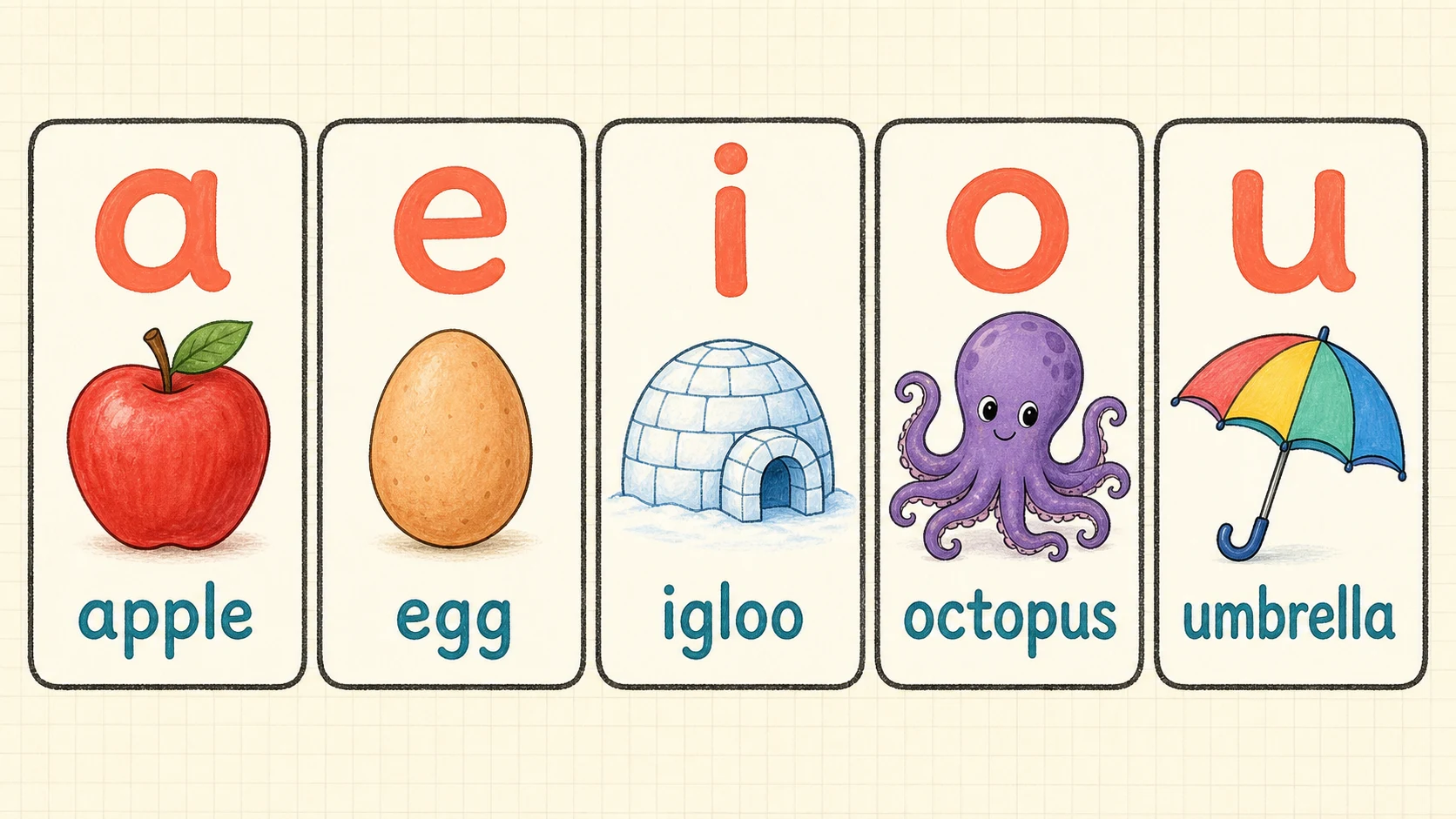
Move from listening and modeling to supported work, independent attempts, and a brief review.
The complete lesson can take place in one sitting or across several short sessions. There is no universal timetable. A learner who is still developing pencil control, attention to print, or confidence with letter sounds may benefit from five items at a time. Another learner may comfortably complete more.
| Lesson phase | Adult action | Learner action | Evidence to notice |
|---|---|---|---|
| Oral warm-up | Say two or three familiar CVC words and emphasize the middle sound naturally | Repeat each word and identify or imitate the vowel sound | Can the learner hear the middle sound without seeing print? |
| Task launch | Read the printed direction and explain what one answer requires | Point to the vowel being identified | Does the learner understand that the target is the vowel sound, not the first letter? |
| Modeling | Demonstrate one or two comparable words | Watch, listen, and explain what the adult noticed | Can the learner follow the sound-to-letter reasoning? |
| Guided practice | Complete several worksheet items together | Blend or repeat each word, then choose the vowel | Which prompts help without giving away the answer? |
| Independent practice | Assign a small group of items | Attempt each item with minimal prompting | Are responses accurate, deliberate, and reasonably fluent? |
| Check and discuss | Compare answers after the attempt | Correct errors and explain the middle sound | Can the learner revise after rehearing the word? |
| Retrieval | Revisit a few words later without showing prior answers | Recall, read, or sort by vowel sound | Does learning remain available after time has passed? |
The IES foundational reading practice guide provides broad instructional framing for foundational reading, including explicit work with sound segments and letter-sound relationships. It did not evaluate WorksheetWise or this particular printable. Here, its general emphasis supports a clear model, guided response, feedback, and repeated opportunities to connect sounds with letters.
Prepare Before the Learner Starts
Preview the printable and answer key
Print or open both the worksheet and its separate answer key. Look over the actual 20 words before teaching. This matters because the catalogue describes the overall task but does not list every item in the prompt supplied for this guide.
Check how the learner is expected to record each answer. Depending on the page design, that may involve circling, writing, matching, or saying the vowel while an adult records it. Follow the printed layout. Avoid adding a second demand—such as copying every word—unless you intentionally want separate handwriting practice.
Keep the answer key out of the learner’s view. Use it to confirm the intended response after an honest attempt, not to preview answers.
Establish five sound anchors
The topic materials use these anchors:
- a as in apple
- e as in egg
- i as in itch
- o as in octopus
- u as in umbrella
Say each anchor aloud and have the learner repeat it. Optional motions can make the sounds easier to retrieve: pretend to bite an apple, crack an egg, scratch an itch, move arms like an octopus, or hold an imaginary umbrella. These are instructional cues, not requirements.
Keep the spoken vowel short. Avoid adding an extra “uh” after the sound. The learner needs to compare the sound inside a word with a clean model.
Separate reading from pencil demands
A learner can understand the vowel contrast and still find writing tiring. If pencil control interferes with the phonics task, let the learner point, use letter cards, place a small marker, or say the answer while you record it. The skill remains identifying the short vowel sound. This adjustment changes the response method, not the phonics target.
Model the Task Explicitly
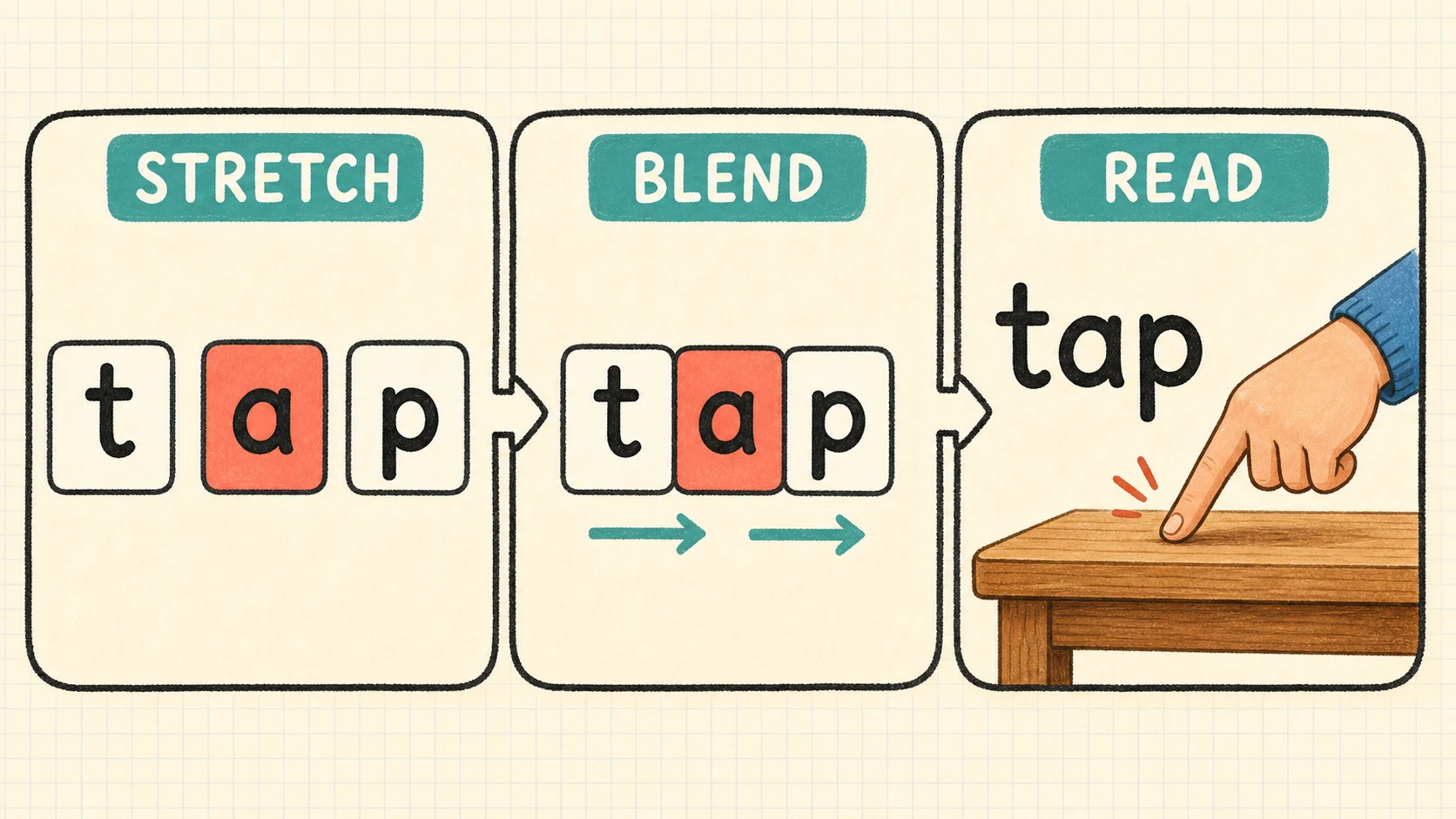
Model how to say the whole word, listen to its middle sound, and connect that sound to a vowel letter.
Use a word that is comparable to the worksheet rather than assuming it appears among the 20 printed items. A concise model might sound like this:
“The word is map. I will say it slowly: /m/ /ă/ /p/. I hear /ă/ in the middle. /ă/ is the short sound for a, so the answer is a.”
Then repeat the word normally: map. Segmenting helps reveal the sounds, but returning to natural pronunciation prevents the learner from treating the stretched version as a different word.
What to make visible
Model three decisions:
- Read or repeat the complete word.
- Listen for the vowel sound, usually between the consonants in a simple CVC word.
- Connect that sound to a, e, i, o, or u.
Do not merely announce the letter. The spoken reasoning is the reusable part of the demonstration.
Keep the target narrow
If the word is map, the answer is the short a sound. The learner does not need to define map, name every consonant, copy the word, or generate a rhyme before moving on. Those can be useful activities elsewhere, but stacking them onto every item can hide whether the learner can perform the stated task.
The IES elementary writing practice guide concerns writing instruction more broadly and was not written to validate this worksheet. Its relevance here is limited but useful: adults can provide appropriate writing support while keeping the learning purpose clear. On this page, a laborious written response should not be mistaken automatically for weak vowel knowledge.
Four Fully Checked Worked Examples
The following examples are verified from their spellings and conventional short-vowel pronunciations. They illustrate the method; they are not presented as confirmed items from the printable.
Example 1: map → short a
Say map, then segment it: /m/ /ă/ /p/. The middle sound is /ă/, as in apple. The correct vowel is a.
A learner who selects m may be listening for the beginning sound instead of the vowel. Redirect with: “You found the first sound. Now listen between /m/ and /p/.”
Example 2: hen → short e
Say hen: /h/ /ĕ/ /n/. The vowel sound is /ĕ/, as in egg. The answer is e.
If the learner chooses i, say hen and hin distinctly without claiming that hin is the intended word. Ask which version matches the printed word. A mirror can also help the learner watch the slightly wider mouth position used for short e in the topic’s suggested approach.
Example 3: sit → short i
Say sit: /s/ /ĭ/ /t/. The middle sound is /ĭ/, as in itch. The answer is i.
If the learner says e, compare sit with set. These form a useful listening contrast because the consonants stay the same while the middle vowel changes. Return to sit and ask the learner to identify only the sound actually heard there.
Example 4: hot → short o
Say hot: /h/ /ŏ/ /t/. The middle sound is /ŏ/, as in octopus. The answer is o.
If u is chosen, contrast hot with hut. Say both naturally and ask the learner to point to the anchor picture that matches each middle sound. Pronunciation can vary by accent, so use the pronunciation expected in the learner’s language environment and compare it with the answer key’s intended spelling.
Example 5: cup → short u
Say cup: /k/ /ŭ/ /p/. The middle sound is /ŭ/, as in umbrella. The correct answer is u.
If the learner identifies c, acknowledge that /k/ is a sound in the word, then restate the target: “We are finding the vowel sound in the middle.”
Together, these examples cover all five short vowels. They also show why a correct response should come from both the heard sound and the printed spelling, not from guessing based on one familiar word.
Move Through Guided and Independent Practice
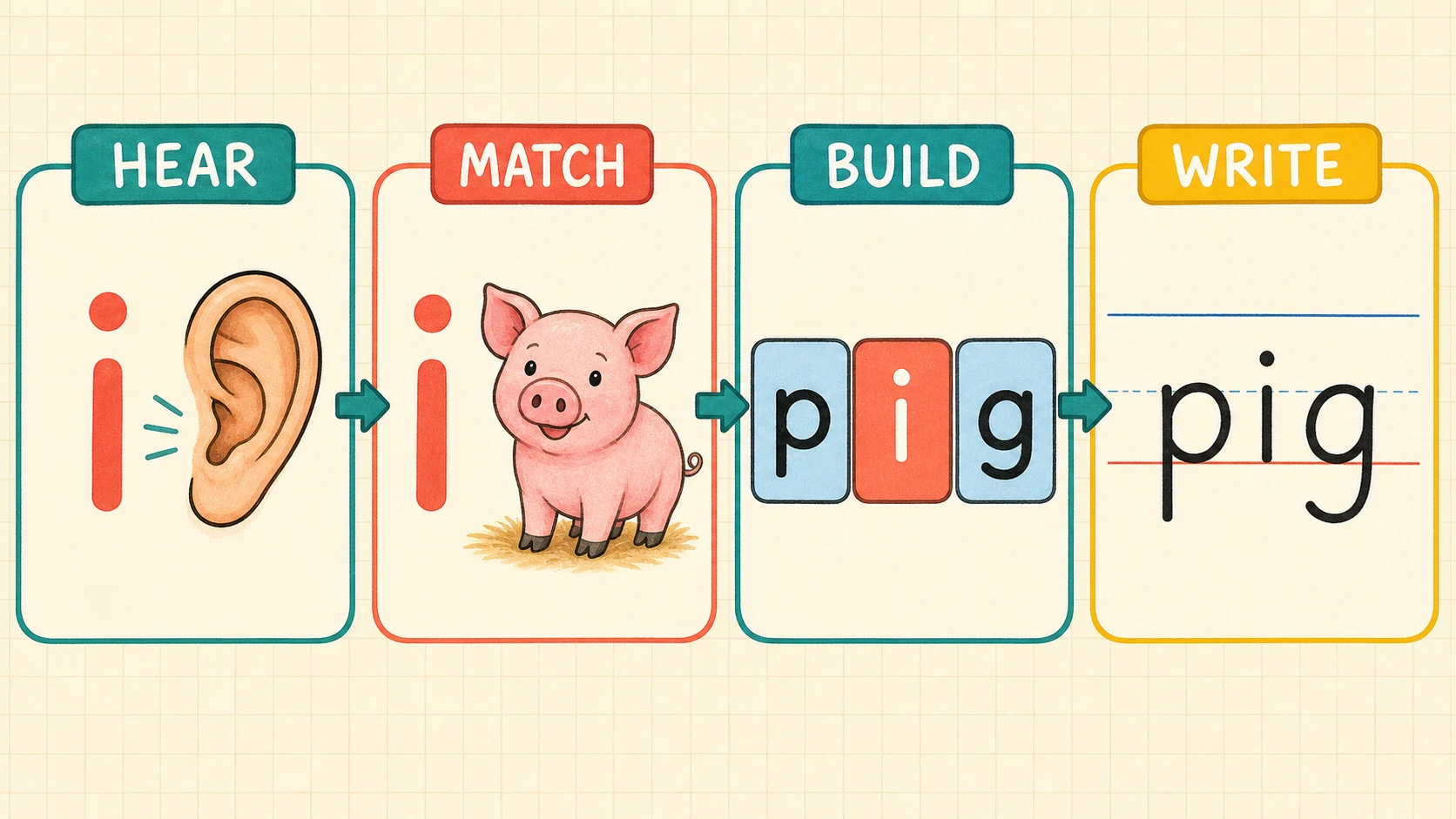
Reduce help gradually as the learner shows that the routine is understood.
Begin with guided items
Complete the first few selected items together. For each one, ask a consistent prompt such as, “What sound do you hear in the middle?” If the learner cannot read the word, say it clearly and let the learner repeat it. This preserves practice with vowel identification while revealing that independent decoding still needs support.
Use the least help that produces a thoughtful response:
- First, pause and allow time.
- Next, ask the learner to repeat the word.
- Then, segment the word together.
- If necessary, offer two relevant vowel anchors.
- Finally, model the item and choose a new one for the learner to try.
A correct answer after full modeling is not yet independent evidence. Record mentally—or lightly on a separate note—how much support was needed.
Release a small set
Once the learner can explain the routine, assign a short group of items. You might say, “Try these three. Say each word softly, listen to the middle, and mark the vowel.” This is an instructional suggestion, not a sourced universal rule. Adjust the group size from the learner’s observed accuracy, attention, and effort.
Stay nearby without correcting every hesitation instantly. A brief pause gives the learner an opportunity to retrieve the sound. Step in when repeated guessing or frustration makes further independent work uninformative.
Treat independence as a condition, not a location
Independent practice does not require the adult to leave. It means the learner makes the phonics decision without being led to the answer. An adult may still manage materials, read a direction, or help the learner return to the correct line.
If all 20 items would be too much, cover the lower part of the page and reveal one row at a time. The worksheet remains a 20-item printable even when instruction is distributed across sessions.
Adapt Support Without Changing the Skill
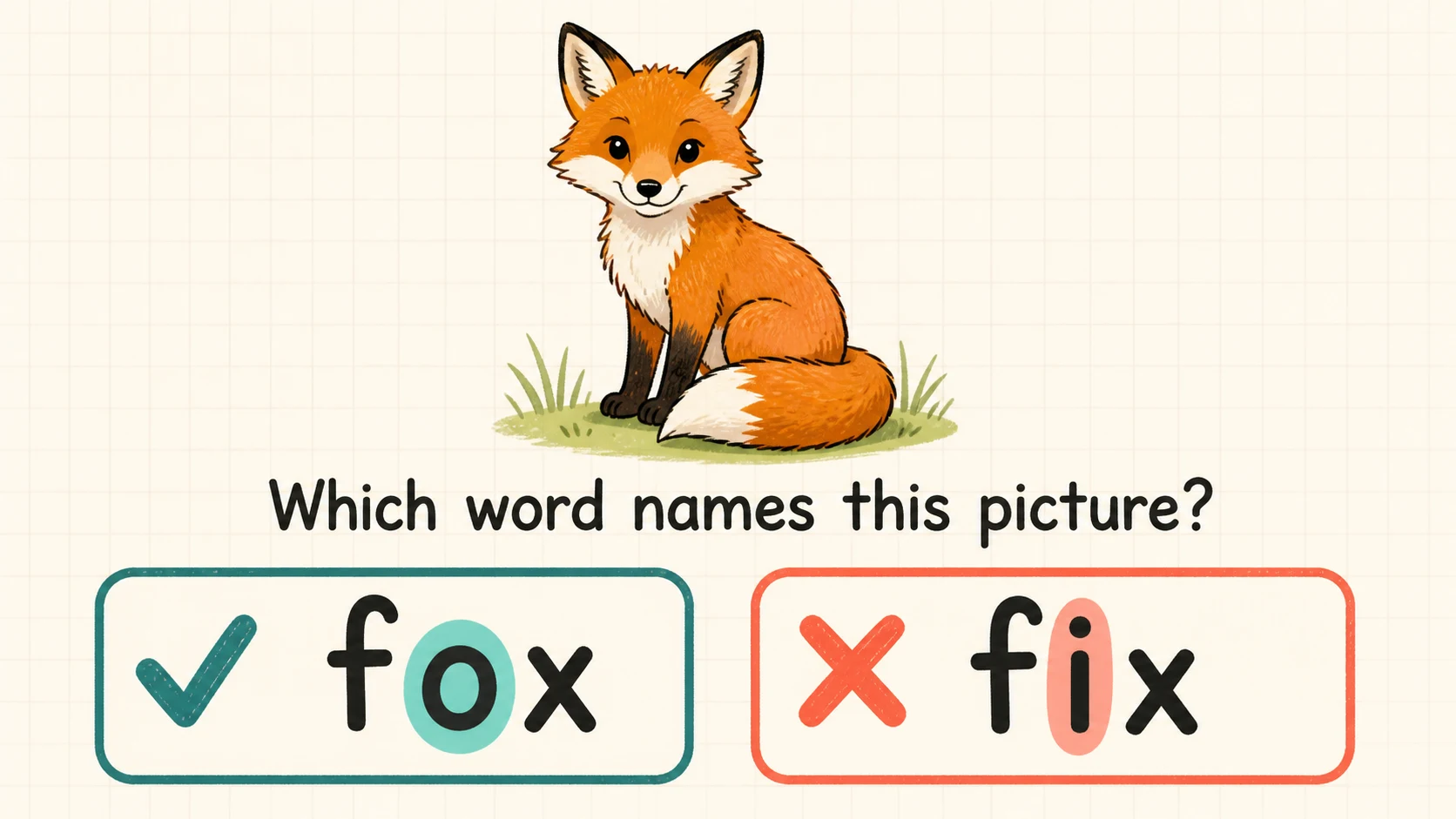
Adjust access, amount, or prompting while preserving the short-vowel decision.
When the learner cannot yet read the words
Read each word aloud, but do not name the vowel. Have the learner repeat the word and choose the corresponding vowel letter or anchor. This changes the task from independent decoding plus identification to supported listening plus identification. Say so when interpreting the result.
Later, revisit several words in print to see whether the learner can blend them. The broader Pre-K phonics collection can help you select practice that matches the missing prerequisite.
When five choices are overwhelming
Display only the vowel letters currently being contrasted—for example, a and i—while still using worksheet words that contain those sounds. Once responses are stable, add another choice. Do not change the target to identifying any letter in the word; the learner must still listen for the vowel.
The catalogue’s teaching notes suggest introducing short vowels one at a time, with a possible order of a, i, o, u, e, and giving extra attention to easily confused pairs. That is a supplied instructional sequence, not a claim that every school or learner must follow it.
When handwriting masks understanding
Offer movable vowel cards, oral responses, pointing, or stamps. If the learner can consistently select the right vowel but cannot form it legibly, note the phonics response separately from handwriting. If writing practice is also a goal, add one carefully chosen written response after the oral work rather than turning all 20 items into a copying exercise.
When the learner finishes quickly
Ask for evidence instead of immediately moving to a harder topic: “Say the word and tell me the vowel sound.” Then use two or three familiar words in oral dictation. For example, say map and have the learner identify a before attempting to write the word.
Do not assume fast completion means secure learning. Confirm that answers are accurate and that the learner can retrieve the sound again later.
Interpret Errors Before Correcting Them
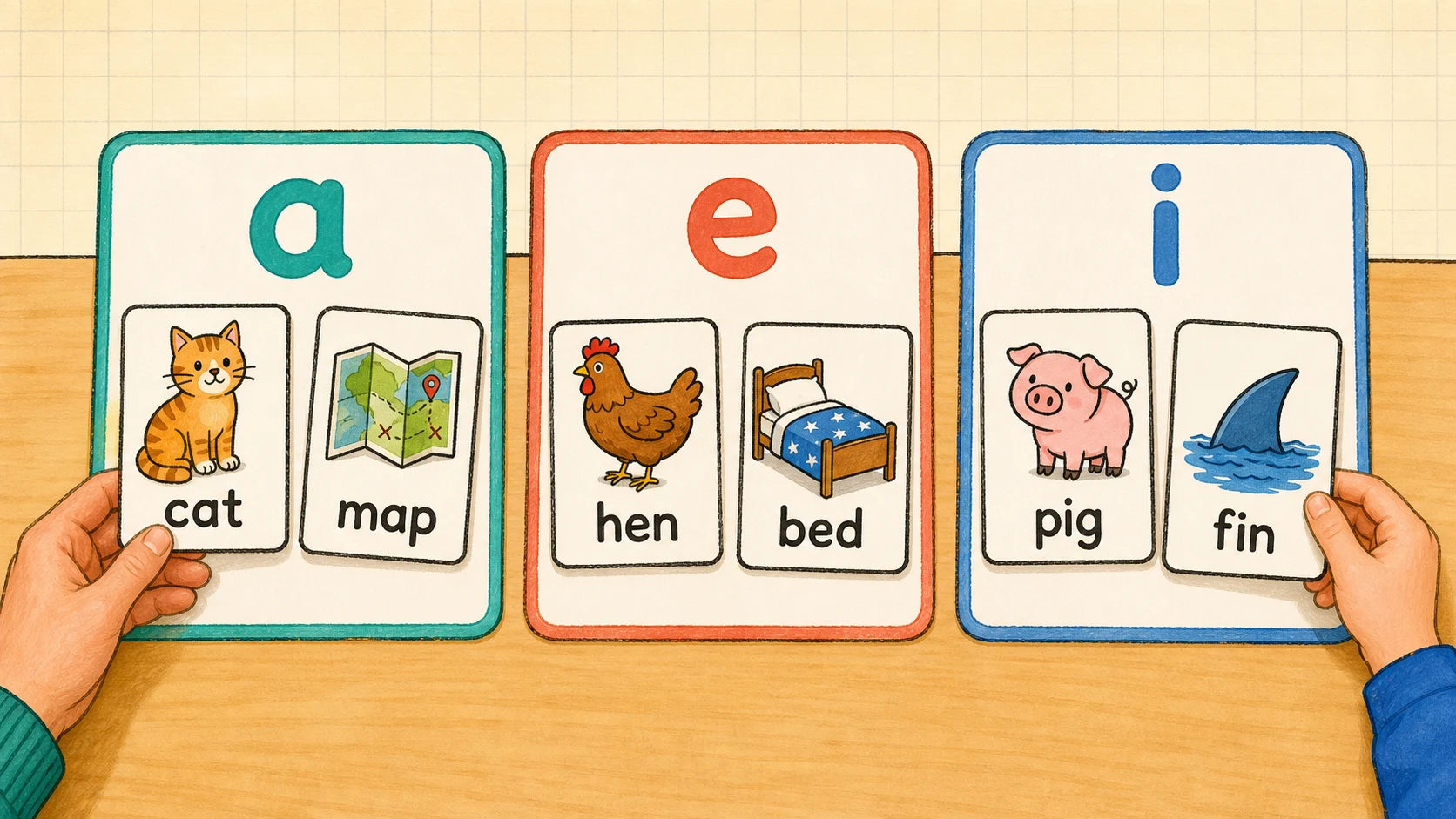
Identify whether the difficulty came from the direction, the spoken sound, the printed word, or the response method.
An incorrect mark does not identify its own cause. Use a brief check routine:
- Ask the learner to say or repeat the whole word.
- Ask for the middle sound.
- Ask which vowel letter represents that sound.
- If needed, compare the response with an anchor or a carefully chosen contrast.
- Have the learner retry the original item.
First-sound answers
A learner may name the initial consonant because “What sound?” has often meant “What sound does the word start with?” Clarify the direction and point to the middle of the printed word. This is a task-understanding issue until repeated work shows otherwise.
Short e and short i confusion
Words such as pen/pin, set/sit, and bed/bid isolate the middle contrast. Say each pair naturally, ask whether the words sound the same or different, and then identify the vowel. Do not rush to another worksheet if the learner cannot yet hear the distinction orally; provide additional listening practice first.
Short o and short u confusion
Use a contrast such as hot/hut. Accent and dialect can affect vowel realization, so avoid treating a learner’s home pronunciation as careless speech. The page asks for the conventional vowel represented in the printed word. Model the instructional pronunciation clearly and connect it to the spelling without criticizing the learner’s language variety.
Guessing from position or repetition
Patterns such as alternating answers, choosing the same vowel for a whole row, or looking at the adult before every response may signal guessing. Return to one item, cover surrounding work, and ask the learner to explain the middle sound. More items will not repair a missing decision routine.
Decoding errors
If the learner reads sit as sat, the selected vowel may accurately match the word the learner said while failing to match the print. Record the underlying issue as a word-reading error, then rebuild the printed word sound by sound. This distinction guides the next lesson more usefully than simply counting the answer wrong.
For a fuller sequence beyond this single printable, use the short-vowels topic guide rather than trying to make one worksheet cover sound introduction, discrimination, decoding, spelling, and cumulative review all at once.
Use the Answer Key Responsibly
The separate answer key supports efficient checking, but it should not replace listening to the learner. First inspect the completed page and ask the learner to revisit any uncertain items. Then compare responses with the key.
For each mismatch, verify three things:
- what word is actually printed;
- what answer the key identifies;
- what the learner said or appeared to understand.
Marking every mismatch identically loses useful information. A reversed or unclear letter, a misread word, and a vowel-sound confusion may produce the same wrong box while requiring different support.
Avoid displaying the key during independent work. If the learner self-checks afterward, reveal one answer at a time and require a correction routine: say the word, identify the middle sound, and then change the response. Copying the key can produce a neat page without demonstrating learning.
The Common Core English Language Arts standards include expectations related to sound-letter knowledge and regular one-syllable words across the early grades. That source offers broad context only. The catalogue lists related standards, but this guide does not claim comprehensive standards alignment or that completing one Pre-K worksheet satisfies any standard.
Decide What the Work Means
A raw score is only one part of the evidence. Review accuracy alongside independence, response pattern, and the learner’s ability to explain or repeat the sound.
| Observed work | Reasonable interpretation | Useful next move |
|---|---|---|
| Mostly accurate without prompts | The task may be becoming secure in this format | Recheck a few items after a delay and add oral spelling or a mixed review |
| Accurate only after the adult says every word | Vowel listening may be stronger than independent decoding | Continue supported identification and teach or review blending |
| One vowel is repeatedly confused with another | A specific contrast needs attention | Use anchors and minimal pairs before retrying selected items |
| Correct orally but written marks are unclear | Response production may be obscuring phonics knowledge | Accept pointing or letter cards, then address writing separately |
| Many first consonants are selected | The learner may misunderstand “vowel sound” or “middle sound” | Remodel one item and conduct a brief oral check |
| Accuracy drops late on the page | Fatigue or attention may be affecting performance | Shorten the next session and revisit unfinished items later |
| Answers are fast but explanations are inconsistent | Some responses may be guesses | Ask for the word and middle sound on a small sample |
Do not diagnose a learning condition from this worksheet. It is one narrow practice sample, not a medical, developmental, or comprehensive educational assessment. If persistent concerns extend across tasks and settings, document concrete observations and discuss them through the learner’s usual educational support process.
Schedule Retrieval Instead of Repeating Immediately
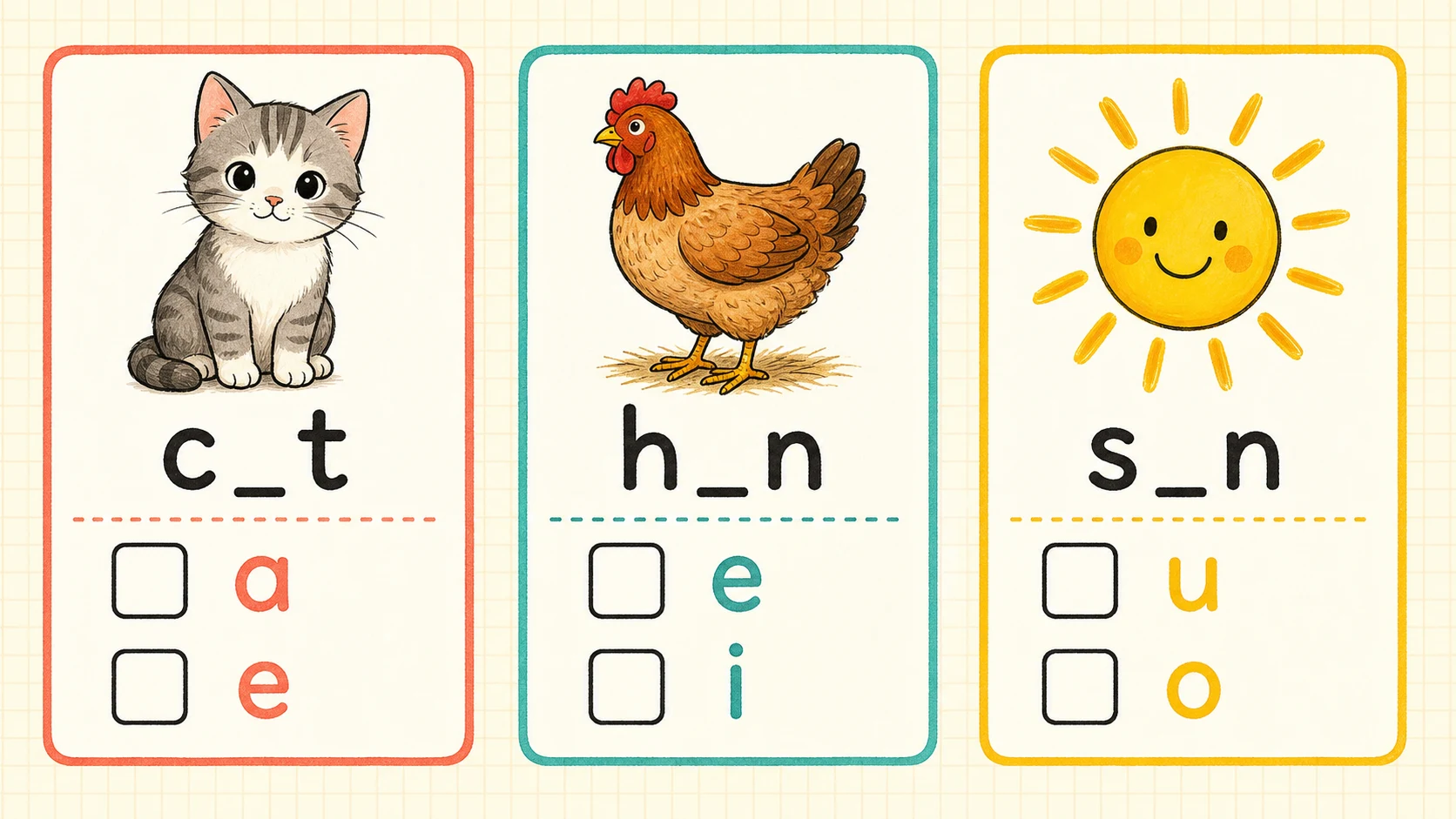
Revisit a small sample after time has passed, changing the response format when helpful.
A practical schedule might look like this:
| Time | Retrieval activity |
|---|---|
| End of the lesson | Revisit two corrected items without showing the answers |
| Next learning session | Read or identify the vowels in three to five previously attempted words |
| A few days later | Mix familiar words with two new examples and sort them by vowel |
| The following week | Use brief oral dictation, word reading, or a fresh short-vowel page |
This is a flexible instructional plan, not an authoritative timetable. If delayed work shows confusion, return sooner to a smaller contrast. If the learner recalls accurately and explains the vowel sounds, widen the mix gradually.
Retrieval should require an answer from memory. Simply rereading a corrected page is review, but it does not provide the same evidence as hearing cup and independently selecting u, or reading hen and naming e.
Boundaries and Honest Limitations
This easy, standard-theme worksheet provides 20 focused opportunities to identify short vowel sounds in words. It can show how a learner handles this particular format on a particular day. It cannot establish that the learner will decode unfamiliar words, spell all CVC words, discriminate every vowel in every accent, or transfer the skill automatically to connected text.
Pictures, adult pronunciation, and answer choices can make identification easier. Independent reading can make it harder. That difference is useful information rather than a contradiction. Record the conditions under which the learner succeeded.
The page also should not carry the entire early-literacy program. Pre-K learning includes oral language, alphabet knowledge, phonological awareness, print concepts, fine-motor development, and playful interaction with books and sounds. The Pre-K worksheet hub provides broader practice options, while the short-vowels guide holds the fuller topic progression.
The Next Useful Action
Print the free 20-item worksheet, choose five vowel anchor cues, and preview the answer key before meeting with the learner. Model one comparable word, complete two or three printed items together, and release only a small set for an independent attempt. Note whether errors come from hearing the vowel, reading the word, understanding the direction, or recording the answer.
After a delayed check, follow the evidence. If one contrast remains difficult, return to the short-vowels topic guide for focused practice. If the learner handles mixed vowels accurately across sessions, continue with varied examples from the 18-worksheet Pre-K Short Vowels Pack or create a fresh, appropriately limited review through the free worksheet generators.
Put it into practice
Use the guide with a real printable
Move from explanation to a short, observable practice task. Check the first item together, then adjust the next session from the learner's actual work.
See the 18-worksheet pack