Complete guide
How to teach and practise pre-k cvc words worksheets - standard theme (easy)
What This Worksheet Teaches
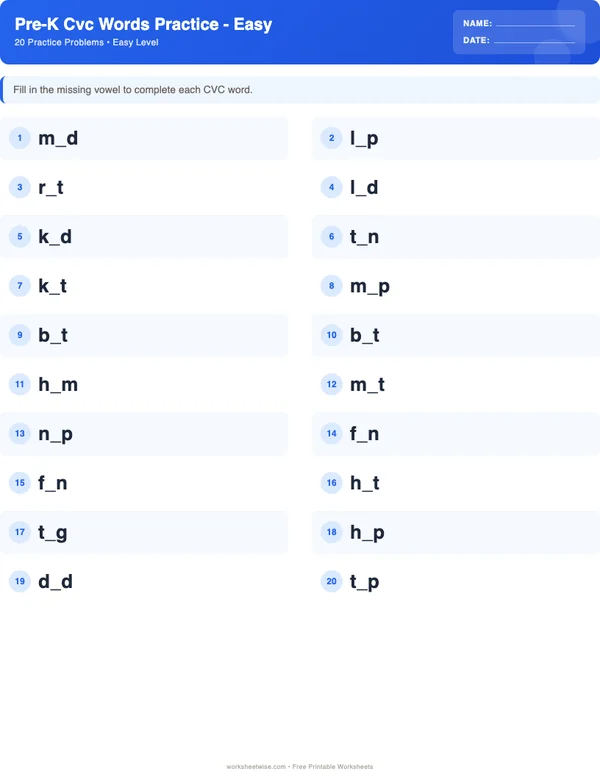
The free Pre-K CVC Words worksheet gives a learner 20 easy-level items with one direction: fill in the missing vowel to complete each consonant-vowel-consonant word. It practices phonemic awareness, short-vowel recognition, decoding, and blending. A separate printable answer key is included.
The most useful way to teach it is to model how to hear the three sounds in a word, identify the middle vowel sound, write the corresponding vowel, and blend the completed word. Complete a few items together, release a manageable group for independent work, and use the learner’s observed responses—not the grade label or a fixed timer—to decide whether to continue, add support, or stop.
“Pre-K” describes the intended practice level. It does not establish a universal timetable, and local curriculum sequences differ. Some learners will be ready to write vowels independently; others may need oral sound work, movable letters, or fewer items at one sitting.
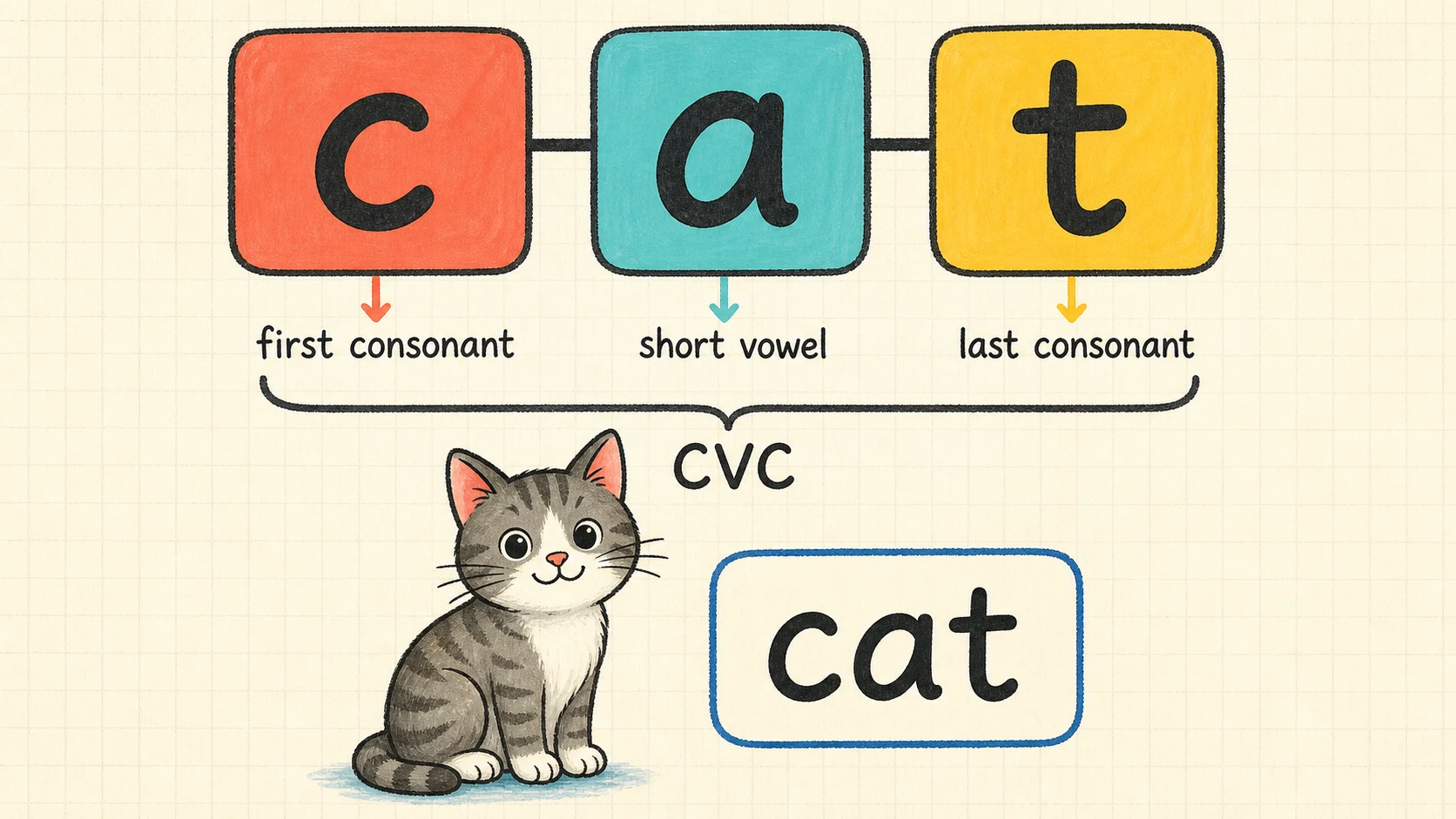
Use the map to move from oral listening to modeled work, guided practice, independent attempts, feedback, and later retrieval.
Before You Give the Worksheet
This printable is most appropriate when the learner can attend to a short spoken word and has begun connecting at least some letters with their usual sounds. The learner does not need to read CVC words fluently. The page is practice, not proof that every prerequisite has already been mastered.
The broader Pre-K phonics collection places this activity among other early letter-and-sound tasks. For the fuller sequence of CVC reading, spelling, vowel families, and word manipulation, use the CVC Words topic guide. This lesson focuses narrowly on launching and using this particular missing-vowel printable.
Make a quick readiness check
Before placing the page in front of the learner, say two or three simple CVC words, such as map, sit, and log. Ask the learner to repeat each word slowly. Listen for whether the learner can notice that each word has a sound at the beginning, in the middle, and at the end.
Then show the lowercase vowels a, e, i, o, u. Ask for any sounds the learner knows. This is an informal check, not a test. If the learner cannot yet connect any vowel letters to short-vowel sounds, teach one or two contrasts orally before expecting independent written answers.
The IES foundational reading practice guide provides high-level guidance on teaching learners to connect sounds with letters and to blend letter sounds into words. It does not evaluate WorksheetWise or prescribe this exact 20-item lesson. Here, that general principle supports making the sound-to-letter reasoning explicit rather than treating each blank as a guessing exercise.
Prepare a small teaching set
Have these materials ready:
- The worksheet and a pencil or crayon
- The separate answer key, kept with the adult
- Five vowel cards or letter tiles: a, e, i, o, u
- Three drawn sound boxes, if the learner benefits from seeing one space per sound
- A blank sheet for modeling without exposing worksheet answers
Print clarity matters. Confirm that the beginning and ending letters are readable and that the learner understands where the missing letter belongs. If handwriting is effortful, using vowel tiles during guided practice can preserve the phonics task while reducing the writing demand.
A Practical Lesson Sequence
A single sitting does not have to include all 20 items. The table offers a flexible sequence; it is an instructional suggestion, not a sourced universal schedule.
| Phase | Adult action | Learner action | Evidence to watch |
|---|---|---|---|
| Oral warm-up | Say two or three CVC words slowly | Repeat and identify the middle sound | Can the learner hear a sound between the first and last sounds? |
| Model | Demonstrate one parallel example aloud | Watch, listen, and repeat the blend | Does the learner follow the sound order? |
| Guided practice | Complete two to four parallel or worksheet items together | Say, choose, place or write, and blend | Is the vowel chosen from sound evidence? |
| Supported release | Assign three to five worksheet items | Work with vowel cards available | Can the learner begin without copying? |
| Independent attempt | Offer another small group if performance is steady | Complete items and read them back | Are responses accurate and reasonably self-corrected? |
| Review | Discuss selected correct answers and errors | Explain or retry the middle sound | Does feedback lead to a better second attempt? |
| Retrieval | Revisit a few words later without displaying old answers | Read, build, or spell them again | Is the skill available after a delay? |
Keep the launch brief enough that the learner still has attention for practice. If the first few guided items require extensive prompting, divide the worksheet into smaller sets. If the learner completes a set accurately and can explain the middle sounds, continue or move some practice into reading and spelling.
Model the Task Without Giving Away the Page
Use a word that demonstrates the same reasoning as the worksheet without claiming it appears among the 20 printed items. The examples below are fully checked parallel examples. They illustrate the process but are not a transcription of the worksheet.
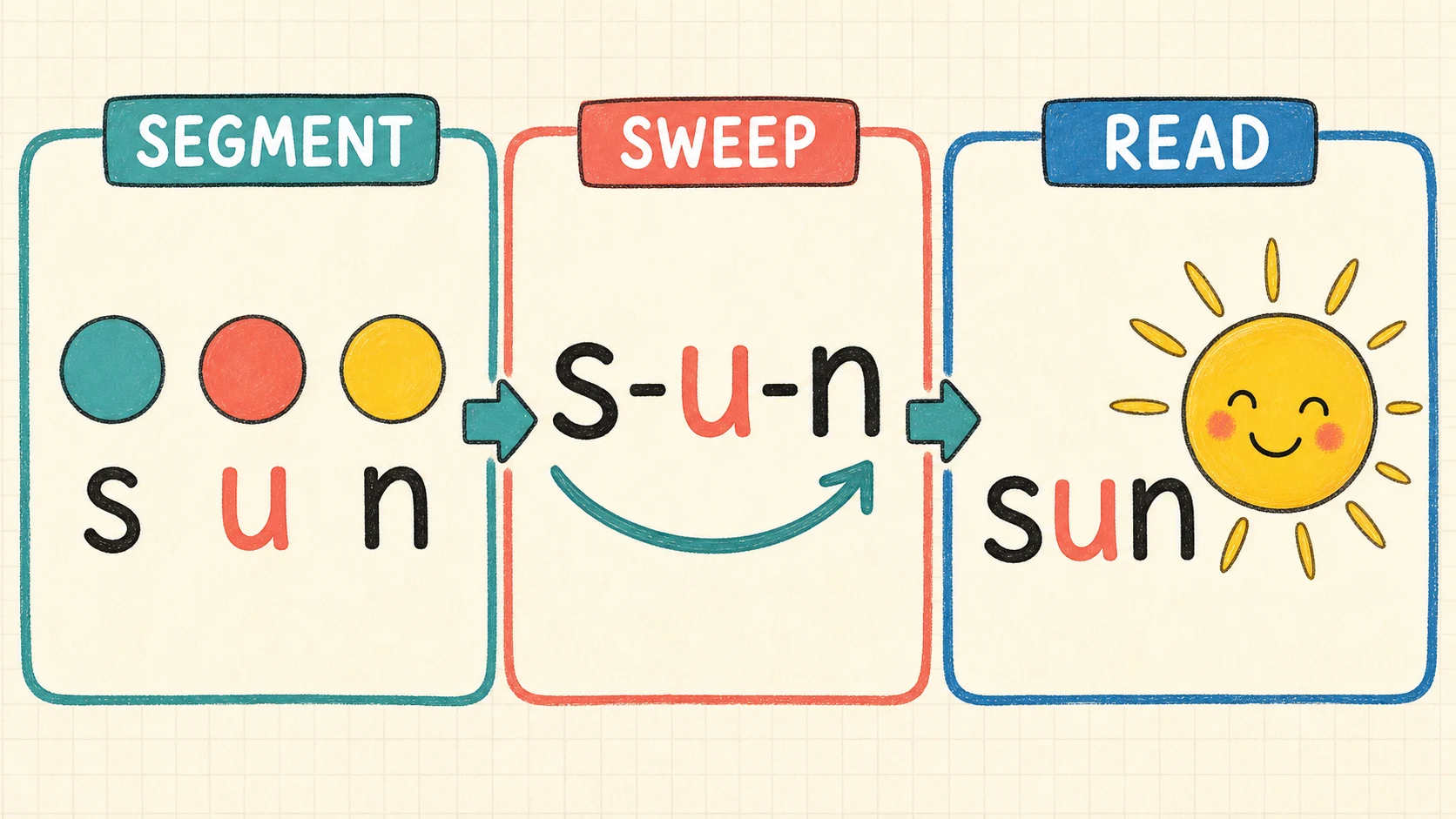
The adult makes the hidden middle sound audible, connects it to a vowel letter, and then blends the completed word.
Use a consistent think-aloud
Write m _ p on blank paper.
Say:
- “The word is map.”
- “I hear three sounds: /m/ /ă/ /p/.”
- “The middle sound is /ă/.”
- “The letter a represents that sound here.”
- “I write a: m-a-p.”
- “Now I blend it: map.”
The completed word is map, so a is the checked answer.
Keep the pronunciation natural. You can stretch sounds to make their order easier to hear, but avoid adding an extra vowel after a consonant. For example, /m/ should not become “muh.” That added sound can make the word harder to blend.
After modeling, point to each position while repeating the sounds. Then sweep a finger under the complete word and say it normally. This demonstrates that segmenting and blending are two views of the same three-sound word.
Separate the picture or meaning clue from the sound evidence
If an item includes a picture, let it help establish the intended word. Then return immediately to the sounds. The reasoning should be “The picture represents map; the middle sound in map is /ă/; therefore I write a.” It should not be “That picture looks like an a word.”
A learner can sometimes name a picture correctly and still select the wrong vowel. Requiring a spoken blend after writing helps reveal whether the letter choice matches the intended word.
Four Fully Checked Examples
These worked examples cover four short vowels and several useful boundary cases. They are suitable for modeling on separate paper before or during the lesson.
Example 1: c _ t becomes cat
Say cat slowly: /k/ /ă/ /t/.
- Beginning sound: /k/, represented by c
- Middle sound: /ă/, represented by a
- Final sound: /t/, represented by t
- Completed word: cat
Check by blending: /k/–/ă/–/t/ → cat.
The missing letter is a. If the learner writes o, ask for a read-back: cot says a different word. The contrast makes the effect of the middle vowel concrete.
Example 2: p _ n becomes pin
Say pin: /p/ /ĭ/ /n/.
- Beginning sound: /p/, represented by p
- Middle sound: /ĭ/, represented by i
- Final sound: /n/, represented by n
- Completed word: pin
Check by blending: /p/–/ĭ/–/n/ → pin.
The missing letter is i. Do not rely only on the letter name “eye.” The task requires matching the short sound heard in pin to the letter i.
Example 3: d _ g becomes dog
Say dog: /d/ /ŏ/ /g/.
- Beginning sound: /d/, represented by d
- Middle sound: the short vowel sound in dog, represented here by o
- Final sound: /g/, represented by g
- Completed word: dog
Check by blending: /d/–/ŏ/–/g/ → dog.
The missing letter is o. Pronunciations can vary by region, so use the spoken target intended in the learner’s setting and confirm it against the supplied answer key. Do not frame an accent difference as carelessness.
Example 4: s _ n becomes sun
Say sun: /s/ /ŭ/ /n/.
- Beginning sound: /s/, represented by s
- Middle sound: /ŭ/, represented by u
- Final sound: /n/, represented by n
- Completed word: sun
Check by blending: /s/–/ŭ/–/n/ → sun.
The missing letter is u. If the learner writes a, compare the two spoken forms slowly. Ask, “Which middle sound do you hear in sun?” This keeps attention on phonemes rather than visual familiarity.
A useful short-e contrast
Write p _ n and state that the intended word is pen. The checked completion is pen: /p/ /ĕ/ /n/. This also demonstrates a boundary condition: the same outside consonants can form pin or pen. Without a stated word, picture, or other context, p _ n is ambiguous.
Do not tell a learner that one vowel is inherently correct when more than one real CVC word fits the printed frame. For an actual worksheet item, inspect its complete prompt and use the included answer key to confirm the intended response.
Move From Guided to Independent Practice
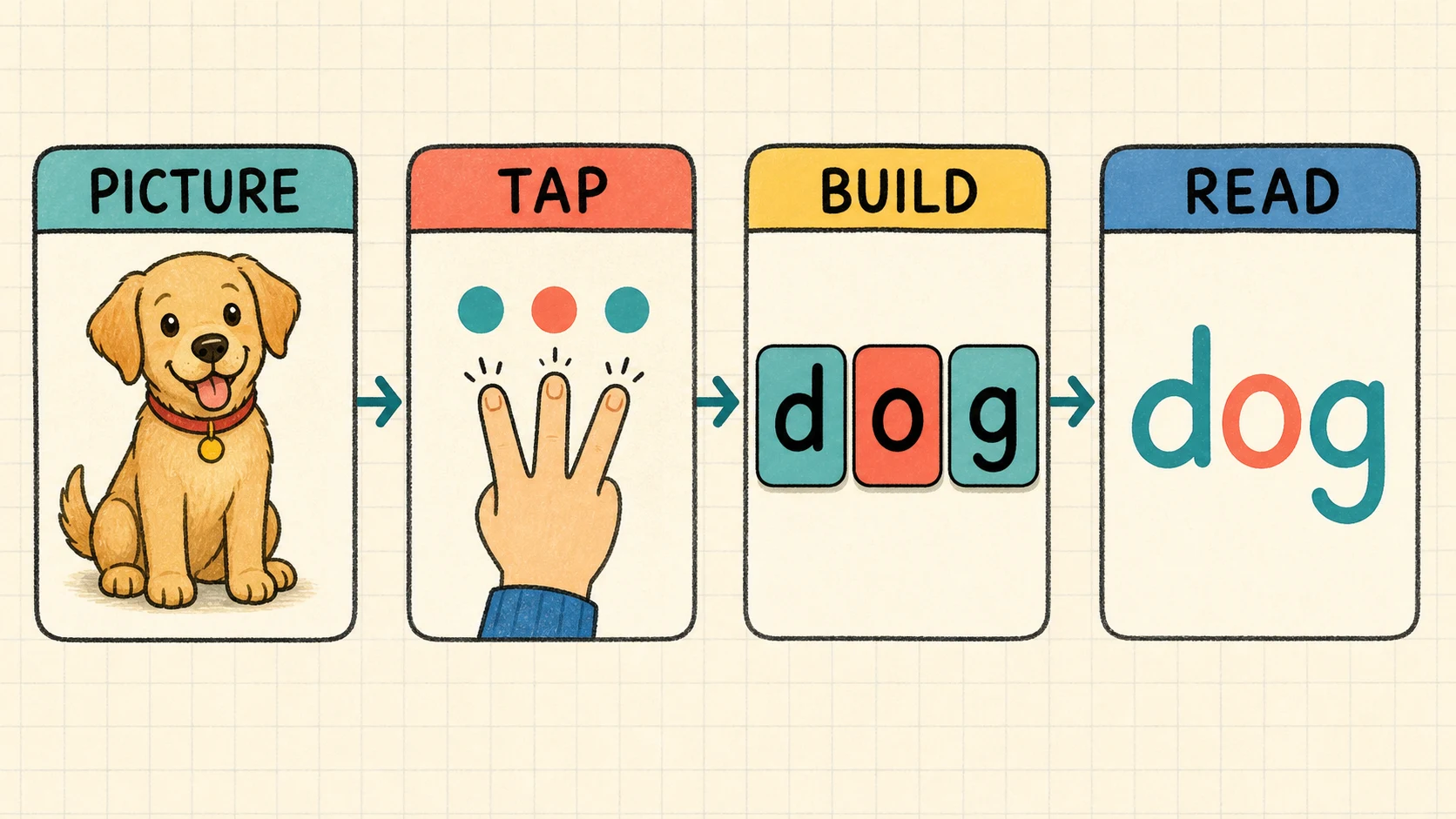
Guided practice should reveal the reasoning process before the adult reduces prompts.
Prompt in a stable order
For the first two to four items, use the same sequence:
- “What word are we completing?”
- “Say it slowly.”
- “What sound is in the middle?”
- “Which vowel letter represents that sound?”
- “Write or place the letter.”
- “Blend the whole word and check it.”
At first, perform some steps with the learner. Then reduce help. You might say the word on the first item, ask the learner to segment the second, and wait for the learner to initiate the third.
Avoid turning every prompt into immediate correction. A short pause gives the learner room to retrieve the sound-letter connection. If the learner chooses a vowel, ask for the completed word to be read back before confirming it.
Release a small group at a time
Cover the rest of the page with another sheet and expose three to five items. This changes the amount visible, not the phonics skill. Ask the learner to complete the set and read each finished word.
Move forward when the learner can:
- Identify the intended word or use the item’s clue
- Say or attend to its three sounds
- Select the middle vowel based on sound
- Blend the completed word
- Work without an adult naming the answer
If responses become hurried, random, or dependent on watching the adult’s face, pause. Ten thoughtfully completed items can provide better instructional information than 20 guesses.
Adapt Support Without Changing the Skill
The target remains the same across adaptations: hear the medial vowel in a CVC word and represent it with the correct vowel letter. Support should make that reasoning accessible, not replace it.
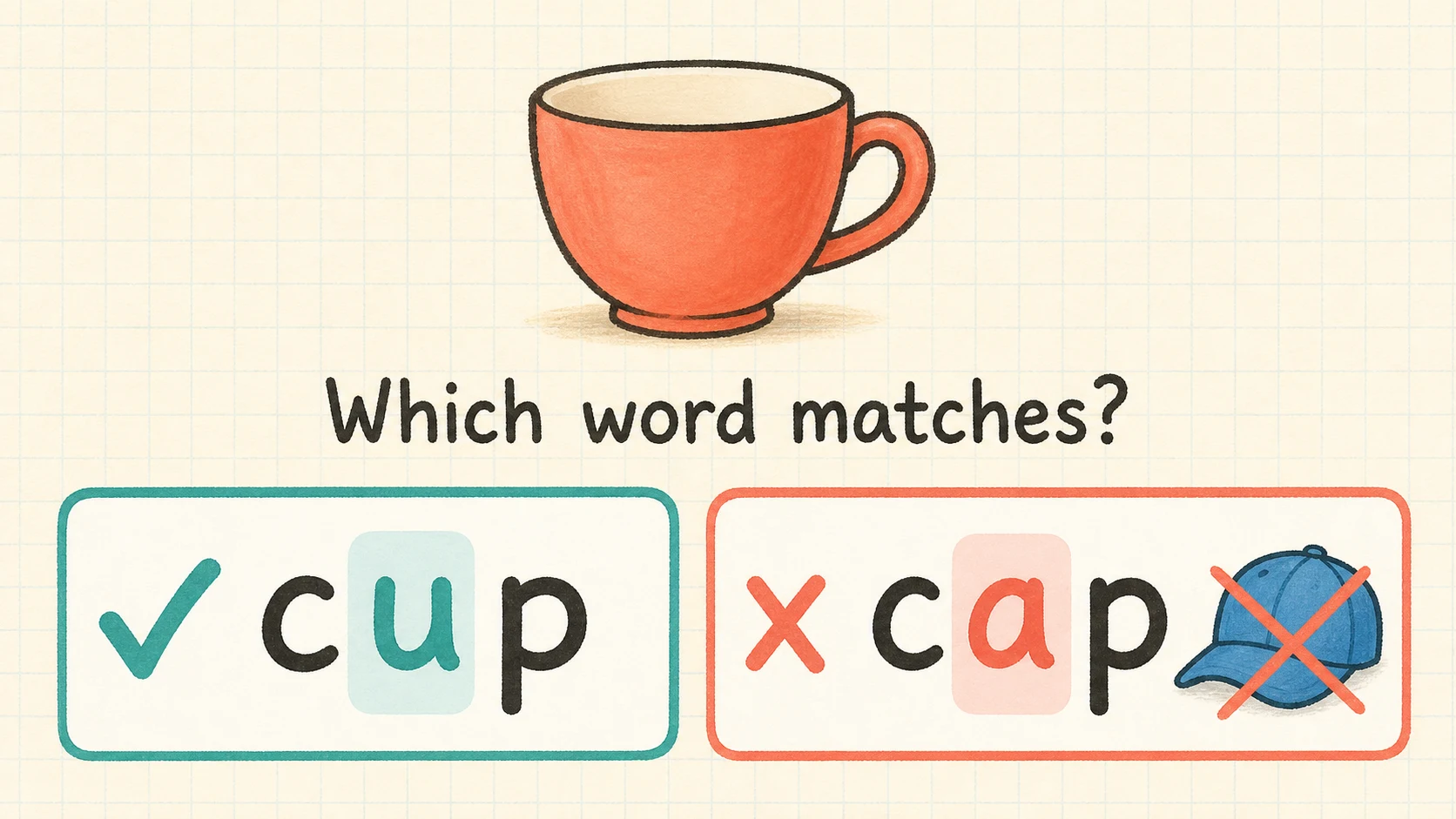
Adjust the number of choices, the visible workload, or the response method while preserving the missing-vowel decision.
When the learner needs more sound support
Say the target word clearly and ask the learner to repeat it. Stretch the three sounds with minimal gaps. Use three connected sound boxes and move one token for each sound. Pause over the middle box, then present two plausible vowel cards.
For cat, you might offer a and o. Have the learner test both:
- c-a-t → cat
- c-o-t → cot
Ask which one matches the intended word. This is still a vowel-identification task because the learner must compare sounds and select the matching grapheme.
When writing is the obstacle
Let the learner point to, place, or say the missing vowel before copying it into the blank. A learner who identifies i for pin but forms the letter poorly has shown different evidence from a learner who writes a neat but incorrect e.
The IES elementary writing practice guide addresses writing instruction at a broad level, including developing foundational writing skills. It does not prescribe how to score this worksheet. For this activity, separating the phonics decision from handwriting performance is a practical instructional choice when motor demands obscure what the learner hears.
You can still include a brief writing opportunity after the vowel is selected. The point is to avoid mislabeling letter formation difficulty as failure to recognize the vowel sound.
When the learner is ready for less support
Remove the vowel cards, ask for oral reasoning only on selected items, or have the learner spell a completed word from memory after reading it. Pairing decoding with a small amount of encoding keeps the focus on the same three-sound structure.
Do not make the task harder merely by withholding the intended word when a letter frame is ambiguous. A challenge should require stronger sound analysis, not mind-reading.
Interpret Errors Before Correcting Them
An incorrect letter is evidence, but it does not explain itself. Look across several responses and listen to the learner’s read-backs before deciding what support is needed.
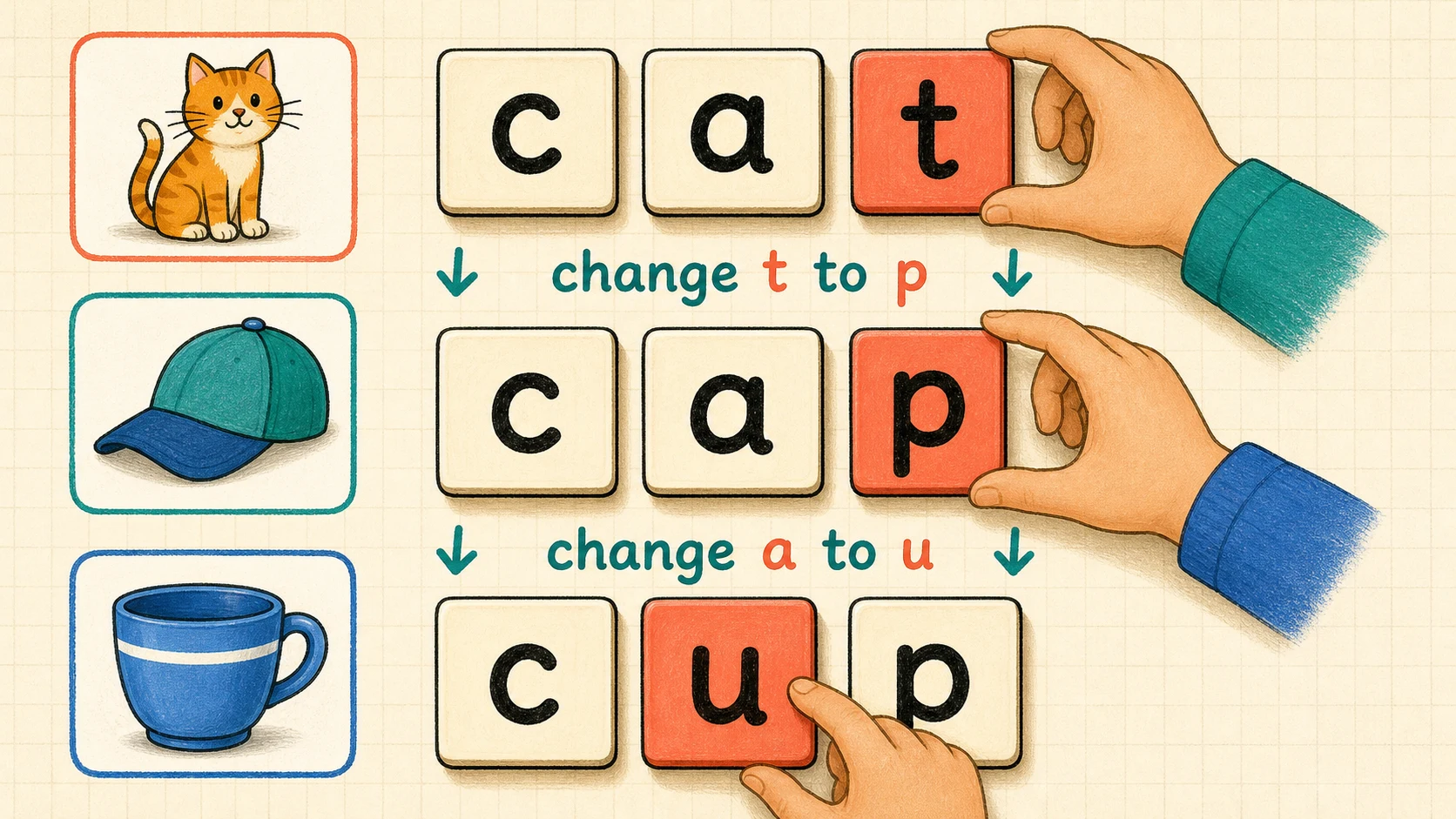
Check the intended word, the spoken middle sound, the selected letter, and the final blend in that order.
Common error patterns
| Observed response | Possible interpretation | Useful next check |
|---|---|---|
| The same vowel is placed in many blanks | The learner may be guessing, using visual habit, or relying on one familiar letter | Ask for each completed word to be read aloud |
| The learner says the correct middle sound but chooses the wrong letter | The sound may be heard, but its letter correspondence is not secure | Offer two vowel cards and compare their sounds |
| The learner selects the correct vowel but cannot blend the word | Vowel recognition may be stronger than blending | Model a smooth blend and have the learner echo it |
| The learner gives a different real word that fits the frame | The item may be ambiguous without its picture or stated target | Recheck the full prompt and answer key |
| Oral answers are accurate, but written letters are unclear | Handwriting may be masking phonics knowledge | Accept pointing or tiles temporarily, then practice formation separately |
| Accuracy falls late on the page | Attention or workload may be affecting performance | Compare early and late items; shorten the next set |
| One vowel family is repeatedly confused | That contrast may need focused listening and letter matching | Practice a small set contrasting the two sounds |
These are instructional hypotheses, not diagnoses. One response is rarely enough to establish a pattern.
Misconceptions to address directly
A learner may think that every word containing a certain consonant uses the same vowel. Build a contrast such as cat, cot, and cut to show that changing the middle letter changes the word.
Another misconception is that the vowel’s letter name must be audible. Explain through examples that i in pin represents the short sound /ĭ/, not its letter name.
Some learners treat the picture as the whole task and never inspect the letters. Ask them to point to the first consonant, the blank, and the last consonant. Then have them verify that their completed spelling can be blended into the pictured word.
Avoid introducing silent-e words, vowel teams, or irregular spellings as if they were ordinary CVC cases. Words such as cake, boat, and said do not match the simple three-letter consonant-vowel-consonant pattern practiced here.
Use the Answer Key Responsibly
The answer key is a checking tool, not a substitute for observing the learner. Keep it out of view during the initial attempt, then compare responses after a small section or at the end of the chosen set.
For each mismatch:
- Confirm the complete printed item and its intended word.
- Ask the learner to read the written completion.
- Say the intended word naturally.
- Have the learner identify the middle sound.
- Invite one revision.
- Use the key to verify the final response.
Record enough information to guide the next lesson. A simple notation can distinguish:
- Correct independently
- Correct after a general prompt
- Correct after choices or modeling
- Not yet correct after support
A raw total such as 16 out of 20 does not show whether errors cluster around one vowel, blending, handwriting, or ambiguous interpretation. The pattern is more useful than the score for planning instruction.
The Common Core English Language Arts standards describe grade-level expectations involving phonological awareness and phonics, including sound isolation, letter-sound knowledge, blending, and decoding. They offer context for why these skills matter, but they do not certify this worksheet as comprehensively aligned. Because this resource is labeled Pre-K while cited standards include later grade-level expectations, use the worksheet according to learner readiness and the local instructional sequence.
Boundary Cases and Limits
This worksheet contains 20 easy-level missing-vowel exercises. It can show how a learner responds to that task on that occasion, but it cannot by itself establish comprehensive CVC mastery.
Success may depend partly on picture recognition, vocabulary, pronunciation, attention, handwriting comfort, or familiarity with the printed words. A learner who completes familiar words may not yet decode unfamiliar CVC strings. Conversely, a learner may understand the vowel sound but be unable to identify an unfamiliar illustration.
Nonsense CVC forms can sometimes help distinguish decoding from memorized word recognition, as the broader topic guidance notes, but they are not part of the catalogue description for this exact printable. If you use them later, explain that they are made-up words and treat them as a separate check.
The worksheet also does not cover the whole progression of early reading. It is not a comprehensive assessment of alphabet knowledge, oral language, phonological awareness, handwriting, or reading comprehension. It should not be used for medical or developmental conclusions.
Pause or change the response method when frustration, fatigue, or motor demands interfere with useful practice. The learner’s observed work should determine pacing.
Decide What to Teach Next
Use both accuracy and independence to choose the next step.
If the learner needs more preparation
Return to oral three-sound work with no writing. Say a CVC word, move one token for each sound, and ask which sound is in the middle. Once that is stable, match one short-vowel sound to its letter and revisit only a few worksheet items.
The Pre-K worksheet hub can help you select other practice at the same intended level without assuming that every Pre-K learner follows the same sequence.
If the learner is accurate only with support
Repeat a small mixed set using vowel cards, then reduce the choices. For example, move from two displayed vowels to all five, and finally to no cards. Keep requiring a spoken blend after each completion.
Do not advance simply because the worksheet has been finished. Look for evidence that the learner can perform the middle-sound decision with less prompting.
If the learner is accurate and independent
Ask the learner to read selected completed words in a different order. Next, cover one word and ask the learner to build or write it from dictation. This checks whether the sound-letter sequence can be reconstructed rather than merely recognized on the finished page.
For broader practice across the topic, the Pre-K CVC Words Worksheet Pack contains 18 worksheets and is listed at $4.79. Select additional pages according to the skill pattern you observed, not simply to increase volume.
Schedule Retrieval After the First Lesson
Retrieval means asking the learner to produce the sound, letter, or word again after the original page is no longer directly supplying the answer. The schedule below is a practical option, not a universal requirement.
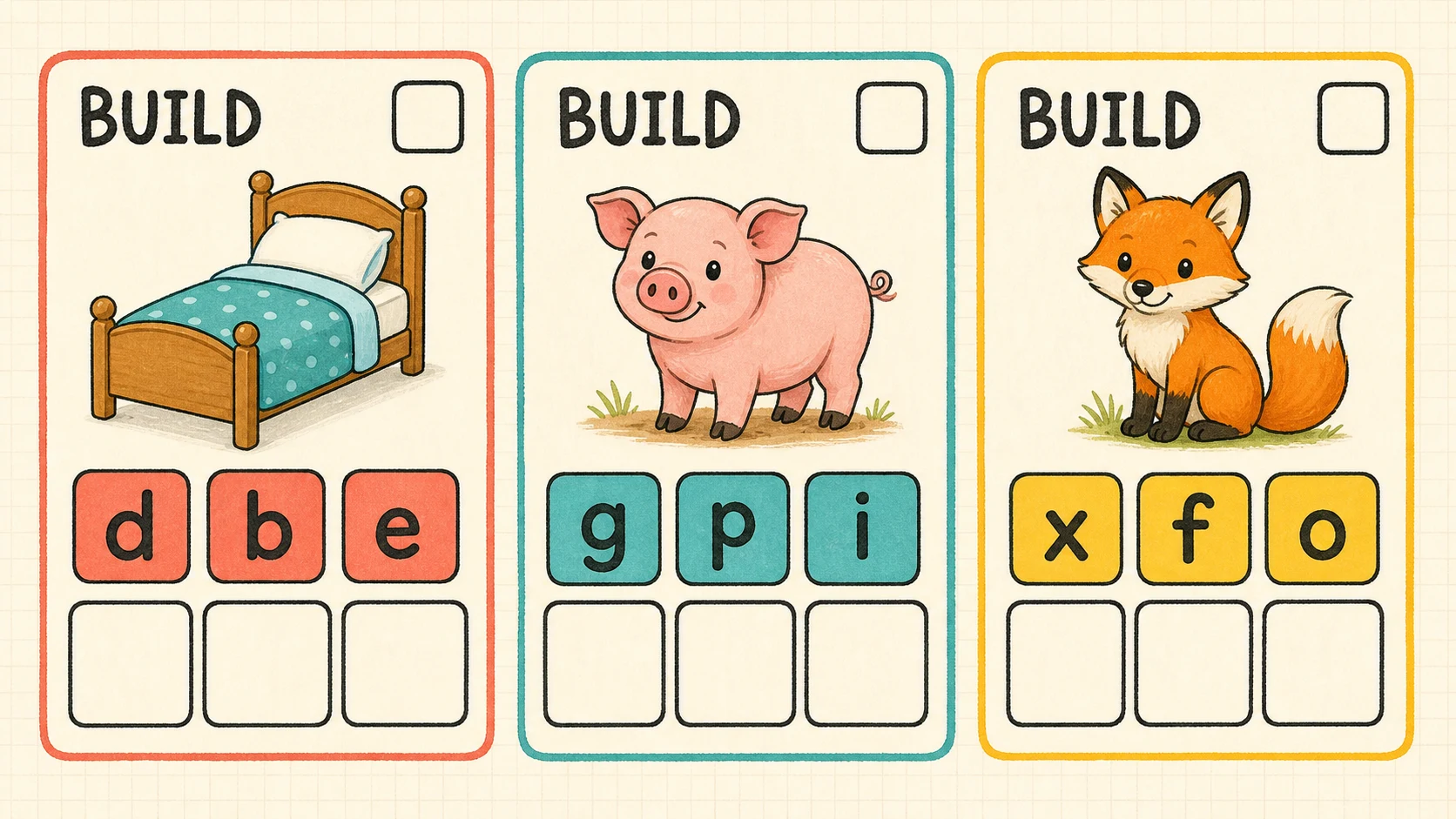
Revisit a small sample after increasing delays, and adjust the interval when performance shows that more or less support is needed.
| Review point | Suggested task | What to observe |
|---|---|---|
| Later the same day | Orally revisit two completed words | Can the learner identify the middle sound without seeing the answer? |
| About one day later | Show three incomplete word frames or build them with letters | Can the learner choose and blend the vowel again? |
| Several days later | Mix previously successful and previously difficult examples | Are earlier corrections retained? |
| About one week later | Read or spell a short mixed set without the completed worksheet visible | Is the process still available after a longer delay? |
| Later as needed | Include a few CVC items during other phonics practice | Does the skill remain usable among different tasks? |
If retrieval is weak, shorten the delay, reduce the set, and restore a helpful prompt. If it is strong, lengthen the delay or mix vowel families. There is no need to repeat all 20 items at every review.
A Calm, Evidence-Based Next Action
Begin by downloading the free Pre-K CVC Words printable. Model one parallel example, guide two to four items, and expose only a small independent set. Note which vowels are identified without help, which require prompting, and whether the learner can blend each completed word.
After the lesson, use the CVC Words topic guide to choose the next appropriate form of reading, spelling, or vowel-family practice. If the learner needs fresh items built around the same observed need, explore the free worksheet generators and create a short review set rather than repeating a full page automatically.
Put it into practice
Use the guide with a real printable
Move from explanation to a short, observable practice task. Check the first item together, then adjust the next session from the learner's actual work.
See the 18-worksheet pack