Complete guide
How to teach and practise pre-k counting worksheets - standard theme (easy)
How to Use This 20-Item Counting Worksheet
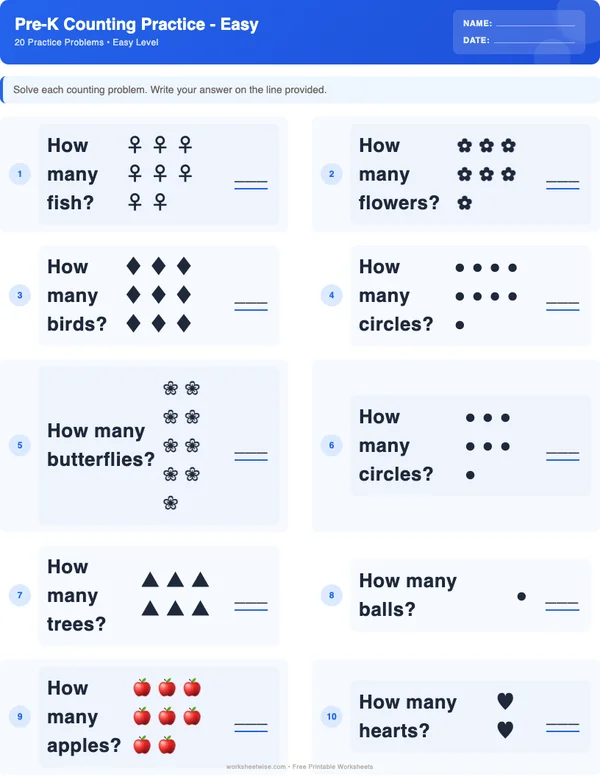
The free Pre-K Counting Worksheets — Standard Theme (Easy) printable gives a learner 20 exercises involving counting, number sequences, skip counting, number recognition, and number sense. The simplest effective lesson is to model one problem, solve two or three together, let the learner attempt a short group independently, and then adjust the remaining work from what you observe.
Do not assume all 20 items must be completed in one sitting. Accuracy matters, but so do the learner’s counting actions: Does each object or position receive one count word? Does the learner preserve the counting pattern? Can the learner explain how an answer was found? Those observations should determine the pace.
Grade labels describe the intended practice level, not a universal placement rule. Local curricula, school sequences, and individual learning histories differ. Use “Pre-K” as a starting point for selecting practice, then respond to the learner’s actual work.
What This Worksheet Practices
The worksheet is labeled easy and contains 20 problems. Its directions are: “Solve each counting problem. Write your answer on the line provided.” A separate printable answer key is included.
The catalogue identifies four skills:
- Counting
- Number sequence
- Skip counting
- Number sense
These skills are related, but they are not identical. A learner might count objects accurately while having difficulty continuing a written sequence. Another learner might recite a skip-counting pattern from memory but lose the pattern when an unfamiliar starting point appears. Notice which part of the task is creating difficulty before deciding what support to provide.
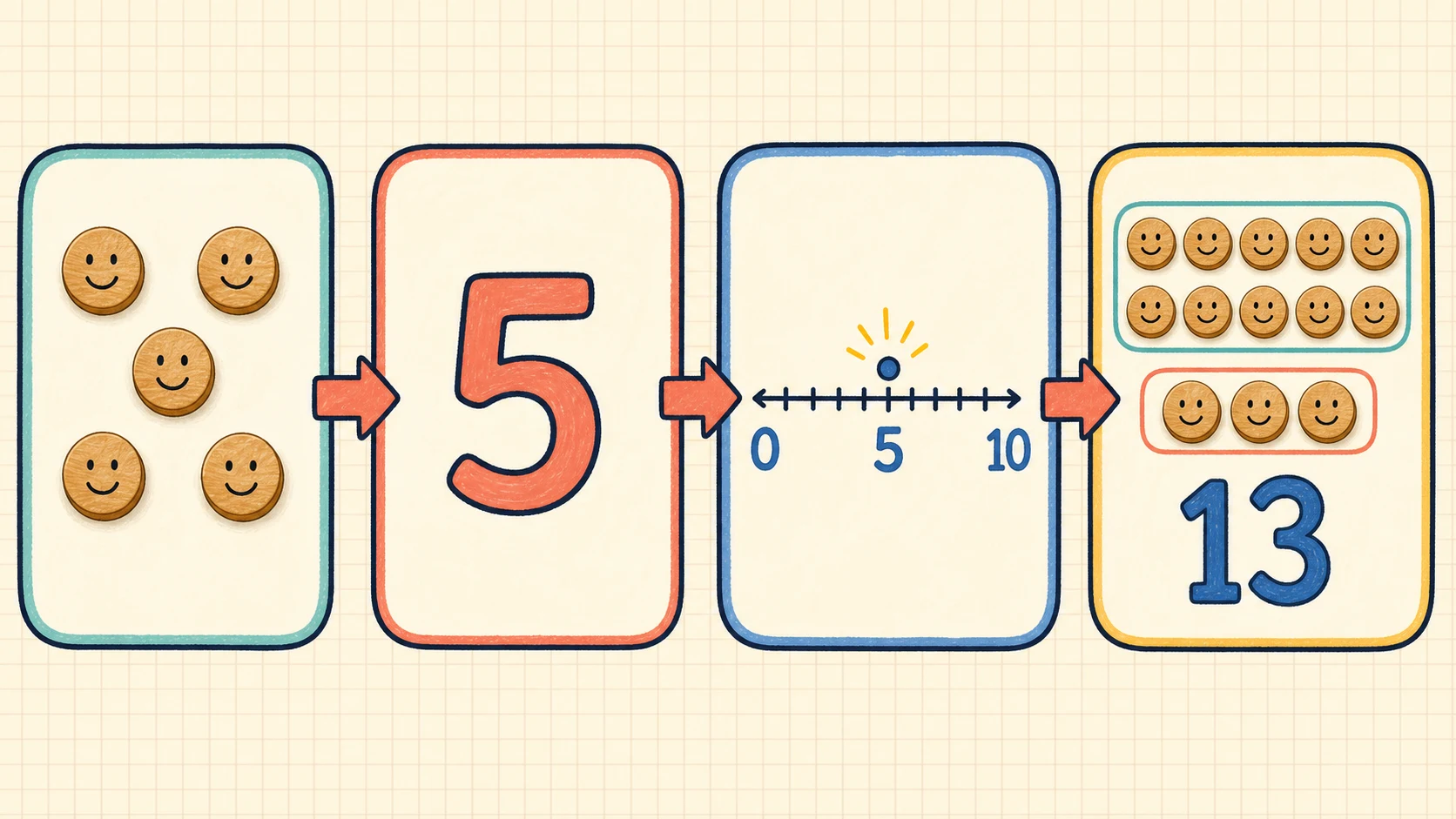
Use a brief launch, guided practice, independent attempts, checking, and later review rather than treating the page as a single uninterrupted assignment.
A practical lesson can follow this progression:
| Phase | Suggested amount | Adult’s role | What to observe |
|---|---|---|---|
| Preview | 1–2 minutes | Show the directions and answer spaces | Does the learner understand what must be written? |
| Model | 1 problem | Think aloud and demonstrate a reliable method | Does the learner attend to the counting process? |
| Guided practice | 2–3 problems | Prompt only when necessary | Which prompts help without supplying the answer? |
| Independent practice | 3–6 problems at a time | Watch quietly and record patterns | Is the method stable when help is removed? |
| Check and discuss | 2–4 selected answers | Compare work with the key and recount | Can the learner locate and repair an error? |
| Retrieval | A few items later | Revisit the skill after a delay | Is the method remembered without full reteaching? |
These amounts are instructional suggestions, not a prescribed timetable. A learner who remains attentive and accurate may continue. A learner who begins guessing, rushing, or losing track may benefit from a break after only a few items.
For the larger sequence of counting skills, use the Pre-K counting topic guide. This lesson stays focused on using the specific 20-item printable well rather than repeating that broader progression.
Prepare the Page and the Learning Space
Print the worksheet and keep the answer key out of the learner’s immediate view. Have a pencil or crayon available. If the learner benefits from concrete counting, prepare a small set of safe, familiar objects such as blocks or large counters. The objects are a support for the same counting skill; they are not a replacement activity.
Preview before teaching
Look over the entire page before the lesson. Identify which problems involve ordinary counting, sequences, skip counting, or recognizing a numeral. Because the catalogue does not specify the exact order or values of individual items, do not assume the page moves from one skill to the next in a fixed progression.
Choose one accessible-looking problem for the model. Also mark a likely stopping point after several items. This prevents the adult from deciding the lesson length only after the learner has become tired.
If writing is effortful, separate the mathematical demand from the recording demand. The learner may say an answer first and then write it. You can point to the answer line and allow adequate time, but avoid turning a counting lesson into extended handwriting correction.
Establish a simple routine
Use the same short routine throughout the page:
- Look at the whole problem.
- Decide what is changing or what must be counted.
- Count carefully.
- Say the answer.
- Write the answer.
- Check once.
Consistency reduces unnecessary directions. It also gives you a useful diagnostic question: At which step does the learner’s process break down?
Launch the Lesson with One Clear Model
Read the printed direction aloud if needed. Then explain the immediate goal in plain language: “We will solve a few counting problems. I will show you one, we will do some together, and then you will try some.”
Do not begin with a long explanation of every possible problem type. Model the first selected task and make the counting action visible.
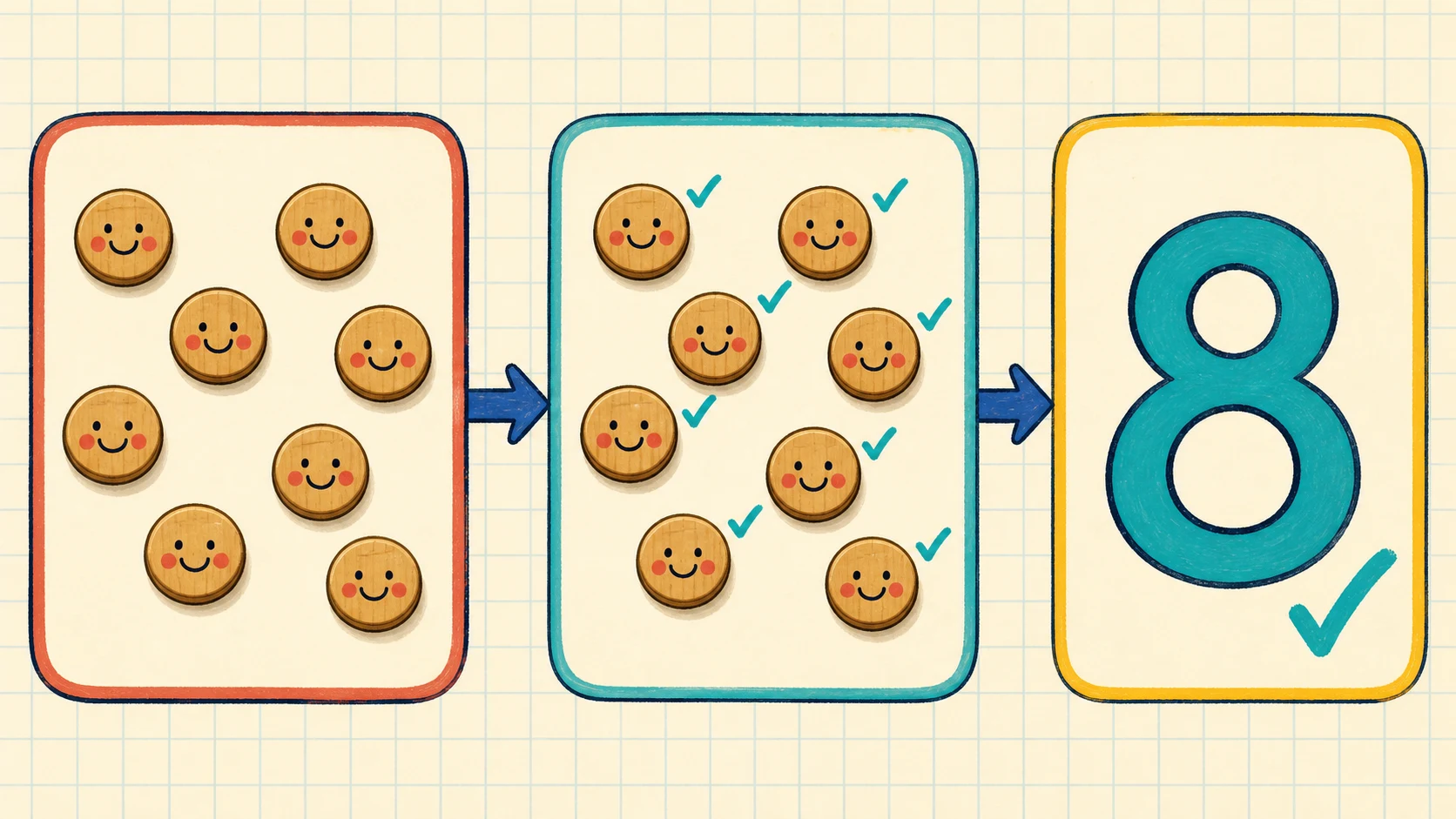
The example demonstrates a method; it is not presented as a transcription of a particular item on the printable.
Suppose a similar sequence problem is:
1, 2, 3, __
A concise model would be:
“I read the numbers from left to right: one, two, three. They go up by one each time. After three comes four, so I write 4.”
The completed sequence is 1, 2, 3, 4. Check it by reading the entire sequence again. Each neighboring number increases by one.
For a set of pictured objects, model one-to-one correspondence instead:
“I will touch each object once and say one number for each touch. I counted five objects, so I write 5.”
The important action is the match between one object and one count word. The IES guide on teaching mathematics to young children provides high-level guidance about helping young children connect mathematical ideas, representations, and language. It did not evaluate this WorksheetWise printable, so use it as general instructional framing rather than evidence about this particular page.
Move from Guided Practice to Independent Work
After the model, invite the learner to solve the next selected problem. Ask for action before explanation: “Show me where you will start.” If objects or pictures are present, the learner can point or touch. If it is a number sequence, the learner can read the known entries aloud.
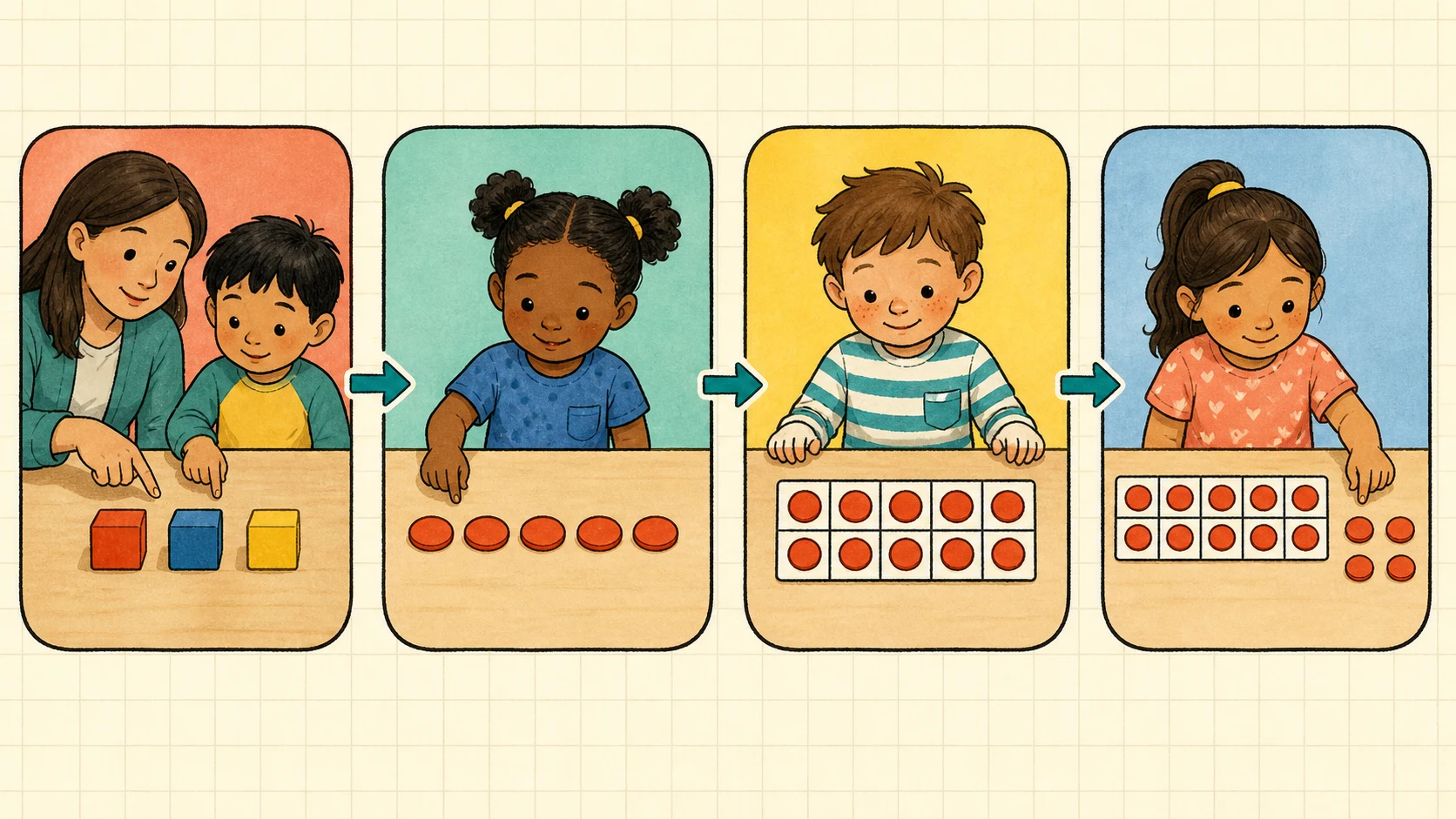
Guided practice should reveal the learner’s thinking while leaving the actual counting to the learner.
Use prompts from lightest to strongest
Begin with the least intrusive prompt that could restart the process:
- “What do you notice?”
- “Where will you begin?”
- “Say the numbers you already see.”
- “What changes from one number to the next?”
- “Touch each one as you count.”
- “Let’s place a counter on each picture, then count the counters.”
Pause after a prompt. Several rapid questions can make it difficult to tell whether the learner understands the task or is merely following the adult’s voice.
Avoid embedding the answer in the question. “Does four come next?” tests agreement more than counting. “What comes after three?” leaves the mathematical decision with the learner.
Release responsibility in small steps
Once the learner completes two or three guided examples with a stable method, offer a small independent set. Three problems may be enough for the first attempt.
Say, “Try these on your own. When you finish, we will check how you counted.” Stay available, but do not correct each answer immediately. Watching a short uninterrupted attempt reveals whether the learner can initiate the process without prompts.
If the first independent group is accurate and deliberate, assign another short group. If errors cluster or the learner abandons the method, return to guided practice. This is adjustment based on observed work, not a judgment about effort or ability.
Use Fully Checked Examples to Explain the Skills
The following constructed examples are similar to the catalogue’s listed skill types. They are fully checked here, but they should not be described as exact items from the worksheet unless they actually appear on your printed copy.
Example 1: Continue a count-by-one sequence
Problem:
2, 3, 4, __
Reasoning:
- From 2 to 3, the increase is 1.
- From 3 to 4, the increase is also 1.
- Therefore, add 1 to 4.
Answer: 5
Check: Read 2, 3, 4, 5. Every step increases by one, so 5 is correct.
Example 2: Fill a number between two known numbers
Problem:
5, __, 7
Reasoning:
- Begin at 5.
- The next number is 6.
- The number after 6 is 7.
Answer: 6
Check: The completed sequence is 5, 6, 7. Six is one more than 5 and one less than 7.
This is a useful boundary case because the blank is in the middle rather than at the end. A learner who automatically writes the number after the final visible number may need to read the entire sequence before answering.
Example 3: Count a small set
Problem: A picture shows six separate stars.
Reasoning:
- Point to the first star and say “one.”
- Continue touching one new star for each count word.
- Stop after the sixth star.
- Make sure no star was touched twice and none was skipped.
Answer: 6
Check: Recount in a different order while still touching each star exactly once. The total remains six. If the result changes, organize the count more carefully rather than choosing one of the two totals.
Example 4: Continue a skip-counting pattern
Problem:
2, 4, 6, __
Reasoning:
- From 2 to 4, the increase is 2.
- From 4 to 6, the increase is 2.
- Add 2 to 6.
Answer: 8
Check: The differences are +2, +2, +2, giving 2, 4, 6, 8.
A learner who writes 7 has continued by one instead of preserving the displayed pattern. Ask the learner to compare the jumps rather than simply saying the answer is wrong.
Example 5: Recognize a written number
Problem: Point to the numeral that means “five” from 3, 5, 8.
Reasoning:
- Say the target number: “five.”
- Compare it with each printed numeral.
- Select
5.
Answer: 5
Check: The selected symbol is the written numeral for five. This task is number recognition, not object counting. Adding counters may help connect quantity and symbol, but the learner must still identify the numeral.
A boundary case: starting somewhere other than one
Problem:
4, 5, __, 7
Answer: 6
Check: 4, 5, 6, 7 increases by one throughout.
If the learner restarts aloud at one before reaching four, that can still lead to the right answer, but it is less direct. Invite the learner to begin with the number already shown: “Start at four and count on.” Do not require counting from one when the task supplies a later starting point.
The Common Core mathematics standards can be consulted for the broader Kindergarten counting-and-cardinality expectations referenced in the catalogue. That reference does not establish comprehensive alignment for this one Pre-K worksheet, and local programs may introduce or order skills differently.
Adapt Support Without Replacing the Skill
An adaptation should make the counting process more accessible while preserving the mathematical decision. If the task is to determine a total, the learner should still determine the total. If the task is to continue a pattern, the learner should still identify and continue that pattern.
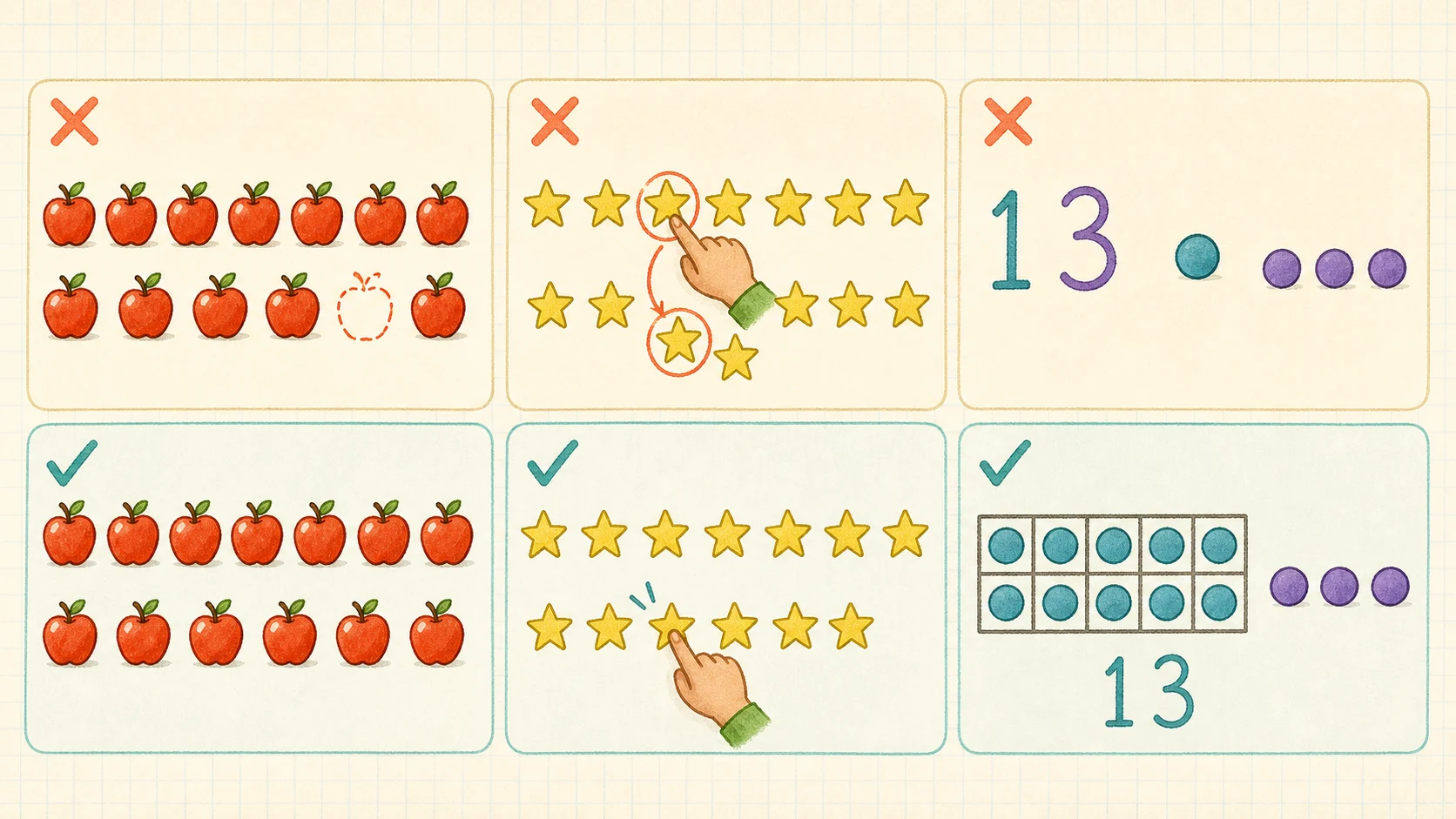
Adjust the representation, number of visible items, or amount of prompting while keeping the counting goal intact.
When the learner needs more support
Try one change at a time:
- Cover the rest of the page so only one problem is visible.
- Place a small counter on each pictured object after it is counted.
- Draw a light line under a sequence to support left-to-right tracking.
- Let the learner answer orally before writing.
- Provide a simple number line as a reference.
- Break the page into groups of three or four problems.
- Alternate one guided problem with one independent problem.
For scattered objects, suggest a counting path. The learner might move from left to right or slide each counted counter into a separate group. The goal is to prevent omissions and double-counts, not to make every arrangement look identical.
When the learner is ready for less support
Remove supports gradually:
- Ask the learner to point rather than move counters.
- Hide the number line for one problem.
- Increase the independent group from three items to five.
- Ask for a brief explanation after the answer: “How did you know?”
- Have the learner check one completed sequence without adult direction.
Do not increase difficulty merely by imposing speed. Fast responses can hide skipped objects, memorized fragments, or guesses. A stronger extension is to ask the learner to represent the answer another way—for example, showing the same total with counters after identifying its numeral.
The IES practice guide on assisting students who struggle with mathematics offers broad guidance about systematic instruction, mathematical representations, and monitoring progress. It is not specific to this worksheet or to an individual child. Use its principles to inform careful teaching, not to make a diagnosis.
Interpret Errors Before Correcting Them
An incorrect numeral does not identify its own cause. Reconstruct what the learner did.
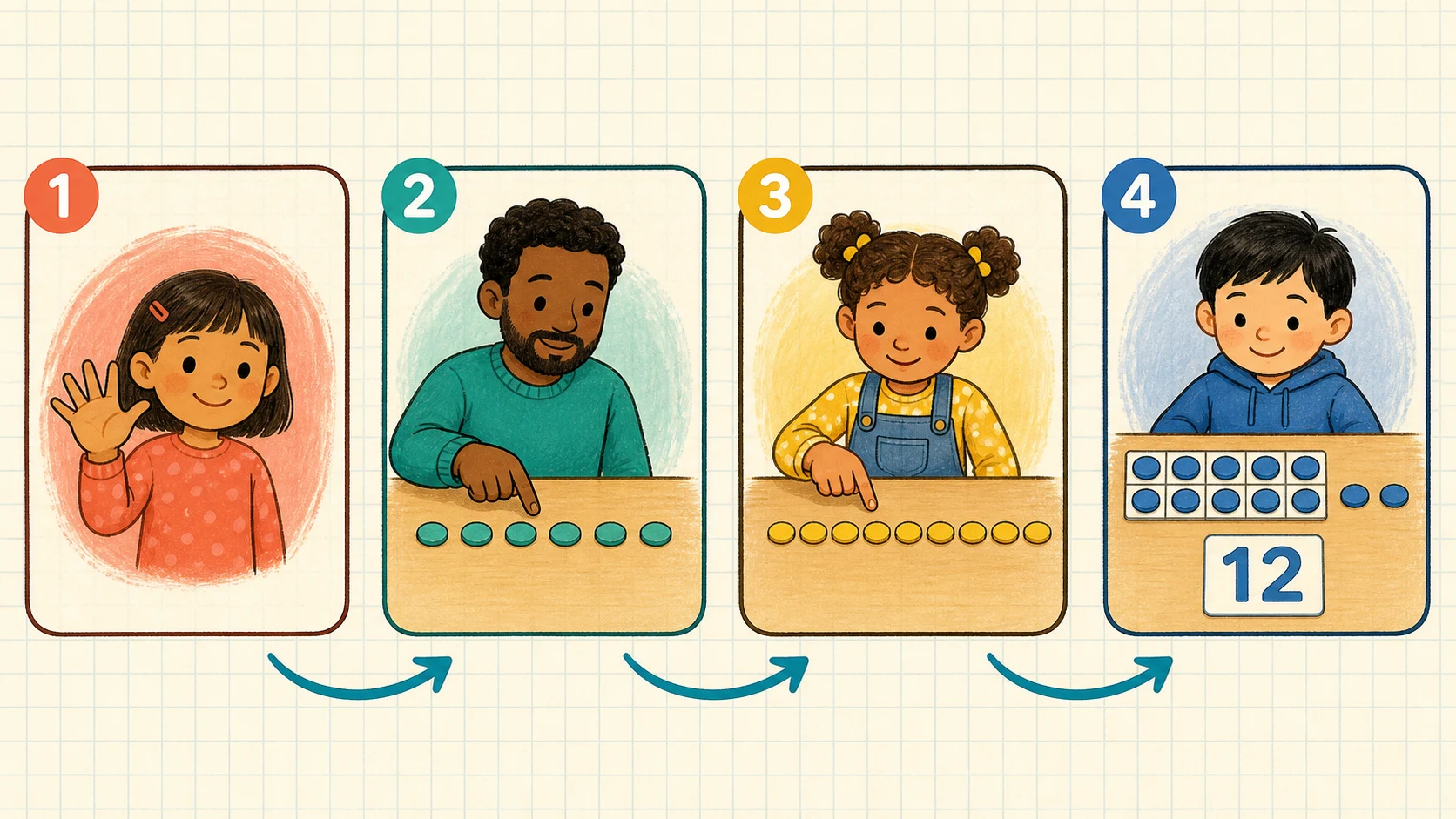
Return to the objects or pattern, repeat the process, compare results, and repair only after locating the mismatch.
Common error patterns
| Observed work | Possible task-level explanation | Useful next move |
|---|---|---|
| Correct count words but wrong total | An object may have been skipped or counted twice | Recount while touching or moving each item once |
| Sequence continues by one when it should skip | The learner may not have noticed the repeated jump | Compare the difference between each known pair |
| Correct oral answer but wrong written numeral | The counting and recording demands may be separating | Let the learner say the answer, then match it to a numeral |
| Blank in the middle receives the last visible number plus one | The learner may be attending only to the final entry | Read the whole sequence, including both sides of the blank |
| Answers change across repeated counts | The counting path may be unstable | Organize counted and uncounted objects into separate groups |
| Several unrelated guesses appear late on the page | Attention or endurance may be affecting performance | Stop, record where the change began, and resume later |
| Every answer is copied from a nearby number | The learner may not understand the response requirement | Re-model one item and ask the learner to explain what belongs on the line |
These are interpretations to test, not conclusions about the learner. Ask the learner to recount or explain, and base the next prompt on what happens.
Correct errors with a short repair loop
Use four steps:
- Identify the exact item.
- Ask the learner to repeat the counting process.
- Compare the new result with the original answer.
- Have the learner replace the answer only after explaining the change.
For example, if six objects were labeled 5, say, “Let’s touch each object once and count again.” If the recount gives six, ask, “What should change on the answer line?” This keeps the correction connected to mathematical evidence.
Check the Answer Key Responsibly
The separate answer key is useful for verifying final responses, but it should not replace looking at the learner’s process.
First, complete or review a short group of problems. Then compare the written responses with the key. Mark items for discussion rather than immediately writing the correct answers over the learner’s work.
For each mismatch:
- Confirm that you are comparing the same item number.
- Read the original problem again.
- Ask the learner to solve it a second time.
- Use objects, pointing, or pattern marks if needed.
- Consult the key after the learner has produced a reasoned answer.
- If the learner’s reasoned answer and the key still appear inconsistent, inspect the printed problem carefully before treating the key as decisive.
Record error types, not just a score. “Three errors” provides less instructional information than “two objects were double-counted, and one skip-counting pattern was continued by ones.”
Avoid treating one completed page as comprehensive evidence of counting mastery. The worksheet samples listed skills through 20 exercises. Performance can also be affected by understanding directions, visual tracking, writing, familiarity with the format, or persistence.
Decide What to Do After the First Attempt
The next step should depend on the pattern of work.
If the learner is accurate and independent
If the learner solves most attempted items accurately, uses a stable method, and can check selected answers, finish the page in another short block or move to varied counting practice. You might ask the learner to count familiar objects, complete a different easy worksheet, or explain a skip-counting pattern.
Do not repeat the identical page many times merely to produce perfect-looking work. A delayed revisit or a fresh representation gives better information about whether the learner can retrieve the method in a new moment.
If the learner succeeds only with prompts
Keep the skill level the same and reduce the amount of support gradually. Begin the next session with one model, complete one guided item, and then ask for two independent attempts. Note which prompt was last needed.
A learner who can solve a problem after “touch each one” is showing a different need from a learner who still cannot establish a one-object-to-one-count-word match. That distinction should shape the next lesson.
If errors cluster around one skill
Separate that skill for a brief practice block:
- For object-counting errors, use a small set of movable objects.
- For sequence errors, read short sequences aloud and mark each change.
- For skip-counting errors, compare equal jumps between known numbers.
- For numeral-recognition errors, match a written numeral to a counted set.
Then return to one worksheet item of the same type. This checks whether the support transfers back to the printed task.
For additional level-appropriate materials, browse the Pre-K math worksheet collection. Choose the next page by the learner’s demonstrated need rather than by a desire to move quickly through grade labels.
Schedule Retrieval Instead of Immediate Repetition
Retrieval means asking the learner to use the skill again after some time has passed. It does not require a long test or a fixed universal schedule.
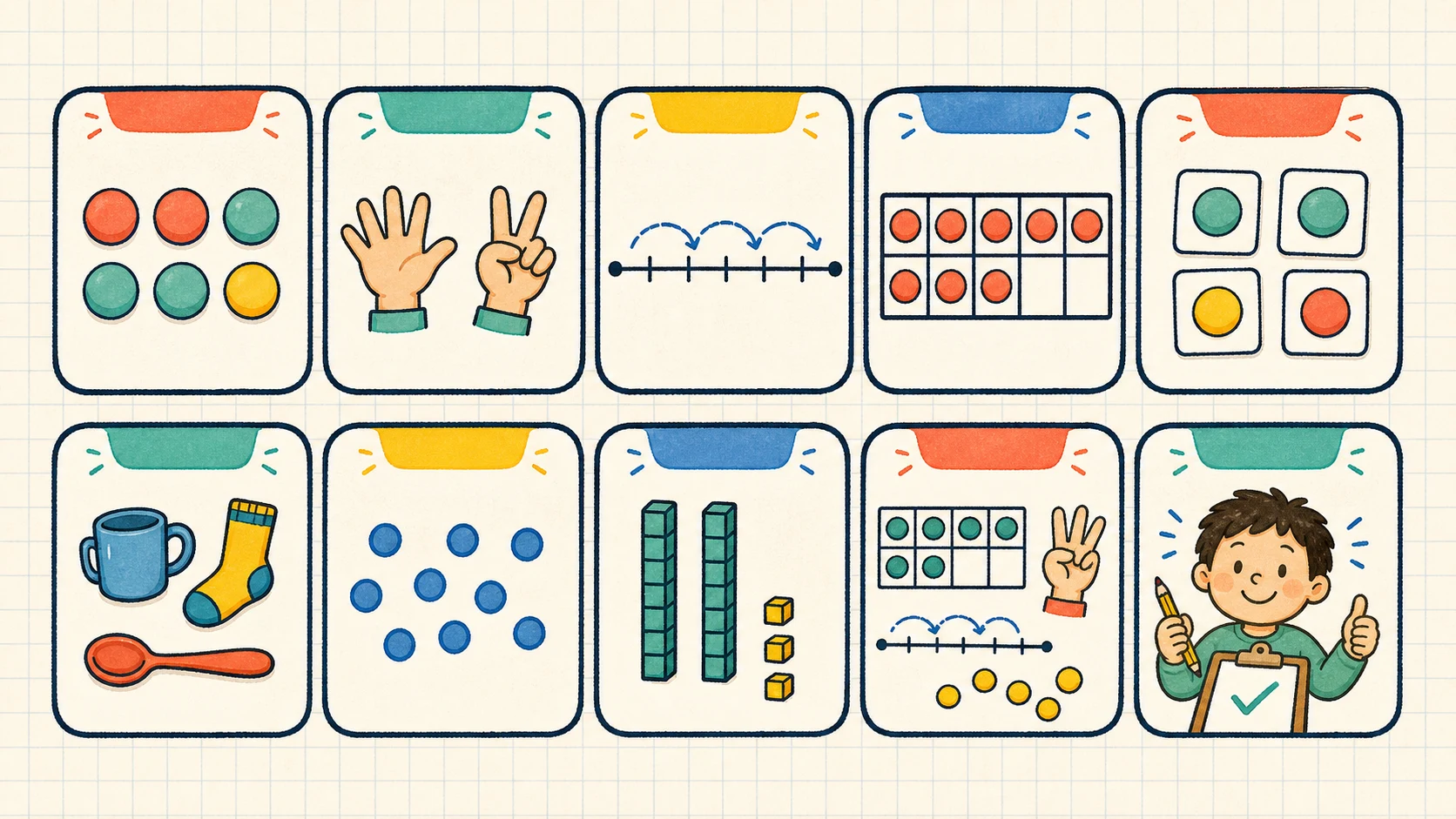
Revisit a few representative items after short delays and adjust the interval from the learner’s actual recall.
A practical review plan
| Time | Suggested activity | Decision point |
|---|---|---|
| Later the same day | Orally revisit one count-by-one or object-counting example | Can the learner begin without the original prompt? |
| About 1–2 days later | Solve two unused worksheet items or recreate two similar examples | Is the method remembered after a delay? |
| About 4–7 days later | Mix one sequence, one set-counting task, and one recognition task | Does the learner select the right method for each type? |
| About 1–2 weeks later | Use a fresh worksheet or a few newly arranged objects | Does the skill transfer beyond the original layout? |
This is a flexible instructional plan, not a sourced universal timetable. Shorten the interval if the learner cannot recall the process. Lengthen it when the learner responds accurately and explains the method without support.
Keep retrieval brief. Two carefully chosen problems can reveal more than an entire page completed with mounting fatigue. Include at least one previously difficult problem type, but do not make every review item a former error.
Keep the Worksheet’s Limits in View
This printable provides structured, easy-level practice across 20 items. It can help an adult observe counting, sequences, skip counting, numeral recognition, and aspects of number sense. It cannot by itself establish that a learner has mastered every counting situation.
The page may not show whether the learner can:
- Count unfamiliar physical objects in a new arrangement
- Maintain one-to-one correspondence when objects are moved
- Explain a sequence without visual cues
- Apply the same pattern with different starting numbers
- Distinguish a counting error from a numeral-writing error in every context
- Retain the method after a substantial delay
The worksheet is also not medical, developmental, or diagnostic guidance. Persistent difficulty on the page should lead first to closer observation, smaller examples, clearer modeling, and communication with the learner’s regular educator when appropriate—not to conclusions outside the evidence available.
Use the Pre-K grade hub to see neighboring practice areas, but remember that the label indicates intended practice level. It does not determine where every learner must begin or how quickly every learner should progress.
Take the Next Useful Step
Download the free 20-item counting worksheet, preview its problem types, and plan one model plus a three-item guided set before printing the answer key. After the attempt, use the learner’s error pattern to choose the next resource.
If the learner needs the broader skill sequence, continue with the counting topic guide. If varied practice is appropriate, consider the Pre-K Counting Worksheet Pack, which contains 18 worksheets and is listed at $4.79. For a fresh arrangement or a targeted follow-up, explore the free worksheet generators and create a short review that preserves the specific counting skill the learner is ready to retrieve.
Put it into practice
Use the guide with a real printable
Move from explanation to a short, observable practice task. Check the first item together, then adjust the next session from the learner's actual work.
See the 18-worksheet pack