Complete guide
How to teach and practise kindergarten word families worksheets - standard theme (easy)
How to Use This 20-Item Word Families Worksheet
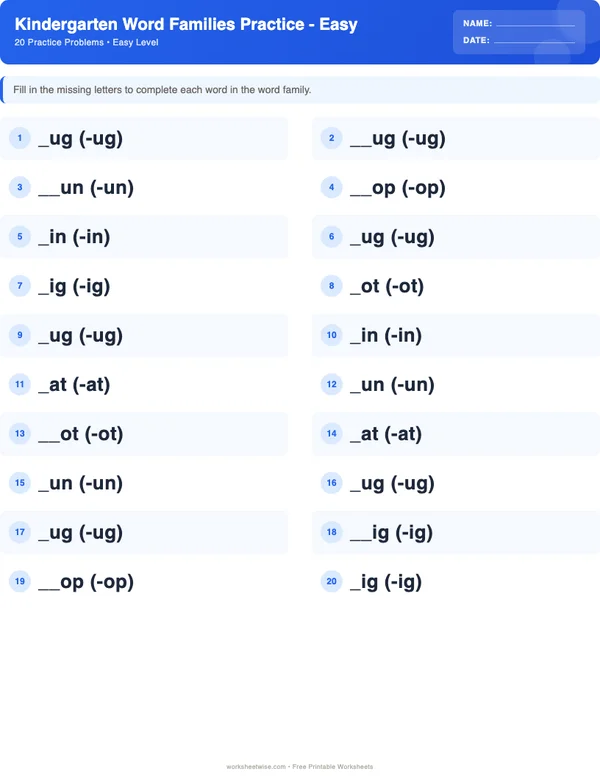
The free Kindergarten Word Families worksheet gives a learner 20 easy-level exercises with one consistent direction: fill in the missing letters to complete each word in the word family. It practices word patterns, onset and rime, rhyming, and word building. A separate printable answer key is included.
The most useful way to run it is to model one example, complete several items together, and then release a manageable group for independent work. Ask the learner to say each completed word aloud before writing. Watch whether the learner uses the shared ending pattern or guesses from a single letter. Stop and reteach when the work shows confusion; do not require all 20 items in one sitting merely because they fit on one printable.
This guide provides a lesson routine for this exact worksheet type. For a wider sequence of families, sorts, word wheels, and sentence practice, use the broader Word Families topic guide.
Grade labels describe the intended practice level, not a guarantee that every learner will find an activity equally easy. Local curricula and phonics sequences differ. Check that the letter-sound relationships and word families on the printed page are familiar enough for productive practice before beginning.
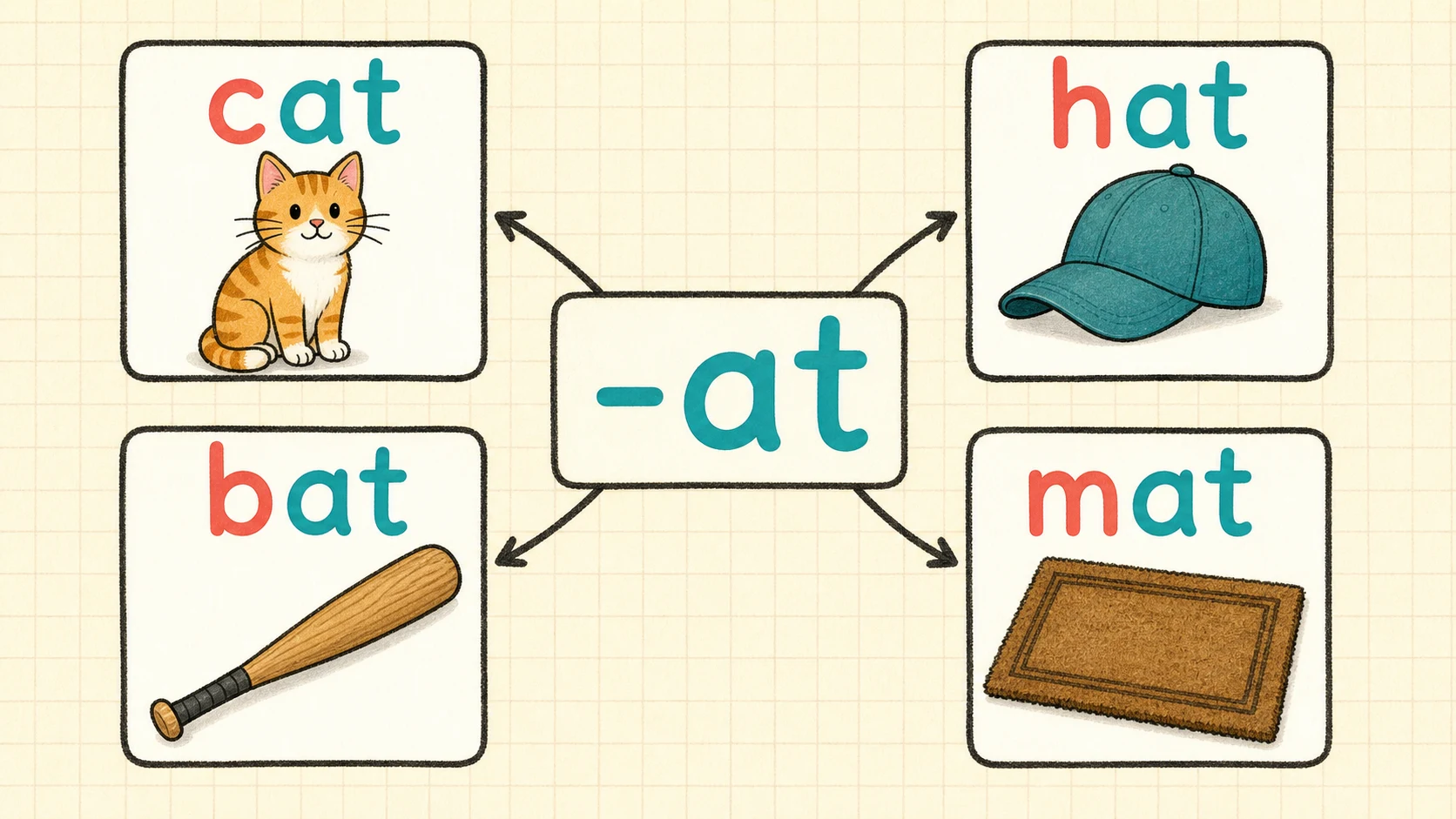
Preview, model, practice together, release a small set, check the reasoning, and plan review.
What This Worksheet Is—and Is Not—Practicing
A word family is a group of words with a shared ending pattern. For example, cat, bat, hat, mat, and sat share -at. The first part of a one-syllable word is often called the onset, while the vowel and sounds that follow form the rime. In cat, c- is the onset and -at is the rime.
The worksheet’s missing-letter format asks the learner to coordinate several actions:
- Notice the displayed word-family pattern.
- Identify the sound or letters needed in the blank.
- Blend the completed parts into a word.
- Check that the result belongs to the intended family.
- Write the missing letter or letters legibly.
This is narrower than a complete phonics lesson. It does not, by itself, show whether a learner can decode the same word in a sentence, distinguish every short vowel, spell the word from memory, or transfer the pattern to unfamiliar text. It is best treated as focused practice within broader phonics instruction.
The IES foundational reading practice guide supports explicit work with sound segments and letter-sound relationships as part of early reading instruction. That source provides high-level instructional framing; it did not evaluate WorksheetWise or this particular printable. Similarly, the Common Core English Language Arts standards include early foundational work with rhyming, spoken word parts, and letter-sound relationships. Because local sequences differ, this article does not claim comprehensive standards alignment for the worksheet.
Check readiness before printing
Look at several items on the worksheet and ask:
- Has the learner practiced the relevant vowel sound?
- Can the learner say the visible word-family ending?
- Can the learner blend a beginning sound with that ending orally?
- Can the learner form the letters likely to be written?
- Are any pictures, directions, or blanks visually confusing?
If the learner cannot yet blend two spoken parts such as /c/ … /at/ into cat, begin orally. The page should record or reinforce thinking, not substitute for the thinking itself.
A Practical Lesson Progression
The following sequence is an instructional suggestion, not a required or research-prescribed timetable. Shorten, extend, or divide it according to the learner’s observed work.
| Phase | Adult action | Learner action | Evidence to notice |
|---|---|---|---|
| Preview | Point out the directions, blanks, and repeated patterns. | Tracks one sample item. | Understands what must be filled in. |
| Oral warm-up | Say an onset and rime separately. | Blends them into a whole word. | Blends without relying on handwriting. |
| Model | Think aloud through one example. | Watches and repeats the completed word. | Attends to the shared ending. |
| Guided practice | Prompt through two to four items. | Says, builds, writes, and checks. | Uses the pattern with decreasing help. |
| Independent practice | Release a small group of items. | Completes each and reads it aloud. | Applies the routine without immediate prompting. |
| Check | Compare responses with the answer key. | Explains or repairs selected answers. | Can distinguish an error from a correct response. |
| Retrieval | Revisit a few words after a delay. | Reads or builds them again. | Retains the pattern beyond the first sitting. |
A brief oral warm-up
Choose one word family visible on the printed page. Say its ending cleanly, without adding an extra vowel. For -at, say /at/ rather than “uh-at.” Then combine it with familiar onsets:
- /m/ … /at/ becomes mat.
- /s/ … /at/ becomes sat.
- /h/ … /at/ becomes hat.
Keep the letters visible if that helps the learner connect speech to print. If the learner can blend orally but hesitates in print, point to each part as it is spoken. If the learner cannot blend orally, adding more written items is unlikely to resolve the immediate difficulty.
Model the Task Without Doing the Thinking for the Learner
Use one item to demonstrate the complete routine. The essential model is: inspect the pattern, say the parts, blend, decide which letters fit, write, and reread.
A useful think-aloud might sound like this:
“I see the word-family ending -at. I need a beginning letter. If I place c before -at, I get /c/ /at/, cat. I will write c. Now I will read the whole word again: cat. The ending is still -at, so it belongs to the family.”
This is a model created to explain the method; it is not a claim that cat appears among the worksheet’s 20 items.
Avoid turning the model into a long lecture. The learner needs to hear the decision process, but then needs a prompt that invites participation. On the next item, leave one step unsaid: “The ending is -at. What beginning sound would make hat?”
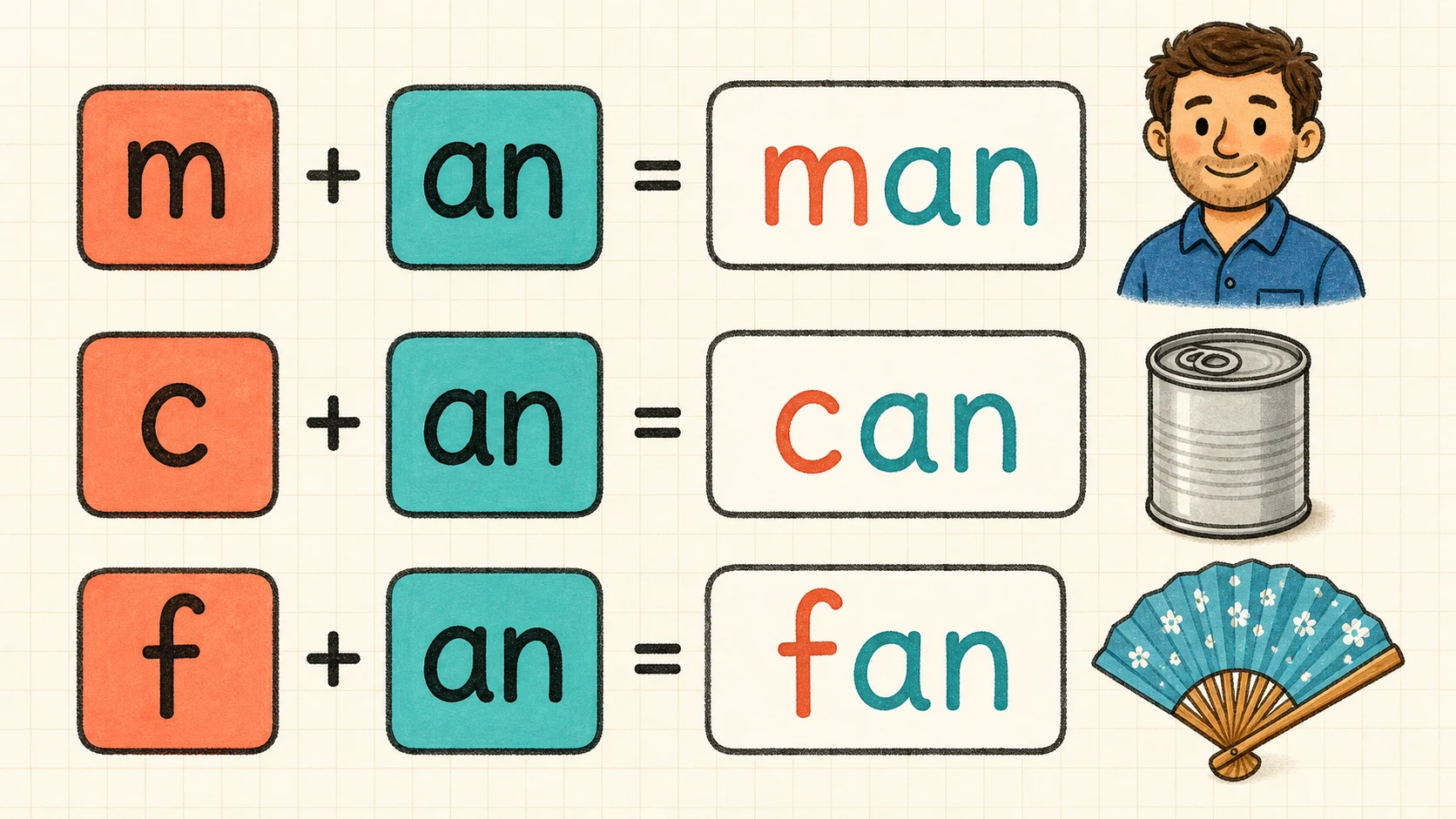
The letters, sounds, completed word, and shared ending should all agree.
Four fully checked examples
These examples illustrate the worksheet’s stated skill and missing-letter direction. They are not a transcription of the printable.
-
c + at = catSay /c/, then /at/. Blend: cat. The written word is c-a-t. Its final letters are -at, so it belongs to the -at family. The missing onset is c.
-
h + op = hopSay /h/, then /op/. Blend: hop. The written word is h-o-p. It ends in -op, so the family pattern is preserved. The missing onset is h.
-
p + ig = pigSay /p/, then /ig/. Blend: pig. The written word is p-i-g. It ends in -ig, so it belongs to that family. The missing onset is p.
-
s + un = sunSay /s/, then /un/. Blend: sun. The written word is s-u-n. Its rime is -un, so the missing onset is s.
A correct check goes beyond “that looks right.” It confirms the intended letters, the blended pronunciation, and the shared ending. If the actual item supplies the onset and omits part of the ending, reverse the reasoning: preserve the beginning, identify the displayed family, fill the ending, and reread the whole word.
Move from Guided Practice to Independent Work
Guided practice should reveal whether the learner can use the routine, not merely echo an answer.
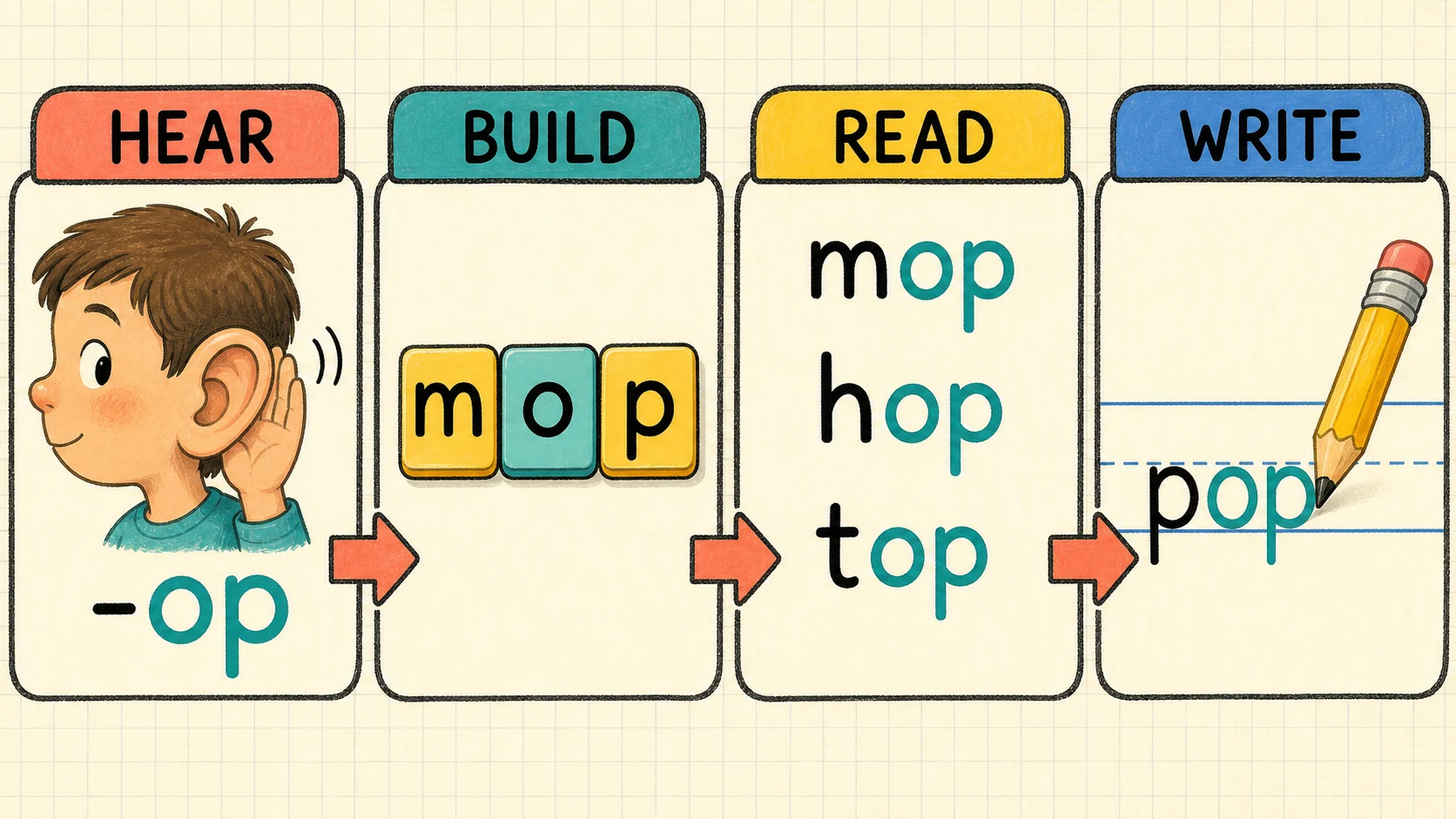
Reduce prompts only after the learner shows how the missing letters were chosen.
Use prompts in a deliberate order
Begin with prompts that direct attention without supplying the answer:
- “What word-family ending do you see?”
- “Say that ending.”
- “What letter or letters are missing?”
- “Blend the parts.”
- “Does the whole word keep the same ending?”
- “Write the missing part and read the word again.”
If the learner is stuck, increase support gradually:
- Point to the onset and rime while saying them.
- Offer two plausible letters to compare.
- Build the word with movable letters.
- Model one more item.
- Return to oral blending before asking for writing.
Do not immediately name every missing letter. That may produce a completed page without showing whether the learner can recognize or build the pattern.
Release a small set first
After two to four guided items, ask the learner to complete a short run independently—perhaps three or four items rather than the entire remaining page. The number is an adjustable teaching choice, not a universal requirement.
Check the short run before releasing more. If the learner completes it accurately and can read the words, continue. If the same error appears repeatedly, pause. One correction now is more useful than allowing the same misconception to spread across ten items.
A practical independence test is to ask, “How did you know?” A learner need not give technical terminology. An answer such as “They all end in -op, so I added m to make mop” shows more useful understanding than “I guessed.”
Adapt Support Without Changing the Skill
An adaptation should make the same word-family decision more accessible. It should not quietly replace that decision with copying an adult’s answer.
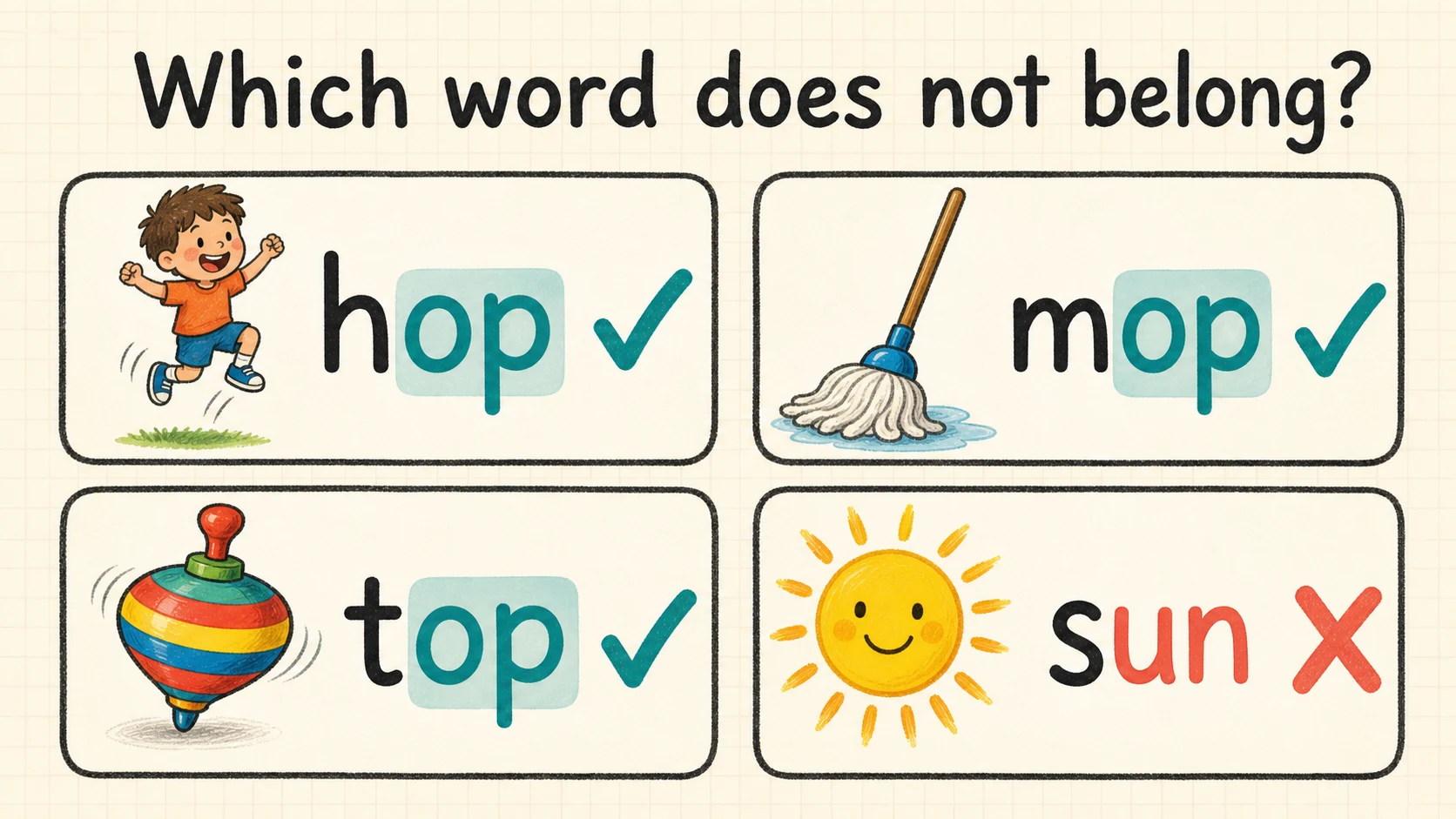
Adjust visual load, response method, or amount of practice while preserving pattern recognition and word building.
Reduce visual and workload demands
Cover the items that are not currently being attempted with a blank sheet of paper. Reveal one row or one item at a time. This preserves the original word-family task while reducing the amount visible.
You can also divide the 20 exercises across two or more sittings. Mark the stopping point lightly and resume with a quick oral review. The learner’s accuracy, effort, and explanation should determine the chunk size.
If handwriting slows the lesson so much that the phonics reasoning disappears, let the learner say the missing letters or place letter tiles first. Then ask for writing on a smaller number of selected items. The skill remains identifying and building the word-family word; the response method is temporarily supported.
Increase sound and print support
For a learner who needs more help connecting sounds to letters:
- Keep the family ending visible on a card.
- Slide an onset letter toward the rime as the sounds are blended.
- Have the learner touch the onset once and the rime once.
- Contrast two options aloud: /m/ /op/, mop and /m/ /at/, mat.
- Ask the learner to underline or lightly trace the shared ending after completing a word.
These are instructional suggestions. Use only the amount of support needed. Remove a support when the learner begins completing the same reasoning independently.
Extend without introducing a different phonics demand
If the worksheet is easy, ask for a modest extension tied to the same family:
- Read completed words in a mixed order.
- Name another real word in one of the practiced families.
- Sort completed words by their endings.
- Choose two words and use each in an oral sentence.
- Cover an onset, reveal the rime, and build the word again from memory.
Avoid treating speed as the only sign of mastery. A learner who works rapidly but changes vowel patterns, cannot reread the words, or relies on the item order may need a mixed review more than a harder page.
For broader phonics materials beyond this one activity, browse the Kindergarten phonics collection.
Handle Boundary Cases Carefully
Word-family exercises look simple, but several edge cases can produce misleading answers.
Rhyming is not always enough
Words can sound alike without displaying the exact spelling pattern being practiced. A word-family worksheet generally asks the learner to attend to both sound and print. For example, sun and one may rhyme in some pronunciations, but they do not share the written ending -un. Do not mark an answer correct solely because it sounds similar if the printed family requires a particular letter pattern.
Conversely, a learner may copy the correct ending without successfully blending the word. Ask for an oral reread so that correct-looking writing is checked against actual decoding.
Real words, possible letter strings, and worksheet intent
A learner may create a pronounceable letter string that follows the pattern but is not the intended word. Use the printed item and answer key to determine the expected response. Explain neutrally: “Those letters can be blended, but this item is asking for the word shown by its clues and family.”
Do not turn every invented string into a vocabulary correction. First identify the phonics issue: Did the learner preserve the rime? Did the onset match the intended word? Was the vowel changed? Then clarify whether the result is an expected English word.
Accents and speech differences
Pronunciation varies across speakers and regions. Treat a difference cautiously before labeling it a phonics error. Bring attention back to the printed letters and the family pattern. This guide does not provide speech, language, or medical assessment. Persistent concerns that extend beyond the worksheet should be discussed through the learner’s usual educational support process.
Interpret Errors by Their Pattern
A wrong answer is useful only if the adult identifies what went wrong. Separate handwriting slips from sound-pattern misunderstandings and from task confusion.
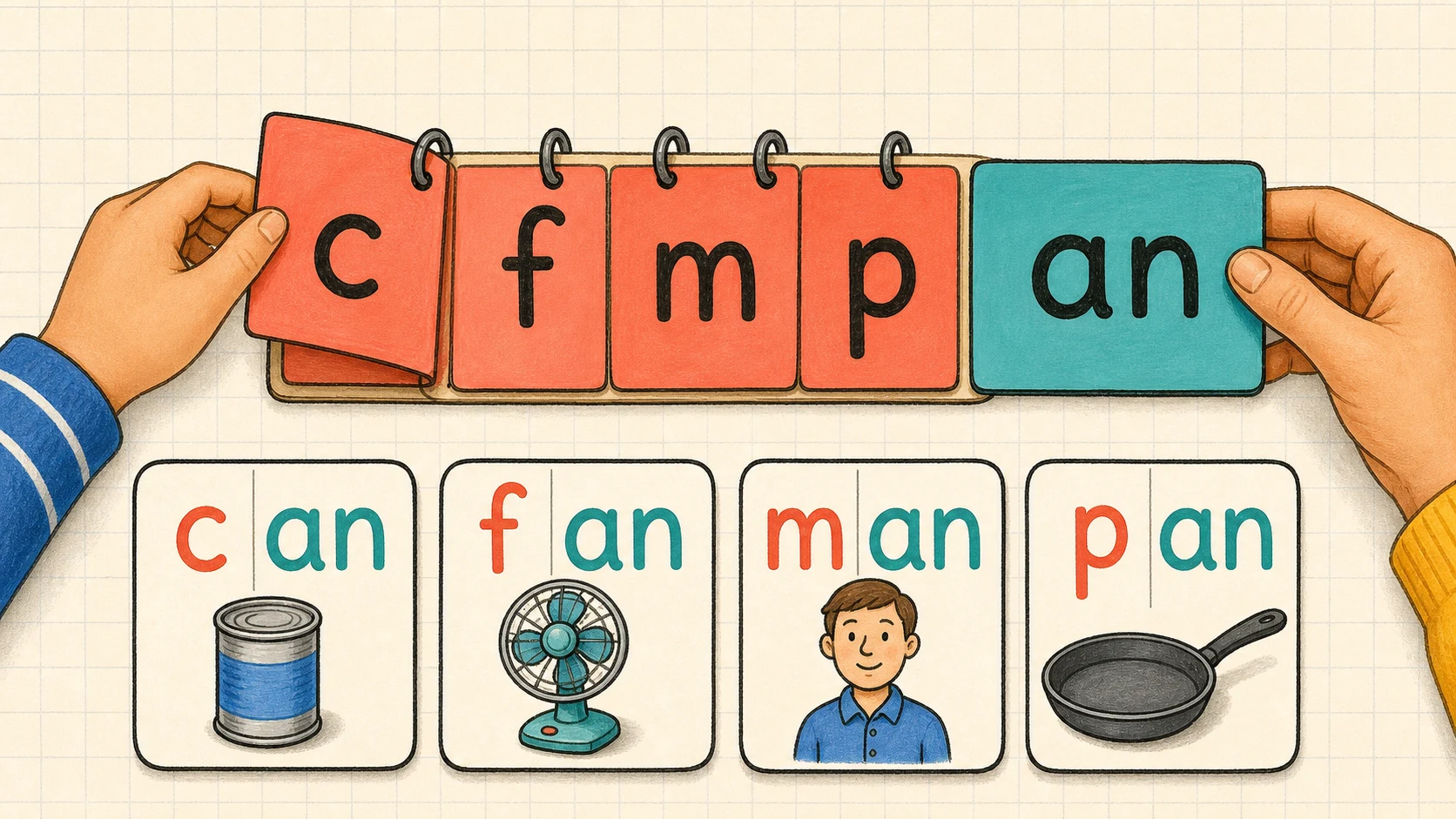
Read the attempt, compare its ending, locate the mismatch, repair it, and reread the whole word.
Common error types and responses
| Observed work | Possible interpretation | Immediate response |
|---|---|---|
| The learner changes the family ending | The shared rime may not yet be stable. | Cover the onset, read the ending, and rebuild one word orally. |
| The learner writes a plausible onset but forms a different word | The learner may be blending but not using all item information. | Compare the attempted word with the printed clues and answer-key target. |
| The learner selects a letter by its name rather than its sound | The letter-name and sound connection may be confused. | Say the sound, show the letter, and blend the parts again. |
| The learner copies nearby letters | The pattern may be noticed visually without decoding. | Mix the order and ask for oral reading. |
| The learner says the right word but writes the wrong letter | The phonics decision may be sound while letter recall or formation is weak. | Provide a small letter choice, then have the learner select and write it. |
| The learner completes one family accurately but confuses another | Knowledge may be pattern-specific. | Compare the two endings side by side and practice a small contrast set. |
| Errors increase late on the page | Attention or effort may be affecting performance. | Stop, record the point reached, and resume after a break or later sitting. |
These are interpretations to test, not diagnoses. Confirm them with another example. One reversed letter, hesitation, or incorrect response is not enough to establish a lasting difficulty.
Use repair rather than erasure alone
When an answer is wrong, ask the learner to read what was actually written. Then compare it with the intended family. A concise repair routine is:
- Circle or point to the shared ending.
- Say the onset and rime separately.
- Blend the complete word.
- Change only the incorrect letter or letters.
- Read the repaired word once more.
This keeps the correction connected to the reason for the error.
Check the Answer Key Responsibly
The separate answer key makes checking efficient, but it should confirm reasoning rather than replace instruction.
First, complete or discuss the learner’s attempt without displaying the key. Then compare one item at a time. Mark correct responses consistently. For an incorrect response, note whether the problem involved the onset, the rime, letter formation, or misunderstanding the direction.
If the learner gives a response that seems reasonable but differs from the key, inspect the actual printed item closely:
- Does the response preserve the required word-family ending?
- Does it produce the word indicated by all available clues?
- Is more than one completion genuinely possible?
- Could a letter-forming issue make a correct response look different?
- Does the answer key clarify an intended word that the item alone did not make obvious?
Do not alter the answer key casually, but do not treat it as evidence of a skill the learner did not demonstrate. A copied correct response is still copied. An independently repaired error can provide stronger instructional information than an untouched answer.
Because the task includes writing missing letters, a brief focus on clear formation is reasonable. The IES elementary writing practice guide places foundational transcription skills, including handwriting and spelling, within broader writing instruction. That is general guidance, not an evaluation of this worksheet. Keep handwriting feedback proportionate so that letter formation does not overwhelm the phonics goal.
Decide What to Do After the 20 Items
Do not base the next step on a score alone. Consider accuracy, independence, oral reading, and error pattern together.
When to repeat, review, or move on
Repeat selected items when the learner understands the routine but made a small number of correctable mistakes. Reuse only the relevant examples rather than requiring the whole page again.
Review the family pattern with manipulatives or oral blending when the learner changes endings, cannot blend the parts, or needs the answer supplied repeatedly. Return later to several worksheet items as a transfer check.
Use mixed-family practice when the learner succeeds while one family is grouped together but becomes confused when endings are interleaved. Sorting words into families can show whether the pattern is recognized outside a predictable block.
Move to context when the learner completes the items independently and can reread the words. Use short, decodable phrases or sentences containing familiar family words. This tests recognition when the word is no longer isolated.
Introduce a related family cautiously when the current pattern is secure. Do not assume success with -at automatically transfers to -an, -op, or -ig. Begin with a clear comparison and inspect the learner’s work.
The worksheet catalogue identifies this printable as easy-level Kindergarten practice. “Easy” describes its intended difficulty within the catalogue; it does not mean every learner should finish without support.
Schedule Retrieval After the First Lesson
A completed page shows performance during one encounter. Brief retrieval after a delay gives better information about what remains accessible.
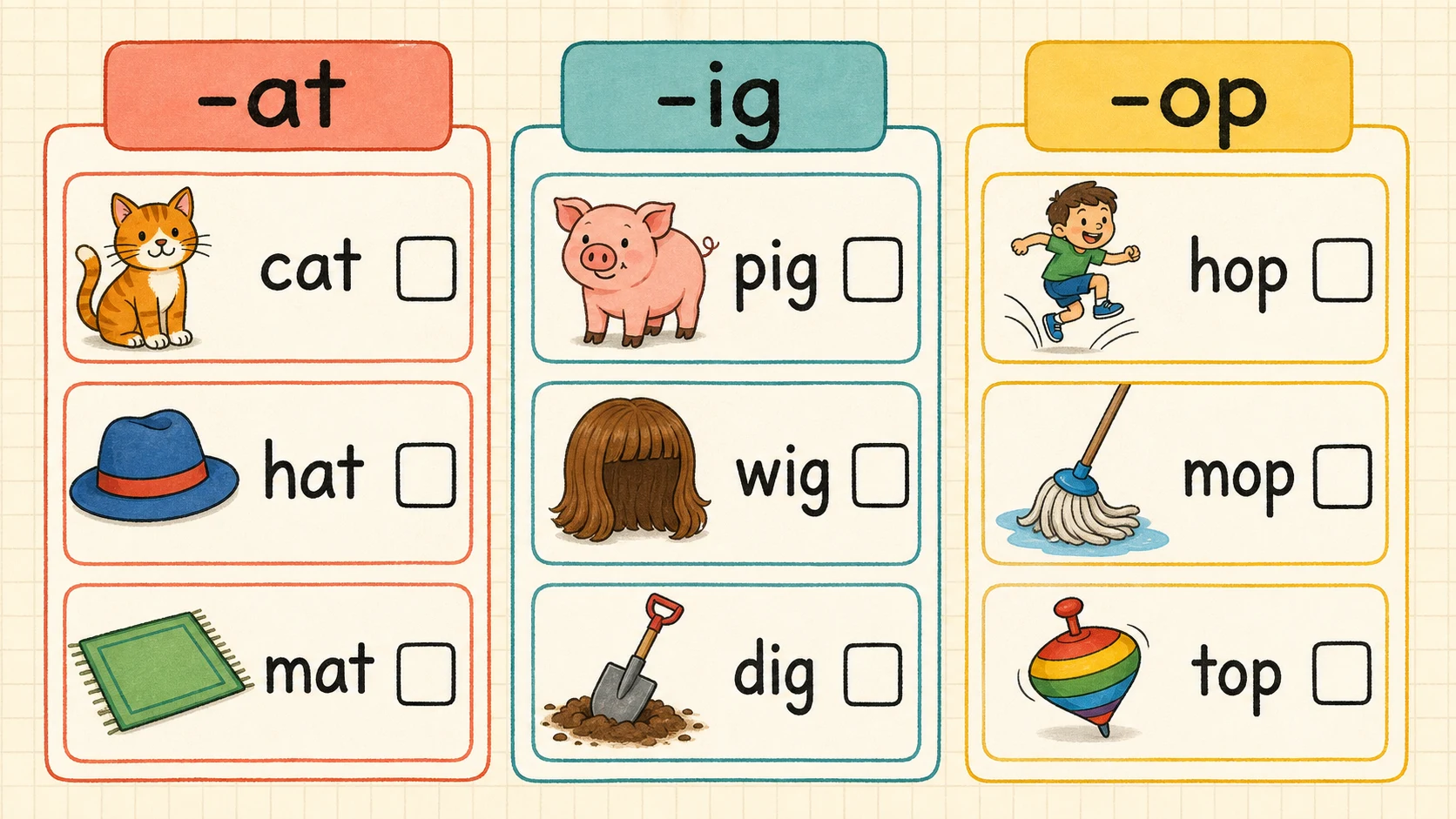
Revisit a few examples after increasing delays, adjusting the schedule to the learner’s responses.
The following is a practical, flexible plan rather than a universal timetable:
| Review point | Suggested activity | What to observe |
|---|---|---|
| Later the same session | Reread three completed words in a new order. | Does the learner decode rather than recall page position? |
| The next learning day | Rebuild two or three words without first showing the completed answers. | Is the shared ending remembered? |
| Several days later | Mix words from two practiced families and sort them. | Can the learner distinguish the endings? |
| About a week later | Read or build a small mixed set, including one new onset with a known rime. | Does the pattern transfer to a new combination? |
If retrieval is accurate, brief, and independent, increase the delay or move to mixed practice. If the learner needs substantial prompting, shorten the delay and reduce the number of examples. If oral reading is sound but writing remains effortful, separate the phonics check from additional handwriting practice.
Limits of the Printable
This worksheet offers 20 focused exercises and a quick way to observe word-pattern decisions. It cannot establish broad reading mastery, diagnose a learning need, or represent an entire phonics curriculum. Its isolated words provide limited evidence about connected-text reading, vocabulary knowledge, comprehension, spelling from memory, or fluent sentence reading.
It also should not be used to claim guaranteed outcomes or universal readiness for the next grade-level task. Grade expectations, teaching sequences, and adopted standards vary by location. The learner’s observed work—especially how independently the learner blends, writes, explains, and later retrieves the words—should drive pacing.
For continued practice, use the Kindergarten Word Families Worksheet Pack, which contains 18 worksheets, only if additional structured practice matches the learner’s current need. For a free next action, open the Word Families topic guide, choose one familiar family from the completed page, and follow it with a mixed sort or another free worksheet that asks the learner to recognize the same pattern in a less predictable order.
Put it into practice
Use the guide with a real printable
Move from explanation to a short, observable practice task. Check the first item together, then adjust the next session from the learner's actual work.
See the 18-worksheet pack