Complete guide
How to teach and practise kindergarten short vowels worksheets - standard theme (easy)
What this worksheet teaches and how to use it
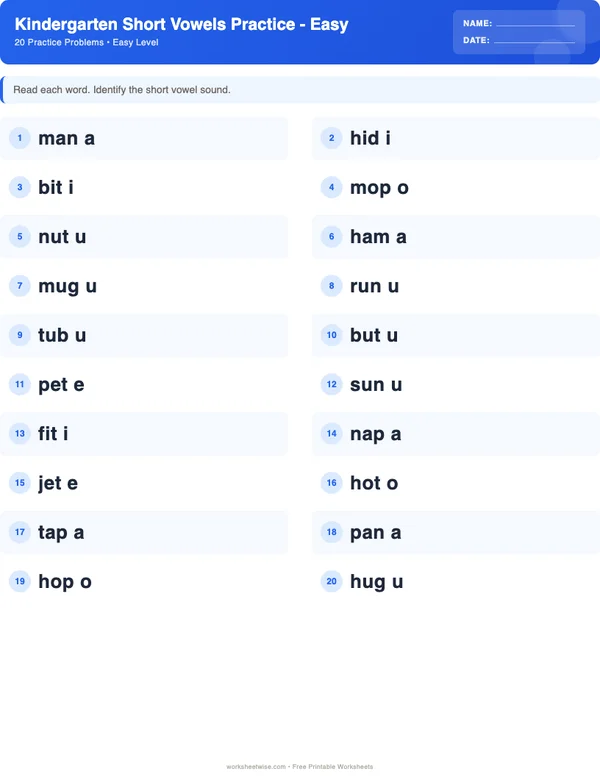
The free Kindergarten Short Vowels worksheet gives a learner 20 easy-level exercises with one direction: “Read each word. Identify the short vowel sound.” Use it to observe whether the learner can decode a simple word, attend to its middle sound, and connect that sound to a, e, i, o, or u. Model one item, complete a few together, and then release the learner to work independently only while the responses remain thoughtful and reasonably accurate.
The worksheet practices short vowel sounds, phonics, CVC patterns, and decoding. It includes a separate printable answer key. It can serve as classroom practice, homeschool work, tutoring practice, or a focused homework task, but the learner’s observed work—not the “easy” label or a fixed timetable—should determine how quickly the 20 items are completed.
Grade labels describe the intended practice level. Local curricula and instructional sequences differ, so “Kindergarten” does not mean every learner should complete this sheet at the same point in the year. The label also does not establish comprehensive standards alignment. The catalogue associates the broader topic with skills such as connecting common spellings to long and short vowel sounds, while the Common Core English Language Arts standards provide the wider grade-specific literacy context.
Move from a brief sound review to modeling, guided practice, independent work, and later retrieval.
Before giving the learner the printable
This worksheet is most useful when the adult first checks that its task matches the learner’s current instruction. The words require the learner to read, not merely name a picture or recite the vowels. A learner who cannot yet produce several consonant sounds may need earlier phonics practice before this particular sheet can show much about short vowel knowledge.
Check the prerequisite behaviors
Before printing or beginning, show three separate letters, such as m, a, and t. Ask for their sounds. Then place them together as mat and see whether the learner can blend the sounds into a word. This is a readiness check, not an extra scored test.
Look for whether the learner can:
- Track the word from left to right.
- Say common consonant sounds without relying entirely on adult help.
- Blend three sounds into a simple word.
- Hear that the vowel sound is between the beginning and ending consonants.
- Match at least some short vowel sounds to their letters.
If blending is not yet secure, the adult can model blending before using the printable. If the learner can blend but confuses particular vowels, the worksheet may provide appropriate focused practice.
Prepare a small set of supports
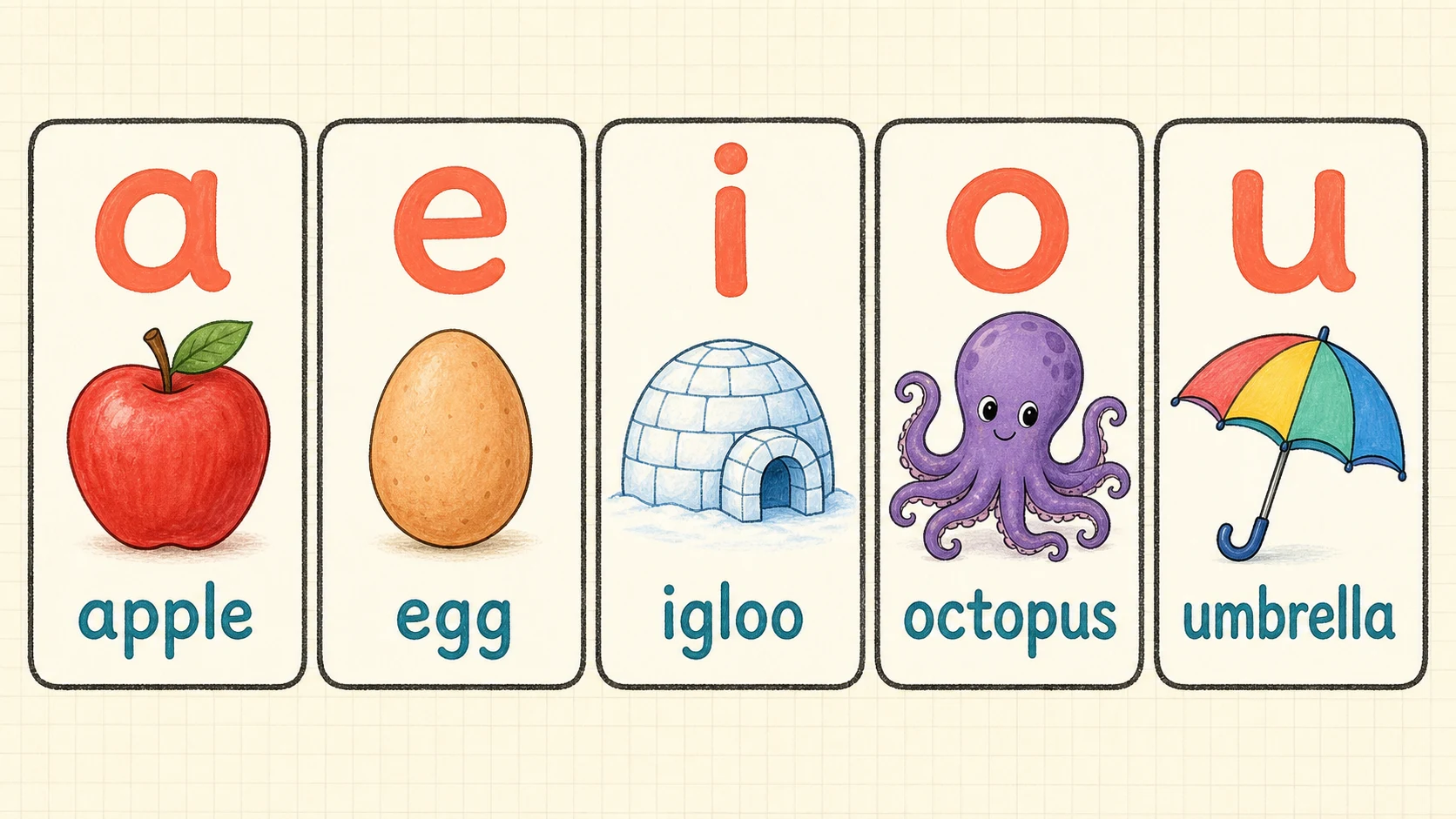
Keep the worksheet, pencil, and answer key separate. Optional supports include five vowel cards, a blank strip of paper for covering later rows, and anchor words such as apple, egg, itch, octopus, and umbrella. These anchor words come from the supplied topic guidance. They are memory cues, not substitutes for listening to the vowel in each printed word.
The IES foundational reading practice guide gives high-level support for teaching learners to notice speech sounds, connect sounds with letters, decode words, and write or recognize words. It did not evaluate WorksheetWise or this particular printable. Here, that broad framing supports a simple routine: hear the sounds, connect the middle sound to a letter, and read the whole word again.
A flexible lesson map for the 20 items
The following progression is an instructional suggestion, not a universal schedule. Use the item ranges as convenient stopping points, and adjust them according to the learner’s attention, accuracy, and explanations.
| Phase | Suggested portion | Adult role | Evidence to notice |
|---|---|---|---|
| Sound warm-up | No worksheet items yet | Review two or three short vowel sounds and blend one sample word | Can the learner hear the middle sound? |
| Model | 1 item | Think aloud without asking the learner to guess | Does the learner follow sound-by-sound blending? |
| Guided practice | 2–4 items | Prompt, wait, and reduce help gradually | Which prompts are still needed? |
| Independent attempt | Up to 5–8 items at a time | Observe without giving the vowel | Are responses accurate and deliberate? |
| Check and correct | Completed portion only | Compare, discuss, and retry errors | Can the learner explain the correction? |
| Retrieval | Selected examples later | Present a few old words in a new order | Is the vowel recalled without the original prompt? |
Completing all 20 items in one sitting is not required. Continue when the learner is reading and identifying sounds with useful effort. Pause when guessing, fatigue, or repeated confusion makes the remaining answers poor evidence of learning.
Model the task explicitly
The first demonstration should expose the reasoning that the learner will later perform silently. Point to a practice word you provide—not an unseen worksheet answer—and say each sound slowly enough to hear its position. Then blend the word and name the vowel sound.
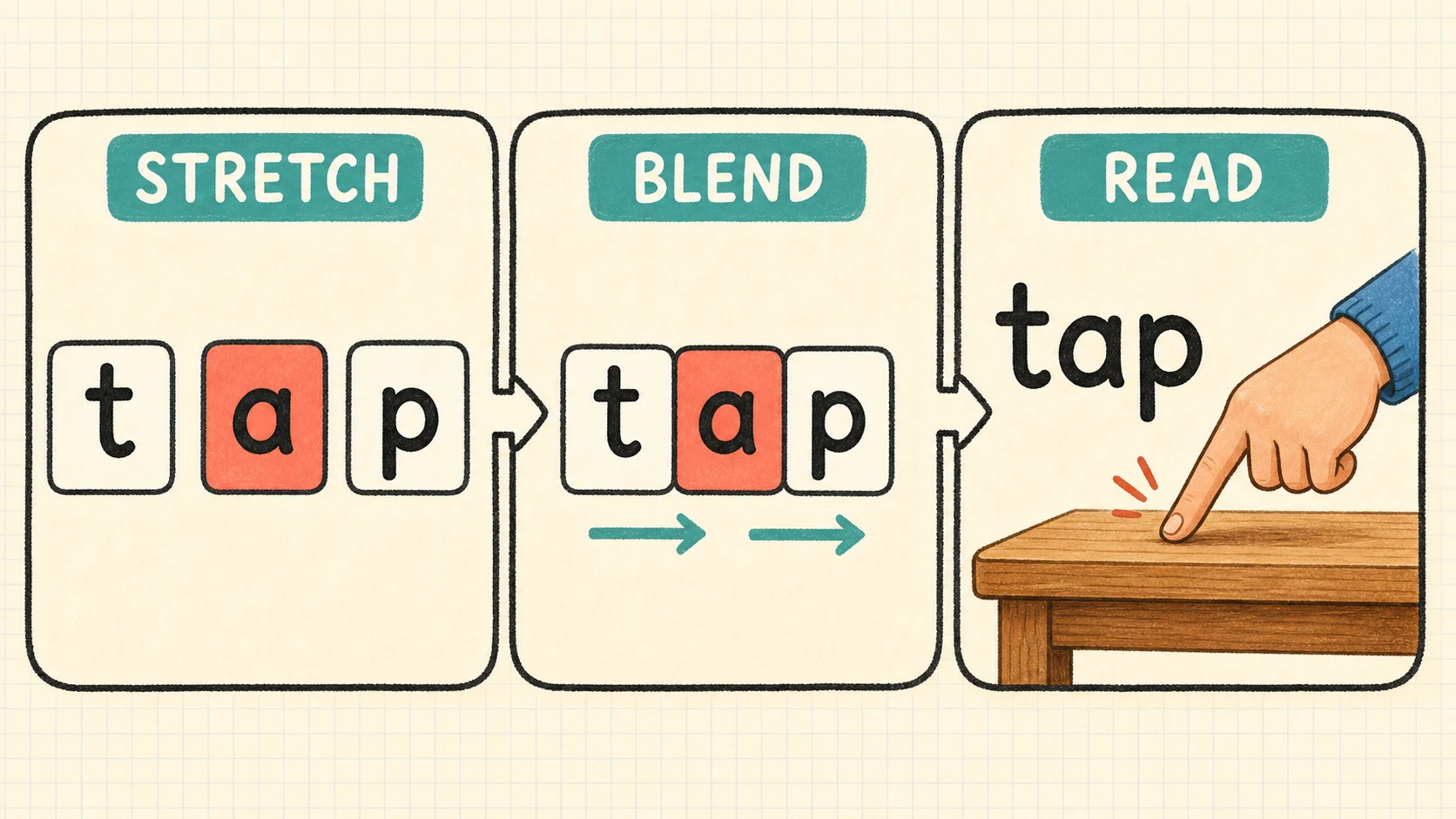
The useful sequence is read the letters, hear the middle sound, and identify the vowel.
A concise think-aloud
For map, an adult might say:
“I see m-a-p. The sounds are /m/ /ă/ /p/. Blended together, the word is map. The middle sound is /ă/, so the short vowel is a.”
This is adult-created modeling, not a claim that map appears among the worksheet’s 20 items. Keep the explanation short. The important actions are visible: read across the word, isolate the middle sound, and connect it to the vowel letter.
After modeling, ask the learner to repeat the process with a different example. Avoid asking only for the answer. “How did you find the vowel?” reveals more than “Is that right?”
Keep pronunciation clear but natural
Stretching a consonant can help with blending when the sound permits it, but do not distort the vowel into another sound. Say sun as /s/ /ŭ/ /n/, not as letter names and not with an exaggerated extra syllable. If the learner copies an unclear pronunciation, say the word normally, segment it once, and then blend it again.
The worksheet’s task is vowel identification within words. It is not a test of whether a learner can recite a, e, i, o, u in order. Naming all five letters may be a warm-up, but the adult still needs to listen for sound-to-letter reasoning.
Run guided practice before independent work
Begin the guided phase with prompts that direct attention without supplying the answer. A useful sequence is:
- “Point under each letter as you say its sound.”
- “Blend the sounds. What word did you read?”
- “Say the word slowly once more.”
- “Which sound is in the middle?”
- “Which vowel represents that sound?”
Allow several seconds after each prompt. If the learner answers correctly after the first or second prompt, do not continue through the entire script. The goal is to remove support, not make every item feel like an oral examination.
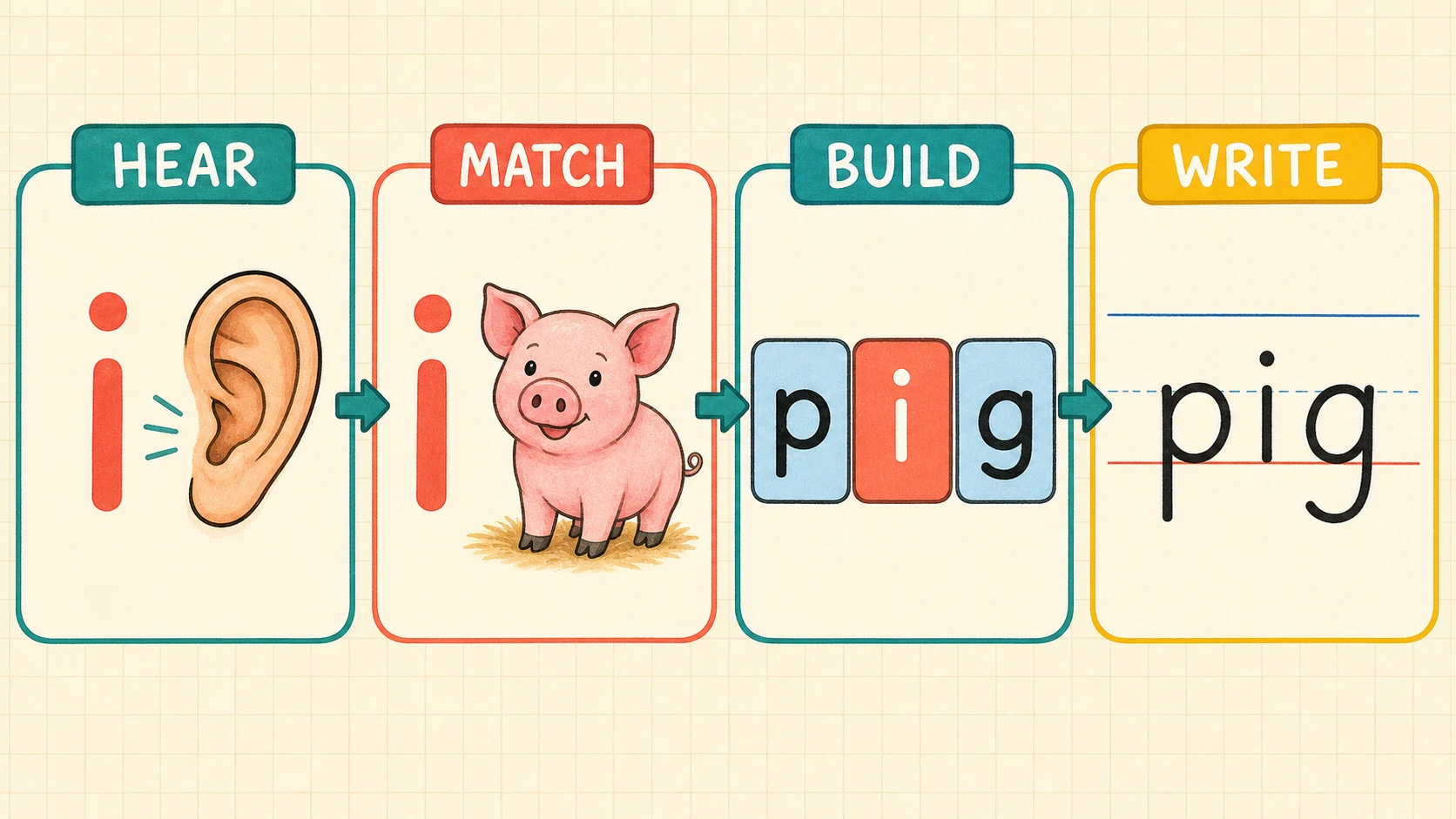
Prompts should direct attention to the word and then fade as the learner takes over.
Release responsibility gradually
On the first guided item, the adult may segment and blend with the learner. On the next, the learner can segment while the adult points. On a later item, the adult can simply say, “Read, listen to the middle, and identify the vowel.”
Move to independent work when the learner can apply that routine without being told the vowel. Independence does not require silence: a beginning reader may need to whisper sounds or tap one finger for each sound. That behavior can make the reasoning observable.
During independent practice, avoid correcting each response immediately. Let the learner finish a small group, perhaps three to five items, and then check that group. Short checking cycles prevent a misunderstood direction from affecting many answers while still giving the learner meaningful independence.
Use fully checked examples to clarify the skill
The following examples are created for teaching and checking the method. They are similar to the worksheet’s stated focus, but they are not presented as its actual item list.
Example 1: cat
- Segment the word: /k/ /ă/ /t/.
- Blend it: cat.
- Isolate the middle sound: /ă/, as in apple.
- Match the sound to its letter: a.
- Checked answer: short a.
The beginning sound /k/ and final sound /t/ help define the word, but neither is the requested response. The target is the vowel sound in the middle.
Example 2: hen
- Segment the word: /h/ /ĕ/ /n/.
- Blend it: hen.
- Isolate the middle sound: /ĕ/, as in egg.
- Match the sound to its letter: e.
- Checked answer: short e.
If the learner answers i, say hen and hin as contrasting pronunciations, making clear that only hen is the printed word. The supplied topic guidance identifies short e and short i as a potentially confusing pair. A practical suggestion is to let the learner watch the adult’s mouth while hearing each sound, then return immediately to the printed word.
Example 3: pig
- Segment the word: /p/ /ĭ/ /g/.
- Blend it: pig.
- Isolate the middle sound: /ĭ/, as in itch.
- Match the sound to its letter: i.
- Checked answer: short i.
A learner who says the vowel’s letter name /ī/ has noticed the correct printed letter but produced the wrong sound. Separate the two facts: “The letter is i. In pig, its sound is short /ĭ/.”
Example 4: fox
- Segment the word: /f/ /ŏ/ /ks/.
- Blend it: fox.
- Isolate the vowel sound: /ŏ/, as in octopus.
- Match the sound to its letter: o.
- Checked answer: short o.
The letter x represents the final /ks/ sound sequence, so the spoken word contains more sound detail than a simple one-letter/one-sound demonstration. That does not change the vowel: o remains in a closed syllable and represents the short sound.
Example 5: sun
- Segment the word: /s/ /ŭ/ /n/.
- Blend it: sun.
- Isolate the middle sound: /ŭ/, as in umbrella.
- Match the sound to its letter: u.
- Checked answer: short u.
If sun and son sound alike in the learner’s pronunciation, direct attention to the printed middle letter. Phonics uses both sound and spelling. The answer for the printed word sun is u, even though another word may sound the same.
These five examples cover all five short vowels. They also show why checking should include the process rather than only a final letter.
Adapt support without changing the target skill
An adaptation should help the learner attend to the short vowel while preserving the requirement to identify it. It should not turn the task into copying an answer.
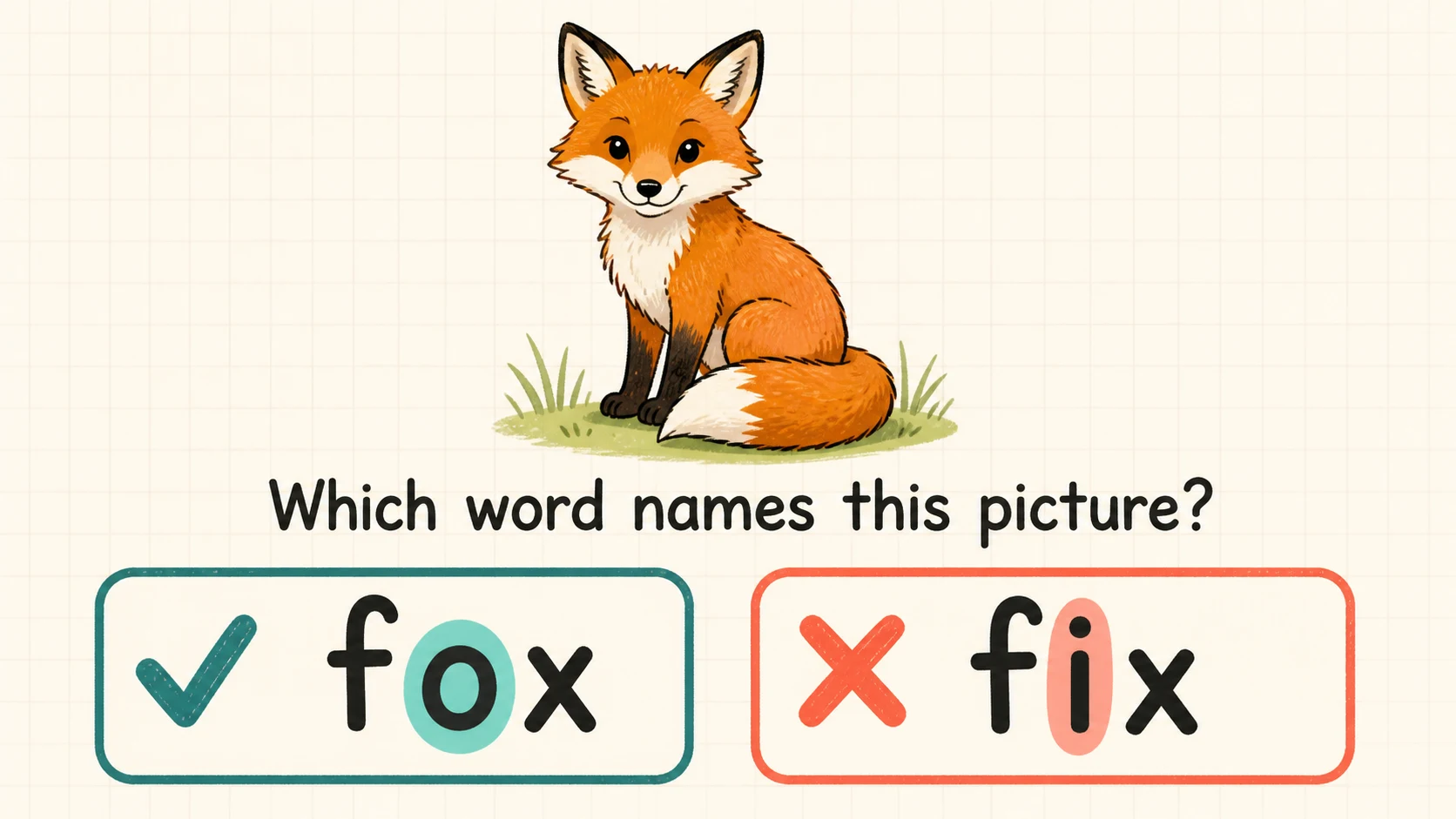
Reduce visual load, provide sound cues, or increase explanation while keeping vowel identification central.
When the page feels visually crowded
Cover all but one row or a small group of items with a blank sheet. Reveal the next group after the first is complete. The learner still reads and identifies the vowels; only the amount visible at once changes.
You can also place a plain card beneath the active word as a tracking guide. Do not cover the middle letter, because connecting the sound to that spelling is part of the task.
When vowel recall is uncertain
Place the five vowel letters where the learner can see them. Add the supplied anchor words or simple gestures: pretend to bite an apple, crack an egg, scratch an itch, move arms like an octopus, or hold an imaginary umbrella. Ask the learner to choose the matching anchor only after reading the word.
If five choices cause guessing, review fewer vowel sounds before returning to the worksheet. Do not permanently reduce every item to two visible choices; that would make the response easier in a way that could conceal whether the learner knows the full set.
When handwriting interferes with the response
The sheet includes phonics and decoding practice, not a broad assessment of composition. If forming a letter consumes so much attention that the learner loses the sound, allow the learner to say the vowel and then write it with brief support, or point to a vowel card before recording it.
The IES elementary writing practice guide addresses broader writing instruction and includes fluency with handwriting and spelling among its recommendations. It did not review this worksheet, and its listed grade range begins above Kindergarten. Its relevance here is limited: writing mechanics can affect how clearly a learner records phonics knowledge, so the adult should distinguish a sound-identification error from a letter-formation problem.
Recognize boundary cases and common misconceptions
The worksheet is described as easy-level short vowel practice involving CVC patterns. Not every word containing a, e, i, o, or u belongs in the same practice set.
Words outside the immediate pattern
Use these contrasts orally to clarify the boundary, not to extend the worksheet prematurely:
- cap has short a, but cape has a long vowel pattern.
- kit has short i, but kite has a long vowel pattern.
- hop has short o, but boat uses a vowel team.
- cut has short u, but cute does not use the same short vowel pattern.
- ship contains short i, but its first two letters form the consonant digraph sh, so it is not a three-letter CVC spelling.
A closed syllable ends in a consonant, as in cat, pen, sit, hot, and cup. That description helps explain the typical pattern, but it should not become a rule the learner applies without reading. English contains words and spelling patterns that require additional instruction.
Misconceptions worth addressing directly
A learner may believe the middle letter is always the entire answer without reading the word. Ask for the sound as well as the letter to check the connection.
Another learner may say the vowel’s name instead of its short sound. Respond with precise language: “You found a. In cat, a says /ă/.”
A third may identify the first sound because it is easiest to hear. Have the learner tap three sound positions and touch the middle finger when saying the vowel.
Do not introduce long vowels, vowel teams, consonant blends, and several confusing pairs at once merely because an error occurred. The broader Short Vowels topic guide is the better place to view the progression and select related practice without duplicating the entire sequence here.
Interpret errors before choosing more practice
A total score cannot show why an answer was wrong. Review the learner’s work item by item and classify the error according to what you actually observed.
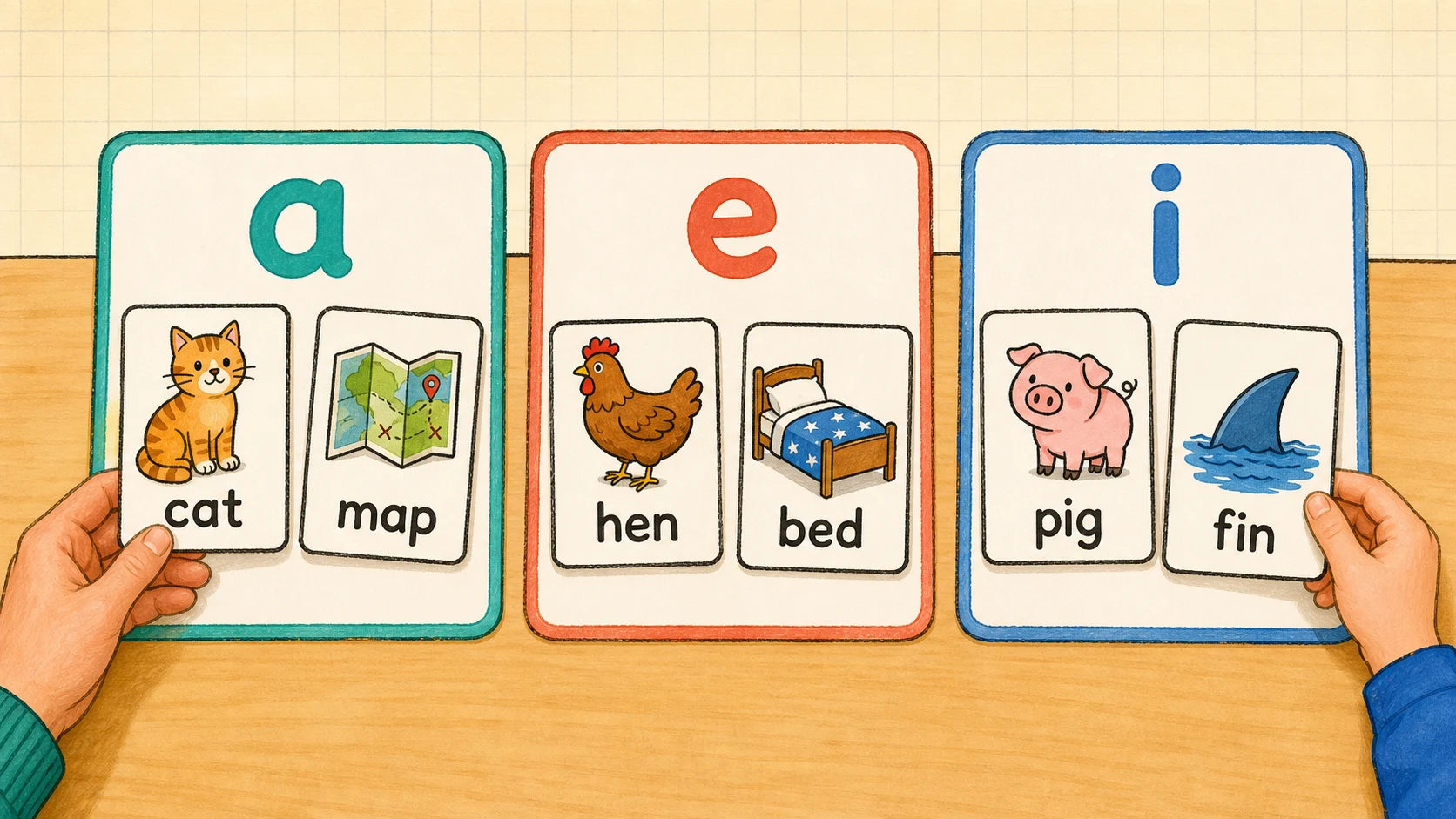
Re-read, segment, identify the middle sound, correct, and read the whole word again.
| Observed behavior | Likely immediate issue | Useful instructional response |
|---|---|---|
| Cannot blend the consonants and vowel into a word | Blending is not yet secure | Model sound-by-sound blending with fewer words |
| Reads the word correctly but names the wrong vowel | Sound-to-letter connection is uncertain | Isolate the middle sound and compare it with an anchor |
| Repeatedly swaps e and i | A specific vowel contrast needs attention | Practice a small oral contrast such as pen/pin |
| Gives letter names instead of short sounds | Letter name and sound are being confused | State both: “letter i, short sound /ĭ/” |
| Says the correct answer but records another letter | Recording or formation may be the difficulty | Ask for an oral answer, then support accurate recording |
| Answers rapidly without reading | Guessing or task avoidance is obscuring skill | Require a quiet blend before each response |
| Accuracy drops only near the end | Fatigue or attention may be affecting the sample | Stop and finish the remaining items later |
These interpretations are hypotheses to test through a retry, not diagnoses. For example, if the learner writes e for pig, ask for the word, its middle sound, and the matching letter. A correct oral retry suggests something different from an inability to hear /ĭ/. The observed work should drive pacing and support.
Check the answer key responsibly
Keep the printable answer key out of sight during the initial attempt. After a small section or the completed sheet, compare each response with the key. Marking a response wrong is only the beginning of checking.
For every mismatch:
- Return to the printed word.
- Ask the learner to read it again.
- Segment the sounds if needed.
- Identify the middle sound.
- Match that sound to the vowel letter.
- Correct the response.
- Read the whole word once more.
If your spoken pronunciation seems inconsistent with the printed answer, recheck the spelling, pronounce the word naturally, and consult the supplied key before teaching a correction. Accent and dialect differences can affect how some vowels are perceived. Do not tell a learner that a home pronunciation is careless or inferior. Keep the discussion attached to the spelling and pronunciation model being used for this instructional task.
Record more than a single percentage if you need to plan instruction. A brief note such as “18 correct independently; two e/i confusions corrected after segmentation” is more informative than “18/20.” Do not count a prompted response as independent mastery. It is successful guided practice, which is useful evidence of a different kind.
Schedule retrieval from the learner’s results
A corrected worksheet shows what the learner can do with recent support. Retrieval asks whether the sound-letter connection remains available later and in a different order.
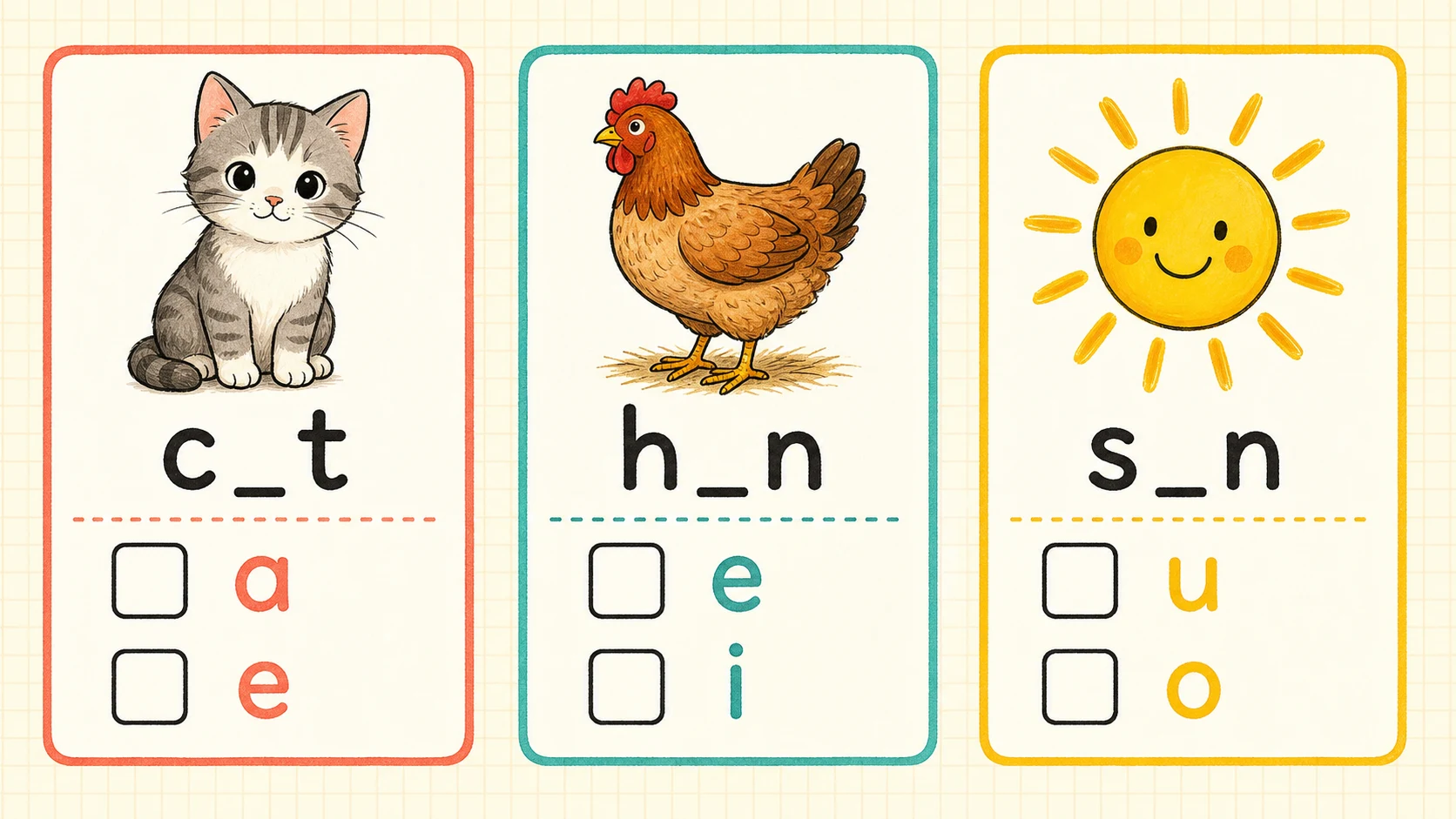
Revisit a small, mixed selection after increasing gaps and adjust from the learner’s responses.
A practical sample schedule is:
| Review point | Suggested task | Decision |
|---|---|---|
| End of the first lesson | Retry one corrected word and one independently correct word | If both require heavy prompting, review before adding more items |
| Next instructional session | Read and identify vowels in three to five previous words, reordered | If a confusion returns, practice that contrast briefly |
| Two or three sessions later | Mix old examples with two new CVC examples | Look for transfer rather than memory of worksheet order |
| About a week later | Retrieve a small mixed set without anchor cues at first | Restore a cue if needed, then fade it again |
| During later phonics work | Include occasional short vowel words alongside newer patterns | Continue only as much review as observed work warrants |
This is an example schedule, not a universal timetable or guarantee. Some learners will need a shorter gap; others will retain the pattern with less review. Avoid repeating all 20 items automatically. Select a few independently correct words, corrected words, and confusable contrasts so that review remains informative.
Understand what this printable cannot establish
One 20-item worksheet cannot establish complete phonics mastery. It samples identification of short vowel sounds in printed words. It does not, by itself, show whether the learner can spell unfamiliar words from dictation, read short vowels fluently in connected text, distinguish every possible vowel contrast, or apply the skill amid later patterns such as digraphs, blends, silent-e words, vowel teams, and multisyllabic words.
The IES foundational skills guide also places decoding within a larger instructional picture that includes speech-sound awareness, word analysis, word recognition, and connected-text reading. That broader guidance should not be treated as a claim that this worksheet covers all foundational reading instruction.
Likewise, the answer key confirms intended responses; it does not explain every error or prescribe an intervention. Adults should use it as a checking tool alongside observation, not as a replacement for listening to the learner read.
Decide the next honest step
If the learner identifies most vowels independently and explains corrections, revisit a small mixed set later and then move into related short-vowel practice. The Kindergarten phonics collection can help you place this skill beside other phonics work.
If one contrast remains unstable, choose focused practice rather than simply repeating the same page. The 18-worksheet Kindergarten Short Vowels Worksheet Pack offers a broader set of practice materials, while the free worksheet generators can be used to create another appropriately focused activity.
If blending itself remains difficult, pause the 20-item sheet and work with a few orally segmented CVC words before returning. The most useful next action is to complete the free Kindergarten Short Vowels worksheet, note which responses were independent or prompted, and use the Short Vowels topic guide to choose the next practice from that evidence.
Put it into practice
Use the guide with a real printable
Move from explanation to a short, observable practice task. Check the first item together, then adjust the next session from the learner's actual work.
See the 18-worksheet pack