Complete guide
How to teach and practise kindergarten digraphs worksheets - standard theme (easy)
How to use this 20-item digraph worksheet
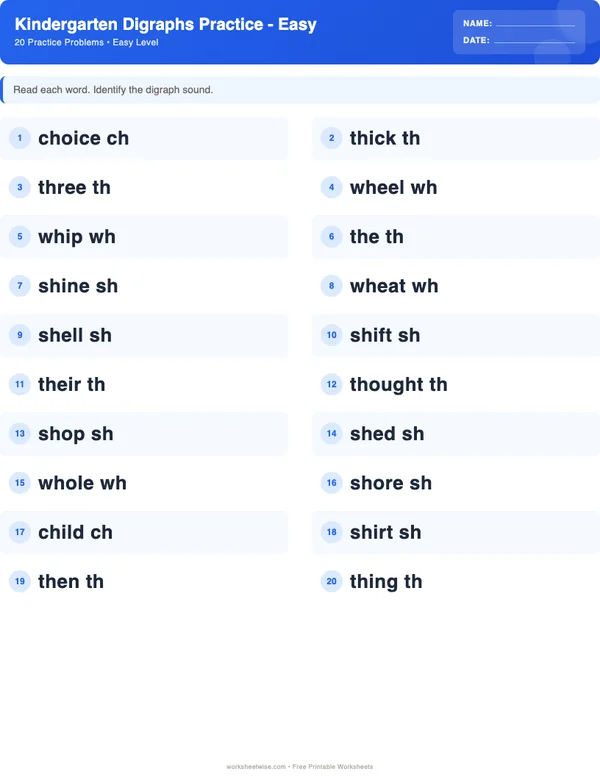
The free Kindergarten Digraphs worksheet gives a learner 20 words containing the initial digraphs ch, sh, th, or wh. The immediate goal is to read each word, locate the two-letter digraph, and say the sound it represents.
For a useful lesson, do not treat completion as proof of mastery. Model two items, solve several together, and then let the learner attempt a short group independently. Because the page prints a digraph label beside every word, cover that label when you want the learner to retrieve the digraph without seeing the answer. Ask the learner to underline or circle the two target letters in the word.
The worksheet is most appropriate when the learner can already recognize individual letters and attempt short words. If those foundations are not yet secure, reduce the number of items and provide more oral modeling. Let the learner’s observed work—not the word “Easy” or a fixed timetable—determine the pace.
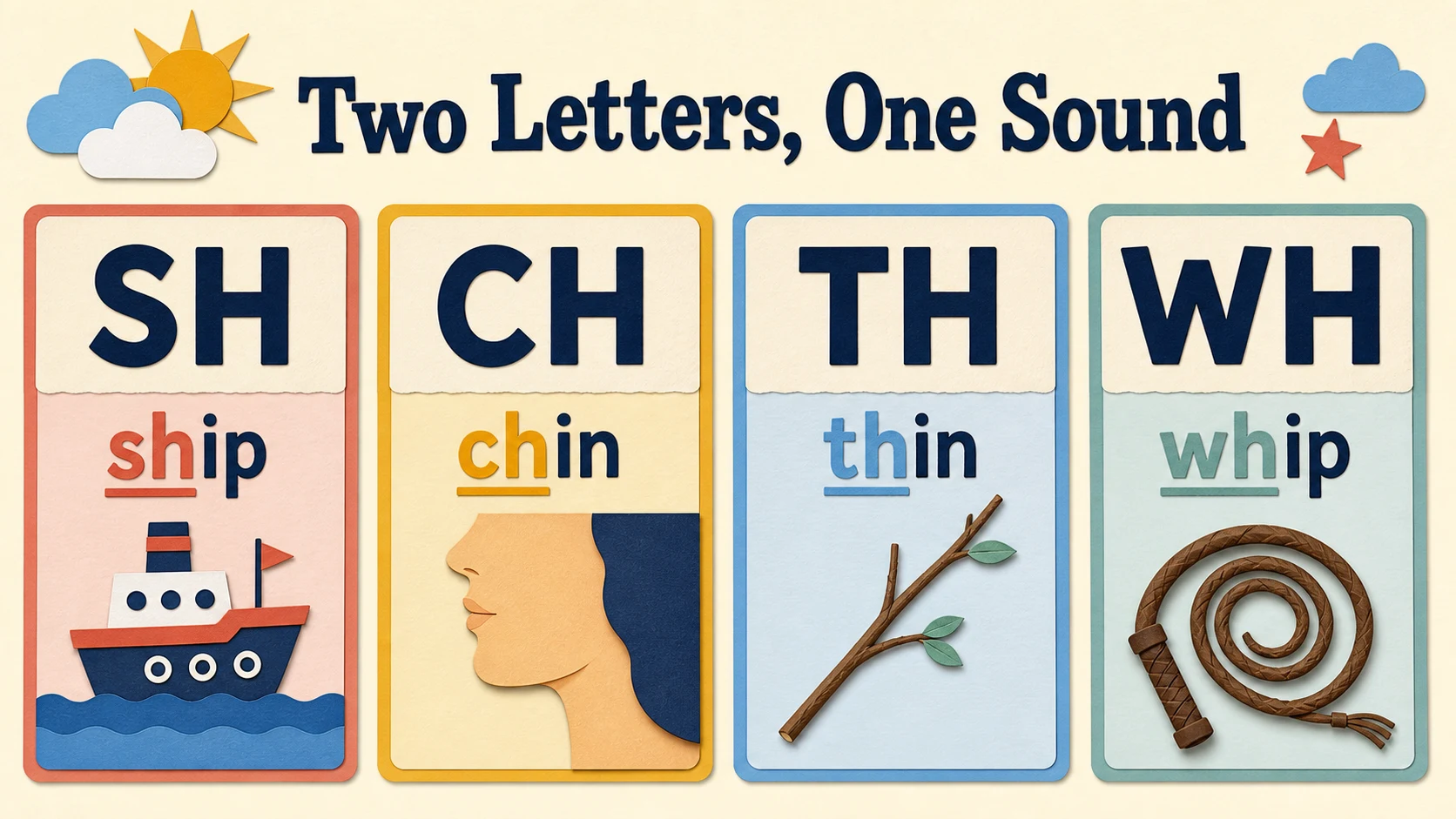
Move from a brief sound review to modeling, guided practice, independent attempts, feedback, and later retrieval.
What this exact worksheet practices
The instruction reads: “Read each word. Identify the digraph sound.” Its 20 items use these words:
- ch: choice, child
- sh: shine, shell, shift, shop, shed, shore, shirt
- th: thick, three, the, their, thought, then, thing
- wh: wheel, whip, wheat, whole
The activity therefore concentrates on recognizing these four digraphs at the beginnings of printed words. It also gives practice in word recognition and noticing letter combinations.
A consonant digraph is a pair of letters working together to represent one sound. In ship, for example, the letters s and h are read together as /sh/. That differs from a blend such as sl, where both consonant sounds remain audible.
The broader digraphs topic guide explains the larger progression, including initial and final positions, the two pronunciations of th, and the distinction between digraphs and blends. Use this article for teaching the present sheet rather than as a replacement for that progression.
The IES foundational reading practice guide provides the high-level instructional frame: connect speech sounds with letters, teach learners to decode words and analyze word parts, and include connected reading. IES did not evaluate WorksheetWise or this particular printable. The routines below are practical applications to this page, not sourced claims about its effectiveness.
Check readiness before beginning
Listen for prerequisite knowledge
Show the learner sh and ask, “What sound can these two letters make together?” Repeat with ch, th, and wh. Accept a correctly produced sound even if the learner does not know the term digraph.
Then try one familiar word orally. Say shop, stretch its sounds without separating s from h, and ask which sound comes first. If the learner hears /sh/, the sheet is likely usable with ordinary support.
More modeling may be needed if the learner:
- names each letter but cannot produce the combined sound;
- says /s/ and then /h/ for sh;
- guesses from the first letter alone;
- cannot track a short printed word from left to right; or
- becomes occupied with reading the entire word and loses the target pair.
These observations do not require abandoning the skill. They tell the adult how much support to provide and how many items to present at once.
Prepare the page for active responses
Print the worksheet and keep its separate answer key out of sight. Have a pencil, crayon, or small counters ready.
Notice that each item already displays a word followed by its target digraph label. For example, the page shows choice ch and wheel wh. This layout can support initial learning, but it also means a learner can copy or repeat the visible label without finding the digraph independently.
Choose one response format before starting:
- For introductory practice, let the learner read the printed label, find the matching letters inside the word, and circle them.
- For recall practice, cover each label with a narrow strip of paper or a small note. Reveal it only after the learner answers.
- For an oral lesson, point only to the word and ask the learner to say the digraph and its sound.
All three formats preserve the target skill: identifying a digraph in a word. Covering the answer changes the amount of prompting, not the phonics content.
A flexible lesson progression
The following sequence is an instructional suggestion, not a universal timetable. A learner who responds accurately may move through it in one sitting. Another learner may benefit from stopping after a few items and returning later.
| Stage | Suggested items | Adult action | Learner action | Evidence to notice |
|---|---|---|---|---|
| Sound review | No worksheet items yet | Display ch, sh, th, and wh | Say or imitate each sound | Does the learner treat each pair as a unit? |
| Model | 1–2 | Think aloud and mark the letters | Watch, listen, and repeat | Can the learner explain what was marked? |
| Guided practice | 3–6 | Prompt only when needed | Read, locate, circle, and say | Which prompt produces success? |
| Independent check | 4–8 | Conceal printed labels and observe | Complete a short set without coaching | Is identification accurate without the visible label? |
| Feedback | Missed items | Ask for a reread before supplying the answer | Recheck and correct | Can the learner repair an error? |
| Transfer | 1–2 familiar examples | Give an oral or handwritten word not copied from the page | Identify the same digraph | Does the skill extend beyond the practiced row? |
| Retrieval | Selected items later | Re-present a mixed set without labels | Retrieve the digraph and sound | Is the response retained after a delay? |
Do not insist on completing all 20 items if attention or accuracy declines. A smaller sample completed thoughtfully is more informative than a finished page produced through guessing.
Model the task explicitly
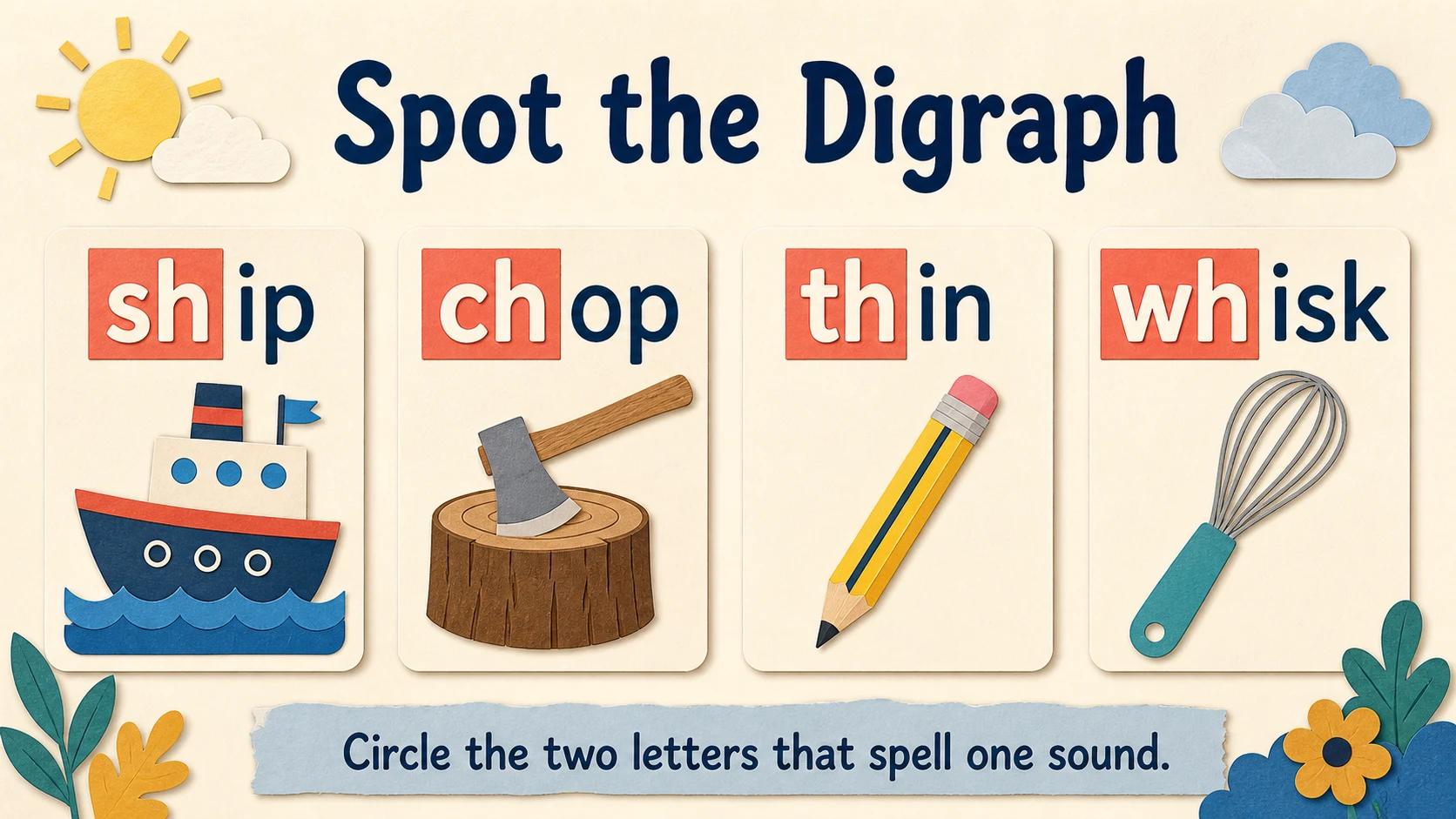
The adult reads the word, locates the two letters, joins them as one unit, and checks the sound.
Use a short think-aloud
Point to choice and say:
“I read the word choice. At the beginning, I see c next to h. These two letters work together here. I circle ch. The digraph is ch, and it represents the /ch/ sound at the beginning of choice.”
Keep the explanation focused. The vowel spelling in choice is not the target of this worksheet, so there is no need to teach it during the digraph response.
For a second model, use shine:
“I start at the left and see s and h together. I do not say the two letter sounds separately. Together, sh represents /sh/. I circle sh and read shine.”
After modeling, ask the learner to repeat the routine in plain language: “Read it, find the two letters, circle them, and say their sound.”
Four fully checked examples
These examples come directly from the printable.
Example 1: choice
- Printed word: choice
- Target letters: ch
- Position: beginning of the word
- Sound: /ch/
- Checked response: ch
Example 2: shine
- Printed word: shine
- Target letters: sh
- Position: beginning of the word
- Sound: /sh/
- Checked response: sh
Example 3: wheel
- Printed word: wheel
- Target letters: wh
- Position: beginning of the word
- Sound: /w/ or /hw/, depending on the speaker’s pronunciation
- Checked response: wh
Example 4: three
- Printed word: three
- Target letters: th
- Position: beginning of the word
- Sound: the unvoiced th sound heard at the beginning of three
- Checked response: th
The learner does not need the labels voiced and unvoiced. Those terms help the adult understand why three and the begin with the same letters but not exactly the same sound.
Two useful boundary examples
Thick contains th at the beginning and ck at the end. The page’s printed target is th, so that is the expected response for this item. However, the catalogue’s broader digraph scope also identifies ck as a digraph used after a short vowel at the end of words. If a learner points out ck, acknowledge the valid observation: “Yes, you found another letter team. On this row, we are looking for the beginning digraph, th.”
The begins with the voiced pronunciation of th, while three begins with its unvoiced pronunciation. Both answers are written th. A learner who notices that the sounds differ has made a useful observation, not an error.
Run guided practice without doing the thinking for the learner
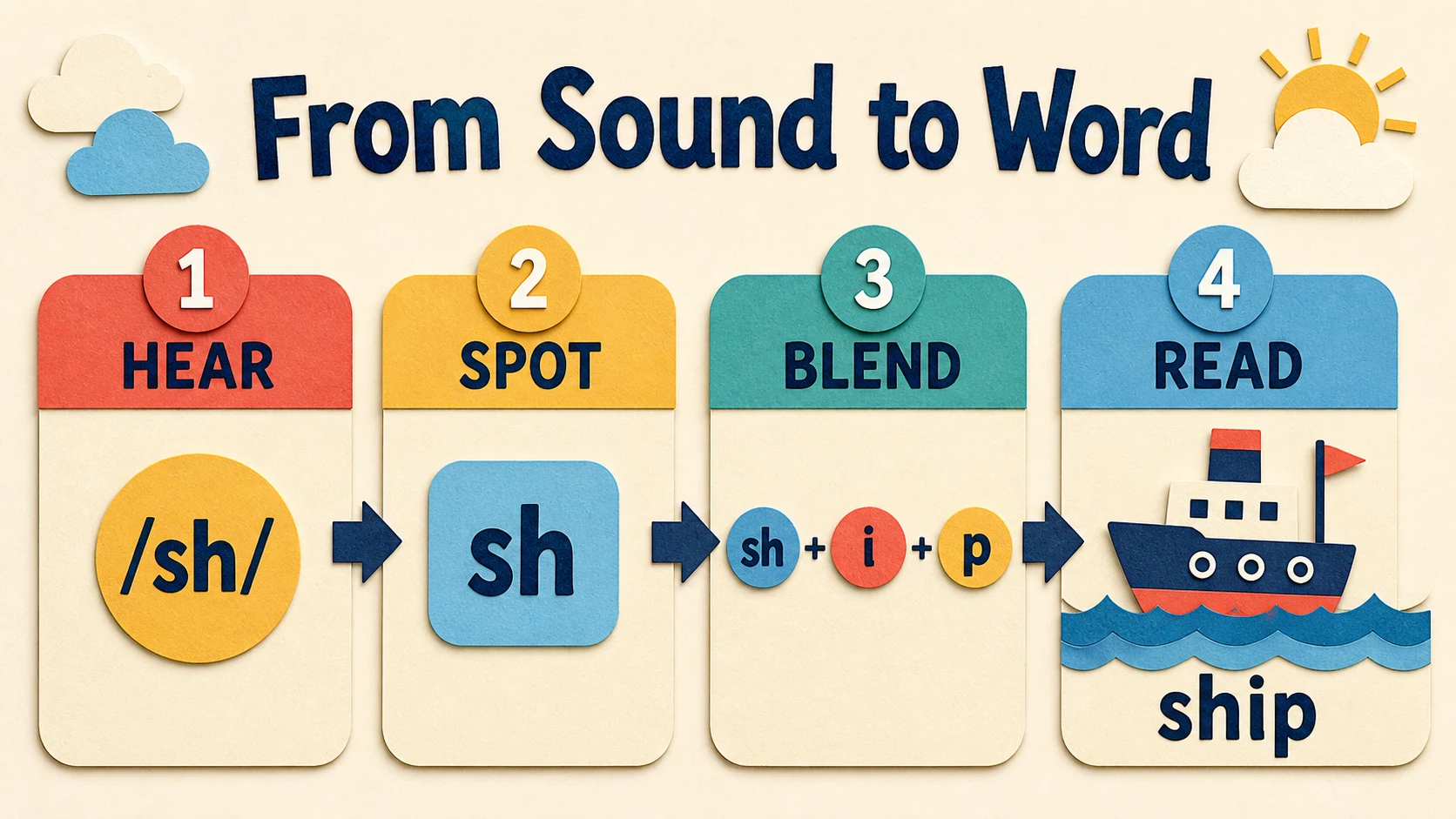
During guided practice, prompts become shorter as the learner takes over the routine.
Start with a word such as whip. Cover the printed wh label and use prompts in this order:
- “Read or try the word.”
- “Look at the first two letters.”
- “Do they work separately or together here?”
- “Circle the digraph.”
- “Say its sound.”
For shell, pause after “Look at the first two letters.” If the learner identifies sh, do not continue supplying prompts that are no longer needed.
For then, listen carefully. The correct letters are th, but the sound is voiced. If the learner gives the unvoiced sound from thing, say both words naturally—then, thing—and invite comparison. The written identification remains th in both cases.
A useful guided set is whip, shell, child, and then. It includes all four printed digraph categories. Shuffle the order rather than teaching a block of identical answers; a mixed set reveals whether the learner is looking at each word.
Fade prompts deliberately
Prompt fading means reducing help as soon as the learner shows that it is no longer necessary. Move from “Look at the first two letters” to “Find the digraph,” and then to silent observation.
Record the lightest support that led to a correct response:
- independent;
- correct after being asked to reread;
- correct after being directed to the first two letters;
- correct after hearing the sound;
- copied from the visible label.
These notes are more informative than a score alone. A copied answer and a retrieved answer may look identical on paper but reflect different levels of independence.
Shift to a short independent attempt
Choose four to eight unused items. Cover their printed labels and explain that the learner should:
- try each word;
- circle the digraph inside it;
- write or say the two letters; and
- say the sound represented in that word.
Good mixed choices include wheat, shop, their, child, shore, and thing. Do not correct the first error immediately if the learner is still working. A brief independent sample should show what the learner can do without continuous adult cues.
Watch the process as well as the final marks. Does the learner begin at the left? Is the learner circling exactly two letters? Does the learner check the word before answering? Does accuracy change when th is voiced or unvoiced?
If the learner reads a word imperfectly but correctly identifies its digraph, record those outcomes separately. The worksheet targets digraph identification, although it also asks the learner to read each word. Conversely, a learner might recognize the whole word from memory while being unable to explain which letters form the digraph.
Adapt support without changing the skill
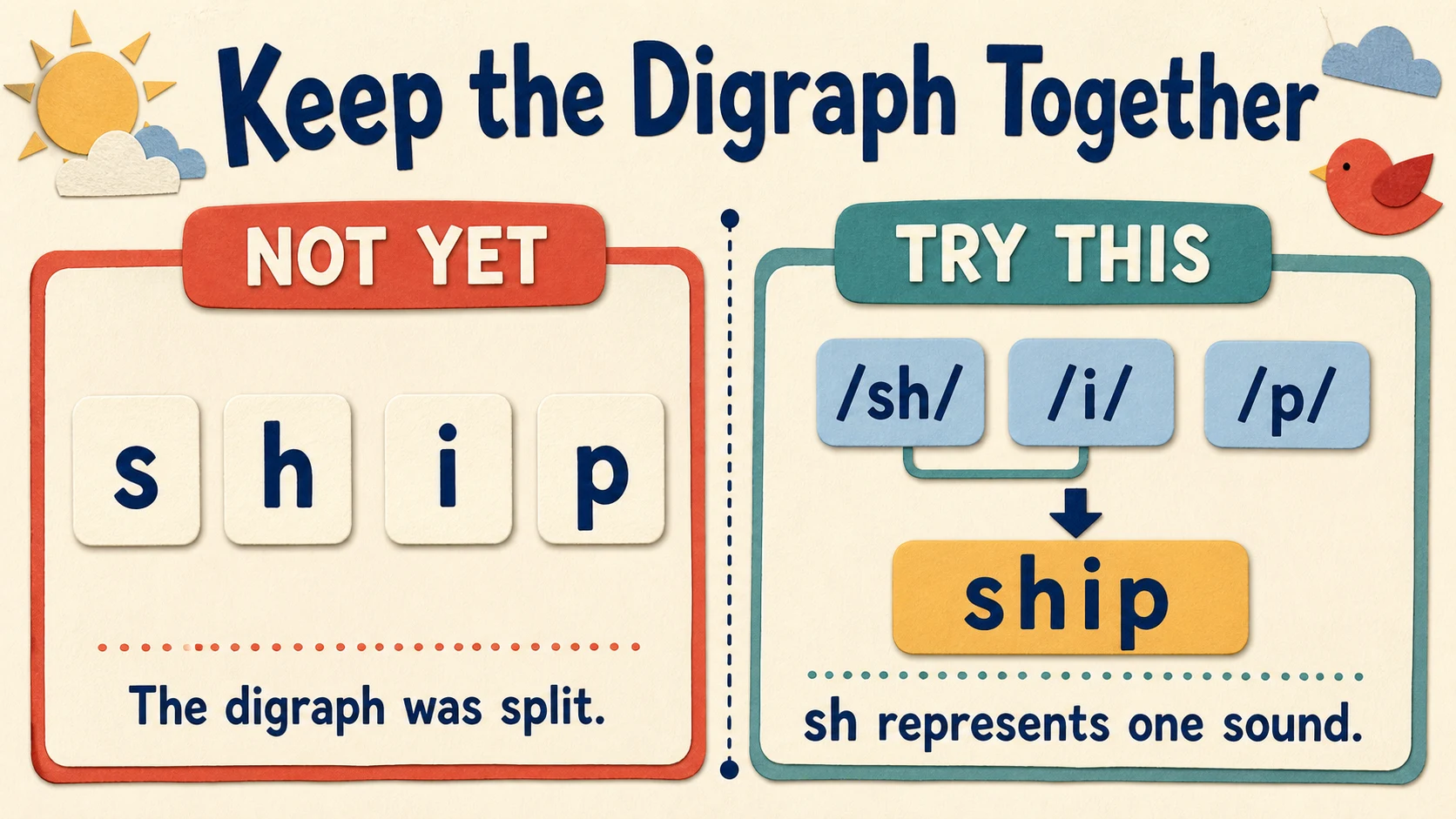
Adjust visibility, response method, or number of items while preserving identification of the same letter-sound unit.
When the learner needs more support
Present one row at a time by covering the rest of the page. Use the printed digraph label as a matching cue: “Find these same two letters inside the word.” After several successful matches, conceal the label and ask for recall.
You can also provide four digraph cards—ch, sh, th, and wh—and have the learner select the matching card before circling the letters. This reduces memory demands while retaining the comparison among the four target digraphs.
If reading the complete word is the obstacle, say the word once and ask the learner to track its print. The phonics task remains locating the letter pair connected with the heard beginning sound. Return to independent word reading when the learner’s responses indicate readiness.
When handwriting obscures phonics knowledge
Allow pointing, circling, placing a counter, or giving an oral response. The listed skill is identifying digraph sounds, not producing extended handwriting. A learner can demonstrate that skill without copying the complete word.
An optional follow-up is to copy one correctly identified digraph or one short word. The IES elementary writing guide includes handwriting and spelling fluency within its broader recommendations for writing instruction. That source does not evaluate this worksheet, and its public grade scope begins at grade 1, so copying should be treated here as an optional extension—not as evidence that Kindergarten learners must write every word.
When the learner is ready for less support
Remove the printed-label cue, mix items from different parts of the page, and ask for a brief explanation: “How do you know it is sh?”
A stronger response names the letters and connects them to the sound in the word. A weaker response such as “I just know” may still be correct, but it gives less evidence that the learner can analyze an unfamiliar word.
Do not make the task harder by introducing unrelated vowel rules or longer spelling tests during the check. Increase independence while holding the digraph-identification skill steady.
Interpret errors before assigning more practice
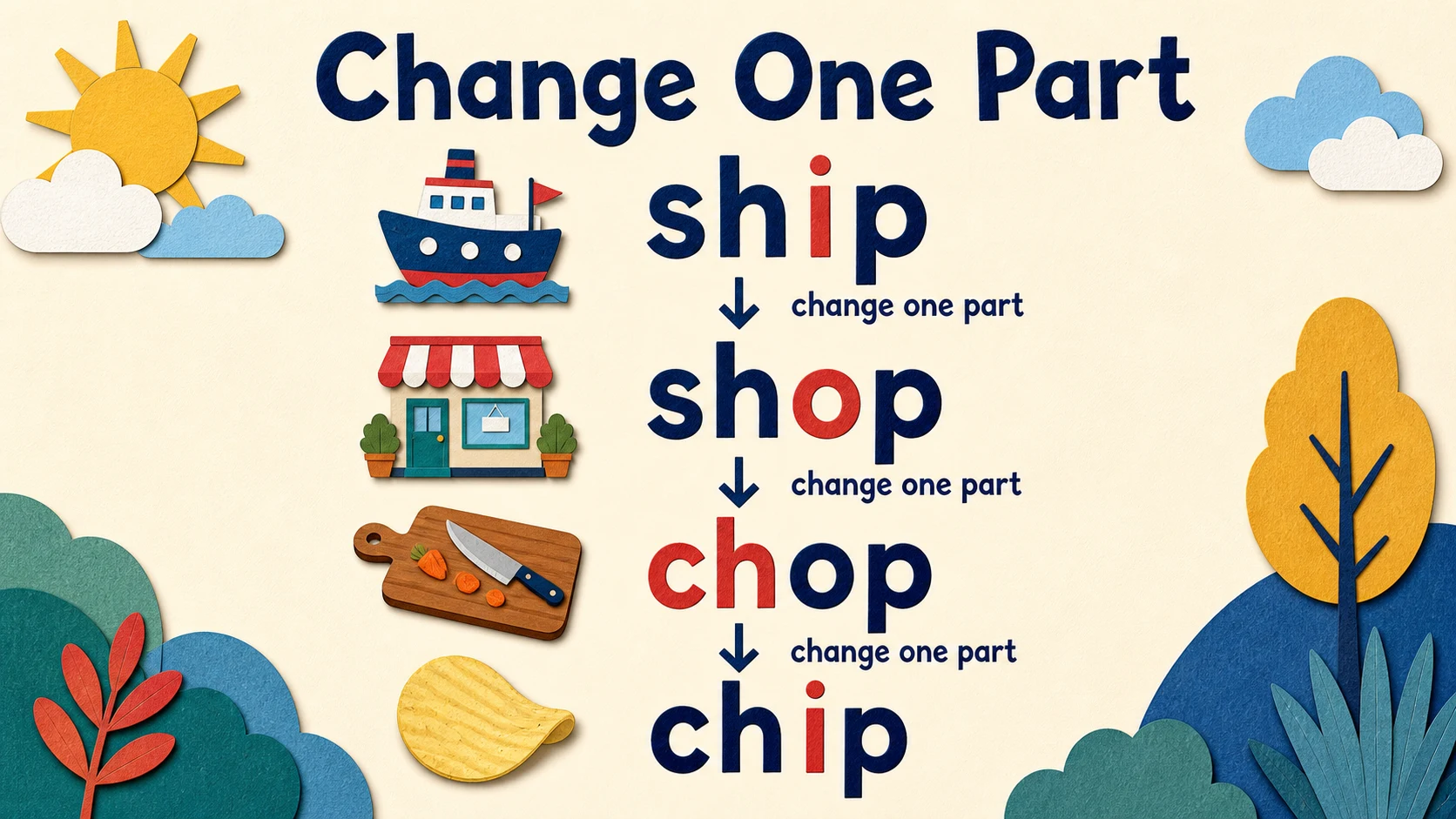
Reread the word, locate the letters, say the sound in context, and compare with the intended target.
Common error patterns
The learner names only the first letter.
For shine, the learner says s. Point to both initial letters and say, “These two are a team in this word.” Model /sh/, then have the learner blend the whole word again.
The learner separates the digraph.
For child, the learner says /k/ followed by /h/. Join two fingers or slide a pencil under ch as one unit. The physical cue should emphasize one represented sound from two letters.
The learner confuses visually similar pairs.
If wh is called sh, ask the learner to name the two printed letters before producing the sound. This distinguishes a letter-recognition error from a sound-recall error.
The learner gives one pronunciation for every th word.
Compare the with three or then with thing. Keep the spelling constant and say each word naturally. The goal is exposure to both pronunciations, not memorizing technical labels.
The learner relies on the printed answer.
Cover the label and retry a different item with the same digraph. A correct second response without the cue provides better evidence of recall.
The learner identifies ck in thick.
Recognize that ck is a legitimate digraph observation, then redirect to the worksheet’s printed target, the initial th. Do not describe the learner’s reasoning as nonsense or guessing.
Separate decoding, identification, and articulation
A wrong response can come from different places:
- The learner may not recognize the letters.
- The letters may be recognized, but their combined sound is not recalled.
- The sound may be known, but the complete word is difficult to decode.
- The correct sound may be produced differently because of the learner’s ordinary speech pattern.
- The learner may understand the item but struggle to record the response.
Retest the smallest uncertain step. Ask for the letters, then the sound, then the word. This prevents unnecessary repetition of a skill the learner already knows.
Check the answer key responsibly
The separate answer key can confirm the intended label for each row: ch, sh, th, or wh. Use it after the learner has attempted the selected items.
The key repeats the item’s word along with its intended answer, while the student page itself already prints a digraph label. Therefore, neither page should be used as a stand-alone mastery measure. The adult still needs to observe whether the learner found the letters independently, read the word, and produced the appropriate sound.
Use this checking sequence:
- Ask the learner to reread the word.
- Have the learner point to the circled letters.
- Compare those letters with the intended label on the key.
- Ask for the sound in the complete word.
- Let the learner correct the mark.
- Note whether correction was independent or prompted.
Do not calculate a percentage unless it serves a clear local purpose. A pattern is usually more actionable: all sh items secure, wh confused with sh, or th identified but pronounced inconsistently.
The Common Core English Language Arts standards provide grade-specific literacy expectations within a much broader framework. This worksheet’s catalogue references standards from later grades, but the page is labeled for Kindergarten practice. Do not present one completed sheet as comprehensive standards alignment. Grade labels describe the intended practice level, and local school, district, state, and homeschool sequences differ.
Decide what to teach next
Continue the same level when responses depend on prompts
Stay with these four digraphs if the learner succeeds only when the printed label remains visible, needs repeated sound models, or guesses from the first letter.
Reuse a smaller mixed group rather than immediately assigning all 20 items again. For example, revisit shop, wheel, child, and thing. Cover the labels and compare the new level of independence with the earlier attempt.
Broaden practice when identification is independent
If the learner accurately identifies the digraphs, says their sounds in the printed words, and corrects an occasional slip after rereading, move beyond repeated completion of the same page.
The next lesson might mix initial and final digraphs, contrast digraphs with blends, or place familiar digraph words in short decodable text. Those are instructional suggestions consistent with the catalogue’s topic scope. Consult the Kindergarten phonics hub or the broader topic guide to choose a resource that matches the learner’s current work.
Pause and rebuild a prerequisite when the task breaks down
If the learner cannot reliably name the letters in sh, ch, th, and wh, return briefly to letter recognition. If the learner knows the pairs but cannot blend even after hearing the word, practice blending familiar short words alongside—rather than instead of—the digraph work.
The observed barrier should determine the next lesson. Repeating a full page is unlikely to clarify whether the difficulty lies in letters, sounds, blending, word recognition, or the response method.
Schedule retrieval after the first lesson
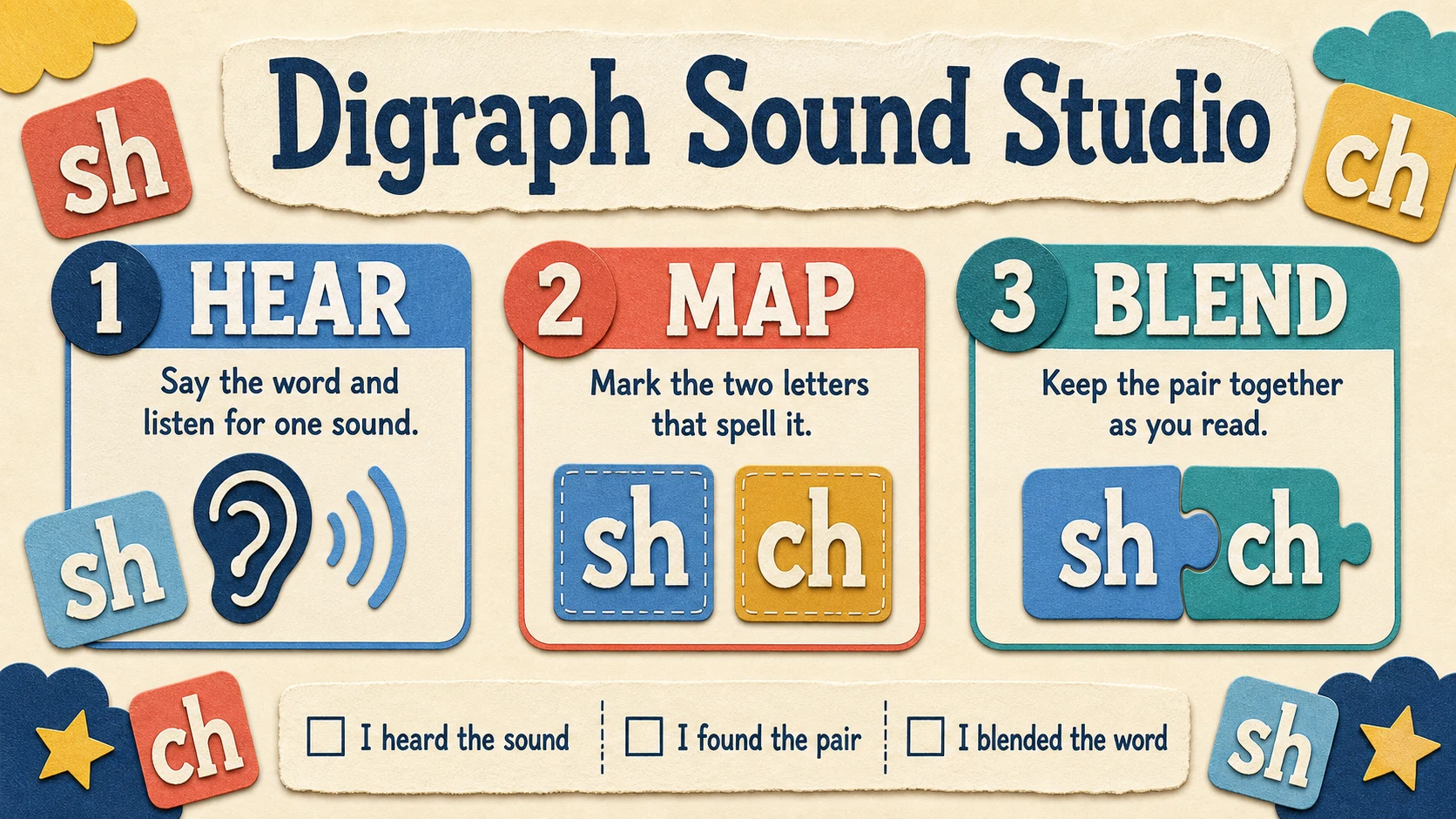
Revisit a small mixed sample after increasing delays and adjust the spacing according to what the learner retains.
This is a sample scheduling plan, not a sourced or universal timetable:
| Review point | Suggested task | Decision |
|---|---|---|
| End of the first lesson | Retry two missed words without visible labels | Reteach immediately if the same error returns |
| Next learning day | Identify four mixed digraphs from unused or previously covered rows | Shorten support if responses are independent |
| A few days later | Recheck one ch, one sh, one th, and one wh word | Revisit only the uncertain categories |
| About a week later | Mix worksheet words with a few familiar words from instruction | Continue if the learner transfers the skill |
| Later cumulative review | Include digraph words with previously learned phonics patterns | Use the result to select the next practice level |
Change the interval when the work calls for it. If recall is fragile, review sooner and use fewer items. If responses remain accurate and explained, increase the delay or move to more varied examples. Retrieval should provide new evidence, not become automatic recitation of the page order.
Understand the worksheet’s limitations
This printable offers focused practice, not a complete phonics lesson or assessment. Its 20 words emphasize initial ch, sh, th, and wh. It does not sample final digraphs such as the sh in wish, provide systematic practice with ck, contrast digraphs with blends on the page, or include connected sentences.
Several words also contain spelling features beyond the stated target. Choice, wheel, wheat, thought, and whole should not be used to infer mastery of their vowel patterns. Keep attention on the intended beginning digraph unless another observation reveals useful learner thinking.
The visible digraph labels make the page accessible for introductory recognition but limit what an unmodified completion can reveal about recall. Concealing the labels creates a more informative check while preserving the skill.
Most importantly, this worksheet cannot establish reading level, diagnose a learning condition, guarantee progress, or demonstrate comprehensive standards alignment. Use it as one observation within ongoing instruction.
Take the next useful step
Download the free 20-item worksheet, choose four mixed words, and begin with one model plus three guided attempts. Record whether each response is independent, prompted, or copied from the visible label.
After the later retrieval check, use the digraphs topic guide to select the next skill. If the learner needs broader repeated practice, the Kindergarten Digraphs Worksheet Pack contains 18 worksheets. If a custom mix would better match the errors you observed, explore the free worksheet generators.
Put it into practice
Use the guide with a real printable
Move from explanation to a short, observable practice task. Check the first item together, then adjust the next session from the learner's actual work.
See the 18-worksheet pack