Complete guide
How to teach and practise kindergarten cvc words worksheets - standard theme (easy)
What this worksheet teaches
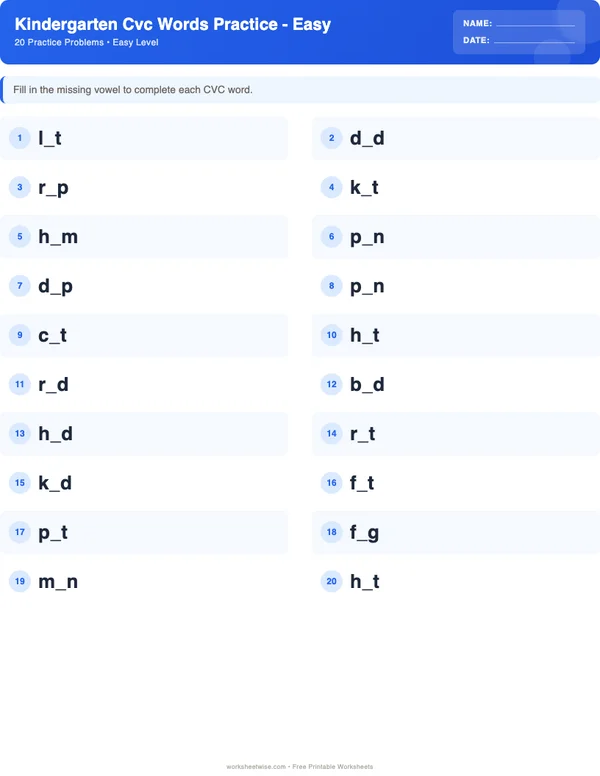
The free Kindergarten CVC Words worksheet gives a learner 20 easy-level exercises with one direction: fill in the missing vowel to complete each consonant-vowel-consonant word. The learner must inspect the two visible consonants, identify or confirm the intended word, choose a short vowel, write it in the middle, and blend the completed word.
Use the printable as a short lesson, not merely a page to finish. Model two or three examples, solve a small group together, and then release the learner to work independently. If errors cluster around one vowel contrast, return to oral listening and blending before assigning more items. The learner’s observed work—not a fixed timetable—should determine the pace.
This worksheet practices phonemic awareness, vowel sounds, decoding, and blending. It also asks the learner to write individual lowercase vowels. The separate answer key makes checking efficient, but it cannot show whether a correct answer came from decoding, guessing, picture clues, or adult prompting. Watch and listen while the learner completes at least part of the page.
Grade labels describe the intended practice level; they do not establish a universal sequence or guarantee that every Kindergarten learner is ready for the same task. Local curricula and instructional sequences differ. For the larger CVC sequence, including work across the five short-vowel families, use the CVC Words topic guide.
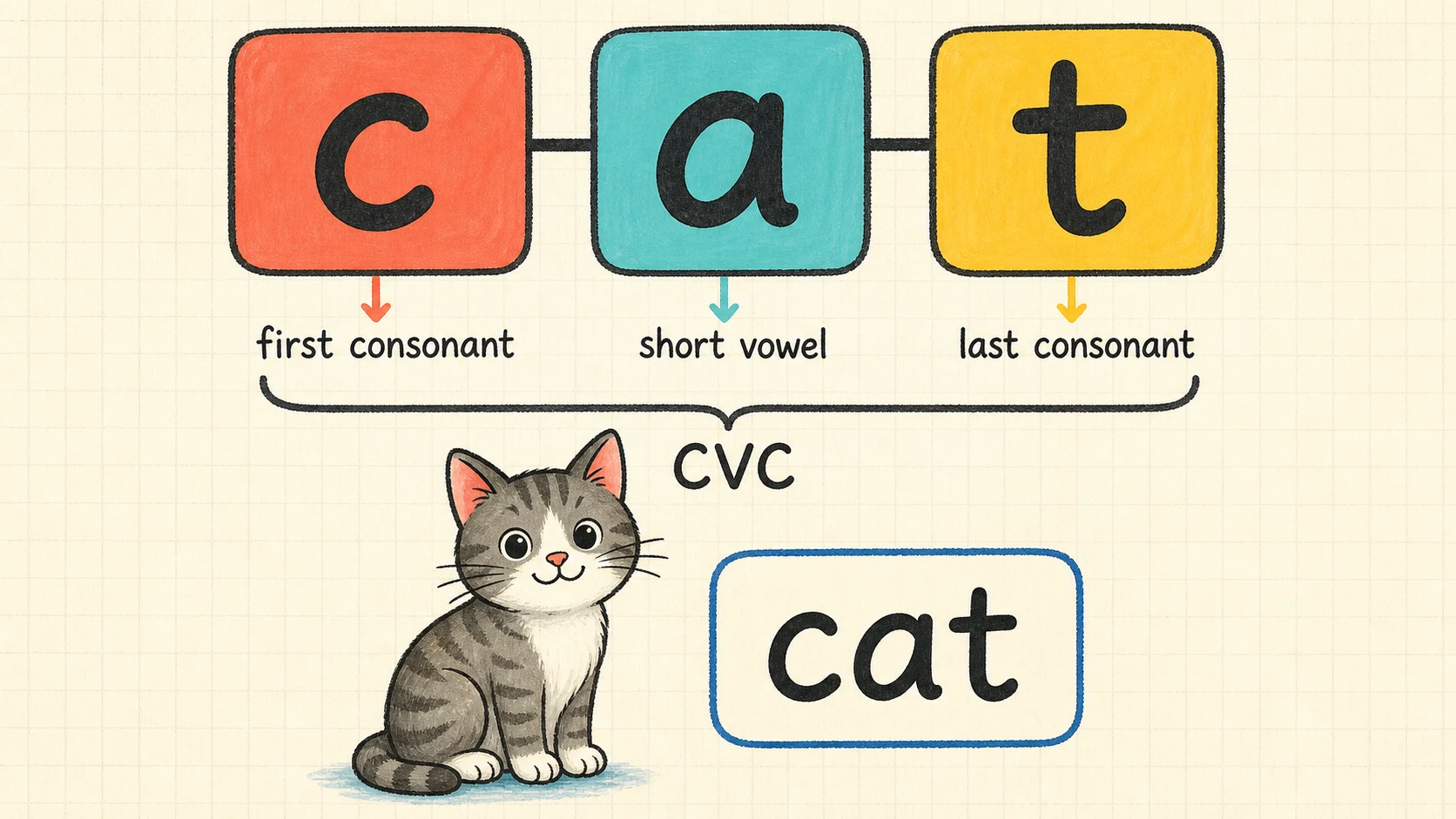
A practical route from oral warm-up through modeling, practice, checking, and later review.
Prepare a focused CVC lesson
Print the worksheet and, if needed, the separate answer key. Keep the key out of the learner’s view. Have a pencil and eraser ready. Optional supports include three connected sound boxes, three counters, or movable vowel letters: a, e, i, o, u.
Before beginning, confirm that the learner understands the page’s basic conventions:
- A letter is missing from the middle of each word.
- The missing letter must be a vowel.
- The completed word has three letters in a consonant-vowel-consonant pattern.
- The learner should say the sounds and blend the word, not select a vowel solely because it “looks right.”
The IES foundational reading practice guide recommends developing awareness of speech sounds and their links to letters, then teaching learners to decode and write words. That high-level framing supports combining oral sound work, letter selection, blending, and brief spelling practice. The guide did not evaluate this particular WorksheetWise printable.
Start with an oral readiness check
Say three familiar CVC words without showing them in print—for example, map, sit, and log. Ask the learner to say each word slowly and identify the middle sound.
Accept the sound before asking for the letter name:
- “Map. The middle sound is /ă/. The letter that spells it here is a.”
- “Sit. The middle sound is /ĭ/. The letter is i.”
- “Log. The middle sound is /ŏ/. The letter is o.”
This quick check separates two demands. A learner may hear the middle sound but forget its letter, or know the vowel letters but have difficulty isolating a sound within a word. Those situations need different prompts.
Do not turn the warm-up into a long preliminary test. If the learner can attend to three sounds and connect at least some of them to letters, move to the printed model and observe what happens.
Use a short, adjustable lesson sequence
The times below are instructional suggestions, not sourced requirements or a universal timetable.
| Lesson phase | Adult action | Learner action | Suggested amount |
|---|---|---|---|
| Oral warm-up | Say CVC words and emphasize the middle sound | Identify or repeat the vowel sound | 2–3 words |
| Model | Think aloud while completing an analogous item | Watch, listen, then reread the word | 2 examples |
| Guided practice | Prompt only as much as needed | Complete and blend several words | 3–5 items |
| Independent practice | Observe without supplying answers | Complete a manageable group | 5–10 items |
| Check and repair | Compare with the key and revisit errors | Explain, correct, and reread | Selected items |
| Retrieval | Re-present a few words later without the completed page | Recall, build, read, or spell | 3–5 words |
The full page has 20 exercises, but it does not have to be completed in one sitting. A clean stopping point after 5 or 10 items may produce more useful evidence than pushing through declining attention.
Model the missing-vowel routine explicitly
Use an example similar to the worksheet rather than completing a live worksheet item for the learner. Write c_t where both of you can see it.
Say: “The first letter is c, and the last letter is t. I need a vowel in the middle. I think the word may be cat. I will try a: /k/ /ă/ /t/. Now I blend it: cat. That is a complete CVC word, so I write a.”
A useful routine is:
- Look at the first and last letters.
- Say the intended word if it is clear from the item.
- Stretch or segment its three sounds.
- Listen closely to the middle sound.
- Match that sound to a vowel letter.
- Write the vowel.
- Blend the entire word and check it.
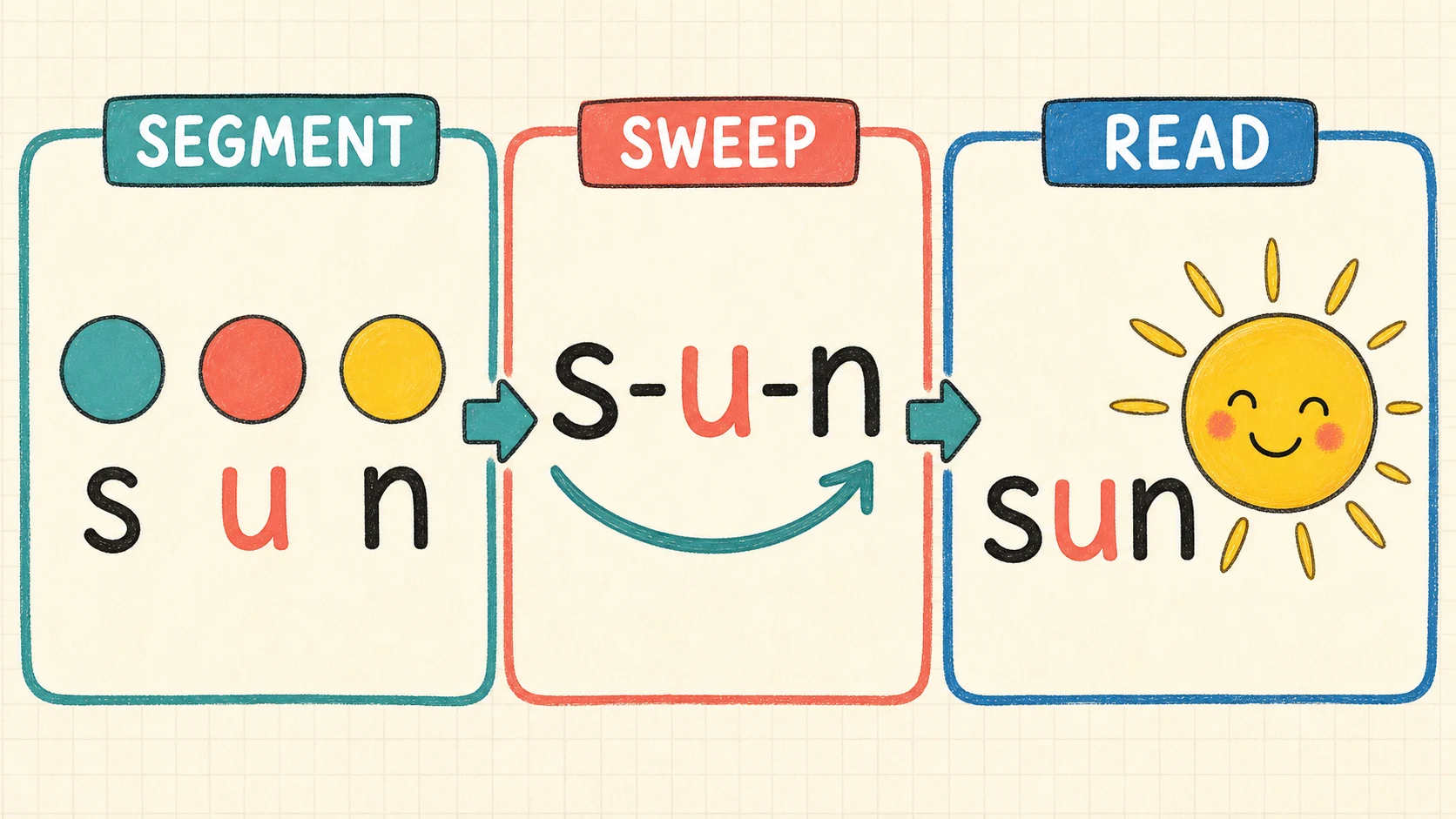
The missing vowel is chosen from the middle sound and then verified by blending the completed word.
Model listening, not trial-and-error guessing
Avoid beginning with “Which of these five letters looks best?” That can turn the work into visual guessing. Begin with the spoken word and its sounds.
For p_n → pin, the decisive information is the middle /ĭ/ sound. The visible p and n establish the outside letters, but they do not independently determine the vowel. The learner must connect the intended spoken word with its printed form.
Continuous blending can help preserve the word while the learner reads across it. For a word such as sun, move from the sounds toward the whole word without long pauses: /sssŭnnn/ → sun. Some stop consonants cannot be stretched naturally, so keep them brief rather than adding an extra vowel sound. For map, say /m/, /ă/, /p/—not “muh-a-puh.”
Show how writing completes the reasoning
After selecting the vowel, write it carefully in the blank and reread the whole word. The writing is part of the response, but this remains primarily a phonics task. A reversed, oversized, or imperfectly formed vowel can still reveal correct sound-letter reasoning.
The IES elementary writing practice guide includes handwriting and spelling fluency within broader writing instruction. It applies to elementary writing generally and did not assess this worksheet. Here, its relevance is limited: the learner should get a brief opportunity to form the letter and spell the word, but handwriting correction should not overwhelm the vowel lesson.
Move from guided to independent practice
During guided practice, choose a small number of worksheet items. Ask the learner to do the thinking while you control the prompt level.
A restrained prompt sequence is:
- “Say the whole word.”
- “Stretch the word.”
- “What sound do you hear in the middle?”
- “Which letter spells that sound?”
- “Write it and blend the whole word.”
Pause after each prompt. Do not ask all five questions automatically. If the learner responds after “Stretch the word,” further prompting would hide what the learner can do independently.
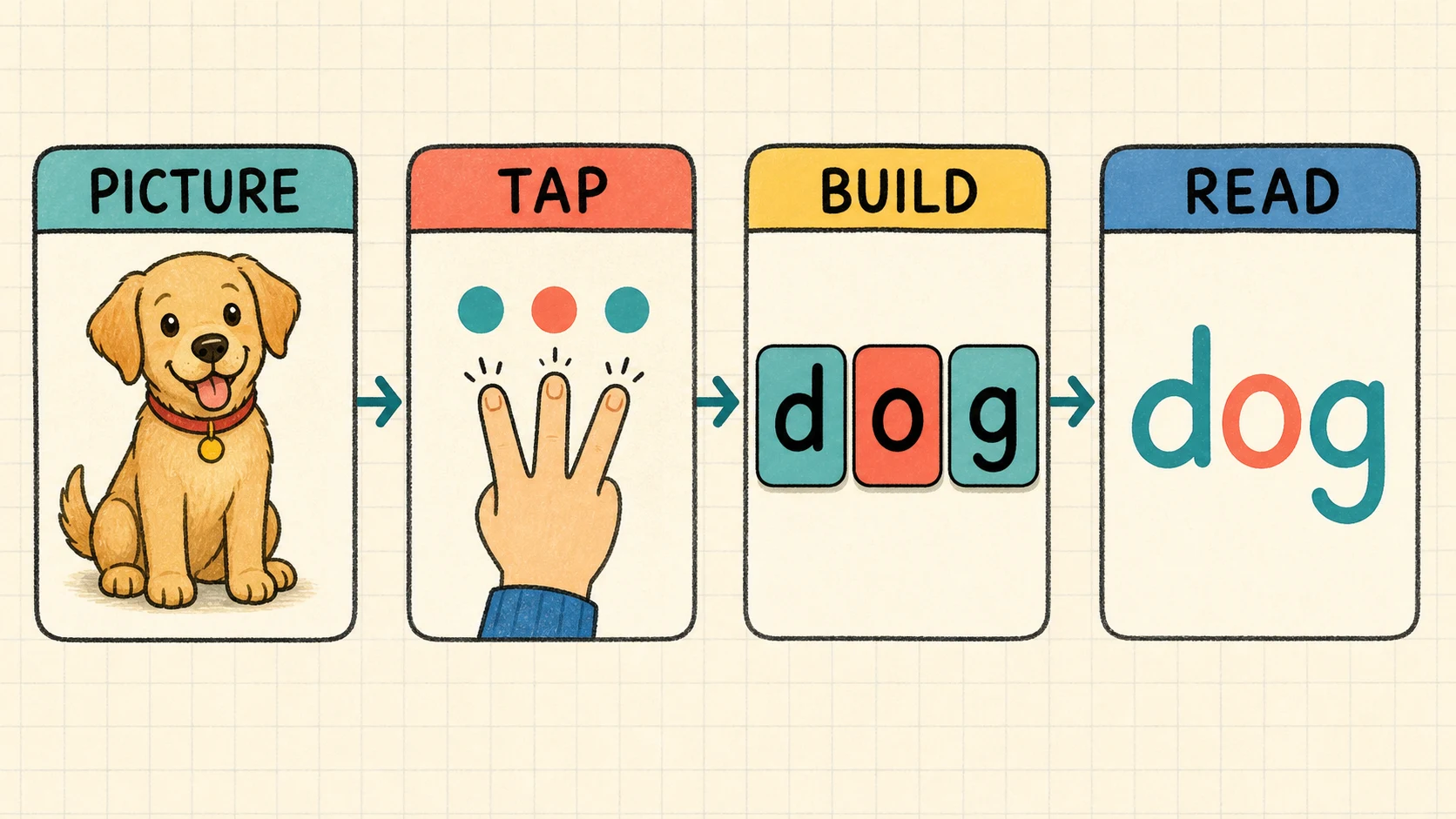
Guided practice supplies a repeatable routine while leaving the vowel decision to the learner.
Decide when to release responsibility
Move to independent work when the learner can complete several guided items while:
- attending to the middle sound;
- selecting a plausible vowel without being told its name;
- blending the completed word;
- recognizing and attempting to repair a word that does not match the intended word.
“Independent” should mean that the adult does not identify the vowel or mouth the answer. You may restate the printed direction, encourage the learner to use the routine, or mark a stopping point.
If the learner needs a full prompt on nearly every item, return to guided practice. Independence is not demonstrated by filling every blank while the adult supplies each sound.
Keep observation purposeful
While the learner works, record brief evidence rather than commenting on every response. A simple notation might include:
- I for independent;
- P for completed after a general prompt;
- S for completed after a sound-specific prompt;
- E for an uncorrected error.
These marks are for instructional planning, not a formal standardized score. Two learners with 17 correct answers may need different next steps if one worked independently and the other received 12 sound prompts.
Use fully checked examples to make the process visible
The following examples are constructed to demonstrate the worksheet’s missing-vowel skill. They should not be treated as a transcription of the 20 printed items.
Example 1: c_t becomes cat
- Visible consonants: c, t
- Intended spoken word: cat
- Segmented sounds: /k/ /ă/ /t/
- Middle sound: /ă/
- Letter representing the middle sound: a
- Completed word: cat
- Verification: blending /k/ /ă/ /t/ produces cat
The checked answer is a. If the learner writes o and reads cot, the response forms another real CVC word but does not match cat. That is a vowel-selection error, not random letter formation.
Example 2: p_n becomes pin
- Visible consonants: p, n
- Intended spoken word: pin
- Segmented sounds: /p/ /ĭ/ /n/
- Middle sound: /ĭ/
- Letter representing the middle sound: i
- Completed word: pin
- Verification: /p/ /ĭ/ /n/ blends to pin
The checked answer is i. If the learner says “pin” correctly but writes e, ask for the middle sound again. This response may reflect confusion between the vowel sound and the vowel letter rather than a blending problem.
Example 3: h_n becomes hen
- Visible consonants: h, n
- Intended spoken word: hen
- Segmented sounds: /h/ /ĕ/ /n/
- Middle sound: /ĕ/
- Letter representing the middle sound: e
- Completed word: hen
- Verification: the completed spelling blends to hen
The checked answer is e. If the learner writes i and reads the result as “hen,” point to the middle letter and have the learner produce the sound represented in this word. The mismatch lies between print and speech.
Example 4: l_g becomes log
- Visible consonants: l, g
- Intended spoken word: log
- Segmented sounds: /l/ /ŏ/ /g/
- Middle sound: /ŏ/
- Letter representing the middle sound: o
- Completed word: log
- Verification: /l/ /ŏ/ /g/ blends to log
The checked answer is o. If the learner correctly identifies /ŏ/ but cannot name or write o, provide the vowel choices and ask for the matching letter. Preserve the sound decision.
Example 5: s_n becomes sun
- Visible consonants: s, n
- Intended spoken word: sun
- Segmented sounds: /s/ /ŭ/ /n/
- Middle sound: /ŭ/
- Letter representing the middle sound: u
- Completed word: sun
- Verification: the three sounds blend to sun
The checked answer is u. If the learner inserts a and reads “san,” ask the learner to compare the spoken words sun and san. The goal is to hear that changing the vowel changes the word.
Handle boundary cases without changing the skill
A missing-vowel item can be deceptively ambiguous when viewed without its full context. The same outside consonants may allow several real words: c_t can become cat, cot, or cut. Similarly, p_n can produce pan, pen, or pin.
The intended answer must therefore come from the worksheet’s complete item and its answer key—not from the consonant frame alone. If an item supplies a picture or another cue, use that cue to identify the intended word, then require the learner to confirm the vowel through sound analysis. Do not declare every other possible real word correct without checking what the item asks.
Separate accents from misunderstandings
Short-vowel pronunciations can vary across dialects and accents. Do not correct a learner merely for speaking differently from you. Say the intended word naturally, ask the learner to repeat it, and focus on matching the worksheet’s expected word to its conventional spelling.
This is instructional guidance, not a claim that every regional pronunciation creates the same sound contrast. When pronunciation makes an item genuinely unclear, provide the intended spoken word and assess the learner’s ability to connect that word to the middle letter.
Keep CVC boundaries clear
A CVC word has three phonemes in the targeted pattern for this activity. Words with consonant digraphs, blends, silent e, or long-vowel spellings introduce additional relationships. They should not be substituted into these blanks merely to increase difficulty.
Likewise, the letter y can function as a vowel in some English words, but the task described in this worksheet concerns the familiar short-vowel letters a, e, i, o, and u in simple CVC words. Keep enrichment from obscuring the page’s specific skill.
The Common Core ELA standards provide grade-specific literacy expectations within a broader reading, writing, speaking, listening, and language framework. The catalogue associates this CVC topic with isolating sounds, connecting letters and sounds, blending, and decoding. That is contextual information, not a claim of comprehensive standards alignment for this single printable. Schools and homeschool programs may use other standards or arrange instruction differently.
Adapt support while preserving the vowel task
Support should reduce an unnecessary barrier without supplying the central answer. The learner must still identify the missing middle sound and connect it to a vowel.
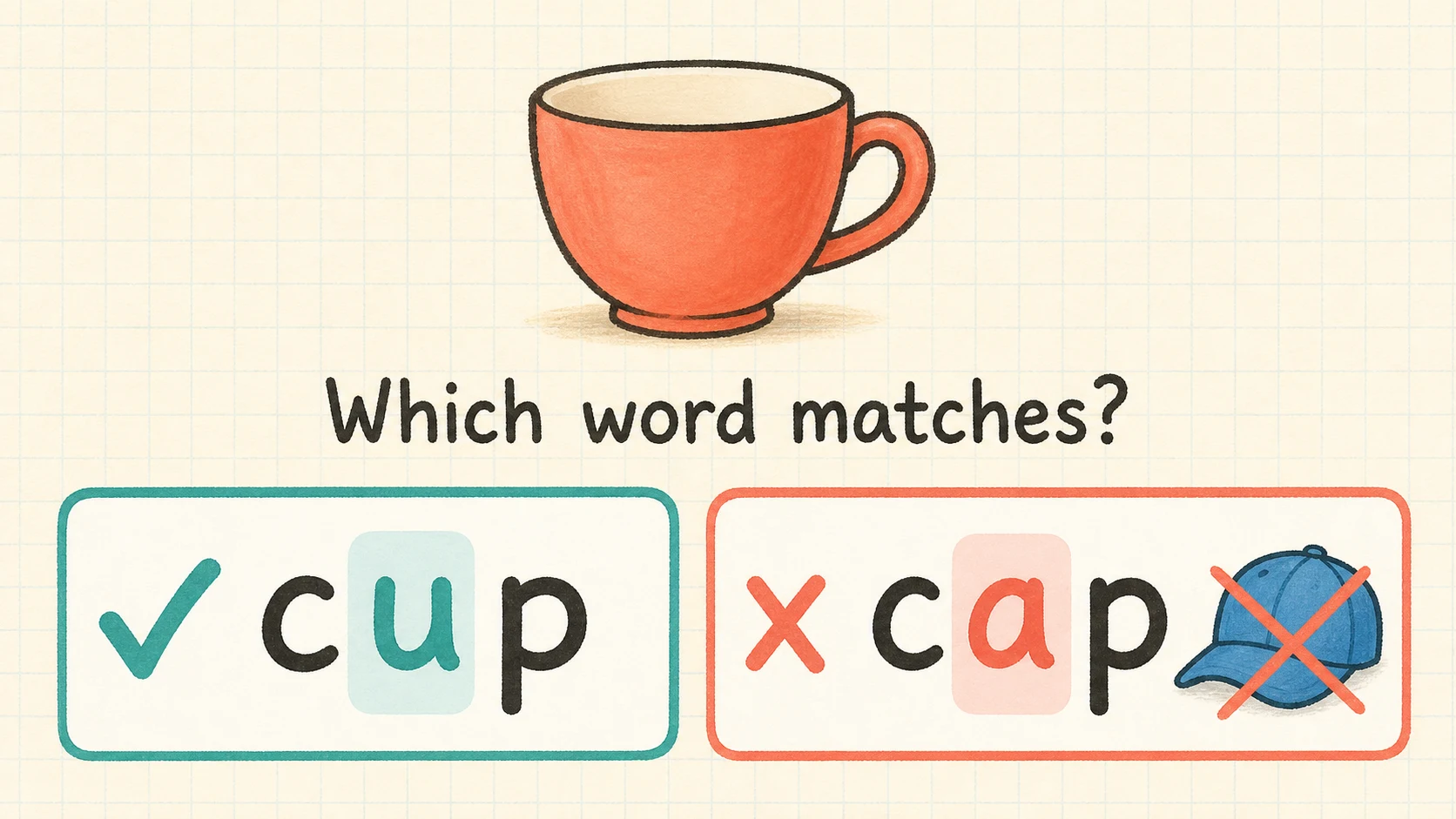
Sound boxes, limited vowel choices, and smaller item groups can change access while preserving the same decision.
For a learner who cannot isolate the middle sound
Use three connected sound boxes. Say the intended word and have the learner push one counter into each box while saying its sounds. Touch the middle box and ask, “What sound is here?” Then match that sound to a letter.
If counters distract the learner, use three fingers or three taps. The representation may change; the target remains the medial vowel.
For a learner who knows sounds but forgets vowel letters
Place a, e, i, o, u on movable cards. After the learner says the middle sound, ask which card represents it. If five choices are overwhelming, present two contrasting letters for one item—for example, a and i—and expand the set when responses become stable.
Record that a choice set was used. A correct response from two options is useful progress, but it is different from recalling the letter independently.
For a learner whose attention or handwriting is limiting performance
Cover all but one row, or assign five items at a time. Let the learner point to a vowel card before writing it. If handwriting effort is masking phonics knowledge, the adult may write one dictated response during guided practice, provided the record notes that the learner selected the sound and letter orally.
Return to learner-written vowels when possible. The worksheet includes writing, but fatigue should not be misread as an inability to hear short vowels.
For a learner who completes the page easily
Do not simply require faster completion. Ask the learner to reread selected words without pausing between sounds, build two or three with movable letters, or spell a few from dictation after the page is removed.
A carefully chosen unfamiliar or nonsense CVC form can check whether the learner is applying sound-letter relationships instead of recalling familiar words. Label it clearly as a made-up word. This extension still targets decoding; it should not replace ordinary meaningful word reading.
More worksheets are not automatically the right response. The Kindergarten phonics hub can help you choose a related practice type, while the broader topic guide explains where CVC work sits in the available progression.
Interpret errors before assigning more practice
An incorrect vowel is evidence to investigate, not a complete diagnosis. Ask the learner to explain or redo the item with the routine. The repair attempt often reveals more than the original mark.
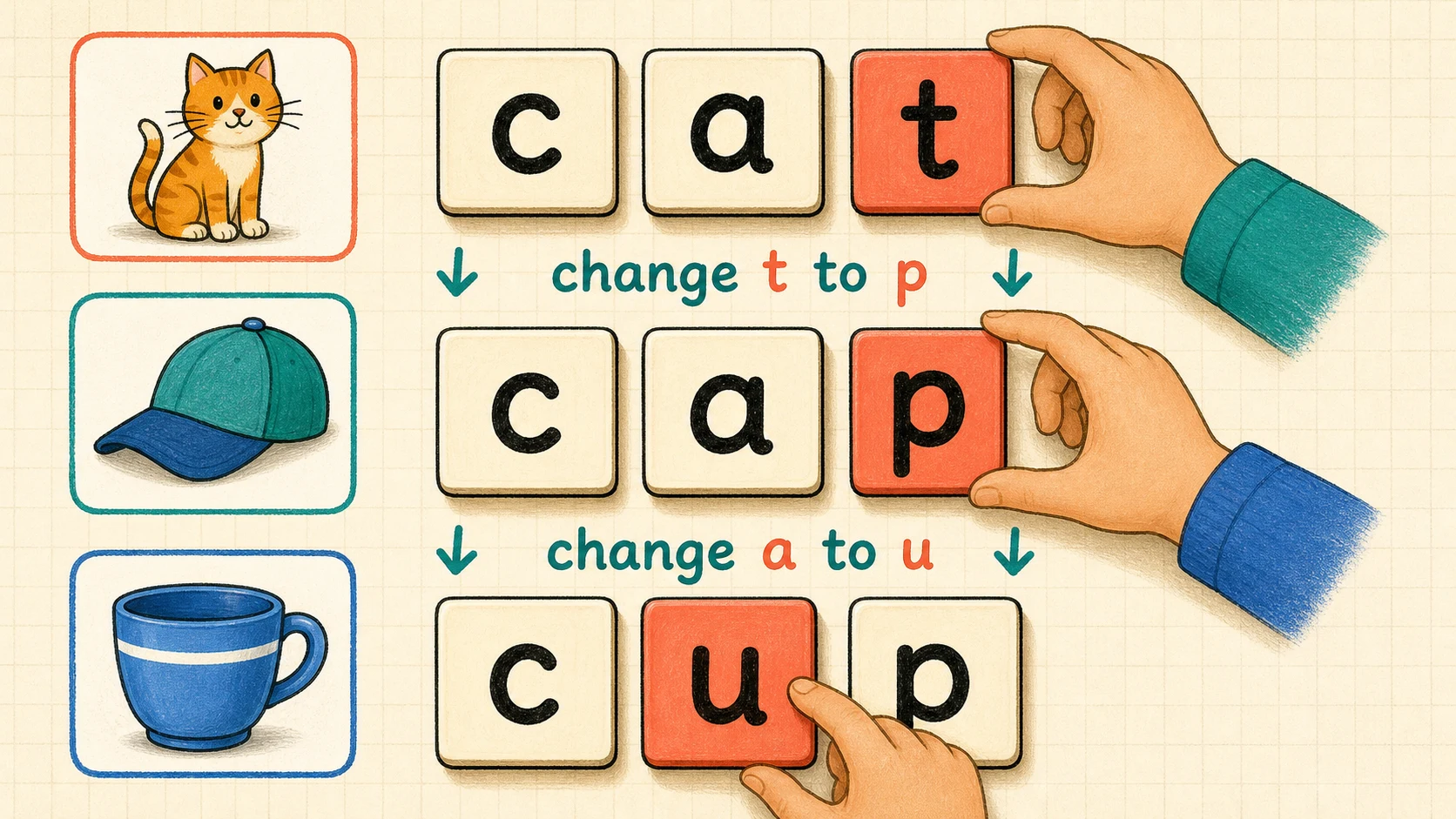
Check the spoken word, segment its sounds, inspect the middle letter, blend, and compare again.
Common error patterns and responsive prompts
| Observed work | Possible instructional issue | Useful next prompt |
|---|---|---|
| Says the wrong intended word before writing | The item or cue was not understood | “What word is this item asking you to make?” |
| Says the right word but cannot identify its middle sound | Medial-phoneme isolation needs support | “Stretch the word and tap one sound in each box.” |
| Identifies the sound but selects the wrong letter | Sound-letter connection is not secure | “Which vowel letter represents /ĭ/ in pin?” |
| Writes a vowel and does not blend | The learner may be completing blanks visually | “Read the whole word you made.” |
| Blends the letters accurately but accepts the wrong word | Self-checking against the intended word is weak | “Does that match the word we started with?” |
| Changes a visible consonant | The CVC frame or directions may be unclear | “Which letter is missing? Leave the printed letters unchanged.” |
| Gets early items right, then begins guessing | Attention, fatigue, or task length may be interfering | Stop, record the point of change, and resume later |
| Corrects after a neutral reminder | The skill may be emerging but not yet independent | Recheck later without the reminder |
Avoid labels such as “careless” when the page does not establish why an error occurred. Also avoid interpreting one worksheet as a comprehensive reading assessment. Its narrow purpose is useful precisely because it samples a limited skill.
Check the answer key responsibly
First, review the learner’s work without revealing the key. Ask the learner to read several completed words, including correct and incorrect responses. Then compare each written vowel with the separate printable answer key.
Mark three distinctions when practical:
- correct and independent;
- correct after prompting or self-correction;
- still incorrect after a supported recheck.
Do not erase the original response before noting it. A small correction beside the first attempt preserves evidence of the learner’s thinking.
When an answer differs from the key, inspect the full item. Determine the intended word, pronounce it, segment it, and verify the conventional middle vowel. If the consonant frame could form another real word, explain that possibility while returning to the item’s intended answer: “Yes, c_t can make cut, but this item asks for cat, so its middle letter is a.”
The answer key verifies expected written responses. It does not establish independent mastery, reading fluency, or transfer to new words. It also should not be used as a preview list for the learner to memorize.
Decide what the observed work calls for next
Look across the 20 items for patterns rather than relying only on a total. Group errors by vowel, by level of prompting, and by whether the learner could repair them.
Continue at the same level
Use another short set of comparable missing-vowel items when the learner understands the routine but still needs occasional prompts or shows one inconsistent contrast. Keep the next practice brief and include previously successful vowels alongside the difficult one.
The Kindergarten CVC Words Worksheet Pack contains 18 worksheets and can provide additional material. It is a paid pack listed at $4.79; it is an option, not a necessary next purchase.
Step back within the same skill
Return to oral segmentation and vowel-letter matching when errors occur before the learner can reliably identify the middle sound. Use sound boxes, counters, and two-choice vowel cards. Then revisit a few worksheet items.
This is not abandoning the skill. It isolates the part of the same CVC process that is breaking down.
Move toward transfer
If the learner independently completes the task, blends the completed words, and handles a later recheck, move beyond identical blanks. Appropriate instructional options include building CVC words, reading complete CVC words, matching words and pictures, or spelling short-vowel words from dictation.
Use the CVC Words topic guide to choose the next form of practice without duplicating the entire progression here. For custom review that mixes known and less-secure examples, explore the free worksheet generators.
Schedule retrieval after the worksheet
A completed page shows performance at one moment. Retrieval checks whether the learner can use the same relationships after the immediate model and visual answers are gone.
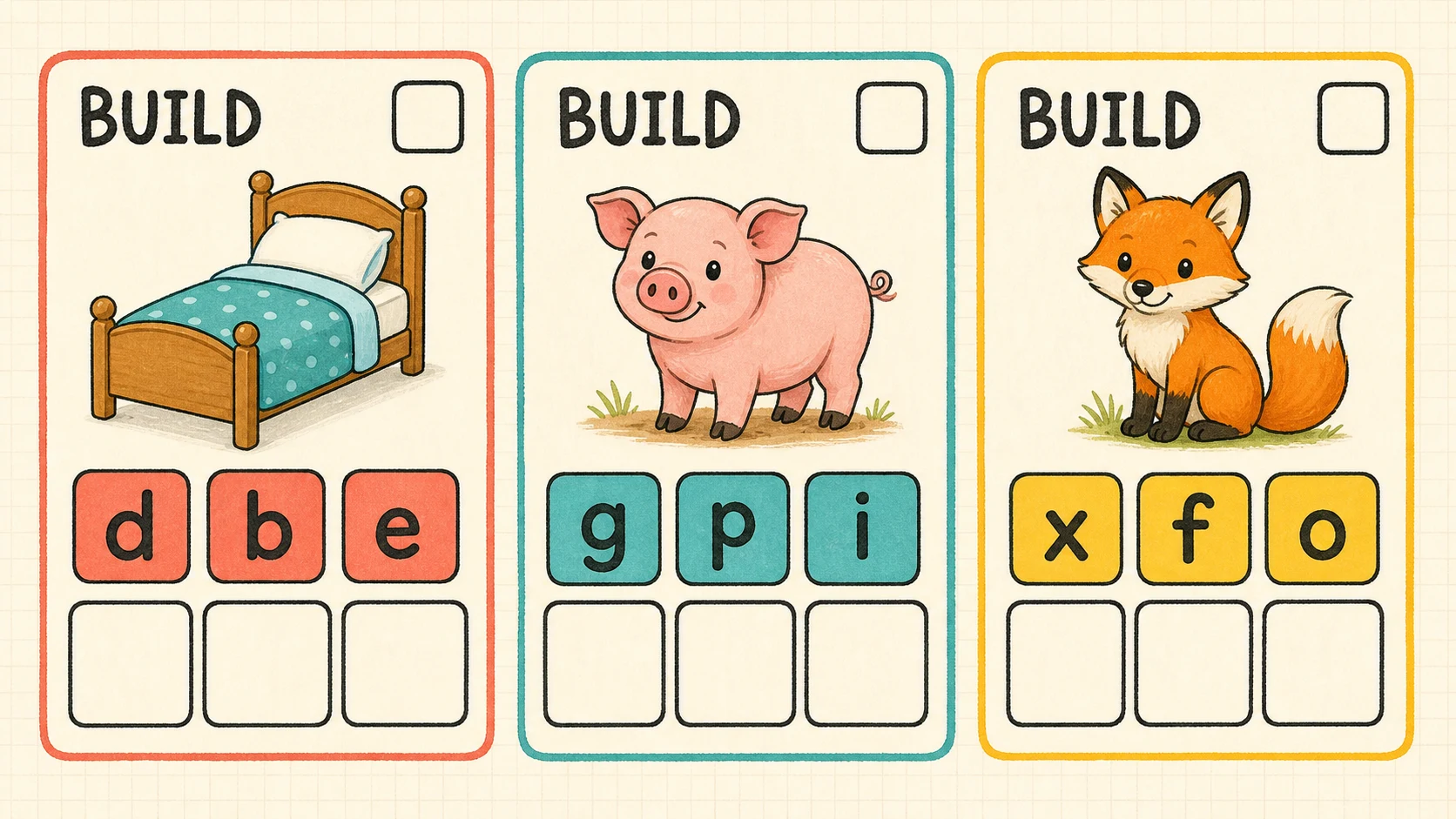
Brief later checks can revisit the same vowel decisions without repeating the entire printable.
A practical, adjustable schedule is:
| Review point | Suggested retrieval task | What to notice |
|---|---|---|
| End of the lesson | Reread 3 completed words | Can the learner blend without adult sound cues? |
| Next learning session | Complete or build 3–5 previously practiced words from spoken prompts | Are middle vowels recalled without seeing the old page? |
| Several sessions later | Mix prior words with a few comparable CVC words | Does the skill transfer beyond memorized positions? |
| Following week, if useful | Read and spell a small mixed set | Are previously corrected contrasts more stable? |
These intervals are suggestions, not research claims about an ideal schedule for every child. Shorten or lengthen them according to observed work, your local program, and the learner’s attention. Revisit sooner when the learner cannot reconstruct a corrected word. Increase the interval when responses remain accurate and independent.
The worksheet’s limitations should remain clear: it contains 20 easy-level missing-vowel exercises, not a complete phonics curriculum, diagnostic instrument, or guarantee of broader reading performance. It can show how a learner handles one constrained CVC task. It cannot by itself establish command of every short-vowel family, connected-text reading, or independent spelling.
For the next action, download the free Standard Theme (Easy) worksheet, choose two examples to model, and mark the first five items as the initial independent set. After checking how the learner identifies, writes, and blends those vowels, use the topic guide to select either targeted support or the next CVC practice form.
Put it into practice
Use the guide with a real printable
Move from explanation to a short, observable practice task. Check the first item together, then adjust the next session from the learner's actual work.
See the 18-worksheet pack