Complete guide
How to teach and practise kindergarten consonant blends worksheets - standard theme (easy)
What this worksheet teaches
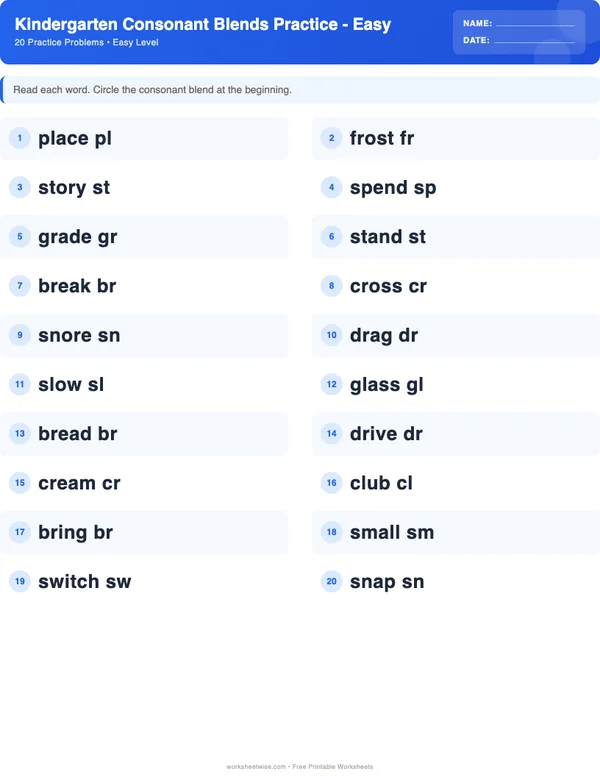
The free Kindergarten Consonant Blends worksheet gives a learner 20 easy-level words. The direction is precise: Read each word. Circle the consonant blend at the beginning. The instructional target is recognizing an initial consonant blend while reading the whole word.
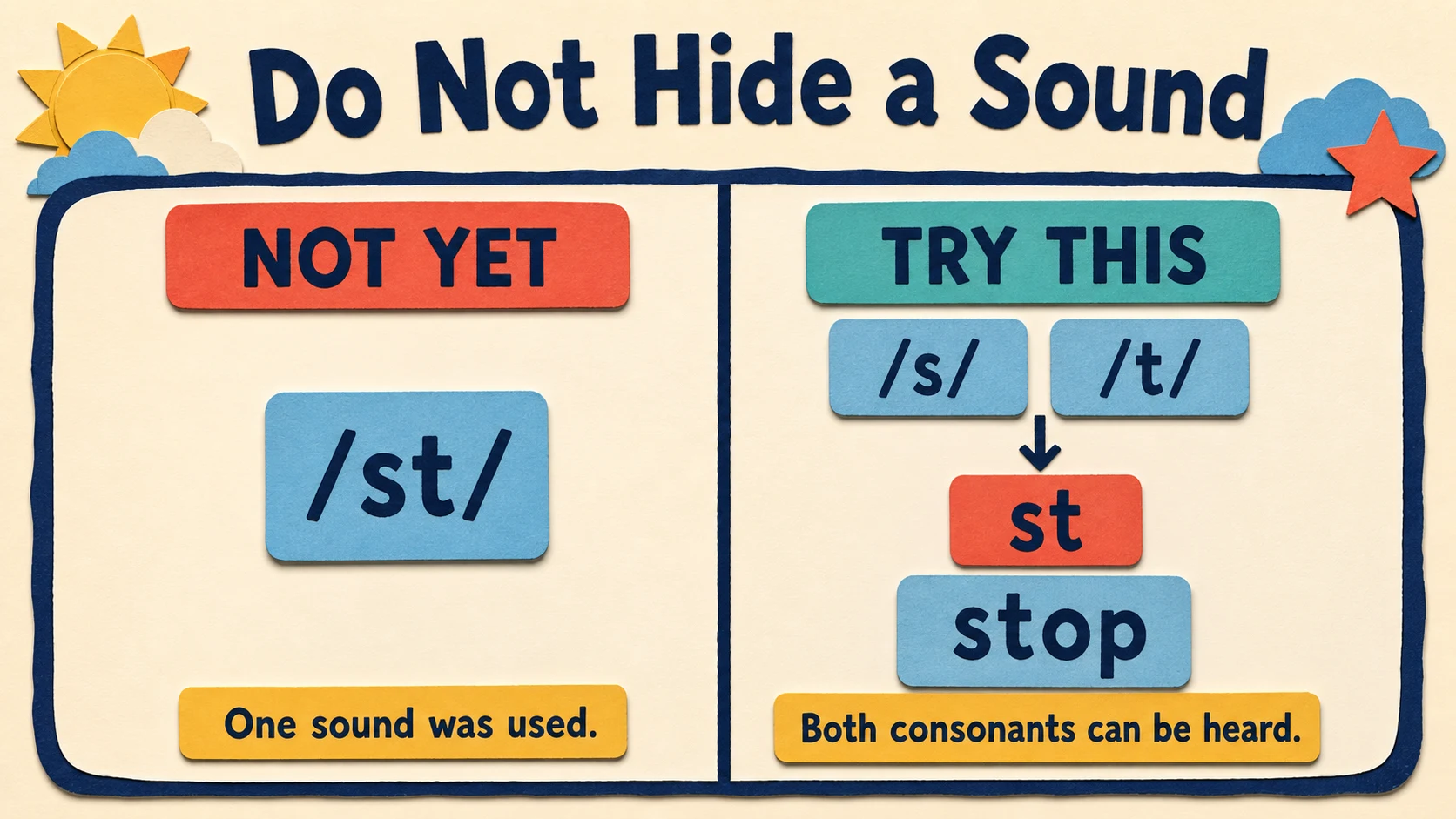
A consonant blend contains two or more neighboring consonants whose individual sounds can still be heard. In stop, for example, the initial blend is st: the learner can hear both /s/ and /t/. This differs from a digraph such as sh, in which two letters represent one combined sound.
The short answer for an adult using this printable is:
- Confirm that the learner can read or sound out simple words.
- Explain that the learner will find two consonants at the beginning whose sounds are both heard.
- Model two examples that are not on the worksheet.
- Complete several worksheet items together.
- Let the learner attempt the remaining items without immediate correction.
- Review errors by asking the learner to say, stretch, and inspect the beginning of each word.
- Use the answer key after the learner has committed to answers.
- Schedule a small amount of later retrieval rather than repeating all 20 items immediately.
The worksheet practices a narrow skill. It does not, by itself, measure all phonics knowledge, reading fluency, spelling, or comprehension.
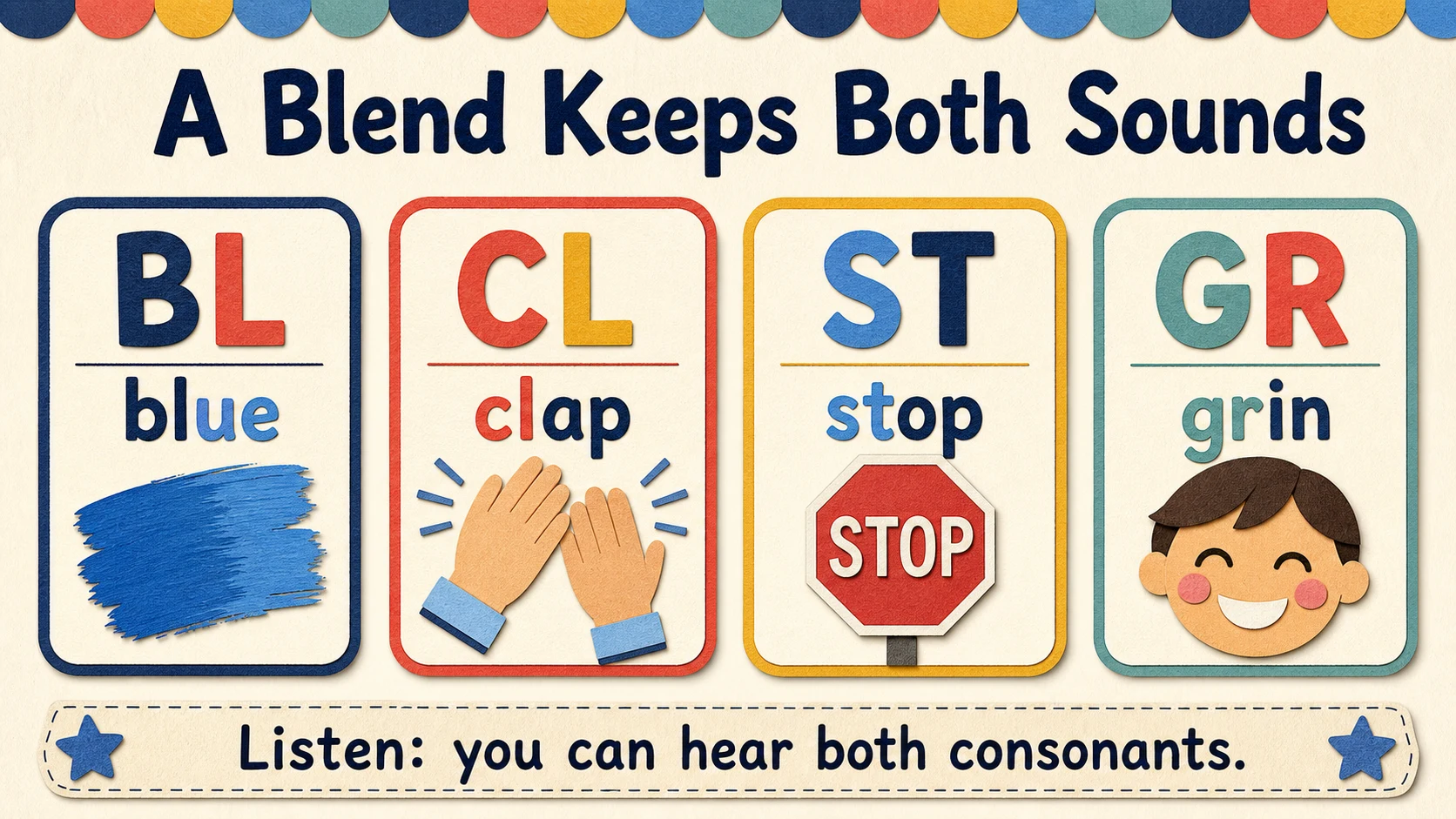
Move from a brief readiness check through modeling, guided practice, independent work, review, and later retrieval.
Before printing: decide whether the task is a good fit
This printable is intended for Kindergarten practice, particularly for learners beginning consonant blends or needing reinforcement. Grade labels describe the intended practice level; they are not promises that every learner of that age is ready for the same task. Local curricula and instructional sequences also differ.
The catalogue places consonant-blend work after basic letter-sound knowledge and CVC blending. That sequence matters because a word beginning with a blend asks the learner to hold an additional consonant sound while combining the word. A learner who is still uncertain about individual consonant sounds may need earlier practice from the broader Kindergarten phonics collection before this page is useful.
A quick readiness check
Before showing the worksheet, write or arrange these demonstration words separately:
- map
- sit
- stop
- clap
Ask the learner to read each word or help sound it out. Observe the process rather than setting a speed requirement.
The learner is probably ready to try the worksheet when they can:
- connect most letters in these words with plausible sounds;
- blend a simple word such as map or sit;
- attempt stop and clap without consistently deleting the second consonant;
- point to the beginning of a printed word;
- understand what it means to circle letters.
Readiness does not require perfect reading. Hesitation, self-correction, or a need to stretch the sounds can be compatible with useful practice. The more important concern is whether the learner can attend to the first two consonants without guessing the entire task.
If stop becomes “sop” and clap becomes “cap,” the worksheet may still be appropriate as guided instruction. If the learner cannot identify the sounds of s, t, c, or l, return first to letter-sound and simple blending work. Keep the consonant-blend worksheet for another session.
The IES foundational reading practice guide provides the broad instructional frame: learners need opportunities to connect speech sounds with letters and to decode words and word parts. It does not evaluate this WorksheetWise printable or prescribe a universal timetable for using it.
Prepare a short, observable lesson
You need the worksheet, a pencil or crayon, and the separate answer key kept out of sight. A blank sheet or index card is useful for covering later rows. No extra materials are required.
Use the following progression as a practical starting point, then change the pace in response to the learner’s work.
| Lesson phase | Adult action | Learner action | Evidence to watch |
|---|---|---|---|
| Readiness check | Present two simple words and two blend words | Read or sound out each word | Can the learner retain both initial sounds? |
| Explain | Define a blend in one sentence | Listen and repeat one example | Does the learner distinguish “beginning” from the whole word? |
| Model | Think aloud through two new examples | Track the letters and sounds | Can the learner explain why two letters are circled? |
| Guided practice | Complete about 3–5 worksheet items together | Read, identify, and circle | Is support decreasing across items? |
| Independent attempt | Reveal a manageable group of items | Complete without immediate correction | Are answers based on the printed word rather than guessing? |
| Review | Discuss selected correct answers and errors | Reread and revise when justified | Does the learner notice a dropped or added sound? |
| Retrieval | Revisit a few examples later | Identify blends from memory and in new words | Does learning carry beyond the original page? |
This is an instructional suggestion, not a sourced requirement. Some learners will complete all 20 items comfortably in one sitting. Others will show clearer thinking when the page is divided into two or more brief attempts.
Explain the exact job without overexplaining
Use direct language:
“Read the whole word. Listen to the beginning. If the word starts with two consonants and you can hear both sounds, circle those beginning letters.”
Then show the physical action. Point under the word from left to right, say the sounds, blend the word, and circle only the initial blend.
Avoid telling the learner merely to “circle the first two letters.” That shortcut changes the skill. The learner must use sound as well as print. Some words begin with two letters that work together as one sound, and some begin with only one consonant before the vowel.
Also avoid presenting every possible blend before beginning. This worksheet is an identification task, not a demand to memorize a complete inventory. The broader consonant blends topic guide is the better place to examine blend groups and a wider progression.
Use consistent language
Choose a few prompts and reuse them:
- “Read the whole word.”
- “Stretch the beginning.”
- “Which consonant sounds can you hear before the vowel?”
- “Point to the letters that show those sounds.”
- “Circle only the blend.”
Consistency lets the learner focus on the phonics decision instead of decoding a new direction each time.
Model with fully checked examples
The examples below are created for instruction and are not claims about which words appear among the worksheet’s 20 items. Each has been checked against the definition in the supplied topic information: the word begins with neighboring consonants, and each consonant retains its own sound.
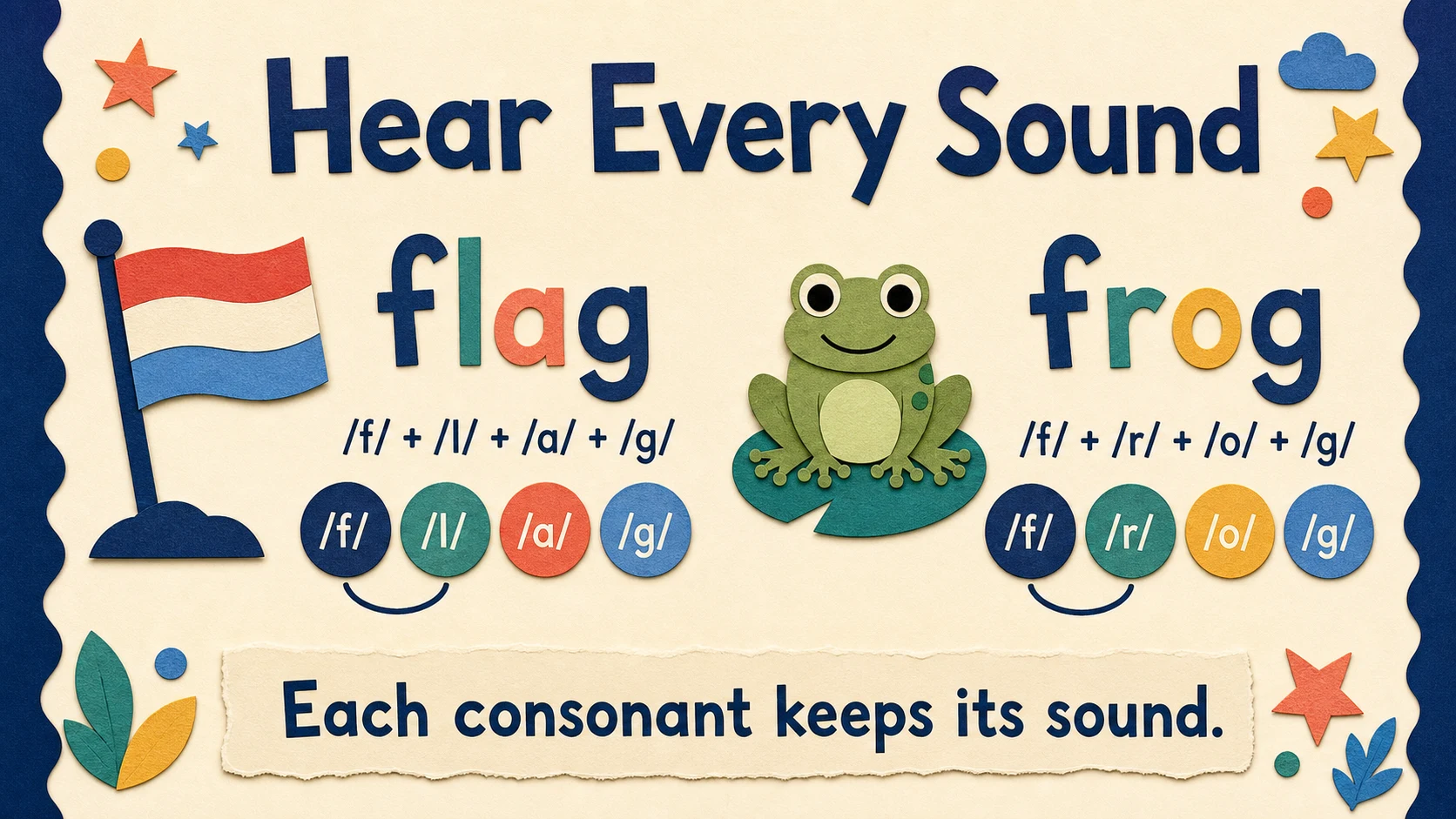
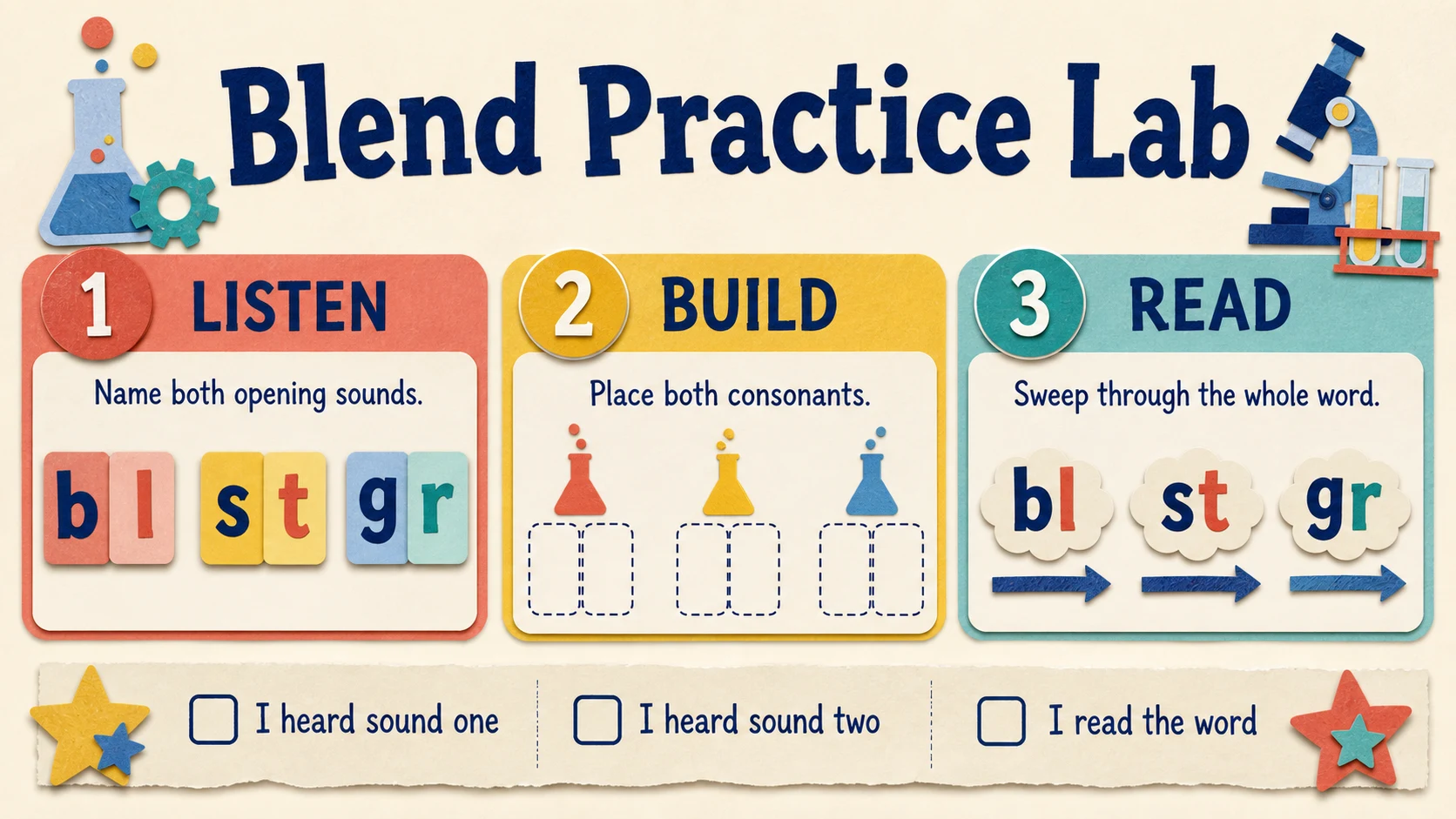
Read the word, stretch its beginning, match each heard sound to a letter, and circle only the initial blend.
Worked example 1: stop
Write stop.
- Say the sounds slowly: /s/ /t/ /o/ /p/.
- Blend them into stop.
- Return to the beginning: /s/ /t/.
- Point to s for /s/ and t for /t/.
- Circle st.
Checked answer: st is the initial consonant blend. Both consonant sounds are retained. The letters op belong to the rest of the word and should not be circled.
A useful model is: “I hear /s/ and then /t/ before the vowel. I see s and t, so I circle st.”
Worked example 2: clap
Write clap.
- Segment the word: /c/ /l/ /a/ /p/.
- Blend it: clap.
- Isolate the beginning: /c/ /l/.
- Match those sounds to c and l.
- Circle cl.
Checked answer: cl. A common incomplete response would be to circle only c because it is the first letter. Rereading slowly makes the second consonant easier to notice.
Worked example 3: frog
Write frog.
- Say /f/ /r/ /o/ /g/.
- Read frog.
- Listen specifically before the vowel sound: /f/ /r/.
- Circle fr.
Checked answer: fr. The r must remain audible. If the learner says “fog,” they have dropped the second consonant sound and need to rebuild the word before circling.
Worked example 4: swim
Write swim.
- Stretch the beginning without inserting a vowel: /s/ /w/.
- Blend the full word: /s/ /w/ /i/ /m/, swim.
- Circle sw.
Checked answer: sw. Both s and w contribute sounds at the beginning.
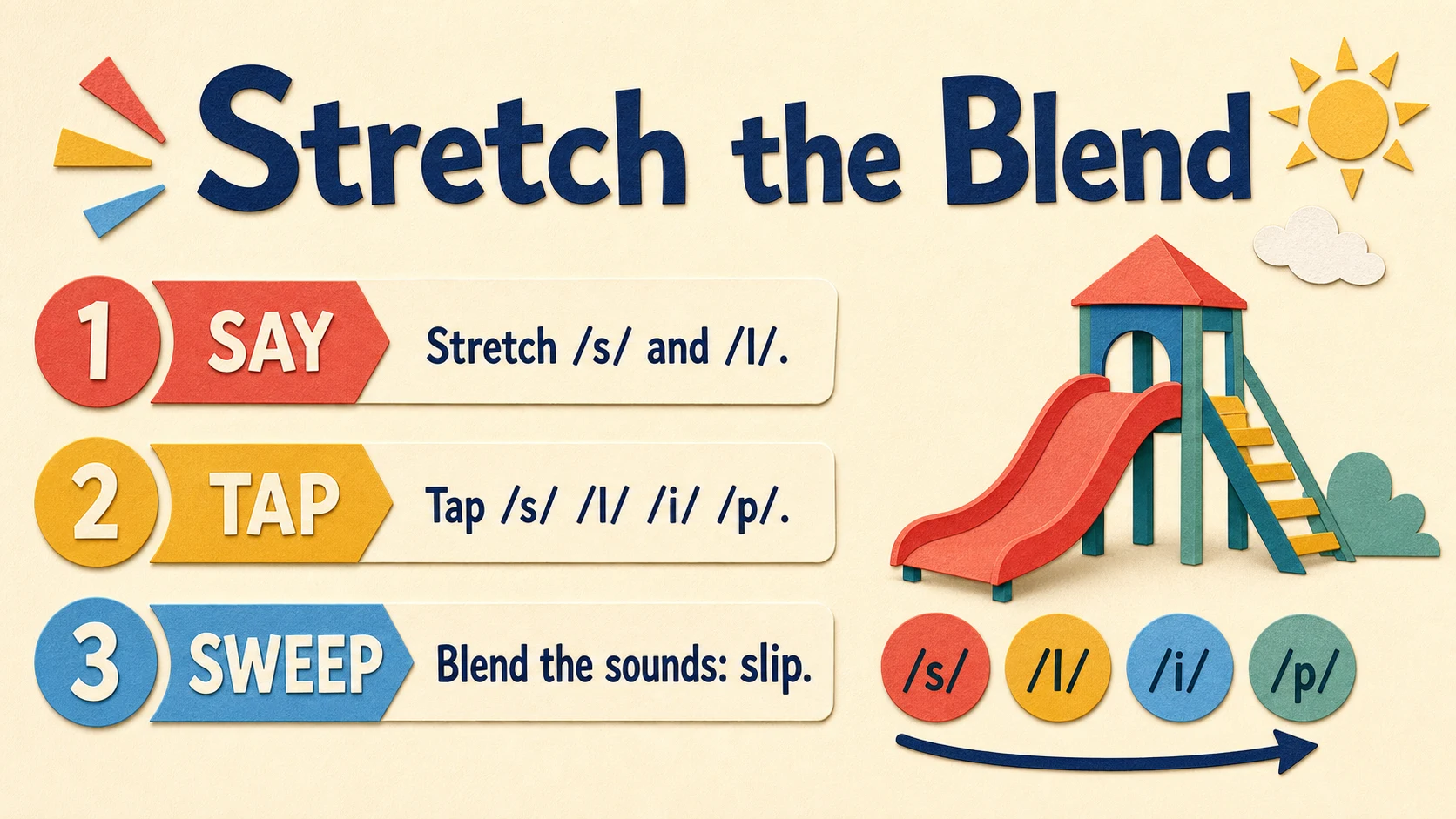
Do not stretch the model into “suh-wuh-im.” Added vowel sounds can make blending harder and can obscure the word’s actual sound sequence. Use the cleanest consonant sounds you can produce, then move promptly into the whole word.
Move from guided to independent practice
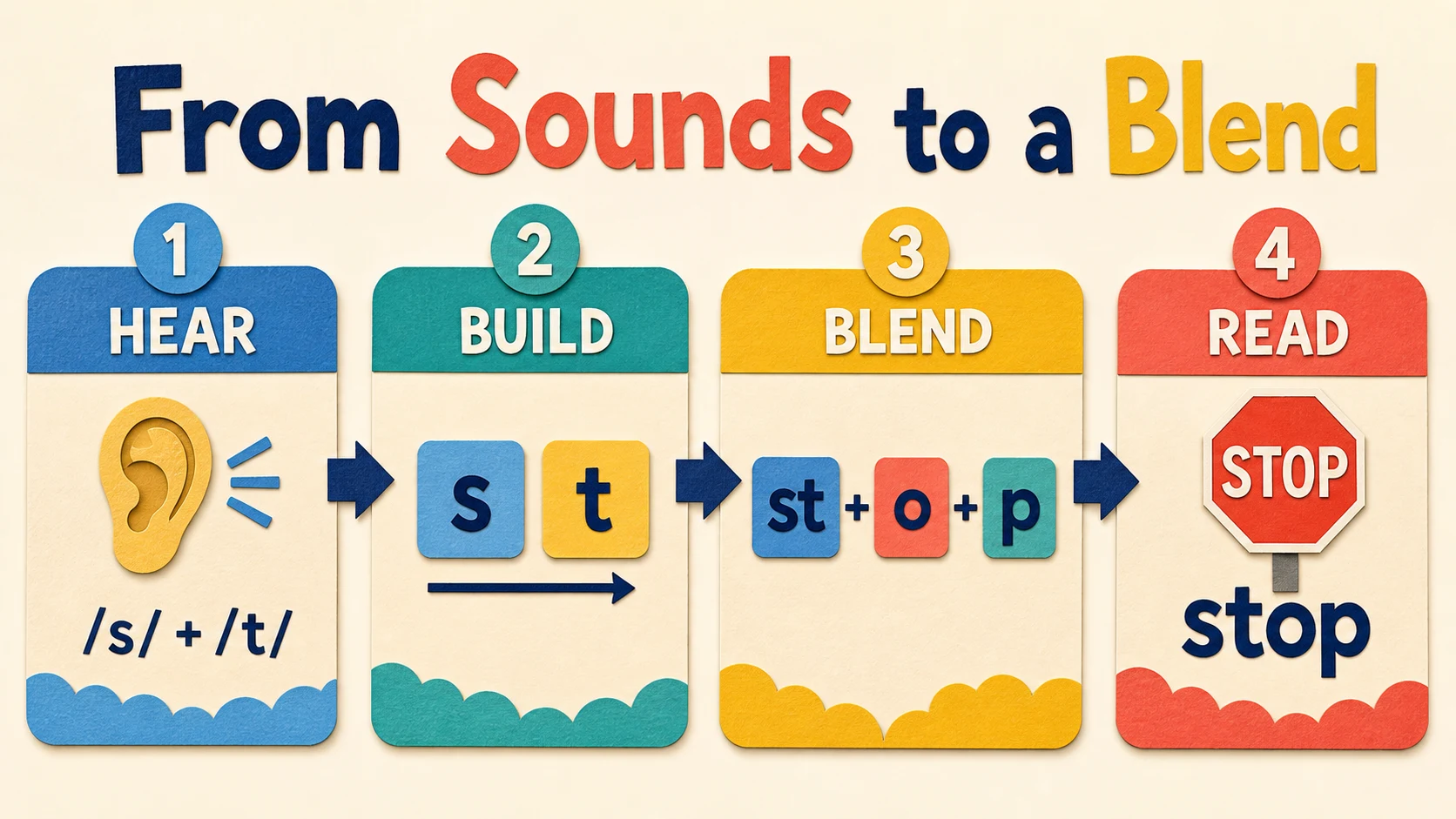
Guided practice should reveal the learner’s reasoning, then gradually remove adult prompts.
Guided practice on the worksheet
Begin with the first item. Ask the learner to read it. If needed, point under each letter while the learner says the sounds. Ask, “What do you hear at the beginning?” Wait before helping.
For an accurate response, request a brief explanation: “Show me the two letters. What sounds do they make?” This confirms that the circle reflects phonics reasoning rather than a guess.
For an inaccurate response, do not immediately announce the correct letters. Use the smallest prompt that could help:
- “Read the word again.”
- “Stretch only the beginning.”
- “Tap one finger for each sound before the vowel.”
- “Now point to the letters that show those sounds.”
Complete enough items together to see a pattern of understanding. Three to five guided items may be sufficient, but the learner’s behavior—not a preset count—should determine the transition.
Independent practice
Tell the learner what “independent” means: “Try these by yourself. If one is hard, put a small dot beside it and move on. We will return to it.”
You can expose one row at a time with a blank card. This reduces visual load without changing the skill, wording, or answer choices. Do not pronounce every word in advance, because reading each word is part of the stated task. If a word is outside the learner’s decoding reach, note that distinction and provide only the support needed to access the word.
Observe quietly. Useful evidence includes whether the learner:
- looks through the whole word before circling;
- says or mouths sounds;
- circles two beginning consonants rather than an arbitrary pair;
- notices and repairs a response;
- begins guessing after several items;
- loses accuracy when the page becomes visually or mentally tiring.
A completed page is less informative than a page that shows how the learner approached the skill.
Adapt support without changing the target
Adaptations should preserve the central decision: identify the consonant blend at the beginning of a written word. Giving fewer items, increasing print visibility, or adding sound prompts preserves that target. Supplying every answer does not.
Change the amount of work, the visibility of the print, or the prompt level while preserving initial-blend identification.
When the learner needs more phonics support
Work in smaller sets. Cover most of the page and reveal two or three items. For each word, have the learner tap a finger for each sound, blend the word, and then return to the beginning.
If the learner repeatedly drops a consonant, contrast the attempted form with the printed word. For example, compare sop with stop or cap with clap. Ask what letter and sound are missing. These are instructional examples, not reported worksheet items.
You may read a difficult word with the learner, but still require the learner to locate and explain its beginning blend. This shifts some decoding support to the adult while retaining the printed blend-identification task.
When attention or visual load is the obstacle
Fold the page or use a cover sheet so only one small group is visible. Offer a thicker pencil or crayon if circling is physically awkward. Let the learner point to the blend before making the circle.
The IES elementary writing guide treats handwriting and related transcription skills as abilities that require instruction. This worksheet, however, asks for a simple circle. Therefore, an untidy circle should not be treated as evidence that the learner misunderstood consonant blends. Record phonics accuracy separately from pencil control.
When the learner is ready for more challenge
Do not make circling harder merely by demanding speed. Ask the learner to read the word, name the blend, and use the word orally in a short sentence. Alternatively, ask for another real word beginning with the same blend.
Keep the extension narrow. Requiring the learner to spell several new words from memory would add a different demand. It may be worthwhile on another occasion, but it should not replace an accurate interpretation of this worksheet.
Handle boundary cases carefully
Not every word beginning with two consonant letters contains a two-sound consonant blend. These examples help adults keep the explanation accurate.
Digraphs are not blends
In ship, the letters sh represent one combined consonant sound. The learner does not hear a separate /s/ followed by /h/. Under the supplied definition, sh is not a consonant blend.
Similarly, adults should not teach “any two consonants together” as the rule. The decisive feature is that each consonant retains its individual sound.
A word may have no initial blend
In cat, the first consonant is c, followed by the vowel a. There is no initial consonant blend. This is useful as a contrast example outside the worksheet, but the catalogue describes the printable as practice identifying blends at the beginning. Do not assume that contrast words occur among its 20 items unless you inspect the page.
Three-letter beginnings require all retained sounds
In scrap, the beginning scr contains three consonants, and each contributes to the spoken beginning. It is a valid consonant blend under the supplied topic definition. However, it may be beyond the easiest starting point for a learner working on two-letter blends. Use it as a boundary case only when the learner is ready.
Final blends are a different location
In tent, the final nt is a blend at the end. It should not be circled for a direction that specifically says “at the beginning.” The learner may correctly hear a blend but still answer the worksheet incorrectly by ignoring location.
Ask, “Did you find a blend, and is it at the beginning?” That separates sound recognition from positional attention.
Interpret errors before correcting them
An error is evidence about the learner’s current process. Grouping errors by type is more useful than relying only on a total score.
Reread, isolate the beginning, match sounds to letters, and revise only when the evidence supports a change.
| Observed response | Possible interpretation | Useful next prompt |
|---|---|---|
| Circles only the first consonant | The learner may not retain the second sound | “Stretch the beginning and tap each sound.” |
| Reads stop as “sop” | The middle consonant of the initial blend was dropped | “Point to every letter. Which sound belongs to t?” |
| Circles letters in the middle or end | The learner may understand “blend” but not “at the beginning” | “Touch the first letter. Work from there.” |
| Circles the first two letters automatically | The learner may be using a visual shortcut | “Say both sounds. Can you hear each one?” |
| Identifies the blend orally but circles inaccurately | The phonics decision may be sound; marking or tracking may be the difficulty | Let the learner point, then circle together |
| Reads the word inaccurately but selects a plausible blend | Blend recognition may exceed whole-word decoding | Rebuild the whole word and note both skills separately |
| Starts accurately, then guesses | Fatigue or loss of attention may be affecting performance | Stop or divide the remaining items into a later set |
| Changes correct answers after adult questioning | The learner may interpret every check as a signal of error | Ask neutral prompts and affirm justified answers |
These interpretations are hypotheses, not diagnoses. Check them against more than one response. A single error can result from misreading, distraction, an awkward circle, or uncertainty about the directions.
Use a neutral repair routine
For a missed item:
- Ask the learner to reread the complete word.
- Have them isolate the sounds before the vowel.
- Match each of those sounds to its printed letter.
- Ask whether the circled letters agree with that evidence.
- Let the learner revise the answer if needed.
- Revisit a similar example later without announcing that it is a test.
Avoid erasing and supplying the answer before the learner has reconsidered the word. The repair process is the instructional opportunity.
Check the answer key responsibly
The worksheet includes a separate printable answer key for quick checking. Keep it separate during instruction so the task remains an authentic attempt.
First, review the page yourself. Check each circled response against the answer key. Then return to the learner and discuss selected items. There is no need to turn every correct response into a lengthy exchange.
For an apparent mismatch:
- Read the printed word exactly as shown.
- Confirm that the marked letters are at the beginning.
- Say the word naturally, then slowly.
- Listen for the individual consonant sounds.
- Compare the reasoning with the key.
- If the print is unclear, consult the original PDF rather than guessing from a faint copy.
The key should support checking, not replace adult judgment about how an answer was produced. A learner who copied correct circles has not provided the same evidence as a learner who decoded and explained the words. Conversely, an inaccurate pencil mark does not necessarily erase a correct oral explanation.
Record two observations if useful: initial blend identified and word read accurately. The worksheet involves both, but they can separate during learning.
Decide what to do after the 20 items
Avoid using one rigid cutoff for every learner. Look for patterns across the page.
Continue to broader blend work
Move forward when the learner usually reads the words, identifies both initial consonant sounds, and explains the corresponding letters without heavy prompting. Occasional self-corrected errors do not necessarily require repeating the entire worksheet.
Use the consonant blends topic guide to choose a broader progression rather than trying to reproduce that progression here. Connected reading with already-taught patterns is also valuable; the IES foundational skills guide includes connected-text reading within its broad recommendations for early reading instruction.
Repeat a small set, not automatically the whole page
If errors cluster around one action—such as dropping the second sound—select three or four examples for another brief practice. Model one, guide one, and let the learner attempt the others.
If accuracy falls mainly near the end, the issue may be the amount completed at once. Divide future work before concluding that the blend concept is missing.
If the learner cannot decode many of the words even with modest support, step back to letter sounds and CVC blending through the Kindergarten worksheet hub. Return to this printable once the prerequisite work is more stable.
Schedule retrieval after the lesson
Retrieval means asking the learner to bring the skill back after some time has passed. The schedule below is a practical suggestion, not a universal timetable.
Revisit a few familiar and new examples over time, adjusting the spacing from the learner’s observed recall.
| Review point | Suggested activity | Decision |
|---|---|---|
| Later the same day or next session | Reread 2–3 previously discussed words without the answer key | If both sounds are retained, reduce prompting |
| A few days later | Mix 2 familiar examples with 2 new blend words | If new examples transfer, widen the blend set |
| About a week later | Identify blends in a short list or suitable decodable text | If the skill holds in context, continue forward |
| Later review | Include one or two blend words among other phonics work | If errors return, use the repair routine briefly |
Vary the words while keeping the decision familiar. For example, after stop, try another word beginning with st; after clap, try another cl word. Verify that every new example is a real word whose initial consonant sounds remain audible.
The learner’s observed recall should drive spacing. If retrieval is easy and accurate, lengthen the interval. If the learner again drops consonants, shorten the interval and reduce the number of blend families practiced at once.
Standards context and instructional limits
The Common Core English Language Arts standards organize literacy expectations by grade and place reading, writing, speaking, listening, and language within a broader literacy framework. This printable offers focused phonics practice, but it should not be described as comprehensive standards alignment or as complete literacy instruction.
The worksheet can show whether a learner identifies beginning blends in these 20 printed items under the conditions in which it was completed. It cannot establish that the learner will decode every blend in connected text, spell blend words independently, comprehend sentences containing them, or retain the skill indefinitely.
It also cannot explain why a learner struggles. Repeated difficulty may justify closer observation, a prerequisite review, or discussion with the learner’s educator. This guide does not provide medical guidance or child-specific diagnosis.
A balanced interpretation is concrete:
- Use the page to practice and observe initial-blend identification.
- Treat oral reading, blend selection, and pencil marking as related but distinguishable evidence.
- Adjust pacing from the work the learner actually produces.
- Confirm retention with a few later examples.
- Use other reading and writing activities for skills this printable does not cover.
A practical next action
Download the free Kindergarten Consonant Blends worksheet, choose four demonstration words that are not on the printed page, and run the readiness-model-guided-independent sequence. Save two missed or effortful patterns for a brief retrieval check a few days later.
If the learner identifies the blends accurately with decreasing support, continue through the consonant blends topic guide. If you need a larger organized set for repeated practice, the Kindergarten Consonant Blends Worksheet Pack contains 18 worksheets.
Put it into practice
Use the guide with a real printable
Move from explanation to a short, observable practice task. Check the first item together, then adjust the next session from the learner's actual work.
See the 18-worksheet pack