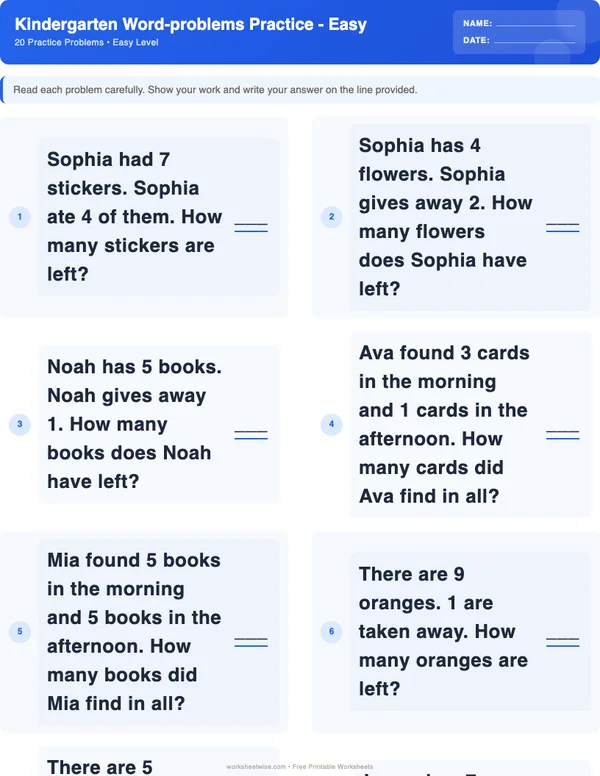
Complete guide
How to teach and practise kindergarten word problems worksheets - standard theme (easy)
How to Use This 12-Item Worksheet
The free Kindergarten Word Problems worksheet gives a learner 12 easy-level story problems involving problem solving, reading comprehension, mixed operations, and multi-step reasoning. A separate printable answer key is included.
For most learners, the best use is not to assign all 12 items without preparation. Begin by modeling one similar problem, solve two or three items together, and then release a small group of items for independent work. Ask the learner to show the quantities with objects or drawings, explain what changes in the story, and write an answer. Use observed work—not a fixed timetable—to decide whether to continue, pause, or add support.
Grade labels describe the intended practice level; local curricula and instructional sequences differ. If you need to see how this printable fits into a larger progression, use the Kindergarten word-problems topic guide rather than treating one worksheet as a complete course.
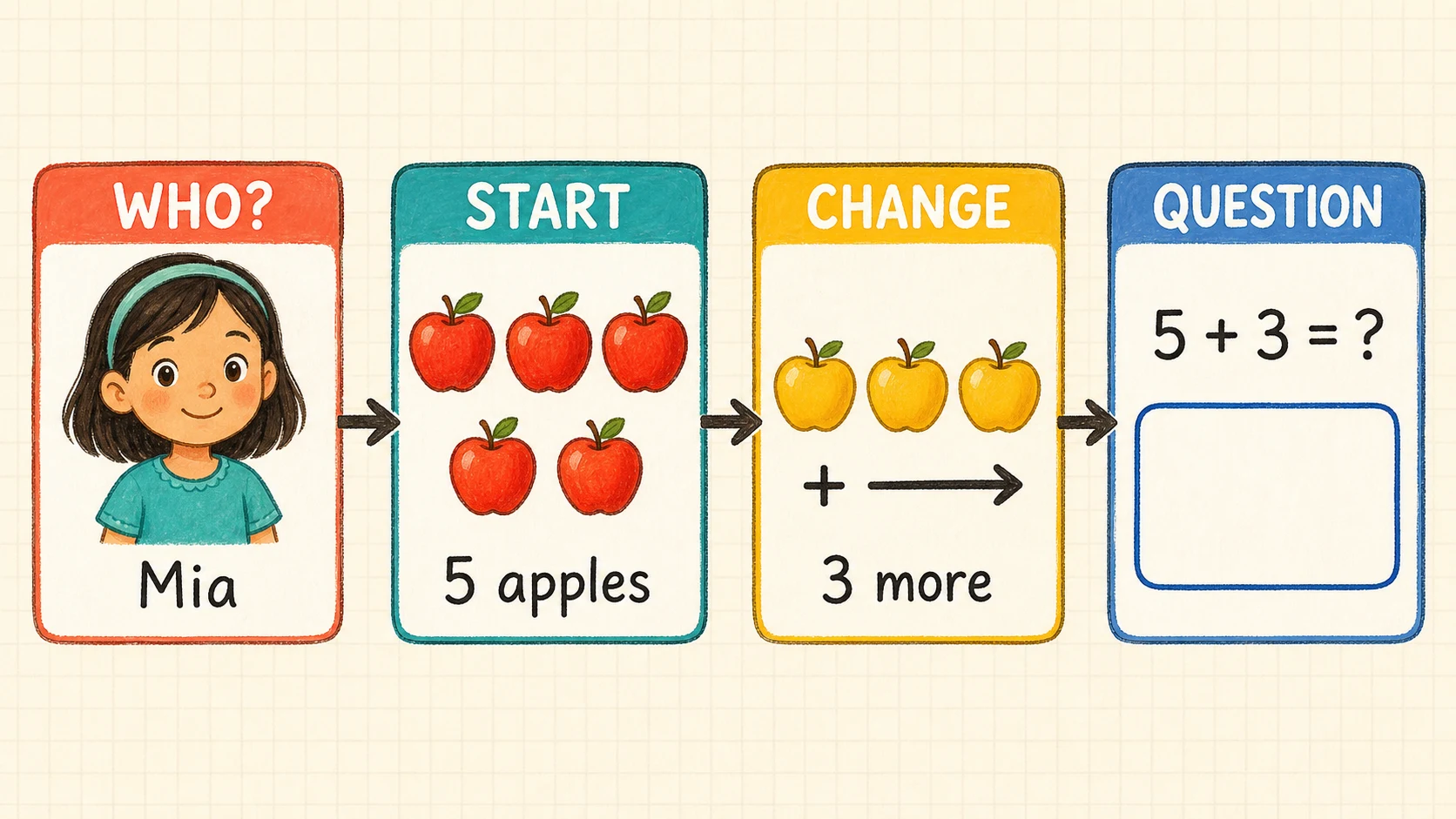
Move from a brief launch to modeling, guided practice, independent work, checking, and later retrieval.
Before the Learner Starts
Check the mathematical tools
Have a small set of counters available. Buttons, connecting cubes, bottle caps, or small blocks work well. Because Kindergarten addition and subtraction stories commonly involve quantities within 10, ten counters are usually enough for modeling similar introductory examples.
Also provide:
- A pencil and eraser
- Blank paper or a small drawing space
- A number path from 0 to 10 if the learner already uses one
- Two crayons or pencils in different colors, if separating groups visually would help
These tools support the target skill. They do not change the problem or supply the answer. A learner who represents a story with counters is still solving a word problem.
Preview without pre-solving
Look through the printable before the lesson. Notice whether the stories involve quantities joining, separating, or being considered in more than one step. Do not mark operation words for the learner or write equations beside the items. That would remove part of the reasoning the worksheet is meant to exercise.
The worksheet instructions say: “Read each problem carefully. Show your work and write your answer on the line provided.” Decide in advance what “show your work” may look like. For a beginning learner, acceptable work might be:
- A drawing with objects crossed out
- Two pictured groups combined
- Counters arranged to match the story
- An equation
- A brief oral explanation accompanied by a written numeral
The drawing does not need to be artistic. Five circles with two crossed out can communicate the mathematics more clearly than a detailed picture of five decorated balloons.
Set a workable purpose
A concise launch is enough: “These are short math stories. We will figure out what happens, show it, and answer what the story asks.”
Avoid presenting the page as a reading test. If decoding the text would prevent the learner from showing mathematical understanding, read the problem aloud exactly as printed. You may then ask the learner to retell it. Reading assistance changes access to the words, not the numerical relationship being assessed.
A Scannable Lesson Progression
The following sequence is an instructional suggestion for this worksheet, not a timetable prescribed by the cited sources. Shorten or extend each phase according to the learner’s work.
| Phase | Suggested worksheet use | Adult action | Evidence to watch |
|---|---|---|---|
| Launch | No item yet | Explain that each story contains quantities and a question | Learner attends to what is happening |
| Model | Use a similar problem you create | Read, retell, represent, solve, and check aloud | Learner connects the story to the model |
| Guided practice | Items 1–2 | Prompt without selecting the operation | Learner identifies known quantities and the question |
| Supported practice | Items 3–4 | Reduce prompts as understanding becomes visible | Learner builds or draws the correct situation |
| Independent check | Items 5–8 | Observe quietly; read text aloud if needed | Learner chooses a representation and records answers |
| Decision point | Pause | Inspect methods and error patterns | Accuracy, explanation, effort, and independence |
| Continued practice | Items 9–12, if appropriate | Continue, split the set, or save items | Learner sustains reasoning without accumulating confusion |
| Review | Selected items later | Revisit one solved type and one less-secure type | Learner retrieves the routine after a delay |
The IES guide on teaching mathematics to young children provides high-level support for purposeful instruction, progress monitoring, and helping young children view and describe mathematical ideas in more than one way. It did not evaluate this WorksheetWise printable.
Model the Thinking, Not Just the Calculation
Use one repeatable routine
A useful routine is:
- Read the whole story.
- Retell what happens.
- Name what is known.
- Point to what must be found.
- Build or draw the situation.
- Decide how to find the answer.
- Solve and record.
- Check the answer against the story.
Do not turn the routine into a script the learner must recite perfectly. Its purpose is to keep attention on meaning.
During modeling, speak in short, concrete sentences. For example: “I know there are three birds. Two more arrive. The group becomes larger. I need to find how many birds there are now.” Then place three counters, add two, and count the combined set.
Avoid teaching a rule such as “more means add” or “left means subtract.” A word can appear in stories with different structures. Understanding who has what and what changes is more dependable than searching for a keyword.
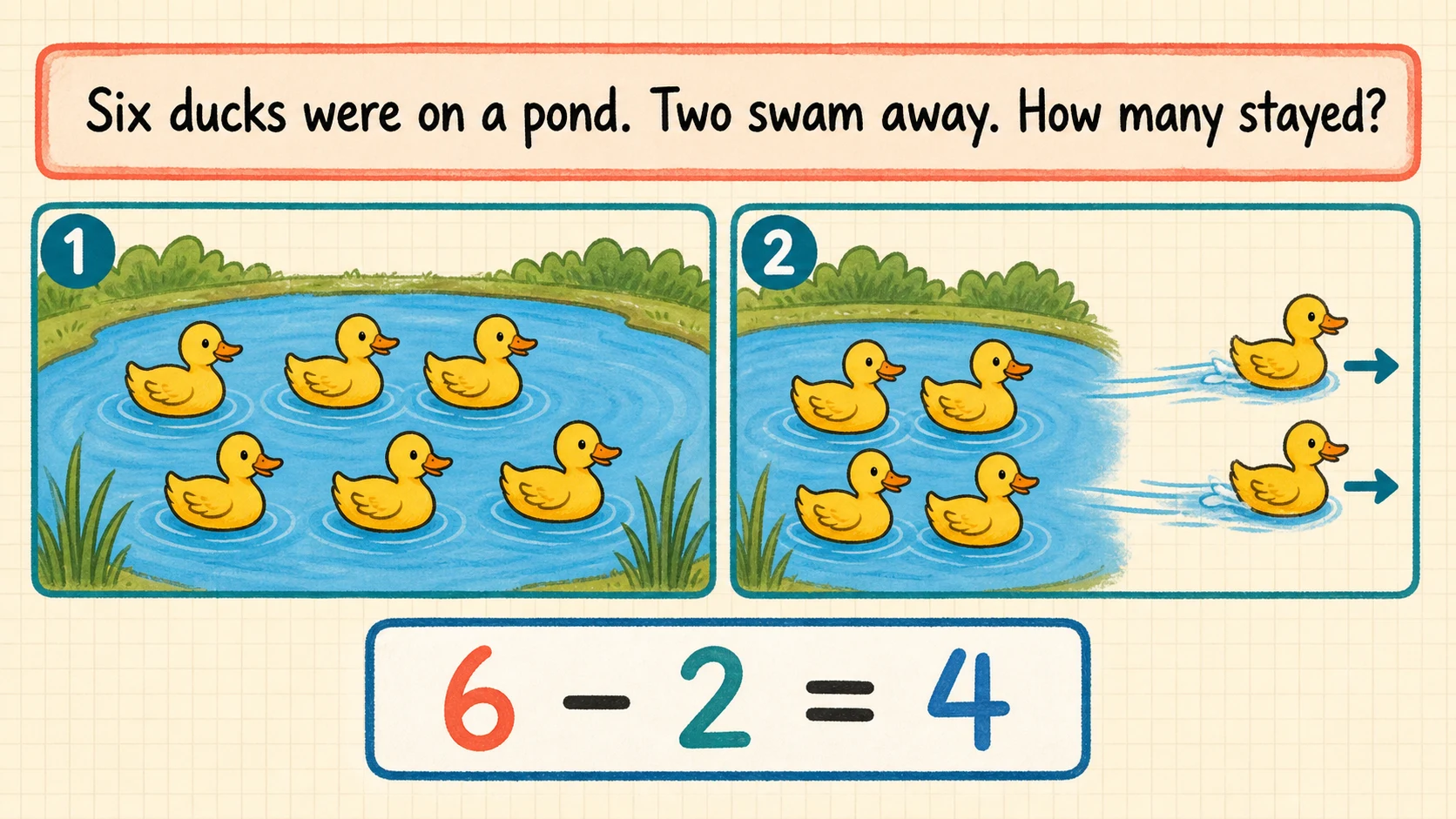
Retelling and representing the situation make the equation meaningful.
Ask for a retell
After reading, say, “Tell me what happened in your own words.” A learner might respond, “There were some ducks, and more ducks came.” That retell shows attention to the action even if the original sentence is not repeated.
Then ask, “What are we trying to find?” This separates the question from the story details. If the learner repeats a number but cannot state what must be found, reread the final question and have the learner point to the relevant groups or actions.
The IES practice guide for assisting students struggling with mathematics supports explicit, systematic instruction and the use of visual representations as broad instructional practices. Here, those principles inform the suggested routine; they should not be read as a claim that IES reviewed this worksheet.
Four Fully Checked Worked Examples
These examples are newly written models similar to the type of work the printable develops. They are not quotations or claimed reproductions of its 12 items.
Example 1: Joining two groups
Problem: Mia has 3 shells. She finds 2 more shells. How many shells does she have now?
Retell: Mia begins with three shells, and two shells join her collection.
Representation: Draw three circles, then two more circles:
○ ○ ○ + ○ ○
Equation: 3 + 2 = 5
Answer: Mia has 5 shells.
Check: Count every circle once: 1, 2, 3, 4, 5. The answer is greater than 3 because shells were added. Both the exact count and the story direction agree.
An adult could model this problem and then ask, “Which part shows what Mia had first? Which part shows what she found?”
Example 2: Separating from a group
Problem: There are 7 apples in a basket. Two apples are taken out. How many apples remain?
Retell: The basket starts with seven apples. Two leave the basket.
Representation: Draw seven circles and cross out two:
ⓧ ⓧ ○ ○ ○ ○ ○
Equation: 7 - 2 = 5
Answer: 5 apples remain.
Check: Start with seven counters, remove two, and count the counters still present: 1, 2, 3, 4, 5. The answer must be less than 7 because objects were removed.
Notice that the check uses the context as well as recounting. If a learner wrote 9, the adult could ask whether taking apples out should make the basket contain more or fewer apples.
Example 3: Finding a total without an action word
Problem: Four red blocks and 3 blue blocks are on a mat. How many blocks are on the mat altogether?
Retell: There are two parts of one collection: four red blocks and three blue blocks.
Representation: Use color or spacing to preserve the two parts:
■ ■ ■ ■ □ □ □
Equation: 4 + 3 = 7
Answer: There are 7 blocks on the mat.
Check: Count the red set: 4. Continue counting the blue set: 5, 6, 7. Separately, count every block from one: there are still 7.
This example matters because nothing arrives. The groups already exist. The learner must understand that the question asks for the whole collection.
Example 4: A simple two-step story
Problem: Five frogs sit by a pond. Two frogs hop away. Then 1 frog comes back. How many frogs are by the pond now?
Retell: Begin with five, remove two, and then return one.
Representation: Place five counters. Move two aside. Return one of those counters.
Equations:
5 - 2 = 3
3 + 1 = 4
Answer: 4 frogs are by the pond now.
Check: Replay the story slowly: five becomes three after two leave; three becomes four when one returns. A one-step calculation such as 5 - 2 = 3 is incomplete because it ignores the final event.
For a learner just beginning multi-step reasoning, keep both actions visible. Do not ask the learner to hold every change in memory while also decoding the text.
Guided Practice Before Independent Work
Use prompts that preserve the thinking
Begin the first worksheet item together. Read it, then wait. If the learner does not begin, use the least revealing prompt that moves the work forward:
- “What is happening in this story?”
- “What do you know?”
- “What are you trying to find?”
- “Can you show the first quantity?”
- “What changes next?”
- “Does the group become larger, smaller, or stay arranged in two parts?”
- “How can you check?”
Avoid prompts such as “This is subtraction” or “Cross out three.” Those directions may produce a correct numeral without revealing whether the learner understood the problem.
On the second guided item, ask fewer questions. If the learner independently retells and draws the quantities, allow the process to continue. Adult silence can be informative: it reveals what the learner can initiate.
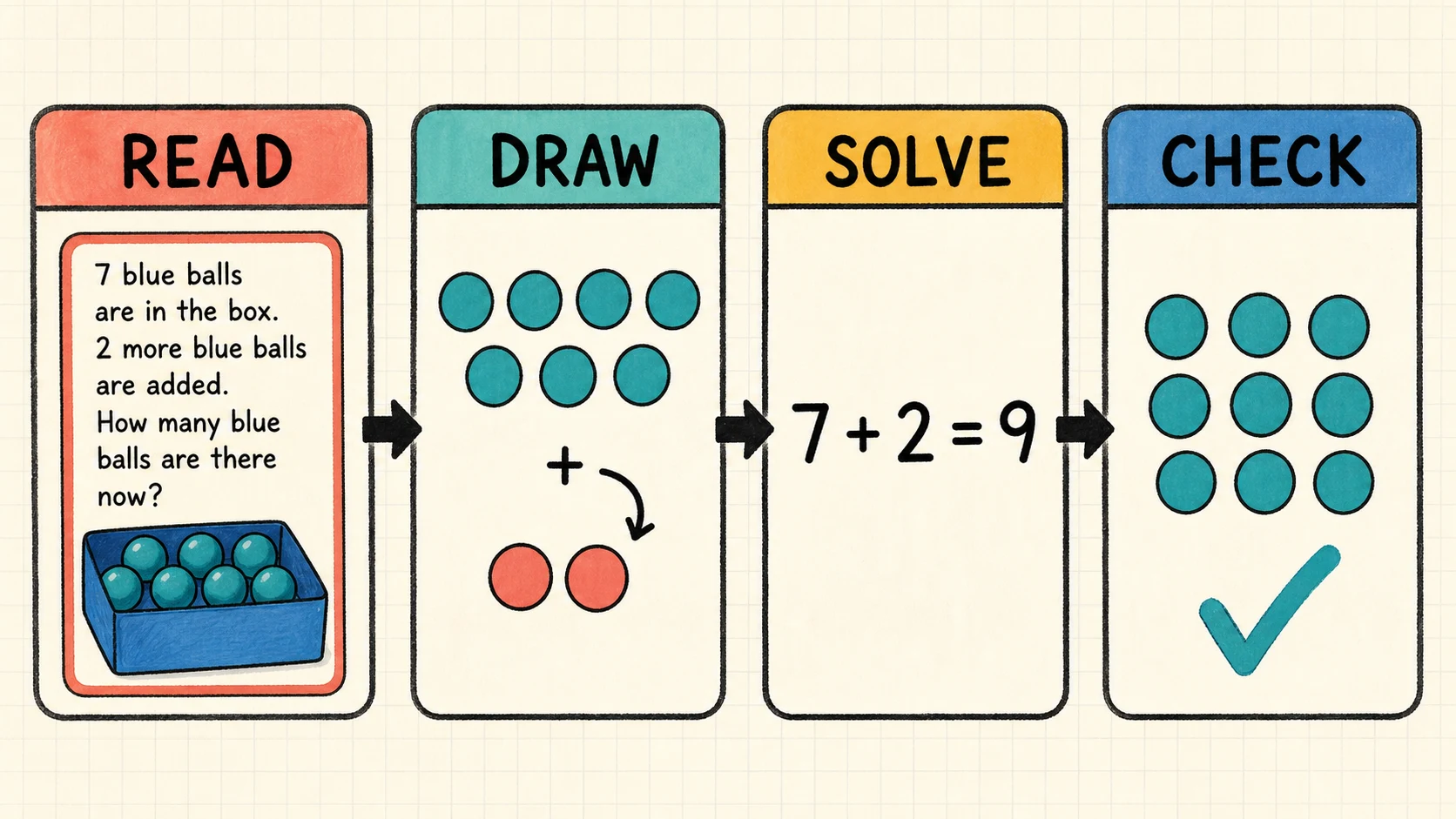
Prompts should direct attention to the story while leaving the operation choice to the learner.
Release a small set
After guided work, assign two to four items rather than automatically assigning the entire remaining page. Say, “Try these on your own. You may use counters or drawings.”
During independent work, note what the learner does before asking for help:
- Reads or listens to the complete problem
- Starts calculating after hearing only one number
- Represents both quantities
- Shows each event in a multi-step story
- Records a numeral that matches the model
- Checks without being reminded
- Changes strategy after noticing a mismatch
These observations are more useful for planning than the total score alone.
If the learner completes a small group accurately and can explain at least one answer, continue. If the work shows repeated misunderstanding, stop and model another similar story. Twelve items are available for practice; they do not have to be finished in one sitting.
Adapt Support Without Changing the Skill
Support access to language
Read the problem aloud while the learner follows along. Pause at sentence boundaries, but keep the wording intact on the first reading. Ask for a retell and clarify ordinary context words only when needed.
Do not simplify a story into an equation before the learner has considered it. “This says five take away two” removes the comprehension work. A better prompt is, “Show me what happens to the five.”
Support representation and recording
Offer counters when a learner cannot yet create a useful drawing. If a detailed drawing consumes attention, suggest quick marks: “One circle can stand for one bear.” If handwriting is slow, allow the learner to explain orally and then write only the equation or answer numeral.
You may cover unused items with a blank sheet so only one problem is visible. This changes the visual load, not the mathematics.
Increase independence without increasing difficulty
For a learner who solves accurately with heavy prompting, keep the same item difficulty but fade adult support:
- Adult reads and asks each routine question.
- Adult reads and asks only, “What happens?”
- Learner reads or listens, then chooses a representation.
- Learner solves and checks before explaining.
For a learner who completes the page easily, ask for a second representation or an explanation of why the answer fits. Do not add larger numbers merely to make the task harder. Flexible representation and clear justification can deepen the same skill.
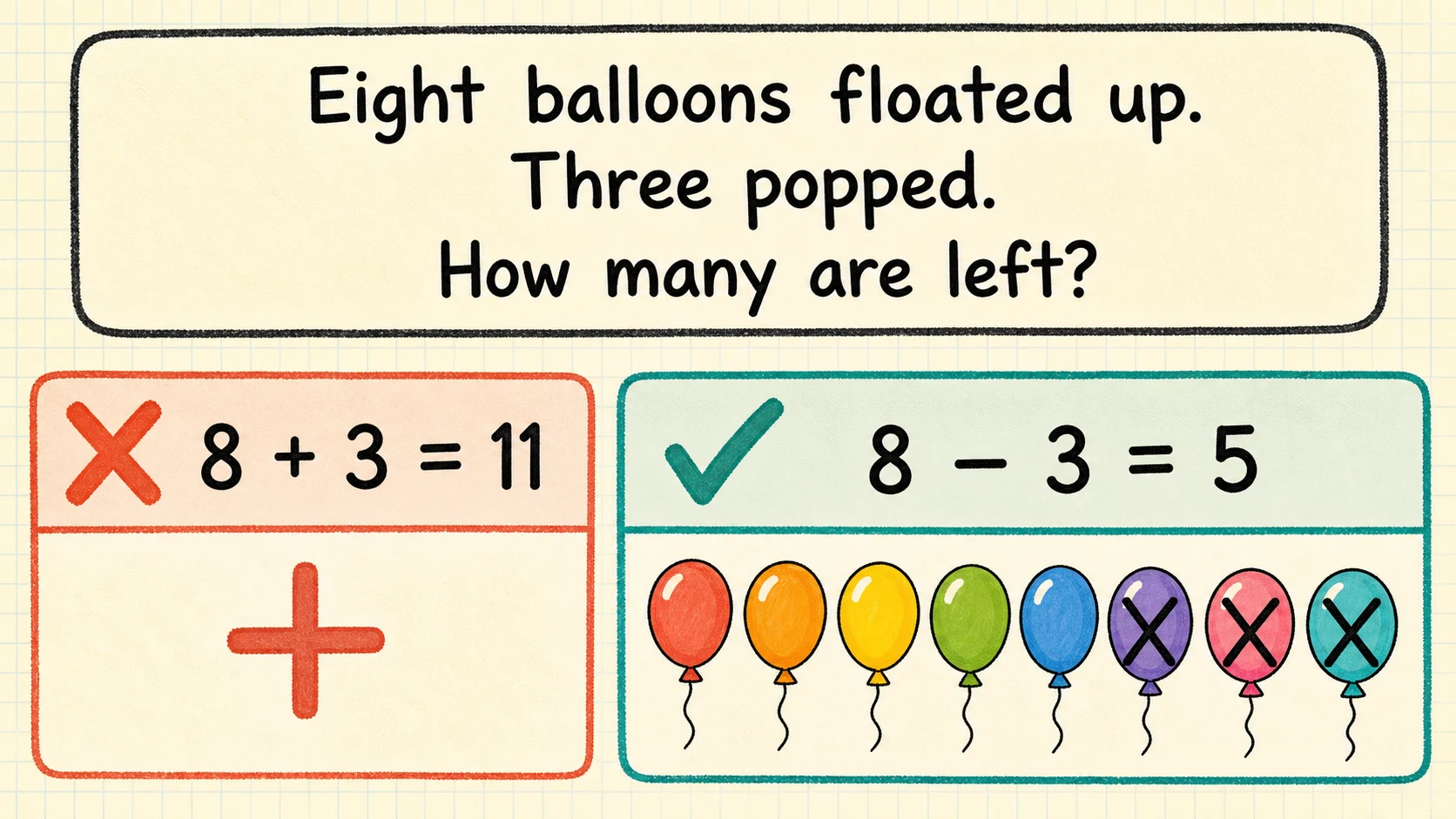
Language access, concrete models, and faded prompting can preserve the original reasoning demand.
Boundary Cases and Misconceptions
When correct arithmetic hides weak comprehension
A learner may see 3 and 4, add them automatically, and write 7. That answer could be correct in a joining story and wrong in a separating story. Ask the learner to show the story or explain what the answer counts.
A correct numeral with no matching representation is not necessarily wrong, but it provides limited evidence. Use one follow-up: “How did you know?” If the explanation matches the situation, accept the method.
When the model is right but the numeral is wrong
Suppose a learner draws six objects, crosses out two, leaves four visible, and writes 5. The story representation appears sound; the error is in counting or recording. Point to the mismatch: “Your picture shows the objects left. Count them again and compare that count with the number you wrote.”
This calls for a different response than an operation error. Re-teaching subtraction from the beginning may be unnecessary.
When every number is used at once
In a two-step story, a learner may combine all visible numbers without following their roles. Return to sequence:
- “What is true at the start?”
- “What happens first?”
- “How many are there now?”
- “What happens next?”
Record an intermediate result before solving the second step. The goal is not merely to use every number; it is to represent each event in order.
When the story does not supply enough information
A boundary case such as “Sam has some cars and gets 2 more. How many cars does Sam have now?” cannot produce one numerical answer because the starting amount is unknown. Although this may not appear among the 12 items, discussing it can clarify that word-problem solving is not automatic calculation.
A suitable response is: “We know Sam gets two more, but we do not know how many cars he started with.” Do not encourage guessing.
When an answer is possible but unreasonable
If four birds sit on a branch and one flies away, an answer greater than four conflicts with the story. “Reasonable” here means consistent with the represented quantities and actions, not merely close to the answer key.
The Kindergarten operations-and-algebraic-thinking section of the Common Core State Standards for Mathematics includes representing addition and subtraction problems with objects, fingers, mental images, drawings, sounds, actions, verbal explanations, expressions, or equations. That source provides broad context for varied representations. Local expectations may organize or teach these ideas differently, and this article does not claim comprehensive standards alignment for the worksheet.
Interpret Errors Before Correcting Them
Use an error-check routine that identifies where the reasoning changed course.
| Observed work | Likely issue to investigate | Productive response |
|---|---|---|
| Uses only the first number | Incomplete reading or listening | Reread and identify every event |
| Combines numbers in a removal story | Story structure was misunderstood | Act out who or what leaves |
| Correct model, incorrect count | Counting or numeral-recording error | Recount the finished model |
| Correct answer, unrelated drawing | Possible guessing or hidden mental method | Ask for a verbal explanation |
| Solves only the first event | Second step was missed | Mark “first” and “then” orally |
| Reverses the story action | Sequence was not retained | Rebuild the starting set and replay |
| Cannot begin without an operation cue | Prompt dependence | Return to retelling and representing |
| Repeatedly erases despite sound reasoning | Low confidence or unclear checking habit | Ask for one explicit check before changing work |
Treat these as hypotheses, not diagnoses. The same visible error can have different causes. A learner who omits a second step may not understand multi-step reasoning, may have overlooked a sentence, or may simply have lost their place.
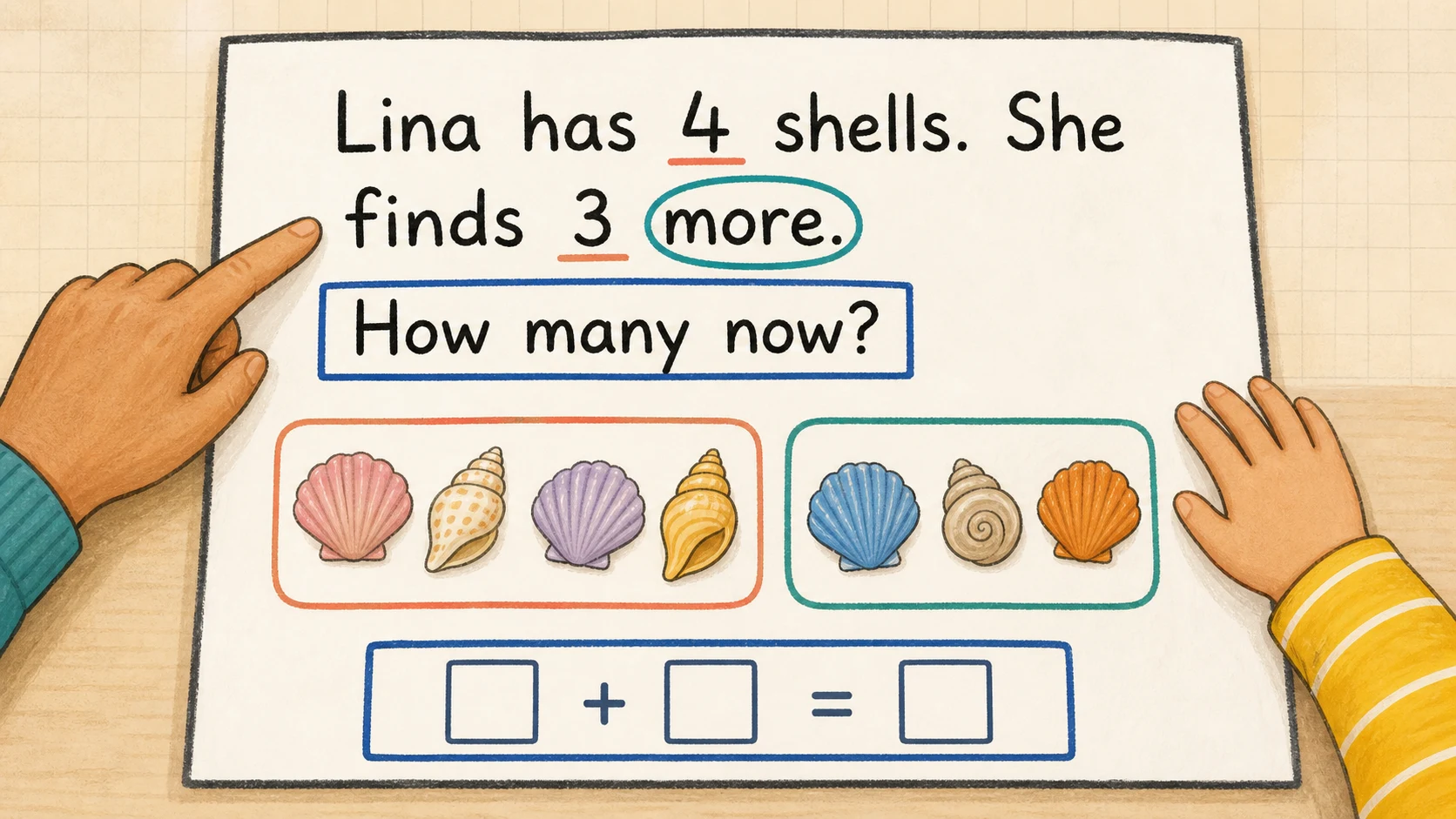
Compare the story, representation, calculation, and written answer before deciding what needs reteaching.
Use the Answer Key Responsibly
The separate answer key makes checking efficient, but it should confirm reasoning rather than replace it.
First, solve or inspect the learner’s representation without displaying the key. Then compare the final answer. For an incorrect response:
- Reread the exact problem.
- Ask the learner to retell it.
- Compare the retell with the drawing or counters.
- Recount or recalculate.
- Consult the key to confirm the corrected result.
- Have the learner state what changed.
Do not mark the whole page and announce a score without examining methods. Three incorrect answers caused by skipping the final sentence call for a different next lesson than three unrelated counting mistakes.
The key also has limitations. It normally confirms the expected result, but it cannot show whether a correct answer came from understanding, guessing, copying, or adult direction. Nor can it capture every valid representation. A drawing, counters, and an equation may all express the same relationship.
When recording progress, use brief factual notes such as:
- “Represented joining stories independently.”
- “Needed the final question reread.”
- “Modeled two-step changes correctly with counters.”
- “Counted accurately but reversed one action.”
These notes are more actionable than broad labels such as “good at word problems” or “struggling.”
Decide What to Do Next
Continue, pause, or revisit
Continue with the remaining items when the learner can represent the story, choose a fitting action, and explain or check the result with decreasing support.
Pause when effort remains productive but accuracy begins to deteriorate. Save unused items for later; unfinished practice is not failed practice.
Revisit with modeling when errors repeat around the same point in the routine. For example, if the learner consistently builds the starting quantity but ignores what happens next, model story actions with counters before returning to the page.
Move to related practice when the learner solves accurately and independently across more than one story structure. The broader Kindergarten Math worksheet collection can help you choose adjacent practice, while the Kindergarten worksheet hub provides other subject areas. For a larger set focused on this skill, the Kindergarten Word Problems Worksheet Pack contains 18 worksheets and is listed at $4.79.
A single successful page does not establish permanent mastery. Likewise, one difficult sitting does not establish a lasting difficulty. Look for patterns across attempts, representations, and delayed review.
Schedule Retrieval After the First Lesson
Retrieval means returning to the reasoning after some time has passed. The schedule below is a practical option, not a universal timetable.
| Time | Review task | Adult support |
|---|---|---|
| Later the same day or next day | Revisit one previously solved item orally | Ask the learner to retell before looking at old work |
| About 2–3 days later | Solve one saved item | Offer counters, but do not select the operation |
| About 1 week later | Solve one joining or part-whole item and one separating item | Ask for a check using a second method |
| About 2 weeks later | Solve a fresh similar problem | Compare current independence with earlier notes |
Change the spacing when the learner’s work indicates a need. If the routine disappears after one day, shorten the interval and provide a brief model. If retrieval is accurate and independent, lengthen the interval or mix the problem with other Kindergarten math tasks.
Do not rehearse only the exact answer. A learner who remembers that a particular item equals 6 may not have retrieved the reasoning. Ask for a reconstruction: “What happens in the story, and how could you show it?”
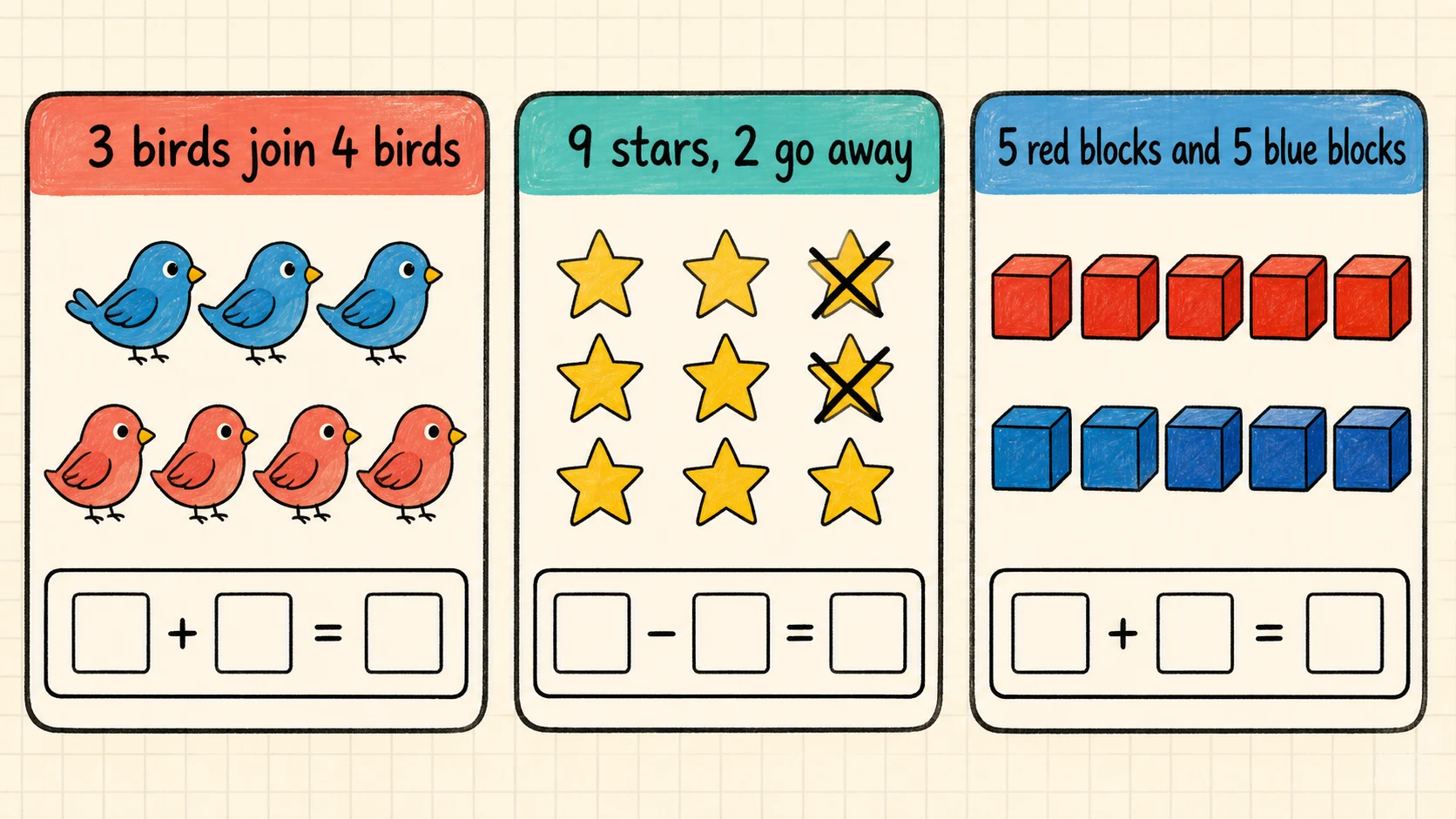
Revisit the process with selected old and new problems instead of repeating the whole page immediately.
Limitations of This Printable
This worksheet offers 12 easy-level exercises, not a comprehensive assessment or complete word-problem curriculum. Its labels indicate intended practice level, not a guarantee that every Kindergarten learner has received the same prior instruction.
The worksheet includes reading comprehension, problem solving, mixed operations, and multi-step reasoning. Performance can therefore be affected by several interacting demands. An incorrect answer alone does not reveal whether the difficulty came from decoding, language comprehension, representing a quantity, following a sequence, calculating, counting, or recording a numeral.
The page also cannot establish how a learner performs during discussion, with concrete materials, in a different context, or after a delay. Use it as one source of observable work. Avoid drawing child-specific educational or medical conclusions from the score. If concerns persist across settings and forms of support, share specific work samples and observations with the learner’s teacher or another appropriate education professional.
For a fuller view of how story types and problem-solving habits can develop, return to the word-problems topic guide. It is the better place for the broader progression.
A Practical Next Action
Print the free 12-item worksheet, choose counters, and prepare the four-step launch: model one similar story, solve two items together, release two items independently, and inspect the learner’s representations before deciding whether to continue.
After the first sitting, reserve at least one unused item for delayed retrieval. If the learner needs more practice with the same topic, select the next activity from the Kindergarten word-problems guide. If you need a newly generated practice page instead, explore the free worksheet generators and keep the quantities and story structure matched to what the learner’s observed work shows they are ready to practice.
Put it into practice
Use the guide with a real printable
Move from explanation to a short, observable practice task. Check the first item together, then adjust the next session from the learner's actual work.
See the 18-worksheet pack