Complete guide
How to teach and practise kindergarten subtraction worksheets - standard theme (easy)
How to Use This 20-Item Kindergarten Subtraction Worksheet
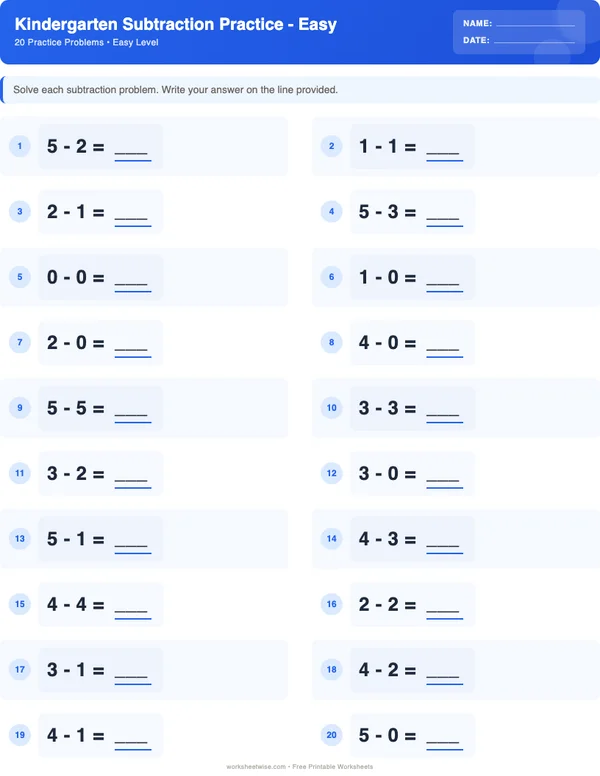
The free Kindergarten Subtraction Worksheets – Standard Theme (Easy) printable contains 20 subtraction exercises and a separate answer key. Its directions are straightforward: solve each subtraction problem and write the answer on the line.
The short answer is to use the page as a lesson, not merely as a test. Preview the printed problems, model one or two similar equations with objects, solve several items together, and then release the learner to complete a manageable group independently. Check for understanding after each group rather than waiting until all 20 items are finished. If the work shows confusion, return to objects or drawings without changing the subtraction being practiced.
This guide provides one practical way to do that. It does not prescribe a universal lesson length or require the learner to finish the page in one sitting. The learner’s observed work should determine the pace.
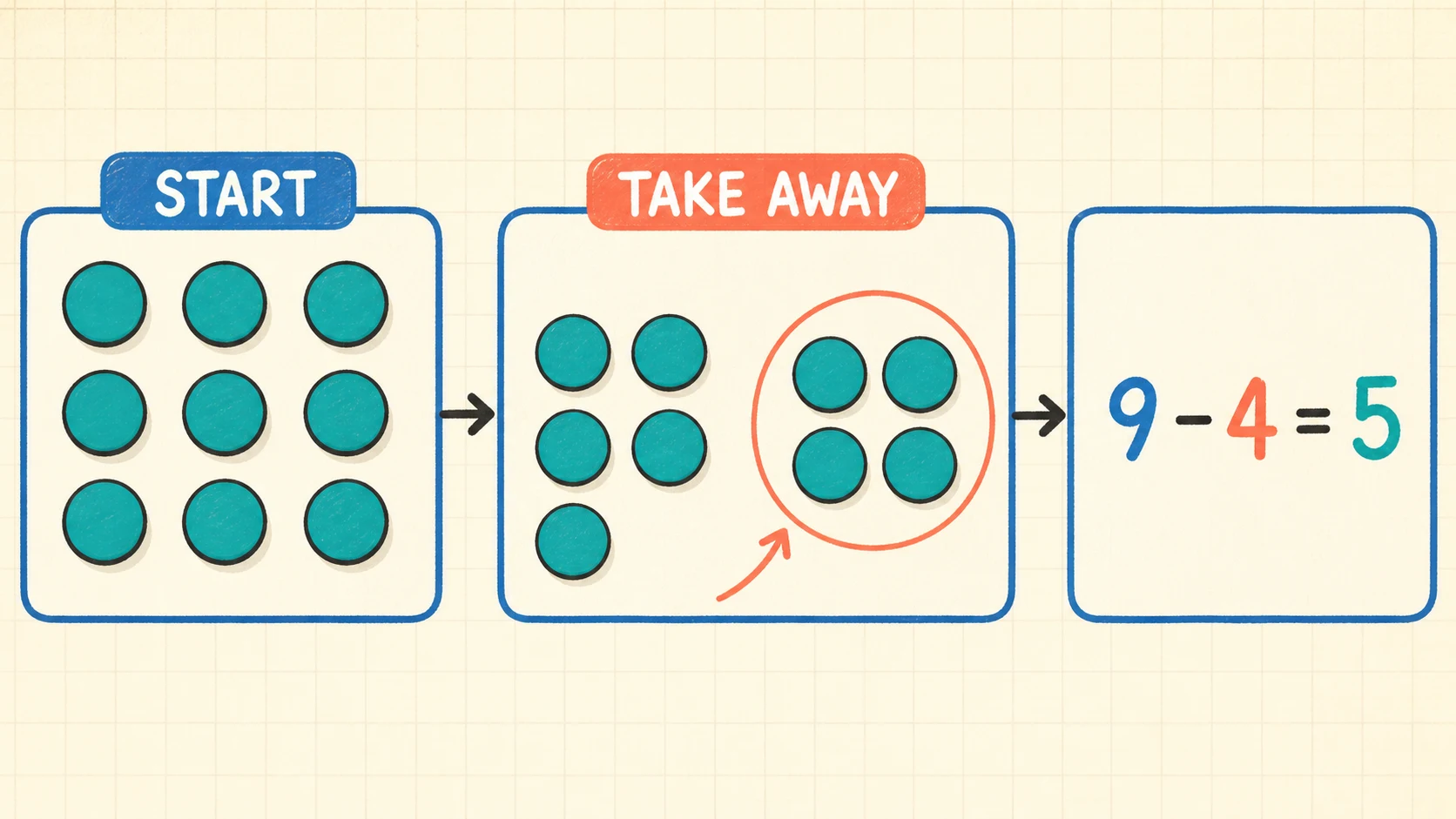
Move from a brief launch to modeling, guided work, independent practice, and review.
Confirm the Worksheet Is a Good Match
This is an easy-level Kindergarten worksheet with 20 exercises. The catalogue identifies subtraction facts, mental math, number sense, and regrouping among its skills. Before beginning, look through the actual printable and answer key. Confirm the size of the numbers, the notation, and whether any item requires a representation or procedure that the learner has not encountered.
Grade labels describe the intended practice level; local curricula and teaching sequences differ. “Kindergarten” therefore does not mean that every Kindergarten learner should complete the page at the same point in the year or use the same strategy.
A learner is reasonably prepared to try the page when they can do most of the following with small quantities:
- Count a set accurately.
- Recognize that the first number in a take-away example is the starting amount.
- Remove objects and count what remains.
- Connect a spoken statement such as “five take away two” to .
- Write or select a numeral for the remaining quantity.
These are readiness observations, not a diagnostic checklist. If the learner cannot yet connect an equation to a concrete action, begin with objects and a few oral examples. The broader Kindergarten subtraction topic guide provides the wider progression; this article stays focused on launching and using this particular printable.
Materials that preserve the skill
Prepare the worksheet, a pencil, and the separate answer key for the adult. Add six to ten small counters if needed. Buttons, linking cubes, blocks, bottle caps, or dry beans can work as long as they are safe for the learner and easy to move.
A blank sheet of paper is useful for drawing dots or crossing out objects. A number line may also help a learner who already understands that moving left represents taking away. The representation should clarify the same equation rather than replace it with an easier one.
Keep the answer key out of sight during instruction. It is for checking after the learner has had a genuine opportunity to reason.
Use a Flexible Lesson Progression
The IES guide for teaching mathematics to young children recommends teaching number and operations through a developmental progression and monitoring what each child knows. That high-level framing supports moving from concrete action toward drawings and equations while using the learner’s responses to decide when to continue.
The following plan is an instructional suggestion for this worksheet, not a timetable issued by IES.
| Lesson phase | Suggested worksheet use | Adult action | Evidence to notice |
|---|---|---|---|
| Launch | No items yet | Review “start, take away, remain” with counters | Learner removes rather than adds |
| Model | Use a similar example | Think aloud and record the equation | Learner connects the action to the symbols |
| Guided practice | First 3–5 suitable items | Prompt, then gradually reduce help | Learner explains or shows the subtraction |
| Checkpoint | Pause briefly | Examine strategy and accuracy | Errors are isolated or follow a pattern |
| Independent practice | Next 5–10 items | Observe without solving for the learner | Strategy remains stable without prompts |
| Finish or pause | Remaining items | Continue only if work is productive | Attention and reasoning remain adequate |
| Review | Selected items later | Revisit one secure and one difficult fact | Learner recalls or reconstructs the answer |
Twenty items may be manageable in one sitting for one learner and too many for another. Folding the page, covering unused rows, or stopping at a natural break changes the amount presented at once, not the mathematical skill.
Launch Subtraction as an Action
Begin away from the printed page. Place five counters where both of you can see them.
Say, “We start with five. I take away two. Now we count what remains.” Move two counters aside and count the three that are left. Then write:
Point to each part:
- tells the starting quantity.
- The minus sign means an amount is being taken away in this example.
- tells how many are removed.
- tells how many remain.
Use consistent, concise language. “Start with,” “take away,” and “remain” are clearer during an initial model than a stream of changing phrases. Once the learner understands the action, connect it to other appropriate words such as “subtract” and “difference.”
The IES mathematics intervention guide recommends systematic instruction, clear mathematical language, and well-chosen concrete or semi-concrete representations for learners who need additional support. That source did not evaluate WorksheetWise or this worksheet. Here, counters and drawings are practical applications of its broader instructional framing.
Model the complete routine
Demonstrate one problem from beginning to end:
- Read the equation from left to right.
- Name the starting amount.
- Show that amount with counters.
- Remove the stated quantity.
- Count what remains.
- Write the answer.
- Check whether the answer makes sense.
Avoid turning the demonstration into a long speech. The learner should be able to see the quantity change. After modeling, ask the learner to retell the steps or show the action with a fresh example.
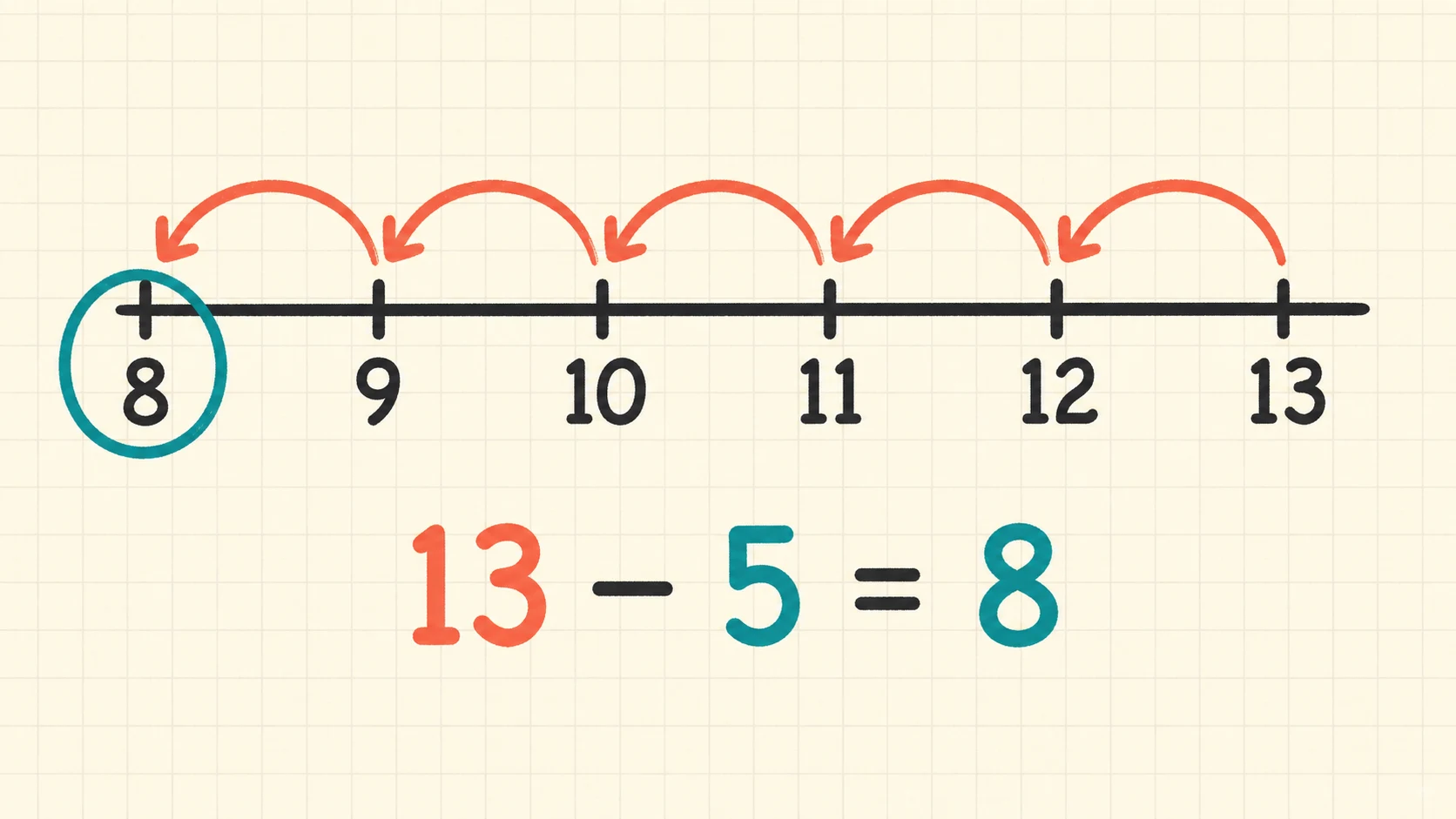
Objects, an equation, and a check should describe the same subtraction.
Teach Through Fully Checked Examples
The following examples are independently verified and are similar to the kind of foundational subtraction practice an adult might use when preparing for the printable. They are not presented as transcriptions of particular worksheet items.
Example 1: A basic take-away fact
Solve .
Start with five counters:
Remove two:
Three remain, so:
Check with related addition:
The check rebuilds the starting amount, so the answer is correct.
Example 2: Subtracting one
Solve .
A learner can show seven objects and remove one. Six remain:
A count-back check also works: one step before seven is six. Related addition confirms it:
If a learner answers , ask them to perform the removal physically. They may have counted the starting set without changing it.
Example 3: Subtracting zero
Solve .
Start with six and remove no objects. The original six remain:
Check:
This boundary case helps reveal whether the learner thinks every minus sign must make the number smaller. Subtraction by zero leaves the quantity unchanged.
Example 4: Subtracting the whole amount
Solve .
Start with four counters and remove all four. None remain:
Check:
The answer is zero, not four. The learner may need an empty space, an empty box, or the spoken phrase “none remain” before connecting that result to the numeral .
Example 5: Counting back with control
Solve .
Begin at eight and count back exactly three moves:
Therefore:
Check with addition:
Watch that the learner does not count the starting number as the first backward move. Saying “start at eight; one move lands on seven” keeps the movement and count synchronized.
These examples cover ordinary take-away facts and two useful boundaries: subtracting zero and subtracting the entire starting quantity. Do not assume the learner understands those boundaries merely because they can solve a fact such as .
Move From Guided to Independent Practice
Choose the first worksheet item only after the learner has understood the modeled routine. Read the printed direction together. If reading the equation is itself a barrier, point to the symbols while naming them, but allow the learner to perform the mathematics.
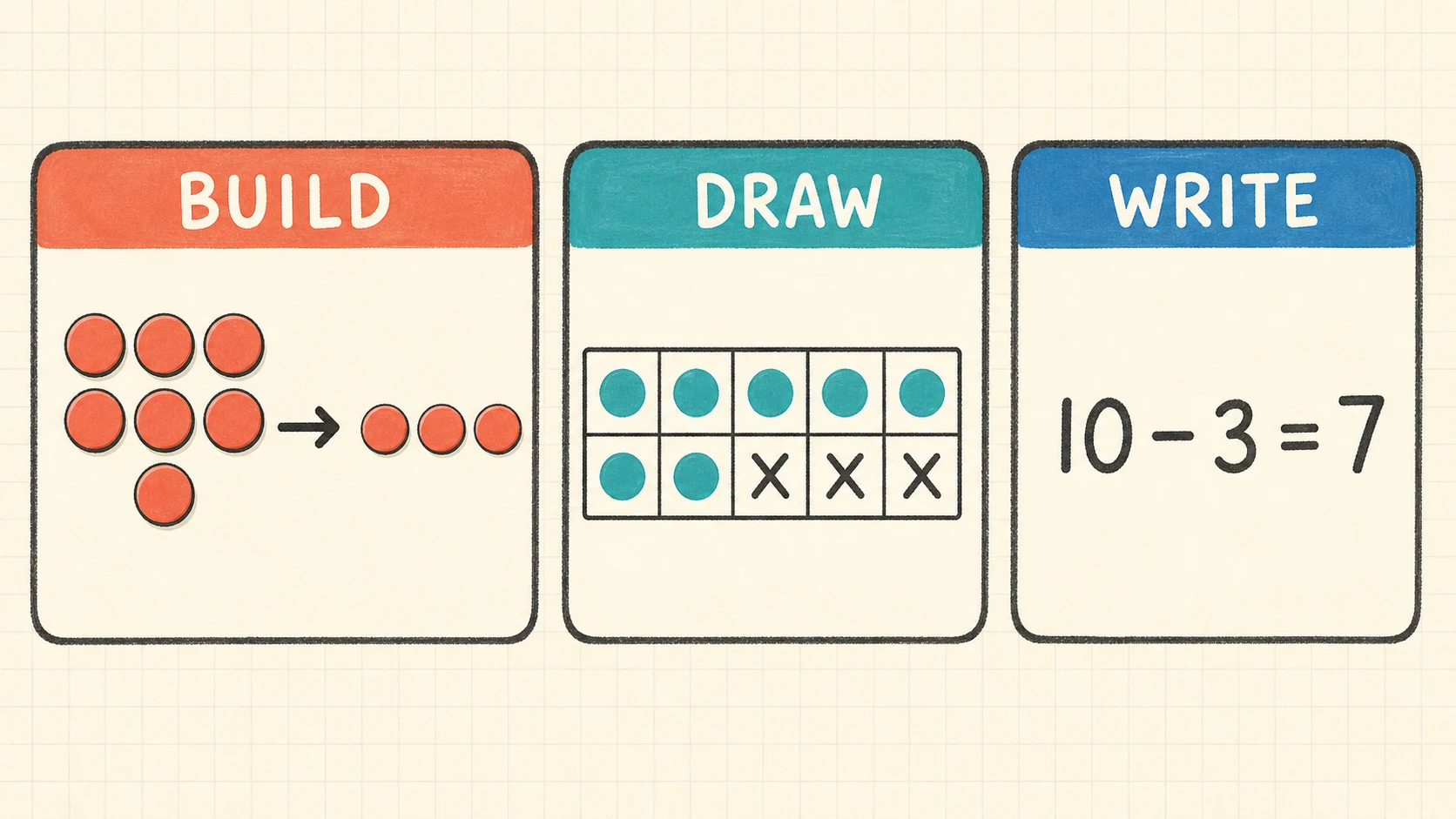
Reduce prompts only after the learner can carry out the subtraction accurately.
Guided practice prompts
For the first few suitable items, use prompts in a stable order:
- “What number do you start with?”
- “How many are you taking away?”
- “Show that with the counters.”
- “How many remain?”
- “Where will you write that answer?”
- “How can you check it?”
Do not ask every question when it is no longer needed. If the learner begins the next item correctly, wait. Excessive prompting can hide whether the routine is becoming independent.
A useful release sequence is:
- Adult models and explains.
- Learner solves while the adult prompts.
- Learner solves and explains while the adult observes.
- Learner solves silently, then checks or explains one selected item.
A checkpoint before continuing
After three to five items, pause and inspect the work. A practical decision rule is:
- If the learner’s answers and representations are mostly accurate, allow a short independent group.
- If one error appears but the method is sound, correct that item and continue cautiously.
- If several answers show the same misunderstanding, stop the page and reteach that idea with objects.
- If the mathematics is accurate but numeral formation is difficult, separate the writing support from the subtraction judgment.
This rule is an instructional suggestion. It is not a validated screening threshold. The important evidence is the nature of the learner’s work, not a predetermined percentage.
During independent work, remain available but avoid confirming every answer. Immediate approval after each item can make the learner dependent on the adult’s expression. Instead, ask the learner to complete a small group and then review it with you.
Adapt Support Without Changing the Subtraction
Adaptation should make the existing task more accessible while preserving the operation and quantities on the page. It should not quietly turn subtraction into copying answers.
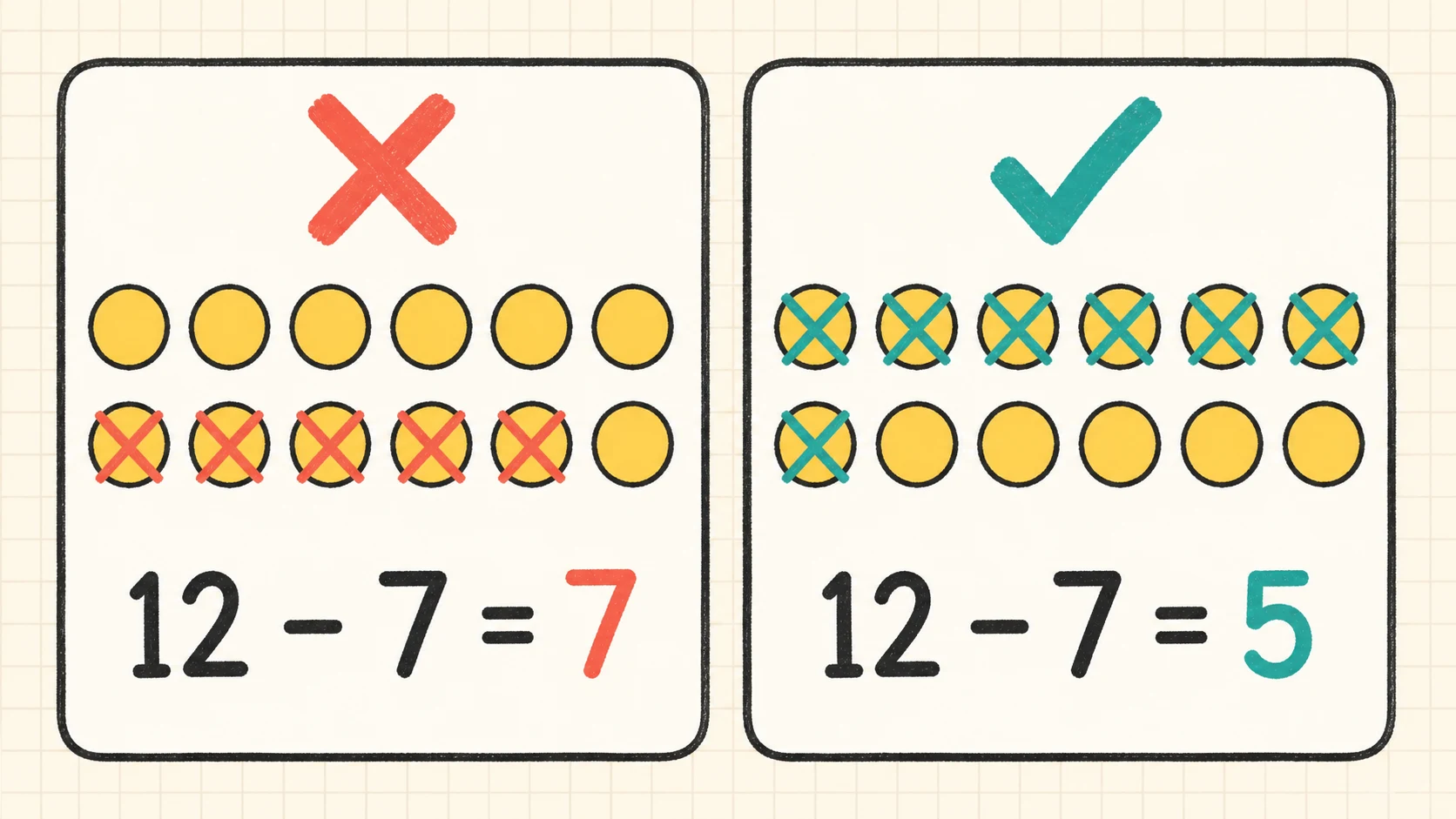
Adjust the representation, page load, or response method while preserving the equation.
When concrete support is needed
Let the learner build every equation with counters. Place the starting set in a small box or drawn circle so it is clear which objects belong to the problem. Have the learner move removed objects to a separate “taken away” area.
If loose counters create distraction, draw the starting quantity as dots. The learner can cross out the amount being subtracted and count the uncrossed dots.
When the full page is visually demanding
Cover all but one row with plain paper. Fold the page so only a small group is visible, or use a blank sheet as a tracking window. These changes reduce the amount of visual information without altering an item.
Give a brief movement or water break between groups if attention has declined. Resume by reviewing one completed example before presenting new items. Do not insist on finishing simply because unused problems remain.
When writing is the main obstacle
Allow the learner to say the answer while the adult records one or two responses, or offer numeral cards from which the learner can select. Continue asking the learner to show the subtraction independently. This separates evidence of mathematical understanding from the physical act of writing.
When appropriate, return to writing answers on later items. The worksheet’s stated task includes writing the answer on the provided line, but supported responding can help identify whether the immediate difficulty is subtraction or recording.
When the page appears too easy
Do not manufacture larger numbers and call them part of this worksheet. Instead, ask the learner to justify selected answers with a drawing or a related addition equation. For example, after solving , the learner might check .
The Common Core mathematics standards describe mathematics learning as involving both understanding and procedural skill and note the value of age-appropriate explanation. This is high-level context, not a claim that this exact printable has been independently reviewed for comprehensive standards alignment.
Interpret Errors Before Correcting Them
A wrong answer is useful only when the adult looks for the reasoning behind it. Marking every incorrect response with the same symbol can conceal different needs.
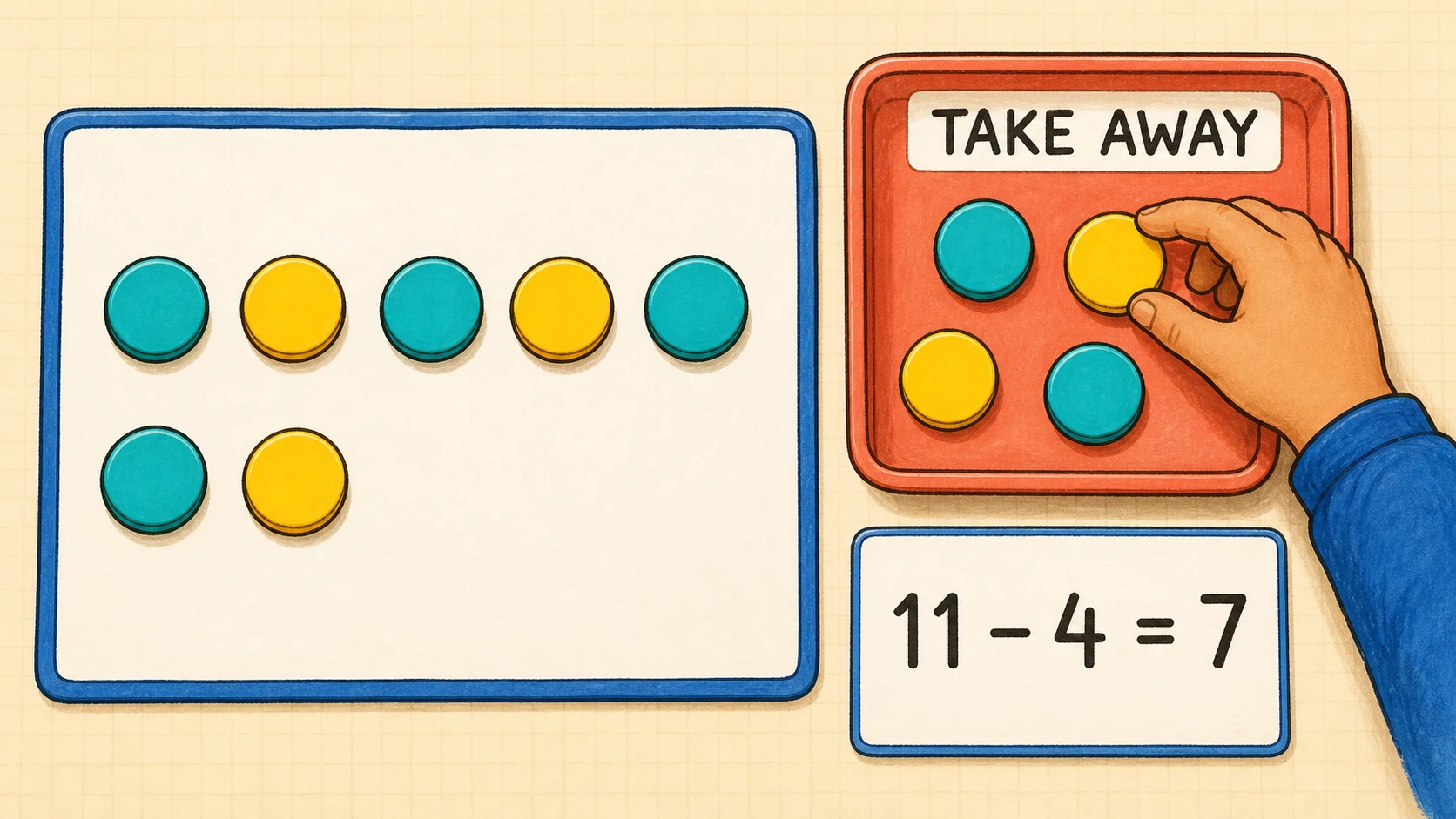
Rebuild the quantity, identify the step that changed, and retry the original item.
The learner adds instead of subtracting
For , a response of may mean the learner combined the numbers. Point to the minus sign, say “take away,” and have the learner physically remove two from five.
Do not merely say, “That is addition.” Reconnect the symbol, language, and action. Then retry the original equation before moving to a different fact.
The learner reverses the numbers
A learner may try to remove the first number from the second or may read as . Use a starting box: place six counters inside it and label that set “start.” Then remove two.
Emphasize reading from left to right: “Start with six; take away two.” For this foundational practice, the order carries meaning.
The learner makes a one-off counting error
Suppose a learner solves by saying “eight, seven, six” and writes . They counted the starting number as one of the three backward moves.
Place a finger on eight without counting a move. Then make three visible hops: seven is hop one, six is hop two, and five is hop three. The corrected result is .
The learner thinks subtraction always leaves something
An answer of for can signal discomfort with an empty result. Remove all four objects and ask the learner to count what remains. Connect “none” to , then verify .
The learner changes the starting quantity
If the learner builds with six or eight counters, the difficulty occurred before subtraction. Ask them to touch and count the starting set once, then compare it with the first numeral. Accurate one-to-one counting may need attention alongside the subtraction work.
The answer is correct but the strategy is unclear
A correct response does not always show whether the learner understood. Select one or two answers and ask for a demonstration: “Show how you know.” Accept counters, crossed-out dots, a controlled count back, or a related addition check when it accurately represents the equation.
Avoid requiring a lengthy verbal explanation for every item. The purpose is to sample understanding, not add a second 20-item assignment.
Use the Answer Key Responsibly
The separate printable answer key supports efficient checking, but it should not replace observing the learner’s method.
First, solve or inspect the learner’s work. Then compare each response with the corresponding key entry. Match item numbers carefully, especially if the page was completed across multiple sittings. If your own reasoning and the key appear to disagree, rebuild the item with objects and calculate it independently before changing the learner’s answer.
Classify corrections rather than reporting only a total:
- Accurate without help
- Accurate with objects or a drawing
- Accurate after a prompt
- Corrected after discussion
- Not yet understood
These descriptions are more useful for planning the next lesson than a score alone. They also prevent an answer reached after substantial help from being mistaken for independent fluency.
Ask the learner to correct only a manageable number of errors at once. Cover the key, return to the original equation, and use the lightest support that restores accurate reasoning. Never have the learner copy a column of correct answers as a substitute for correction.
Decide What Comes Next
The completed page is one sample of work. It cannot by itself establish broad mastery, diagnose a learning difficulty, or show that the learner can apply subtraction in every setting.
Continue at a similar level
Choose more easy subtraction practice when the learner understands the action but still relies on counters, makes occasional counting errors, or needs more experience recognizing facts. The Kindergarten math worksheet collection can help an adult place this work among related number activities.
The focused Kindergarten Subtraction Worksheet Pack contains 18 worksheets and is listed at $4.79. It may be useful when repeated printable practice is wanted, but purchasing a pack is not necessary to review this free page.
Return to earlier representations
Return to short object-based activities when the learner repeatedly adds, reverses the action, cannot identify the starting quantity, or guesses without representing the problem. Keep the quantities from suitable worksheet items and change only the support.
A brief successful reconstruction is preferable to pushing through the remaining items inaccurately. Resume the printable after the learner can explain or demonstrate several similar examples.
Add a small reasoning extension
When the learner completes the work accurately and can explain selected items, ask for related addition checks or simple oral take-away situations using the same number range. Do not assume that fast completion alone proves conceptual understanding.
For a fuller sequence across take-away, comparison, missing-part situations, and later subtraction development, use the subtraction topic guide rather than trying to make this single fact-practice page cover the entire topic.
Schedule Brief Retrieval After the Lesson
Retrieval means returning to previously practiced material after some time has passed. The schedule below is a flexible planning example, not a universal timetable or a sourced requirement. Shorten, extend, or repeat an interval according to the learner’s observed work and local teaching plan.
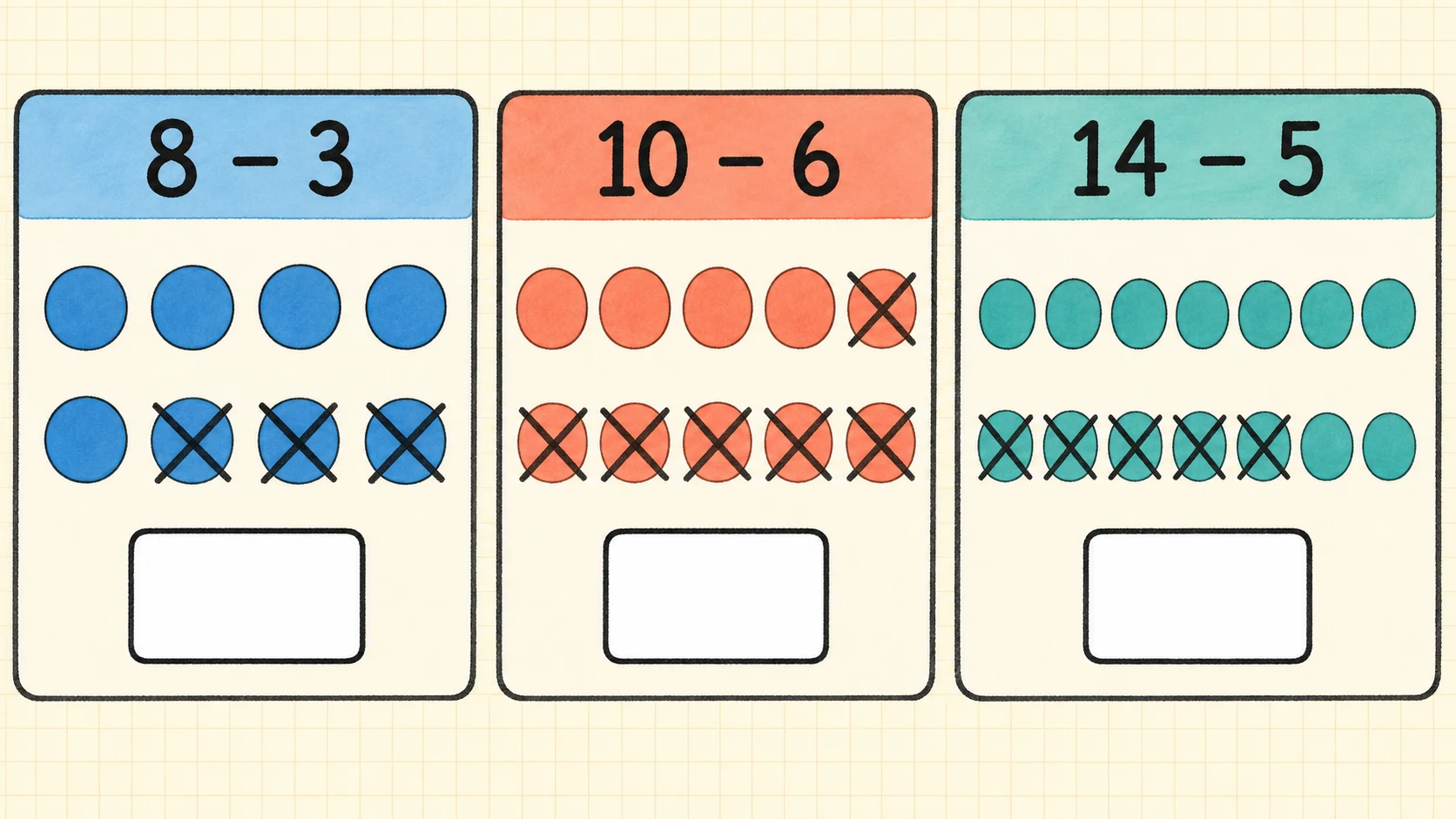
Revisit a few facts after increasing intervals and adjust from the learner’s responses.
| Review point | Suggested task | What to record |
|---|---|---|
| Later the same session | Rebuild one corrected problem | Whether the correction is retained |
| Next planned math session | Solve two secure facts and one previously difficult fact | Strategy, accuracy, and prompting needed |
| Several days later | Revisit three to five selected facts in a new order | Whether answers are recalled or reconstructed |
| The following week | Mix a few subtraction facts with oral or drawn examples | Whether the learner recognizes subtraction across forms |
| Later review | Use a fresh worksheet or generated set at the appropriate level | Whether understanding transfers to new items |
Do not make every retrieval attempt a speed test. Accuracy, an understandable strategy, and the ability to recover from an error provide useful information. If timed work is used in a local program, it should not obscure whether the learner understands the subtraction.
Keep a compact note such as “subtracting zero secure,” “counts starting number as first hop,” or “accurate with counters, not yet without them.” At the next session, begin with the recorded need rather than restarting the entire page.
Recognize the Worksheet’s Limits
This printable offers 20 easy-level exercises with an answer key. It can provide focused practice and a convenient work sample, but it is not a complete subtraction curriculum. Its catalogue skill labels do not reveal every number, representation, or procedure on the printed page, so adults should inspect the worksheet before instruction—particularly the listed reference to regrouping.
The page also cannot establish comprehensive standards alignment, guarantee an outcome, prescribe support for an individual child, or replace professional educational judgment. Persistent difficulty may deserve discussion with the learner’s teacher or another qualified education professional who can review work across tasks and settings. This guide does not provide medical guidance.
Use the page for the job it can do well: make a small set of subtraction responses visible, connect equations to understandable actions, and show what support the learner needs next.
A Practical Next Action
Print the free 20-item Kindergarten subtraction worksheet, select counters, and preview its answer key before meeting with the learner. Model , complete a short guided group, and stop for a strategy check before assigning the rest.
Afterward, record one secure idea and one point needing review. Use that note to choose the next activity from the Kindergarten subtraction topic guide, or create a suitably focused follow-up through the free worksheet generators.
Put it into practice
Use the guide with a real printable
Move from explanation to a short, observable practice task. Check the first item together, then adjust the next session from the learner's actual work.
See the 18-worksheet pack