Complete guide
How to teach and practise kindergarten place value worksheets - standard theme (easy)
A practical way to use this 20-item worksheet
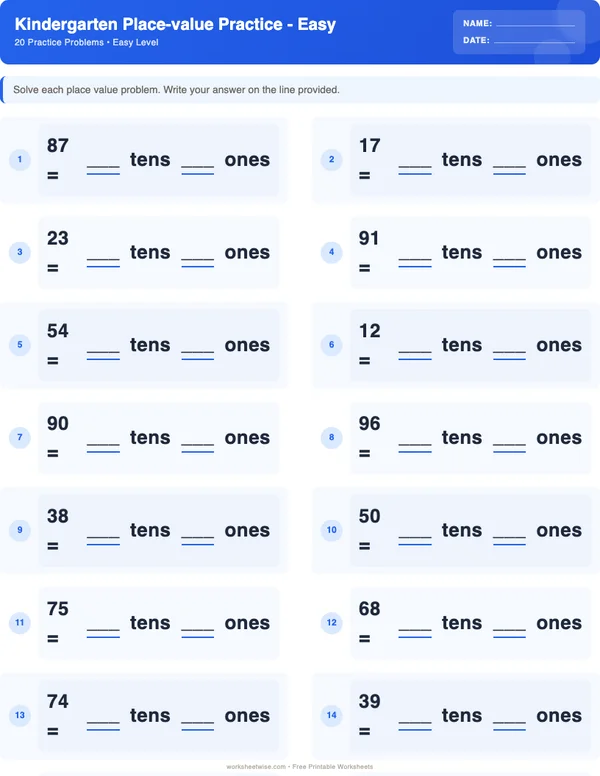
The free Kindergarten Place Value worksheet contains 20 easy-level problems covering place value, expanded form, number comparison, and rounding. Use it as a short lesson with pauses—not automatically as a single independent assignment. Preview the printed prompts, model one problem of each type that appears, complete a few items together, and then release the learner to work independently.
The concise answer is: begin with objects or drawings, connect those representations to the written numbers, and ask the learner to explain what each digit means. Check understanding after a small group of problems. Continue only while the work remains accurate and purposeful.
Grade labels describe the intended practice level; local school, district, state, and homeschool sequences differ. The Kindergarten label therefore helps adults select material, but it does not prove that every listed skill has already been taught in a particular program. For context, the Common Core State Standards for Mathematics specifically describe composing and decomposing numbers 11–19 into one ten and some ones at Kindergarten. This worksheet’s catalogue also includes comparison, expanded form, and rounding, so an adult should preview those items and provide instruction when a prompt reaches beyond the learner’s current sequence.
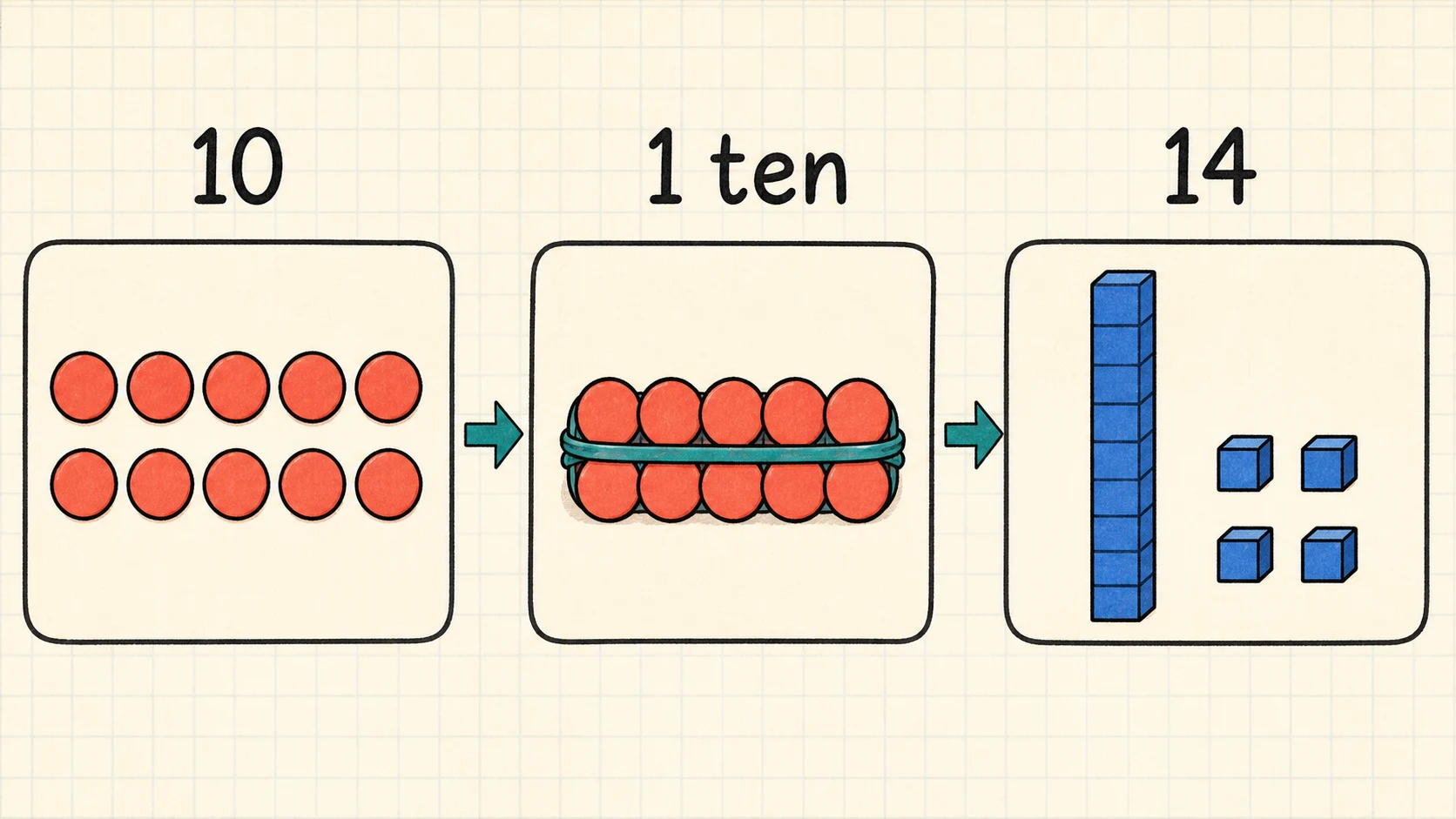
Preview, model, guide, observe, check, and revisit rather than treating all 20 items as one uninterrupted test.
What this worksheet asks the learner to practice
The printed direction is simple: “Solve each place value problem. Write your answer on the line provided.” The mathematical demands underneath that direction are more varied. According to the worksheet catalogue, the learner may need to:
- identify the value represented by a digit;
- write a number in expanded form;
- compare numbers;
- round a number;
- record an answer clearly on the provided line.
These are related skills, but they are not interchangeable. A child who can identify one ten and four ones may not yet understand a rounding prompt. Likewise, a child may compare two numbers correctly while still confusing a digit with its value. Keep notes by problem type instead of reducing all performance to one total score.
The broader Kindergarten Place Value topic guide provides the larger progression. Use that guide when you need to step backward to prerequisite work or decide which related skill should come next. This lesson guide stays focused on launching and interpreting this particular printable.
Materials to have ready
Prepare the worksheet, a pencil, and the separate answer key. It is also useful to have at least 20 small countable objects, such as counters, cubes, buttons, or craft sticks. If the learner has already used a ten-frame or place-value mat, keep that familiar representation available.
Use objects as thinking tools, not decorations. Ten loose counters can be gathered into one clearly marked group of ten, while remaining counters stay separate as ones. If bundling physical objects is inconvenient, draw one long bar for a ten and individual dots for ones.
Keep the answer key out of the learner’s sight during instruction. It should support adult checking after the learner has reasoned through a problem, not replace that reasoning.
A flexible lesson progression
A workable lesson can be organized by evidence from the learner’s work rather than by a universal number of minutes. Some learners may complete the entire page comfortably. Others may benefit from dividing the 20 problems across two or more sittings.
| Lesson phase | Adult action | Learner action | Evidence to watch |
|---|---|---|---|
| Preview | Identify every prompt type on the page | Listen and examine the layout | Recognizes where answers belong |
| Warm-up | Build or draw a teen number | Count and describe tens and ones | Counts one group of ten as ten |
| Model | Demonstrate one matching problem type | Watch, answer brief prompts, restate the method | Connects the model to the written number |
| Guided practice | Complete selected worksheet items together | Build, draw, compare, or explain | Uses the representation meaningfully |
| Independent practice | Assign a small run of items | Solve without step-by-step prompting | Maintains the method independently |
| Checkpoint | Review reasoning before revealing answers | Explain or correct selected work | Finds and repairs an error |
| Finish or pause | Continue, reduce the set, or stop | Complete an appropriate amount | Work remains attentive and interpretable |
| Retrieval | Revisit selected ideas later | Solve without copying prior work | Recalls the meaning after a delay |
This sequence is an instructional suggestion for using the printable. It is not a required timetable. The IES guide on teaching mathematics to young children supports high-level practices such as following a developmental progression, monitoring what children know, and helping them connect representations with mathematical language. It did not evaluate WorksheetWise or this exact worksheet.
Preview before the learner begins
Read all 20 items before presenting the page. Mark, on your own copy or notes, where the task changes from one skill to another. Confirm what each rounding item asks—for example, whether the printed direction specifies a rounding place. Do not supply an assumed rule when the page provides a more specific one.
Choose one fresh example for each problem format. A fresh example should resemble the mathematical task without duplicating a worksheet item. That preserves the page for practice while giving the learner a clear model.
Also decide where you will pause. A checkpoint after several items is generally more informative than waiting until all 20 answers have been written. If the learner begins making the same error repeatedly, stop the independent run before the error becomes a rehearsed pattern.
Launch with tens and ones
Start with a quantity the learner can verify. Build 13 using one group of ten and three loose objects. Count the group as ten, then count on: 11, 12, 13. Say, “Thirteen is one ten and three ones.” Write:
13 = 10 + 3
Ask the learner to point to the digit that records the ten and the digit that records the three ones. The important connection is not merely that 1 appears before 3. The 1 in 13 represents one group of ten, while the 3 represents three ones.
Keep the opening diagnostic
Use one or two quick checks before opening the worksheet:
- Show one ten and six ones. Ask the learner to name the number.
- Write 18. Ask the learner to build it or draw it.
- Show 14 and 17. Ask which is greater and how the tens and ones show that.
If the learner counts a bundled ten as one object and then says the total is 4 or 7, return to counting the ten objects before regrouping them. If the learner can build a number but cannot write it, keep the model visible and connect each part to its digit.
Do not preteach every answer on the printable. The launch should reveal whether the learner has an entry point, not turn the worksheet into a copying exercise.
Model the task with fully checked examples
Use explicit but brief modeling. Name what you notice, perform one mathematical step at a time, and check the result in a second way. The examples below are verified examples for instruction; they are not claims about the exact numbers printed among the 20 items.
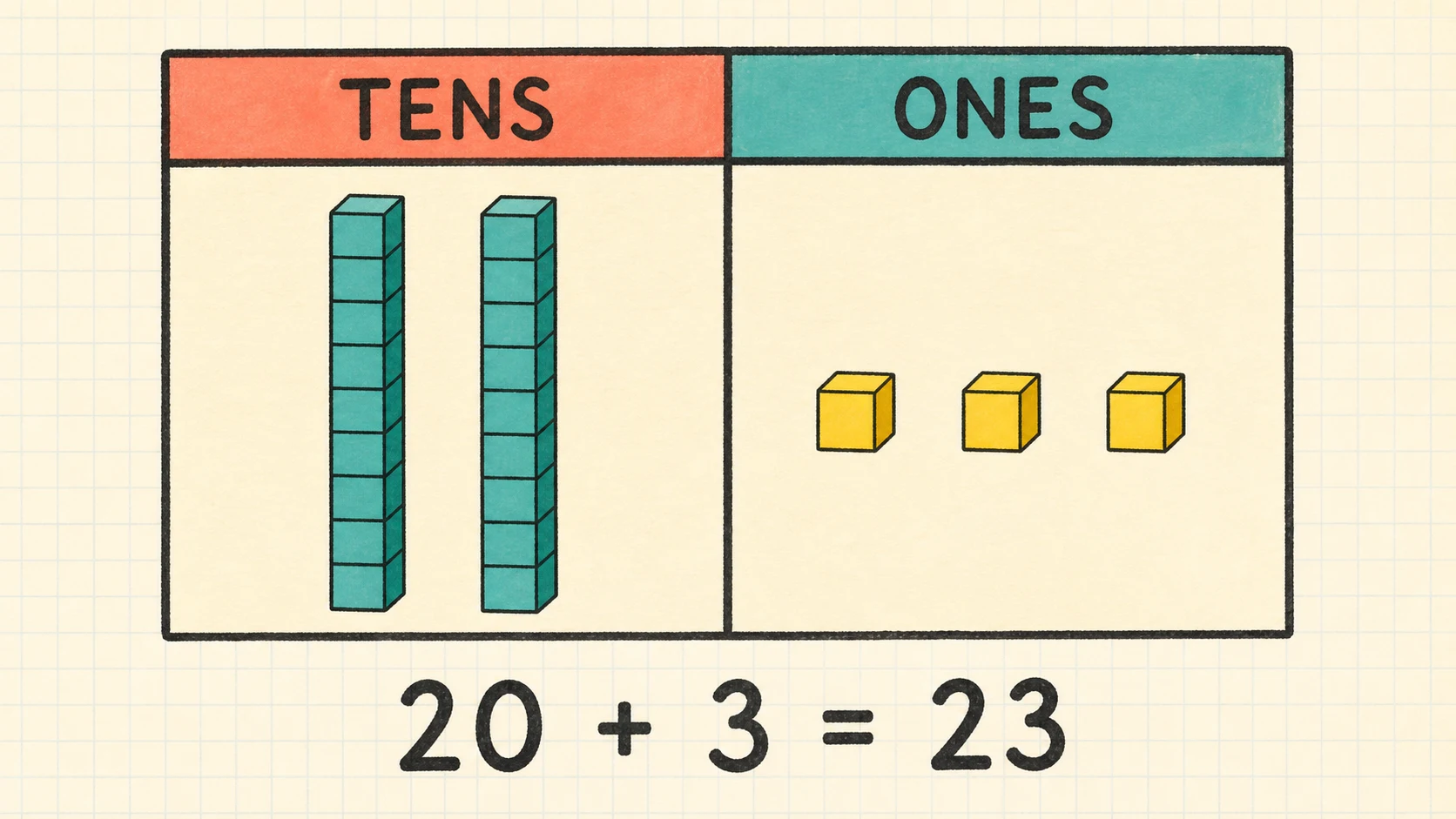
Connect the objects, the place-value language, the written number, and the final answer.
Example 1: Compose a teen number
Problem: What number has 1 ten and 5 ones?
Build one group of ten and five separate counters.
- One ten has a value of 10.
- Five ones have a value of 5.
10 + 5 = 15.
Checked answer: 15
Check by counting from ten: 11, 12, 13, 14, 15. The total and the written number agree.
Example 2: Identify a digit’s value
Problem: In 17, what value does the digit 1 represent?
The digit 1 is in the tens place. It represents one ten.
- One ten has a value of 10.
- The digit 7 represents seven ones.
Checked answer: 10
A useful boundary distinction is that the digit is 1, but its value in 17 is 10. If the prompt asks for the digit, answer 1. If it asks for the digit’s value, answer 10.
Example 3: Write expanded form
Problem: Write 14 in expanded form.
Fourteen contains one ten and four ones.
14 = 10 + 4
Checked answer: 10 + 4
Check by recombining the parts: 10 + 4 = 14. Writing 1 + 4 would name the visible digits but would not record the value of the tens digit.
Example 4: Compare two teen numbers
Problem: Compare 13 and 18.
Both numbers contain one ten, so the tens are equal. Compare the ones:
- 13 has 3 ones.
- 18 has 8 ones.
- 8 ones is more than 3 ones.
Checked answer: 13 < 18
Read the statement aloud: “Thirteen is less than eighteen.” If the worksheet asks for a word rather than a symbol, the answer would be “less than.”
Example 5: Compare across a tens boundary
Problem: Which is greater, 9 or 12?
Twelve contains one complete ten and two ones. Nine contains only nine ones. One ten is greater than nine ones.
Checked answer: 12
This is a useful boundary case because a learner may focus on the 2 in 12 and incorrectly decide that 9 is greater. Building both quantities makes the full values visible.
Example 6: Round only when the place is stated
Problem: Round 14 to the nearest ten.
Locate the neighboring tens, 10 and 20. Fourteen is 4 away from 10 and 6 away from 20.
Checked answer: 10
Check the distances:
14 - 10 = 420 - 14 = 6
Because 4 is less than 6, 14 is nearer to 10.
Example 7: The rounding midpoint
Problem: Round 15 to the nearest ten.
Fifteen is exactly halfway between 10 and 20:
15 - 10 = 520 - 15 = 5
Under the usual whole-number convention of rounding a midpoint to the next higher ten, the answer is 20.
Checked answer: 20
State this convention when teaching the problem. The midpoint is a boundary case; it cannot be decided by claiming that 15 is physically closer to one neighboring ten.
Move from guided to independent practice
Begin guided practice with an actual worksheet item that matches the model but is not identical to it. Ask the learner to do the mathematical action while you limit your help to short prompts.
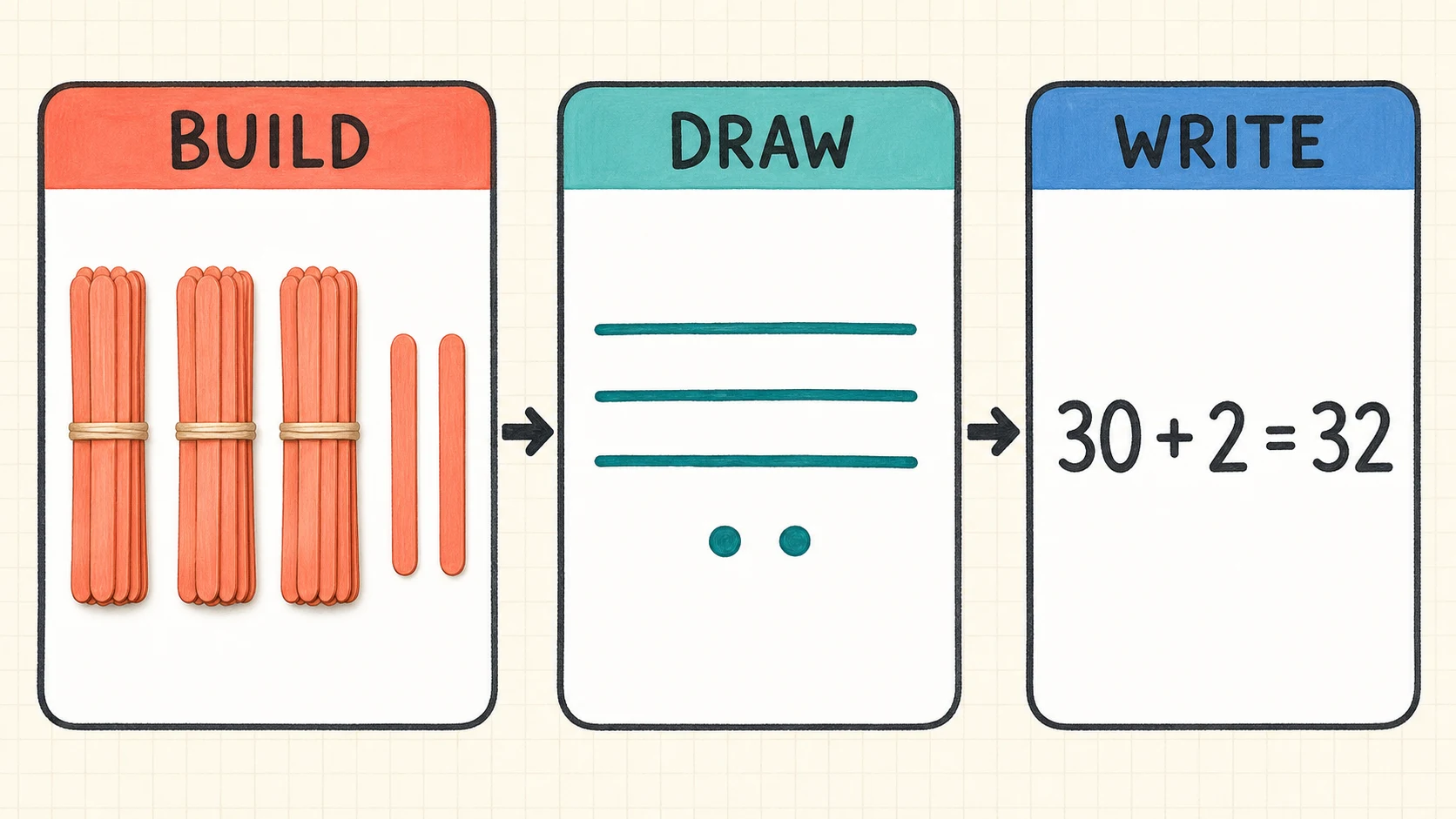
During guided practice, the adult prompts the reasoning without supplying the result.
Prompts that preserve the thinking
For a tens-and-ones problem, try:
- “Can you build the number?”
- “Where is the group of ten?”
- “How many ones are left?”
- “What number does that make?”
For expanded form:
- “What is the value of the tens part?”
- “What is the value of the ones part?”
- “How can you join those values with a plus sign?”
For comparison:
- “What do you notice about the tens?”
- “If the tens match, which ones are greater?”
- “Can you read your comparison aloud?”
For rounding:
- “What place does the prompt tell you to round to?”
- “What are the neighboring benchmark numbers?”
- “Which benchmark is nearer?”
- “Is this exactly halfway?”
Avoid turning these prompts into a chant that bypasses meaning. The learner should be able to point, build, draw, or explain why an answer is reasonable.
A release rule based on observed work
Move to independent practice when the learner completes at least a small sample of the current problem type accurately and can explain the method without having each step supplied. This is a practical instructional rule, not a sourced universal threshold.
Assign a short group of items first. During that group, avoid confirming each answer immediately. Observe whether the learner:
- begins without waiting for a cue;
- uses tens and ones consistently;
- reads the actual prompt;
- records the answer in the requested form;
- checks a result without looking at the key.
If accuracy breaks down, return to one guided item. If only handwriting or answer placement is causing difficulty, address that access issue without reteaching mathematics the learner already understands.
Adapt support without changing the skill
An adaptation should make the same mathematical idea more accessible. It should not quietly replace the task with a different one or reveal the answer.
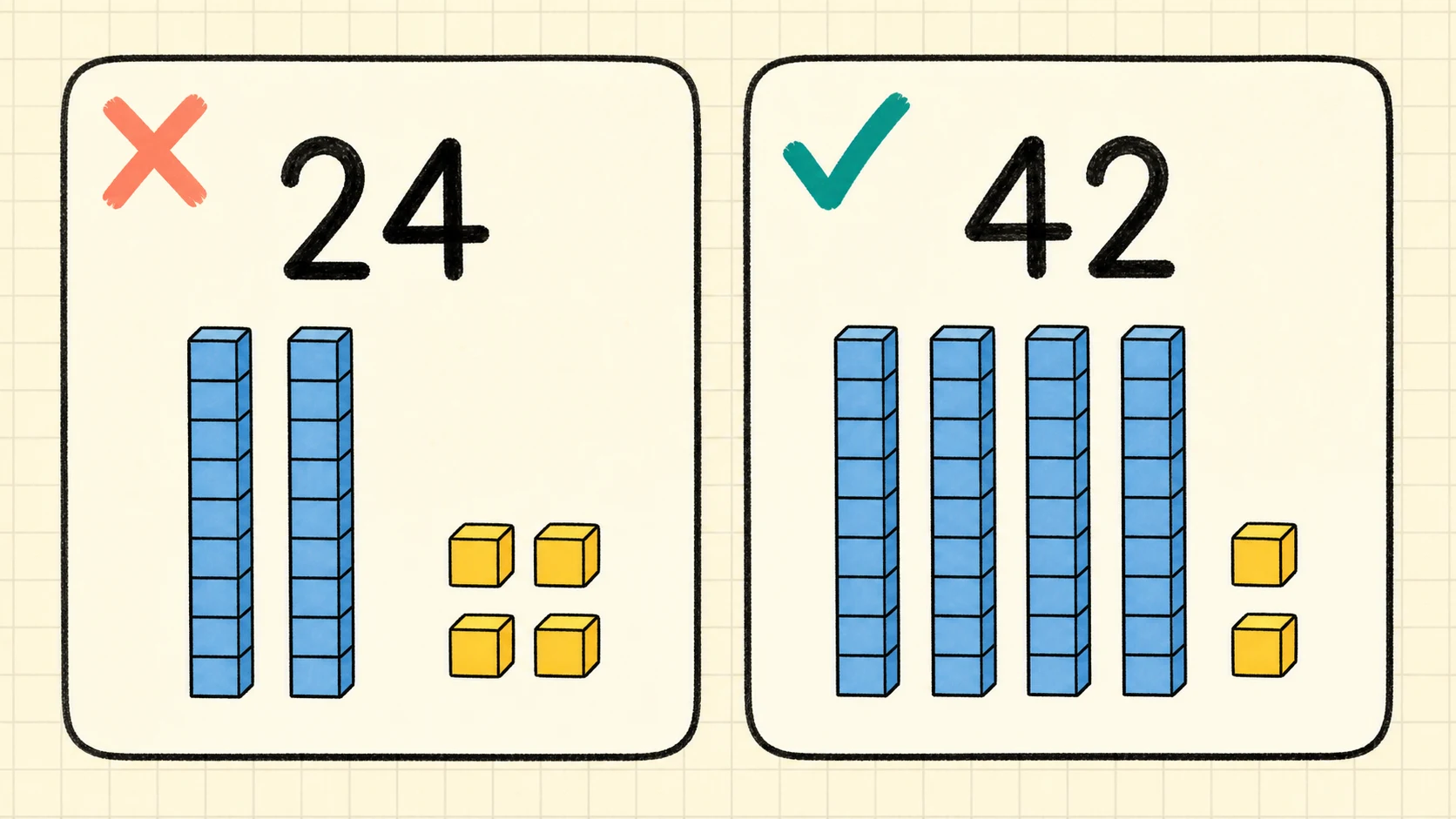
Change the representation, amount of visible work, or response method while preserving the place-value decision.
More concrete support
Let the learner build each number with objects. Use a cup, band, or drawn enclosure to show that ten objects are being treated as one group of ten. After building, require the learner to connect the model to the written answer.
For expanded form, place a card marked 10 beneath the group of ten and a ones card beneath the loose objects. The learner can then write the two values with a plus sign.
For comparison, build both numbers in parallel rows. Align the groups of ten and then align the ones. The comparison remains about the quantities, even though the representation is more concrete.
Less visual or reading load
Cover the problems that are not currently being solved with a blank sheet of paper. Reveal one item at a time while leaving the original wording and required answer intact.
Read the printed direction aloud if decoding the text would otherwise prevent the learner from showing the math skill. Do not paraphrase in a way that gives away the operation or answer.
If the learner loses track when moving between the page and manipulatives, place the objects directly beside the current problem. A finger, index card, or small marker can hold the place on the page.
More explanation for a ready learner
Ask for a representation or justification in addition to the written answer:
- draw the ten and ones for a teen number;
- explain why
10 + 8represents 18; - prove a comparison by discussing tens before ones;
- show both neighboring tens for a rounding problem.
This extension deepens the same skill. It does not require introducing larger place values merely because the learner finished quickly.
The IES guide for assisting students struggling with mathematics provides high-level support for systematic instruction, clear mathematical language, visual representations, and ongoing checks of understanding. Those recommendations can inform adult support, but the guide does not prescribe a particular number of worksheet items or certify this printable.
Interpret errors before correcting them
A wrong answer is most useful when it reveals the step at which meaning was lost. Ask the learner to recreate the reasoning before explaining the correction.
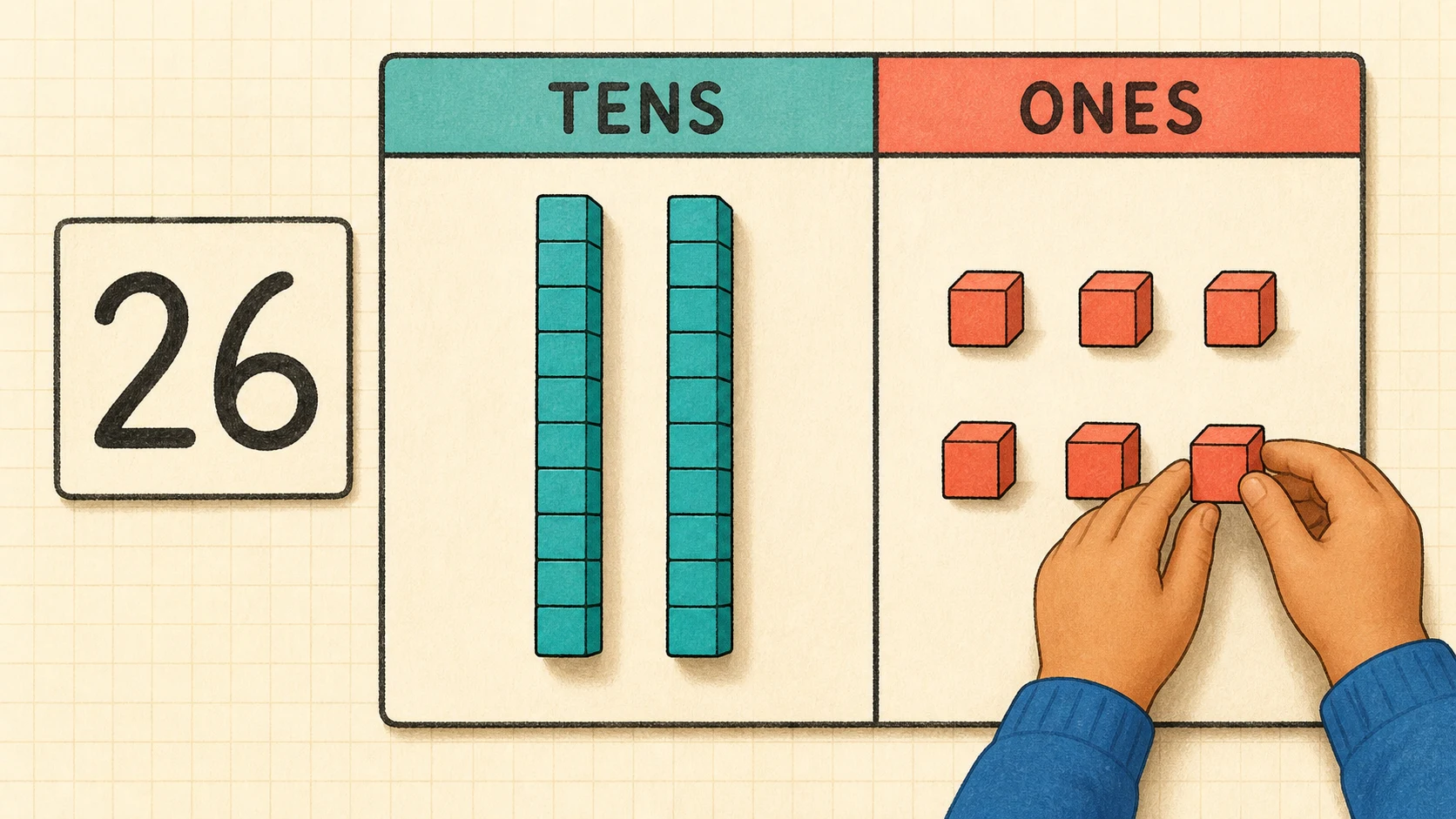
Read the prompt, rebuild or redraw the quantity, compare it with the written answer, and revise only after locating the mismatch.
Common error patterns
| Observed work | Possible interpretation | Useful check |
|---|---|---|
| Writes 5 for 15 when shown one ten and five ones | Counts only the loose ones or ignores the bundled ten | Unbundle and count all 15 objects, then regroup |
| Says the 1 in 16 has a value of 1 | Names the digit rather than its place value | Contrast “Which digit?” with “What value?” |
Writes 1 + 7 for 17 |
Copies digits instead of decomposing values | Build 17 and label the parts 10 and 7 |
| Chooses 8 as greater than 12 | Attends to a single digit instead of the whole number | Build 8 and 12; compare the complete quantities |
Reverses < and > |
May understand the quantities but not the symbol | Ask the learner to say “less than” or “greater than” aloud |
| Rounds every number upward | Applies a memorized action without comparing benchmarks | Mark both neighboring benchmarks and compare distances |
| Leaves a correct model but writes a different numeral | Representation is sound; recording may be the issue | Ask the learner to read the model and then reread the numeral |
These interpretations are possibilities, not diagnoses. Confirm them by asking the learner to show the work again with a fresh example.
A single slip after several accurate answers may call for a quick correction. The same conceptual error across multiple items calls for a pause, a new model, and fewer independent problems. Neat but unexplained answers are not stronger evidence than a correctly built and explained quantity.
Use the answer key responsibly
The separate printable answer key is included for efficient checking. Use it after solving or independently verifying selected examples yourself. Answer keys can confirm the expected response, but they do not show why the learner chose it.
A reliable checking routine
- Read the original prompt again, including the requested form of the answer.
- Compare the learner’s response with the key.
- If they differ, solve the item independently before labeling it wrong.
- Ask the learner to explain, build, or draw the reasoning.
- Identify whether the issue concerns place value, expanded form, comparison, rounding, or recording.
- Correct one example and then use a fresh, similar example to check whether the idea transfers.
Be especially careful with equivalent-looking responses. For example, 10 + 4 and 14 are equal in value, but only 10 + 4 answers a request for expanded form. Similarly, a learner may identify the greater number correctly while writing a comparison symbol backward. Record the precise issue.
Do not use the answer key as a script to dictate replacements. Copying the keyed answer can produce a finished page without demonstrating understanding.
Decide what to do after the worksheet
Review performance by skill category and by independence, not only by the number correct.
Continue within this level
Continue with similar Kindergarten Place Value practice when the learner can represent teen numbers, explain the ten and ones, and complete the relevant item types with little prompting. A few corrected slips do not automatically require starting over if the learner can explain and repair them.
The Kindergarten Math worksheet hub can help you select other math practice at the intended level. Keep place-value review in the mix rather than assuming one completed page has made the idea permanent.
Step back and rebuild
Return to concrete grouping when the learner repeatedly treats the tens digit as loose ones, cannot connect a teen number with one ten and some ones, or relies on guessing. Use fewer numbers and more building, drawing, and explaining before returning to the remaining worksheet items.
If comparison is the difficulty, compare quantities the learner can build reliably. If expanded form is the difficulty, reconnect the written expression to the two physical parts. If rounding has not been taught in the learner’s local sequence, treat those items as new instruction or postpone them rather than interpreting unfamiliarity as failure.
Extend carefully
When the page is accurate and the explanations are clear, ask the learner to make a matching representation or create a similar example. For instance, after solving 16 = 10 + 6, the learner might choose a different teen number, build it, and write its expanded form.
Avoid jumping automatically to hundreds, thousands, or decimal place value. Those ideas belong to the broader progression described in the Place Value topic guide. Extension should remain understandable and connected to demonstrated knowledge.
Schedule brief retrieval
A completed worksheet provides evidence from one sitting. Retrieval later shows whether the learner can bring the idea back without simply copying the recent procedure.
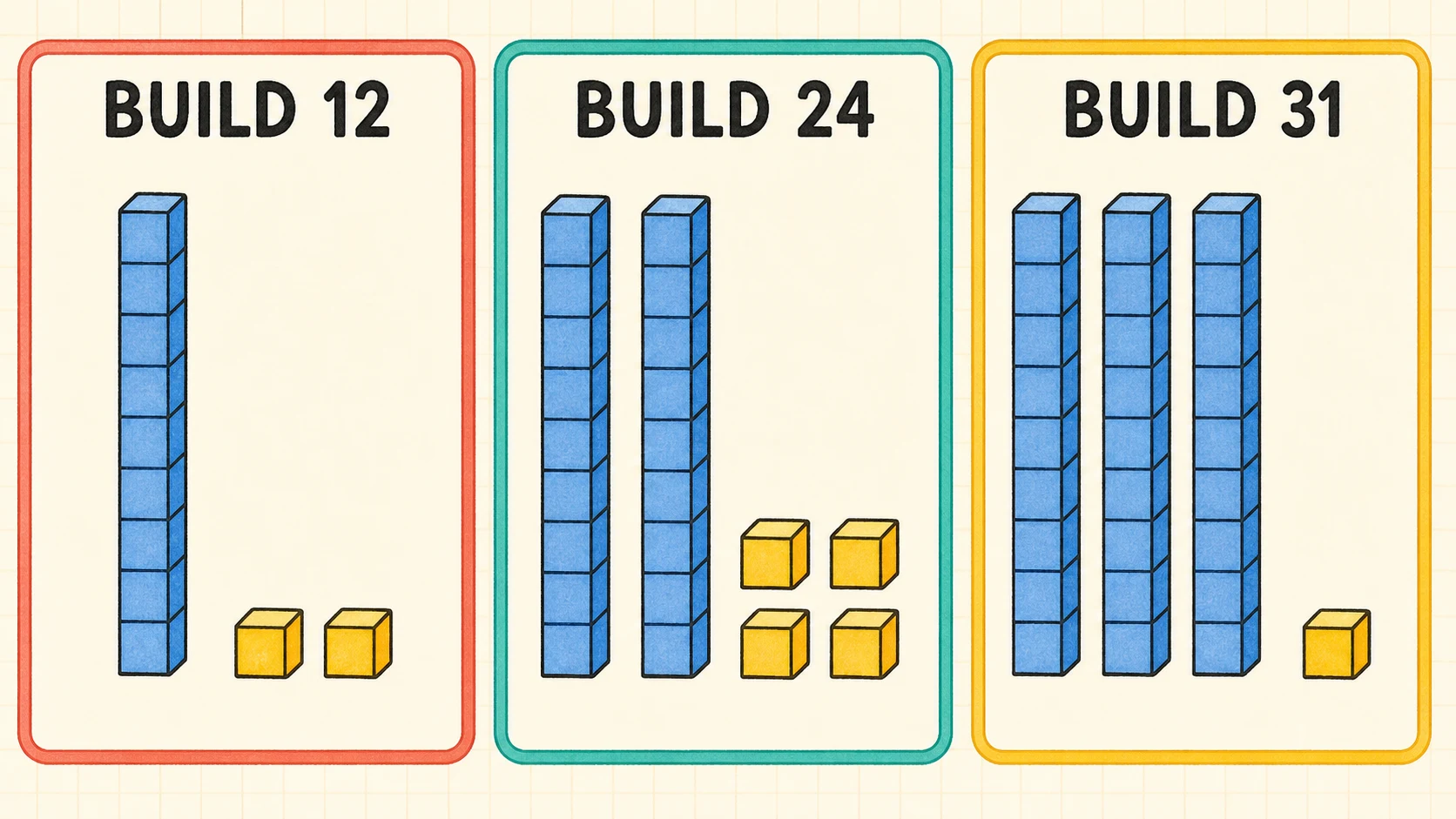
Revisit a small selection after a delay and adjust the spacing according to the learner’s observed recall.
A practical, adjustable schedule is:
| Review point | Suggested task | What to observe |
|---|---|---|
| Next learning session | Build one teen number and write its expanded form | Recalls one ten and some ones |
| A few sessions later | Compare two numbers and explain the decision | Uses whole-number values, not isolated digits |
| The following week, if appropriate | Mix one decomposition item with one previously taught rounding item | Selects a method from the prompt |
| Later review | Complete a few fresh place-value problems | Retains the ideas without copying the worksheet |
This schedule is a planning suggestion, not a universal timetable. Shorten the gap when the learner cannot reconstruct the idea. Lengthen it when recall is accurate and explanations remain secure. The observed work should drive both pacing and repetition.
Do not repeatedly assign all 20 problems merely to create more volume. A small set of fresh examples can give clearer evidence of retrieval. If the learner remembers the answers from the original page, change the numbers while preserving the same mathematical structure.
Limits of the printable
This worksheet is a focused practice resource, not a complete measure of mathematical understanding. Its 20 written responses cannot by themselves establish how flexibly a learner counts objects, explains a representation, applies an idea in a new setting, or responds to instruction.
The “easy” label describes the catalogue difficulty, not how every learner must experience the page. The Kindergarten label identifies the intended practice level, while local sequences and prior instruction differ. No single printable can establish comprehensive standards alignment, guarantee progress, or determine a child-specific educational plan.
The included skills also deserve separate interpretation. Secure work with tens and ones does not automatically establish secure rounding, and unfamiliarity with a rounding prompt does not erase correct place-value reasoning. Preserve these distinctions when recording results or discussing the work with another adult.
For a broader sequence, examples across place-value forms, and guidance about moving between levels, use the topic guide rather than asking this one page to represent the entire subject.
The most useful next action
Download the free 20-item worksheet, preview its four listed skill types, and choose one model plus a first short group of independent items. After the learner works, record whether each error involved tens and ones, expanded form, comparison, rounding, or answer recording.
Then use the Kindergarten Place Value topic guide to choose the next practice deliberately. If you want a larger collection after confirming that this level fits, the Kindergarten Place Value Worksheet Pack contains 18 worksheets. If the learner needs fresh examples of a specific structure for later retrieval, explore the free worksheet generators and keep the numbers and directions within the skill already taught.
Put it into practice
Use the guide with a real printable
Move from explanation to a short, observable practice task. Check the first item together, then adjust the next session from the learner's actual work.
See the 18-worksheet pack