Complete guide
How to teach and practise kindergarten counting worksheets - standard theme (easy)
How to use this 20-item counting worksheet
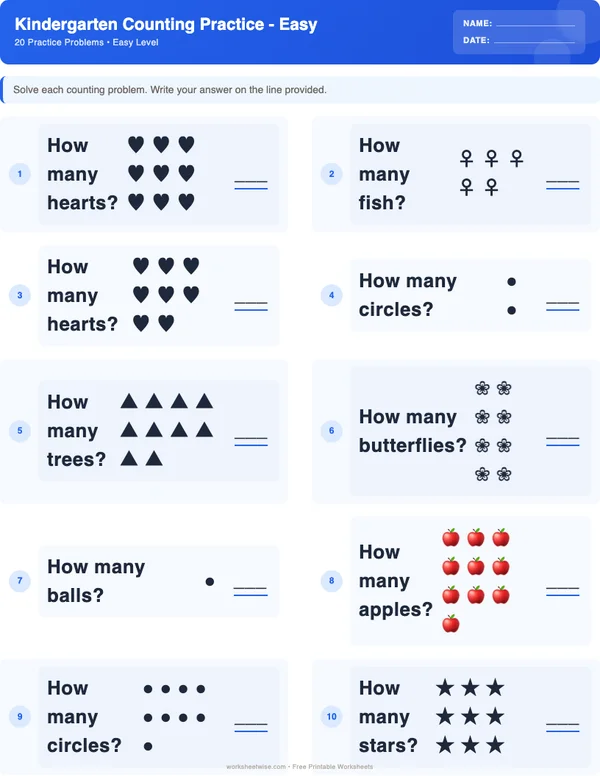
The free Kindergarten Counting worksheet provides 20 easy-level exercises involving counting, number sequences, skip counting, number recognition, and foundational number sense. The learner solves each problem and writes an answer on the line. A separate printable answer key is included.
The short answer: use the worksheet as one focused practice session, not as a race or a complete assessment. Model one representative problem, solve two or three together, and then release the learner to complete a manageable group independently. Watch how the learner counts, not only whether the final answer is correct. Pause or add support when the work shows confusion; reduce support when the learner demonstrates a reliable method.
Grade labels describe the intended practice level, and local school or homeschool sequences differ. “Kindergarten” and “easy” help adults choose a starting point, but they do not guarantee that every learner will find every item equally easy. Skip-counting exercises, teen-number sequences, and visually crowded sets can demand different kinds of thinking.
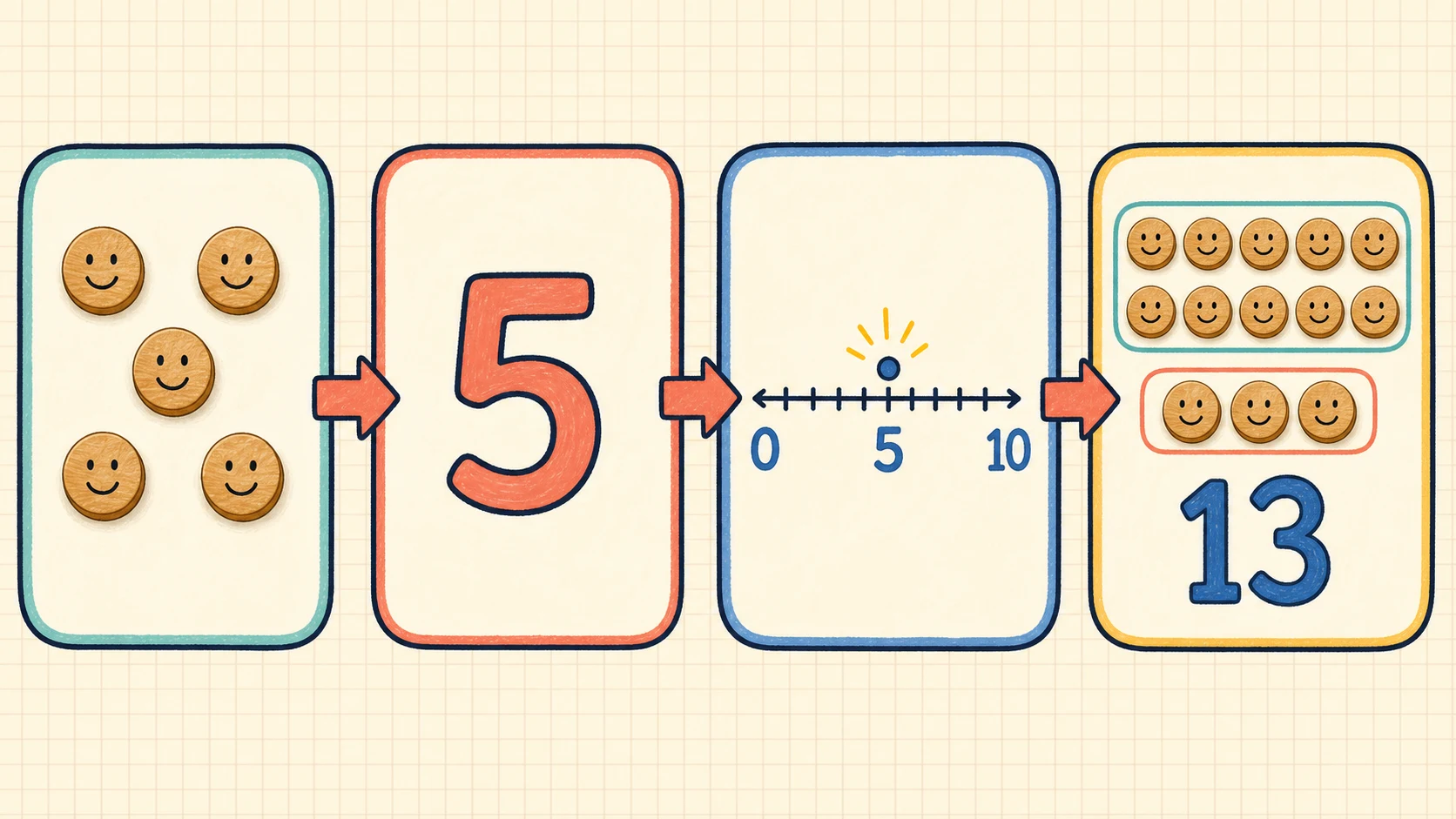
Use a brief launch, guided practice, independent work, checking, and later retrieval rather than assigning all 20 items without preparation.
What this printable does—and does not—cover
This worksheet combines several related skills:
- Counting in the correct order
- Recognizing numerals
- Completing number sequences
- Skip counting
- Connecting numbers with quantities
- Recording an answer clearly
These skills overlap, but they are not interchangeable. A learner might recite “one, two, three, four, five” correctly and still lose track while counting five separate objects. Another learner might identify the numeral 12 but struggle to determine which number comes after 12. A third might count by ones successfully but not yet recognize a skip-counting pattern.
The wider Kindergarten Counting topic guide explains the broader progression, including rote counting, one-to-one correspondence, counting sets, number sequences, and skip counting. Use that guide when you need to locate this printable within a longer instructional path. The present guide stays focused on launching, supporting, checking, and revisiting this particular 20-item resource.
The worksheet should not be treated as proof that the learner has mastered counting in every setting. Written items cannot fully show whether a child can organize a scattered collection, count objects in daily life, explain a pattern, or transfer the skill to unfamiliar materials. They also do not establish comprehensive standards alignment by themselves.
The Common Core State Standards for Mathematics describe a broader Kindergarten counting and cardinality domain that includes number sequences, written numerals, relationships between numbers and quantities, and answering “how many” questions. That source provides useful high-level context; it did not evaluate WorksheetWise or this exact printable.
Prepare a short, observable lesson
Print the worksheet and answer key separately. Keep the key out of the learner’s immediate view. Have a pencil, several small counters, and an optional number line available. Counters can be buttons, blocks, bottle caps, or other safe objects that are easy to move. Avoid materials so interesting that handling them becomes the main activity.
Before beginning, scan the worksheet yourself. Identify one early item that appears suitable for modeling, two items for guided practice, and a natural stopping point after perhaps five problems. The learner’s observed work should determine whether you continue, pause, or divide the sheet across sessions.
A practical lesson sequence
| Phase | Approximate scope | Adult action | Evidence to watch |
|---|---|---|---|
| Preview | 1 minute | Name the task and inspect the first few items | Does the learner recognize what each item asks? |
| Model | 1 example | Think aloud and record one answer | Does the learner attend to the counting method? |
| Guided practice | 2–3 items | Prompt briefly, then wait | Can the learner continue without the adult supplying numbers? |
| Independent practice | 4–8 items at a time | Observe quietly | Does the learner use a stable method? |
| Check and repair | Selected items | Compare, explain, and retry | Can the learner find where an error began? |
| Retrieval | Later sessions | Revisit a few similar tasks | Is the method available after time has passed? |
The suggested quantities are instructional options, not a universal timetable. One learner may complete all 20 items comfortably in a sitting. Another may produce better evidence by working in two or three shorter rounds.
Set a clear purpose
A useful launch is:
“This page has different kinds of counting problems. First I’ll show how I check one. Then we’ll do a few together. After that, you’ll try a group on your own.”
Explain that careful counting matters more than speed. Read the printed direction—“Solve each counting problem. Write your answer on the line provided”—and clarify unfamiliar symbols or layout without revealing answers.
The Institute of Education Sciences guide Teaching Math to Young Children provides high-level guidance on building young children’s mathematical understanding through purposeful instruction and attention to developmental progressions. Here, an adult can apply that framing by selecting a suitable entry point and using the learner’s actual responses to decide how much support to give. The guide is not an evaluation of this worksheet.
Model the task without taking it over
The purpose of modeling is to reveal a repeatable method. It is not to demonstrate several answers while the learner watches passively. Choose one representative item and speak slowly enough for the learner to connect each action with each number.
Because the actual printable may present different specific values, the examples below are checked examples of the same skill types, not quotations from its 20 items.
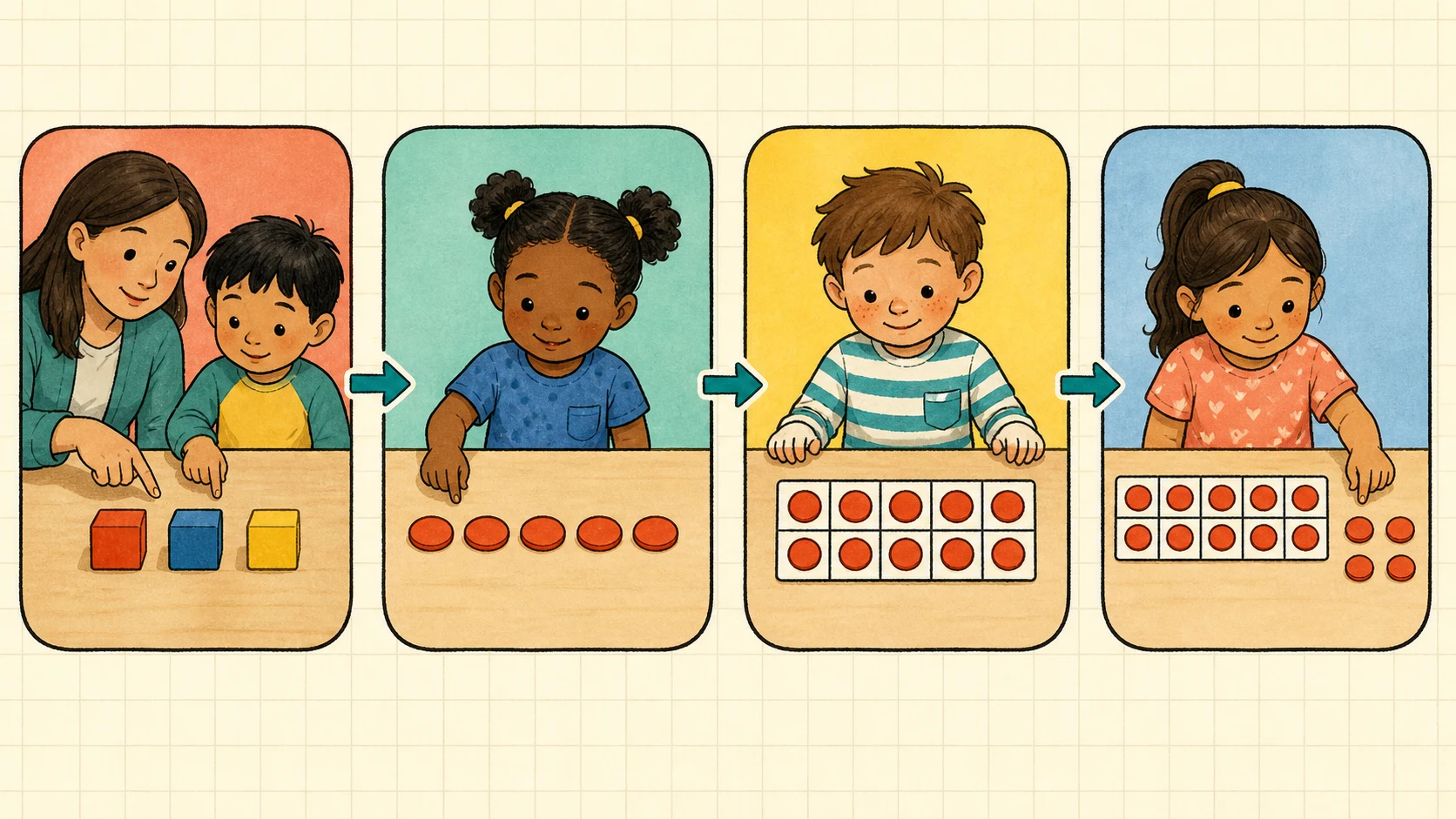
Model one complete method, guide a small number of attempts, and then allow the learner to carry the method independently.
Model a counting-set problem
Suppose a practice example shows seven dots.
- Point to the first dot and say “one.”
- Touch each remaining dot once while continuing: “two, three, four, five, six, seven.”
- Stop after the final dot.
- Say, “I counted every dot once. The last number I said tells how many dots there are.”
- Write 7.
The checked result is 7 because seven objects received one count word each and the last count word was seven.
If the objects are scattered, demonstrate a way to prevent double-counting. Move each physical counter into a “counted” group, or mark a clear visual starting point and follow an orderly path. Do not imply that objects must always appear in a row; the aim is to preserve one-to-one correspondence in different arrangements.
Model a sequence problem
For the sequence 4, 5, __, 7, point to each entry and read it in order:
“Four, five, six, seven.”
The missing number is 6. Check it in both directions:
- 6 comes after 5.
- 6 comes before 7.
Write 6 on the line. The check matters because it shows that the answer fits the sequence rather than being a numeral selected by appearance.
Keep the think-aloud compact
Useful statements include:
- “I will touch each object once.”
- “I am looking for how the numbers change.”
- “The numbers go up by one each time.”
- “I will read the whole sequence again to check.”
- “I wrote the numeral that matches the amount.”
Avoid narrating every possible strategy. Too much adult language can hide the mathematical relationship. After the model, ask the learner to state or show the next action.
Use guided practice to reveal the learner’s method
During guided practice, give the learner enough responsibility to expose what they understand. Present a problem, wait, and observe. If the learner begins successfully, avoid interrupting with praise after every count word. A neutral pause often gives better information than continuous prompting.
A prompt ladder
Use the least revealing prompt that helps the learner restart:
- “What does this problem ask you to find?”
- “Where could you begin?”
- “How will you keep track?”
- “Can you touch each object as you count?”
- “Read the sequence from the beginning.”
- “Let’s build this amount with counters.”
- Model one step, then return the task to the learner.
Move down the ladder only when needed. If you immediately provide the next number, you may obtain a completed page without learning whether the child can generate the sequence.
The IES practice guide Assisting Students Struggling with Mathematics offers broader recommendations about systematic instruction, clear mathematical language, representations, and deliberate practice for learners who need added support. Those ideas can frame an adult’s choice to model explicitly and connect objects, pictures, spoken numbers, and written numerals. They do not prescribe a child-specific intervention or certify this worksheet.
Check four representative examples together
Here are four fully checked examples to use before or alongside the printable.
Example 1: Count a set
A picture contains ● ● ● ● ● ●.
Touching one dot per count gives: 1, 2, 3, 4, 5, 6.
Answer: 6.
Check: there are six touches, six dots, and the last number said is six.
Example 2: Find the missing number
Sequence: 8, 9, __, 11
Counting forward gives: 8, 9, 10, 11.
Answer: 10.
Check: 10 is one more than 9 and one less than 11.
Example 3: Continue by ones
Sequence: 13, 14, 15, __
The difference between neighboring numbers is one. One more than 15 is 16.
Answer: 16.
Check: read the complete sequence aloud—13, 14, 15, 16.
Example 4: Skip count
Sequence: 2, 4, 6, __
Each number is two more than the previous number:
- 2 + 2 = 4
- 4 + 2 = 6
- 6 + 2 = 8
Answer: 8.
Check: the completed sequence is 2, 4, 6, 8, with a consistent increase of two.
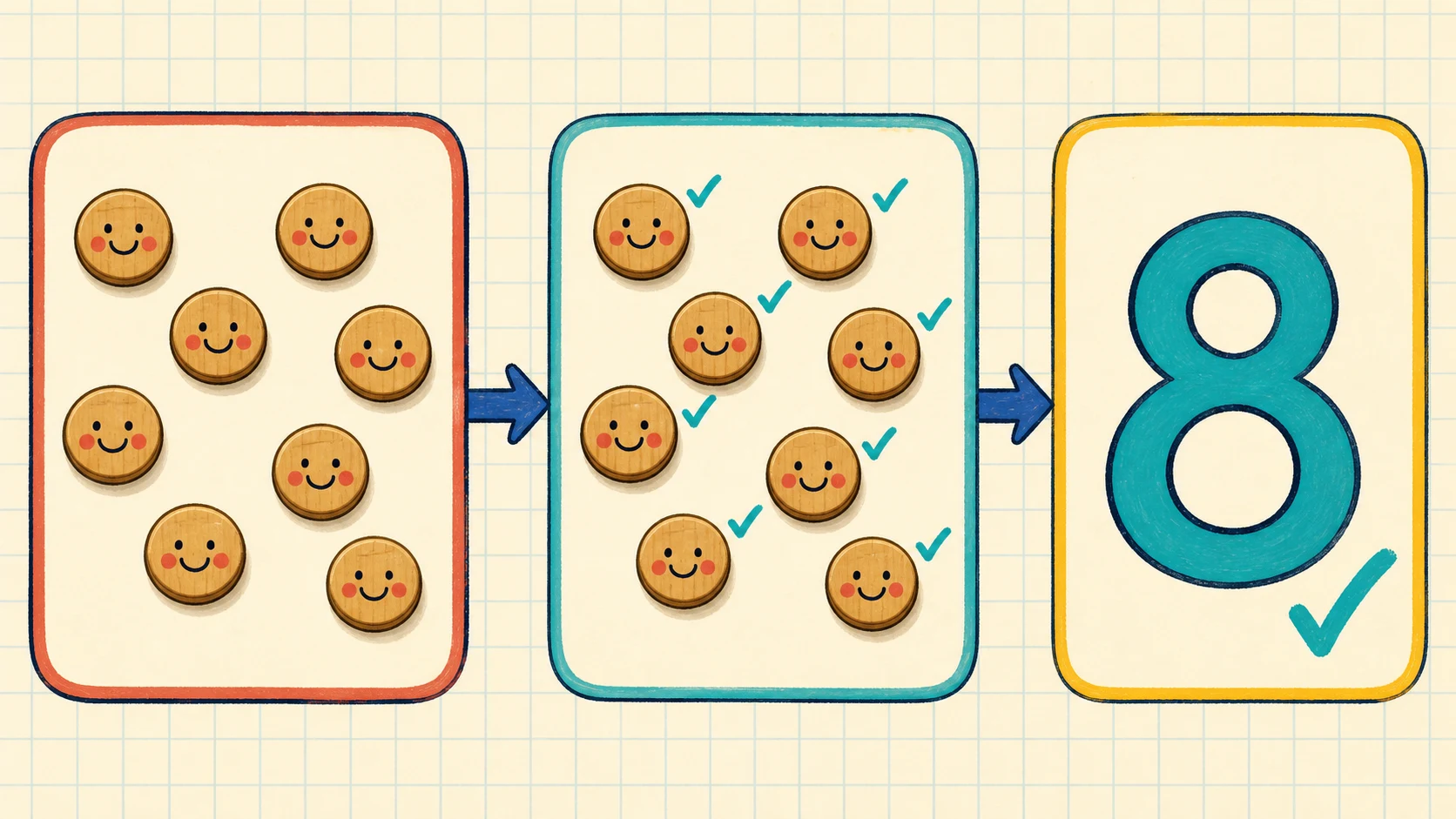
Checked examples should expose the relationship: one count per object, one-step sequence changes, or a consistent skip-counting interval.
Shift from guided to independent practice
Independent work begins when the learner can explain or demonstrate a workable approach, not merely after the adult has completed a fixed number of examples.
Ask the learner to try a small group, such as the next four items. Stay close enough to observe but do not point to each object or silently mouth the number sequence. Independent practice should reveal whether the support has transferred.
Signs that the learner is ready
A learner may be ready for a larger independent group when they can:
- Start without being told the first count word
- Match one spoken number to one object
- Stop after every object has been counted
- Identify whether a sequence changes by one or by a larger step
- Record a recognizable numeral
- Recheck a result when prompted
Correct answers alone are not sufficient evidence. A child might guess a missing numeral or copy a visible number from elsewhere on the page. Ask for an occasional brief explanation such as, “How did you know?” The response can be spoken, pointed, or demonstrated with counters.
When to pause
Pause the independent block if errors repeat in the same way, the learner no longer attends to individual objects, or numeral writing prevents the child from showing the intended answer. A short reset is often more informative than requiring completion of all 20 items.
If the learner solves five items accurately with a stable method and then becomes inconsistent, fatigue or attention may be affecting the sample. Record where independent work ended and resume later. Do not treat later errors automatically as evidence that the earlier skill disappeared.
Adapt support without changing the counting skill
Adaptations should preserve the mathematical target. If an item asks the learner to count a quantity, support should help organize or represent that quantity—not replace counting with an adult-provided answer.
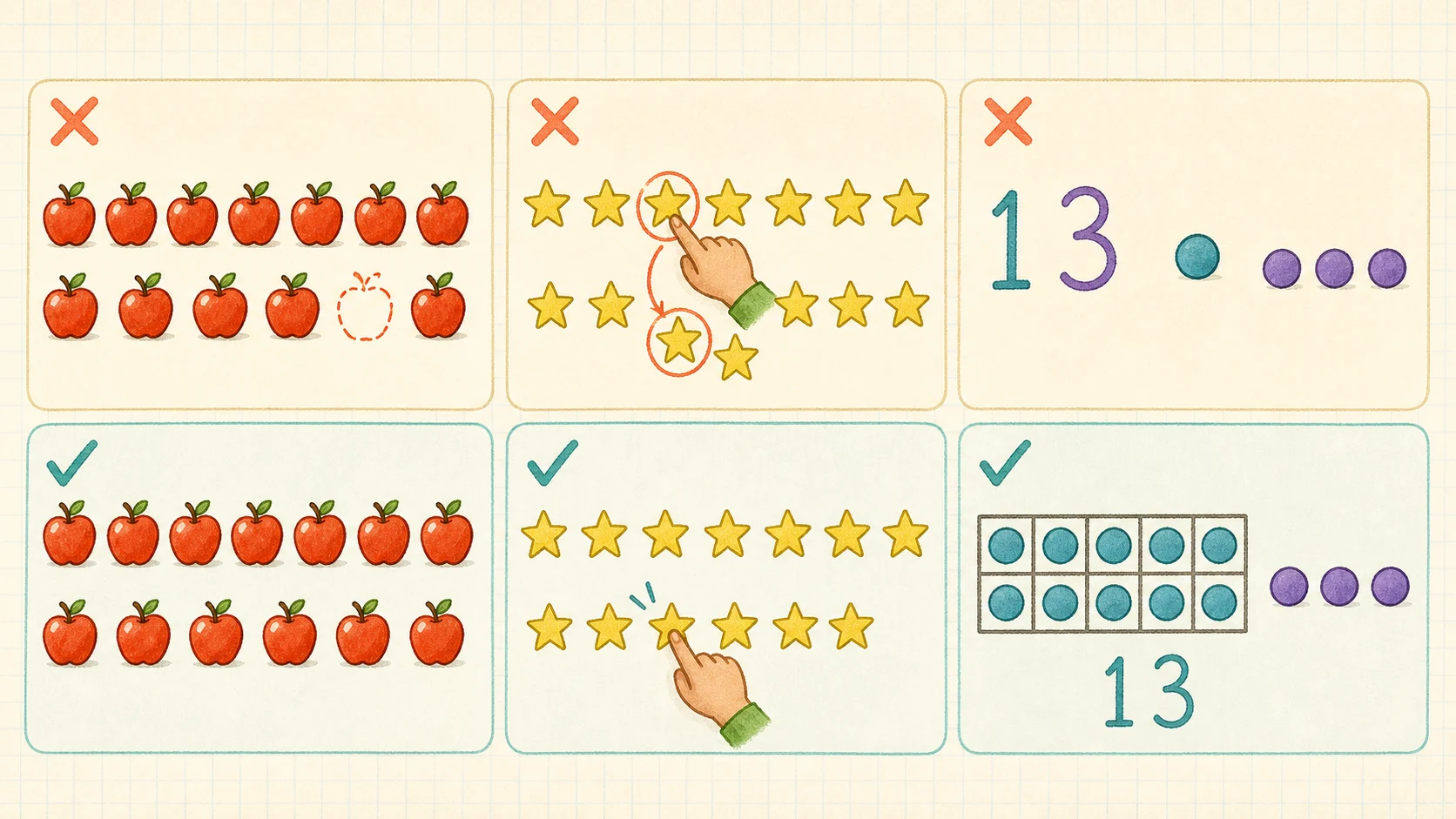
Change the amount of visual, physical, or verbal support while keeping the learner responsible for the counting decision.
For a learner who loses track of objects
Provide movable counters matching the pictured quantity. The learner can move one counter into a new row for each pictured object, then count the row. Alternatively, cover part of a crowded page with blank paper so only one item is visible.
You may also ask the learner to circle each pictured object after counting it. This reduces tracking demands while preserving one-to-one correspondence.
Do not count aloud in unison indefinitely. Chorus counting can make it difficult to tell whether the learner coordinates the spoken sequence with the objects independently.
For a learner who knows amounts but struggles to write numerals
Let the learner say the answer first, choose it from a small set of numeral cards, or trace a lightly modeled numeral beside their own attempt. Record separately that the quantity was identified orally and the numeral required support.
This adaptation keeps counting as the central skill. It also prevents handwriting difficulty from being misread as a counting error. Return to independent numeral writing when it will not obscure the learner’s mathematical response.
For a learner who needs greater challenge
Ask for an explanation or a second representation rather than replacing the page immediately with unrelated advanced work. For example:
- “Show that answer with counters.”
- “What number comes just before it?”
- “What number comes just after it?”
- “How do you know this pattern counts by twos?”
- “Can you start at a different number and keep the same step?”
These additions deepen attention to number relationships while retaining the worksheet’s stated skills. If the learner completes the full page accurately and efficiently with clear reasoning, move to a more demanding resource in the Kindergarten Math collection or the broader counting sequence.
Interpret mistakes before correcting them
An incorrect answer is a clue, not a complete diagnosis. Look for a repeated pattern across more than one item and compare the written response with what the learner says and does.
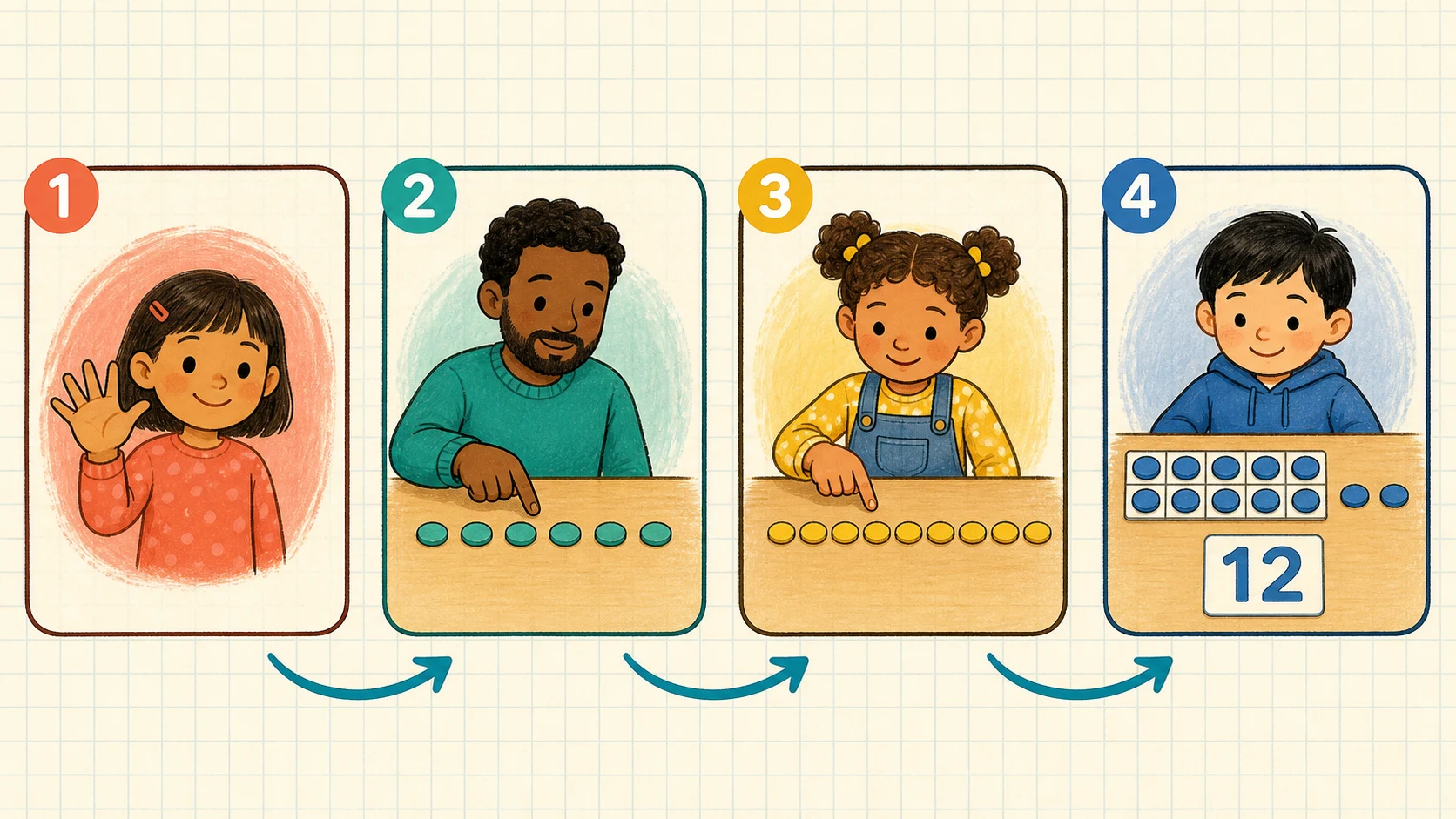
Identify the task, replay the learner’s method, locate the first mismatch, and retry before consulting the key.
Common error patterns
| Observed work | Possible interpretation | Useful next check |
|---|---|---|
| The learner says the correct number sequence but skips an object | One-to-one tracking may be unstable | Recount while touching or moving each object |
| An object receives two count words | The learner may not mark what has already been counted | Organize the set or move counted objects aside |
| The learner counts correctly but writes a different numeral | Numeral recognition or formation may be the obstacle | Ask for the answer orally, then match it to numeral choices |
| A missing number is copied from a nearby item | The sequence relationship may not yet guide the answer | Read the entire sequence and compare neighboring numbers |
| A count-by-two sequence continues by ones | The learner may default to the familiar counting sequence | Compare the gaps: “How much did each number change?” |
| Teen numbers are reversed or misnamed | Spoken and written teen-number forms may not be coordinated | Build and read the sequence slowly around the error |
| The answer is one too many | Counting may have continued after all objects were used | Ask the learner to pair each count word with an object |
| The answer is one too few | The starting object or final object may have been omitted | Mark the first object and recount to the final object |
These interpretations are hypotheses. One response cannot establish a persistent misconception. Verify by presenting a similar example with different numbers or a different arrangement.
Boundary cases worth checking
Zero objects: If an example contains no objects, the quantity is 0. The learner should not begin saying “one” merely because a counting question appears. Zero represents no objects in the set.
A single object: One object is counted as 1, with one touch and one count word. This simple case can reveal whether the learner understands the task or is reciting beyond the set.
A rearranged set: Five counters remain 5 whether they appear in a row, a circle, or a scattered arrangement. Recounting may confirm the amount, but changing the spacing does not change how many objects exist.
A sequence crossing 9: For 8, 9, __, 11, the answer is 10. If the learner returns to 1 after 9, revisit the continuing number sequence.
A non-unit step: For 5, 10, 15, __, the answer is 20, not 16. The learner must identify the consistent increase of five rather than always adding one.
The catalogue states that this worksheet contains skip counting, but it does not specify every interval used in its 20 exercises. Teach the step shown in the actual item rather than assuming all skip-counting problems use twos, fives, or tens.
Use the answer key responsibly
The separate answer key makes checking efficient, but it should confirm reasoning rather than replace observation. First review the learner’s work without the key. Mark items that appear uncertain, illegible, or inconsistent. Then compare responses with the official key.
A four-step checking routine
- Compare: Identify which responses match the key.
- Reconstruct: For a mismatch, ask the learner to show how the answer was found.
- Locate: Find the first point where the method departed from the item.
- Retry: Let the learner solve the original item or a parallel example again.
Distinguish a corrected answer from an independently correct first response. Both can be useful, but they provide different evidence. A small notation such as “correct after recount” preserves that distinction without turning the page into a score sheet.
If the learner’s answer differs from the key but their reasoning appears sound, inspect the original item carefully. Confirm that the picture, sequence direction, and requested blank were interpreted correctly. Do not force agreement before resolving the discrepancy. Printing quality, a faint image, or an adult’s mistaken reading can affect checking.
Avoid announcing only a total such as “17 out of 20.” A total can conceal the difference between three unrelated slips and three repetitions of the same counting error. Sort errors by skill: counting sets, recognizing numerals, continuing by ones, or skip counting. That grouping gives a more useful basis for the next lesson.
Decide what to teach next
Base the next step on the learner’s method across the page, any corrected attempts, and a brief delayed check.
If counting sets was difficult
Return to concrete objects. Ask the learner to count small collections while moving each item. Then use pictured objects, including both orderly and scattered arrangements. Once tracking is reliable, return to selected worksheet items without manipulatives.
If number sequences were difficult
Use a number line or numeral cards. Build a short consecutive sequence, remove one card, and ask which numeral belongs in the gap. Gradually move from sequences beginning at 1 to sequences beginning at another given number.
If skip counting was difficult
Separate skip counting from counting by ones. Build equal groups or make equal jumps on a number line. Say both the action and the numbers: “Each jump moves two more: 2, 4, 6, 8.” Then compare that pattern with “1, 2, 3, 4,” so the learner sees that the step changed.
If the work was consistently secure
Use a worksheet with less support, a wider number range, a less predictable starting point, or more varied arrangements. Do not add difficulty merely by requiring faster completion. Greater independence, clearer explanations, and successful transfer are more informative next targets.
The Kindergarten worksheet hub can help you coordinate counting practice with other intended Kindergarten-level work. Remember that local instructional sequences vary, so select the next resource from observed readiness rather than the grade label alone.
Schedule retrieval instead of ending after one page
A correct page completed today does not show whether the method will be available later. Brief retrieval gives the learner another opportunity to reconstruct the idea after some forgetting has occurred.
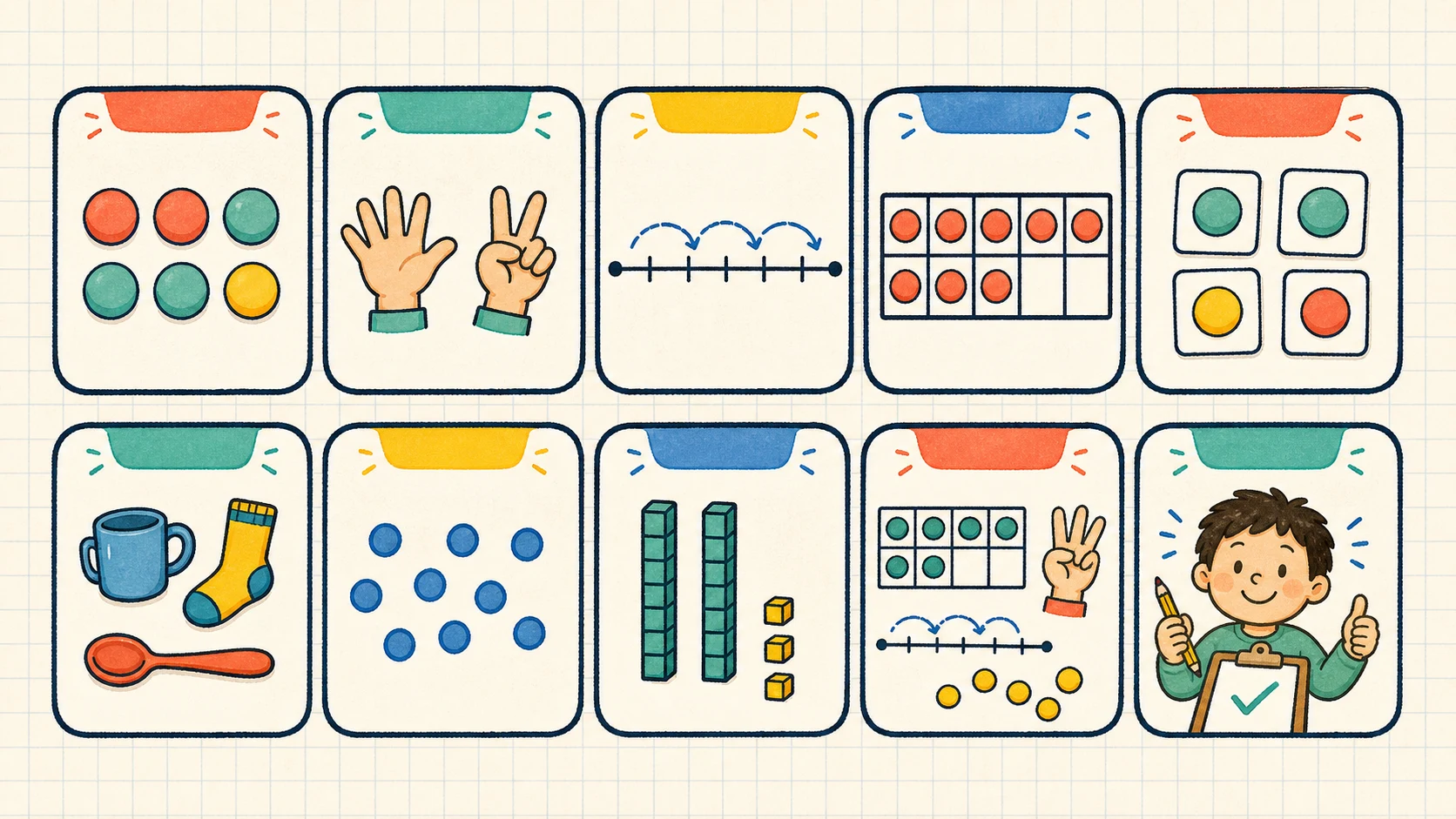
Revisit a few representative tasks after increasing intervals, adjusting the schedule when the learner’s work shows a need for more or less support.
A practical, adjustable schedule is:
- Later the same day: Orally revisit one sequence or count a small set in a different arrangement.
- One or two days later: Present three examples—one counting set, one consecutive sequence, and one skip-counting sequence.
- About a week later: Mix several counting tasks with other familiar math work.
- After a longer interval: Use a fresh printable or real objects to check transfer rather than memorization of the original page.
This is an instructional suggestion, not a universal timetable. Shorten the interval if the learner cannot recover the method. Lengthen it if performance remains accurate and independent. If errors reappear, provide a concise reminder and another attempt; do not simply display the previous answer.
Keep retrieval small enough that it checks memory without recreating the entire lesson. Two well-chosen problems can be more revealing than immediately repeating all 20.
Keep the evidence and limitations in view
This printable is useful for structured practice, homework, classroom review, or homeschool instruction. Its 20 items provide several opportunities to observe related counting skills in a consistent format. The separate key supports prompt checking.
Its limits are equally important:
- The page samples counting performance; it does not measure every aspect of number understanding.
- Accuracy may be affected by attention, visual tracking, language, or numeral formation.
- A single session cannot establish durable mastery.
- Familiar worksheet formats may not transfer automatically to physical objects or everyday situations.
- The “easy” designation describes the intended difficulty, not every learner’s experience.
- Standards documents and practice guides provide broader instructional context; they did not review this exact WorksheetWise resource.
- The worksheet does not supply medical, developmental, or individualized educational guidance.
Keep a brief record of what was independent, what required prompting, and what became correct after a retry. That evidence is more actionable than a label such as “good at counting” or “needs help.”
Continue with a focused next action
Print the free Kindergarten Counting worksheet, select one model item and two guided items, and let the learner’s observed work determine the size of the independent block. After checking and one later retrieval attempt, use the Counting topic guide to choose the next skill level.
If the learner needs repeated mixed practice, the Kindergarten Counting Worksheet Pack contains 18 worksheets and is listed at $4.79. If you need a new practice format or a more specific set of values, explore the free worksheet generators.
Put it into practice
Use the guide with a real printable
Move from explanation to a short, observable practice task. Check the first item together, then adjust the next session from the learner's actual work.
See the 18-worksheet pack