Complete guide
How to teach and practise kindergarten addition worksheets - standard theme (easy)
How to use this 20-item addition worksheet
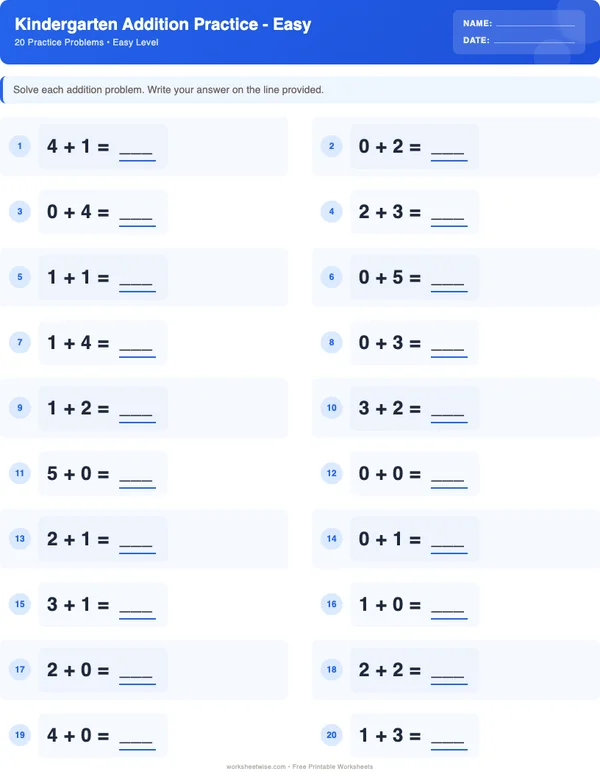
The free Kindergarten Addition worksheet gives a learner 20 easy-level exercises with one consistent direction: solve each addition problem and write the answer on the line. Use it after the learner can count a small collection accurately and is beginning to connect “put together” actions with written addition.
A productive lesson is simple: model one or two similar problems, solve several together, let the learner complete a manageable group independently, and then review the reasoning—not merely the score. Keep counters and drawing tools available. If errors increase, shorten the independent portion and return to objects or pictures.
This printable is intended to practice addition facts, mental math, number sense, and place value understanding. However, a single completed page cannot demonstrate broad mastery of all four areas. Treat the learner’s observed work—what they count, draw, say, and write—as the main evidence for choosing the next step.
Grade labels describe an intended practice level, not a guarantee that every Kindergarten learner is ready for the same page at the same time. Local curricula and instructional sequences differ.
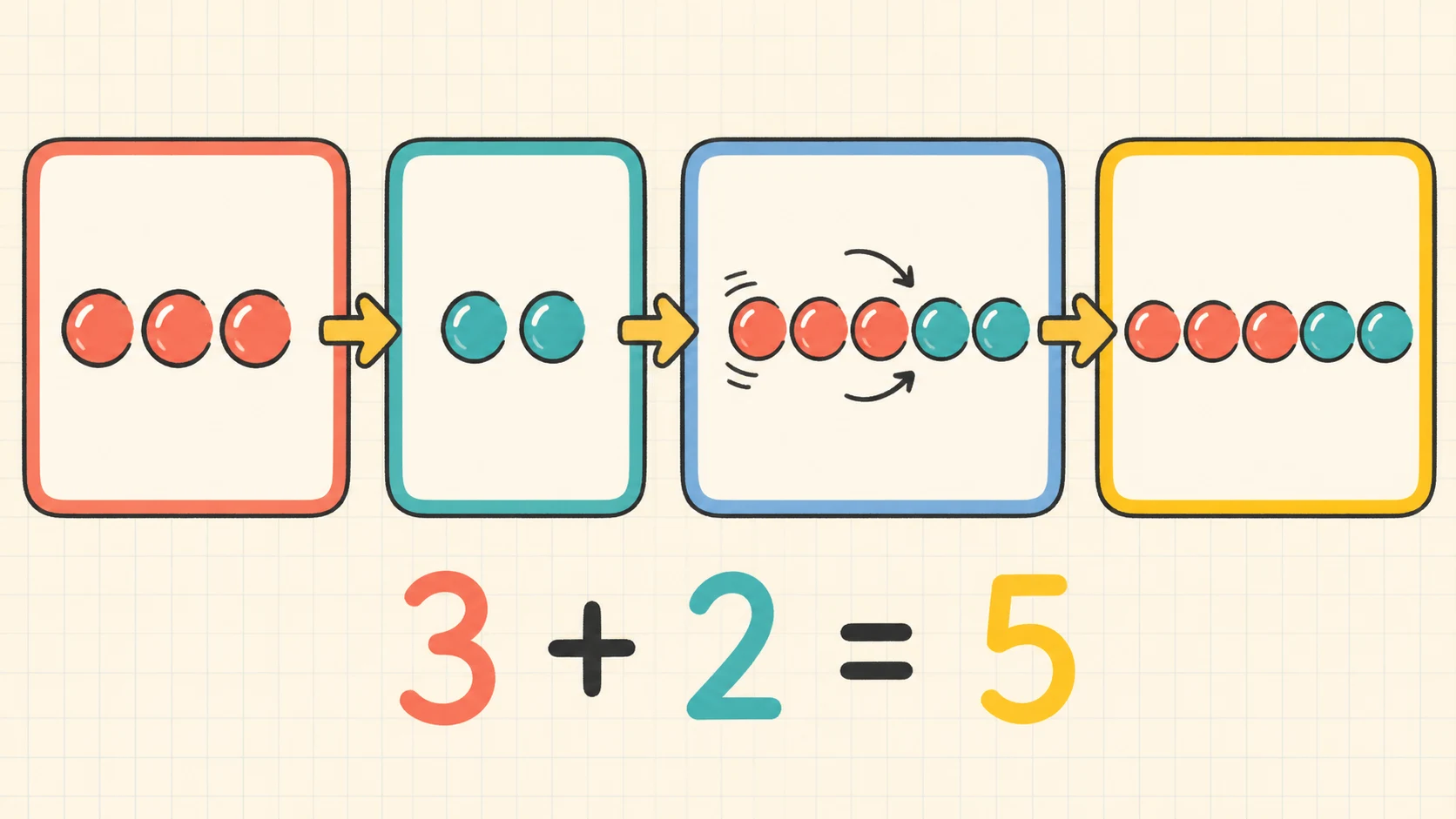
Preview the task, model the meaning of addition, guide a few items, observe independent work, and review selected answers.
Before the worksheet: confirm the starting point
This is an easy-level Kindergarten worksheet, but “easy” is meaningful only in relation to the learner’s current understanding. Before printing or handing over the page, check three prerequisites informally.
First, place three counters on a table and ask the learner to count them. Add one more counter and ask, “How many are there now?” Second, show a simple written expression such as and ask what the plus sign tells us to do. Third, ask the learner to write the numeral 3. These are brief observations, not a separate test.
The learner does not need to solve mentally before using the worksheet. Objects and drawings are appropriate tools for beginning addition. The IES guide on teaching mathematics to young children supports high-level practices such as using developmental progressions, monitoring what children know, and helping them connect mathematical ideas with representations. That source provides general instructional guidance; it did not review this WorksheetWise printable.
Signs that the page is a reasonable match
The learner is likely ready to begin when they can:
- Count a small group without regularly skipping or double-counting objects.
- Recognize that addition joins quantities or finds a total.
- Follow the page direction with adult explanation.
- Record at least some numerals independently or by copying from a number reference.
A learner may still use counters for every item. That is not a reason to withhold the worksheet. The purpose is to connect a reliable counting process to the written number sentence.
Signs that more preparation may help
Pause before the full page if the learner cannot yet count the first group accurately, interprets the plus sign as “say the next number,” or becomes unsure about where to write. Use oral joining activities first: “Here are two buttons. I am adding one button. How many altogether?”
The broader Kindergarten Addition topic guide covers the larger instructional progression. Use that guide when the learner needs work before or beyond this particular 20-item practice page rather than trying to turn one worksheet into a complete addition sequence.
Prepare a short, observable lesson
Have the worksheet, a pencil, and about ten small counters available. Buttons, blocks, coins used only as counters, or paper squares will work. A blank sheet or small whiteboard is useful for modeling examples that are similar to—but not copied from—the printable.
Do not display the answer key during instruction. Keeping it separate makes it easier to observe what the learner can do without answer matching.
A practical first session might look like this:
| Lesson phase | Adult action | Learner action | What to observe |
|---|---|---|---|
| Preview | Read the direction and point out the plus sign and answer line | Restate the job in their own words | Understanding of the task |
| Model | Solve a similar example with counters and an equation | Watch, count, and explain what changed | Connection between objects and symbols |
| Guided practice | Complete two or three worksheet items together | Move or draw quantities and state the total | Counting accuracy and strategy |
| Independent practice | Assign a small group of items | Solve without step-by-step prompting | Independence, stamina, and consistency |
| Review | Discuss selected correct and incorrect responses | Rebuild or redraw the problems | Ability to check and revise |
| Retrieval | Revisit a few facts after a delay | Solve without copying prior answers | What was retained |
The complete page contains 20 exercises, but it does not have to be completed in one sitting. The learner’s attention and accuracy should determine the amount. Five carefully considered items can provide more instructional information than 20 rushed responses.
Model what an addition sentence means
Start with a fresh example rather than completing many worksheet items for the learner. Use the same routine repeatedly:
- Read the first number.
- Make that quantity.
- Read the second number.
- Add that quantity.
- Count or reason about the total.
- Write the answer.
- Read the complete equation aloud.
Worked example 1: joining two small groups
Write .
Place one counter on the table. Then place two more beside it. Point to the first group and say, “This one matches the 1.” Point to the second group and say, “These two match the 2. The plus sign tells us to put the quantities together.”
Count all the counters once: “One, two, three.” Write 3 on the answer line.
Check: one counter plus two counters makes three counters, so .
Worked example 2: counting on
Write .
Build two counters, add three counters, and count all five. Then show a more efficient option without insisting that the learner use it immediately: hold 2 in mind and count on three counts—“3, 4, 5.”
Check by recounting the joined collection: .
Counting all is a valid starting strategy. Counting on is a useful next strategy when the learner can keep the starting quantity in mind. If counting on causes confusion, return to the full collection.
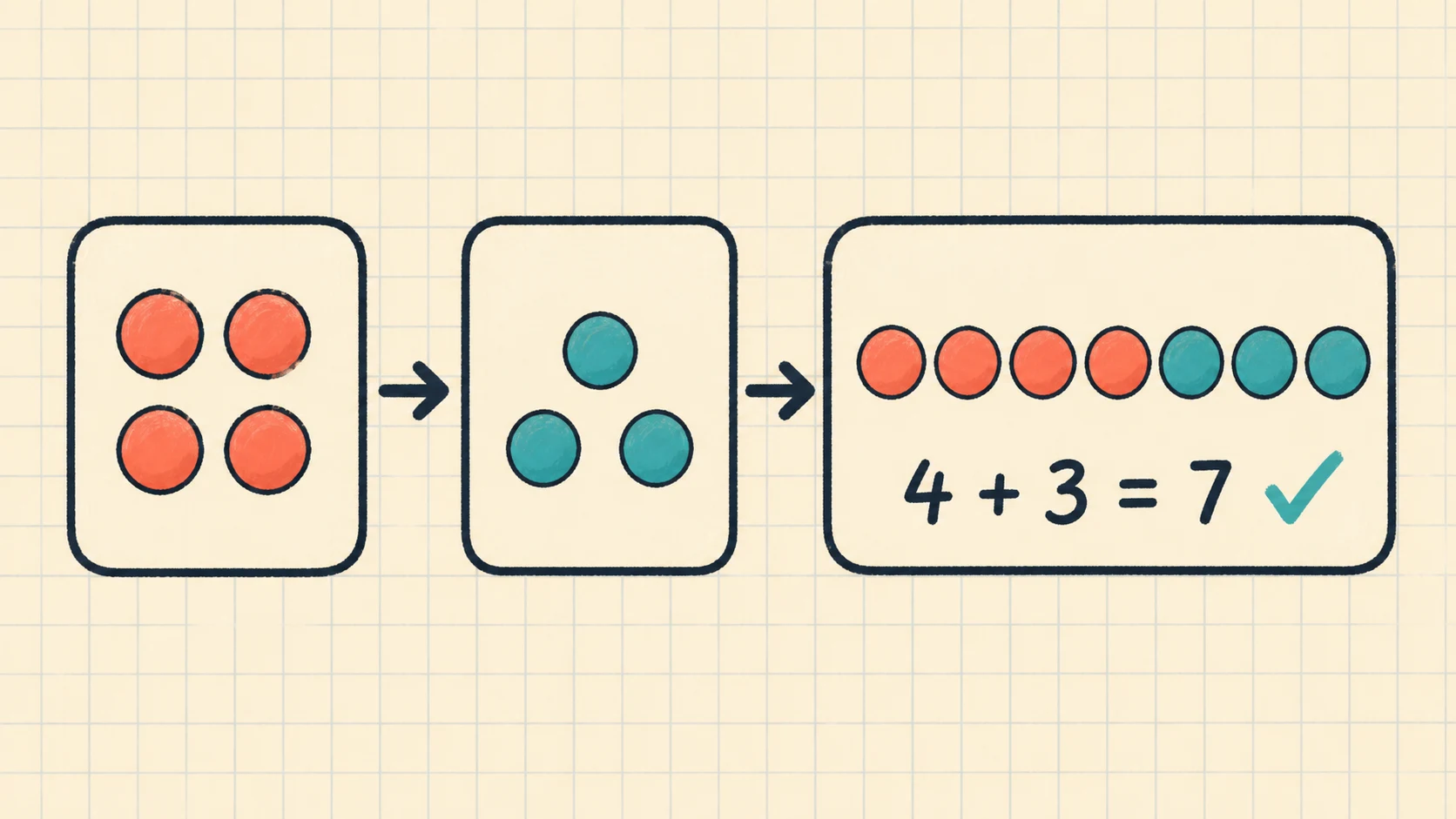
Objects, spoken counting, and the written equation should describe the same mathematical action.
Worked example 3: adding one
Write .
Make four counters. Add one more. Ask, “What number comes after 4 when we add one?” The learner may count all five or recognize that one more than 4 is 5.
Check by touching each counter exactly once: .
This example can reveal whether the learner understands “one more.” A memorized answer is useful, but the learner should also be able to show why the answer makes sense.
Worked example 4: equal addends
Write .
Make one group of three and another group of three. Join them and count: “1, 2, 3, 4, 5, 6.” Write 6.
Check by separating the collection back into two groups of three: .
Equal addends can be described as “three and another three.” The phrase “double three” may be introduced if it is already part of the learner’s instruction, but it is not necessary for completing the page.
These are checked teaching examples similar to the worksheet’s addition task. They are not presented as exact items from the printable.
Move from guided practice to independent work
Guided practice is not simply an adult giving hints until the learner says the correct number. It is a chance to make the process visible and then gradually remove support.
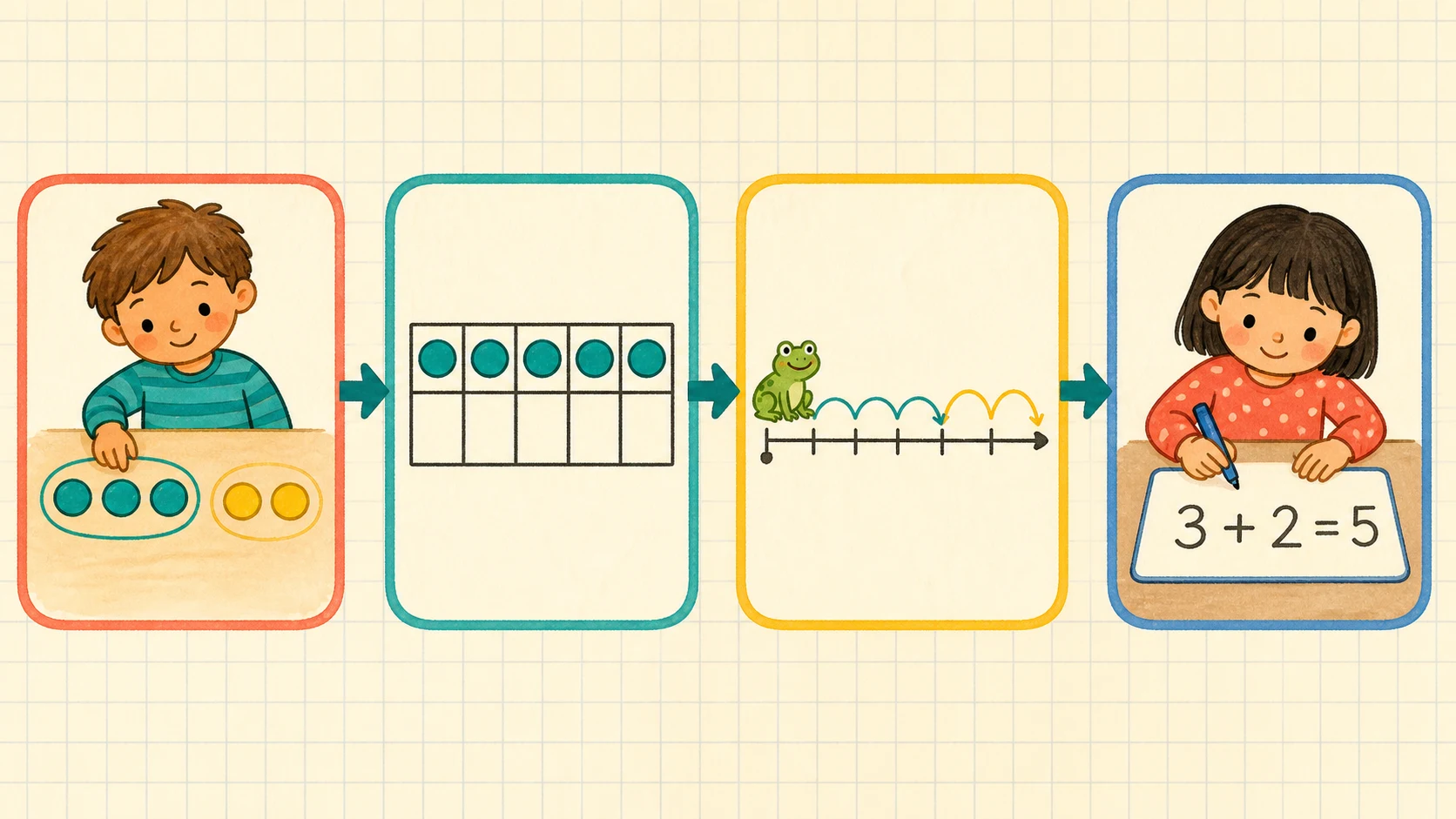
During guided practice, prompt the process—represent, join, count, record—without supplying the total.
Complete the first guided item together
Ask the learner to read the two addends if possible. If numeral reading is the obstacle, name a numeral and continue with the addition task. Have the learner build both quantities, join them, and count the total.
Use prompts such as:
- “What does the first number tell you to make?”
- “How many more are you adding?”
- “Where can you begin counting?”
- “How could you check that total?”
- “Which numeral belongs on the line?”
Avoid asking only, “What’s the answer?” That question hides whether an incorrect response came from numeral recognition, representation, counting, or recording.
Reduce support across the next few items
On the second guided item, let the learner choose counters or a drawing. On the third, wait before prompting. If the learner starts correctly, allow the process to continue even when it is slower than an adult’s method.
A useful handoff is: “Show me how you would begin this one by yourself.” If the learner identifies both quantities and starts joining or counting them, assign a small independent set.
Define independence realistically
Independent work means the learner chooses and carries out a strategy without step-by-step coaching. It does not mean removing every tool. Counters, fingers, dots, and a numeral reference can remain available unless the particular lesson is explicitly checking unaided mental recall.
Start with three to five items. Then check in. Continue if the learner remains accurate and purposeful. Stop or switch back to guided work if the learner begins guessing, copying a neighboring answer, or losing track repeatedly.
Adapt support without changing the addition skill
An adaptation should make the same addition thinking more accessible. It should not replace addition with an unrelated task or disclose the answers.
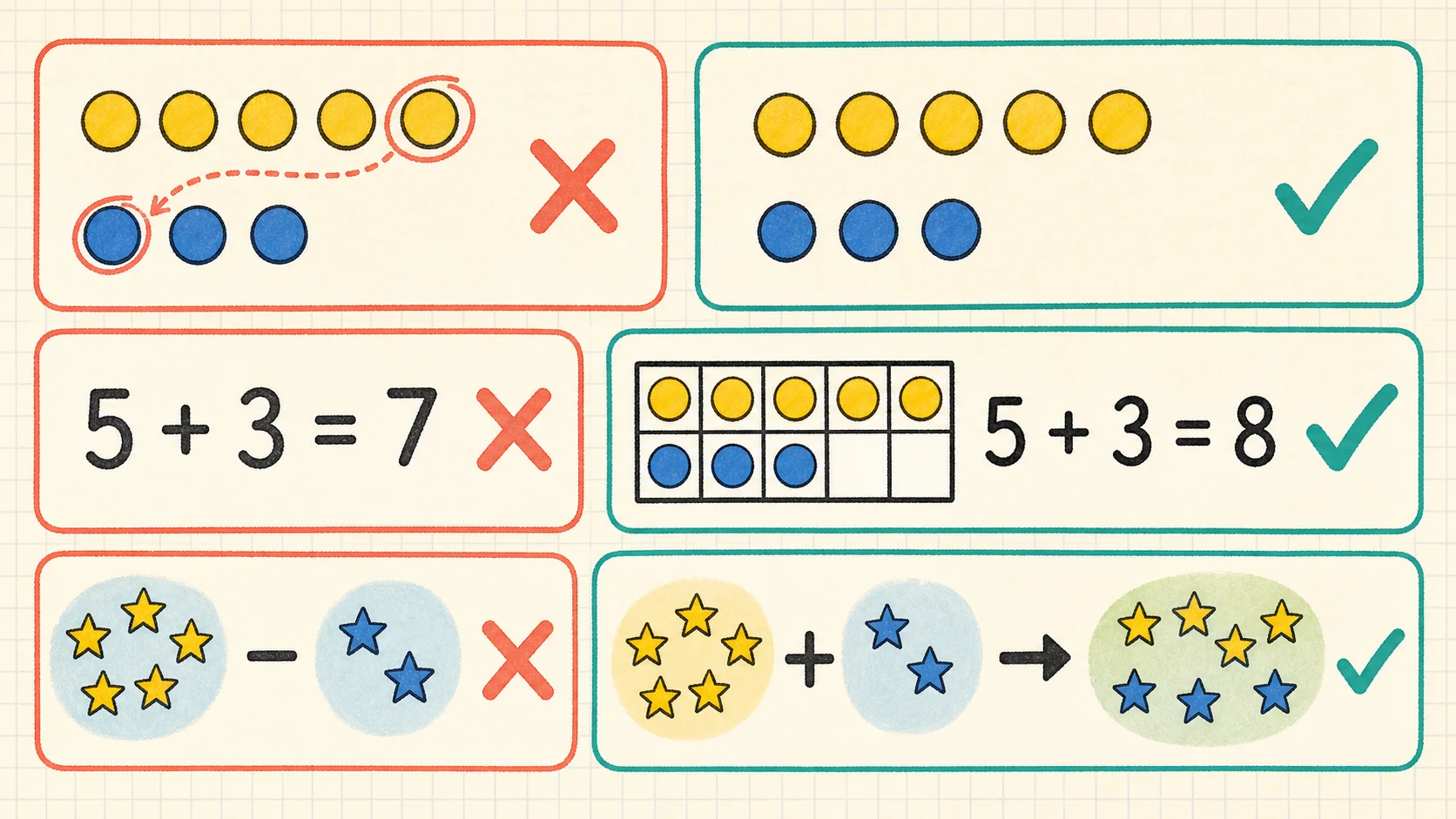
Adjust the amount, representation, or response method while preserving the need to find each sum.
When the learner needs more concrete support
Let the learner build every equation with counters. Use two colors if available: one color for the first addend and another for the second. After joining the groups, slide all counters into one row before counting. The row can reduce skipped or repeated counts.
If loose counters are distracting, draw empty circles for the learner to mark. The learner can draw the first group, draw the second group, and count all the marks. This remains addition practice because the learner must represent and combine both quantities.
When writing is harder than solving
The instruction requires an answer on the line, but handwriting difficulty can obscure the mathematical evidence. Let the learner say the total first, then copy the corresponding numeral from a small number reference. An adult may also write two numeral choices for the learner to select from after the learner has solved the problem.
That support changes how the answer is recorded, not how the sum is found. Note the distinction in your records: “Solved with counters and stated the total; needed help forming the numeral.”
This is an instructional accommodation, not medical guidance or a diagnosis. Concerns about development or persistent difficulty require appropriate local professional support beyond what a worksheet can provide.
When the learner is ready for less support
Invite the learner to solve an item mentally and then verify it with counters. Another option is to ask for two methods: count all, then count on. Do not increase difficulty merely by imposing speed. Accuracy, explanation, and an efficient strategy are more informative than pressure to finish quickly.
You can also cover the unused portion of the page so that only one row or small group is visible. This reduces visual load while leaving each addition problem unchanged.
Include boundary cases in the teaching conversation
Some addition ideas are easy to overlook because they may or may not appear among the 20 printed exercises. Teach them with separate examples when they suit the learner’s current work, but do not imply that they occur on this exact page unless you have inspected the printable.
Adding zero
Model . Begin with no counters in the first group and four in the second. Nothing is added to the four, so the total remains 4.
Check: counting the visible collection gives four; therefore, .
Zero can be confusing because a learner may interpret it as a direction to erase everything or may leave the answer blank. Emphasize that zero describes a quantity: there are no objects in that group.
Reversing the addends
Compare and . Build both expressions. Each total is 5, even though the groups are named in a different order.
This comparison can strengthen number sense, but the learner still needs to attend to the printed expression. Do not encourage a blanket rule of copying a nearby answer merely because two problems look similar.
Totals near the learner’s counting limit
If a sum is near the highest quantity the learner can count reliably, provide enough space to arrange the counters in a straight line. Observe whether the error is in joining quantities or in maintaining one-to-one counting.
The Kindergarten overview in the Common Core State Standards for Mathematics includes representing addition with objects, drawings, and equations and working with addition in the Kindergarten operations-and-algebraic-thinking domain. This provides broad context for instruction; it should not be read as a claim that this one worksheet comprehensively addresses every Kindergarten standard or every local expectation.
Interpret errors before correcting them
An incorrect numeral is the endpoint of a process. Reconstruct that process before deciding what to reteach.
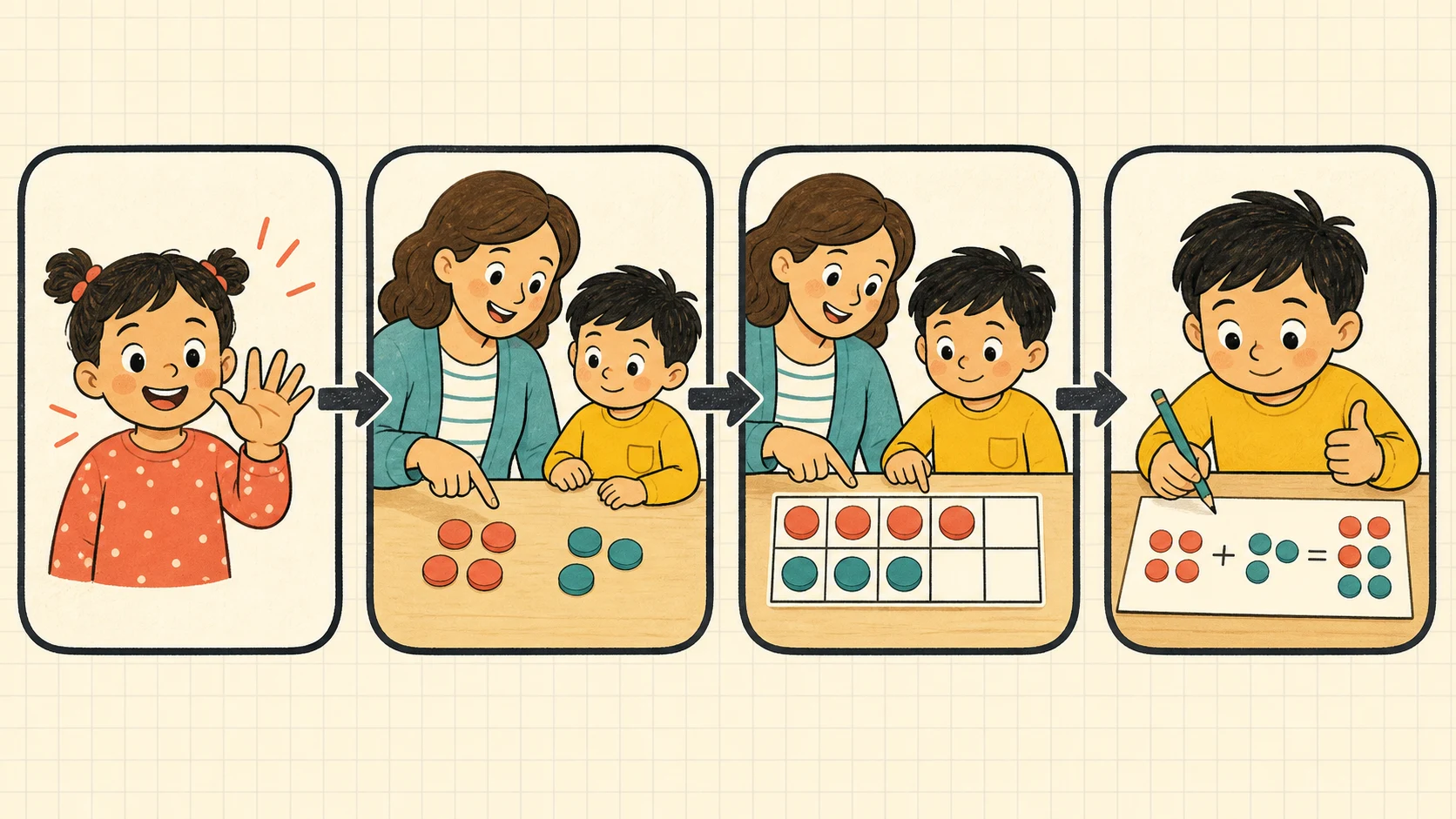
Read the equation, rebuild both quantities, recount once, compare, and revise only after finding the mismatch.
| Observed work | Possible interpretation | Useful response |
|---|---|---|
| Learner uses only the second addend as the answer | One group may have been ignored | Build and label both groups before joining |
| Answer is one too high or low | A counter may have been skipped or counted twice | Arrange counters in a row and touch each once |
| Learner restarts at 1 when trying to count on | Counting-on sequence is not yet stable | Permit counting all; model counting on separately |
| Correct spoken total, incorrect written numeral | Recording, not addition, may be the obstacle | Use a numeral reference and note the distinction |
| Same answer appears on many items | Learner may be guessing or copying | Ask for a representation of one selected item |
| Learner treats “+” as part of the numeral string | Symbol meaning may be unclear | Say and act out “first group, add another group” |
| Several correct answers require laborious recounting | Concept may be present but strategy is inefficient | Model adding one, familiar pairs, or counting on |
| Fast answers cannot be explained or checked | Recall may be correct, but evidence is limited | Ask the learner to verify one answer with objects |
The IES practice guide on assisting students struggling with mathematics offers general recommendations concerning systematic instruction, mathematical language, representations, and regular review. Use those ideas as broad framing, not as evidence that a particular response proves a learning difficulty or that this worksheet has been evaluated by IES.
Correct the process, then the answer
Suppose the learner answers . Do not immediately replace 4 with 5. Ask the learner to build two counters and add three. If the learner creates the correct collection but counts “1, 2, 3, 4” while touching five objects, the issue is counting accuracy. If only four counters were built, identify which addend was represented incorrectly.
After the learner finds the mismatch, have them write the corrected equation and explain it briefly: “Two and three more make five.” This turns correction into another act of reasoning.
Use the answer key responsibly
The separate printable answer key is useful for efficient checking, especially when an adult is reviewing several pages. It should confirm arithmetic after the learner’s work has been observed, not replace observation.
First, verify that the answer key title or file corresponds to the worksheet being used. Then compare one item at a time so rows are not shifted accidentally. Mark correct work unobtrusively. For an incorrect response, circle or point to the item without writing the correct total immediately.
Ask the learner to check it using objects, a drawing, or a second counting method. If the revised answer agrees with the key and the representation is accurate, discuss what changed. If the learner’s reasoning and the key appear to disagree, rebuild the problem yourself before assuming either is correct.
Keep separate notes for different kinds of performance:
- Correct independently.
- Correct with a tool.
- Correct after a general prompt.
- Correct after step-by-step help.
- Not yet correct after rebuilding.
A score such as 16 out of 20 does not show these differences. Four errors caused by reversed numeral formation present a different instructional need from four errors caused by omitting an addend. Likewise, 20 correct answers completed by copying an exposed key would provide almost no evidence of independent addition.
The worksheet description also names place value understanding among its practiced skills. Be conservative when interpreting that claim. The learner’s work on 20 straightforward addition exercises may contribute to number relationships, but this page alone is limited evidence of place value understanding. Direct place-value tasks would be needed to evaluate that area more specifically.
Decide what to do after the page
Choose the next activity from the pattern of work, not from completion alone.
If the learner solved most items accurately using counters, repeat easy addition on another day while inviting—but not requiring—a move toward drawings or counting on. The goal is a gradual connection among concrete quantities, visual representations, and equations.
If the learner solved accurately with drawings but made errors when working mentally, keep drawings available and model one efficient strategy at a time. Adding one and recognizing equal pairs are reasonable examples drawn from checked facts, but use the strategies that fit the actual items and the learner’s demonstrated understanding.
If errors were frequent even with counters, return to oral joining situations and smaller quantities. Work with one equation at a time. The wider Kindergarten Math collection can help you choose practice that matches the prerequisite needing attention.
If the work was accurate, independent, and easily explained, move to varied easy addition rather than repeating the identical page immediately. The Kindergarten Addition Worksheet Pack contains 18 worksheets, but purchasing or completing the full pack is not necessary to prove progress. Select only practice that serves a clear instructional purpose.
A practical decision rule
Use three questions after reviewing the page:
- Did the learner represent both addends correctly?
- Did the learner find totals accurately with an appropriate strategy?
- Could the learner check or explain at least a few answers?
If the answer to all three is usually yes, reduce support or vary the practice. If the first answer is no, revisit the meaning of the written equation. If the second is no, examine counting and joining. If the third is no, add short explanation and checking routines before increasing difficulty.
Schedule retrieval without imposing a universal timetable
Retrieval means asking the learner to solve again after some time has passed, without simply copying the original page. The interval should fit the learner, the teaching schedule, and the evidence from the first session.
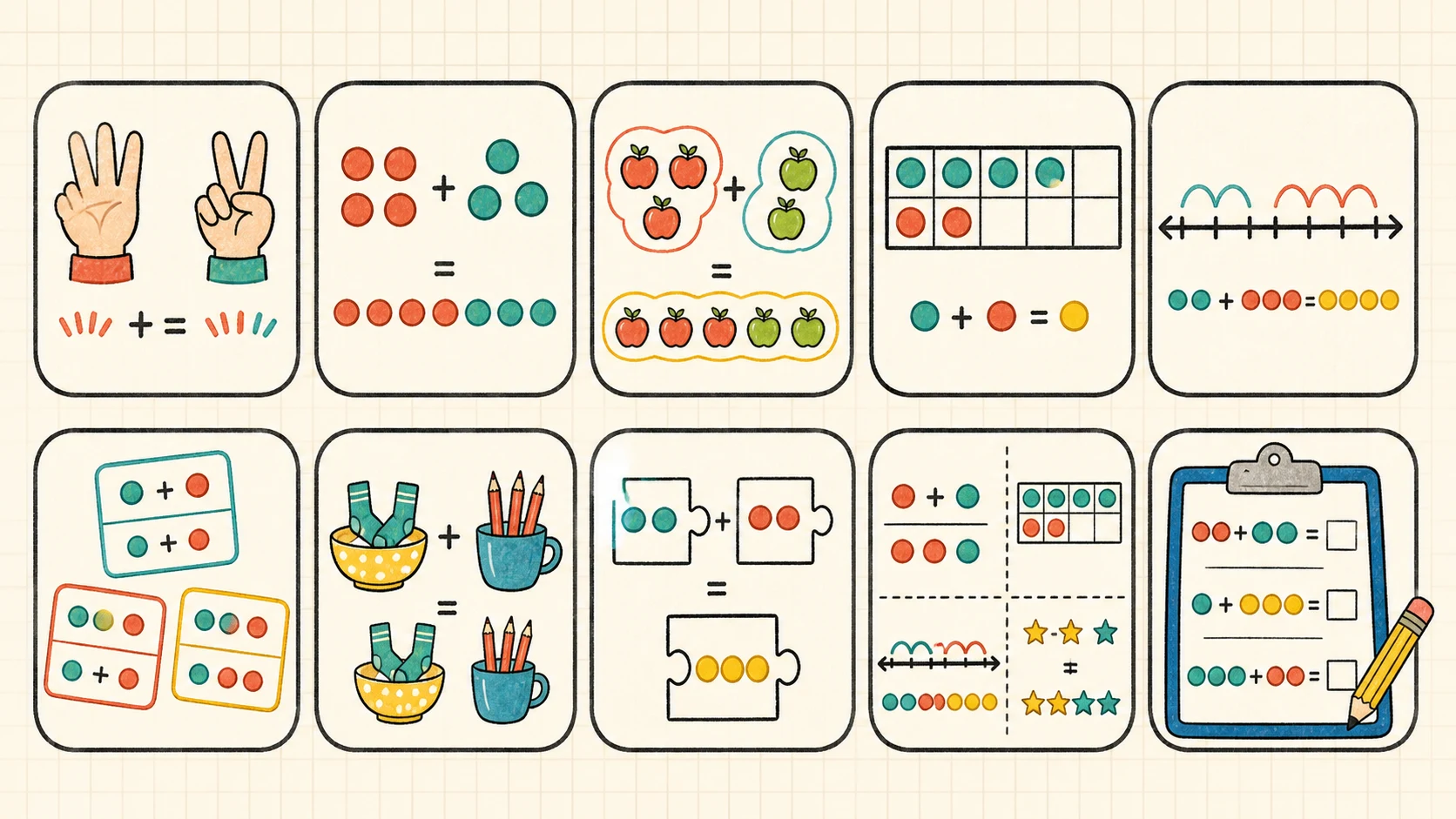
Revisit a small sample after a delay, then adjust the next review according to accuracy and strategy use.
One workable plan is:
| Time | Activity | Decision |
|---|---|---|
| Initial lesson | Model, guide, and complete part or all of the page | Record strategy and error patterns |
| Next suitable session | Recreate three similar facts orally or on blank paper | Continue support if the process is uncertain |
| Several days later | Mix a few reviewed facts with new easy facts | Look for retention without answer copying |
| Following week | Use a short mixed addition check | Extend the interval if understanding remains stable |
| Later review | Include addition among other familiar math work | Return sooner only when errors reappear |
This is an instructional example, not a research-backed universal timetable. A learner who needed extensive guidance should revisit the idea sooner. A learner who retained the facts and explained them clearly can wait longer and use a varied set. Avoid repeating all 20 items every day; memorizing their order can make performance look stronger without showing flexible addition.
Limits of this printable
The worksheet offers 20 consistent, easy-level opportunities to solve written addition problems, plus a separate answer key. That makes it useful for focused practice, homework, a homeschool lesson, or a short classroom task.
It is not a complete Kindergarten addition curriculum. A paper response alone cannot fully show whether the learner understands a joining story, can invent an equation from a real situation, or can apply addition in unfamiliar contexts. It also cannot establish comprehensive standards alignment, guarantee fluency, diagnose a learning need, or predict later outcomes.
Balance the page with spoken problems, physical objects, drawings, and brief explanations. Use the Kindergarten worksheet hub when another subject or prerequisite needs attention, and use the addition topic guide for the broader sequence rather than expecting this printable to contain every stage.
The next useful action
Print the free Kindergarten Addition Worksheets – Standard Theme (Easy), prepare a small set of counters, and begin with one modeled example plus three guided items. Record whether the learner counts all, counts on, draws, recalls a fact, or guesses. That observation should determine how much of the remaining page to assign.
After reviewing the work, visit the Kindergarten Addition topic guide to choose the next practice level. If a fresh arrangement of problems would be more useful than repeating the same page, explore the free worksheet generators and create a short review matched to the learner’s demonstrated range.
Put it into practice
Use the guide with a real printable
Move from explanation to a short, observable practice task. Check the first item together, then adjust the next session from the learner's actual work.
See the 18-worksheet pack