Complete guide
How to teach and practise kindergarten punctuation worksheets - standard theme (easy)
A direct plan for this 12-item worksheet
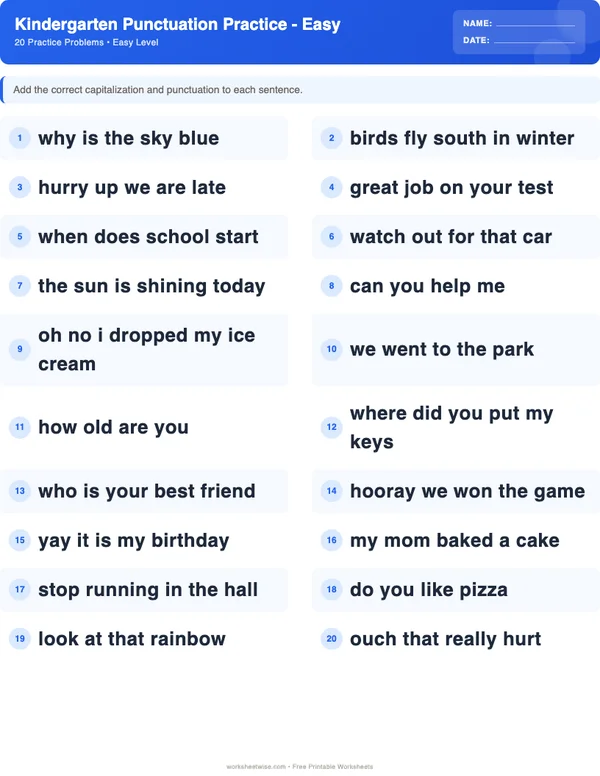
The free Kindergarten Punctuation worksheet asks a learner to add correct capitalization and punctuation to 12 sentences. The target skills are sentence-opening capitalization and choosing among a period, question mark, and exclamation mark.
For a first lesson, model two similar sentences, complete three or four worksheet items together, and then invite the learner to attempt the remaining items independently. Do not decide the pace from age or grade alone. Use the learner’s observed work: continue if the choices are thoughtful and accurate, pause for more modeling if the learner is guessing, or divide the page across two sessions if writing effort begins to obscure punctuation knowledge.
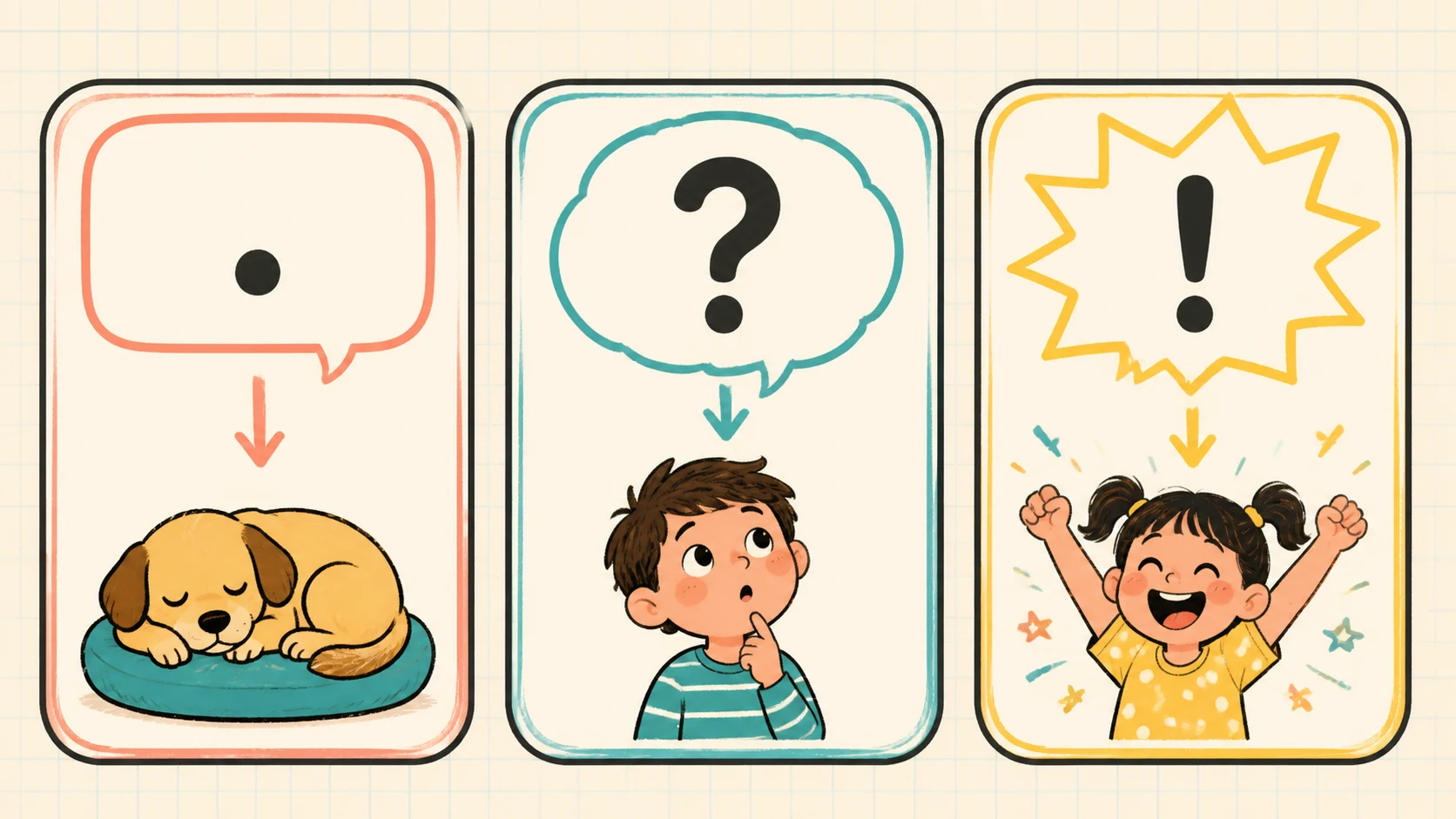
The lesson moves from noticing sentence meaning to correcting the beginning and ending.
| Lesson phase | Suggested use | What the adult watches |
|---|---|---|
| Preview | 2–3 minutes | Can the learner identify a capital letter and the three target end marks? |
| Adult modeling | 2 examples | Does the learner attend to both the beginning and the end? |
| Guided practice | 3–4 worksheet items | Can the learner explain whether a sentence tells, asks, or exclaims? |
| Independent practice | Remaining items | Does the learner apply the same routine without immediate prompting? |
| Check and discuss | 3–5 minutes | Are errors isolated, repeated, or connected to reading difficulty? |
| Retrieval | Short later reviews | Can the learner make the choice again after time has passed? |
This is a compact practice page, not a complete punctuation course. For the wider sequence—from early end punctuation to later work with commas, apostrophes, and quotation marks—use the Kindergarten punctuation topic guide.
Understand the skill before beginning
The printed direction is: “Add the correct capitalization and punctuation to each sentence.” That wording contains two separate jobs:
- Correct the capitalization, especially the first letter at the beginning of the sentence.
- Add the end mark that fits the sentence’s meaning.
A learner may understand one job and miss the other. For example, a child might choose a question mark correctly but leave the first word lowercase. Another might capitalize every beginning correctly while putting a period after every sentence. Treat those as different patterns rather than one broad “punctuation problem.”
The worksheet’s easy label describes its intended practice level. Grade labels also describe intended practice levels; they do not establish a universal timetable for every learner. Local curricula and instructional sequences differ. A learner’s reading experience, handwriting fluency, and previous exposure to punctuation may affect how much adult support is useful.
The high-level instructional frame is consistent with the IES foundational reading practice guide, which discusses systematic instruction and supported practice in foundational literacy. The IES elementary writing practice guide likewise provides a broader rationale for explicitly teaching writing processes and skills. Neither source evaluates WorksheetWise or this particular printable.
Check prerequisite knowledge without turning it into a test
Before showing the whole page, write or point to these marks:
.?!
Ask the learner to name any marks they know. Then read three short oral examples:
- “The dog is wet.”
- “Is the dog wet?”
- “What a wet dog!”
The goal is not to require perfect terminology. Listen for whether the learner notices that one sentence tells something, one asks something, and one expresses strong feeling or emphasis.
Also check whether the learner can locate the first and last parts of a written sentence. If not, physically track from left to right with a finger and say, “This is where the sentence begins. This is where it ends.” That support preserves the punctuation skill while reducing confusion about page navigation.
Prepare a small, uncluttered setup
Useful materials are simple:
- The worksheet
- A pencil and eraser
- The separately printed answer key, kept out of sight during practice
- Optional scrap paper or a small whiteboard for modeling
Avoid presenting the answer key beside the worksheet. The purpose of independent practice is to reveal the learner’s current decision-making, not the ability to copy a finished form.
If 12 items look visually demanding, cover the lower portion of the page with blank paper. Reveal one row or a few items at a time without changing the sentences, marks, or response requirement.
Model the exact decision process
Begin with examples that resemble the task but are not presented as items from the worksheet. The learner needs to see how meaning leads to punctuation.
Write:
the bird can fly
Think aloud in a short sequence:
“I look at the first word. A sentence begins with a capital, so I change the lowercase t to uppercase T. Now I read the words: ‘The bird can fly.’ This sentence tells me something. It does not ask a question or show a strong exclamation, so I put a period at the end.”
The corrected sentence is:
The bird can fly.
Keep the explanation tied to visible evidence. Avoid saying only, “A period looks right.” The useful reasoning is that the sentence tells something.
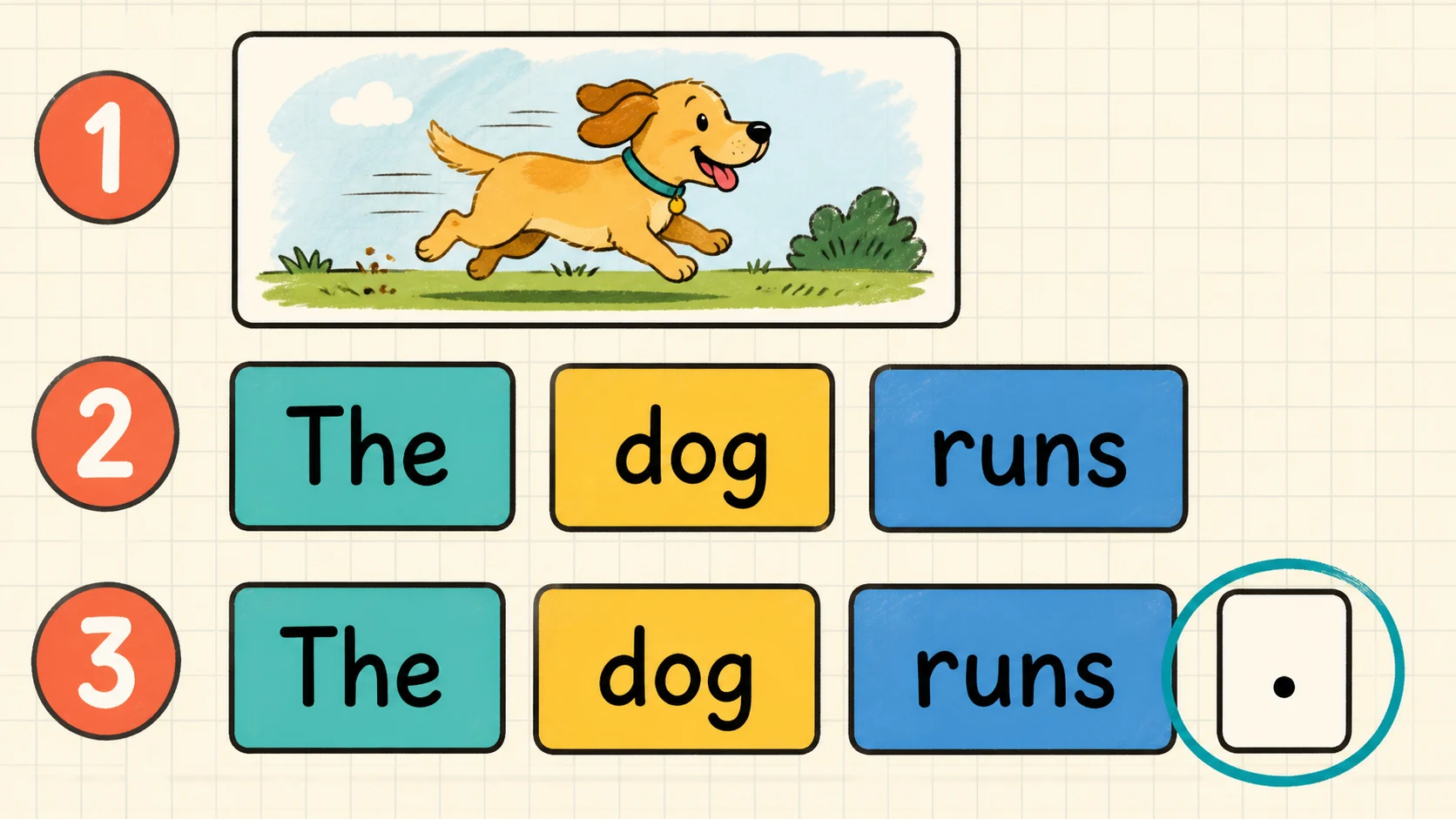
The adult checks the sentence beginning, reads for meaning, and then selects the end mark.
Use one repeatable routine
Teach a four-part routine that can be used on every item:
- Find the beginning. Does the first letter need to become uppercase?
- Read the whole sentence. Read it aloud if needed.
- Decide what the sentence does. Does it tell, ask, or exclaim?
- Check both ends. Confirm the capital at the beginning and the mark at the end.
A short verbal cue can help: “Beginning, meaning, ending, check.” Once the learner understands the sequence, shorten your prompts so the routine does not become a script the child depends on permanently.
Work through fully checked examples
These examples are newly written for instruction. They demonstrate the worksheet’s listed skills without claiming to reproduce its 12 items.
Example 1: A statement
Uncorrected:
we see a red kite
Reasoning:
- The first word is lowercase, so
webecomesWe. - The sentence tells something.
- A telling sentence takes a period here.
Corrected:
We see a red kite.
Check:
- Capital at the beginning: yes.
- Appropriate end punctuation: period.
- Other words changed unnecessarily: no.
Example 2: A question
Uncorrected:
can you hop
Reasoning:
- The first word begins with lowercase
c, so it becomes uppercaseC. - The sentence asks whether someone can hop.
- An asking sentence takes a question mark.
Corrected:
Can you hop?
Check:
- Capital at the beginning: yes.
- Appropriate end punctuation: question mark.
- The answer is not a period merely because the sentence can be spoken calmly.
Example 3: An exclamation
Uncorrected:
what a big splash
Reasoning:
whatbecomesWhatat the beginning.- The wording expresses a strong reaction to the splash.
- An exclamation mark fits that emphatic meaning.
Corrected:
What a big splash!
Check:
- Capital at the beginning: yes.
- Appropriate end punctuation: exclamation mark.
- The mark is based on the sentence’s function, not just on reading it loudly.
Example 4: A statement that contains an exciting idea
Uncorrected:
the puppy runs fast
Reasoning:
thebecomesThe.- A fast puppy may feel exciting, but this wording simply tells what the puppy does.
- A period is the most direct choice.
Corrected:
The puppy runs fast.
Check:
- Capital at the beginning: yes.
- Appropriate end punctuation: period.
- An exciting topic does not automatically require an exclamation mark.
Example 5: A question without an obvious question word
Uncorrected:
is this your hat
Reasoning:
isbecomesIs.- The sentence asks for information even though it does not begin with
who,what,where,when, orwhy. - It needs a question mark.
Corrected:
Is this your hat?
Check:
- Capital at the beginning: yes.
- Appropriate end punctuation: question mark.
- The decision comes from the sentence asking something.
Boundary cases worth discussing
Young learners sometimes rely on a single clue: loud voice means exclamation mark, a sentence with what means question mark, or every sentence gets a period. Show why those shortcuts are incomplete.
Compare:
What is in the box?asks for information.What a big box!expresses a reaction.
The same opening word can appear with different end marks because the sentences do different things.
Now compare:
The bell is loud.tells something about the bell.That bell is so loud!gives the statement stronger emphasis.
At this level, do not turn a borderline item into a debate over every possible interpretation. Use the intended plain reading, compare it with the answer key after the learner has committed to a choice, and explain the difference in concrete language.
Run guided practice before independent work
Move to the actual worksheet after modeling. On the first guided item, ask the learner to do only the first step: identify the beginning. On the next item, have the learner identify the sentence type. By the third or fourth, ask for the entire routine.
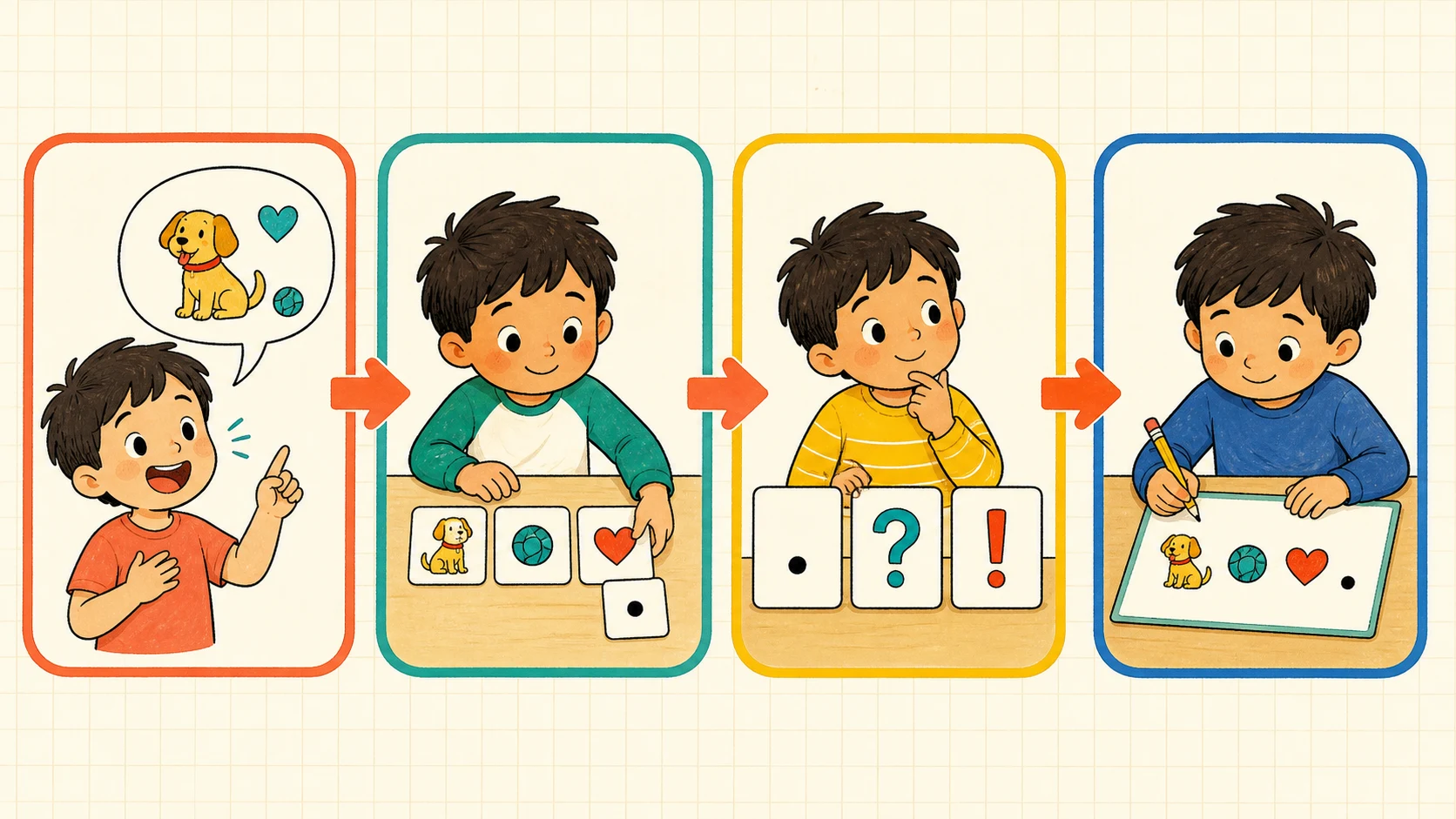
Support is gradually reduced as the learner takes over the same correction routine.
Use prompts that reveal reasoning
Helpful prompts include:
- “Where does the sentence begin?”
- “Read the whole sentence before choosing.”
- “Is it telling, asking, or exclaiming?”
- “What belongs at the end?”
- “Check both ends. Did you fix both jobs?”
These prompts direct attention without giving the mark immediately.
Less useful prompts include:
- “Are you sure?”
- “Look again.”
- “That one is wrong.”
Those comments indicate a problem but do not tell the learner what feature to inspect. If the child changes a correct answer after hearing “Are you sure?”, you learn little about the original reasoning.
Decide when to release responsibility
Independent practice is appropriate when the learner can complete the four-part routine on at least a couple of guided items without being told the answer. This is an instructional suggestion, not a universal cutoff.
If the learner still needs the adult to name the sentence type every time, continue guided practice for another item or use a fresh oral example. If the learner names the sentence type but struggles to form the mark, let the child point to the correct mark on a reference card before writing it. That keeps the decision about punctuation central.
Protect the value of independent practice
Independent does not have to mean that the adult leaves the room. It means the learner makes each punctuation decision before receiving evaluative feedback.
Sit nearby if attention, reading, or pencil control requires support. You may read a sentence aloud neutrally when decoding prevents access to the grammar task. Do not exaggerate your voice so strongly that it gives away every answer. After reading, ask the learner to decide what the sentence does.
Let observed work determine the pace
Watch for three signals:
- Productive effort: The learner reads, chooses, and checks with occasional hesitation.
- Unproductive guessing: The learner cycles through marks without referring to meaning.
- Physical or attentional fatigue: Letter formation deteriorates, items are skipped, or the routine is abandoned despite earlier success.
With productive effort, allow the learner to continue. With guessing, pause and return to one modeled example. With fatigue, stop at a natural point and finish later. Splitting a 12-item worksheet does not change the target skill.
Avoid imposing a strict completion time. Speed is not one of the listed worksheet skills, and a universal timetable would ignore differences in reading and handwriting demands.
Adapt support without changing the skill
Differentiation should make the target decision accessible while keeping the learner responsible for capitalization and end punctuation.
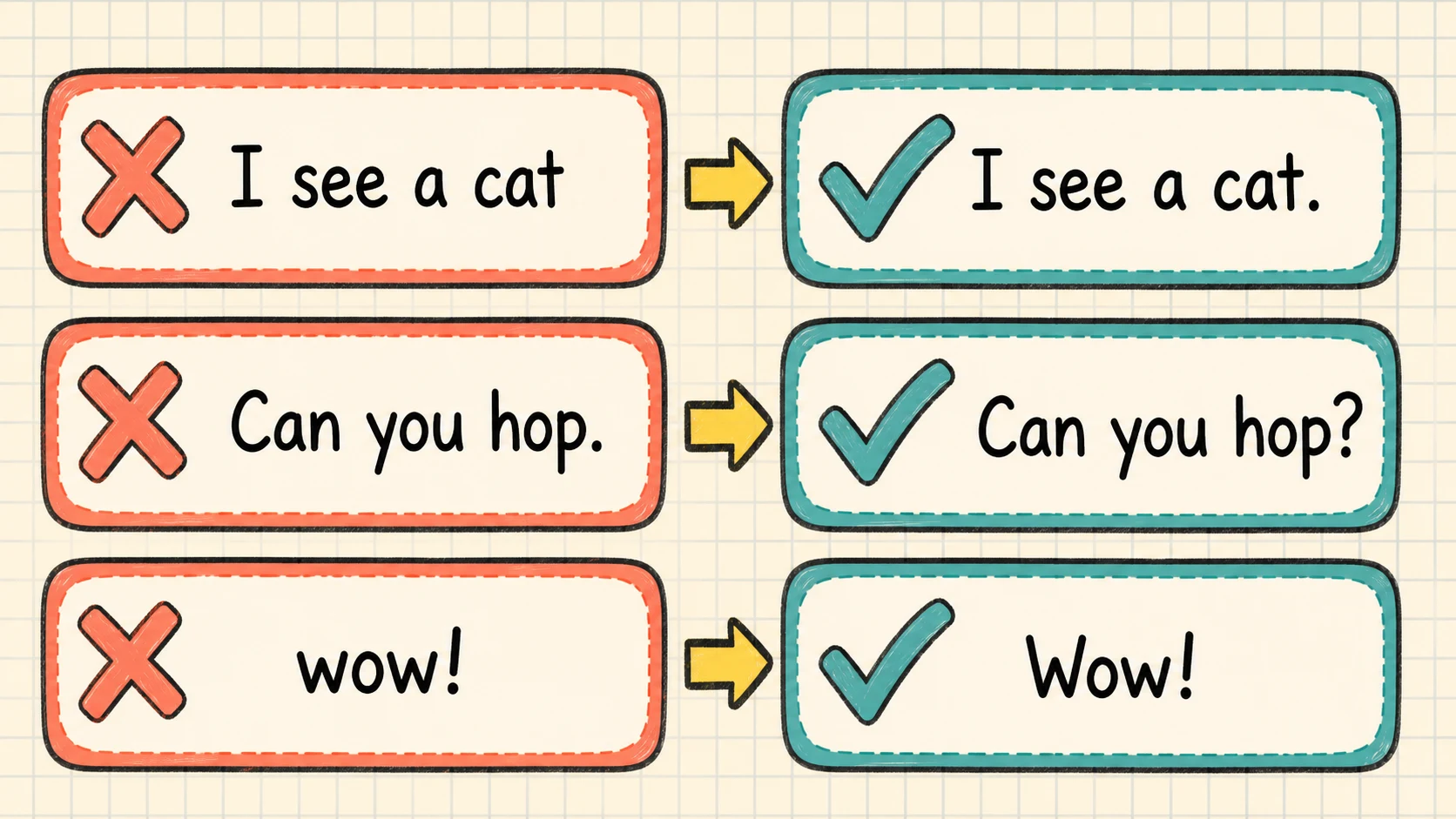
Reading support, visual cues, and reduced page load can preserve the same punctuation decision.
When reading is the main barrier
Read the sentence aloud while the learner follows the words. Then ask the learner to classify it as telling, asking, or exclaiming and add the marks independently.
This adaptation changes who performs the decoding, but it does not change the punctuation problem. Record that reading support was provided so the finished page is not mistaken for fully independent reading and editing.
When handwriting is the main barrier
Let the learner:
- Circle the first letter and say its uppercase form.
- Point to a period, question mark, or exclamation mark on a small reference card.
- Write only the corrected capital and end mark if rewriting the whole sentence is not required by the printable layout.
The adult may note the response separately if necessary. Do not infer medical, developmental, or diagnostic conclusions from handwriting difficulty on one page.
When the page feels visually crowded
Cover all but one or two items. Maintain the original order and reveal the next section after the current part is checked. This reduces the visible load without reducing the number or difficulty of the decisions.
When the learner is ready for less support
Remove the sentence-type labels and ask the learner to explain one or two choices after completing them. A useful extension is to write one original telling sentence, one asking sentence, and one exclamation. That extension is separate from the worksheet’s 12 required exercises; it should not be used to make the original page seem longer or harder than its catalogue description.
Interpret errors instead of counting only totals
A score can summarize correct responses, but an error pattern tells you what to teach next. Sort errors by the job the learner missed.
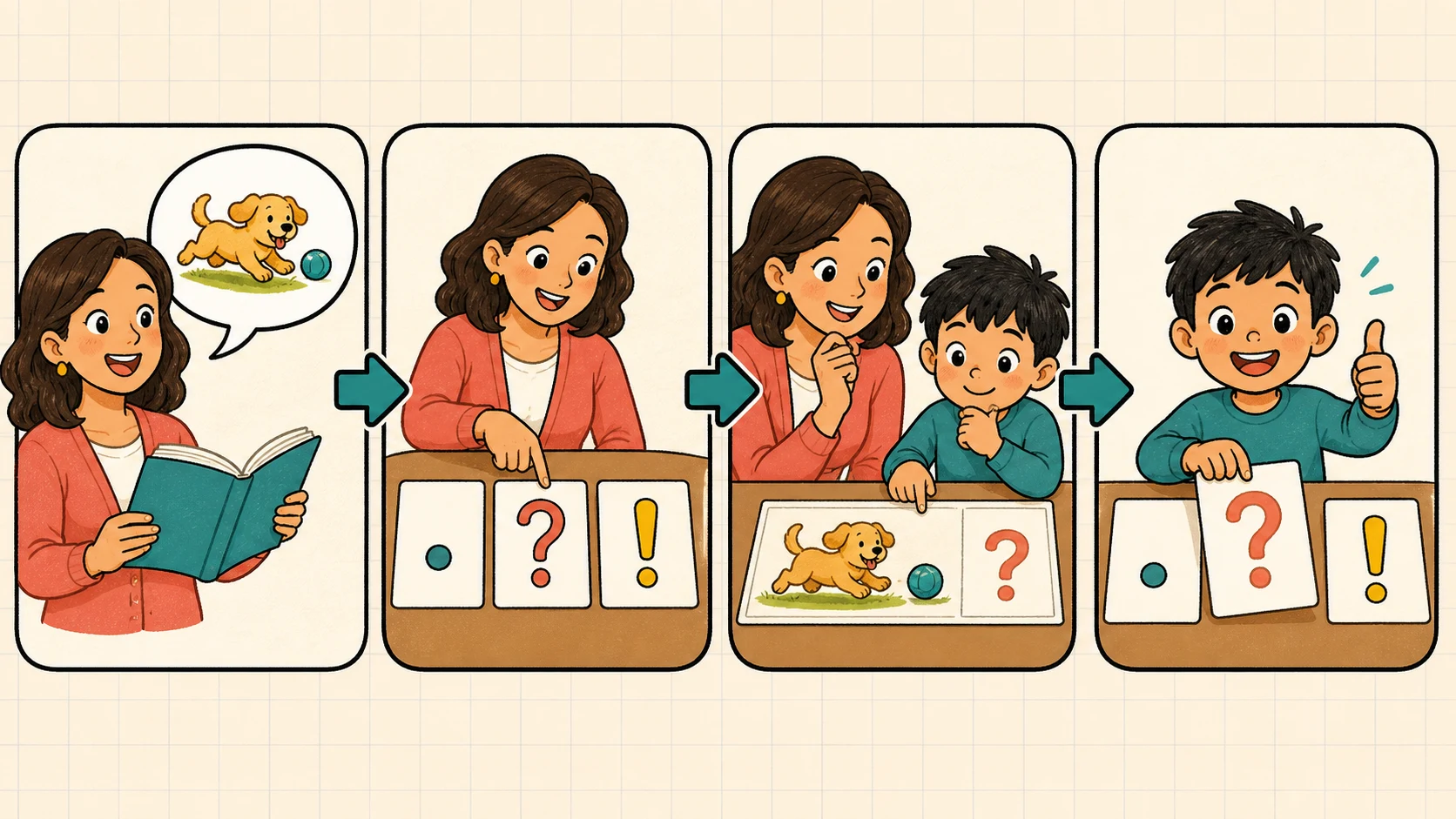
Classify the error, ask for the reasoning, model briefly, and then try a fresh example.
| Observed pattern | Possible instructional meaning | Useful response |
|---|---|---|
| Correct end marks, lowercase beginnings | The learner may understand sentence purpose but omit capitalization | Mark the first-letter position and practice checking both ends |
| Capitalized beginnings, periods everywhere | The learner may recognize capitalization but not distinguish sentence functions | Contrast one telling sentence with one question |
| Question marks only after question words | The learner may depend on a surface clue | Use a yes-or-no question such as Can birds fly? |
| Frequent exclamation marks | The learner may equate interesting content with strong emphasis | Compare a plain statement and an emphatic version |
| Correct oral answer, incorrect written mark | The concept may be stronger than mark formation | Practice forming ., ?, and ! separately, then return to one sentence |
| Correct after adult reading, inconsistent when reading alone | Decoding may be interfering with the punctuation decision | Provide neutral oral reading while continuing grammar practice |
| Items skipped near the bottom | Attention, visual load, or fatigue may be involved | Reveal fewer items at a time or divide the session |
These interpretations are hypotheses for instruction, not diagnoses. Confirm a pattern with another example before deciding what it means.
Correct common misconceptions precisely
If the learner says, “Questions always start with what,” respond with two counterexamples:
Can I play?Where is my shoe?
Both ask something, but only one begins with a familiar question word.
If the learner says, “An exclamation mark means yelling,” refine the idea: an exclamation mark can show strong feeling or emphasis. It is not an instruction to shout every time.
If the learner says, “A period goes after every sentence,” acknowledge the partial truth: every complete sentence needs an ending mark in this exercise, but the appropriate mark may be a period, question mark, or exclamation mark.
The Common Core English Language Arts standards include recognition and naming of end punctuation in the Kindergarten language conventions. That provides broad context for this practice level, but it should not be treated as proof of comprehensive alignment with every local curriculum or assessment.
Check the answer key responsibly
The separate answer key is useful after the learner has completed a meaningful portion of the work. It should support feedback, not replace observation.
Use a two-pass check
On the first pass, inspect each response for both required elements:
- Is the sentence beginning correctly capitalized?
- Does the end mark match the sentence’s intended function?
On the second pass, classify any errors. A sentence with a correct capital but incorrect mark is not the same as a sentence with both parts missing.
Invite the learner to review before showing the key:
“Check the beginning and ending of each sentence. Is there one you want to reconsider?”
After that self-check, compare the work with the answer key. If an answer differs, ask the learner to read the sentence and explain the choice. Then give a brief correction:
“This sentence asks something, so it needs a question mark.”
Avoid erasing every error yourself. Let the learner make a clear correction when practical so the final page records the revised decision.
Keep the result in proportion
This page contains 12 items and covers only capitalization, periods, question marks, and exclamation marks. It cannot establish complete grammar proficiency, predict future writing performance, or show mastery of the broader punctuation progression.
A strong result suggests readiness for another short application or later retrieval check. A mixed result indicates which part of the routine needs more practice. A weak result may mean the task was premature, reading demands interfered, or the learner needed more guided instruction. One page cannot determine which explanation is correct by itself.
Decide what to teach next
Base the next step on the learner’s work rather than automatically moving to a harder page.
If capitalization was the main difficulty
Use three fresh sentences with the end punctuation already supplied. Ask the learner only to correct the sentence beginnings. Later, return to a mixed example that requires both capitalization and punctuation.
If questions were the main difficulty
Contrast statements and questions:
You have a blue cup.Do you have a blue cup?
Have the learner state what each sentence does before writing a mark. Include yes-or-no questions so the learner does not rely only on question words.
If exclamations were the main difficulty
Compare neutral and emphatic wording:
The cake is tall.What a tall cake!
Ask which one simply tells and which one expresses a stronger reaction. Keep voice helpful but do not make loudness the only cue.
If all four skills were secure
Apply the same mechanics to a tiny writing task. The learner might write or dictate:
- One sentence that tells something about a picture
- One sentence that asks about the picture
- One sentence that shows a strong reaction
Check the beginning and ending of each sentence. This moves from correcting supplied text to producing original sentences without introducing advanced punctuation.
For additional pages at the same broad level, browse the Kindergarten grammar collection. The Kindergarten worksheet hub can help when punctuation practice needs to be balanced with other subjects.
Schedule brief retrieval instead of immediate repetition only
Completing several nearly identical items in one sitting can show short-term consistency. A later check shows whether the learner can retrieve the routine after a delay.

Later reviews reuse the decision process with fresh sentences rather than simply copying old answers.
A practical, adjustable schedule is:
| Time | Review task | Evidence to collect |
|---|---|---|
| Later the same day or next lesson | Correct one fresh statement and one fresh question | Can the learner remember to check both ends? |
| A few days later | Correct three mixed sentences | Can the learner distinguish telling, asking, and exclaiming without labels? |
| About a week later | Write or dictate one original sentence of each type | Can the learner apply capitalization and punctuation during composition? |
| During later writing | Check one authentic sentence | Does the skill transfer beyond a punctuation-only exercise? |
This is an instructional suggestion, not a prescribed or universal schedule. Shorten or lengthen the intervals according to observed recall. If the learner remembers accurately, make the next review less frequent. If the routine is forgotten, model one example and schedule another short attempt sooner.
Do not repeatedly assign the same completed worksheet from memory and interpret copied answers as retrieval. Use fresh examples or a related printable so the learner must examine meaning again.
Recognize the worksheet’s boundaries
This printable offers focused, easy-level practice with four listed mechanics: capitalization, periods, question marks, and exclamation marks. It does not cover the entire punctuation topic. It also does not replace shared reading, oral language work, sentence composition, or feedback on the learner’s own writing.
The page should not be used to make child-specific developmental conclusions. It does not provide medical guidance, a diagnostic assessment, guaranteed outcomes, or comprehensive standards alignment. The authoritative sources linked above offer broad instructional and standards context; they have not reviewed or endorsed this exact WorksheetWise resource.
A useful lesson therefore combines the page with observation:
- What can the learner explain?
- What can the learner do with a prompt?
- What can the learner do independently?
- What remains available after a delay?
- Does the skill appear in original writing?
Those questions provide a more responsible picture than a correct-answer total alone.
Take the next honest step
Start with the free 12-item Kindergarten Punctuation worksheet, model two similar examples, and record whether errors involve capitalization, sentence type, mark formation, reading, or sustained attention. Then choose the next resource from evidence: revisit the punctuation topic guide for the broader progression, use the focused Kindergarten Punctuation pack when additional related practice is appropriate, or create fresh retrieval items with the free worksheet generators.
Put it into practice
Use the guide with a real printable
Move from explanation to a short, observable practice task. Check the first item together, then adjust the next session from the learner's actual work.
See the 18-worksheet pack