Complete guide
How to teach and practise 6th grade word problems worksheets - standard theme (easy)
How to Use This 30-Item Worksheet
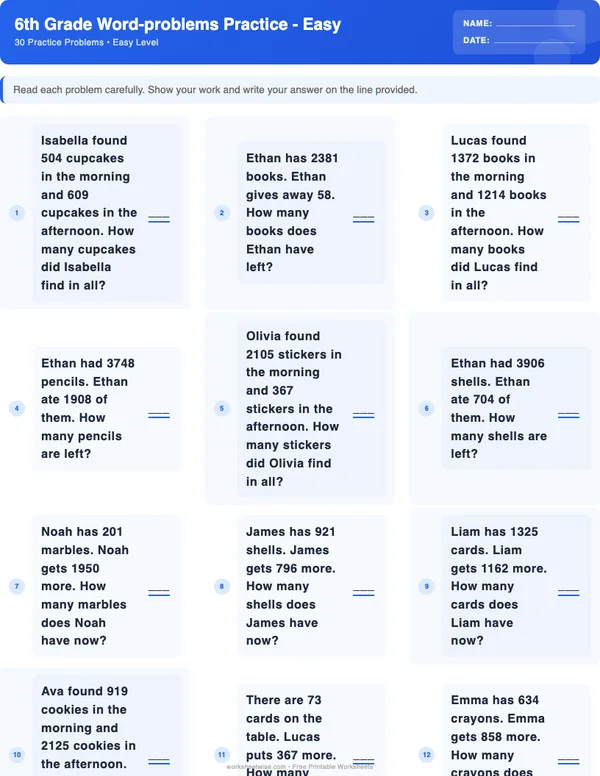
The free 6th Grade Word Problems worksheet provides 30 easy-level story problems involving reading comprehension, mixed operations, problem solving, and multi-step reasoning. A productive way to use it is to model one problem, solve several together, assign a short independent set, inspect the learner’s work, and choose the next set from that evidence. The learner does not need to complete all 30 items in one sitting.
The worksheet directions are simple: read each problem carefully, show the work, and write the answer on the provided line. Treat all three actions as part of the assignment. A correct number without an equation, diagram, or other visible reasoning does not show whether the learner understood the situation or guessed an operation.
Grade labels describe the intended practice level; local curricula, course sequences, and learner readiness differ. “Easy” identifies this worksheet’s catalogue difficulty, not a promise that every sixth grader will find every item easy. The adult should let observed work—not the label or a universal timetable—determine pacing.
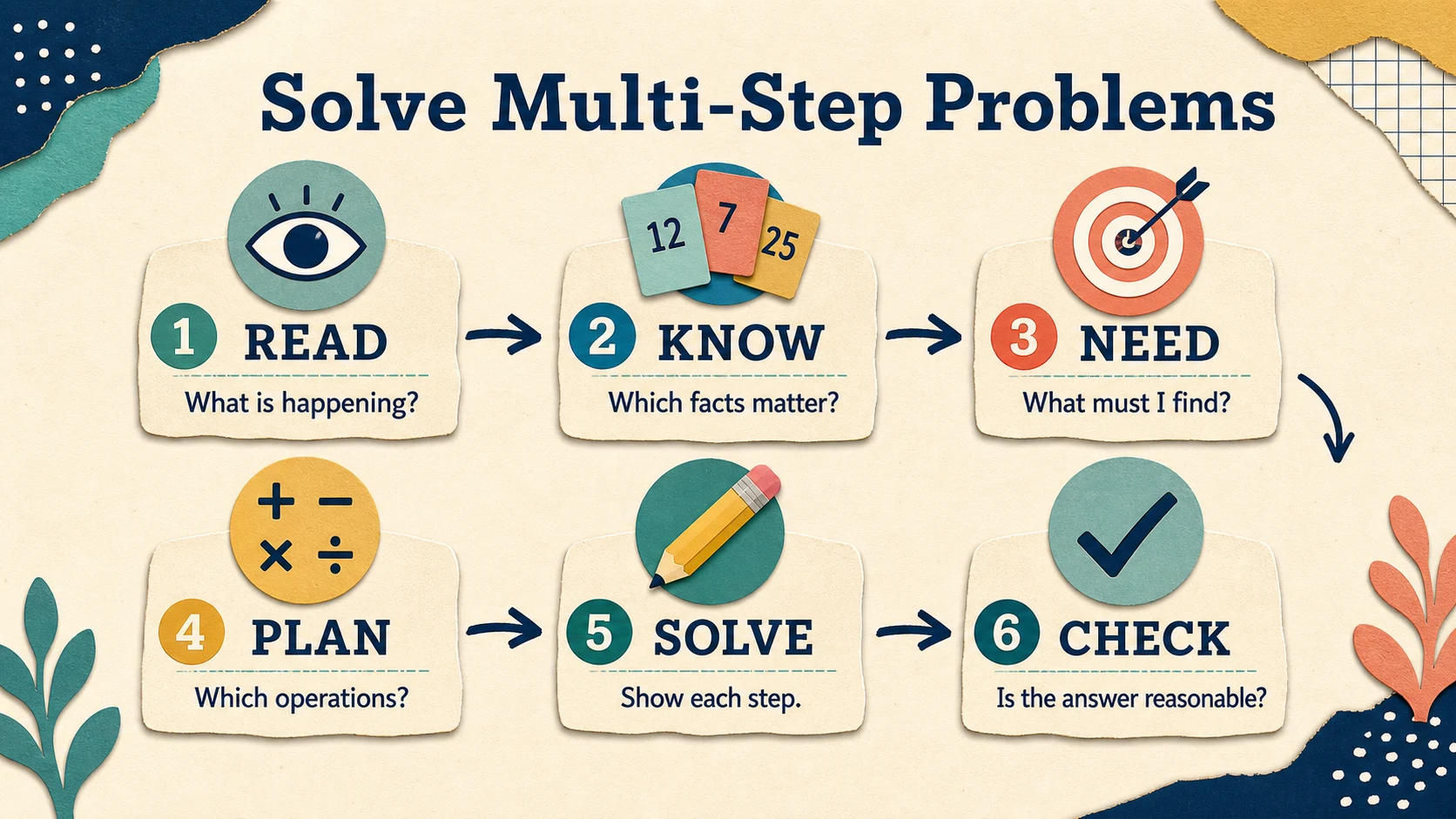
Move from a brief launch to modeling, guided practice, independent work, feedback, and later retrieval.
A Practical Lesson Map
This is a flexible instructional plan, not a required schedule. Pause sooner if accuracy or explanations deteriorate. Continue only when the learner can explain the quantities and relationships with decreasing adult help.
| Phase | Suggested amount | Adult’s role | Evidence to notice |
|---|---|---|---|
| Launch | 3–5 minutes | Establish the routine and preview the task | Can the learner state what a word problem asks them to do? |
| Model | 1 problem | Think aloud without asking the learner to guess | Does the learner follow how the situation becomes an equation? |
| Guided practice | 2–4 problems | Prompt, question, and gradually reduce help | Can the learner identify known and unknown quantities? |
| Independent practice | 4–8 problems | Observe without coaching each step | Can the learner choose operations and show organized work? |
| Review | 1–3 errors or uncertain answers | Compare reasoning with the answer key | Can the learner locate and correct the point of error? |
| Retrieval | A few previously completed problems later | Ask for a fresh solution without showing old work | Is the method still available after a delay? |
A classroom teacher might use selected items for a short small-group lesson. A tutor might spread the page across several meetings. A homeschool family might complete one set now and another after related instruction. For a broader sequence of problem types and strategies, use the Word Problems topic guide instead of expecting this single printable to supply the entire progression.
Prepare the Learner Before the First Problem
Set up a repeatable solving routine
Write this six-part routine where the learner can see it:
- Read the whole problem.
- Retell what is happening.
- List what is known and what must be found.
- Represent the relationships.
- Calculate and label the answer.
- Check whether the result fits the story.
The catalogue guidance emphasizes comprehension rather than keyword hunting. A word such as “left” does not automatically prove that subtraction is appropriate. For example, “Mia has 12 pages left to read after finishing 28” asks for the original total, so the relationship is , not . The operation comes from the relationship among quantities.
The IES practice guide on teaching mathematics provides high-level instructional guidance that includes using representations and helping learners connect mathematical ideas. Although its title focuses on younger children, that general framing can still inform an adult’s modeling: make the quantities visible, connect the representation to an equation, and ask the learner to explain the connection. It does not evaluate this worksheet.
Establish what “show your work” means
Accept more than one useful representation:
- A labeled equation
- A tape or bar diagram
- A table
- A short sequence of calculations
- A sentence explaining the relationship
Do not require decorative copying of every sentence. The written work should preserve enough reasoning to make the operation choice and calculation checkable.
Before starting, confirm that the learner has a pencil, scratch paper if needed, and a quiet place to read. Keep the answer key out of view. The goal is to produce interpretable work before comparing answers.
Model One Problem Completely
Tell the learner that you will demonstrate the thinking process. Do not begin by asking, “What operation do you use?” That question can turn modeling into a guessing test. Instead, narrate how you identify the question, quantities, units, and relationship.
The following examples are newly written and fully checked. They illustrate the type of reasoning suitable for this worksheet, but they are not claims about the wording or numerical content of any particular item in the printable.
Worked example 1: Two-step subtraction
Problem: A library display begins with 96 books. Visitors borrow 28 books in the morning and 17 in the afternoon. How many books remain?
Retell: The display starts with 96 books. Two groups are removed. I need the amount still there.
Known: 96 at the start, 28 borrowed, then 17 borrowed.
Unknown: Books remaining.
Equation:
Calculate in two steps:
Answer: 51 books remain.
Check: A combined 45 books were borrowed because . Then . Adding the borrowed and remaining books gives , the original total.
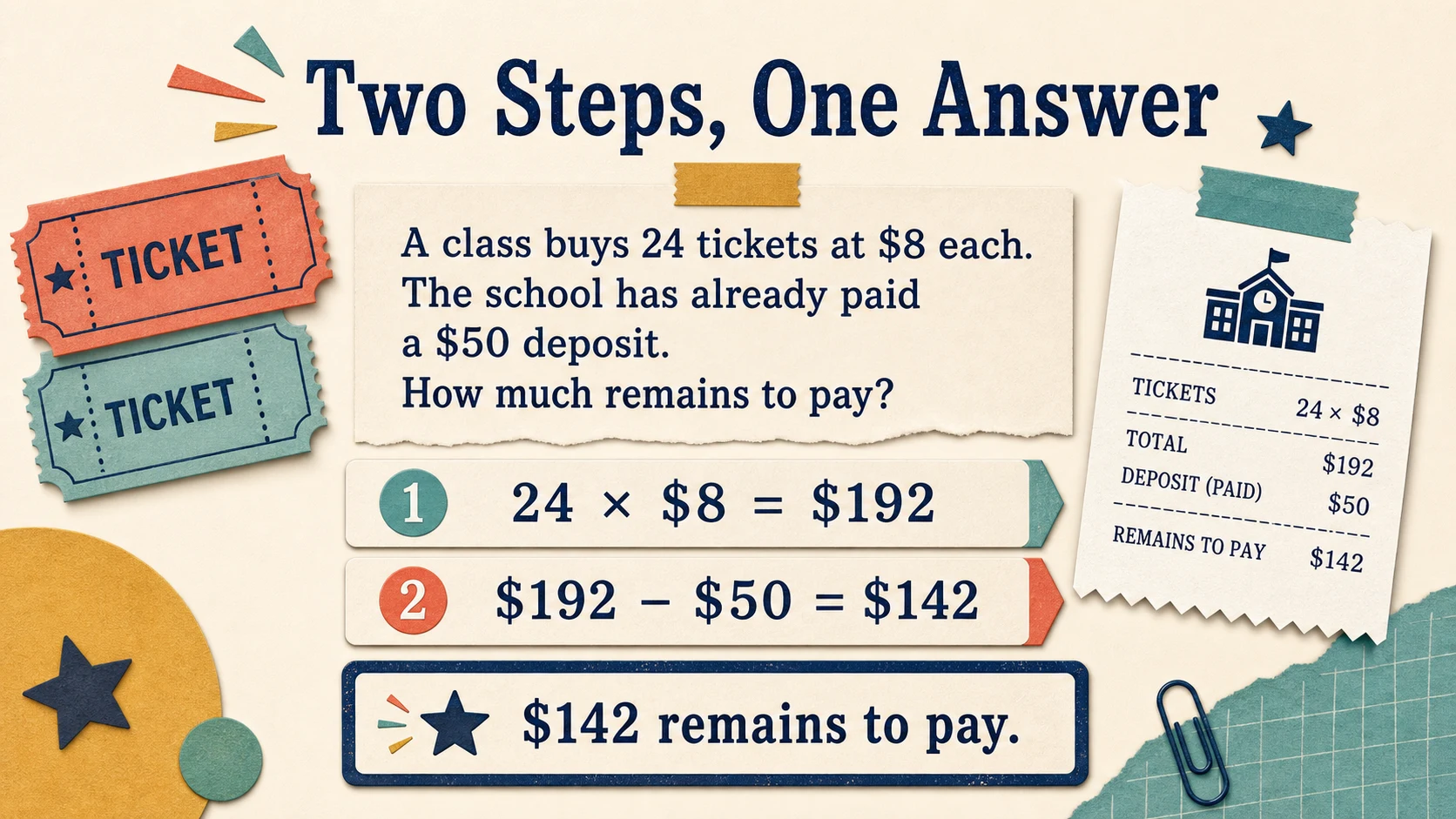
The explanation connects the story, representation, equation, computation, unit, and check.
Use a think-aloud, not a keyword script
A concise model might sound like this:
I need the amount remaining, but I will not subtract merely because I saw “remain.” I am subtracting because books leave the starting group twice. My answer must be less than 96, and its unit is books.
That explanation is an instructional suggestion, not a sourced rule about this exact worksheet. Its purpose is to reveal decisions that an experienced solver may otherwise make silently.
Move into Guided Practice
During guided practice, let the learner do the intellectual work while you control the amount of support. Ask one prompt, wait, and listen. If the learner answers correctly, ask for the relationship rather than immediately confirming the operation.
Useful prompts include:
- “What is happening in the story?”
- “Which quantities are connected?”
- “What are you trying to find?”
- “Can you show that with a bar, table, or equation?”
- “Why does that operation fit?”
- “What unit belongs with the answer?”
- “How could you check it?”
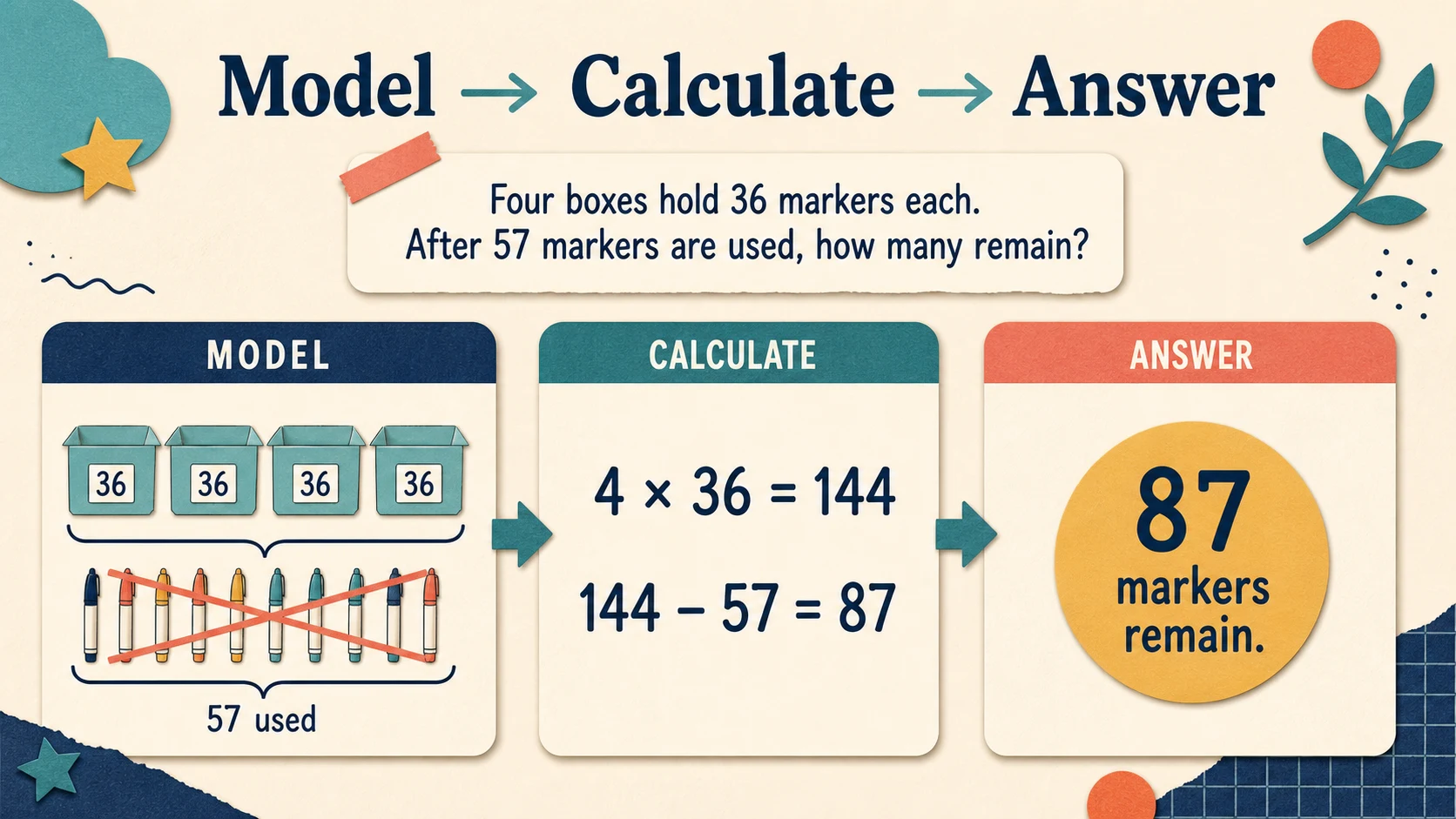
Guided practice should transfer one decision at a time from the adult to the learner.
Worked example 2: Equal groups with a remainder decision
Problem: A teacher has 157 index cards and places 12 cards in each packet. How many full packets can the teacher make, and how many cards remain?
Represent the relationship:
Since ,
Answer: The teacher can make 13 full packets, with 1 card remaining.
Check: .
The boundary here matters. Rounding up to 14 would create a packet that does not have 12 cards. Writing only “13” would omit the requested remainder. The context determines how the remainder is reported.
Worked example 3: Decimal money
Problem: Four identical notebooks cost $3.75 each. A customer pays with $20. How much change should the customer receive?
First find the total cost:
Then subtract from the payment:
Answer: The customer should receive $5.00 in change.
Check: The cost and change must total the amount paid:
A learner who writes $16.25 may have subtracted one notebook’s price from $20 without accounting for all four notebooks. That is a relationship error, not merely a decimal error.
Fade help deliberately
For the first guided item, you might supply a diagram and ask the learner to label it. For the next, ask the learner to choose the representation. On the third, wait until the learner has read, represented, and calculated before intervening.
The IES guide for assisting students who struggle with mathematics offers high-level guidance on explicit, systematic instruction and the use of visual representations. In this lesson, a reasonable application is to model the routine clearly, provide focused prompts, and remove prompts as the learner becomes more independent. This is an adaptation of broad instructional guidance, not a claim that IES reviewed WorksheetWise materials.
Assign Independent Practice in Manageable Sets
Independent practice should reveal what the learner can do without live coaching. Choose a short run of items from the worksheet rather than assigning all 30 automatically. Four to eight items can provide useful evidence while leaving time to examine the reasoning.
Explain what help remains available. For example, the learner may reread the routine, draw a diagram, or ask for an unfamiliar word to be explained. If you identify the operation, set up the equation, or correct each calculation during the attempt, the work is no longer independent evidence.
Worked example 4: Fraction of a quantity
Problem: A container holds 36 liters of water. Three-fourths of the water is used. How many liters are used, and how many remain?
Find the amount used:
One-fourth of 36 is:
Three-fourths is:
So 27 liters are used. Now find the remainder:
Answer: 27 liters are used, and 9 liters remain.
Check:
Also, is one-fourth of 36, which fits because using three-fourths leaves one-fourth.
Worked example 5: Ratio reasoning
Problem: A drink mix uses 2 cups of juice for every 3 cups of water. If 12 cups of water are used, how many cups of juice are needed?
The water amount grows from 3 cups to 12 cups:
Apply the same scale factor to the juice:
Answer: 8 cups of juice are needed.
Check: The ratio simplifies by dividing both terms by 4:
Adding 2 and 3, or subtracting 2 from 12, would use the numbers without preserving the stated relationship.
The sixth-grade catalogue includes ratio and proportional reasoning among the broader mathematics expectations at this level. The Common Core State Standards for Mathematics also provide a public reference for grade-level mathematical domains and expectations. Local sequences can differ, and this guide does not claim that every item on this worksheet comprehensively covers or certifies alignment with any standards system.
Adapt Support Without Changing the Skill
Support should make the reasoning accessible without completing it for the learner. The target remains interpreting a story, representing its quantitative relationships, choosing and performing operations, and checking the result.
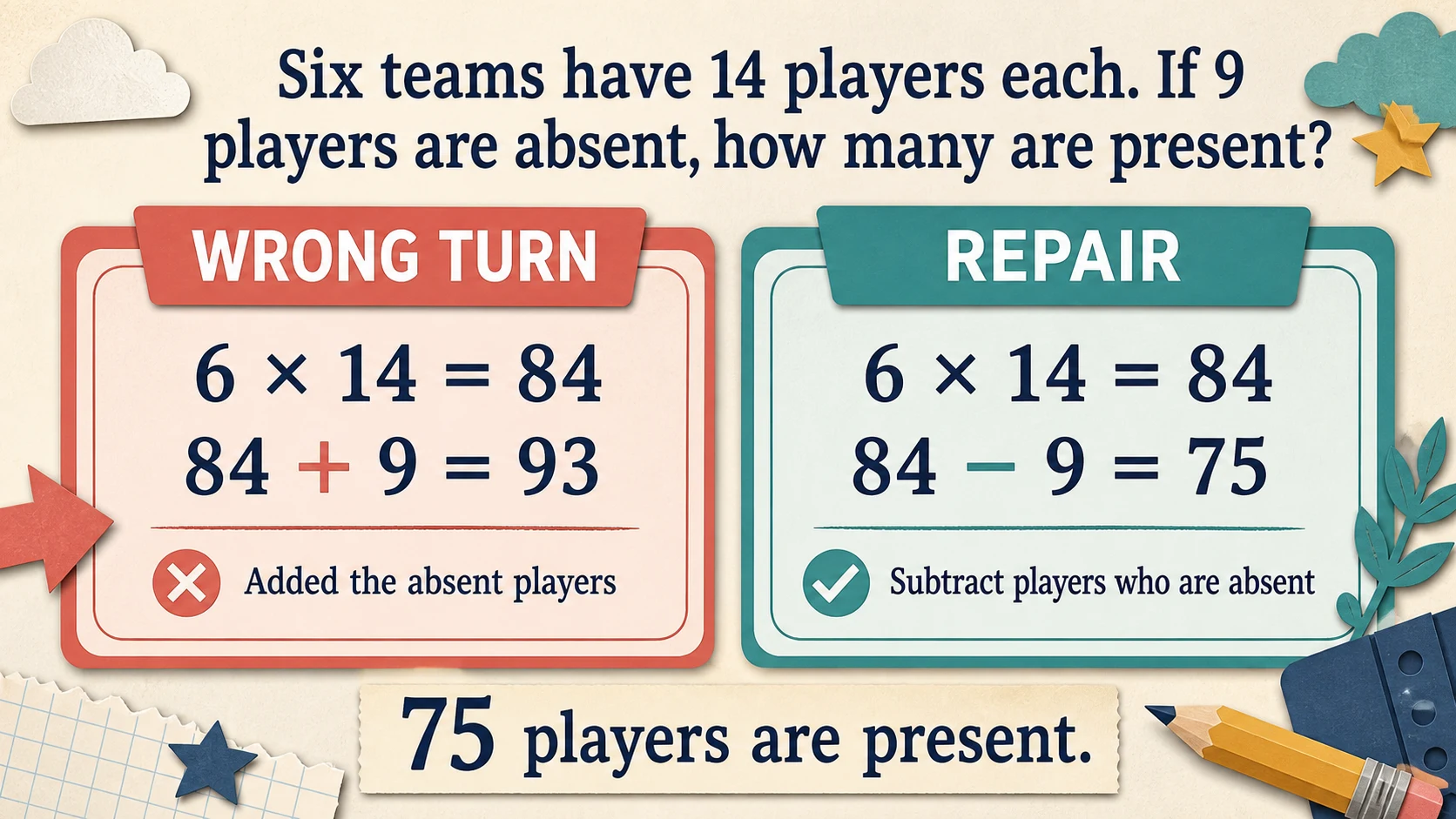
Adjust reading load, representation support, or practice quantity while preserving the mathematical decision.
If reading is consuming all the effort
Read the problem aloud once while the learner follows the text. Then ask the learner to retell it. You may clarify ordinary vocabulary, but do not replace relational language with an operation. Saying “shared equally means divide” gives away a decision the task is meant to assess. Saying “shared equally means each group receives the same amount” preserves the reasoning.
Break a long sentence at natural clauses, or cover later items so the page appears less crowded. These changes alter access and visual load, not the mathematical skill.
If the learner cannot organize the quantities
Provide a blank organizer with these labels:
| What I know | What I need | Representation | Equation | Answer and unit |
|---|
A partially drawn bar model is another option. Label one quantity, then ask the learner to place the others. Avoid drawing the complete model and selecting the operation yourself.
If computation obscures comprehension
Let the learner set up the complete equation before addressing arithmetic. Then decide what evidence you need. If the lesson is assessing both mixed-operation computation and word-problem reasoning, the learner should calculate independently. If you are temporarily isolating comprehension during instruction, you can discuss the equation first and then return to the calculation. Record that distinction so a correct answer obtained with calculation help is not mistaken for fully independent performance.
If the learner moves quickly
Ask for a second representation, an estimate, or a written check. You can also change the position of the unknown in a similar problem. For example:
- Result unknown: “A container has 24 red beads and 18 blue beads. How many beads are there?”
- Part unknown: “A container has 42 beads. Twenty-four are red. How many are blue?”
- Start unknown: “After 18 blue beads are added, a container has 42 beads. How many were there before?”
The arithmetic facts are related, but the reader must interpret a different unknown. This extends flexibility without merely increasing the numbers.
Interpret Errors Before Correcting Them
A marked answer tells you whether the result matches the key. The learner’s work tells you what to teach next. Classify the earliest meaningful error rather than treating every incorrect response as the same problem.
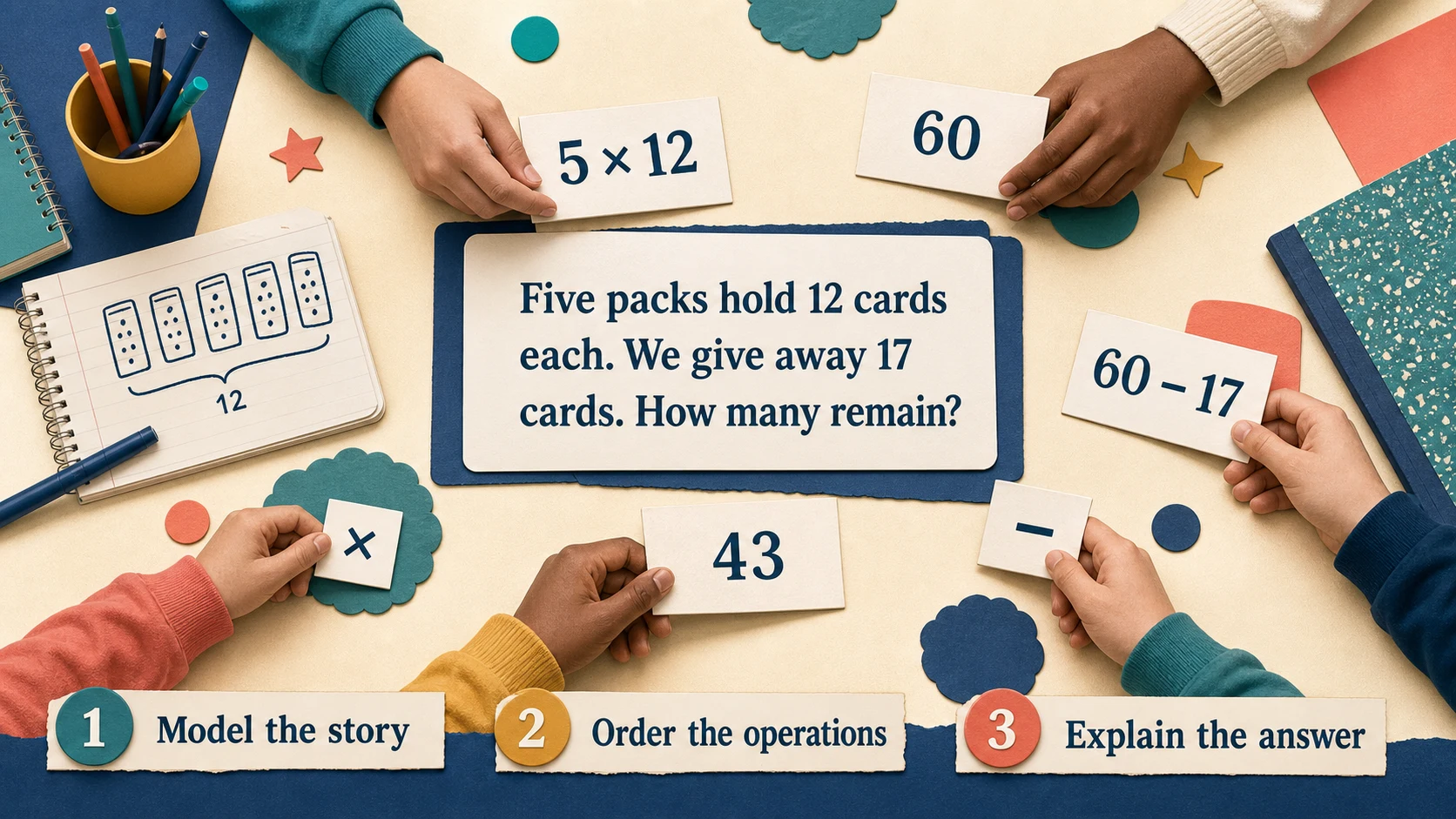
Trace an error from comprehension to representation, operation, computation, labeling, and checking.
Common error patterns
| Observed work | Likely interpretation | Useful response |
|---|---|---|
| Uses every number in the text | The learner may assume all information must enter the calculation | Ask which quantities answer the stated question and why |
| Chooses an operation from one word | The learner may be using a keyword shortcut | Ask for a retelling or diagram before discussing operations |
| Builds the correct equation but calculates incorrectly | The story was understood; computation needs attention | Preserve the setup and correct the arithmetic separately |
| Computes accurately with the wrong equation | The main issue is representing the relationship | Compare the equation with a bar model or verbal retelling |
| Gives an unlabeled number | The learner may not be connecting the result to the question | Ask, “What does this number count or measure?” |
| Reports an impossible remainder | The learner may not have interpreted the context | Reconstruct full groups and leftovers |
| Produces an unreasonable result | The checking step may be absent | Estimate or compare the answer with the original quantities |
| Leaves a problem blank | The barrier is not yet known | Ask the learner to identify the first confusing point |
Do not diagnose a stable weakness from one item. A single mistake can come from misreading, distraction, or an isolated arithmetic slip. Look for a repeated pattern across several comparable attempts.
Boundary cases worth discussing
Some answers depend on what the story asks:
- Remainders: Forty-three students placed in vans holding eight each require six vans if everyone must travel, because five vans hold only 40. The same calculation would produce five complete groups and three left over if the question asked for full groups.
- Money: Currency answers should use sensible notation. Five dollars can be written as $5 or $5.00, but $5.5 conventionally needs a trailing zero when expressed as dollars and cents.
- Units: An answer of “12” is incomplete when the question asks for 12 meters, 12 tickets, or 12 minutes.
- Extra information: A number mentioned in the story need not enter the equation if it does not affect the requested quantity.
- Missing information: If a quantity needed for a unique solution is absent, the responsible response is that the problem cannot be determined from the given information—not an invented number.
These cases show why operation keywords and answer-only grading are limited.
Use the Answer Key Responsibly
The worksheet includes a separate printable answer key for quick checking. Use it after the learner has produced visible work, not as a source of hints during the initial attempt.
A sound checking routine is:
- Compare the final response with the key.
- If it differs, inspect the equation or representation before recalculating.
- Locate the first point where the learner’s reasoning diverged.
- Ask the learner to explain that step.
- Correct the work in a different color or on a clean line.
- Re-solve a similar problem later without displaying the correction.
The key confirms the intended answer, but it does not by itself explain the learner’s reasoning. If the learner reaches the keyed answer through an invalid method, treat the item as unresolved. If the reasoning appears valid but conflicts with the key, reread the wording, verify units and arithmetic, and consider whether the interpretation is genuinely supported before assuming the learner is wrong.
Keep three tallies if useful: independent, correct after a prompt, and not yet secure. That record is more informative than one percentage because it distinguishes mastery from successful guided participation. It is an instructional tracking suggestion, not a standardized scoring system.
Decide What to Do Next from the Work
Continue on this worksheet
Continue with another short set when the learner can usually:
- Retell the situation accurately
- Identify the requested quantity
- Choose or construct a suitable representation
- Write an equation that matches the story
- Calculate with manageable errors
- Label and check the answer
The learner does not need identical representations or perfect wording. Look for sound relationships and increasing independence.
Pause and reteach
Pause when several items show the same conceptual error, when the learner cannot explain why an operation fits, or when assistance is increasing rather than fading. Select one representative problem, model the missing decision, and have the learner try a parallel example. Avoid assigning more of the same before the misunderstanding is addressed.
If the difficulty is primarily with a prerequisite calculation—such as decimal multiplication or fraction-of-a-quantity work—practice that computation separately, then return to a story problem so the connection is restored.
Move to broader or more varied practice
This printable is an easy-level, 30-item resource. It can provide foundational practice, but it is not a complete sixth-grade word-problem curriculum or a comprehensive measure of reading, computation, ratio reasoning, fractions, decimals, and every multi-step structure.
Use the 6th Grade Math hub to locate related mathematical practice, or consult the broader sixth-grade hub when planning across subjects. For a larger collection in this topic, the 6th Grade Word Problems Worksheet Pack contains 18 worksheets and is listed at $4.79. Choose additional material because the observed work calls for more breadth or repetition, not simply because the current page is finished.
Schedule Retrieval After Initial Success
Completing a problem correctly today does not show whether the learner can select the method after a delay. Revisit a small number of previously completed problem types without showing the old solutions.
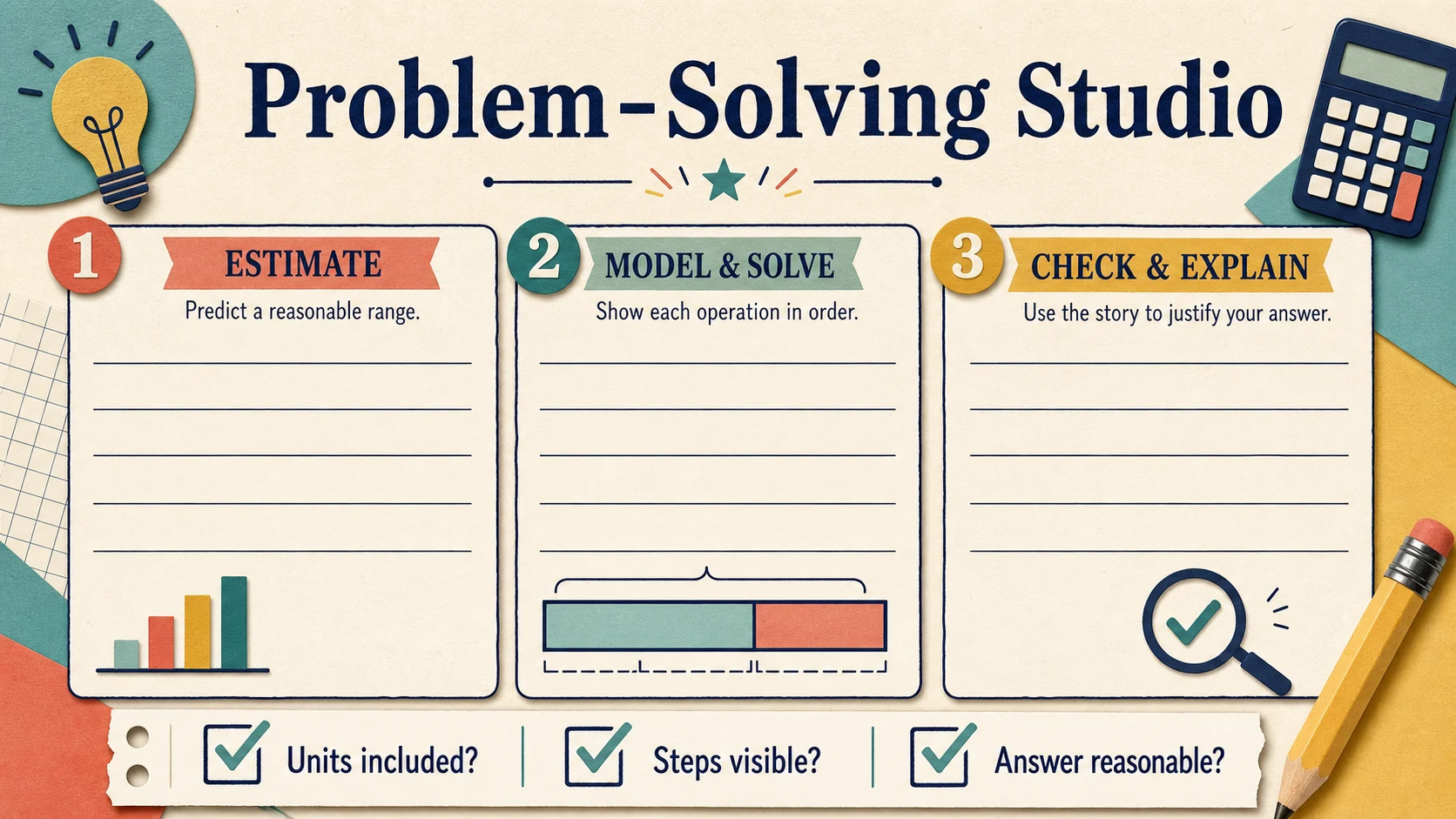
Use brief delayed checks and adjust the spacing according to what the learner actually retains.
A practical, adjustable sequence might be:
| Time | Retrieval task | Decision |
|---|---|---|
| End of the lesson | Re-solve one corrected problem on a clean line | If the same error returns, reteach before adding items |
| Next study session | Solve two previously unseen worksheet items | If the routine is independent, reduce prompts |
| Several days later | Solve one familiar type and one contrasting type | If operations are confused, compare representations |
| One or two weeks later | Complete a short mixed set | If performance remains sound, widen the problem types |
This is an instructional example, not a universal timetable or a sourced guarantee. Shorten the interval when a method is not retained. Lengthen it when the learner recalls and explains the method readily. Retrieval should require fresh reasoning; copying an old solution does not test whether the strategy can be selected again.
Limitations and an Honest Next Step
This worksheet offers 30 straightforward practice exercises in problem solving, reading comprehension, multi-step reasoning, and mixed operations. It includes an answer key and can support classroom work, tutoring, homework, or homeschool instruction. It cannot establish a diagnosis, certify standards mastery, guarantee an outcome, or show how a learner performs across every sixth-grade problem type.
The most honest next step depends on the learner’s evidence. If several items still require prompts, return to one representation and complete another short set from the same free worksheet. If the learner solves and explains the easy-level items independently, use the Word Problems topic guide to choose a broader progression. When you need fresh numbers or targeted additional practice, create a small follow-up set with the free worksheet generators, then schedule two of those problems for delayed retrieval.
Put it into practice
Use the guide with a real printable
Move from explanation to a short, observable practice task. Check the first item together, then adjust the next session from the learner's actual work.
See the 18-worksheet pack