Complete guide
How to teach and practise 6th grade multiplication worksheets - standard theme (easy)
A practical way to use this 30-item worksheet
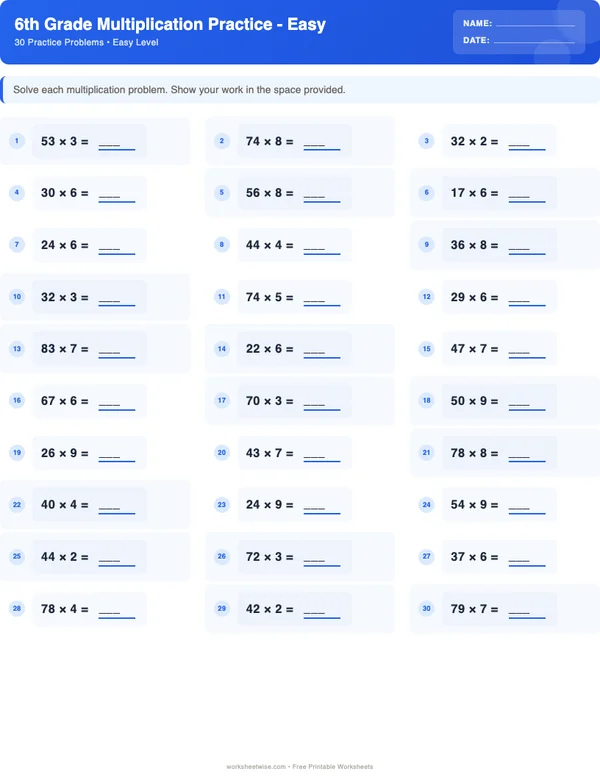
The free 6th Grade Multiplication worksheet provides 30 easy-level multiplication exercises with space for work and a separate answer key. Use it to observe how accurately and independently a learner handles multiplication facts, times tables, mental computation, and basic number relationships.
A productive session is simple: preview a few items, model one or two examples, solve several together, assign a manageable independent set, and review errors by type. Do not require all 30 problems in one sitting merely because they fit on one printable. The learner’s observed work should determine the pace.
Grade labels describe the intended practice level; local curricula and instructional sequences differ. For a broader explanation of how multiplication develops from equal groups through multi-digit computation, use the multiplication topic guide rather than expecting this one worksheet to cover the entire progression.
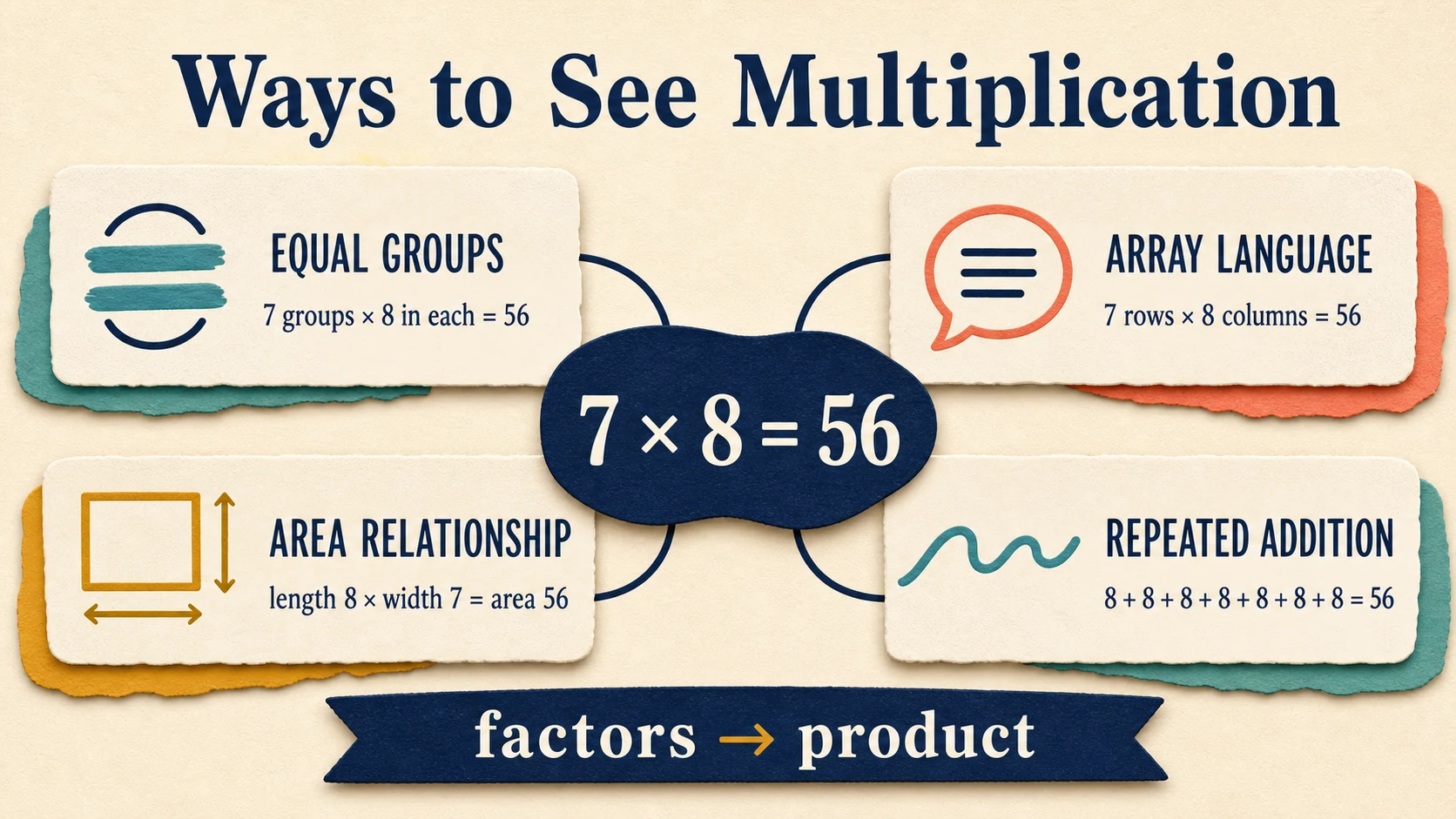
Preview, model, practice together, release responsibility, and review the resulting evidence.
What this worksheet does—and does not—cover
This printable is intended as straightforward multiplication practice. Its listed skills are:
- Multiplication facts
- Times tables
- Mental math
- Number sense
The directions ask the learner to solve each multiplication problem and show work in the provided space. That makes the page useful for more than counting correct answers. Written work can reveal whether a learner recalls a fact, derives it from a known relationship, uses repeated addition, reverses the factors, or makes a calculation or copying error.
The worksheet can serve several legitimate purposes:
- A calm review after multiplication has already been taught
- Extra reinforcement for a learner whose fact knowledge is uneven
- A brief check of strategy use before harder computation
- Independent practice following a small-group or one-to-one lesson
- A source of problems for spaced retrieval over several days
It is not a complete sixth-grade multiplication course. The catalogue’s broader sixth-grade description includes ratios, fractions, negative numbers, expressions, equations, coordinate work, and statistics. This worksheet addresses a narrower foundational skill. It also cannot, by itself, show whether a learner can apply multiplication in word problems, explain a general property, or use multiplication inside a more complex sixth-grade task.
The Common Core mathematics standards place whole-number multiplication foundations and the standard algorithm in earlier grade-level progressions, while sixth-grade work draws on established arithmetic in more complex contexts. That context helps explain why an easy multiplication worksheet may be useful for a sixth grader who needs reinforcement. It does not mean this particular printable has been independently evaluated for comprehensive standards alignment.
Prepare the lesson before handing over the page
A short preview prevents a practice sheet from becoming an unexplained test. Print or open the worksheet, keep the answer key out of the learner’s immediate view, and decide how many items will be attempted during the first session.
Choose a purpose
Name one purpose in plain language. For example:
“We are going to see which multiplication facts feel automatic and which ones need a strategy.”
That purpose is more useful than “Finish the worksheet.” It directs attention to mathematical thinking and gives the adult a reason to watch the process.
If the learner has recently struggled, begin with 6 to 10 items. If those are accurate and completed with a sensible method, extend the assignment. If the first few reveal confusion, pause for instruction instead of allowing the same error to repeat across 30 items.
Gather only useful supports
Possible materials include blank paper, a pencil, an eraser, counters, or a hand-drawn array. A multiplication chart may be appropriate during initial supported practice, but decide in advance when it will be available. If the goal is independent retrieval, leaving the chart visible changes what the activity measures.
Keep the printed answer key for adult checking or delayed self-checking. The key should confirm calculations after genuine attempts, not replace them.
Preview without solving everything
Scan the page with the learner. Read the instruction aloud if necessary: “Solve each multiplication problem. Show your work in the space provided.”
Then establish what “show your work” can mean on an easy fact:
- Write a related known fact.
- Break apart one factor.
- Draw a small array.
- Record a doubled fact.
- Write one intermediate equation.
A learner does not need to fill the workspace with repeated addition for every known fact. The written method should be sufficient to make uncertain thinking visible.
A flexible lesson sequence
The following sequence is an instructional suggestion for this worksheet, not a universal timetable. Adjust the number of problems and the length of each phase according to the learner’s responses.
| Phase | Suggested use of the 30 items | Adult’s role | Evidence to notice |
|---|---|---|---|
| Launch | Preview 2–3 items | Clarify the directions and lesson purpose | Does the learner understand the symbols and task? |
| Model | Use 1–2 similar examples off the page | Think aloud and verify the product | Can the learner follow the strategy? |
| Guided practice | Complete 3–5 worksheet items together | Prompt, then gradually reduce help | Which prompts are still necessary? |
| Independent practice | Assign 6–12 items initially | Observe without supplying products | Accuracy, strategy choice, hesitation, and organization |
| Check and correct | Review attempted items | Use the key after reasoning has been inspected | Are errors isolated or patterned? |
| Extend or stop | Add items or end the session | Match the amount to the evidence | Is practice still productive? |
| Retrieval | Revisit selected items later | Mix known and previously missed facts | Can the learner retrieve the learning after a delay? |
The IES practice guide on assisting students who struggle with mathematics provides high-level instructional guidance that includes systematic teaching, clear mathematical language, representations, and intentional practice. Those ideas can inform an adult’s choices here, but the guide does not review WorksheetWise or prescribe a fixed schedule for this printable.
Model multiplication as reasoning, not guessing
Before independent work, demonstrate a small number of examples that resemble the worksheet’s fact and mental-math focus. Write each equation, name the relationship used, and check the result another way.
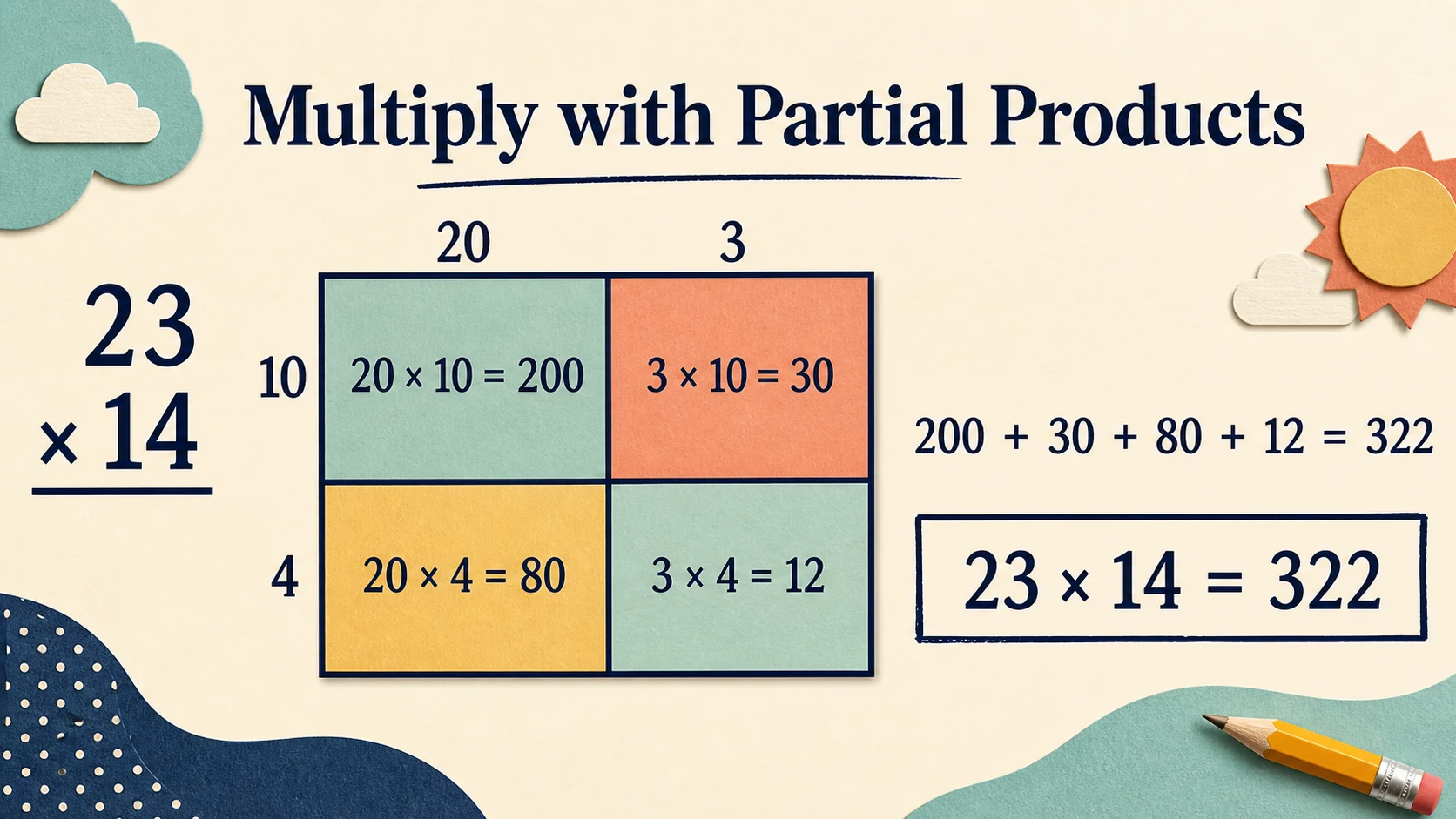
An efficient strategy should remain visible long enough for the learner to explain and verify it.
Worked example 1: Use a known five-times fact
Solve:
Break 8 into 5 and 3:
Calculate both partial products:
Therefore:
Check by reversing the factors:
The reversal does not create an independent calculation, but it connects the example to the commutative property and can help the learner recognize a familiar orientation.
Worked example 2: Use ten groups and subtract one group
Solve:
Think of 9 groups as 10 groups minus 1 group:
Then:
Therefore:
Check with repeated groups:
Repeated addition is cumbersome as a regular method, but it can verify the meaning of this product.
Worked example 3: Double a known product
Solve:
One option is to use :
Because 12 is twice 6, double 24:
Therefore:
Check by breaking apart 12:
Both strategies produce the same answer.
Worked example 4: Attend to the zero factor
Solve:
This means six groups with zero objects in each group. The total is zero:
Check by reversing the factors:
A common mistake is writing 6 because the learner confuses multiplication by zero with multiplication by one. Ask what the groups contain rather than merely repeating the rule.
Worked example 5: Attend to the identity factor
Solve:
One group of 11 contains 11 altogether:
Check by reversing the factors:
This boundary case distinguishes the identity effect of multiplying by one from the zero effect of multiplying by zero.
Move from guided practice to independent work
Guided practice should reveal whether the learner can use the modeled reasoning, not whether the adult can lead them to every answer.
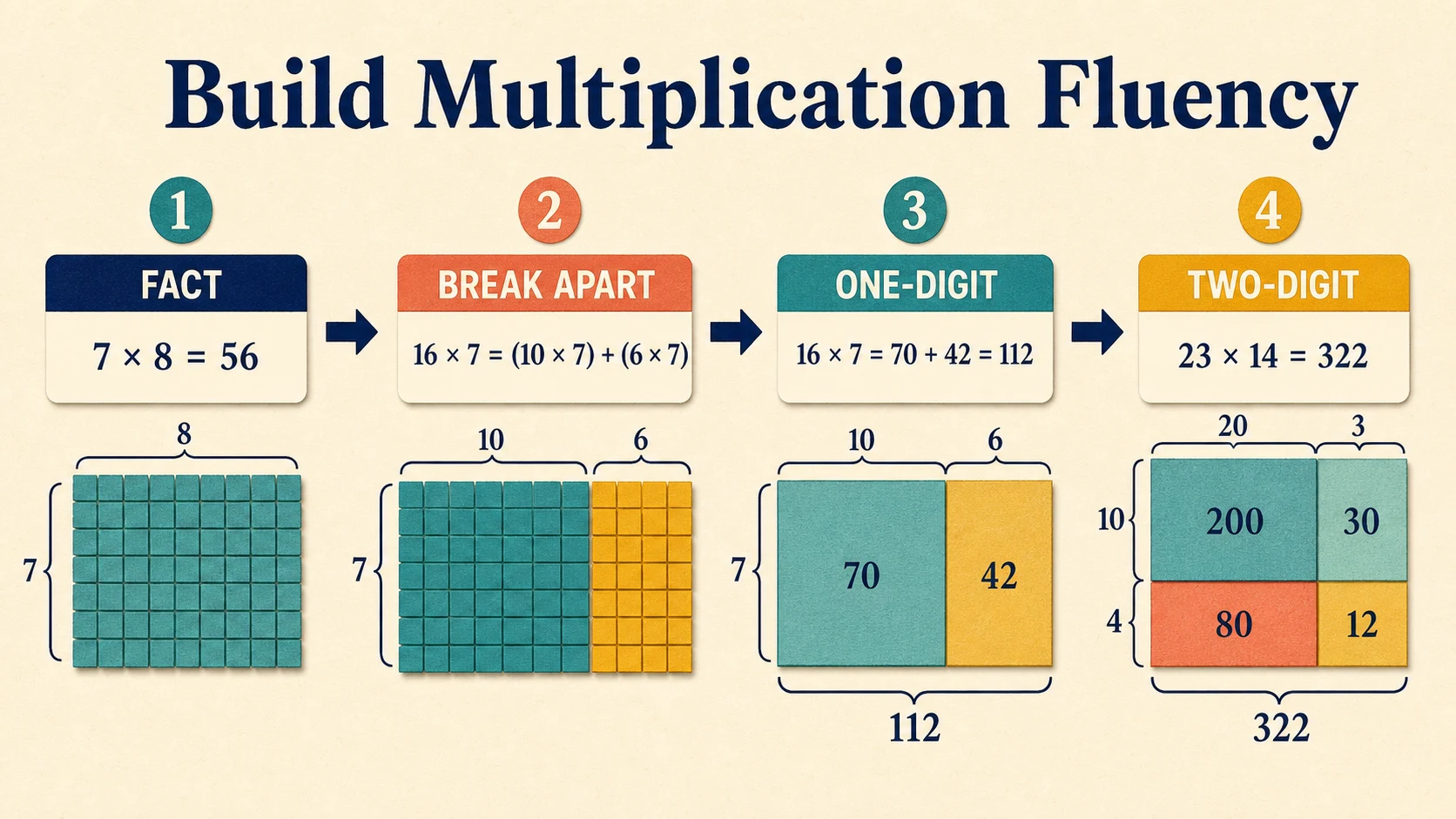
Prompts become lighter as the learner takes over the calculation and the explanation.
Use prompts in a deliberate order
Start with a broad prompt:
“What do you notice about these factors?”
If the learner cannot begin, narrow the prompt:
“Could you use a five-times fact, a ten-times fact, or doubling?”
If more support is needed, offer a choice tied to the actual problem:
“For , would you rather use groups or double ?”
Avoid immediately supplying the first partial product. A prompt such as “What is ?” may be necessary, but it changes the task from choosing a strategy to following one selected by the adult.
Check readiness for release
After three to five supported items, ask the learner to solve one while explaining the approach. Independent work is reasonable when the learner can:
- Identify the operation correctly.
- Begin without being told the product.
- Select a workable fact or relationship.
- Record enough work to reconstruct the reasoning.
- Check whether the answer is plausible.
These signs matter more than a particular number of minutes. If the learner still needs a prompt at every step, continue guided practice with fewer problems.
During independent work, stay available but do not turn each hesitation into assistance. Mark or note where the learner pauses. A six-second pause followed by a correct strategy conveys different information from an immediate but incorrect response.
Adapt support without changing the multiplication skill
Differentiation should preserve the mathematical target. Reading the equation aloud, reducing the number of visible items, or supplying counters changes access to the task without replacing multiplication with an easier unrelated activity.
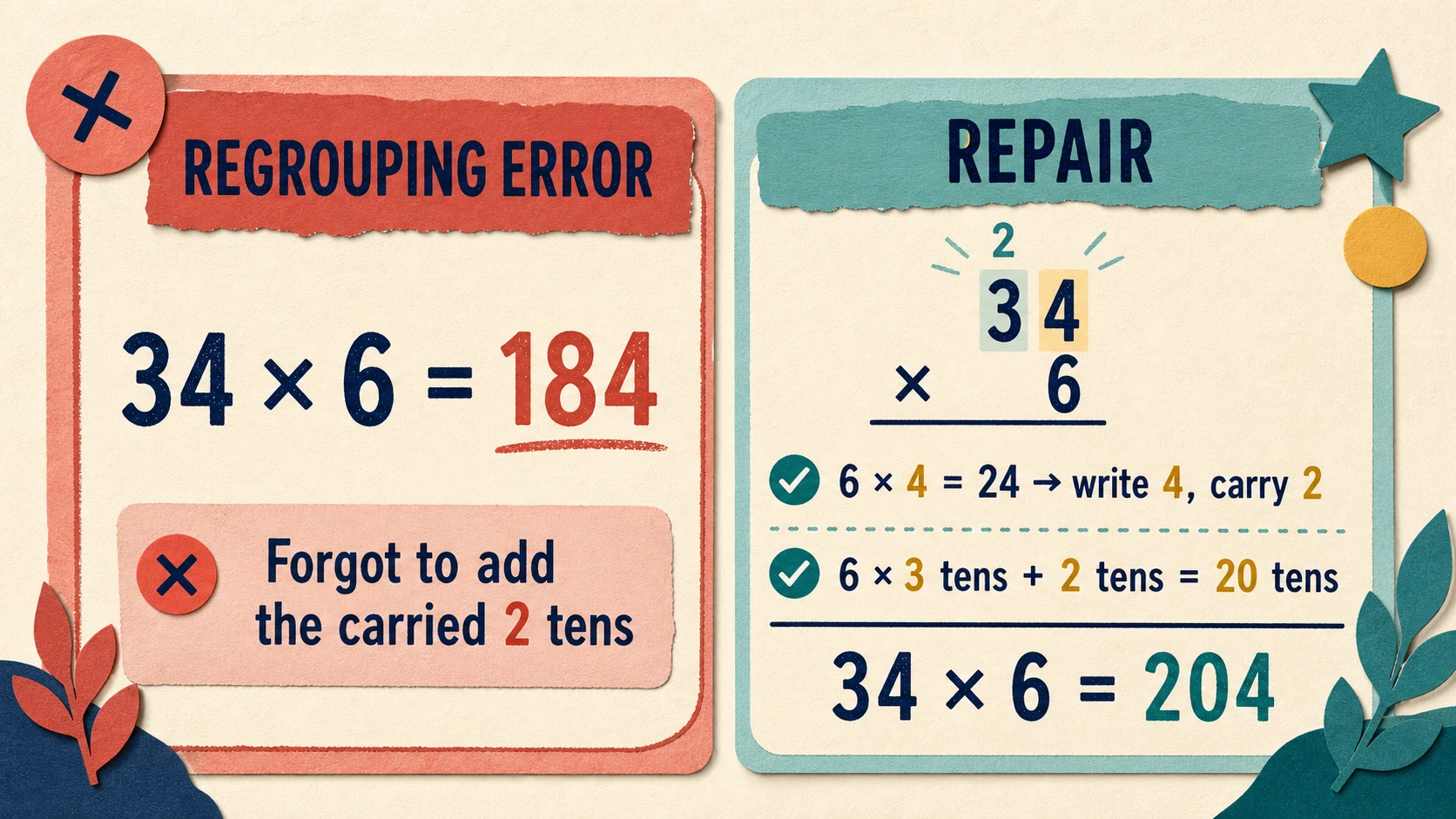
Adjust the amount, representation, or response method while keeping the same multiplication relationship.
When the full page feels overwhelming
Cover all but one row with blank paper. Ask the learner to complete four problems, take a brief pause, and then uncover the next set. The page still contains 30 items, but the learner only has to organize attention around a small group.
You can also divide the worksheet across two or three sessions. Record the date beside each completed section so delayed work is not mistaken for one continuous performance.
When fact recall is incomplete
Allow a strategy note beside each uncertain item. For example:
The target remains multiplication. The learner is deriving a product through the distributive property rather than looking it up without thought.
Arrays or counters may help confirm what the factors mean. For , arrange four rows of six, count the total, and connect the model to . Then remove the objects and ask the learner to reproduce the equation.
The IES guide on teaching mathematics to young children addresses early mathematical foundations and the use of representations and mathematical language. It is not sixth-grade-specific guidance, but its broad treatment of connecting representations with mathematical ideas can help an adult understand why a temporary array may clarify an older learner’s unfinished foundation.
When writing is the obstacle
Permit the learner to state a strategy orally while the adult records the exact equations. Then ask the learner to write the final product. This preserves the calculation while separating it from the amount of writing.
Do not silently correct reversed digits, copied factors, or poorly aligned notation. Clarify whether the learner calculated incorrectly or recorded a correct thought inaccurately.
When the work is consistently easy
Do not manufacture difficulty by imposing speed pressure. Instead, ask the learner to explain two products with different strategies, identify a related division fact, or estimate which of two products is greater before calculating.
If the entire page is accurate, efficient, and independent, move to a broader task instead of assigning another nearly identical page automatically. The 6th Grade math hub can help you select a different area of practice, while the multiplication topic guide shows the wider topic progression.
Interpret errors before correcting them
A wrong answer is a starting point for diagnosis. Look across several items before deciding what the learner misunderstands.
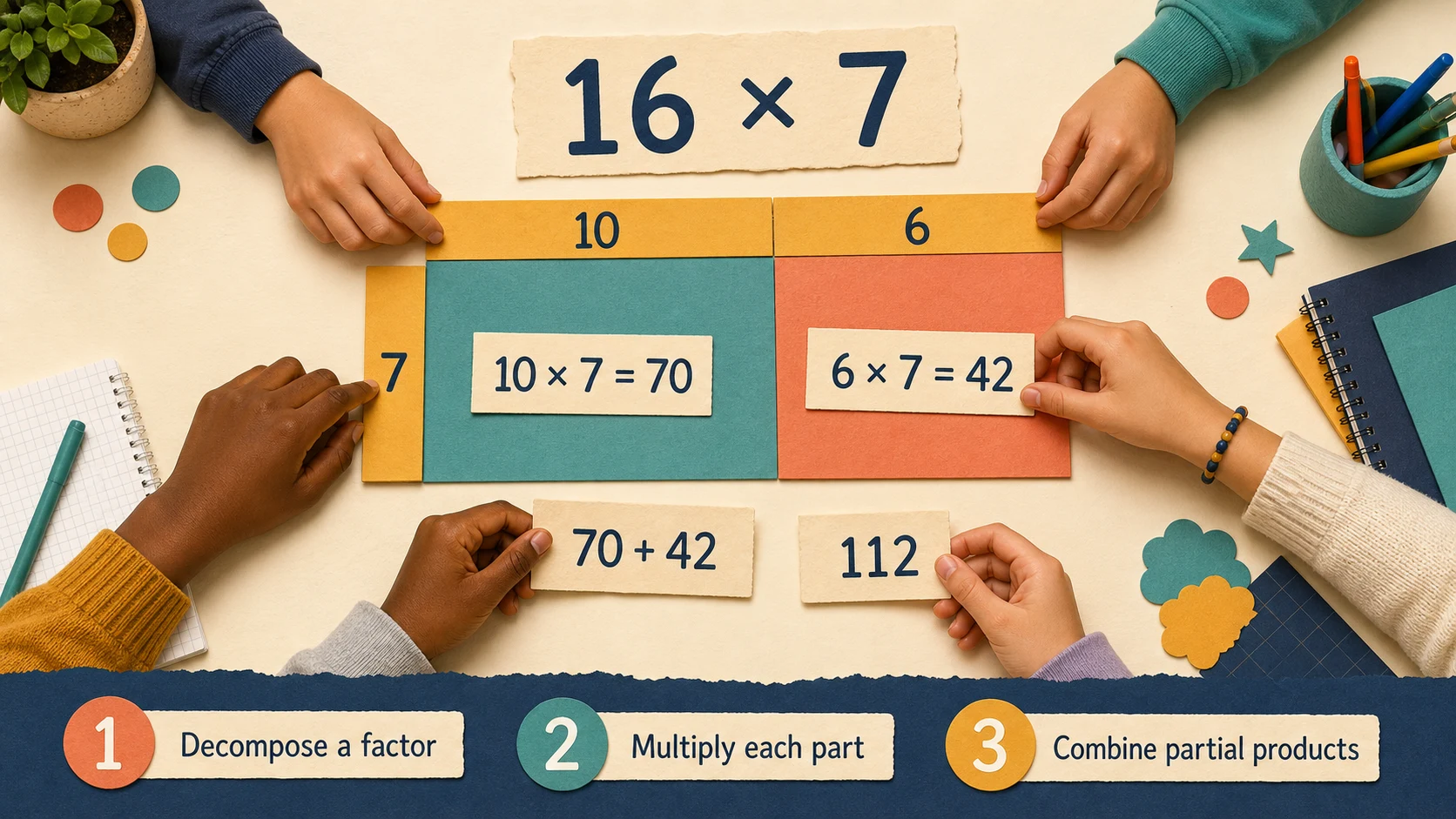
Read the equation, reconstruct the method, classify the error, and retry without copying.
Fact-retrieval errors
Suppose the learner writes:
Ask for a reconstruction rather than saying only that the answer is wrong:
“Show how you could build from a fact you trust.”
If the learner correctly writes but totals it as 54, the multiplication reasoning is sound and the addition check needs attention. If the partial products are wrong, the issue may involve the component facts. If no strategy is available, reteach one relationship and practice it on a small set.
Confusion between multiplication and addition
A response such as:
may show that the learner combined the two visible numbers using addition. Return to meaning:
- Six groups of four contain how many objects?
- What would six rows of four look like?
- Is the product expected to be greater than either positive factor in this case?
The last check has boundary conditions. It applies here because both whole-number factors are greater than one. It does not apply when a factor is zero or one.
Zero and one misconceptions
Compare these equations:
If the learner gives the same answer for both, use groups language. Eight empty groups contain zero objects; eight groups containing one object each contain eight objects. Keep the contrast focused. A long list of rules may obscure the difference.
Counting and skip-counting slips
A learner may understand as six groups of seven but count:
The final jump should reach 42, not 41. Ask the learner to compare the size of each jump. Equal groups require equal increments.
Skip counting can support multiplication, but it should not remain the only available method for every fact. Connect the sequence back to a product and then introduce a more efficient relationship where appropriate.
Copying and notation errors
A learner might calculate correctly but write 46 instead of 48, or copy as . These errors still matter, yet they call for different follow-up than a missing multiplication concept.
Have the learner point to each factor, reread the operation sign, and compare the written answer with the spoken calculation. A short “copy, calculate, compare” routine may be enough.
Use the answer key responsibly
The separate printable answer key makes checking efficient, but efficient grading is not the same as useful feedback.
First inspect the learner’s work without the key. Circle or mark the items that need attention, noting any repeated strategy or error. Then use the answer key to confirm products. If an answer differs, recompute the problem yourself or reconstruct it with the learner before treating the key as the entire explanation.
A practical checking routine is:
- The learner completes the assigned set without seeing the key.
- The adult reviews the written method and marks uncertain items.
- The key is used to confirm final products.
- The learner revisits each mismatch without copying the keyed answer.
- The corrected problem is checked with a second method.
- One related problem is attempted to see whether the correction transfers.
For example, after correcting , ask for or . The first checks whether the ten-minus-one strategy extends to a neighboring fact. The second checks recognition of the same factor pair in reverse.
Do not erase all evidence of an original error. A single line through the first response, followed by a clearly labeled correction, preserves information about what changed. For classroom collection, follow the educator’s usual correction policy.
An answer key cannot determine why an error occurred, whether the learner relied on unrecorded help, or whether a correct answer came from understanding, guessing, or copying. Adult observation and the learner’s explanation supply that context.
Decide what to do after the first session
The next step should follow a pattern in the work, not a predetermined worksheet calendar.
If work is accurate and independent
When the learner completes the assigned section accurately, uses efficient methods, and checks without prompting, finish the remaining items only if additional practice serves a clear purpose. Otherwise, move into multiplication within a broader context, such as ratios, fraction operations, or expressions, according to the learner’s local program.
You can also ask for a concise explanation:
“Choose one product and show two ways to know it is correct.”
This adds reasoning without changing the underlying multiplication facts.
If accuracy is good but effort is slow
Slow work is not automatically weak work. Look at the method. A learner who derives every answer correctly through repeated addition may understand equal groups but lack efficient fact relationships.
Select two useful strategies—perhaps doubling and using ten minus one—and practice a small family of facts. Then return to a few worksheet items. Compare independence and method, not only elapsed time.
If errors cluster around particular facts
Create a short practice set from the missed relationships. If the learner struggles with , include nearby or related calculations such as:
The first two support a decomposition of the third; the fourth reinforces factor order without introducing a new product.
For sustained multiplication practice, the optional 6th Grade Multiplication Worksheet Pack contains 18 worksheets. Use a pack only when varied additional practice is warranted. More pages are not a substitute for correcting the strategy that produced a repeated error.
If errors appear across most items
Stop independent completion. Return to a representation or a small fact set and establish what multiplication means. Check separately whether addition errors, symbol confusion, or unfinished fact knowledge are contributing.
This worksheet alone cannot identify a learning disability or provide medical guidance. If difficulties are persistent across settings or interfere with the learner’s broader mathematics work, document specific examples and discuss them with the learner’s teacher or other appropriate educational professional.
Schedule retrieval instead of one-time completion
Practice is more informative when a learner returns to selected calculations after a delay. The purpose is not to repeat all 30 items indefinitely. Revisit a mixture of secure, corrected, and related facts to see what remains available without immediate prompting.
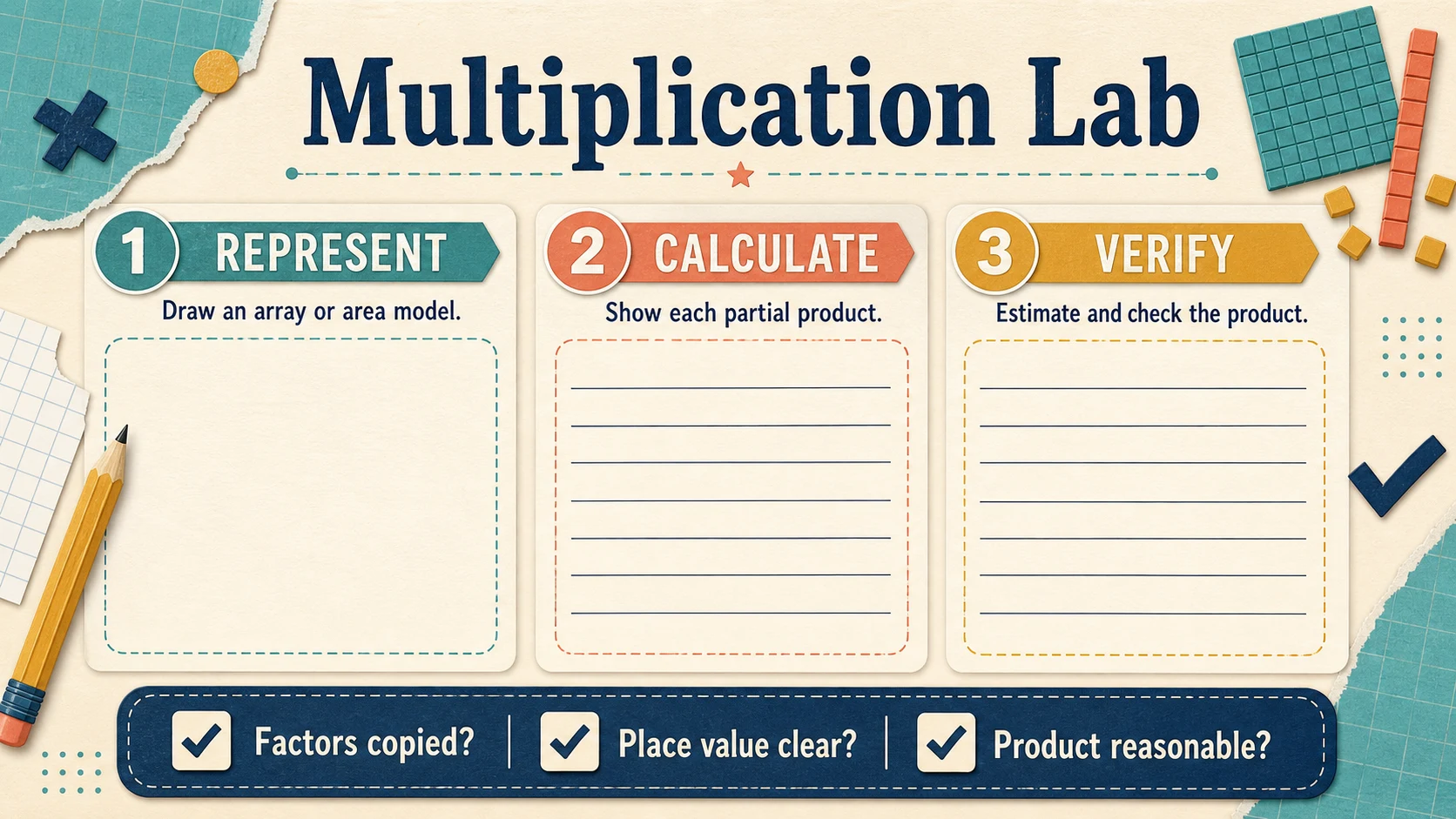
Short delayed checks reveal whether a corrected strategy can be retrieved again.
A flexible plan might look like this:
| Time | Suggested activity | What to record |
|---|---|---|
| Initial session | Model, guide, and assign 6–12 items | Strategies, errors, and help required |
| Next study session | Retry 2–4 missed or hesitant items | Whether the learner starts independently |
| Several days later | Mix 3 reviewed facts with 3 unpracticed items | Accuracy and strategy retention |
| About one to two weeks later | Give a short mixed check | Which relationships remain secure |
| Later unit work | Notice multiplication inside a broader task | Whether fact knowledge supports new work |
These intervals are suggestions, not a sourced universal timetable. School schedules, learner needs, and other assignments differ. If the learner retrieves the facts reliably, lengthen the interval or move on. If the same misconception returns, shorten the set and reteach the underlying relationship rather than simply scheduling more identical attempts.
Record only useful details: the date, selected item numbers or equations, whether help was needed, and one next step. A compact note such as “Used independently for nines facts” is more actionable than “Needs more practice.”
Limitations and an honest next step
This easy 30-item printable can provide focused evidence about basic multiplication performance, but it samples only a narrow part of mathematics. It does not establish mastery of every multiplication application, the full sixth-grade curriculum, or a complete standards progression. Correct answers on one occasion do not guarantee later retrieval, and errors on a single session may reflect unfamiliarity, inattention, fatigue, recording problems, or unfinished understanding. Interpret patterns across work and time.
Begin with the free worksheet, model one verified strategy, and assign a small section today. After checking the work and revisiting any errors, use the broader multiplication guide to choose the next appropriate level. If the learner needs a fresh, targeted set rather than more of the same page, create one through the free worksheet generators.
Put it into practice
Use the guide with a real printable
Move from explanation to a short, observable practice task. Check the first item together, then adjust the next session from the learner's actual work.
See the 18-worksheet pack