Complete guide
How to teach and practise 6th grade geometry worksheets - standard theme (easy)
How to use this 14-item geometry worksheet
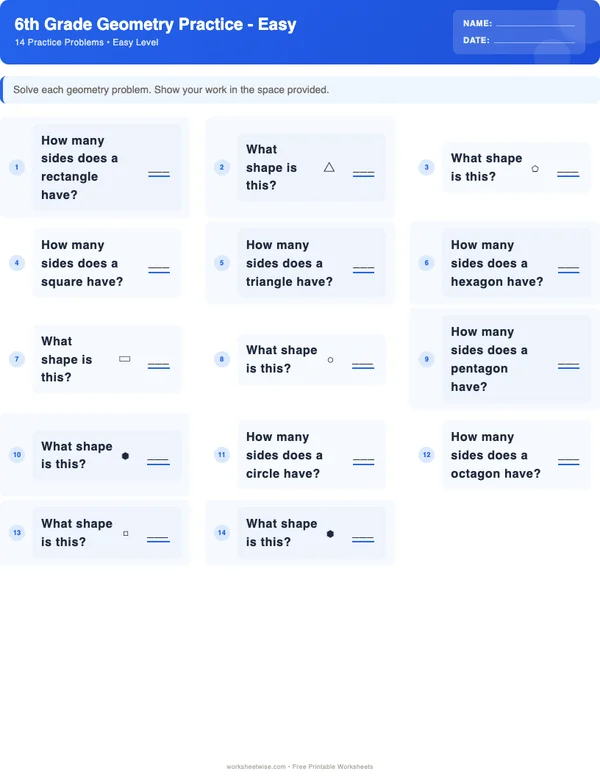
The free 6th Grade Geometry worksheet provides 14 easy-level exercises on identifying shapes, counting sides and vertices, recognizing geometric properties, and calculating perimeter and area. Use it as a focused practice session: preview the page, model one similar problem, solve two or three items together, and then release the learner to work independently. Check for accurate reasoning—not merely completed answers—and revisit uncertain skills before assigning more practice.
The worksheet instructions ask the learner to solve each problem and show work in the provided space. A productive session will usually include these phases:
| Phase | Adult’s role | Learner’s role | Evidence to notice |
|---|---|---|---|
| Preview | Identify the kinds of tasks without solving them | Name familiar shapes, measurements, and symbols | Readiness and vocabulary |
| Model | Demonstrate a similar example aloud | Watch, question, and restate the method | Understanding of the process |
| Guided practice | Prompt briefly on selected items | Explain each step and record work | Appropriate strategy choice |
| Independent practice | Step back while remaining available | Complete the remaining items | Accuracy without immediate prompting |
| Review | Compare reasoning with the answer key | Correct and explain errors | Ability to revise independently |
| Retrieval | Return to a few representative problems later | Solve without copying earlier work | Durable recall of the method |
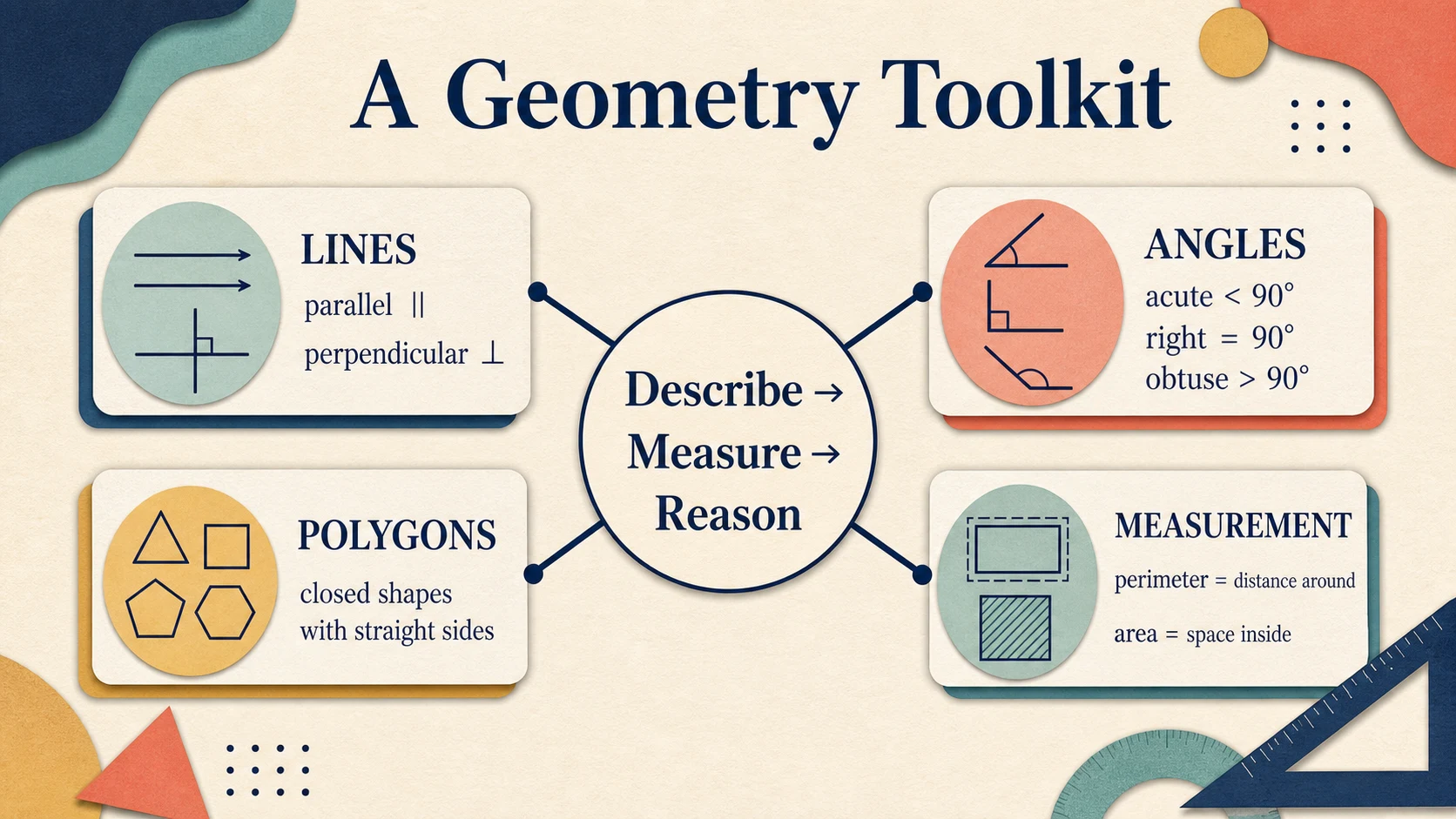
Move from a short preview to modeling, guided work, independent practice, and later retrieval.
This printable is intended for 6th Grade practice, but a grade label describes an intended practice level rather than a guarantee that every local curriculum teaches the same content at the same time. Local sequences differ. Use the learner’s observed work to decide whether to slow down, continue, or move to a more demanding task.
Prepare the learner without preteaching every answer
Before printing, download both the worksheet and its separate answer key. Keep the key out of sight during the first attempt. Have a pencil, eraser, ruler, and a blank sheet or graph paper available. A ruler can help a learner track side lengths and distinguish the boundary of a figure from its interior, even when no physical measuring is required.
Review the directions together: “Solve each geometry problem. Show your work in the space provided.” Clarify that showing work may look different across item types:
- For shape identification, the learner might write the shape name and mark the properties used.
- For sides and vertices, the learner can trace the boundary and place a small dot at each vertex.
- For perimeter, the learner should record an addition expression or multiplication shortcut.
- For area, the learner should record the relevant dimensions, multiplication, and square units when units are given.
Do not turn the preview into a lecture on the entire geometry progression. The broader 6th Grade geometry topic guide is the better place to review how shapes, angles, area, perimeter, volume, and coordinate geometry relate. This worksheet has a narrower purpose: accessible practice with shapes, geometric properties, perimeter, and area.
Run a two-minute readiness check
Ask four brief prompts before beginning:
- Point to a side of a drawn polygon.
- Point to a vertex.
- Explain the difference between the distance around a rectangle and the space inside it.
- State what units would describe perimeter and what units would describe area.
These prompts are instructional checks, not a formal assessment. If the learner cannot answer one, model the missing idea with a quick sketch. If several are uncertain, complete fewer worksheet items in the first sitting and return later. The page should reveal understanding, not endurance.
The IES practice guide on teaching mathematics to young children supports broad instructional practices such as using clear mathematical language, representations, and purposeful progressions. It did not evaluate this WorksheetWise printable. Here, those principles translate into naming sides and vertices precisely, tracing boundaries, and connecting a numerical calculation to a visible figure.
Model the task with a problem that is not on the page
Modeling a similar problem preserves the worksheet for meaningful practice. Draw a rectangle measuring 7 units by 3 units. Then think aloud in a short, orderly way:
- “The problem asks for perimeter, so I need the total distance around the outside.”
- “A rectangle has two sides of length 7 and two sides of length 3.”
- “I can add , or use .”
- “Both calculations give 20.”
- “Because perimeter is a length, the answer is 20 units.”
Keep the explanation focused on decisions. Avoid narrating every pencil movement. Then ask the learner to restate why the answer uses units rather than square units.
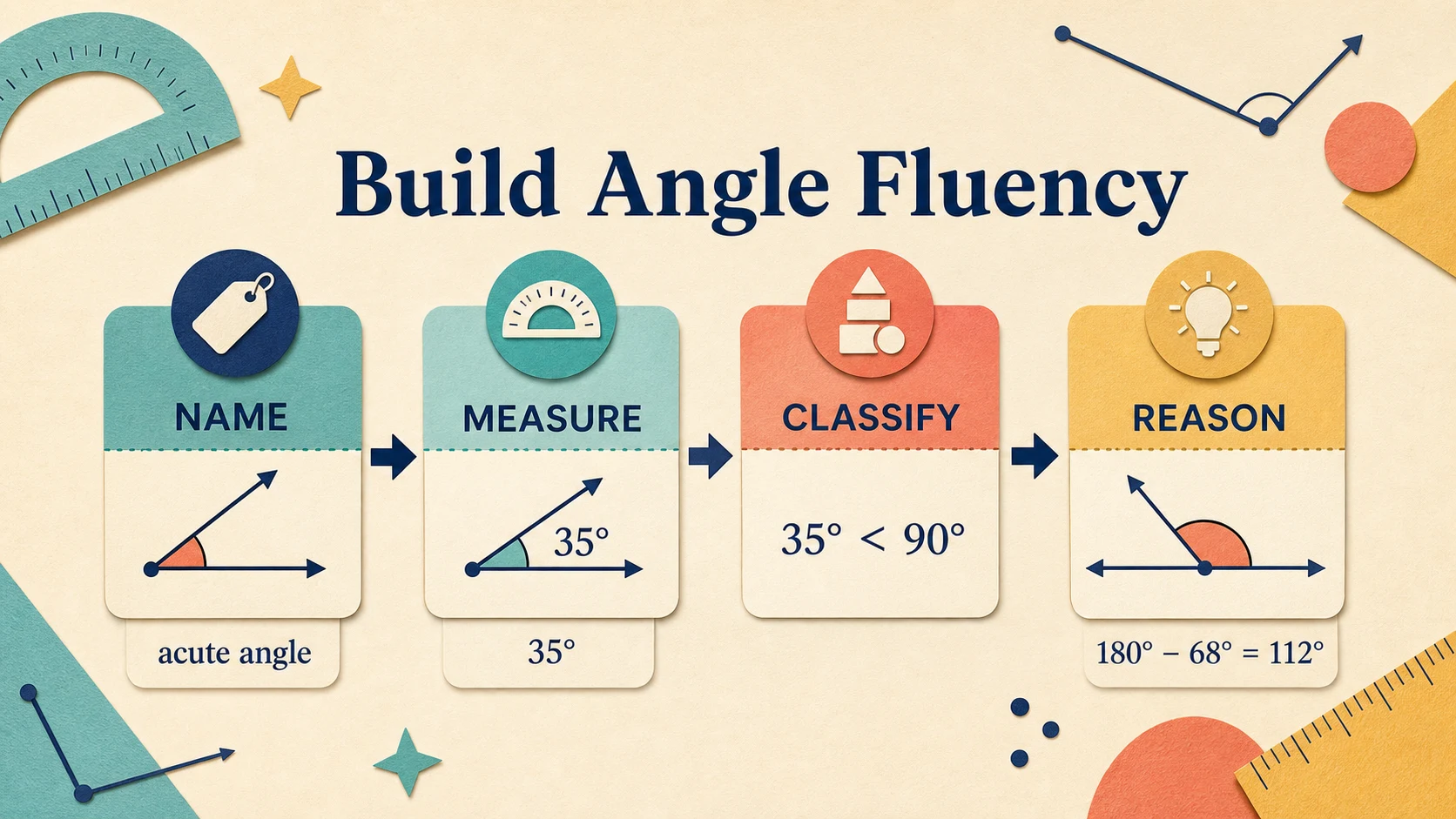
Model the choice of operation and unit, then ask the learner to explain the same choices.
Use a compact think-aloud routine
For any item, teach the learner to ask:
- What does the problem ask me to find?
- Which information matters?
- What property or operation fits?
- Does my answer need units or square units?
- How can I check that the result is reasonable?
This routine keeps attention on meaning. It also helps an adult identify whether an error began with reading, geometric vocabulary, arithmetic, or answer notation.
Shift quickly into guided practice
After the model, choose one shape-property item and one measurement item from the worksheet. Let the learner lead. Ask one prompt at a time and wait for a response:
- “What do you notice about this figure?”
- “Show me the boundary.”
- “Which lengths must be included?”
- “Are you finding around or inside?”
- “How will you label the answer?”
Do not stack several hints together. A single prompt gives the learner room to retrieve the next step. If the learner succeeds, reduce prompting on the next item. If the learner still depends on the prompt, provide another similar example before expecting independent work.
Four fully checked examples for teaching and review
The following examples are similar to the worksheet’s stated skills. They are not presented as copies of its 14 items. Use them to model reasoning, supply extra guided practice, or diagnose an error without revealing an actual worksheet answer.
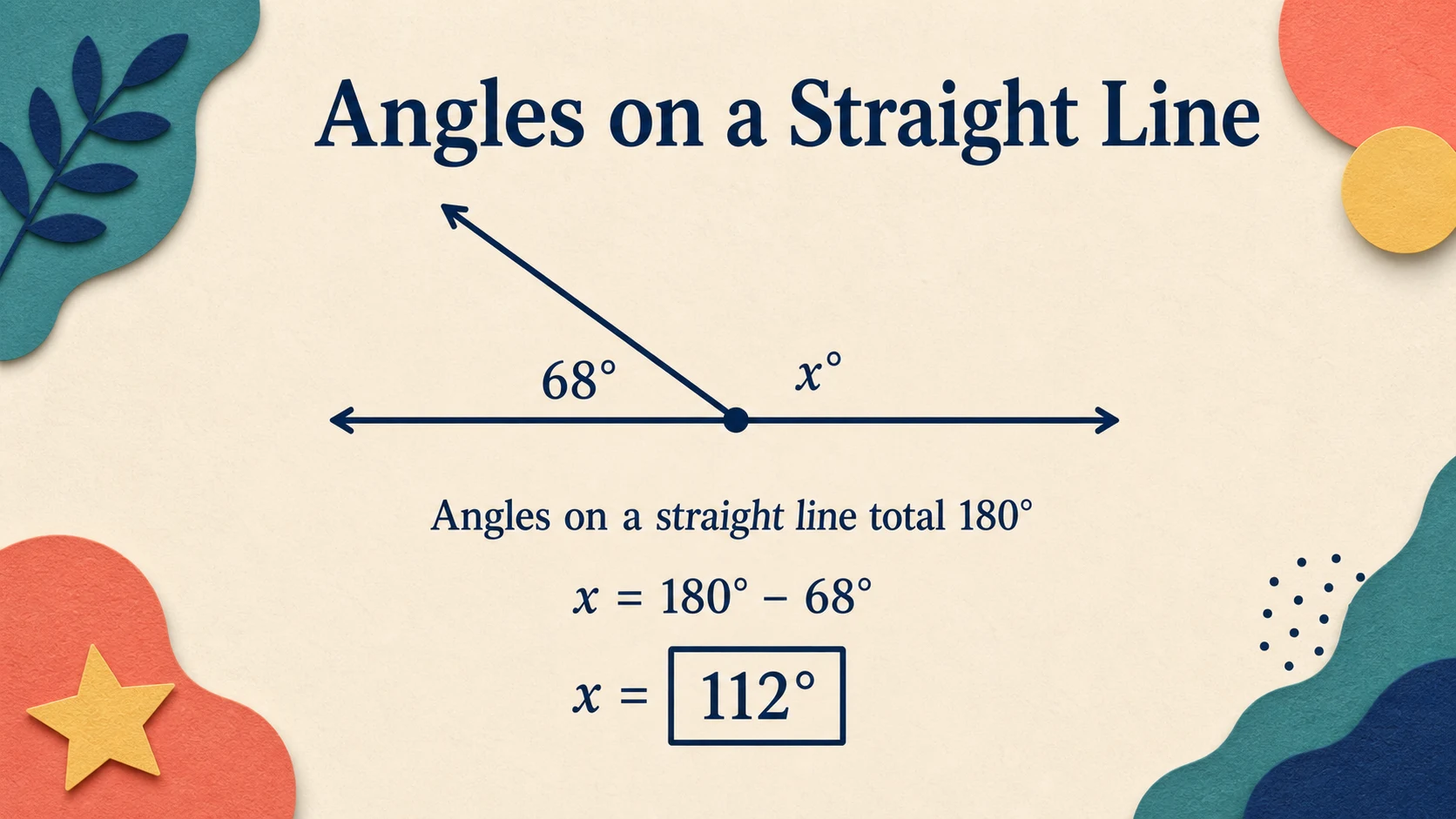
Connect the figure, operation, answer, and unit in every worked measurement example.
Example 1: Identify a shape from its properties
Problem: A polygon has five straight sides and five vertices. What is it?
Work: Trace one complete trip around the boundary and count each side once:
Now count the corners, or vertices:
A polygon with five sides is a pentagon.
Answer: pentagon
Check: The name agrees with the side count. The five vertices are also consistent because each pair of neighboring sides meets at a vertex in this simple polygon.
This example shows why appearance alone is unreliable. A pentagon can be wide, narrow, tilted, regular, or irregular. Its orientation does not change its number of sides.
Example 2: Count sides and vertices carefully
Problem: How many sides and vertices does a hexagon have?
Work: A hexagon has six line segments forming its boundary. Mark one starting vertex so that it is not counted twice. Move around the boundary in one direction and count:
Count the meeting points between adjacent sides:
Answer: 6 sides and 6 vertices
Check: For a simple polygon, each side connects to the next at a vertex. Six boundary segments therefore correspond to six vertices.
A common mistake is counting the starting vertex again after returning to it. Marking the starting point prevents a total of seven.
Example 3: Find perimeter when all side lengths matter
Problem: A rectangle is 9 centimeters long and 4 centimeters wide. Find its perimeter.
Work:
The equivalent shortcut is:
Answer: centimeters
Check: Two long sides total centimeters, and two short sides total centimeters. Since , the result is confirmed. The label is centimeters, not square centimeters, because perimeter measures length around the boundary.
Do not accept as the perimeter. That includes only one length and one width, or half the boundary.
Example 4: Find area and label square units
Problem: A rectangle measures 8 feet by 5 feet. Find its area.
Work:
Answer: square feet
Check: Imagine five rows with eight unit squares in each row. That gives:
The multiplication and row-count interpretations agree. Area describes the interior covered by square units, so “40 feet” would be an incomplete unit label.
Example 5: Compare figures with equal area but different perimeters
Problem: Compare a -by- rectangle with a -by- rectangle.
For the first rectangle:
For the second rectangle:
Answer: Both rectangles have an area of square units, but their perimeters are different: units and units.
Check: Recalculate by addition:
This example directly separates area from perimeter. Equal interior coverage does not require equal boundary length.
Handle boundary cases before they become shortcuts
Easy-level practice can still expose important limits. Discuss these cases briefly when they arise; there is no need to introduce all of them before the learner starts.
A rotated shape keeps its identity
A square tilted so that it resembles a diamond is still a square if it retains four equal sides and four right angles. “Diamond” may describe its appearance, but it does not replace the relevant geometric properties. Ask the learner to examine sides and angles rather than depend on page orientation.
Likewise, a triangle does not require a horizontal base. A narrow triangle, an upside-down triangle, and a right triangle all have three straight sides and three vertices.
An irregular polygon is still classified by properties
A five-sided figure remains a pentagon even when its sides are unequal. If the task asks for the general shape family, count sides. Do not assume that only a symmetrical textbook drawing qualifies.
A curved figure needs different language. A circle has a continuous curved boundary; it does not have straight polygon sides or vertices. Counting imagined sections of the curve as sides changes the definition being used.
Perimeter requires the complete outside boundary
For a rectangle, works because opposite sides have equal lengths. It is not a universal rule for every polygon. For an irregular polygon with side lengths and units, add every side:
Do not use a rectangle formula merely because it is familiar.
Area also requires enough information. Knowing only the perimeter of an unspecified rectangle does not determine a unique area. A -by- rectangle and a -by- rectangle both have perimeter units, but their areas are and square units. If an item does not provide enough information, an adult should not invent a missing dimension.
Adapt support without changing the geometry
An adaptation should make the same skill more accessible. It should not quietly replace the task with an easier, unrelated one.
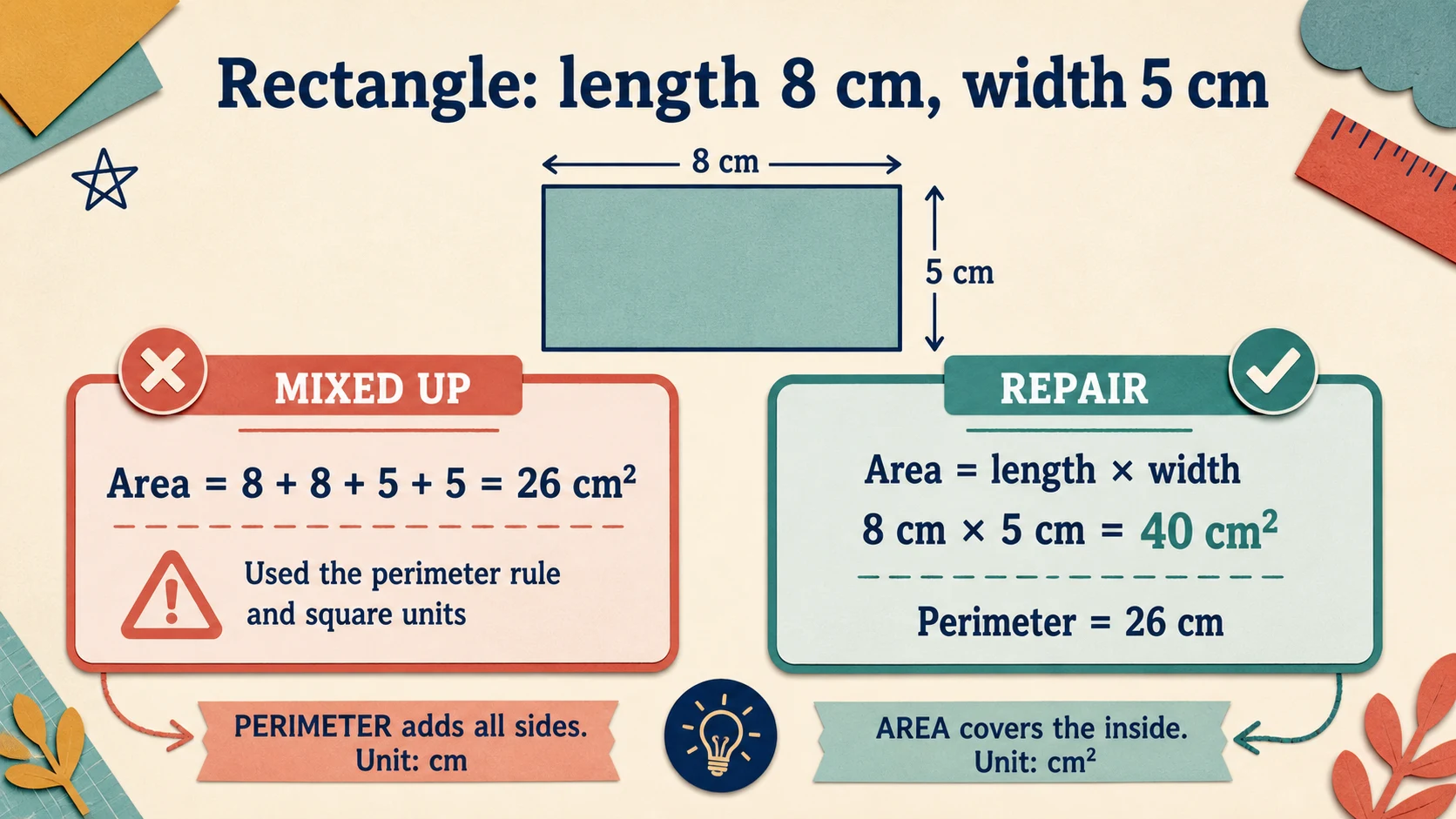
Adjust visibility, prompting, or workload while keeping the underlying geometry intact.
When the learner needs more support
Cover all but one item with blank paper. This reduces visual competition without changing the selected problem. For a shape item, let the learner trace sides with a finger and dot vertices lightly. For perimeter, highlight or tick each side after its length has been included. For area, sketch unit-square rows inside a practice rectangle before returning to the printed item.
Provide a small reference card if vocabulary is the barrier:
- Side: a line segment on a polygon’s boundary
- Vertex: a point where two sides meet
- Perimeter: total distance around a figure
- Area: amount of two-dimensional space inside a figure
Remove the card later and ask the learner to retrieve the definitions. Permanent access may conceal whether the language has been learned.
The IES guide on assisting students struggling with mathematics offers high-level guidance concerning explicit instruction, mathematical language, representations, and cumulative review. It does not prescribe a response to this exact worksheet or to an individual child. The suggestions here apply that general framing by making one step visible, checking understanding, and fading support according to observed work.
When arithmetic obscures geometry
If a learner correctly identifies all required side lengths but makes an addition or multiplication error, separate the two issues. Ask for an estimate, allow a multiplication chart if that is already part of the learner’s normal support, or have the learner recompute using a second method.
The geometry skill remains choosing the correct dimensions and operation. Do not mark the geometric reasoning as fully secure, however, until the learner can produce and check a complete result under the conditions normally expected.
When the learner is ready for more challenge
Keep the same skill and deepen the explanation:
- Ask for two methods of finding a rectangle’s perimeter.
- Ask the learner to draw a different rectangle with the same area.
- Present a rotated or irregular version of a familiar polygon.
- Ask the learner to explain why area uses square units.
- Have the learner write a plausible incorrect answer and identify the misconception behind it.
These extensions add reasoning without rushing into an unrelated topic.
Interpret errors by their source
A total score is useful, but the pattern of errors is more informative. Record what the learner did before correcting the page.
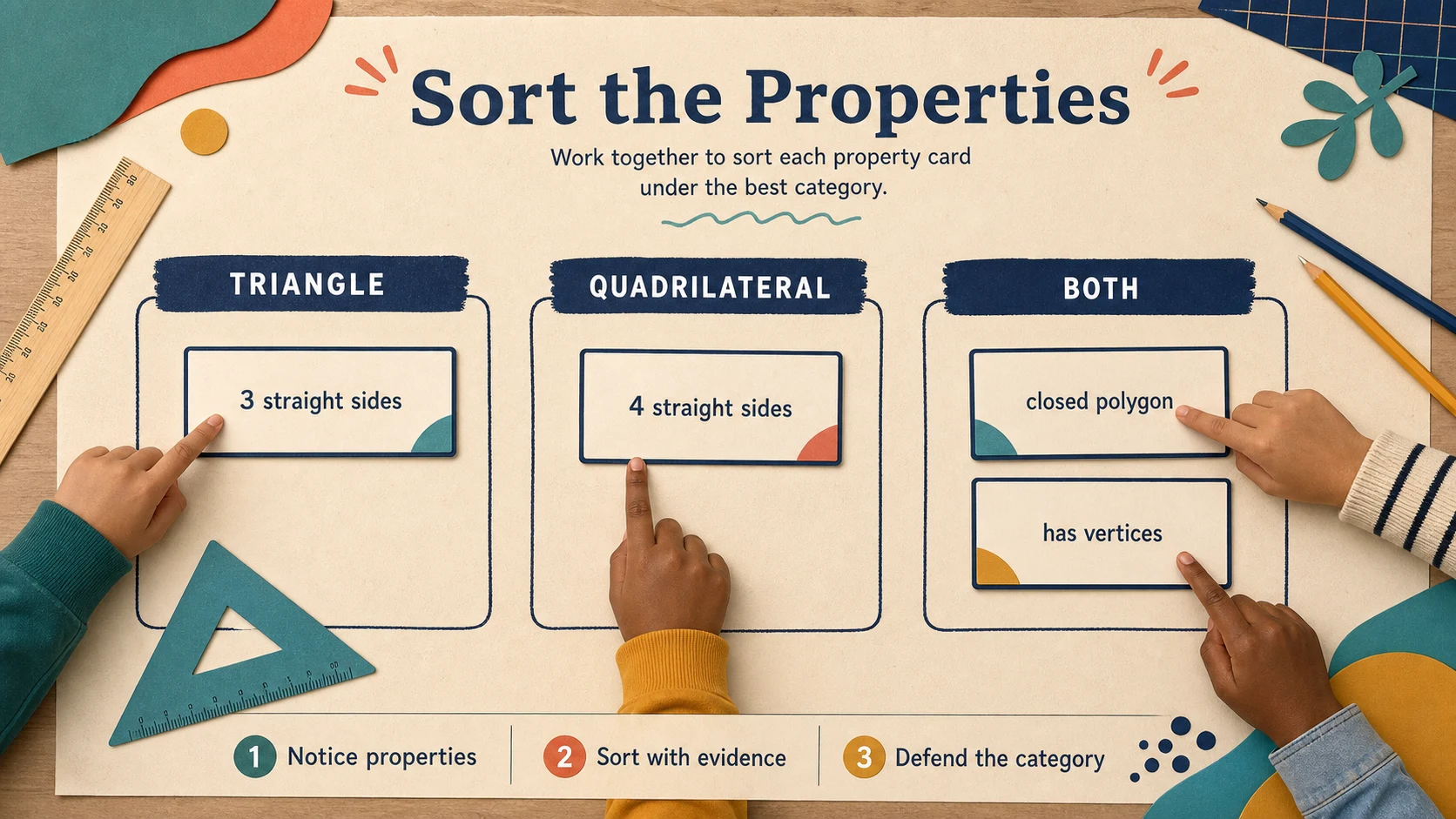
Locate the first incorrect decision, repair it, and verify the revised answer.
| Observed work | Likely issue to investigate | Useful response |
|---|---|---|
| Names a tilted square a “diamond” | Classification based on orientation | Rotate the page and list defining properties |
| Counts one vertex twice | No fixed starting point | Mark a starting vertex and move in one direction |
| Gives for rectangle perimeter | Only half the boundary included | Trace all four sides and write each addend |
| Multiplies for every measurement problem | Area and perimeter are being conflated | Ask whether the task concerns “around” or “inside” |
| Gives correct number with the wrong unit | Quantity understood incompletely | Compare length units with square units |
| Uses the right method but computes incorrectly | Arithmetic error after correct setup | Recalculate using another method |
| Leaves work blank but states an answer | Reasoning is not visible | Ask for an equation, labels, or property statement |
| Changes an answer after seeing the key but cannot explain | Copying rather than correcting | Close the key and solve a parallel example |
Correct the earliest point at which the reasoning went wrong. If the learner selected area instead of perimeter, practicing multiplication facts will not address the main error. If the setup was correct and only was miscalculated, reteaching shape properties would also miss the issue.
Ask the learner to complete an error note in plain language: “I found area, but the question asked for perimeter,” or “I counted my starting vertex twice.” This is an instructional suggestion, not a sourced requirement. Its purpose is to make the correction specific enough to guide the next attempt.
Check the answer key responsibly
The separate answer key is for verification after genuine effort. It should not replace reading, drawing, calculating, or explaining.
First, compare the learner’s written answer with the key. Then inspect the work that produced it. A matching number does not prove that the reasoning was sound; a learner might multiply when addition was required and arrive at the same value by coincidence. Conversely, a wrong final number may follow an appropriate geometric setup and a small arithmetic slip.
Use this correction sequence:
- Mark the item for review without immediately supplying the key’s answer.
- Ask the learner to reread the prompt and identify the requested quantity.
- Locate the first step that does not follow from the figure or information.
- Let the learner revise in a different pencil color.
- Compare the revision with the answer key.
- Give one similar, unscored example to test whether the correction transfers.
If a key entry appears inconsistent with the printed figure, wording, or supplied dimensions, pause. Rework the item independently and check that no label or unit was overlooked. Do not pressure the learner to copy a result that neither of you can justify. Report a suspected worksheet issue through the site’s usual contact route if one is available.
The Common Core State Standards for Mathematics can provide broad context for mathematical content and practices across grades. Do not treat the presence of geometry content on this page as proof of comprehensive standards alignment. This worksheet’s catalogue identifies its actual scope as shapes, perimeter, area, and geometric properties. Local schools may place or revisit those ideas differently.
Decide what to do after the first attempt
Avoid a universal passing percentage. Instead, consider accuracy, independence, explanations, and error type together.
Continue within this worksheet when understanding is emerging
If the learner can solve the problems after one brief prompt, finish the page in a second sitting. Begin that sitting with one unprompted review example. Fade aids such as tracing marks or vocabulary cards as soon as they are no longer necessary.
Pause for focused reteaching when one idea dominates the errors
If most mistakes involve perimeter, use two or three hand-drawn figures and have the learner trace and total every outside edge. If area is the difficulty, return to arrays or drawn unit squares. If shape identification is fragile, sort several figures by observable properties and include rotated or irregular examples.
Then return to only the relevant worksheet items. Recopying all 14 answers is unlikely to show whether the specific misconception has changed.
Move forward when the reasoning is independent
The learner is ready for a next step when they can identify the requested quantity, choose a fitting method, calculate accurately, label the answer, and explain a check without substantial prompting. Explore the 6th Grade math collection for a neighboring skill, or use the topic guide to choose a more demanding geometry task.
For sustained practice across related material, the 6th Grade Geometry Worksheet Pack contains 18 worksheets and is listed at $4.79 in the supplied catalogue. A larger pack may provide variety, but it should follow observed need rather than replace targeted feedback.
Schedule short retrieval instead of immediate repetition
A completed page is evidence from one occasion. Brief retrieval on later days shows whether the learner can reconstruct the method without copying recent work.
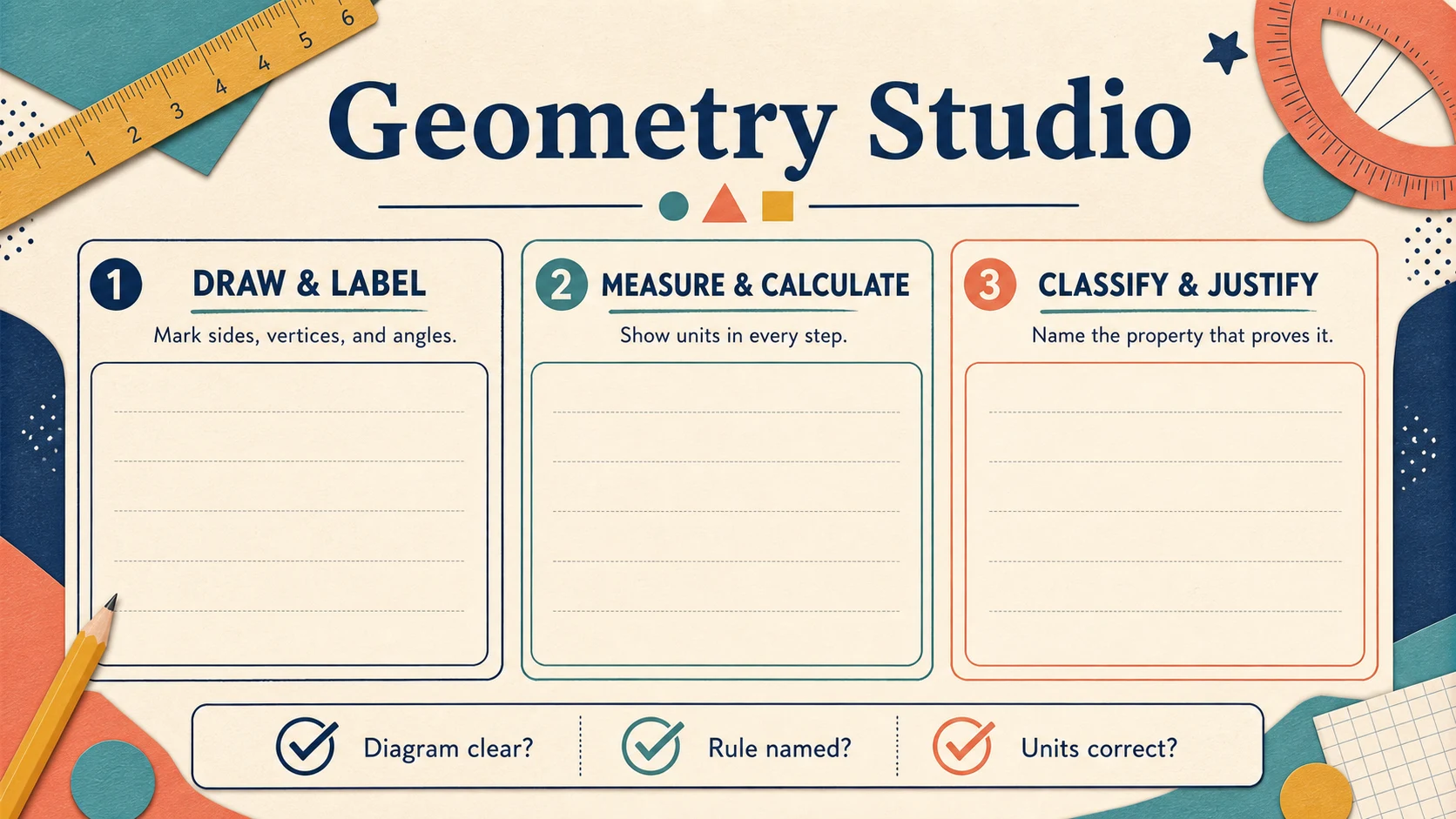
Revisit representative skills after increasing intervals and adjust timing from observed performance.
A practical, adjustable schedule is:
| Time | Retrieval task | Adult response |
|---|---|---|
| End of the lesson | Explain one shape item and one measurement item | Clarify only the first uncertain step |
| About 1–2 days later | Solve one perimeter and one area example from scratch | Note whether formulas and units are recalled |
| About 1 week later | Classify a rotated shape and solve one mixed measurement problem | Check whether strategy selection remains accurate |
| About 2–3 weeks later | Complete a short mixed review without notes | Decide whether to continue, reteach, or extend |
This is a practical instructional plan, not a universal timetable or a claim about guaranteed retention. Shorten the interval if the learner cannot begin without help. Lengthen it if the work is accurate, efficient, and well explained. Vary dimensions and orientation so that retrieval depends on the concept rather than memorization of an earlier answer.
For fresh examples, an adult can use the free worksheet generators, provided the generated task still targets the skill being reviewed. Check every generated problem and answer before giving it to a learner.
Keep the worksheet’s limitations in view
This 14-item printable is focused practice, not a comprehensive geometry course, diagnostic instrument, or certification of mastery. Its catalogue scope includes identifying shapes, counting sides and vertices, calculating perimeter and area, and working with geometric properties. It should not be used to infer proficiency in every 6th Grade geometry topic.
The worksheet also cannot reveal everything affecting performance. A learner may understand a concept but misread a label, rush, make an arithmetic error, or struggle to organize work in the available space. Observe the written process and ask the learner to explain one or two decisions before drawing conclusions.
Grade labels describe intended practice level, and local instructional sequences differ. The best pacing decision comes from the learner’s work: what they can do independently, which prompts help, whether corrections transfer, and what remains uncertain.
Use the free worksheet now for a focused baseline. After correcting it and completing the first retrieval check, choose the next free activity from the broader geometry guide that directly addresses the learner’s observed need—shape properties, perimeter, area, or a suitable next geometry skill.
Put it into practice
Use the guide with a real printable
Move from explanation to a short, observable practice task. Check the first item together, then adjust the next session from the learner's actual work.
See the 18-worksheet pack