Complete guide
How to teach and practise 6th grade fractions worksheets - standard theme (easy)
How to use this 22-item fractions worksheet
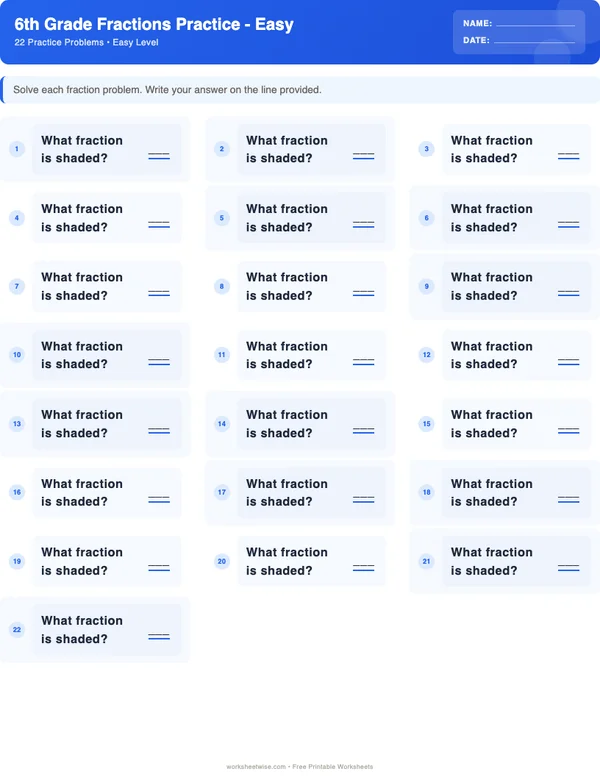
The free 6th Grade Fractions worksheet provides 22 easy-level exercises on identifying, comparing, finding equivalent fractions, and computing with fractions. Use it as a focused practice lesson, not as a one-sitting test of everything a learner knows about fractions.
A productive session usually has four parts: briefly check prerequisite understanding, model one or two representative problems, complete a small group of items together, and then release the learner to work independently. The learner’s observed work—not the “6th Grade” label or a fixed number of minutes—should determine how quickly you move between those parts.
Grade labels describe the intended practice level. Local curricula and teaching sequences differ, so confirm that the problem types are familiar before expecting independent completion. For a fuller view of related skills and their progression, use the 6th Grade fractions topic guide instead of trying to turn this single printable into a complete fractions unit.
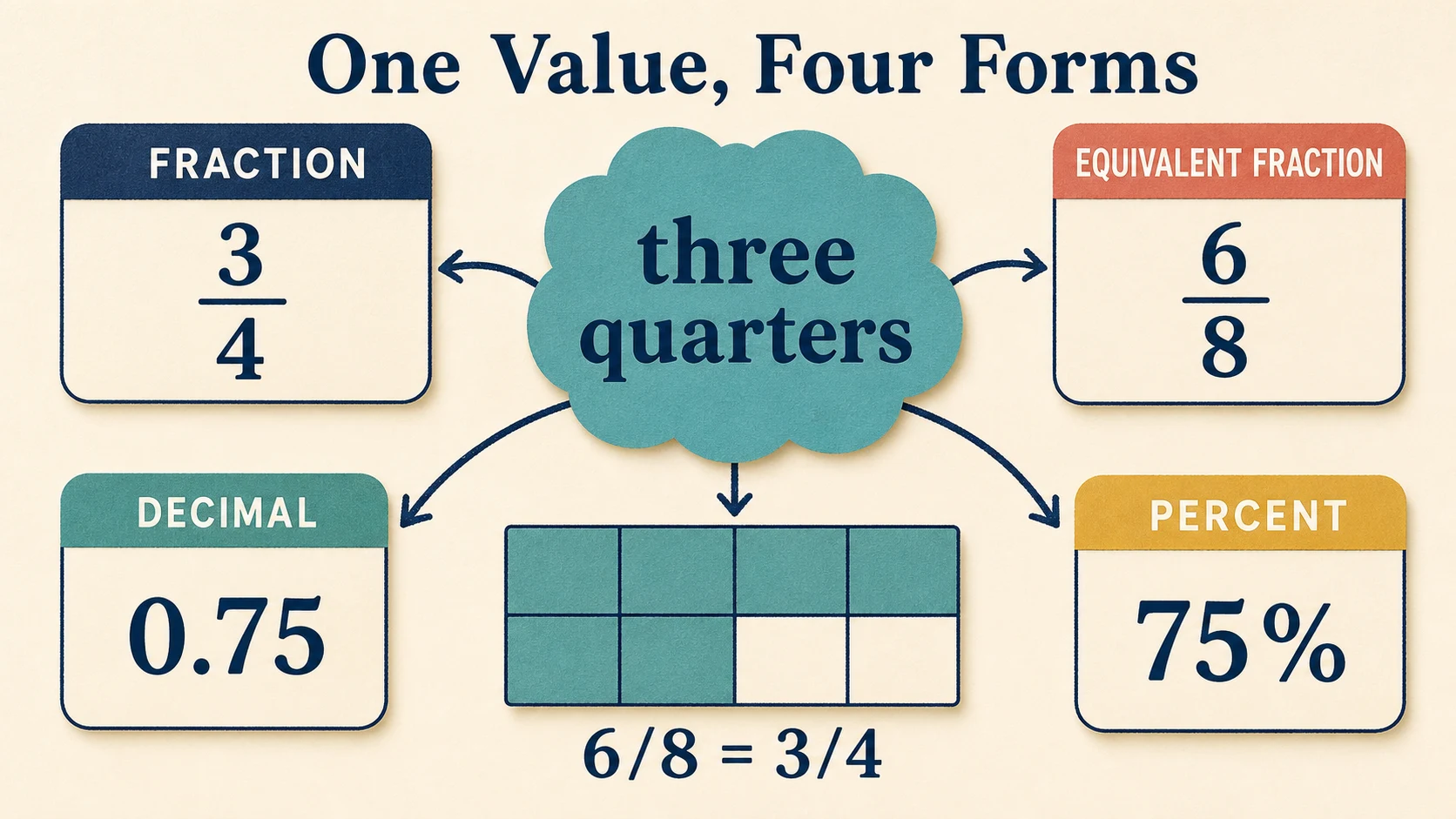
Preview, model, practice together, work independently, check, and revisit.
What this worksheet can and cannot show
This printable gives practice across four stated skill areas:
- fractions;
- equivalent fractions;
- comparing fractions; and
- fraction operations.
The directions are deliberately simple: solve each fraction problem and write the answer on the provided line. A separate printable answer key is included.
Because the worksheet contains several fraction skills, the total score is less informative than the pattern of work. Two learners might each answer 17 of 22 items correctly but need different instruction. One may compare fractions accurately and struggle only with operations. Another may calculate successfully but misunderstand equivalence. Record the problem type beside each error before deciding what to reteach.
An easy-level worksheet can help you determine whether foundational ideas and procedures are available without excessive complexity. It cannot, by itself, establish complete mastery, explain why every error occurred, or represent an entire local curriculum. It also does not show whether the learner can use the same reasoning in an unfamiliar setting unless you ask a few follow-up questions.
The Common Core State Standards for Mathematics provide broad grade-by-grade context for mathematical learning. They should not be treated as proof that this one printable comprehensively assesses every applicable expectation. The WorksheetWise catalogue describes sixth-grade mathematics as including fraction division alongside ratios, negative numbers, algebraic thinking, coordinate work, and statistics. This worksheet addresses only its stated fractions scope.
Prepare the lesson before handing over the page
Print or open the student worksheet, but keep the answer key separate. Have blank paper available for diagrams and calculations. Fraction strips, fraction circles, or a hand-drawn number line can help if the learner needs a representation; they are instructional supports, not shortcuts.
Scan the page and identify where the problem type appears to change. Since the catalogue describes a mixture of identification, comparison, equivalence, and operations, avoid assuming that one method applies to all 22 items. If necessary, lightly mark stopping points so the learner works in short sets.
Run a three-part readiness check
Before beginning the worksheet, ask the learner to complete these oral or written prompts:
- In , what does the 5 tell us? What does the 3 tell us?
- Which is greater, or ? How do you know?
- Name one fraction equivalent to .
These are instructional screening prompts, not items claimed to appear on the printable. Listen for meaning as well as correct answers. A learner who says that fifths divide a whole into five equal parts and three of those parts are being considered has a useful starting conception. A learner who compares and by saying “four is bigger than two” may be treating denominators like whole-number magnitudes.
Decide how much to release
Use the readiness check and the first modeled problem to choose an entry point:
| Observed readiness | Suggested launch | Initial independent amount |
|---|---|---|
| Explains fraction parts and justifies comparisons | Model one example, then begin | 6–8 items |
| Gets answers but gives uncertain explanations | Model two examples and complete two together | 4–6 items |
| Confuses numerator and denominator or cannot represent a simple fraction | Build a visual model before using the page | 2–3 items |
| Understands models but makes procedural slips | Rehearse the check routine | 4–6 items |
These quantities are practical starting points, not a universal timetable. Increase or reduce the set after observing accuracy, explanations, effort, and self-correction.
Model a repeatable solving routine
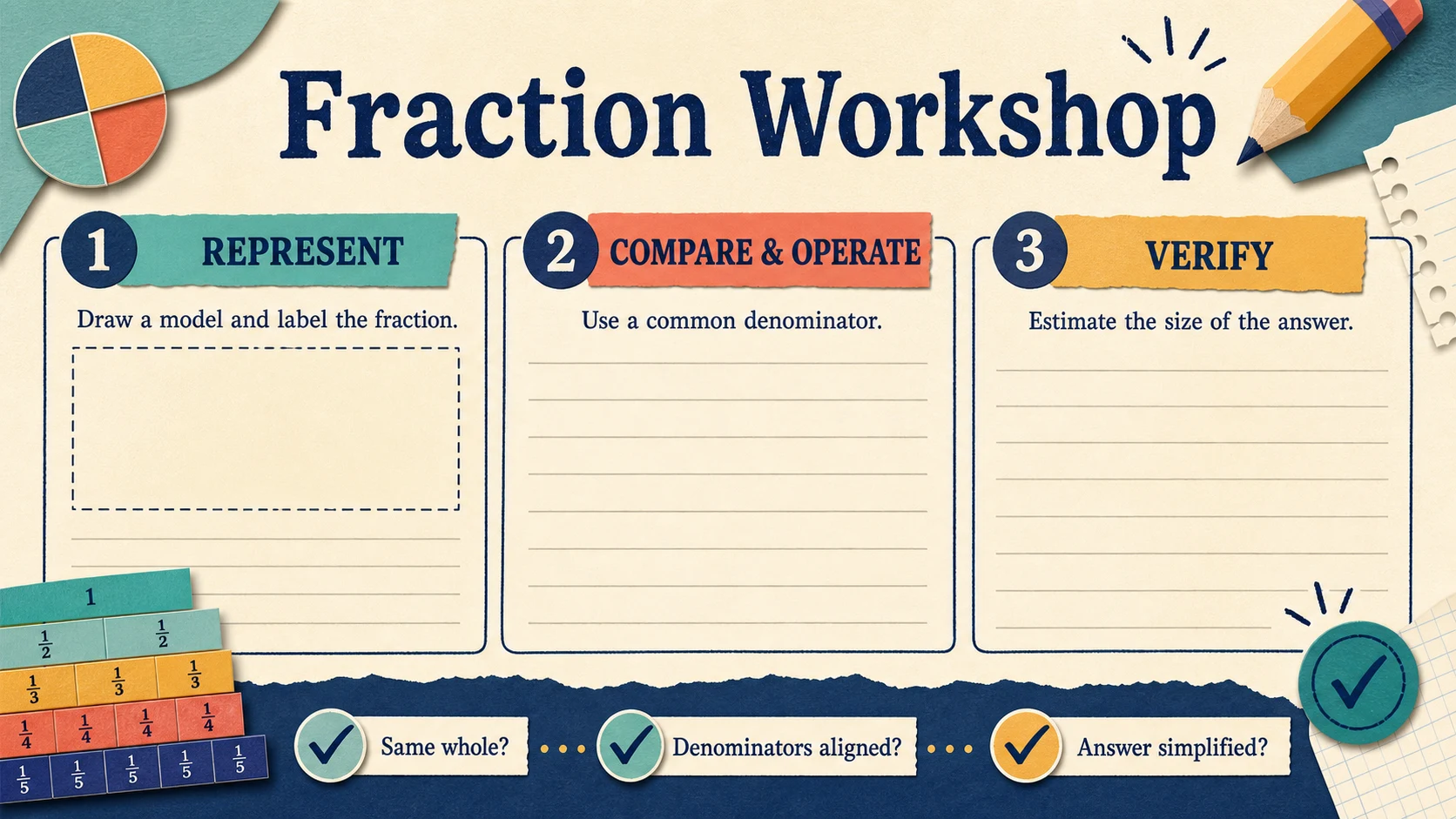
The adult’s model should expose decisions that are often hidden in a finished answer. Do not merely perform arithmetic while the learner watches. Name the problem type, estimate or compare expected size when possible, choose a representation or procedure, and check whether the result is reasonable.
A useful routine is:
- Read: What is the problem asking me to identify, compare, or compute?
- Represent: Would a number line, fraction strip, common denominator, or operation model help?
- Solve: Carry out one justified step at a time.
- Check: Does the answer’s size and form make sense?
The IES practice guide on teaching mathematics to young children concerns younger learners, not this exact sixth-grade worksheet. Its high-level attention to mathematical representations and monitoring understanding can still inform an adult’s modeling choices. Here, that means connecting fraction symbols to quantities when a learner’s written procedure lacks meaning.
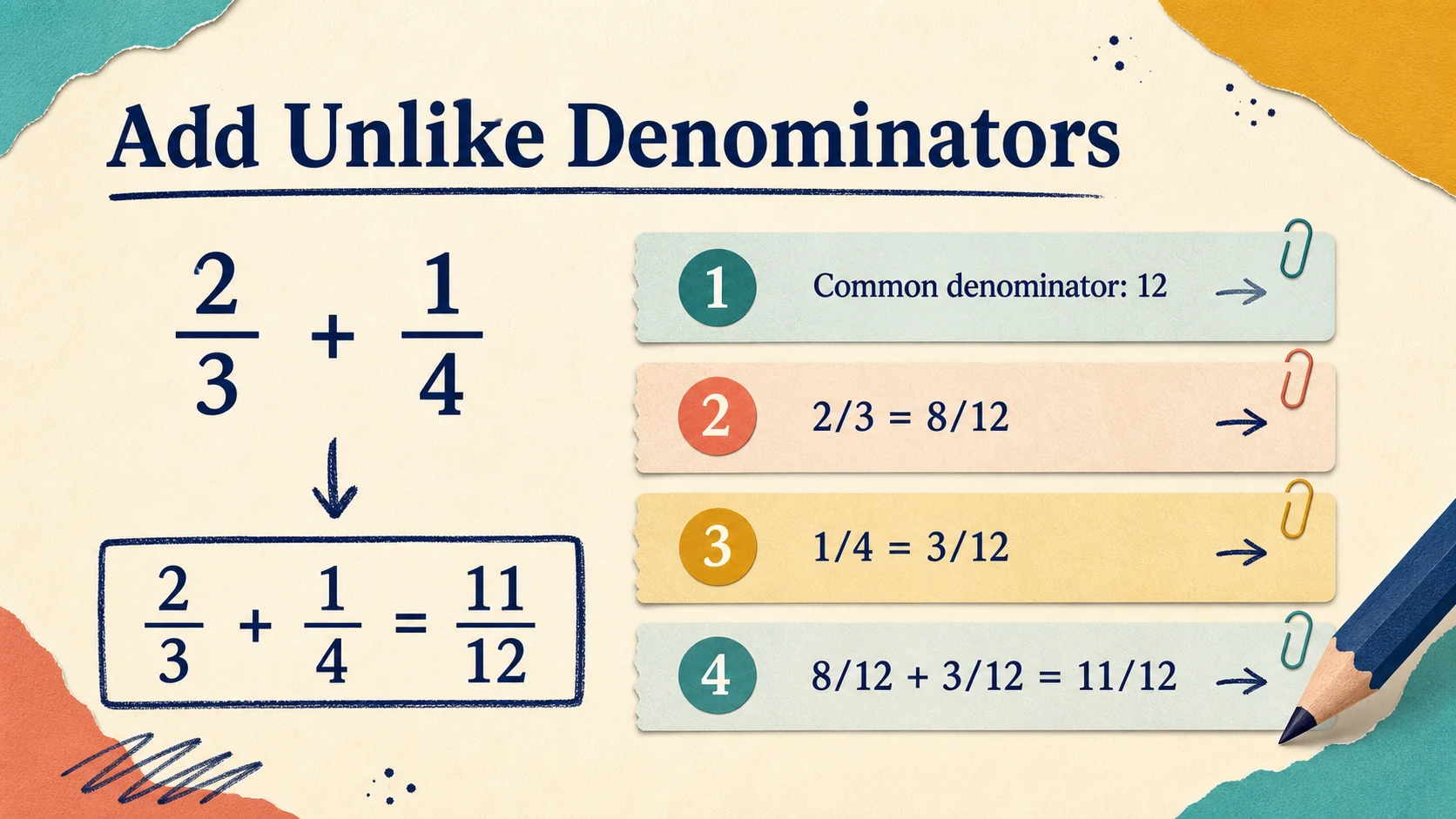
Explain the decision behind each step, then verify the result.
Worked example 1: identify a fraction
Suppose a bar is partitioned into eight equal sections and three are shaded.
The denominator records the number of equal sections in the whole: . The numerator records the sections being considered: . The shaded fraction is therefore:
Check the conditions carefully. If the sections are visibly unequal, simply counting three shaded pieces and eight total pieces does not justify . A fraction-of-a-whole model requires equal parts.
Worked example 2: generate an equivalent fraction
Find a fraction equivalent to with denominator .
Ask what multiplies to make :
To preserve the value of the fraction, multiply the numerator by the same number:
A direct check is to simplify by dividing both numbers by :
The multiplication changed the number of named pieces, not the amount represented.
Worked example 3: compare unlike fractions
Compare and .
One exact method is to use a common denominator. The least common denominator is :
Because ,
Estimation provides a second check. Both fractions are less than , but is only below , while is below . Since , is closer to and therefore greater.
Worked example 4: add unlike fractions
Compute:
Thirds and fourths name different-sized parts, so the numerators cannot yet be combined. Use twelfths:
Now add equal-sized parts:
The result should be greater than and less than . Since meets both conditions, the size is reasonable.
Worked example 5: multiply fractions
Compute:
Multiply numerators and denominators:
Simplify by dividing numerator and denominator by :
The factor means taking two thirds of . Because two thirds of a positive quantity less than one must be smaller than , the answer is sensible.
Worked example 6: divide fractions
Compute:
This asks how many groups of size fit into . Use the reciprocal procedure:
A number-line interpretation checks the result: one full half fits into , and the remaining is half of another . Therefore groups fit.
These examples illustrate possible methods within the worksheet’s stated skill areas. They are not presented as transcriptions of its items.
Move from guided practice to independent work
During guided practice, ask the learner to do the thinking while you control the pace. Choose one or two worksheet items at a time. Ask for the problem type before asking for an answer.
Useful prompts include:
- “What stays the same when fractions are equivalent?”
- “Can you estimate whether the answer should be less than or greater than one?”
- “Why are you choosing that denominator?”
- “Which step can you check without redoing the whole problem?”
- “Can you show the comparison another way?”
Avoid turning every hesitation into a lecture. Wait briefly, then offer the smallest prompt that restarts reasoning. If the learner can continue after you point to the denominators, that is different from needing you to supply the common denominator and every conversion.
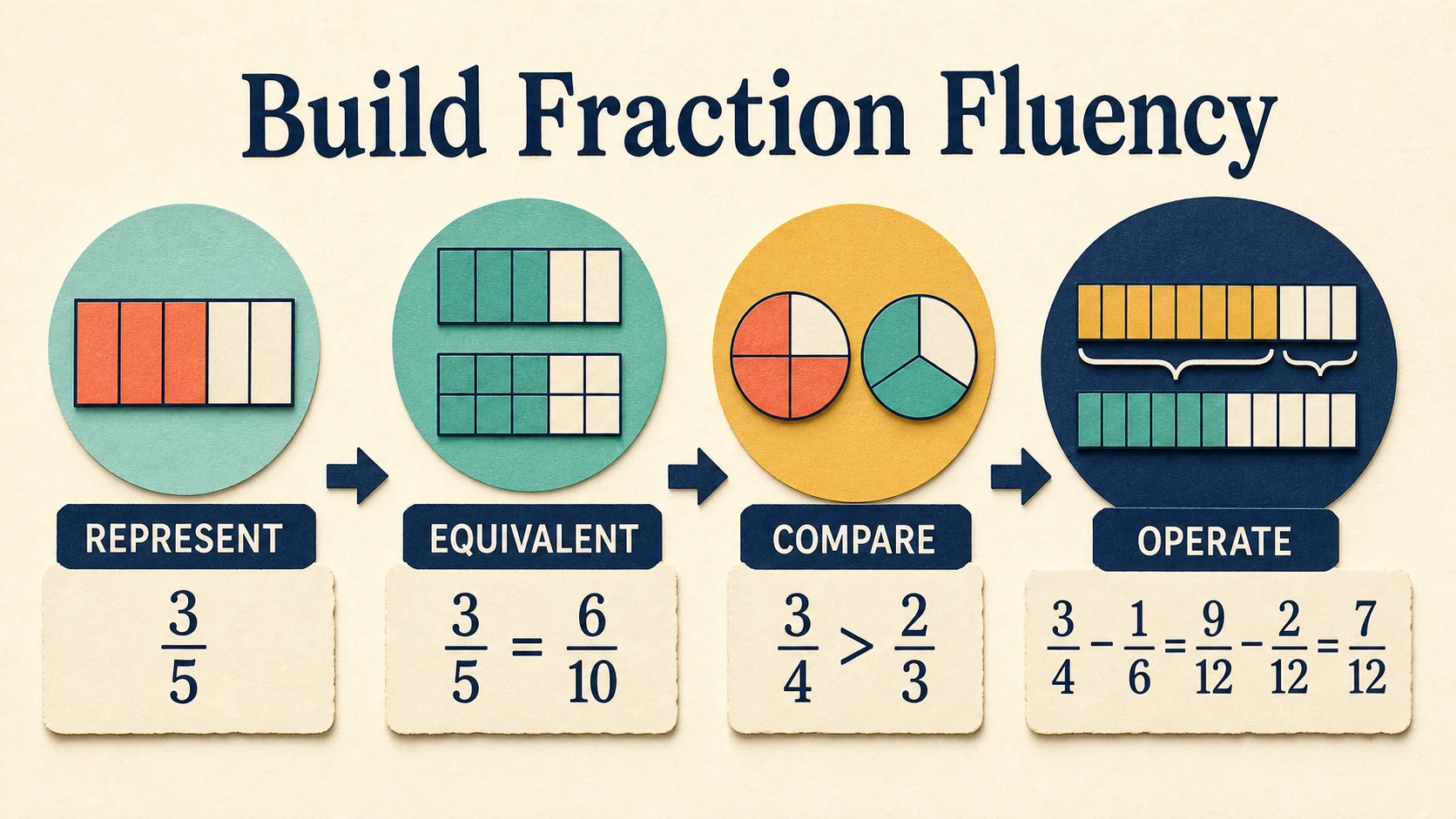
Reduce prompts gradually as the learner explains and checks each decision.
Use a prompt-fading sequence
When help is needed, move through these levels:
- General prompt: “What kind of fraction problem is this?”
- Attention prompt: “Look at the denominators.”
- Choice prompt: “Do you need a common denominator or a reciprocal here?”
- Partial model: Demonstrate the first conversion, then stop.
- Full model: Solve a similar problem and return to the original.
Record the level of help. An answer completed after a full model should not be interpreted the same way as an answer completed independently.
When the learner solves two or three consecutive items accurately and can explain the method, begin independent practice. Ask them to mark uncertain answers with a small star rather than seeking immediate confirmation. This preserves the opportunity to see whether they can monitor their own work.
Adapt support without changing the mathematical skill
Differentiation should alter access, representation, pacing, or response demands while preserving the central fraction task. If the item asks the learner to compare fractions, support should still lead to a comparison—not replace it with an unrelated easier activity.
Adjust visibility, pacing, or explanation while keeping the fraction reasoning intact.
For a learner who needs more structure
Cover all but one row of problems. Circle the operation signs or comparison symbols only if visual scanning is obstructing the mathematical work. Provide fraction strips or a blank number line, and ask the learner to connect the visual result to the symbols.
You can also prewrite a consistent workspace:
- estimate;
- common denominator or model;
- calculation;
- simplified answer;
- reasonableness check.
Do not fill in the decisive values unless you are intentionally modeling.
For a learner who understands but works slowly
Split the 22 items across more than one sitting. Resume with one previously completed problem before beginning new items. Allow extra scratch paper and do not require mental computation when written work is part of the target skill.
A slower pace is not automatically evidence of weak fraction understanding. Look separately at accuracy, strategy choice, organization, and the amount of prompting required.
For a learner ready for greater explanation
Keep the same worksheet but add one reasoning request after each small set:
- Draw a number line that supports one comparison.
- Write an equivalent form used in one calculation.
- Identify an answer that is close to , , or .
- Create a different fraction with the same value as one answer.
- Explain why one incorrect method would fail.
This deepens the use of the existing problems without claiming that the easy worksheet itself provides advanced coverage.
The IES guide for assisting students struggling with mathematics offers high-level guidance on systematic instruction, mathematical language, representations, and cumulative review. It did not evaluate WorksheetWise or prescribe a single intervention for every learner. Use those principles as framing while letting the learner’s actual responses determine the next prompt.
Watch for boundary cases and common misconceptions
Some errors arise where a familiar shortcut no longer works. Include at least one boundary check during discussion, even if the learner’s worksheet answers appear accurate.
Equal numerators
Compare and . With the same numerator, both fractions contain three parts, but fifths are larger than eighths:
A learner who chooses because is comparing denominator numerals instead of the sizes of the fractional parts.
Equal denominators
Compare and . The parts are the same size, so compare how many there are:
The reasoning differs from the equal-numerator case. Asking the learner to state what is equal helps prevent a memorized rule from being applied indiscriminately.
Fractions equal to one
A fraction with equal nonzero numerator and denominator equals one:
A learner may incorrectly label every fraction as “less than one” because early examples often use proper fractions. Include cases equal to and greater than one when checking whether the concept extends beyond that pattern.
An operation that produces a larger answer
Multiplication by a proper fraction makes a positive number smaller, but division by a proper fraction can make it larger. For example:
If the learner rejects this answer only because “division makes numbers smaller,” revisit the meaning of how many half-sized groups fit into three fourths.
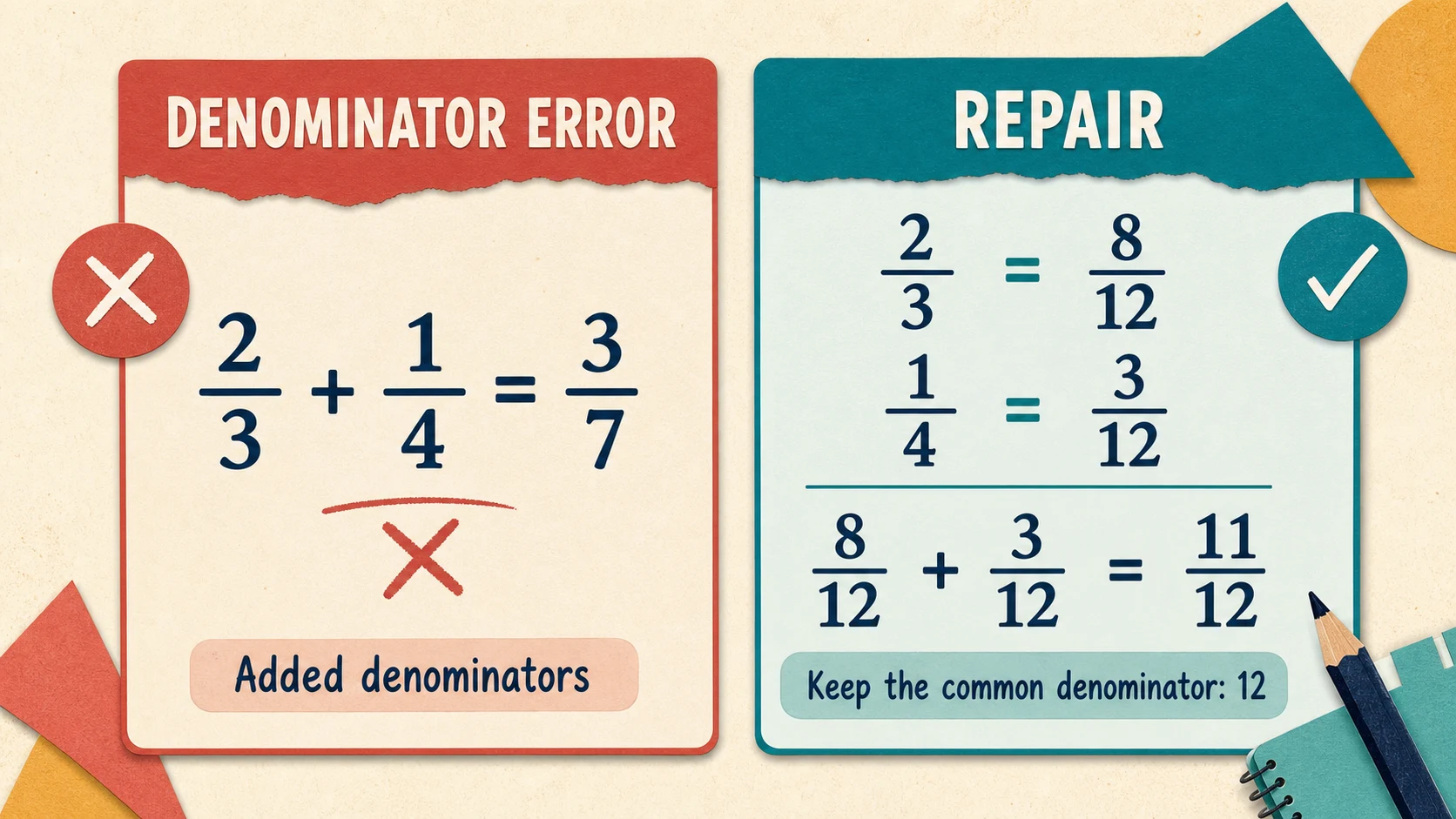
Adding denominators
The incorrect calculation
combines labels for differently sized parts. Convert to equal-sized parts instead:
A visual model can make the failure visible: one third and one fourth of equal wholes clearly total more than one half, while is less than one third.
Interpret errors before correcting them
Do not mark every wrong answer as the same kind of failure. The written steps, explanation, and response to a prompt provide more useful information than the final answer alone.
Classify the error, repair one step, and check the new answer’s size.
Use four broad categories:
| Error pattern | Evidence to look for | Immediate instructional response |
|---|---|---|
| Concept error | Treats unequal pieces as equivalent or larger denominators as larger fractions | Return to a strip or number line |
| Procedure-selection error | Uses addition rules for multiplication or forgets to find common denominators | Ask the learner to name the operation and required preparation |
| Execution error | Chooses a sound method but multiplies, adds, or copies incorrectly | Have the learner isolate and recompute the affected step |
| Representation or recording error | Reasoning is correct orally but symbols, signs, or final form are unclear | Rehearse how to write each transformation |
Also note self-correction. A learner who catches by asking whether denominators still represent twelfths is developing useful monitoring, even though the first response was wrong.
Correct one representative error from a pattern, then ask the learner to repair another. Reworking every item for the learner conceals whether the idea transferred.
Check the answer key responsibly
The separate answer key makes checking efficient, but it should confirm reasoning rather than replace it. Whenever possible, have the learner review starred items before revealing any answers.
Use this sequence:
- Compare the final response with the key.
- If they differ, inspect the learner’s written steps.
- Identify the first step at which the reasoning changed course.
- Ask the learner to explain or repair that step.
- Recalculate independently if the key or notation seems questionable.
- Mark whether the repair was independent, prompted, or modeled.
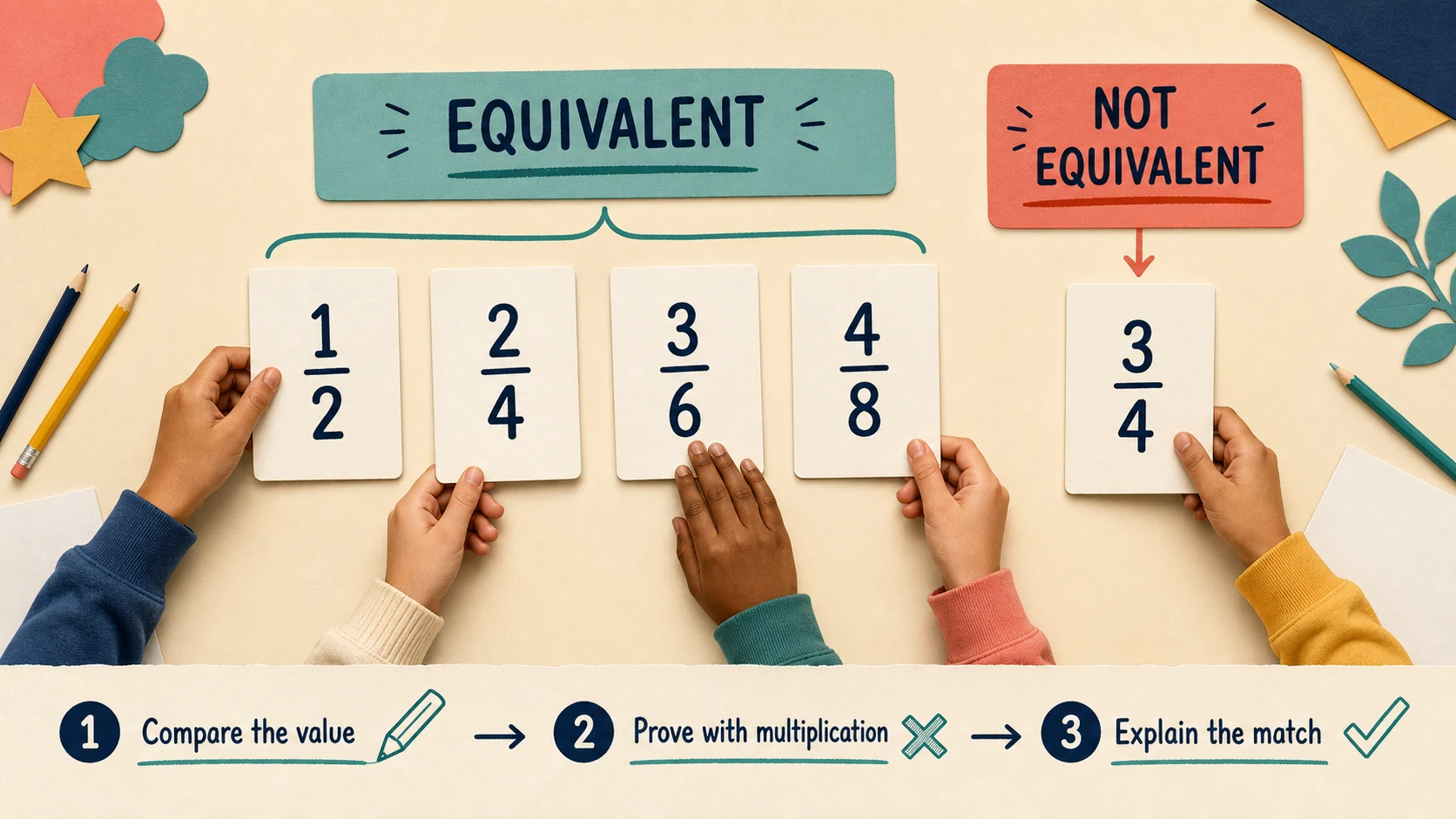
Equivalent forms require care. For example, , , and represent the same value. If a key shows a simplified form, determine whether the worksheet directions or local expectations require simplification. The supplied direction only says to solve each problem and write the answer; do not invent an unstated formatting requirement.
Likewise, an improper fraction and its equivalent mixed number may express the same value:
Check mathematical equivalence before labeling a response wrong. Then teach the expected form separately if the surrounding task makes that expectation clear.
An answer key can contain no explanation of a learner’s method. It cannot distinguish a lucky choice from sound reasoning, or an arithmetic slip from a conceptual misconception. Use it to verify results quickly, then rely on the learner’s work to plan instruction.
Decide what should happen next
After checking, group the results by skill rather than calculating only a percentage. A simple record might contain four rows: identifying fractions, equivalence, comparison, and operations. For each row, note independent accuracy, explanations, and prompting.
Continue with similar practice when
- the learner understands the underlying representation;
- errors are isolated calculation or recording slips;
- the learner can correct mistakes after a general prompt; and
- a second item of the same type is completed accurately.
You can find additional grade-level material through the 6th Grade math hub or broader 6th Grade worksheet collection.
Reteach a focused idea when
- the same misconception appears in several problems;
- the learner cannot explain why a procedure applies;
- correct answers depend on adult-supplied steps; or
- visual and symbolic responses contradict one another.
Reteach with one representation and two or three carefully chosen examples. Then return to one previously missed worksheet item. Avoid restarting all 22 problems unless there is a clear instructional reason.
Move to broader or varied practice when
- the learner completes the relevant problems accurately without prompts;
- explanations connect the symbols to fraction size or equal parts;
- estimates agree with calculated results; and
- the learner detects at least some unreasonable answers independently.
The 6th Grade Fractions Worksheet Pack contains 18 worksheets and may be useful when a learner needs more varied fraction practice. Its catalogue price is $4.79. The single worksheet remains a valid free option when only a short follow-up is needed.
Schedule retrieval without overloading the learner
Retrieval means returning to previously practiced ideas after some time has passed. The purpose is to see what the learner can reconstruct, not merely what remains in short-term memory after correction.
Revisit a few mixed items after a delay and adjust the interval from observed performance.
A practical starting schedule is:
| Time | Suggested review | What to observe |
|---|---|---|
| End of the lesson | One corrected item and one successful item | Can the learner explain both without copying? |
| Next study session | Two or three mixed fraction prompts | Is the correct method selected independently? |
| Several days later | One equivalence, one comparison, and one operation | Which ideas remain available after a delay? |
| About one or two weeks later | A short mixed set or newly generated practice | Does learning transfer to different numbers and layouts? |
This is an instructional suggestion, not a universal timetable or sourced requirement. Shorten the interval when the learner cannot begin without extensive prompting. Lengthen it when responses are accurate, explained, and retained. If several mathematics topics are being studied, mix one fraction item into later review rather than assigning the entire worksheet again.
Do not use identical answers as the only retrieval task. Change the numbers or representation while keeping the same reasoning demand. The free worksheet generators can help create fresh practice when repeating the original page would encourage answer recall rather than method recall.
Keep the lesson within its limits
This worksheet is useful for easy-level practice across its four listed fraction skills. It is not a diagnostic instrument, a complete sixth-grade course, or evidence of comprehensive standards alignment. It cannot determine why a learner struggles without observation and follow-up conversation. It also should not be used to make medical or developmental judgments.
Adults can make sound instructional decisions within those limits:
- preserve the fraction skill while changing support;
- model reasoning before expecting independent speed;
- inspect patterns rather than relying only on a total score;
- accept mathematically equivalent answers while clarifying expected form;
- revisit missed ideas after a delay; and
- move forward only when the learner’s work supports that choice.
For the next lesson, choose one error pattern from this worksheet, teach it with a visual or number-line example, and then assign a small fresh set from the 6th Grade fractions topic guide. If no repeated error appears, use the same guide to select the next fraction skill rather than repeating all 22 items.
Put it into practice
Use the guide with a real printable
Move from explanation to a short, observable practice task. Check the first item together, then adjust the next session from the learner's actual work.
See the 18-worksheet pack