Complete guide
How to teach and practise 6th grade division worksheets - standard theme (easy)
How to Use This 30-Item Division Worksheet
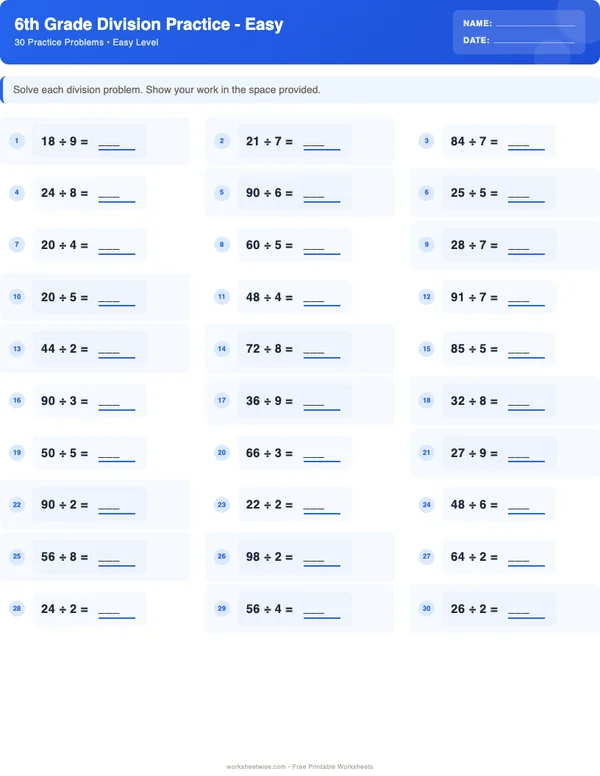
The free 6th Grade Division worksheet provides 30 easy-level exercises covering division facts, mental math, number sense, long division, and remainders. The learner should solve each problem and show work in the space provided. A separate printable answer key is included.
For a productive first session, model one or two similar problems, complete several items together, and then assign a manageable section for independent work. Do not assume that all 30 items must be finished at once. The learner’s observed accuracy, written reasoning, and effort should determine the pace. Check the work by multiplication when possible, discuss errors before correcting them, and save several unused or revisited problems for later retrieval practice.
Grade labels describe the intended practice level; local curricula and instructional sequences differ. This worksheet may reinforce division taught in an earlier grade or provide foundational review before more advanced sixth-grade work. For the broader sequence of division models, facts, long division, and contextual problems, use the Division topic guide rather than expecting one printable to cover the entire progression.
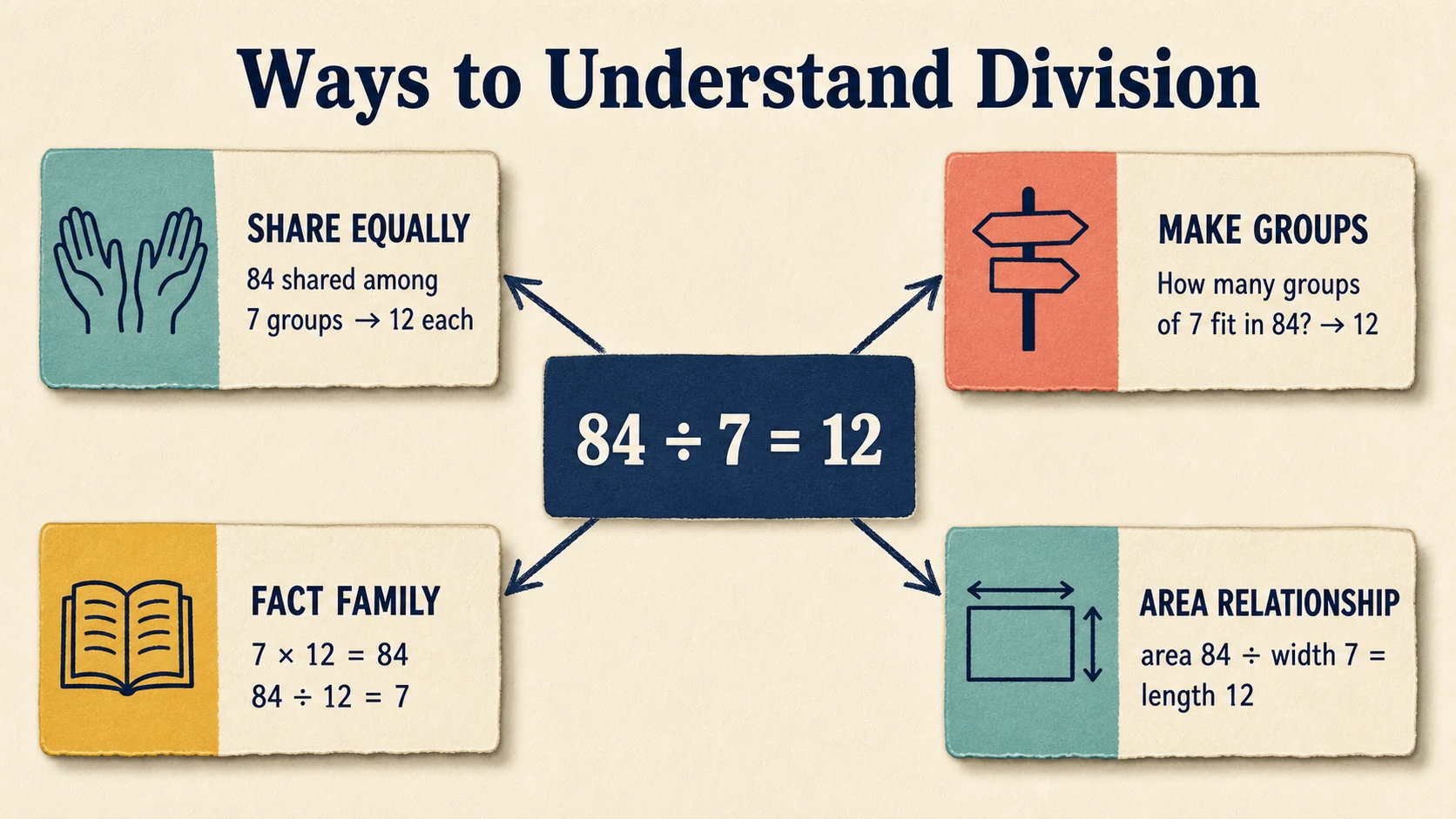
Move from a brief launch to modeling, guided practice, independent work, checking, and later review.
What This Worksheet Can and Cannot Show
The worksheet offers a focused sample of written performance. It can help an adult observe whether the learner can select and carry out familiar division procedures, use mental relationships, record long-division steps, and make sense of remainders. Because it contains 30 exercises at an easy level, it can also be useful for rebuilding fluency or checking whether foundational skills are stable.
One result should not be treated as a complete judgment of the learner’s mathematical understanding. A correct answer may come from sound reasoning, a memorized procedure, a guess, or unrecorded mental work. An incorrect answer may reflect a division misconception, a multiplication-fact gap, a subtraction error, unclear handwriting, lost place value, or fatigue.
The printable also cannot establish comprehensive standards alignment by itself. The Common Core State Standards for Mathematics provide the larger grade-to-grade framework. In that framework, whole-number division procedures are developed before sixth grade, while sixth-grade mathematics includes work such as dividing fractions by fractions. This makes an easy whole-number division worksheet reasonable as review or prerequisite practice, but it should not be presented as the whole sixth-grade division curriculum.
The worksheet is most informative when the adult looks at three things together:
- The final quotient and remainder, if any
- The written steps or mental explanation
- The multiplication check
A learner who gets 12 correct problems with clear reasoning may be showing more useful understanding than one who races through 30 and cannot explain any answer.
Prepare the Materials and Set a Clear Purpose
Print the worksheet and keep the separate answer key out of the learner’s view during initial practice. Provide a pencil, eraser, and scrap paper if the printed workspace is not enough. A multiplication chart may be used as temporary support when the immediate goal is practicing the division process rather than testing fact recall.
State the purpose concretely:
“These problems will show us which kinds of division already feel dependable and which steps need more practice. You do not need to rush. Show enough work that we can check your reasoning.”
That framing makes mistakes usable. It also avoids promising that one sitting will produce mastery.
Before starting, ask for two brief oral warm-ups:
- “What multiplication fact helps with ?”
- “How could multiplication check a division answer?”
Expected reasoning might be: , so . This refreshes the inverse relationship between multiplication and division without turning the launch into a long lecture.
The catalogue guidance recommends teaching division in direct connection with multiplication and ensuring that procedural steps carry place-value meaning. The IES guide on assisting students who struggle with mathematics likewise provides high-level instructional guidance about systematic teaching, clear mathematical language, representations, and deliberate practice. That source did not evaluate this WorksheetWise printable; it supports the general teaching frame only.
Use a Flexible Lesson Progression
A single session might last 25 to 40 minutes, but that is an instructional suggestion, not a universal timetable. Shorten or extend it according to the learner’s work.
| Lesson phase | Suggested use | What the adult observes | Decision point |
|---|---|---|---|
| Launch | 2–4 minutes | Can the learner connect division to multiplication? | Review a fact family if needed. |
| Model | 5–7 minutes | Can the learner explain what the quotient means? | Add a drawing or place-value language if the procedure is unclear. |
| Guided practice | 5–10 minutes | Which step requires prompting? | Continue together until prompts decrease. |
| Independent practice | 10–15 minutes | Are accuracy and written organization stable? | Stop early if errors repeat or attention fades. |
| Check and discuss | 5–8 minutes | Can the learner locate and explain an error? | Reteach the specific issue, not the whole topic. |
| Retrieval review | Later sessions | Is the skill retained without immediate modeling? | Advance, maintain, or return to guided practice. |
A practical first division of the page is five modeled or guided items, ten independent items, and the remaining items reserved for another day. That split is not required. If the learner completes the first ten accurately, records readable steps, and checks answers independently, a larger second set may be appropriate. If the same error appears twice, pause before assigning more of the same.
Model the Task Before Independent Work
Use examples similar in skill to the worksheet rather than claiming that these exact numbers appear on it. Write each step where the learner can see it. Speak in mathematical language, but keep the explanation economical.
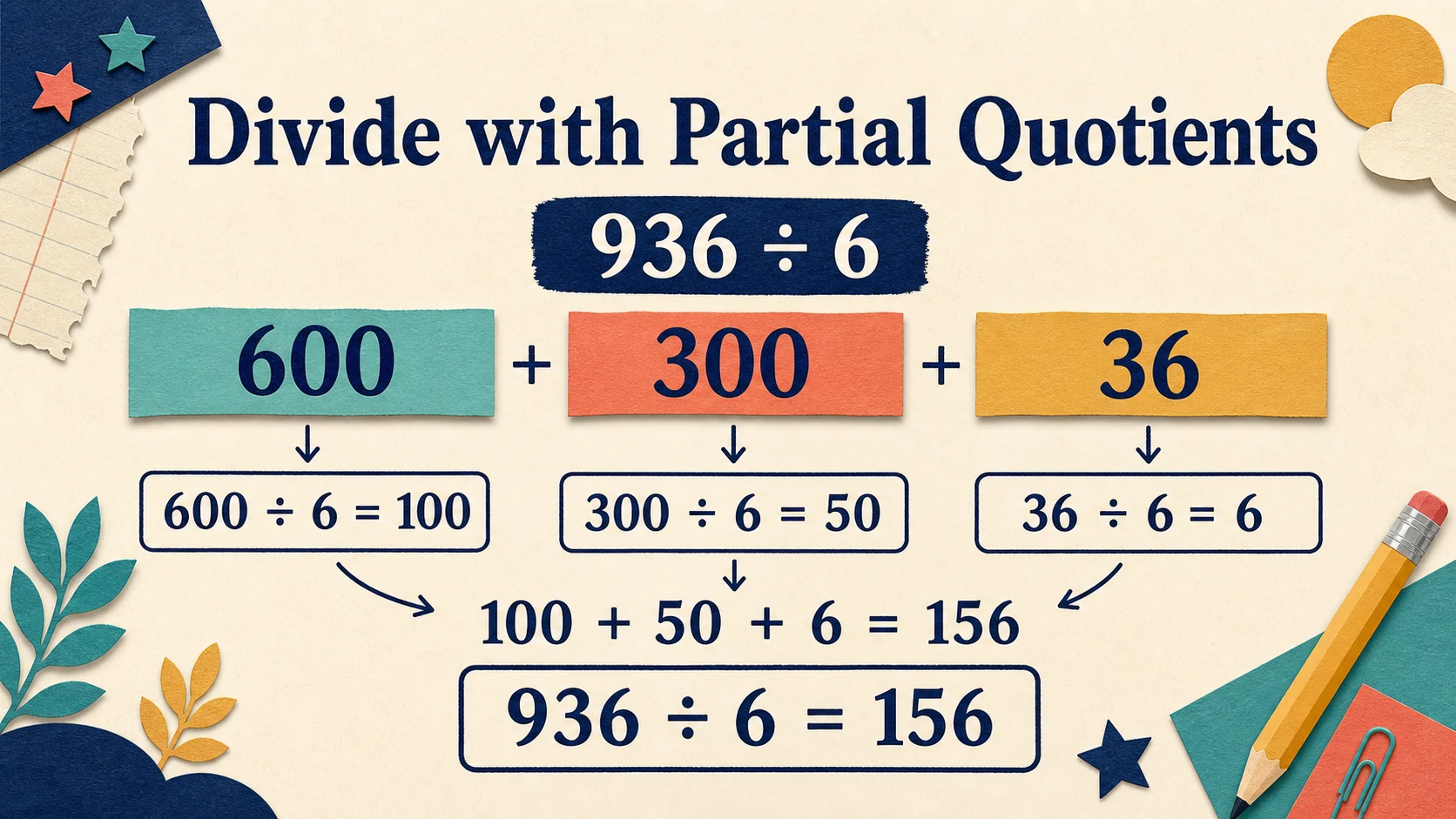
Model the quotient, any remainder, and a multiplication-based check.
Example 1: Use a multiplication fact
Solve:
Think of the related multiplication question:
Because ,
Check:
The answer is 7.
This model keeps the inverse relationship visible. If the learner counts repeatedly by eights, allow the strategy during guided practice, then note that remembering makes the division more efficient.
Example 2: Divide mentally with place value
Solve:
Decompose 360 as tens. Since
then tens divided by 9 equals tens:
Check:
The answer is 40.
Do not explain this as merely “adding a zero.” The place-value explanation is more dependable: 360 is 36 tens, and 36 tens shared into 9 equal groups gives 4 tens in each group.
Example 3: Long division with no remainder
Solve:
Work from left to right:
- goes into one time. Write 1 in the hundreds place.
- , and .
- Bring down the 3 to make 33.
- goes into five times because .
- . Bring down the 6 to make 36.
- goes into six times.
Therefore,
Check:
The answer is 156.
The key place-value point is that the digits in 156 represent 1 hundred, 5 tens, and 6 ones. The quotient digits must be written over the corresponding dividend places.
Example 4: Long division with a remainder
Solve:
- goes into one time. Subtract from , leaving 2.
- Bring down the 8 to make 28.
- goes into seven times. Subtract 28, leaving 0.
- Bring down the 5.
- goes into one time. Subtract 4, leaving 1.
So,
Check a quotient with a remainder by multiplying and adding the remainder:
The answer is 171 remainder 1.
The remainder must be smaller than the divisor. Here, , so the form is valid.
Move from Guided Practice to Independence
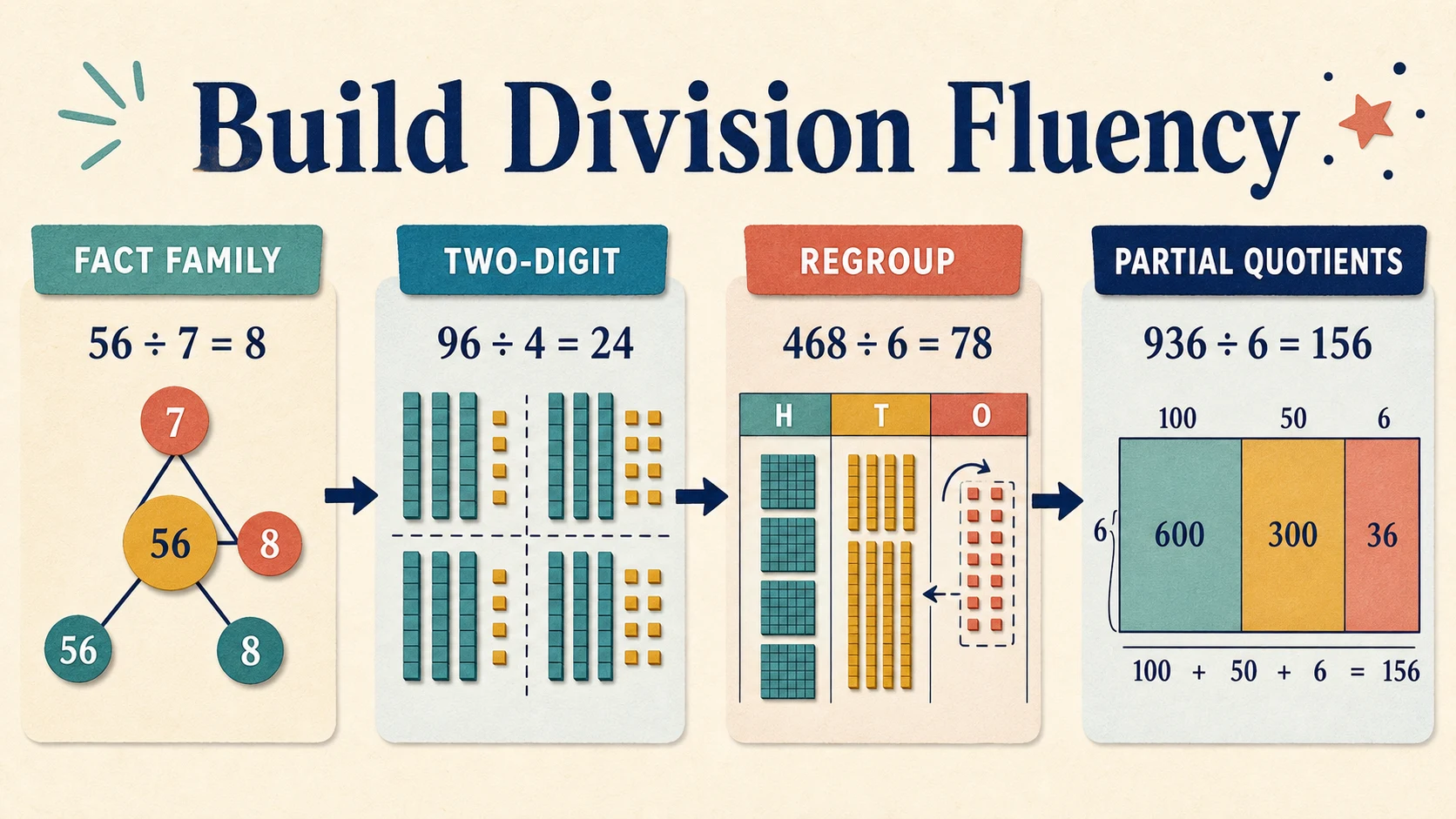
Reduce prompts gradually so the learner, not the adult, carries the procedure.
Use prompts that reveal thinking
For the first few worksheet items, avoid giving the next quotient digit immediately. Ask prompts such as:
- “What multiplication fact is closest without going over?”
- “What value does this digit represent?”
- “What do you multiply next?”
- “What remains after subtraction?”
- “Which digit comes down?”
- “How could you verify the result?”
If the learner answers a prompt correctly, let that learner write the step. The adult should not take over the pencil unless demonstrating a separate example.
The IES practice guide on teaching mathematics to young children addresses younger learners, so it is not evidence about this sixth-grade worksheet. Its broad emphasis on mathematical representations, language, and progress monitoring can still inform an adult’s instructional habits. Here, that means asking the learner to connect symbols to groups or place value and using observed work to choose the next prompt.
Fade assistance deliberately
A simple support sequence is:
- Adult models and explains.
- Adult asks a prompt before each step.
- Learner names each step without prompting.
- Learner solves silently but shows work.
- Learner checks independently.
Do not move to silent independent work merely because the learner watched a correct example. First ask for a complete problem with limited prompting. Independence is more credible when the learner can begin, continue, and verify without being rescued at every difficult point.
Set a stopping rule
During independent practice, look after three to five items rather than waiting until the end. Continue if the work is accurate or self-corrected and the layout remains clear.
Pause if:
- The same conceptual or procedural error occurs twice
- Quotient digits are repeatedly placed in the wrong columns
- Remainders equal or exceed the divisor
- The learner is guessing multiplication facts without checking
- Written work becomes too compressed to interpret
- Effort or attention drops enough that the results stop being informative
A pause is not a failure. It protects the remaining problems for useful practice after a focused explanation.
Adapt Support Without Changing the Division Skill
Support should make the target operation accessible without replacing it. A multiplication chart, a partially drawn long-division frame, or fewer problems in one sitting can preserve the division task. Giving the quotient or performing most of the calculation for the learner does not.
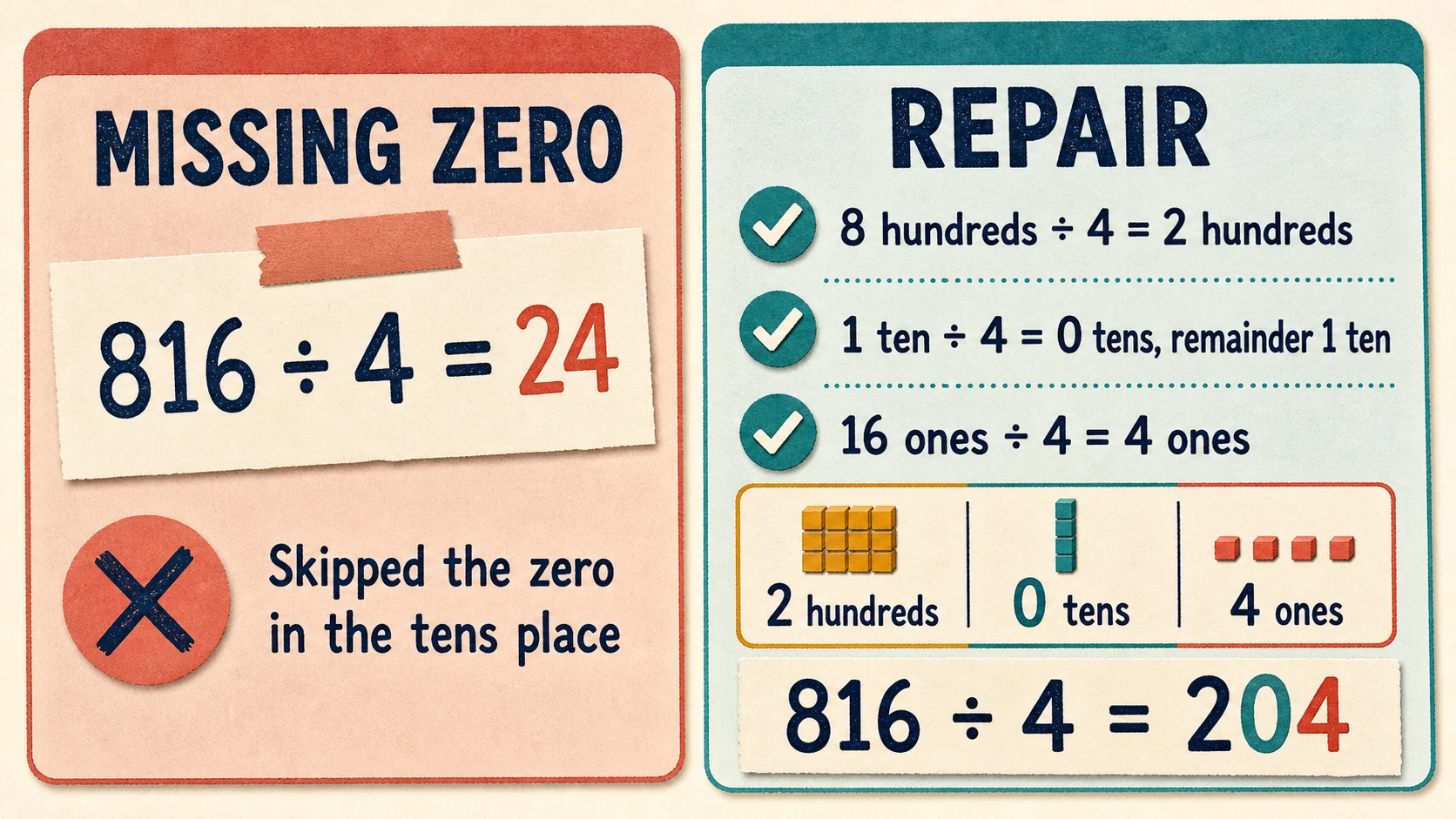
Adjust access, quantity, or representation while keeping division as the task.
When multiplication facts are the bottleneck
Allow a multiplication chart or have the learner list several multiples of the divisor. For , the learner might write:
For larger partial values, ask, “What multiple of 7 is near 15?” and later, “What multiple is near 14?” The learner still selects quotient digits and completes the division.
Record that fact support was used. Accuracy with a chart and accuracy from recall provide different information.
When long-division layout is the bottleneck
Use lined or graph paper to align digits. Lightly mark place-value columns, or provide a reusable sequence card:
Divide → Multiply → Subtract → Bring down → Check
Treat the sequence as an organizational aid, not a substitute for meaning. Ask what each subtraction shows and why the next digit is brought down.
When a full page is overwhelming
Fold or cover the worksheet so only four or five items are visible. Schedule a short second session for the next group. The learner still completes the original problems; the visual and workload demand are simply reduced.
Do not automatically lower the numbers after one error. First determine whether the problem was division, multiplication, subtraction, place-value alignment, or attention.
When the work appears too easy
Ask for verification and explanation rather than adding speed pressure. The learner can:
- Check each quotient by multiplication
- Estimate before calculating
- Explain why a remainder is valid
- Compare mental math with long division
- Write a matching multiplication equation
If the 30 items are consistently accurate and independently checked, move to broader practice from the 6th Grade Math collection or the topic guide. Repeating an easy page many times may add little once the reasoning is secure.
Treat Remainders and Other Boundary Cases Carefully
A zero in the quotient
Solve:
- Bring down 0. , so a zero must be written in the tens place.
- Bring down 4. .
Thus,
Check:
The answer is 201, not 21. Omitting the zero changes the place value and fails the multiplication check.
A dividend smaller than the divisor
For a whole-number quotient with a remainder:
Check:
This boundary case shows why the quotient can be zero and why the remainder must remain less than the divisor. Whether a particular worksheet expects whole-number remainder notation or another number form should be inferred from its examples and answer key, not assumed.
Exact division versus contextual interpretation
Numerically,
Check:
In a context, the remainder may change how the numerical result is reported. If 25 learners need vans holding 6 people each, four vans are insufficient; five are needed. If 25 objects are placed into complete groups of 6, there are four complete groups and one object left. The worksheet is described as straightforward division practice, so do not assume every item asks for contextual interpretation. Use the Division topic guide when broader work with sharing, grouping, and remainder meanings is needed.
Division by zero is not defined. If a learner encounters or invents , do not treat 0 as a possible quotient. No number multiplied by 0 produces 12.
Interpret Errors Before Assigning More Practice
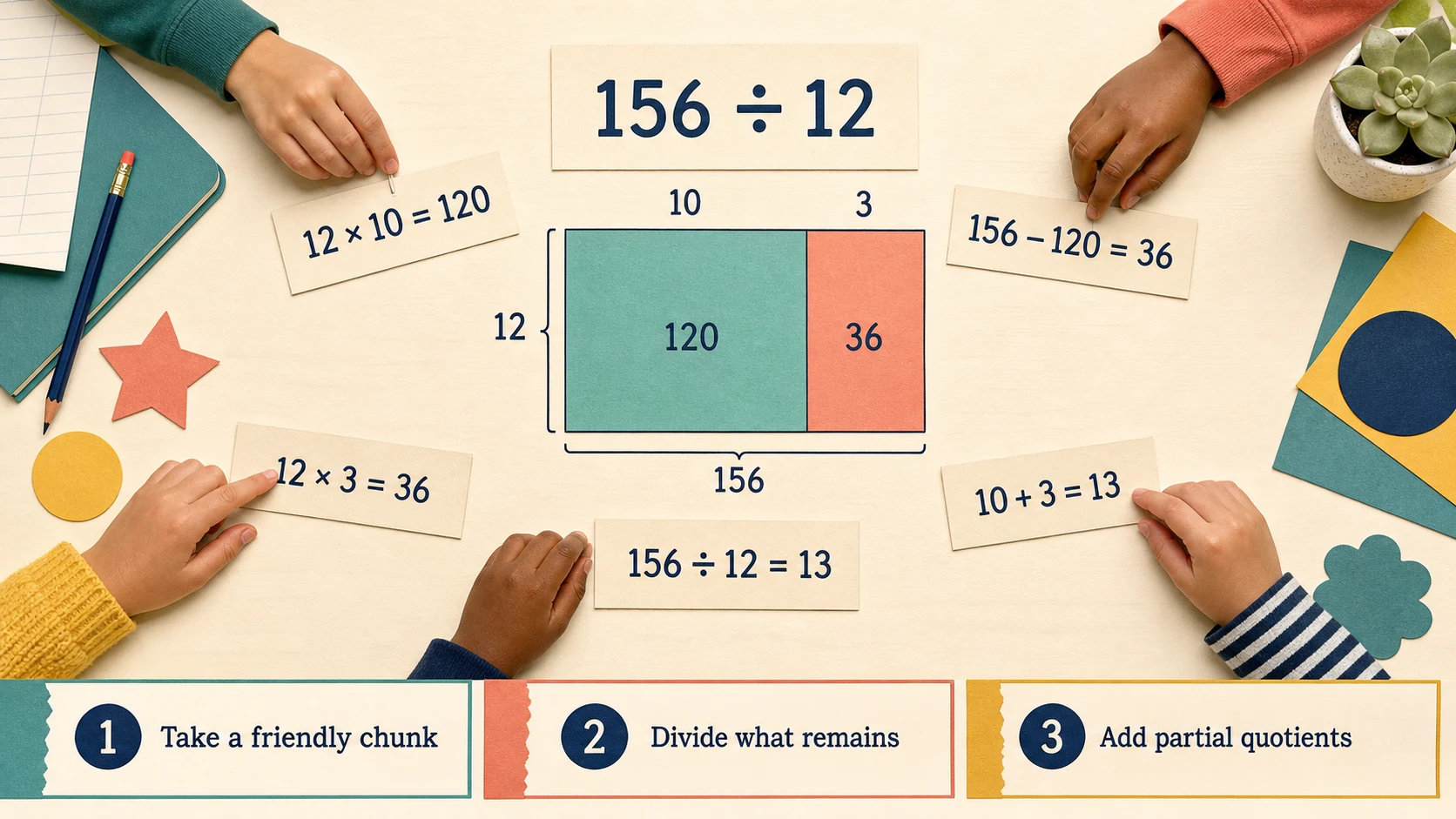
Identify the first incorrect step, name the error type, repair it, and verify the revision.
Multiplication-fact errors
Suppose a learner writes:
Ask for the check:
Because 56 does not equal 63, the answer cannot be correct. Have the learner locate , then revise the quotient to 9. If this pattern recurs, practice the relevant multiplication facts briefly while continuing to frame division as an unknown-factor question.
Quotient-placement errors
A learner may correctly calculate intermediate values but place quotient digits over the wrong dividend positions. Multiplication checking will often expose the result. Realign the problem on graph paper and ask the learner to name the place value of each quotient digit.
Do not label this simply as “careless.” The written record may show a genuine place-value or notation problem.
Subtraction errors inside long division
A learner might choose the correct multiple but subtract it incorrectly. For example, during , the learner may know that but calculate . Separate the skills:
- Confirm that the quotient digit 5 was selected correctly.
- Correct the subtraction to .
- Continue the division from that point.
Restarting the entire topic would ignore the evidence that the division choice was sound.
Invalid remainders
If the learner reports , the remainder is too large because another group of 5 can be made. Regroup:
Since , add one more group:
Check:
Teach the test: a remainder must be at least 0 and smaller than the divisor.
Procedure without meaning
A learner may recite “divide, multiply, subtract, bring down” but be unable to estimate whether an answer is reasonable. Ask for a rough comparison. Since , the result of should be greater than 100. An answer such as 16 or 1,560 should trigger reconsideration before exact checking.
Check the Answer Key Responsibly
Use the included printable answer key after the learner has attempted the assigned set. It is a checking tool, not evidence by itself that the underlying reasoning is understood.
A reliable routine is:
- Compare one answer at a time.
- Mark correct answers without interrupting every successful item.
- Circle or note mismatches without immediately writing the correct quotient.
- Ask the learner to check the mismatched item by multiplication.
- Locate the first step where the work diverged.
- Revise the work in a different color or beside the original attempt.
- Confirm the corrected result against the key.
For quotient , divisor , remainder , and dividend , verify:
Also confirm:
If the learner’s answer and the key disagree but the learner’s multiplication check reconstructs the dividend, inspect notation and arithmetic before assuming the key must be right. A remainder-format difference may also require attention. For example, and a decimal representation communicate related values, but they may not match the expected form for a whole-number remainder exercise.
Record patterns, not merely a total score. “Three errors caused by subtracting incorrectly” leads to a clearer next lesson than “27 out of 30.”
Decide What to Do After the Worksheet
Use the learner’s observed work to select one of three paths.
Continue with the next level of division work
Move on when most assigned problems are solved independently, written steps are readable, remainders are valid, and multiplication checks confirm the answers. “Most” should not be reduced to a universal cutoff; consider the type and concentration of errors.
The 6th Grade Division Worksheet Pack contains 18 worksheets and may provide additional practice choices. Its listed price is $4.79. The pack is an option, not a requirement.
Reteach one narrow prerequisite
If one error type dominates, teach that component briefly and return to two or three worksheet items:
- Review a small multiplication-fact set
- Practice subtraction with regrouping
- Align place-value columns
- Compare remainders with divisors
- Reconnect quotient digits to estimated size
Keep already-correct skills visible. A learner who understands quotient selection but makes subtraction errors does not need every division idea retaught.
Return to a broader representation
If the learner cannot explain what division means, use equal-sharing and equal-grouping examples before returning to symbols. Counters, drawings, or grouped objects can show both interpretations. Then connect the model to a multiplication equation and finally to division notation.
For a fuller progression without reproducing it here, consult the broader division guide. Families who need other sixth-grade subjects can also use the 6th Grade worksheet hub.
Schedule Retrieval Instead of One Long Drill
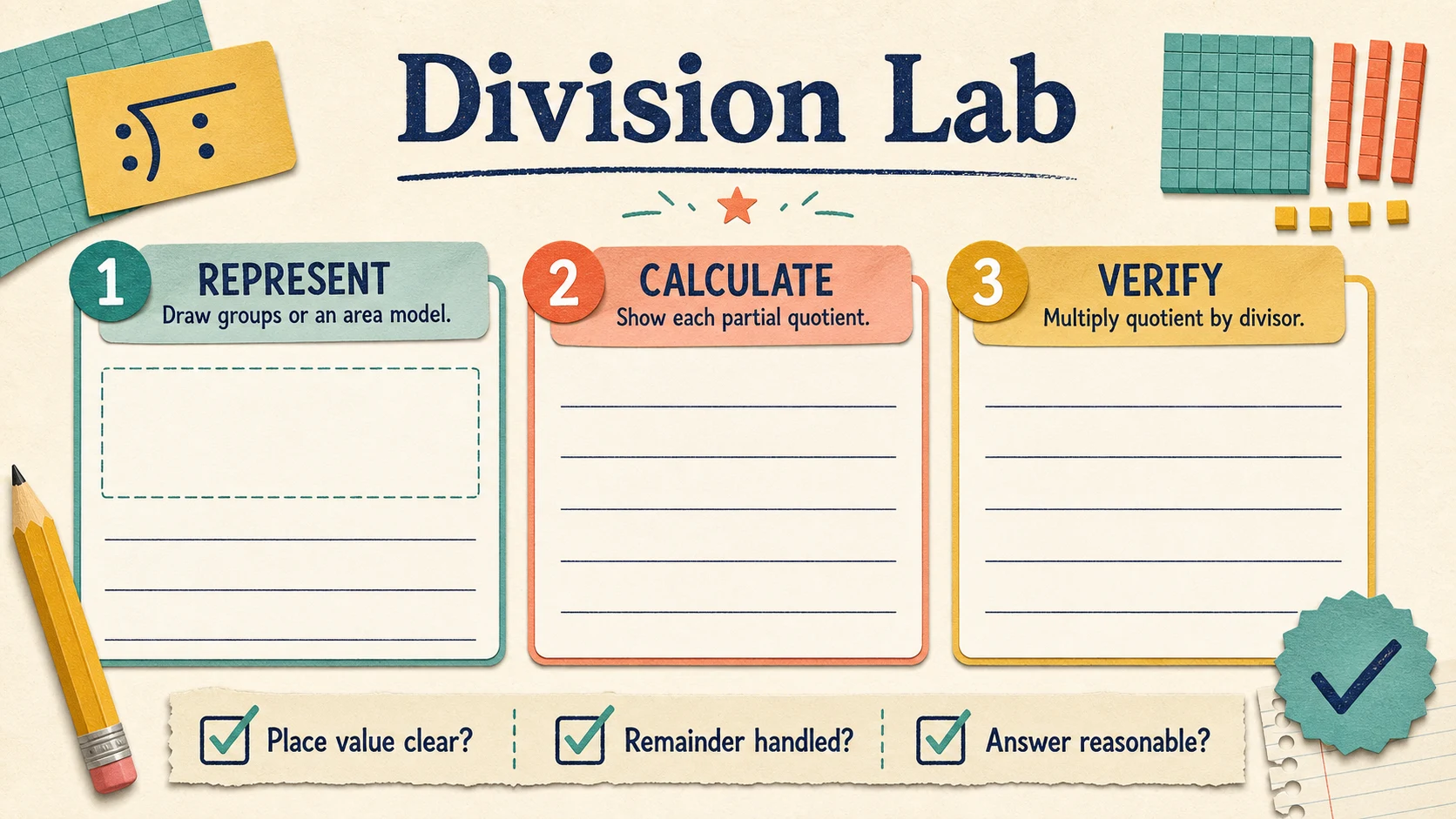
Revisit a small, mixed sample after time has passed and adjust the schedule from the learner’s response.
A practical schedule might look like this:
| Time | Suggested task | Evidence to collect |
|---|---|---|
| First session | Model, guide, and assign 8–12 items | Prompt level, error types, checking habits |
| 1–2 days later | Solve 4–6 unused or previously corrected items | Retention without immediate modeling |
| About one week later | Complete 4 mixed division items | Accuracy, organization, and self-checking |
| About two weeks later | Use a small mixed review set | Whether the procedure remains available among other math work |
This is a suggested plan, not a sourced or universal timetable. If the learner retains the process easily, widen the interval or move forward. If the learner needs the same prompts again, shorten the interval and reteach the narrow point of difficulty. Retrieval should be brief enough that it reveals memory rather than producing exhaustion.
Avoid having the learner memorize the order of answers from the same page. Mix unused worksheet items with adult-created examples, or use the free worksheet generators to create fresh practice when an appropriate division option is available.
Keep the Final Judgment Proportionate
This printable is useful for practice and observation, but it has clear limits. It contains 30 easy-level exercises and focuses on division facts, long division, mental math, number sense, and remainders. It does not, by itself, demonstrate the full range of sixth-grade mathematics, diagnose a learning condition, guarantee fluency, or determine a universal instructional pace.
A strong outcome is not simply a completed page. Look for a learner who can:
- Explain division through a related multiplication fact
- Keep quotient digits aligned with place value
- Carry out the long-division process accurately
- Report a remainder smaller than the divisor
- Reconstruct the dividend through multiplication and addition
- Notice when an answer is unreasonable
- Complete a later sample with less support
The honest next step is to print the free 30-item worksheet and answer key, assign only the first useful section, and record the learner’s first repeated error. Use that evidence to choose either focused reteaching, spaced review, or the next activity in the 6th Grade Division topic guide.
Put it into practice
Use the guide with a real printable
Move from explanation to a short, observable practice task. Check the first item together, then adjust the next session from the learner's actual work.
See the 18-worksheet pack