Complete guide
How to teach and practise 6th grade decimals worksheets - standard theme (easy)
How to use this 30-item decimal worksheet
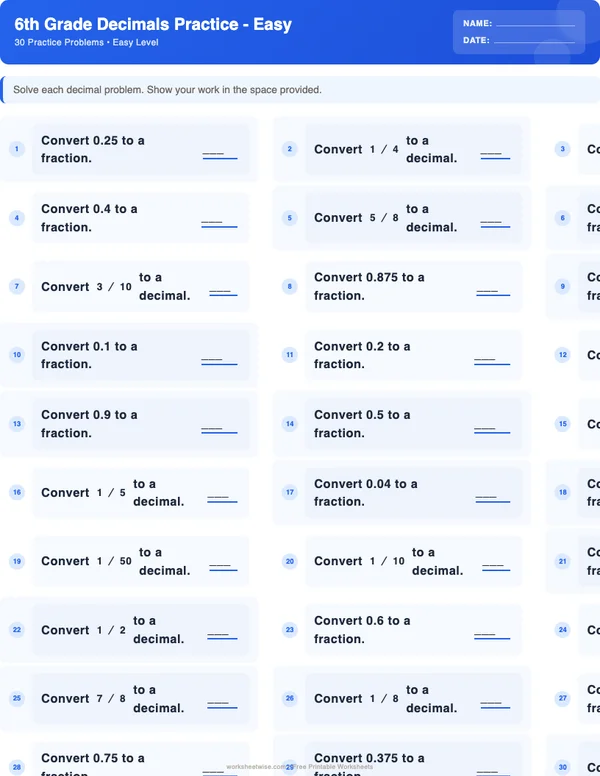
The free 6th Grade Decimals worksheet provides 30 easy-level exercises involving fraction-decimal conversion, decimal addition, subtraction, multiplication, and number sense. A separate printable answer key is included.
For a practical first session, model one problem, solve two or three together, and then assign a short independent set. Do not require all 30 items at once unless the learner’s work shows that the amount is appropriate. Accuracy, written reasoning, and the kinds of errors made should determine whether to continue, pause for another example, or schedule a shorter review.
This guide gives a lesson sequence for this particular printable. For a broader explanation of decimal place value, comparison, rounding, conversion, and all four operations, use the 6th Grade Decimals topic guide.
Grade labels describe the intended practice level; local curricula and teaching sequences differ. The worksheet’s grade label should therefore guide selection, not replace observation of what the learner can currently explain and do.
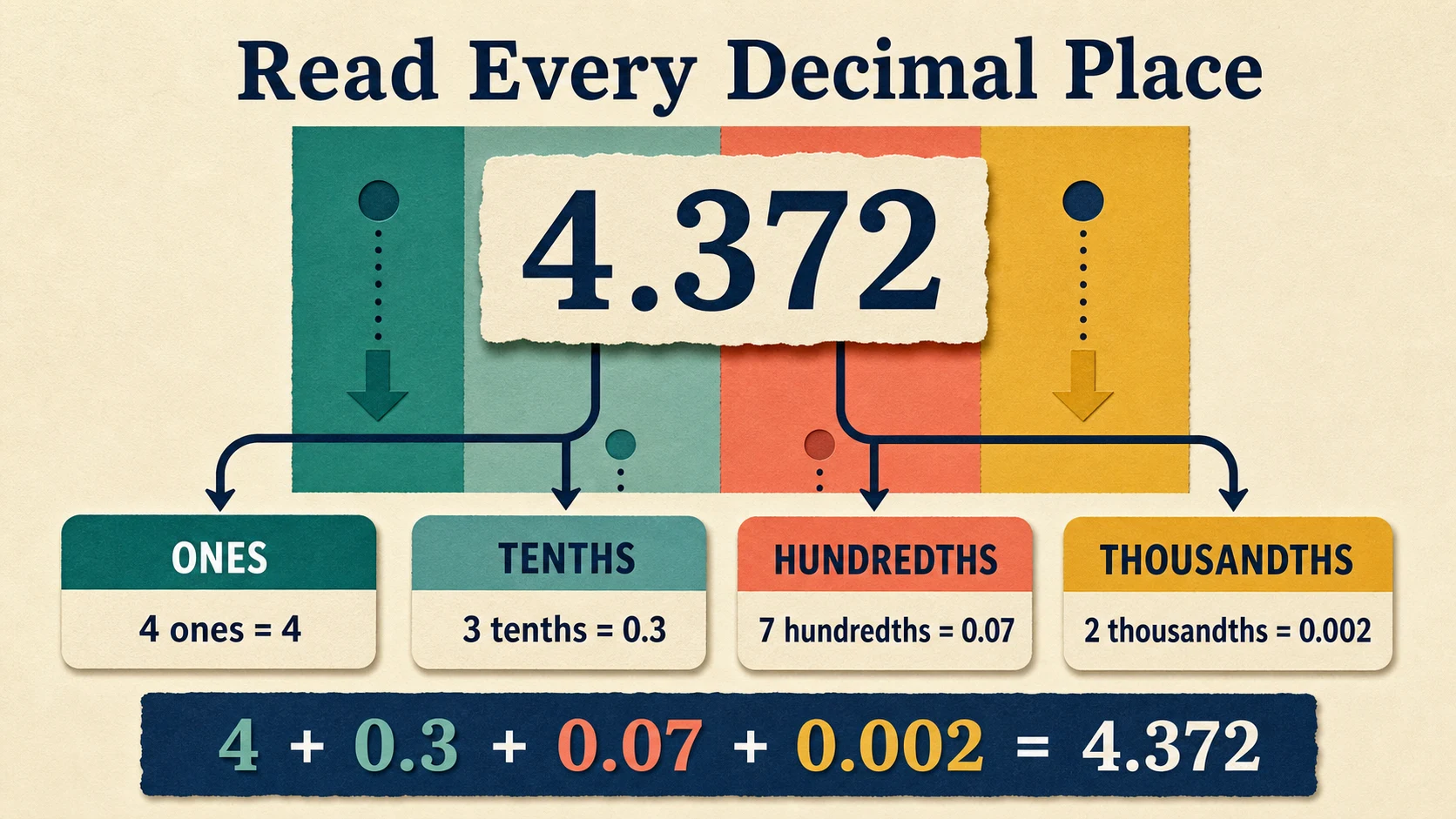
Move from a brief readiness check to modeling, guided work, independent practice, feedback, and later retrieval.
What this worksheet does—and does not—cover
The printable targets foundational decimal practice through four stated areas:
- Decimal operations
- Fraction-decimal conversion
- Addition and subtraction of decimals
- Multiplication of decimal numbers
- Number sense
Its directions are simple: solve each decimal problem and show work in the space provided. That makes the page suitable for classroom practice, homework, tutoring, or homeschool instruction. The easy difficulty level may also be useful when a learner is beginning decimal work or needs reinforcement.
The worksheet is not described as a complete decimal unit. Its catalogue scope does not include a promise that every decimal concept or every possible problem form appears. In particular, the description names conversion, addition, subtraction, and multiplication; it does not identify decimal division as part of this printable. Do not treat performance on these 30 items as a comprehensive measure of decimal understanding.
The broader catalogue progression includes reading and writing decimals, place value, comparison, rounding, fraction-decimal relationships, and decimal computation. Those areas are organized in the Decimals topic guide, while additional sixth-grade math materials can be found in the 6th Grade Math collection.
The Common Core mathematics materials identify fluent computation with multi-digit decimals as part of Grade 6 number-system work. They also emphasize both procedural skill and mathematical understanding. That provides useful high-level context, but it does not establish comprehensive alignment for this individual printable. Consult the Common Core State Standards for Mathematics and any applicable local requirements when planning a full course.
Prepare the learner and the materials
Print the worksheet and keep the answer key out of sight during initial work. Provide a pencil, eraser, and a separate sheet of paper if the printed workspace is not enough. Optional supports include a place-value chart, a hundredths grid, or base-ten materials in which a chosen whole is divided into tenths and hundredths.
Before teaching, scan the worksheet yourself. Notice where the problem type changes, how much workspace is available, and which items would make useful stopping points. Because the catalogue describes a mix of skills, a learner may handle one kind of item easily and need support with another.
Run a short readiness check
Use three oral or written prompts before beginning:
- “What value does the 6 have in 4.63?”
- “Which is greater, 0.4 or 0.36? Explain.”
- “How would you write thirty-seven hundredths as a decimal?”
Expected reasoning:
- In 4.63, the 6 represents six tenths, or 0.6.
- Since 0.4 equals 0.40, it is greater than 0.36.
- Thirty-seven hundredths is , or 0.37.
These prompts are an instructional suggestion, not part of the supplied worksheet. Their purpose is to reveal whether the learner can use place value before beginning the computation.
If all three explanations are clear, move quickly to the modeled problem. If the learner relies only on rules or guesses, briefly review tenths and hundredths. If the learner cannot yet identify those places, postpone the full page and use a representation first.
Establish a working routine
Ask the learner to use the same four-part routine throughout the page:
- Identify the operation or conversion.
- Represent the place values accurately.
- Calculate and show enough work to inspect.
- Check whether the answer is reasonable.
For addition and subtraction, “represent the place values” usually means aligning decimal points and adding placeholder zeros when useful. For multiplication, it means estimating the size of the product before fixing the decimal point. For conversion, it means connecting the fraction’s denominator to decimal places.
Use a flexible lesson progression
The sequence below is a practical plan for this printable, not a universal timetable or a schedule prescribed by the cited sources. Shorten, extend, or divide it across days according to the learner’s observed work.
| Phase | Suggested use | Adult’s role | Evidence to notice |
|---|---|---|---|
| Readiness | Three quick place-value prompts | Listen to explanations without supplying rules immediately | Place-value language, comparison reasoning, fraction-decimal connection |
| Model | One complete example | Think aloud and show the checking step | Whether the learner follows why each step is used |
| Guided practice | Two or three worksheet items | Prompt, question, and fade help | Whether prompts are still needed |
| Independent practice | A manageable run of items | Observe without correcting every line immediately | Accuracy, work shown, hesitation, repeated error patterns |
| Review | Discuss selected correct and incorrect items | Ask for explanation before revealing the key | Whether the learner can locate and repair an error |
| Retrieval | Revisit a few mixed items later | Use fresh examples or selected unsolved items | Whether the method can be recalled without the model |
The IES guide on teaching mathematics to young children applies specifically to preschool, prekindergarten, and kindergarten, not Grade 6. Its high-level emphasis on developmental progression and monitoring what a learner knows is still a useful planning principle: begin with observable understanding and adjust the next instructional step accordingly. It should not be presented as research on this worksheet or this age group.
Model one problem from start to finish
Choose a worksheet item that represents the skill you want the learner to use next. Cover nearby items if they are distracting. Read the problem, name the relevant place values, write each step, and check the result.
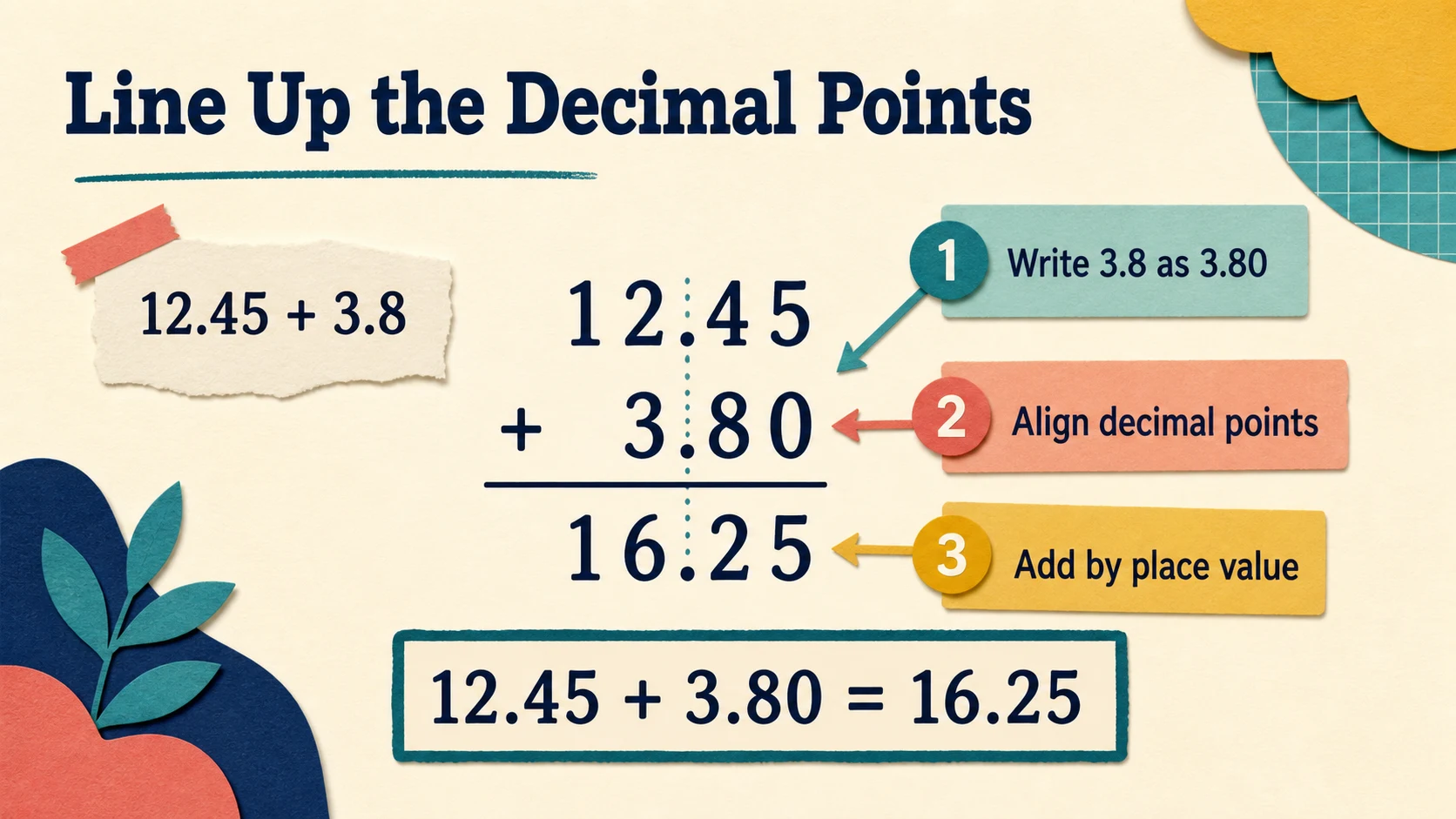
The model should make the place-value decision and the checking step visible.
Worked example 1: Convert a fraction to a decimal
Convert:
A denominator of 100 divides one whole into hundredths. The numerator gives the number of those parts, so 37 hundredths is written with 37 in the hundredths position:
Check by expanding the decimal:
Convert three tenths to hundredths:
Then:
The conversion is correct.
A concise think-aloud might be: “The denominator is 100, so I need two decimal places. Thirty-seven hundredths is 0.37. I can check by expanding it back into thirty hundredths plus seven hundredths.”
Do not extend the rule to every possible denominator. This example verifies a denominator of 100. Fractions with other denominators may require a different method.
Run guided practice before independent work
After modeling, solve two or three actual worksheet items with the learner. Let the learner make the first decision. Ask focused prompts instead of narrating every move:
- “Which place values must line up?”
- “Would a placeholder zero make the columns clearer?”
- “Should the answer be greater or less than the starting number?”
- “About how large should the product be?”
- “How can you check that result with an inverse operation or a second representation?”
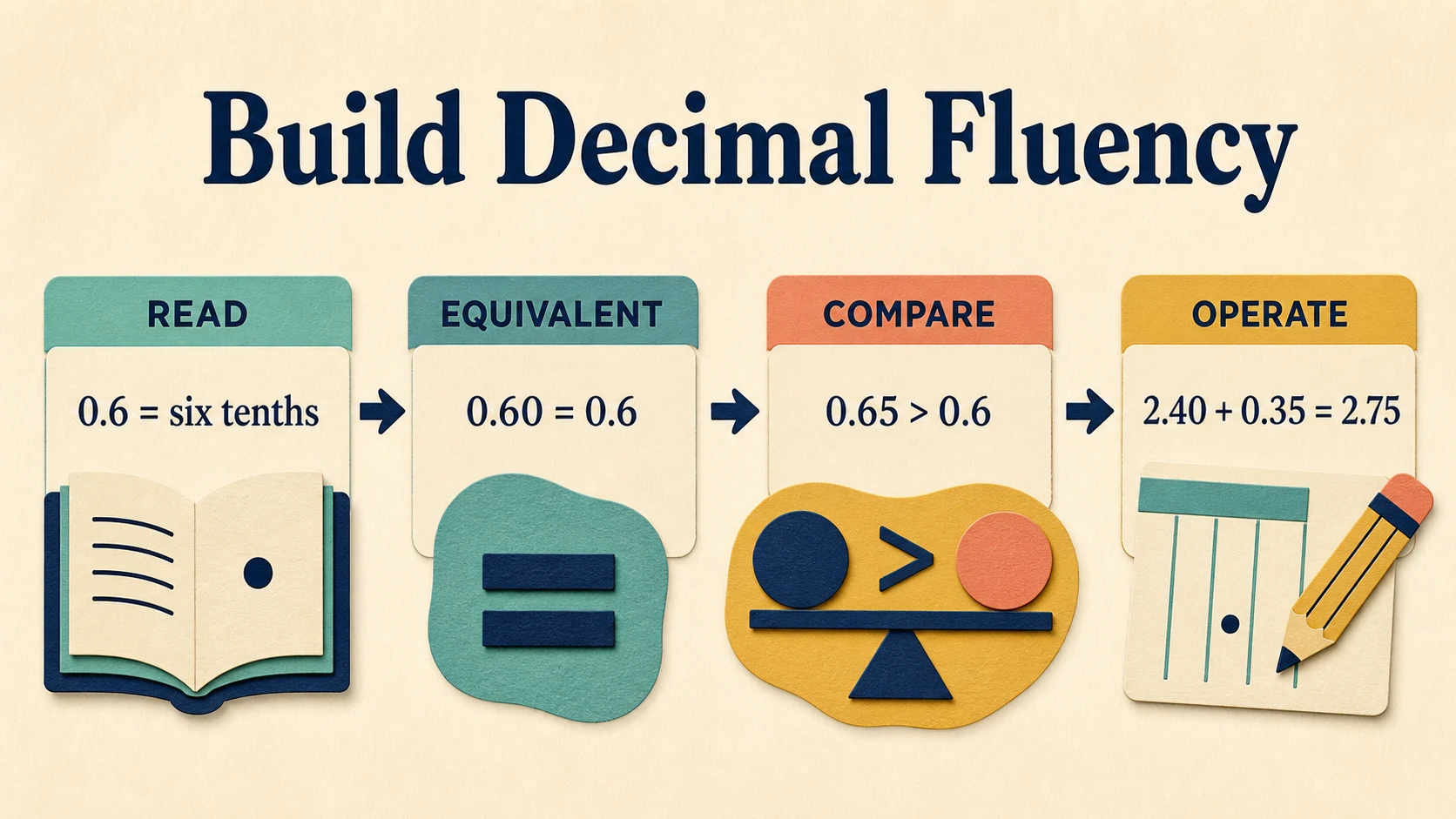
Begin with visible support, then reduce prompts as the learner shows control of the method.
The IES guide for assisting students struggling with mathematics covers Grades K–6 and recommends high-level practices including systematic instruction, clear mathematical language, carefully chosen representations, and number lines. Those recommendations support the general use of explicit modeling and representations here. The guide did not evaluate WorksheetWise or this particular printable.
Worked example 2: Add decimals with unlike lengths
Calculate:
Write 4.7 as 4.70 so that tenths and hundredths are visible:
  4.70
+ 2.35
------
  7.05
Column check:
- Hundredths:
- Tenths: tenths, so write 0 tenths and regroup 1 whole
- Ones:
Therefore:
Check with subtraction:
An estimate also supports the result:
The exact answer, 7.05, is close to 7.1.
Worked example 3: Subtract across a placeholder zero
Calculate:
Write 6.2 as 6.20:
  6.20
- 0.85
------
  5.35
Regroup carefully. Twenty hundredths cannot lose 85 hundredths without exchanging across the place values. The completed difference is:
Check using addition:
A magnitude check also works. Subtracting a positive number from 6.2 must produce a number below 6.2, and subtracting slightly less than 1 should give a result slightly above 5.2. The answer 5.35 meets both conditions.
At this point, ask the learner to explain why the zeros in 4.70 and 6.20 did not change the values. A useful explanation is that adding zeros to the right of the final decimal digit does not change the represented amount: 4.7 and 4.70 both mean four wholes and seven tenths.
Move into independent practice carefully
Do not announce that help is over. Instead, say, “Try the next set using the same routine. Mark any item where you are unsure.” This preserves independence while allowing uncertainty to be visible.
A reasonable first independent set might be five to eight items, but the learner’s work should control the amount. Stop earlier if errors repeat or written organization deteriorates. Continue if the learner is accurate, explains the work, and remains attentive. The number of problems completed is less informative than what the work reveals.
During independent work, record observations without interrupting every error:
- Does the learner identify the operation correctly?
- Are decimal points aligned for addition and subtraction?
- Are placeholder zeros used meaningfully?
- Is the product estimated before decimal placement?
- Does the learner distinguish tenths from hundredths?
- Is work shown consistently enough to diagnose mistakes?
- Does the learner check an answer without being reminded?
Intervene immediately only when continued work would rehearse the same misunderstanding repeatedly. For an isolated arithmetic slip, allow the learner to complete the set and return to it during review.
Worked example 4: Multiply two decimals
Calculate:
First estimate the size. Three tenths of 2.4 must be less than 2.4, and it should be near three tenths of 2, or 0.6.
Temporarily multiply as whole numbers:
The factors contain two decimal places altogether: one in 2.4 and one in 0.3. Place the decimal two positions from the right:
Check by writing the factors as fractions:
Then:
The fraction check and the estimate both support the answer.
This example shows why counting decimal places should not be the only check. If a learner wrote 7.2, the whole-number digits would still be 72, but the estimate would expose that 7.2 is too large.
Adapt support without changing the mathematical skill
Adaptations should make the intended reasoning more accessible, not replace it with an easier skill. For example, a place-value chart can support decimal addition while the learner still completes decimal addition. Changing every decimal problem into whole-number computation would change the target.
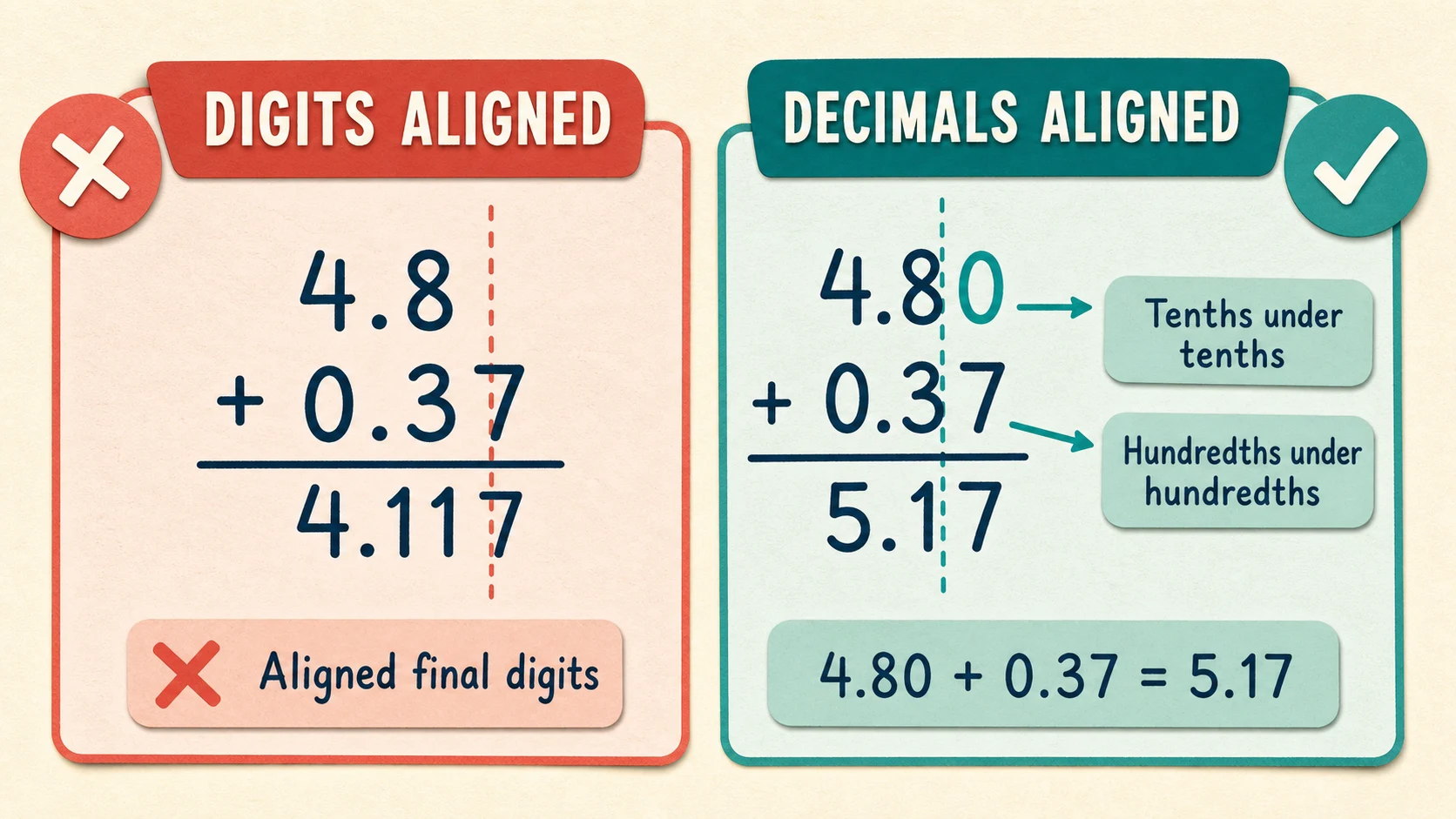
Adjust the amount, representation, or prompting while preserving the decimal task.
When the learner needs more structure
Use one or more of these supports:
- Assign three items at a time and review before continuing.
- Highlight the decimal point in each number with the same light color.
- Draw a place-value chart labeled ones, tenths, and hundredths.
- Let the learner rewrite horizontal problems vertically.
- Provide a completed model beside the first similar item.
- Ask the learner to state an estimate before calculating.
- Use a hundredths grid or base-ten representation for a selected conversion or comparison.
Fade each support when it is no longer needed. For example, after two correctly aligned addition problems, remove the highlighted columns and ask the learner to create the alignment independently.
When the learner is accurate but slow
Do not assume that speed alone signals a conceptual problem. Look at the work. If the method is correct but laborious, use a shorter set and ask the learner to explain one representative item. Later, revisit the same kind of task without the model.
A timer is not required by this worksheet. If timing is used for a specific fluency purpose, it should not replace inspection of reasoning or become the only measure of progress.
When the learner finishes easily
Ask for stronger checking rather than simply adding more of the same:
- Verify one addition with subtraction.
- Verify one subtraction with addition.
- Estimate a product before calculating it exactly.
- Explain why adding a trailing zero does not change a decimal.
- Create a fraction with denominator 100 that equals a given decimal.
These extensions preserve the listed decimal skills. If the learner consistently handles them, move to broader or more varied decimal practice rather than repeating the easy page indefinitely.
Teach the boundary cases explicitly
Some decimal errors occur when a familiar shortcut is used outside its valid boundary. Brief examples can make those boundaries visible.
A longer decimal is not automatically larger
Compare:
Rewrite 0.4 as 0.40:
Therefore:
The learner who chooses 0.36 because 36 is greater than 4 is comparing the digits as whole numbers rather than comparing decimal place values.
A whole-number-looking decimal keeps its value
These expressions are equal:
The zeros show precision to different decimal places, but they do not change the amount represented. This fact permits clear alignment:
  3.00
- 0.47
------
  2.53
Check:
A product can be smaller than both positive factors
For:
the exact result is:
The product is smaller than both 0.6 and 0.4 because the calculation finds four tenths of six tenths. The whole-number expectation that multiplication always makes numbers larger does not apply when multiplying positive numbers less than 1.
Interpret mistakes before correcting them
A wrong answer is useful only when connected to the work that produced it. Ask the learner to explain the first step, then locate the earliest point where the reasoning changed direction.
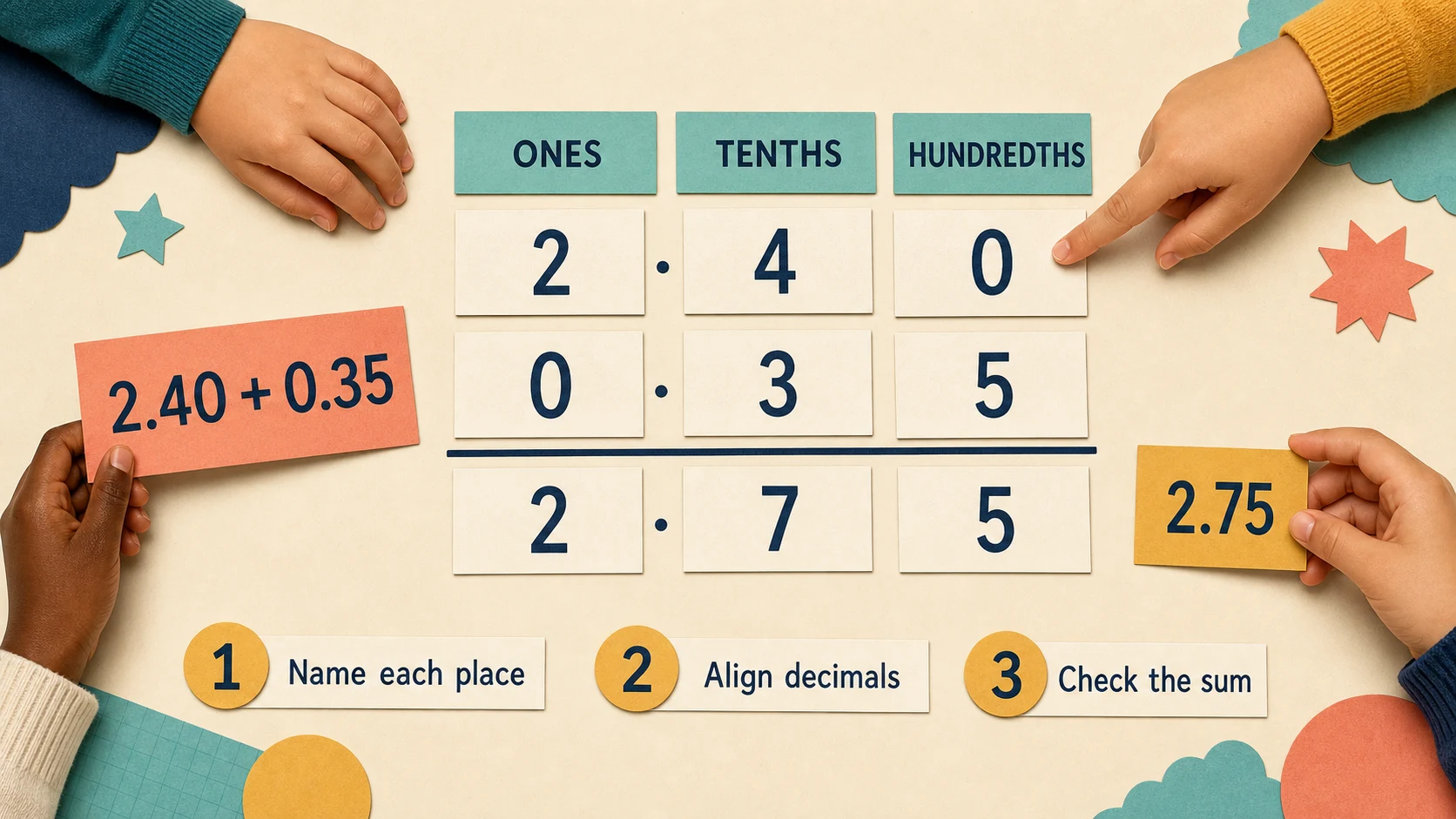
Identify the error type, repair one representative item, and then test the corrected method on a fresh item.
| Observed work | Possible interpretation | Useful response |
|---|---|---|
| Digits were compared as whole numbers | Rewrite 0.4 as 0.40 and compare tenths first | |
| Decimal points are staggered in addition | Digits were aligned by their right edges | Label place values and realign decimal points |
| or similar | Regrouping across the decimal was not organized | Rewrite 6.2 as 6.20 and model the exchange |
| Whole-number multiplication was completed without a magnitude check | Estimate first and verify with fractions | |
| Hundredths were placed in the thousandths position | Mark two places to the right of the decimal | |
| Correct answer with no visible method | Understanding cannot yet be distinguished from guessing or mental work | Ask for an oral explanation or a written check |
These are interpretations to test, not diagnoses. The same written answer can arise from different reasoning. Ask, “Show me how you decided,” before selecting a correction.
Correct one representative error together. Then give a fresh, closely related example. If the new example is correct and explainable, return to the worksheet. If the same error remains, step back to a place-value representation rather than repeating the rule louder or assigning a large block of similar problems.
Use the answer key responsibly
The separate printable answer key is designed for efficient checking, but it should confirm results rather than replace mathematical review.
A sound routine is:
- Have the learner complete the agreed independent set.
- Ask the learner to check two selected answers without the key.
- Compare answers with the key.
- Mark discrepancies without immediately writing the correct method.
- Rework one item from each apparent error type.
- Use a new example to see whether the correction transfers.
When an answer differs from the key, recalculate independently. Check signs, copied digits, decimal placement, and the operation. If your calculation still differs, avoid forcing the learner’s work to match blindly; verify the item again.
A matching answer does not prove that the reasoning was sound. A learner might make two compensating mistakes, guess correctly, or copy inaccurately and still land on the listed value. Conversely, an incorrect final digit may follow otherwise sound decimal reasoning. Inspect the work before deciding what needs reteaching.
Avoid turning every correction into an erased, invisible mistake. Keeping the original attempt legible and placing the repair nearby makes the change in reasoning easier to discuss.
Decide what should happen next
Sort the completed work by skill rather than relying only on a total score. Use four informal categories:
- Secure: accurate work plus a clear explanation or valid check
- Developing: mostly correct work with occasional prompts or arithmetic slips
- Misunderstood: repeated place-value, conversion, or decimal-placement errors
- Not observed: too few relevant items completed to make a decision
If conversion is secure but multiplication is misunderstood, there is no need to reteach every topic on the page. Model decimal multiplication again, use a representation or fraction check, and assign a small fresh set. If several skills show place-value errors, return to tenths and hundredths before continuing mixed computation.
If work is secure across the represented skills, choose more varied practice from the 6th Grade Decimals Worksheet Pack, which contains 18 worksheets and is listed at $4.79. The pack is an option for additional practice, not evidence that every learner needs 18 more pages.
If the worksheet is too broad, use the free worksheet generators to create a more focused follow-up. Keep the target narrow enough to reveal whether the learner repaired the specific error.
Schedule retrieval from observed performance
Retrieval means asking the learner to recall and use a method after some time has passed and the model is no longer directly in view. The following schedule is a flexible instructional suggestion, not a universal timetable.
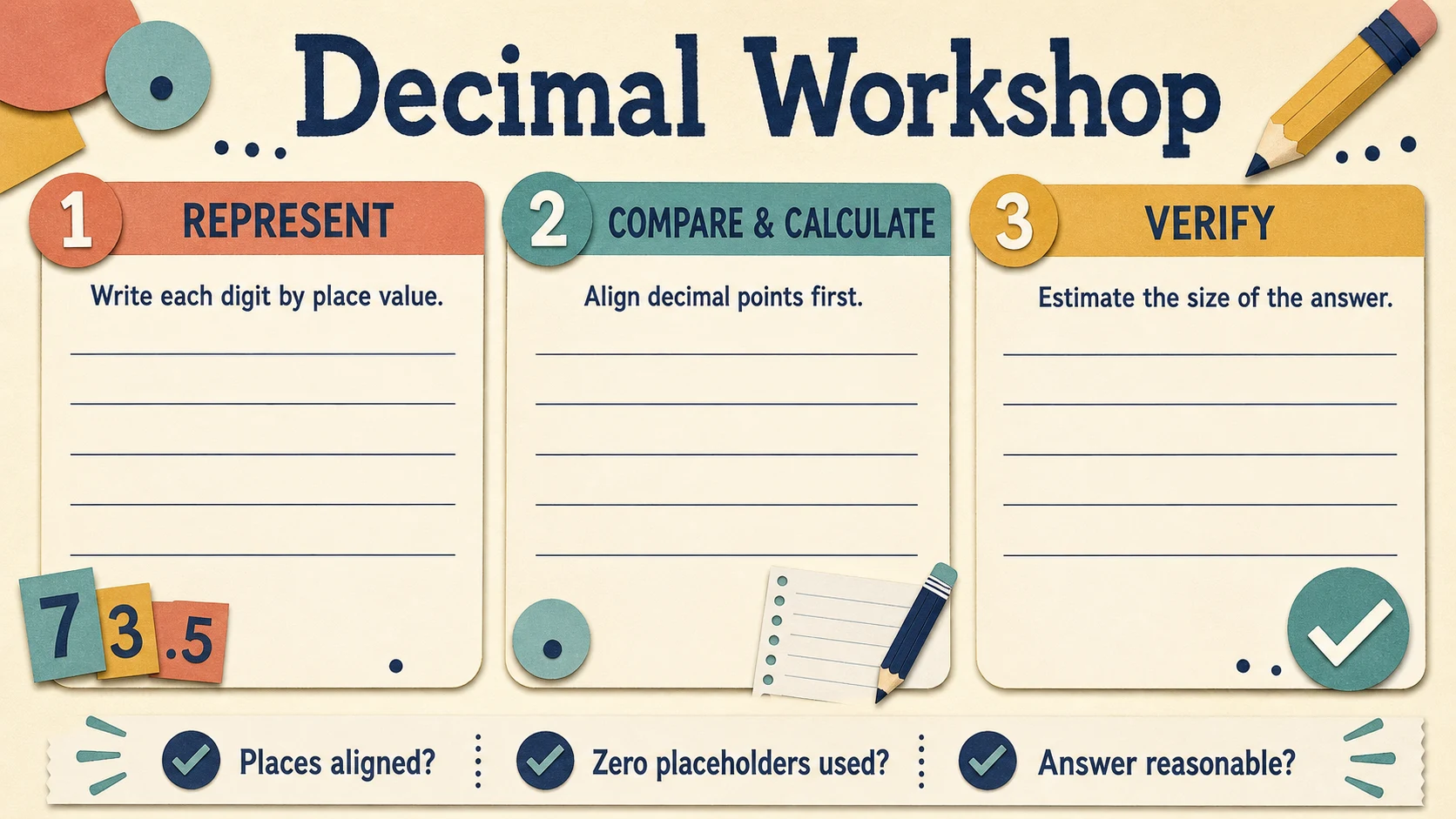
Revisit a small mix after a delay, then lengthen or shorten the interval according to the learner’s work.
- Later the same day or next session: revisit two corrected items using fresh numbers.
- Two or three days later: complete three mixed prompts—one conversion, one addition or subtraction, and one multiplication.
- About one week later: solve four mixed items without the original model.
- In a later decimal lesson: include one prior skill alongside the new work.
At each review, ask for at least one check or explanation. If the learner recalls the method accurately, increase the interval. If the same misconception returns, shorten the interval and restore a representation or model. If only an arithmetic slip appears, a full conceptual lesson may not be necessary.
Do not save all review until the entire worksheet is finished. A learner who completes only part of the page can still retrieve the skills already practiced.
Keep the conclusions appropriately limited
This worksheet can provide useful evidence about performance on its 30 easy-level exercises. It cannot by itself establish complete decimal mastery, predict later achievement, identify a learning condition, or show how the learner performs across every curriculum.
The answer key supports checking, but it does not replace explanation, observation, or independent recalculation. The suggested examples and lesson schedule in this guide are instructional tools, not claims that a particular sequence will work identically for every learner.
Use the learner’s written work to choose the next action: continue when reasoning is accurate, narrow the task when one skill needs repair, or return to the broader decimal guide when the difficulty reflects a missing earlier concept. Then open the free 6th Grade Decimals worksheet, select the first manageable set, and begin with one fully modeled item.
Put it into practice
Use the guide with a real printable
Move from explanation to a short, observable practice task. Check the first item together, then adjust the next session from the learner's actual work.
See the 18-worksheet pack