Complete guide
How to teach and practise 6th grade sentence structure worksheets - standard theme (easy)
How to Use the 6th Grade Sentence Structure Worksheet
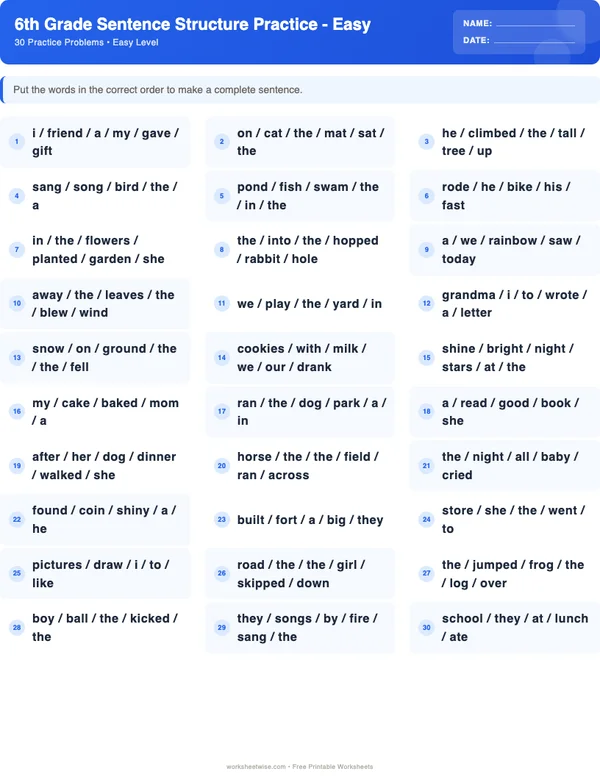
The free 6th Grade Sentence Structure worksheet gives a learner 30 easy-level items in which scrambled words must be placed in the correct order to form complete sentences. Use it as focused practice in word order, sentence formation, syntax, and grammar—not as a complete assessment of sentence-structure knowledge.
The most effective launch is brief: model one item aloud, solve two or three items together, and then let the learner attempt a manageable group independently. Check whether the learner can use every supplied word, locate a likely subject and predicate, produce a coherent thought, and reread the result naturally. The learner’s observed work—not the grade label or a fixed timetable—should determine how quickly support is removed.
Grade labels describe an intended practice level. Local curricula, school sequences, and individual experience differ. A sixth grader may use this worksheet for an introduction, review, or extra reinforcement.
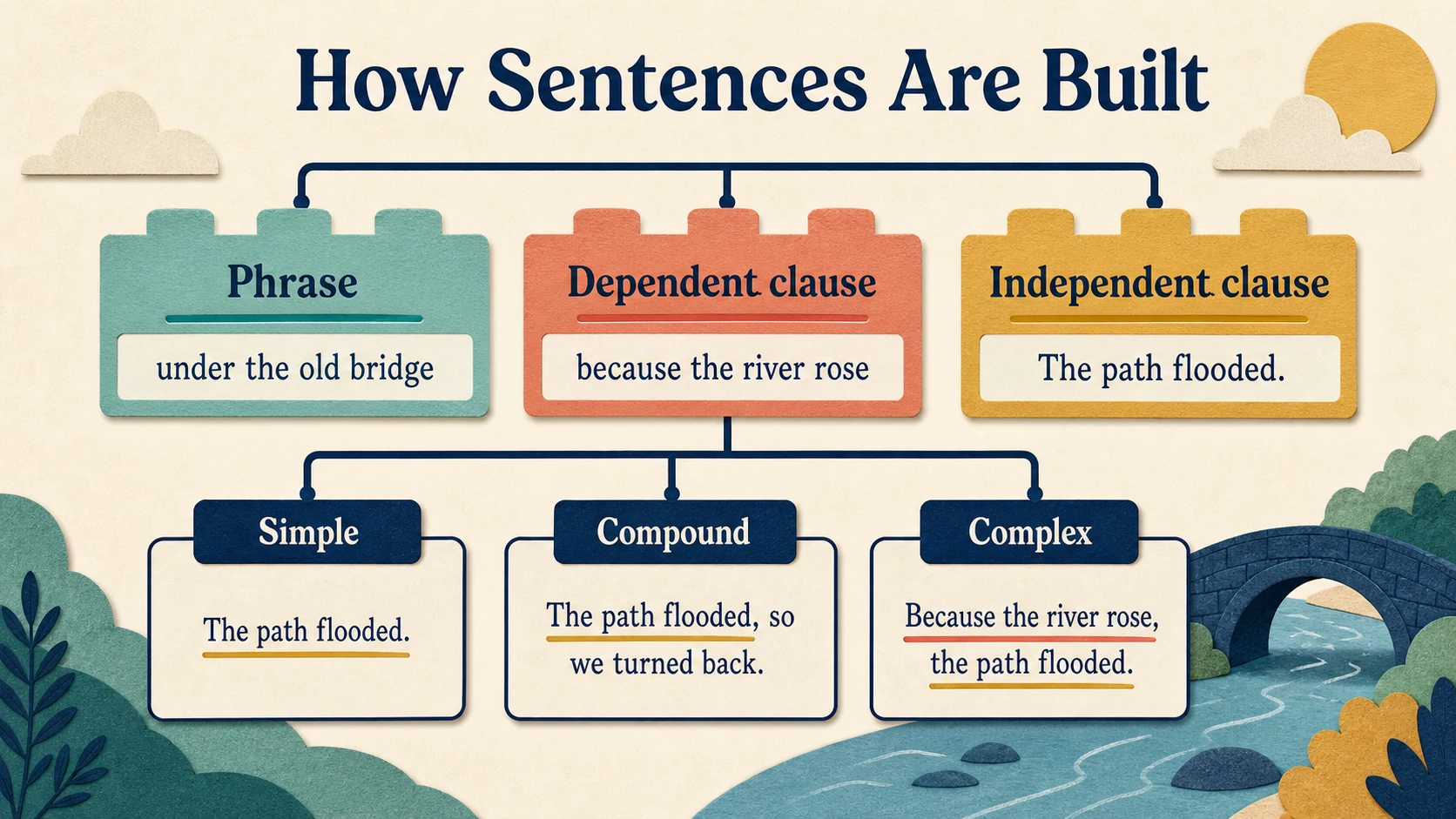
Move from a quick launch to modeling, guided practice, independent work, checking, and later retrieval.
What This Printable Practices
The instruction is precise: “Put the words in the correct order to make a complete sentence.” Each item therefore asks the learner to reconstruct a sentence rather than generate one from scratch.
Success requires several connected decisions:
- Which word or phrase can act as the subject?
- Which word expresses the action or state?
- Which words belong together as a phrase?
- Where do details such as time, place, or manner fit?
- Does the final order communicate a complete, sensible thought?
- Were all supplied words used exactly once?
This is narrower than the full topic of sentence structure. The printable does not, by itself, establish that a learner can independently write varied simple, compound, and complex sentences; diagnose every fragment or run-on; or control sentence style in a paragraph. For that broader sequence, use the Sentence Structure topic guide.
The worksheet is also described as easy-level practice. That makes it suitable for a learner beginning this form of sentence work or needing reinforcement, but “easy” should not be treated as a judgment about the learner. A task can be difficult because of unfamiliar vocabulary, working pace, reading demands, or uncertainty about how to begin.
The IES elementary writing practice guide includes sentence construction among the foundational writing skills educators can teach. That is useful high-level context for giving sentence-level practice a clear place within writing instruction. The guide did not evaluate WorksheetWise or this particular printable.
Prepare a Short, Observable Lesson
Before handing over all 30 items, decide what successful work will look and sound like. For this worksheet, a useful target is:
Arrange every supplied word into a complete, grammatical sentence and explain one clue that helped determine the order.
The explanation matters because a correctly guessed arrangement does not reveal much about the learner’s reasoning. A short statement such as “I put the hikers first because that is who performed the action” gives the adult evidence to use when choosing the next step.
A practical lesson progression
| Phase | Suggested use | What the adult watches for |
|---|---|---|
| Preview | Read the direction and inspect one item | Does the learner understand that words are reordered, not replaced? |
| Model | Adult thinks aloud through one example | Can the learner follow subject, verb, and meaning clues? |
| Guided practice | Solve two or three examples together | Which prompts help without giving the full answer? |
| Independent practice | Assign a small group of worksheet items | Can the learner start, complete, and reread without prompting? |
| Review | Compare responses with the answer key | Are errors random or part of a pattern? |
| Transfer | Write or revise one original sentence | Can the learner use the same reasoning outside scrambled-word work? |
| Retrieval | Revisit a few items later | Is the process still available after a delay? |
This is an instructional suggestion, not a universal schedule. A learner who solves the first group accurately and explains the order may continue. A learner who becomes less accurate, stops rereading, or repeatedly omits words should pause for guided work.
Materials and setup
Print the worksheet and keep the separate answer key out of sight during the initial attempt. Have a pencil and, if useful, colored pencils or scrap paper available. The learner can underline a possible subject once and circle a likely verb once. Avoid turning every item into a heavily marked diagram; the markings should clarify the decision, not replace it.
For homeschool or tutoring use, one short sitting may be enough for part of the page. In a classroom, the worksheet can follow a sentence mini-lesson, serve as guided practice, or provide independent review. The catalogue also identifies homework as an appropriate use, but send only an amount the learner can approach with the procedure already modeled.
Model the Task Without Solving the Whole Page
A strong model makes the invisible decisions visible. Do not merely read the finished sentence. Show how to test an arrangement and reject one that does not work.
Use a repeatable think-aloud
For an item similar in form to the worksheet, suppose the words are:
quickly / the river / crossed / the hikers
Think aloud:
- “I will first look for the action. Crossed is the verb.”
- “Who crossed? The hikers can be the subject.”
- “They crossed what? The river completes that part of the meaning.”
- “Quickly tells how they crossed, so I can place it after the main sentence.”
- “My sentence is: The hikers crossed the river quickly.”
- “I used every supplied word once. It has a subject and a predicate, and it communicates a complete thought.”
That model teaches a process: find an anchor, build a likely core, place details, and verify.
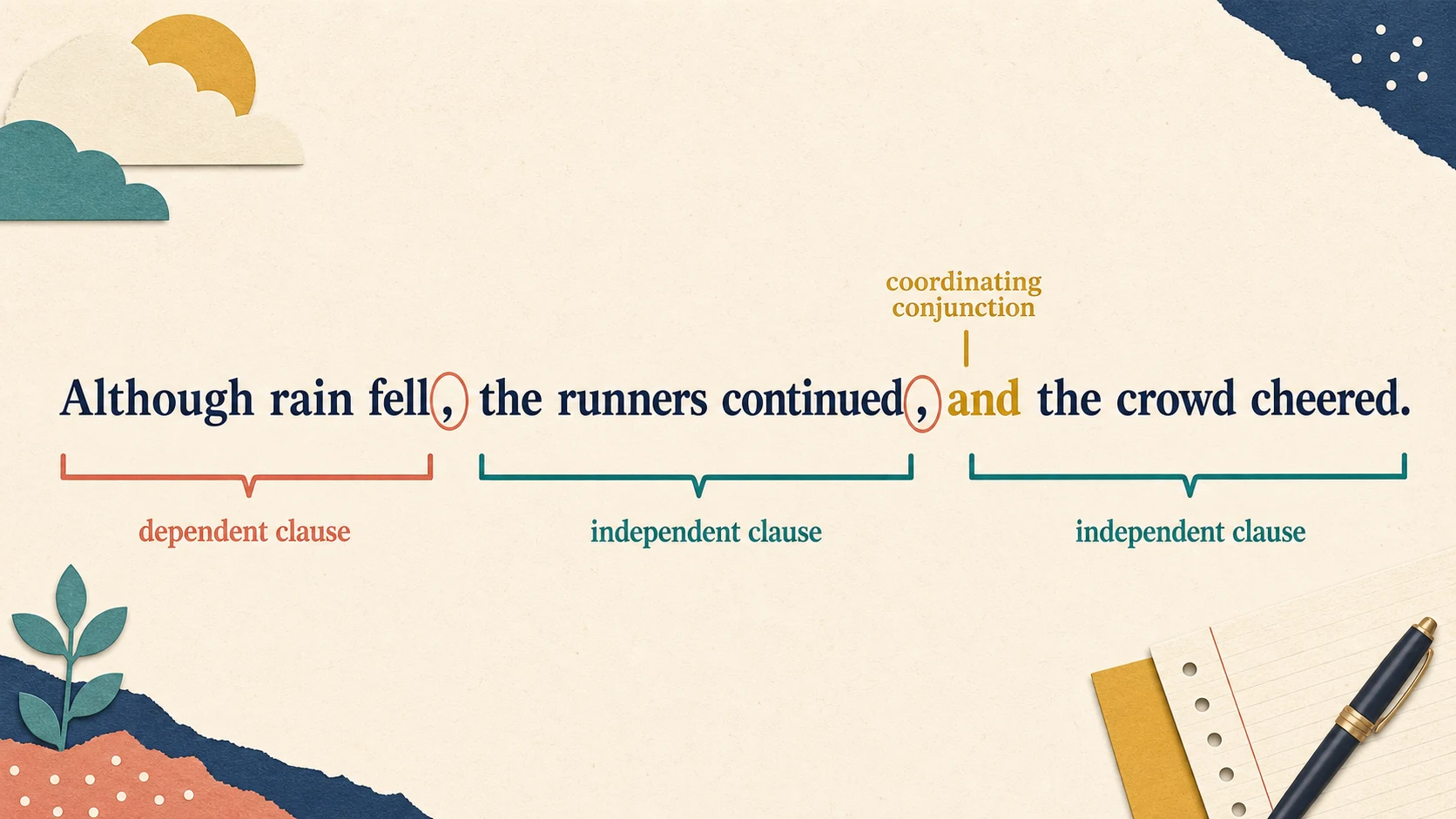
Build the sentence around a likely subject and verb, then confirm meaning and completeness.
Do not imply that this example appears on the printable; it is a fully checked example of the same task type. Also avoid supplying extra words merely to make an arrangement easier. The target skill is organizing the words provided.
Work Through Four Fully Checked Examples
These examples can be used before or alongside the printable. They have been checked for word use, grammar, completeness, and coherent meaning.
Example 1: Establish the basic subject–verb pattern
Scrambled words:
the library / visited / Maya / after school
Correct arrangement:
Maya visited the library after school.
Check:
- Subject: Maya
- Verb: visited
- What Maya visited: the library
- Time phrase: after school
- All supplied words used once: yes
- Complete thought: yes
A learner might first write “After school Maya visited the library.” That is also a grammatical arrangement if capitalization and punctuation are handled appropriately. If the answer key presents the first version, do not automatically treat the second as evidence of faulty syntax. Compare the exact supplied tokens and determine whether the alternative uses all of them and preserves a natural meaning.
Example 2: Keep a phrase together
Scrambled words:
under the old bridge / flowed / the water
Correct arrangement:
The water flowed under the old bridge.
Check:
- Subject: the water
- Verb: flowed
- Place phrase: under the old bridge
- All words used once: yes
- Complete thought: yes
“Under the old bridge flowed the water” can also be grammatical, but it uses an inverted order that is less typical in ordinary prose. For an easy worksheet, the expected answer will usually be the straightforward order. A learner who produces the inverted version may understand the words but need to compare conventional and marked sentence patterns.
Example 3: Coordinate two actions
Scrambled words:
Liam / and / checked the facts / finished his notes
Correct arrangement:
Liam finished his notes and checked the facts.
Check:
- Subject for both actions: Liam
- First verb phrase: finished his notes
- Connector: and
- Second verb phrase: checked the facts
- Complete thought: yes
A common error is “Liam and finished his notes checked the facts.” The learner has noticed the connector but has not identified the units it joins. Ask, “Which two things did Liam do?” That prompt preserves the skill because it directs attention to structure without dictating the full order.
Example 4: Recognize a linking verb
Scrambled words:
on the shelf / three books / are
Correct arrangement:
Three books are on the shelf.
Check:
- Subject: three books
- Verb: are
- Place phrase: on the shelf
- Subject–verb agreement: plural books with are
- Complete thought: yes
A learner searching only for action verbs may overlook are. Explain that a predicate can tell what the subject is or where it is, not only what it does. Then return responsibility: “What is this sentence telling us about the three books?”
Example 5: Place an opening time phrase
Scrambled words:
the team / practiced / before sunrise
Two natural arrangements are:
The team practiced before sunrise.
Before sunrise, the team practiced.
Both contain the same core meaning and all supplied words. The second normally needs a comma after the opening phrase in polished writing. Because the worksheet’s stated task is word order, inspect how punctuation is presented on the actual item before deciding whether the learner was expected to add or relocate punctuation.
This is an important boundary case: word order can permit more than one complete sentence. The answer key is the intended solution, but grammatical alternatives deserve examination rather than mechanical rejection.
Move from Guided to Independent Practice
Guided practice should require the learner to make decisions. If the adult supplies the subject, verb, and final order every time, the learner is copying a solution process rather than using it.
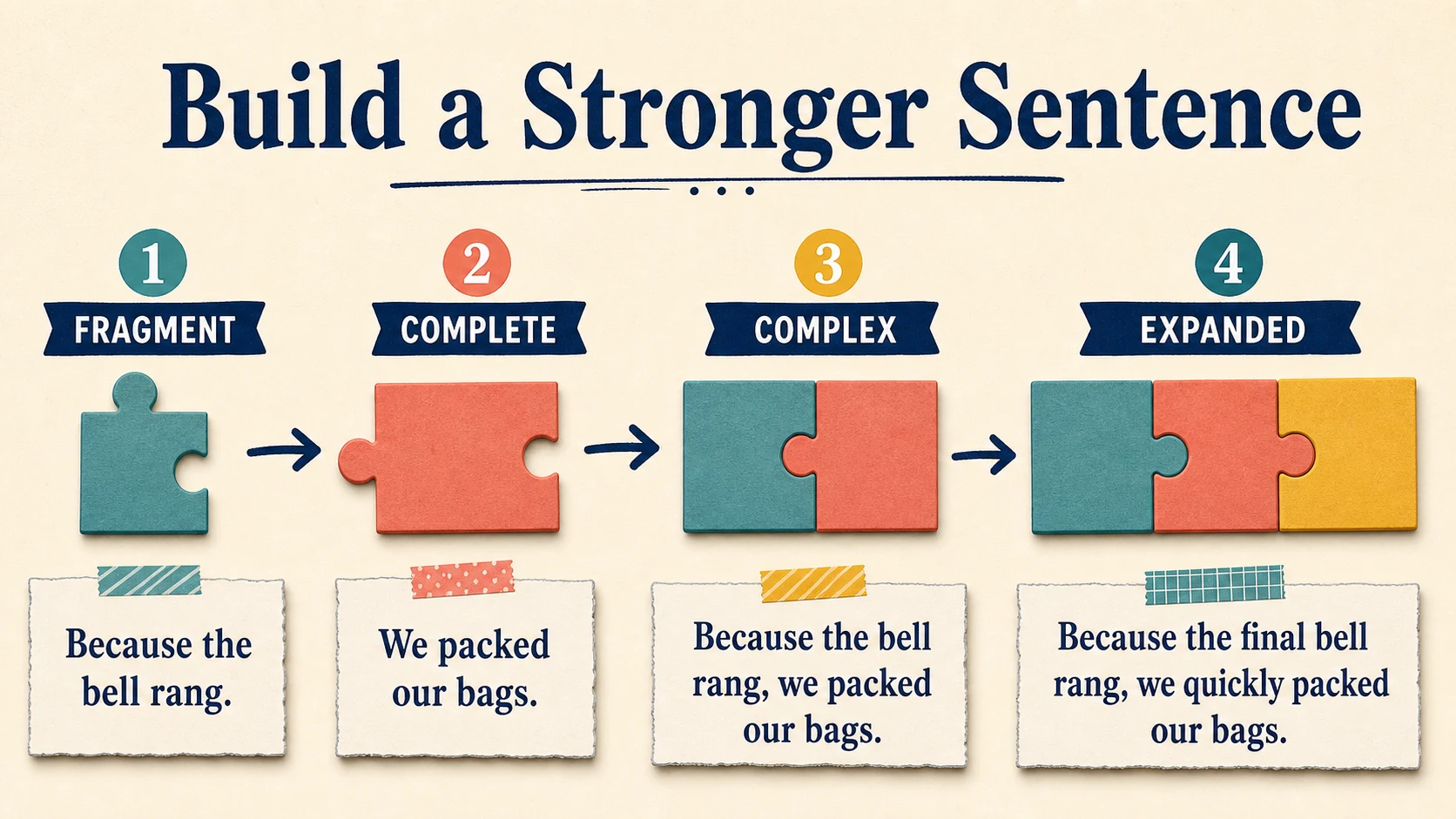
During guided practice, prompts should expose the next decision while leaving the arrangement to the learner.
Use prompts from least to most support
Begin with open prompts:
- “What do you notice?”
- “Which word gives you a starting point?”
- “Read your arrangement aloud. Does it sound complete?”
- “Who or what is this sentence about?”
- “What does that person or thing do, have, or seem to be?”
- “Which words probably need to stay together?”
- “Have you used every word?”
If those are insufficient, narrow the choice:
- “Can you find the verb?”
- “Which of these two groups could be the subject?”
- “Try building just the subject and verb first.”
- “Move the time phrase to the beginning or end. Which sounds more natural?”
Only then model another item. Record the smallest prompt that restores progress. That information is more useful than noting only right or wrong answers.
Choose the size of independent work from evidence
After two or three guided items, give a small uninterrupted set. Five items is a practical starting suggestion, not a rule. Ask the learner to mark any uncertain answer rather than waiting helplessly or seeking confirmation after every line.
Continue when the learner:
- begins without another model;
- uses all supplied words;
- creates complete, natural sentences;
- catches at least some mistakes by rereading; and
- can explain a structural clue.
Return to guidance when the learner repeatedly omits words, relies on word-by-word guessing, cannot locate a likely verb, or produces strings that do not express complete thoughts. Finishing all 30 at once is less important than practicing a usable method.
Adapt Support Without Changing the Skill
An adaptation should preserve the central demand: the learner must determine a workable word order. Rewriting the sentences for the learner, removing most choices, or allowing the answer key during construction would change that demand substantially.
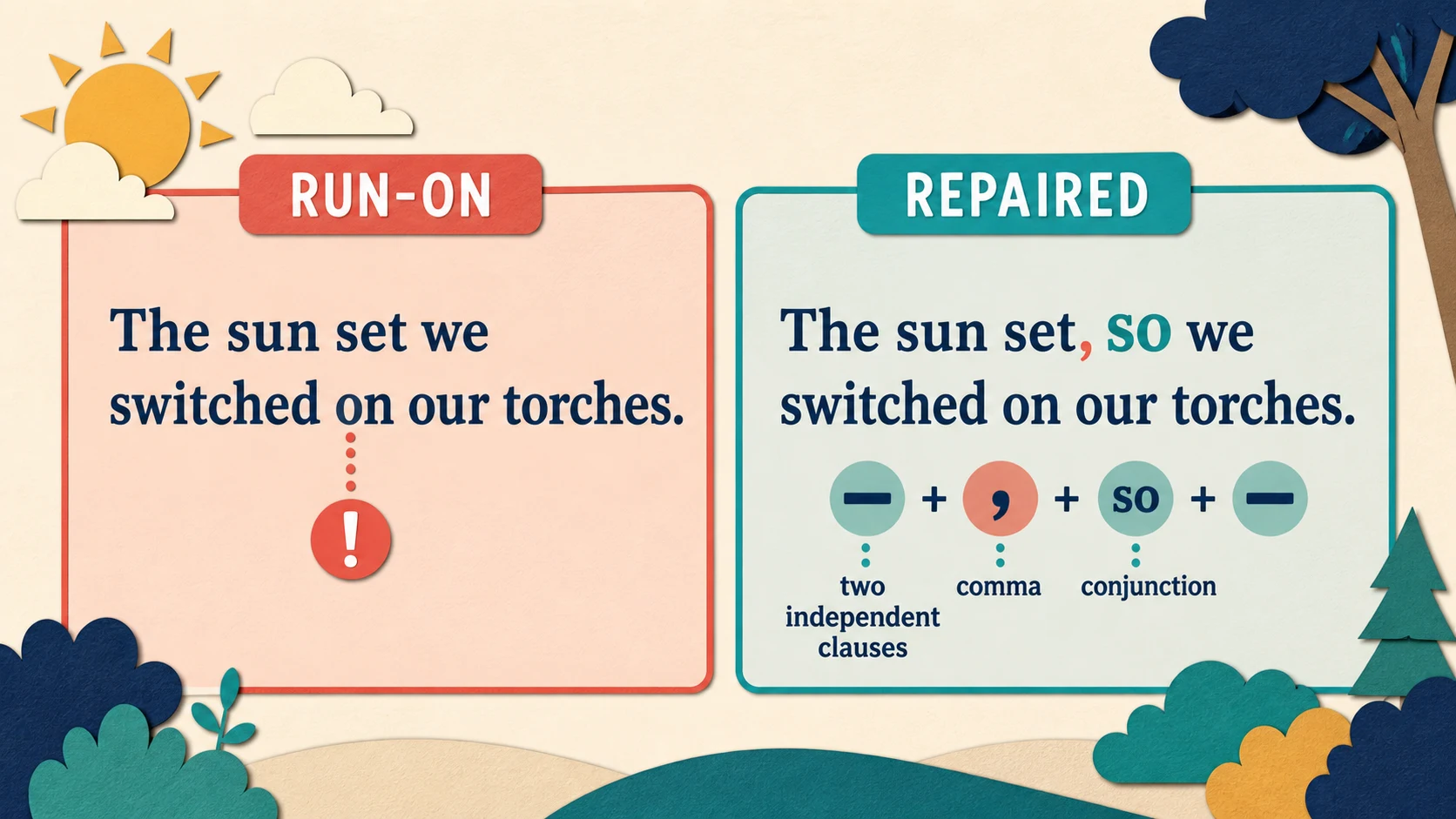
Adjust visibility, quantity, or prompting while keeping sentence reconstruction as the learner’s task.
For a learner who cannot get started
Cover the remaining items and show one line at a time. Ask the learner to underline the likely verb and bracket any group of words that appears to function as a phrase. On scrap paper, the learner may copy each supplied chunk onto a separate line and number the intended order.
You can also ask the learner to say possible sentences aloud before writing. This is an instructional suggestion drawn from the topic’s oral-language teaching guidance, not a claim that oral rehearsal is required for every sixth grader.
For a learner who works accurately but slowly
Reduce the number completed in one sitting, not the reasoning required per item. Let the learner complete two short sets with a break between them. Do not impose speed as a second skill unless fluency is the stated objective.
If copying consumes attention, the learner can first number the printed chunks in order and then write the sentence. Confirm that the final response still shows the complete arrangement clearly enough to check.
For a learner who finishes easily
Do not make the page harder by adding unrelated grammar demands to every item. Instead, select a few completed sentences and ask for controlled transfer:
- Move a time or place phrase while preserving the meaning.
- Explain why two words must remain together.
- Identify the subject and complete predicate.
- Create one new scrambled sentence for the adult to solve.
- Use one reconstructed sentence as the opening of a two-sentence passage.
For a broader range of sentence forms and skills, move to the 6th Grade Sentence Structure Worksheet Pack, which contains 18 worksheets. Check its contents against the learner’s observed needs before choosing the next page.
Interpret Errors as Evidence
A total score tells how many responses matched the key. Error patterns tell the adult what to teach.
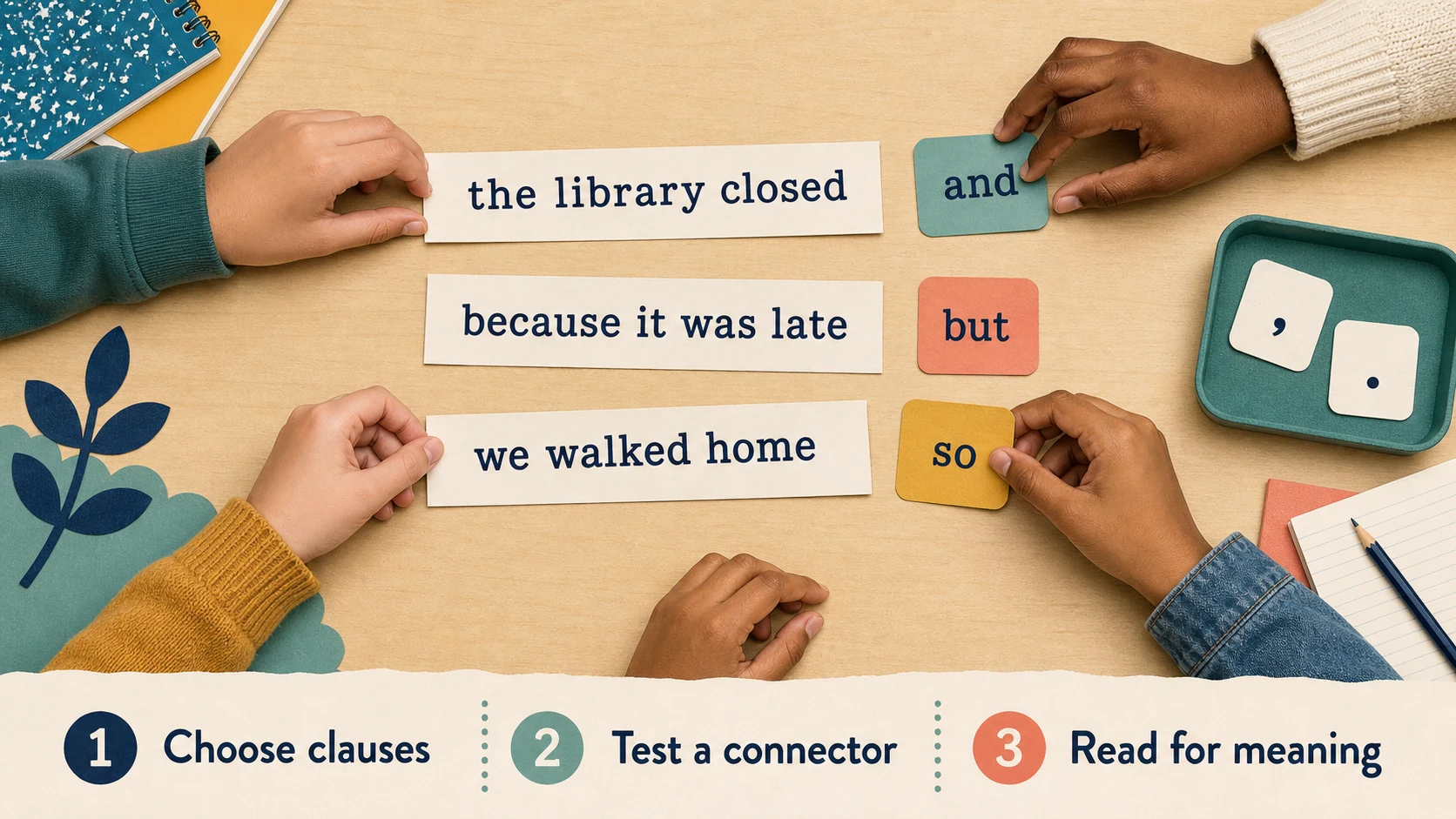
Classify the error, ask the learner to revisit it, and choose a prompt matched to the problem.
Common patterns and useful responses
| Observed work | Possible issue to investigate | Next prompt or action |
|---|---|---|
| A supplied word is missing | The learner may not be checking all tokens | “Point to each original word as you find it in your sentence.” |
| Words are all present but the sentence is incomplete | Subject or predicate may be unidentified | “Who or what is this about, and what are we told?” |
| A prepositional phrase is broken apart | The learner may be arranging isolated words rather than chunks | “Which words belong with under, after, or before?” |
| The verb appears before an unsuitable subject | The learner may be relying on the printed sequence | “Find the action or state first. Who or what matches it?” |
| Singular and plural forms conflict | Agreement may not be considered during rereading | “Read the subject and verb together. Do they match?” |
| The sentence is grammatical but differs from the key | There may be more than one valid order | Check word use, punctuation, meaning, and naturalness before marking |
| Early answers are accurate but later ones deteriorate | The set may exceed the learner’s productive practice length | Stop, review one error, and continue in a later short set |
| The learner corrects errors when reading aloud | Self-checking is emerging | Require an oral or quiet reread before key comparison |
These are interpretations to investigate, not diagnoses. One error does not prove a broad weakness. Ask the learner to explain the choice, test another similar example, and look for repetition before deciding what instruction is needed.
A learner may also build a complete sentence whose meaning is odd. Syntax and meaning work together: “The sandwich ate Maya” has a recognizable subject–verb–object pattern, but it assigns the action implausibly. Ask whether the sentence communicates a sensible event using the supplied words.
Use the Answer Key Responsibly
The printable includes a separate answer key for quick checking. Use it after the learner has attempted the assigned set and completed a self-check.
A four-step checking routine
- Compare all words. Confirm that none were omitted, duplicated, or replaced.
- Compare the structure. Identify whether the learner’s sentence matches the intended relationship among subject, verb, objects, and details.
- Read for completeness and meaning. A sentence should express a complete, coherent thought.
- Examine alternatives. If the order differs from the key, decide whether it is still grammatical and faithful to the supplied words.
Marking an alternative correct does not mean every possible order is equally effective. Compare ordinary, clear syntax with unusual inversion. If punctuation affects the judgment, look at the exact printed item rather than assuming punctuation was available as a movable token.
After checking, ask the learner to correct only a small group of representative errors first. For each correction, request a reason: “I moved after lunch because it is a time phrase,” or “I put the dogs before barked because the dogs performed the action.” Then give one fresh, similar example without the key. A copied correction shows that the answer was seen; a fresh example better reveals whether the reasoning can be reused.
The Common Core English Language Arts standards provide grade-specific language expectations and describe literacy across content areas beginning in grade 6. They are a useful reference point, but this single word-order worksheet should not be presented as comprehensive standards coverage. Its catalogue focus is the narrower practice of word order, sentence formation, syntax, and grammar, and local sequences differ.
Decide What to Teach Next
Base the next lesson on the smallest recurring obstacle.
If the learner needs more work with sentence cores
Practice identifying “who or what” and “did what” or “is what” in short complete sentences. Contrast a complete sentence with a phrase:
- under the table — not complete by itself
- The backpack is under the table. — complete
- ran through the gate — missing who or what ran
- The horse ran through the gate. — complete
Then return to a few unfinished worksheet items. This maintains a direct connection between instruction and the original task.
If the learner handles basic order accurately
Move from reconstruction to application. Ask the learner to write two original sentences, then cut or copy each into meaningful chunks for someone else to reorder. Next, examine how a phrase can move:
- The class met in the library after lunch.
- After lunch, the class met in the library.
Discuss what stayed constant and what changed. Continue into sentence combining, expansion, fragments and run-ons, or varied beginnings through the broader 6th Grade Grammar hub and sentence-structure guide, rather than asking this one printable to carry the entire progression.
The IES foundational reading guide concerns kindergarten through grade 3, not sixth-grade sentence instruction. It is included only as high-level literacy context: it addresses academic language, word analysis, and connected-text reading in the early grades. It should not be treated as evidence that this exact sixth-grade worksheet was evaluated or that its recommendations transfer unchanged to this task.
Schedule Retrieval Without Fixing a Universal Timetable
Revisiting a process after a delay helps an adult see whether the learner can still use it without the original modeling. The schedule should remain flexible.
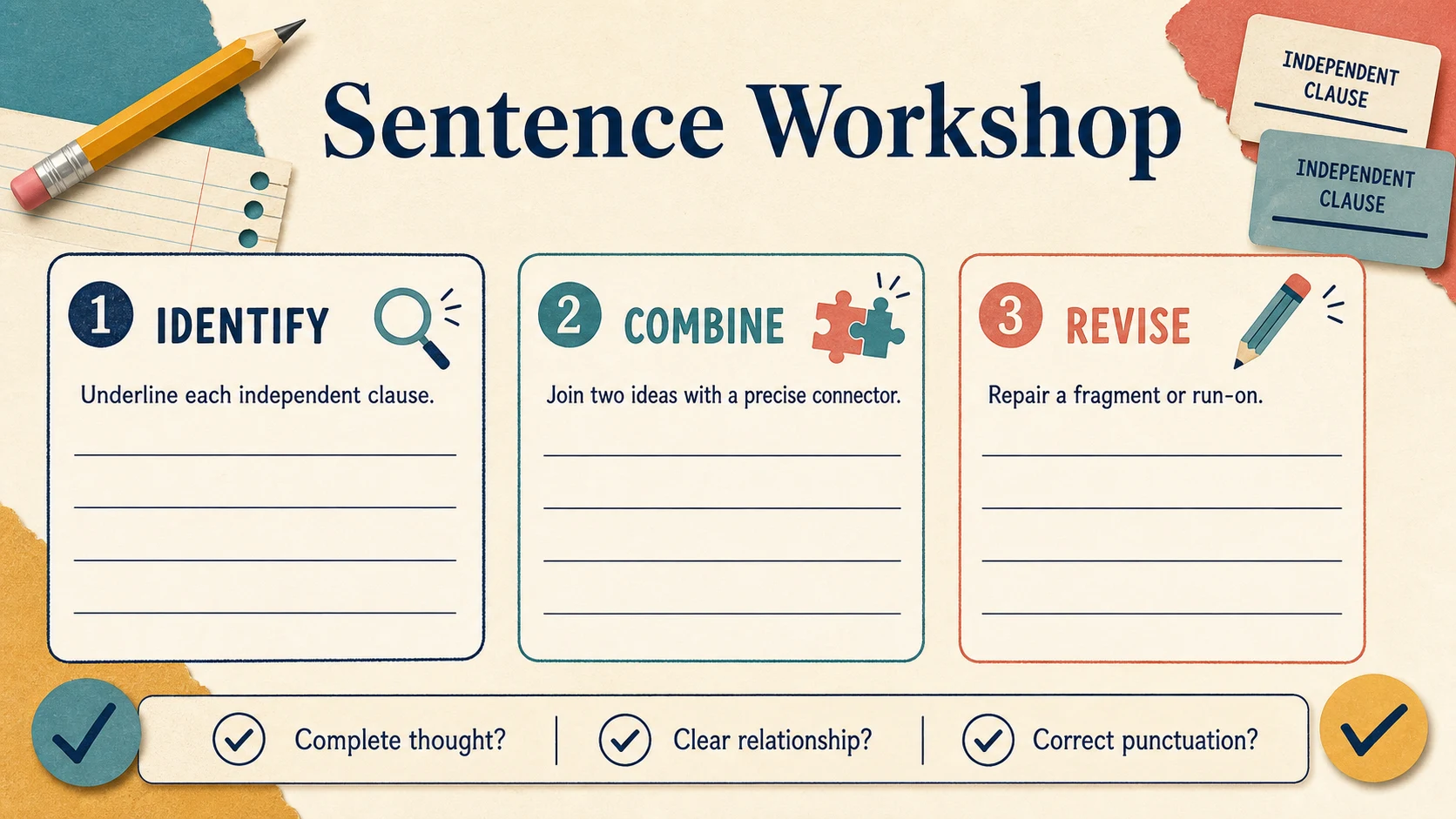
Use short delayed checks and adjust their spacing from the learner’s actual recall.
A practical starting plan is:
| Time | Retrieval task | Decision |
|---|---|---|
| End of the first lesson | Reconstruct one previously missed sentence without viewing the correction | Reteach immediately if the same reasoning error returns |
| Two or three days later | Complete three unused or rewritten word-order items | Continue if the learner explains the order independently |
| About one week later | Revisit two structures and write one original complete sentence | Move forward if the process transfers beyond scrambling |
| During later writing | Inspect one paragraph for complete, clearly ordered sentences | Return to focused practice only if the need reappears |
These intervals are suggestions, not sourced requirements or a universal timetable. Shorten the gap when the process is forgotten. Lengthen it when performance is accurate and independent. If the learner remembers the answer but cannot explain the structure, use a fresh example.
Limitations and the Honest Next Step
This worksheet can show how a learner handles 30 easy-level word-order exercises. It cannot establish overall writing quality, reading comprehension, mastery of every sentence type, or readiness for every local sixth-grade expectation. Accuracy may also be influenced by vocabulary familiarity, attention, copying demands, or the particular wording of an item.
Use the page as one piece of evidence. Keep a brief note of which prompts were needed, which error pattern repeated, and whether the learner could transfer the process to a new sentence. That record makes the next choice more precise than a score alone.
The best next action is to complete a short first set from the free worksheet, classify any errors with the routine above, and then choose the matching follow-up from the Sentence Structure topic guide. If the learner needs additional practice built around the same skill, create a fresh set through the free worksheet generators or select an appropriate page from the focused pack.
Put it into practice
Use the guide with a real printable
Move from explanation to a short, observable practice task. Check the first item together, then adjust the next session from the learner's actual work.
See the 18-worksheet pack