Complete guide
How to teach and practise 6th grade parts of speech worksheets - standard theme (easy)
What this worksheet practices
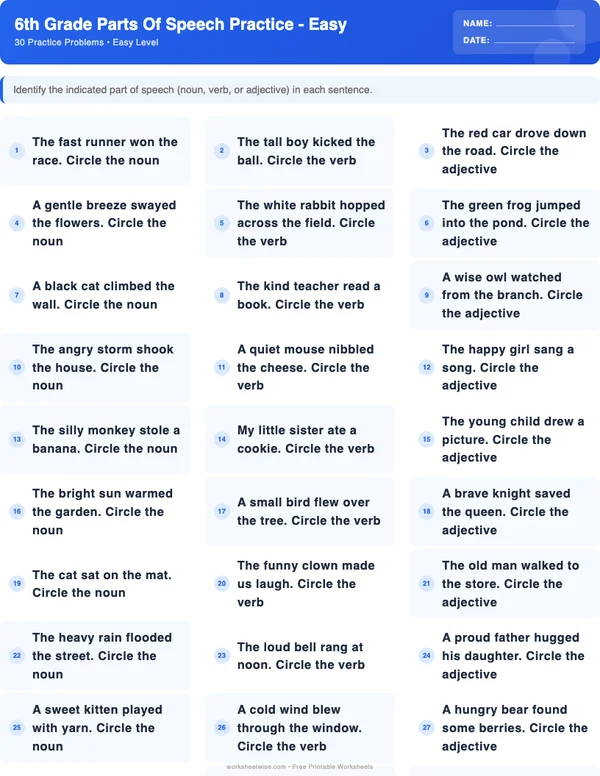
The free 6th Grade Parts of Speech worksheet gives a learner 30 easy-level sentence-analysis items. Each item asks the learner to identify an indicated noun, verb, or adjective. A separate printable answer key is included.
The short answer: use this printable as focused practice, not as a complete lesson on all eight parts of speech. First model how to identify a word by the job it performs in its sentence. Complete a few items together, let the learner finish a manageable group independently, and then study the reasons behind any errors. The learner’s observed work—not a fixed timetable—should determine how quickly support is removed and when harder practice begins.
The three target categories are:
- A noun names a person, place, thing, or idea.
- A verb expresses an action or functions as a linking verb.
- An adjective describes or limits a noun.
That scope matters. The printable does not claim to provide comprehensive practice with pronouns, adverbs, prepositions, conjunctions, or interjections. Those categories belong in the broader Parts of Speech topic guide, which explains the larger progression without requiring this one worksheet to cover everything.
Grade labels describe the intended practice level; local school and homeschool sequences differ. “6th Grade” does not mean that every sixth grader should complete the sheet in the same way or on the same day. An easy-level page may serve as an introduction, a review, a warm-up, homework, or reinforcement after a more detailed lesson.
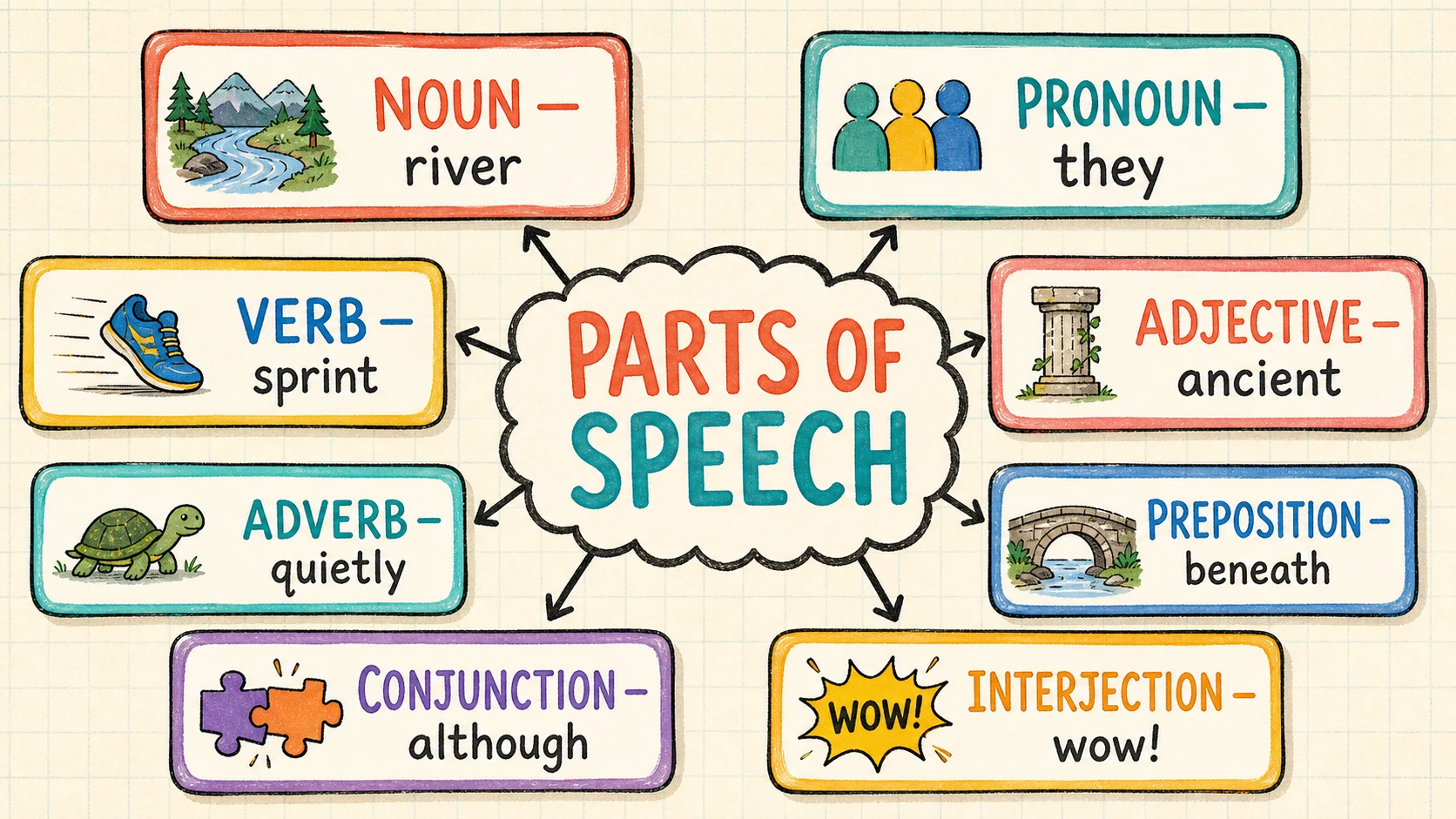
The lesson moves from a brief check and adult model to guided work, independent practice, correction, and later retrieval.
Prepare the page and define the goal
Print the worksheet and keep the answer key out of the learner’s immediate view. Have a pencil and two spare sheets available: one for a three-column noun–verb–adjective reference and one for corrections.
State a narrow, observable goal:
“You will decide whether the indicated word is a noun, verb, or adjective by checking what it does in the whole sentence.”
This is an instructional script, not a recommendation attributed to an outside source. It keeps attention on grammatical function rather than on memorized word lists.
Before beginning, decide how much of the 30-item page the learner will see at once. Covering later rows with blank paper can reduce visual load without changing the sentences or the target skill. The learner still performs the same analysis; only the amount visible at one time changes.
A practical sequence might look like this:
| Lesson stage | Suggested use of the printable | What the adult watches for |
|---|---|---|
| Quick readiness check | Ask for one example each of a noun, verb, and adjective | Whether the learner can explain each category |
| Adult model | Demonstrate one comparable sentence | Whether the learner follows the reasoning, not just the answer |
| Guided practice | Complete a small group of worksheet items together | Which prompt helps the learner decide |
| Independent practice | Assign the next manageable group | Whether reasoning remains accurate without prompting |
| Check and correct | Compare responses with the key | Whether errors form a pattern |
| Brief application | Revise or create one sentence | Whether the learner can use the categories in writing |
| Retrieval | Revisit selected categories later | Whether the distinction can be recalled after a delay |
This is a flexible lesson map rather than a universal schedule. Increase or reduce the group size according to accuracy, explanations, attention, and independence.
Check readiness before teaching
Ask for function, not just a definition
Begin with a sentence such as:
The careful painter measures the wall.
Ask the learner to identify a noun, a verb, and an adjective, then explain each choice.
A complete analysis is:
- painter is a noun because it names a person.
- measures is a verb because it tells what the painter does.
- careful is an adjective because it describes the noun painter.
- wall is also a noun because it names a thing.
If the learner supplies correct labels but cannot explain them, do not treat the check as secure mastery. The explanation reveals whether the learner is analyzing the sentence or recalling a familiar association.
Look for an efficient starting point
Start with more adult modeling when the learner:
- guesses from a word’s appearance;
- calls every action-related word a verb;
- identifies a describing word without naming what it describes;
- labels the first word in every sentence as a noun;
- or cannot distinguish the name of a category from its function.
Move sooner to guided practice when the learner can identify all three categories and justify each answer. If readiness is strong, the adult model can be brief. If it is uneven, preserve the easy-level task but provide more think-aloud reasoning.
Model a repeatable sentence-analysis routine
Tell the learner that a word’s location does not determine its part of speech. Its work in the sentence does. Then model a routine that can be reused across the page.
Use three passes
Consider this comparable example:
The curious rabbit explored the garden.
-
Find who or what the sentence is about.
The sentence is about a rabbit. A rabbit is a thing, so rabbit is a noun. -
Find what happens or what is stated about the subject.
The rabbit explored. Explored is the verb. -
Find a word that describes a noun.
Curious tells what kind of rabbit. Curious is an adjective.
Finish by checking the requested category. If a worksheet item asks for an adjective, the response is curious, even though the sentence also contains nouns and a verb.
Avoid turning every item into a long interrogation. The purpose of the model is to make the decision process visible. A compact think-aloud is enough: “Curious describes rabbit, and rabbit is a noun, so curious is an adjective.”
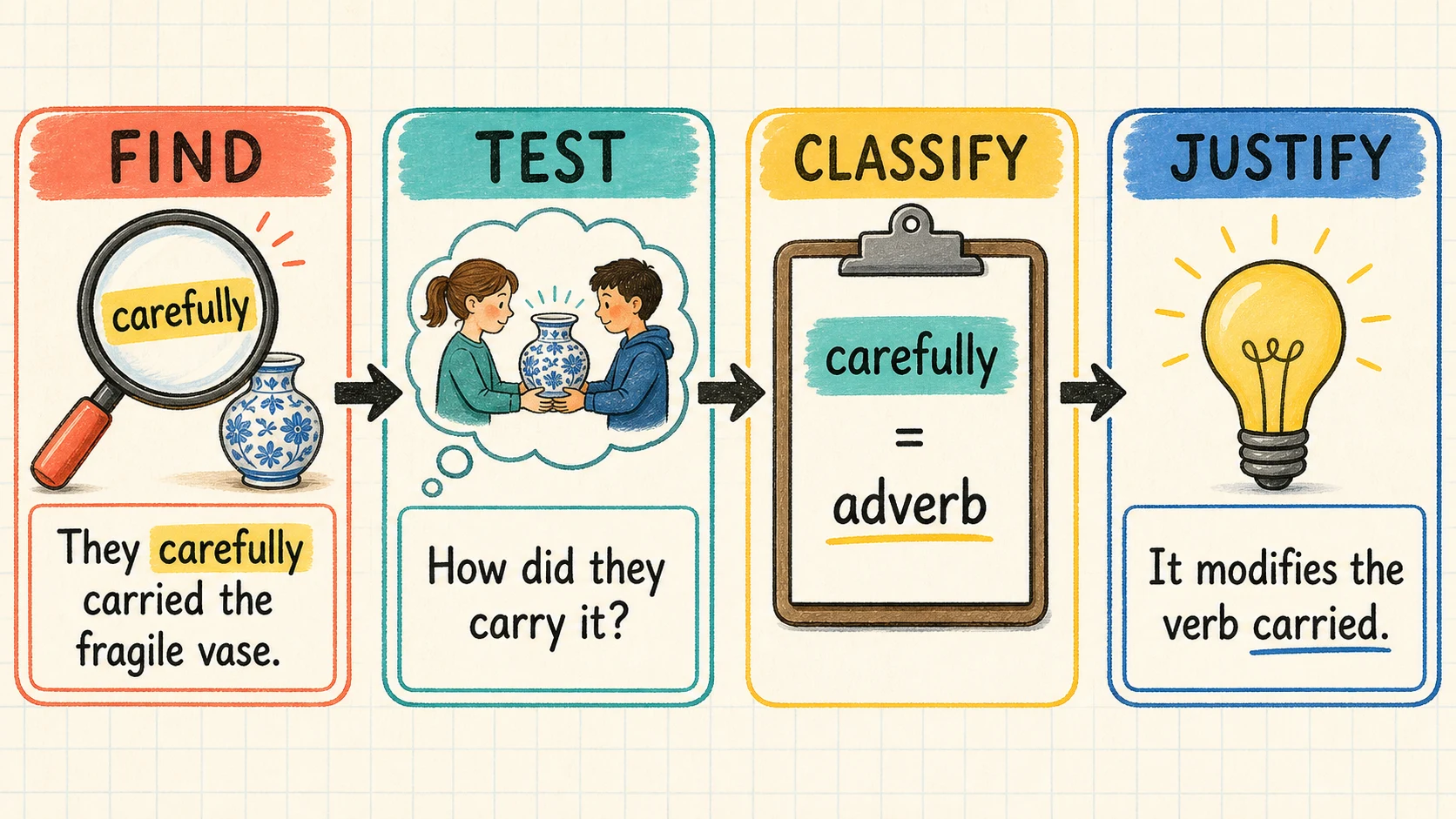
The adult demonstrates the reasoning, invites the learner to supply the next step, and then removes prompts.
Work through fully checked examples
The examples below are original practice sentences similar in skill to the worksheet; they are not presented as items copied from the printable.
Example 1: identify a noun
Sentence: The hikers crossed the narrow bridge.
Task: Identify a noun.
Checked answer: hikers is a noun because it names people. Bridge is also a noun because it names a thing.
If the task permits only one response, either noun may be grammatically valid unless the item indicates a specific word or position. This is why the adult should read the precise worksheet prompt before using the key. Do not mark a valid alternative wrong merely because the key lists only one possible noun.
The complete sentence analysis is:
- hikers: noun;
- crossed: verb;
- narrow: adjective describing bridge;
- bridge: noun.
Example 2: identify a verb
Sentence: Maya carried the heavy basket.
Task: Identify the verb.
Checked answer: carried is the verb because it tells what Maya did.
The other relevant words confirm the distinction:
- Maya: noun naming a person;
- basket: noun naming a thing;
- heavy: adjective describing basket.
A learner might choose heavy because carrying a heavy object involves action. Ask, “Which word actually tells what Maya did?” The answer remains carried.
Example 3: identify an adjective
Sentence: The silver bell rang.
Task: Identify the adjective.
Checked answer: silver is the adjective because it describes the noun bell. It answers “What kind of bell?”
The complete analysis is:
- bell: noun;
- rang: verb;
- silver: adjective.
The word silver can name a material in another sentence, as in “Silver tarnishes.” In that sentence, silver is a noun. Here, it modifies bell, so it functions as an adjective.
Example 4: recognize a linking verb
Sentence: The hallway became quiet.
Task: Identify the verb.
Checked answer: became is the verb. It links the subject hallway with the description quiet rather than naming a physical action.
The rest of the analysis is:
- hallway: noun;
- became: linking verb;
- quiet: adjective describing hallway.
This example checks an important misconception: verbs do not always show visible movement.
Example 5: separate a noun from a nearby adjective
Sentence: Our science class examined smooth rocks.
Task: Identify an adjective.
Checked answer: smooth is an adjective because it describes the noun rocks.
Other relevant words are:
- class: noun;
- examined: verb;
- rocks: noun.
The word science helps specify the kind of class, but noun modifiers can complicate elementary classification. For a focused noun–verb–adjective lesson, choose the unambiguous answer smooth when that is the indicated target. If a worksheet sentence appears to allow more than one defensible analysis, record the learner’s reasoning and review the wording rather than forcing the answer key mechanically.
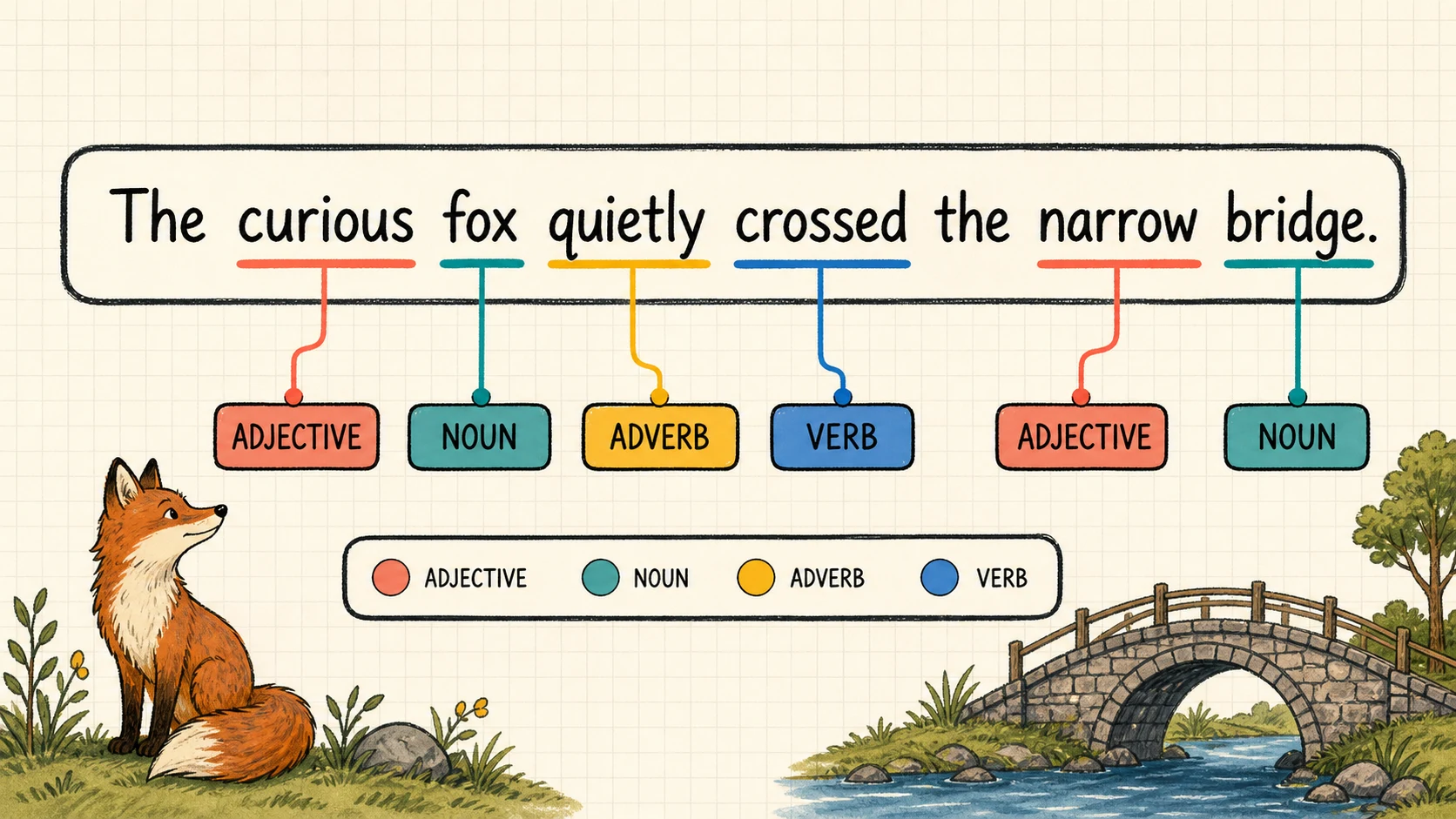
Checking the target word against its sentence function produces a defensible answer.
Handle boundary cases without losing the lesson
English words can perform different jobs in different sentences. A memorized claim such as “light is an adjective” is incomplete.
Compare these sentences:
- The light filled the room. Here, light is a noun naming a thing.
- Please light the candle. Here, light is a verb expressing an action.
- We lifted the light box. Here, light is an adjective describing box.
The same contextual test works with paint:
- The paint dried. Paint is a noun.
- They paint murals. Paint is a verb.
These boundary cases should clarify the central rule, not dominate an easy worksheet session. If they confuse the learner, return to straightforward examples and revisit flexible words later through the broader Grammar collection.
Also distinguish an adjective from the noun it describes. In the noisy bus, noisy is an adjective and bus is a noun. The adjective is not “the describing part” merely because it appears before another word; it is an adjective because it modifies a noun.
Move from guided to independent practice
Use prompts in a deliberate order
For the first guided item, ask the full sequence:
- What category does the prompt request?
- Which word might fit?
- What job does that word perform?
- Which word in the sentence proves your explanation?
For the next item, shorten the prompt to: “What job is the word doing?” After that, try only: “Explain your choice.” This gradual reduction lets you see whether the learner is becoming independent.
When the learner chooses incorrectly, resist supplying the right label immediately. Return attention to the sentence:
- For a possible noun: “Does this word name a person, place, thing, or idea?”
- For a possible verb: “What happens, or what links the subject to a description?”
- For a possible adjective: “Which noun does this word describe or limit?”
These are instructional prompts developed for using the page. They are not claims that a particular prompt is universally best.
Protect independent evidence
Once guided answers are consistently reasoned, assign a small consecutive group independently. Do not correct each item while the learner works. Immediate interruptions can hide whether the learner can sustain the process alone.
After the group, ask the learner to mark one answer they feel sure about and one they want to revisit. Confidence is not proof of correctness, but comparing confidence with accuracy can reveal useful habits. A confidently reasoned error needs conceptual correction; an uncertain correct answer may need additional explanation and retrieval.
Continue in manageable groups until all 30 items are complete, or stop when the work shows that productive attention or accurate reasoning has fallen. Finishing the page is less informative than seeing what the learner can do independently.
Adapt support without changing the skill
Differentiation should preserve the task: identifying nouns, verbs, and adjectives in sentences. It should not quietly replace analysis with copying.
For a learner who needs more structure
Provide a small reference card:
| Category | Test |
|---|---|
| Noun | Does it name a person, place, thing, or idea? |
| Verb | Does it show action or link the subject to information about it? |
| Adjective | Does it describe or limit a noun? |
Reveal five items at a time. Read a sentence aloud if decoding effort is blocking grammar analysis, but do not emphasize the target word with your voice. Ask the learner to point to the evidence and state the category.
If necessary, use consistent marks: box a possible noun, underline a possible verb once, and draw an arrow from an adjective to the noun it describes. The marks support analysis while leaving the grammatical decision to the learner.
For a learner ready for standard independent work
Keep the full directions visible, model one example, and assign a reasonable group without a reference card. Require a brief explanation only for selected answers rather than for every item. This keeps the 30-item activity moving while still checking reasoning.
For a learner who finishes accurately
Do not add unrelated difficulty merely to create more work. Ask the learner to choose three completed sentences and explain all relevant nouns, verbs, and adjectives in each. Another option is to revise one sentence by replacing a general noun with a more specific noun, changing the verb, or adding a precise adjective.
The IES elementary writing practice guide offers broad instructional framing around writing processes and sentence construction. It did not evaluate this WorksheetWise printable. A short sentence-revision task is an instructional extension that connects identification to writing; it is not evidence that completing this sheet alone will improve writing.
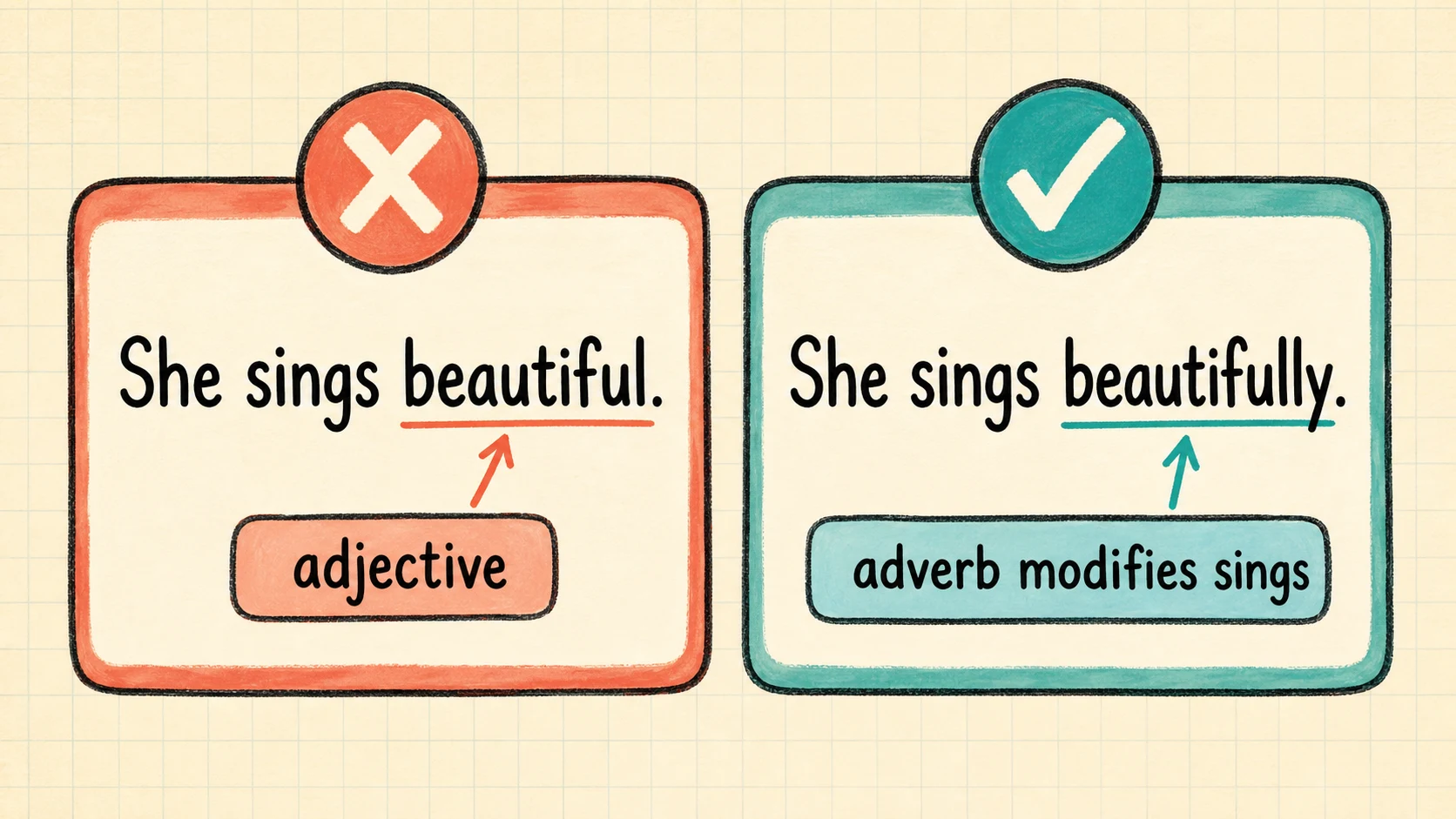
Change the amount of prompting, visible work, or required explanation while preserving sentence analysis.
Interpret errors as evidence
A total score gives a summary. Error types give teaching information.
Category-confusion errors
If the learner repeatedly chooses a noun when asked for an adjective, ask them to name the noun being described. Use pairs such as storm/stormy or danger/dangerous in original sentences, but keep attention on function rather than word endings.
If verbs are confused with nouns, have the learner locate the subject and then ask what that subject does or what is stated about it. Include a linking-verb example so that “verb means movement” does not become the replacement misconception.
Position-based errors
A learner who selects the first word or the word immediately before a noun may be using location instead of function. Rearrange comparable sentences:
- The patient dog waited.
- Near the gate, the patient dog waited.
Dog remains a noun, waited remains a verb, and patient remains an adjective despite the changed opening.
Definition-only errors
A learner may recite “an adjective describes” but label runs as an adjective because running describes what someone does. Tighten the language: an adjective describes or limits a noun; a verb tells an action or links a subject with information about it.
Context errors
If the learner insists that a familiar word always has one category, compare two short sentences containing that word in different roles. Require the explanation to mention the sentence: “Paint is a verb here because it tells what they do.”
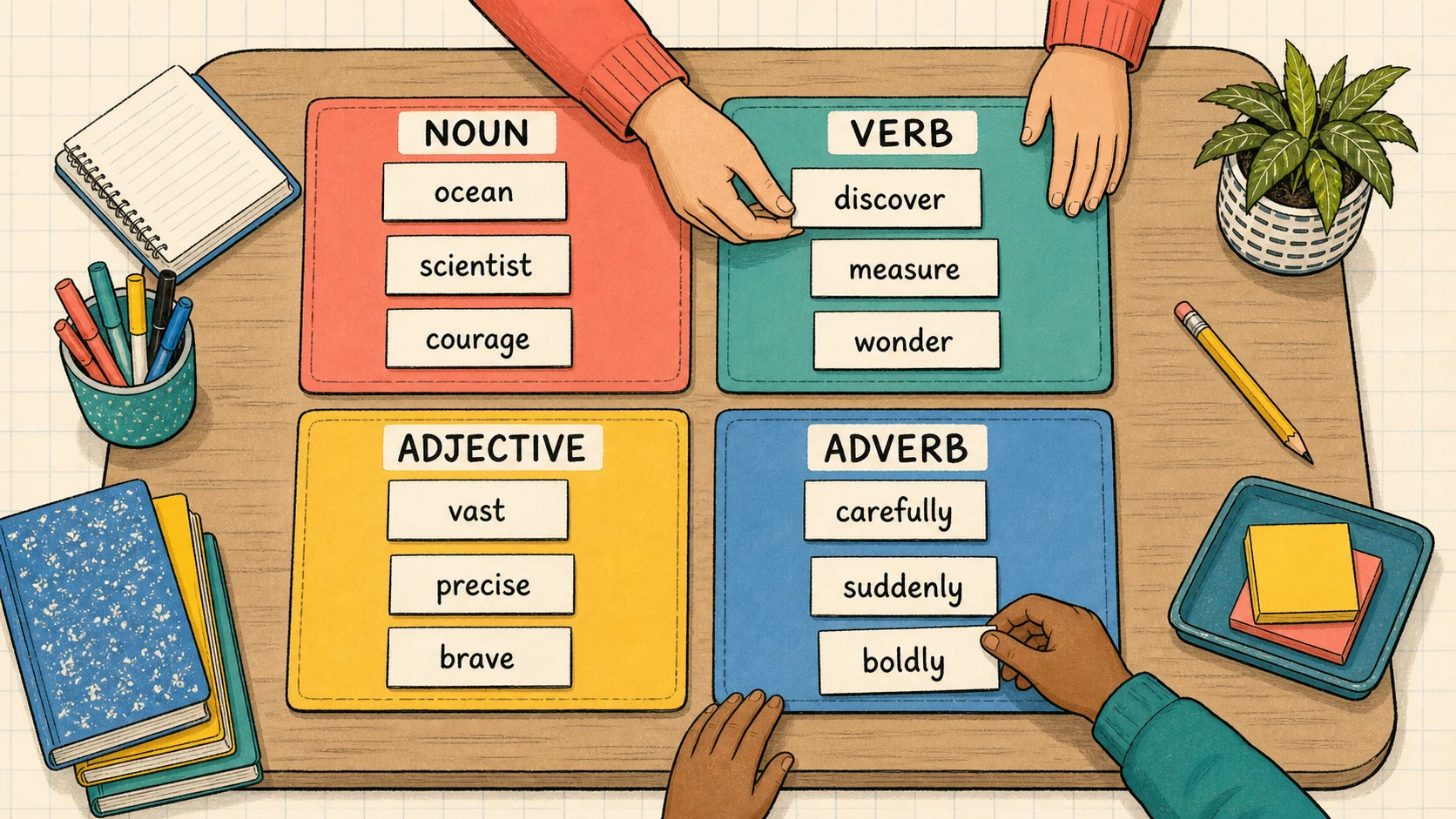
Sort errors by the reasoning that produced them, correct the idea, and then try a fresh sentence.
Check the answer key responsibly
Use the separate key after the learner has produced independent evidence. Check in small groups when possible rather than announcing only a final score.
For each mismatch:
- Reread the full sentence and exact direction.
- Ask the learner to explain the chosen word’s function.
- Compare that reasoning with the keyed answer.
- Decide whether the response is wrong, incomplete, or a defensible alternative.
- Correct the explanation, then solve a fresh comparable example.
Do not ask the learner to erase every wrong response without preserving evidence. A correction sheet can show the original choice, corrected choice, and one-sentence reason. This makes the misconception visible.
The key supports efficient checking; it does not replace grammatical judgment. Natural language can contain ambiguity, and a sentence may include multiple nouns or adjectives. When an item identifies a particular word, classify that word. When it asks for any example from a sentence, accept another grammatically valid answer if the directions allow it.
Connect the practice to literacy carefully
Parts-of-speech knowledge gives adults and learners shared language for discussing sentences. It can support conversations about choosing a specific noun, replacing a weak verb, or deciding which noun an adjective modifies. That is a sensible instructional connection, not a promise of a particular outcome.
The IES foundational reading guide addresses kindergarten through grade 3 and includes high-level attention to academic language and connected text. Its age range is younger than this worksheet’s intended audience, so it should not be presented as evidence for this exact sixth-grade activity. It is relevant only as broad context for teaching language within meaningful text rather than treating words as context-free labels.
The Common Core English Language Arts standards describe literacy across reading, writing, speaking, listening, and language, with grade-specific detail. Local adoption and sequencing vary. This 30-item worksheet practices a narrow grammar skill and should not be described as comprehensive standards alignment or as a complete sixth-grade language program.
Decide what to do next
Use observed work to select the next step.
- Mostly accurate with clear explanations: Move from identifying one indicated category to classifying several relevant words in a sentence. Then connect the labels to a brief revision task.
- Accurate only with prompts: Repeat a small set of fresh noun–verb–adjective sentences and reduce prompts gradually.
- One category causes repeated errors: Give short focused practice on that category while continuing to contrast it with the other two.
- Errors increase late on the page: Retry a few missed concepts when the learner is fresh before concluding that the categories are not understood.
- Answers are accurate but explanations are weak: Ask for evidence: “What does this word name?” “What is the subject doing?” or “Which noun does this describe?”
- The worksheet is consistently too easy: Continue into the 6th Grade Parts of Speech pack, which contains 18 worksheets, or consult the topic guide for the wider eight-category progression.
The printable’s limitation is also its strength: it provides 30 straightforward items focused on nouns, verbs, adjectives, and sentence analysis. It does not by itself assess authentic writing, reading comprehension, every use of these categories, or all eight parts of speech.
Schedule brief retrieval
Return to the skill after a delay instead of treating a completed page as the end of instruction. The following is a practical option, not a universal timetable:
| Review point | Retrieval task |
|---|---|
| Next session | Recheck two corrected items without looking at the correction notes |
| A few days later | Classify a noun, verb, and adjective in two fresh sentences |
| About a week later | Explain one flexible word used in two different grammatical roles |
| During later writing | Identify one noun, verb, and adjective in the learner’s own sentence |
If recall is secure, widen the context or introduce another part of speech. If the same misconception returns, model it again and shorten the delay before the next retrieval attempt. The learner’s performance should drive the schedule.
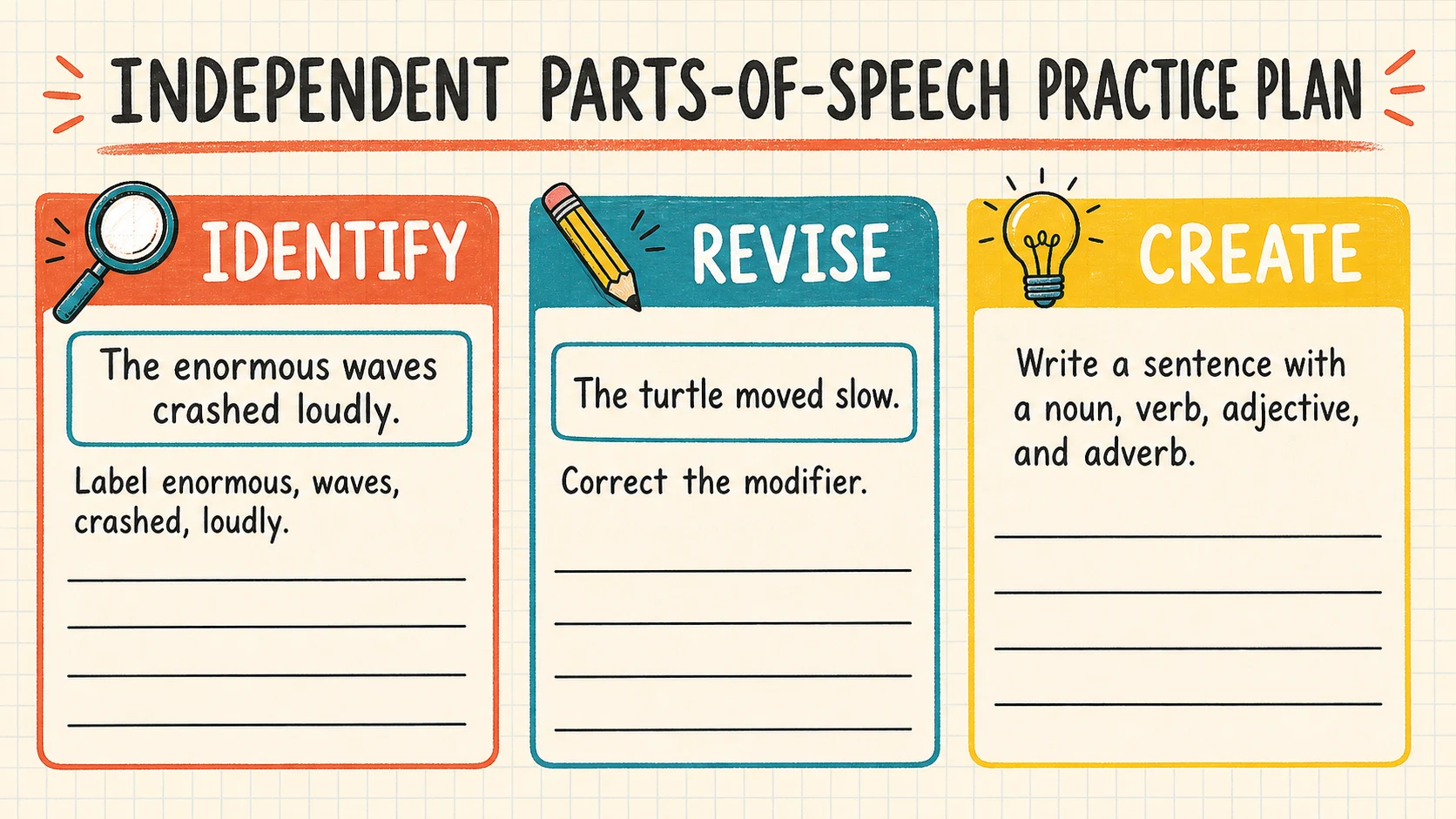
Brief, delayed checks show whether the learner can retrieve the distinction without relying on the completed page.
A useful next action
Download the free 30-item worksheet, choose one original sentence from this guide for the opening model, and begin with a small guided group. After checking the learner’s explanations, use the Parts of Speech topic guide to choose the next category or level. If a few targeted follow-up sentences would be more useful than another fixed page, create fresh practice through the free worksheet generators.
Put it into practice
Use the guide with a real printable
Move from explanation to a short, observable practice task. Check the first item together, then adjust the next session from the learner's actual work.
See the 18-worksheet pack