Complete guide
How to teach and practise 5th grade spelling words worksheets - standard theme (easy)
How to use this 30-item spelling worksheet
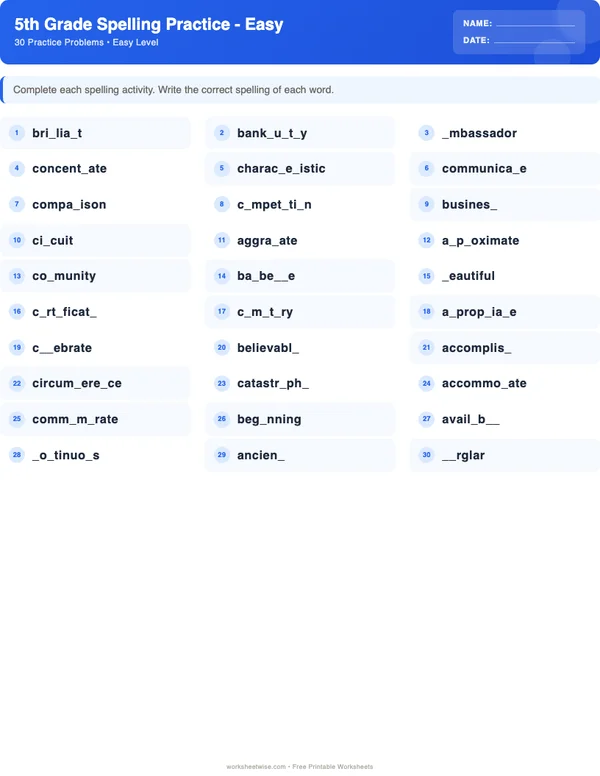
The free 5th Grade Spelling Words worksheet provides 30 easy-level exercises involving fill-in-the-blank items, word scrambles, and misspelling correction. It practices spelling, word recognition, vocabulary, and attention to letter patterns. A separate printable answer key is included.
The most useful approach is direct: preview the activity types, model one example of each type, complete several items together, and then release the learner to work independently. Afterward, use mistakes to identify which words or patterns need another short practice session. Do not require repeated practice of all 30 items when only a few caused difficulty.
“Easy” describes this worksheet’s catalogue difficulty, not the amount of effort every fifth grader should need. Grade labels describe the intended practice level, and local curriculum sequences differ. The learner’s observed work—not the label alone—should determine pacing and support.
This guide concentrates on launching and reviewing this exact printable. For a wider sequence of word study, sorting, sentence practice, and cumulative review, use the broader Spelling Words topic guide.
Prepare the worksheet without over-preparing the learner
Before the lesson, print or open the worksheet and keep the answer key separate. Read the directions aloud or have the learner read them:
Complete each spelling activity. Write the correct spelling of each word.
Clarify that “correct spelling” may require different actions:
- In a fill-in-the-blank item, the learner identifies and writes the word that completes the prompt.
- In a word scramble, the learner rearranges all the supplied letters.
- In a misspelling-correction item, the learner locates the incorrect part and rewrites the complete word correctly.
Preview the pages yourself so you know where the activity type changes. This is especially useful when a learner understands one format but overlooks a new direction halfway through a worksheet.
Have a pencil and a plain sheet of paper available. The extra paper can hold a quick sound map, letter inventory, or retry. It should not become a second 30-item assignment.
Ask the learner to explain what each activity type requires before beginning. This brief check distinguishes a direction problem from a spelling problem. A learner who thinks a scramble asks for a new word may appear to have weak spelling when the real issue is task interpretation.
Follow a short model-to-independence lesson map
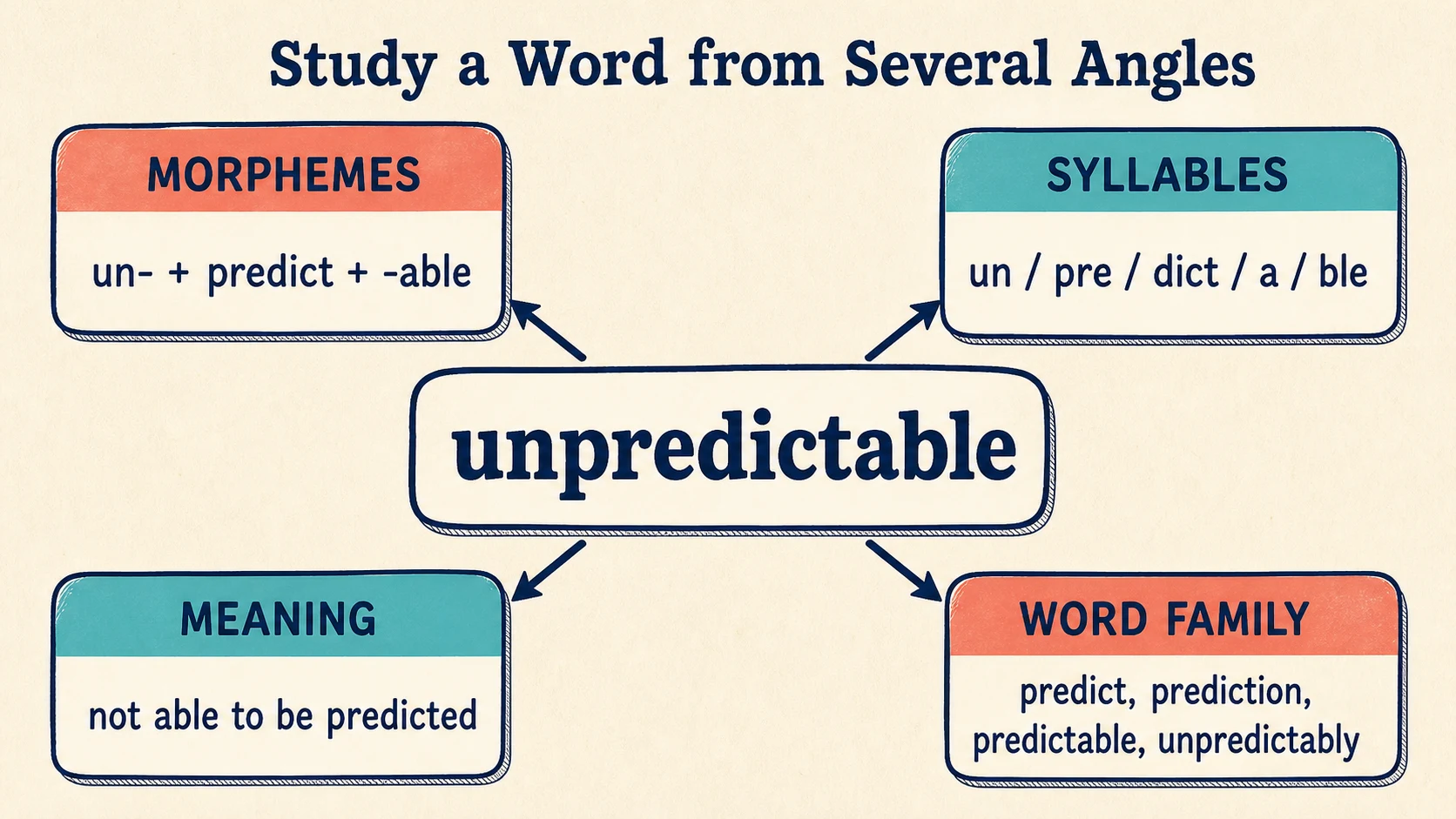
Move from a brief preview to modeling, guided practice, independent work, and targeted review.
The following progression is an instructional suggestion for this worksheet, not a universal timetable. A learner who quickly demonstrates understanding can move ahead. A learner who is unsure may need the 30 items divided across more than one sitting.
| Lesson phase | Adult action | Learner action | Evidence to notice |
|---|---|---|---|
| Preview | Identify the three activity formats and read the directions | Restate what each format requires | Can the learner explain the task? |
| Model | Think aloud through one similar example | Watch, question, and verify | Does the learner notice meaning, sounds, and letters? |
| Guided practice | Prompt without giving the complete spelling | Solve a small group of worksheet items | Which prompts help, and which are unnecessary? |
| Independent practice | Step back and observe | Complete an appropriate portion | Are errors isolated, repeated, or format-specific? |
| Check | Compare responses with the answer key | Mark and analyze uncertain items | Can the learner locate the incorrect part? |
| Review | Select only words or patterns needing retrieval | Retry from memory later | Is the corrected spelling retained? |
A complete sitting might include all six phases, but it does not have to include all 30 items. Stop at a natural break if handwriting becomes rushed, directions are no longer being followed, or errors suddenly multiply. Those changes may reflect the conditions of the task rather than a new spelling weakness.
Model how a speller thinks
The model should demonstrate a repeatable process rather than display an adult’s speed. Use an example similar to the worksheet but not presented as an actual worksheet item. Say explicitly that you are practicing the method.
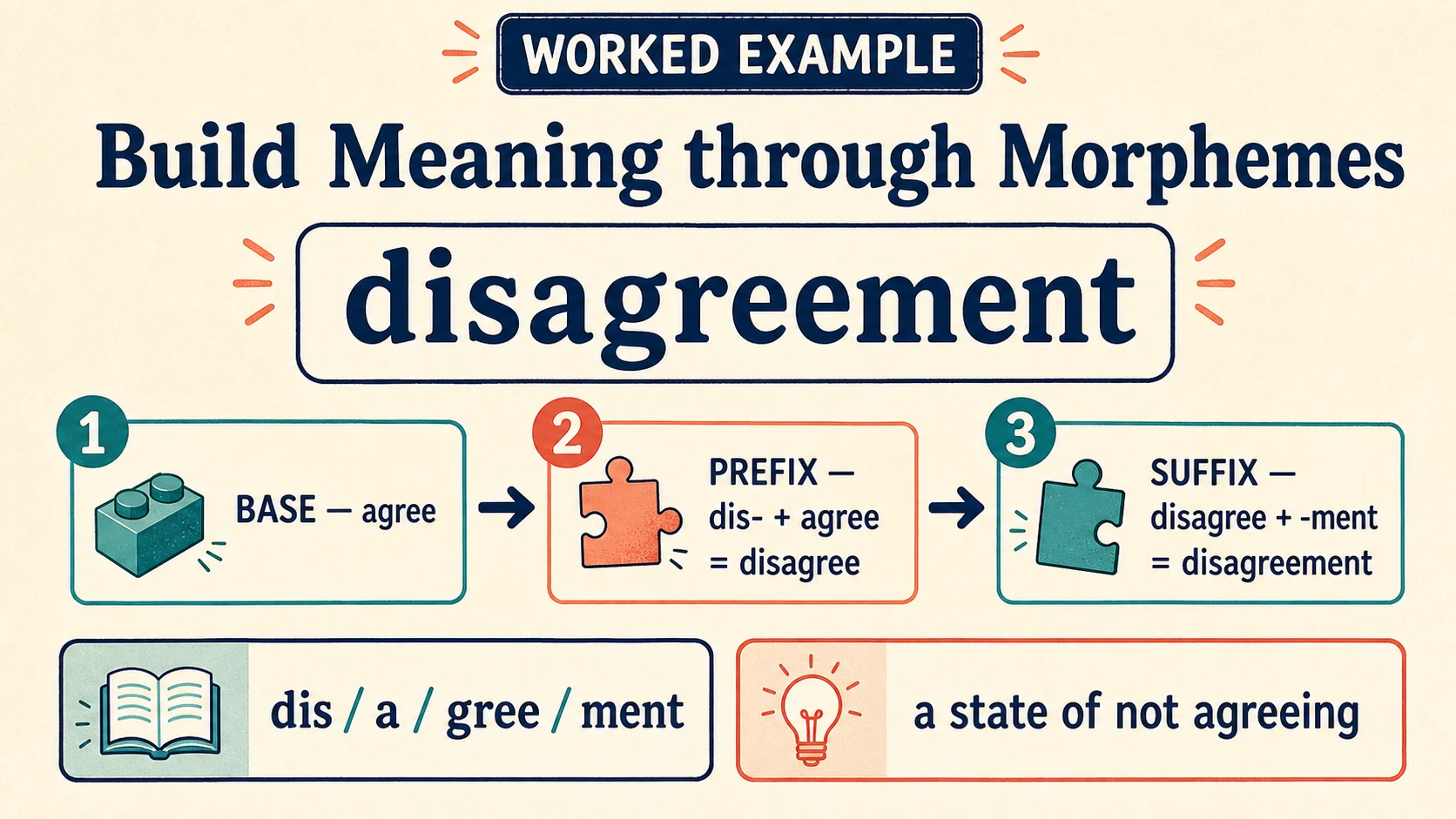
Check meaning, identify the word, examine its parts, write it, and verify every letter.
Worked example 1: Complete a sentence
Practice prompt:
We wrote the field-trip date on the ______.
Word to spell: calendar
A useful think-aloud is:
- “The missing word names something that shows dates.”
- “The word is calendar.”
- “I hear three spoken parts: cal-en-dar.”
- “I will write calendar.”
- “I will check every letter: c-a-l-e-n-d-a-r.”
The checked answer is calendar. A response such as calender may sound plausible, so saying the word again is not always enough. The learner needs to inspect the internal vowel sequence.
This example also establishes a boundary: the sentence’s meaning helps identify the word, but meaning alone does not prove that it has been spelled correctly.
Worked example 2: Unscramble every supplied letter
Practice prompt:
rowomrot
Start with the likely word tomorrow, and then verify the letter inventory instead of accepting a familiar-looking guess.
- Target: t-o-m-o-r-r-o-w
- Scramble: r-o-w-o-m-r-o-t
- Both contain one t, three o letters, one m, two r letters, and one w.
The checked answer is tomorrow.
Model crossing out or pointing to each scrambled letter as it is used. If the learner writes tomorow, the word is recognizable but incomplete: one r is missing. If the learner writes a correctly spelled word that does not use the supplied letters, it is not a correct solution to the scramble.
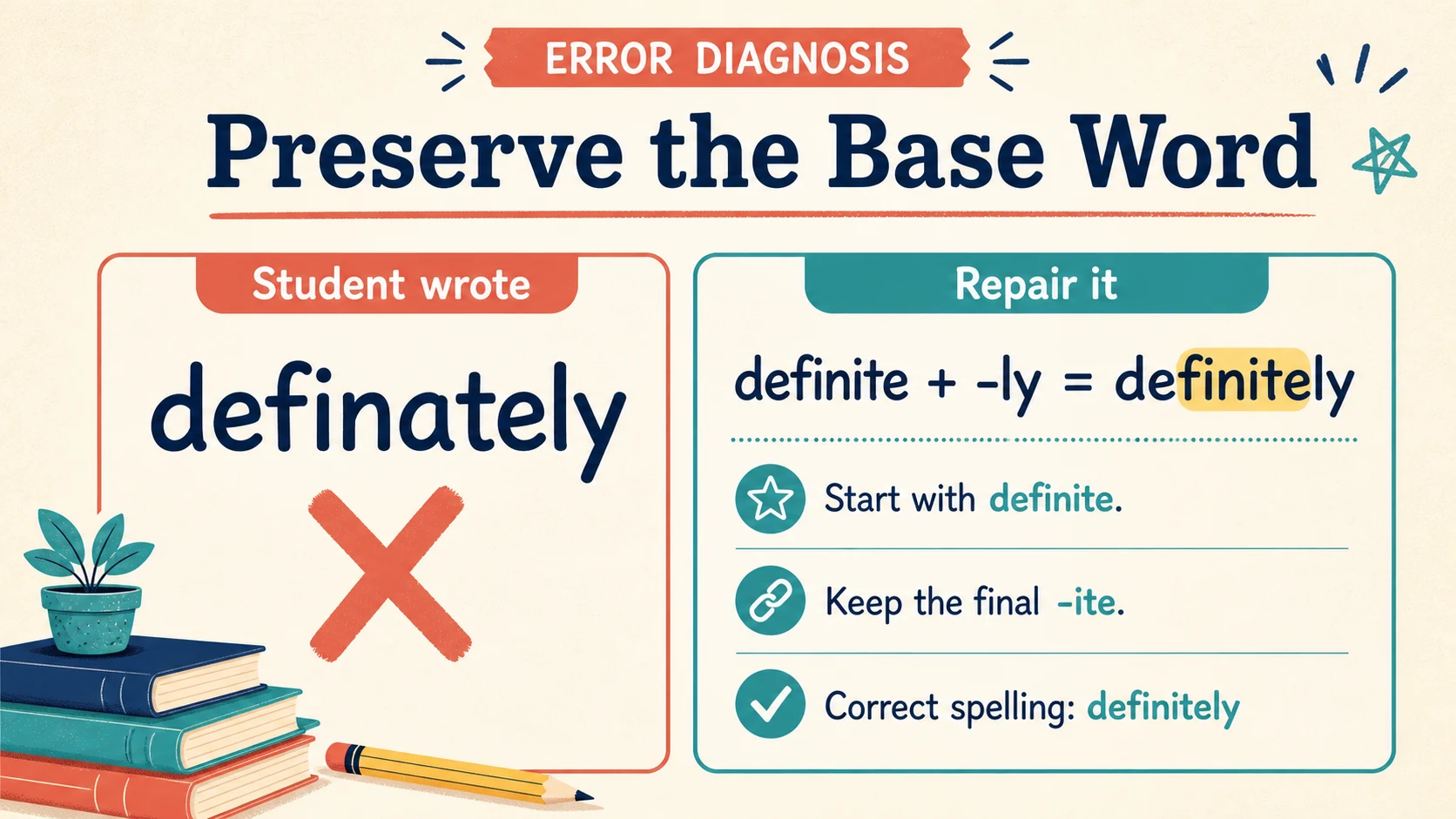
Worked example 3: Repair a misspelling
Practice prompt:
definately
Compare it with the correctly spelled base word definite, then add -ly:
- definite
- definite + ly
- definitely
The checked answer is definitely.
The correction is not merely “change an a to an i.” The learner should see the stable spelling of definite inside definitely. That observation creates a more reusable check than memorizing a correction mark.
Do not force every word into a simple rule. If the learner cannot explain a reliable pattern, it is enough to mark the difficult part, study the correct form, and retrieve it later.
Worked example 4: Check a suffix carefully
Practice prompt:
carefull
The intended word is built from care and the suffix -ful:
- care + ful
- careful
The checked answer is careful, with one l at the end.
A common misconception is that full always keeps both l letters when it appears at the end of a longer word. In the suffix -ful, the conventional spelling uses one l. The learner can box care and underline ful to make the structure visible.
These four examples are fully checked teaching examples created to model the worksheet’s activity types and relevant spelling decisions. They are not claims about which words appear among the printable’s 30 items.
Run guided practice with prompts that preserve the thinking
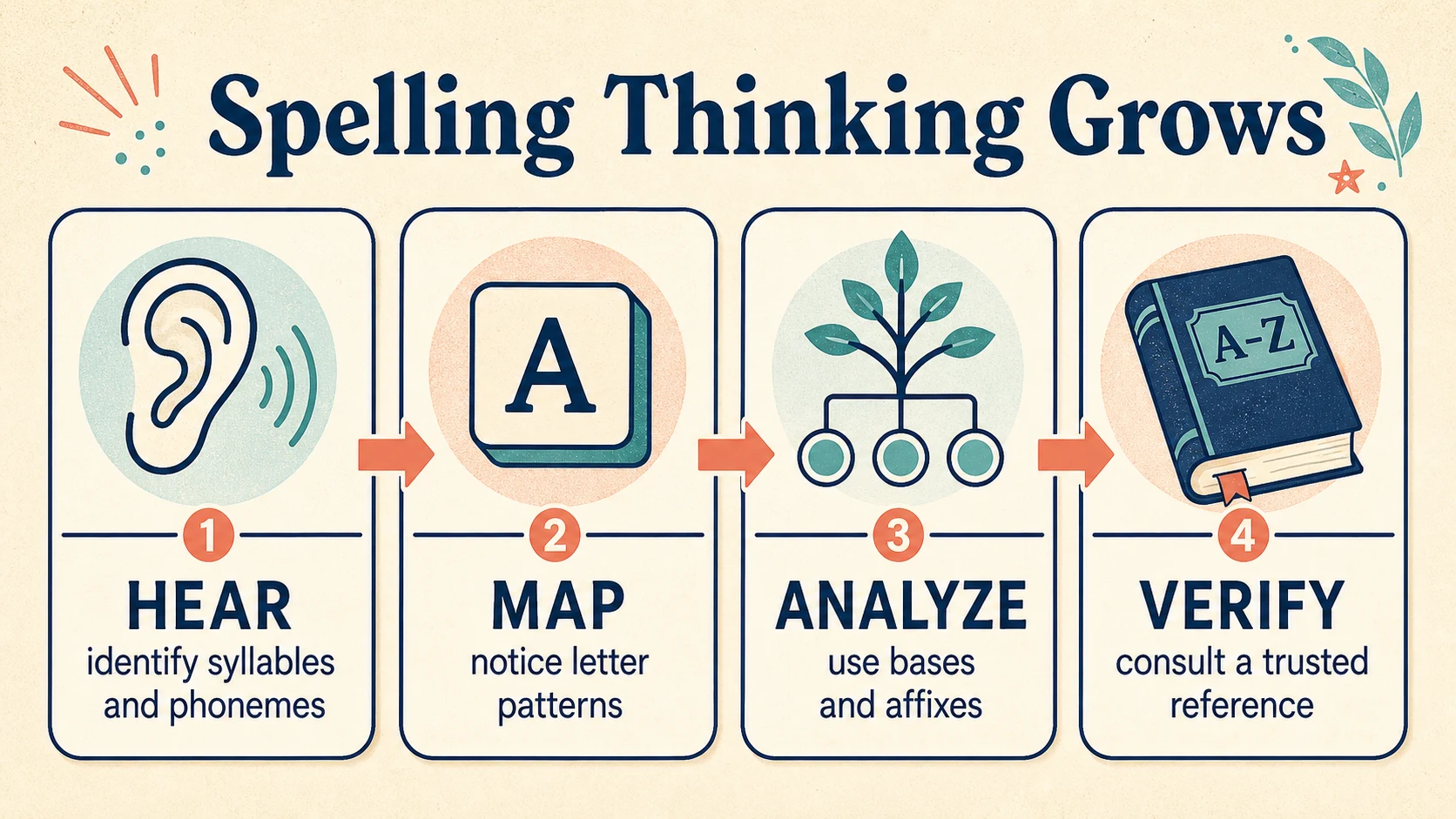
During guided practice, give the smallest prompt that helps the learner resume the task.
Choose a few items from the beginning of the worksheet and solve them together. Let the learner attempt each item before intervening. If help is needed, move from a light prompt to a more explicit one.
A practical prompt sequence
For a fill-in-the-blank item, try:
- “What word makes sense here?”
- “Say the whole sentence with that word.”
- “Which part of the spelling are you least sure about?”
- “Write your best attempt, then inspect that part.”
For a scramble, try:
- “What word might these letters form?”
- “Have you used every letter?”
- “Are any letters used more times than the scramble allows?”
- “Read the completed word and compare the inventories.”
For a correction item, try:
- “Does any part look unusual?”
- “Point to the part you would check.”
- “Can you connect the word to a base word, ending, or familiar pattern?”
- “Rewrite the entire correct word.”
The goal is not to avoid all errors. It is to see whether the learner can use an appropriate checking process. If an adult supplies the missing letters too early, the completed page reveals little about independent spelling.
The IES elementary writing practice guide treats foundational writing skills, including spelling and sentence construction, as part of broader writing instruction. That high-level framing supports giving spelling attention while still connecting it to meaningful written language. It does not mean that IES evaluated this WorksheetWise printable or prescribed this particular lesson sequence.
Know when guided practice is complete
Move to independent work when the learner can:
- Explain the current item type.
- Attempt a word without waiting for approval after every letter.
- Use the prompt or sentence for meaning.
- Check a scramble against all supplied letters.
- Rewrite a corrected word completely.
- Mark uncertainty instead of stopping the entire page.
If those behaviors are not yet present, continue with another item or split the page into a smaller section. Independent practice should test the method just modeled, not introduce an unexplained routine.
Protect the independence of independent practice
Tell the learner how many items to complete before checking in. A visible stopping point—such as the end of a row or activity section—is clearer than “do some.”
During this phase, avoid spelling words aloud letter by letter. If the learner asks for an answer, invite a best attempt and allow a small question mark beside it. That mark preserves momentum and gives you useful evidence about uncertainty.
Observe without hovering. Notice whether the learner:
- Reads the prompt completely.
- Confuses one activity format with another.
- Omits letters when copying.
- Produces a plausible phonetic spelling.
- Misses the same letter sequence repeatedly.
- Corrects a word before asking for help.
- Begins accurately but becomes less careful later.
The printable can serve as classroom practice, homework, or homeschool work, but the setting changes what the completed page can show. A page finished with extensive adult assistance is guided practice, not an independent sample. Labeling the type of help given is more informative than treating every completed response as equivalent.
Fifth-grade learners are moving toward greater independence, but independence does not require completing a long task without a pause. It means taking increasing responsibility for reading directions, attempting spellings, checking work, and explaining corrections.
Adapt support without changing the spelling skill
Adjust the amount, presentation, or prompting while keeping the learner responsible for the spelling decision.
Useful adaptations keep the original skill intact. They do not convert the activity into copying every answer from a visible key.
When the page feels too demanding
Reduce the number of visible items by covering later rows with a blank sheet. Complete one activity section at a time. Read directions aloud if decoding the directions is obstructing the spelling practice, but let the learner generate and write the target words.
For a scramble, provide movable letter tiles or let the learner rewrite each supplied letter on a separate paper square. The learner still has to form and verify the word; only the visual organization changes.
For a correction task, invite the learner to circle the suspected part before rewriting. If locating the error is difficult, narrow the search: “The word has one part that needs checking.” Avoid naming the replacement letter immediately.
When handwriting slows the lesson
Permit the learner to say the intended word before writing it. This separates word identification from transcription and helps you interpret the result. A spelling must still be written for this printable to assess written accuracy.
If a word is correct orally but letters are omitted or reversed during writing, record that observation rather than assuming the learner did not know the spelling. Then have the learner produce one careful written retry. This guide cannot diagnose the cause of persistent handwriting or transcription difficulties; it can only help you document what occurred during the activity.
When the worksheet is completed easily
Do not make the learner rewrite all 30 correct answers merely to increase the workload. Instead, choose a few words and ask for a short original sentence, a pattern sort, or a look-cover-write-check attempt.
A stronger transfer check is to dictate a brief sentence containing a practiced word after the worksheet is no longer visible. The learner must then recall the spelling while managing sentence meaning, capitalization, spacing, and punctuation.
You might also ask the learner to identify a meaningful word part or compare two spellings. Keep such extensions tied to actual words encountered in the lesson. The 5th Grade spelling hub can provide additional practice formats when this easy-level page no longer supplies enough productive challenge.
Interpret errors before assigning more practice
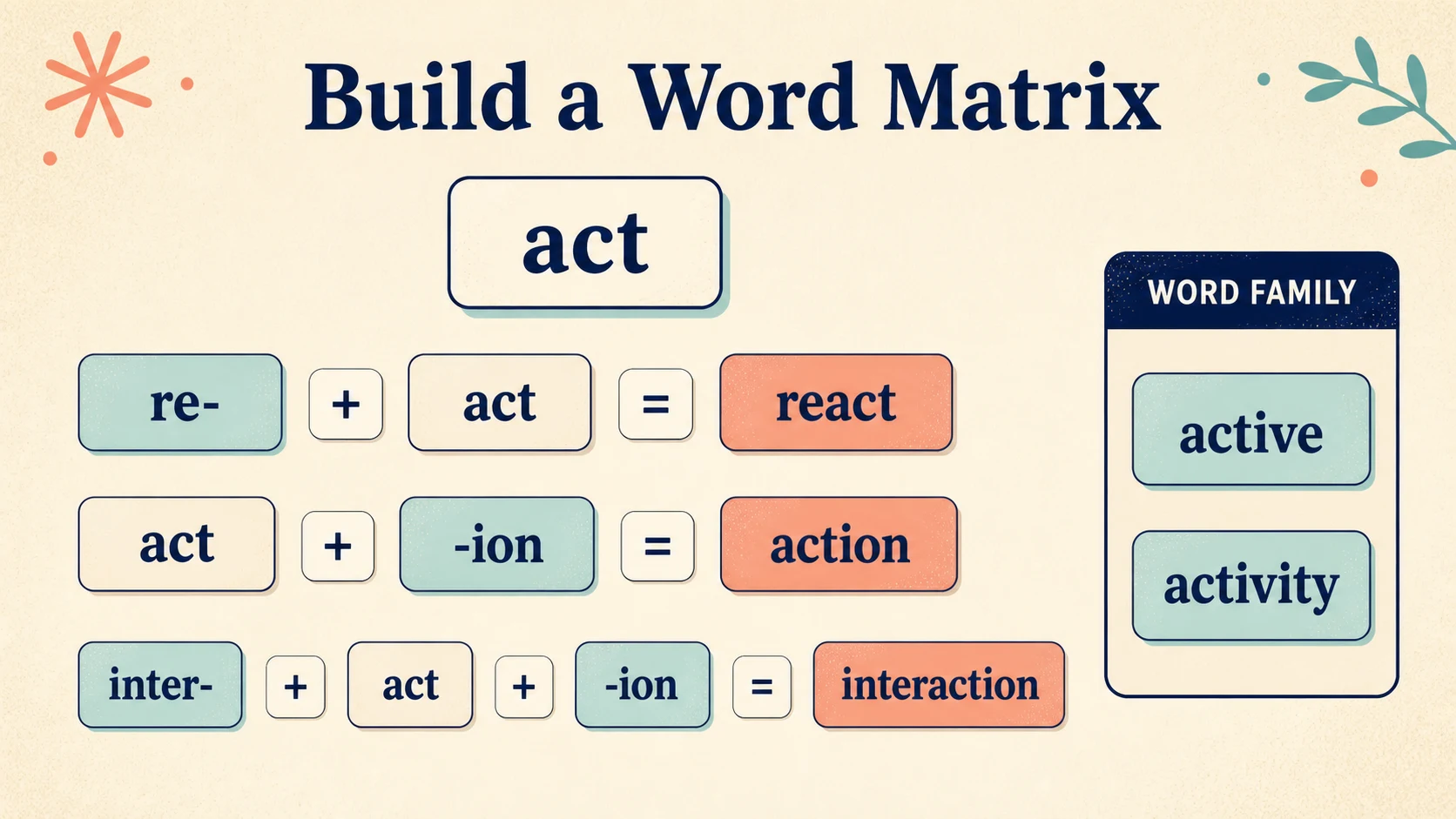
Classify what happened, correct the word, explain the changed part, and test it again later.
A total score is convenient, but the type of error gives better instructional direction. Review missed items with the learner and ask what happened.
Direction and format errors
A learner may insert a sensible word without checking the required spelling, leave scramble letters unused, or circle an error without writing the corrected word. These responses show that the task requirement was not fully carried out.
Reteach the format with one item. Do not automatically assign extra study of every word. The next check should ask whether the learner now follows the operation correctly.
Word-identification errors
In a fill-in-the-blank activity, the learner may spell a word accurately even though it does not fit the sentence. That is not a correct response because the task requires both identifying the intended word and spelling it.
Ask the learner to read the completed sentence aloud. Discuss whether the word makes sense grammatically and in context, then return to spelling.
Letter-pattern errors
Repeated trouble in the same part of several words may justify a small comparison set. For example, the learner might repeatedly omit a doubled consonant, confuse an internal vowel sequence, or alter a suffix.
Describe only what the work demonstrates: “These three words were missing a repeated consonant.” Do not conclude that the learner has a broad deficit from one worksheet. Select two or three relevant words, compare the difficult portions, and revisit them later from memory.
Memory, copying, and checking errors
A learner may copy a model inaccurately, write a word correctly once and incorrectly later, or correct a word while looking at the key but miss it again after the key is removed. These outcomes call for retrieval rather than more copying.
Use a short cycle:
- Study the correct spelling.
- Cover it.
- Write it from memory.
- Compare each letter.
- Explain the corrected part.
- Try it again after a delay.
The catalogue’s broader topic guidance includes look-cover-write-check, word sorting, sentence use, and cumulative review. The IES foundational-skills guide concerns kindergarten through grade 3, so it should not be presented as a fifth-grade program. It can provide background for attending to sound-letter relationships when an older learner’s spelling attempt reflects uncertainty in those foundations.
Use the answer key as a checking tool, not a substitute
The separate answer key makes grading efficient, but responsible checking involves more than placing a mark beside each response.
First, let the learner complete the agreed portion without seeing the key. Then compare one item at a time. For every mismatch:
- Confirm that you and the learner are checking the same item.
- Read the prompt again.
- Compare the response with the keyed spelling letter by letter.
- Identify the first place where the forms differ.
- Rewrite the complete word correctly.
- Explain whether the issue involved meaning, task format, an omitted letter, an added letter, letter order, or an uncertain pattern.
Do not count an answer as correct simply because it resembles the target or can be understood. Spelling tasks require the conventional written form. At the same time, avoid treating every crossed-out letter as evidence that the learner did not know the word. If the final response is clear, note whether your purpose is evaluating the finished answer or the first attempt.
Answer keys can also contain layout or interpretation complications. If a response appears reasonable but differs from the key, reread the exact prompt and verify that the key corresponds to the same numbered item. Do not alter the learner’s answer solely because an adult glanced at the wrong key line.
The Common Core English Language Arts standards include grade-level expectations for spelling correctly and consulting references when needed. That broad framework can inform how adults balance independent recall with responsible checking. It does not establish that this single worksheet comprehensively aligns with every local standard or spelling sequence.
Schedule retrieval based on observed work
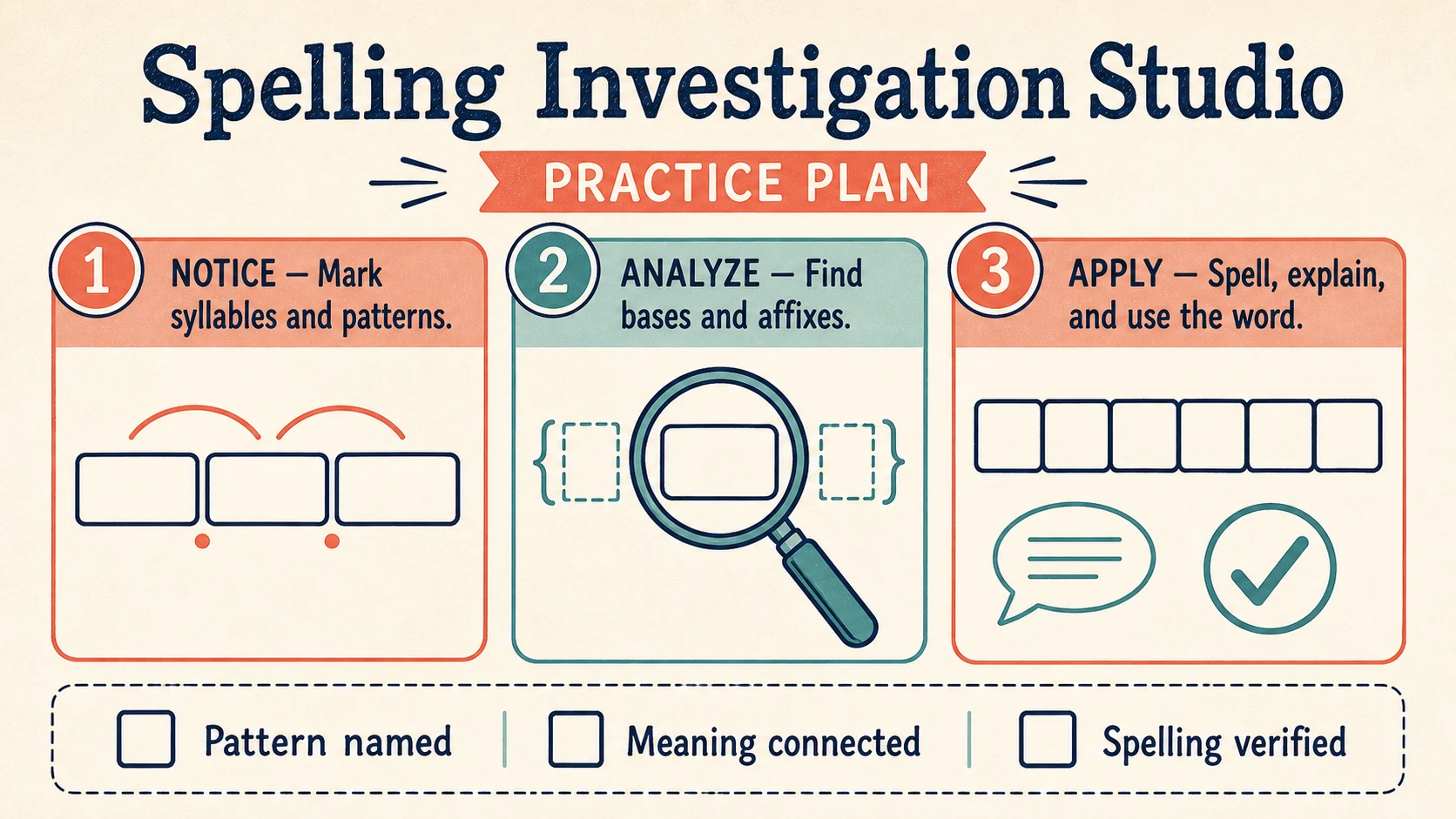
Revisit missed or uncertain words after increasing delays instead of repeating the whole page immediately.
Retrieval means producing a spelling after the model has been removed. A correction copied while the answer remains visible is useful study, but it is not yet evidence of recall.
The following is a practical schedule, not a sourced universal timetable:
| Review point | What to practice | Suggested check |
|---|---|---|
| End of the lesson | Missed and question-marked words | Look-cover-write-check |
| Next short session | The same target words in mixed order | Oral prompt followed by written recall |
| Several days later | Words still uncertain plus a few secure words | Quick mixed dictation or correction task |
| About a week later | Only words not yet stable | Sentence use, sort, or another memory check |
Change the intervals according to performance. If the learner recalls every selected word promptly and accurately, extend the delay or move on. If the learner studies a word and misses it moments later, shorten the set and provide another guided comparison.
Keep the review list narrow. Six uncertain words usually provide clearer practice than repeating 30 words indiscriminately. Remove words that remain accurate across delayed checks. Add a word back if it reappears incorrectly in ordinary writing.
When using sentences, check the target spelling separately from punctuation or sentence quality. Those features matter, but combining every concern into one correction can obscure the purpose of the spelling review.
Avoid common misconceptions about worksheet results
A perfect page does not prove permanent mastery. The learner may have recognized words in context, used visible letters in a scramble, or remembered a correction for only a few minutes. Delayed retrieval and use in original writing provide additional evidence.
A low score does not establish a diagnosis or even a broad spelling weakness. The learner may have misunderstood directions, rushed, lost place, struggled with a particular format, or encountered several unfamiliar words. Examine the responses before deciding what they mean.
Repeated copying is not the same as retrieval. Copying can focus attention on the correct form, but the word must eventually be covered and produced from memory.
Sounding out is useful but not sufficient for every conventional spelling. Some plausible attempts preserve the sounds while using the wrong vowel pattern, consonant count, or suffix. Teach the learner to combine pronunciation with visual inspection, meaningful word parts, context, and reference checking.
Finally, “grade appropriate” is not a fixed list shared by every school. Grade labels describe intended practice level, and local sequences differ. Use this worksheet as one sample of fifth-grade practice rather than as a complete spelling curriculum or comprehensive standards assessment.
Decide what comes next from the evidence
Sort the learner’s results into three groups:
- Secure: correct independently and checked confidently.
- Developing: correct after a prompt, self-corrected, or marked uncertain.
- Needs review: incorrect, incomplete, or not recalled after correction.
If most words are secure, use a few in sentences and move to a more varied activity rather than repeating the printable. If errors cluster around one visible pattern, prepare a small word sort or retrieval set. If problems occur mainly in one activity format, reteach that format before drawing conclusions about spelling knowledge.
If many items remain difficult even with clear directions and guided examples, divide the worksheet into smaller sessions and return to the relevant word patterns through the Spelling Words topic guide. Persistent concerns should be discussed with the learner’s teacher or another qualified educational professional who can consider classroom work and a broader history. This worksheet alone cannot identify the cause of a persistent difficulty or provide medical guidance.
For continued structured practice, select another free activity from the 5th Grade worksheet hub, create a targeted list with the free worksheet generators, or use the 18-worksheet 5th Grade Spelling Words pack. The best immediate next action is to record only the missed or uncertain words from this printable and schedule the first covered, from-memory check for the learner’s next short spelling session.
Put it into practice
Use the guide with a real printable
Move from explanation to a short, observable practice task. Check the first item together, then adjust the next session from the learner's actual work.
See the 18-worksheet pack