Complete guide
How to teach and practise 5th grade word problems worksheets - standard theme (easy)
A practical way to use this 16-item worksheet
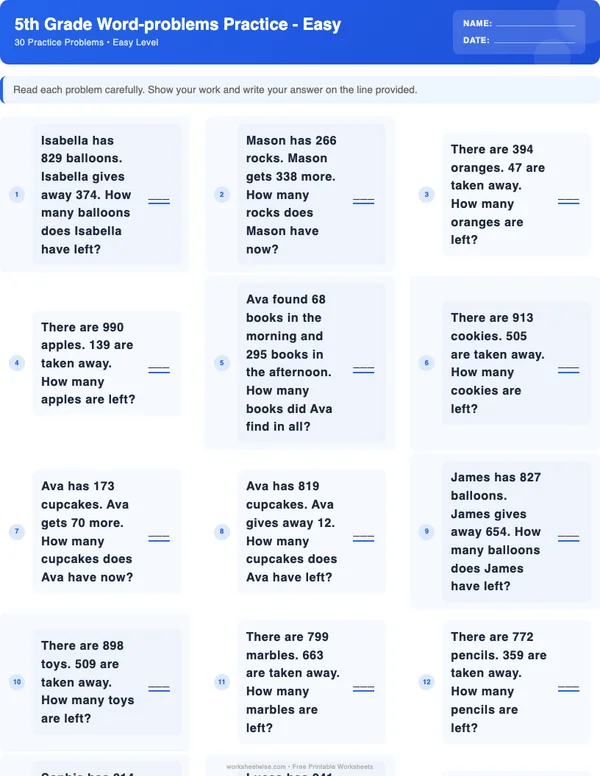
The free 5th Grade Word Problems worksheet contains 16 easy-level story problems involving problem solving, reading comprehension, multi-step reasoning, and mixed operations. Use it as a short lesson sequence rather than handing over all 16 items at once: model one similar problem, solve two or three items together, assign a manageable independent set, discuss errors, and return to selected problems later.
The goal is not merely to obtain 16 correct answers. A learner should practice this repeatable routine:
- Read the entire situation.
- Retell what is happening.
- identify the known quantities and the unknown.
- Represent the relationships with an equation, drawing, table, or bar model.
- Calculate.
- Check whether the answer fits the question.
Let the learner’s observed work determine the pace. Someone who can calculate accurately but misreads relationships needs different support from someone who selects the right operation but makes computation errors. Grade labels describe the intended practice level; local curricula, teaching sequences, and expectations differ.
What this printable covers—and what it does not establish
The worksheet is titled “5th Grade Word Problems Worksheets - Standard Theme (Easy).” Its 16 exercises are intended for straightforward introductory practice or reinforcement. The worksheet directions ask the learner to read carefully, show work, and write each answer on the provided line. A separate printable answer key is included.
The catalogue identifies four areas of practice:
- Problem solving
- Reading comprehension
- Multi-step reasoning
- Mixed operations
“Easy” is a catalogue difficulty label, not a prediction about how any particular learner will experience every item. A short story can still be demanding if the learner is unsure what the question asks, has difficulty organizing several quantities, or encounters an unfamiliar operation structure.
The worksheet should not be treated as a comprehensive assessment of fifth-grade mathematics. Sixteen responses cannot show everything a learner understands about whole-number operations, fractions, decimals, measurement, or mathematical communication. Nor does this page claim that the printable covers every local standard. The Common Core State Standards for Mathematics provide broad grade-level context, but districts and homeschool programs may order or emphasize content differently. Consult the learner’s current curriculum when exact alignment matters.
For a fuller sequence of problem types and teaching ideas, use the broader 5th Grade Word Problems topic guide. This lesson focuses on launching and learning from this particular printable rather than repeating the entire progression.
Prepare the lesson before the learner begins
Print or open both the student worksheet and the separate answer key, but keep the key out of sight during initial work. Have a pencil, blank paper, and—if useful—two differently colored pencils available. One color can mark information that is known; the other can mark what must be found.
Scan the 16 items before teaching. Because the catalogue describes mixed operations and multi-step reasoning but does not list every problem’s numbers or structure, identify which actual worksheet items appear suitable for modeling, guided work, and independent practice. Notice whether an item includes whole numbers, fractions, decimals, equal groups, comparison, or more than one operation. Do not assume that every example in this guide appears on the printable.
A workable first session might look like this:
| Phase | Suggested use | What the adult observes |
|---|---|---|
| Launch | 2–3 minutes | Can the learner explain what a word problem asks them to do? |
| Adult model | 1 similar problem | Does the learner follow the connection between the story and equation? |
| Guided practice | 2–3 worksheet items | Can the learner retell, represent, and select operations with prompts? |
| Independent practice | 4–6 items | Which parts of the routine continue without help? |
| Review | 1–2 selected responses | Can the learner find and explain an error? |
| Later session | Remaining items or a smaller set | Is the process becoming more independent? |
This is an instructional suggestion, not a universal timetable. A learner who becomes less accurate or less able to explain after four items may benefit from stopping. Another learner may complete more while still showing careful reasoning.
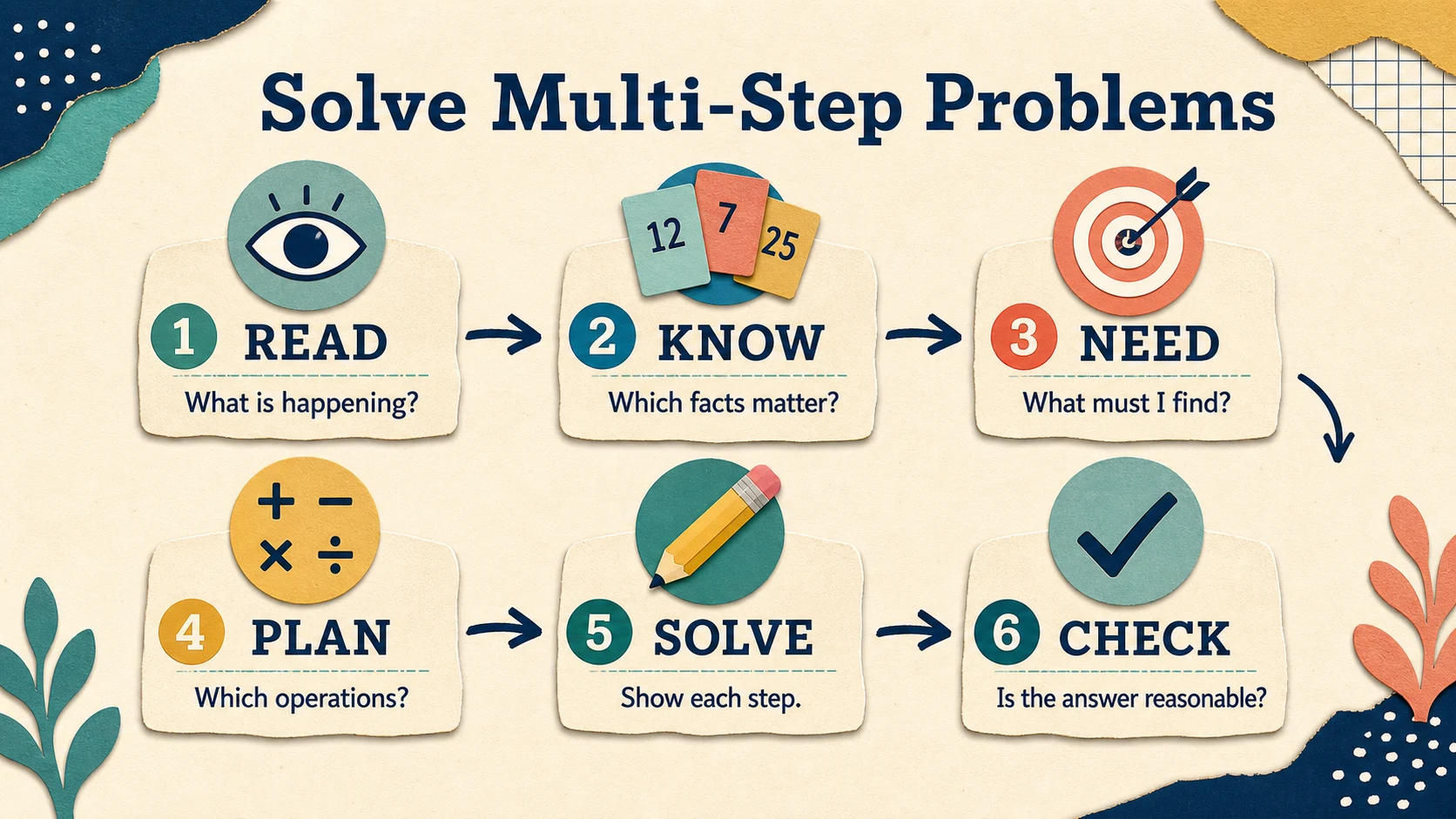
Use the map to separate modeling, guided work, independent practice, feedback, and later review.
Model a complete problem-solving routine
Modeling should make normally hidden decisions visible. Instead of saying, “This means multiply,” explain how the quantities are related and why multiplication represents that relationship.
The IES practice guide on teaching mathematics offers high-level instructional guidance that includes using representations and helping learners connect mathematical ideas. That source did not evaluate WorksheetWise or this worksheet. Here, a representation is useful only when it clarifies the quantities and their relationship.
Consider using this short script:
- “I will read the whole problem before calculating.”
- “I know there are equal groups.”
- “I need the total, so I can draw equal bars or write multiplication.”
- “My equation is .”
- “After I calculate, I will check that my answer names the requested quantity.”
Avoid teaching that a single word always determines an operation. For example, “left” often appears in subtraction situations, but a learner still needs to understand what changed and what remains. The same phrase can occur in differently structured stories.
Worked example 1: Equal groups
Problem: A classroom prepares 6 supply trays. Each tray contains 24 pencils. How many pencils are on the trays altogether?
Understand the situation: There are 6 equal groups with 24 pencils in each group. The unknown is the total number of pencils.
Represent it:
Calculate:
Answer: There are 144 pencils on the trays.
Check: Division reverses the relationship:
The check returns the number of pencils in each tray. The answer is also reasonable because six groups of about 25 would total about 150, and 144 is close to that estimate.
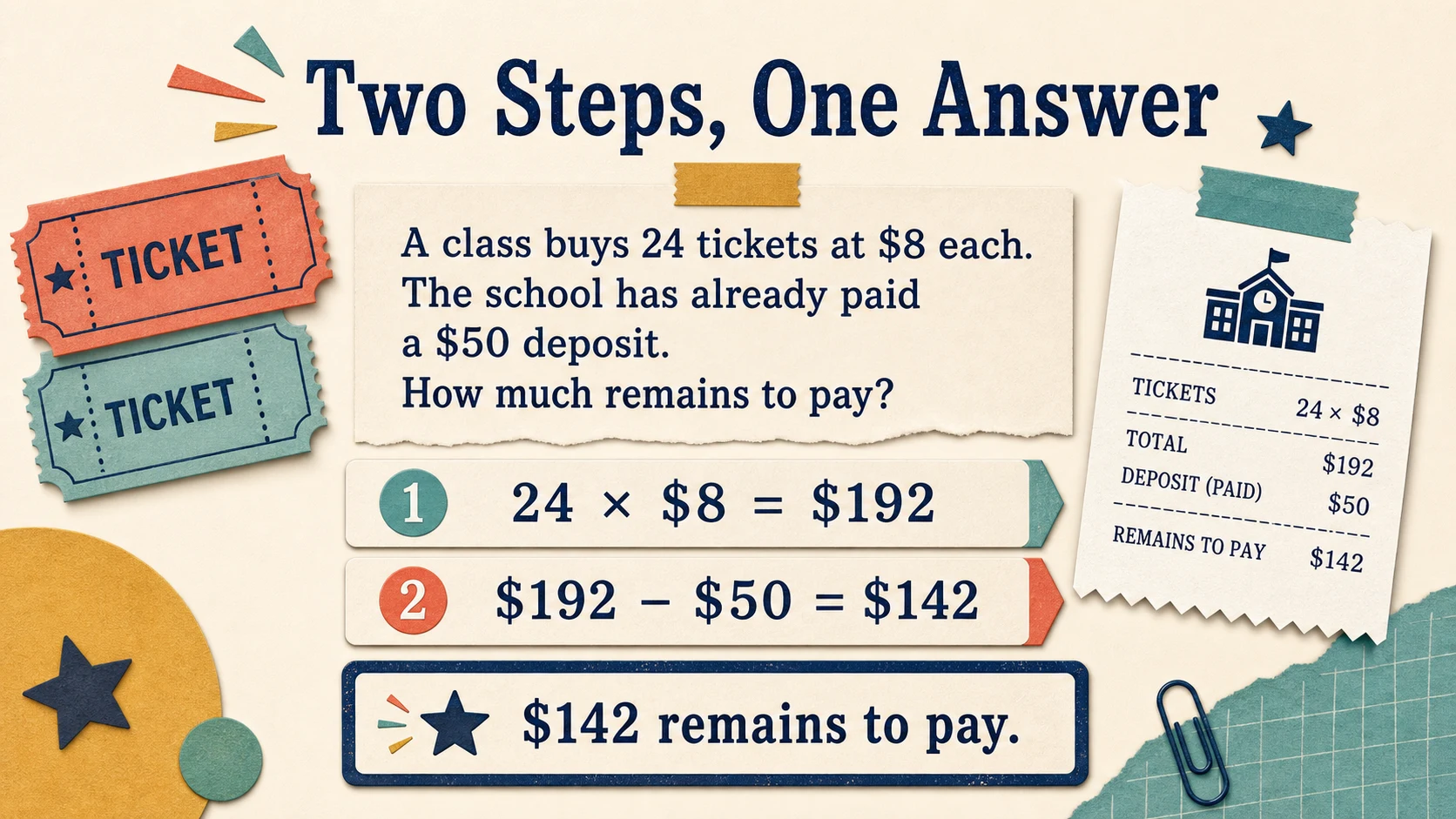
This example demonstrates the routine; it is not presented as a copy of a worksheet item.
Move from guided practice to independent work
During guided practice, ask questions that direct attention without completing the reasoning for the learner. Useful prompts include:
- “What is happening in the story?”
- “Which quantities do we know?”
- “What exactly must we find?”
- “How are those quantities related?”
- “Could you draw that relationship?”
- “What equation matches your drawing?”
- “What unit belongs with the answer?”
- “How could you check it?”
After a prompt, wait for the learner to respond or mark the page. Repeatedly converting the story into an equation for the learner would reduce the very practice the worksheet is meant to provide.
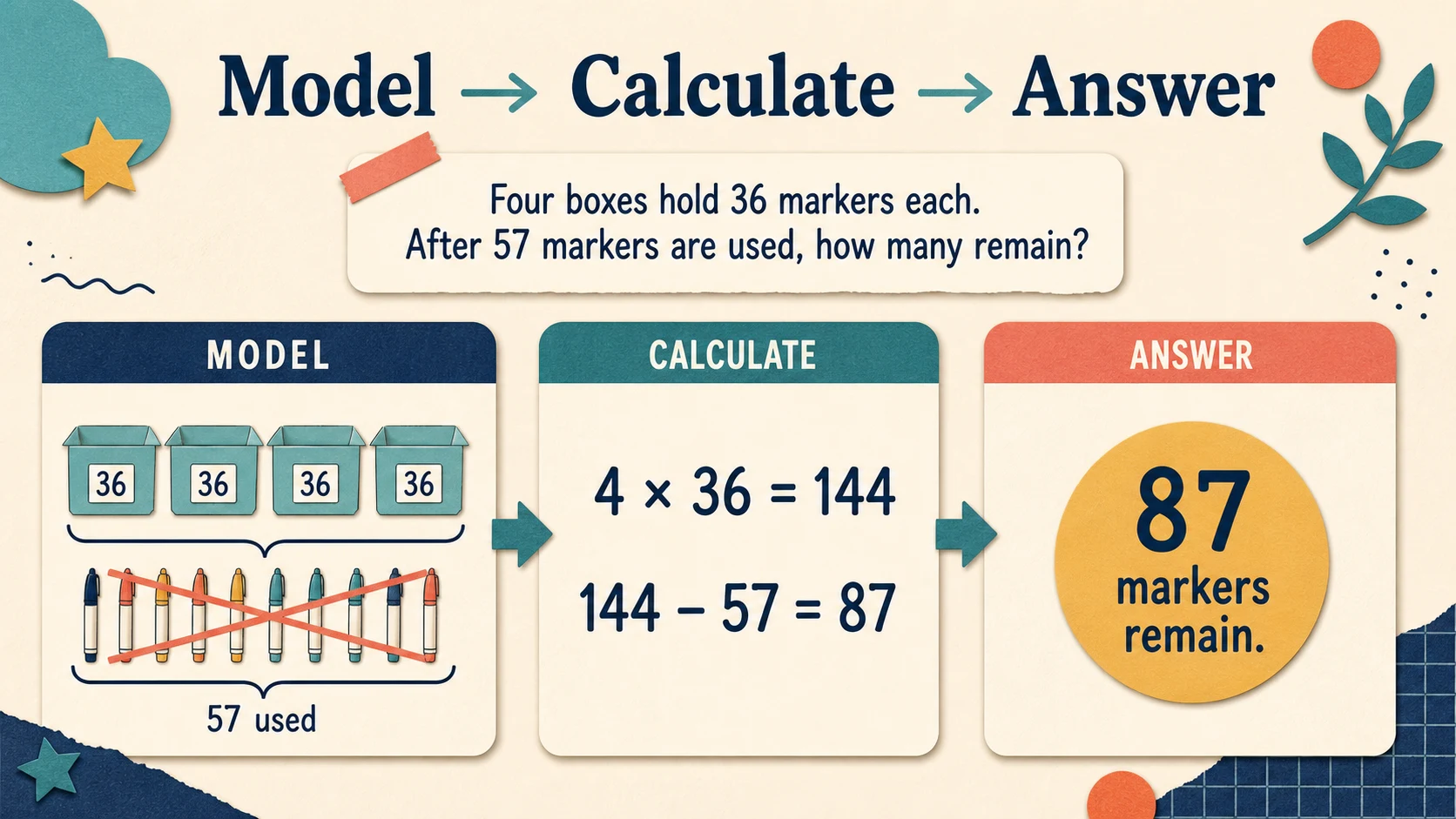
Reduce prompts gradually as the learner begins to use the routine without reminders.
Worked example 2: A two-step total and difference
Problem: A school collected 286 cans on Monday and 174 cans on Tuesday. It used 95 cans for an art project. How many collected cans remained?
Retell: First combine the cans collected on both days. Then remove the cans used.
Represent it:
First step:
Second step:
Answer: 365 cans remained.
Check the subtraction:
Check the full situation: The answer must be less than 460 because some cans were used. It must be greater than either single-day amount because only 95 were removed from the combined collection. The result fits both conditions.
A common incomplete response is 460 cans. That calculation is correct for the first step but does not answer what remained. Ask the learner to reread the final sentence and point to where the 95 cans appear in the solution.
Worked example 3: Decimal quantities
Problem: A roll of ribbon held 12.5 meters. A student used 3.75 meters for one project and 2.4 meters for another. How many meters remained?
Retell: Begin with 12.5 meters and subtract both used amounts.
One representation is:
Another equally valid representation combines the used ribbon first:
Calculate the amount used:
The zero in 2.40 does not change its value; it helps align place values.
Calculate the remainder:
Answer: 6.35 meters remained.
Check:
The remaining amount and the amount used recombine to give the starting length.
If a learner gets 8.51 or another result caused by misaligned digits, return to place value. That is a computation issue after a sound operation choice, not necessarily a word-problem comprehension error.
Worked example 4: Fractions with unlike denominators
Problem: A family walked mile in the morning and mile in the afternoon. How far did they walk altogether?
Understand: Two distances are being combined. The unknown is the total distance.
Represent it:
Twelfths provide a common denominator:
Now add:
Convert the improper fraction:
Answer: They walked miles altogether.
Check for reasonableness: is less than 1 and is less than 1, so the total should be less than 2. Both fractions are greater than , so the total should be greater than 1. The answer satisfies both boundaries.
These examples use skills found within the supplied fifth-grade catalogue context, but they are illustrative. If the worksheet does not include a particular number type, use the example to teach the routine only when it matches the learner’s current program.
Set expectations for independent practice
Before the learner works alone, agree on what “show your work” means. A complete response need not use one rigid format, but it should leave enough evidence to follow the reasoning. For each item, ask for:
- A representation or equation
- Visible calculation
- A labeled answer
- A brief check when practical
Assign a small group of items rather than automatically requiring all 16 in one sitting. Do not interrupt each time you suspect an error. A few uninterrupted items reveal which parts of the process the learner can manage independently.
Mark the kind of help given beside an item. For example:
- R: adult reread a sentence
- Q: adult asked a guiding question
- D: adult suggested a drawing
- I: independent
These notes make later interpretation more accurate. A correct answer after the adult supplied the operation is different from a correct answer reached independently.
If reading load interferes with showing the mathematics, the adult may read an item aloud exactly as written. Avoid emphasizing a supposed keyword or changing the sentence into an operation cue. After reading, ask the learner to retell the situation before solving.
Adapt support without changing the mathematical skill
Support should preserve the central task: understand the quantitative situation, choose a suitable operation or sequence, calculate, and check. Making the print easier to access is different from telling the learner what calculation to perform.
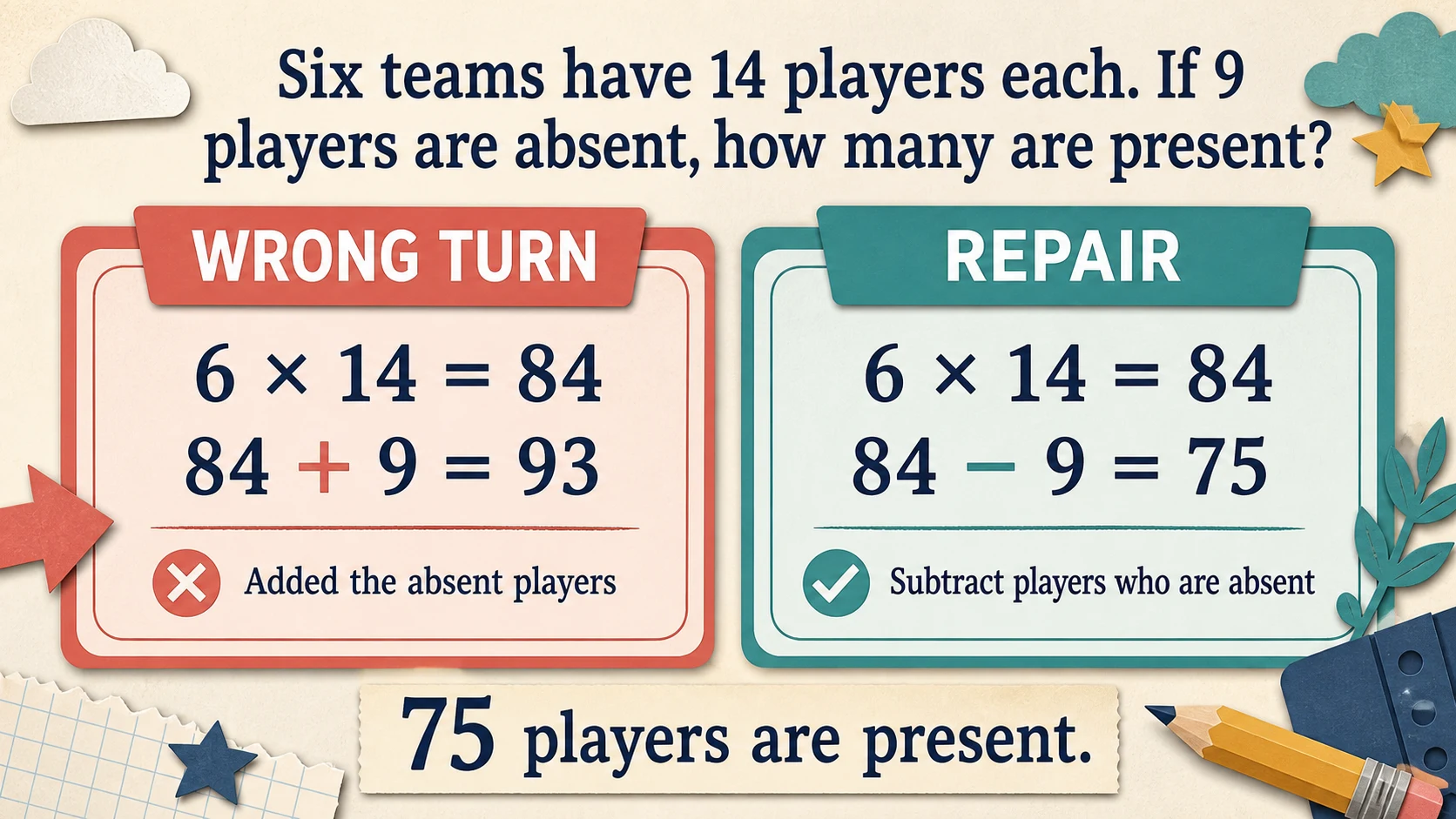
Adjust reading, representation, or workload while preserving the reasoning demanded by each selected problem.
When the learner needs help understanding the text
Read one sentence at a time, then ask the learner to paraphrase it. Cover later lines temporarily if the page feels visually crowded. Circle quantities only after discussing what each quantity represents.
A useful organizer has four boxes:
| Known information | Need to find | Relationship or model | Answer and unit |
|---|
Do not prefill the relationship box. Choosing the relationship is part of the skill.
When the learner understands but cannot organize the quantities
Offer blank bars, an unlabeled table, counters, or a number line. Ask the learner to decide what each part represents. For a comparison problem, two aligned bars can show which quantity is larger and where the difference belongs. For equal groups, repeated equal bars can display the number of groups and the amount in each.
The catalogue’s topic guidance recommends diagrams such as bar models as a way to make relationships visible. Treat the model as a thinking tool, not as an extra drawing requirement after the answer is already known.
When calculation obscures sound reasoning
If the learner chooses and explains the correct operation but makes a calculation mistake, separate the two judgments. Record that the model was correct, then practice the needed computation briefly on another sheet. The original word problem can be recalculated afterward.
A calculator would materially change what the item measures if independent computation is part of the assigned task. Use one only when the adult has deliberately decided to isolate problem representation from computation, and label that attempt accordingly.
When stamina or pace declines
Reduce the number of items in one session while keeping the selected items intact. One option is four items now, four later, followed by a decision about the remaining eight. Another is to stop after the learner makes two consecutive rushed errors that were not present earlier.
This does not lower the operation or reasoning demand. It changes how much practice occurs at once. Resume later with one previously successful item before moving to unfinished work.
Use boundary cases to expose real understanding
Straightforward problems are useful for establishing a routine, but nearby boundary cases show whether the learner understands the situation rather than relying on surface clues.
Worked example 5: A remainder that must be interpreted
Problem: Forty-six students will sit at tables that hold 6 students each. What is the least number of tables needed?
Represent it:
Seven full tables seat:
Four students still need seats, so one more table is required.
Answer: 8 tables are needed.
Check:
Eight tables provide enough seats. Seven provide only 42, which is not enough.
The numerical division result does not by itself finish the reasoning. If the question instead asked, “How many tables can be filled completely?” the answer would be 7 full tables, with 4 students not included in those full groups. The same numbers and calculation produce different reported answers because the question changes.
Extra, missing, and unknown-position information
For an item containing an unused detail, ask, “Does this quantity help determine the requested answer?” Crossing out a number before understanding its role can be as risky as using every number automatically.
For a situation with insufficient information, the correct conclusion may be that an answer cannot be determined. For example: “A shelf holds some books. Nine are removed. How many remain?” Without the starting number, the remainder cannot be calculated.
Also vary where the unknown appears when you create oral follow-ups:
- Result unknown: 28 books plus 17 books equals how many?
- Change unknown: 28 books plus how many equals 45?
- Start unknown: Some books plus 17 equals 45.
These variations should be used as supplementary instruction, not described as exact contents of this printable.
Interpret errors before correcting them
A wrong final answer does not identify the cause. Examine the learner’s marks, equation, calculation, unit, and explanation.
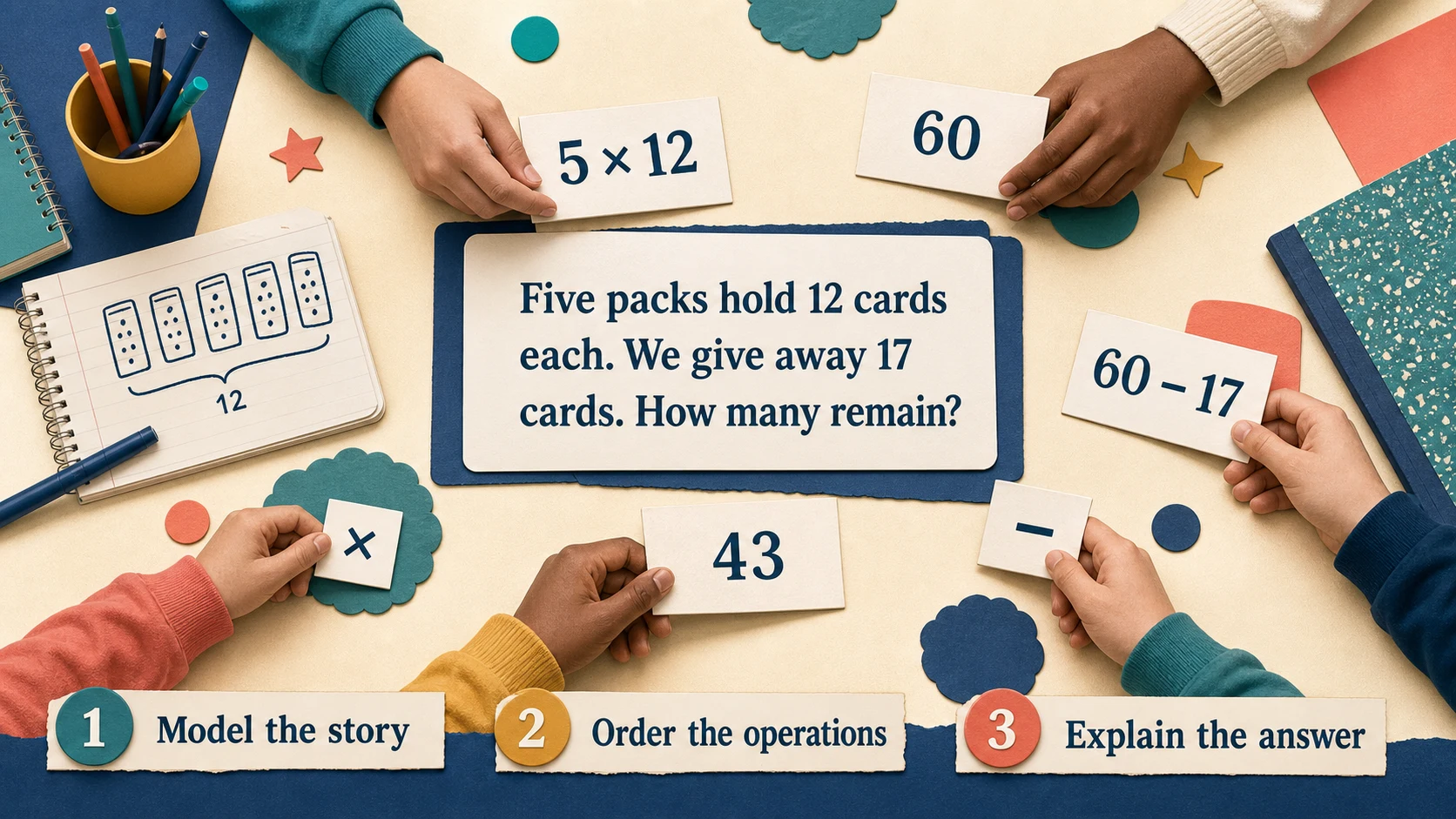
Trace the error from understanding to representation, calculation, and final reporting.
| Observed work | Likely point to inspect | Useful adult response |
|---|---|---|
| Uses every number in one calculation | Relevance of information | “Tell me what each number measures.” |
| Chooses an operation from one familiar word | Understanding of the relationship | “Retell the whole event without using the numbers.” |
| Correct first step but stops early | Attention to the final question | “What have you found, and what still needs to be found?” |
| Correct model, incorrect arithmetic | Computation or place value | Recalculate separately and compare each line. |
| Correct number, missing or wrong unit | Interpretation of the requested quantity | “What does this number count or measure?” |
| Implausible answer with no concern | Reasonableness checking | Estimate a range before recomputing. |
| Changes a correct answer after looking at the key | Confidence or key use | Require comparison of methods before revising. |
| Cannot explain a correct answer | Guessing or unsupported procedure | Ask for a drawing, equation, or inverse check. |
The IES guide for assisting students who struggle with mathematics provides high-level guidance on explicit instruction, representations, mathematical language, and cumulative review. It does not diagnose an individual learner and did not evaluate this worksheet. Use observed patterns to choose the next instructional move; do not turn a few worksheet errors into a medical, developmental, or universal judgment.
Check the answer key responsibly
The separate answer key makes checking efficient, but it should confirm reasoning rather than replace it. Complete or review each assigned problem before showing the corresponding key entry.
Use this sequence:
- Compare the learner’s final answer with the key.
- If they match, inspect the equation and work for a valid route.
- If they differ, do not immediately replace the learner’s answer.
- Reread the problem and locate the first point where the two paths diverge.
- Recalculate independently.
- Confirm that the final response answers the stated question and includes an appropriate unit.
An answer key can show an expected result, but it cannot reveal why the learner made an error. It also does not make every alternate method invalid. Two representations may be mathematically equivalent.
If you believe a key entry is inconsistent with the printed question, verify the wording, numbers, operation, and arithmetic again. Record the item and your complete calculation rather than forcing the learner’s work to match. The responsible response to a suspected discrepancy is verification, not automatic deference.
Decide what to teach next
Review the worksheet by process, not only by total correct. Sort selected responses into four categories:
- Understood and solved independently
- Understood after a light prompt
- Selected the right relationship but calculated inaccurately
- Misunderstood or could not represent the situation
Then choose a narrow next step.
If the learner mostly misunderstood stories, return to retelling and diagrams with two fresh problems. If the equations were sound but arithmetic was unreliable, practice the specific computation separately before returning to word problems. If multi-step items were left unfinished, teach the learner to write a short note after each calculation: “I found ___; I still need ___.” If work was consistently accurate and well explained, move to less-supported or more varied problems through the 5th Grade Math hub or the broader topic guide.
Do not infer mastery from one error-free sitting. Likewise, do not infer broad weakness from one difficult sitting. Performance may vary with the selected problem structures, number types, reading demands, amount of prompting, and length of the session.
Schedule retrieval instead of one-time completion
Return to a small number of problems after the initial lesson. The purpose is to see whether the learner can reconstruct the reasoning after some time has passed, not merely remember the most recent correction.
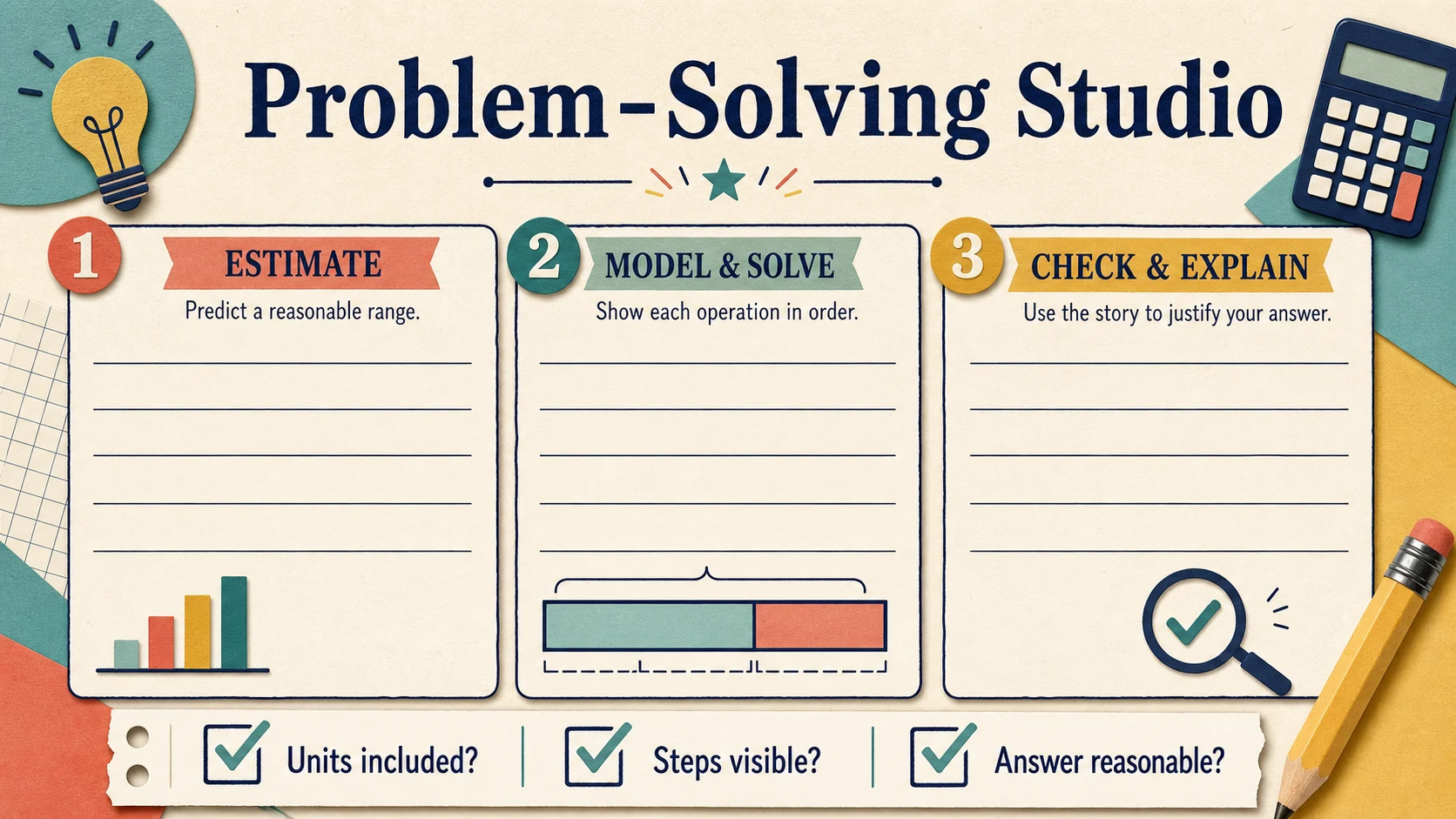
Choose review intervals from the learner’s work rather than treating this schedule as universal.
A practical, adjustable plan is:
| Time | Review task | Evidence to collect |
|---|---|---|
| End of first session | Explain one solved item | Can the learner connect the story, equation, and answer? |
| Next study session | Redo one corrected item without the old work | Does the corrected reasoning return independently? |
| Several days later | Solve one familiar and one fresh problem | Does the routine transfer beyond memory of one answer? |
| About one or two weeks later | Mix two word problems with other math practice | Can the learner recognize and organize the task without advance cues? |
These intervals are instructional suggestions, not sourced requirements or a guaranteed timetable. Shorten the gap when the learner cannot recall the process. Lengthen it when the reasoning remains accurate and independent. Retrieval should include explaining or reconstructing the solution, not simply rereading completed work.
Keep the worksheet’s limits in view
This printable offers 16 easy-level opportunities to practice reading and solving story problems with mixed operations and multi-step reasoning. It can reveal useful patterns, but it cannot by itself establish comprehensive grade-level proficiency, reading ability, standards mastery, or long-term retention.
The worked examples in this guide were created to demonstrate verifiable reasoning. They are not claimed to reproduce the worksheet’s exact questions. The IES and Common Core links provide general instructional and grade-level context; none of those organizations reviewed or endorsed WorksheetWise, this article, or this printable.
Use the worksheet as one evidence source. Notes about prompts, diagrams, explanations, and checks are often more informative than a single score. The learner’s observed work should continue to drive pacing and support.
For the next session, select two unfinished or corrected items from the free worksheet and have the learner solve them with the six-step routine. Then use the 5th Grade Word Problems topic guide to choose the next problem structure. If broader repeated practice is appropriate, compare the 18-worksheet 5th Grade Word Problems Pack or create a targeted follow-up with the free worksheet generators.
Put it into practice
Use the guide with a real printable
Move from explanation to a short, observable practice task. Check the first item together, then adjust the next session from the learner's actual work.
See the 18-worksheet pack