Complete guide
How to teach and practise 5th grade subtraction worksheets - standard theme (easy)
How to Use This 30-Problem Subtraction Worksheet
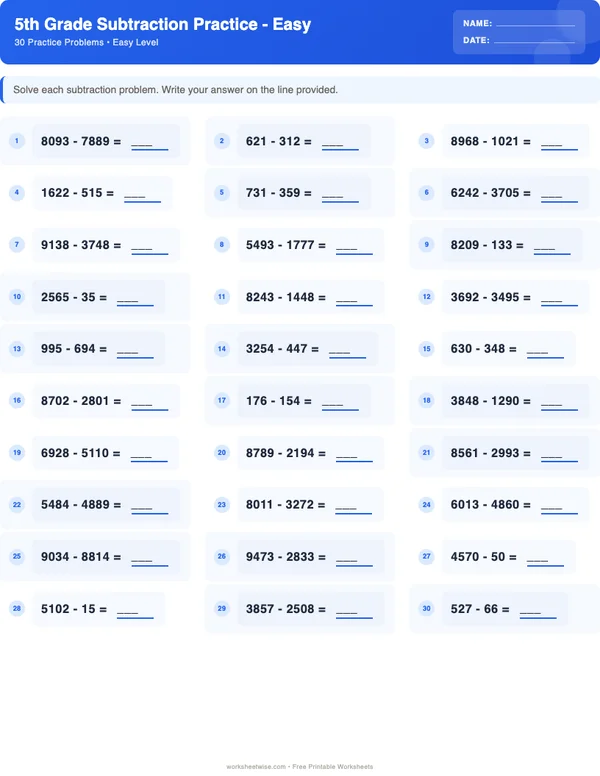
The 5th Grade Subtraction Worksheets - Standard Theme (Easy) printable provides 30 straightforward subtraction exercises covering subtraction facts, mental math, number sense, and regrouping. The learner solves each problem and writes the answer on the provided line. A separate printable answer key is included.
The most useful way to teach with this worksheet is to model one or two problems, solve a short set together, assign a manageable group independently, and then study the learner’s errors before deciding whether to continue. Do not assume that all 30 items must be completed in one sitting. The learner’s observed work—not a fixed timetable—should determine the pace.
This worksheet is intended as accessible fifth-grade practice. Grade labels describe the intended practice level; local curricula and instructional sequences differ. An “easy” label also describes the worksheet’s place within this catalogue, not the needs or overall ability of a particular learner.
Use the free subtraction worksheet when a learner needs focused written practice. For the larger development of subtraction—from meanings and fact relationships through multi-digit work—refer to the 5th Grade subtraction topic guide rather than expecting one printable to teach the entire progression.
A Practical Lesson Map
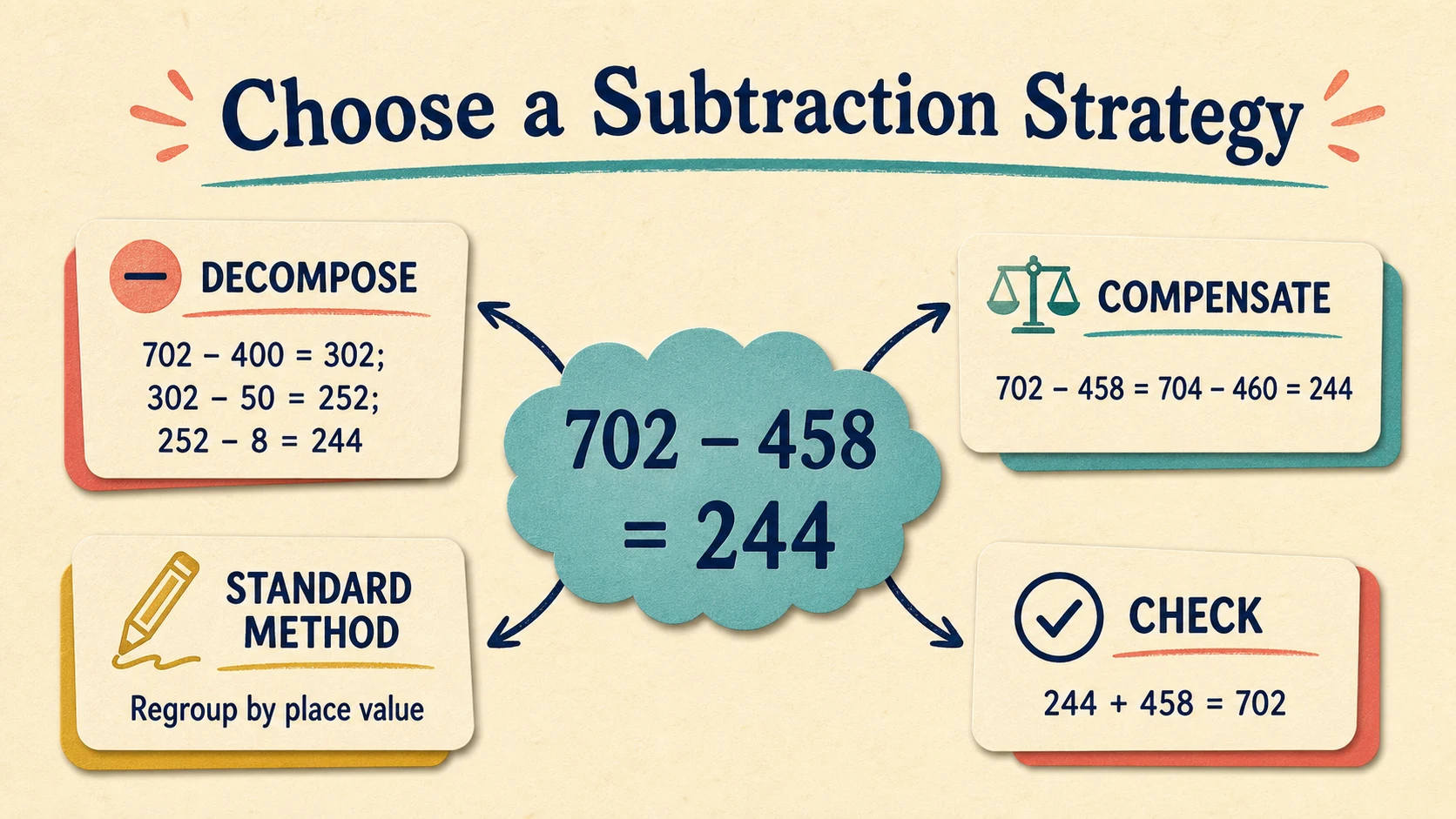
Move from a brief readiness check to modeling, guided work, independent practice, review, and later retrieval.
The following sequence is an instructional suggestion for this particular printable. It is not a universal timetable. Shorten, extend, or divide the lesson according to what the learner writes and explains.
| Lesson phase | Suggested use | What the adult watches for |
|---|---|---|
| Readiness check | Give one mental subtraction fact and one written problem | Does the learner understand subtraction and preserve place value? |
| Launch | Read the printed direction together | Can the learner state what each problem requires? |
| Model | Demonstrate one uncomplicated example and one regrouping example | Does the learner follow why each written step is valid? |
| Guided practice | Complete two or three selected items together | Can prompts be reduced without accuracy breaking down? |
| Independent practice | Assign a small group of worksheet items | Are errors isolated, repeated, or caused by recording? |
| Check and discuss | Compare work with the separate answer key | Can the learner locate and repair an error? |
| Continue or stop | Assign another group only when the first is informative | Is practice still productive and attentive? |
| Retrieval | Revisit a few problems after a delay | Can the learner reproduce the method without copying? |
The IES guide on assisting elementary students who struggle with mathematics recommends systematic instruction, clear mathematical language, and well-chosen representations. That is high-level guidance for elementary intervention; it is not an evaluation of WorksheetWise or this worksheet. In this lesson, those principles translate into an explicit demonstration, precise words such as minuend, subtrahend, difference, and regroup, and an optional place-value representation when written digits alone are not enough.
A separate IES guide on teaching mathematics to young children addresses preschool, prekindergarten, and kindergarten rather than fifth grade. Its high-level emphasis on developmental progression and monitoring what a learner knows still offers a useful reminder: begin from observed understanding and choose the next step accordingly. It should not be treated as fifth-grade-specific guidance.
Prepare the Learner and the Materials
Print and separate the answer key
Print the worksheet and its answer key, but keep the key with the adult at first. The key is most useful as a checking tool after the learner has produced visible work. If it remains directly beside the worksheet, it may turn the activity into copying or answer matching.
Provide a pencil and eraser. Lined scrap paper can help if the learner needs more room to rewrite a problem vertically. If regrouping is uncertain, have base-ten blocks or a quick place-value chart available. These supports clarify the same subtraction skill; they do not replace it.
Start with a two-problem readiness check
Before assigning worksheet items, ask the learner to solve a simple fact such as:
Check it with the related addition fact:
Then present a written example such as:
Do not use these checks to label the learner. Use them to choose the starting level of support. A correct answer with an orderly explanation suggests that modeling can be brief. A correct answer produced through uncertain guessing calls for discussion. A repeated place-value error signals that the learner needs more explicit preparation before a long independent set.
Establish a simple checking routine
Ask the learner to use the same routine throughout:
- Read the entire subtraction expression.
- Estimate or identify a reasonable answer range.
- Align digits by place if rewriting the problem.
- Subtract carefully, regrouping when required.
- Check the result with addition or estimation.
An estimate does not need to be elaborate. For , noticing that the answer should be a little more than is enough to reject answers such as or .
Model the Written Process Clearly
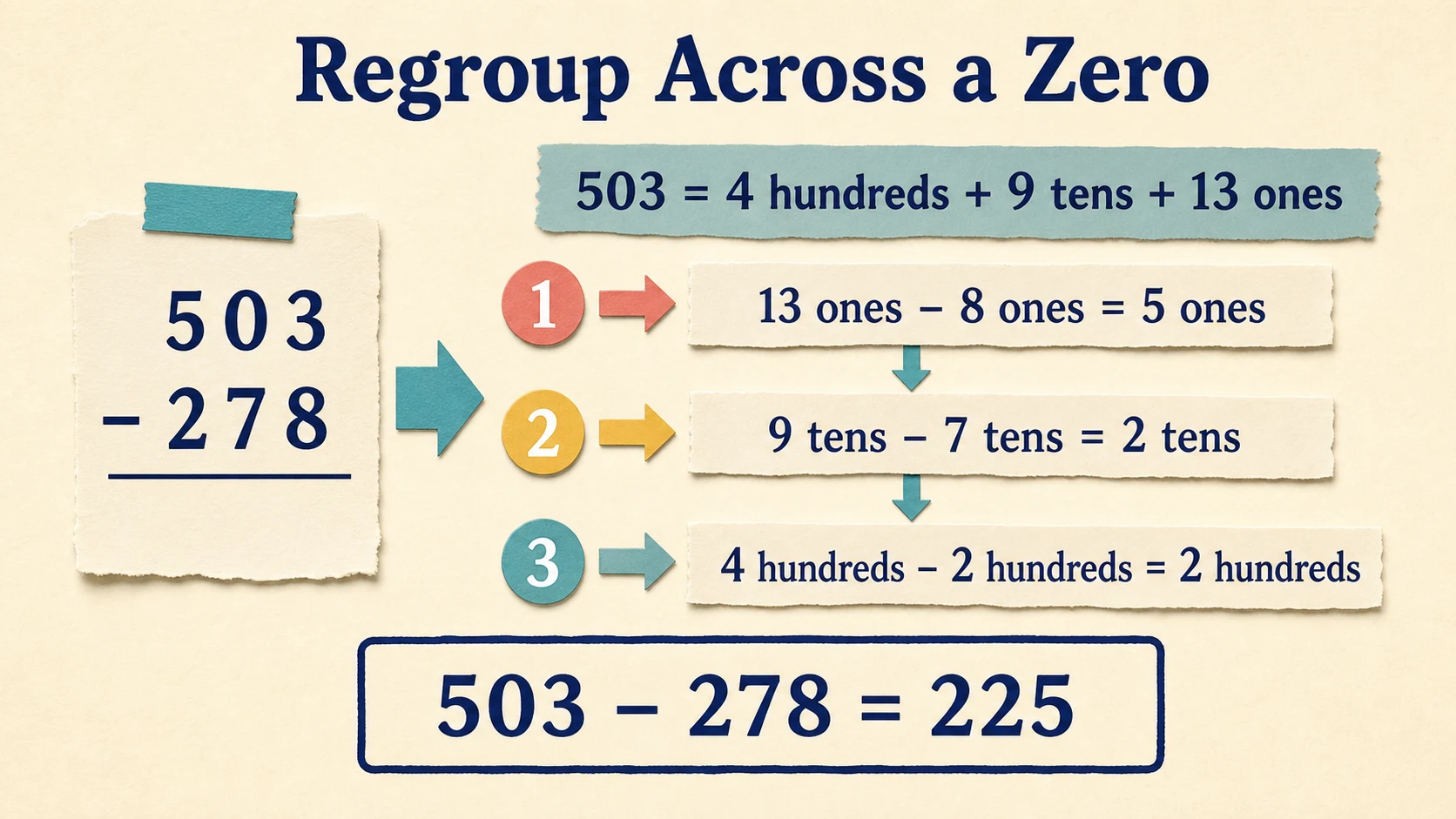
Model place value, regrouping, and a separate check rather than showing only the final difference.
The examples below are teacher-created examples for this guide. They are not presented as copied items from the printable. Each one is fully checked.
Example 1: Subtract without regrouping
Solve:
Align the numbers by place:
  654
- 321
-----
  333
Work from right to left:
- Ones:
- Tens:
- Hundreds:
Therefore:
Check by addition:
The addition returns the original minuend, so the subtraction is correct.
This example lets the learner attend to alignment and direction before regrouping adds another demand. Say, “I am subtracting ones from ones, tens from tens, and hundreds from hundreds.” Avoid describing the task as merely “taking the bottom number away,” because that wording does not explain the role of each place.
Example 2: Use mental math with a multiple of 100
Solve:
Think of the numbers as hundreds and tens:
Therefore:
Check:
A written algorithm is valid here, but mental subtraction is efficient. Ask the learner to explain why the tens digit remains . The explanation should refer to subtracting zero tens, not to a rule that digits simply “stay the same.”
Example 3: Regroup across a zero
Solve:
In the ones place, cannot be completed within whole-number column subtraction without regrouping. The tens digit is zero, so regroup one hundred:
- hundreds becomes hundreds.
- The regrouped hundred becomes tens.
- Regroup one of those tens to the ones place.
- tens becomes tens, and ones becomes ones.
Now subtract:
  4  9 13
  5  0  3
- 1  7  8
----------
  3  2  5
- Ones:
- Tens:
- Hundreds:
Thus:
Check:
The check can be decomposed as , , and .
Example 4: Regroup through several zeros
Solve:
The ones, tens, and hundreds places require regrouping. Regroup one thousand as hundreds. Then pass one hundred to the tens place and one ten to the ones place. The available places become thousand, hundreds, tens, and ones.
  1  9  9 10
  2  0  0  0
- 0  8  6  4
-------------
  1  1  3  6
- Ones:
- Tens:
- Hundreds:
- Thousands:
Therefore:
Check:
This is a useful boundary case because a learner may incorrectly turn every zero into without reducing the place to its left. Emphasize that regrouping renames the same total quantity; it does not create new value.
Move from Guided to Independent Practice
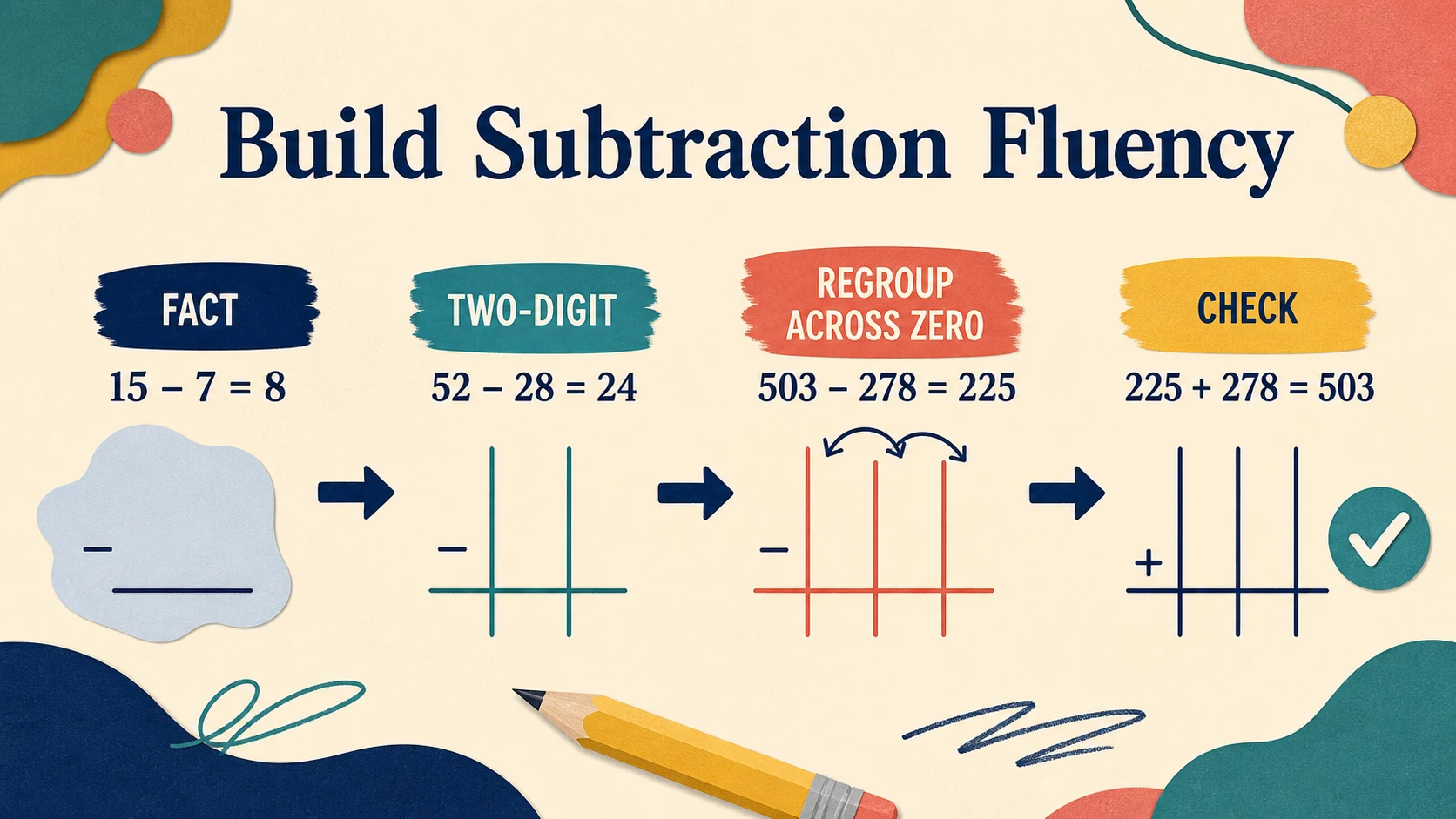
During guided practice, ask for reasoning and gradually remove prompts.
Use prompts that reveal thinking
Choose two or three worksheet items for guided practice. The learner should hold the pencil whenever possible. Ask short prompts:
- “Which place will you subtract first?”
- “Are the digits aligned by place?”
- “Can you subtract in this column as written?”
- “What quantity are you regrouping?”
- “What is a reasonable estimate?”
- “How could addition check this difference?”
These prompts keep the learner responsible for the mathematics. If the adult names every step before the learner considers it, the completed problem shows that the learner can follow directions, not necessarily that the learner can subtract independently.
When an error appears, pause at the first incorrect step. Do not immediately erase the whole solution. Ask the learner to explain what the written marks mean. A crossed-out digit or newly written should correspond to a place-value exchange that can be described.
Fade support deliberately
Support can be reduced in stages:
- Model one example while explaining every step.
- Solve another with the learner supplying each next step.
- Let the learner solve while the adult asks only checking questions.
- Assign a small independent group with no step-by-step prompting.
If the learner succeeds only while prompts are present, return to guided practice. If the learner completes several varied items correctly and can check one with addition, continue independently.
Divide the 30 items purposefully
Thirty exercises can provide substantial practice, but completing every item at once is not the instructional goal. One possible plan is:
- First group: 5 items after modeling
- Review: inspect accuracy and written process
- Second group: 5–10 items if the method is stable
- Remaining items: later practice, homework, or retrieval
This division is a practical suggestion, not a sourced requirement. A learner who works accurately may complete a larger group. A learner whose first few responses show a repeated misconception will benefit more from immediate teaching than from repeating that misconception across the page.
Adapt Support Without Replacing Subtraction
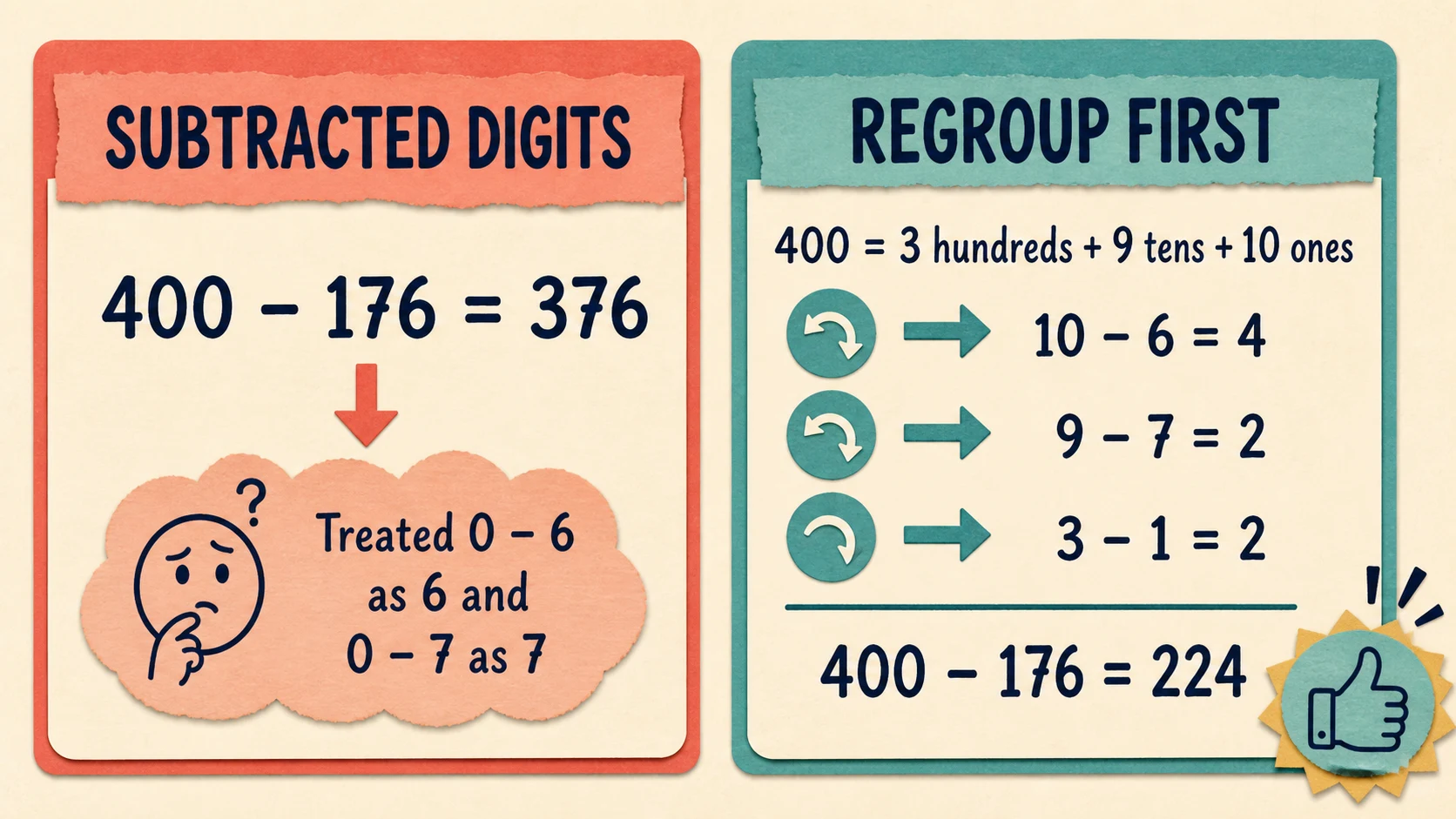
Adjust visibility, quantity, or representation while preserving the subtraction task.
Increase visual and organizational support
For a learner who loses place alignment:
- Cover later rows with blank paper.
- Reveal one problem at a time.
- Rewrite one expression on lined or graph paper.
- Draw vertical place-value guides.
- Have the learner label columns as ones, tens, hundreds, and so on.
These changes reduce visual crowding without simplifying the calculation. Do not prewrite answers or complete all regrouping marks for the learner. Instead, model one set of marks and ask the learner to create the next.
Add a concrete place-value representation
For regrouping difficulty, represent a problem with base-ten materials or a place-value drawing. A hundred can be exchanged for ten tens; one ten can be exchanged for ten ones. Keep the written expression visible beside the representation so the learner connects the exchange to the altered digits.
The IES elementary intervention guide supports the high-level use of carefully selected concrete and semi-concrete representations. It does not say that every learner or every worksheet problem requires manipulatives. Use a representation when it clarifies a specific misunderstanding, then reconnect it to the written procedure.
Adjust the amount, not the target skill
If endurance is the barrier, assign fewer items per sitting while retaining problems that require the intended subtraction work. A learner might complete six carefully checked calculations rather than rush through thirty. The remaining exercises can be saved for later.
If facts are slow, allow a brief fact reference during early guided work, then test whether the learner can solve selected facts without it later. If regrouping marks become messy, provide scrap paper rather than accepting untraceable mental guesses.
Support should respond to evidence. Do not infer a diagnosis from one page or prescribe child-specific treatment. Persistent concerns that extend beyond ordinary instruction should be discussed with the learner’s teacher or another appropriately qualified professional who knows the learner’s broader work.
Read Errors as Evidence
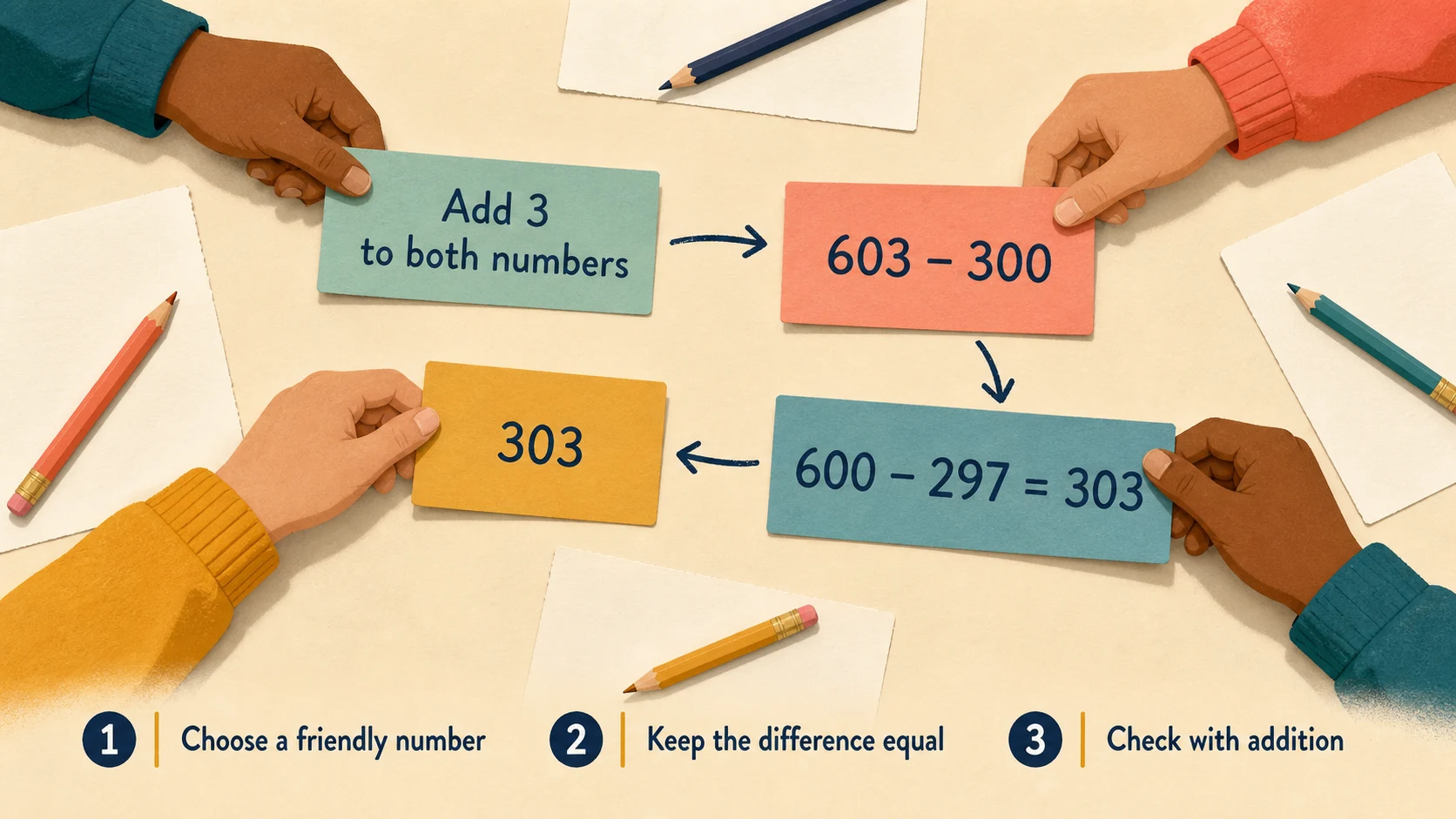
Locate the first incorrect step, name its type, repair it, and confirm the new answer.
Smaller-from-larger digit subtraction
A learner may solve as by subtracting the smaller digit from the larger digit in each column: and . This ignores the direction of the subtraction and the need to regroup.
Model as four tens and three ones. Exchange one ten for ten ones, producing three tens and thirteen ones:
So:
Check:
The response should be more than “remember to borrow.” Ask the learner to explain what was exchanged and why the total value remained .
Regrouping without reducing the next place
Suppose a learner changes ones into ones but forgets to reduce the tens digit. The resulting answer will be too large because ten extra ones have effectively been added.
Point to both connected marks: the new and the reduced tens value. Have the learner say, “I exchanged one ten for ten ones.” Then check with addition. If the difference plus the subtrahend does not equal the minuend, the written answer cannot be correct.
Place-value misalignment
If a horizontally written problem is copied vertically with ones under tens, even correct basic facts produce a wrong result. Ask the learner to identify the ones digit in each number before calculating. A place-value grid can make this error visible.
This is a recording problem until evidence suggests otherwise. Recopy one item correctly and let the learner attempt a new one. Do not conclude that the learner lacks subtraction understanding solely because of one misaligned problem.
Fact error versus procedure error
A fact error occurs when the setup and regrouping are sound but a calculation such as is answered incorrectly. A procedure error occurs when the learner does not regroup, changes the wrong place, or subtracts in an inconsistent direction.
The distinction matters:
- For an isolated fact error, review the fact and recheck the problem.
- For a repeated fact pattern, use related addition facts or brief focused fact practice.
- For a procedure error, return to place value and model the exchange.
- For several mixed errors, reduce the number of items and inspect each step.
Also watch for correct answers produced by unclear work. Ask for an explanation or an addition check. The Common Core mathematics standards overview frames mathematical understanding as including both procedural skill and age-appropriate justification. That broad framing does not certify this worksheet or establish comprehensive standards alignment for it.
Use the Answer Key Responsibly
The answer key supports quick checking, but a match is not the entire evaluation. First inspect the learner’s written process. Then compare the final response with the key.
Use this sequence:
- Mark a correct answer without requiring unnecessary rewriting.
- For a mismatch, ask the learner to estimate before revealing the keyed result.
- Locate the first step where the work changes from valid to invalid.
- Let the learner correct the original calculation in a different color or on nearby paper.
- Check the corrected result with addition.
- Record the error type if it repeats.
Adults can make transcription and checking mistakes too. If the learner’s answer differs from the key, independently recompute the subtraction and verify it with addition before treating the key as decisive. For example, if a result is claimed for , test whether adding returns . The verified difference is because .
Avoid reporting only a score such as “24 out of 30.” Six errors could represent six unrelated slips, one repeated regrouping misconception, or loss of attention near the end. Those patterns imply different next steps.
The key is also not a teaching sequence. It provides results, while the adult and learner must examine how those results were produced.
Decide What Comes Next
Continue when the method is stable
Continue with more of the worksheet when the learner:
- Aligns digits consistently
- Regroups accurately when needed
- Solves subtraction facts with workable accuracy
- Notices unreasonable answers
- Can explain at least one calculation
- Can verify a difference with addition
Perfect speed is not required. A slower but organized method may be ready for further practice. The worksheet description includes mental math and fluency-related practice, but speed should not hide whether the learner understands the operation.
Reteach when a pattern repeats
Pause independent work when the same conceptual error appears more than once in a short group. Model a fresh example, use a place-value representation if helpful, and then give one similar problem to test the repair.
For example, after correcting , try:
Regroup as four tens and twelve ones:
Therefore:
Check:
This fifth checked example should be used as a transfer test, not memorized as a template.
Move beyond the page honestly
One 30-item worksheet cannot demonstrate complete subtraction mastery. It does not, by itself, show whether a learner can interpret removal, comparison, and missing-part situations in unfamiliar contexts. It also cannot establish long-term retention, flexible strategy choice, or performance across every number size and format.
Use the broader 5th Grade math collection to place this practice beside other mathematical work. Consult the subtraction topic guide for the wider progression rather than repeatedly assigning the same easy-level page when the learner needs a different kind of task.
Schedule Retrieval After the First Lesson
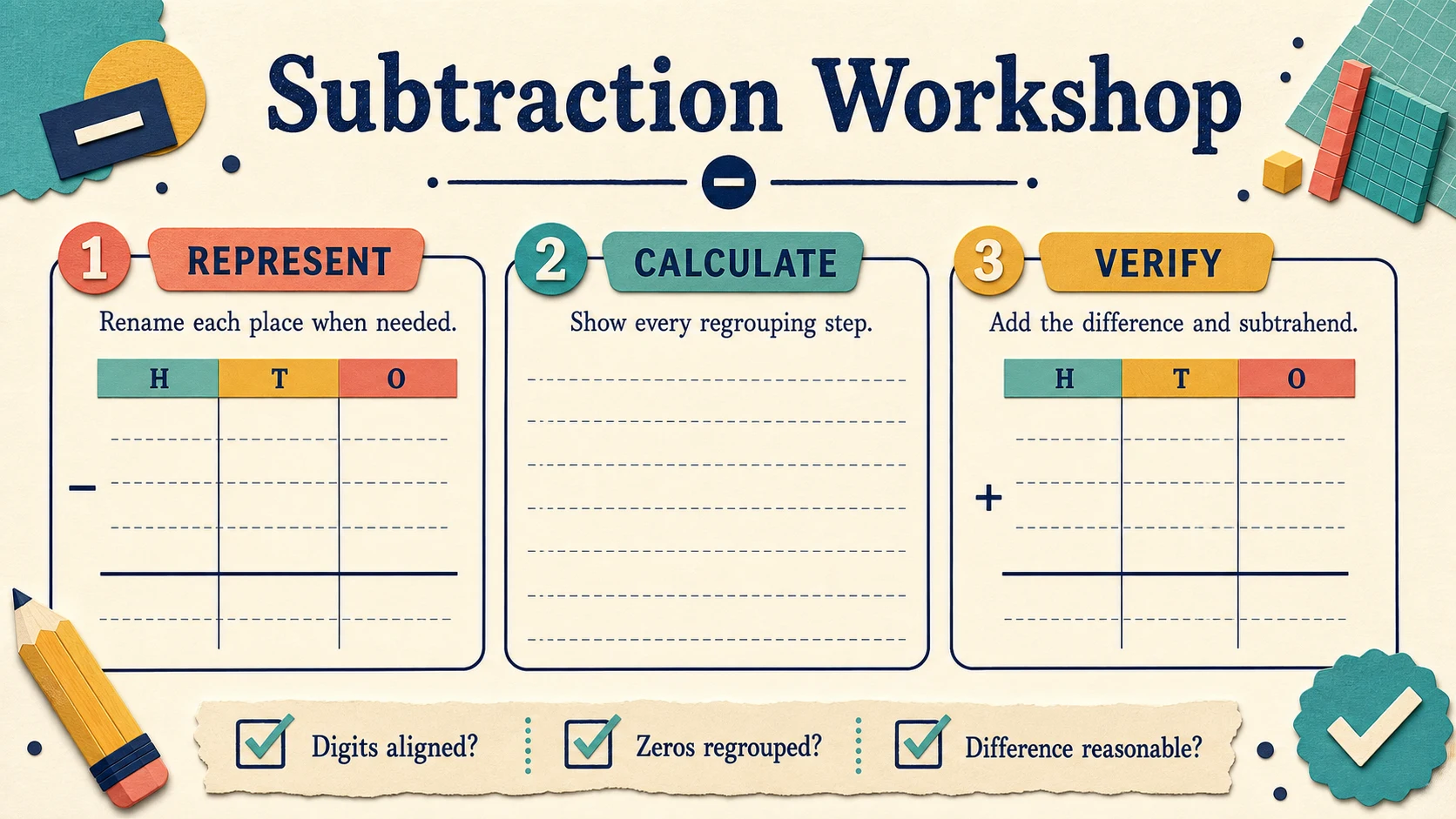
Reuse a few uncompleted or previously corrected items after increasing delays.
Retrieval means asking the learner to reproduce the method after some time has passed, without first copying a completed example. It can show whether the procedure remains available beyond the original lesson.
A practical schedule might look like this:
| Review point | Suggested task | Decision |
|---|---|---|
| Later the same session | Rework one corrected item without looking at the correction | If the same error returns, reteach immediately |
| Next study session | Solve two unused items and check one with addition | Continue if the method remains accurate |
| Several days later | Solve a small mixed set including regrouping | Note whether support is still needed |
| The following week | Complete a few fresh subtraction problems | Move forward, maintain, or revisit based on the work |
This schedule is an instructional option, not a universal recommendation. Local schedules differ, and the appropriate interval depends on what the learner remembers. If performance remains accurate, increase the delay or move to more varied subtraction practice. If the method fades, shorten the delay and use a brief model before trying again.
Do not simply have the learner reread completed answers. Include at least one fresh calculation. Previously corrected items are useful because they test whether the learner can avoid an earlier mistake, while new items test whether the learning transfers.
Limitations and the Best Next Action
This printable offers 30 easy-level subtraction exercises in a standard theme, with a separate answer key. It can support practice with subtraction facts, mental math, number sense, and regrouping. It does not replace direct instruction when the learner does not yet understand place-value exchanges. It is not a diagnostic assessment, a complete fifth-grade curriculum, medical guidance, or proof of comprehensive standards alignment. No single completion time or accuracy threshold is appropriate for every setting.
Use the learner’s work to choose among three honest next steps:
- If regrouping is still unstable, revisit a few items with a place-value model and the subtraction topic guide.
- If the learner is accurate but needs retention, save unused worksheet items for spaced retrieval.
- If the learner is ready for broader practice, use the 5th Grade Subtraction Worksheet Pack, which contains 18 worksheets, or create a fresh set through the free worksheet generators.
The most useful immediate action is to print the free 30-item worksheet, select the first five items for a guided-to-independent check, and let those five responses determine the next lesson.
Put it into practice
Use the guide with a real printable
Move from explanation to a short, observable practice task. Check the first item together, then adjust the next session from the learner's actual work.
See the 18-worksheet pack