Complete guide
How to teach and practise 5th grade place value worksheets - standard theme (easy)
How to Use This 30-Item Place Value Worksheet
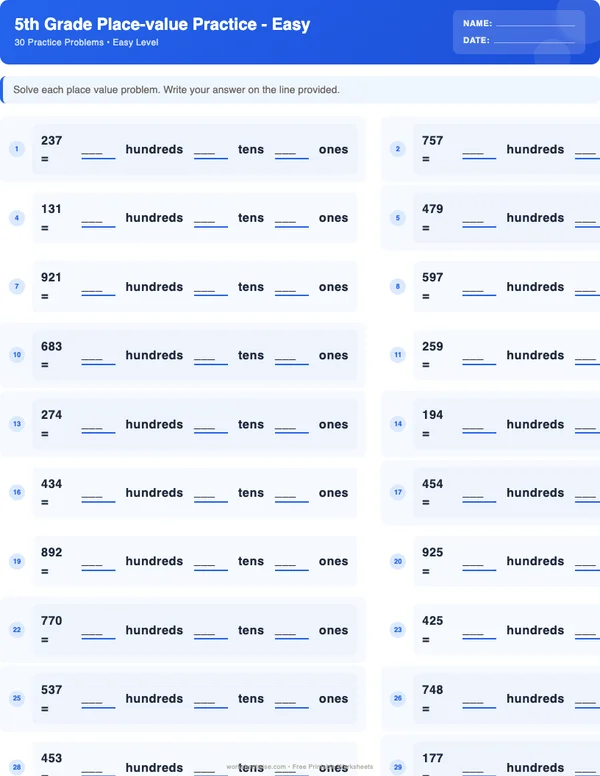
The free 5th Grade Place Value worksheet provides 30 easy-level exercises covering four skills: identifying place values, writing numbers in expanded form, comparing numbers, and rounding. A separate printable answer key is included.
For most learners, the clearest way to use the printable is to preview the item types, model one example, solve a few items together, and then assign a short independent set. Review errors before deciding whether to continue. The learner’s observed work—not a fixed schedule—should determine the pace.
Grade labels describe the intended practice level; local curricula and instructional sequences differ. An adult should therefore check that the notation, vocabulary, and rounding expectations match what the learner has already been taught.
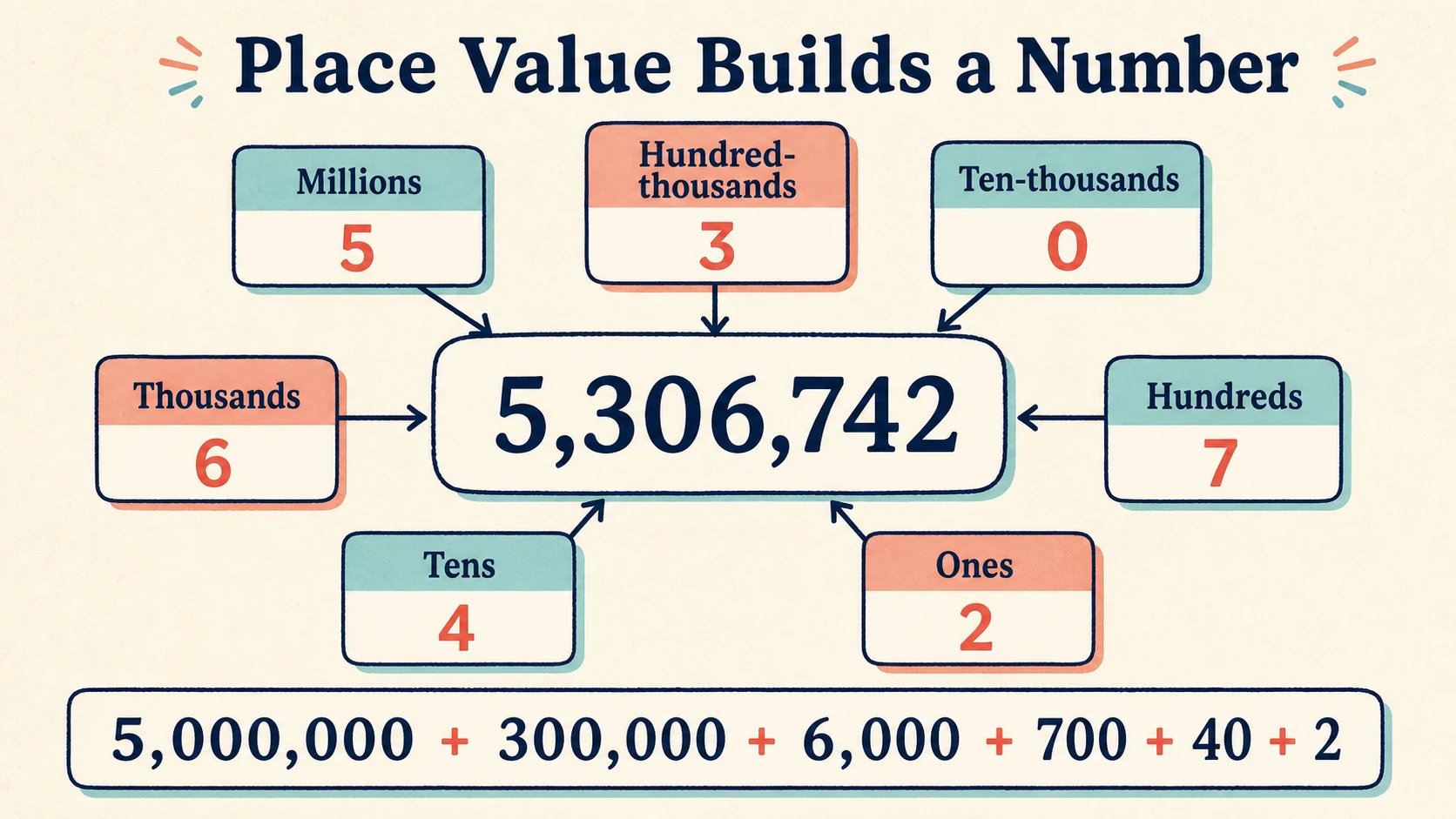
Preview, model, guide, release, review, and revisit rather than treating all 30 items as one uninterrupted assignment.
What This Worksheet Does and Does Not Cover
This printable offers focused practice with:
- Place value
- Expanded form
- Number comparison
- Rounding
Those skills are connected, but they are not interchangeable. A learner may identify the value of a digit correctly yet struggle to decompose the same number. Another may read numbers accurately but compare them by looking at only one digit. Keep notes by skill instead of recording only a total score.
The worksheet’s easy designation means its exercises are intended as straightforward foundational practice. It does not guarantee that every fifth grader will find every item easy. Prior instruction, language familiarity, attention, and experience with the notation can all affect how the work appears.
Use the broader Place Value topic guide when you need the full progression across representations and related place value ideas. This lesson-and-use guide stays centered on launching, observing, and reviewing this particular printable.
The worksheet is also limited in scope. Thirty written responses can show how a learner handles the presented exercises, but they cannot by themselves establish comprehensive mastery of place value. They do not replace conversation, explanation, manipulatives, or examples chosen to investigate a particular misunderstanding.
Prepare the Lesson Before the Learner Begins
Print the worksheet and keep the separate answer key out of sight during instruction. Have a pencil, scrap paper, and an optional place value chart available. A chart can include columns such as hundred-thousands, ten-thousands, thousands, hundreds, tens, and ones. If an item includes decimal places, extend the chart only as far as the item requires.
Read through the 30 problems before the lesson. Mark where the task changes from one skill to another. Do not assume that the exercises are grouped evenly or that they must be completed in printed order. The catalogue identifies the four included skills but does not specify how many questions belong to each one.
A quick preview helps you choose a sensible starting point:
- Identify the directions: “Solve each place value problem. Write your answer on the line provided.”
- Note the representations used in the actual items.
- Circle one problem that would make a clear model.
- Select two or three problems for guided practice.
- Decide where the first independent section will stop.
- Check the corresponding answer-key entries in advance.
Do not preteach every possible place value rule. Begin with the minimum explanation needed for the first task, then use the learner’s work to decide whether more support is warranted.
A Flexible Lesson Progression
The following plan is an instructional suggestion, not a timetable established by the worksheet or its sources.
| Lesson phase | Suggested use | What the adult watches for |
|---|---|---|
| Orientation | Read the directions and inspect one item | Does the learner understand what form the answer requires? |
| Model | Adult solves one similar example aloud | Can the learner identify the target place and explain each step? |
| Guided practice | Solve two or three worksheet items together | Does support decrease across the items? |
| Independent check | Learner completes three to five items | Are answers accurate without prompts? |
| Continued practice | Assign another short set if appropriate | Does accuracy remain stable as item types change? |
| Error review | Rework selected errors without copying the key | Can the learner explain what changed? |
| Retrieval | Revisit a few skills later | Can the learner solve them after time has passed? |
A learner who is accurate and can explain the reasoning may move into a longer independent section. A learner who hesitates, changes notation unpredictably, or repeats the same error should pause for a short model or guided example.
This gradual shift from explicit demonstration toward independent work is consistent with the high-level instructional framing in the IES guide on assisting students struggling with mathematics. That source does not evaluate WorksheetWise or prescribe a particular number of items for this worksheet.
Use a Brief Readiness Check
Before writing on the printable, present one spoken prompt:
In 483,216, what is the value of the digit 8?
A correct response is 80,000 because 8 is in the ten-thousands place. If the learner says “eight,” ask for the place name and then the digit’s value. This distinction will matter throughout the worksheet.
You might also ask the learner to read 483,216 aloud or place its digits in a chart. These are instructional checks, not additional scored worksheet questions.
Establish Helpful Language
Use consistent terms:
- A digit is a symbol from 0 through 9.
- A place is a position in a number.
- A digit’s value depends on its place.
- Standard form writes the number with digits.
- Expanded form shows the value contributed by each nonzero digit.
- Comparing asks which number is greater, less, or equal.
- Rounding replaces a number with a nearby benchmark at a named place.
These definitions are sufficient for launching the four listed worksheet skills. Refer to the 5th Grade math worksheet collection if the learner needs related practice in other math topics.
Model the Task Without Taking It Over
Choose a problem similar to a worksheet item, but do not consume several of the learner’s practice questions during the demonstration. Write the example where both of you can see it.
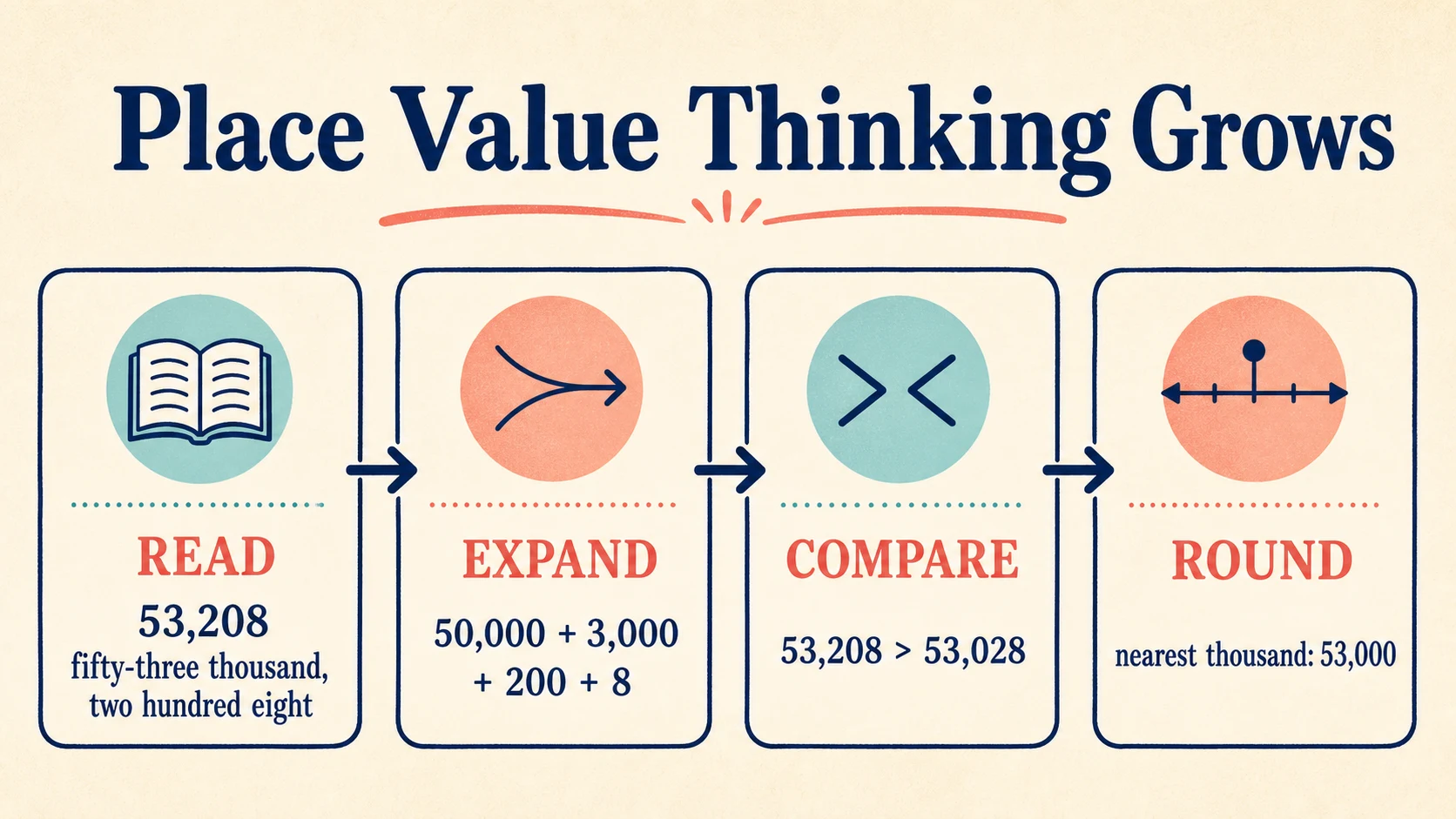
Model one complete reasoning path, then ask the learner to supply increasingly more of the next solution.
A useful model has four parts:
- Read the prompt and name the requested answer form.
- Locate the relevant digit or rounding place.
- Explain the place value relationship.
- Check that the final notation answers the actual question.
For example, if the prompt asks for the value of 6 in 462,915, say:
“The 6 is in the ten-thousands place. Six ten-thousands equals 60,000, so the value of the digit is 60,000.”
Avoid replacing that explanation with a positional trick. The IES early mathematics practice guide offers high-level support for building mathematical ideas through representations and purposeful instruction. Although its scope is young children rather than this particular fifth-grade worksheet, the general framing supports using words, written numbers, and visual representations together. It does not certify or review this printable.
After the demonstration, give the learner a parallel prompt. Ask, “What will you look for first?” A response such as “the digit named in the question” or “the place I am rounding to” reveals more than immediately supplying another procedure.
Fully Checked Examples for the Four Skills
The following examples are constructed for instruction. They illustrate the worksheet’s listed skills but are not claimed to reproduce its exact questions.
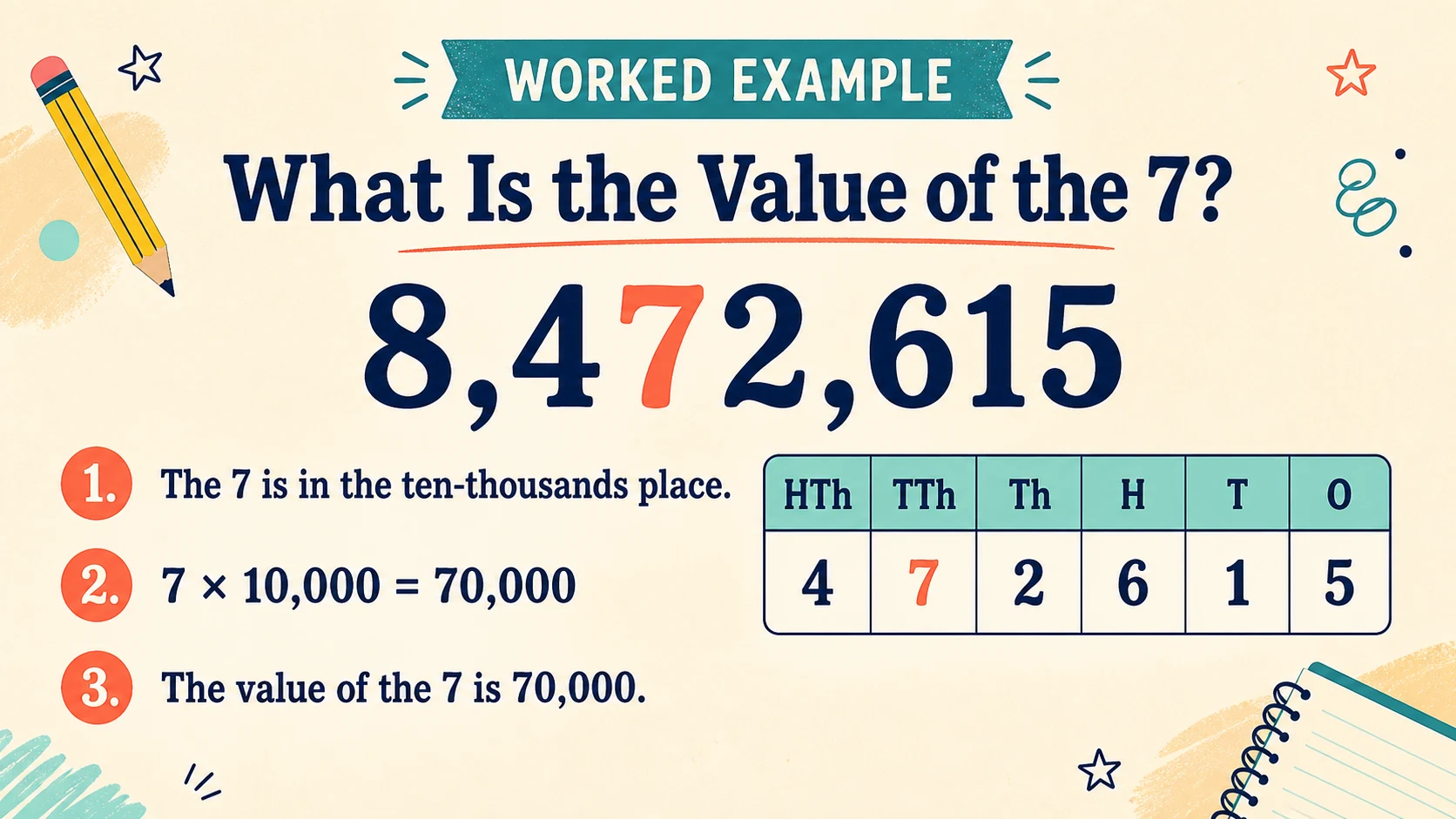
Each checked example connects the written answer to the value of the digits, not merely to a memorized step.
Example 1: Identify a Digit’s Value
Problem: What is the value of the digit 7 in 572,481?
Write the places:
| Digit | 5 | 7 | 2 | 4 | 8 | 1 |
|---|---|---|---|---|---|---|
| Place | hundred-thousands | ten-thousands | thousands | hundreds | tens | ones |
The 7 is in the ten-thousands place.
Answer: 70,000
Check: Decompose the number:
The 7 contributes 70,000, confirming the answer.
A response of “ten-thousands” names the place but not the digit’s value. It would be correct only if the prompt asked for the place.
Example 2: Write Expanded Form
Problem: Write 406,092 in expanded form.
Evaluate each digit by position:
- 4 hundred-thousands = 400,000
- 0 ten-thousands = 0
- 6 thousands = 6,000
- 0 hundreds = 0
- 9 tens = 90
- 2 ones = 2
A conventional expanded form is:
Answer: 400,000 + 6,000 + 90 + 2
Check: Add the parts:
The internal zeros matter because they hold places, even though zero-value addends are usually omitted from the final expanded expression.
Example 3: Compare Two Numbers
Problem: Insert , , or :
Compare from the greatest place toward the right:
- Hundred-thousands: 6 and 6 are equal.
- Ten-thousands: 3 and 3 are equal.
- Thousands: 8 and 8 are equal.
- Hundreds: 4 and 4 are equal.
- Tens: 0 is less than 5.
Therefore:
Answer:
Check: The numbers differ by:
The second number is 45 greater, so the comparison is correct.
Example 4: Round to a Named Place
Problem: Round 347,651 to the nearest thousand.
The two neighboring multiples of 1,000 are:
The halfway point is:
Because 347,651 lies above 347,500, it is closer to 348,000.
Answer: 348,000
Check by distance:
Since 349 is less than 651, 348,000 is nearer.
The catalogue’s teaching guidance recommends reasoning from benchmarks rather than relying only on an underline-circle-arrow routine. A number line or a pair of neighboring multiples makes the choice visible.
Example 5: Connect Place Value Across Adjacent Places
Problem: Compare the value of the two 3s in 330,000.
The left 3 is in the hundred-thousands place:
The right 3 is in the ten-thousands place:
Now compare:
Answer: The left 3 has ten times the value of the right 3.
Check: Ten groups of 30,000 equal 300,000.
This relationship is part of the fifth-grade place value system described in the Common Core mathematics standards. The standards provide context for place value instruction; this link should not be read as independent verification of the worksheet’s complete standards alignment.
Handle Boundary Cases Deliberately
Boundary cases are useful because they reveal whether the learner understands the structure or is applying a step without considering its meaning.
Zeros Inside a Number
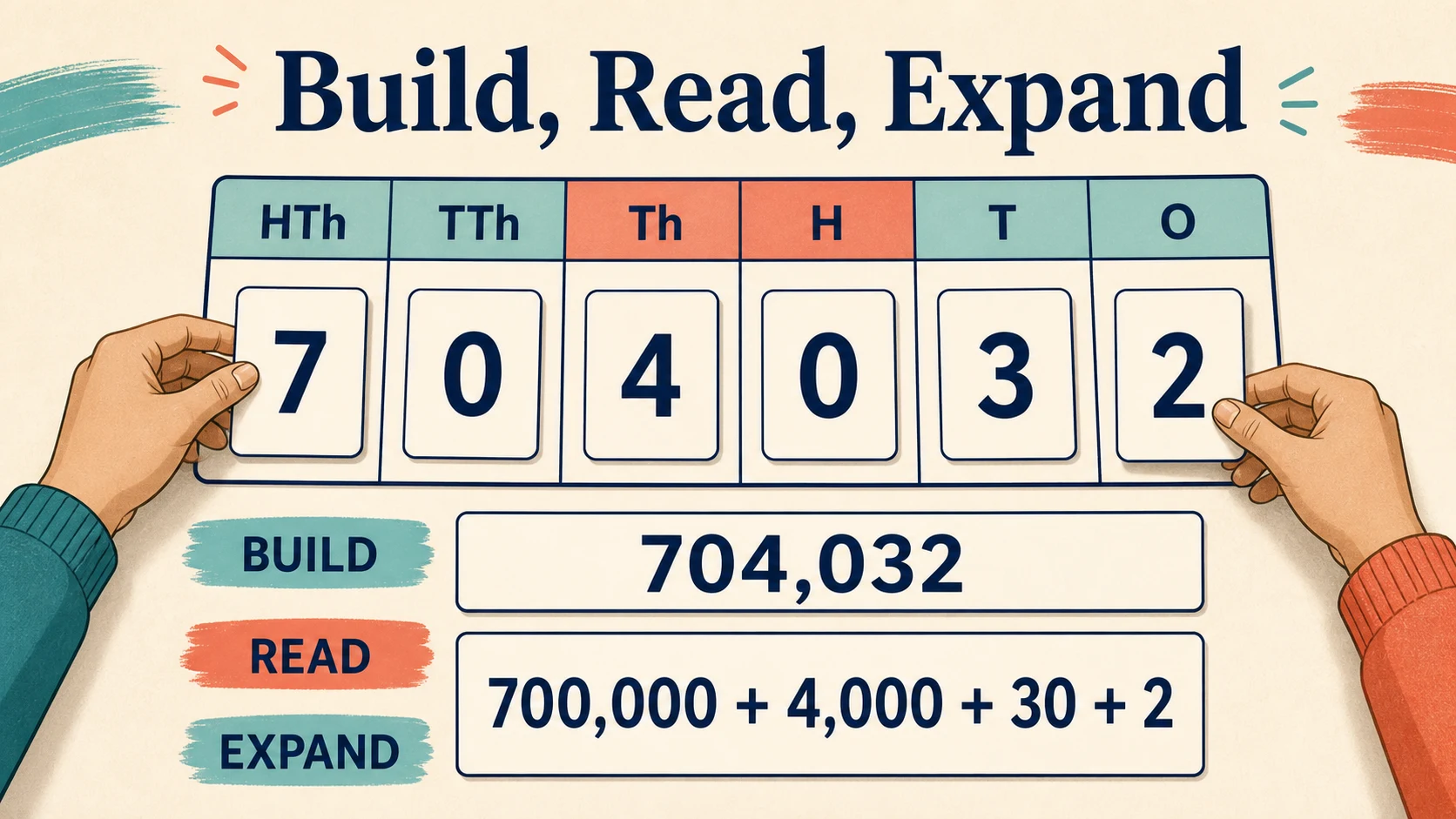
In 705,040, the zeros are placeholders. Expanded form can be written as:
Writing 700,000 + 5,000 + 4 changes the value because the final 4 represents four ones rather than four tens.
Ask the learner to reconstruct the number after expanding it. This catches dropped-place errors quickly.
Numbers That Match Through Several Places
To compare 812,306 and 812,360, the learner must continue past the matching digits. The first difference occurs in the tens place:
A visual scan of the entire number can be misleading. Comparing from left to right, one place at a time, makes the decision traceable.
Rounding at the Halfway Point
Consider 24,500 rounded to the nearest thousand. Its neighboring thousands are 24,000 and 25,000, and it lies exactly halfway between them. Under the commonly taught base-ten rule, the result is 25,000.
Before marking a boundary answer, confirm the convention used in the learner’s local materials. The worksheet title and catalogue facts do not state every rounding convention that may appear in a local curriculum.
Rounding That Changes Several Digits
Round 999,501 to the nearest thousand. The neighboring thousands are 999,000 and 1,000,000. Because 999,501 is above the midpoint 999,500, it rounds to:
The increase in digit length does not invalidate the answer. The result is the nearer named benchmark.
Move from Guided to Independent Practice
Begin guided practice with an actual worksheet item from each relevant format. Ask the learner to do the writing while you prompt only when needed.
Useful prompts include:
- “What is the question asking you to produce?”
- “Which place are you working with?”
- “Where is the first place these numbers differ?”
- “What are the two neighboring rounding benchmarks?”
- “How could you check that expanded form?”
Prompts should direct attention without supplying the answer. If the learner succeeds, reduce your involvement on the next item. If the learner cannot begin, return briefly to a representation such as a place value chart or number line.
A practical first independent set is three to five items, chosen from the current skill. This is an instructional suggestion, not a universal requirement. Check the set before assigning more. Short cycles allow an error to be corrected before it is repeated across many questions.
For a learner who remains accurate, assign a larger portion or the remaining items. For a learner whose accuracy declines after several questions, a break or a second session may be more informative than insisting on completion. Pace should reflect the work you observe.
Adapt Support Without Changing the Skill
Adaptation should preserve the mathematical target. If the item asks for expanded form, the learner should still produce expanded form; the support should make the place structure easier to see.
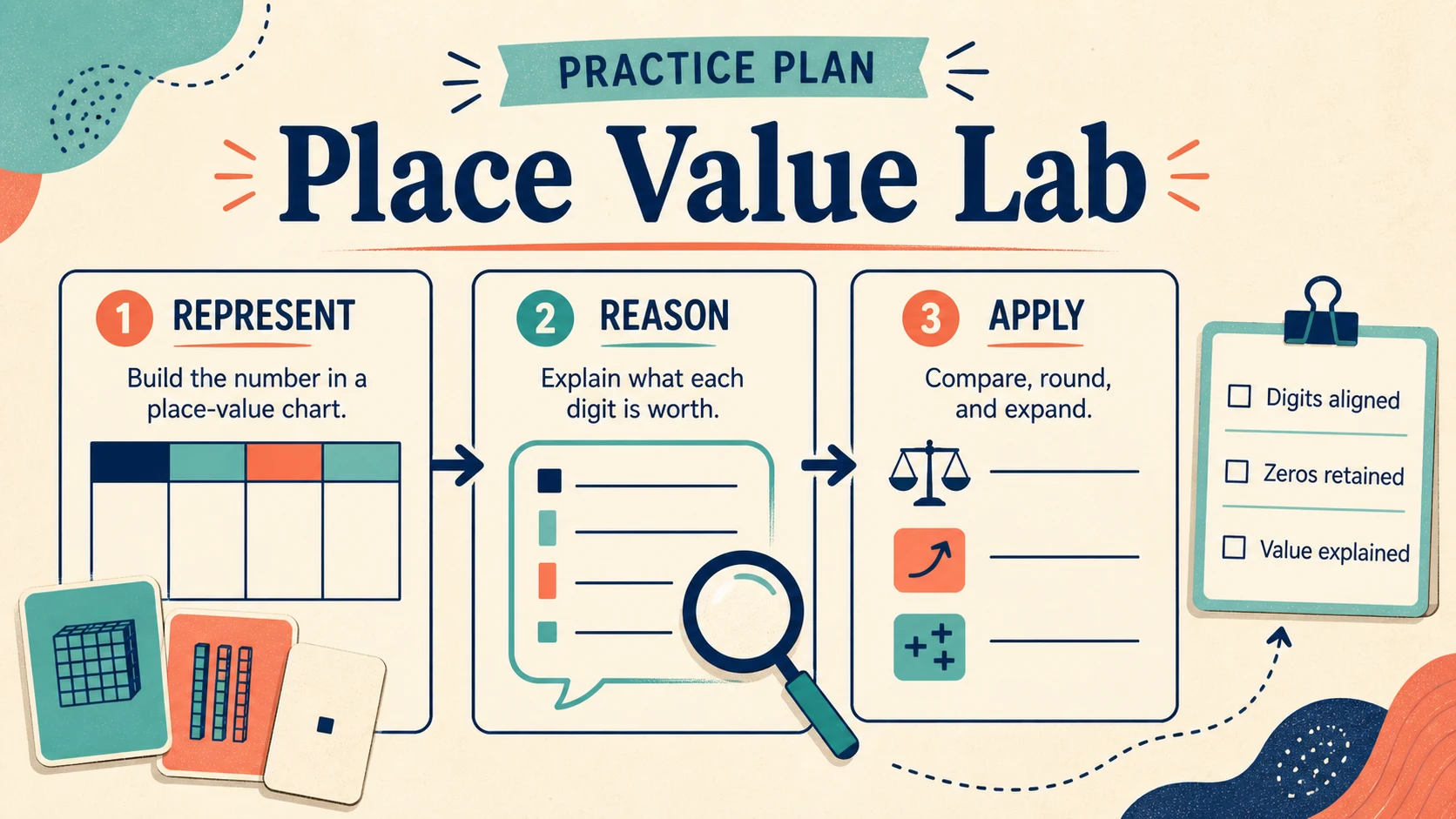
Adjust visibility, prompting, or workload while keeping the original place value decision intact.
When the Learner Needs More Structure
Provide a blank place value chart and let the learner copy each digit into a column. Cover unrelated worksheet items with a sheet of paper. Complete fewer problems in one sitting, but return to the remaining items later.
For rounding, draw a short number line showing the lower benchmark, midpoint, and upper benchmark. The learner should still decide where the original number belongs.
When the Learner Needs Language Support
Read the directions aloud without changing the mathematical demand. Pair terms such as digit, place, and value with a written example. Allow the learner to point to a place on a chart before stating or writing the answer.
Do not treat difficulty reading a long number as proof that the learner lacks place value understanding. Ask for an explanation using the representation available, then note separately whether number-reading language also needs practice.
When the Learner Is Ready for Less Support
Remove the chart and ask for a brief written check. Have the learner explain why a comparison symbol points in a particular direction or identify the two benchmarks used for rounding.
Do not increase difficulty merely by rushing. A useful extension asks for reasoning: “Write a different number that rounds to 348,000 to the nearest thousand, and explain why.” That extends the same concept without claiming it is part of the printable.
Interpret Errors Before Correcting Them
A wrong answer is a starting point for diagnosis, not a complete diagnosis by itself. Look for patterns across similar items.
Classify the error, ask for the reasoning, rebuild one example, and then retry a fresh item.
Common patterns include:
| Observed work | Possible interpretation to test | Useful follow-up |
|---|---|---|
| Writes “thousands” when asked for a digit’s value | Confuses place name with value | Ask for both: “Which place? What value?” |
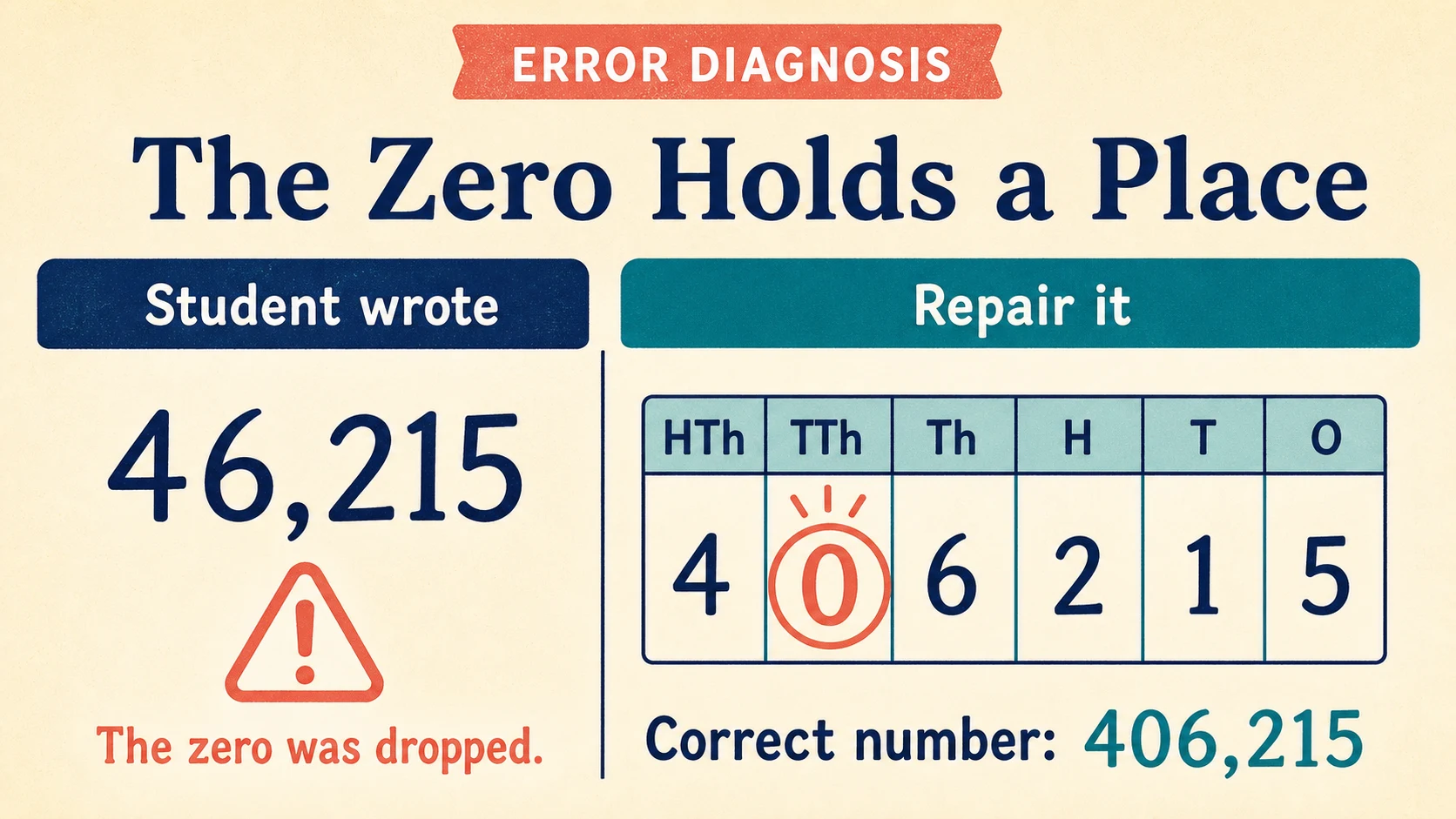
| Drops a zero in standard or expanded form | Does not preserve placeholder positions | Rebuild the number in a place value chart |
| Compares using a later digit before an earlier one | Lacks a consistent left-to-right method | Align the numbers vertically and mark the first difference |
| Rounds using the wrong neighboring place | Has not identified the requested rounding unit | Name the two multiples that surround the number |
| Changes digits to the left of the rounding place unnecessarily | Applies a memorized procedure inaccurately | Locate the two benchmarks and choose between them |
| Copies the number incorrectly | Recording error rather than demonstrated conceptual error | Let the learner compare the copied number with the prompt |
| Gives correct answers but cannot explain any step | Understanding is not yet clear from the written result | Ask for one place-value or benchmark justification |
The phrase “possible interpretation” matters. For example, a dropped zero may reflect misunderstanding, visual tracking, or a simple copying mistake. Ask the learner to talk through one fresh example before choosing a response.
Correct one type of error at a time. If three expanded-form answers omit zero-held positions, model one example, solve one together, and then give a new independent example. Recopying the answer key does not show whether the underlying issue has changed.
Check the Answer Key Responsibly
The separate answer key is designed for quick checking, but it should support analysis rather than replace it.
First, match each answer to the correct item number. Check the requested form as well as the numerical value. A learner might produce an equivalent number while failing to use the form requested by the prompt.
For each error:
- Mark the item for review without immediately writing the correct answer.
- Ask the learner to reread the prompt.
- Have the learner explain the original reasoning.
- Use a chart, decomposition, comparison sequence, or benchmark check.
- Let the learner revise the answer.
- Confirm the revision against the key.
If the learner’s response appears mathematically equivalent to the key, verify it directly. For instance,
and
both total 406,092. The first is simply more concise. By contrast, 400,000 + 6,000 + 9 + 2 is not equivalent because it assigns the 9 to ones rather than tens.
Keep a short skill record rather than only a percentage:
- Place value: accurate, prompted, or revisit
- Expanded form: accurate, prompted, or revisit
- Comparison: accurate, prompted, or revisit
- Rounding: accurate, prompted, or revisit
This record makes the next lesson more targeted than a single total such as “24 out of 30.”
Decide What to Do After the Worksheet
Use both accuracy and explanation when choosing the next step.
If the learner is consistently accurate and can justify the work, move to another set that mixes the same skills or asks for greater independence. The 5th Grade Place Value Worksheet Pack contains 18 worksheets and can provide additional practice, but purchasing a pack is not required to use this free printable effectively.
If performance differs by skill, avoid repeating all 30 items. Select practice for the specific area:
- For place-value confusion, use charts and adjacent-place comparisons.
- For expanded-form errors, repeatedly reconstruct the standard number.
- For comparison errors, align digits and locate the first differing place.
- For rounding errors, identify neighboring benchmarks and the midpoint.
If errors remain broad even with a chart and guided explanation, return to the Place Value topic guide and choose earlier representations or narrower practice. That is a more honest next step than assuming that completing more pages will resolve the misunderstanding.
The catalogue also notes that fifth-grade math extends into multi-digit operations, fractions, decimals, volume, coordinate planes, and numerical expressions. This worksheet does not teach that larger body of content. It should be treated as focused place value practice within the broader 5th Grade worksheet hub.
Schedule Retrieval Without Fixing a Universal Timetable
Revisiting a skill after a delay helps reveal what the learner can retrieve without the immediate model still in view. The exact spacing should be adjusted to the learner’s work and local schedule.
Use short delayed checks and change the schedule when the learner’s responses show that more or less support is needed.
A workable starting plan is:
| Time | Suggested retrieval task |
|---|---|
| End of the first session | Rework one corrected item without looking at the prior solution |
| One or two days later | Solve one fresh example from each skill that required prompting |
| About one week later | Complete a short mixed set of place value, expanded form, comparison, and rounding |
| Later review | Include one or two place value items alongside other fifth-grade math work |
This schedule is a practical option, not a sourced universal timetable. Shorten the interval if the learner cannot begin independently. Lengthen it if responses are accurate and explanations remain clear.
Do not use the original answer key for newly invented review questions. Calculate and verify those answers separately. Adults can also create a limited set with the free worksheet generators, provided the generated items match the representations and number ranges the learner is ready to handle.
A Clear Next Action
Download the free 5th Grade Place Value worksheet and answer key, preview the 30 items, and mark one model problem plus three guided-practice problems. After the learner completes a short independent set, record performance separately for place value, expanded form, comparison, and rounding.
If one skill remains uncertain, use the broader Place Value guide to choose a more focused follow-up rather than assigning the entire worksheet again.
Put it into practice
Use the guide with a real printable
Move from explanation to a short, observable practice task. Check the first item together, then adjust the next session from the learner's actual work.
See the 18-worksheet pack