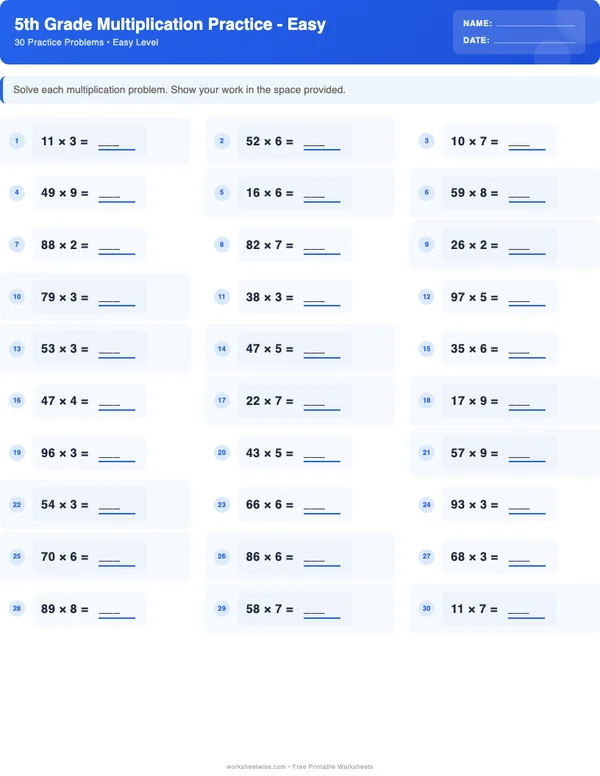
Complete guide
How to teach and practise 5th grade multiplication worksheets - standard theme (easy)
How to use this 30-item multiplication worksheet
The free 5th Grade Multiplication worksheet provides 30 easy-level exercises in multiplication facts, times tables, mental math, and number sense. Its directions are simple: solve each multiplication problem and show work in the space provided. A separate printable answer key is included.
For most learners, a useful session is:
- Preview a few items together.
- Model one multiplication fact and one checking strategy.
- Complete three to five items with adult guidance.
- Assign a manageable group for independent work.
- Review errors by type, not just by score.
- Revisit selected facts after a delay.
The worksheet does not have to be completed in one sitting. Let the learner’s observed work determine the pace. If the first ten items are accurate and efficiently solved, continue or save the remaining items for retrieval practice. If errors cluster around a particular fact family or strategy, pause and address that pattern before assigning more of the same.
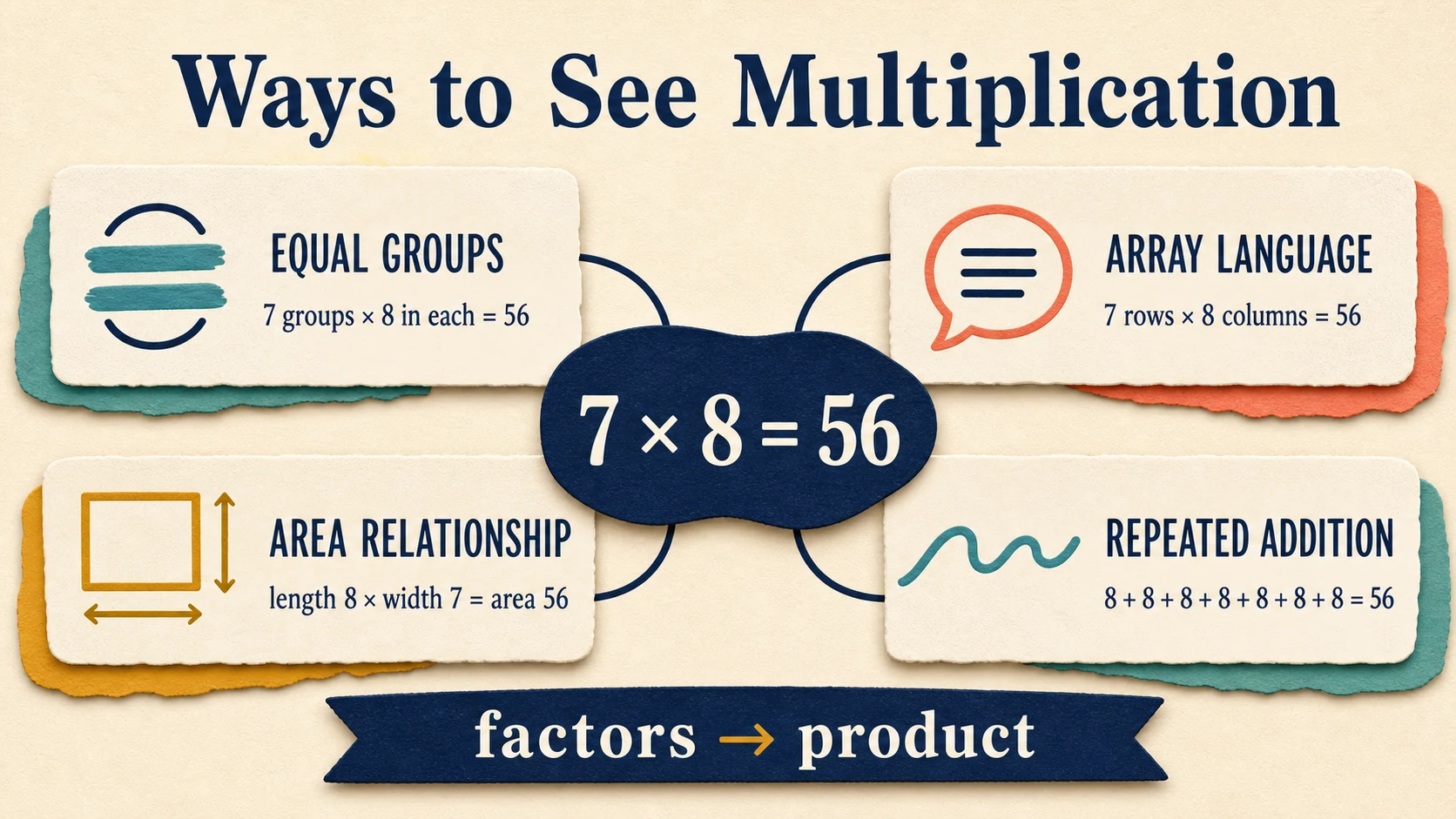
Preview, model, guide, release, review, and return to the skill after a delay.
Grade labels describe the intended practice level; local curricula, school sequences, and individual learning paths differ. Although fifth-grade mathematics includes multi-digit multiplication, this easy worksheet is described more narrowly as practice with multiplication facts, times tables, mental math, and number sense. Use the broader multiplication topic guide when you need the full progression from models and fact strategies to multi-digit computation.
Prepare the learner and the materials
Print the worksheet and its separate answer key, but keep the key out of sight during initial practice. Provide a pencil, an eraser, and optional scratch paper. If the learner benefits from concrete support, have counters, small blocks, or a blank grid nearby. These supports help explain a product without changing the multiplication being practiced.
Before starting, scan the page together. State the directions in plain language: “Solve each multiplication problem. Use the space to show how you know.” Showing work does not have to mean writing repeated addition for every item. It may be a small array, a split fact, a related fact, or a brief equation.
Avoid beginning with a speed demand. First determine whether the learner understands the facts and can choose reasonable strategies. Efficient recall may develop with practice, but a rushed session can conceal whether an incorrect answer came from weak fact knowledge, a notation mistake, or simple inattention.
A short readiness check can include three orally presented facts:
- A familiar pattern fact, such as
- A fact involving one, such as
- A less automatic fact, such as
Ask for both the answer and a brief explanation. “I know because I counted six groups of five” reveals more than “30” alone. Do not require the same explanation from every learner or for every item. The purpose is to identify a dependable starting strategy.
The IES guide on teaching mathematics provides high-level support for intentional instruction that develops mathematical ideas and monitors learners’ progress. It did not evaluate WorksheetWise or this specific printable. Here, that framing translates into a simple practice: observe how the learner arrives at an answer before deciding whether to add, remove, or repeat support.
Follow a clear lesson progression
The full lesson can take place in one session or be divided across several shorter sessions. No universal timetable fits every learner.
| Lesson phase | Suggested worksheet use | Adult action | Evidence to notice |
|---|---|---|---|
| Launch | Preview 2–3 items | Read directions and identify the operation | Learner recognizes multiplication notation |
| Model | Use a similar example off the page | Think aloud and show one efficient strategy | Learner can explain what the factors and product mean |
| Guided practice | 3–5 worksheet items | Prompt without giving the product | Learner selects and carries out a strategy |
| Independent practice | 5–15 items at a time | Step back and observe | Accuracy, efficiency, work habits, and persistence |
| Error review | Only missed or uncertain items | Sort errors and ask for corrections | Learner can locate and repair an error |
| Retrieval | Selected items on later days | Re-present facts in a new order | Learner recalls or reconstructs answers after a delay |
This table is a planning tool, not a rule. A learner who works accurately may move quickly into independent practice. A learner who cannot yet explain what multiplication represents may need arrays or equal groups before continuing. The 5th Grade math hub can help place this worksheet alongside other mathematics practice without treating one printable as a complete curriculum.
Set a focused purpose
Give the session one observable purpose. For example:
- “Today we will use known facts to solve related facts.”
- “Today we will check products for reasonableness.”
- “Today we will practice facts involving six, seven, and eight.”
- “Today we will write enough work to explain an answer.”
Choose a purpose after looking at the page and the learner’s recent work. Do not announce that every objective will be mastered in one session.
Establish a calm checking habit
Teach the learner to place a small mark beside any item that feels uncertain. That mark is useful information, not a penalty. During review, compare marked items with actual errors. A correct but uncertain response may need retrieval practice just as much as an incorrect response.
Model the task before assigning the page
Use an example similar to the worksheet rather than completing several actual items for the learner. Model the mathematical decision, not merely the handwriting.
Write:
Say: “I need seven groups of six. I know , and two more groups of six make 12. So . Therefore, .”
Then check it with a related fact:
The reversal does not create a new total. It provides a useful check because the same quantities are grouped in the opposite order.
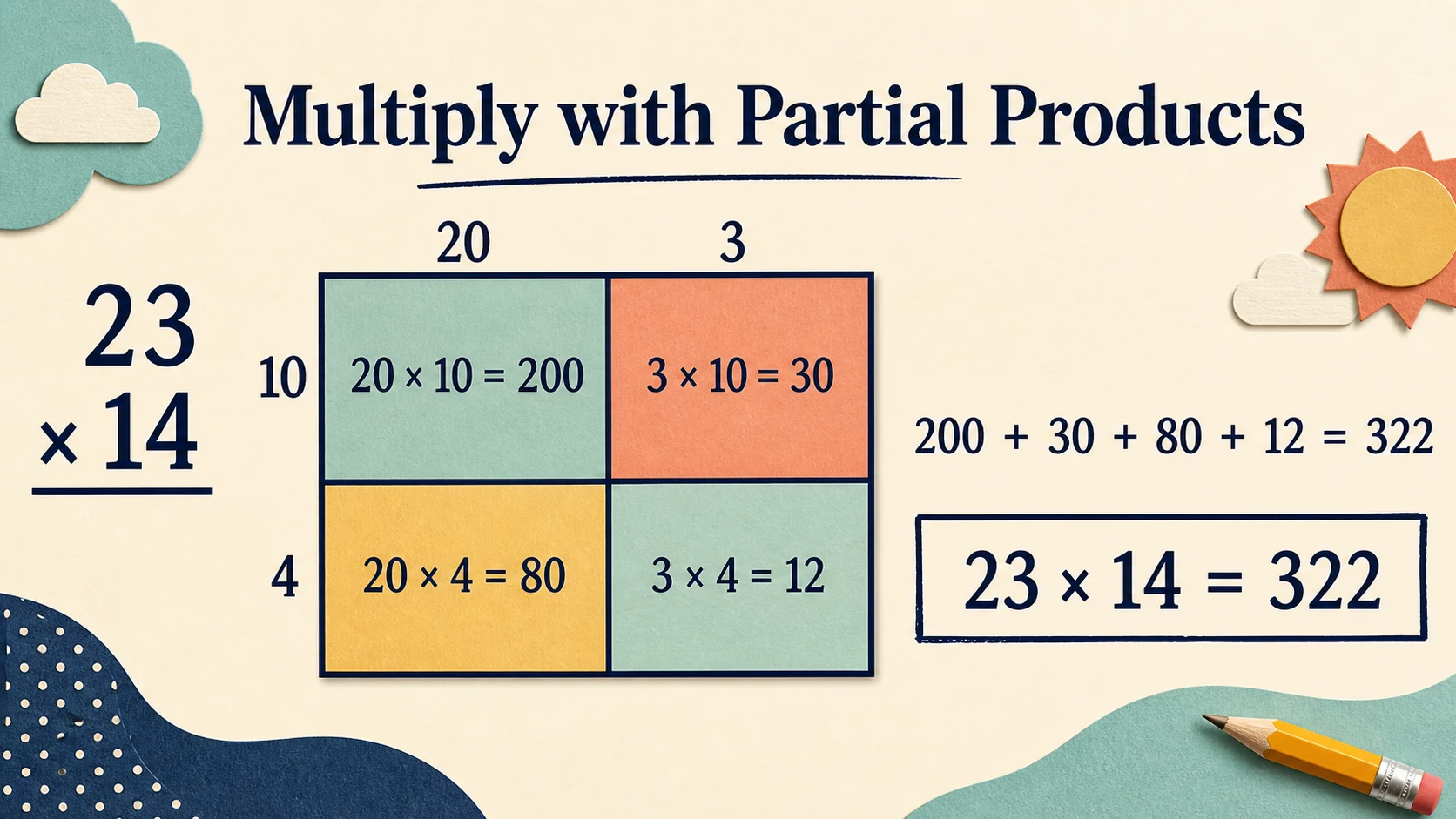
Split an unfamiliar fact into known parts, combine the partial products, and verify the result.
Name each part of the equation
In , seven and six are factors, and 42 is the product. Use these words naturally, then connect them to ordinary language: “Seven groups with six in each group make 42 altogether.”
Mathematical vocabulary should clarify the task, not become a second test. If the learner can calculate accurately but forgets the word product, briefly supply the term and return attention to the multiplication.
Show work that matches the difficulty
For a fact such as , appropriate work might be:
That is enough to show a doubling strategy. Requiring a full array for every easy fact may add unnecessary writing. Conversely, writing only “32” gives little evidence when the learner is uncertain. Ask for the smallest amount of work that makes the reasoning visible.
“Standard Theme” is the worksheet’s catalogue title. It should not be interpreted by itself as a claim that every item practices the multi-digit standard algorithm. The stated worksheet skills are multiplication facts, times tables, mental math, and number sense.
Use fully checked examples to teach flexible reasoning
The following examples are suitable for modeling or guided practice. They are not presented as exact items from the printable.
Example 1: Use a known five fact
Solve:
Break six groups into five groups and one more group:
Check by repeated groups:
Therefore:
This strategy is helpful when facts involving five are secure. If counting the repeated addition introduces errors, use the related reversed fact or another decomposition as the check.
Example 2: Double twice
Solve:
First double nine:
Double the result because four groups are twice as many as two groups:
Check by splitting nine into ten minus one:
Therefore:
The two methods agree, so the product is checked.
Example 3: Break apart a harder factor
Solve:
Split seven into five and two:
Check by splitting eight into four and four:
Therefore:
This example shows that a learner does not need to rely on a single memorized route. Both decompositions preserve the original factors.
Example 4: Use a nearby ten fact
Solve:
Think of nine groups as ten groups minus one group:
Check by adding nine six times:
Therefore:
The multiplication method is more efficient than repeated addition, while the addition can serve as a one-time verification.
Boundary cases with zero and one
If an item includes zero, distinguish zero groups from a group containing zero:
There are no groups of eight, so the total is zero. Reversing the factors also gives:
Eight groups containing zero objects still contain zero altogether.
For one:
One group of nine contains nine. Likewise:
These are useful boundary cases because learners sometimes overgeneralize patterns and answer or .
Move from guided practice to independent work
Guided practice should require the learner to do the mathematical thinking. Ask prompts that direct attention without naming the answer:
- “Which fact do you already know that could help?”
- “Could you split one factor into easier parts?”
- “Would doubling help here?”
- “What would ten groups be? How could you adjust?”
- “How can you check that product another way?”
Avoid turning every item into an extended discussion. Once the learner demonstrates a strategy on two or three examples, reduce the prompts.
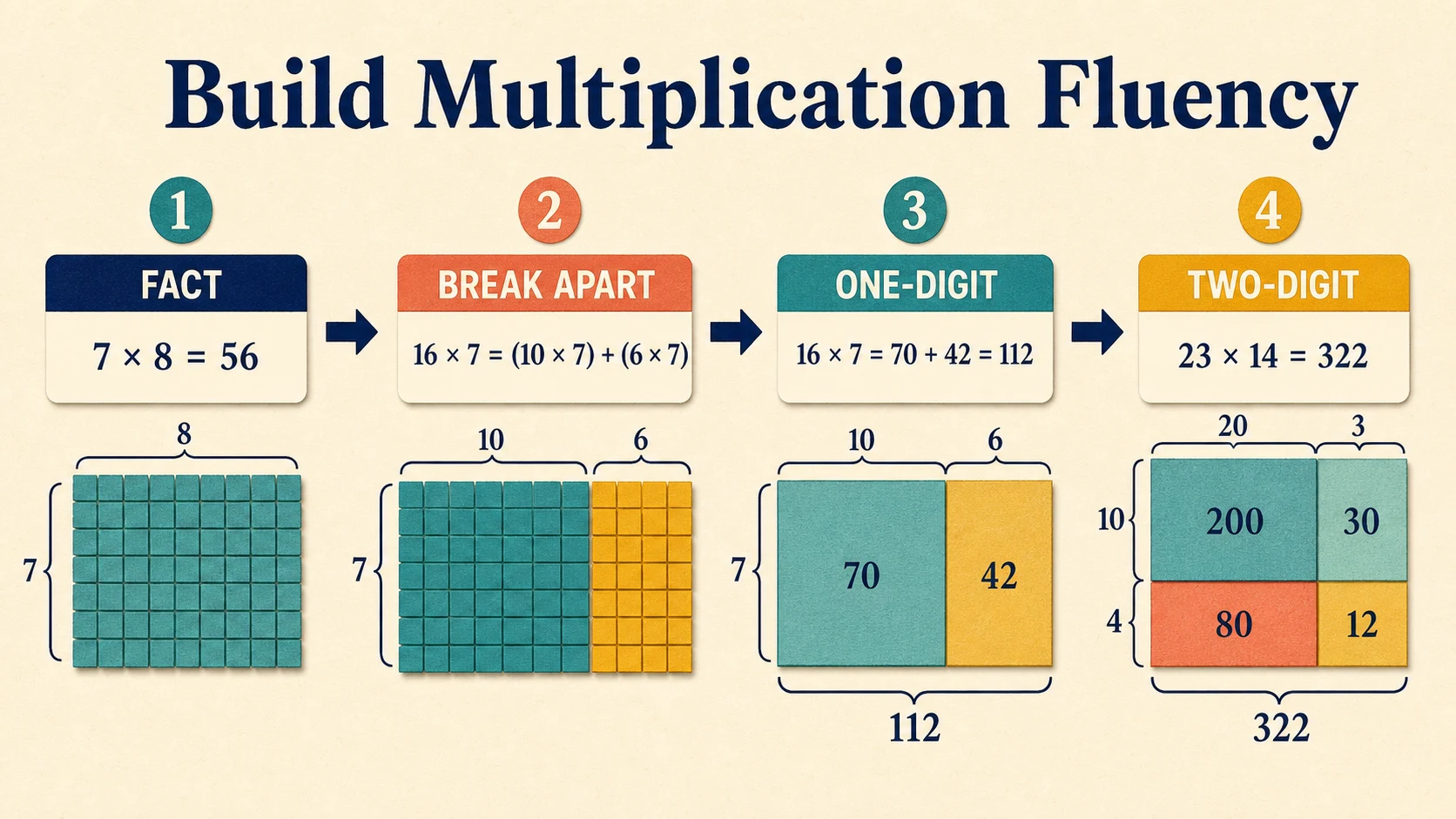
Think aloud once, solve together briefly, and then transfer responsibility to the learner.
Release responsibility in small steps
A practical release sequence is:
- The adult models one similar example.
- The learner solves one while the adult prompts.
- The learner solves one and explains afterward.
- The learner begins an independent group.
During independent work, stay available but do not confirm every answer. Repeated confirmation can make the adult, rather than mathematical reasoning, the learner’s checking system. Encourage a self-check first: “Mark it, try another method, and then we can compare.”
Start with five independent items if attention, confidence, or fact recall is uncertain. Increase the group only when the work supports doing so. Completing all 30 at once is an option, not a requirement.
Observe more than the final products
Notice whether the learner:
- Reads the factors correctly
- Uses addition in place of multiplication
- Counts from one for every item
- Chooses a known related fact
- Records a strategy accurately
- Changes correct answers without a mathematical reason
- Works accurately at first but becomes less careful later
- Recognizes an unreasonable product
These observations guide the next lesson more precisely than a percentage alone.
Adapt support without changing the skill
An adaptation should make the multiplication accessible while preserving the requirement to determine products. Do not replace the page with unrelated easier work simply because the learner needs support.
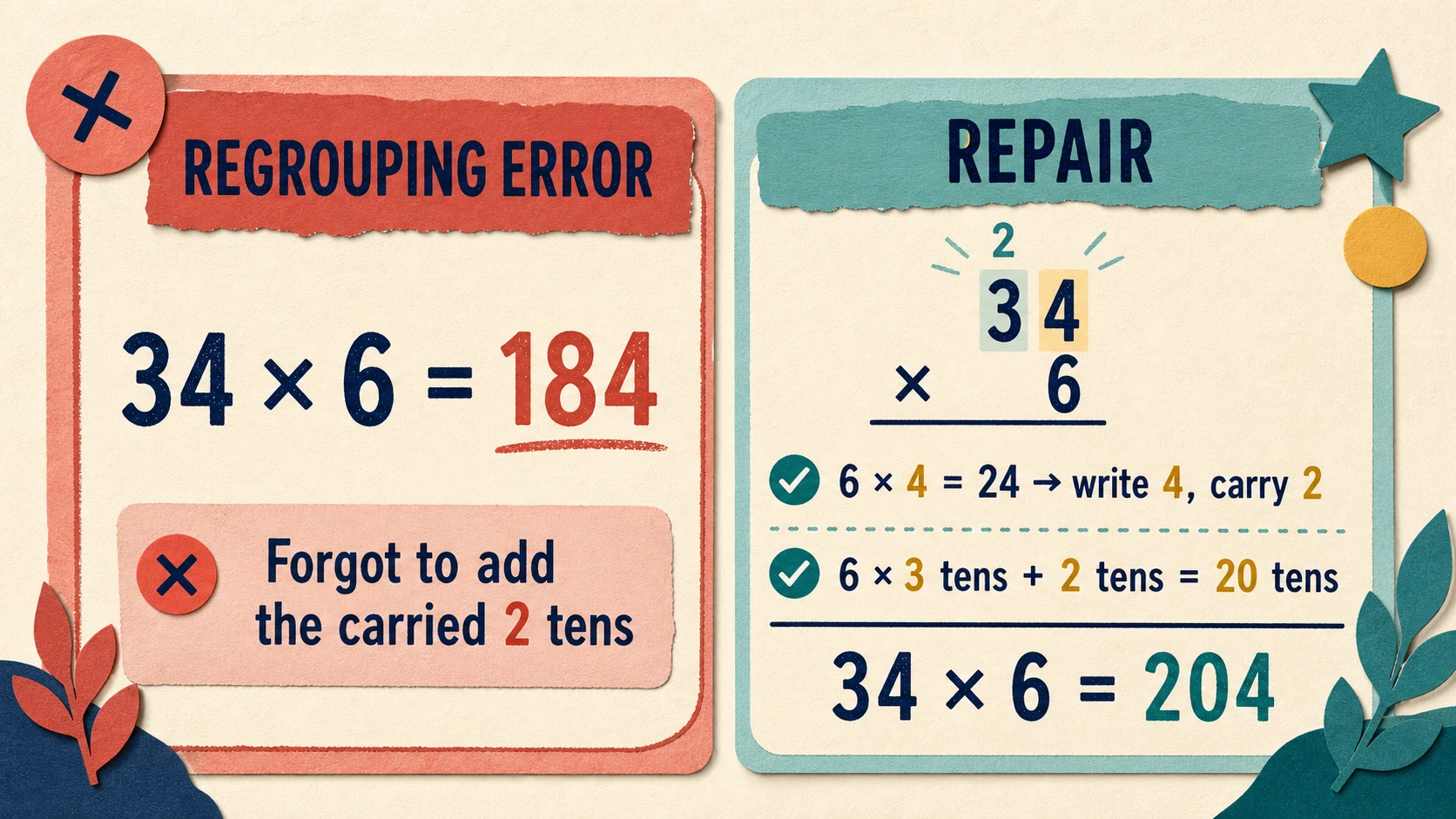
Adjust the amount, representation, or prompting while keeping multiplication as the target.
Reduce visual and workload demands
Cover unused rows with a blank sheet of paper and reveal one section at a time. Fold the page or place a ruler beneath the current line if the learner loses position. Assign five or ten items rather than all 30, then return to the rest later.
This changes how much is visible or attempted at once; it does not change the multiplication.
Add a representation
Allow counters or a quick array for a difficult fact. For , the learner could arrange three rows of six and count 18. Then write:
The representation should connect to the equation. It should not become an isolated craft activity. As understanding becomes more stable, ask the learner to sketch smaller arrays, use partial products, or rely on related facts.
The IES practice guide for assisting students who struggle with mathematics supports high-level practices such as systematic instruction, clear mathematical language, visual representations, and purposeful fluency work. It does not prescribe the use of this exact worksheet or establish a fixed schedule for it.
Provide strategy cues rather than answers
Place a short strategy card nearby:
- Use a five fact and add more groups.
- Double a known fact.
- Use ten groups and subtract.
- Reverse the factors to recall a related fact.
- Draw equal rows if the meaning is unclear.
Remove cues gradually when the learner begins selecting strategies independently.
For a learner who completes the page easily, preserve the same facts but deepen the explanation. Ask for two methods on selected items, a reasonableness check, or a grouping story that matches an equation. Do not add cumbersome work to every item merely to make an easy worksheet feel harder.
Interpret errors before correcting them
A wrong product does not identify its own cause. Review the written work and ask the learner to reconstruct the thinking. Use a neutral prompt: “Show me how you got this answer.”
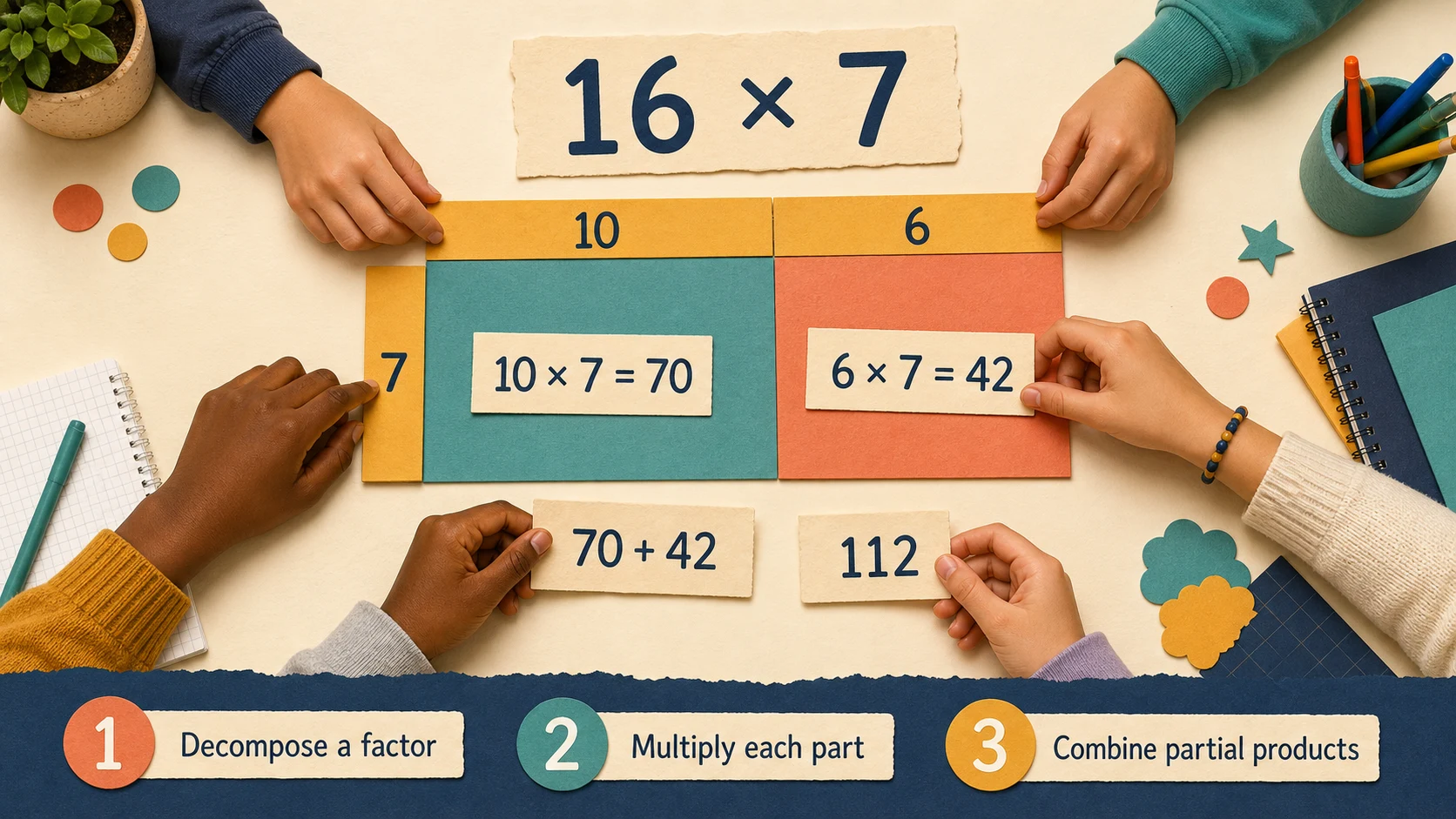
Re-read the equation, name the strategy, recompute, and verify with a second route.
Confusing multiplication with addition
A learner may write:
The answer suggests that the factors were added. Return to meaning: six groups of four are not the same as six plus four. Draw six groups containing four marks, or use:
Then record:
Use only enough representation to repair the confusion.
Losing part of a decomposition
For , a learner may write:
The multiplication pieces are correct; the final addition is not. Label this as a combination error rather than a multiplication-concept error. Recalculate , then estimate: seven groups of eight should be more than five groups of eight, or 40. Both 46 and 56 satisfy that loose bound, so a second calculation is still needed.
Applying a nearby fact incorrectly
A learner may reason:
The adjustment removed one rather than one group of seven. Rewrite:
Emphasize that changing the number of groups from ten to nine removes an entire group.
Reversing digits or copying factors incorrectly
An answer may be mathematically correct for a different problem. For example, the item is , but the learner calculates . Have the learner point to and read both factors before calculating. This is a recording or attention error unless it appears alongside broader misunderstandings.
Relying on slow counting for every fact
Repeated addition can verify meaning, but counting every group from the beginning is inefficient and creates many opportunities to miscount. Teach a bridge from counting to known products. For , begin with , then add three groups of six:
The goal is not to ban counting immediately. It is to help the learner adopt more dependable multiplicative strategies.
Check the answer key responsibly
Use the separate printable answer key after the learner has attempted the assigned items. Check each response against the correct item number and equation. A misplaced line can make several correct products appear wrong.
Mark answers in a way that supports revision. A dot or small circle beside an incorrect item leaves room for the learner to locate and repair the error. Supplying the correct product immediately may be appropriate after genuine effort, but it should not replace correction practice.
For each missed item:
- Re-read both factors.
- Ask the learner to explain the original strategy.
- Identify whether the difficulty involved the operation, a fact, a calculation step, or recording.
- Rework the item without copying from the key.
- Check with a second method or related fact.
- Compare with the answer key only after the correction.
Do not treat the key as evidence that a learner understands an answer they copied or guessed. Conversely, do not assume that one incorrect product proves the whole fact family is unknown.
A simple review record might use three labels:
- Accurate and explained: The learner solved it and can justify the product.
- Correct but uncertain: The learner needs later retrieval even though the answer is right.
- Incorrect or incomplete: The learner needs correction and possibly more instruction.
The answer key enables quick checking, but the adult still interprets the work.
Decide what to do after the worksheet
Base the next step on patterns across the attempted items.
If the learner is accurate and can explain selected products, move toward broader multiplication work rather than repeating easy fact pages indefinitely. The multiplication topic guide describes the larger pathway, including equal groups, arrays, fact fluency, area models, partial products, and the standard algorithm.
If only one or two fact families cause difficulty, practice those selectively. Revisit them in mixed order so the learner must recognize the structure rather than follow a predictable sequence.
If errors show weak understanding of equal groups, return briefly to counters, arrays, and grouping language. If strategies are sound but addition mistakes spoil partial products, include careful addition checks without changing the main multiplication target.
The Common Core State Standards for Mathematics place fluent use of the standard algorithm for multi-digit whole-number multiplication within Grade 5 expectations. That source provides broad grade-level context; it does not establish that this one easy fact-focused worksheet is comprehensive standards preparation. Fact and mental-math practice can support later computation, but additional instruction and practice are needed for the broader expectation.
The available 5th Grade worksheet hub can help an adult choose work in other subject areas or identify whether multiplication should remain the current focus.
Schedule retrieval instead of immediate repetition alone
Correcting errors during the lesson is useful, but a correct correction does not show that the fact will be available later. Revisit a small selection after time has passed.
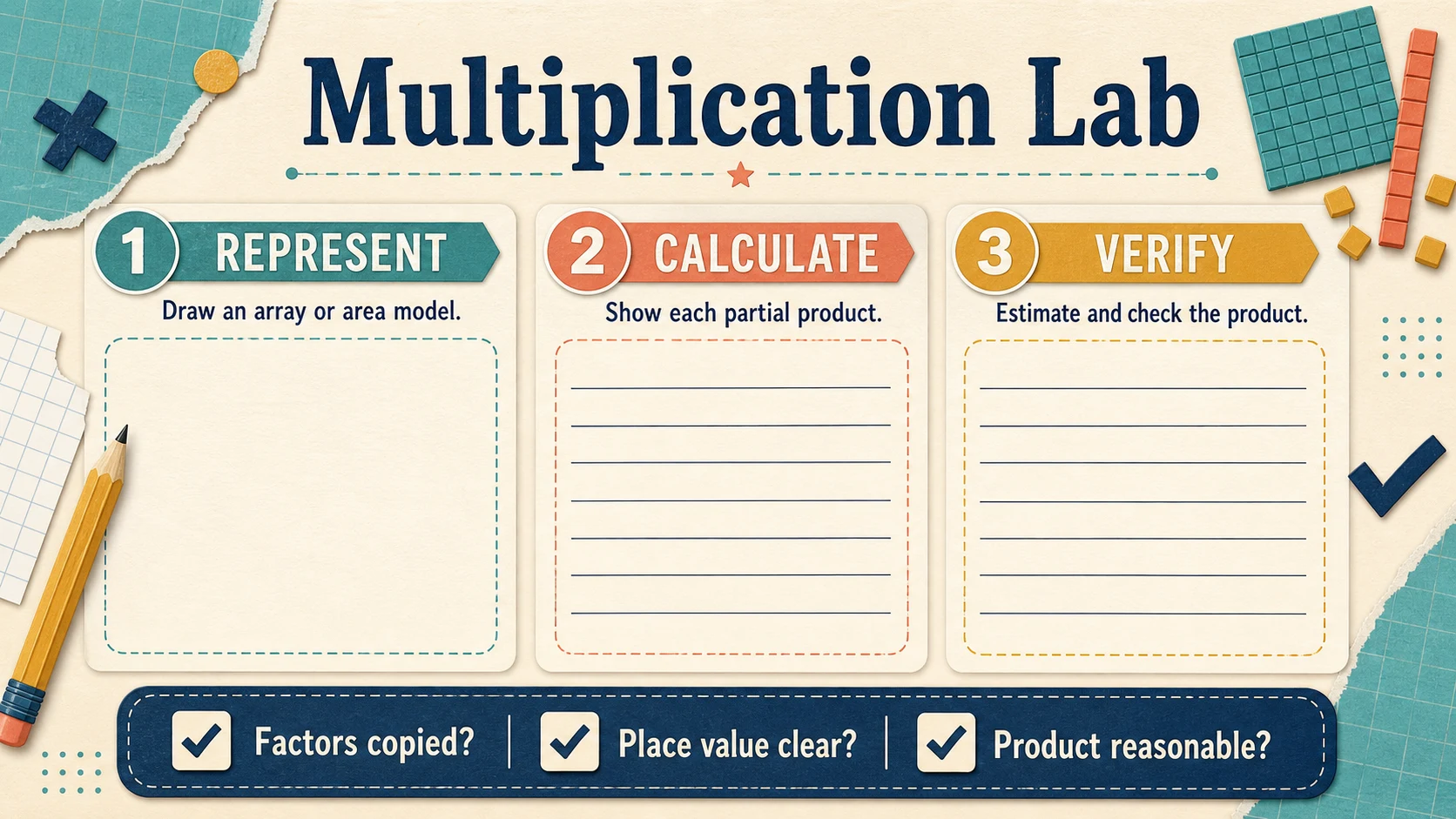
Return to a few selected facts after increasing delays and adjust the schedule from observed performance.
A practical, adjustable schedule is:
| Time | Retrieval task | Adult response |
|---|---|---|
| End of the session | Re-solve 2–3 corrected items without looking | Confirm the strategy and note uncertainty |
| Next practice session | Mix 3 previous facts with new ones | Look for independent recall or reconstruction |
| Several days later | Revisit 4–6 selected facts in a different order | Compare accuracy with the first attempt |
| The following week | Use the facts within a short mixed review | Decide whether support can be reduced |
This is an instructional suggestion, not a sourced universal timetable. Shorten or lengthen the intervals according to the learner’s work. If a product is forgotten but quickly reconstructed with a sound strategy, the learner may need more retrieval rather than complete reteaching. If the learner cannot explain the multiplication, return to meaning and representation first.
Blank items from the original 30 can be saved for delayed practice. You can also cover previous answers and ask the learner to solve selected items again on separate paper. Avoid memorizing the page order by mixing facts or generating a fresh set.
Recognize the worksheet’s limits
This printable is a focused practice resource. It contains 30 easy-level exercises and an answer key, and its stated skills are multiplication facts, times tables, mental math, and number sense. It can support classroom practice, homework, tutoring, or homeschool instruction, but it is not a complete fifth-grade multiplication course or a full assessment.
The worksheet alone cannot establish why a learner is struggling, whether a skill transfers to word problems, or whether performance will remain stable over time. It also does not replace local curriculum requirements or an educator’s broader evidence. Grade labels indicate intended practice level, while local teaching sequences and learner readiness vary.
Use the page to collect useful evidence: which facts are secure, which strategies are available, which errors repeat, and how much support is needed. Then make the next assignment narrower or more advanced accordingly.
For immediate continuation, open the free 5th Grade Multiplication worksheet, print the worksheet and separate answer key, and begin with one modeled example plus five observed items. If those items are secure, continue through the page and then use the 5th Grade Multiplication Worksheet Pack or the free worksheet generators to create a fresh retrieval set matched to the facts that actually need more practice.
Put it into practice
Use the guide with a real printable
Move from explanation to a short, observable practice task. Check the first item together, then adjust the next session from the learner's actual work.
See the 18-worksheet pack