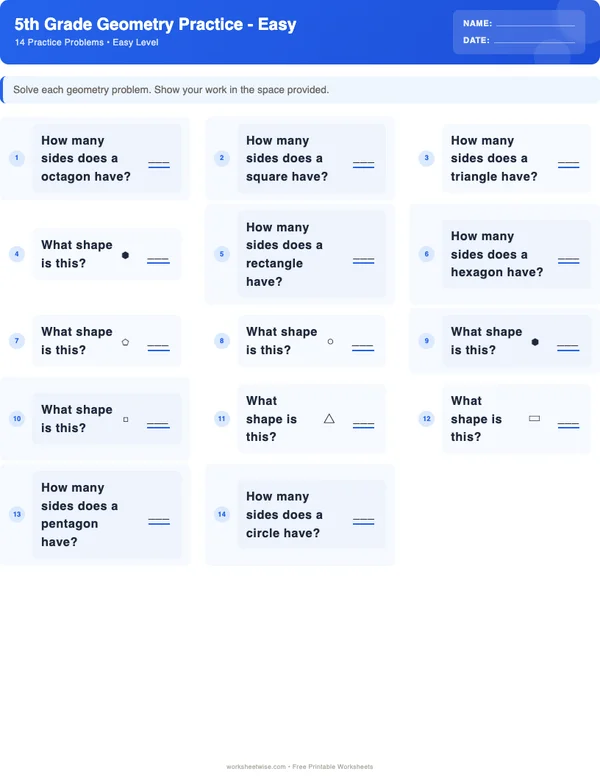
Complete guide
How to teach and practise 5th grade geometry worksheets - standard theme (easy)
How to Use This 30-Item Geometry Worksheet
The free 5th Grade Geometry worksheet provides 30 easy-level exercises on identifying shapes, counting sides and vertices, recognizing geometric properties, and calculating perimeter and area. Use it as focused practice rather than as a one-sitting test: model one representative problem, solve a short group together, assign a manageable independent set, and use the learner’s work to decide what comes next.
A practical first session is 8 to 12 items, but that is an instructional suggestion, not a universal timetable. A learner who explains each answer accurately may continue. A learner who begins confusing area with perimeter, guessing shape names, or omitting units should pause for a brief reteaching example. Observed work—not the printed grade label or a fixed schedule—should determine the pace.
Grade labels describe the intended practice level, and local curricula and teaching sequences differ. The broader 5th Grade Geometry topic guide provides the larger progression; this guide stays focused on launching, teaching, checking, and revisiting this particular printable.
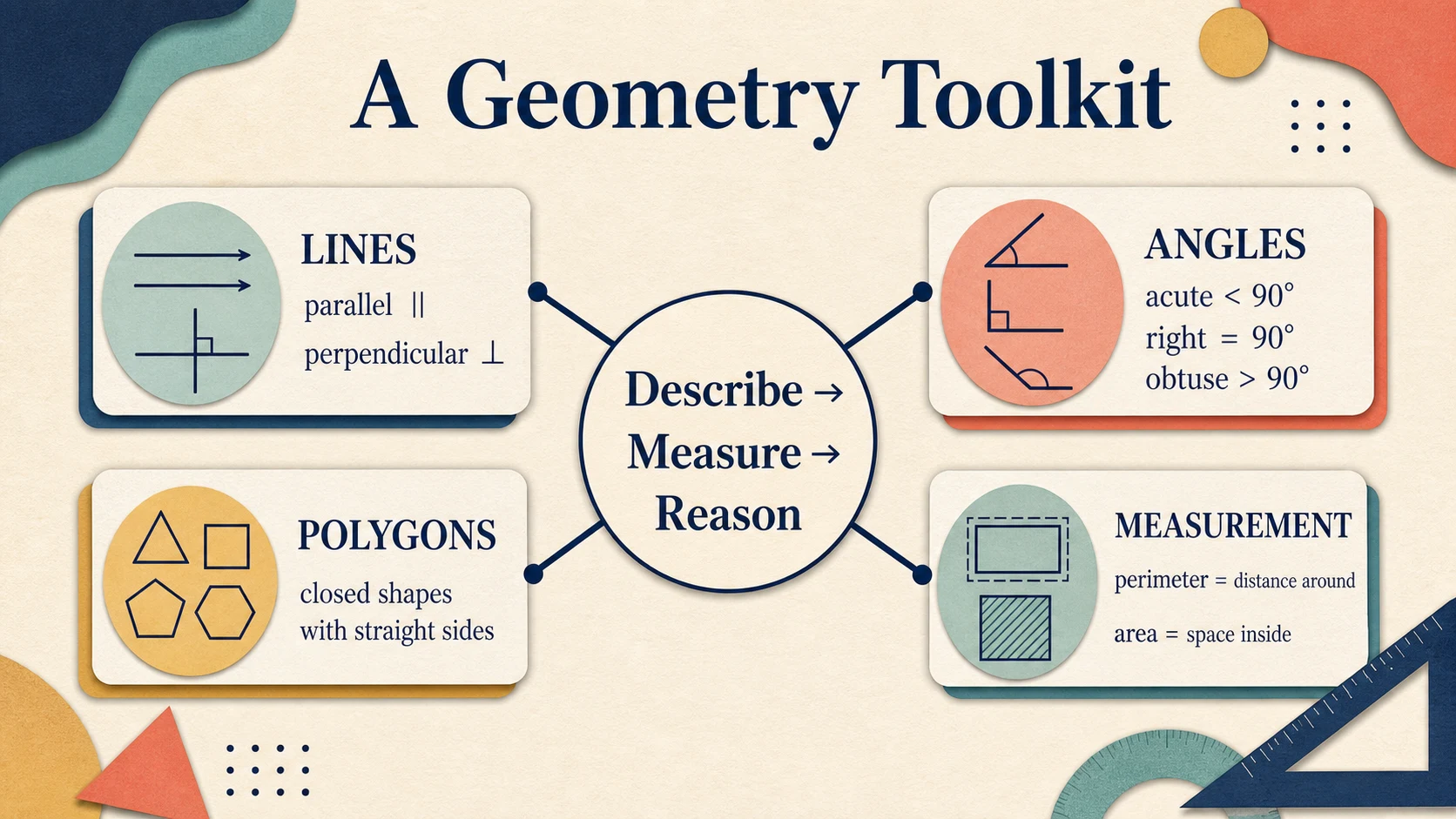
Move from a brief launch to modeling, guided practice, independent work, and later retrieval.
A Scannable Lesson Progression
The worksheet instructions are simple: solve each geometry problem and show work in the space provided. The adult’s role is to make “show your work” concrete before the learner begins.
| Lesson stage | Suggested use | What the adult watches for | Decision point |
|---|---|---|---|
| Preview | 2–3 minutes | Does the learner recognize the task types and needed symbols? | Clarify vocabulary without solving the page. |
| Model | 1 representative item | Can the learner follow the reasoning, not merely the answer? | Ask the learner to restate the method. |
| Guided practice | 3–5 items | Are shape properties, formulas, and units being used correctly? | Give less help after each successful item. |
| Independent practice | 5–10 items | Can the learner select and complete a method alone? | Continue, pause, or stop based on accuracy and explanation. |
| Review | Selected errors | Is the error conceptual, procedural, visual, or clerical? | Reteach the smallest missing idea. |
| Retrieval | 2–4 items on a later day | Can the learner solve without seeing the earlier model? | Choose another review or broader geometry practice. |
These quantities are adjustable. Five carefully explained items can be more useful than fifteen rushed ones. Conversely, a learner who works accurately and remains attentive may complete a larger section.
The instructional structure is consistent with broad guidance in the IES practice guide on teaching mathematics, which supports purposeful instruction using mathematical language, representations, and opportunities to explain thinking. The source offers general instructional guidance; it did not evaluate WorksheetWise or this worksheet.
Prepare the Page Without Preteaching Every Answer
Gather only the useful materials
Print the worksheet and keep the separate answer key out of the learner’s immediate view. Have a pencil, eraser, ruler, and a blank sheet or small whiteboard available. The catalogue does not establish which dimensions or diagrams appear in every item, so inspect the actual printable before deciding whether the ruler will be used for measuring or merely as a straightedge.
Do not add tools that obscure the skill. A calculator, for example, may turn a perimeter or area item into button practice when the arithmetic is meant to remain visible. If computation becomes the only obstacle and calculator use is permitted in your setting, record that adaptation separately so the final score is interpreted accurately.
Preview the four skill families
Ask the learner to scan the page without solving it and locate examples that appear to involve:
- Naming or identifying a shape
- Counting sides or vertices
- Finding perimeter
- Finding area
Then establish a compact vocabulary bank:
- A side is a straight boundary segment of a polygon.
- A vertex is a corner where two sides meet; vertices is the plural.
- Perimeter is the total distance around a figure.
- Area measures the surface covered inside a figure and uses square units.
These definitions support the listed worksheet skills. Avoid delivering the entire geometry curriculum before practice begins. If the learner already understands a term, ask for an example and move on.
Model the Task With Fully Checked Examples
Use examples similar to the worksheet’s stated skills rather than presenting them as copies of unseen worksheet items. Write each step large enough to inspect. A useful model contains four parts: identify what is being asked, select the relevant property or operation, calculate or count, and label the answer.
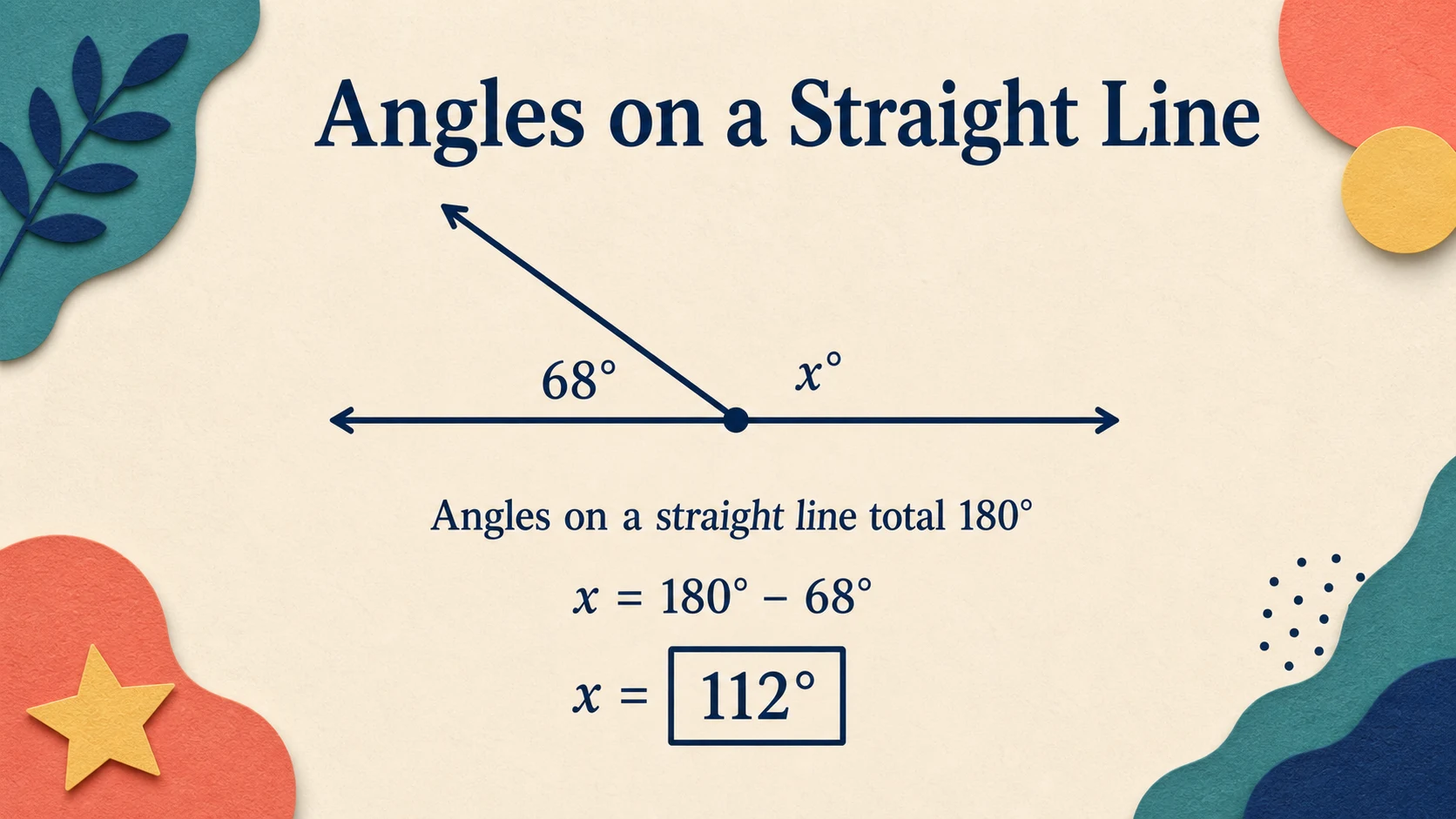
The operation, work, answer, and unit should agree.
Worked example 1: Identify a shape from its properties
Example: A closed figure has three straight sides and three vertices. Name it.
- Count the stated sides: 3.
- Count the stated vertices: 3.
- Match those properties to a shape name.
- A polygon with three sides is a triangle.
Checked answer: triangle.
To verify, draw a triangle and trace its boundary. It has three straight side segments. Marking each corner gives three vertices.
A useful boundary case is orientation. A triangle remains a triangle when it points down, tilts sideways, or has unequal side lengths. Its position on the page does not change the defining count of three sides.
Worked example 2: Count sides and vertices
Example: How many sides and vertices does a pentagon have?
Trace the boundary once and place a small mark on each side as it is counted:
- Side count: 1, 2, 3, 4, 5
- Vertex count: 1, 2, 3, 4, 5
Checked answer: 5 sides and 5 vertices.
The answer can be checked by pairing each side with the next corner around the polygon. For a simple closed polygon, the counts agree. Do not count the interior region as another side, and do not count a starting vertex twice after returning to it.
Worked example 3: Calculate perimeter
Example: A rectangle has length 8 units and width 3 units. Find its perimeter.
A rectangle has two sides of each length:
A second check uses :
Checked answer: 22 units.
Perimeter uses linear units because it measures distance around the boundary. Writing “22 square units” would attach an area unit to a perimeter answer.
A boundary case helps expose incomplete reasoning: adding only gives 11, but that accounts for only one length and one width. Trace all four edges to see why both dimensions must be counted twice.
Worked example 4: Calculate area
Example: A rectangle is 7 units long and 4 units wide. Find its area.
Think of four rows with seven unit squares in each row:
Checked answer: 28 square units.
Reverse the multiplication to verify:
The unit must be square units because area counts two-dimensional coverage. Adding correctly finds the perimeter of this rectangle, but it does not answer the area question.
Worked example 5: Apply more than one property
Example: A square has side length 6 units. Find its perimeter and area.
All four sides of a square have equal length.
Checked answers: perimeter units; area square units.
This example is useful because the same dimension produces two different measurements. The numerical answers, operations, and units differ. It also illustrates a classification boundary: a square satisfies the properties of a rectangle because it has four right angles, while also having the additional property that all four sides are equal. When classification by properties appears, a figure can belong to more than one valid category.
The Common Core mathematics standards place coordinate work and classification of two-dimensional figures by properties in the Grade 5 geometry domain. That high-level reference helps situate fifth-grade geometry, but it should not be treated as proof that every exercise on this printable covers every Grade 5 standard.
Move From Guided Practice to Independent Work
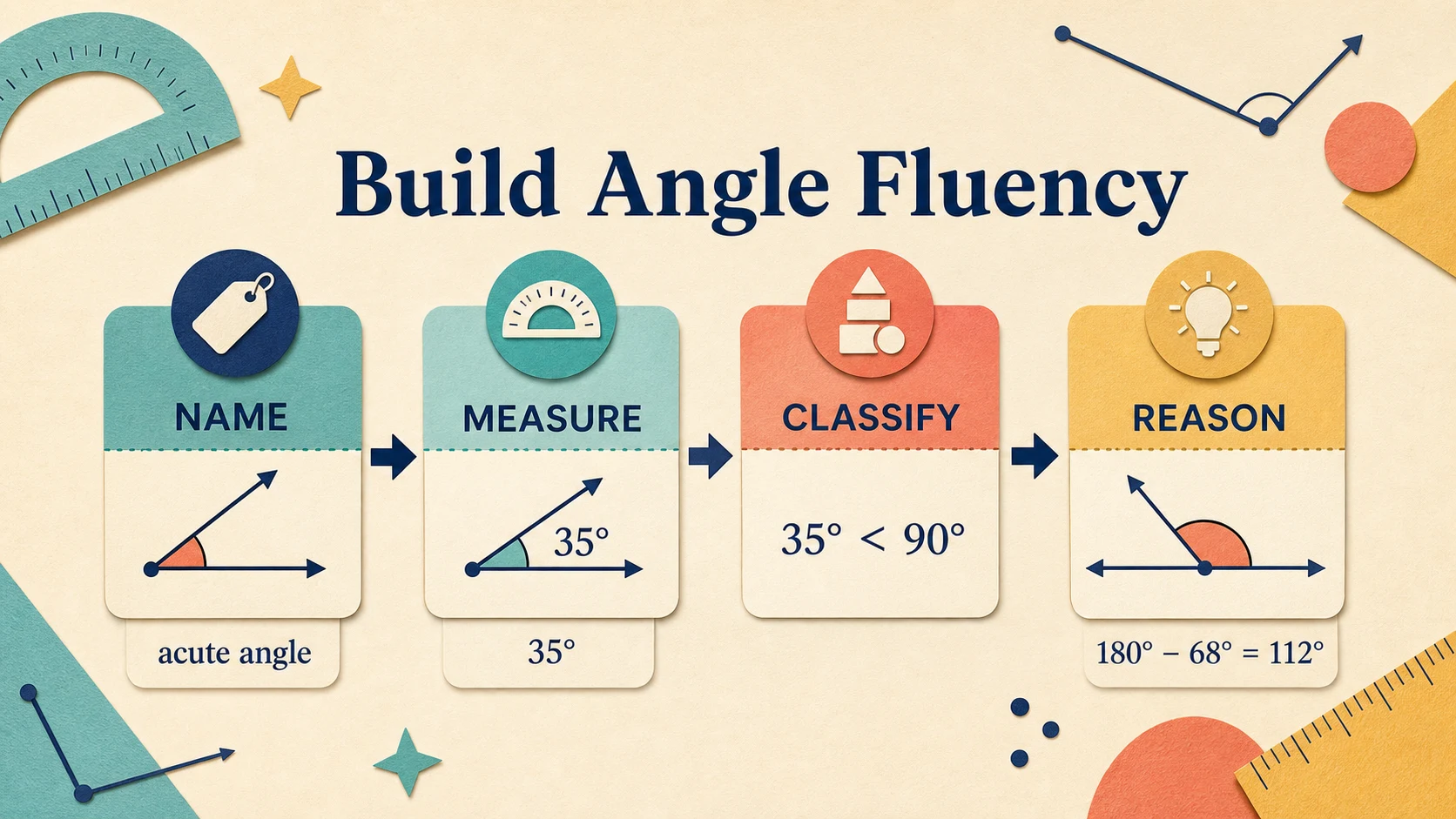
Reduce prompting gradually so the learner assumes responsibility for the method.
Run a short guided set
Select several items representing the visible task types. For the first item, think aloud:
I see the word perimeter, so I need the distance around the boundary. I will account for every outside side and write a linear unit.
For the next item, replace the explanation with prompts:
- What is the problem asking you to find?
- Which information matters?
- Will you count, add, or multiply?
- How can you check the result?
- What unit belongs with the answer?
By the third or fourth guided item, ask only, “What is your plan?” If the learner can state and carry out a sound plan, remove further prompting.
Do not turn prompts into hidden answers. “Shouldn’t you multiply?” directs the operation. “What does area measure?” requires the learner to retrieve the relevant idea.
Release a manageable independent set
Mark a stopping point before independent work begins. The learner should know how many items to attempt and what to do when uncertain. A simple routine is:
- Circle the item number.
- Write what is known.
- Attempt a method.
- Mark the item for discussion.
- Continue to the next item.
This prevents one difficult item from consuming the entire session. It also preserves evidence of what the learner can do without immediate rescue.
During independent work, avoid correcting every pencil movement. Watch for patterns: repeated unit errors, counting the same vertex twice, using perimeter for every rectangle, or relying on a shape’s orientation instead of its properties. A single slip may need only a check. Repetition signals a teaching need.
Adapt Support Without Changing the Geometry Skill
The goal of adaptation is to make the intended reasoning accessible while preserving the same mathematical demand. If the task is to find perimeter, the learner should still determine the distance around the figure. If the task is to identify a polygon, the learner should still use its properties.
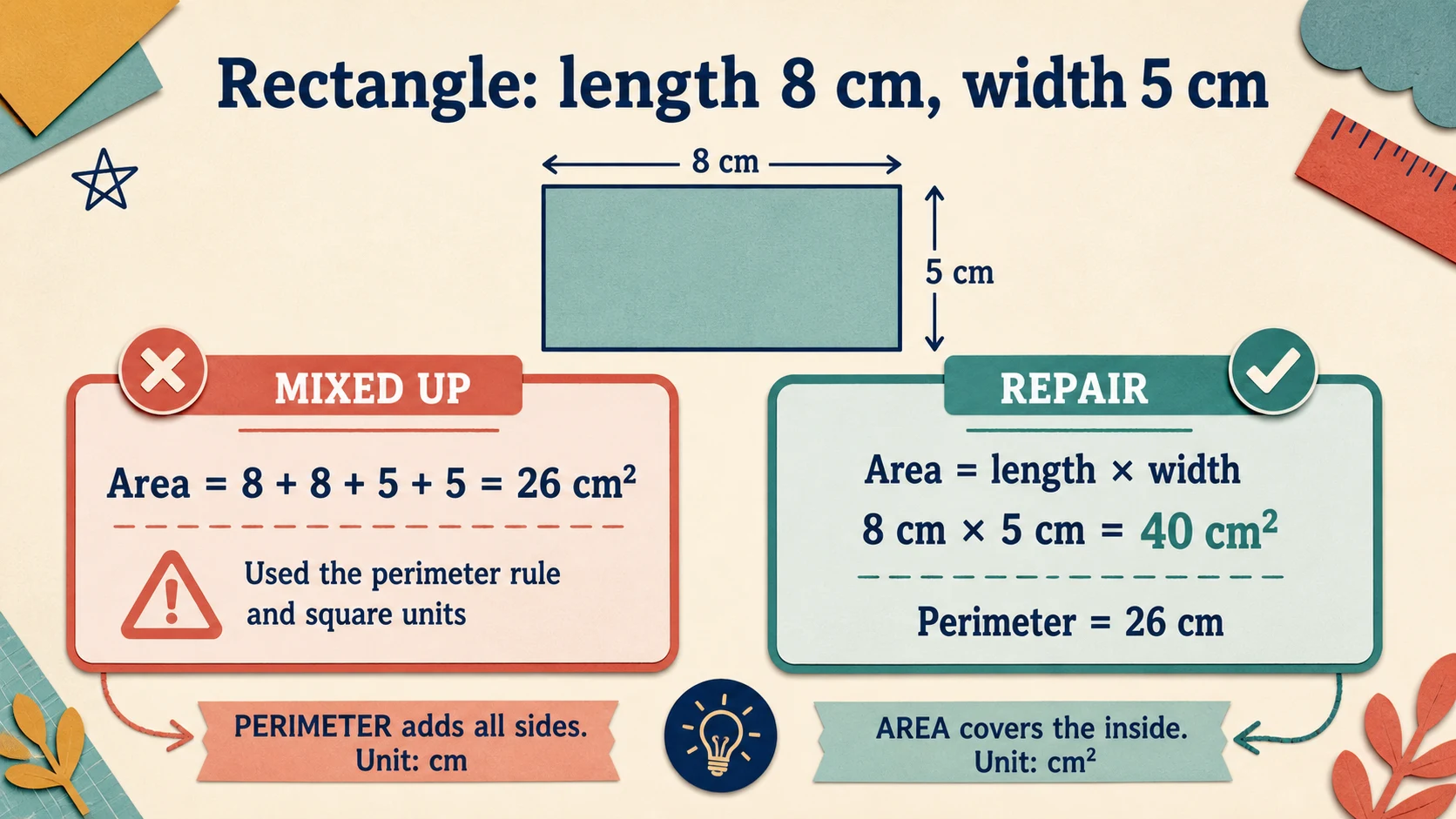
Adjust visibility, language, or workload while preserving the target skill.
For a learner who needs more visual structure
Cover the rest of the page so only one item is visible. Let the learner trace the outside boundary when finding perimeter, mark each vertex once, or lightly shade the interior region when distinguishing area from perimeter. Graph paper or drawn unit squares can make rectangular area visible without changing the required calculation.
Present shapes in more than one orientation when you create an additional example. A rectangle does not stop being a rectangle when its longer sides are vertical. A tilted square is still a square. The catalogue’s topic guidance specifically emphasizes varied orientations because superficial appearance can distract from defining properties.
For a learner who needs language support
Keep the geometry term but simplify the surrounding sentence. Pair terms with actions:
- Perimeter: trace around.
- Area: cover inside.
- Vertex: mark a corner.
- Side: trace one straight boundary segment.
Ask the learner to point, trace, or sketch before explaining verbally. This supports access without replacing the vocabulary that the worksheet is practicing.
For a learner who works slowly or tires
Assign fewer items per sitting while keeping a mixture of skills. Do not remove every perimeter item merely because perimeter is difficult. Instead, include one modeled item, one supported item, and one independent attempt.
A reduced set changes the amount of practice, not the geometry. Record which item numbers were completed so unfinished items can be scheduled intentionally rather than forgotten.
For a learner ready for a modest extension
Ask for a second representation or a reason:
- Draw a different triangle and label its sides and vertices.
- Show two ways to calculate a rectangle’s perimeter.
- Explain why area uses square units.
- Name every category that fits a given figure and justify each name by a property.
An extension should deepen the existing skill. It need not introduce an unrelated advanced topic.
Interpret Errors Before Correcting Them
An incorrect answer does not identify its own cause. Examine the learner’s marks, arithmetic, explanation, and unit before deciding what to reteach.
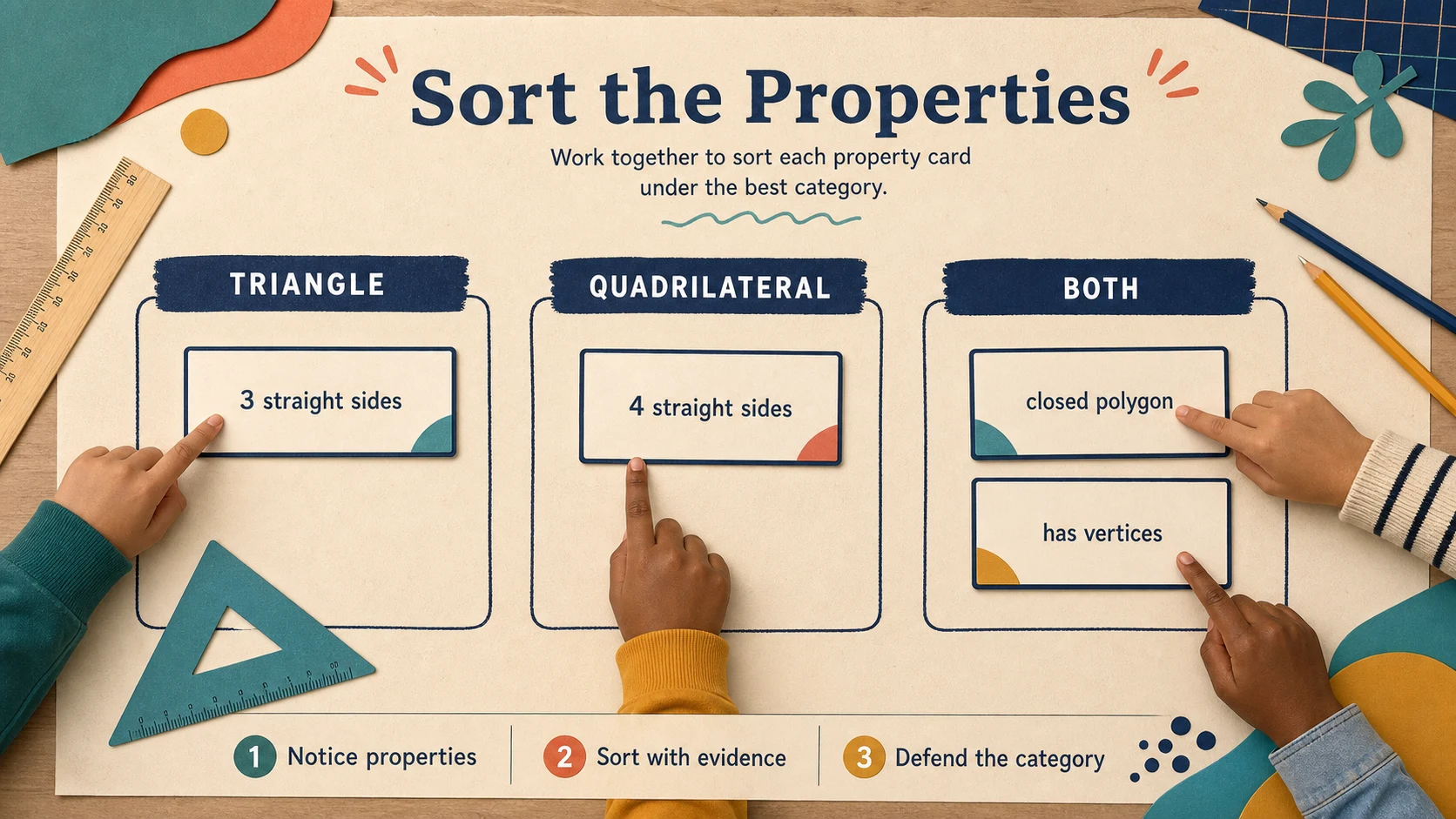
Identify the error type, revisit the smallest missing idea, and try a fresh item.
Shape and property errors
If a learner calls every four-sided figure a square, ask for the property that distinguishes a square from a general quadrilateral. Have the learner count sides, inspect angles when they are relevant and shown, and compare side lengths only when the diagram or labels provide that information.
If a tilted shape is misidentified, redraw or rotate a comparable figure. Ask which defining properties changed. The answer should be none: orientation changed, but the side and angle relationships did not.
If sides and vertices are confused, use two different marks. Trace each side with a short line and dot each vertex. Then count the lines and dots separately.
Perimeter errors
Common evidence and possible interpretations include:
| Observed work | Likely issue to investigate | Immediate response |
|---|---|---|
| Adds only length and width | Only half the boundary was counted | Trace every outside edge and label each term in the sum. |
| Multiplies length by width | Area procedure was used | Ask whether the task concerns the boundary or interior. |
| Omits a side in an irregular-looking outline | Visual tracking failed | Mark a starting point and move around the boundary once. |
| Correct number, square units | Measurement type and unit are disconnected | Contrast a boundary segment with a unit square. |
Do not assume that every wrong perimeter answer reflects weak geometry. Recalculate the learner’s addition. If the setup includes all sides but the sum is wrong, the geometry plan may be sound while the arithmetic needs correction.
Area errors
A learner who adds all four sides for an area item probably recognizes the dimensions but selected the wrong measurement. Return to the meaning of coverage. Sketch a rectangle partitioned into rows and columns, then connect the counted squares to multiplication.
A learner who writes for a -by- rectangle may not yet connect dimensions with rows and columns. Draw four rows of seven squares or seven rows of four. Both arrangements contain 28 unit squares.
A correct product without square units is different from a wrong product. Ask the learner to supply the missing unit and explain why it is squared. Track unit errors separately if you want to know whether calculation and measurement language are developing at different rates.
The IES guide for assisting students who struggle with mathematics offers broad support for explicit, systematic instruction, visual representations, and ongoing attention to student performance. Applied here, that means modeling a clear process and responding to observed error patterns. It does not imply a diagnosis or prescribe a child-specific intervention.
Check the Answer Key Responsibly
The worksheet includes a separate printable answer key for quick checking. Use it after examining the learner’s reasoning, not as a substitute for that examination.
Check method, answer, and unit
For each completed item, consider three layers:
- Method: Did the learner use properties or an operation appropriate to the question?
- Result: Is the count or calculation correct?
- Communication: Is the answer labeled clearly, including units when needed?
A learner can reach a correct answer through unclear or accidental reasoning. Ask for an explanation when the work does not show how the answer was obtained. Conversely, a sound perimeter setup with one addition error should not be described as complete misunderstanding.
If the learner’s answer differs from the key, independently solve the item before explaining the difference. Inspect the diagram, labels, and requested measurement. Answer keys support efficient review, but responsible checking still includes verifying the problem and the learner’s method.
When recording performance, avoid relying only on a total score. A short note such as “shape names secure; area operation secure; perimeter units inconsistent” gives better direction for the next session than “8 out of 10.”
Decide What to Do After the First Session
Use the completed work to choose among continuation, targeted review, or a temporary step back.
Continue on the same worksheet
Continue when the learner usually identifies the requested quantity, selects an appropriate method, shows readable work, and corrects occasional slips after a neutral prompt. Assign the next mixed set rather than repeating explanations the learner no longer needs.
Reteach one narrow idea
Pause for a small correction when errors cluster around one distinction, such as area versus perimeter or sides versus vertices. Model one fresh example, solve one together, and give one independent check. Then return to an uncompleted worksheet item of the same type.
Do not restart all 30 exercises because of one narrow misconception. Equally, do not push through the remaining page when the same misconception is producing repeated wrong work.
Revisit broader geometry instruction
If the learner cannot yet identify the task type, explain basic properties, or distinguish boundary from interior even with visual support, use the broader geometry guide to select prerequisite practice. The 5th Grade Math hub can help place geometry alongside the grade’s other mathematics topics.
The worksheet is easy-level practice, but “easy” describes its catalogue difficulty, not how any individual learner must experience it. Local sequences differ, and a learner may encounter these ideas earlier, later, or in a different order.
Schedule Retrieval Instead of One-Time Completion
Retrieval means returning to a skill after some time has passed and attempting it without copying the previous model. The schedule should respond to performance rather than follow a universal calendar.
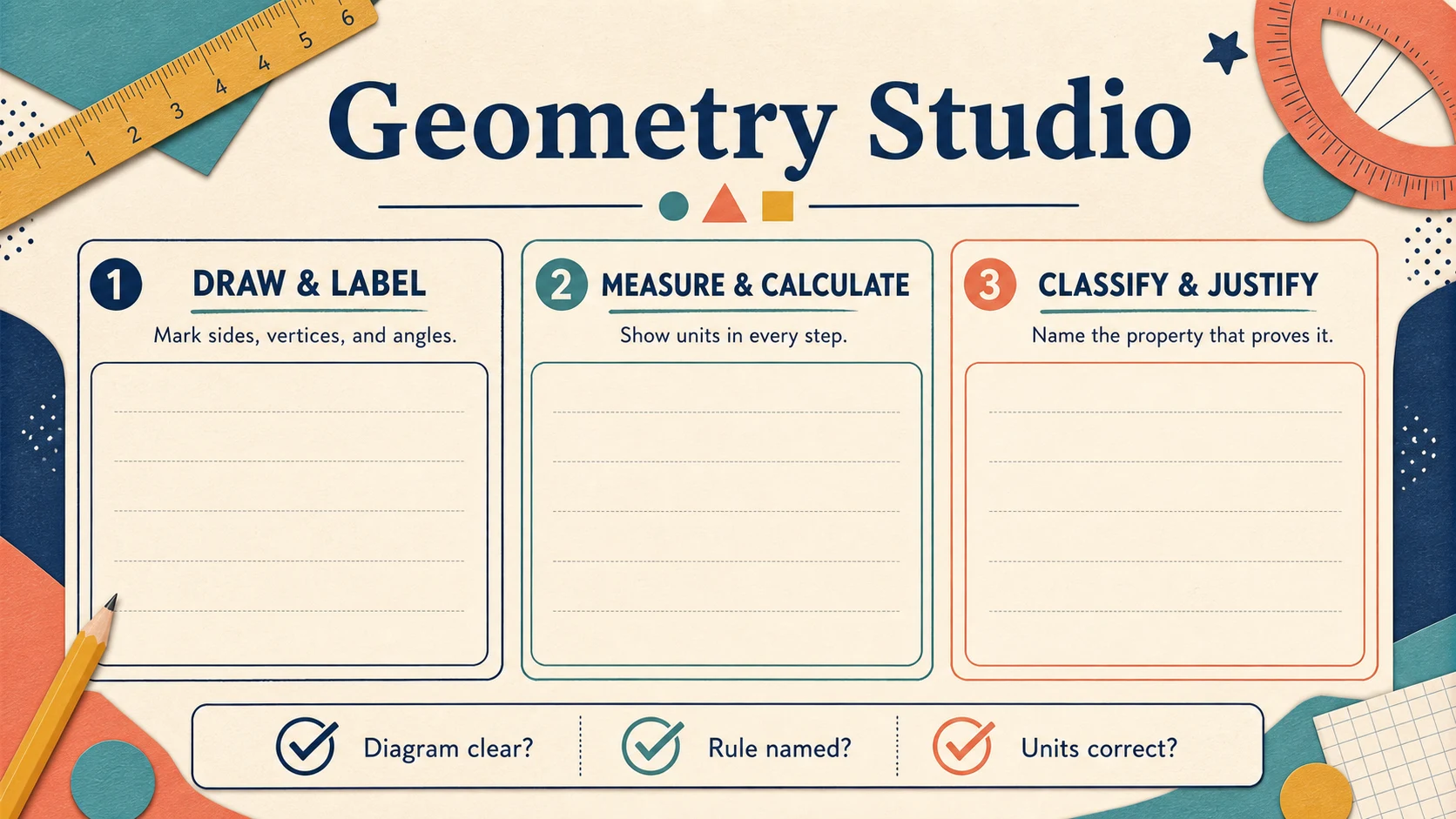
Revisit a small mixed set after increasing gaps, adjusting from the learner’s work.
A practical starting plan is:
| Suggested time | Retrieval task | What to record |
|---|---|---|
| Later in the first session | One shape/property item and one measurement item | Whether the learner works without the model |
| Next study session | Two to four uncompleted mixed items | Accuracy, method selection, and units |
| Several days later | One perimeter item, one area item, and one property item | Which distinctions remain available after a gap |
| About one or two weeks later | A short mixed review from unused items or comparable practice | Whether support can be reduced |
This is a flexible instructional plan, not a sourced or universal timetable. Shorten the gap if the learner cannot retrieve the method. Lengthen it after accurate, well-explained work. If all 30 items have been used, create comparable numbers with a free worksheet generator or select another worksheet rather than asking the learner to memorize answers from the same page.
Keep retrieval brief enough that it reveals learning rather than becoming another full lesson. Avoid showing the previous worked example before the first attempt. If the learner is stuck, provide a small cue, note the support given, and try a fresh item later.
Limits of This Printable
This worksheet targets the catalogue skills of shapes, sides and vertices, perimeter, area, and geometric properties through 30 easy-level exercises. It can provide useful practice and evidence of current understanding, but one printable cannot represent the whole geometry progression.
It should not be used to claim comprehensive standards alignment, guaranteed outcomes, or mastery of every fifth-grade geometry topic. The catalogue’s broader topic scope also includes angles, coordinate geometry, volume, symmetry, and other areas across grades, but those topics should not be assumed to appear on this specific worksheet.
Paper responses also reveal only part of a learner’s reasoning. A correct answer may conceal guessing, while an incorrect answer may result from arithmetic or notation rather than a geometry misconception. Brief explanations, sketches, and independent checks make the evidence more informative.
A Useful Next Action
Begin with the free 30-item worksheet, model one representative item, and assign a short mixed set. Record errors by skill rather than only by total score. After a later retrieval check, use the 5th Grade Geometry topic guide for the next appropriate topic or choose the 18-worksheet geometry pack if a wider set of structured practice is needed.
Put it into practice
Use the guide with a real printable
Move from explanation to a short, observable practice task. Check the first item together, then adjust the next session from the learner's actual work.
See the 18-worksheet pack