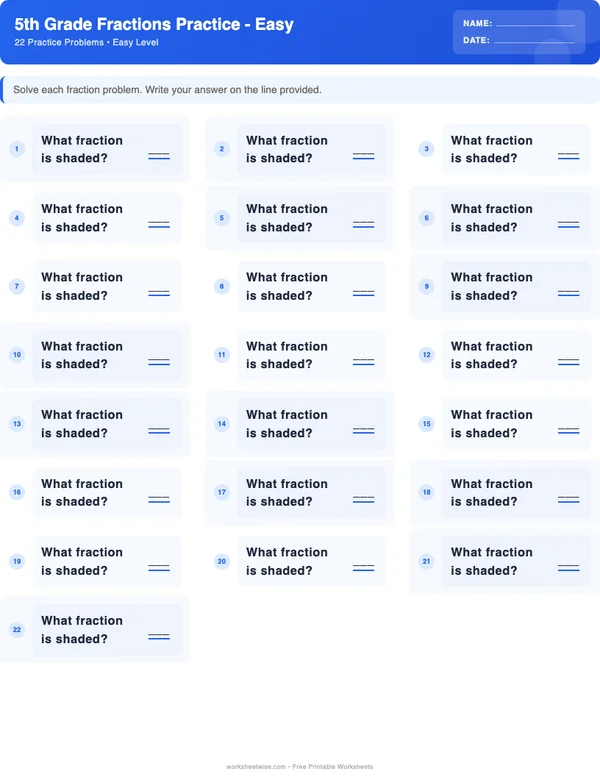
Complete guide
How to teach and practise 5th grade fractions worksheets - standard theme (easy)
How to Use This 22-Item Fractions Worksheet
The free 5th Grade Fractions worksheet provides 22 easy-level exercises covering fraction identification, equivalent fractions, comparisons, and fraction operations. Use it as a focused practice session: preview the page, model one representative problem, complete a short guided set, and then release the learner to work independently. Review errors by skill rather than counting only the total correct.
The printed instruction is simple: “Solve each fraction problem. Write your answer on the line provided.” The adult’s main job is to make the mathematical thinking visible before independent work begins. Ask the learner to name the task, choose a suitable representation or procedure, solve, and check whether the answer is reasonable.
Grade labels describe the intended practice level, not a guarantee that every fifth grader has encountered every skill in the same order. Local curricula and instructional sequences differ. If part of the sheet is unfamiliar, teach or review that skill before treating those items as independent practice.
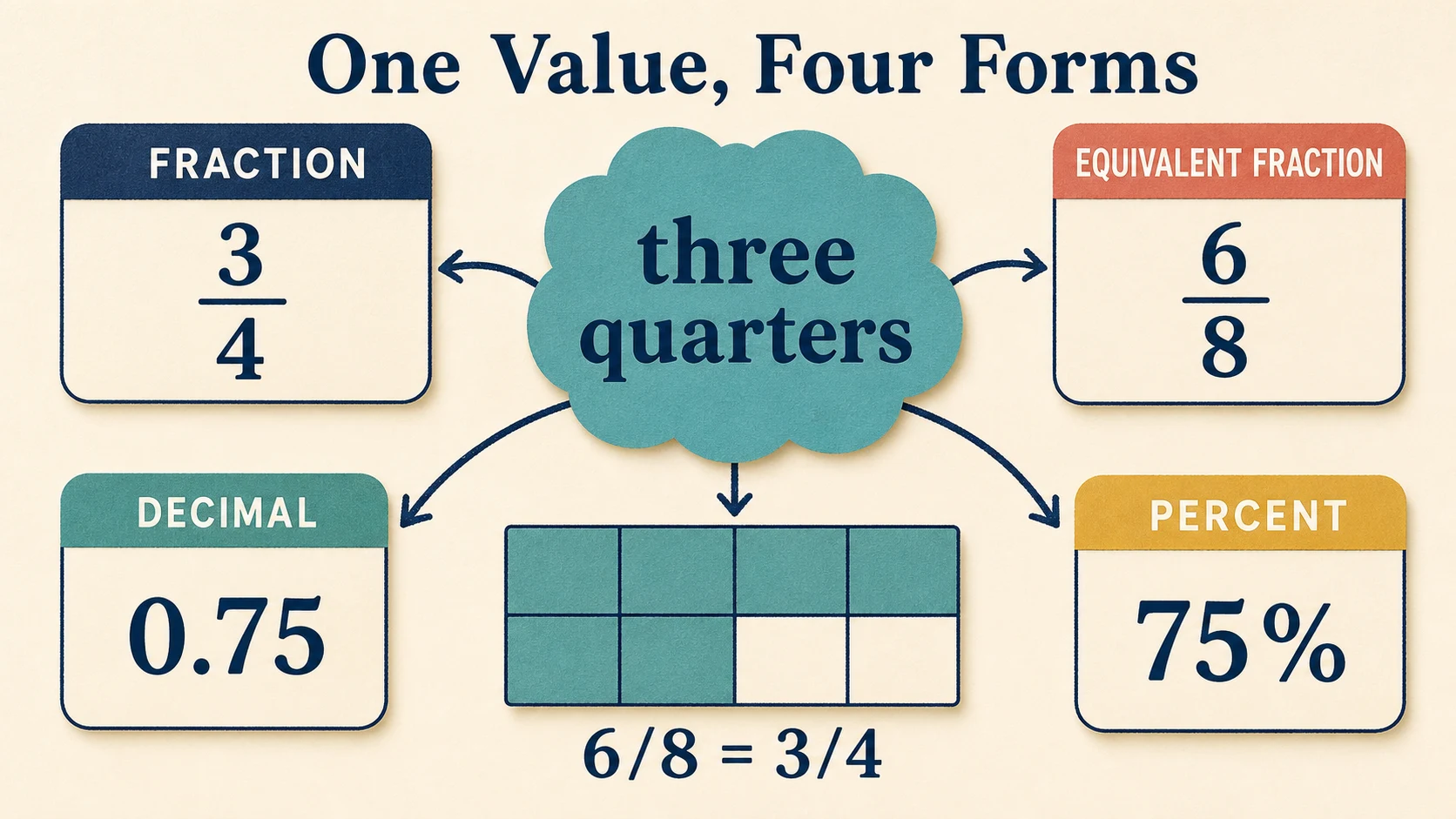
Preview, model, guide, release, review, and revisit the work.
What This Printable Does—and Does Not Do
This worksheet offers a mixed set of straightforward exercises. Its catalogue identifies four areas:
- Fractions
- Equivalent fractions
- Comparing fractions
- Fraction operations
That mixture makes the page useful for checking whether the learner can recognize which kind of fraction reasoning a problem requires. It is not described as a full lesson sequence, a complete assessment, or comprehensive coverage of every fifth-grade fraction skill. The broader fractions topic guide is the better place to see the progression from fraction identification and number-line understanding through equivalence, comparison, mixed numbers, and operations.
The catalogue describes the page as appropriate for learners beginning this level of fraction work or needing extra reinforcement. “Easy” refers to its place within the WorksheetWise collection. It does not mean that every item will feel easy to every learner.
The Common Core State Standards for Mathematics describe grade-level expectations that include adding and subtracting fractions with unlike denominators and interpreting multiplication and division involving fractions. That source provides broad instructional context; it did not evaluate this WorksheetWise printable. Before assigning the page, compare its listed skills with what the learner has actually been taught and with any local expectations you follow.
Prepare the Lesson Before the Learner Starts
A two-minute adult preview can prevent an unhelpful start. Print or open the worksheet and its separate answer key, but keep the key out of the learner’s immediate view. Scan the 22 exercises and sort them mentally by task type. Look for items that ask the learner to identify a fraction, generate or recognize an equivalent fraction, compare two fractions, or compute.
Have a few simple supports available:
- Blank paper for working
- A pencil and eraser
- Fraction strips, fraction circles, or hand-drawn bars
- A number line
- Two colored pencils for marking equivalent parts or common units
These are instructional tools, not shortcuts. A fraction bar can show why two fractions are equivalent; a number line can show which of two fractions is farther to the right. The symbols should remain connected to an amount.
The IES practice guide Teaching Math to Young Children discusses broad practices such as using representations and helping learners connect mathematical ideas. Although its stated audience is younger children, the high-level principle of linking representations to mathematical language can still inform an adult’s modeling. It should not be treated as a fifth-grade endorsement of this particular worksheet.
Decide the Purpose
Choose one purpose before the page begins:
- Supported practice: The learner is still developing the listed skills, so the adult will model and guide.
- Independent review: The learner has already received instruction and will complete most items alone.
- Informal skill check: The adult wants to see which listed skills are secure and which need more teaching.
Do not change the purpose halfway through without noting it. A page completed with extensive prompting should not later be interpreted as fully independent mastery.
Establish a Simple Routine
Use the same short sequence for each item:
- Name the task.
- Represent or plan.
- Solve.
- Check.
For example: “This is a comparison. I need to decide which fraction is greater. I can use a common denominator, a benchmark, or a visual model. Then I will check whether my conclusion makes sense.”
A Practical Lesson Progression
The learner’s observed work should determine pacing. The times below are instructional suggestions, not a universal timetable.
| Phase | Suggested action | What the adult watches for |
|---|---|---|
| Launch | Discuss one familiar fraction and preview the task types | Can the learner explain numerator and denominator in context? |
| Model | Solve one representative problem aloud | Does the learner connect each written step to the fraction’s value? |
| Guided practice | Complete two to four selected items together | Can the learner choose a strategy with decreasing prompting? |
| Independent practice | Assign a manageable run of items | Is the work accurate, organized, and genuinely independent? |
| Review | Analyze selected correct and incorrect responses | Can the learner explain why an answer works or fails? |
| Retrieval | Revisit a few problems later without copying | Is the reasoning available after time has passed? |
If the learner is accurate and can explain the reasoning, reduce prompts and extend the independent portion. If errors repeat, pause the page and return to a representation or a smaller example. Finishing all 22 items in one sitting is less important than preserving accurate mathematical thinking.
Model the Thinking, Not Just the Answer
A useful model includes the decision that comes before the calculation. Avoid demonstrating only a string of rules. The learner needs to hear why a denominator is changed, why a comparison method works, or why an answer is plausible.
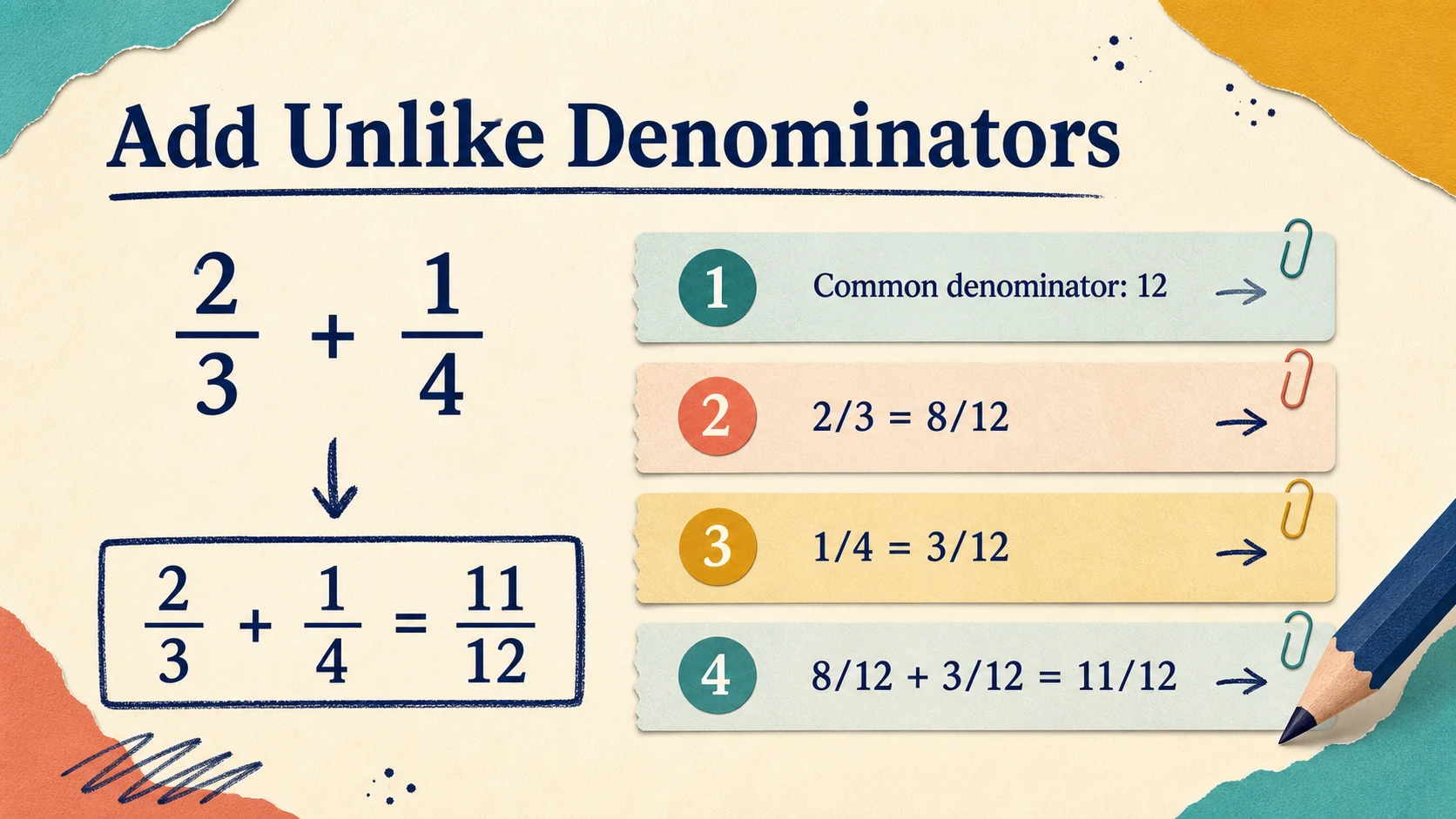
Show the meaning of each step and finish with an independent check.
The examples below are fully checked illustrations of the worksheet’s listed skills. They are not presented as copies of particular numbered items.
Worked Example 1: Identify a Fraction
Suppose a bar is divided into 8 equal parts and 5 parts are shaded.
The fraction shaded is:
The denominator, 8, records the number of equal parts in the whole. The numerator, 5, records how many of those parts are shaded.
Check: Count all equal parts: 8. Count the shaded parts: 5. Therefore, is correct.
A useful boundary case is a shape divided into pieces that are not equal. The learner should not simply count pieces and name a fraction as though they were equal shares. Fraction identification depends on equal-sized parts.
Worked Example 2: Find an Equivalent Fraction
Find a fraction equivalent to:
Multiply the numerator and denominator by the same nonzero whole number. Using 2:
Therefore:
Check by simplifying: Divide the numerator and denominator of by 2:
A pair of equal-length fraction bars gives a second check: shading 3 fourths should cover the same length as shading 6 eighths.
A boundary case worth discussing is multiplication by 1:
This is equivalent but does not create a differently named fraction. Multiplying only the numerator, such as changing to , changes the value and is not a valid equivalence step.
Worked Example 3: Compare Unlike Denominators
Compare:
Use a common denominator of 12:
Since is greater than :
Check with a benchmark: Both fractions are greater than . The fraction is below 1, while is below 1. Because , is closer to 1 and therefore greater.
This example also exposes a common faulty shortcut: comparing 6 and 4 and declaring that sixths must be larger because 6 is larger. When the whole stays the same, a larger denominator means smaller unit parts, not automatically a larger fraction.
Worked Example 4: Add Unlike Denominators
Calculate:
The denominators name different-sized parts, so first rename in sixths:
Now add:
Therefore:
Check: is about , and is about . Their sum is about , consistent with , which is about .
Do not add denominators to produce . Thirds and sixths must first be expressed in a shared unit before their counts can be combined.
Worked Example 5: Multiply Two Fractions
Calculate:
Multiply the numerators and denominators:
Simplify by dividing numerator and denominator by 2:
Therefore:
Check for reasonableness: The problem asks for of . Taking a proper fraction of should produce a positive result smaller than . Since , the result fits that expectation.
The phrase “multiplication makes numbers larger” is not reliable here. Multiplying a positive amount by a number between 0 and 1 makes the result smaller.
Move from Guided to Independent Practice
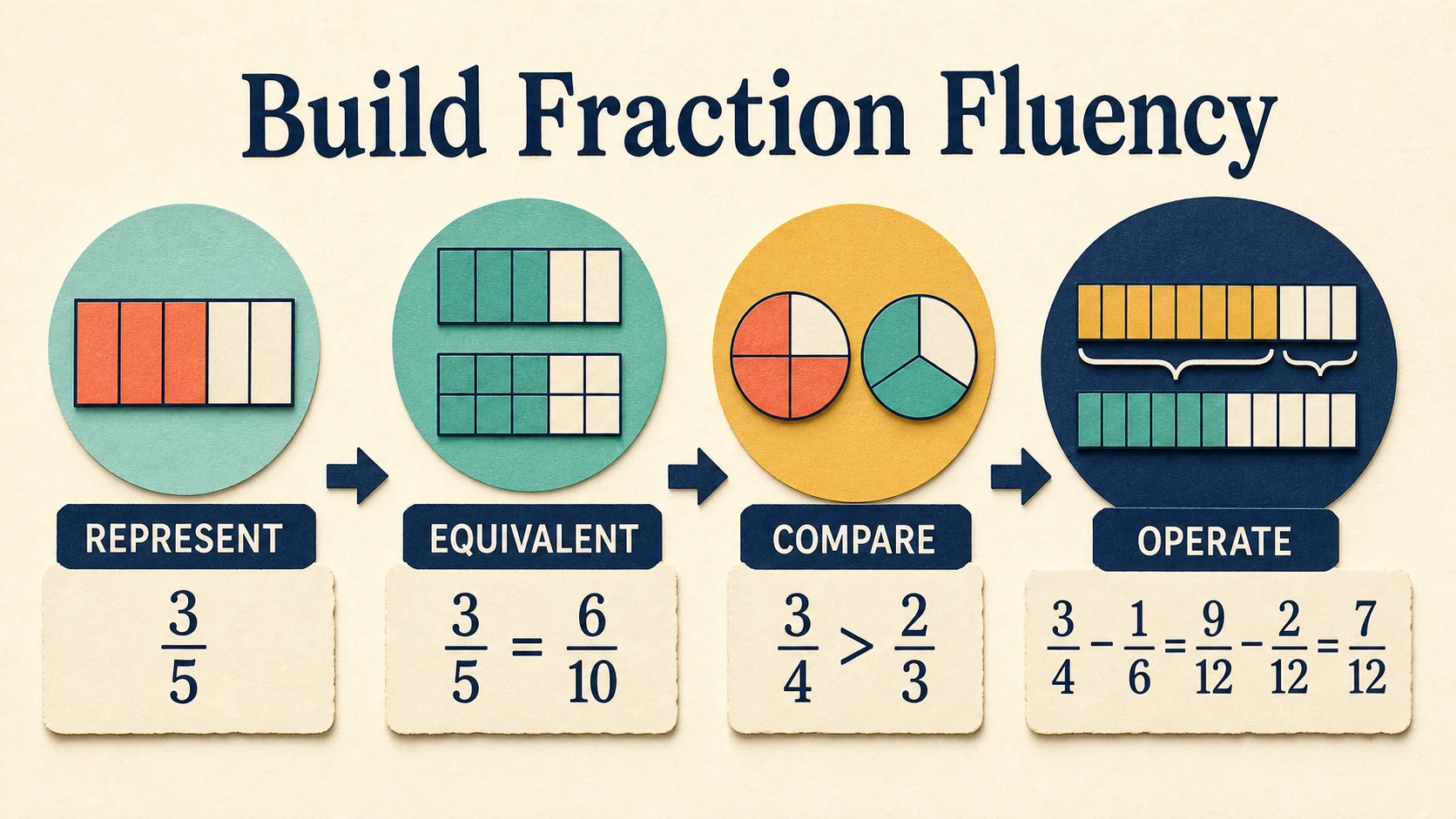
Transfer one decision at a time until the learner can complete the full routine.
Use a Gradual Release
Begin with one adult model. Next, solve a problem together while the learner supplies the decisions. Then ask the learner to solve a similar item while explaining the plan. Independent work begins when the learner can identify the task and choose a reasonable method without being told every step.
Prompts can be faded in this order:
- “What kind of problem is this?”
- “What representation or procedure could help?”
- “What will you do first?”
- “How will you check?”
- Silence, followed by review after the learner finishes.
Avoid prompts that reveal the operation or answer, such as “Multiply both parts by 2” or “The answer should be .” Those may complete the item without showing whether the learner can make the decision independently.
Divide the 22 Items Purposefully
One workable plan is to use a small opening set for guided practice and reserve the rest for independent work. Do not assume that the first items necessarily represent every listed skill; preview the actual page and select examples intentionally.
You might pause after every five or six independent items for a brief accuracy check. If the learner has misunderstood the same feature twice—such as adding denominators—stop and reteach before more repetitions reinforce the error. If mistakes are isolated and the reasoning is otherwise sound, allow the learner to continue and return to them during review.
The IES guide Assisting Students Struggling with Mathematics offers high-level guidance on systematic instruction, clear mathematical language, representations, and deliberate review. These principles can inform how an adult structures support, but the guide does not certify or assess this worksheet.
Adapt Support Without Changing the Skill
An adaptation should reduce an unnecessary barrier while preserving the mathematical decision. If the task is comparing fractions, the learner must still determine relative value. If the task is finding an equivalent fraction, the learner must still preserve the fraction’s value.
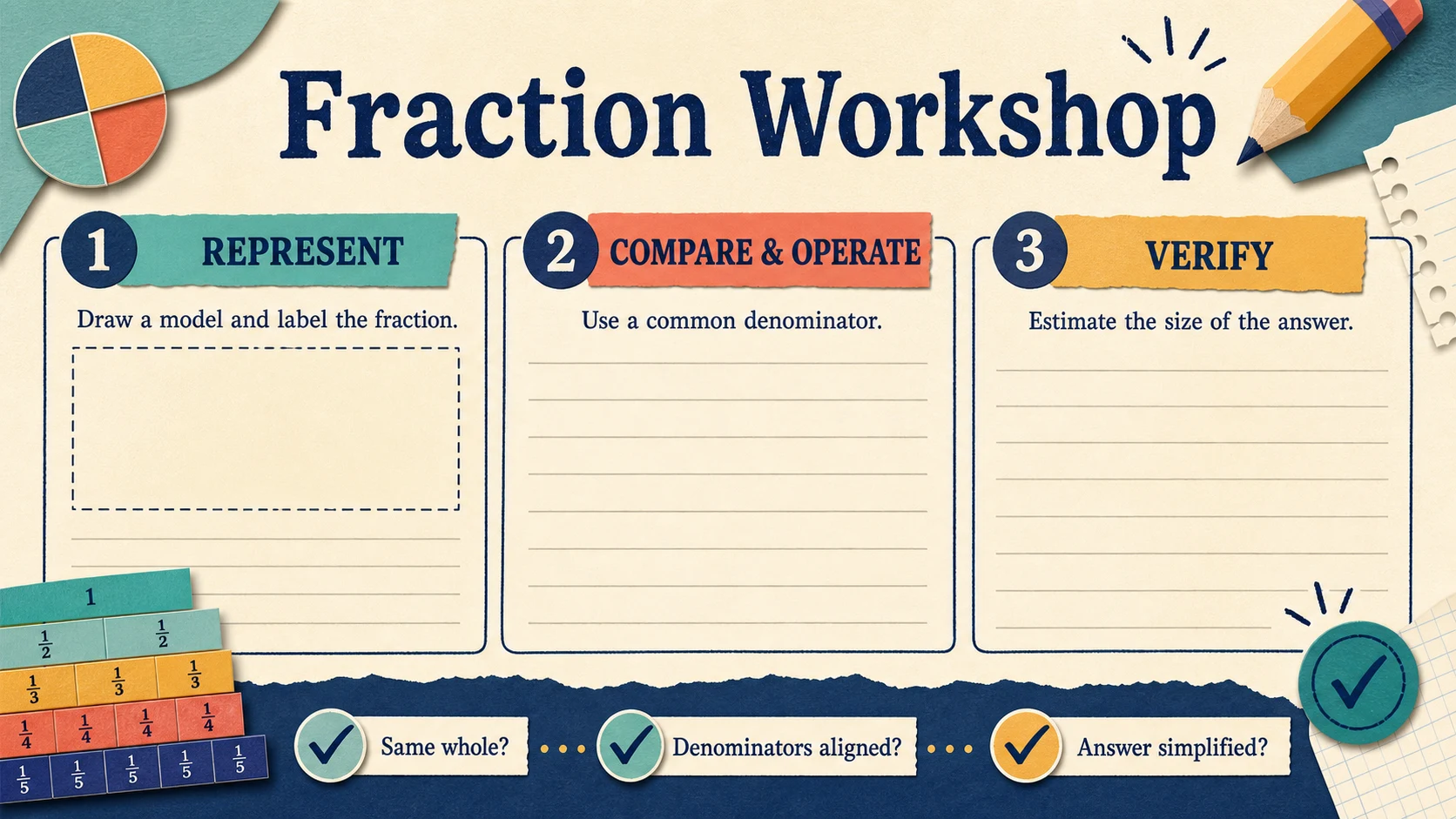
Adjust representation, workload, or prompting while keeping the fraction reasoning intact.
When More Support Is Needed
Offer one or more of these changes:
- Cover the unused portion of the page so only a few items are visible.
- Let the learner draw fraction bars or use fraction strips.
- Provide a blank number line for comparison problems.
- Mark a stopping point and complete the remaining items in another session.
- Read directions aloud while leaving the mathematical work to the learner.
- Supply a strategy card that says, “Name the task; choose a model; solve; check.”
- Allow additional workspace on separate paper.
These are instructional suggestions, not source-mandated accommodations or child-specific clinical guidance. Any formal accommodation should follow the learner’s established educational plan.
When Less Support Is Needed
Keep the same items but ask for stronger explanations:
- Solve a comparison in two ways.
- Estimate before computing.
- Draw a model that confirms a symbolic answer.
- Identify an incorrect method and explain why it changes the value.
- Create a similar problem with a different correct answer.
Do not add complexity merely to make the page take longer. If the learner is accurate, efficient, and able to explain the reasoning, the honest next step may be a more focused or more challenging resource.
Interpret Errors as Evidence
A score summarizes performance, but the written work shows what to teach next. Separate conceptual errors from procedural slips and recording mistakes.
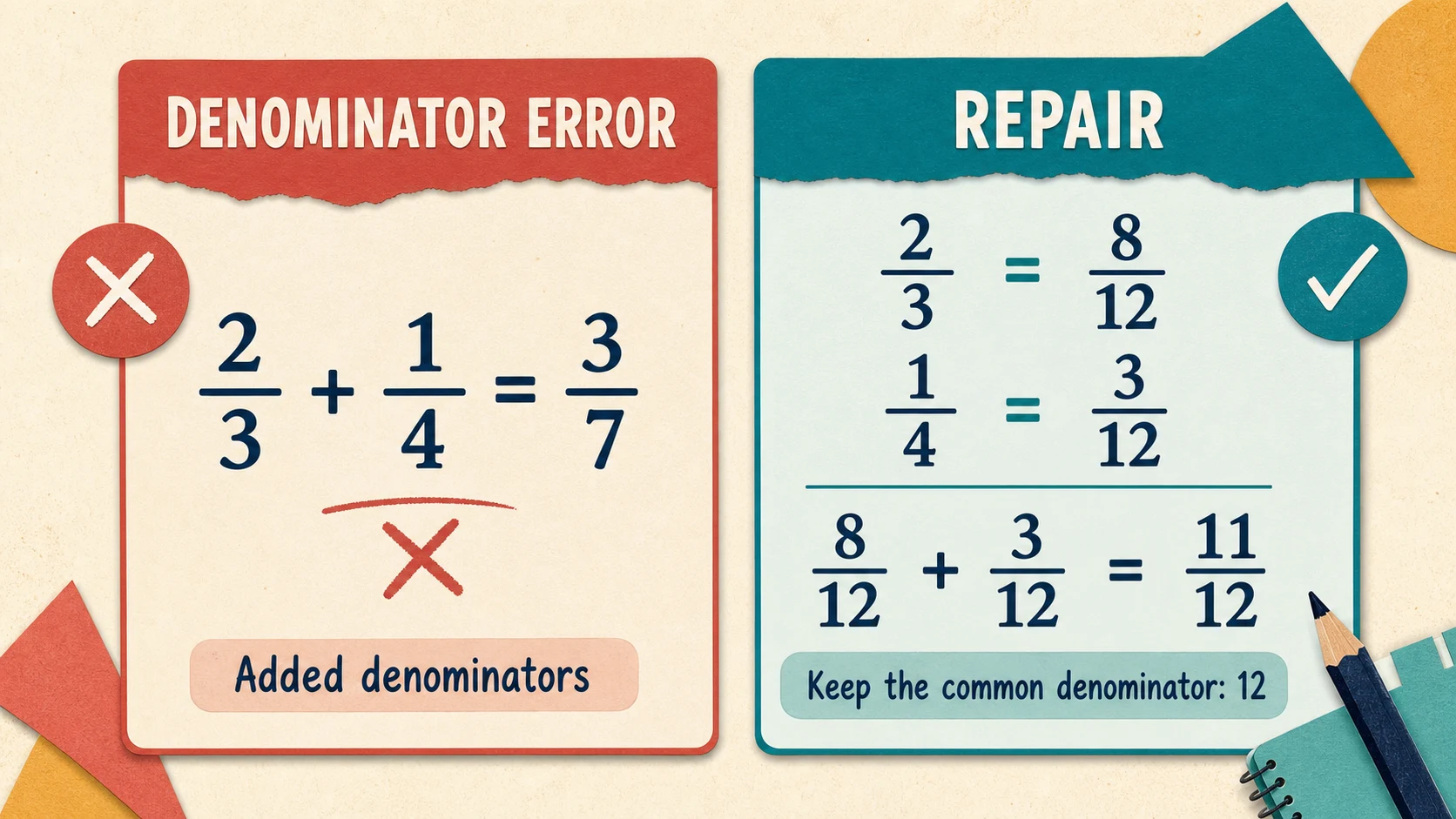
Locate the first step that changed the value, then repair and recheck it.
Common Error Patterns
| Observed work | Possible interpretation | Useful response |
|---|---|---|
| The learner combines numerators and denominators without creating common units | Use fraction bars to rename thirds as sixths, then recompute | |
| The learner treats the larger denominator as the larger amount | Compare equal wholes divided into fourths and eighths | |
| The learner changes only the numerator | Ask whether the shaded amount doubled while the whole stayed fixed | |
| The learner divides only one part of the fraction | Simplify by applying the same division to numerator and denominator | |
| A correct answer with no visible method | The learner may understand, guess, or calculate mentally | Ask for a brief explanation or model before drawing a conclusion |
| Reversed comparison symbol | The values may be understood even though the symbol is confused | Ask the learner to read the complete statement aloud |
| Unsimplified but equivalent result | The computation may be correct, but the expected answer form may differ | Verify equivalence, then practice simplifying separately |
A crossed-out answer followed by a correct repair can be useful evidence. Ask, “What did you notice?” A learner who can identify and correct the error may have stronger understanding than the first mark suggests.
Use a Repair Routine
For an incorrect response:
- Ask the learner to name the problem type.
- Find the first step where the value or relationship changed incorrectly.
- Rebuild that step with a visual model or common unit.
- Solve the original problem again without copying the key.
- Complete one new, similar example.
- Revisit the idea later.
Correcting the same written answer repeatedly can create familiarity without independent retrieval. A fresh example checks whether the learner can transfer the repaired reasoning.
Check the Answer Key Responsibly
The worksheet includes a separate printable answer key. Use it after the learner has attempted the assigned work, not as the primary teaching model.
First, compare answers and mark items for discussion. Then inspect the learner’s method. A matching answer does not prove that every step was valid, and a nonmatching answer does not reveal where the reasoning failed.
For each discrepancy:
- Rework the problem independently.
- Confirm that the operation and copied numbers match the original item.
- Check equivalent forms before marking a response wrong.
- Simplify both fractions when necessary.
- Use estimation or a visual representation as a second check.
- If the printed key and a verified calculation appear inconsistent, retain the written calculation and investigate rather than forcing the learner’s work to match.
Equivalent answers deserve careful attention. For example, , , and represent the same value. Whether a simplified form is required depends on the problem’s wording and the instructional expectation. The catalogue instruction says to solve each fraction problem and write the answer; it does not, by itself, state that every answer must be in simplest form.
Record support honestly. A notation such as “14 correct independently; 4 correct after a prompt; 4 need reteaching” is more useful for planning than combining every repaired answer into one final score.
Decide What to Do After the Page
Use patterns across the four listed skills rather than a universal percentage cutoff.
If the Work Is Mostly Accurate and Explained
Move to a new set that asks for the same reasoning with less prompting or somewhat greater complexity. The 5th Grade Fractions Worksheet Pack contains 18 worksheets and can provide additional practice choices. Select the next page by skill need, not simply because it is next in a file.
You can also browse the 5th Grade Math collection when the learner is ready to connect fraction work with other fifth-grade math topics.
If One Skill Is Unsteady
Keep the next lesson narrow. For example, if identification and equivalence are secure but comparison is inconsistent, choose comparison practice rather than repeating another mixed page immediately. Use the fractions topic guide to locate the skill within the broader progression.
A worksheet generator can help create a small fresh set after correction. The free worksheet generators are useful when you need new numbers rather than another attempt from memory. Check generated work before assigning it and keep the chosen task aligned with what has been taught.
If Several Skills Are Unsteady
Return to concrete or visual examples and teach one idea at a time. Mixed independent practice is premature when the learner cannot yet distinguish the task types. Begin with equal parts and fraction meaning, then follow the relevant progression in the topic guide rather than trying to duplicate that entire sequence through this one printable.
If the learner’s difficulty extends beyond this worksheet or persists despite clear instruction and review, coordinate with the learner’s teacher or other responsible educator. This guide does not provide medical advice or an individualized diagnosis.
Schedule Retrieval Instead of Immediate Repetition
A corrected answer is not yet evidence that the method will be available later. Revisit a few representative problems after some time has passed.
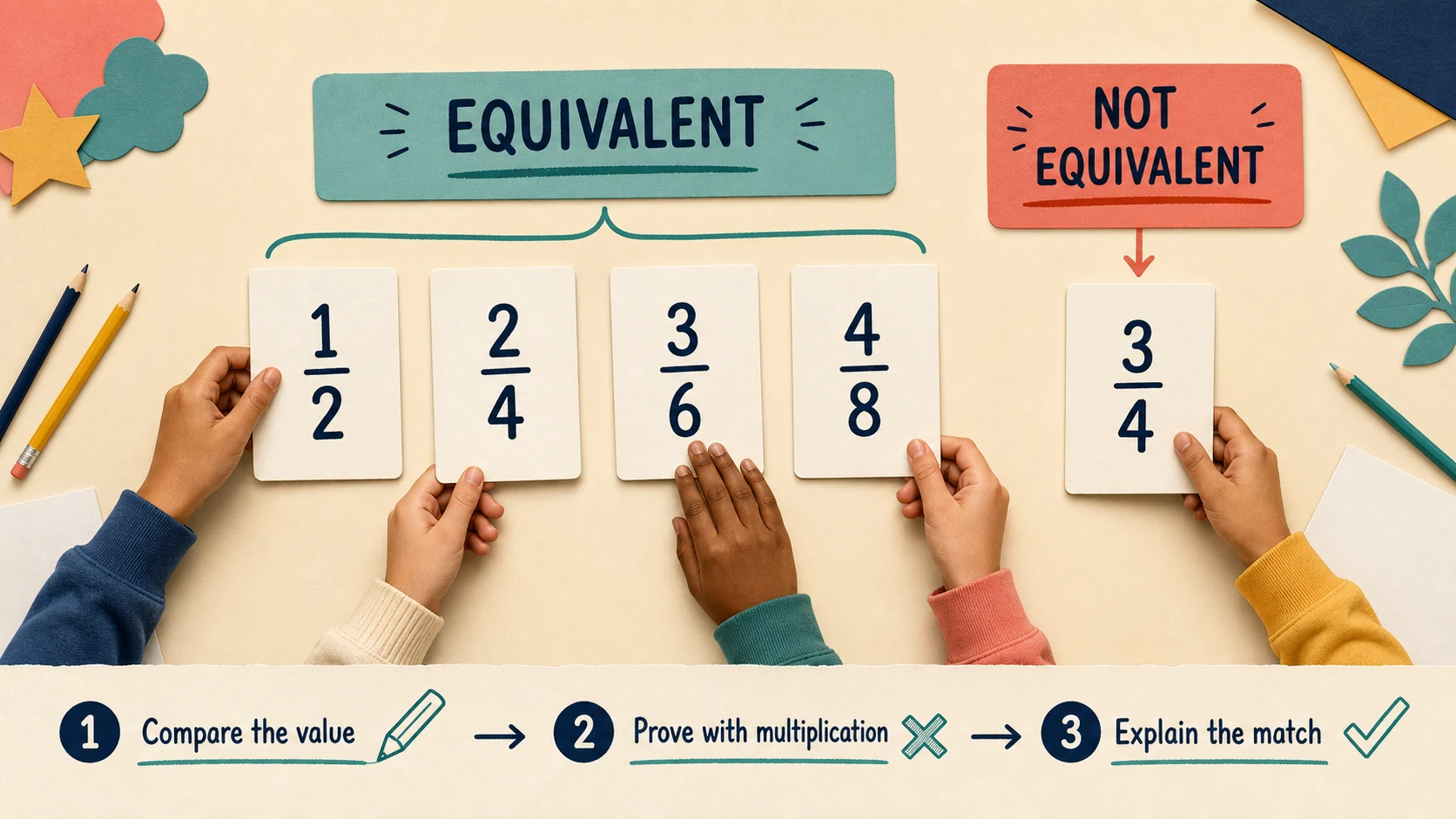
Use short, fresh checks over time and adjust the spacing from the learner’s results.
A practical, adjustable schedule is:
| Review point | Suggested task |
|---|---|
| End of the lesson | Explain one correct item and repair one error |
| Next study session | Solve two fresh examples without viewing prior work |
| Several days later | Complete a short mixed set covering the practiced skills |
| About one or two weeks later | Retrieve one example of each skill that previously required support |
This is an instructional suggestion, not a universal timetable. Shorten the interval if the learner cannot recall the strategy. Lengthen it when the learner solves accurately and explains the method without prompts. Include successful skills occasionally, but give more attention to errors that repeated or required substantial support.
Do not use the identical worksheet as the only retrieval check. Recognition of familiar numbers or page positions can hide uncertainty. Change the numbers, order, or representation while preserving the skill.
Keep the Result in Perspective
This printable can show how a learner handled 22 easy-level exercises on one occasion. It cannot establish complete fraction mastery, comprehensive standards alignment, or future performance. Results may also be influenced by prior instruction, adult prompting, attention, familiarity with the format, and whether the learner had access to models.
Treat the page as one piece of instructional evidence. Preserve a few examples of the learner’s reasoning, note which supports were used, and compare later work with the same skill rather than relying only on a total score.
The most useful next action is to review the completed page by skill, select one error pattern for a fresh follow-up example, and then use the free 5th Grade Fractions topic guide to choose the next worksheet at an appropriate level.
Put it into practice
Use the guide with a real printable
Move from explanation to a short, observable practice task. Check the first item together, then adjust the next session from the learner's actual work.
See the 18-worksheet pack