Complete guide
How to teach and practise 5th grade division worksheets - standard theme (easy)
How to Use This 30-Item Division Worksheet
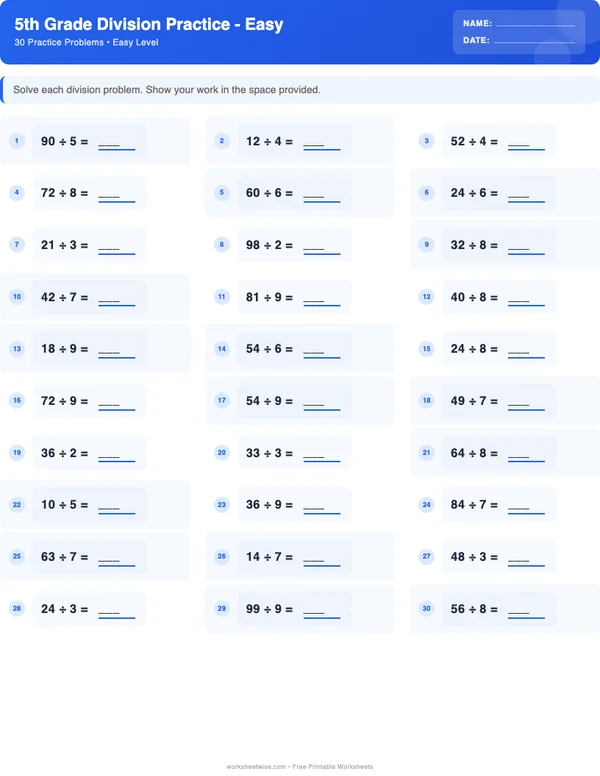
The free 5th Grade Division worksheet provides 30 easy-level exercises covering division facts, long division, mental math, and number sense. The learner is asked to solve each problem and show the work in the space provided. A separate printable answer key is included.
For a practical first session, model one problem, solve two or three together, assign a short section independently, and then examine the learner’s written work before deciding whether to continue. Do not assume that all 30 items must be completed at once. A learner who works accurately but slowly may benefit from two shorter sessions. A learner who makes repeated place-value or multiplication errors needs targeted support before more of the same practice.
Grade labels describe the intended practice level; local curricula and instructional sequences differ. The broader division topic guide can help you place this printable within a larger progression without turning one worksheet into a complete division course.
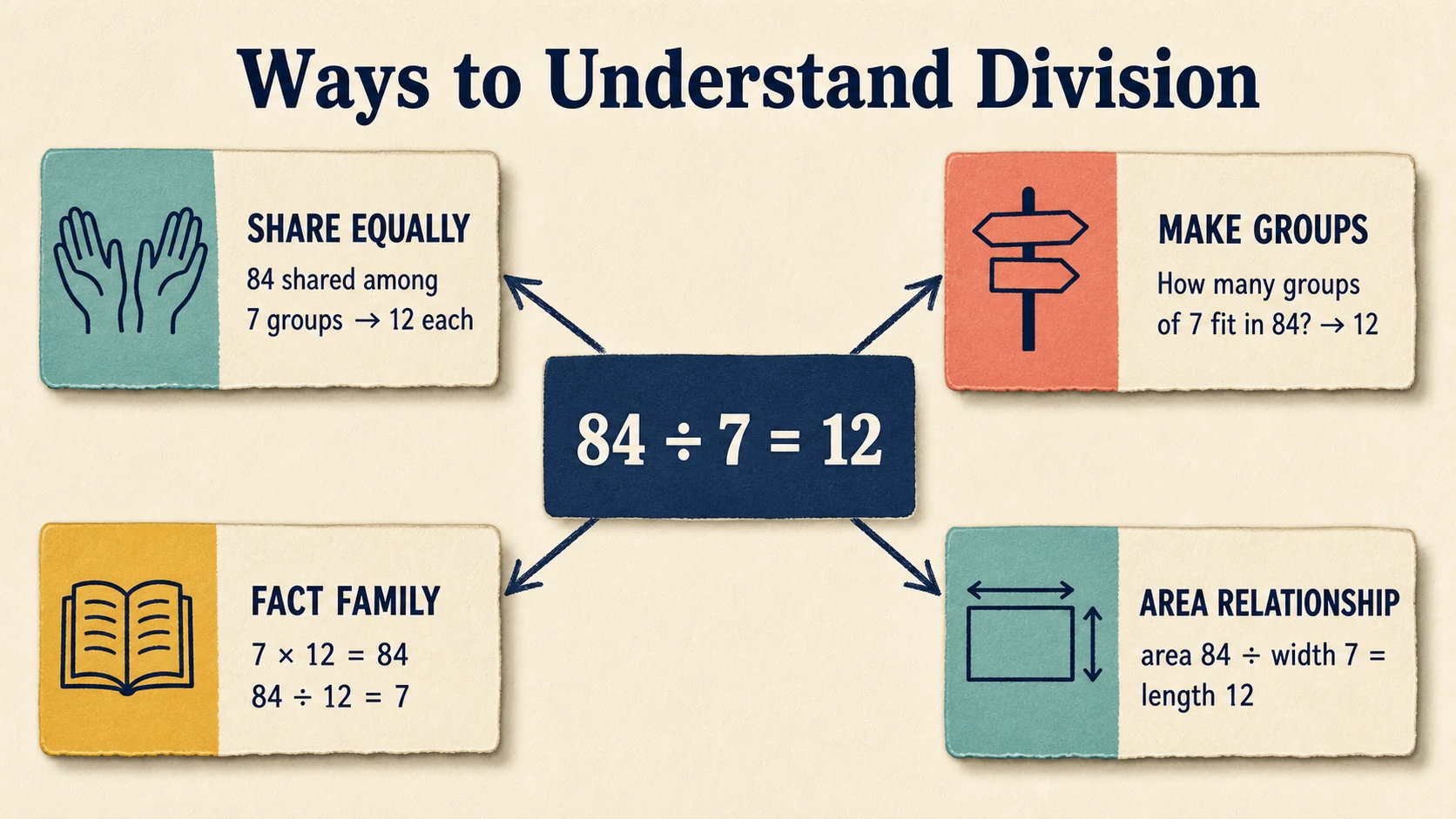
Use the map to move from a brief readiness check through modeling, guided practice, independent work, feedback, and later retrieval.
What This Worksheet Can and Cannot Show
This printable is useful for observing how a learner handles straightforward division exercises on paper. Because the listed skills include division facts, long division, mental math, and number sense, look for more than final answers. The written work can reveal whether the learner:
- Connects division with multiplication.
- Chooses reasonable quotient digits.
- Keeps digits aligned during long division.
- Subtracts accurately.
- Brings down the correct digit.
- Recognizes and records a remainder.
- Notices when an answer is unreasonable.
- Uses mental calculation when the numbers make it efficient.
The worksheet cannot, by itself, establish complete mastery of division. Thirty written exercises are a sample of performance under one set of conditions. They do not show automatically whether the learner can explain the operation, interpret a remainder in a real situation, retain the skill several weeks later, or select division independently in an unfamiliar problem.
The Common Core State Standards for Mathematics describe a broad elementary progression that includes interpreting division, finding whole-number quotients, and using the standard algorithm with multi-digit numbers. That source provides high-level curricular context; it has not evaluated this WorksheetWise printable. Use local curriculum documents when you need to confirm exactly when a method or problem type is expected.
Prepare the Lesson Before the Learner Begins
Print the worksheet and answer key separately. Keep the key out of view during instruction so the learner’s work reflects actual decision-making. Have a pencil, eraser, and spare paper available. If the learner benefits from concrete support, counters or small objects can represent equal groups, but do not require manipulatives for every item.
Review the page yourself before the session. The catalogue identifies the worksheet as easy-level 5th Grade Division practice, but “easy” is a relative label, not a promise that every learner will find every item simple. Notice which exercises appear to involve known facts, mental calculation, written long division, or remainders. That inspection will help you choose representative problems for modeling and guided practice.
Begin with a brief readiness check
Use three oral prompts before opening the worksheet:
- “What multiplication fact could help with ?”
- “About how large should be?”
- “What does a remainder tell us?”
Possible responses are , “a little more than 50” or exactly 52, and “the amount left after making equal groups.” Do not turn these prompts into a separate test. Their purpose is to show you where to begin.
If the learner cannot connect with multiplication, model that connection before asking for long-division work. If the learner understands the operation but forgets one fact, allow a multiplication chart during initial instruction. The skill remains division; the chart temporarily reduces fact-recall demands.
Set a clear purpose
A useful launch is:
“This page gives us 30 chances to practice division. I will demonstrate one, we will solve a few together, and then you will try a short group independently. Showing the steps will help us find exactly what is working and what needs another example.”
This is an instructional suggestion, not a rule from an external source. Adjust the amount of practice in response to the learner’s observed work.
A Flexible Lesson Progression
The following plan fits a tutoring session, homeschool lesson, intervention period, or classroom practice block. The times are deliberately approximate. There is no universal timetable for division practice.
| Phase | Adult action | Learner action | Evidence to notice |
|---|---|---|---|
| Readiness | Ask two or three oral prompts | Explain a fact connection or estimate | Understanding of division and multiplication |
| Model | Think aloud through one representative item | Watch, predict, and check | Whether each long-division step makes sense |
| Guided practice | Prompt only when needed | Solve two or three items with support | Type and frequency of prompts |
| Independent sample | Assign about five items | Work without coaching | Accuracy, organization, and strategy |
| Feedback | Compare work with the key | Correct and explain errors | Ability to identify the first incorrect step |
| Continued practice | Assign another short group if appropriate | Apply the correction | Whether the same error returns |
| Retrieval | Revisit selected items later | Solve from memory | Retention after time has passed |
The IES guide on teaching mathematics to young children offers high-level support for purposeful mathematical instruction, including helping learners connect representations and mathematical ideas. Although its stated age range is younger than fifth grade, that general framing can still inform an adult’s use of concrete models and mathematical language. It does not provide a review of this worksheet.
The IES guide on assisting students struggling with mathematics provides broader instructional framing for explicit, systematic teaching, clear mathematical language, visual representations, and cumulative review. Use those principles as general guidance, not as evidence that one fixed lesson sequence will fit every learner.
Model the Division Process Clearly
Choose one worksheet item that represents the method the learner will need most. Since the exact numbers may vary across copies or formats, the checked examples below are similar in skill rather than claims about particular numbered items on the printable.
Worked example 1: use a known division fact
Solve:
Think aloud:
- Division asks how many groups of 7 fit into 56.
- Recall the related multiplication fact: .
- Therefore, .
- Check by multiplying: .
The verified answer is:
This example makes the inverse relationship visible. It also shows that writing a check does not require repeating the entire division process.
Worked example 2: divide without a remainder
Solve:
Using long division:
- Three goes into 1 zero whole times, so consider 15 tens.
- Three goes into 15 five times because .
- Subtract: .
- Bring down the 6.
- Three goes into 6 two times because .
- Subtract: .
Therefore:
Check:
The answer is correct. An estimate supports it as well: 156 is close to 150, and , so 52 is reasonable.
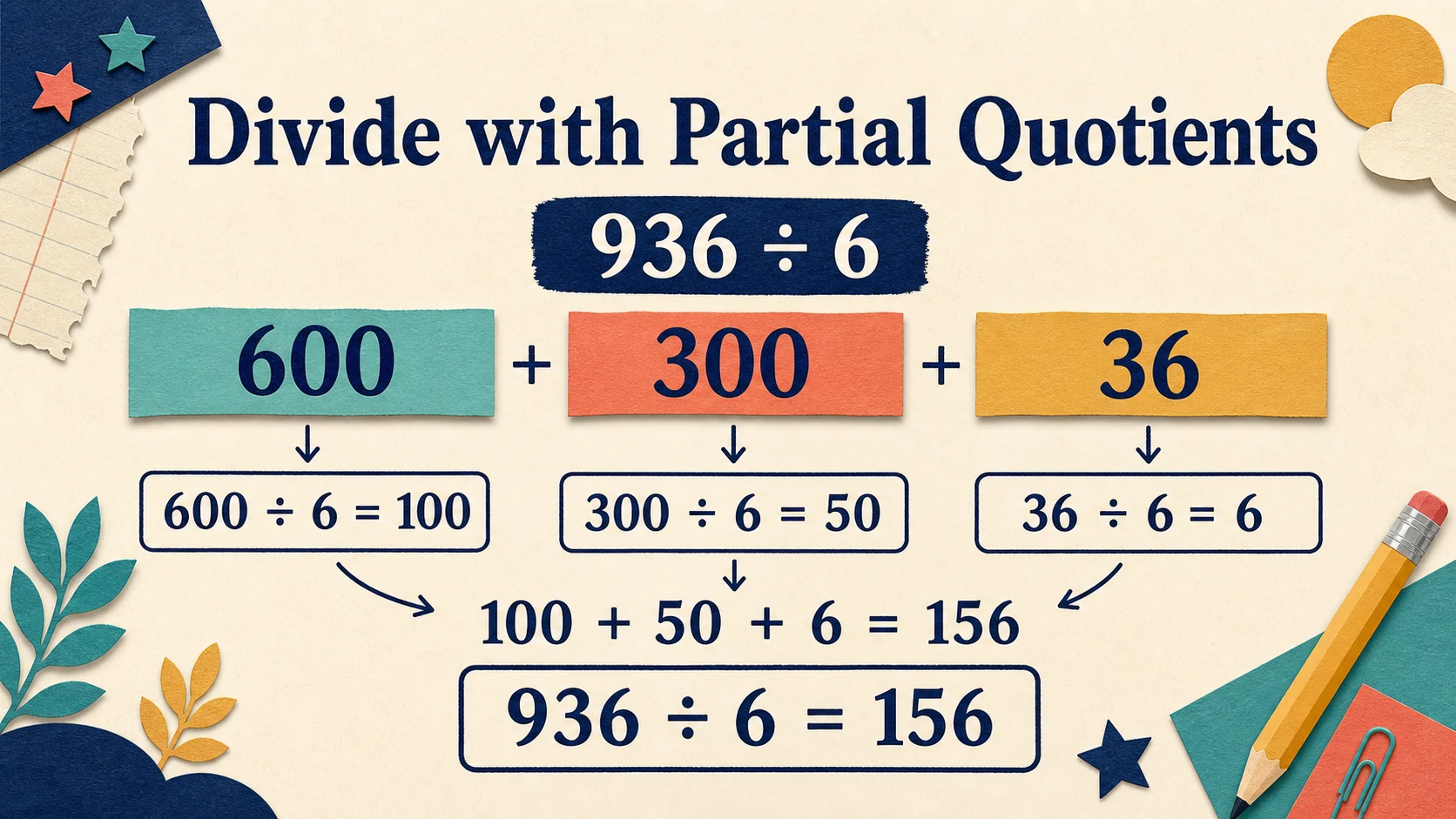
The quotient, multiplication step, subtraction, and check should all be visible rather than compressed into unexplained marks.
Explain the meaning behind the routine
“Divide, multiply, subtract, bring down” can help a learner remember the order of steps, but the words should not replace place-value reasoning. In , the 5 in the quotient means 5 tens, not merely “a 5 written above the 5.” The calculation first partitions 15 tens into three equal groups, then partitions the remaining 6 ones.
Ask one short meaning question after modeling:
- “Why did I write 5 in the tens place?”
- “What does the subtraction show?”
- “How does multiplication verify the quotient?”
A correct explanation may be informal. Look for mathematical meaning, not memorized wording.
Move Through Guided and Independent Practice
Guided practice should expose the learner’s thinking without turning the adult into a second pencil. Present a problem, wait, and use the smallest prompt that allows progress.
Use prompts in a deliberate order
Begin with prompts that preserve the learner’s responsibility:
- “What are you trying to find?”
- “Which digits are you considering first?”
- “What multiplication fact is close without going over?”
- “What should you do after subtracting?”
- “How could you check that result?”
If the learner still cannot proceed, model the current step and then return the next step to the learner. Record mentally—or on a separate note—whether support was needed for fact recall, place value, the sequence of the algorithm, subtraction, or interpreting a remainder. “Needed help” is too broad to guide the next lesson.
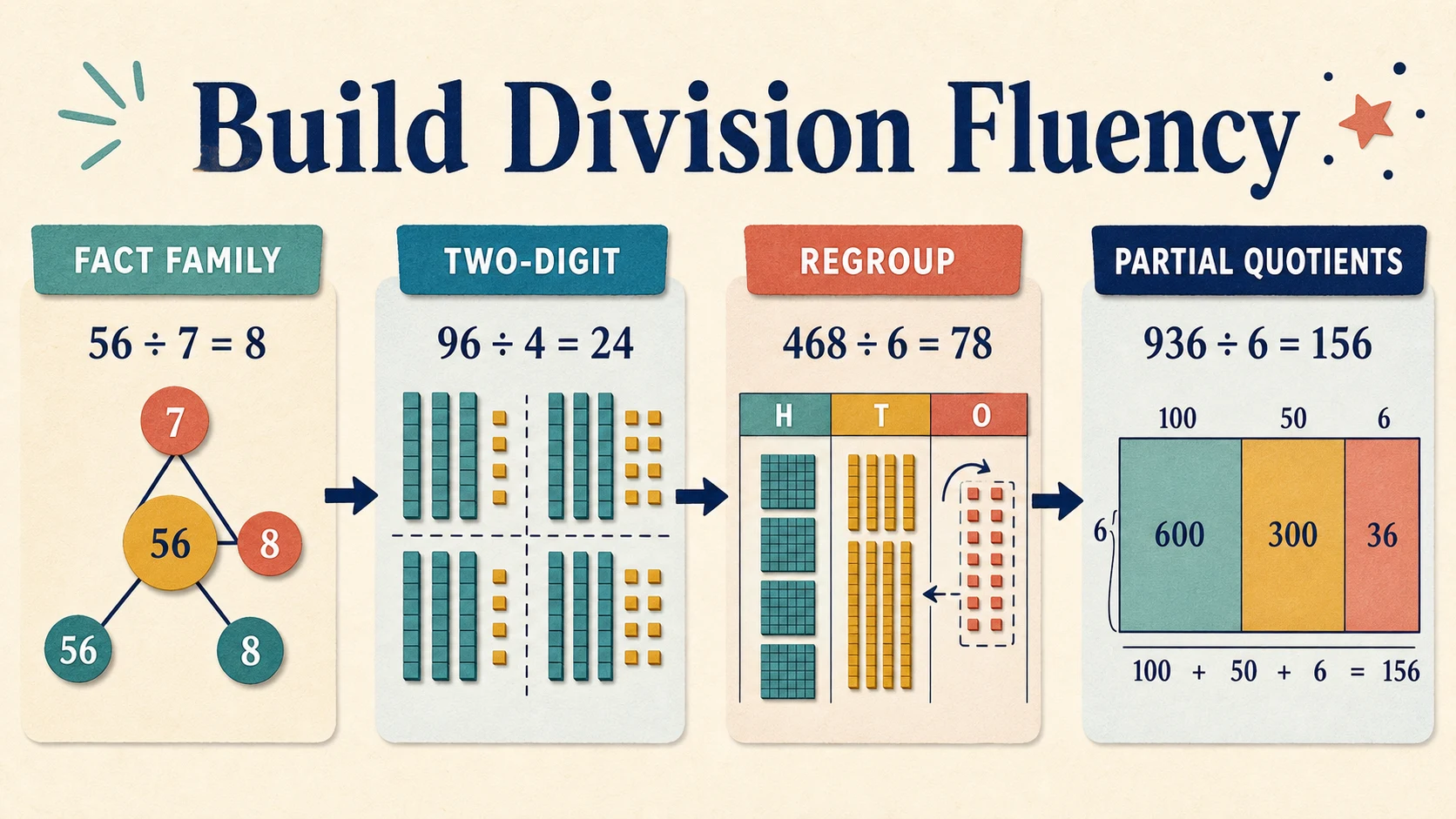
During guided work, the adult demonstrates a decision and then gives the mathematical work back to the learner.
Worked example 3: include a remainder
Solve:
- Four goes into 17 four times because .
- Subtract: .
- Bring down the 3 to make 13.
- Four goes into 13 three times because .
- Subtract: .
Therefore:
Check:
The result is verified. The remainder is smaller than the divisor, as it must be for a whole-number quotient with remainder.
Decide when independence is appropriate
After two or three guided examples, assign a small independent sample. Five problems can be enough to reveal whether the learner can initiate and sustain the process. Avoid commenting after every answer. Constant confirmation may make it difficult to tell whether the learner can work independently.
Continue with more of the page when the learner’s work shows a stable method and mostly accurate results. Pause when the same error appears repeatedly, the layout becomes increasingly disorganized, or the learner is guessing quotient digits without checking multiplication. A shorter, carefully reviewed set is more informative than 30 hurried responses.
Adapt Support Without Changing the Skill
Adaptation should make division accessible while keeping division as the mathematical target. It should not silently replace the task with an easier, unrelated one.
For a learner who needs more structure
Cover later rows with a blank sheet so only one line is visible. Enlarge the page if small print or crowded work interferes with organization. Provide lined or squared paper for aligning digits. Mark a light vertical guide between place-value columns if alignment is the main obstacle.
You can also prewrite a neutral checklist:
- Divide.
- Multiply.
- Subtract.
- Bring down.
- Check the remainder.
- Verify.
The checklist supports the process without supplying any quotient digits.
For a learner with weak fact recall
Allow a multiplication chart for the first portion of practice. Before each division step, ask the learner to locate or state the largest relevant multiple that does not exceed the current amount. For , the useful comparison is , leaving 2.
This support keeps attention on quotient selection and the division structure. Remove the chart gradually only if the learner’s work shows that doing so will not collapse the whole process into guessing.
For a learner ready for greater independence
Keep the worksheet unchanged but reduce adult prompting. Ask the learner to estimate before calculating, solve, verify with multiplication, and explain one selected item. Another suitable extension is to sort completed problems into “exact quotient” and “quotient with remainder,” if both appear on the page.
Do not add larger divisors merely to make the page feel more advanced. The immediate goal is secure, explainable performance with the skill represented on this printable.
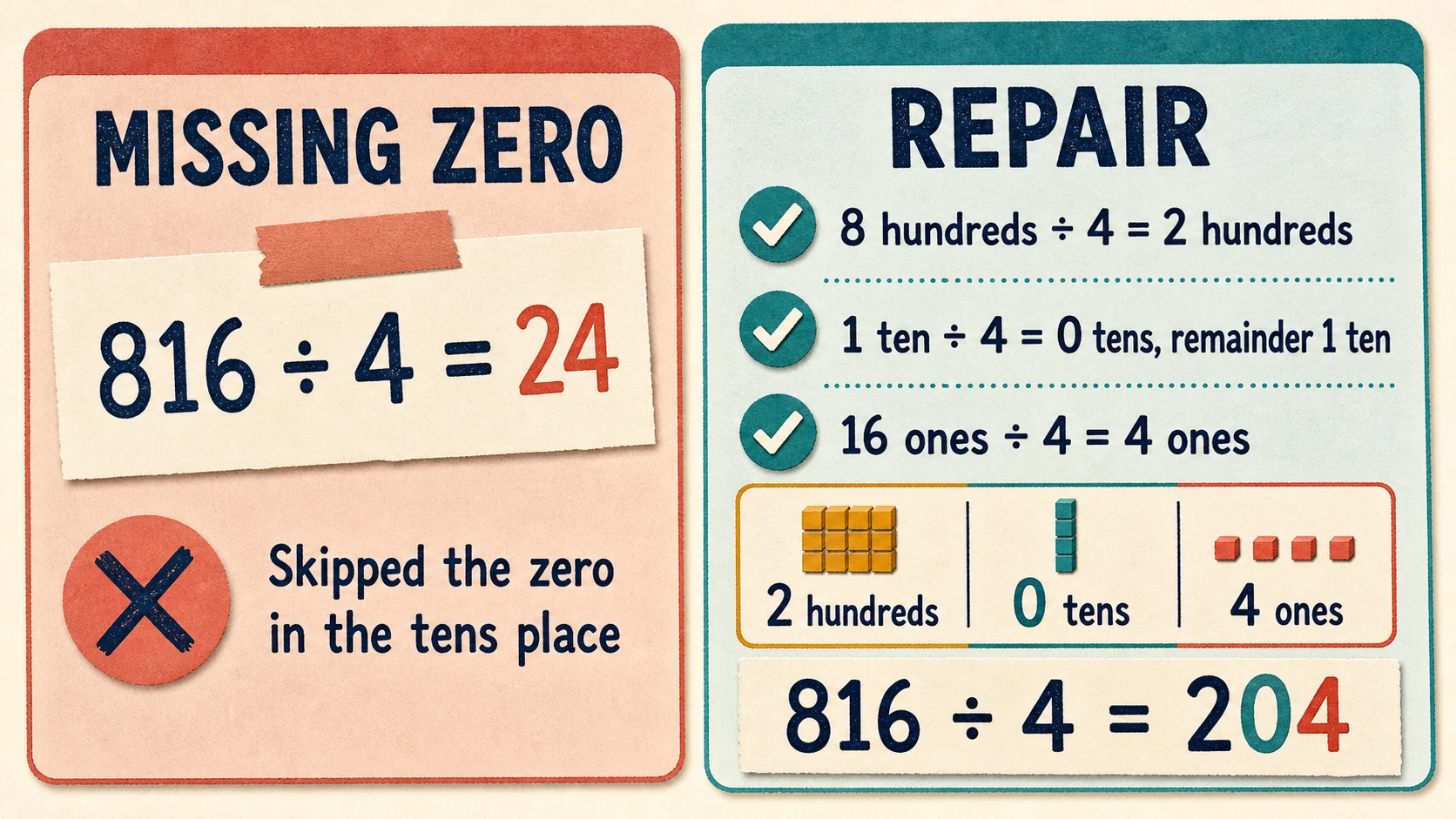
Adjust visibility, workspace, fact support, or prompting while preserving the original division task.
Handle Boundary Cases and Remainders Carefully
Boundary cases often reveal whether the learner understands division or is only following a visual routine.
Worked example 4: a zero in the quotient
Solve:
- Four goes into 4 one time.
- Subtract , then bring down the 0.
- Four goes into 0 zero times, so write 0 in the tens place.
- Bring down the 8.
- Four goes into 8 two times.
Therefore:
Check:
Writing 12 instead of 102 is a place-value error. The zero holds the tens place and cannot be omitted.
Worked example 5: a dividend smaller than the divisor
Solve in whole numbers:
Five complete groups cannot be taken from 3, so the whole-number quotient is 0 with 3 remaining:
Check:
This is a useful boundary example even if the worksheet does not contain that exact form. It confirms that a quotient can be zero and that the remainder must be less than the divisor.
Separate computation from interpretation
A numerical result such as does not always settle a real situation. If 25 learners require vans holding at most 6 each, five vans are needed. If 25 items are packed into complete groups of 6, there are four complete groups and one item left. If a question asks only for the leftover amount, the answer is 1.
This worksheet is described as division practice rather than a complete set of contextual remainder problems. Use the division topic guide when you need the wider progression through equal sharing, grouping, long division, and remainder interpretation.
Interpret Errors Before Assigning More Problems
A wrong answer is evidence, but its value depends on locating the first incorrect decision.
Common error: an inaccurate multiplication fact
Suppose a learner writes:
Inspect the written steps. If the learner treated as 4, the issue may be fact recall or quotient selection. Ask for the related multiplication statement. Since and , the first quotient digit should be 5.
Response: rehearse a few related multiplication and division facts, then retry one comparable division problem. Do not reteach the entire algorithm unless the work shows a broader problem.
Common error: omitted placeholder zero
For , a learner may write 12. The multiplication check exposes the problem:
Response: return to place value. Have the learner label hundreds, tens, and ones, then explain why the quotient needs a digit in each relevant position.
Common error: remainder equal to or greater than the divisor
A result such as cannot be final because 5 is large enough to make another group of 4. It is also numerically equivalent to , but it is not the properly completed whole-number division form.
Response: ask, “Can another full group of 4 be made from the remainder?” Then have the learner revise and verify.
Common error: bringing down too early or twice
The learner may combine digits before completing the subtraction, or bring down a digit that has already been used. This usually creates a chain of apparently unrelated errors.
Response: mark one line for multiplication and one for subtraction. Ask the learner to point to the next unused dividend digit before bringing it down. Solve one fresh item using the organized layout.
Common error: accepting an unreasonable answer
If is reported as 520, the learner may have performed familiar steps without monitoring magnitude.
Response: estimate with a nearby compatible number. Since , an answer near 50 is plausible; 520 is not. Estimation is a check, not a replacement for exact calculation.
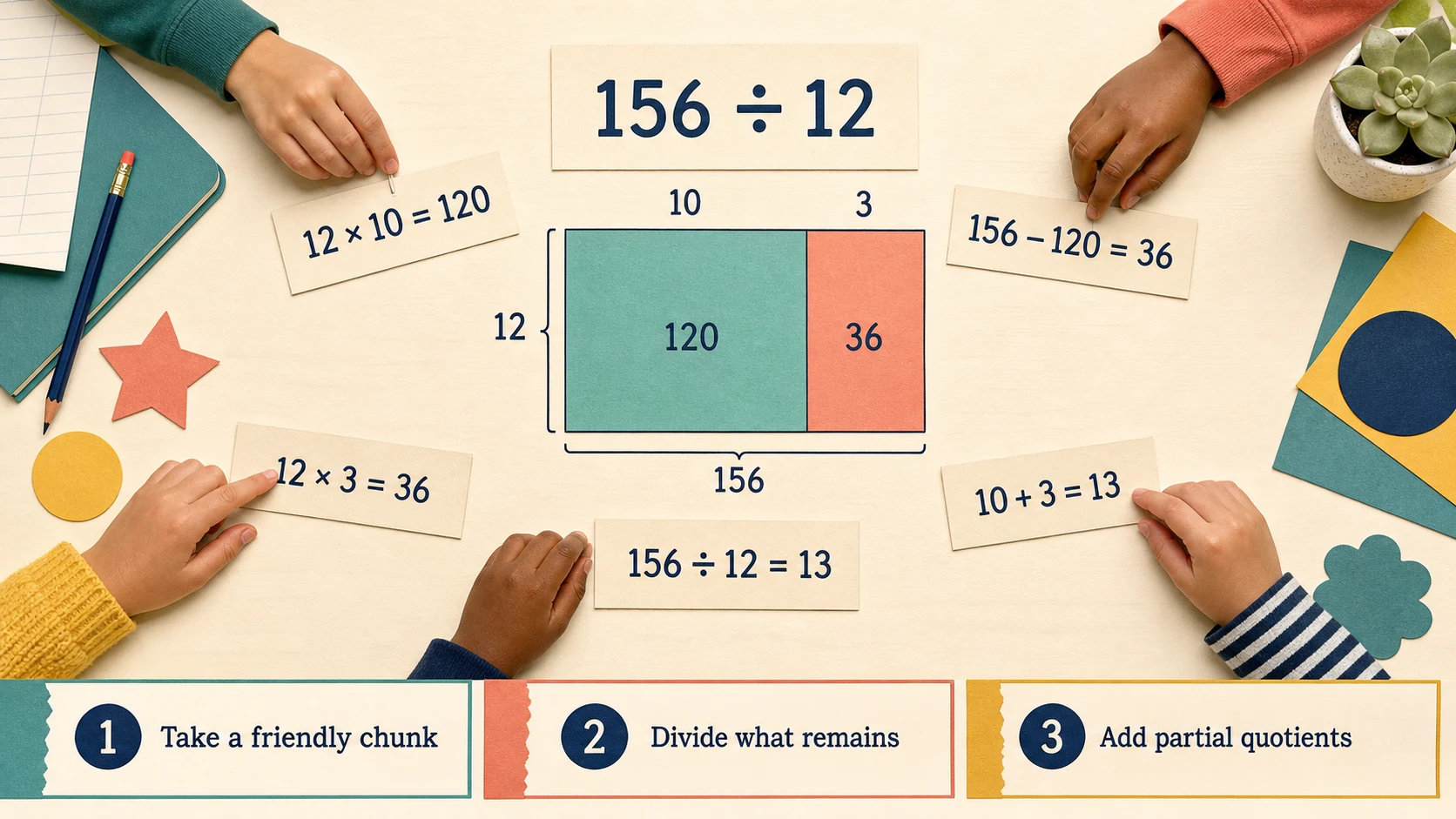
Find the first incorrect step, name the error type, repair one example, and then test the repair on a new problem.
Use the Answer Key Responsibly
The separate answer key supports quick checking, but it should begin a conversation rather than end one. First solve or inspect representative items yourself. Then compare the key with the learner’s final answer and written process.
Use this sequence:
- Mark correct answers without interrupting the learner’s concentration.
- For an incorrect answer, locate the first incorrect step.
- Ask the learner to explain that step.
- Provide one focused prompt or model.
- Have the learner correct the original work in a different color or beside it.
- Assign one similar item to see whether the correction transfers.
For a quotient with remainder, verify:
Also confirm that the remainder is nonnegative and smaller than the divisor. For example:
because:
Do not mark an answer wrong merely because the learner used a different valid written method. Partial quotients, an area-based approach, mental reasoning, and the standard algorithm can all produce a correct result. The worksheet’s instruction to show work means the reasoning should be visible enough to check, not necessarily identical to the key’s layout.
If you believe the printed key contains a discrepancy, recompute the item independently before correcting the learner. One key mismatch should not be treated as evidence of misunderstanding.
Decide What to Do After the Page
Count patterns, not just correct answers. A simple decision record might include independent accuracy, prompt use, error type, and success after correction.
Continue at the same level when the method is emerging
Use more easy-level practice when the learner understands division but still needs occasional reminders, makes scattered fact errors, or loses place alignment under longer calculations. Select a limited number of fresh problems through the free worksheet generators, or revisit unfinished items from this page.
Step back when the foundation is unstable
Return to equal groups, related multiplication facts, or smaller dividends when the learner cannot explain what division finds, selects quotient digits randomly, or cannot verify answers even with support. Stepping back is not a penalty. It identifies a prerequisite that makes written division meaningful.
The wider collection of 5th Grade math worksheets can help you coordinate division work with other current math practice, while the topic guide supplies the more focused division sequence.
Move forward when performance is stable
A learner may be ready for the next level when work is accurate across several types of items, written steps remain organized, answers are checked without reminders, and a similar problem can be solved after a delay. One perfect row completed immediately after modeling is encouraging, but it is not strong evidence of retention.
For sustained practice across multiple printables, the 5th Grade Division Worksheet Pack contains 18 worksheets and is listed at $4.79. It is an optional practice resource, not a requirement for progress.
Schedule Retrieval Instead of One Long Review
Retrieval means returning to the skill after some time has passed. The exact spacing should respond to observed work rather than follow a universal schedule.
A practical starting plan is:
| When | Suggested task | What to observe |
|---|---|---|
| Initial lesson | Model, guide, then assign a short independent set | Method, accuracy, and prompt dependence |
| Next session | Retry one corrected item and solve two fresh items | Whether the correction was retained |
| Several days later | Solve three mixed division items without notes | Independent recall and organization |
| About one or two weeks later | Complete a short mixed review | Durability and choice of strategy |
| Later unit review | Include division among other operations | Whether the learner identifies division without being told |
This schedule is an instructional suggestion. Shorten the interval if the process is quickly forgotten. Lengthen it when the learner retrieves the method accurately and confidently. If the learner needs the same full model at every review, return to the underlying misconception instead of merely scheduling more repetitions.
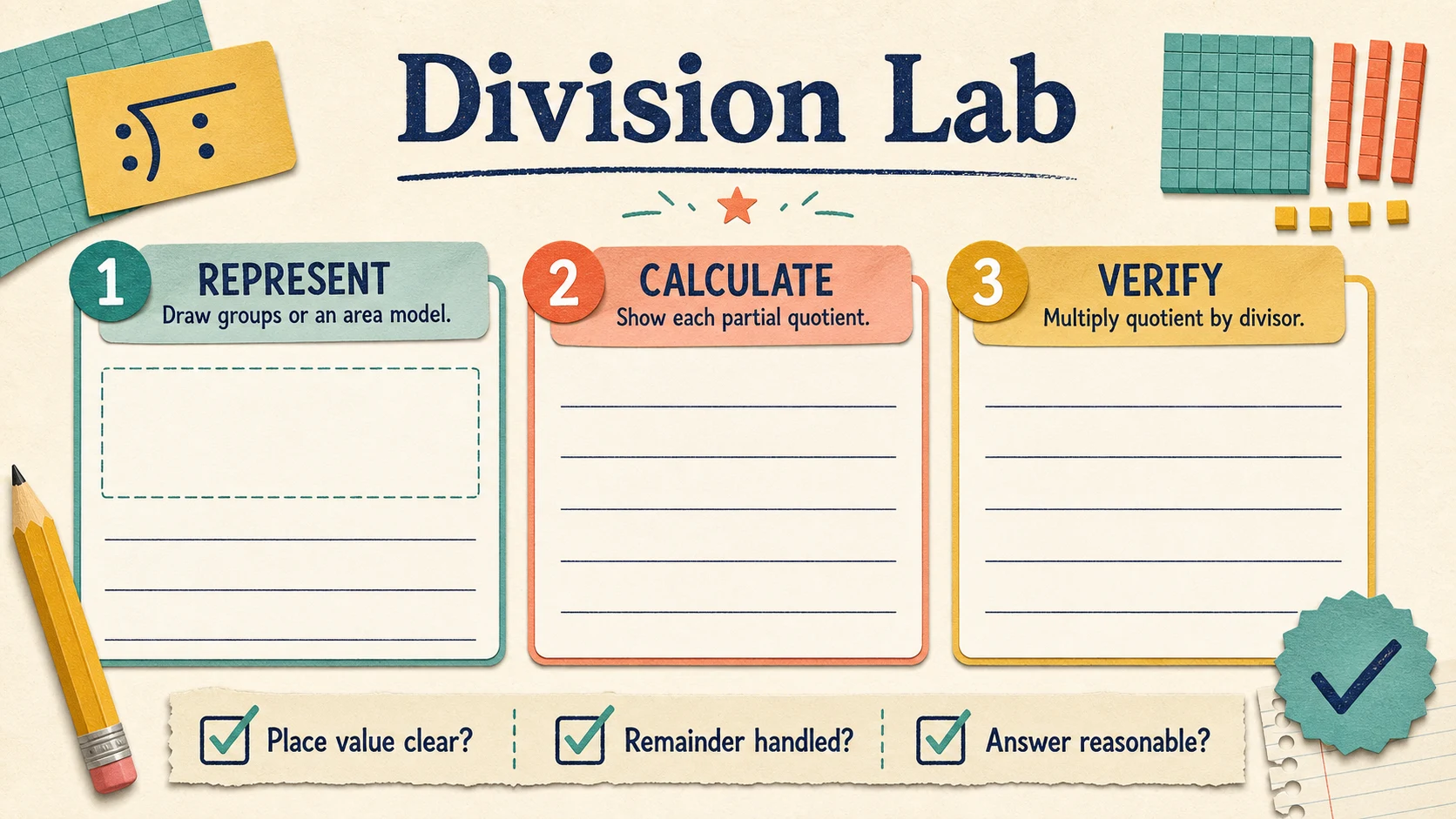
Revisit a few carefully selected problems after increasing delays, and adjust the timing from the learner’s performance.
Limitations and the Honest Next Step
The printable offers 30 straightforward exercises and an answer key. It can provide useful practice and clear evidence about written calculation. It does not replace direct instruction, discussion of why the algorithm works, varied contextual problems, or later checks for retention. Its easy label describes catalogue difficulty, not how much support a particular learner should need.
Use the completed page to name one specific next target. That target might be accurate fact recall, preserving a zero in the quotient, selecting quotient digits, interpreting remainders, or checking by multiplication. Avoid assigning a broad judgment such as “bad at division” when the written work points to a narrower, teachable issue.
For the next session, choose three representative problems from the learner’s corrections, solve them after a delay, and record which steps remain independent. Then use the free 5th Grade Division topic guide to select the next appropriate worksheet or concept rather than automatically repeating the entire page.
Put it into practice
Use the guide with a real printable
Move from explanation to a short, observable practice task. Check the first item together, then adjust the next session from the learner's actual work.
See the 18-worksheet pack