Complete guide
How to teach and practise 5th grade decimals worksheets - standard theme (easy)
How to use this 30-item decimal worksheet
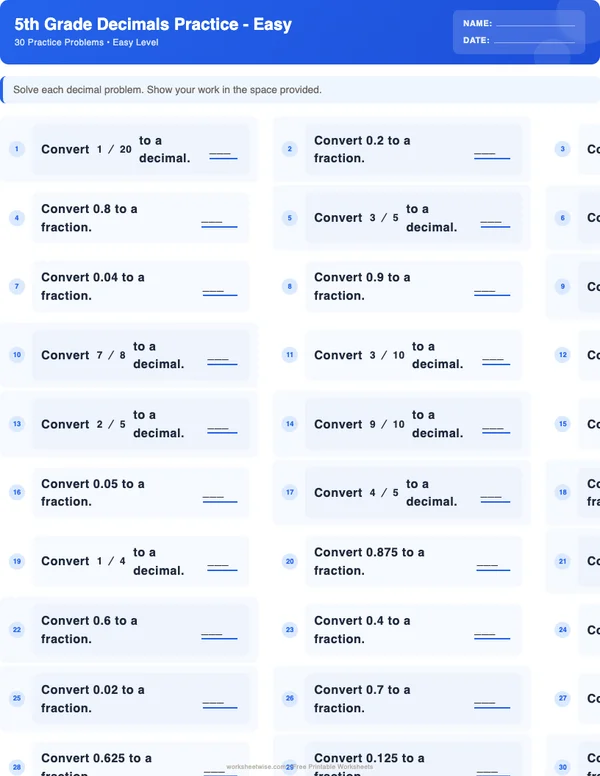
The free 5th Grade Decimals worksheet provides 30 easy-level exercises covering decimal operations, fraction-decimal conversion, and number sense. The directions ask the learner to solve each problem and show the work in the space provided. A separate printable answer key is included.
For most learners, the best use is not necessarily to assign all 30 items at once. First inspect the page and identify the kinds of problems it contains. Model one representative problem, solve a few together, and then release a manageable set for independent work. Use the learner’s written work—not speed, age, or the “easy” label—to decide whether to continue, pause for another model, or schedule a shorter review.
Grade labels describe the intended practice level; local curricula and instructional sequences differ. The broader 5th Grade decimals topic guide is the better place to see how conversion, place value, comparison, rounding, and decimal computation connect. This guide concentrates on teaching with this particular printable.
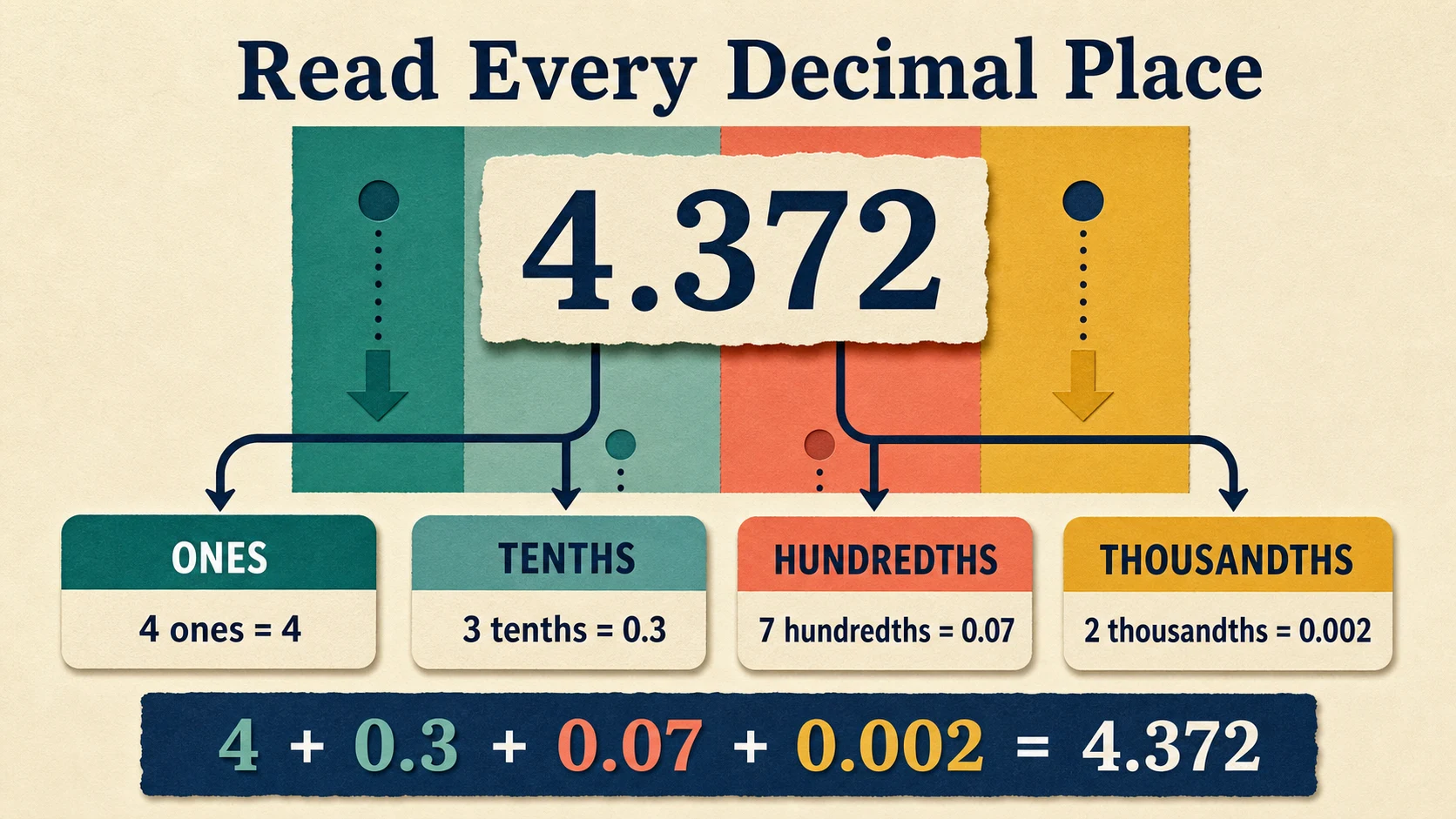
Preview, model, guide, release, check, and revisit rather than treating the page as a single uninterrupted assignment.
What this worksheet can and cannot show
This printable can provide useful evidence about how a learner handles straightforward decimal tasks. Its stated skill range includes:
- Decimals and decimal number sense
- Fraction-decimal conversion
- Decimal addition
- Decimal subtraction
- Decimal multiplication
Because the worksheet is labeled easy, it is most suitable for a learner beginning this material or needing reinforcement of foundational procedures. The label does not guarantee that every item will feel easy to every fifth grader. A learner might convert tenths accurately yet misalign hundredths in subtraction. Another might calculate well but have weak decimal magnitude sense. Treat those patterns separately.
One completed worksheet is not a comprehensive assessment of decimal understanding. It cannot, by itself, establish mastery across every fifth-grade expectation, explain why an error occurred, or show whether the learner will retain the skill. It also does not replace instruction with concrete models, discussion, estimation, or application.
The Common Core State Standards for Mathematics place fifth-grade decimal work within a broader base-ten progression that includes reading, writing, comparing, and rounding decimals and computing with decimals. That source provides general standards context; it has not evaluated this WorksheetWise printable. Consult the expectations used by your school, district, state, or homeschool program when exact alignment matters.
Prepare the page before the learner begins
Print both the worksheet and answer key, but keep the key with the adult at first. Supply a pencil, eraser, and a separate sheet of paper if the printed workspace is not enough. A place-value chart or hundredths grid can be available as a support, especially when the learner is still connecting written notation to quantity.
Before teaching, scan all 30 items. The catalogue identifies the covered skills, but the exact mix on the printed page should determine your lesson groups. Mark small clusters such as conversion, addition, subtraction, multiplication, or number-sense items. Do not assume that every group must contain the same number of questions.
A practical first session might look like this:
| Lesson phase | Suggested use of the printable | What the adult watches |
|---|---|---|
| Orientation | Read the directions and inspect two or three item types | Can the learner explain what each symbol asks them to do? |
| Modeling | Adult demonstrates one similar example | Does the learner attend to place value and operation signs? |
| Guided practice | Solve two to four selected items together | Can the learner choose and explain a method? |
| Independent practice | Assign a short cluster from the page | Is the method stable without prompts? |
| Check and discuss | Compare work with the answer key | Can the learner find and repair an error? |
| Retrieval | Revisit selected problems later | Is the skill still available after a delay? |
These time and item-group suggestions are instructional options, not rules from an external source. The learner’s observed work should set the pace.
The Institute of Education Sciences practice guide on assisting students who struggle with mathematics supports broad instructional practices such as systematic instruction, clear mathematical language, visual representations, and deliberate review. It does not prescribe a universal timetable for this worksheet and did not review it.
Launch with meaning before procedure
Ask the learner to read the quantities
Begin with one or two decimal values from the worksheet. Ask the learner to read each number aloud and identify the value of a chosen digit. For example, in 3.47, the 4 represents four tenths and the 7 represents seven hundredths.
This brief check matters because decimal calculation depends on place value. A learner who reads 0.4 and 0.04 as interchangeable is not ready to rely on a written algorithm alone. Use a place-value chart:
| Ones | Tenths | Hundredths |
|---|---|---|
| 0 | 4 | 0 |
| 0 | 0 | 4 |
The first row represents 0.40, which equals 0.4. The second represents 0.04. The values differ by a factor of ten.
Preview the operations
Point to the operation signs without solving the problems. Ask the learner to name each operation and describe what a reasonable answer might look like. If the item is addition, should the sum be greater than both positive addends? If a smaller positive decimal is subtracted from a larger one, should the result be positive and less than the starting amount?
This is not a demand for exact mental calculation. It establishes an expectation that answers should make sense.
Use one familiar representation if needed
Money can clarify tenths and hundredths when used carefully. For example, 0.25 of a dollar is 25 cents. A hundredths grid can show the same value as 25 shaded squares out of 100. However, not every decimal behaves naturally as an amount of money, especially when thousandths enter later work. Use the representation to clarify place value, then return to decimal notation.
The IES guide on teaching mathematics to young children discusses broad practices such as using developmental progressions, monitoring learners’ mathematical understanding, and helping learners view and describe mathematical ideas. Although its stated audience is younger children, those high-level principles can inform a careful launch. It is not evidence about this specific fifth-grade worksheet.
Model the task with fully checked examples
Tell the learner that your examples are similar practice examples, not a preview of the answer-key entries. Write every step large enough to inspect. After each calculation, include a second check so that “show your work” means more than recording an answer.
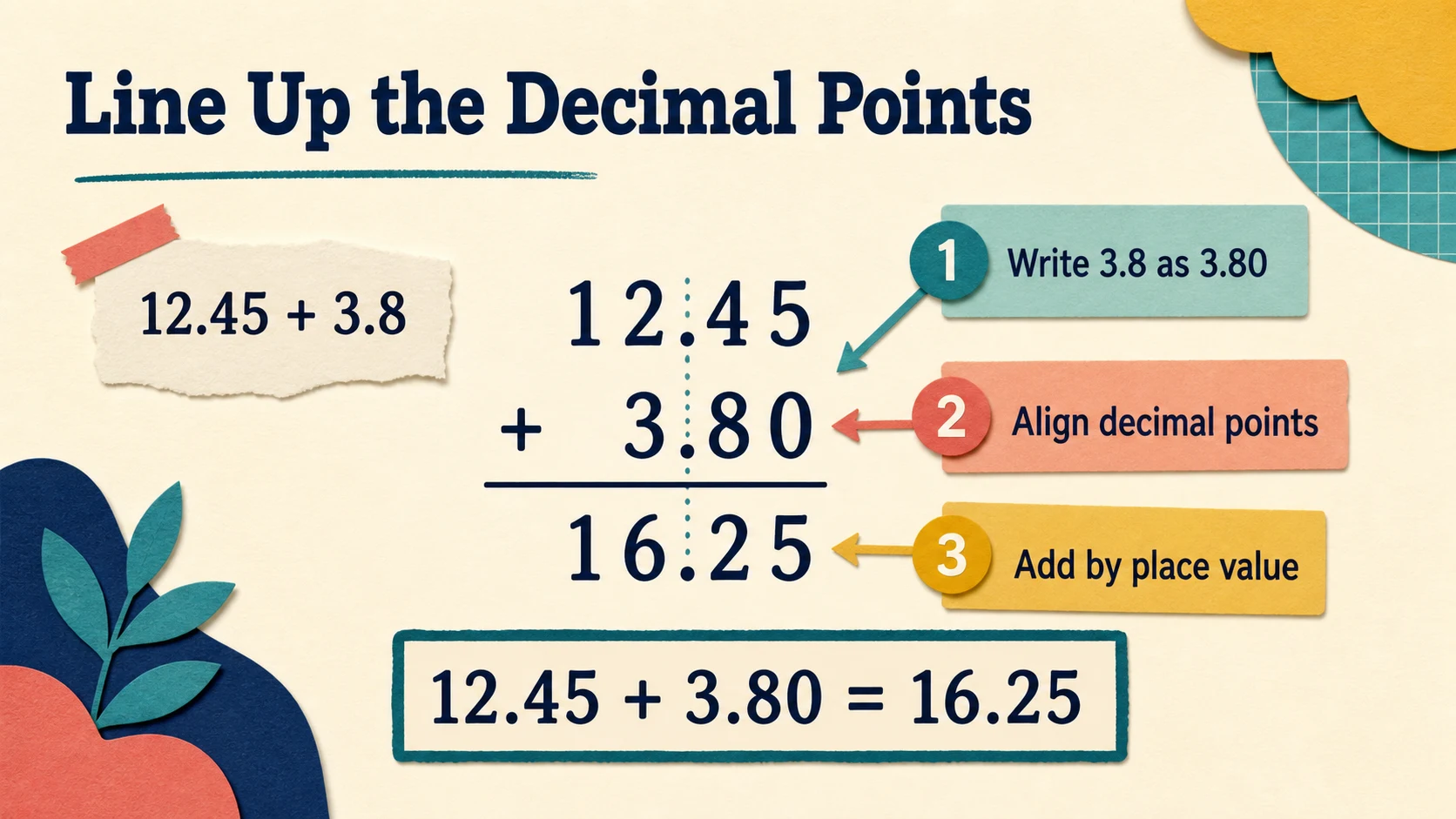
Align quantities by place value, calculate, and then check whether the result is reasonable.
Example 1: Convert a fraction to a decimal
Convert:
A denominator of 10 means the fraction names tenths. Seven tenths is written with 7 in the tenths place:
Check by writing the decimal as an equivalent fraction:
The conversion is correct.
If a learner writes 0.07, place the two numbers in a chart. In 0.7, the 7 is in the tenths place. In 0.07, it is in the hundredths place. The error is about place value, not merely a missing zero.
Example 2: Add decimals with unlike written lengths
Calculate:
Write 0.8 as 0.80. This does not change its value:
Therefore:
Check by estimating. 0.47 is close to 0.5, and 0.8 remains 0.8:
The exact answer, 1.27, is close to 1.3, so its size is reasonable. An inverse-operation check also works:
Example 3: Subtract across place values
Calculate:
Write 5.2 as 5.20 and align decimal points:
The regrouping can be checked explicitly. Twenty hundredths cannot lose 86 hundredths without regrouping across the aligned places. The result is:
Check with addition:
The original amount is recovered, so the subtraction is correct.
Estimate as an additional reasonableness check:
The exact answer 3.34 fits that estimate.
Example 4: Multiply two decimals
Calculate:
Six tenths multiplied by four tenths gives 24 hundredths:
Therefore:
This fraction model verifies the decimal placement. It also explains why the product is smaller than either positive factor: each factor is between zero and one.
A whole-number calculation provides another check:
The digits 24 appear in the product, but place-value reasoning determines that the answer is 24 hundredths, not 24, 2.4, or 0.024.
Example 5: Compare decimals without counting digits
Compare:
Write both values to the hundredths place:
Thirty-six hundredths is less than forty hundredths:
Therefore:
The longer decimal is not automatically larger. Comparison begins at the greatest place value and moves right only when the digits are equal.
Move from guided practice to independent work
Use prompts that reveal thinking
After modeling, select a worksheet item of the same type. Let the learner write while you ask short prompts:
- What operation is required?
- Which digits occupy the same place?
- What could you write as an equivalent decimal?
- About how large should the answer be?
- How will you check it?
Avoid converting every prompt into a direction. “Where should the decimal point go?” can become a guessing exercise. “What place does this digit represent?” draws attention to the mathematical structure.
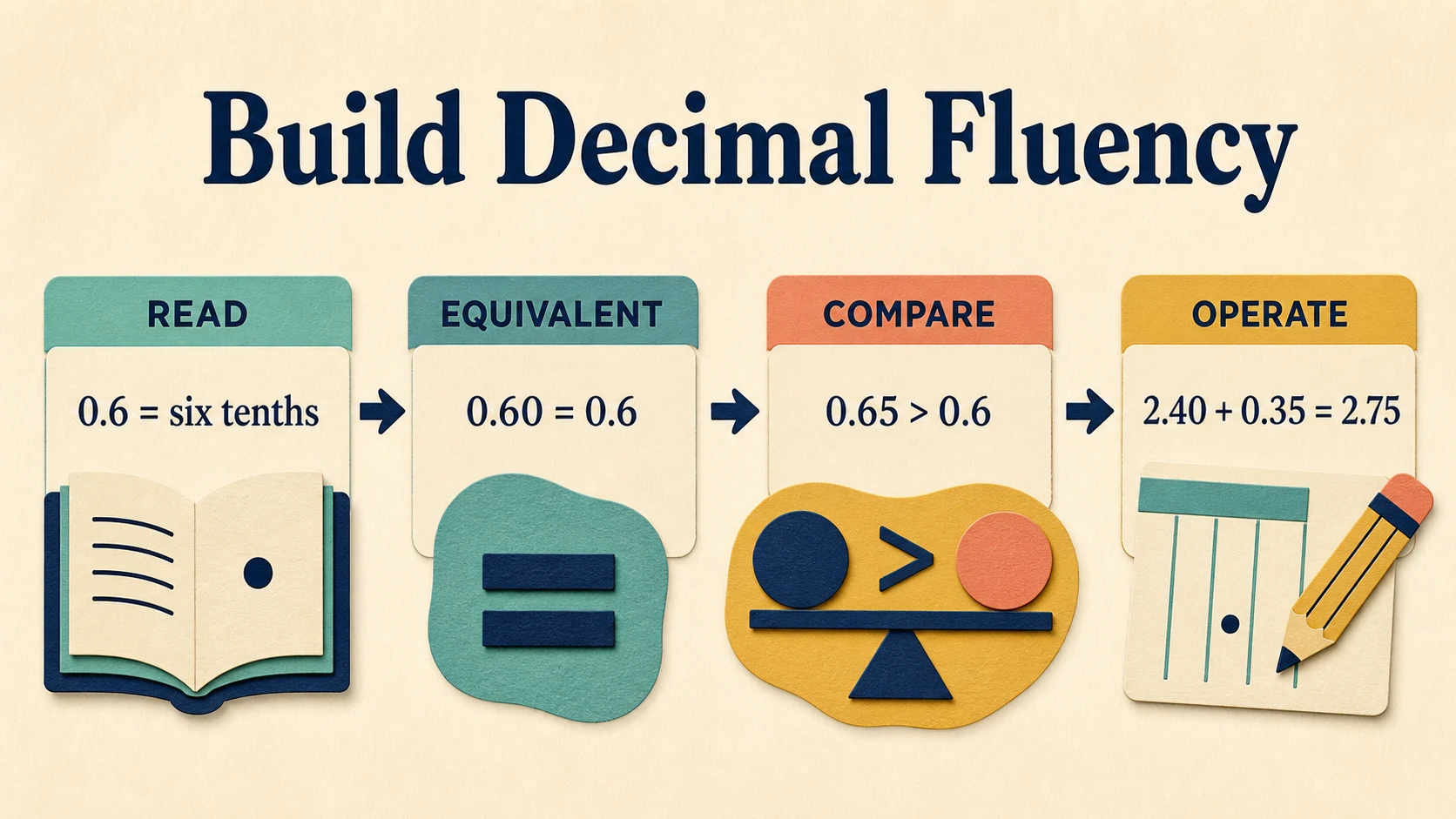
During guided work, prompt for place value and reasoning while leaving the calculation to the learner.
Fade help deliberately
Use a simple three-step release:
- Adult model: The adult solves and explains one similar problem.
- Shared solution: The learner completes most steps while the adult prompts.
- Independent attempt: The learner solves a fresh worksheet item without help.
If the independent attempt is correct and clearly organized, assign a small cluster. If it is correct but unexplained, ask the learner to annotate one calculation or give an oral explanation. If it is incorrect, return to the first uncertain step rather than repeating the whole lesson automatically.
Do not require lengthy prose for every item. Showing aligned digits, regrouping, a fraction equivalence, or a brief estimate may be enough to make the method visible.
Decide how many items to assign
Thirty items offer flexibility. A learner showing accurate, independent work might complete a larger block. A learner whose place-value errors appear early may benefit more from stopping after a short cluster and revisiting the concept with a chart or grid.
Possible uses include:
- One lesson with selected items and later review
- Two sessions divided by skill type
- A guided group activity followed by an independent subset
- Homework after the learner demonstrates the method
- A homeschool practice page divided across several brief meetings
These are practical options, not universal schedules. Accuracy, explanation, effort, and error patterns are more informative than simply reaching item 30.
Adapt support without changing the decimal skill
An adaptation should make the mathematics accessible while preserving the target. For example, supplying a place-value chart supports decimal alignment. Replacing every problem with whole-number arithmetic would remove the skill being practiced.
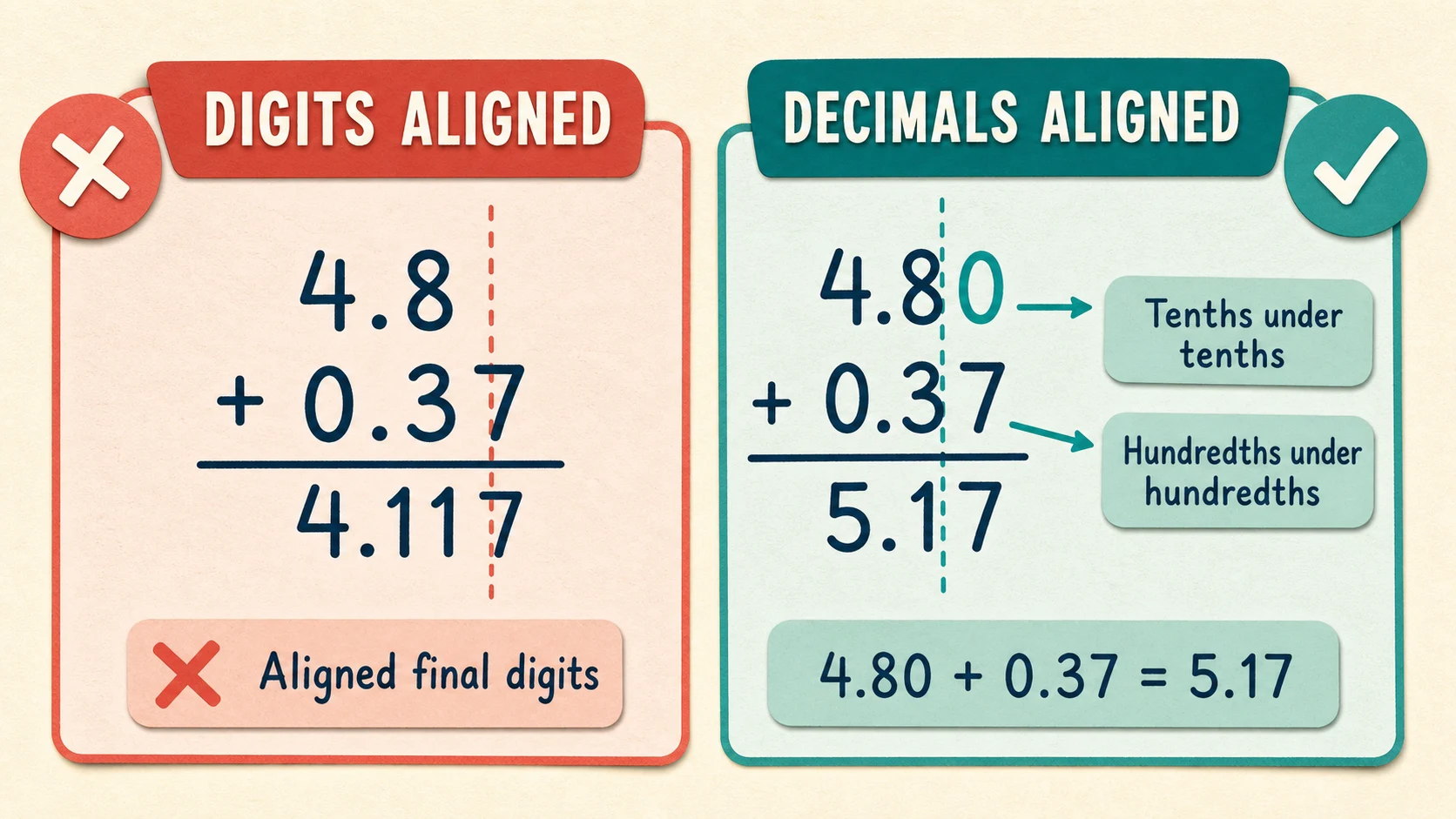
Adjust visibility, quantity, or prompting while keeping the original decimal reasoning intact.
When the learner needs more structure
Cover the lower portion of the page so that only one row is visible. Highlight decimal points or draw vertical place-value lines on a separate working sheet. Permit the learner to rewrite 0.6 as 0.60 before adding or subtracting.
For fraction-decimal conversion, provide a tenths or hundredths grid. Ask the learner to shade the fraction first, name the amount, and then record the decimal.
If multiplication is uncertain, reconnect the factors to fractions as in:
The support explains the product; it does not provide the worksheet answer.
When writing is the main obstacle
The instructions call for showing work. A learner can satisfy that purpose through neatly aligned calculations, arrows showing equivalent forms, or an oral explanation recorded by the adult beside one or two items. Do not silently supply calculation steps and then treat the resulting answer as independent work.
Use additional paper if cramped spacing causes digit-alignment mistakes. Copy the original expression exactly, and verify that no sign or digit changed during copying.
When the work is immediately accurate
Do not make the learner repeat an already stable procedure solely to fill time. Ask for a stronger check or a short explanation:
- Prove the conversion in the opposite direction.
- Estimate before calculating.
- Verify subtraction with addition.
- Explain why a product of two positive decimals below one is below both factors.
- Create a similar problem with a specified answer.
Then move to an appropriate next worksheet or broader decimal task. Extension should deepen reasoning rather than merely add more of the same easy-level items.
Teach the boundary cases explicitly
Boundary cases expose whether a learner understands value or is following a surface rule.
Equivalent decimal forms
Trailing zeros to the right of a decimal do not change its value:
Zeros placed before the first nonzero decimal digit do matter:
The first number is five tenths; the second is five hundredths.
Values near zero and one
Compare:
Write 0.9 as 0.90:
Now compare:
Ninety-nine hundredths is one hundredth less than one:
These cases counter the mistaken idea that more digits always mean a greater value.
Multiplication by zero and one
For any decimal :
and
For example:
If the learner applies a decimal-placement routine and obtains a different answer, return to the meaning of zero groups and one group.
Products around one
Multiplying by a positive number below one reduces a positive quantity:
Multiplying by a number greater than one can increase it:
These examples help the learner judge magnitude. They should not be turned into an unqualified rule for negative numbers or other later cases.
Interpret errors before assigning more practice
A wrong answer does not identify its own cause. Compare the written steps with the task and ask the learner to explain the first decision.
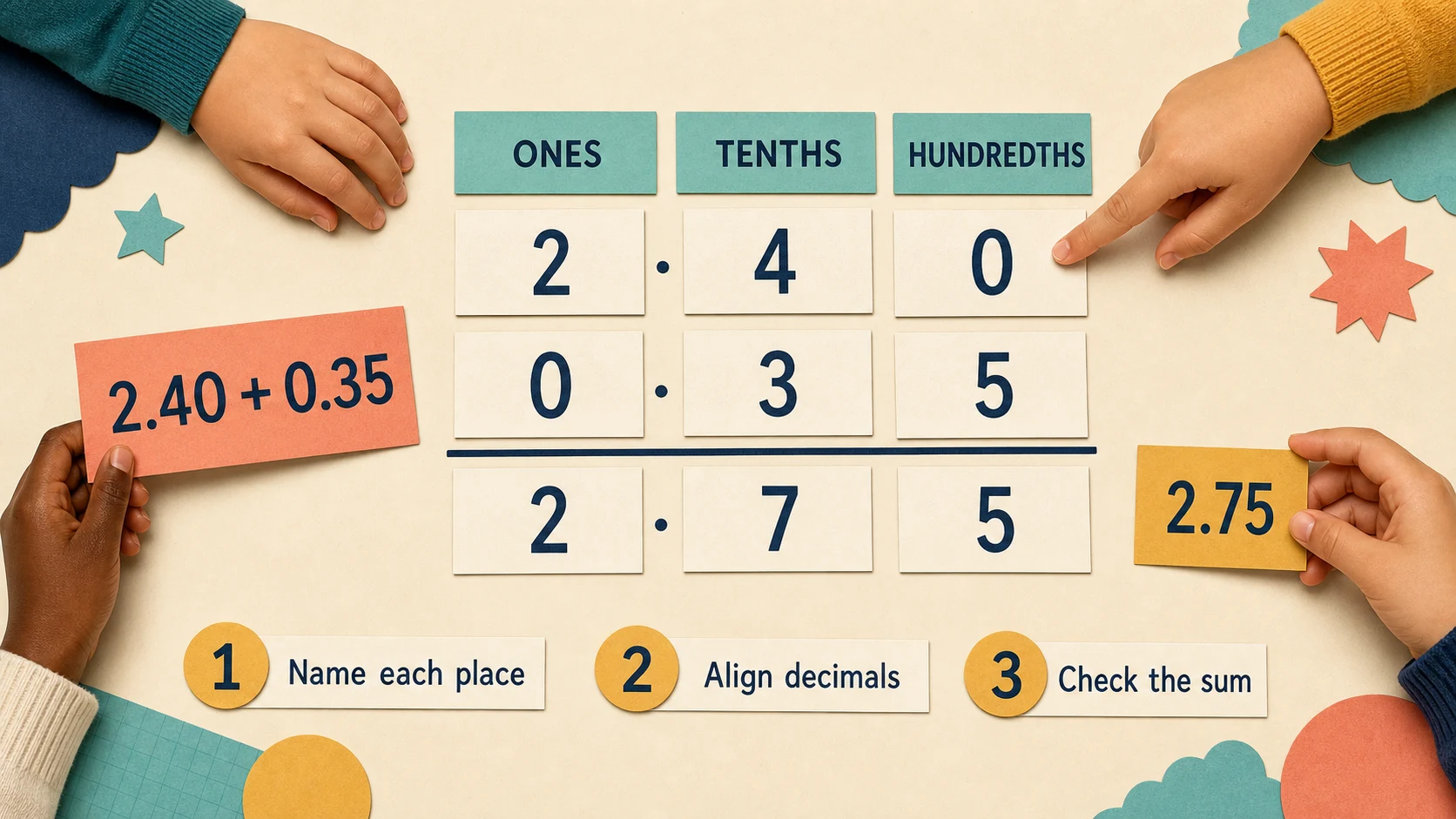
Locate the first uncertain step, name the error type, repair one example, and test the repair on a fresh item.
Common patterns include:
| Observed work | Likely issue to investigate | Useful response |
|---|---|---|
0.36 > 0.4 because 36 is greater than 4 |
Whole-number reasoning applied to decimals | Rewrite 0.4 as 0.40 and compare tenths first |
| Addition digits are right-aligned regardless of decimal points | Place values are not aligned | Use a place-value chart and equivalent trailing zeros |
7/100 = 0.7 |
Tenths and hundredths are confused | Name the denominator and place the numerator in the matching place |
| A subtraction result is larger than the starting positive number | Weak magnitude check or operation error | Estimate, then verify with addition |
0.6 × 0.4 = 2.4 |
Whole-number product used without place-value reasoning | Rebuild as tenths multiplied by tenths |
| Correct answers appear only after repeated prompts | Procedure is not yet independent | Reduce the set and fade prompts gradually |
| Mixed operation signs are overlooked | Task identification or visual scanning issue | Have the learner circle the sign before calculating |
These interpretations are hypotheses, not diagnoses. Confirm them with another example. If the learner corrects 0.36 versus 0.4 but then compares 0.52 and 0.6 incorrectly, the misconception is probably still active. If several fresh comparisons are correct, the original response may have been an isolated slip.
Correct answers also deserve inspection. A learner might produce 0.24 for 0.6 × 0.4 while being unable to explain the decimal placement. Ask for one verification using fractions, a model, or magnitude. The goal is not to interrogate every answer; it is to distinguish stable understanding from a lucky or memorized step.
Check the answer key responsibly
Use the separate answer key after the learner has made a genuine attempt. Marking only right or wrong is fast, but it loses information about where reasoning changed course.
A responsible check has four parts:
- Compare the learner’s final response with the key.
- Inspect the shown work for the first mismatch.
- Ask the learner to explain or repair the item.
- Test the repair with a similar problem that is not copied from the key.
If the worksheet answer and the key differ, recalculate independently before concluding that either is wrong. For addition or subtraction, use the inverse operation. For conversion, move from the decimal back to a fraction. For multiplication, estimate and verify with fraction place value when practical.
Record patterns rather than only a total score. A note such as “three hundredths-placement errors during conversion” is more useful for planning than “27 out of 30.” The total says how many answers differed; the pattern suggests what to teach next.
Do not change an answer before asking the learner about it. An apparently misplaced decimal point may reveal either a conceptual confusion or a copying slip, and those call for different responses. Likewise, do not let access to the answer key replace explanation. A corrected numeral without a corrected method is limited evidence of learning.
Decide what to do after the first session
Sort the evidence into one of three practical paths.
Continue with comparable practice
Continue when the learner independently solves most selected items, shows a sensible method, and catches occasional mistakes with a check. Use remaining worksheet items later rather than immediately exhausting every example.
The 5th Grade math hub can help you select related practice while keeping the grade-level context visible.
Rebuild one prerequisite
Pause and rebuild when a recurring error affects several items. If the learner confuses tenths and hundredths, focus first on reading, representing, and comparing decimals. If alignment breaks down, practice writing equivalent trailing zeros and organizing place values before adding more computation.
Use the broader decimals guide to locate the relevant part of the topic progression. There is no need to duplicate every stage during one worksheet lesson.
Increase challenge carefully
Move forward when the learner’s work is accurate, independent, and explainable across the represented skills. A harder task might involve less familiar numbers, a mixed-operation set, a word problem, rounding, or a demand to justify reasonableness. Confirm that the next resource actually targets the intended skill rather than assuming that a harder label guarantees a suitable sequence.
The 5th Grade worksheet hub provides a wider view of available subjects and topics. The optional 5th Grade Decimals Worksheet Pack contains 18 worksheets and is listed at $4.79, but more pages are useful only when selected in response to observed need.
Schedule retrieval instead of immediate repetition
A learner who completes a procedure correctly today may not retrieve it later without a prompt. Save several unused items or record a few similar examples for delayed review.
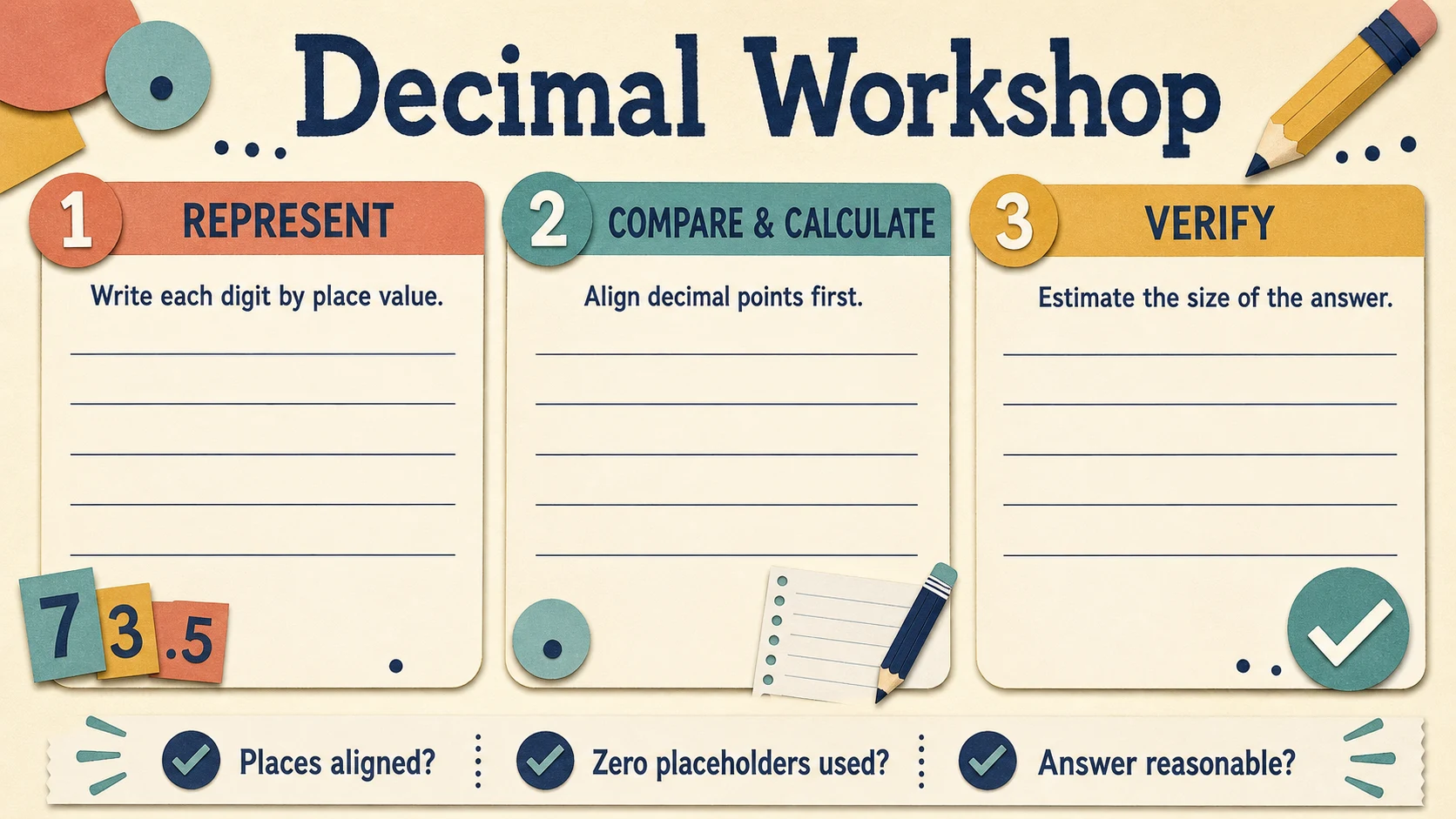
Revisit a small mixed set after increasing delays, adjusting the schedule when the work shows a need.
One possible schedule is:
| Review point | Suggested task | Decision |
|---|---|---|
| End of the first lesson | One conversion and one operation item | Repair any unresolved method |
| A day or two later | Two to four mixed items without notes | Check whether the learner can select the method |
| About a week later | A short mixed review with an estimate or explanation | Look for retained place-value reasoning |
| Later in the month | One or two decimal items mixed with other mathematics | Check retrieval when the topic is not announced |
This is an instructional example, not a sourced universal timetable. Shorten the interval after repeated errors. Lengthen it when retrieval is accurate and independent. If the learner remembers addition but not fraction-decimal conversion, schedule those skills separately instead of restarting the whole worksheet.
During delayed review, avoid saying, “Remember, line up the decimal points,” before the learner begins. That prompt tests following a cue. First ask the learner to solve independently; provide support only if the work shows it is needed.
Keep the worksheet in its proper role
This printable offers 30 straightforward opportunities to practice conversion, addition, subtraction, multiplication, and decimal number sense. It is useful for modeling, guided work, homework, reinforcement, or homeschool instruction. It is not a complete decimal curriculum, a universal diagnostic, or evidence of guaranteed progress.
Use representations when they clarify meaning, estimation when it checks magnitude, and the answer key when it supports analysis. Most importantly, let the learner’s observed work determine whether the next step is more independence, targeted rebuilding, or greater challenge.
For the next action, print the free 5th Grade Decimals worksheet, choose one item from each visible problem type, and use those items as the opening check. After reviewing the results, select the matching next resource from the Decimals topic guide or create targeted follow-up practice with the free worksheet generators.
Put it into practice
Use the guide with a real printable
Move from explanation to a short, observable practice task. Check the first item together, then adjust the next session from the learner's actual work.
See the 18-worksheet pack