Complete guide
How to teach and practise 5th grade addition worksheets - standard theme (easy)
How to Use This 30-Item Addition Worksheet
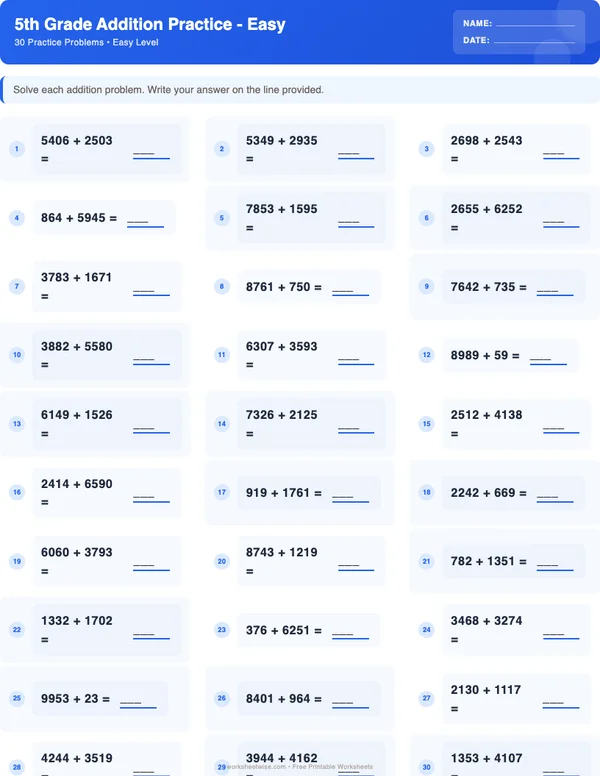
The 5th Grade Addition Worksheets - Standard Theme (Easy) printable is best used as a focused practice lesson, not simply handed out as a test. The worksheet contains 30 straightforward addition exercises and provides practice with addition facts, mental math, number sense, and place value. A separate printable answer key is included.
For a practical session, briefly model one or two similar problems, solve several items together, and then let the learner work independently. Watch the learner’s written work and explanations to decide how much support to provide. If errors cluster around one place-value step, address that step before assigning more problems. If the learner works accurately and can explain the method, move toward less support or a broader addition resource.
Grade labels describe the intended practice level; local curricula and teaching sequences differ. An “easy” fifth-grade worksheet may serve as an introduction, review, confidence-building activity, or quick check, depending on the learner’s current work.
You can open the free 30-item worksheet and its separate answer key from the worksheet page.
A Lesson Map for the Printable
The following plan is an instructional suggestion for using this specific worksheet. It is not a universal timetable. Shorten, extend, or divide the session according to what the learner shows you.
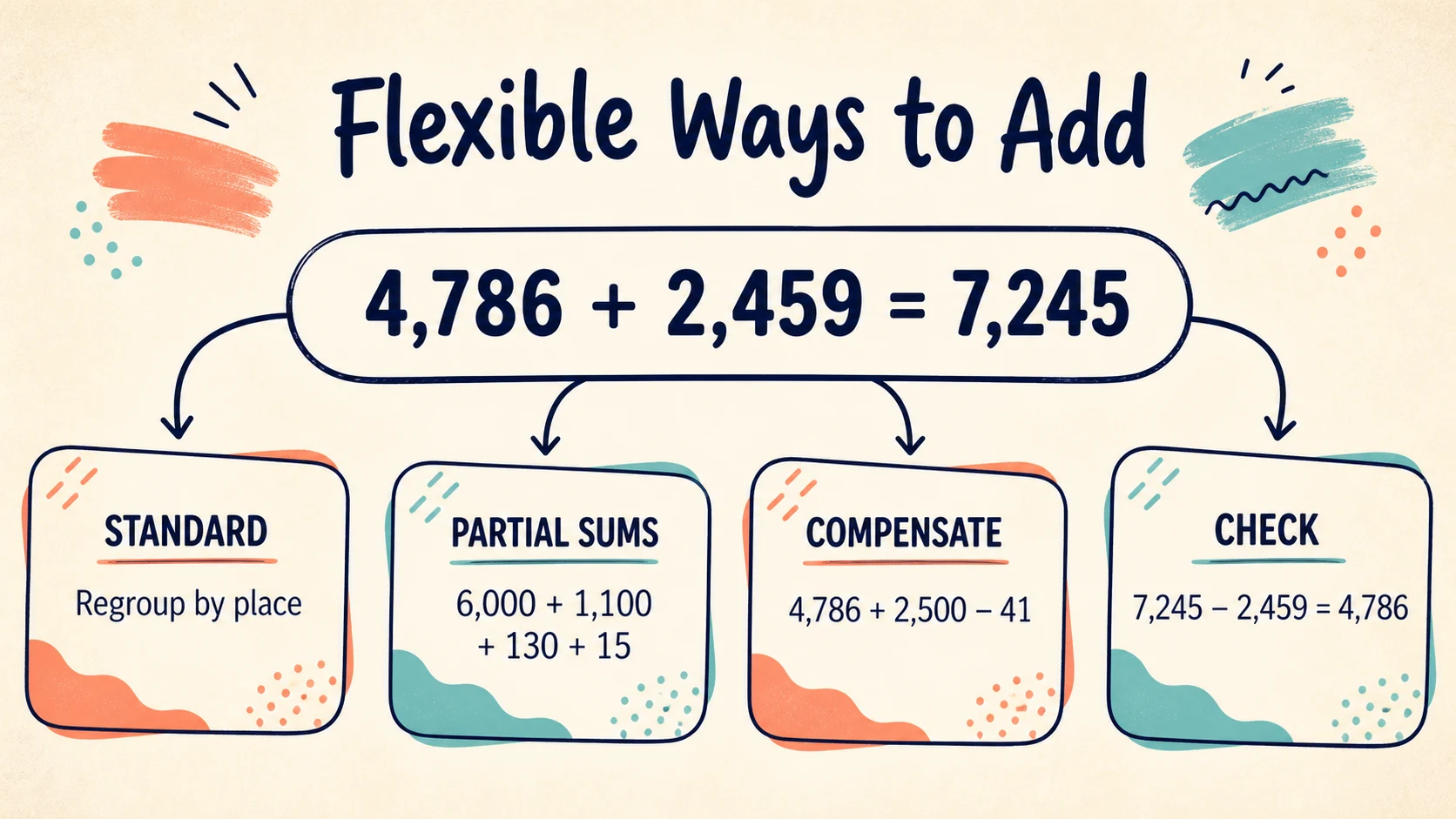
Use the learner’s accuracy, explanations, and work habits to decide when to move between phases.
| Lesson phase | Suggested use | What the adult watches for | Possible response |
|---|---|---|---|
| Preview | 2–3 minutes | Does the learner understand the directions and layout? | Clarify where answers belong without solving worksheet items. |
| Warm-up | 3–5 minutes | Can the learner identify ones, tens, hundreds, and larger places in sample numbers? | Review place value with a quick example if needed. |
| Modeling | 5–8 minutes | Can the learner follow the written addition process and explain regrouping? | Model one additional example, keeping every digit aligned. |
| Guided practice | About 5 worksheet items | Does the learner begin correctly and check each column? | Prompt with questions rather than supplying answers. |
| Independent practice | Remaining appropriate items | Are methods accurate, organized, and increasingly independent? | Pause if the same error repeats; continue if work is stable. |
| Review | 5–10 minutes | Can the learner find and explain an error? | Rework selected items without erasing the evidence too early. |
| Retrieval | Brief later sessions | Is the method remembered without immediate prompting? | Revisit a small selection after a delay. |
The worksheet instructions are concise: solve each addition problem and write the answer on the provided line. Before starting, make sure the learner can see the entire problem, has a pencil and optional scratch paper, and knows whether the goal is careful written computation, mental calculation, or a combination. Because the catalogue identifies mental math and place value among the skills, discussing method choice is useful. It does not mean every problem must be completed mentally.
The IES practice guide on teaching mathematics provides broad instructional framing around intentional teaching, mathematical language, and helping learners connect representations with mathematical ideas. It did not evaluate this WorksheetWise printable. Here, those principles can inform a simple sequence: show the structure, explain the reasoning, practice together, and then release responsibility.
Prepare the Learner Without Preteaching Every Item
Set a clear purpose
Describe the task in concrete terms:
“This page has 30 addition problems. First, we will look at how the numbers are organized. I will model a similar problem, we will solve a few together, and then you will complete a section independently.”
That introduction gives the learner a predictable sequence without promising that the page will be easy or difficult. Avoid saying, “You should already know this,” because the learner’s actual work—not the grade label—should determine what happens next.
Decide in advance whether all 30 items need to be completed in one sitting. Completion is not the only useful goal. A learner who solves 12 problems carefully, notices a place-value error, and corrects it may reveal more understanding than one who rushes through all 30.
Check the starting skills briefly
Use one or two oral prompts that do not duplicate worksheet items:
- In 4,382, which digit is in the hundreds place?
- When a column totals 14, what does the 1 represent after 4 is written in that column?
- How could you estimate whether 2,418 + 3,205 should be closer to 5,000 or 6,000?
These are suggested readiness checks, not claims about the exact operands printed on the worksheet. They help distinguish a computation problem from a place-value or notation problem.
If the learner cannot identify place values reliably, model with a place-value chart or base-ten drawing before expecting a fluent written procedure. Keep the target skill as addition: the visual support should clarify the same quantity relationships rather than replace the task with an unrelated activity.
For a wider explanation of the progression from early addition through multi-digit work, use the 5th Grade Addition topic guide. This lesson guide stays focused on launching and reviewing the easy 30-item printable.
Model an Addition Problem Clearly
Choose an example similar in skill to the worksheet but separate from the printed items. Write it vertically so digits with the same place value line up.
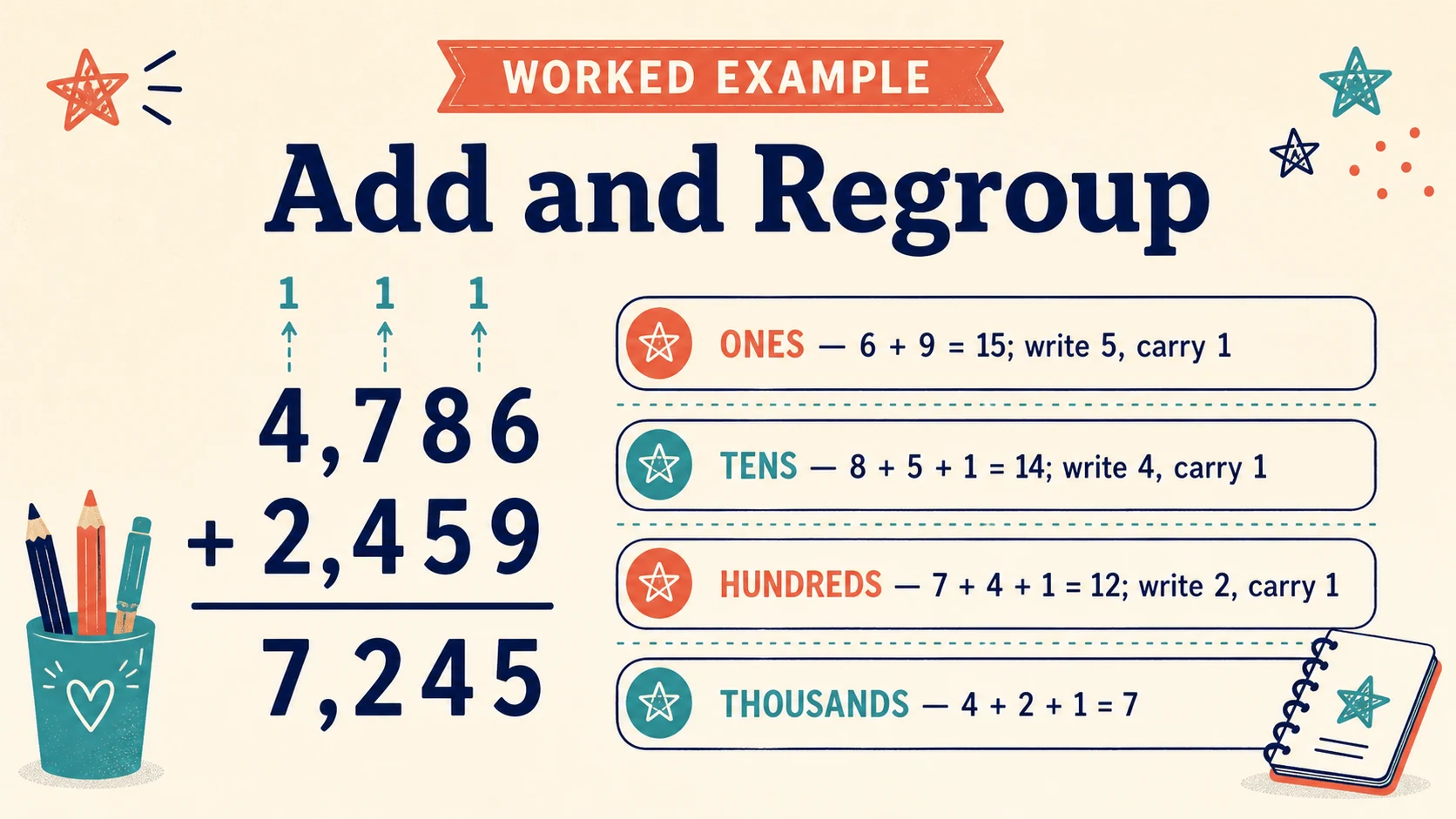
The written record should show what was added, what was regrouped, and why the digits remain aligned.
Worked example 1: no regrouping
Add 2,314 and 3,425.
  2,314
+ 3,425
-------
  5,739
Check each place from right to left:
- Ones: 4 + 5 = 9
- Tens: 1 + 2 = 3
- Hundreds: 3 + 4 = 7
- Thousands: 2 + 3 = 5
Therefore, 2,314 + 3,425 = 5,739.
A quick estimate supports the result: 2,314 is about 2,300, and 3,425 is about 3,400. Their estimated sum is 5,700, which is close to 5,739. Estimation is a reasonableness check; it does not replace the exact calculation.
Worked example 2: regrouping in one column
Add 2,468 and 1,357.
    1
  2,468
+ 1,357
-------
  3,825
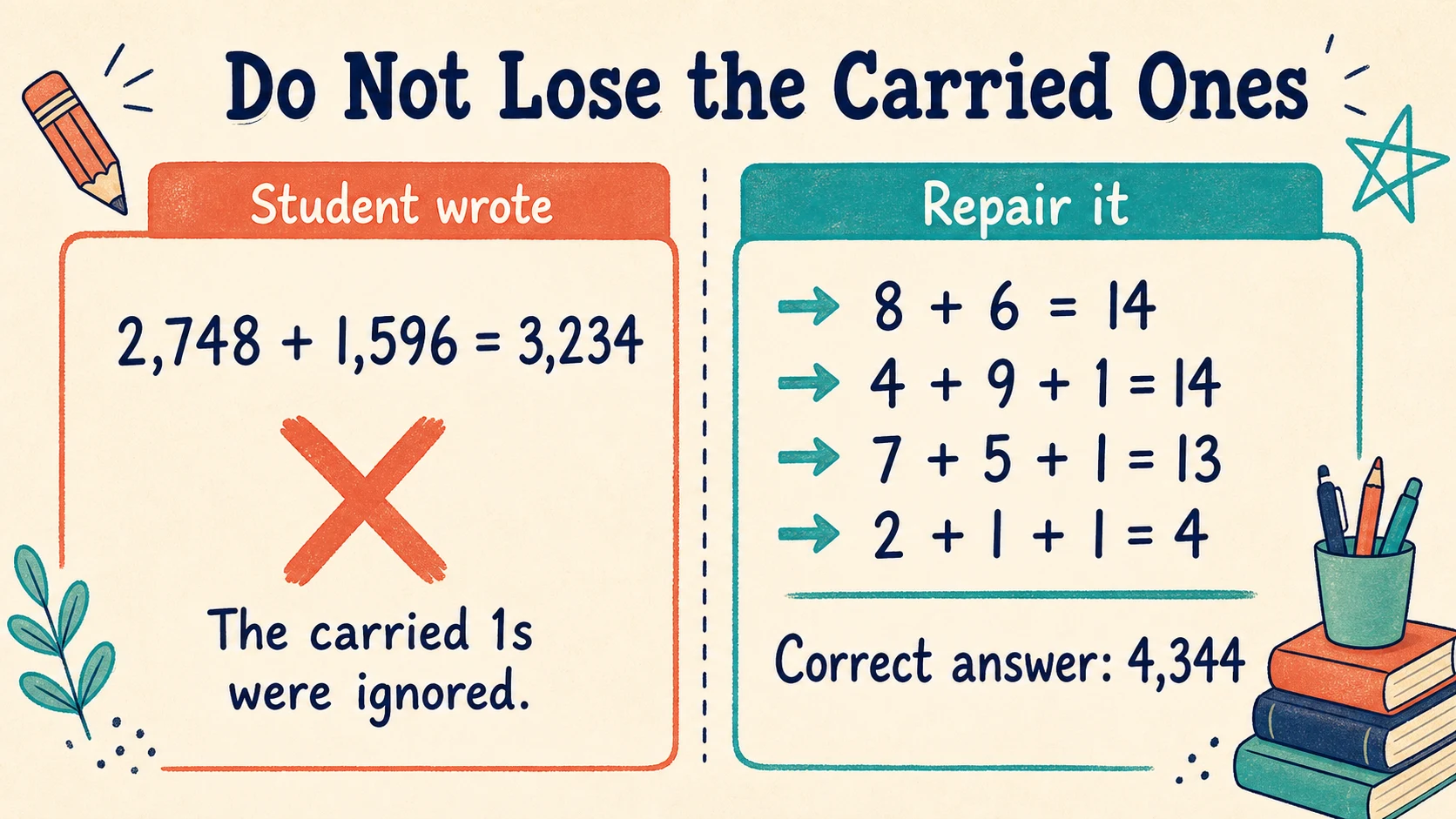
The small 1 shown above the tens column represents one regrouped ten.
- Ones: 8 + 7 = 15. Write 5 ones and regroup 1 ten.
- Tens: 1 regrouped ten + 6 tens + 5 tens = 12 tens. Write 2 tens and regroup 1 hundred.
- Hundreds: 1 regrouped hundred + 4 hundreds + 3 hundreds = 8 hundreds.
- Thousands: 2 thousands + 1 thousand = 3 thousands.
Thus, 2,468 + 1,357 = 3,825.
Although the compact display above shows only one marker, an adult modeling on paper should record each regrouped unit as it occurs. Say what the regrouped digit means. “Carry the one” names an action; “regroup ten ones as one ten” explains the value.
Model a checking routine
After solving, ask three questions:
- Are digits with the same place value aligned?
- Did every regrouped unit get included exactly once?
- Is the answer reasonable compared with an estimate?
This routine is more informative than immediately checking the key. It also gives the learner a repeatable way to examine independent work.
The Common Core State Standards for Mathematics provide high-level context for elementary work with place value and multi-digit whole-number computation. The supplied catalogue’s addition progression describes fluent multi-digit whole-number addition with the standard algorithm by the end of fourth-grade work. That context can help explain why an easy fifth-grade sheet may appropriately function as review. It does not establish comprehensive standards alignment for this exact printable.
Move From Guided to Independent Practice
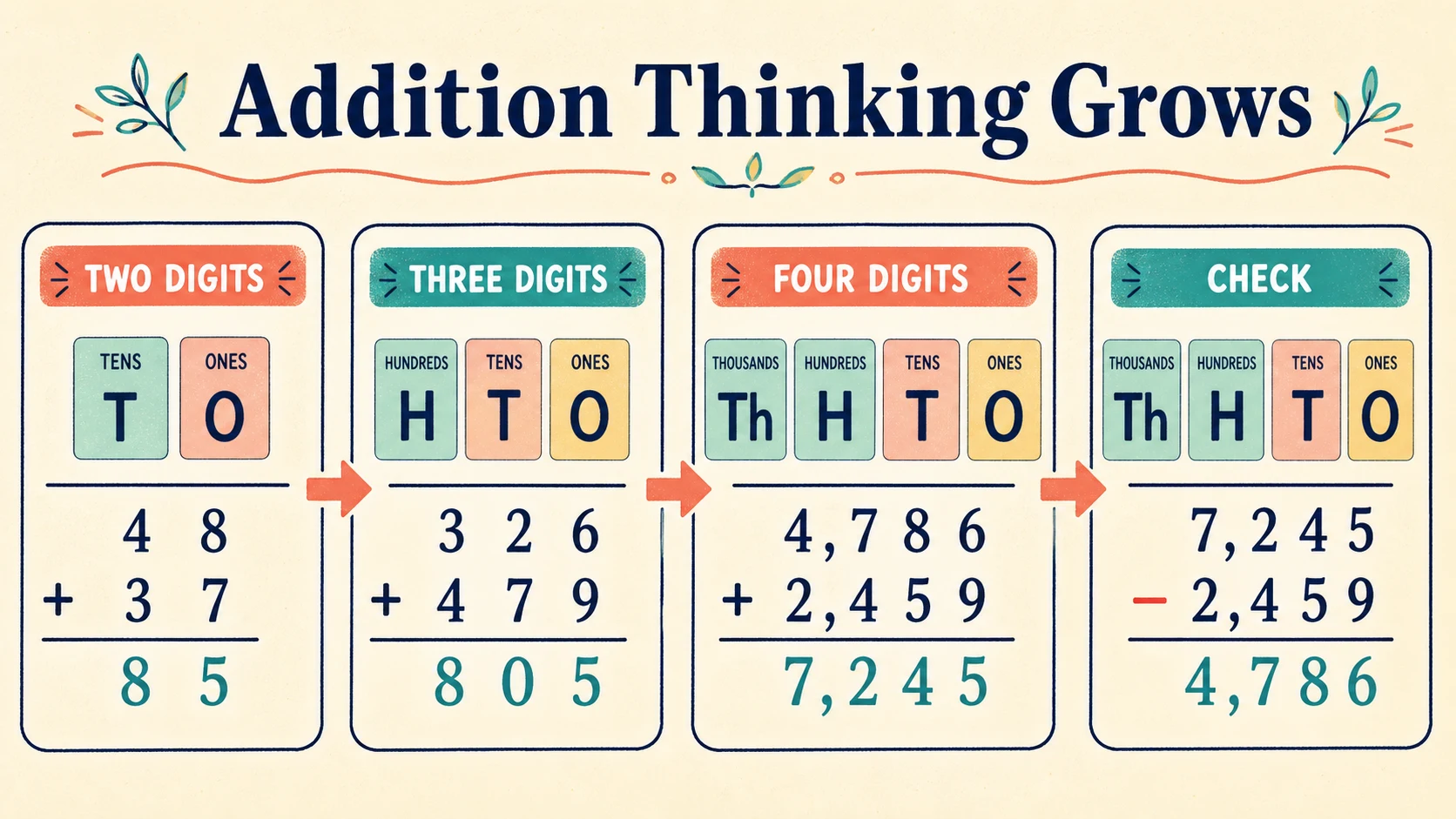
During guided practice, prompts should reveal the learner’s thinking without turning into a running answer service.
Use a short guided set
Begin with approximately five worksheet items. On the first item, ask the learner to explain the setup before calculating. On later items, reduce the prompts.
Useful prompts include:
- “Which digits belong in the same column?”
- “What is the sum in the ones place?”
- “Does that total require regrouping?”
- “What does the regrouped digit represent?”
- “How could you tell whether the final answer is reasonable?”
Avoid automatically correcting the learner at the first hesitation. A brief pause can show whether the learner can recover independently. Step in when the learner has lost the structure of the problem, repeats the same mistake, or begins guessing.
Worked example 3: regrouping across columns
Add 3,786 and 2,659.
  3,786
+ 2,659
-------
  6,445
Verify the result carefully:
- Ones: 6 + 9 = 15; write 5 and regroup 1 ten.
- Tens: 1 + 8 + 5 = 14; write 4 and regroup 1 hundred.
- Hundreds: 1 + 7 + 6 = 14; write 4 and regroup 1 thousand.
- Thousands: 1 + 3 + 2 = 6.
Therefore, 3,786 + 2,659 = 6,445.
A second check can use subtraction: 6,445 − 2,659 = 3,786. If subtraction has not been taught or is not secure, use estimation instead: 3,800 + 2,700 is about 6,500, so 6,445 is plausible.
Release responsibility gradually
Move into independent work when the learner can:
- align place values without correction;
- begin in a consistent place;
- regroup with an explanation or accurate written record;
- complete several consecutive items without procedural prompting; and
- use a reasonable check.
These are practical observation points, not a required mastery scale. If the learner needs a prompt for every column, independent completion of the remaining page is probably premature. Continue with a few more guided items or divide the worksheet across sessions.
During independent work, stay available but do not hover over every calculation. Mark an item for later discussion if you see an error. Unless the error will contaminate the entire page, allow enough work to accumulate to identify a pattern.
Adapt Support Without Changing the Skill
Differentiation here means altering access, pacing, or response support while preserving addition as the mathematical target.
Change the amount of structure or practice before changing the mathematical objective.
When the learner needs more structure
Offer one support at a time so you can see what helps:
- Cover the lower part of the page and reveal one row at a time.
- Use graph paper or draw vertical guide lines to maintain column alignment.
- Let the learner circle or lightly mark each place-value column.
- Provide a place-value chart beside the worksheet.
- Complete fewer items in one sitting while retaining the same type of addition.
- Ask the learner to say each regrouping step aloud.
- Use counters or base-ten drawings to clarify a regrouping step, then return to the written problem.
The IES guide for assisting students who struggle with mathematics offers broad guidance on systematic instruction, clear mathematical language, representations, and deliberate practice. It does not make a recommendation about this particular WorksheetWise page or about an individual learner. For this worksheet, those ideas can support explicit modeling and a careful move from representations to written computation.
Do not quietly solve the difficult columns and leave only easy facts for the learner. That changes what the work reveals. Instead, prompt the learner to connect the column total with its place-value meaning.
When the learner is ready for less support
Reduce assistance before increasing difficulty. For example:
- Ask the learner to choose which items need written work and which can be solved mentally.
- Request an estimate for every third or fourth problem rather than for every item.
- Have the learner independently select one answer to verify using another method.
- Ask for a short explanation of one regrouping step.
- Remove the place-value chart after several accurate items.
These adjustments preserve the worksheet’s focus while building independence.
When attention or writing load is the obstacle
Divide the page into small sections, but keep completed and remaining items visible in a simple checklist. A learner might complete 10 items, take a short break, and return for another section. This is a pacing suggestion, not a claim that 10-item blocks work for everyone.
If handwriting makes alignment difficult, allow graph paper or a larger rewritten copy of a problem. The learner should still determine and record the sum. A calculator would change the evidence gathered if the purpose is to observe computation, so use one only when checking answers after the mathematical work—not as an unnoticed substitute for it.
Include Boundary Cases in the Teaching
Boundary cases expose whether the learner understands place value rather than merely repeating a routine. They may or may not appear on this exact printable, so use them as separate teaching examples when relevant.
Worked example 4: a zero inside a number
Add 4,205 and 1,673.
  4,205
+ 1,673
-------
  5,878
Check:
- Ones: 5 + 3 = 8
- Tens: 0 + 7 = 7
- Hundreds: 2 + 6 = 8
- Thousands: 4 + 1 = 5
Therefore, 4,205 + 1,673 = 5,878.
The zero is a placeholder showing that 4,205 contains no tens. It must remain in the correct position during setup. A common mistake is to compress the number or shift the 7 under the hundreds digit.
Worked example 5: a new place in the sum
Add 5,999 and 4,001.
  5,999
+ 4,001
-------
 10,000
Check:
- Ones: 9 + 1 = 10; write 0 and regroup 1 ten.
- Tens: 1 + 9 + 0 = 10; write 0 and regroup 1 hundred.
- Hundreds: 1 + 9 + 0 = 10; write 0 and regroup 1 thousand.
- Thousands: 1 + 5 + 4 = 10 thousands.
The exact sum is 10,000. The answer needs a fifth digit. Restricting the answer to the same number of places as the addends would produce an impossible result.
Worked example 6: an addend with fewer digits
Add 3,482 and 76.
  3,482
+    76
-------
  3,558
The 6 belongs under the 2 because both are ones; the 7 belongs under the 8 because both are tens.
- Ones: 2 + 6 = 8
- Tens: 8 + 7 = 15; write 5 and regroup 1 hundred.
- Hundreds: 1 + 4 = 5
- Thousands: 3 remains 3
Thus, 3,482 + 76 = 3,558.
Aligning numbers by their left edges would change 76 into a different place-value quantity. The dependable rule is to align places, not first digits.
Interpret Errors Before Assigning More Work
A wrong answer is evidence, but the final digit alone rarely identifies the cause. Preserve enough written work to see where the method changed.
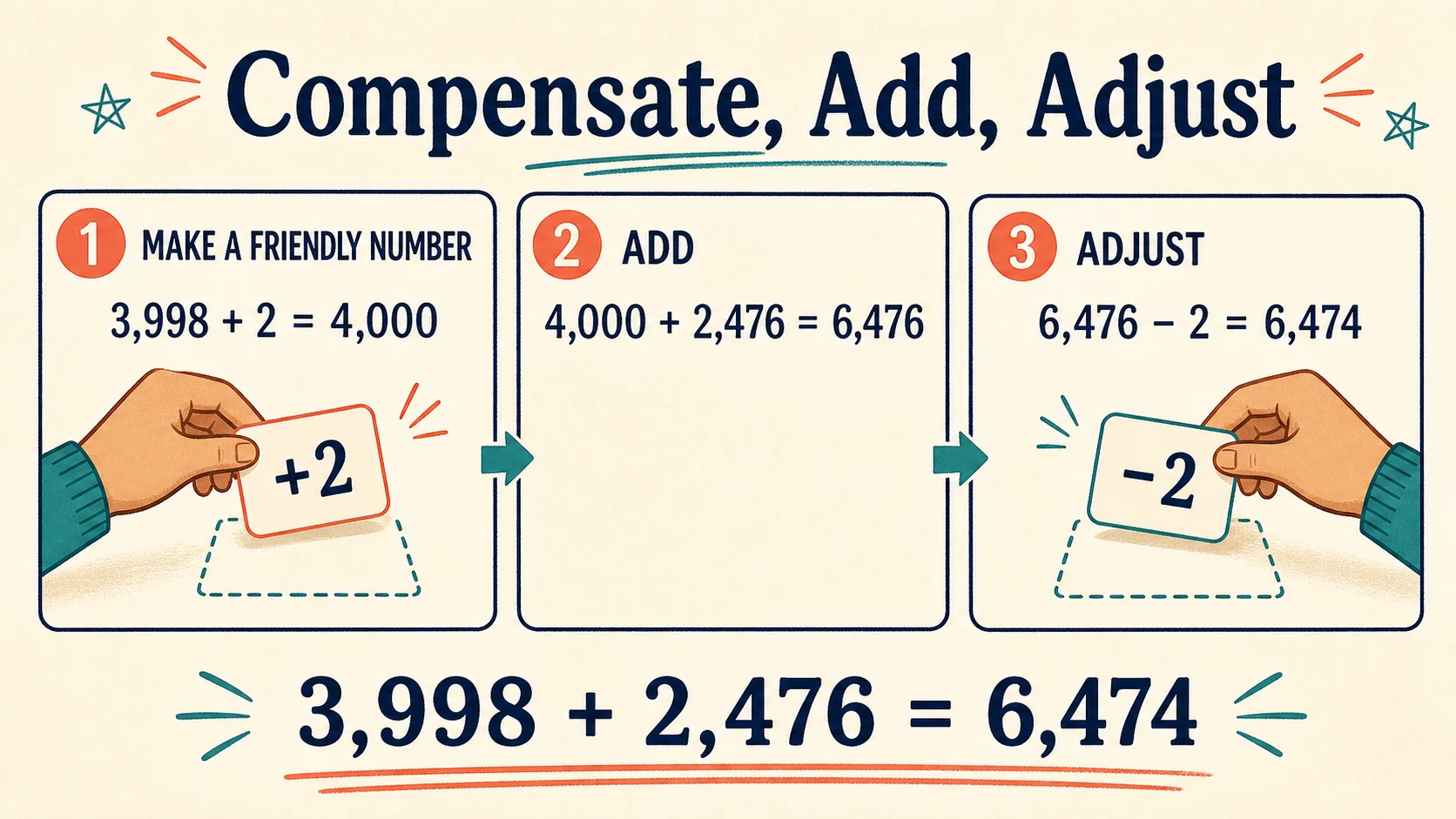
Locate the first incorrect step, name its place value, repair it, and then verify the new sum.
| Observed pattern | Possible interpretation | Useful response |
|---|---|---|
| Many columns are shifted | Place-value alignment is insecure or the layout is difficult to track | Add guide lines or graph paper and have the learner name each place. |
| Basic column sums are incorrect without regrouping | Addition facts or attention may be interfering | Recheck a few facts and compare mental and written methods. |
| The learner writes 12 in one answer column | Regrouping notation is not yet connected to place value | Model 12 ones as 1 ten and 2 ones. |
| A regrouped 1 is omitted | The learner may understand the column sum but lose track of the written record | Ask where the regrouped unit belongs and why. |
| A regrouped 1 is counted twice | The notation may be visible but its role is unclear | Have the learner point to each quantity exactly once. |
| Answers are consistently too small or too large | A whole step, addend, or place may be omitted or duplicated | Compare the exact answer with an estimate and trace each column. |
| Errors appear mostly near the end | Fatigue, rushing, or declining attention may be involved | Pause and later try a short fresh set before changing instruction. |
| Corrections are accurate after one prompt | The method may be present but not yet self-monitored | Teach a brief independent checking routine. |
These interpretations are hypotheses, not diagnoses. Test an interpretation with one fresh example. For instance, if you suspect alignment is the issue, provide graph paper and a new problem. Improved performance with that support strengthens the interpretation; unchanged errors suggest looking elsewhere.
Do not treat every isolated slip as evidence that the learner lacks the entire skill. Conversely, do not dismiss a repeated pattern because some answers are correct. Look for the first point where the written reasoning becomes inconsistent.
Use the Answer Key Responsibly
The separate printable answer key allows quick checking, but it should confirm analysis rather than replace it.
A dependable checking sequence
First, have the learner perform a self-check without the key:
- Recheck place-value alignment.
- Recalculate one column at a time.
- Confirm every regrouped unit.
- Estimate the expected size of the sum.
- Mark any answer that still feels uncertain.
Next, compare answers with the key. Record which items differ, but do not immediately write the correct answers over the learner’s work. Ask the learner to rework one discrepancy on separate paper. If the new answer agrees with the key, discuss what changed. If it still differs, solve the item together and examine the first incorrect step.
Adults should also check responsibly. A copied number, unclear handwriting, or mismatched item number can make correct reasoning appear wrong. Match the problem number and the complete answer before marking it.
If the learner consulted the answer key before solving, the page no longer gives clean evidence of independent computation. It can still be used for instruction: cover the key, choose fresh problems from the free worksheet generators, and observe the learner’s method. Do not present the original score as independent performance.
A simple review code can keep attention on causes:
- A for alignment
- F for addition fact
- R for regrouping
- C for copied number
- S for self-checking or skipped step
Use codes only when they help the learner understand the correction. A long list of marks without discussion is not useful feedback.
Decide What to Do After the Worksheet
The next step should follow the pattern of work, not merely the number of completed items.
If the work is accurate and explainable
When the learner completes a substantial section accurately, maintains place-value alignment, and can explain a regrouping step, reduce support. Ask for one independent verification or use another worksheet from the 5th Grade Math collection. The aim is to see whether the method remains stable with a fresh set, not to reward accuracy with an excessive volume of repetitive work.
If errors follow one clear pattern
Teach that pattern directly and then try three or four fresh items:
- For alignment errors, use place-value columns.
- For missed regrouping, connect the written 1 to ten units of the previous place.
- For weak checking, require an estimate before viewing the key.
- For rushed copying, ask the learner to point to and read both addends before calculating.
Improvement on fresh examples is more informative than repeatedly erasing and reconstructing the same answer.
If the learner needs broader review
Return to the Addition topic guide to locate the relevant part of the progression rather than duplicating every earlier addition stage here. The broader 5th Grade worksheet hub can help place this practice alongside other subjects and skills.
The 5th Grade Addition Worksheet Pack contains 18 worksheets and is listed at $4.79 in the supplied catalogue. It may be useful when an adult wants a larger set of addition practice. The free worksheet remains the appropriate starting point when the immediate goal is to observe how the learner handles this 30-item easy-level page.
Schedule Brief Retrieval Instead of Immediate Repetition
Retrieval means asking the learner to use the addition method again after some time has passed. The schedule below is a practical suggestion, not a sourced prescription or universal timetable.
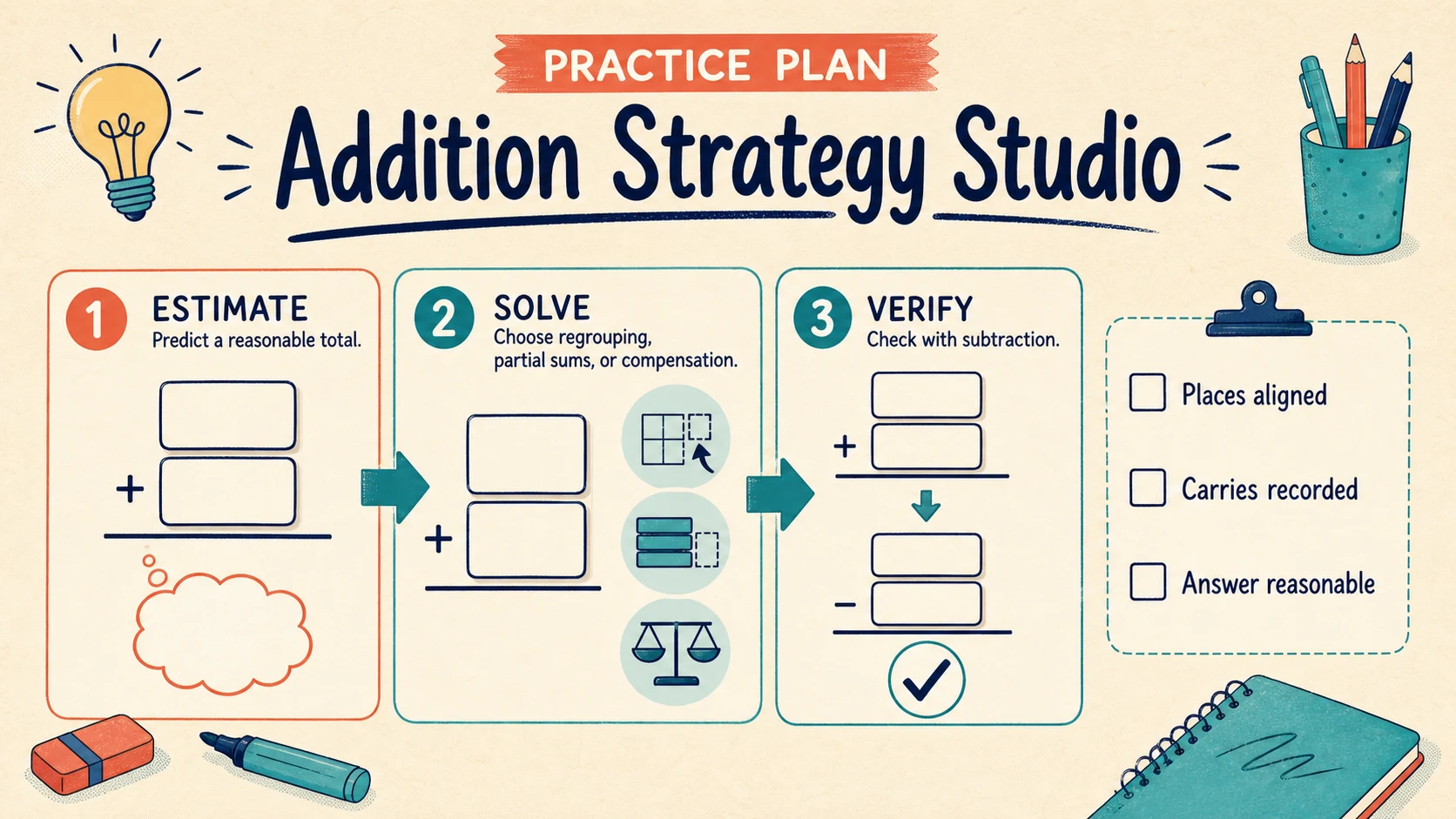
Keep delayed reviews short and use fresh items when possible so remembered answers do not mask the method.
| Suggested time | Brief task | Decision point |
|---|---|---|
| Later the same session | Rework one corrected item without looking at the old solution | Can the learner reproduce the corrected step? |
| About 1–2 days later | Solve 3–5 fresh addition problems | Is the method available without immediate modeling? |
| About one week later | Complete a short mixed set or a selected worksheet section | Does accuracy remain stable after a longer delay? |
| Later review | Include one or two addition items among other math work | Can the learner recognize and apply the method in a mixed context? |
Adjust the intervals based on observed performance. If the learner cannot begin after a short delay, return to a clear model and guided practice. If the learner retrieves the method accurately and explains it, lengthen the interval or reduce the number of review items. If only one error type returns, target that feature rather than repeating all 30 exercises.
Keep a minimal record: date, number attempted, error pattern, and support needed. Avoid turning the record into a permanent label. Its purpose is to guide the next teaching decision.
Limitations of This Printable
This worksheet provides 30 easy-level addition exercises with an answer key. It can supply focused practice and visible written evidence, but it cannot by itself show everything a learner understands about addition.
A correct answer does not reveal whether the learner used place value, mental calculation, counting, memorized facts, or copied information. Ask for occasional explanations, not an explanation after every problem. Similarly, a wrong answer may reflect a fact error, misalignment, regrouping confusion, copying, or attention. Inspect the written process before deciding what needs teaching.
The worksheet does not replace a complete curriculum or the broader addition progression. Its catalogue skills include addition facts, mental math, number sense, and place value, but no single 30-item printable can comprehensively assess all aspects of those skills. This guide also does not provide medical, developmental, or child-specific advice.
Use the printable for a defined purpose: introduce a familiar format, reinforce addition, observe a method, or revisit the skill after a delay. Then act on the evidence. Start now with the free 5th Grade Addition worksheet; after checking the learner’s method and error pattern, choose the next targeted practice from the broader Addition guide.
Put it into practice
Use the guide with a real printable
Move from explanation to a short, observable practice task. Check the first item together, then adjust the next session from the learner's actual work.
See the 18-worksheet pack