Complete guide
How to teach and practise 5th grade sentence structure worksheets - standard theme (easy)
What This Worksheet Practices
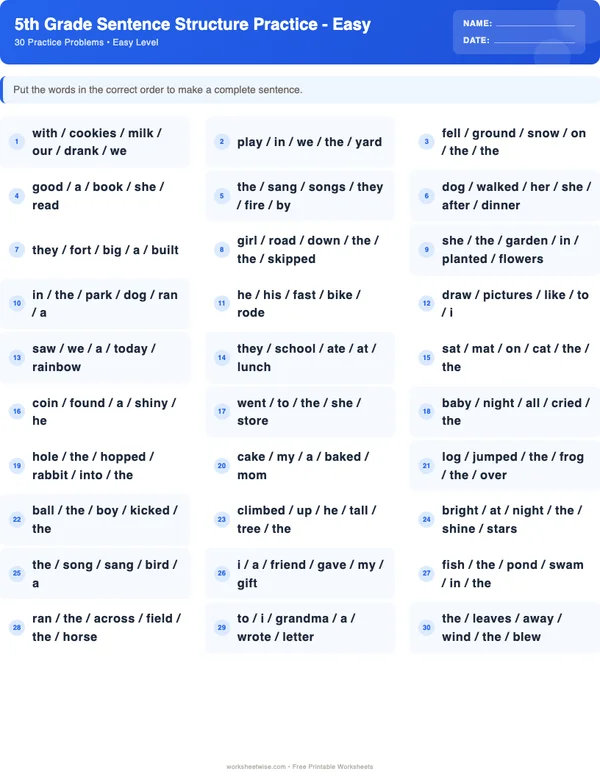
The free 5th Grade Sentence Structure worksheet gives a learner 30 easy-level items with one consistent direction: Put the words in the correct order to make a complete sentence. The immediate goal is to arrange every supplied word into an order that expresses a complete, grammatically sensible thought.
For an adult supporting the learner, the most useful approach is concise: model one item aloud, solve several together, assign a manageable independent set, and then study the learner’s errors before choosing the next step. Do not require all 30 items in one sitting merely because they fit on one printable. The learner’s observed work should determine the pace.
This worksheet specifically practices:
- Word order
- Sentence formation
- Syntax
- Grammar
It includes a separate printable answer key. The standard theme and easy difficulty make it suitable for introductory practice or reinforcement, but “easy” does not mean that every learner should complete it without support. Grade labels describe the intended practice level; local curricula, instructional sequences, and learner experience differ.
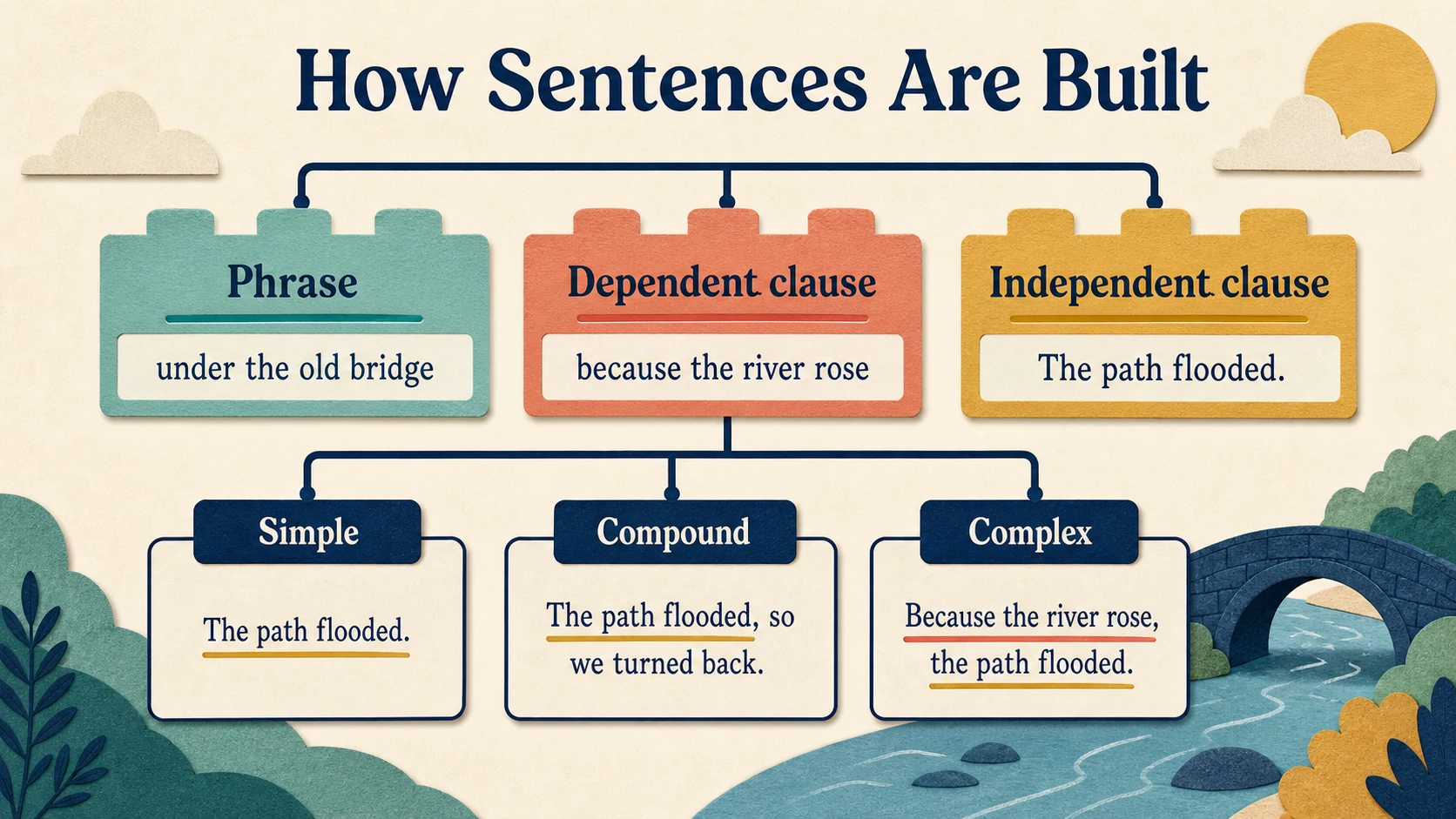
Use the lesson map to move from explanation to modeling, guided practice, independent work, feedback, and later review.
Prepare the Worksheet and Set a Clear Purpose
Print or open the worksheet without placing the answer key where the learner can see it. Keep the key available for adult checking after the learner has attempted the selected items. You may also want blank paper, a pencil, and small slips of paper for moving words physically.
Before beginning, give a specific explanation:
“Each item contains the words for a sentence, but they are out of order. Your job is to arrange all the words so the sentence expresses a complete thought.”
That statement keeps attention on the actual task. This printable is not a broad assessment of fifth-grade writing, vocabulary, reading comprehension, or punctuation. It samples one constrained skill: ordering supplied words to form sentences.
Ask the learner to explain the direction in their own words. A suitable response might be, “I put the words in an order that makes sense.” If the learner instead says, “I add words to finish each sentence,” correct that misunderstanding before practice begins. The task calls for rearranging the supplied words, not replacing them or inventing new content.
Establish a simple checking routine
Teach the learner to check each constructed sentence with four questions:
- Did I use every supplied word?
- Did I use each word only once?
- Does the result express a complete thought?
- Does it sound natural when I read it aloud?
If capitalization and punctuation are visibly part of the printed response format, the learner should preserve or apply them as the item requires. However, do not turn every correction into an unrelated punctuation lesson. The central skill remains sentence order and formation.
Use a Flexible Lesson Progression
A single session can work when the learner is accurate and comfortable. Two or more shorter sessions may be more useful when word order is effortful. The following progression is an instructional suggestion for this worksheet, not a universal timetable.
| Phase | Suggested worksheet use | Adult role | Evidence to notice |
|---|---|---|---|
| Launch | Discuss the direction without completing an item | Clarify that all supplied words must be reordered | Can the learner restate the task? |
| Model | 1 similar example created by the adult | Think aloud and check every word | Can the learner explain why the order works? |
| Guided practice | 3–5 worksheet items | Prompt, question, and gradually reduce help | Does the learner identify a likely subject and action? |
| Independent practice | 5–10 items at a time | Observe without correcting each move | Are errors isolated or repeated? |
| Check and revise | Review the completed set | Compare reasoning with the answer key | Can the learner repair an error after a clue? |
| Retrieval | Revisit selected items later | Ask for reconstruction without showing the old response | Is the sentence formed more efficiently and accurately? |
| Transfer | Write or revise one original sentence | Connect ordering to authentic writing | Can the learner apply the same complete-thought check? |
Pause independent work when the learner repeatedly guesses, omits words, or cannot explain a completed sentence. Return to one guided item rather than allowing a long string of preventable errors.
The broader Sentence Structure topic guide covers the larger progression, including complete sentences, subjects and predicates, fragments and run-ons, sentence combining, and sentence expansion. Use that guide when the learner’s needs extend beyond this worksheet’s word-order task.
Model the Task With Fully Checked Examples
Use examples that resemble the worksheet format without presenting them as actual worksheet items. A strong model makes the invisible decisions visible: finding who or what the sentence is about, locating the action or state, placing modifiers sensibly, and checking every word.
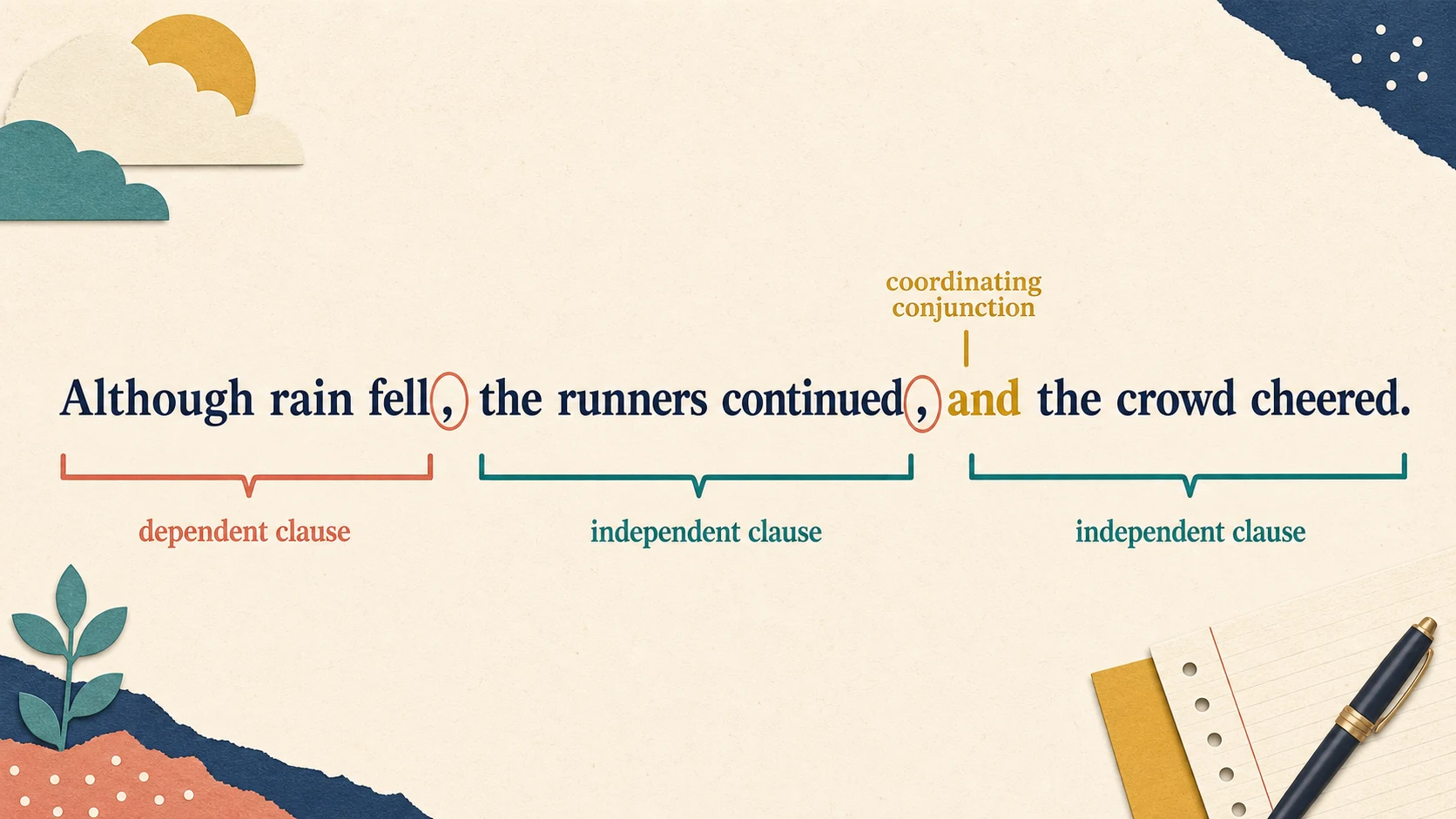
The model should show both the finished sentence and the checks used to confirm it.
Example 1: Find the actor and action
Scrambled words: the / rabbit / crossed / quiet / the / path
Start by looking for a likely naming group. “The rabbit” names who performs the action. Next, identify the action: “crossed.” Ask what the rabbit crossed. The remaining words can form “the quiet path.”
Correct sentence: The rabbit crossed the quiet path.
Check it carefully:
- Every supplied word appears.
- No word appears twice.
- “The rabbit” is who the sentence is about.
- “Crossed the quiet path” tells what the rabbit did.
- The sentence expresses a complete thought.
“The quiet rabbit crossed the path” is also grammatical if the original set contains the same two instances of “the.” This is a genuine boundary case: more than one arrangement can sometimes form a complete sentence. If a worksheet item permits two sensible arrangements, use the answer key as the intended response but also judge whether the learner’s version uses every word and is grammatically complete. Do not mark a defensible sentence wrong solely because it differs from the key’s wording.
Example 2: Keep an adjective with a sensible noun
Scrambled words: built / a / careful / the / model / student
First locate the likely subject: “the student.” Then locate the verb: “built.” The remaining words form the object “a careful model.”
Correct sentence: The student built a careful model.
Checks:
- Subject: “The student”
- Action: “built”
- What was built: “a careful model”
- All six words are used once
- The word order sounds natural
A learner may produce “The careful student built a model.” That sentence also uses every word and is grammatically valid. The meaning changes because “careful” now describes the student rather than the model. This example shows why an adult should check grammatical completeness and meaning, not just exact word position. When the key selects one reading, discuss the intended meaning rather than treating the alternate reading as nonsense.
Example 3: Place a time phrase coherently
Scrambled words: after / practiced / Maya / dinner / piano
A useful first attempt is “Maya practiced piano.” The remaining words, “after dinner,” form a time phrase.
Correct sentence: Maya practiced piano after dinner.
Checks:
- “Maya” names who acted.
- “Practiced” gives the action.
- “Piano” completes the central idea.
- “After dinner” tells when.
- All five supplied words are included.
“After dinner, Maya practiced piano” expresses the same basic event and is also grammatically complete. If punctuation is not among the supplied elements, do not let a comma question obscure the word-order objective. You can say, “That beginning works; when we write it as a full sentence, we usually separate this opening phrase with a comma.” Then return to the assigned skill.
Example 4: Recognize a helping verb
Scrambled words: will / tomorrow / arrive / package / the
The naming group is “the package.” The complete verb is “will arrive,” not merely “arrive.” “Tomorrow” tells when.
Correct sentence: The package will arrive tomorrow.
Checks:
- Subject: “The package”
- Complete verb: “will arrive”
- Time word: “tomorrow”
- All five words appear once
- The sentence is complete
A common incorrect answer is “The package arrive will tomorrow.” The learner has identified useful groups but has reversed the helping verb and main verb. Model the pair orally: “will arrive,” “will walk,” “will begin.” This is an instructional prompt based on the visible error, not a reason to replace the activity with an entire verb-tense lesson.
Example 5: Handle a question structure
Scrambled words: did / why / early / leave / Marcus
This item cannot be solved by placing the person first and following with the verb. In an information question, “why” comes first, followed by “did,” the subject, and the base verb.
Correct sentence: Why did Marcus leave early?
Checks:
- “Why” signals a request for a reason.
- “Did” comes before the subject in this question.
- “Leave,” not “left,” follows “did.”
- All five words are used once.
- The sentence is a complete question.
This is another boundary case. A learner who succeeds with statements may still struggle with questions because their usual subject-first strategy no longer works. Record that distinction. “Needs help ordering questions” is more informative than “does not understand sentences.”
Run Guided Practice Without Doing the Thinking
Select three to five worksheet items for guided practice. Ask the learner to attempt each one before you intervene. The purpose is to reveal the learner’s method and provide only enough support to move that method forward.
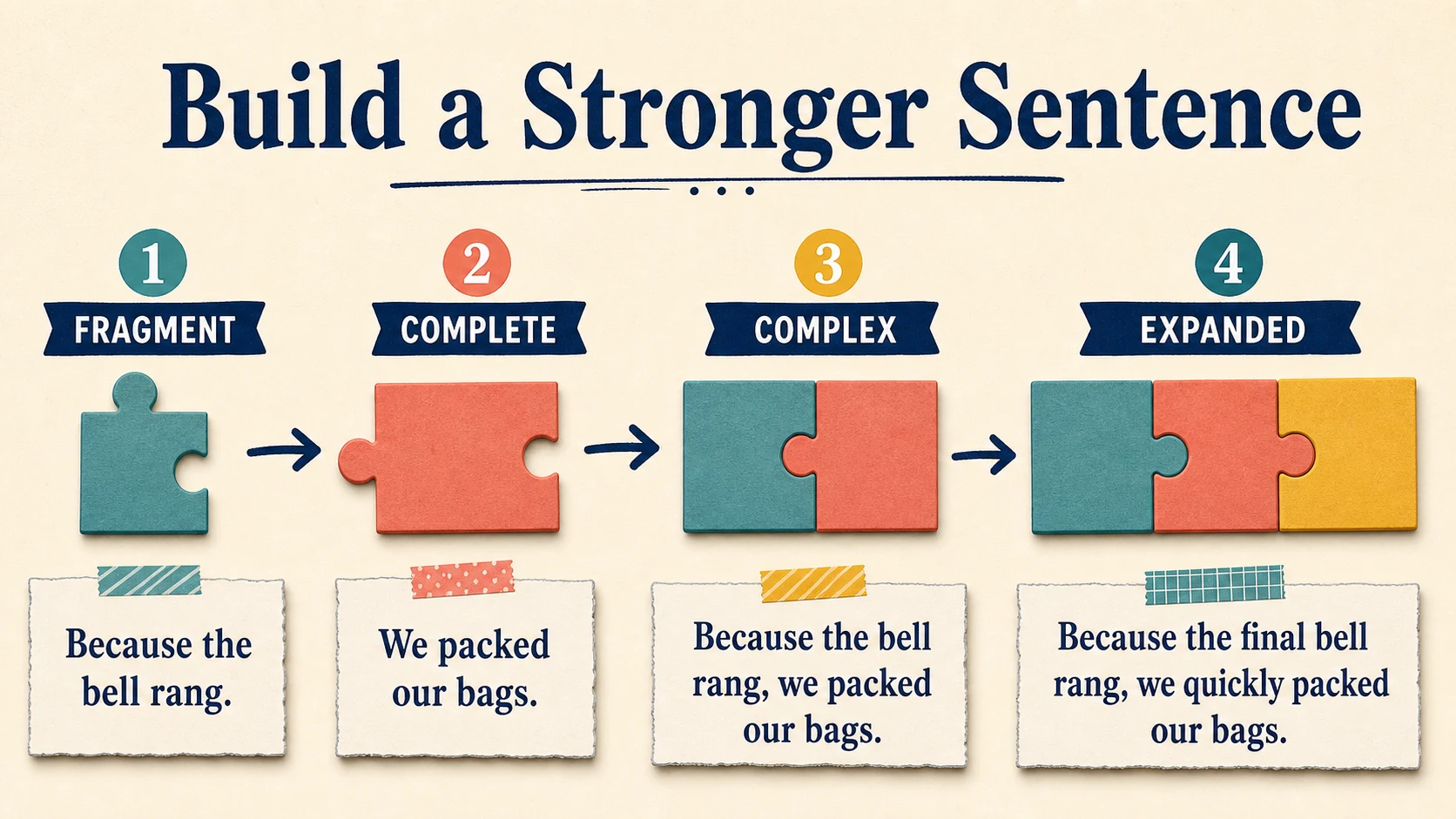
During guided practice, prompts should become less specific as the learner gains control.
Use prompts from broad to specific
Begin with a broad prompt:
- “What do you notice?”
- “Which words seem to belong together?”
- “What might the sentence be about?”
- “Read your arrangement aloud. Where does it stop sounding natural?”
If that is not enough, narrow the prompt:
- “Which word names the person, place, thing, or idea?”
- “Which word tells an action or state?”
- “Can you build the shortest complete idea first?”
- “Which words are still unused?”
Give an explicit model only after prompts fail. For example: “I see ‘the hikers’ as a possible subject. Now I am looking for what the hikers did.” Then ask the learner to continue.
Avoid supplying the first word automatically. That shortcut may complete the page while hiding whether the learner understands how sentence parts relate. Also avoid asking the learner to try every possible order. A five-word item has many theoretical arrangements; grammatical reasoning is more efficient than random rearrangement.
Fade assistance deliberately
On the first guided item, you might identify the subject. On the next, ask the learner to identify it. By the final guided item, wait while the learner uses the complete checking routine independently.
Move to independent practice when the learner can:
- Propose a plausible sentence opening
- Keep common word groups together
- Use all supplied words
- Read the result and detect at least some awkward ordering
- Explain why the sentence is complete
These are practical readiness signs for this activity, not a formal score or diagnostic threshold.
Manage the 30 Independent Items
The worksheet contains 30 exercises, but the page can be divided into smaller sets without changing the skill. Cover the unassigned portion with another sheet of paper, mark a stopping point, or fold the page so only the current set is visible.
A reasonable first independent set is five items. Afterward, look at both accuracy and behavior. If the learner solves them carefully and explains the constructions, assign another set. If accuracy drops sharply or the learner begins rushing, stop and review. More items are not automatically better practice when the same misunderstanding is being repeated.
During independent work, observe quietly. Note whether the learner:
- Writes immediately without planning
- Whispers possible sentences aloud
- Crosses off words after using them
- Checks for unused words
- Revises an awkward sentence
- Depends on the capitalization of one word to find the beginning
- Treats every item as a subject-first statement
Oral rehearsal is useful here because syntax can often be heard before it can be explained. The learner may say several arrangements softly and recognize which one sounds coherent. The earlier IES foundational reading guide concerns kindergarten through grade 3, so it should not be presented as evidence about this fifth-grade worksheet. At a broad literacy level, however, it illustrates that spoken language, word knowledge, and connected text are related parts of literacy instruction. Here, oral rehearsal is simply a practical way to inspect a sentence before writing it.
Adapt Support Without Changing the Skill
Adapt the access conditions while preserving the demand: the learner must still determine the correct word order. Do not quietly convert the activity into copying sentences that an adult has already assembled.
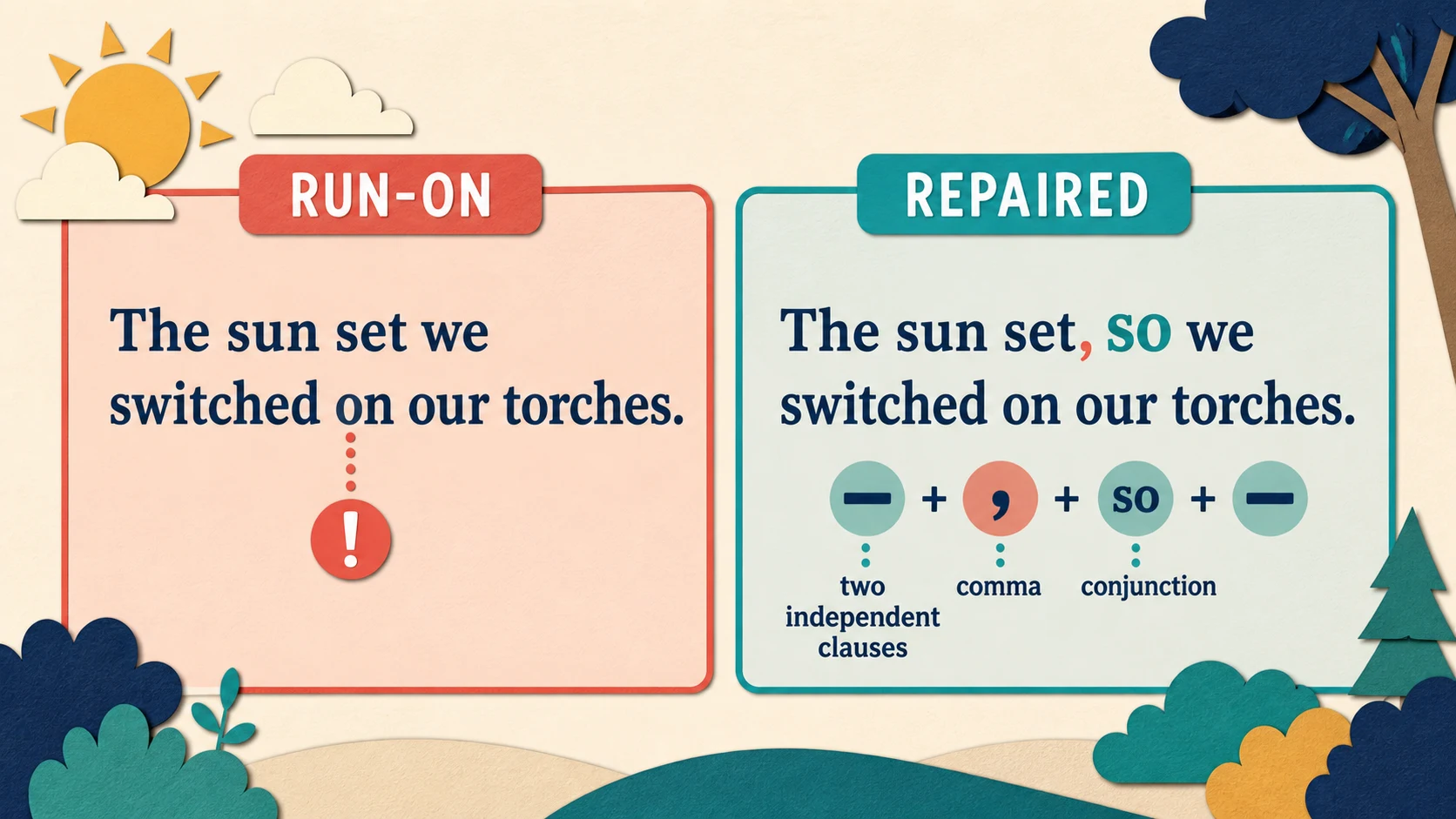
Change the amount or form of support while keeping sentence reconstruction as the learner’s task.
When the learner needs more concrete support
Rewrite one item on separate word cards. Let the learner move the cards, read each arrangement aloud, and settle on a final order. Physical movement reduces the burden of erasing and rewriting, but it does not supply the solution.
You may also ask the learner to group words before ordering them. For example, the learner might place “the small boat” together, then search for a verb. Do not label every grammatical category unless those labels help. “Who or what?” and “What happened?” may be enough.
Assign fewer items per round. Completing three carefully reconstructed sentences can reveal more than completing fifteen through guesses. Keep all original words and require a complete sentence so the target skill stays intact.
When the learner is nearly independent
Provide a small checklist rather than verbal help:
- Build a possible subject.
- Find the action or state.
- Add the remaining details.
- Use every word once.
- Read the whole sentence aloud.
Ask the learner to place a dot beside uncertain answers. Review those first. This makes uncertainty visible and discourages the learner from pretending every response feels equally secure.
If one sentence sounds unnatural, point only to that item and say, “Check the order again.” The learner then performs the analysis.
When the learner finishes accurately and quickly
Do not make the learner repeat equivalent easy items solely to fill time. Ask for a brief explanation of two constructions, or choose one completed sentence and change its beginning while preserving the basic meaning.
For instance:
- Original: The team practiced after school.
- Variation: After school, the team practiced.
This extension connects word order to sentence variety without changing the original answers. For a broader progression into combining, expanding, and varying sentences, use the 5th Grade grammar collection or the topic guide rather than expecting this single printable to cover every sentence-structure skill.
Interpret Errors Before Correcting Them
A total score gives limited information. Group errors by pattern so the next teaching move addresses what the learner actually did.
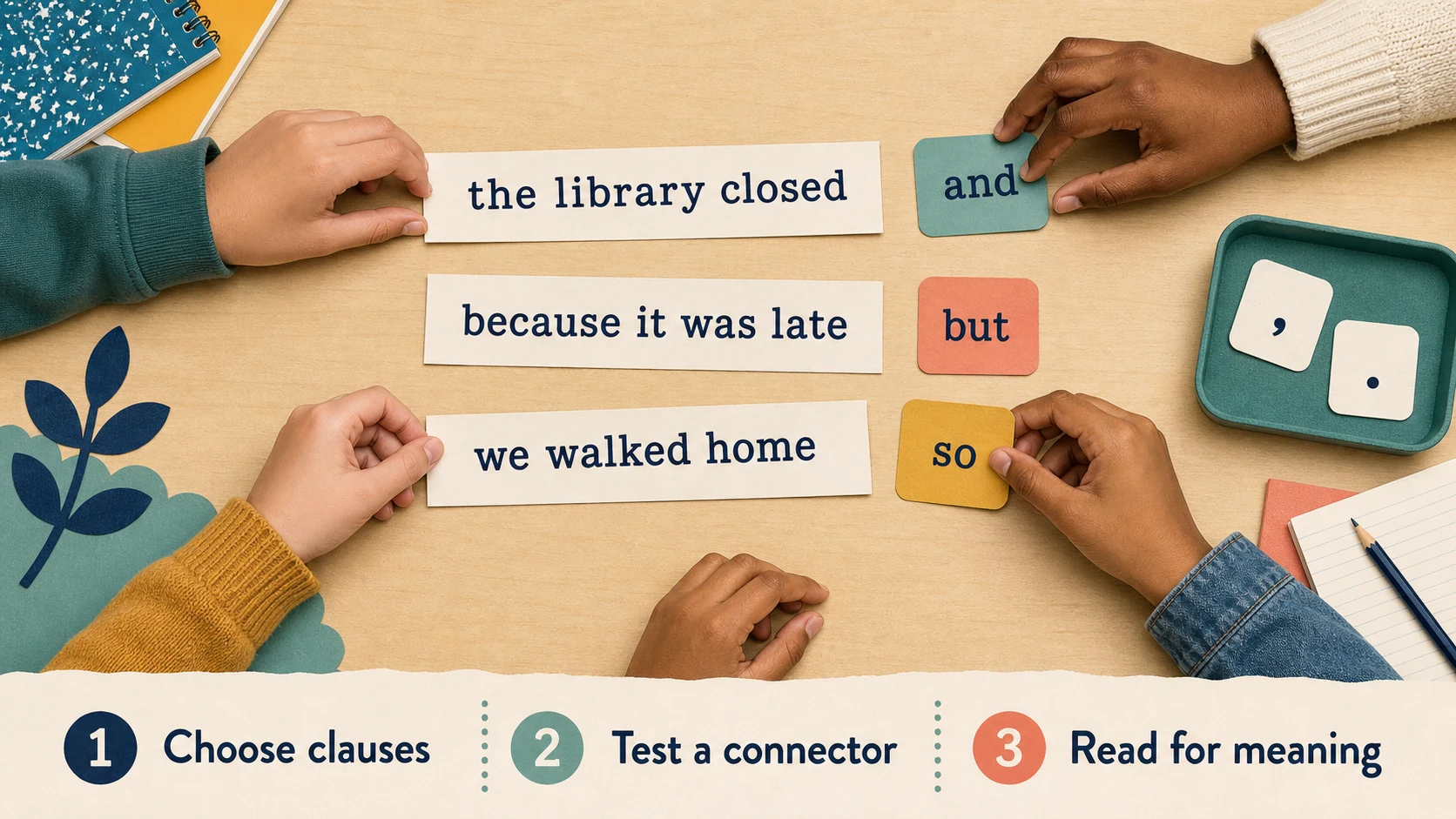
Identify the error pattern, prompt one revision, and then check whether the same pattern appears again.
Missing or repeated words
Example pattern: the learner constructs a sensible sentence but leaves one supplied word unused.
Possible interpretation: the learner is prioritizing meaning but not monitoring the item constraints.
Useful response: have the learner cross off each word as it is used, then compare the number of supplied words with the number used. Do not initially reveal where the missing word belongs.
A complete idea with awkward modifier placement
Example pattern: The dog carried quickly the stick.
Possible interpretation: the learner has identified the central subject, verb, and object but is uncertain where an adverb sounds natural.
Useful response: ask the learner to read the sentence in two forms: “The dog quickly carried the stick” and “The dog carried the stick quickly.” Discuss which arrangement fits the intended emphasis. If both are grammatical, acknowledge both.
Reversed helping verbs or question order
Example pattern: Why Marcus did leave early?
Possible interpretation: the learner is applying ordinary statement order to a question.
Useful response: compare a statement and question:
- Marcus did leave early.
- Why did Marcus leave early?
Ask what moved. Then return to the worksheet item. The goal is a focused correction, not an unrelated lecture on every kind of question.
Fragments that sound like meaningful phrases
Example pattern: Under the old bridge.
Possible interpretation: the words create a coherent phrase, but the learner has not checked for a complete thought.
Useful response: ask, “What happened under the old bridge?” This directs attention to the missing predicate without immediately supplying one. On the actual worksheet, all supplied words should then be reconsidered to find the complete sentence.
Grammatically valid alternatives
Sometimes the learner’s sentence may differ from the answer key yet remain complete and use every word once. Adjectives, adverbs, and introductory phrases can permit more than one acceptable arrangement.
Useful response: compare meanings. Ask which word each modifier describes and whether punctuation would be needed in ordinary writing. Accept a genuinely grammatical alternative while explaining the key’s intended arrangement.
Do not accept an answer merely because its general meaning can be guessed. The carefully scientist recorded results is understandable, but “carefully” cannot directly modify “scientist” in that position. The sentence must be grammatically formed, not merely decodable.
Check the Answer Key Responsibly
Use the separate answer key after the learner attempts a set. It is a checking tool, not a substitute for reading the learner’s sentence.
For each mismatch:
- Read the learner’s version exactly as written.
- Confirm that every supplied word appears once.
- Decide whether the response is complete and grammatically natural.
- Compare its meaning with the keyed arrangement.
- Mark it correct if it is a defensible alternative.
- If it is not correct, offer one targeted clue and request a revision.
- Show the keyed answer only after the learner has had a reasonable chance to repair the sentence.
Track first attempts and revised answers separately. A learner who corrects an item after “Check where the helping verb belongs” is showing something different from a learner who can revise only after seeing the full answer. Neither result should be exaggerated into a broad claim about writing ability.
The IES elementary writing practice guide supports high-level attention to writing practice, the writing process, and fluency with sentence construction. It did not evaluate WorksheetWise or this printable. Its relevance here is limited to the broad instructional principle that sentence construction belongs within elementary writing instruction.
Decide What to Teach Next
Use the dominant error pattern rather than an arbitrary percentage alone.
If most errors involve unused words, continue with short word-order sets and a cross-off routine. If the learner forms grammatical sentences but differs from the key, discuss modifier meaning and flexible order. If responses are fragments, revisit subjects, predicates, and complete thoughts. If statements are secure but questions are not, contrast those two structures directly.
If the learner completes the page accurately but original writing remains repetitive, move beyond rearrangement. Practice expanding or combining sentences and varying beginnings. If the learner cannot identify basic sentence parts even with word cards and oral prompts, return to the earlier concepts in the Sentence Structure topic guide.
The Common Core ELA standards present grade-specific language expectations within a broader literacy framework that includes reading, writing, speaking, listening, and language across subjects. That framework can help an educator place sentence work in context, but this article does not claim comprehensive standards alignment for one 30-item worksheet. Local requirements and teaching sequences may differ.
Schedule Retrieval and Transfer
A finished worksheet should not automatically be filed away and forgotten. Revisit a small sample after time has passed so the learner must reconstruct the reasoning rather than recall a correction from moments earlier.
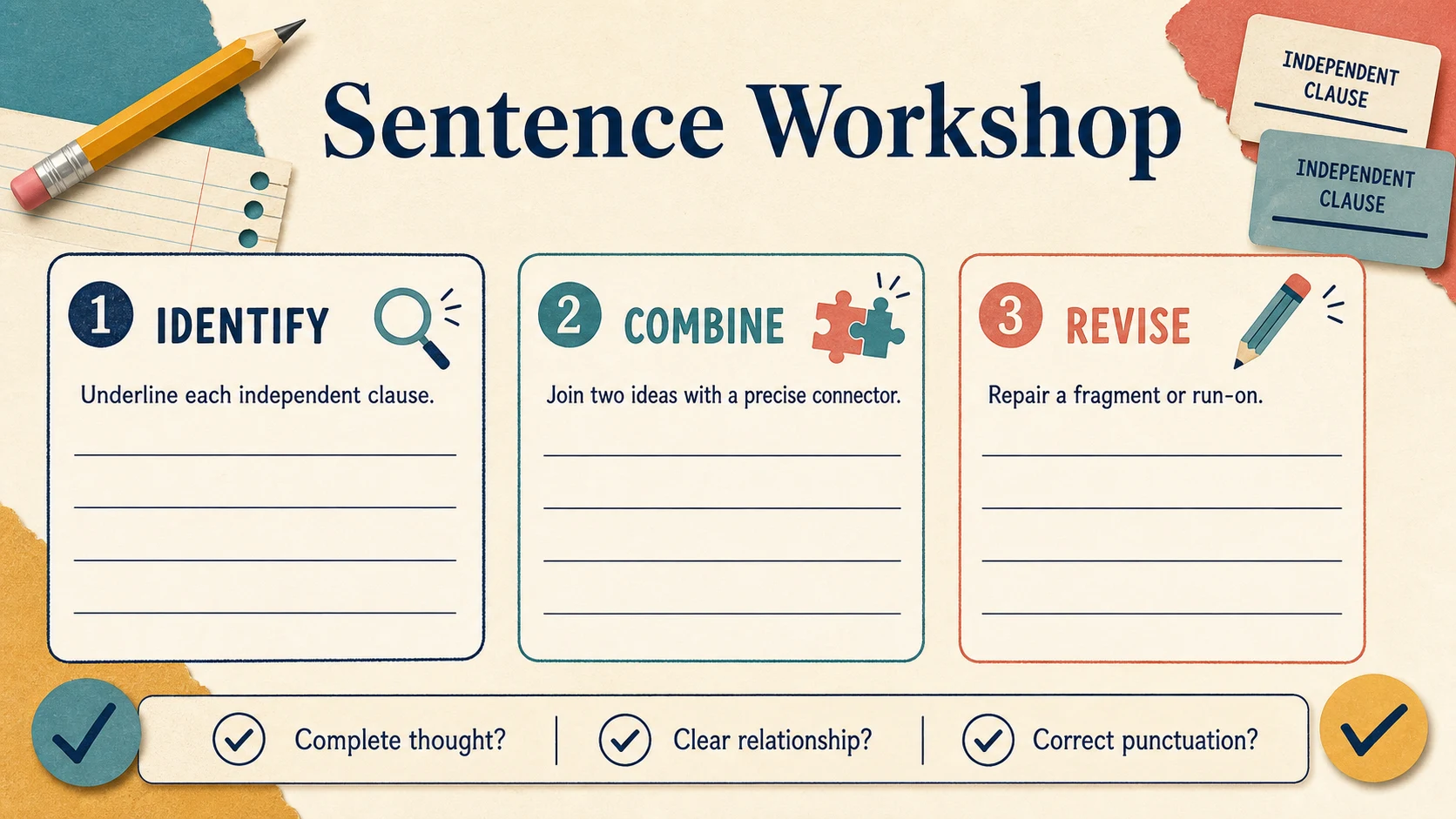
Use brief, spaced checks and adjust the intervals according to the learner’s observed recall.
One practical schedule is:
- Later in the first lesson: Reconstruct one previously corrected item without looking at the old response.
- At the next suitable lesson: Revisit two items representing different structures.
- Several days later: Mix one secure item with two items drawn from earlier error patterns.
- In a later writing task: Ask the learner to check one original sentence for a clear subject, a complete predicate, natural word order, and a complete thought.
This schedule is a flexible instructional suggestion, not a universal timetable. Shorten the interval when the learner cannot reconstruct the idea. Lengthen it when the learner recalls the process accurately and applies it independently.
For transfer, ask the learner to write one original sentence connected to familiar content. Then cut or rewrite that sentence into separate words, scramble them, and reconstruct it. Finally, compare the reconstruction with the original. This keeps the task concrete while showing that word order serves meaning in real writing.
Understand the Worksheet’s Limits
This printable provides 30 easy-level exercises in arranging words into complete sentences. It can show how the learner handles constrained word-order problems, but it cannot by itself establish overall grammar mastery or writing proficiency.
It does not comprehensively measure:
- Paragraph organization
- Sentence combining across a passage
- Independent vocabulary selection
- Sustained composition
- Editing an original draft
- Reading comprehension
- Every type of simple, compound, or complex sentence
Success may also reflect familiarity with worksheet conventions. A learner might use capitalization to guess the first word without understanding the remaining syntax. Conversely, a learner might understand the sentence orally but make a copying error. That is why observation, explanation, revision, and a small transfer task matter alongside the answer key.
Keep claims appropriately narrow: the work shows what happened on these items under these conditions. It does not guarantee future outcomes, provide medical or diagnostic guidance, or replace local instructional judgment.
Take the Next Useful Step
Begin with the free 30-item worksheet, model one similar example, and assign only the first manageable set. Record the error pattern—not just the score—and use that evidence to choose what follows.
If the learner needs a broader sequence, continue with the 5th Grade Sentence Structure topic guide. If repeated practice across this skill is appropriate, review the 18-worksheet focused pack. For fresh practice configured for another lesson, explore the free worksheet generators.
Put it into practice
Use the guide with a real printable
Move from explanation to a short, observable practice task. Check the first item together, then adjust the next session from the learner's actual work.
See the 18-worksheet pack