Complete guide
How to teach and practise 5th grade punctuation worksheets - standard theme (easy)
What this worksheet teaches
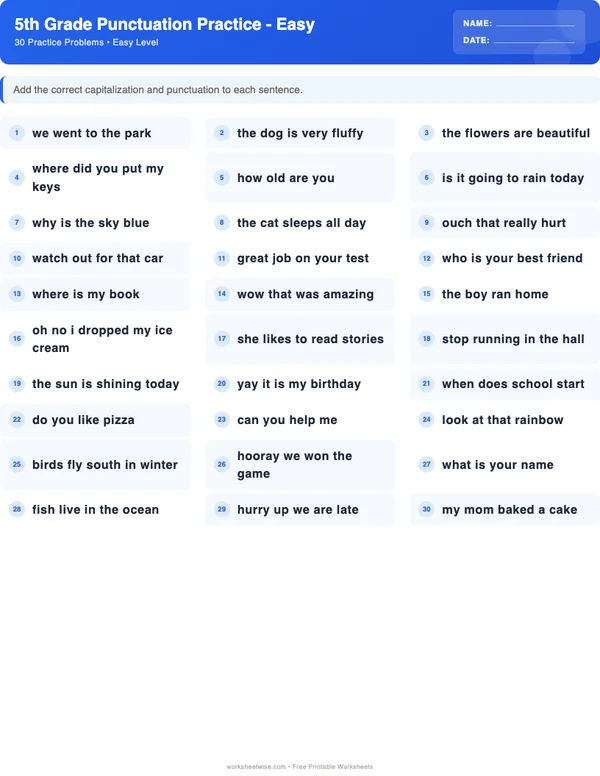
The free 5th Grade Punctuation worksheet gives a learner 30 easy-level sentences to edit. For each sentence, the learner adds correct capitalization and chooses suitable end punctuation: a period, question mark, or exclamation mark.
The direct teaching goal is simple: help the learner recognize what a sentence is doing, then mark its beginning and ending correctly. A successful response should:
- Begin with a capital letter.
- Capitalize any other word that clearly requires it, such as a person’s name.
- End a statement with a period.
- End a direct question with a question mark.
- Use an exclamation mark when the sentence clearly expresses strong feeling, urgency, excitement, or a forceful command.
This printable is best treated as a short editing lesson, not merely a page to complete. Model several sentences, solve a few together, let the learner work independently, and then use the answer key to discuss patterns in the learner’s decisions.
Grade labels describe the intended practice level; local curricula and teaching sequences differ. Although this sheet is labeled for fifth grade, its easy difficulty and foundational focus may also make it useful for a fifth grader who needs reinforcement before working on commas, apostrophes, quotation marks, or more complex editing.
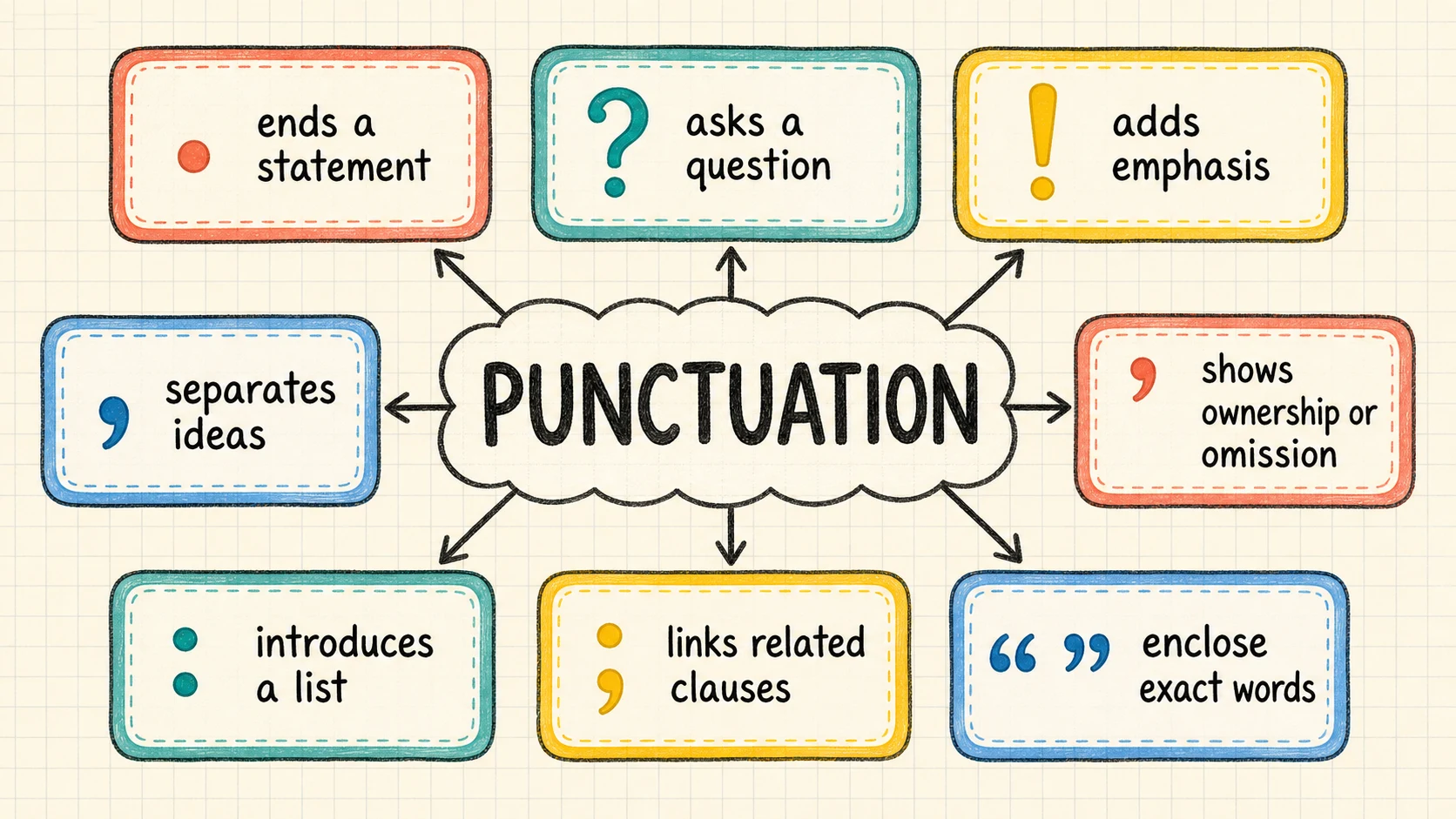
Model the decision, practice it together, observe independent work, and return to uncertain items later.
Prepare a focused punctuation lesson
Before handing over the printable, read its instruction aloud: “Add the correct capitalization and punctuation to each sentence.” Ask the learner to explain that instruction in their own words. The explanation does not need to sound formal. A useful response would be, “Fix the beginning and put the right mark at the end.”
Have the following materials ready:
- The worksheet
- A pencil and eraser
- A colored pencil for corrections
- The separate printable answer key, kept out of sight during initial work
- A blank sheet or small whiteboard for modeling
Do not begin with a long review of every punctuation rule. This worksheet addresses a narrow set of skills: capitalization, periods, question marks, and exclamation marks. Teaching commas, apostrophes, or dialogue conventions during the same lesson may distract from the actual task.
Use a short oral check first
Say three original sentences aloud:
- “The bus is here.”
- “Is the bus here?”
- “The bus is here!”
Ask what changes in the speaker’s purpose. The words are nearly identical, but the sentences do different jobs. The first gives information, the second asks for information, and the third expresses excitement or urgency.
Then show the sentences in writing without end punctuation. Ask the learner to add the marks. This quick check reveals whether the learner can connect meaning to punctuation before managing all 30 items.
Reading aloud may help, but voice alone is not an infallible rule. People do not always raise their pitch when asking a question, and an excited voice does not automatically make every sentence an exclamation. Meaning and sentence purpose should lead the decision.
A practical lesson progression
The entire worksheet does not have to be completed in one sitting. The learner’s observed work should determine whether to continue, pause, or divide the page into smaller sets.
| Lesson stage | Suggested activity | What the adult observes | Possible response |
|---|---|---|---|
| Launch | Read the instruction and complete the oral check | Does the learner understand that both capitalization and punctuation must be added? | Restate the task in two steps if needed |
| Model | Demonstrate two or three new examples | Can the learner explain why a mark fits? | Repeat the meaning-based explanation |
| Guided practice | Complete three to five worksheet items together | Does the learner make a choice before waiting for help? | Offer a limited prompt rather than the answer |
| Independent practice | Assign a manageable group of items | Are errors isolated or repeated? Does attention decline? | Continue, pause, or shorten the set |
| Review | Compare work with the answer key | Can the learner locate and explain corrections? | Sort errors by type |
| Transfer | Write or edit two original sentences | Can the learner apply the same decision outside the worksheet? | Model one more example if transfer is weak |
| Retrieval | Revisit selected items after a delay | Is the skill recalled without re-teaching? | Schedule another brief review |
A possible first session is 10 items rather than all 30. That is an instructional suggestion, not a universal timetable. One learner may complete 30 items accurately and calmly; another may show better thinking when the sheet is divided across several short sessions.
For a wider sequence that includes other punctuation marks and uses, consult the punctuation topic guide. The purpose here is to teach this particular printable well, not to reproduce the entire punctuation progression.
Model the exact task
Write one uncorrected sentence where the learner can see it:
where did you put the blue folder
Think aloud without turning the explanation into a guessing game:
I will first find the beginning of the sentence. The word “where” needs a capital letter. Next, I will decide what the sentence is doing. It asks where the folder was placed, so it is a direct question. I will use a question mark.
The corrected sentence is:
Where did you put the blue folder?
Finally, check both ends. Point to the capital W, move a finger across the whole sentence, and point to the question mark. This physical sweep makes the checking routine visible.
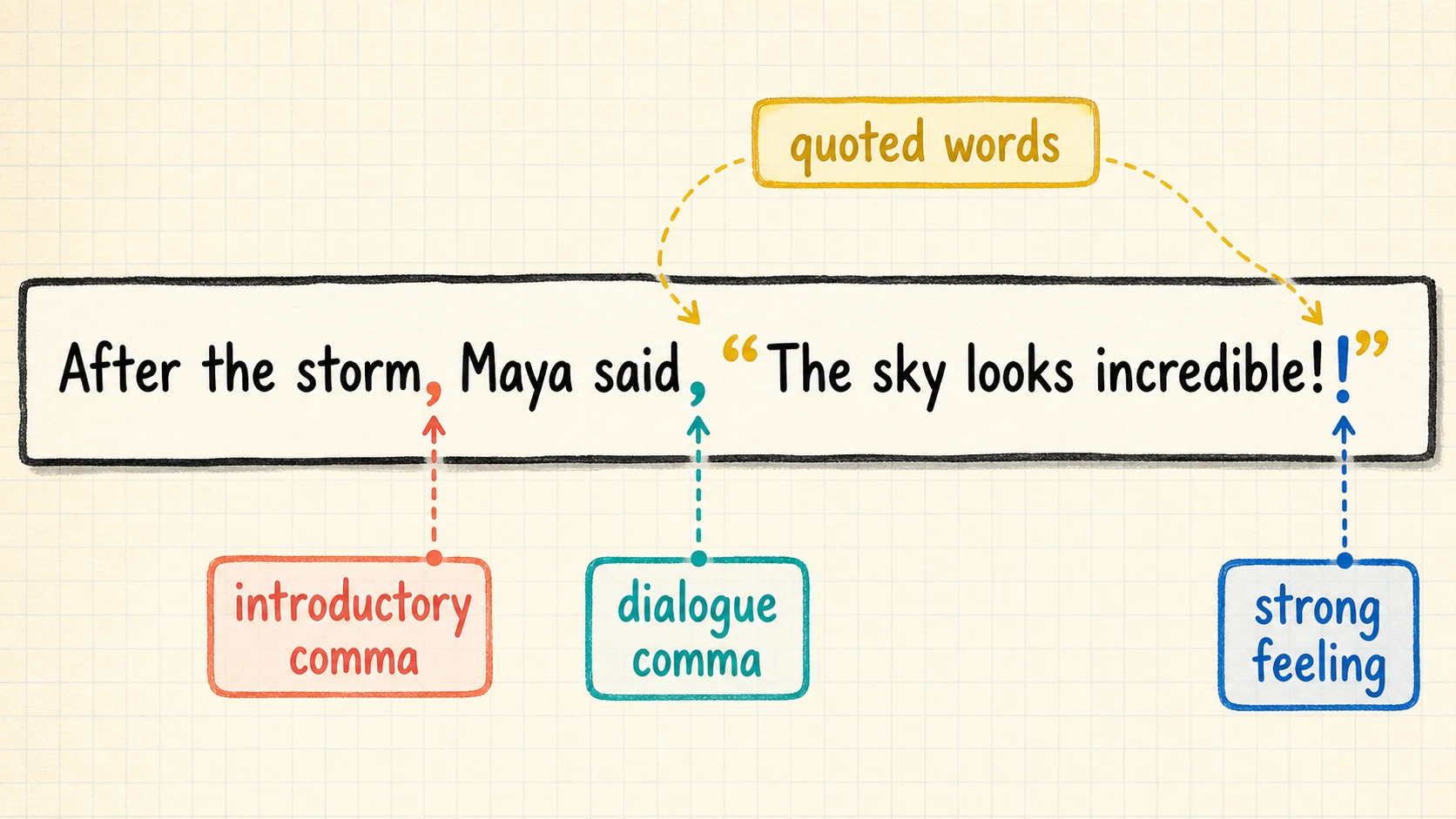
Identify the sentence’s purpose before selecting its final punctuation mark.
Four fully checked examples
The following examples are similar to the worksheet’s stated skill, but they are not presented as actual worksheet items.
Example 1
Uncorrected: the rabbit disappeared under the fence
Corrected: The rabbit disappeared under the fence.
Check:
- The begins with a capital letter.
- The sentence gives information.
- A period completes the statement.
Example 2
Uncorrected: did you bring your science notebook
Corrected: Did you bring your science notebook?
Check:
- Did begins with a capital letter.
- The sentence directly asks whether the notebook was brought.
- A question mark completes the question.
Example 3
Uncorrected: look out for that falling branch
Corrected: Look out for that falling branch!
Check:
- Look begins with a capital letter.
- The command communicates immediate danger.
- An exclamation mark fits the urgency.
Example 4
Uncorrected: maya finished the model on saturday
Corrected: Maya finished the model on Saturday.
Check:
- Maya is capitalized at the beginning and as a name.
- Saturday is capitalized.
- The sentence states what happened.
- A period completes the statement.
This fourth example demonstrates that checking capitalization may require more than changing the first letter. When the worksheet includes a word that clearly needs a capital, the learner should attend to it as well as the sentence opening.
Keep the decision process compact
After modeling, reduce the routine to three prompts:
- What needs a capital?
- Is this a statement, question, or strong exclamation?
- Which mark matches that purpose?
Avoid supplying a rule before the learner has looked at the sentence. The goal is not rapid answer production at any cost. It is a repeatable editing decision the learner can eventually make without prompting.
Run guided practice before independent work
Complete several worksheet items together. Ask the learner to do the thinking while the adult controls the pace.
A useful exchange might sound like this:
- Adult: “Read the sentence once.”
- Learner reads.
- Adult: “What is the sentence doing?”
- Learner: “It is asking something.”
- Adult: “Show me what you will change.”
- Learner adds the capital and question mark.
- Adult: “Check the beginning and ending.”
If the learner hesitates, use a prompt that narrows attention without revealing the answer:
- “Is someone asking for information?”
- “Does this sentence simply tell what happened?”
- “Is the feeling strong enough to need an exclamation mark?”
- “Which letter begins the sentence?”
- “Are there any names or calendar words to check?”
These prompts preserve the skill. Telling the learner, “Put a question mark there,” may finish the item, but it does not show whether the learner can classify the sentence independently.
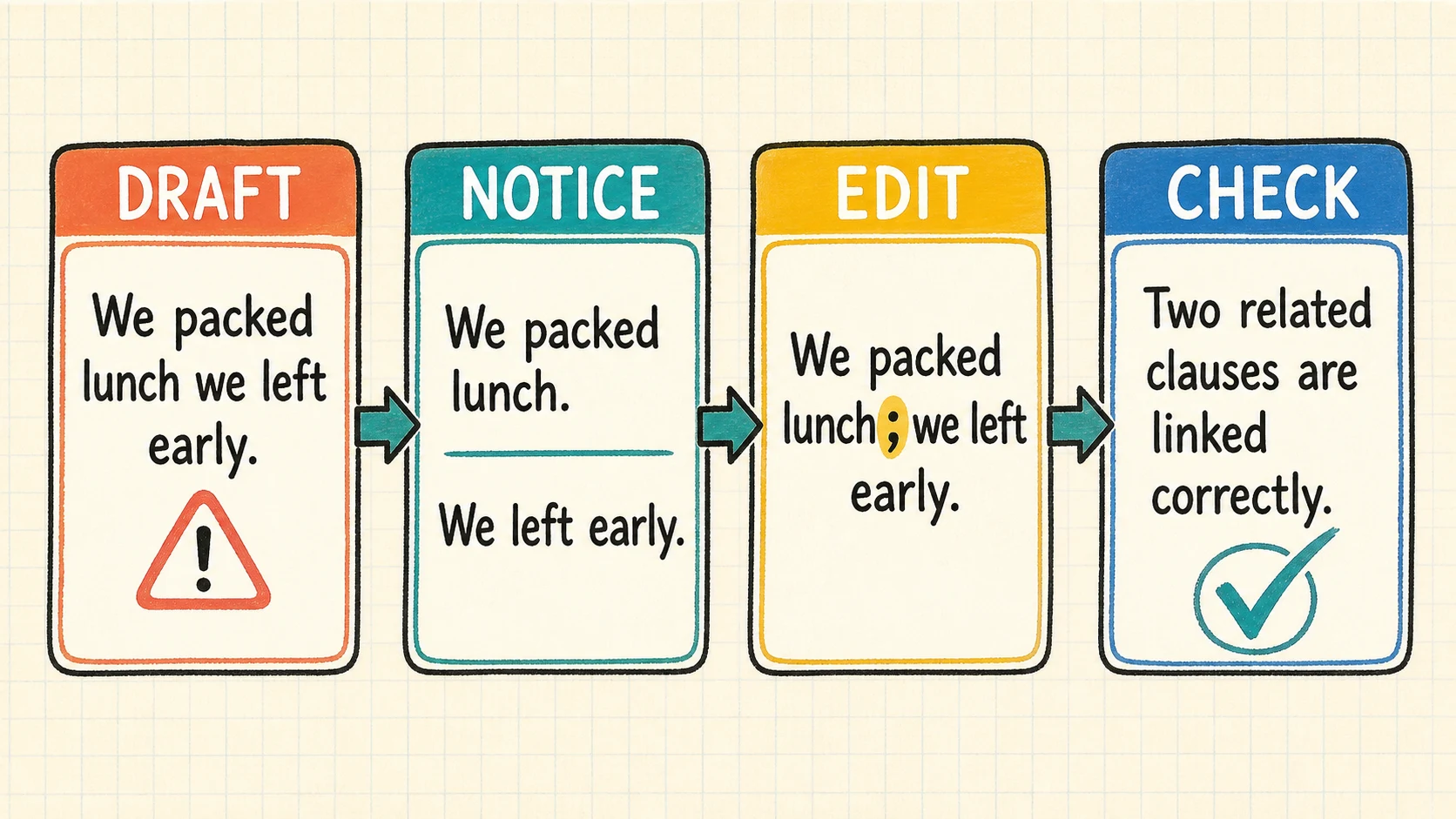
Guided practice should make the reasoning visible while leaving the final decision to the learner.
Know when to release responsibility
Move to independent work when the learner can correctly explain and punctuate several varied examples with little or no prompting. Do not require a perfect performance before allowing independence, but do look for a stable routine.
Signs that the learner is ready include:
- Reading the whole sentence before writing
- Capitalizing the first word without a reminder
- Distinguishing direct questions from statements
- Reserving exclamation marks for clearly strong meanings
- Checking the final mark before moving on
If the learner still guesses among the three marks, continue guided practice. More independent items will otherwise rehearse the guessing pattern.
Manage the 30 independent items
Give a clear stopping point. For example, circle item 10 and say, “Complete through this item, then bring the page back for a quick check.” A visible stopping point can make a 30-item sheet feel manageable without reducing the intellectual demand of any item.
During independent work, observe quietly. Notice whether the learner:
- Reads each sentence completely
- Marks only the ending and forgets capitalization
- Uses one punctuation mark repeatedly
- Changes answers after rereading
- Works accurately at first but becomes careless later
- Asks for confirmation on every item
- Finishes so quickly that words are skipped
These observations are more useful than the total score alone. Ten errors caused by misunderstanding sentence purpose call for a different response from ten errors caused by omitting capital letters while correctly choosing every end mark.
Separate knowing from checking
A learner may know that questions require question marks but still omit one while rushing. Ask the learner to review the page in two passes:
- Inspect only capitalization.
- Inspect only end punctuation.
A focused second pass reduces the amount of information being checked at one time. It also helps distinguish a knowledge gap from an inconsistent editing habit.
Do not require the learner to erase every correction until the original thinking becomes invisible. A neat colored-pencil correction can preserve useful evidence: the first answer, the correction, and the reason for the change.
Adapt support without changing the skill
Support should make the same capitalization-and-punctuation decision more accessible. It should not replace the decision with an easier, unrelated activity.
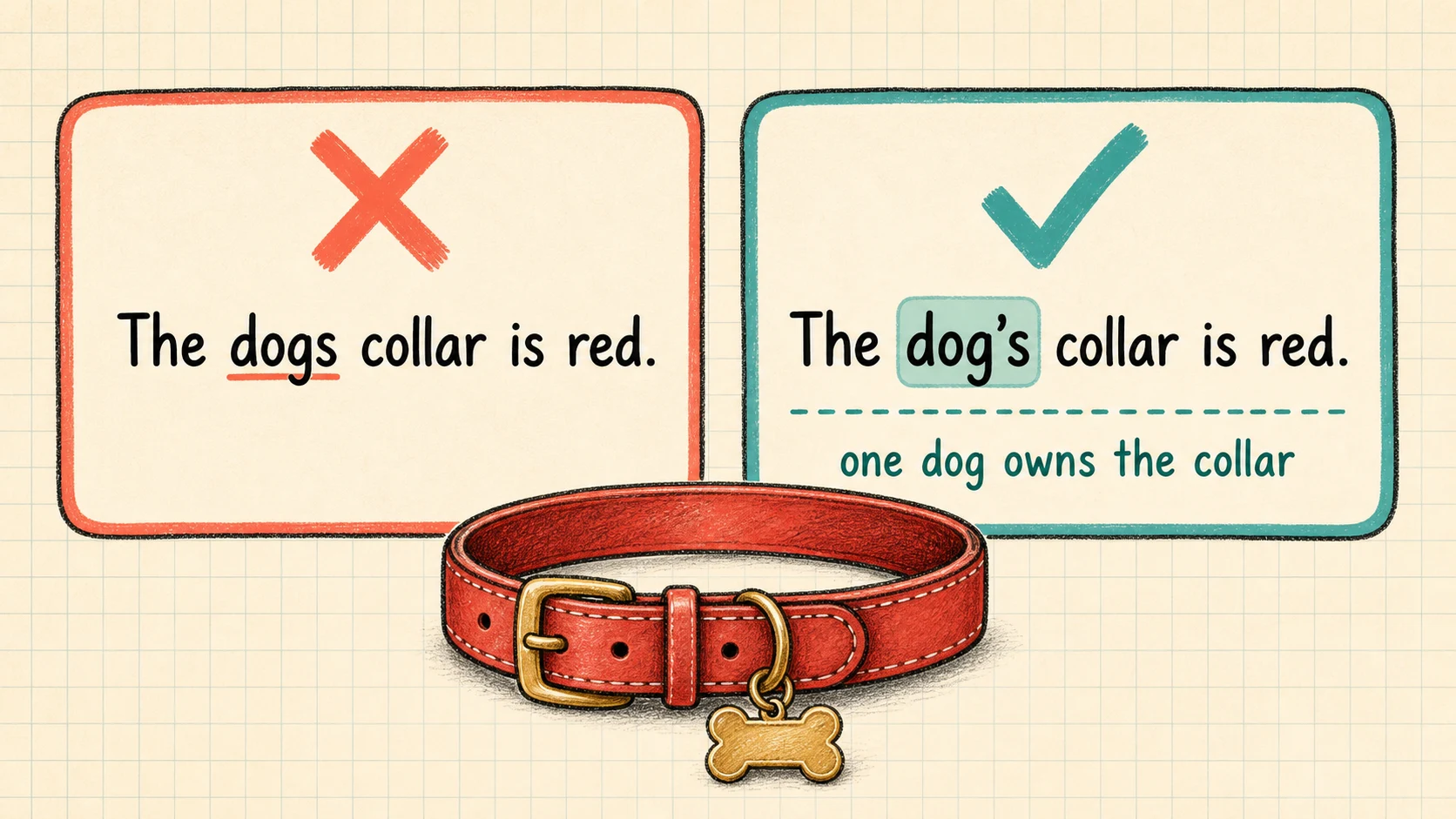
Adjust the amount, presentation, or prompting while keeping the editing target intact.
When the learner needs more support
Cover the lower part of the page and expose one item at a time. Read a sentence aloud if decoding effort is preventing the learner from attending to punctuation, but then ask the learner to explain the sentence’s purpose and make the written correction.
You can also provide a small reference card:
| Sentence purpose | Likely end mark |
|---|---|
| Tells or states | Period |
| Directly asks | Question mark |
| Shows strong feeling, excitement, or urgency | Exclamation mark |
The word “likely” matters. Punctuation depends on meaning and context, not merely on a single signal word.
Other useful supports include:
- Dividing the sheet into sets of five
- Underlining the first word before capitalizing it
- Asking the learner to circle the chosen end mark in a small
. ? !menu before writing it - Having the learner read the corrected sentence aloud
- Completing one model after a break before resuming independent work
When accuracy is strong but attention is inconsistent
Keep the sentences unchanged, but add a checking requirement. For every fifth item, ask the learner to place a small check above the initial capital and another below the end mark. This slows the final inspection without adding new punctuation content.
If mistakes appear mainly near the end of the page, shorten the next work set. That pattern may reflect fading attention, but the worksheet alone cannot establish why attention changed. Describe what you observed rather than assigning a cause.
When the worksheet is too easy
Do not simply demand faster completion. Ask for brief transfer while retaining the same skill:
- Rewrite one statement as a direct question.
- Change a calm command into an urgent exclamation.
- Write one original statement, one question, and one exclamation.
- Explain why a period would change the tone of a sentence that currently ends with an exclamation mark.
For broader or more varied practice, the 5th Grade Grammar hub provides a more appropriate route than forcing advanced punctuation into this easy-level sheet.
Teach boundary cases honestly
Some isolated sentences can accept more than one end mark because the writer’s intended tone is unknown. Consider:
you finished the entire project
Two versions are mechanically possible:
- You finished the entire project. This is a neutral statement.
- You finished the entire project! This communicates strong surprise or excitement.
Without context, both may be defensible. The answer key may select one because a printable needs a definite expected response. If the learner chooses another plausible mark, ask for an explanation before counting it as a misunderstanding.
Commands also vary:
- Please close the door. is a calm request or command.
- Close the door! is forceful or urgent.
A command does not automatically require an exclamation mark. Likewise, a sentence that contains a question word is not automatically a direct question:
- Where is the library? asks a direct question.
- I know where the library is. makes a statement.
Teach the learner to consider the whole sentence rather than hunting for one clue.
Common misconceptions to watch for
“Every command takes an exclamation mark.”
Correct this by contrasting calm and urgent commands.
“A long sentence needs an exclamation mark.”
Sentence length does not determine the end mark. Purpose and tone do.
“A sentence with who, what, when, where, why, or how is always a question.”
Those words can appear inside statements. Read the complete sentence.
“Capitalization means changing only the first letter.”
The first word always needs attention, but names and other clearly capitalized words may also require correction.
“Exclamation marks make writing more interesting.”
They indicate a particular strength of feeling or force. Frequent use can blur that distinction.
“If the answer is wrong, the learner does not know the rule.”
One wrong response may come from a missed word, an unexamined tone, or an incomplete check. Look for repeated patterns before deciding what needs reteaching.
Interpret errors before assigning more practice
Sort errors by type. This takes only a few minutes and provides a clearer next step than recording one total score.
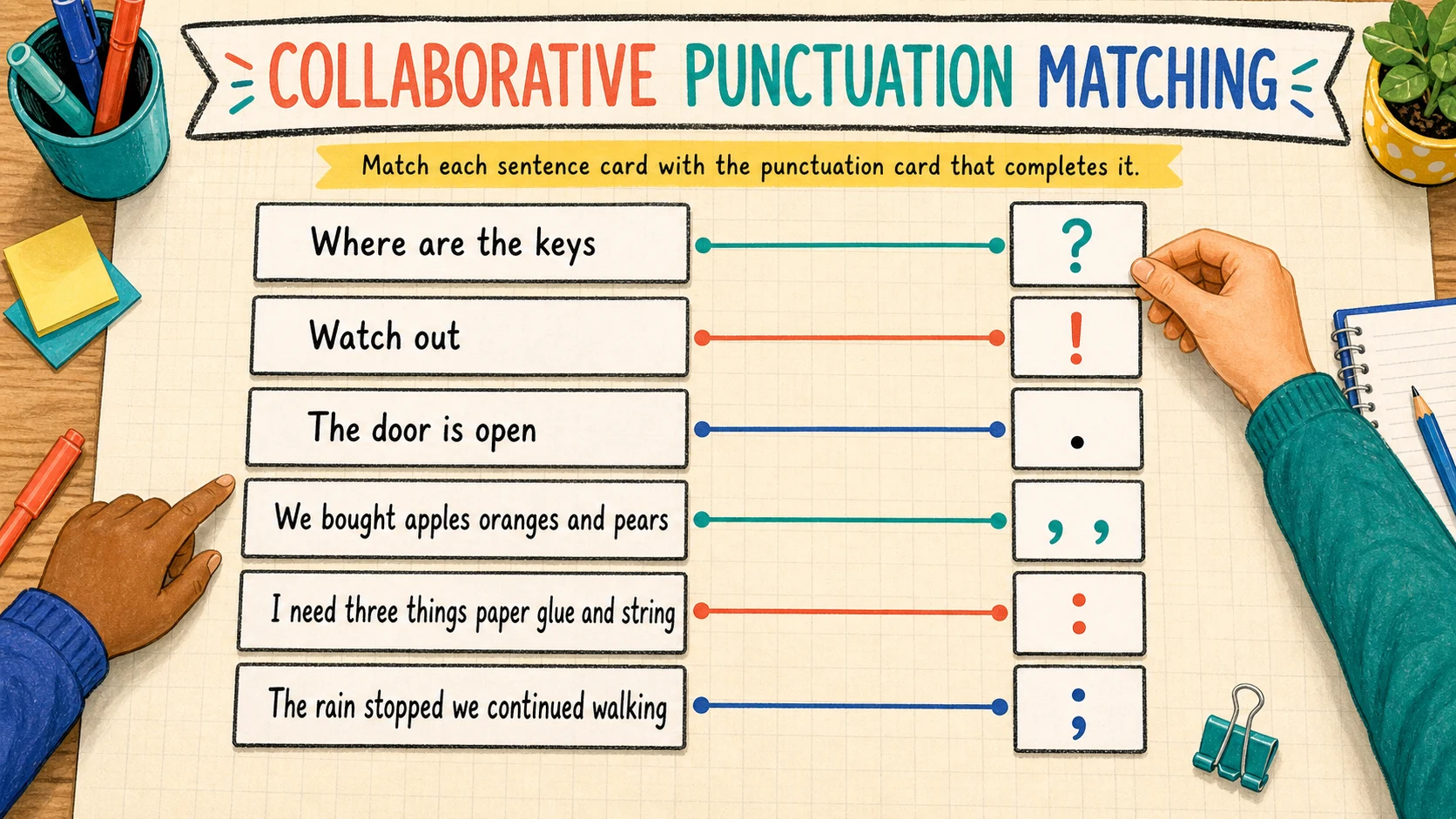
Identify the error pattern, discuss the decision, correct it, and test the same idea in a new sentence.
| Observed pattern | Possible interpretation | Useful response |
|---|---|---|
| First letters remain lowercase | The capitalization step is being skipped or forgotten | Use the two-pass check and mark every sentence beginning |
| Periods appear after direct questions | Sentence purpose may not be recognized | Contrast matched statements and questions |
| Question marks follow statements containing question words | The learner may rely on a keyword | Read the entire sentence and identify whether information is being requested |
| Exclamation marks appear on most items | Strong feeling may be confused with general emphasis | Compare neutral and urgent versions |
| Correct marks appear, but capitals are missing | The learner may treat the instruction as only an end-punctuation task | Restate the two-part instruction |
| Early items are accurate and later items are not | Performance changed across the work period | Use shorter sets and compare accuracy |
| Answers change correctly after oral reading | Rereading supports self-correction | Build oral or silent rereading into the routine |
| The learner explains an alternative mark convincingly | The sentence may allow more than one tone | Compare the explanation with the key and discuss context |
Use cautious language: “You chose periods for four direct questions” is an observation. “You do not understand questions” is a much broader conclusion that the page alone may not justify.
Correct a pattern, then test it
After discussing an error, give one new example that requires the same decision.
If the learner wrote a period after are we leaving after lunch, try:
will the game begin at noon
The checked version is:
Will the game begin at noon?
If the learner corrects the new sentence and explains that it directly asks for information, the immediate reteaching worked. If not, return to a statement-question contrast before assigning more items.
Use the answer key responsibly
The separate answer key is for checking after genuine attempts, not for copying or racing through corrections. Compare a small group of responses at a time.
For each mismatch:
- Read the original sentence.
- Ask the learner to explain the chosen capitalization and punctuation.
- Compare that reasoning with the key.
- Decide whether the response is incorrect, incomplete, or a defensible boundary case.
- Make a visible correction.
- State the rule or meaning in plain language.
Do not treat the key as evidence that the learner has mastered the skill. A corrected page shows that answers were reviewed. Transfer to a fresh sentence and later retrieval provide stronger evidence that the learner can make the decision again.
The key also cannot diagnose a reading difficulty, attention condition, or other learner-specific need. It identifies expected answers for this printable. Persistent concerns across different tasks should be discussed with the learner’s teacher or another appropriately qualified professional.
Schedule brief retrieval after the lesson
A correct page completed with recent modeling may reflect short-term support. Revisit a small sample later to see whether the learner can retrieve the decision process independently.
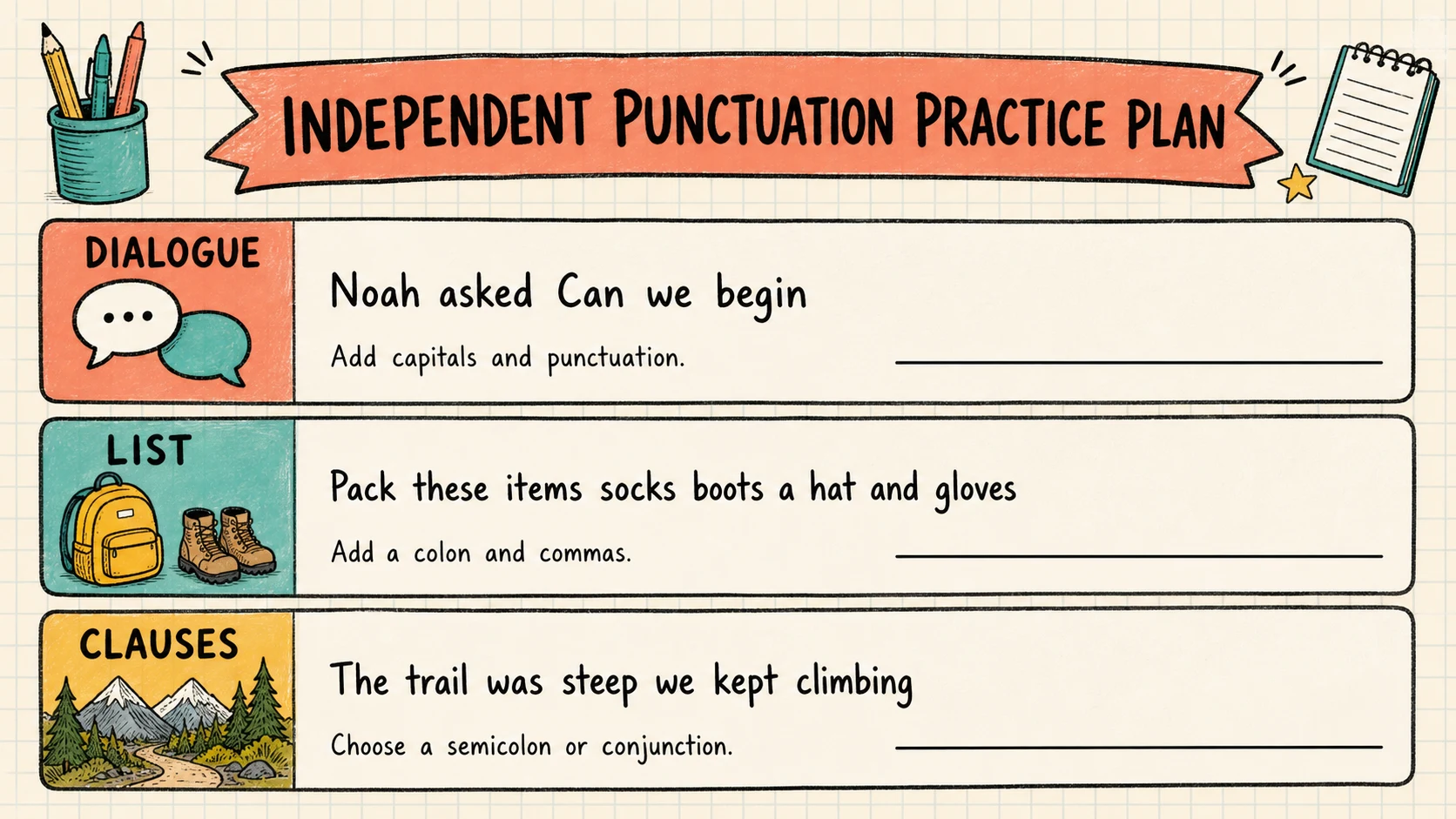
Return to a few varied sentences after a delay instead of repeating the entire page immediately.
A practical, adjustable schedule is:
| Time | Review activity | Decision |
|---|---|---|
| End of the lesson | Correct two errors and explain two correct answers | Is immediate understanding clear? |
| Next study session | Revisit three to five items without viewing previous corrections | Is the routine remembered? |
| Several days later | Edit three new sentences: a statement, question, and exclamation | Does the skill transfer? |
| One or two weeks later | Include several mixed items in a grammar warm-up | Is another review needed? |
This is an instructional example, not a universal timetable or a sourced prescription. Move the review sooner if the learner cannot recall the routine. Increase the interval when responses remain accurate and explanations are clear.
Choose retrieval items strategically. Include:
- One statement
- One direct question
- One clear exclamation
- One item that the learner previously missed
- One new sentence requiring the same reasoning
Avoid repeatedly practicing only the easiest category. If all review items are statements, correct periods do not show whether the learner can still distinguish questions and exclamations.
Place the worksheet in a broader instructional context
This printable offers focused practice, not a complete fifth-grade writing program. It does not cover every punctuation mark named in the broader topic catalogue. In particular, its listed skills do not include commas, apostrophes, quotation marks, colons, or semicolons. It also cannot show whether punctuation is used consistently in paragraphs, dialogue, research writing, or the learner’s own extended compositions.
The Common Core State Standards for English Language Arts provide a broad conventions framework that includes capitalization and punctuation. That framework can help adults understand the larger instructional context, but it should not be used to claim that one 30-item sheet comprehensively covers a standard or an entire local curriculum.
The IES guide to teaching elementary students to be effective writers supports high-level writing instruction rather than evaluating this worksheet. Its broader focus is a reminder to connect mechanics practice with actual writing. After the learner edits isolated sentences successfully, ask for a few original sentences and check whether the same conventions appear there.
The IES foundational reading skills guide is explicitly directed toward kindergarten through third grade. It does not provide fifth-grade validation for this punctuation printable. It is relevant only as broader background on explicit foundational instruction; it should not be stretched into a claim about this sheet’s effectiveness.
Use local curriculum documents and the learner’s current classroom work when deciding what comes next. The worksheet’s grade label identifies an intended practice level, not a guarantee that every fifth grader should use it at the same point or pace.
Decide what to do next
Base the next step on observed work:
- If capitalization and all three end marks are accurate in new sentences, move to the broader 5th Grade Punctuation guide and select the next relevant convention.
- If one category remains uncertain, revisit only that contrast. For example, practice neutral statements beside direct questions rather than repeating all 30 items.
- If the learner succeeds with prompting but not independently, use another short guided set before removing the prompts.
- If performance declines during a long sitting, use smaller groups of items and retain the same punctuation decisions.
- If the learner needs sustained mixed practice, consider the 5th Grade Punctuation Worksheet Pack, which contains 18 worksheets. Select pages according to the demonstrated need rather than completing the pack in order automatically.
- If you need fresh sentences for later retrieval, use the free worksheet generators to create a short follow-up set.
The most useful immediate action is to print the free worksheet and answer key, model one statement and one direct question, and begin with a small group of items. Record which decisions the learner makes independently; those observations should determine the next lesson.
Put it into practice
Use the guide with a real printable
Move from explanation to a short, observable practice task. Check the first item together, then adjust the next session from the learner's actual work.
See the 18-worksheet pack