Complete guide
How to teach and practise 5th grade parts of speech worksheets - standard theme (easy)
What This 29-Item Worksheet Teaches
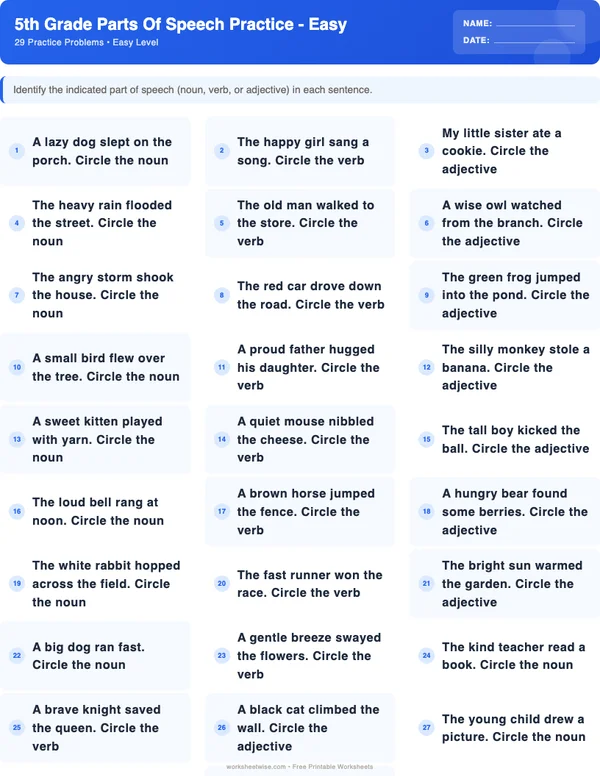
The free 5th Grade Parts of Speech worksheet gives a learner 29 easy-level exercises on identifying nouns, verbs, and adjectives in sentences. The printed instruction is: “Identify the indicated part of speech (noun, verb, or adjective) in each sentence.” A separate printable answer key is included.
The most effective way to use this printable is to model how a word’s job in a sentence determines its part of speech, solve a few items together, and then release the learner to work independently. Do not begin by asking the learner to memorize every part of speech. This worksheet has a narrower purpose: distinguishing nouns, verbs, and adjectives through sentence analysis.
Use the learner’s observed work to set the pace. A learner who explains early answers accurately may need only a brief launch. A learner who guesses, labels words by appearance, or cannot explain a choice needs more guided comparison before completing all 29 items.
Grade labels describe the intended practice level, not a guarantee that every fifth grader has encountered the same sequence. Local curricula, school programs, and homeschool plans differ. This easy worksheet may serve as an introduction, reinforcement, a warm-up, or a quick check of foundational understanding.
For instruction involving the full set of eight categories, use the broader Parts of Speech topic guide. This lesson stays focused on the three categories actually named in the worksheet catalogue: nouns, verbs, and adjectives.
A Practical Lesson Map
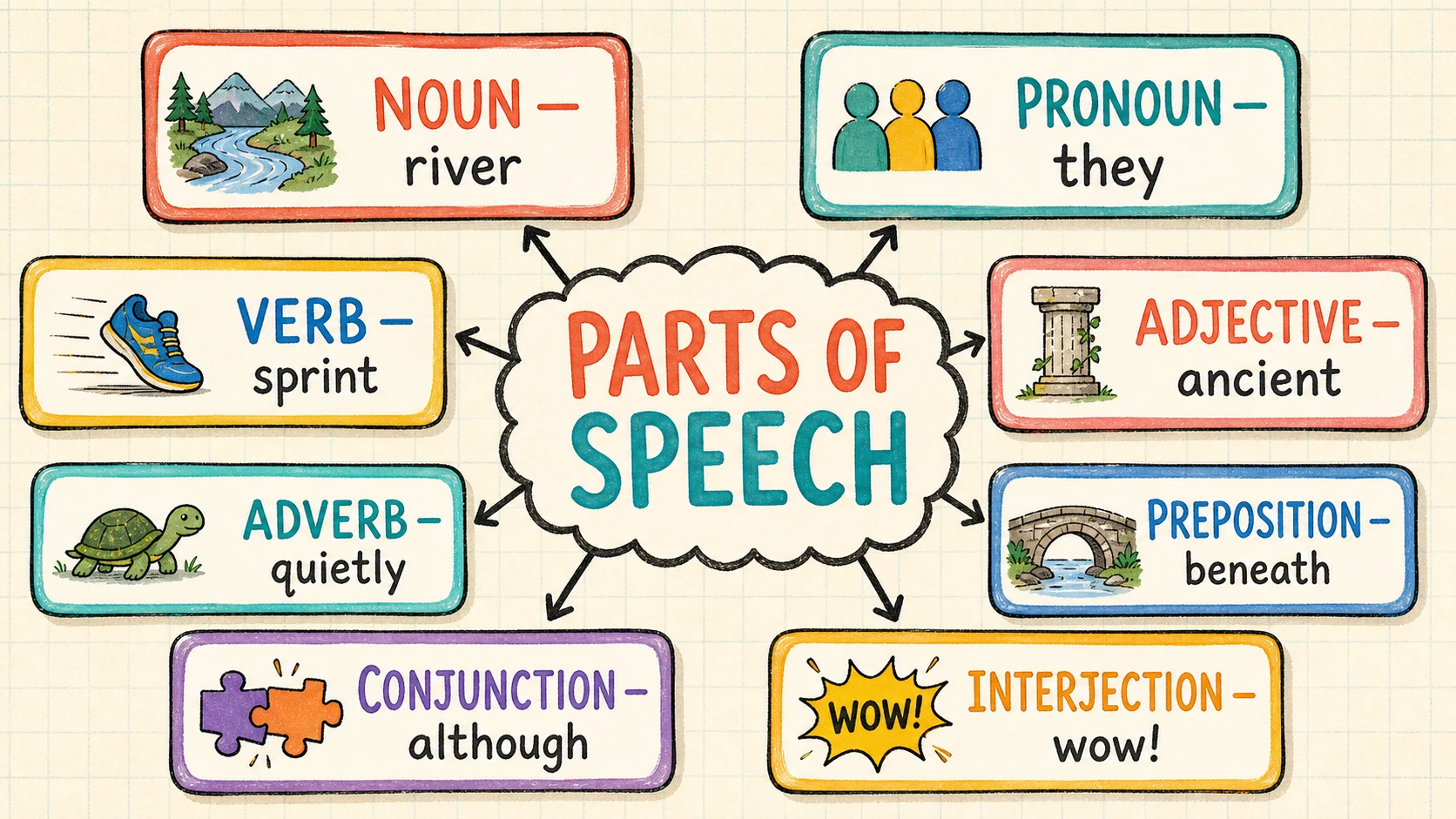
Move from a short explanation to modeling, shared analysis, independent work, correction, and later retrieval.
The following plan is a flexible instructional suggestion, not a universal timetable. Shorten or extend each phase according to what the learner says, writes, and corrects.
| Phase | Adult’s role | Learner’s role | Evidence to watch |
|---|---|---|---|
| Launch | Define the three categories in plain language | Restate each category and give an example | Can the learner distinguish a thing, an action or state, and a describing word? |
| Model | Think aloud through one sentence | Follow the reasoning and ask questions | Does the learner attend to the whole sentence? |
| Guided practice | Prompt without supplying the target word | Identify and explain choices | Can the learner connect an answer to a specific noun or sentence function? |
| Independent practice | Observe quietly and note patterns | Complete a manageable group of items | Are answers accurate, reasoned, and increasingly independent? |
| Check and correct | Use the answer key after reasoning | Compare, explain, and revise | Can the learner find why an answer was wrong? |
| Retrieval | Revisit selected examples later | Solve without copying earlier work | Is the distinction retained after a delay? |
Prepare before the learner begins
Print or open the worksheet and its separate answer key. Keep the key out of sight during initial practice. Preview enough of the printable to understand what each prompt asks the learner to identify.
Have three simple reference labels available:
- Noun: names a person, place, thing, or idea.
- Verb: expresses an action or a state of being.
- Adjective: describes or limits a noun or pronoun.
These definitions are useful starting points, but they are not substitutes for sentence analysis. English words can take different roles in different contexts. The learner must use the sentence, not merely a memorized word list.
Choose an appropriate starting amount
Do not assume that “29 items” means “29 items in one sitting.” Begin with a small sample. If the learner identifies the requested categories and explains the choices, continue. If explanations are uncertain, pause for a contrasting example before assigning another group.
Possible stopping points include after a row, a page section, or any natural break in the printable. Because the supplied catalogue does not specify the worksheet’s page layout or item grouping, choose breaks from the actual copy in front of you.
Launch the Three Categories Clearly
Begin with one sentence that contains all three target categories:
The curious fox watches birds.
Ask the learner to find the person, place, thing, or idea. Fox and birds are nouns because they name animals, which are things. Ask what the fox does. Watches is the verb because it expresses the action. Ask which word describes the fox. Curious is an adjective because it tells what kind of fox.
Then connect the discussion to the worksheet’s exact demand: the prompt will indicate whether the learner should find a noun, verb, or adjective. The learner is not necessarily expected to label every word in every sentence.
Use questions tied to function
Three dependable prompts are:
- For a noun: “Who or what is being named?”
- For a verb: “What happens, or what state is expressed?”
- For an adjective: “Which noun does this word describe or limit?”
The last question matters. A learner should not call a word an adjective merely because it sounds descriptive. The learner should be able to point to the noun it modifies.
For example, in “We carried three boxes,” three limits the noun boxes by telling how many. In “We carried boxes carefully,” carefully tells how the carrying happened; it does not describe boxes. Because this worksheet covers nouns, verbs, and adjectives rather than adverbs, that contrast is useful only when it resolves confusion. It should not become a separate adverb lesson during the launch.
Connect grammar to meaningful sentences
The IES writing practice guide offers high-level guidance for elementary writing instruction, including explicit teaching and opportunities to apply writing processes and skills. It did not evaluate this WorksheetWise printable. Here, its relevance is limited to a sound instructional frame: explain a manageable skill, model it, let the learner practice, and connect grammar analysis to actual sentence construction.
The IES foundational reading guide concerns kindergarten through third grade, so it is not a fifth-grade worksheet endorsement or grade-level prescription. Its treatment of explicit, systematic foundational instruction provides background for using clear explanations and guided practice when an older learner needs reinforcement.
Model the Task with Fully Checked Examples
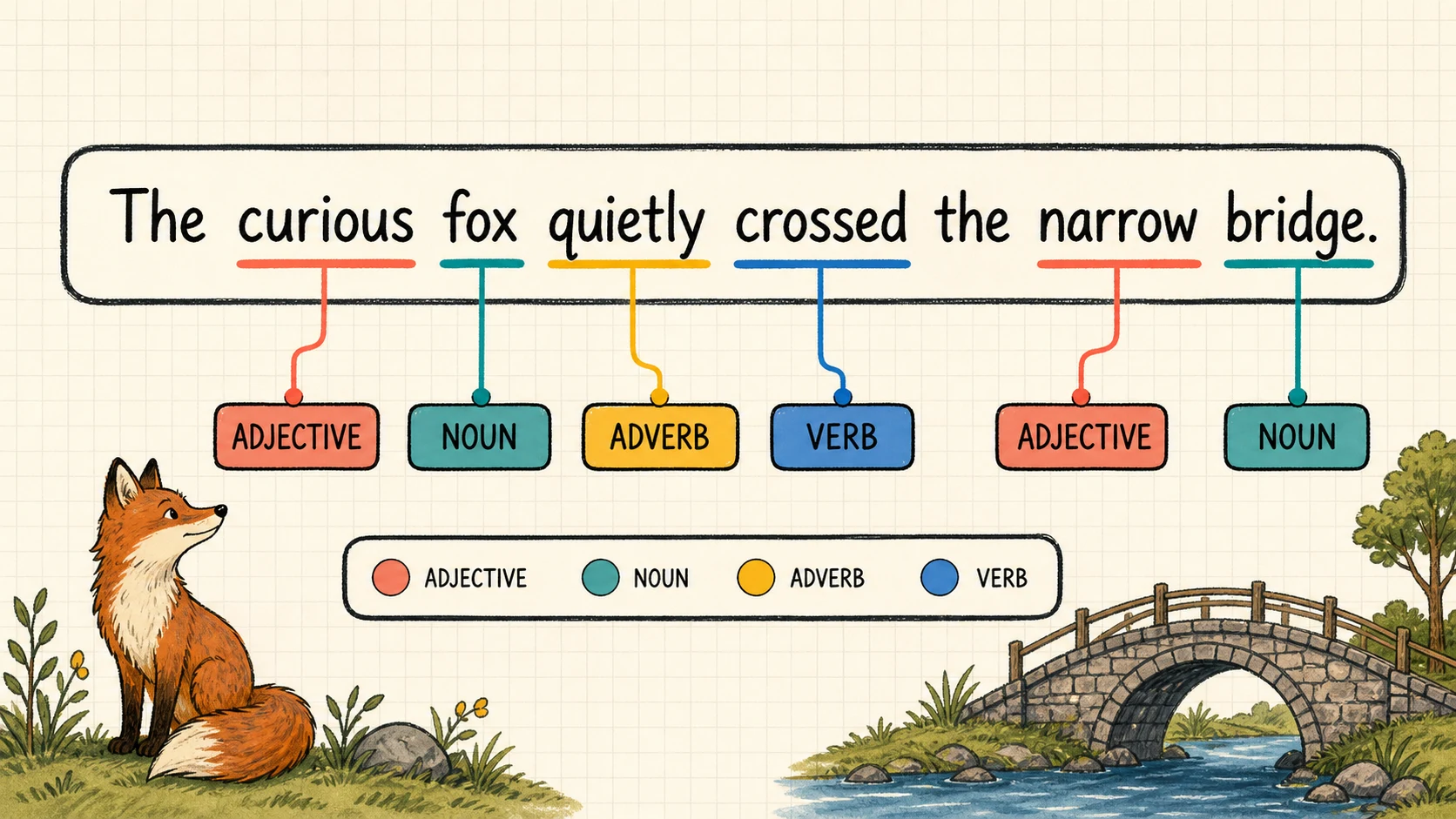
Check the requested category, the word’s job, and the evidence supplied by the sentence.
The examples below are original examples similar to the worksheet’s stated skill. They are not presented as its actual numbered items.
Worked example 1: identifying a noun
Sentence: “Maya placed the lantern beside the tent.”
Task: Identify a noun.
- Ask who or what is named.
- Maya names a person.
- Lantern and tent name things.
- Therefore, Maya, lantern, and tent are all nouns.
If the task accepts any noun, each is defensible. If a printed item marks or points to a particular word, answer according to that formatting. This example also shows why an adult should inspect the prompt carefully rather than assume there can be only one noun in a sentence.
Worked example 2: identifying a verb
Sentence: “The puppy chased the rolling ball.”
Task: Identify the verb.
- Find what happens in the sentence.
- The puppy chased something.
- Chased expresses the main action and is the verb.
- Rolling describes ball in this sentence, so it is not the requested main verb.
The checked answer is chased. The reasoning depends on the job each word performs in this sentence.
Worked example 3: identifying an adjective
Sentence: “A narrow bridge crossed the stream.”
Task: Identify the adjective.
- Find the nouns: bridge and stream.
- Ask whether a word describes either noun.
- Narrow tells what kind of bridge.
- Therefore, narrow is the adjective.
The checked answer is narrow, and the noun it modifies is bridge.
Worked example 4: identifying a linking verb
Sentence: “The soup smells delicious.”
Task: Identify the verb.
- Do not look only for physical action.
- Smells links soup with a quality attributed to it.
- In this sentence, smells functions as a verb.
- Delicious describes the soup, so it functions as an adjective.
The checked verb is smells. This is an important boundary case because the shortcut “a verb is an action word” is incomplete.
Worked example 5: checking an adjective that tells how many
Sentence: “Six hikers followed the rocky trail.”
Task: Identify the adjectives.
- Find the nouns: hikers and trail.
- Six tells how many hikers.
- Rocky tells what kind of trail.
- Therefore, six and rocky function as adjectives in this sentence.
If a worksheet item requests a single indicated word, follow that indication. The full analysis confirms that more than one adjective may appear in a sentence.
Move from Guided to Independent Practice
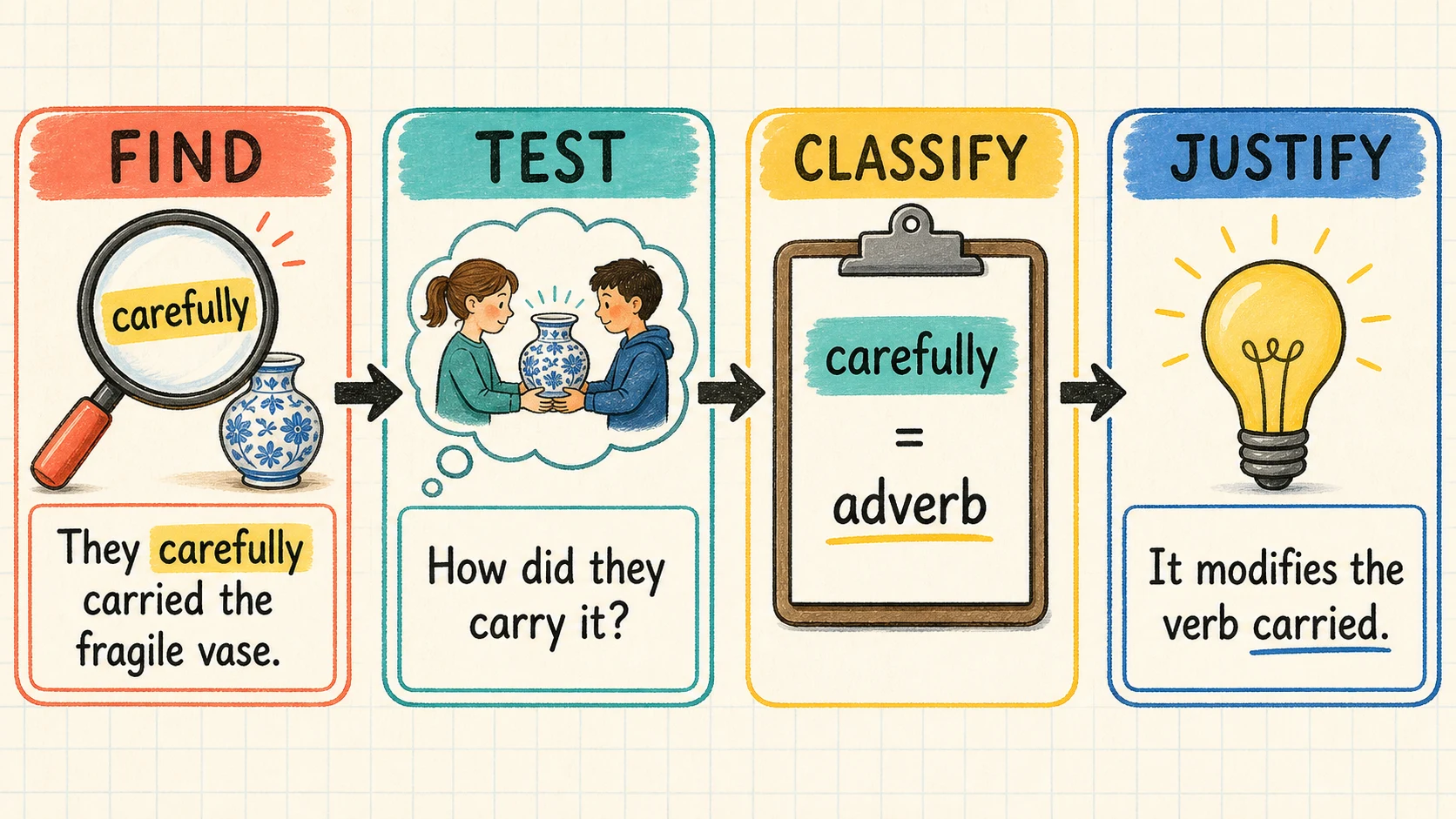
Reduce help as soon as the learner can identify the category and justify the choice.
Model one item without turning it into a lecture
Read the sentence aloud. Name the requested category. Think through the word’s function, and finish with a compact justification:
“The task asks for an adjective. I first find a noun, because an adjective describes or limits a noun. ‘Bright’ tells what kind of light, so I choose ‘bright.’”
The model demonstrates a repeatable process. Avoid adding an explanation of every word unless the learner needs it.
Solve the next items together
During guided practice, use prompts in a consistent order:
- “Which part of speech does the item request?”
- “Which words might fit?”
- “What job does your choice perform here?”
- “What word or part of the sentence proves it?”
If the learner hesitates, narrow the choice without giving the answer. For an adjective item, ask the learner to underline the nouns first. Then ask which nearby word describes or limits one of those nouns.
If the learner gives a correct answer for an incorrect reason, keep the item in guided practice. Accidental accuracy does not show reliable understanding. For example, “Green is an adjective because adjectives are usually short words” requires correction even though green might be the right answer in a particular sentence.
Release responsibility in small steps
After two or three reasoned answers, let the learner try a short group alone. Ask for a written mark, such as circling the target word or underlining it once, only if that fits the printable’s layout. Do not create a marking system that obscures the worksheet directions.
Observe without correcting each answer immediately. Useful notes include:
- Confuses nouns and adjectives.
- Finds action verbs but misses state or linking verbs.
- Selects the first plausible word without rereading.
- Answers accurately but cannot explain why.
- Works accurately until attention fades.
- Corrects an error independently after reading the full sentence.
These observations are more useful for planning than a total score alone.
Adapt Support Without Changing the Skill
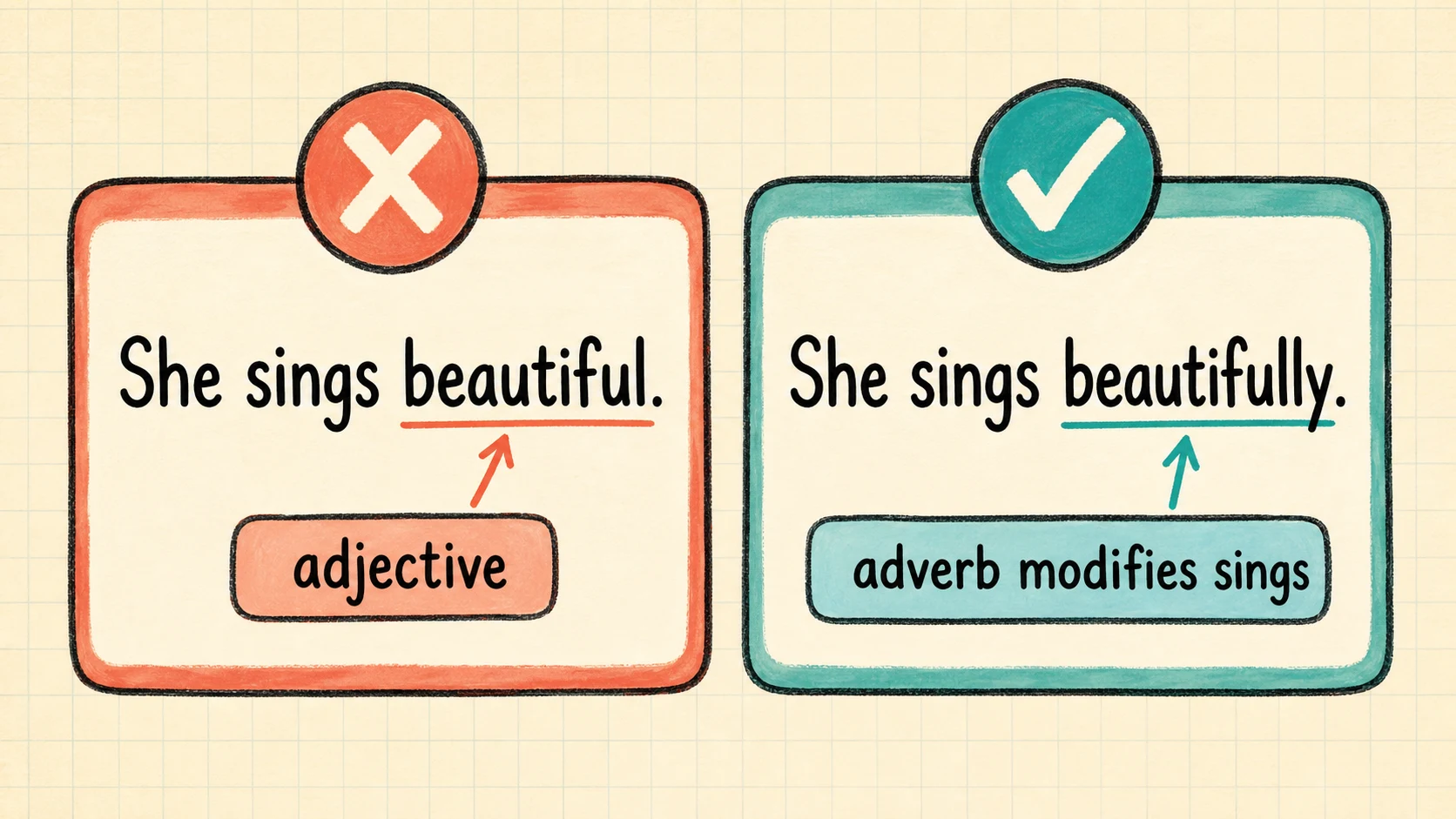
Change the amount of support, visual load, or response method while preserving sentence-based classification.
Adaptation should make the intended analysis more accessible. It should not replace the task with a different one.
When the learner needs more support
Cover the unused portion of the page so only one or a few items remain visible. Read a sentence aloud while the learner tracks the words. Keep the three category definitions nearby. Ask the learner to find nouns before searching for adjectives.
You can also offer a limited oral contrast:
“Does silent name something, show what happens, or describe a noun?”
The learner must still decide among the same grammatical functions. Do not routinely point to the answer, supply the first sound, or turn every item into copying.
Another useful adjustment is to pause after a small group and review immediately. This changes the practice interval, not the skill.
When the learner is nearly independent
Remove the reference card, but ask the learner to mark uncertain items. Complete a group before checking. For any disputed answer, require a sentence-based justification.
A learner may also write N, V, or Adj above a selected word if the worksheet permits it. The label should accompany analysis, not replace attention to the instruction.
When the learner needs additional challenge
Keep the original answer, then ask for one brief extension:
- Name the noun modified by an adjective.
- Replace an adjective while keeping the sentence sensible.
- Change a noun but preserve the verb.
- Write a new sentence in which the same word performs a different role.
For example:
- “We watched the play.” Here, play is a noun naming a performance.
- “The children play outside.” Here, play is a verb expressing an action.
This extension deepens attention to context without altering the original worksheet response. Do not require it for every item; excessive additions can bury the foundational task.
Handle Boundary Cases and Common Misconceptions
Parts-of-speech identification becomes unreliable when a learner treats definitions as fixed labels attached to words. The central principle is that classification depends on use in a sentence.
“A verb must be a visible action”
Words such as is, seems, and became can function as verbs even though they do not name visible movements.
In “The room is quiet,” is is the verb, while quiet describes room. Asking “What action can you see?” will not solve this item. Ask instead, “What word expresses the state or links the subject to its description?”
“Every describing idea is an adjective”
An adjective describes or limits a noun or pronoun. A word that tells how an action happens may be an adverb, even if it feels descriptive.
Compare:
- “The quiet student entered.” Quiet describes student, so it is an adjective.
- “The student entered quietly.” Quietly describes how the student entered, so it is not an adjective.
The second category is outside this printable’s listed focus, but the contrast can explain why “any describing word” is too broad a rule.
“A word always has one part of speech”
Consider light:
- “Turn on the light.” It names a thing, so it is a noun.
- “Please light the candle.” It expresses an action, so it is a verb.
- “She carried a light bag.” It describes the bag, so it is an adjective.
Do not ask the learner, “What part of speech is light?” without a sentence. Ask what job it performs in a particular sentence.
“Only one answer can exist in a sentence”
A sentence may contain several nouns, verbs, or adjectives. The printable’s formatting and wording determine which response is expected. If an item asks for “the noun” but the sentence appears to contain more than one defensible noun, inspect whether a word is underlined, bolded, boxed, or otherwise indicated.
If ambiguity remains, record the learner’s justified response and compare it carefully with the answer key. The purpose is grammatical reasoning, not forcing an unexplained match.
Interpret Errors Before Assigning More Practice
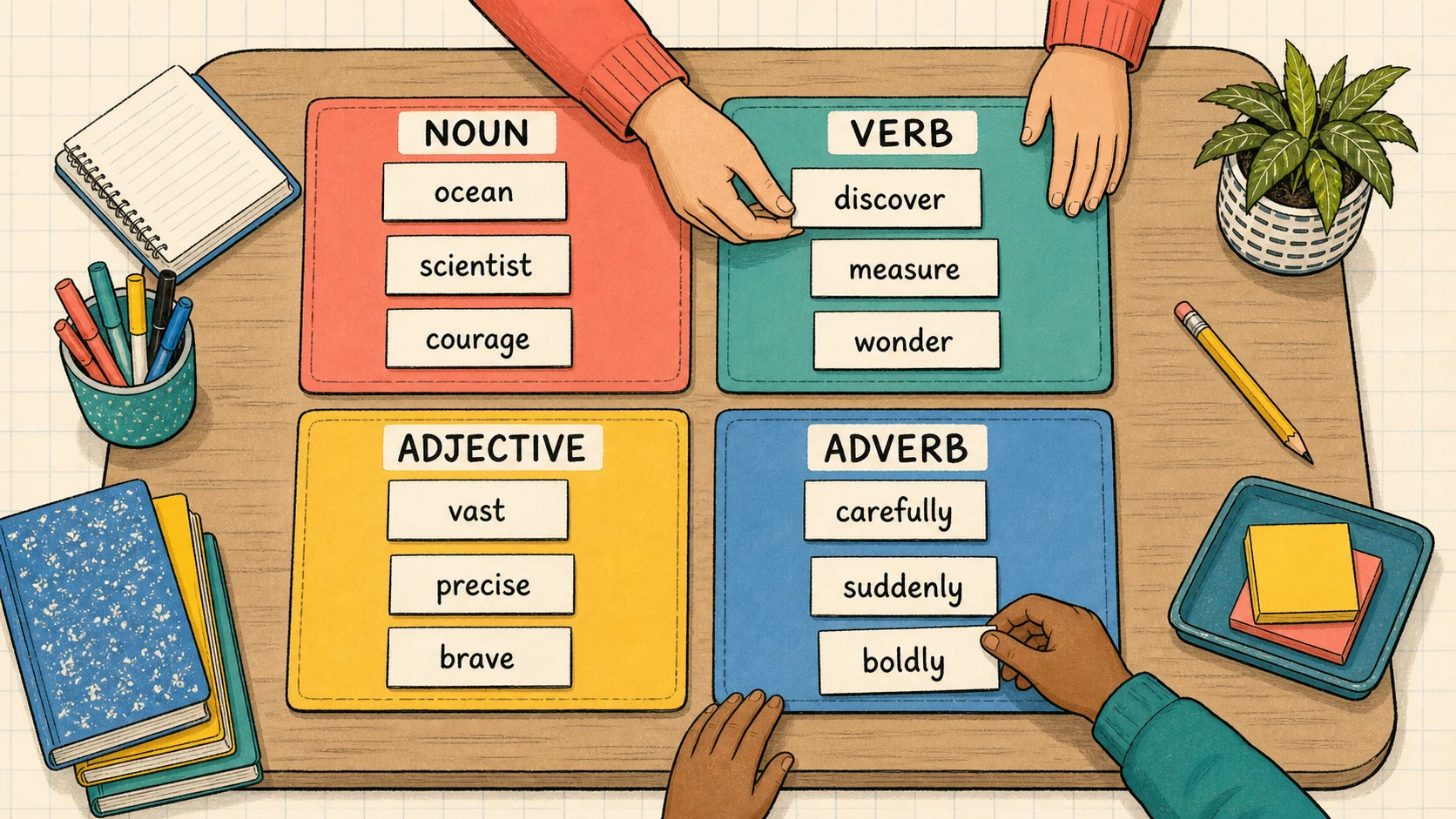
Classify the error, revisit the sentence, explain the correct function, and then test the distinction again.
A wrong answer can result from different problems. The correction should match the problem you observe.
| Error pattern | What it may show | Useful response |
|---|---|---|
| Chooses an adjective when a noun is requested | Missed the stated category or confused a word with the noun it modifies | Have the learner box the requested category, then identify both words and explain their relationship |
| Finds only physical-action verbs | Uses an incomplete verb definition | Contrast an action verb with a linking or state verb |
| Labels every descriptive word an adjective | Does not check what the word modifies | Ask, “Which noun does it describe?” |
| Gives different answers to the same kind of item | May be guessing or reading only part of the sentence | Require a short verbal justification before marking |
| Makes several errors late in the page | Attention or stamina may have changed | Stop at a natural break and revisit the remaining items later |
| Corrects immediately when rereading | Initial reading was incomplete | Add a deliberate reread before finalizing each response |
| Cannot explain even correct responses | Knowledge may be fragile | Return briefly to modeled and guided practice |
These interpretations are possibilities, not diagnoses. A worksheet cannot establish a medical, developmental, or child-specific conclusion. If persistent difficulties appear across varied reading and writing tasks, share concrete work samples and observations with the learner’s teacher or another appropriately qualified professional.
The Common Core English Language Arts standards provide a broad public reference for grade-level language expectations. They can help adults understand the wider instructional context, but this guide does not claim comprehensive standards alignment or certify mastery from one worksheet. Local sequences and adopted standards may differ.
Check the Answer Key Responsibly
The separate printable answer key is useful for efficient checking, but it should confirm analysis rather than replace it.
First, finish a selected group of items without viewing the key. Then compare each response. Mark correct answers plainly and choose only a few errors at a time for discussion. For each mismatch:
- Reread the complete sentence.
- Restate the requested category.
- Identify the learner’s chosen word and its function.
- Identify the keyed word and its function.
- Revise only after the learner can explain the distinction.
If the learner’s answer differs from the key but appears grammatically defensible, inspect the item’s directions and visual indicators. Determine whether the prompt asks for a particular underlined word or permits any example of the category. Do not mark a reasoned alternative wrong merely because the key lists another possible noun or adjective.
At the same time, do not assume the key is mistaken whenever the learner disagrees. Check the sentence structure carefully. A familiar word may function differently in context, and multiword verb forms can complicate an overly quick review.
Keep the score in proportion. A total such as 24 out of 29 summarizes matches, but it does not show whether the five errors all involve adjectives, whether the learner missed only linking verbs, or whether the mistakes occurred after concentration dropped. Record the pattern alongside the total.
Decide What to Do After the Worksheet
The next step should follow the learner’s demonstrated performance, not the word “easy” in the title.
If the learner is accurate and can explain choices
Move beyond identification. Ask the learner to write three original sentences:
- One with a specific noun and a strong verb.
- One with an adjective that clearly modifies a noun.
- One in which a familiar word changes function across two sentences.
Then continue through the broader 5th Grade grammar collection or use the Parts of Speech topic guide to select a logical next category. Do not duplicate the entire parts-of-speech progression during this single lesson.
If one distinction remains unstable
Choose examples that isolate that distinction. A learner confusing nouns and adjectives could compare:
- “The stone rolled.” Here, stone is a noun.
- “The stone wall cracked.” Here, stone describes what kind of wall, so it functions adjectivally.
Use a few carefully chosen contrasts before returning to missed worksheet items. More of the same undifferentiated practice may preserve the misconception.
The free worksheet generators can support fresh practice when you need new sentences rather than immediate repetition of memorized answers. Review generated material before giving it to a learner, and keep the task focused on the unresolved category.
If several foundations remain uncertain
Return to nouns and verbs in short, concrete sentences, then introduce adjectives through the nouns they modify. The catalogue’s broader topic guidance recommends beginning with nouns and verbs because they form a useful foundation, teaching categories in real sentences, and showing that a word’s role can change with context.
The 5th Grade worksheet hub can help you locate other practice at the intended grade level. Select by demonstrated need rather than assigning a large quantity at once.
Schedule Retrieval Instead of One-Time Completion
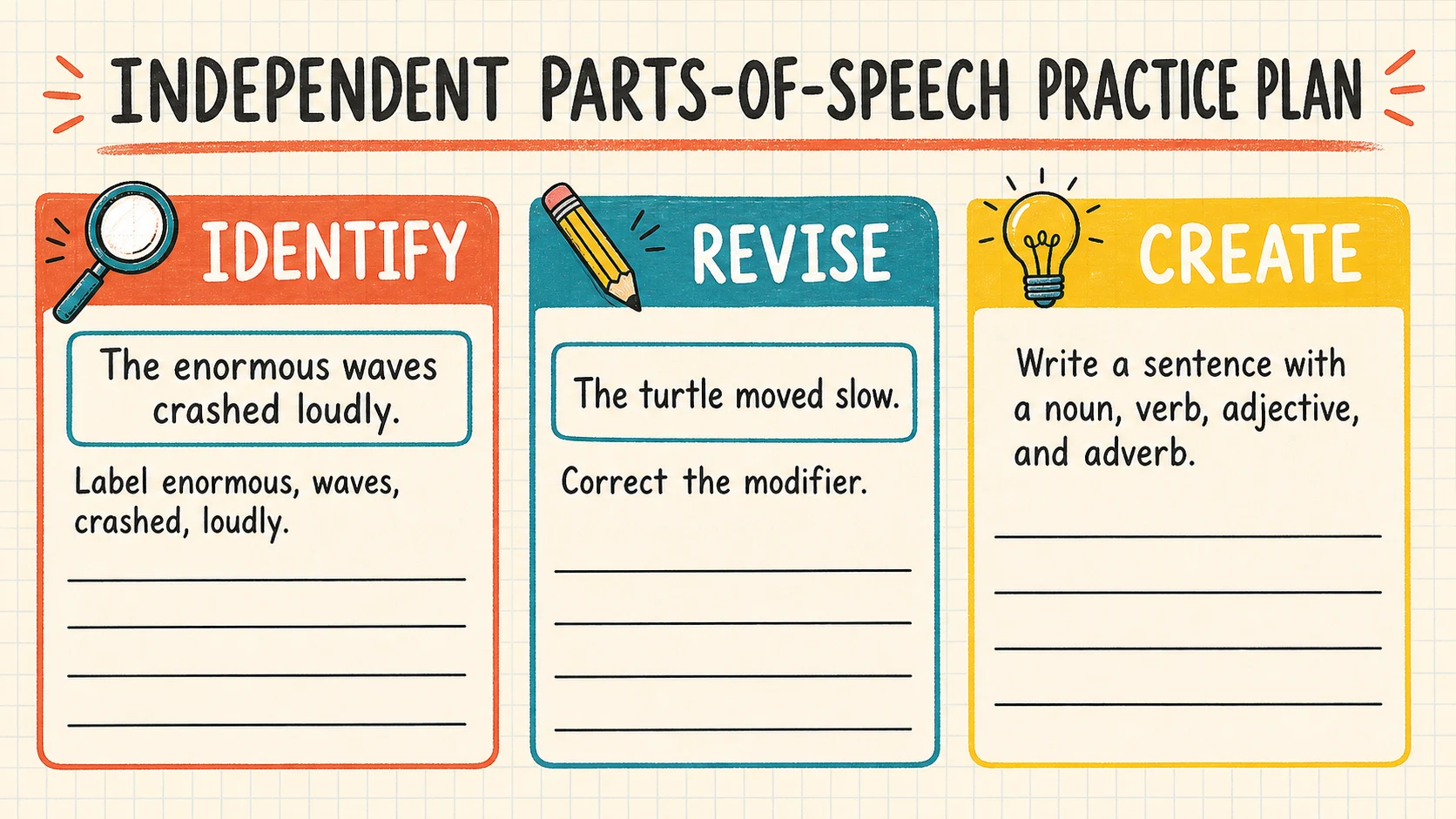
Revisit a small mixed set after delays and adjust the schedule according to retained performance.
A practical retrieval plan might look like this:
| Review point | Suggested task | What to observe |
|---|---|---|
| Later the same lesson | Correct two or three discussed errors without copying | Can the learner explain the changed answers? |
| A later day | Revisit four to six mixed items or parallel sentences | Are nouns, verbs, and adjectives recalled without the reference card? |
| Several days later | Classify target words in new sentences | Does knowledge transfer beyond the original page? |
| The following week | Use the categories while revising a short paragraph | Can the learner connect identification to writing? |
This is an instructional example, not a universally recommended timetable. Increase the interval when recall is accurate and explanations are clear. Shorten it when the learner has forgotten the distinction. A learner who retains nouns but loses adjectives needs targeted adjective retrieval, not a complete restart by default.
Avoid using the completed sheet as the only review source. Once answers become familiar, recall may reflect memory for the page rather than analysis of new sentences. Mix a few original sentences with selected worksheet items.
Limitations and the Honest Next Step
This printable measures a narrow slice of grammar performance: identifying indicated nouns, verbs, and adjectives in 29 easy-level sentence-analysis exercises. It does not by itself demonstrate command of all eight parts of speech, editing skill, sentence construction, reading comprehension, or independent writing. It also cannot show whether knowledge will transfer to unfamiliar passages without additional evidence.
The worksheet is best treated as one useful sample. Pair the answer pattern with the learner’s explanations, corrections, and later retrieval. A learner who scores well but cannot justify choices needs more reasoning practice. A learner who initially makes errors but independently explains and repairs them is showing valuable progress that a first score may conceal.
For the next action, complete one short group from the free 5th Grade Parts of Speech worksheet, record which category causes any errors, and use the topic guide to choose the next focused practice. If the learner is ready for broader, sustained work, the 5th Grade Parts of Speech Worksheet Pack contains 18 worksheets; select from it only after the first worksheet’s evidence identifies a genuine next need.
Put it into practice
Use the guide with a real printable
Move from explanation to a short, observable practice task. Check the first item together, then adjust the next session from the learner's actual work.
See the 18-worksheet pack