Complete guide
How to teach and practise 4th grade spelling words worksheets - standard theme (easy)
How to use this 25-item spelling worksheet
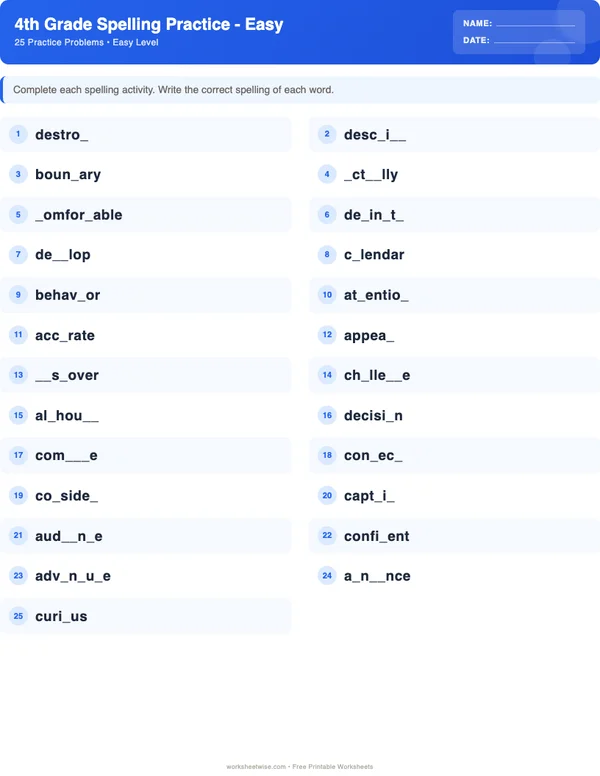
The free 4th Grade Spelling Words worksheet provides 25 easy-level exercises involving fill-in-the-blank items, word scrambles, and misspelling correction. It practices spelling, word recognition, vocabulary, and attention to letter patterns. A separate printable answer key is included.
The short answer: begin by completing one representative item together, asking the learner to explain how the word was identified and checked. Continue with a small guided group of items, and then release the learner to work independently. Afterward, classify errors by type rather than relying only on a total score. Revisit missed words through brief retrieval practice over several later sessions.
Use the worksheet as evidence of what the learner can presently notice, recall, and correct. Do not treat “easy” as a guarantee that every item should be effortless. Grade labels describe the intended practice level, and local curricula, word lists, and instructional sequences differ. A fourth grader who needs substantial support may still benefit from this page; a learner who completes it accurately may be ready for more varied application rather than simply a longer list.
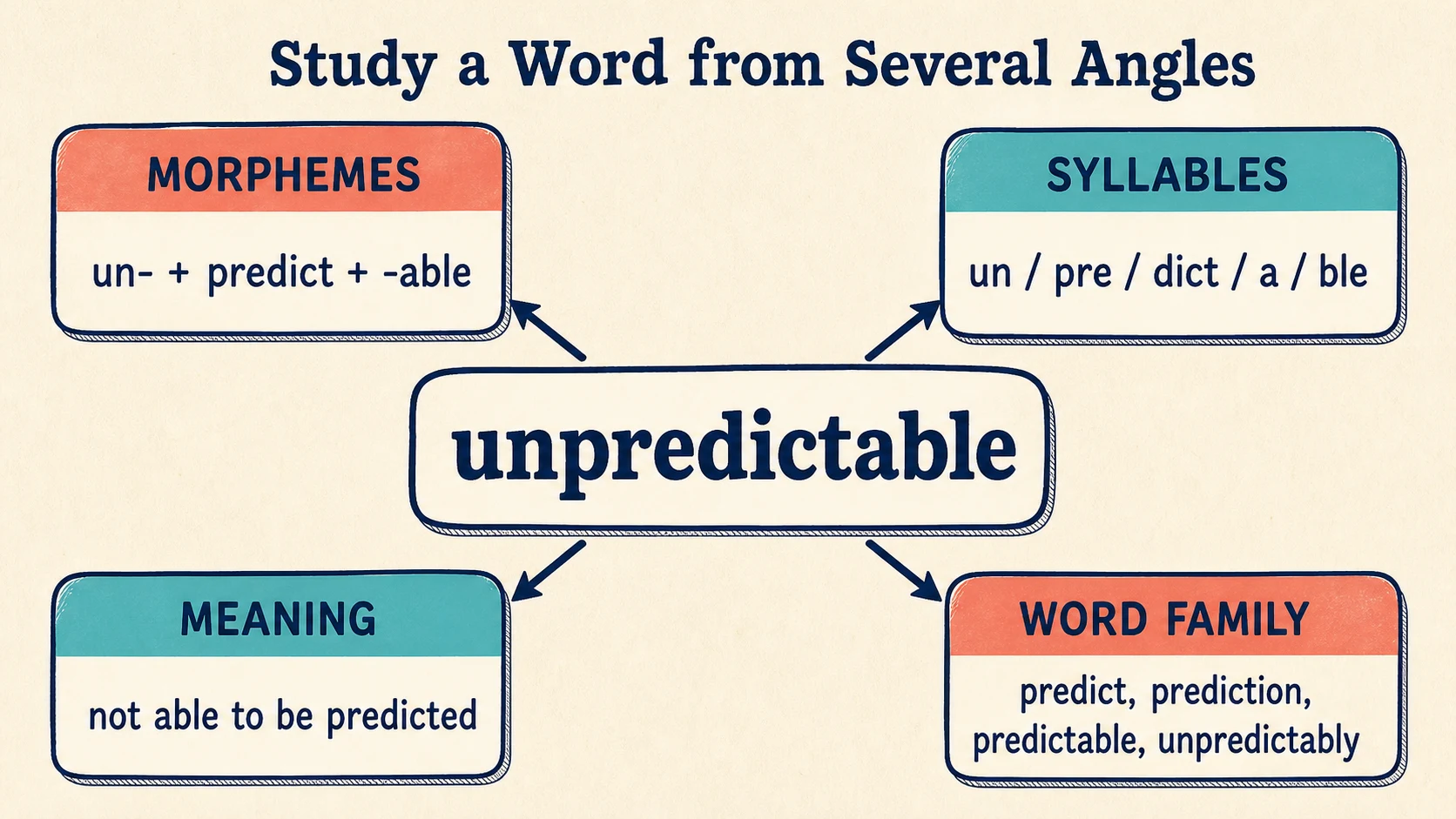
The lesson moves from a brief launch to modeling, guided work, independent practice, review, and later retrieval.
What this worksheet does—and what it does not do
The printed instruction is direct: “Complete each spelling activity. Write the correct spelling of each word.” Within those 25 items, the learner may need to recover a missing word, rearrange letters, or repair a misspelling. Those formats call for related but distinct decisions:
- A fill-in-the-blank item requires the learner to use sentence meaning and available spelling information.
- A word scramble requires the learner to account for every supplied letter and arrange those letters into a recognizable word.
- A correction item requires the learner to detect that a written form is wrong, locate the troublesome part, and produce a conventional spelling.
These tasks offer a useful sample of written spelling performance. They do not establish complete mastery of fourth-grade spelling, reading, vocabulary, or writing. One printable also cannot reveal how well a learner spells the same words during original composition, after a long delay, or without a prompt.
The broader Spelling Words topic guide covers the larger progression of patterns and practice formats. Use that guide for decisions about longer-term word study rather than asking this single worksheet to represent the entire sequence. The fourth-grade spelling hub provides additional practice when a different format or level is needed.
High-level instructional guidance offers context, but it should not be mistaken for an evaluation of this printable. The IES foundational reading practice guide addresses foundational skills through third grade and supports explicit attention to sound–letter relationships and word analysis. That principle can inform how an adult models a spelling decision for an older learner who still needs foundational reinforcement. It does not certify this worksheet or prescribe a universal fourth-grade lesson.
Likewise, the Common Core English Language Arts standards include expectations related to conventional spelling, spelling patterns and generalizations, and the use of references. Local standards and instructional orders may differ, so the worksheet should be placed within the learner’s actual curriculum rather than described as comprehensively aligned.
Prepare a focused, low-pressure lesson
Print the worksheet and answer key separately. Keep the key out of the learner’s view during the first attempt. Provide a pencil, an eraser, and a blank strip of paper or index card that can cover nearby items if the page feels visually crowded. A notebook is useful for recording only the words or patterns that need further attention.
Before beginning, scan the activity formats. You do not need to teach every target word in advance. The purpose of the launch is to make the directions and response process clear without supplying the answers.
A practical lesson can follow this progression:
| Lesson phase | Suggested adult action | Learner action | Evidence to notice |
|---|---|---|---|
| Preview | Identify the activity types and read the printed direction | Point out what each item asks | Whether the format is understood |
| Model | Think aloud through one comparable example | Watch, listen, and explain the checking step | Whether the reasoning is followed |
| Guided practice | Complete two or three selected items together | Attempt before receiving a prompt | Kind and amount of support needed |
| Independent practice | Step back while remaining available | Complete a manageable group of items | Accuracy, hesitation, and self-correction |
| Review | Compare responses with the key after reasoning is complete | Mark and repair discrepancies | Nature of each error |
| Retrieval | Revisit selected words later without displaying answers | Recall, write, and check | Whether learning persists |
This table is a planning suggestion, not a sourced timetable. A learner’s observed work should determine how quickly the lesson moves. If the first few items show secure understanding, shorten the guided phase. If the learner cannot explain what an item requires, pause before independent work.
Give directions that reveal the process
Try a concise launch:
“Each item asks you to write a correctly spelled word. First decide what the word is. Then look closely at its parts, write it, and check that it fits the item.”
For a scramble, add: “Use every given letter once unless the printed item indicates otherwise.” For correction, add: “Find the exact part that needs changing.” For a blank in a sentence, add: “Read the whole sentence before choosing the word.”
These prompts preserve the spelling skill. They clarify the task without spelling the answer aloud, giving the first letter automatically, or narrowing the choice to a single obvious response.
Choose a sensible starting group
The worksheet contains 25 items, but they need not all be completed in one uninterrupted sitting. Begin with a small group that includes more than one activity format. Watch whether the learner:
- reads the full prompt;
- attempts a word before asking for help;
- says or quietly segments a word;
- accounts for every letter in a scramble;
- rereads a completed sentence;
- notices a mismatch without being told where it is; and
- changes a correct answer unnecessarily.
Continue while attention and useful effort remain steady. Stop or change the format if fatigue begins to obscure what the learner actually knows. There is no universal number of items per session.
Model the reasoning with fully checked examples
The examples below demonstrate the kinds of reasoning appropriate for this worksheet. They are illustrative examples similar to the listed activity formats; they are not presented as quotations or confirmed items from the printable.
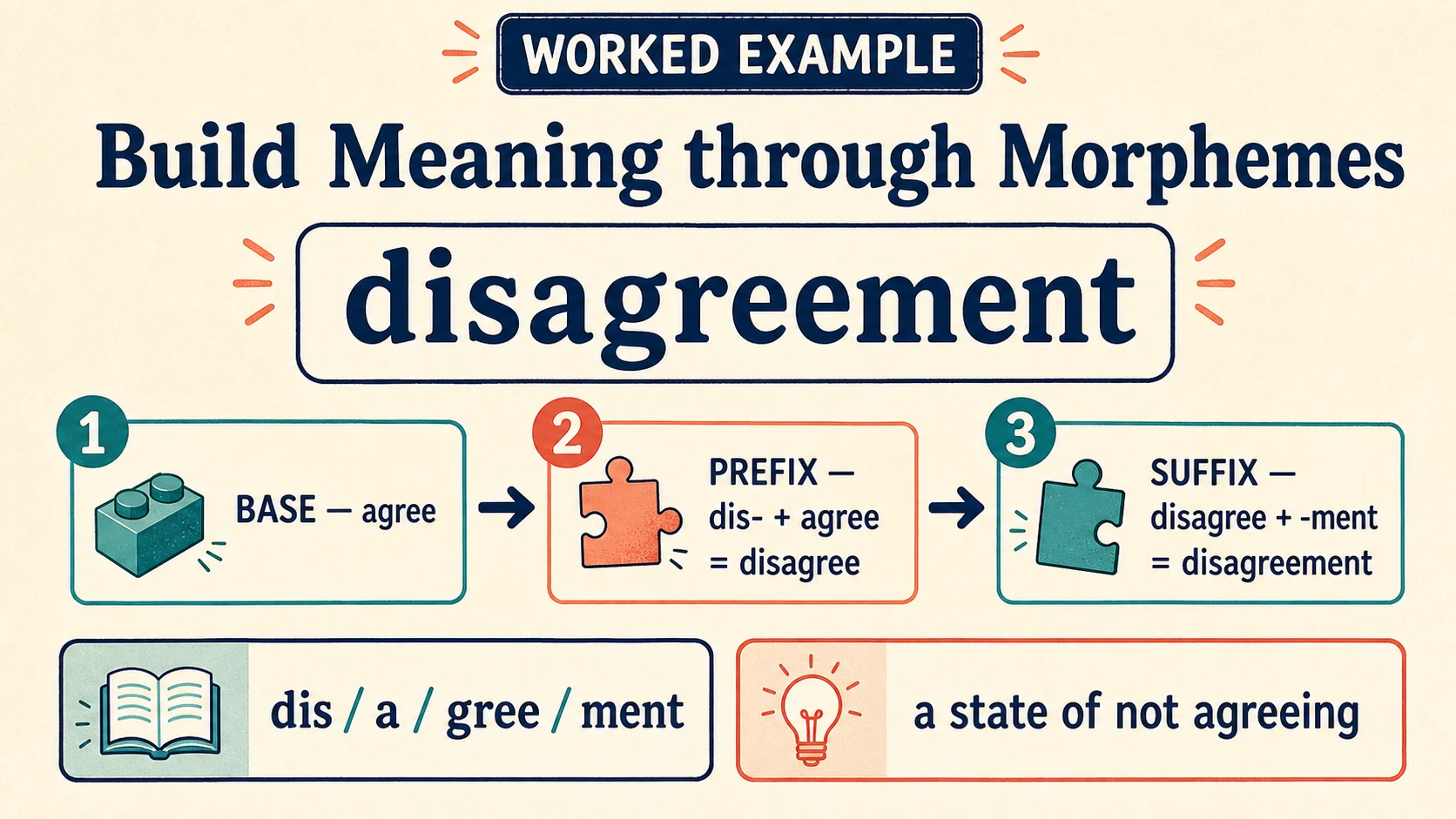
Model the decision, the spelling check, and the reason the completed response works.
Example 1: Complete a sentence
Illustrative item: “Please place the books on the _____.”
Suppose the intended word is shelf.
A useful think-aloud is:
- “I read the whole sentence. It needs the name of a place where books can be put.”
- “The word I want is shelf.”
- “I can hear the beginning
/sh/, which is commonly written sh in this word.” - “The rest is elf, so I write s-h-e-l-f.”
- “I reread it: ‘Please place the books on the shelf.’ The word fits the meaning and is spelled shelf.”
Check: shelf contains five letters, matches the intended word, and makes a complete, sensible sentence.
A boundary case is shelves. That word is correctly spelled in another context, but it does not fit after “the” if one shelf is intended. Correct spelling alone is insufficient when the grammar and meaning require a different form.
Example 2: Unscramble a word
Illustrative item: n p l a t
Checked answer: plant
Reason through the complete letter inventory:
- Supplied letters: n, p, l, a, t
- Proposed word: p, l, a, n, t
- Every supplied letter is used exactly once.
- No extra letter has been introduced.
- Plant is a recognizable word.
A learner might write plan, which is also a correctly spelled word, but it leaves the supplied t unused. For a scramble, that makes the response incomplete. This is an important boundary case: a real word is not necessarily the correct solution.
Example 3: Correct a misspelling
Illustrative item: becaus
Checked answer: because
Compare the two forms from left to right:
- Matching part: becaus
- Missing final letter: e
- Correct form: b-e-c-a-u-s-e
The repair is specific: add e at the end. The learner should not merely copy the corrected word and move on. Ask, “What changed?” A precise response—“I added the final e”—shows more awareness than “I fixed it.”
Example 4: Correct a transposition
Illustrative item: freind
Checked answer: friend
Compare the middle of each form:
- Incorrect sequence: ei
- Correct sequence in this word: ie
- Complete answer: f-r-i-e-n-d
The learner has all the needed letters, but two are in the wrong order. This differs from omitting a letter. Naming that distinction helps the adult choose a useful follow-up: briefly hide friend, ask the learner to write it again, and then compare the middle sequence.
Example 5: Preserve a doubled consonant
Illustrative item: “The puppy is _____ across the yard.”
Intended answer: running
Check the construction:
- Base word: run
- Written form needed in the sentence: running
- Letter sequence: r-u-n-n-i-n-g
- The answer contains two consecutive n letters.
Writing runing conveys the likely word but is not the conventional spelling. Writing run is conventionally spelled yet does not supply the form required by the sentence. This example separates identifying the base word from spelling the form that fits the context.
The catalogue does not state that these exact words appear on the worksheet. Use examples like these only to model the method, then apply that method to the actual printed items.
Move from guided practice to independent work
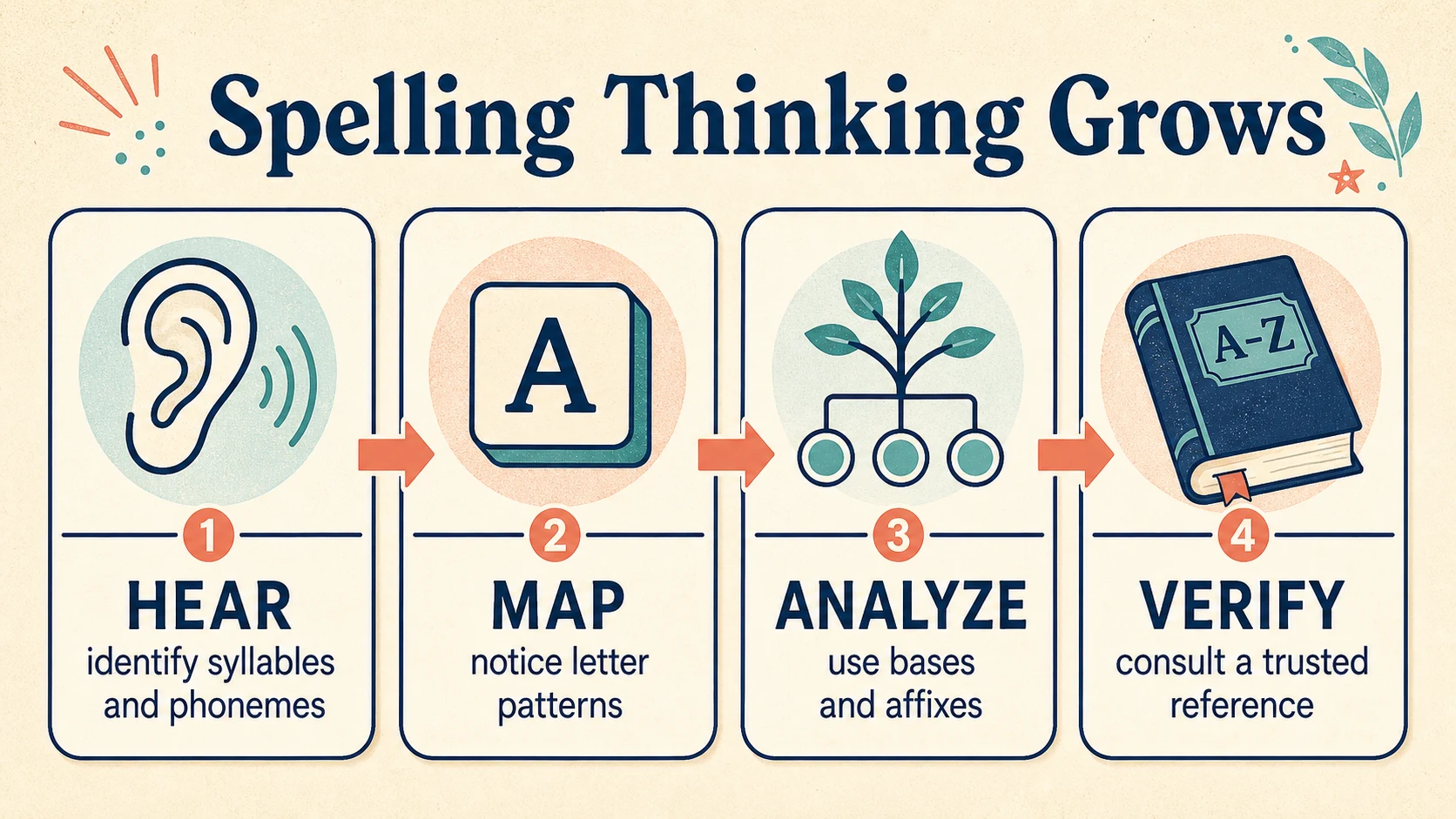
Guidance should make the decision process visible and then gradually become less specific.
During guided practice, point to an item and ask the learner to make the first move. Useful prompts include:
- “What kind of item is this?”
- “What word do you think belongs here?”
- “Which part are you certain about?”
- “Can you account for every scrambled letter?”
- “Where does your version first differ from the printed version?”
- “Read the completed sentence. Does that word form fit?”
Use prompts in a sequence from least to most revealing. First, ask the learner to reread. Next, direct attention to a region: “Check the middle of the word.” Only then, if necessary, identify the relevant letters or model a comparable word.
Avoid turning guided practice into delayed dictation. If the adult repeatedly says the target word very slowly, names each sound, and supplies the difficult letter pattern, the learner may produce a correct response without demonstrating independent spelling.
Decide when to step back
Independent work is appropriate when the learner can state what the activity requires and complete at least one representative item without the adult constructing the answer. Independence does not require speed or perfect accuracy. It means the learner is making the spelling decisions.
Ask the learner to complete a small visible section while you observe quietly or move away. Marking a stopping point can be helpful: “Work through item 8, then we will check how the process is going.” This is an instructional suggestion, not a fixed rule.
If the learner asks, “Is this right?” before finishing, respond with a checking prompt instead of immediate confirmation: “Show me how you checked it.” That keeps responsibility with the learner while still providing support.
Protect the first attempt
Do not correct every letter as it is written. Immediate interruption can erase valuable evidence about what the learner recalls and self-monitors. Unless frustration is escalating, let the learner complete the word, then invite a check.
Record observable facts rather than labels. “Left one letter unused in two scrambles” is actionable. “Careless” is not. “Changed ie to ei after hesitating” points toward a specific comparison. “Bad at spelling” does not.
Adapt support without changing the spelling target
Differentiation should change access, pacing, or prompting while preserving the requirement to determine and write the correct spelling. The goal is not to make all learners complete the page in the same way or at the same speed.
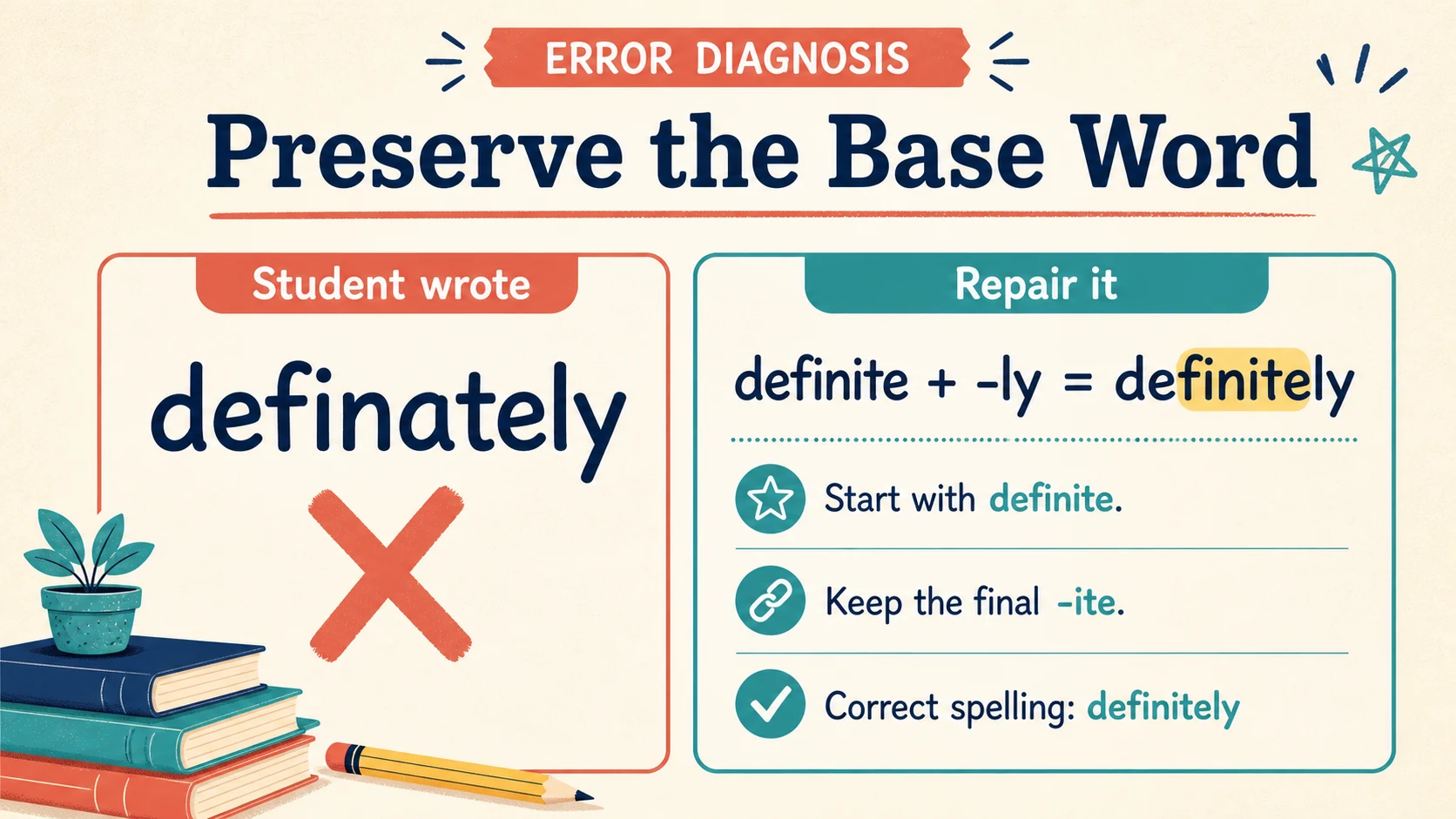
Adjust page load, prompt strength, or application demands while keeping correct spelling central.
When the learner needs more support
Cover all but one row or section. Read the directions aloud, but let the learner read or identify the target word where possible. Allow oral rehearsal before writing. For a long word, invite the learner to draw light separators around recognizable parts after attempting it.
A support ladder might be:
- “Reread the item.”
- “Say the word you intend to write.”
- “Check the beginning, middle, and end.”
- “Look closely at this part.”
- “Compare it with a displayed correct form, cover that form, and try again.”
The final step changes the item from unaided recall to supported study, so record that support was used. The answer may now be correct, but it should not be counted as an independent first-attempt success.
When writing mechanics interfere
If handwriting is slow or tiring, reduce the number of items completed in one block and allow a normal writing tool that the learner can control comfortably. The learner must still produce the letters in the correct order.
Having the adult act as a scribe changes what can be inferred because the learner is no longer independently recording the spelling. If dictation to an adult is necessary for access, document that condition and follow with a smaller written sample when appropriate. This is a task-design limitation, not medical guidance.
When the worksheet is completed easily
Do not make the learner copy all 25 correct words repeatedly. Instead, test transfer without changing the central skill:
- hide three completed answers and ask for them again later;
- ask the learner to sort selected words by a visible letter feature;
- dictate a short sentence containing one practiced word;
- ask the learner to write an original sentence using a selected word; or
- locate a practiced pattern in current reading.
The IES elementary writing practice guide provides high-level guidance for writing instruction, including explicit strategy instruction and opportunities to write. It did not evaluate this WorksheetWise page. Here, a short sentence is simply a practical way to see whether spelling carries into meaningful writing.
Interpret errors before assigning more practice
A total such as 20 out of 25 gives a compact summary, but it does not explain what should happen next. Two learners can miss five items for entirely different reasons.
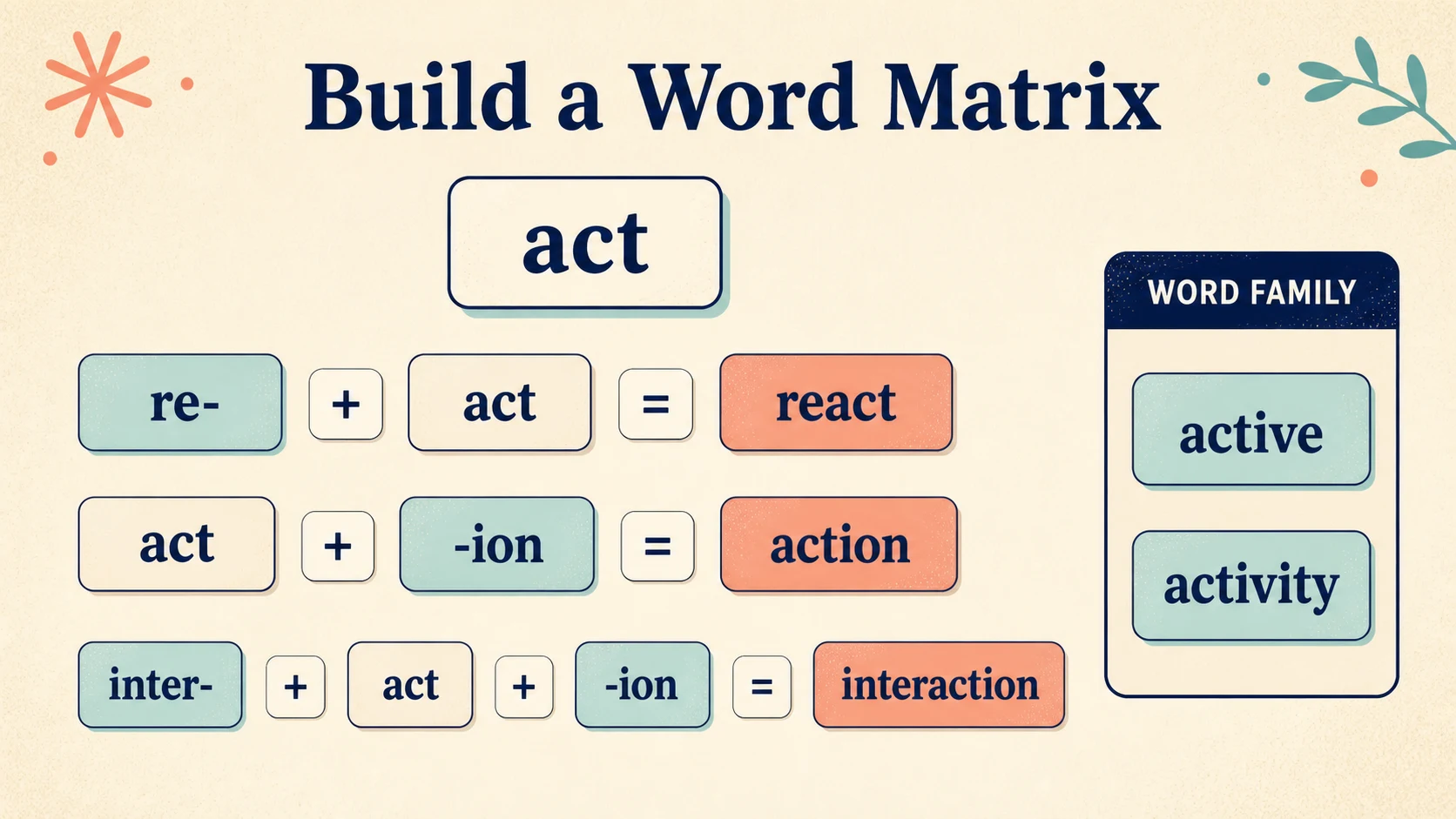
Compare the attempt with the key, identify the exact difference, and choose a matching follow-up.
Use a simple review table:
| Observed error | What it may show in this item | Useful next check |
|---|---|---|
| Letter omitted | Incomplete recall or rushed comparison | Ask the learner to locate the missing position |
| Letters reversed or transposed | Order is not yet secure | Compare the exact letter sequence, then retrieve it |
| Extra letter in a scramble answer | Letter inventory was not checked | Cross off supplied letters as they are used |
| Correctly spelled word that does not fit | Context or grammar was not checked | Reread the entire sentence |
| Same pattern missed repeatedly | Pattern may need explicit comparison | Group the missed forms and notice the shared feature |
| Correct answer after a hint | Knowledge is emerging but not independent | Recheck later without the hint |
| Correct first attempt, changed to wrong | Weak confidence or overchecking | Ask for evidence before revising |
Use cautious language. A single omission does not prove a stable misconception. Repetition across items or later sessions is more informative.
Misconceptions to address directly
“Close enough” is not the same as conventional spelling. If the task asks for the correct written word, every necessary letter and its position matter.
A real word is not automatically the intended answer. In a sentence completion, meaning and grammar constrain the choice. In a scramble, the supplied letters constrain it.
Neat handwriting is not proof of spelling knowledge, and untidy handwriting is not proof of a spelling error. If a letter is ambiguous, ask the learner to identify it before marking the response.
Fast completion is not necessarily secure learning. A learner can finish quickly by recognizing familiar words but fail to retrieve them later. Conversely, slow work may include careful, accurate checking. Judge the written evidence and the level of support, not pace alone.
Repeated copying is not equivalent to retrieval. Copying can help the learner inspect a word, but a later covered attempt provides better evidence of recall. Use both deliberately: look at the correct form, cover it, write it, and check.
Use the answer key responsibly
The separate answer key is for verification, not for replacing analysis. Check it after the learner has completed the agreed independent portion.
For each discrepancy:
- Preserve or note the original response.
- Compare it with the keyed spelling.
- Ask the learner to locate the first difference.
- Name the error precisely: omitted letter, added letter, wrong order, wrong word, or wrong word form.
- Have the learner write the correct form from a clear model.
- Cover the model and request one fresh attempt.
- Schedule another attempt later if recall was not independent.
If the learner’s answer differs from the key but appears plausible, reread the full prompt. For a scramble, verify that every provided letter has been used exactly once. For a sentence item, check meaning and grammar. Do not override a defensible response merely because it looks different; equally, do not accept an alternative that violates the printed constraints.
Record three figures if useful: independent first-attempt accuracy, answers corrected after self-checking, and answers completed with adult help. This distinction is more informative than silently converting all repaired responses into correct first attempts.
The key can contain the intended response, but it cannot explain why an error occurred. When print clarity, an ambiguous handwritten letter, or an unclear prompt prevents a fair decision, mark the item for review rather than using it as firm evidence.
Schedule brief retrieval from the learner’s results
Later recall matters more than an immediate corrected copy. The following schedule is a practical example, not a universal timetable. Shorten, extend, or replace it according to the learner’s observed performance and local teaching sequence.
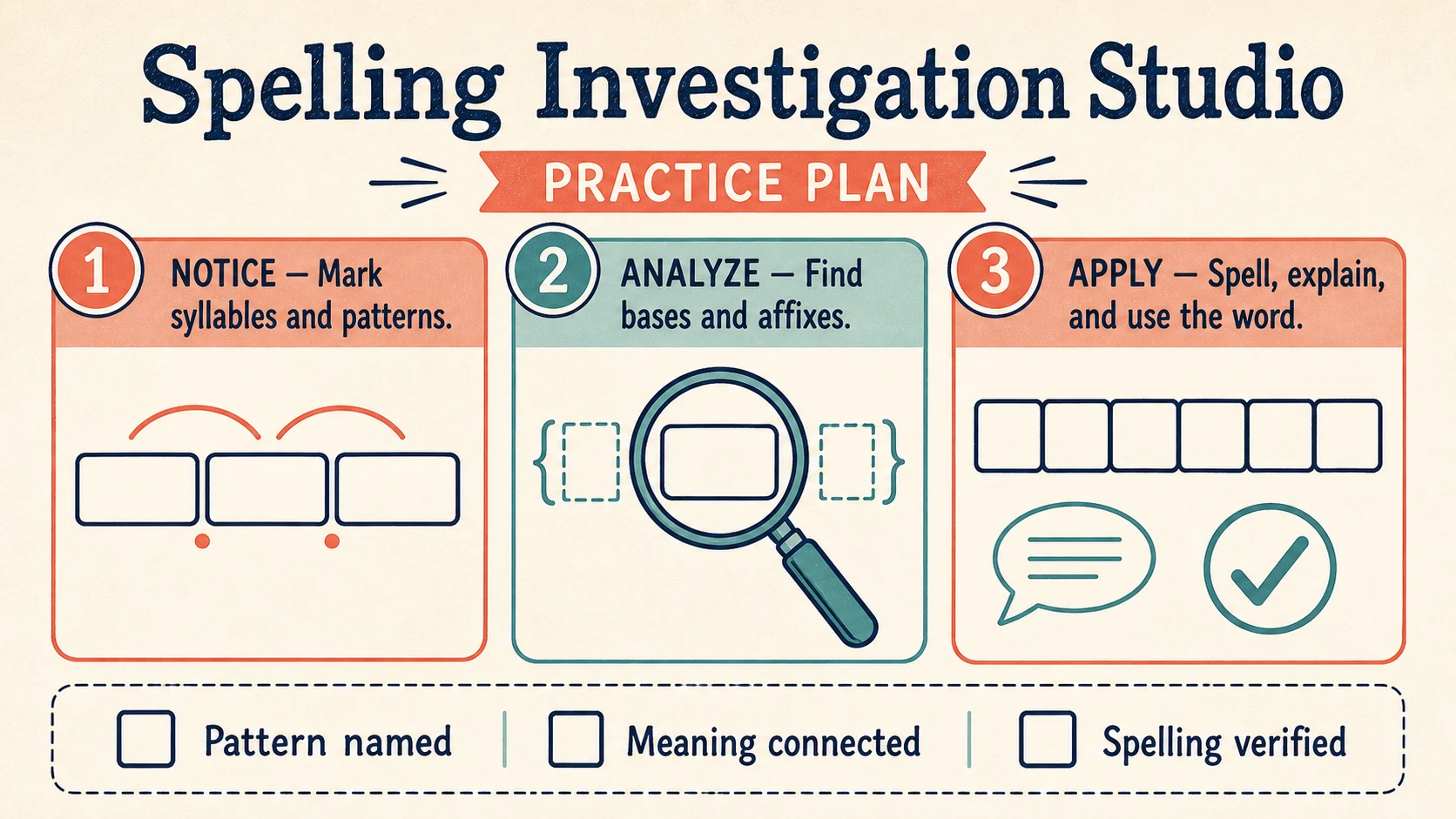
Revisit a small set after increasing delays, and stop rehearsing words that remain secure.
| Time | Suggested review | Decision |
|---|---|---|
| End of the first session | Cover and retrieve two or three corrected words | Note which are recalled without help |
| Next practice session | Mix missed words with one previously correct word | Check whether errors recur |
| Several days later | Dictate selected words or use them in short sentences | Look for delayed recall and context transfer |
| About a week later | Give a small cumulative check | Retire secure words; retain unstable ones |
| During later writing | Notice the same words or patterns naturally | Confirm whether accuracy transfers |
Do not rehearse all 25 words equally unless the evidence supports that choice. A word written accurately several times without help can leave the immediate review set. A word corrected only after a hint should return sooner. A recurring letter pattern may justify grouping a few words for comparison, but avoid inventing a rule from one example.
The topic catalogue recommends pattern-focused work, word sorting, look-cover-write-check, contextual sentences, and cumulative review. Those are WorksheetWise instructional suggestions. They should be adapted to the actual words and errors on the page, not applied as an inflexible routine.
Decide what to do next
Use the learner’s work to choose among three honest next steps.
If directions caused most of the difficulty, reteach the activity formats with a few fresh examples. Do not assume the spelling itself is weak until the learner has had a fair chance to understand the task.
If a small group of words or letter sequences caused difficulty, create a short review set. Compare the exact troublesome parts, use look-cover-write-check, and retrieve those words later. The free worksheet generators can provide additional material, but generated practice should match a clearly identified need rather than merely add volume.
If performance was independent and accurate across formats, move toward transfer and variety. The 4th Grade Spelling Words Worksheet Pack contains 18 worksheets and is listed at $4.79, while the broader topic guide can help place another free activity within a larger sequence. More practice is useful only when it changes the demand, revisits learning after a delay, or addresses evidence from the learner’s work.
Limitations and a practical next action
This worksheet is a 25-item, easy-level practice resource, not a complete spelling assessment or curriculum. Its item formats can show how the learner handles recognition, letter ordering, correction, and written recall under these particular conditions. They cannot establish comprehensive standards alignment, predict classroom outcomes, diagnose a learning difficulty, or guarantee transfer into everyday writing.
Support conditions also affect interpretation. An independently retrieved answer differs from an answer produced after the adult identifies the difficult letters. A same-day correction differs from recall several days later. Record those differences instead of compressing them into a single score.
For the next action, print the free worksheet and separate answer key, model one comparable item, and let the learner complete a small mixed-format section independently. Classify any discrepancies, then use the Spelling Words topic guide to select the next free practice by the pattern or activity need the learner’s work actually reveals.
Put it into practice
Use the guide with a real printable
Move from explanation to a short, observable practice task. Check the first item together, then adjust the next session from the learner's actual work.
See the 18-worksheet pack