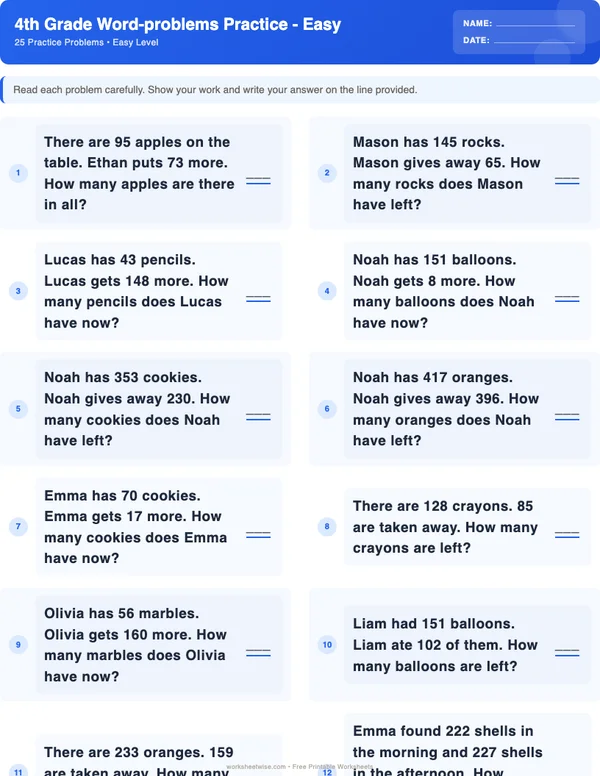
Complete guide
How to teach and practise 4th grade word problems worksheets - standard theme (easy)
How to Use This 14-Problem Worksheet
The free 4th Grade Word Problems worksheet provides 14 easy-level story problems involving reading comprehension, mixed operations, problem solving, and multi-step reasoning. A separate printable answer key is included.
The direct approach is simple: model one problem, solve two or three together, assign a manageable group independently, and review the learner’s reasoning before checking answers. Ask the learner to identify the quantities and their relationship—not merely search for words that appear to signal an operation. If errors multiply, reduce the number of problems completed in one sitting while keeping the mathematical task intact.
Grade labels describe the intended practice level; local curricula, instructional sequences, and learner readiness differ. “Easy” also describes this worksheet’s place within the catalogue, not how every learner will experience it. A child who computes accurately may still need support interpreting a story, while another may understand the situation but make an arithmetic error.
For a fuller progression across problem types and difficulty levels, use the broader 4th Grade Word Problems topic guide. This guide concentrates on launching and using this particular printable.
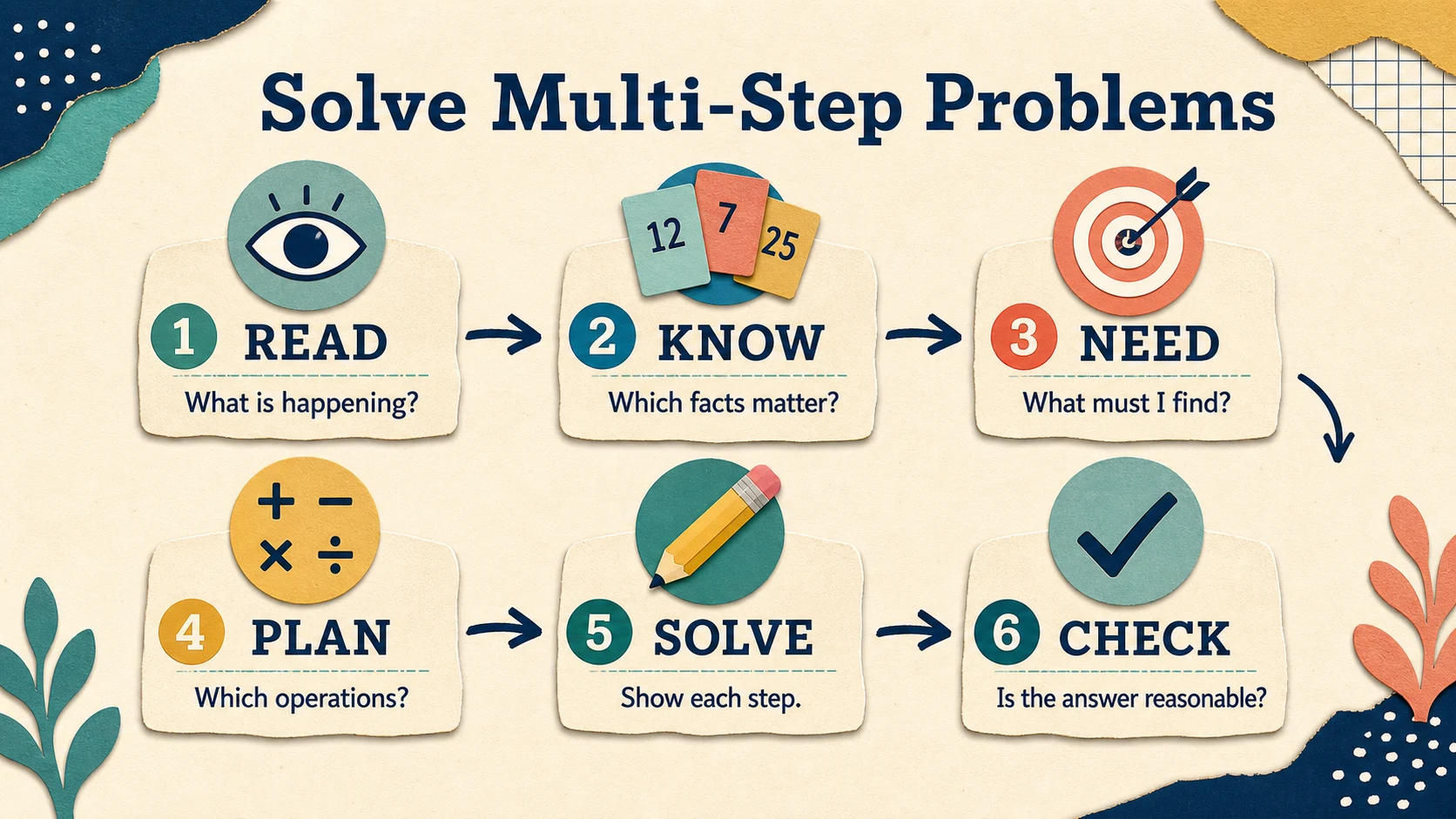
Use a short model–guide–practice–review sequence rather than assigning all 14 items without preparation.
A Practical Lesson Map
The worksheet can be used in one longer lesson or divided across several shorter sessions. The learner’s observed work should determine the pace. The times below are instructional suggestions, not universal requirements.
| Lesson phase | Suggested use | What the adult watches for |
|---|---|---|
| Preview | Read the printed directions and scan the page | Does the learner know where to write and that work should be shown? |
| Launch | Discuss one story without calculating immediately | Can the learner state what is happening and what must be found? |
| Model | Adult solves a similar example aloud | Does the learner connect the operation to the quantities? |
| Guided practice | Complete two or three worksheet items together | Can the learner choose a representation and explain the equation? |
| Independent practice | Assign three to six items at first | Does understanding continue when prompts are removed? |
| Review | Discuss selected correct and incorrect responses | Can the learner locate and revise an error? |
| Retrieval | Revisit a few problems after a delay | Can the learner reproduce the reasoning without copying prior work? |
Fourteen problems do not have to be completed in one sitting. For a learner who sustains attention and explains reasoning clearly, one session may be appropriate. For a learner who begins guessing, omitting work, or confusing operations, divide the page into smaller sets.
Do not assume that a fast finish shows strong understanding. A useful check is to ask the learner to explain one answer, estimate whether it is reasonable, or identify what each number in the equation represents.
Prepare the Worksheet Without Preteaching Every Item
Print the worksheet and its answer key separately. Keep the key out of view during initial work. Provide a pencil, eraser, and blank paper if the printed workspace is not enough for drawings or calculations.
Before beginning, read the worksheet’s instruction together: “Read each problem carefully. Show your work and write your answer on the line provided.” Clarify that showing work might include an equation, a labeled drawing, a bar model, partial products, long division, or another understandable calculation. It need not be an elaborate written explanation for every item.
Check the necessary foundations
Use one brief oral problem to see whether the learner can:
- Retell a mathematical situation in their own words.
- Distinguish known quantities from the quantity being sought.
- Select an operation based on the relationship in the story.
- Carry out the selected computation with reasonable accuracy.
- Attach an appropriate unit to the answer.
This is a readiness check, not a separate test. If the learner understands the story but struggles with multiplication or division, allow a multiplication chart or provide calculation support while preserving responsibility for choosing the operation. If the learner calculates well but cannot explain the story, emphasize retelling and visual representation.
Establish a repeatable routine
A compact routine for each item is:
- Read the whole problem.
- Retell what is happening.
- Mark what is known and what must be found.
- Draw or write an equation showing the relationship.
- Calculate.
- Write the answer with a unit.
- Check whether the result fits the story.
This routine reflects the catalogue’s instructional guidance. It also fits the high-level emphasis on systematic instruction and mathematical representations in the IES practice guide for assisting students who struggle with mathematics. That source offers broad instructional guidance; it did not evaluate WorksheetWise or this worksheet.
Model the Reasoning Before Independent Work
Choose a fresh example similar in scope to the printable so the learner can watch the process without losing one of the 14 practice opportunities. Say enough to expose the decisions, but avoid turning the model into a lecture.
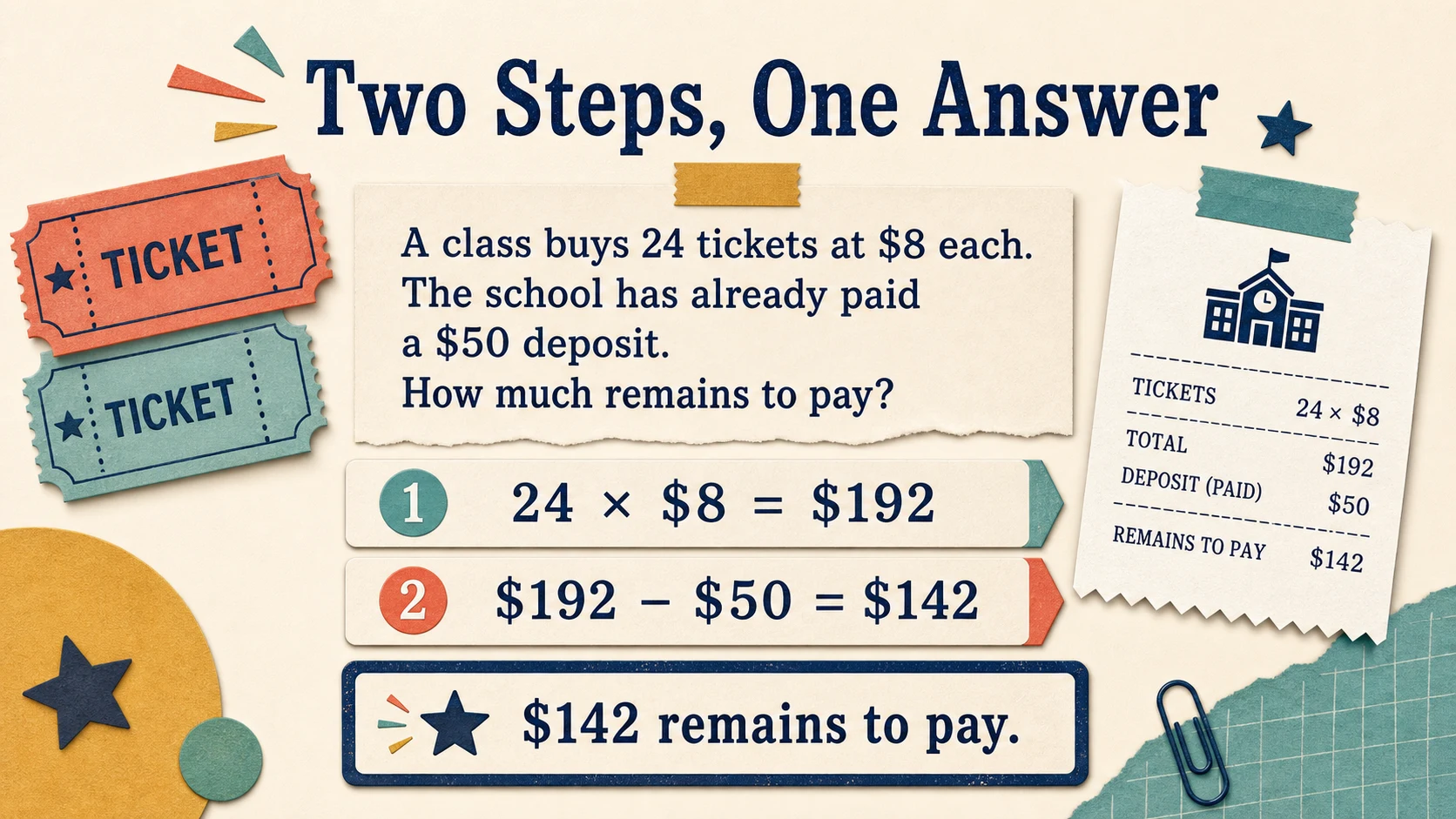
The equation should represent the story, and the final answer should name the unit.
Fully checked example 1: equal groups followed by subtraction
Problem: A supply room has 6 boxes of notebooks. Each box contains 24 notebooks. A teacher gives 39 notebooks to students. How many notebooks remain?
First identify the stages. Six equal boxes of 24 must be combined, so multiplication finds the starting total:
Then 39 notebooks leave the supply room:
Answer: 105 notebooks remain.
Check the multiplication: . Check the subtraction by reversing it: . The answer is smaller than 144 because notebooks were given away.
While modeling, name the reason for each operation: “I multiply because there are six equal groups of 24. I subtract because 39 are removed from the total.” This is more reliable than saying that a particular word always means multiply or subtract.
Fully checked example 2: exact division
Problem: A coach divides 275 practice cards equally among 5 teams. How many cards does each team receive?
The total and number of equal groups are known. The size of each group is unknown:
Answer: Each team receives 55 cards.
Check with multiplication:
A quick estimate also helps. Since , an answer of 55 is plausible. An answer of 550 would be too large because dividing a positive total into several groups should not produce a group larger than the original total.
Fully checked example 3: addition followed by subtraction
Problem: A library display begins with 438 books. Volunteers add 267 books. Later, 189 books are borrowed. How many books remain on the display?
First find the number present after the addition:
Then subtract the borrowed books:
Answer: 516 books remain.
Verify the first step by decomposing 267:
Verify the second step by addition:
The result should be less than 705 because books were borrowed, but it may still be greater than the original 438 because more books were added than removed.
Fully checked example 4: capacity and unused places
Problem: A small auditorium has 8 rows with 6 seats in each row. If 37 seats are occupied, how many seats are empty?
Find the total capacity:
Subtract the occupied seats:
Answer: 11 seats are empty.
Check:
The answer cannot exceed 48, and it cannot be negative because the stated attendance does not exceed the capacity.
These examples are constructed for instruction and are not presented as copies of particular worksheet items.
Move From Guided Practice to Independent Work
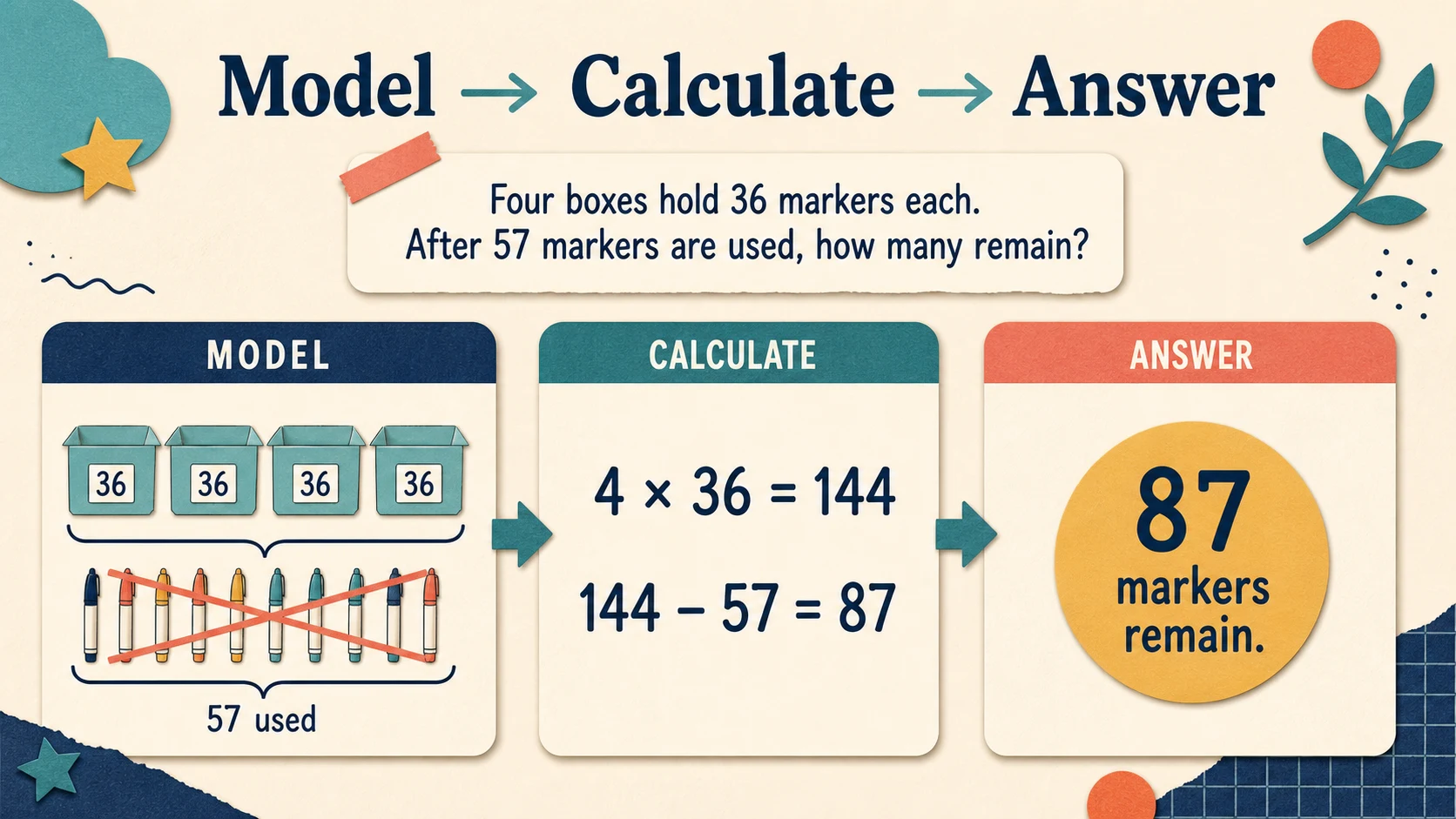
Gradually remove prompts as the learner shows that the routine is becoming independent.
Guided practice: prompt decisions, not answers
For the first worksheet item you solve together, ask:
- “What is happening in this story?”
- “Which quantities are known?”
- “What are we trying to find?”
- “Are these equal groups, parts of a total, a comparison, or a change?”
- “What could you draw or write to show that relationship?”
- “What will your answer count or measure?”
If the learner chooses an incorrect operation, do not immediately supply the correct one. Return to the situation. For example: “You wrote . Does that represent six groups with 24 in every group, or only two quantities being joined?”
On the next item, reduce the prompting. Ask the learner to lead the routine while you listen. By the third guided item, wait before intervening. Silence gives the learner time to organize the information.
Independent practice: assign a diagnostic-sized set
Begin with three to six items rather than automatically requiring all 14. Tell the learner to circle an item if its meaning is unclear and continue to another problem when possible. This separates persistence from unproductive guessing.
Review the first independent set before assigning more. Look at the equations and diagrams as well as the final answers. If the learner selects suitable operations and makes only isolated arithmetic mistakes, continue with the same level. If the equations do not match the stories, return to guided interpretation before adding more items.
The IES early mathematics practice guide discusses broad principles such as using progressions, monitoring what learners know, and supporting mathematical language. It is not specific to fourth grade or this printable, so use it as general instructional framing rather than as evidence about this worksheet.
Adapt Support Without Changing the Skill
Support should make the reasoning accessible without deciding the mathematics for the learner. The target remains reading a story, representing the relationship, selecting operations, calculating, and checking.
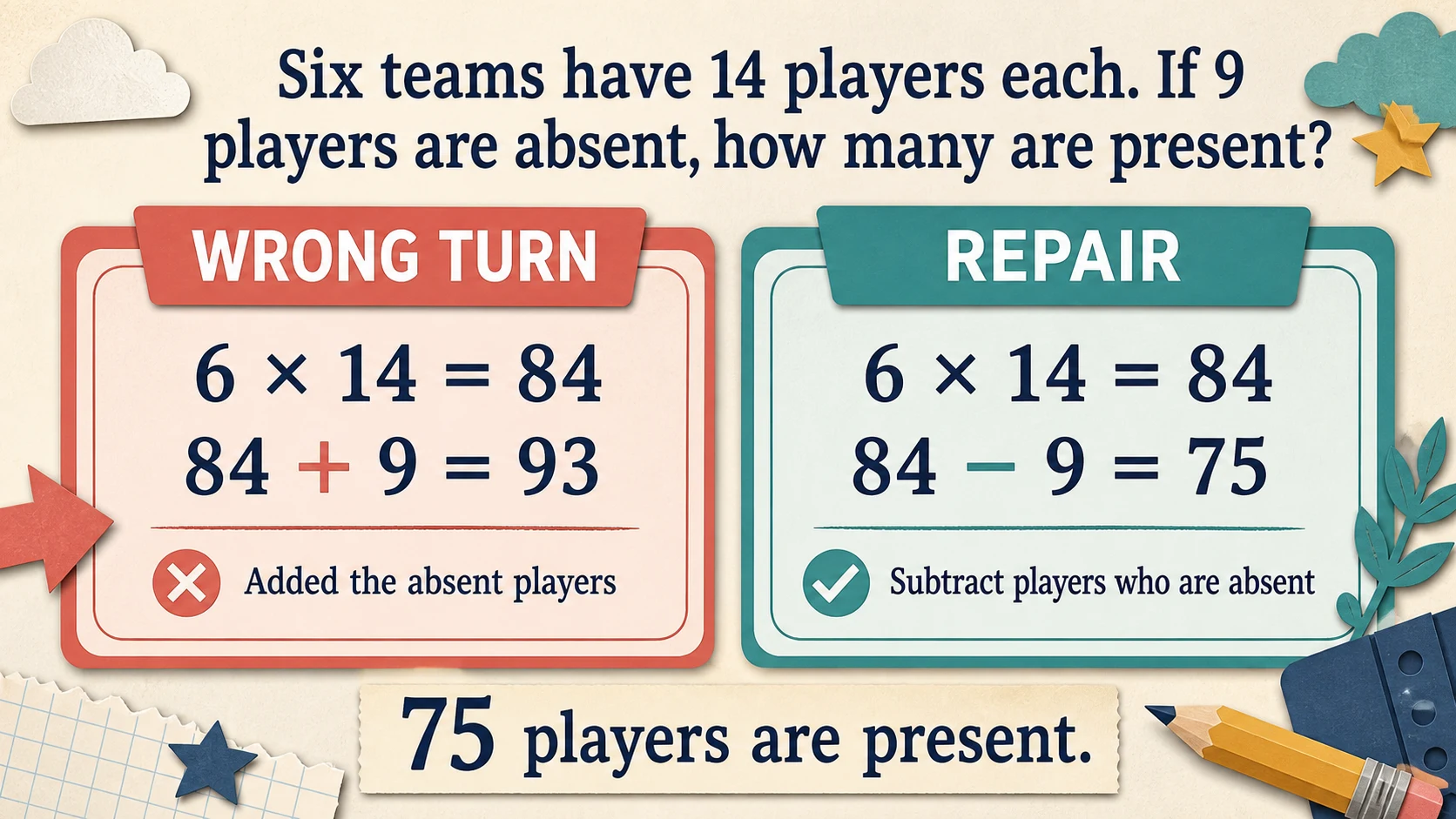
Adjust reading load, representation, or calculation support while preserving the problem-solving decision.
When reading is the main barrier
Read the problem aloud once while the learner follows the text. Then ask for a retelling without numbers: “What happened first? What changed? What do we need to know?” Return the numbers afterward.
You may cover nearby items with a blank sheet so only one problem is visible. You may also mark sentence boundaries or let the learner underline quantities after reading the whole problem. Avoid circling operation “keywords” for the learner. Words such as left, each, or altogether can be helpful in context, but no single word reliably determines an operation.
When representation is the main barrier
Offer a choice among a quick sketch, bar model, table, or equation. For an equal-groups problem, draw several boxes and label the amount in each. For a comparison, use two bars aligned at one end so the difference is visible. For a change situation, show a starting amount, the change, and the result.
Keep the representation lean. Drawing every object can become cumbersome with larger numbers. A labeled rectangle showing “6 groups of 24” preserves the relationship more efficiently than drawing 144 individual notebooks.
When computation is the main barrier
Let the learner state and record the equation before receiving help with arithmetic. Depending on the purpose of the session, support might include graph paper for place-value alignment, a multiplication chart, a worked computation beside the learner’s chosen equation, or permission to calculate in smaller chunks.
Document the support used. “Selected both operations independently; needed help subtracting across zeros” is more informative than recording the entire item as simply wrong.
When the learner is ready for more independence
Ask for a second representation or a written reasonableness check on selected items. Another useful extension is to change the location of the unknown while keeping the numbers manageable. Do not increase number size merely to make the work look harder. The goal is flexible interpretation, not extra arithmetic burden.
Handle Boundary Cases Carefully
Some word problems require more than a numerical calculation. The situation and question determine how a result should be reported.
Remainders depend on the question
Problem: A baker has 157 muffins and places 12 muffins in each full box. How many full boxes can be filled, and how many muffins remain?
because
and
Answer: 13 full boxes can be filled, with 1 muffin remaining.
If the question instead asked how many boxes were needed to hold every muffin, 13 would be insufficient; a fourteenth box would be needed. The same division produces different reporting because the question changes.
Other boundary checks include:
- A count of objects should normally be a whole number.
- An answer should retain its unit: books, seats, teams, or dollars.
- Extra information should be ignored only after the learner explains why it is irrelevant.
- Missing information should not be invented.
- A multi-step answer must address the final question, not merely the first subtotal.
These cases are worth discussing even if they do not appear on this particular sheet. They reveal whether the learner interprets the situation or treats calculation as an isolated procedure.
Interpret Errors Before Correcting Them
A wrong answer does not identify its own cause. Inspect the written work and ask the learner to explain the steps.
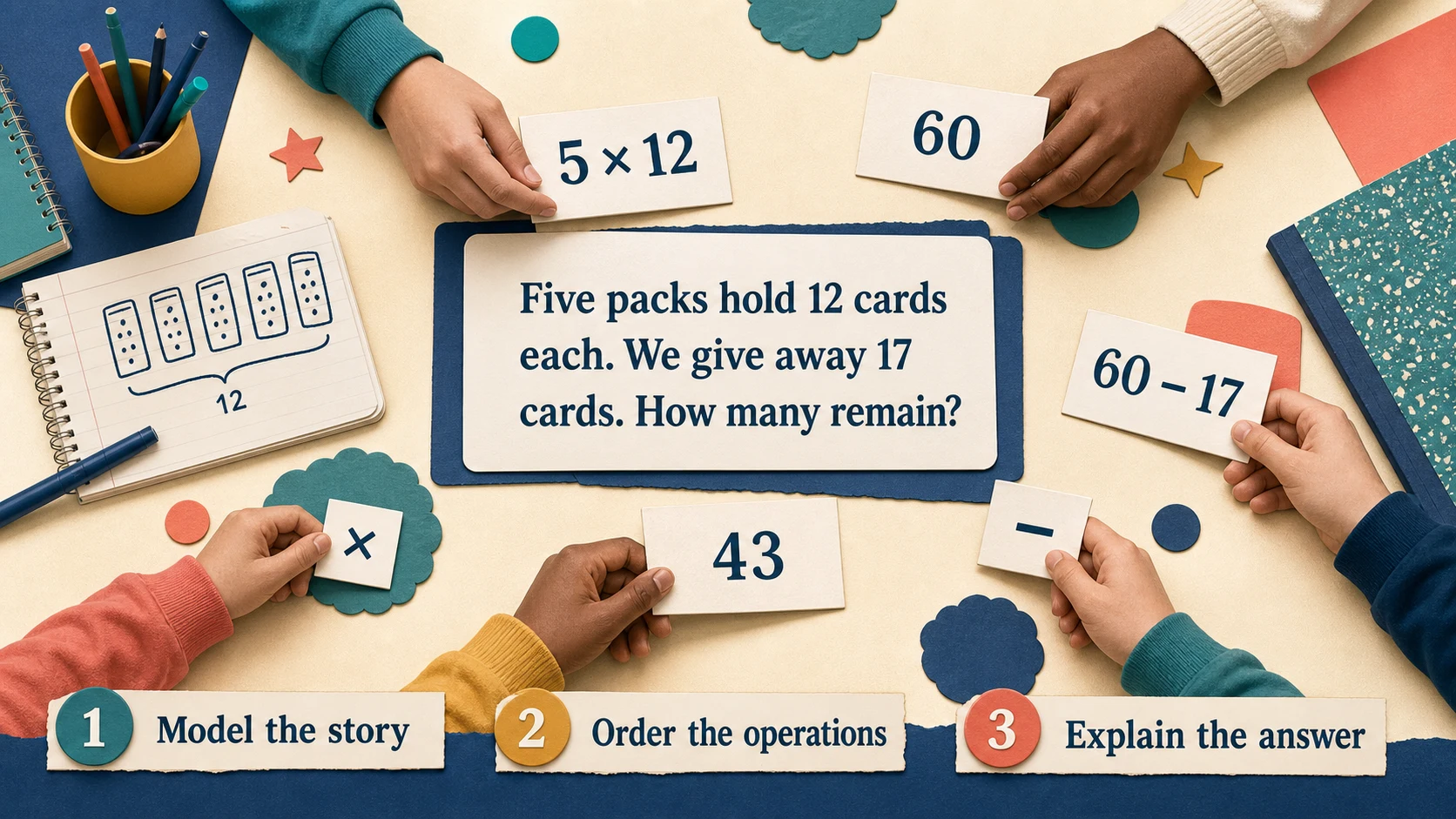
Locate whether the difficulty occurred in reading, representing, calculating, or reporting.
Common error patterns
| Observed work | Likely interpretation | Productive response |
|---|---|---|
| Correct numbers but unrelated operation | The relationship was misunderstood | Retell or draw the story before recalculating |
| Correct first step but no second step | The learner answered a subtotal | Reread the final question and label what the subtotal means |
| Suitable equation but incorrect result | The reasoning may be sound; computation needs attention | Check the arithmetic separately |
| Correct number without a unit | The result is not fully connected to the context | Ask, “105 what?” |
| Every number is used automatically | The learner assumes all details must enter the equation | Ask what each number describes and whether it affects the question |
| Operation chosen from one word | A keyword shortcut is replacing comprehension | Test the equation against the whole situation |
| Implausibly large or negative result | No reasonableness check was applied | Compare the result with the starting quantities |
| Blank work with an answer only | Reasoning cannot be inspected | Request one equation or labeled representation |
Respond to the earliest point at which the reasoning went off course. Repeating the computation will not fix a misunderstood relationship. Conversely, reteaching the whole problem type may be unnecessary when the equation is correct and the error is a single arithmetic slip.
The Common Core mathematics standards include fourth-grade work with multi-step whole-number problems using the four operations, including interpreting remainders. That provides useful grade-level context, but this 14-item easy worksheet should not be treated as a comprehensive standards assessment or proof of full alignment.
Use the Answer Key Responsibly
The separate answer key supports efficient checking, but it should confirm work rather than replace analysis.
First solve or inspect the learner’s work without displaying the key. Compare the final response with the keyed answer, then verify that the recorded equation and reasoning fit the story. A correct answer can result from an unclear method, an unrecorded guess, or two compensating errors. An incorrect answer can follow a sound model with one calculation mistake.
For each reviewed item, consider three layers:
- Interpretation: Did the learner understand what was known and what had to be found?
- Representation and operation: Did the equation, diagram, or sequence match the situation?
- Calculation and communication: Was the computation accurate, and did the answer include the proper unit?
If the key and the learner disagree, recalculate independently before marking the work. Check whether the problem expects a remainder, a rounded-up count, or another context-dependent form. If you still cannot reconcile the result, mark the item for later review instead of forcing the learner to copy the key.
A brief record might use codes such as R for reading or retelling, O for operation choice, C for computation, and U for unit. The codes are an instructional convenience, not a formal diagnosis.
Decide What to Do After the Worksheet
Use patterns across the work rather than a single percentage cutoff. Fourteen items provide a useful practice sample, but they do not establish complete mastery of every fourth-grade word-problem type.
Continue at this easy level when the learner frequently needs help identifying relationships, omits steps, or cannot explain why an operation fits. Reuse missed items after discussing them, but change the numbers or context so the learner must reconstruct the reasoning rather than memorize an answer.
Move toward more varied practice when the learner independently:
- Retells the situation accurately.
- Identifies what must be found.
- Chooses operations that match the relationships.
- Completes all necessary steps.
- Checks answers for reasonableness.
- Explains selected solutions clearly.
If performance is uneven, target the specific source of difficulty. A learner who understands multiplication stories but struggles with comparison problems needs contrastive examples, not necessarily harder computation. A learner who models accurately but calculates unreliably may benefit from focused arithmetic practice alongside continued word problems. The 4th Grade Math hub can help you choose related practice without assuming that every difficulty is a word-problem difficulty.
Schedule Short Retrieval Practice
Do not treat completion day as the final encounter with the reasoning. Revisit a few problems after delays and ask the learner to solve from the story again.
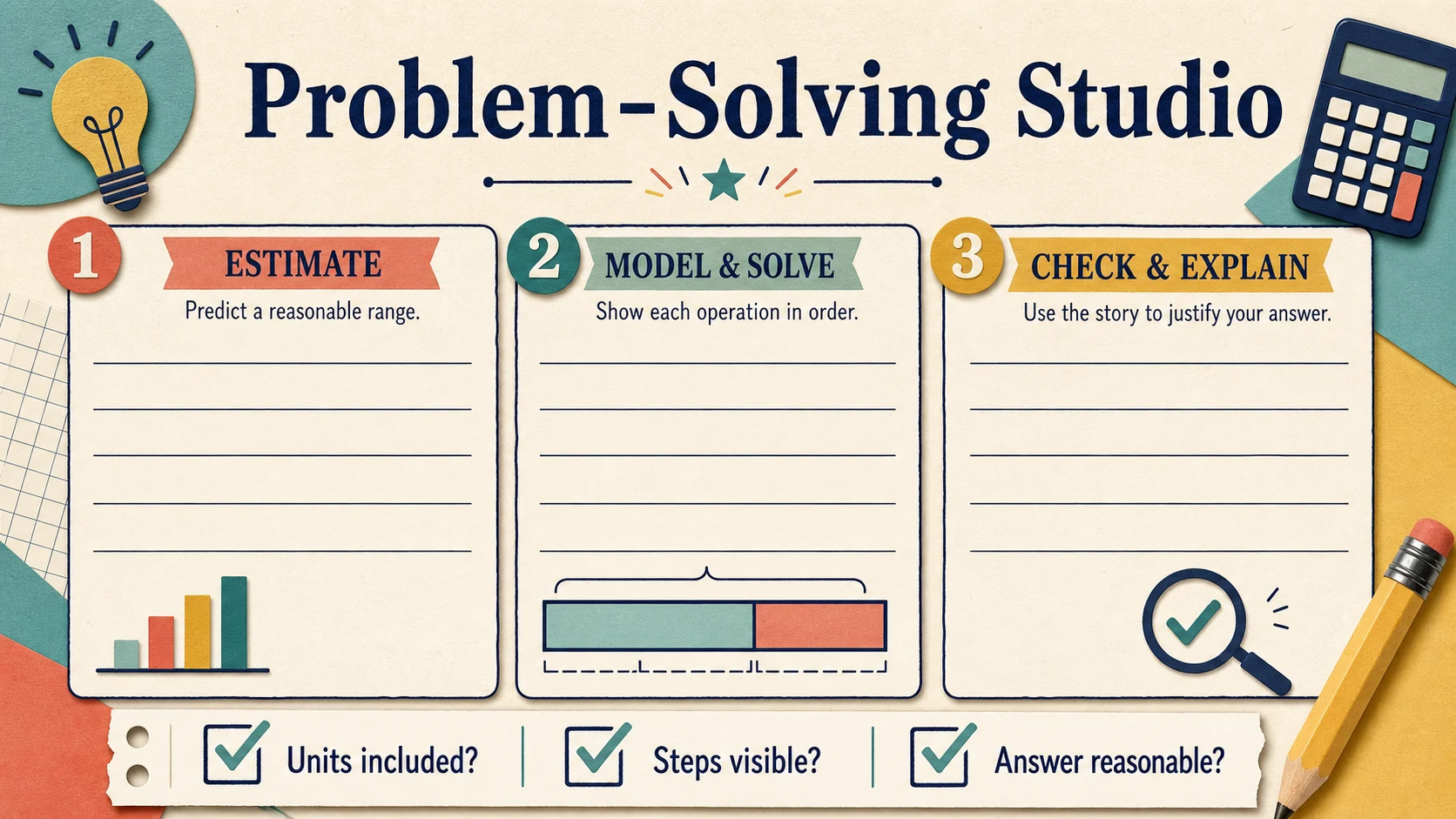
Use a few selected problems over time, adjusting the schedule according to observed recall.
A practical, adjustable schedule is:
| Time | Retrieval task |
|---|---|
| Later the same lesson | Explain one completed item without looking at the calculation |
| One or two days later | Redo one successful item and one corrected item |
| About one week later | Solve two similar problems with changed numbers |
| Two or three weeks later | Mix one of these structures into other fourth-grade math practice |
These intervals are suggestions, not a universal timetable. Shorten the delay if the learner cannot reconstruct the method. Lengthen it when recall is secure. During retrieval, avoid beginning with the full routine printed as a checklist. Let the learner attempt the problem first, then provide the smallest prompt needed.
Track whether the learner remembers an answer or rebuilds the reasoning. Changing 6 boxes of 24 to 7 boxes of 23 prevents simple answer recall while preserving the equal-groups-then-change structure.
Limitations and the Honest Next Step
This printable offers 14 easy-level exercises in problem solving, reading comprehension, mixed operations, and multi-step reasoning. It can support classroom practice, homework, tutoring, or homeschool instruction, but it is only one practice set. It does not reveal every aspect of a learner’s mathematical understanding, guarantee an outcome, replace local curriculum decisions, or provide medical or diagnostic guidance.
Use observed work to choose the next step. If the learner still needs structure, revisit selected problems with bar models and the consistent read–retell–represent–solve–check routine. If the learner works independently and explains the relationships, continue through the 4th Grade Word Problems topic guide or use the 4th Grade Word Problems Worksheet Pack for broader practice. For immediate retrieval, create a short fresh set with changed numbers using the free worksheet generators.
Put it into practice
Use the guide with a real printable
Move from explanation to a short, observable practice task. Check the first item together, then adjust the next session from the learner's actual work.
See the 18-worksheet pack