Complete guide
How to teach and practise 4th grade subtraction worksheets - standard theme (easy)
How to Use This 25-Item Subtraction Worksheet
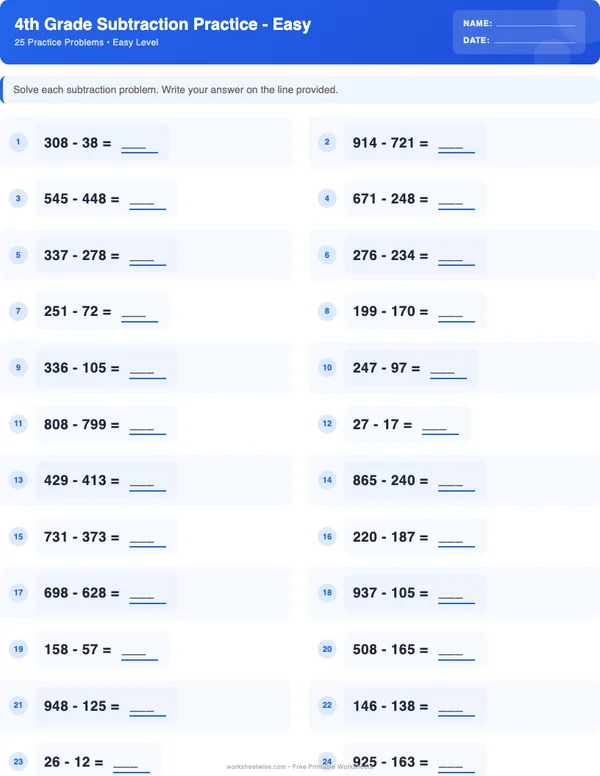
The free 4th Grade Subtraction worksheet provides 25 easy-level exercises covering subtraction facts, mental math, number sense, and regrouping. Use it as focused practice after a learner has seen the relevant subtraction method, not as a complete first lesson or a timed test.
A practical session is:
- Preview two or three items.
- Model one similar problem.
- Solve two similar problems together.
- Assign a manageable set of worksheet items independently.
- Check the reasoning as well as the answers.
- Revisit selected items after a delay.
The learner’s observed work should determine how quickly you proceed. If place-value errors appear in the first few items, pause and provide support. If the learner solves accurately and explains the method, reduce prompting and allow independent work.
Grade labels describe the intended practice level; local curricula and instructional sequences differ. In the Common Core progression, Grade 4 includes fluent addition and subtraction of multi-digit whole numbers using the standard algorithm. That is a useful reference point, but it is not a claim that this single printable provides comprehensive standards coverage. See the Common Core State Standards for Mathematics for the full framework.
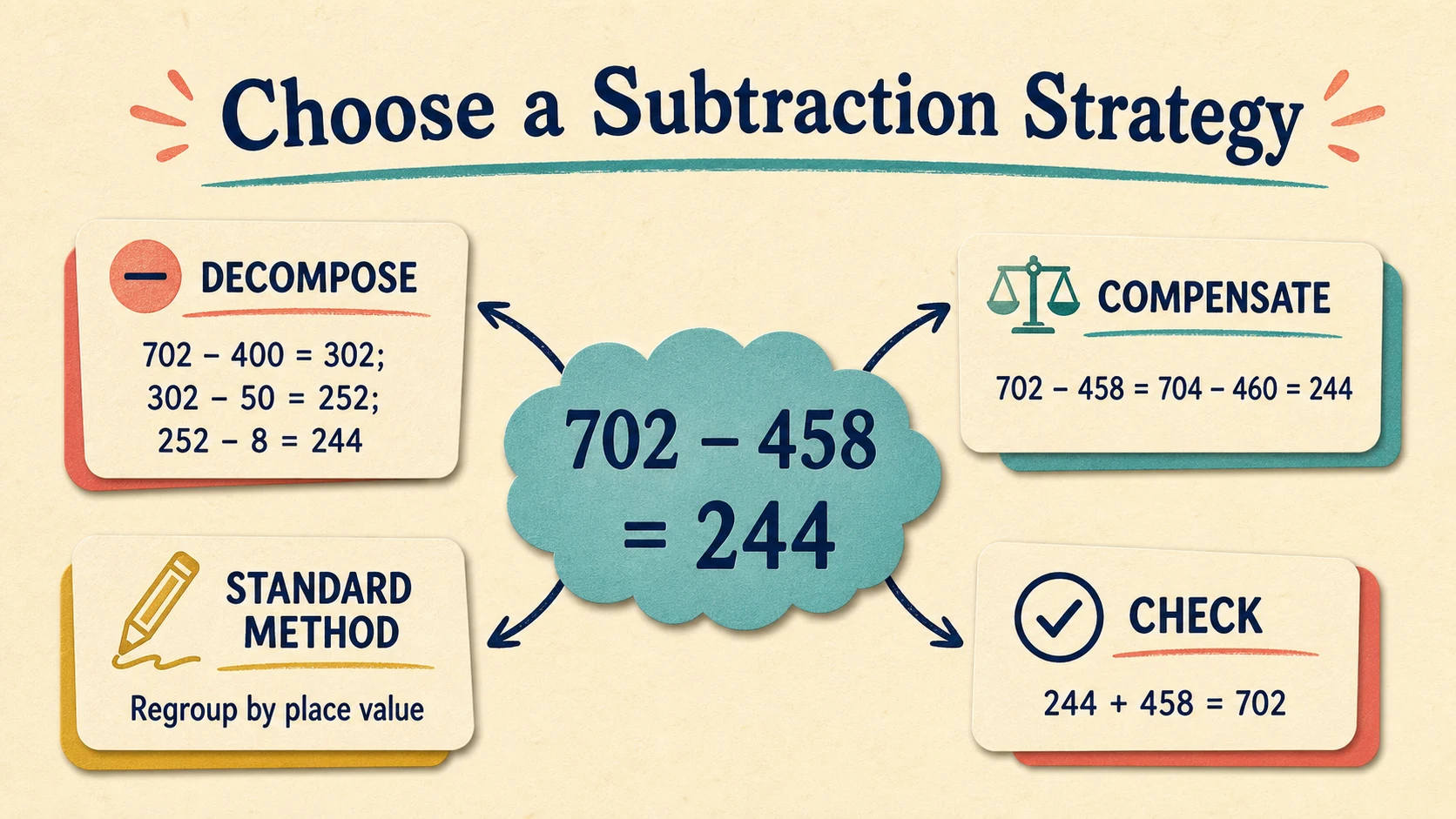
Preview, model, guide, release, check, and revisit.
What This Worksheet Does—and Does Not—Cover
The printable contains 25 straightforward subtraction exercises. Its stated skills are:
- Subtraction facts
- Mental math
- Number sense
- Regrouping
- Written subtraction practice
The learner is directed to solve each subtraction problem and write the answer on the provided line. A separate printable answer key is included.
Because the worksheet is labeled easy, it is most useful for an adult who wants to introduce a practice routine, reinforce a recently taught method, or observe how securely a learner handles foundational subtraction. “Easy” does not mean that every learner should complete all 25 items without support. Difficulty depends on prior instruction, fluency with basic facts, place-value understanding, attention to notation, and familiarity with regrouping.
This worksheet does not by itself teach the entire subtraction progression. It also does not show whether a learner can interpret every kind of subtraction situation in a word problem. For the broader sequence—including take-away, comparison, missing-part situations, fact relationships, place value, and multi-digit work—use the 4th Grade subtraction topic guide.
Decide whether the worksheet fits today’s purpose
Use the worksheet when the immediate purpose is one of the following:
- Checking whether a taught subtraction method is becoming more reliable
- Giving short, structured practice with written calculations
- Observing regrouping and place-value habits
- Rebuilding confidence with an accessible set
- Assigning independent practice after modeling
- Selecting a few problems for delayed review
Choose a different activity first if the learner cannot yet explain what subtraction finds, cannot keep digits in place-value columns, or becomes confused by the meaning of regrouping. In those cases, use objects, drawings, expanded form, or a place-value chart before expecting a page of written calculations.
Prepare the Lesson Before the Learner Begins
Print the worksheet and answer key separately. Keep the answer key out of view during practice, but make it available for checking afterward. Have a pencil, eraser, and blank paper ready. If regrouping may be difficult, add base-ten blocks or a hand-drawn place-value chart.
Before the lesson, scan the printable and select:
- One item to discuss without solving
- One similar problem to model on separate paper
- Two similar problems for guided practice
- An initial independent set of about five items
- Two or three items that could be saved for later retrieval
The number of items in each set is an instructional suggestion, not a universal timetable. A learner who works slowly and accurately may need a shorter set. A learner who is already secure may complete more. Avoid deciding in advance that all 25 problems must be finished in one sitting.
Use a short readiness check
Give three oral or written prompts before opening the worksheet:
- “What does the minus sign tell you to find?”
- “In 463, what value does the 6 represent?”
- “How could addition help you check a subtraction answer?”
A sufficient response might be that subtraction finds what remains or the difference, the 6 represents 60, and the learner can add the difference to the number subtracted. Exact wording is not important. Listen for usable ideas.
If the learner cannot identify place value, insert a brief place-value review. If the learner understands subtraction but hesitates over facts such as , allow a fact strategy during the first examples. The purpose is to preserve attention for the targeted subtraction process rather than turning every hesitation into a memory test.
Set a clear, narrow goal
Say what successful work will look like:
“Today we will keep digits in the correct columns, regroup when a top digit is too small, and check a few answers with addition.”
That is more useful than “Finish the page” because it identifies observable behaviors. It also gives the learner a basis for reviewing work independently.
Model the Task with a Fully Worked Example
Use a problem similar to the worksheet rather than copying an unanswered worksheet item into your demonstration. The example below is independently checked.
Example 1: Subtraction without regrouping
Solve:
Align the digits by place value:
  786
- 243
-----
Work from right to left:
- Ones:
- Tens:
- Hundreds:
Therefore:
Check with addition:
The check returns to the starting number, so the result is consistent.
While modeling, speak in place-value language. Say “eight tens minus four tens,” not only “eight minus four.” Point to the columns as you work. Keep the written demonstration uncluttered enough that the learner can see which marks belong to which step.
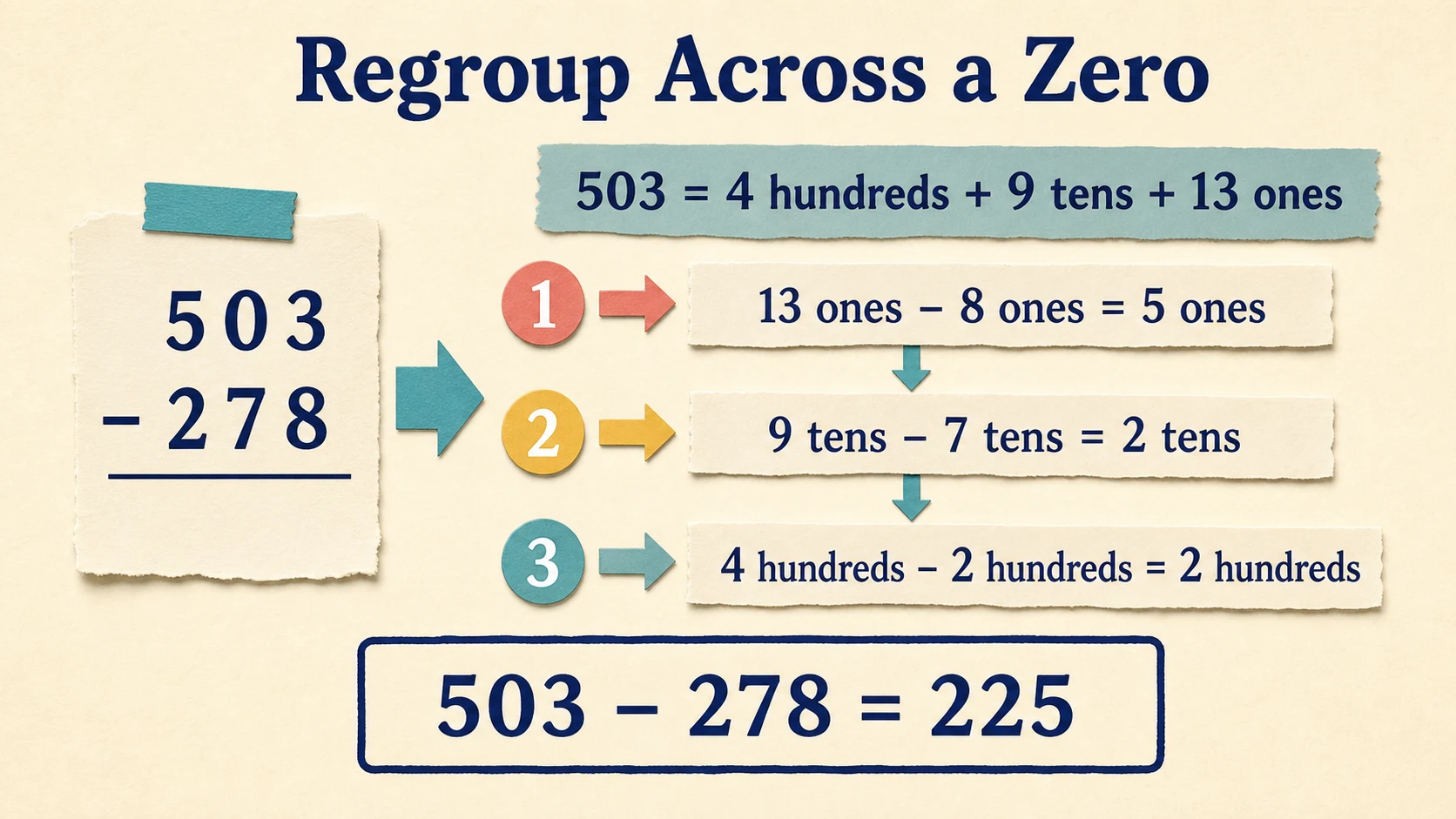
The digits stay aligned, each column is solved, and addition checks the result.
Example 2: One regrouping step
Solve:
Set up the problem:
  542
- 178
-----
In the ones column, ones cannot be used to subtract ones with whole-number digits in the standard written method. Regroup one ten as 10 ones. Five tens become four tens, and two ones become 12 ones.
- Ones:
- Tens: still cannot be completed without regrouping, so regroup one hundred as 10 tens.
- The five hundreds become four hundreds, and the four tens become 14 tens.
- Tens:
- Hundreds:
Therefore:
Check:
This example contains two successive regrouping decisions. Make each trade visible. Avoid teaching regrouping as unexplained digit crossing. The quantity remains equal: one hundred becomes ten tens, and one ten becomes ten ones.
The IES practice guide on teaching mathematics supports high-level use of representations and clear mathematical language in instruction. It did not evaluate this WorksheetWise printable. Here, base-ten blocks or a place-value drawing are optional representations for making the trades visible.
Move from Guided Practice to Independent Work
After modeling, solve two fresh examples with the learner. Keep the mathematical responsibility with the learner even while providing prompts.
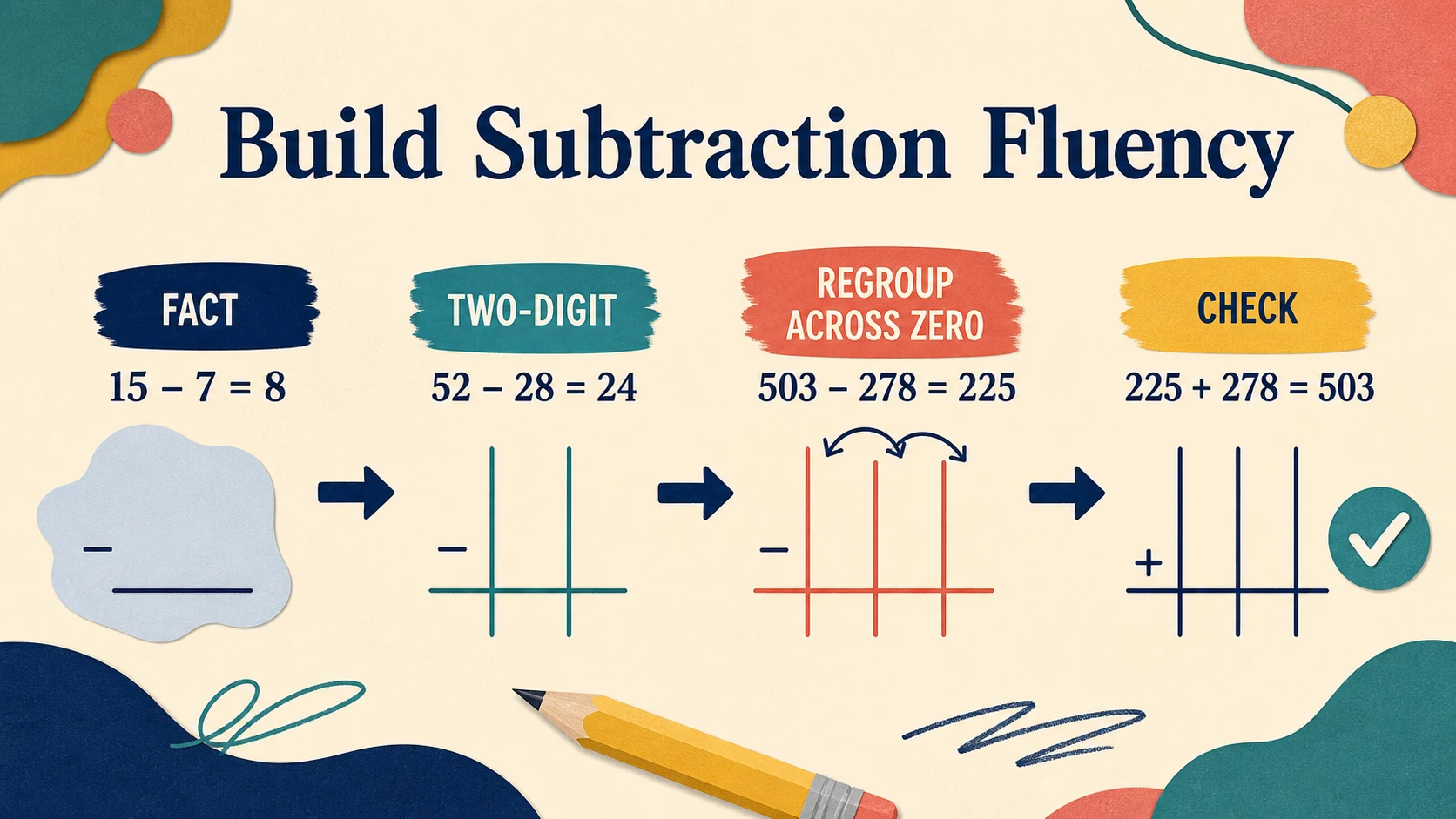
Prompts become lighter as the learner shows accurate, explainable work.
Example 3: Guided practice with a zero
Solve:
Ask the learner to align the digits and inspect the ones column.
- Ones:
- Tens: There are zero tens, so requires regrouping.
- Regroup one hundred from 7 hundreds. This leaves 6 hundreds and creates 10 tens.
- Tens:
- Hundreds:
Therefore:
Check:
Useful prompts include:
- “Which column comes first?”
- “Do you have enough tens?”
- “What can one hundred be traded for?”
- “What value remains in the hundreds column?”
- “How could we verify the answer?”
Do not say “borrow from the 7 and put a 1 beside the zero” without explaining the place-value trade. That shortcut may produce correct marks without secure understanding.
Example 4: Regrouping across a zero
Solve:
This is a boundary case because the tens and hundreds digits are both zero.
Start with the ones column. Two ones are not enough to subtract five ones. The thousands place must be regrouped through the intermediate places:
- Regroup 1 thousand as 10 hundreds.
- Regroup one of those hundreds as 10 tens, leaving 9 hundreds.
- Regroup one of those tens as 10 ones, leaving 9 tens.
- The original 2 ones become 12 ones.
The renamed top number now represents:
- 0 thousands
- 9 hundreds
- 9 tens
- 12 ones
Subtract:
- Ones:
- Tens:
- Hundreds:
Therefore:
Check:
This example is harder than a simple one-trade problem. If the printable does not contain this structure, use it only as an extension or diagnostic boundary case. Do not assume success with one regrouping means the learner is ready to regroup across multiple zeros.
Release responsibility in small steps
A useful progression is shown below. Adjust it from the learner’s actual work.
| Lesson phase | Adult action | Learner action | Move on when |
|---|---|---|---|
| Preview | Read directions and inspect notation | Explain what the task asks | The learner can state the task |
| Model | Solve one similar example aloud | Watch, track columns, and ask questions | The learner can explain why regrouping occurred |
| Guided practice | Prompt at decision points | Complete two similar examples | Steps are mostly accurate with light prompts |
| Short independent set | Observe without correcting immediately | Solve about five worksheet items | Work is accurate enough to continue productively |
| Review | Discuss selected items and checks | Explain, correct, and verify | Corrections reflect understanding |
| Retrieval | Reassign a few items or close variants later | Solve without copying prior work | The method remains available after a delay |
A learner who needs a prompt on nearly every column has not yet reached independent practice. Return to one modeled example or a concrete representation. A learner who completes the first set accurately should receive less commentary, not more interruption.
Adapt Support Without Changing the Skill
Support should make the existing subtraction task accessible while preserving the need to subtract. Do not turn every problem into a different, easier skill unless you have consciously paused the worksheet lesson.
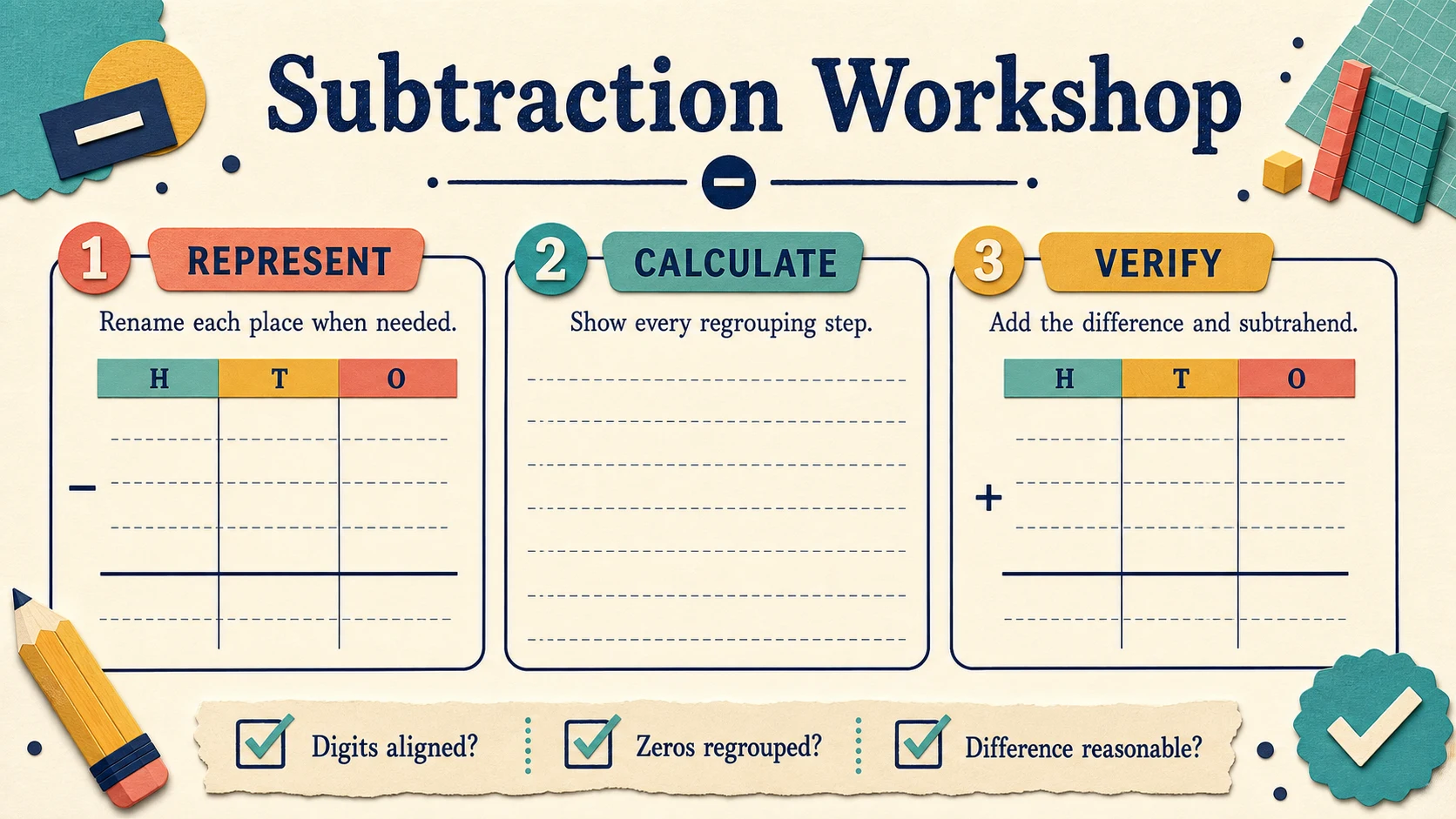
Adjust the amount, representation, or prompting while keeping subtraction central.
For a learner who loses place-value alignment
Draw vertical column lines or provide a place-value chart labeled thousands, hundreds, tens, and ones. Ask the learner to rewrite one problem with one digit per column before calculating.
You can also cover the rest of the page with blank paper so that only one row is visible. This changes visual load, not mathematical demand. Remove the cover when it is no longer needed.
Watch whether commas, minus signs, or answer lines are being mistaken for digits. A copying error is different from a subtraction error and needs a different response.
For a learner who understands the method but recalls facts slowly
Permit a quiet fact strategy:
- Count up from the smaller number
- Use a known addition fact
- Split a number into easier parts
- Refer briefly to a fact-family note
For example, to find , the learner may reason, “Eight plus five is thirteen, so the difference is five.” This maintains the subtraction goal while reducing guessing.
Do not automatically interpret slow fact recall as weak place-value understanding. Observe whether the learner makes correct regrouping decisions even when individual facts take time.
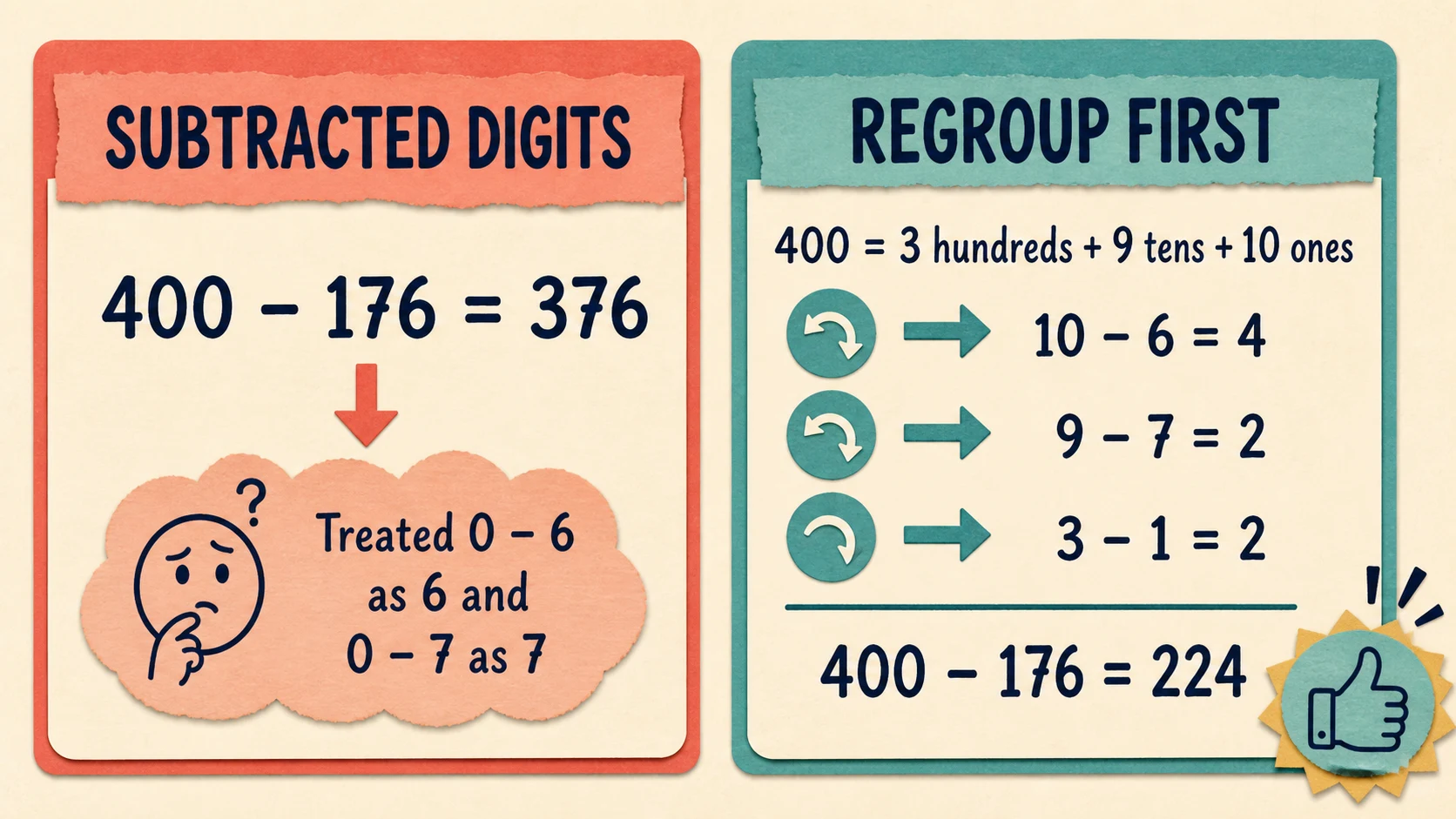
For a learner who regroups mechanically
Use base-ten blocks, quick sketches, or expanded form for one or two examples. For instance:
To subtract 8 ones, rename:
Then . If the tens column also needs regrouping, rename a hundred as ten tens and continue. Ask, “Did the total value change when we traded?” The intended answer is no.
The IES guide for assisting students who struggle with mathematics provides high-level recommendations concerning systematic instruction, representations, mathematical language, and cumulative review. Applying those ideas here means making the procedure explicit, connecting marks to quantities, and revisiting the skill. It does not mean the guide endorses this particular worksheet or prescribes one support for every learner.
Interpret Errors Before Correcting Them
An answer key shows whether the final answer matches. It does not reveal why an error occurred. Look at the written work, ask for an explanation, and classify the error before selecting a response.
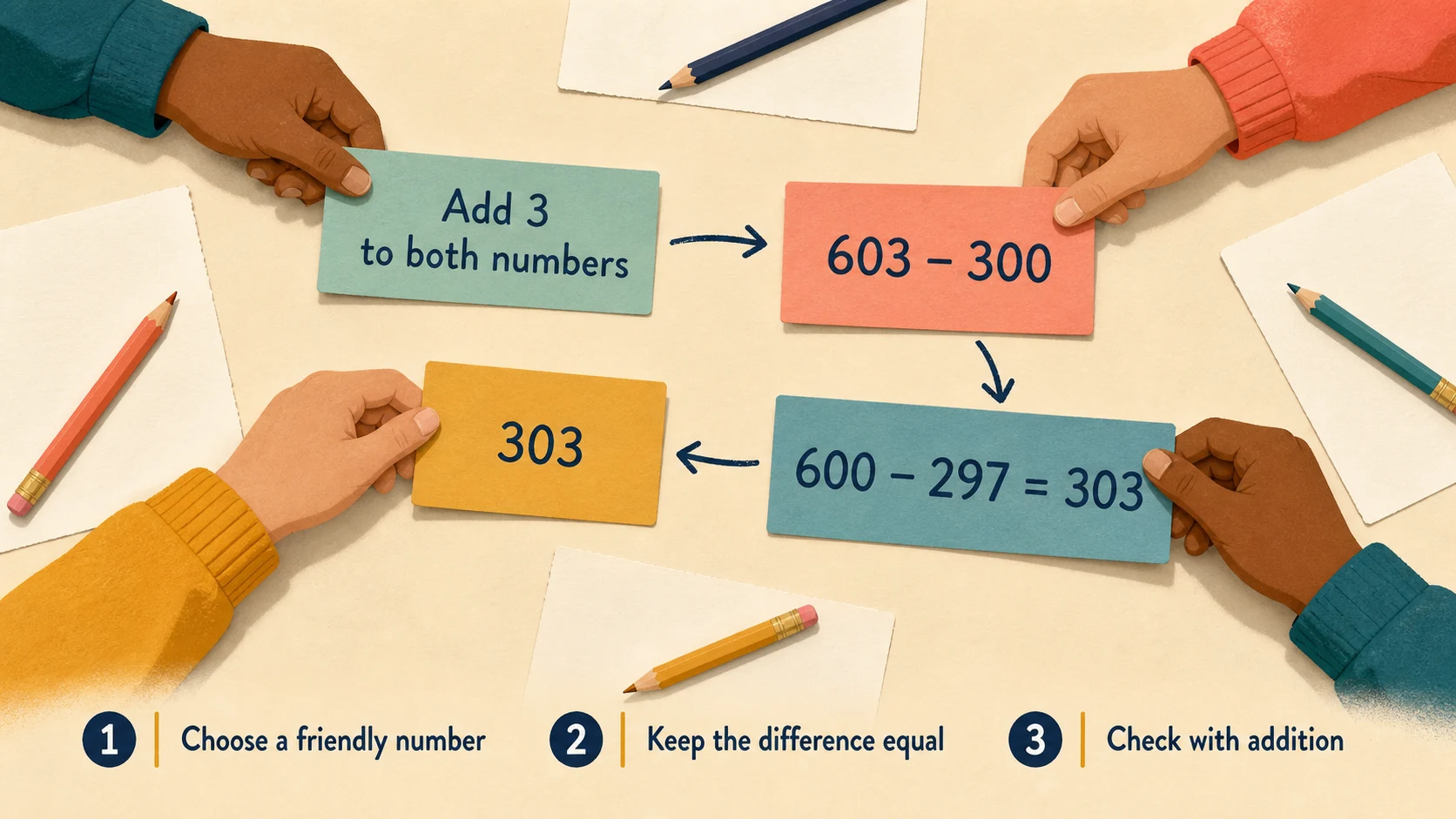
Locate the first incorrect decision, explain it, repair it, and verify the result.
Common error patterns
| Observed work | Possible interpretation | Useful response |
|---|---|---|
| Digits drift into neighboring columns | Place-value alignment or copying difficulty | Rewrite with a place-value chart |
| Learner subtracts the smaller digit from the larger digit in each column | Subtraction order is being ignored | Use a concrete trade and compare with an estimate |
| A regrouped digit is not reduced | The trade is recorded as an addition rather than an exchange | Ask what was traded and what remains |
| A zero is treated as if it were absent | Place value through zero is insecure | Model a problem such as |
| Procedure is correct but a fact is wrong | Fact recall or calculation slip | Recheck that single fact using addition |
| Answer is greater than the starting number | Magnitude was not monitored | Estimate before recalculating |
| Correct answer appears with no readable method | Understanding is uncertain, not necessarily absent | Ask for an oral explanation or a verification |
| Several late errors follow accurate early work | Fatigue or loss of attention may be involved | Stop, save remaining items, and revisit later |
These are interpretations to test, not diagnoses. One error does not establish a stable misconception. Ask the learner to solve a nearby example or explain the disputed step.
Use estimation to catch unreasonable answers
Suppose a learner writes:
Before redoing the algorithm, compare magnitudes. Subtracting a positive whole number from 812 must produce an answer smaller than 812. Also, is close to , and:
So the exact answer should be near 412. Calculate:
Check:
Estimation does not replace the exact calculation. It provides a boundary that exposes an impossible or implausible answer.
Other useful boundary checks are:
- Subtracting zero leaves the number unchanged: .
- Subtracting a number from itself gives zero: .
- If the subtrahend is positive and smaller than the starting number, the difference must lie between zero and the starting number.
- Two close numbers should have a relatively small difference: .
Check the Answer Key Responsibly
The separate answer key is a checking tool, not a substitute for reviewing the learner’s reasoning.
First compare only the completed items. Mark correct answers unobtrusively. For an incorrect answer, do not immediately write the correct number over the learner’s work. Instead, indicate the item and ask the learner to find the first place where the work changed from a valid step to an invalid one.
A useful correction routine is:
- Estimate the likely size of the answer.
- Check digit alignment.
- Revisit regrouping marks.
- Recalculate the individual subtraction facts.
- Solve the item again on clean paper.
- Verify with addition.
When the learner corrects an item, note whether the correction was independent, prompted, or fully modeled. Three correct answers obtained after extensive prompting do not show the same level of independence as three correct first attempts.
Do not use the answer key to calculate a score that hides the error pattern. A result such as 20 out of 25 can represent very different needs: five fact slips, five alignment errors, or five failures to regroup through zero. The next lesson should respond to the pattern.
If you suspect an answer-key discrepancy, solve the problem independently and verify it through addition before deciding that either the learner or key is wrong. Record the exact item and calculation rather than relying on mental comparison.
Decide What to Do After the First Set
Use the learner’s first five or so independent items as a decision point.
If work is accurate and explainable
Allow another short set with minimal interruption. Ask for an addition check on one selected item rather than requiring a written check for every answer. At the end, ask the learner to identify which item required the most attention and why.
Once the 25-item page is comfortably manageable, choose broader or more varied subtraction practice from the 4th Grade math collection or the full 4th Grade worksheet hub. Do not repeat an easy page indefinitely after it has stopped revealing anything useful.
If errors cluster around one feature
Pause the page and teach that feature with two or three fresh examples. For instance, if every error involves regrouping from the tens place, model one trade with base-ten blocks, solve one example together, and then return to one similar worksheet item.
Keep unrelated items for later. This preserves their usefulness as independent evidence instead of converting the entire sheet into guided work.
If errors are widespread
Do not push through all 25 problems. Return to place value, simpler regrouping, or related addition facts, depending on the observed work. The subtraction topic guide is the appropriate place to review the larger instructional progression.
Widespread errors may indicate that the current written form is premature, but the worksheet alone cannot identify the full reason. Consider the learner’s explanations, prior instruction, and performance with concrete or oral examples.
Schedule Retrieval Instead of One-Time Completion
A completed page shows what the learner could do during that session. A small amount of delayed practice provides better information about what remains available later.
Save selected problems or use close variants after increasing delays.
Here is a flexible instructional schedule:
| Time | Suggested activity | What to observe |
|---|---|---|
| Initial lesson | Model, guide, and complete a short independent set | Method, alignment, and immediate accuracy |
| Next practice opportunity | Solve three saved items or close variants | Whether prompts are still needed |
| Several days later | Mix two subtraction items with other math work | Whether the learner recognizes and starts the method independently |
| About one or two weeks later | Use a brief mixed review | Whether regrouping and checking remain reliable |
This is a practical example, not a universal timetable or a sourced prescription. Shorten or lengthen the intervals according to the learner’s work and the local teaching sequence.
During retrieval, avoid showing the old solution first. Ask the learner to solve from a clean copy or use a close variant. For example, after practicing , a later item might be . The numbers change, but the need to inspect and regroup remains.
Record only information that will guide teaching:
- Independent, prompted, or modeled
- Type of error
- Whether the learner found the error
- Whether addition or estimation was used to check
- What representation helped
A long narrative is unnecessary. A note such as “accurate without regrouping; needs place-value prompt when subtracting through zero” is actionable.
Important Limits on Interpretation
This worksheet is one 25-item practice resource. It cannot establish comprehensive mastery of fourth-grade subtraction, overall mathematical ability, or readiness for every later topic. It contains straightforward exercises and may not assess subtraction through word problems, explanation tasks, varied representations, or every multi-digit boundary case.
Accuracy can also be affected by copying, page layout, fatigue, unfamiliar notation, or rushing. Treat these as observations to investigate, not labels to attach to the learner.
The worksheet is not medical or diagnostic guidance. If a learner experiences persistent difficulty across settings and representations, document the specific work and consult the appropriate teacher or educational professional within the learner’s context.
Likewise, the grade label indicates intended practice level rather than a mandatory age-based placement. Local sequences differ, and the learner’s demonstrated understanding should guide selection and pacing.
A Practical Next Step
Begin with the free 4th Grade Subtraction Worksheets – Standard Theme (Easy). Model one similar calculation, guide two examples, and then assign five worksheet items independently. Use the answer key only after inspecting the written reasoning.
If the learner remains accurate after delayed review, move to more varied work through the 4th Grade subtraction topic guide. For a larger organized set, the 4th Grade Subtraction Worksheet Pack contains 18 worksheets. To create fresh close variants for retrieval without repeating memorized answers, use the free worksheet generators.
Put it into practice
Use the guide with a real printable
Move from explanation to a short, observable practice task. Check the first item together, then adjust the next session from the learner's actual work.
See the 18-worksheet pack