Complete guide
How to teach and practise 4th grade place value worksheets - standard theme (easy)
How to Use This 25-Item Place Value Worksheet
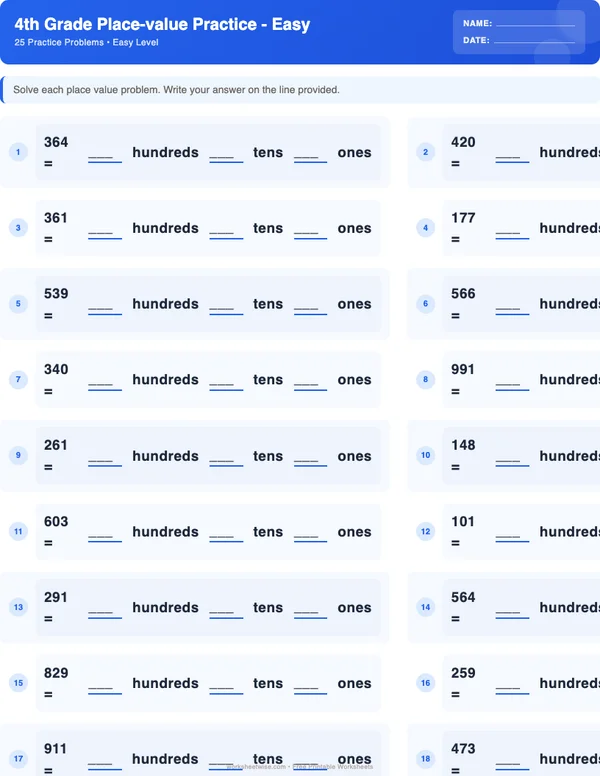
The free 4th Grade Place Value worksheet provides 25 easy-level exercises on four connected skills: identifying place values, writing expanded form, comparing numbers, and rounding. A separate printable answer key is included.
For most learners, a productive use is to model one example, solve several items together, and then release the remaining work in short groups. Do not require all 25 items in one sitting merely because they fit on one printable. Let the learner’s observed accuracy, explanations, and effort determine the pace.
The worksheet instructions are intentionally brief: “Solve each place value problem. Write your answer on the line provided.” Before beginning, clarify what each item asks. A learner may understand place value but still confuse directions such as “value of the digit,” “expanded form,” or “round to the nearest thousand.”
Grade labels describe the intended practice level; they do not establish a universal timetable. Local curricula and instructional sequences differ. Use the learner’s current work, not the label alone, to decide whether this sheet is introductory practice, review, or a quick check.
What This Worksheet Practices—and What It Does Not
This printable combines four foundational applications of whole-number place value:
- identifying the value represented by a digit;
- decomposing a number into expanded form;
- comparing two numbers;
- rounding a number to a stated place.
These skills depend on one central idea: a digit’s value is determined by its position. In 482,731, the digit 8 represents 80,000, not merely eight. Moving one place to the left makes a digit’s value ten times as large; moving one place to the right makes it one-tenth as large.
The Common Core mathematics standards present mathematical understanding and procedural skill as complementary. They also emphasize age-appropriate justification, not only correct answers. In this lesson, that high-level framing can be applied by asking the learner to explain one or two selected responses. This source did not review WorksheetWise or this particular printable.
The worksheet is practice, not a complete place-value curriculum or a diagnostic assessment. It does not, by itself, establish mastery of every fourth-grade place-value expectation. For a broader explanation of composing, decomposing, comparing, and rounding numbers, use the Place Value topic guide rather than trying to teach the entire progression through one sheet.
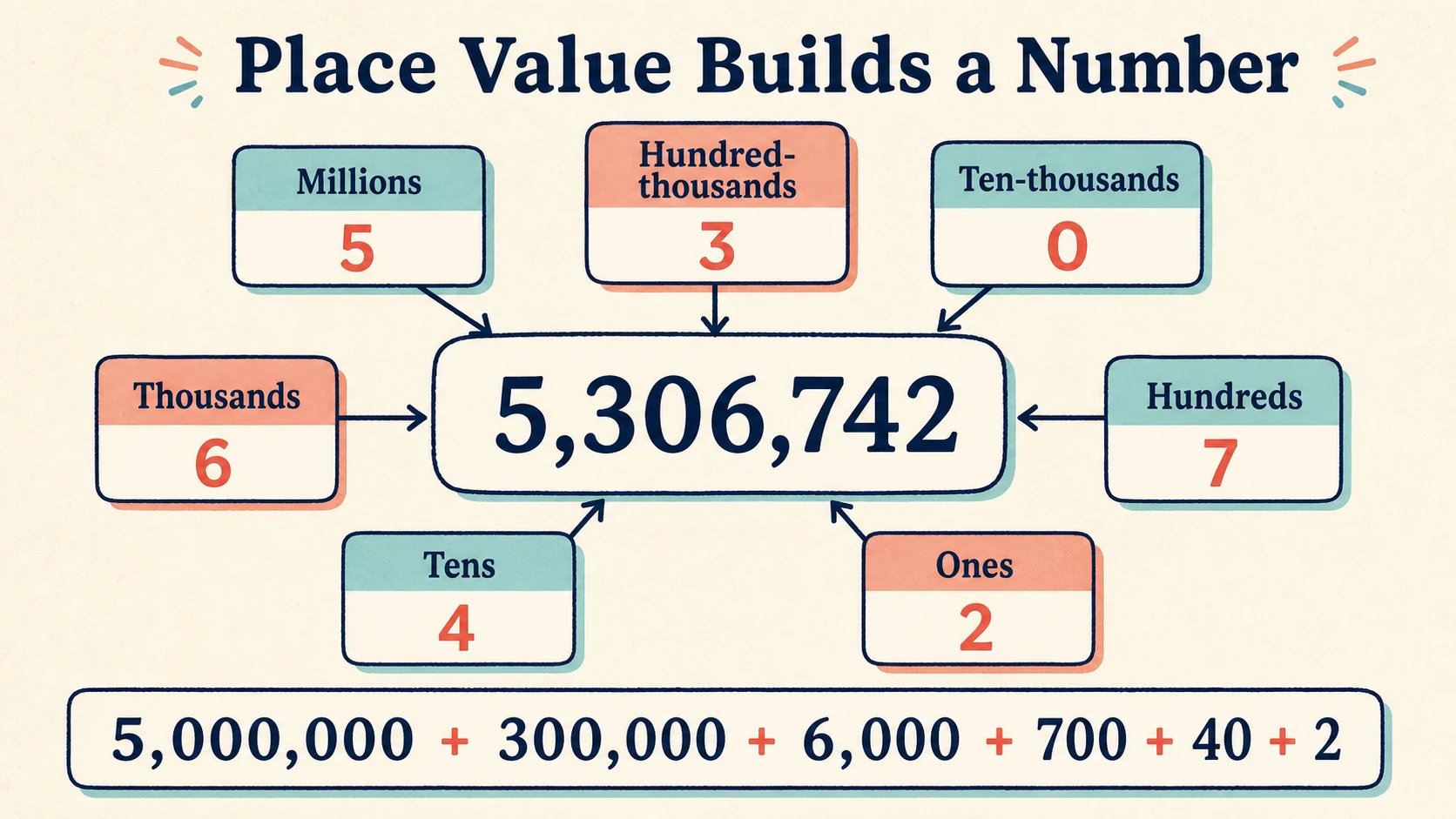
Preview the language, model the reasoning, guide a few items, and then use observed work to set the independent portion.
Prepare the Printable and the Lesson
Print the student worksheet and keep the separate answer key out of the learner’s immediate view. Have a pencil, eraser, blank paper, and a hand-drawn place-value chart available. A chart with columns for hundred-thousands, ten-thousands, thousands, hundreds, tens, and ones will cover many whole-number examples, but adjust the columns to match the actual numbers on the page.
Do not preteach every possible difficulty. First scan the worksheet so you know which directions and number forms appear. Then select one representative item to model without completing the learner’s printed item. Create a similar number on blank paper instead. This preserves the worksheet as useful practice.
Establish the language
Review these terms briefly:
- A digit is one symbol from
0through9. - A place is a position, such as the thousands place.
- A digit’s value is the amount it represents in that position.
- Standard form writes a number with digits, such as
406,205. - Expanded form shows the value of its nonzero digits, such as
400,000 + 6,000 + 200 + 5. - The symbols
<,>, and=compare two values. - Rounding replaces a number with a nearby benchmark at a named place.
Ask the learner to distinguish place from value. For example, in 71,462, the digit 4 is in the hundreds place and has a value of 400. Accepting “hundreds” when the prompt asks for value can hide an important language error.
Use a short readiness check
Before starting the sheet, write 352,814 and ask:
- What digit is in the thousands place?
- What value does the digit
5represent? - Which is greater:
352,814or352,841? - Between which two thousands does
352,814lie?
The checked responses are 2, 50,000, 352,841, and 352,000 and 353,000. These questions are an instructional suggestion for choosing support; they are not a formal placement test.
If the learner answers accurately and explains the comparisons, move quickly into the printable. If place and value are repeatedly confused, begin with a place-value chart. If rounding is the only weak area, keep the main lesson focused on rounding instead of reteaching every skill.
A Flexible Lesson Progression
The following plan is a practical option, not a required or research-prescribed timetable.
| Phase | Adult action | Learner action | Decision evidence |
|---|---|---|---|
| Launch | Read the directions and name the four task types | Restate what each direction means | Can the learner identify what an item is asking? |
| Model | Think aloud through one similar example | Watch, question, and explain the final check | Can the learner connect each digit to its value? |
| Guided practice | Complete two or three worksheet items together | Supply the next reasoning step | Are errors conceptual, directional, or clerical? |
| Supported practice | Assign a small group of items | Work while using a chart or number line if needed | Is the support helping without supplying answers? |
| Independent practice | Assign another manageable group | Solve and mark uncertain items | Does accuracy continue after prompts stop? |
| Review | Discuss selected correct and incorrect responses | Explain, correct, and verify | Can the learner repair an error? |
| Retrieval | Revisit a few mixed examples later | Solve without looking at earlier work | Is the learning available after a delay? |
Decide how many items to assign
Start with a small sample that includes more than one skill. If the learner works accurately and can explain the reasoning, continue. If several errors share the same cause, pause rather than letting that misunderstanding spread through all 25 items.
For homework, avoid using an arbitrary completion target when you will not be present to clarify directions. Mark a specific set of items, and tell the learner to circle any direction or answer that feels uncertain. In a classroom, the sheet can be divided across stations, guided groups, or two short sessions. Homeschool families and tutors can stop after a clear success and return later.
Model the Reasoning Before Independent Work
A strong model makes the hidden decisions visible. Write a fresh example, name the requested skill, solve it, and check it in a second way. Keep the explanation concise enough that the learner still has mathematical work to do.
The IES guide for assisting elementary students who struggle with mathematics recommends systematic instruction, clear mathematical language, useful representations, and number lines. Those are high-level recommendations for elementary intervention—not an evaluation of this worksheet. Here, they support using a consistent routine and selecting a chart or number line when it clarifies the idea.
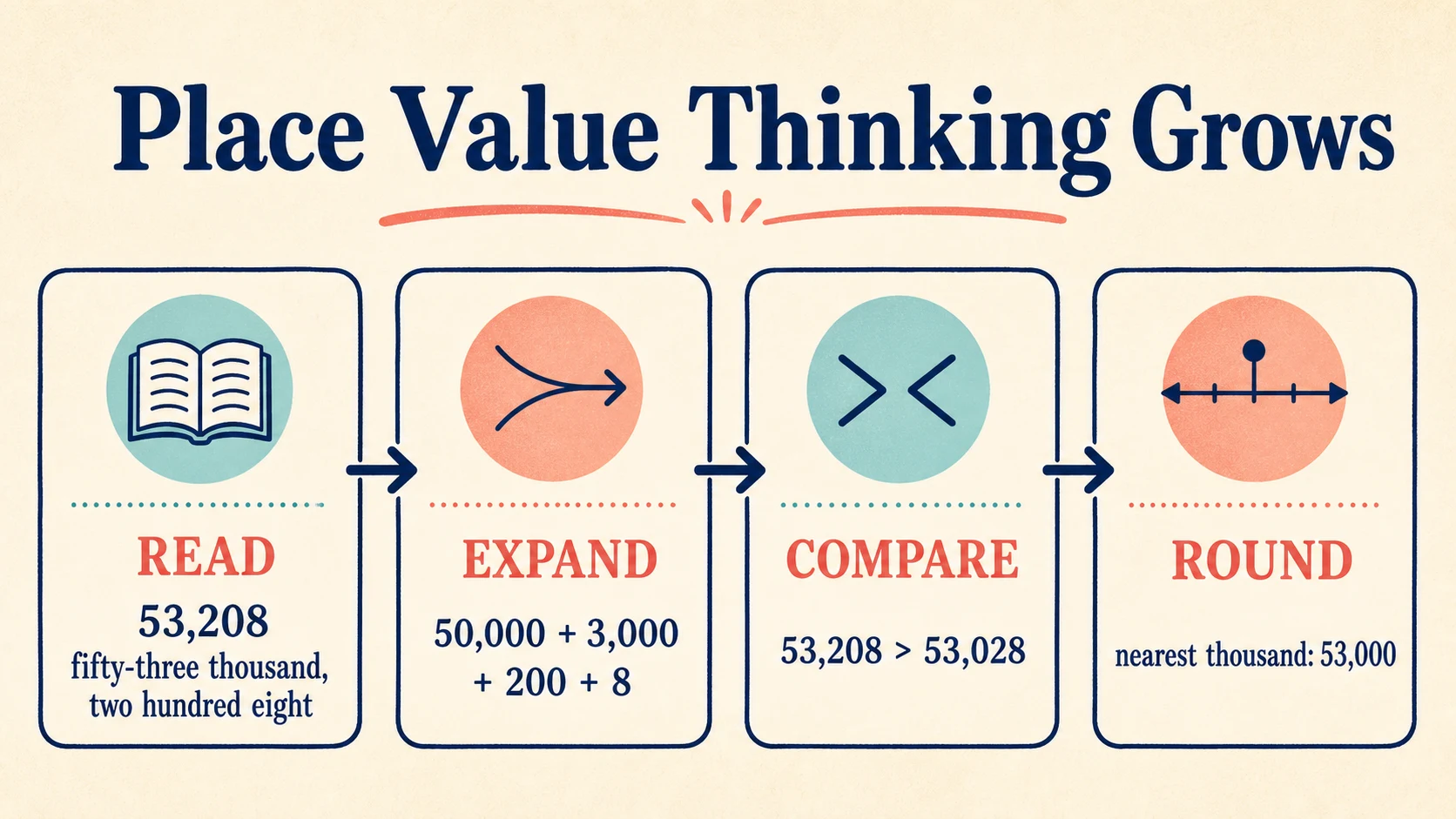
Model a similar problem, invite the learner into the next step, and remove prompts as soon as they are no longer needed.
A concise think-aloud routine
For each task, model four moves:
- Name the task. “I need the value of a digit,” or “I need to round to the nearest thousand.”
- Locate the important place. Align digits in a chart or identify the rounding place.
- Carry out the operation. Write the value, expansion, comparison symbol, or rounded number.
- Check the result. Recompose, read from left to right, or locate the number between benchmarks.
Avoid explaining while doing unexplained mental leaps. “Five means 50,000 because it is in the ten-thousands place” is more useful than “I just added four zeros.” The latter may produce a correct response without reinforcing place-value structure.
Four Fully Checked Worked Examples
These examples are similar to the worksheet’s stated skills. They are not presented as copies of its particular questions.
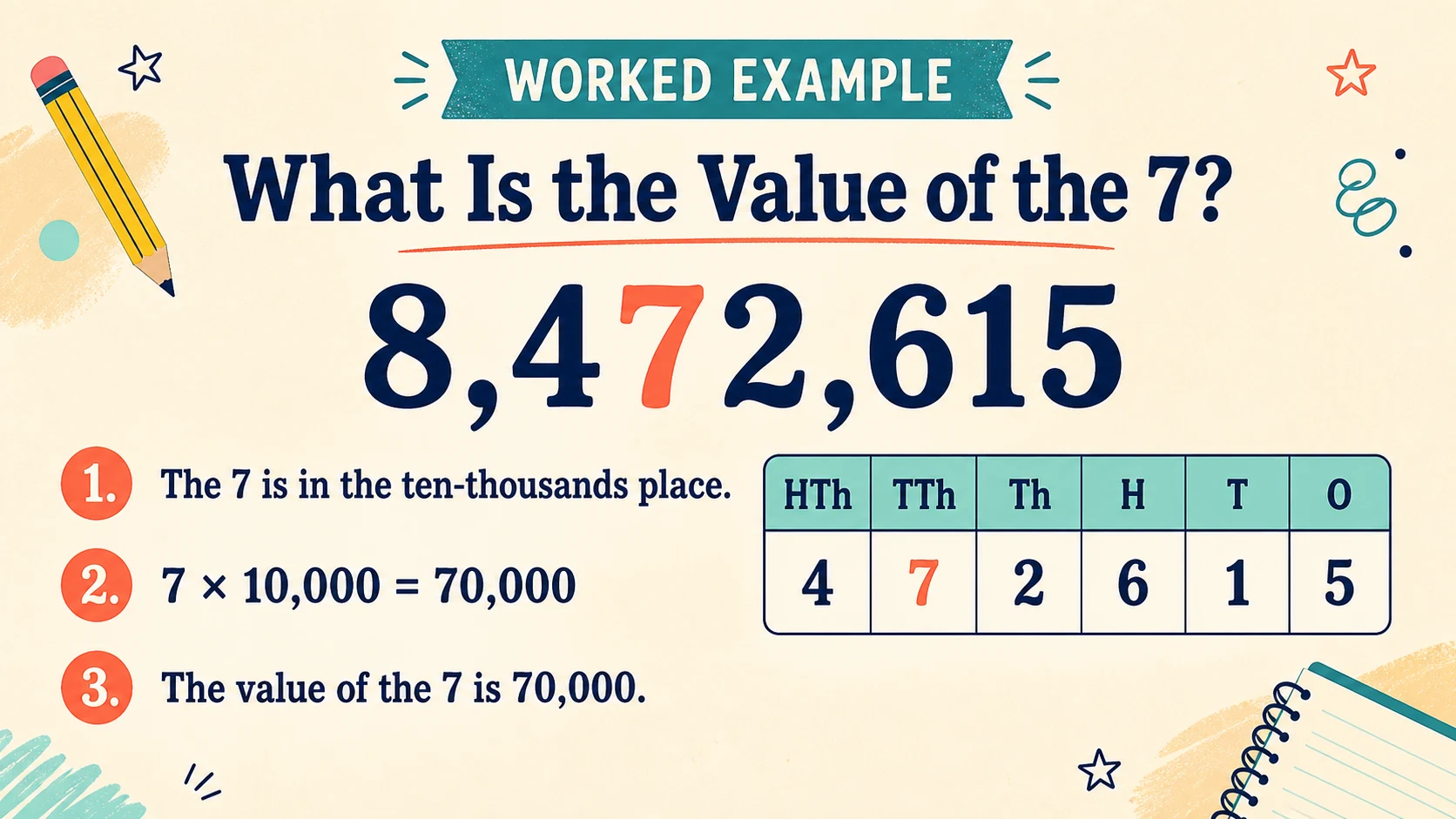
Each example identifies the task, shows the place-value reasoning, and verifies the result.
Example 1: Identify a digit’s value
Problem: What is the value of the digit 8 in 482,731?
Place the number into columns:
| Hundred-thousands | Ten-thousands | Thousands | Hundreds | Tens | Ones |
|---|---|---|---|---|---|
| 4 | 8 | 2 | 7 | 3 | 1 |
The 8 is in the ten-thousands place, so it represents eight ten-thousands:
8 × 10,000 = 80,000
Answer: 80,000
Check: Decompose the full number:
482,731 = 400,000 + 80,000 + 2,000 + 700 + 30 + 1
The 80,000 term confirms the digit’s value.
Example 2: Write expanded form
Problem: Write 406,205 in expanded form.
Consider each nonzero digit:
4in the hundred-thousands place represents400,000;6in the thousands place represents6,000;2in the hundreds place represents200;5in the ones place represents5.
The zero digits hold the ten-thousands and tens places. They do not need separate addends in the usual expanded form.
Answer: 400,000 + 6,000 + 200 + 5
Check by recomposing:
400,000 + 6,000 = 406,000
406,000 + 200 = 406,200
406,200 + 5 = 406,205
The sum matches the original number exactly.
Example 3: Compare two numbers
Problem: Compare 519,408 and 519,480.
Read from the greatest place toward the ones:
- hundred-thousands: both have
5; - ten-thousands: both have
1; - thousands: both have
9; - hundreds: both have
4; - tens: the first number has
0, while the second has8.
The first difference occurs in the tens place. Zero tens is less than eight tens.
Answer: 519,408 < 519,480
Check by subtraction: The numbers are 72 apart because
519,480 − 519,408 = 72.
Therefore, 519,480 is greater.
Example 4: Round to the nearest thousand
Problem: Round 347,650 to the nearest thousand.
The neighboring thousand benchmarks are 347,000 and 348,000.
Distance to the lower benchmark:
347,650 − 347,000 = 650
Distance to the upper benchmark:
348,000 − 347,650 = 350
Because 350 < 650, the number is closer to 348,000.
Answer: 348,000
Digit check: The thousands digit is 7, and the digit immediately to its right is 6. Under the usual whole-number rounding convention, 6 causes the thousands value to increase by one. The result agrees with the benchmark-distance check.
Run Guided Practice Without Taking Over
During guided practice, ask for the next mathematical decision rather than announcing it. Useful prompts include:
- “Which digit are you being asked about?”
- “What place is it in?”
- “What does that digit represent?”
- “Where is the first place these two numbers differ?”
- “What are the two rounding benchmarks?”
- “How could you check this answer?”
If the learner hesitates, narrow the choice. For example, ask, “Is the 6 in the thousands place or the ten-thousands place?” Once the learner answers, return responsibility: “Then what value does it represent?”
A productive release might look like this:
- First item: the adult models.
- Second item: the adult asks each reasoning question.
- Third item: the learner explains while solving.
- Fourth item: the learner solves silently and then explains the check.
This is an instructional suggestion, not a fixed sequence. A learner who already understands the process may need only one model. Another may need several guided examples using different numbers.
The IES early-mathematics practice guide recommends teaching number and operations through a developmental progression and monitoring what children know. Its stated audience is preschool through kindergarten, so it should not be treated as fourth-grade-specific guidance. The limited principle used here is simply to build from observed knowledge and monitor responses as instruction proceeds.
Adapt Support Without Changing the Skill
Support should make the place-value relationship visible while preserving the original mathematical demand. Reading the prompt aloud, providing a chart, or reducing the number of items completed at once can lower irrelevant barriers. Supplying the digit value or comparison answer changes the work and prevents useful observation.
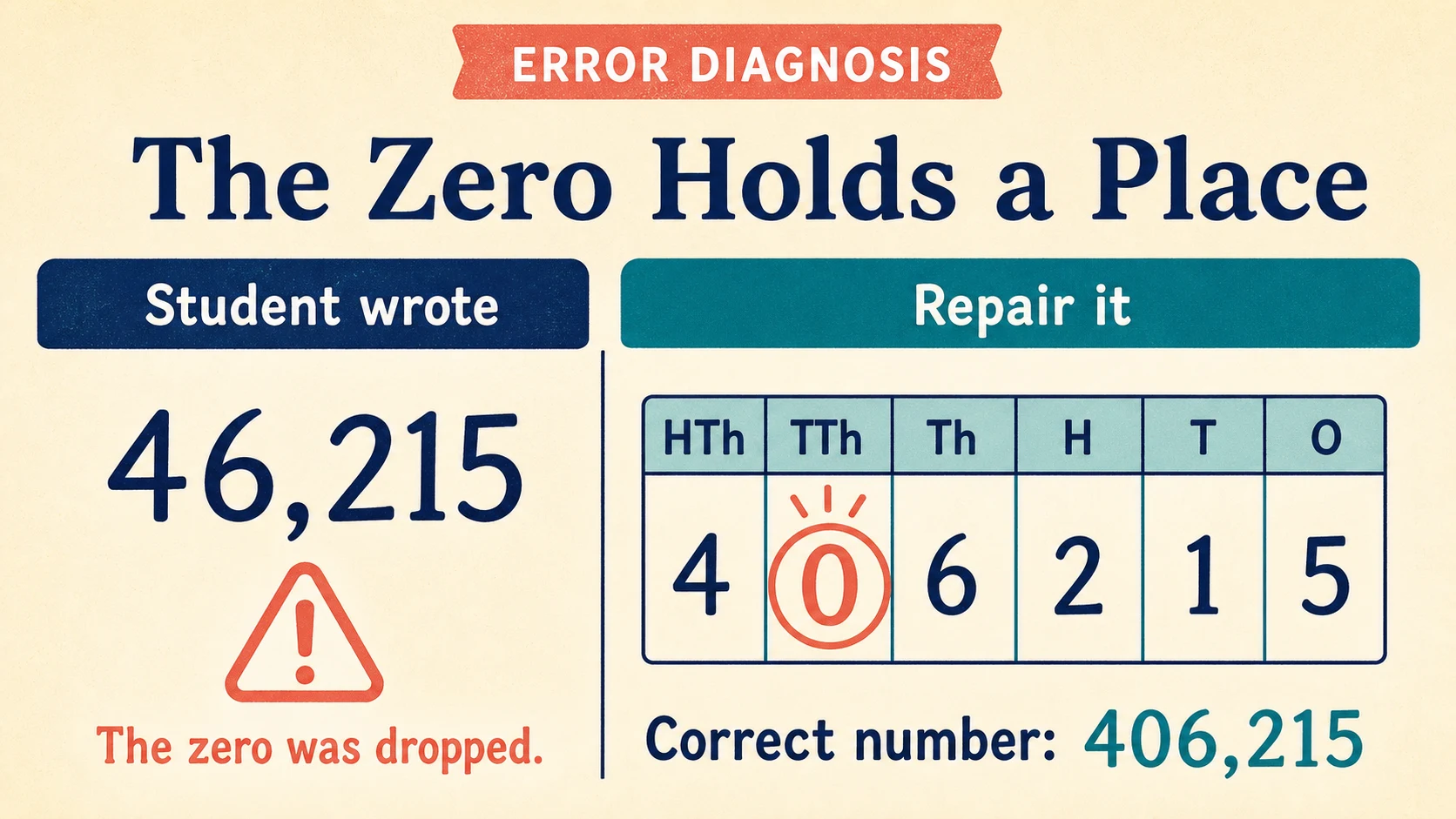
Adjust representation, prompting, or workload while keeping the same place-value decision.
When the learner needs more structure
Draw a place-value chart and have the learner enter one digit per column. Use the same number from the worksheet; do not replace it with a smaller number unless you are briefly modeling the structure. Cover unrelated items with a blank sheet so the learner sees one line at a time.
For expanded form, provide a reusable frame:
_____ + _____ + _____ + _____
Do not predetermine the number of required terms if zeros affect the expansion. Instead, ask the learner to add a term for each nonzero digit.
When language is the main barrier
Underline the action phrase in the direction: “value of,” “expanded form,” “compare,” or “round to.” Have the learner paraphrase the request before calculating. Offer precise sentence frames:
- “The digit ___ is in the ___ place, so its value is ___.”
- “The first different digits are in the ___ place.”
- “The number lies between ___ and ___.”
Reading directions aloud is appropriate support when the goal is mathematics rather than reading fluency. Continue to require the learner to make the mathematical decision.
When the work is accurate but slow or tiring
Divide the 25 items into short sets. Preserve a mixture of the listed skills when possible rather than completing only one task type for a long stretch. Allow the learner to mark a stopping point and resume later.
Do not automatically add a timer. This worksheet is described as easy-level foundational reinforcement, and speed is not one of its listed skills. If timing is used for a separate instructional reason, accuracy and explanation should remain visible.
When the work is immediately easy
Ask the learner to justify selected answers, write a second representation, or create and solve one similar example. For a comparison item, request the place where the decision was made. For rounding, ask for both neighboring benchmarks.
Keep the extension tied to place value. Replacing the worksheet with unrelated multi-step computation would change the lesson rather than deepen the target skill. Additional mixed practice is available through the 4th Grade Math hub.
Interpret Errors as Evidence
A wrong answer is most useful when it is classified before it is corrected. Look for repeated reasoning patterns, not just the total number missed.
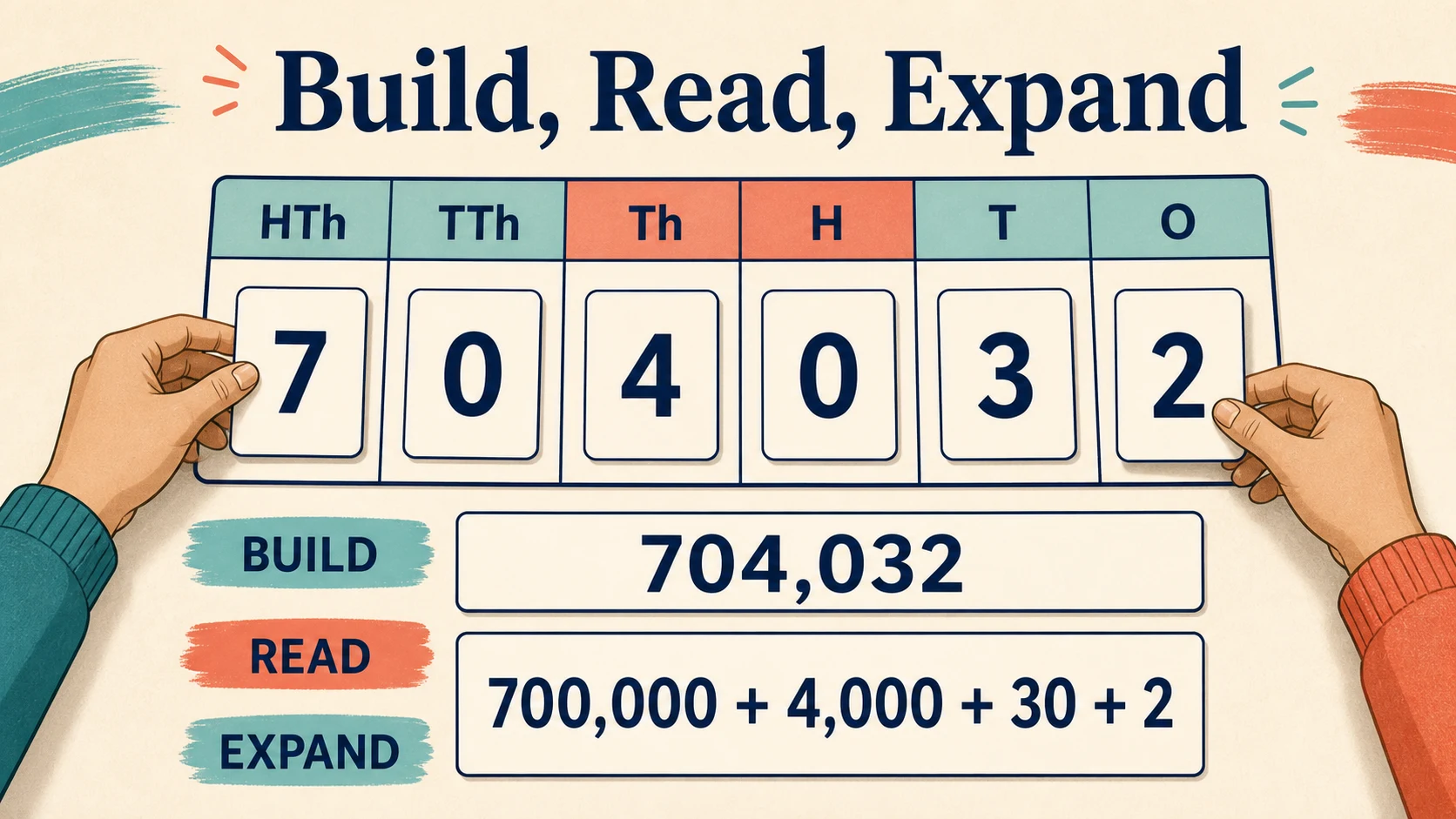
Identify the task, locate the first incorrect decision, correct it, and verify with another representation.
Place confused with value
If the prompt asks for the value of 7 in 274,510 and the learner writes “ten-thousands,” the learner has named the place rather than the value. Ask for both:
- Place: ten-thousands
- Value:
70,000
Do not mark the underlying understanding as wholly absent until you check whether the error came from vocabulary.
Digits compared without aligning places
A learner may choose a number because it contains a larger-looking digit somewhere. Return to left-to-right comparison. The first unequal place decides the comparison; later digits cannot reverse it.
For 63,902 and 63,290, the ten-thousands and thousands digits match. The hundreds digits are 9 and 2, so 63,902 > 63,290. Comparing the final 2 and 0 would focus on a place that no longer matters.
Zeros omitted or moved
Zero can hold a place even when it contributes no separate amount. In 530,004, the 3 still represents 30,000, and the 4 represents 4. A correct expanded form is:
500,000 + 30,000 + 4
Writing 53,004 changes every digit to the left of the ones place. Use a chart to show the empty thousands, hundreds, and tens positions.
Rounding applied to the wrong place
If rounding 68,472 to the nearest thousand, the relevant benchmarks are 68,000 and 69,000. Looking at the ones digit or rounding each digit separately does not answer the question.
Have the learner name the target place first and then identify only the digit immediately to its right. A number line is useful if a memorized rounding procedure is being applied without understanding.
Boundary Cases Worth Discussing
Boundary cases reveal whether a learner understands the structure beyond routine examples.
For an exact benchmark, 72,000 rounded to the nearest thousand remains 72,000. It is already a multiple of one thousand.
For a halfway case, 42,500 lies exactly between 42,000 and 43,000. Under the standard classroom convention used for whole-number rounding, a halfway value rounds to the higher thousand: 43,000.
Rounding may change more than one visible digit. For example:
99,950 rounded to the nearest hundred is 100,000.
The neighboring hundreds are 99,900 and 100,000, and the original number is halfway between them. This is not an error caused by “too many zeros”; it is a legitimate change across a place-value boundary.
In comparison, numbers with different lengths deserve attention. Every six-digit positive whole number is greater than every five-digit positive whole number. Thus 100,000 > 99,999, even though the second number contains several nines.
These examples need not all be taught before the worksheet. Use one only when the learner’s work shows that the relevant boundary is causing confusion.
Check the Answer Key Responsibly
Use the separate answer key after the learner has attempted the assigned items. The key can confirm expected responses quickly, but it cannot explain why an error occurred or whether a correct answer came from sound reasoning.
A reliable checking routine is:
- Compare one item at a time.
- Mark correct responses without interrupting every success.
- Circle or note mismatches rather than writing the correct answer immediately.
- Ask the learner to reread the direction and locate the first questionable step.
- Use the key again after the correction.
- Independently verify any answer that appears inconsistent with the prompt.
Equivalent forms require judgment. An expanded-form response may be mathematically equivalent even if its spacing or term order differs from the key. For example, 5 + 200 + 6,000 + 400,000 totals 406,205, although conventional expanded form is normally written from greatest place to least.
Record error types separately from the score. “Three errors caused by confusing place and value” is more actionable than “22 out of 25.” Do not infer a learning disorder, a permanent limitation, or broad grade-level status from one printable. This worksheet does not provide medical guidance or a comprehensive assessment.
Decide What to Do After the Worksheet
Use both accuracy and explanation to choose the next step.
If the learner is accurate and can explain representative items, move to another place-value application or mixed review. If answers are accurate but explanations are uncertain, revisit two examples with a chart or number line before increasing difficulty. If one skill is weak—such as rounding—practice that skill while briefly retrieving the others. If errors occur across all four skills, return to the broader Place Value topic guide and rebuild from the clearest known point.
Do not treat a fixed percentage as a universal mastery rule. Consider whether the learner:
- understood the directions;
- solved without answer-revealing prompts;
- repeated one misconception or made isolated slips;
- could correct an error after a neutral prompt;
- retained the process after a delay.
The 4th Grade worksheet hub can help place this practice alongside other subjects, while the focused 4th Grade Place Value Worksheet Pack contains 18 worksheets for families or educators who need a larger set. The pack is listed at $4.79, but purchasing it is not necessary to use or revisit the free printable.
Schedule Retrieval Without Assuming a Universal Timetable
Retrieval means asking the learner to solve a small amount again after some time has passed, without copying the earlier solution. The schedule below is a practical starting point, not a guarantee or a required calendar.
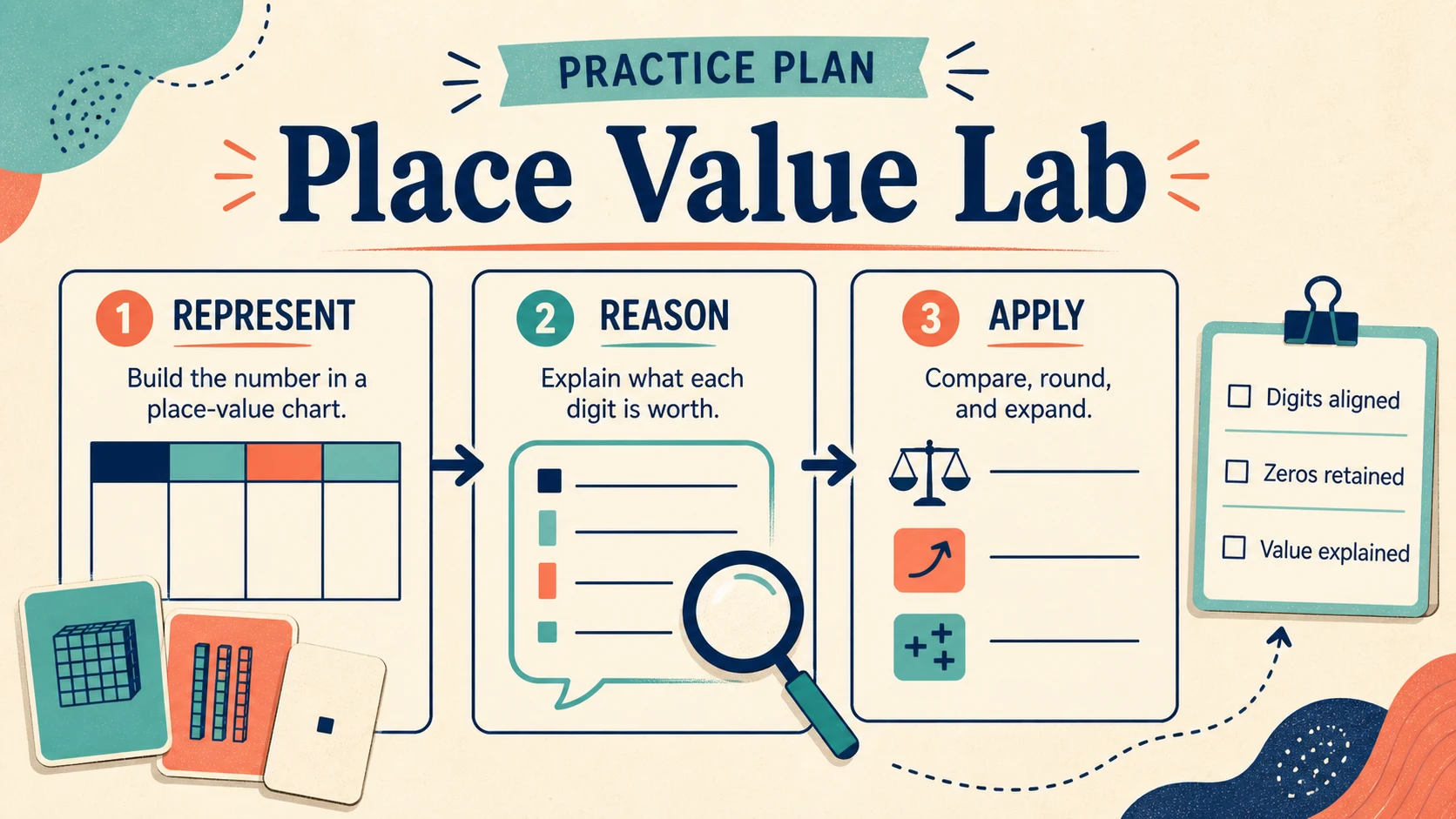
Revisit a small mixed sample after delays, then adjust the interval from the learner’s observed recall.
| Review point | Suggested task | What to observe |
|---|---|---|
| Later the same lesson | Correct one marked error and explain it | Can the learner repair the reasoning? |
| About two days later | Solve four fresh examples, one per skill | Are the procedures available without the worksheet beside them? |
| About one week later | Complete a short mixed place-value set | Does the learner identify each task independently? |
| About two to three weeks later | Include place value within broader math review | Is the skill retained when it is not announced in advance? |
Shorten the interval if the process is forgotten. Lengthen it when responses remain accurate and well explained. Review should use fresh numbers so the learner retrieves the idea rather than remembers a particular answer.
This printable’s limitations should remain clear: it contains 25 easy-level practice exercises, covers four named skills, and includes an answer key. It cannot show every number range, representation, comparison format, or rounding situation a local curriculum may use. It also cannot replace conversation, observation, and later retrieval.
The most useful next action is to print the free Standard Theme worksheet, choose one similar example to model, and assign only the first manageable practice set. After reviewing the learner’s reasoning, use the Place Value topic guide to select the next free practice—or create a targeted follow-up with the free worksheet generators.
Put it into practice
Use the guide with a real printable
Move from explanation to a short, observable practice task. Check the first item together, then adjust the next session from the learner's actual work.
See the 18-worksheet pack